Friday, 10/10/25

Nonpartisan

Levelers

Emily Ruddy was traveling the country with her new husband, Mike, when news reached them of Charlie Kirk’s shooting, then death:

Back in the car with Mike, approaching the Florida border, I’m looking at pictures of Charlie Kirk on my phone. He is staggeringly tall, taller than I ever realized, with a celebratory fist in the air. Reading his Wikipedia page, which has now been changed to past tense, I am reminded of a story I first read in middle school: Kurt Vonnegut’s “Harrison Bergeron.” The story is set in the late twenty-first century, in a dystopian America where the authorities have taken it upon themselves to ensure no person is better than another, be it in athleticism, intelligence, or beauty. The strong citizens get weighed down with bags of bird shot. The attentive citizens are intermittently bombarded with hideous sounds through tiny radios in their ears. The most beautiful faces are concealed by hideous masks.

But it’s the title character, Harrison Bergeron—exceptionally tall, handsome, brilliant and outspoken—who is shackled most heavily. At the end of the story he breaks through the shackles, and as punishment he is shot down on live TV: a warning to whoever tries to pull a similar stunt. Or at least, it would be a warning, if the viewers’ memories weren’t instantly blasted away by the ear radio’s next awful sound.

Emily Ruddy, Battle Above the Clouds.

If you haven’t read Harrison Bergeron, a (very) short story, by all means do. It’s freely available, like, for instance, here.

After Christian faith dies

The biggest confusion among my own students used to be rudderless moral relativism.  Although there is still a lot of that, it seems to be on the decline.  Now the problem is the explicit embrace of evil.  The suggestion that one must never do what is intrinsically evil for the sake of a good result is a hard sell.  Many of students are strongly attracted to “consequentialism,” the view that whether an act is right or wrong is determined only by the result.  To say that the ends do not justify the means puzzles them.

The decline of faith has also produced changes in character.  Young people who were raised in Christian homes, but then abandoned Christianity, often used to retain vestiges of their moral upbringing, and accepted such ideas as courtesy, love of neighbor, and the sacredness of innocent human life.  Today, having grown up in faithless homes, many seem to think that courtesy is for fools, that no one with whom they disagree is their neighbor, and that they should hate those they consider wrong instead of praying for their repentance and restoration.  As for the sacredness of innocent human life – for them, that idea went out when they embraced abortion.

I don’t spend much time asking what is going to happen, but I do ask what God would like me to do in my own place.  He sees the whole shape of things.  I can’t, but like a faithful bone, I can try to turn nimbly in the joint where I’m placed.

J Budziszewski, How Can I Think About the Assassination?

Budziszewski’s description of the decline of faith, as early as the second generation (the first generation of lapsed Christians lives on the vapors of the empty tank), is a description of devolution toward the “nasty, short and brutish” of pre-Christian antiquity.

If you think I’m just making a casual partisan slur, take a look at either of these two books, the first lengthy, the second shorter and more focused.

Wordplay

Frank Bruni’s back with recent favorite sentences. (Do not read this with beverages or food in your mouth.):

  • Also in The New Yorker, Jessica Winter read the infamous Jeffrey Epstein birthday book so that you and I don’t have to: “Sometimes it’s like you’ve discovered a rich man’s contract with the devil, and next to his signature, he’s drawn a little penis cartoon.” (Matthew Ferraro, East Providence, R.I.)
  • And Kelefa Sanneh, reporting from a recent Bad Bunny concert, described an ecstatic fan who “danced so vigorously with a decorative plant that he seemed to be trying to pollinate it.” (Bob Marino, Paris)
  • In The Los Angeles Times, Christopher Goffard tried to make sense of a former Los Angeles County sheriff’s rambling: “As he sat down to face questions from the feds, his sentences traveled winding paths through vague precincts to fog-filled destinations.” (Robin April Dubner, Oakland, Calif.)
  • In The Guardian, Bryan Armen Graham commiserated with the polite subgroup of American fans at an annual Europe-versus-United States golf tournament, who were too often “drowned out by the performative tough guys in flag suits and plastic chains who treat the Ryder Cup like a tailgate with better lawn care.” (John LeBaron, Acton, Mass.)
  • In The Dispatch, Nick Catoggio regarded the marks that President Trump and Defense Secretary Pete Hegseth made to military leaders last week as “a case of two men who radiate neurosis about their own toughness lecturing a roomful of actual tough guys about how to be tough. It had the feel of Pop Warner players scolding a group of N.F.L. linebackers about the importance of hustle.” (Glen T. Oxton, Mamaroneck, N.Y., and John Sabine, Dallas)
  • And John McWhorter analyzed the president’s loopy language: “Even Trump’s most positive-sounding coinages are acts of a certain kind of verbal aggression. I sometimes stop to marvel that the House passed something with the actual official title the One Big, Beautiful Bill Act. That goofy bark of a name is a boisterous clap back against opposing views, an attempt to drown out inconvenient facts with braggadocio. It is a linguistic snap of the locker room towel.” (Matt Masiero, Richmond, Mass., and Sue Hudson, Simi Valley, Calif., among many others)

Anarchism

[T]he essential practices of anarchism — negotiation and collaboration among equals — are ones utterly neglected and desperately needed in a society in which the one and only strategy seems to be Get Management To Take My Side.

Alan Jacobs, Should Christians be Anarchists?

Partisan

Transparent pretext

Trump’s remarks on the night of Kirk’s murder redefined violent incitement to include harsh criticism of judges. (“My administration will find each and every one of those who contributed to this atrocity and to other political violence, including the organizations that fund it and support it, as well as those who go after our judges, law-enforcement officials, and everyone else who brings order to our country.”) Now [aide Stephen] Miller himself is going after judges.

To call this “hypocrisy” is to engage Miller’s reasoning at a level upon which it does not operate. The essence of post-liberalism is the rejection of the notion that some neutral standards of conduct apply to all parties. Miller, like Trump, appears to believe his side stands for what is right and good, and his opponents stand for what is evil. Any methods used by Trump are ipso facto justified, and any methods used against him illegitimate.

A couple of weeks ago, Miller claimed that a disturbed gunman shooting Charlie Kirk impelled the government to crack down on the left. Now he says a handful of activists protesting ICE impel the government to crack down on the left.

Violence is not the cause of Trump and Miller’s desire to use state power to crush their opposition. It is the pretext for which they transparently long.

Jonathan Chait, Stephen Miller is Going for Broke

Bad faith

You can and should worry about American leaders at any level viewing their opponents as the enemy within, whether it’s the president of the United States or a random [Democratic] candidate for state AG. But if you’re more vocal about the latter than the former, forgive me for thinking you’re more interested in contriving a “both sides” equivalency to minimize what the White House is up to than you are about addressing the problem of incitement.

Two things are remarkable about [continuing troop deployments in “blue cities”]. One, which almost goes without saying, is that it’s another case of the Trump administration aiming to normalize unprecedented authoritarian shows of force. But the other is underappreciated: It’s all being done in bad faith, as a provocation, and quite plainly. There’s barely a pretense anymore of a colorable emergency like a riot that might justify the president deploying troops. He’s doing it unbidden and enthusiastically, looking for excuses to intimidate Democrats by symbolically occupying their cities with troops yanked from duty [and civilian jobs] in other states.

Needless to say, this is why the Trump White House didn’t get the benefit of the doubt from Judge Immergut on the Portland deployment, or from Judge Waverly Crenshaw on whether Kilmar Abrego Garcia was vindictively prosecuted. It’s also why the case against James Comey will end up in the toilet sooner rather than later. Courts have traditionally given the president and the Justice Department wide discretion in commanding the military and choosing whom to prosecute, but that’s because presidents traditionally haven’t given courts good reason to think they’re acting in bad faith.

Nick Catoggio, American versus American.

I look forward to the day when judges cease giving a “presumption of regularity,” of good faith, to the actions and legal arguments of this Administration. They have forfeited it because so much of what they do plainly is done in bad faith.

On keeping an impossible promise

Anyone with brown skin and the wrong kind of tattoo is therefore now at risk of being carted off to torture by the US government, with absolutely no safeguards that they have gotten the right people. Or do you think that an administration that confuses billions with millions, and puts classified intelligence on a Signal app, is incapable of making an error?

Andrew Sullivan, Two Perfect Months (March 2025)

I will give Trump “credit” for trying to keep his deportation campaign promise. The problems is, it’s impossible even for competent, non-malicious government workers to keep it (it included luridly-high numbers) without wholesale errors and ubiquitous denials of due process (i.e., in context, the process by which we assure that a person truly is subject to deportation under the law).

Your tax dollars at work

Short Circuits is a punchy weekly summary of notable Federal Court of Appeals decision, like this summary of activities by an ICE goon:

ICE agent escorting passenger from Dallas to Miami takes upskirt pictures and videos of flight attendant. He’s convicted of interfering with her flight-crew duties, sentenced to two years’ probation. Agent: I didn’t know that she was aware of my “clandestine video voyeurism,” and that’s an element of the crime. Eleventh Circuit (unpublished): It is not.

Divine retribution in Dallas

The covert operations of the Kennedys haunted Lyndon Johnson all his life. He said over and over that Dallas was divine retribution for Diem. “We all got together and got a goddamn bunch of thugs and we went in and assassinated him,” he lamented. In his first year in office, coup after coup wracked Saigon, a shadowy insurgency started killing Americans in Vietnam, and his fear that the CIA was an instrument of political murder festered and grew.

Tim Weiner, Legacy of Ashes

Rulebreaker

There are certain unwritten rules in American life, and one of them is that before your face is featured on the nation’s currency you are first obliged to die. There is no constitutional provision that mandates this, nor any law written tightly enough to guarantee it. But, as a general matter, we have shied away from putting living figures on our notes and coins, on the grounds that it is monarchical behavior and that the United States is not a monarchy. Unsurprisingly, this salutary tradition is not of great interest to the Trump administration, which intends to put an image of Trump on both sides of a commemorative $1 coin that will be produced for the 250th anniversary of the Declaration of Independence. On one side, Trump will appear in profile. On the other, he will appear pumping his fist, with the words “Fight Fight Fight” lining the coin’s perimeter. Answering questions about the plan, Trump’s press secretary, Karoline Leavitt, said that she was unsure if Trump had seen it, but that she was “sure he’ll love it.” He will. But that’s not really the important point, is it?

National Review week in review email.

Here’s a coin suggestion:


We are all gatekeepers now.

Peggy Noonan

Your enemies are not demonic, and they are not all-powerful and the right hasn’t always lost and the left hasn’t always won. But if you convince yourself of that, you give yourselves all sorts of permission to do a lot of stupid and terrible things under the rubric of “Do you know what time it is?”

Jonah Goldberg.

[A] critical mass of the American people … no longer want[s] to govern themselves, … are sick of this republic and no longer want to keep it if it means sharing power with those they despise.

Nick Catoggio

I don’t do any of the major social media, but I have two sub-domains of the domain you’re currently reading: (a) You can read most of my reflexive stuff, especially political here. (b) I also post some things on my favorite no-algorithm social medium.

Saturday, 5/31/25

AI doomsday?

[Jaron] Lanier agreed that it’s up to humans to protect the truth in the age of AI, but was less optimistic that we will do so: “The issue with AI is not the AI. It’s not the large language model. It’s the concentration of power and wealth around who owns it,” he said. “You have to look at the big system, including the people, the money, the business, the society, the psychology, the mythmaking, the politics.”

A Free Press Debate on Artificial Intelligence in San Francisco

Jaron Lanier had fallen off my radar for a few years. I’ll forever be interested in his take on anything regarding computers and humanity (together, not separately).

Bon mots

Codgers and technology go together like peanut butter and sardines.

Frank Bruni. Then this, merely via Frank Bruni, not from him:

In the quarterly journal Sapir, Bret Stephens made a kind of peace with the heavily partisan slant of so much cable television news: “To demand scrupulous impartiality on their broadcasts is like expecting fancy linens at a Motel 6.” (Naomi Lerner, West Orange, N.J.)

A non-tribal Democrat

Some of my subscribers dislike when I throw elbows to my left. They share my disdain for Donald Trump and his party, and my commitment to understanding them in light of political theory and history, but they are also devoted Democrats who have warm feelings for Joe Biden, were thrilled by the campaign of Kamala Harris and Tim Walz, and still seethe about Hillary Clinton’s loss in 2016.

That isn’t me. I vote for Democrats. I directionally agree with them on most issues. And I consider the Republican alternative thoroughly unacceptable. Yet I am not a devoted Democrat. A big part of the reason is that I’m not a joiner—of anything. I value my own independence too much and temperamentally resist deploying my talents to advance a cause—any cause, even a worthy one, and even one wrapped up, at this moment, with the fate of liberal democratic self-government in the United States.

But this way of thinking presumes that working to help the Democrats should take the form of deferring to and falling in line behind party leadership and elected officials, taking marching orders, rallying around candidates and nominees endorsed by the party bigwigs, and then maintaining message discipline to get them elected. That’s what I resist. But there’s another kind of devotion—one that expresses itself as tough love and a willingness to speak candidly, and even harshly, about faults.

… a Democratic researcher is quoted as saying that when she asks swing voters to liken the two parties to animals, they consistently describe Republicans as lions, tigers, and sharks—“apex predators” that “take what they want when they want”—but Democrats as tortoises, slugs, or sloths, creatures typically considered “slow, plodding, [and] passive.”

Damon Linker, A Party of Sloths

Substance, process

One of this crazy-making aspects of life in Trump 2.0 is that the media coverage of the administration’s antics focuses, mostly on the substance of what they are doing, ignoring the process, and the question of whether they have the authority to do it at all.

Such, I feared, was the infirmity of NPR and PBS Aren’t Entitled to Your Tax Dollars, a Free Press article by a serious Ivy league constitutional law professor. I slogged my way through it, agreeing with the author again and again, but frustrated that he was ignoring the elephant in the room. Finally, in literally the last paragraph, he mentioned the elephant almost as a throwaway line:

NPR also alleges in its complaint that the federal statute creating the Corporation for Public Broadcasting prohibits Trump from making this defunding decision. That’s a very different argument, which I’m not addressing here ….

I would venture a guess that nine out of ten people who read this column will come away with the impression that NPR and PBS are suffering from a liberal sense of entitlement to tax dollars, and miss the point about there being some limits to executive power.

In the end, it may not matter because this Congress is sufficiently servile that if Trump asks Congress to defund CPB, PBS and NPR (a longtime GOP talking point), it almost certainly will oblige him.

But process does matter, tremendously. Where the power to do something resides also matters.

Dissing Adoption

The New York Times … has never found a basic human good it couldn’t ponderously criticize with the shuffling-foot smarm of the ideas festival class. There’s “I Was Adopted From China as a Baby. I’m Still Coming to Terms With That. There’s “World’s Largest ‘Baby Exporter’ Admits to Adoption Fraud.” There’s “Given Away: Korean Adoptees Share Their Stories.” (In easily-digestible video format!) There’s “I Was Adopted. I Know the Trauma It Can Inflict.” (Subtle.) The New Yorker, a $12,000 espresso machine transformed into a magazine by a mischievous wizard, has “How an Adoption Broker Cashed In on Prospective Parents’ Dreams,” “Living in Adoption’s Emotional Aftermath,” and “Where is your Mother?” (The answer is that she has been separated from her child by a cruel and fickle child welfare system despite being perfectly fit, which I’m sure is how it usually goes.) The Atlantic has “No One’s Children: America’s long history of secret adoption.” (Would you be shocked to learn that said history isn’t a good one?) They’ve got “The New Question Haunting Adoption,” the question being whether adoption is really a secretly selfish act, you know, the selfish act of taking a severely-disabled toddler into your home to provide them with support and love after their birth parents smoked meth throughout pregnancy. They also have, incredibly, “What Adoption ‘Salvation’ Narratives Get Wrong,” “Adoption Is Not a Fairy-Tale Ending,” “The Dark, Sad Side of Domestic Adoption”…. I could go on, and that’s just three prestigious publications. There’s a whole world out of this out there.

This is all, for the record, a really excellent example of what we used to mean when we used the word ideology. Once upon a time, one wouldn’t say “My ideology is…” because ideology referred to the hidden, unexplored, unconscious politics that lay beneath the public, open, explicit politics. An ideology was those pre-political assumptions and beliefs which conditioned and limited political thought, which made the conscious political philosophy of any individual what it was. Ideology is the skeleton that hides unseen within the animal of politics but nevertheless determines the structure of that which is seen. Ideology exists in both the macro and the micro; this bizarre upper-caste antipathy towards ideology is a good example. If you asked leadership at these publications if they had any particular interest in leading a charge against the practice of adoption, they’d say no, of course not, what a weird question! If you were to show them just how repetitively this particular set of critiques and questions and hrm hrm hrm noises gets published in their pages, they’d swear to you that it reflects no underlying party line. And yet there it is, the evidence, in black and white. Something about the current constitution of the anxious educated urbanite liberal soul cries out inside of them: the real problem is adoption.

Freddie deBoer, Adoption is Good

If the shoe fits

A well-regarded Evangelical pastor published this weeks before the 2020 Election.

[T]his is a long-overdue article attempting to explain why I remain baffled that so many Christians consider the sins of unrepentant sexual immorality (porneia), unrepentant boastfulness (alazoneia), unrepentant vulgarity (aischrologia), unrepentant factiousness (dichostasiai), and the like, to be only toxic for our nation, while policies that endorse baby-killing, sex-switching, freedom-limiting, and socialistic overreach are viewed as deadly.

I think it is a drastic mistake to think that the deadly influences of a leader come only through his policies and not also through his person.

This is true not only because flagrant boastfulness, vulgarity, immorality, and factiousness are self-incriminating, but also because they are nation-corrupting. They move out from centers of influence to infect whole cultures. The last five years bear vivid witness to this infection at almost every level of society.

Christians communicate a falsehood to unbelievers (who are also baffled!) when we act as if policies and laws that protect life and freedom are more precious than being a certain kind of person. The church is paying dearly, and will continue to pay, for our communicating this falsehood year after year.

The justifications for ranking the destructive effects of persons below the destructive effects of policies ring hollow.

I find it bewildering that Christians can be so sure that greater damage will be done by bad judges, bad laws, and bad policies than is being done by the culture-infecting spread of the gangrene of sinful self-exaltation, and boasting, and strife-stirring (eristikos).

I think it is baffling and presumptuous to assume that pro-abortion policies kill more people than a culture-saturating, pro-self pride.

When a leader models self-absorbed, self-exalting boastfulness, he models the most deadly behavior in the world. He points his nation to destruction. Destruction of more kinds than we can imagine.

It is naive to think that a man can be effectively pro-life and manifest consistently the character traits that lead to death — temporal and eternal.

John Piper, Policies, Persons, and Paths to Ruin: Pondering the Implications of the 2020 Election

Piper did not say who he was voting for. He did not name names. For that reason, I’m blogging this separately from pointed political material.

But I’m not going to deny that my heart soared to see that our current President had not captured and reduced to servility the entirety of one of America’s most prominent Christian traditions.

The right to know isn’t the whole story

To further clarify our situation, consider W. H. Auden’s discussion, which I’ve cited before, of the idea that, as he put it, “the right to know is absolute and unlimited.” “We are quite prepared,” Auden wrote,

“to admit that, while food and sex are good in themselves, an uncontrolled pursuit of either is not, but it is difficult for us to believe that intellectual curiosity is a desire like any other, and to recognize that correct knowledge and truth are not identical. To apply a categorical imperative to knowing, so that, instead of asking, ‘What can I know?’ we ask, ‘What, at this moment, am I meant to know?’ — to entertain the possibility that the only knowledge which can be true for us is the knowledge that we can live up to — that seems to all of us crazy and almost immoral.”

L.M. Sacasas, Structurally Induced Acedia (The Convivial Society)

Harvard and the Trump administration

Harvard and the Trump administration have each finally met an adversary too big to push around. America’s richest university never really considered how much it depends on government policy, including lavish federal research funding, federal student aid, and a permissive immigration regime for the foreign students—who make up a third of the university’s student body and often subsidize the rest by paying more. Progressives also never thought through how the many tools they devised for using government leverage against private institutions—including threatening tax exemptions, as the Supreme Court allowed on dubious grounds in Bob Jones University v. United States (1983)—could be used against universities that engage in race discrimination for the “right” reasons, cultivate a political monoculture among the faculty, and permit campus mobs to terrorize minority groups who are out of progressive favor (Jews). Now, Trump is trying to strip Harvard of everything—tax exemption, federal funding, and visas for foreign students already enrolled. While the comeuppance for Harvard is admittedly delicious, the president is abusing powers he ought not to have, and Harvard has deep enough pockets to fight him in court.

National Review Weekly email.

Some cases don’t have valid arguments on both sides. That I find nothing “delicious” about Harvard’s “comeuppance” is an example of why I ignore National Review’s regular email invitations to resubscribe.

Can a car have a “catfish smile”?

“Behind that catfish smile, the company’s twin-turbo 4.0-liter DOHC V8 now discharges a drama-drenched 656 hp and 590 lb-ft—153 hp and 85 lb-ft more than the previous Vantage Roadster—thanks to larger turbochargers, revised camshaft profiles, optimized compression ratio and upgraded fueling and cooling.”

Kudos to Dan Neil for the spot-on “catfish smile.”

The car, by the way, is a 2025 Aston Martin Vantage Roadster, which will set you back $300,000 as equipped (this week’s ephemeral tariffs not included).

Credentials, good times, and genuine learning

Most young people today feel, with considerable justification, that they live in an economically precarious time. They therefore want the credential that will open doors that lead to a good job, either directly or (by getting them into good graduate programs) indirectly …

But those same young people also want to have a good time in college, a period of social experience and experimentation that they (rightly) think will be harder to come by when they enter that working world …

… Yes, students understand — they understand quite well, and vocally regret — that when they use chatbots they are not learning much, if anything. But the acquisition of knowledge is a third competing good, and if they pursue that one seriously they may well have to sacrifice one of the other two, or even both. Right now they can have two out of three, and as Meat Loaf taught us all long ago, two out of three ain’t bad.

Alan Jacobs, responding to Ted Gioia on the topic of ending AI cheating.

Potpourri

  • After Trump held a crypto dinner last Thursday night, crypto moguls who paid to be there felt scammed that the president didn’t even stick around at the event they’d hoped to do their own scams at. I saw someone describe him as the apex scammer. Our Scammander in Chief.
  • In other Russia news, a new statue of Joseph Stalin in a Moscow metro station was unveiled this month. President Putin has called Stalin an “effective manager,” and has said that enemies of Russia use the “excessive demonization” of Stalin to attack “the Soviet Union and Russia.” Stalin is back, big time. Interesting that “effective manager” is being used here to describe a man who facilitated the death of millions—and not efficiently. But I’m not a businessman.
  • The continued reckoning: A postmortem on Kamala Harris’s campaign cited a “perception gap” as one of the reasons she lost, saying voters believed she held positions that she didn’t. “Over 80% of swing voters who chose Trump believed Harris held positions she didn’t campaign on in 2024, including supporting taxpayer funding for transgender surgeries for undocumented immigrants (83%), mandatory electric vehicles by 2035 (82%), decriminalizing border crossings (77%), and defunding the police (72%).” But Harris had, in fact, supported all of these positions. Like, she is on record supporting each of those positions (here, here, here, and here). So it’s not really a perception problem so much as a reception problem, like these ideas are not popular even though I support them. There’s a sense among Dems that people should simply ignore the things that are unpopular and that referencing them is fake news. Like, how dare you talk about the surge of migrants coming through our new open borders thanks to swift changes from the Biden admin. Yes, it’s technically true, but it’s disinformation-coded.
  • Leave Bruce alone: A bar in New Jersey canceled a performance by a Bruce Springsteen tribute band after the real Springsteen called Trump “corrupt, incompetent, and treasonous” while on tour in England. Citing the bar’s MAGA clientele, the bar owner said that a Springsteen cover band would be “too risky at the moment.” And: “Whenever the national anthem plays, my bar stands and is in total silence, that’s our clientele. Toms River is red and won’t stand for his bull—.” [But MAGA doesn’t have a violent streak. No way. That’s fake news.]
  • Things that are not antisemitism: The Democratic Socialists of America “Liberation Caucus” has announced its support for Elias Rodriguez, the suspect arrested for slaughtering two Israeli Embassy staffers outside D.C.’s Capital Jewish Museum last week. Here’s the statement signed by the DSA Liberation folks and a bunch of others: “As imperialism has made the entire world its battlefield, it is justified to fight it, by any means necessary, without regard for geography.” And: “[T]here must be consequences for genocidal [Z]ionist imperialism, and those consequences are righteous.”

Nellie Bowles

Fake my …

The latest fitness craze is surely going to be Fake My Run. It fits perfectly with the national ethos whereby university students are already doing Fake My Education.


Your enemies are not demonic, and they are not all-powerful and the right hasn’t always lost and the left hasn’t always won. But if you convince yourself of that, you give yourselves all sorts of permission to do a lot of stupid and terrible things under the rubric of “Do you know what time it is?”

Jonah Goldberg.

Trumpism can be seen as a giant attempt to amputate the highest aspirations of the human spirit and to reduce us to our most primitive, atavistic tendencies.

David Brooks)

I don’t do any of the major social media, but I have two sub-domains of the domain you’re currently reading: (a) You can read most of my reflexive stuff, especially political here. (b) I also post some things on my favorite social medium. I am now exploring Radiopaper.com as well.

Friday, May 2, 2025

Why Trump, lamentably, wins

There aren’t many original insights or approaches to political topics, but there are a few. I commend to you David Brooks, Trump’s Single Stroke of Brilliance. (Shared link)

I’ll single out what most grabbed my attention.

Of Trump:

He is not a learned man, but he is a spirited man, an assertive man. The ancient Greeks would say he possesses a torrential thumos, a burning core of anger, a lust for recognition. All his life, he has moved forward with new projects and attempted new conquests, despite repeated failures and bankruptcies that would have humbled a nonnarcissist.

Of his adversaries:

The people who succeeded in the current meritocracy tend not to be spirited in the way Trump is spirited. The system weeds such people out and rewards those who can compliantly jump through the hoops their elders have put in front of them.

Members of the educated elite (guilty!) tend to operate by analysis, not instinct, which renders them slow-footed in comparison with the Trumps of the world …

Fatally, America now has an establishment that is ambivalent about being an establishment. Back in the day, those WASP blue bloods like Roosevelt were utterly confident in their right to rule, utterly confident they could handle whatever the future might throw at them. But since the 1960s, successive generations, raised on everything from Woodstock to hip-hop, have been taught that the establishment is bad. They have been taught, in the words of those famous Apple commercials, to celebrate “the crazy ones, the misfits, the rebels.”

When those people grew up and became the establishment — holding senior posts in law, government, universities, media, nonprofits and boardrooms — they became the kind of ambivalent souls who are unwilling to take their own side in a fight. They refuse to accept the fact that every society has a leadership class and that if you find yourself in it, your primary job is to defend its institutions, like the Constitution, objective journalism and scientific research centers, when the big bad wolf comes to blow it all down.

Lots of food for thought. I fear the contrast between Trump and the meritocracy is accurate and that it bodes ill for us.

Man of Destiny

There’s a tendency, sometimes very explicit, to see Donald Trump as a world-historical figure, especially after last summer’s failed assassination attempt. Trump even alludes to his own changed self-perception.

But why should that man-of-destiny sense assume that the destiny is good, not merely consequential?

If you see the hand of Providence operating through George Washington and John Adams in the founding of America, you could see the hand of Providence operating through Donald Trump in the chastisement of America – that Trump is a great man of history whose role is to chastise the liberal intelligentsia, and the never-Trumpers, and all these groups that failed to govern America, but it doesn’t mean at the end of the day that he’s actually saving America. Sometimes it’s just a chastisement.

I feel like that possibility deserves more consideration from the people that have this kind of mystical reaction to the drama of the Trump era.

Ross Douthat, interviewing rightwing figure Jonathan Keeperman. (It was a very lively conversation; Keeperman’s no fool.)

I have felt, and said, that two of the past three Presidential elections “had the judgment of God” written all over it,” so it should come as no surprise that I felt more than a little kinship with Ross over his observation.

Americans Don’t Do This

I have a pretty high tolerance for student protests, even as the outrageous cost of college has turned many of them into exercises in bourgeois decadence. But the Columbia protests have been different from past campus uprisings in several stark ways. They have exposed the whole “belonging” and “inclusion” system of handling offensive speech as fraudulent. The amount of intimidation and harassment experienced by Jewish students over the past year and a half should have been more than enough to alert that particular cavalry, but Jewish students turn out to belong to the only religious minority unprotected by it. (A regular talking point to emerge from last year’s encampment was that no Jewish students at the university had reason to feel harassed or intimidated by the protests, an assertion that was at best ignorant and at worst sinister.)

And yet despite my strongly held feelings about these matters, when I learned that Mahmoud Khalil had been arrested in the lobby of his New York apartment building, handcuffed, folded into an unmarked vehicle by men who would not give their names, and transported first to a facility in New York, then to a detention center in New Jersey, and then to one in Louisiana, every siren in my body screamed.

Down to the marrow of my bones, I am an American. And we don’t do this.

Everything that has failed in American universities has failed because of the opposition to freedom of expression.

Caitlin Flanagan, Americans Don’t Do This

Caution on transitioning

On January 28, Donald Trump issued one of his innumerable executive orders, provocatively Titled Protecting Children From Chemical and Surgical Mutilation, providing among other things that “within 90 days of the date of this order, the Secretary of Health and Human Services (HHS) shall publish a review of the existing literature on best practices for promoting the health of children who assert gender dysphoria, rapid-onset gender dysphoria, or other identity-based confusion.”

I heartily approve of this mandate for a review of existing literature on best practices. I disapprove of the President announcing his conclusions (with which i substantially agree, but I’m just some guy, not POTUS) before the reviews. That’s not the way it should be done and it provides instant fodder for undermining the report that arrived on Thursday.

I trust nobody on the transing-of-teens issue more than I trust Jesse Singal, who got an advance copy of the report and summarized his admiration, including of the high-caliber authors (officially undisclosed for now). Singal is, or at least was very recently, a man of the fairly hard left, but intellectually honest. That he’s broken with his tribe on this issue, and has published extensively on it, is reassuring, as I’m not so keen about topic this to read 409 pages myself.

Be careful what you wish for

I think I keep wallowing in the news because I’m still trying to get my head around what it means that my frequently expressed wish has been fulfilled.

That frequently expressed wish was that America could become just a regular country again and stop trying to be a crypto-imperial power. Like the jokes about genies who fulfill wishes painfully literally, too little did I appreciate what a tawdry and corrupt thing a regular country could be.

I guess I somehow thought we could be “regular” and “exceptional” at the same time. So very American of me.

How could anything possibly go wrong?

DOGE Put a College Student in Charge of Using AI to Rewrite Regulations | WIRED

If you think this is a plausible idea, you have a different experience with federal regulations or Artificial Intelligence than I do.


Your enemies are not demonic, and they are not all-powerful and the right hasn’t always lost and the left hasn’t always won. But if you convince yourself of that, you give yourselves all sorts of permission to do a lot of stupid and terrible things under the rubric of “Do you know what time it is?”

Jonah Goldberg.

Regarding said “lot of stupid and terrible things,” my failure to call out anything about the current regime does not mean I approve. There’s just too much, and on some of the apparent illegalities I don’t want to abuse my credentials without thinking it through.

I don’t do any of the major social media, but I have two sub-domains of the domain you’re currently reading: (a) You can read most of my reflexive stuff, especially political here. (b) I also post some things on the only social medium I frequent, because people there are quirky, pleasant and real.

Lazarus Saturday

Today, we commemorate Christ raising Lazarus from the dead. Essentially, I’m now in an eight-day marathon until Pascha/Easter — serving at least two services daily.

Miscellany

FWIW

There was a time when I’d have devoured an article like Best Wireless Headphones (2025): Tested Over Many Hours | WIRED.

Now I think “why bother; what I’ve got is amazing, and quite good enough even if it’s not ‘best’.”

What is the point of being a Republican senator?

“What is the point of being a Republican senator?” one of my editors asked this morning.

It was a rhetorical question.

The remark was inspired by news that former New Hampshire Gov. Chris Sununu won’t run for Democrat Jeanne Shaheen’s Senate seat next year

No thanks, Sununu said Tuesday. “It’s not for me,” he explained in an interview. “I talked to the White House this morning. I talked to Tim Scott [the head of the National Republican Senatorial Committee]. Thanked him for all their support and confidence. But I don’t have to be the candidate, and I’m not going to be the candidate.”

“I don’t have to be the candidate” is interesting phrasing. It’s what you’d say when refusing an unwelcome burden ….

Nick Catoggio

Nellie Bowles excerpts

  • Chiming in on the factory work fetish is—who else?—former gay-turned-antigay Milo Yiannopoulos: “Men are depressed and addicted and broken because they have nothing to do. They get no stimulation or satisfaction from BS email jobs. I’m telling you, white Americans will love working in factories again. Making things, in the image and likeness of God the Maker.” Let me tell you: The image of God is not in the microscopic iPhone screw you’ll be mastering until your eyes burn out, Milo. Installing airbags until your elbows give out is—well, that one’s maybe in His image.
  • [Trump tariff advisor Peter] Navarro’s books have often cited an economist named Ron Vara, who is entirely made up. It’s just an imaginary friend Navarro uses in arguments, created through an anagram of his last name. So he earned his nickname [Peter Retarrdo].
  • Mississippi now has the best standardized test scores for fourth graders, when adjusted for demographics (i.e., taking into account socioeconomic status, native language, race, whether your parents raised you to have enough self-esteem, ate enough broccoli, etc.). The rise follows a 2013 decision to use phonics-based learning statewide and to hold back third graders who failed to pass a reading test, which may seem mean until you realize that blue states are letting entirely illiterate kids graduate into the world, a world that—for now—still requires literacy. Meanwhile, Oregon, whose fourth graders have the lowest demographically adjusted test scores, has paused the use of any standardized test as a graduation requirement until at least 2029 and is, of course, obsessed with the Lucy Calkins school of teaching kids reading with vibes. Sigh. The real tragedy is that these kids will never be able to read my columns. Luckily for them, I will read it out loud!
  • During a lowkey argument over lawn chairs at a track meet, a teenager named Karmelo Anthony allegedly stabbed Austin Metcalf in the heart, killing him. Within days, both 17-year-olds had fundraisers opened in their names. Karmelo’s has raised $330,000, keeping a rough pace with the victim’s. The moment has turned into a race war, with people donating as if these were two teams in some cosmic battle. As if supporting one or the other is part of racial pride. It’s very scary ….
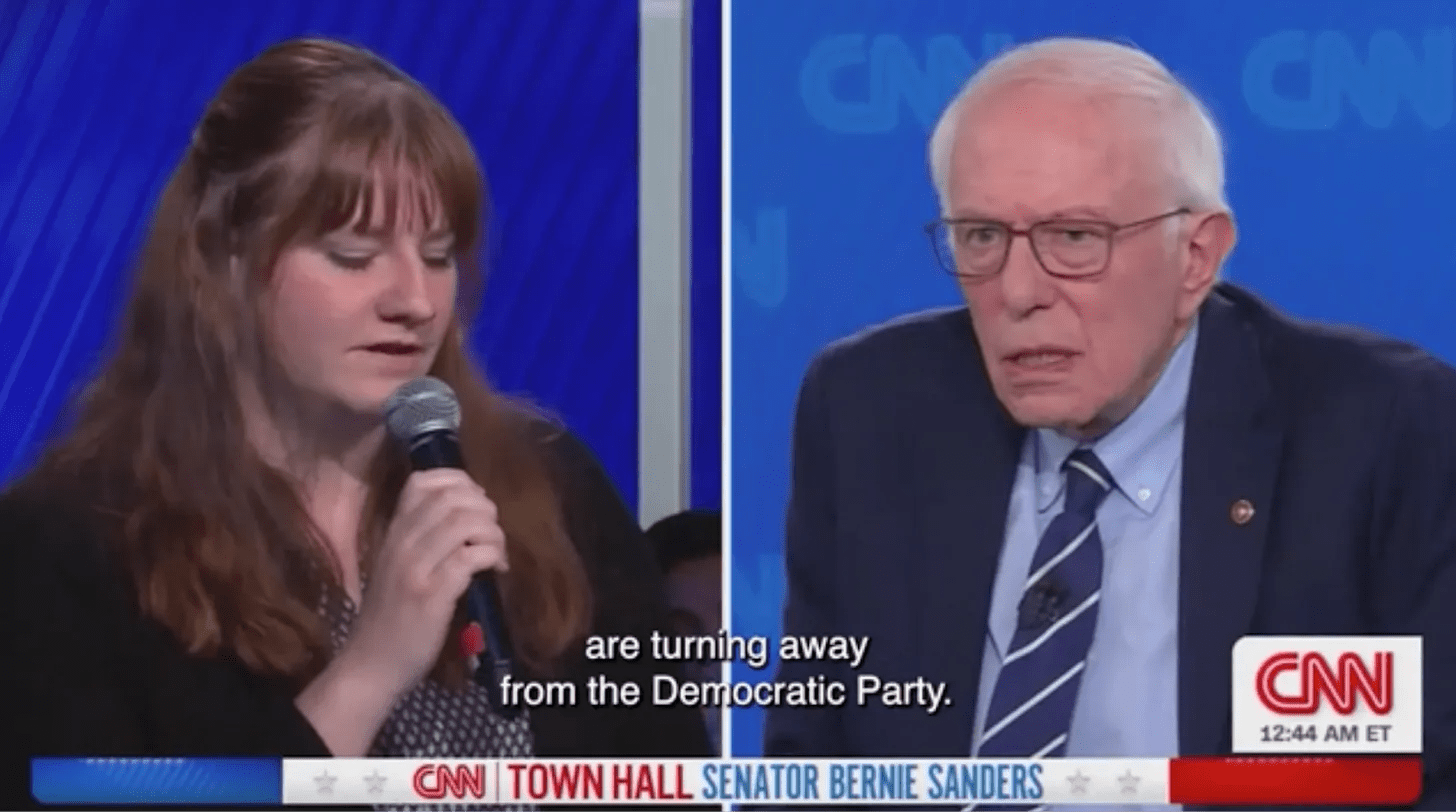
  • Anderson Cooper, leading a town hall with Bernie Sanders, got chastised for using she/her pronouns for a completely normal-looking woman, with a completely normal-woman name of Grace. Called upon by Cooper, she snaps: “I use they/them pronouns actually, thank you,” clearly annoyed, clearly relishing the moment. Then she starts her question, which is about why men aren’t compelled by the Dems anymore, and no, I’m not kidding: “Polling and turnout data indicate that men of all racial demographics are turning away from the Democratic Party. . . ” Yes, it is a great mystery, Grace, they/them. I’m obsessed with Bernie’s face as this is unfolding:
  • John Oliver dedicated his entire show to a monologue about how there are no differences between men and women in athletics, and transwomen should be able to compete against natal females. “Bigger and stronger bodies are not automatically advantaged in every scenario. . . we have no research about how being trans or undergoing gender-affirming treatment impacts athletic performance in teens.” Which is sort of like saying we have absolutely no research indicating that a giraffe is bigger than a goldfish—no double-blind peer-reviewed studies have been done to date, so really, how can you say which is bigger? …

Nellie Bowles

Speaking of John Oliver

Oliver is such a pitch-perfect caricature of progressive self-regard – snarky, aloof, judgmental, incurious – that I sometimes wonder if his show is a brilliant op pulled off by the Heritage Foundation.

Freddie DeBoer

Over/Under

I’ve been puzzling over the term “over/under,” which increasingly seems to be one of the two numbers reported in sports stories where I’m looking for a straightforward prediction of who wins and by how many points.

Since I do not bet on sporting events, I never bothered to try to figure out the term. But the increasingly it is appearing as shorthand in political reporting, e.g.:

One Dispatch colleague told me he’d set the over/under on how many Senate Republicans would vote to convict in the scenario I described at 1.5—and that he’d take the under.

Nick Catoggio

So I finally took the trouble to look it up. You can, too, if you’d like.

It’s not a useless way to express a prediction, but I really hate gambling terminology, becoming obligatory for political discourse. Nick’s Dispatch colleague could have said “I don’t think Senate Republicans could get more than one vote.”

Not so much about Trump as about DC

In a recent members-only Dispatch conversation, Steve Hayes argued that Trump enjoys nothing as much as the exercise of power, and I disagreed with him: It seems to me that Trump does not at all enjoy the actual exercise of power, which is very difficult and demanding work of precisely the sort that he has spent a lifetime avoiding. The counterintuitive fact is that one of the big problems in Washington is that almost nobody enjoys the actual exercise of power, which is why the three branches of government keep trying to hand responsibilities off to each other: from our drama-queen president to our do-nothing Congress to the tortured pseudo-institutionalism of the chief justice, we have a government run by a team of Bizzaro World Kobe Bryants—guys who only know how to pass and never take a shot. Trump wields power in Washington in approximately the way a man playing Macbeth wields power in Scotland. In Trump’s case—which is our case—the damage is real, of course, but that is no more an actual exercise of political power than a drunk crashing his Buick into a school bus is an example of motorsport.

Kevin D. Williamson

Five Current U.S. Protestant Political Outlooks

[MAGA Christianity] is nostalgic for America’s past but not necessarily for America’s founding constitutional principles, which can impair its ambitions.

Mark Tooley, Juicy Ecumenism.

Strongly agree. More:

It mostly hat tips to traditional Christian views about abortion and marriage but is willing to subordinate those stances to wider political ambitions. With the rest of MAGA, it is skeptical if not hostile to American international commitments and to free trade. It’s also impatient with the humanitarian values of the old Religious Right, which it sometimes disdains as signs of weakness if not wokeness. Pentecostal preacher Paul White Cain, the White House faith advisor sometimes associated with the New Apostolic Reformation, is a leading figure. But many others who were conventional Religious Right have aligned with MAGA Christianity. Charlie Kirk of Turning Point USA is a leading cheerleader.

The overall story was about “Five Current U.S. Protestant Political Outlooks.” The other four are:

  1. Religious Left
  2. Religious Right
  3. neo-Anabaptist left
  4. TheoBro right

I find all five options unpalatable. There’s no paywall, so take a look for yourself.

Let’s us three make a deal

Strikingly, … some of the shrewdest officials and analysts in such capitals as Beijing, Brussels and Washington are focused on a challenge to the established world order that is harder to see or hear. To them, the most disruptive force in geopolitics today is Mr Trump’s apparent desire to huddle with other world leaders, and quietly carve up the world together.

The Economist, The dangers of Donald Trump’s instinct for dealmaking

Trump 2.0

For the good of my soul, I’ve got to stop paying so much attention to Donald Trump.

(That paragraph replaces several paragraphs of TMI.)

Due Process

Of all the lawless acts by the Trump administration in its first two and a half months, none are more frightening than its dumping of human beings who have not had their day in court into an infamous maximum-security prison in El Salvador — and then contending that no federal court has the authority to right these brazen wrongs.

Lawrence Tribe and Erwin Chemerinsky

I have been reminded several times lately that this doesn’t quite tell the entire story.

Many of the people swept up and shipped to El Salvador did have their day in court: in ordinary procedures under the Immigration and Naturalization Act, where they were adjudicated deportable. Instead of self-deporting, they remained in the US where nobody got around to deporting them until someone quite suddenly did with lots of fanfare.

Others indeed had no day in court, but were swept up dubiously under the Foreign Enemies Act and summarily deported. They are fairly described by Tribe and Chemerinsky. Moreover, without due process we have no reason to trust that they were deportable at all.

None of this is to defend the prison conditions to which any of the deportees are being subjected and for which we are paying.

Chris Krebs

Lost yesterday amid the public jubilation over being liberated from “Liberation Day” was the signing of two new executive orders, one aimed at Chris Krebs, the other at Miles Taylor.

Krebs led the Cybersecurity and Infrastructure Security Agency during Trump’s first term, placing him in charge of, among other things, detecting and preventing any tampering with America’s election technology. The president fired him on November 17, 2020 not for doing his job poorly but for doing it honestly and well. Krebs insisted repeatedly after Election Day that there had been no security breaches involved in Joe Biden’s victory. That qualified as insubordination in the Trump White House.

Trump’s new memorandum on Krebs accuses him of various offenses, including “censoring” conservative viewpoints, but the true nature of his grievance is right there in the text: “Krebs, through CISA, falsely and baselessly denied that the 2020 election was rigged and stolen, including by inappropriately and categorically dismissing widespread election malfeasance and serious vulnerabilities with voting machines.”

That’s nakedly retaliatory, just like the executive orders targeting law firms that caused legal trouble for the president in the past. Once again, Trump’s corruption is right out in the open. But I believe this is the first time he’s gone as far as to officially penalize someone for rejecting his conspiratorial nonsense about the 2020 election, a position shared by a large majority of the American public and even by some of his own Cabinet nominees. Or former nominees, anyway.

Nick Catoggio

And if he had said there were security breeches, he’s be saying he’d failed at his job.

Dare I suggest that you cannot win working for Donald Trump?

We should have seen this coming

I highly recommend David Brooks’ Article in the Atlantic, I Should Have Seen This Coming


I suffer more from the humiliations inflicted by my country than from those inflicted on her.

Simone Weil, from a letter to Georges Bernanos.

[N]one of the things that I care about most have ever proven susceptible to systematic exposition.

Alan Jacobs, Breaking Bread With the Dead

I don’t do any of the major social media, but I have two sub-domains of the domain you’re currently reading: (a) You can read most of my reflexive stuff, especially political here. (b) I also post some things on the only social medium I frequent, because people there are quirky, pleasant and real.

Wenesday, April 9

Trump-free

Ends and means

I would like to see illegal immigrants deported absent asylum claims that pass the smell test. But I want due process for them, all of them. There’s a right way and a wrong way. The right way, some baddies may get through the net.

I would like to see abortion eliminated in this country. But I always thought that the “decider,” under our constitution, is the states — not the Courts, Congress or, god forbid, an Executive Order from POTUS. Oh, and not by forbidding its citizens to travel out of state.

Yup. Tennessee tried that. I think Texas tried something along those lines, too.

Fessin’ up

I rooted for Brexit.

Having now tasted the equivalent of Brexit, in the form of Executive Orders from he-who-shall-not-be-named-here, I admit I was wrong.

But, see, I’m writing about him, and everyone else is writing or talking about him, so he’ll consider it a win.

Selected Observations on Public Discourse

Stolen from Ted Gioia, The Honest Broker:

4.

The most popular social media platforms will be those that allow people to avoid responsibility for what they say.

Every society has institutions of this sort. In ancient times, it was the bacchanalia. For us it is online shitposting and the burner account.

5.

Consider the etymology of the word ‘dictator’—from the Latin dictare (which translates as ‘to say often’). It thus designates a person who talks obsessively—repeating the same thing over and over.

It’s curious that dictators aren’t defined by their deeds, merely their monotonous talk. The assertion of power through repetitive speaking eliminates the needs for listening, or (at an extreme) even for action.

But isn’t this the dominant model of communication in the current era?

Social media is thus the true dictatorship of the proletariat—contrary to what Marx thought.

9.

If Aldous Huxley had known about endlessly scrolling short videos form a handheld device, he would have made it the preferred media interface of his Brave New World.

He wisely understood—unlike Orwell or Bradbury—that ruling elites don’t need censorship and book-burning if they can convince people to voluntarily abandon literacy.

13.

Podcasting is the new stream of consciousness—long, rambling, freeform.

It is the closest thing to avant-garde that media has ever devised.

23.

When images replace words and concepts, thinking skills erode—and do so rapidly.

Neil Postman saw this coming decades ago. He wrote:

Americans no longer talk to each other, they entertain each other. They do not exchange ideas, they exchange images. They do not argue with propositions; they argue with good looks, celebrities and commercials.

It’s sobering to think that he already grasped this in 1985.

26.

Scholar Perry Link recently described the longterm impact of getting blacklisted in China. It depressed him—at least at first. He could no longer visit friends there, or attend conferences, or do research, or teach.

But his credibility increased as an inevitable result of the official sanctions.

He said he finally understood the full power of his blacklisting, when he showed up one day to teach at UC Riverside.

A young blond male on a skateboard came careening my way. He jumped off in front of me and neatly flipped the board upward with his foot to catch it in his right hand.

“Professor Link!” he said.

“Yes…?”

“I hear you’re on a Chinese government blacklist!”

“Yes, that’s right…”

“Dude!” he shouted, gave me a thumbs up, and skated off.

In the aftermath, Link gained a reputation for courage, honesty, reliability, and forthrightness that he could never have achieved without the blacklisting.

I think about this a lot when I mull over growing evidence that I’ve been shadowbanned on Twitter. Maybe I should thank Elon Musk.

33.

Not long ago, stupid comments were just stupid comments.

But they have risen in the world. Now they’re training data sets.

Andrew Tate

[A] certain segment of conservatives have determined that not only is [Andrew] Tate very much for real, but he is a natural inhabitant of the political and cultural right. He has appeared on The Tucker Carlson show and The Candace Owens show. Benny Johnson recently interviewed him. With news breaking in the last few weeks that the Trump administration may have pressured the Romanian government to allow Tate and his brother Tristan to come to the United States, Tate’s embrace by the popular right seems complete.

Tate apologists offer a couple of related justifications to anyone questioning the wisdom of this arrangement. The first is that Tate, we are told, “has cracked the code” on how to talk to young men, and by bringing him into the movement, conservatives stand to bring countless young men into the fold.

Not going to happen.

The idea that Tate’s success a few years ago at convincing a segment of young men to enter his Hustlers University to earn a P.H.D. (Pimpin’ Hoes Degree) will translate into convincing that same segment of men to commit to a movement aimed at preserving the best of Western culture and virtue seems fanciful at best.

Tate’s popularity with his audience has never been about conservatism in any form. His popularity rides exclusively upon the fact that he grants young men permission to act on their basest impulses while promising that doing so will make them rich. If anything, Andrew Tate cannot save the West because Andrew Tate is what the West must be saved from.

Tate’s ascendency signifies not the triumph of the popular or dissident right, but the rot at its core. No movement not fundamentally adrift would embrace him. No movement rooted in the love of The True, The Good, and The Beautiful would countenance his crass and violent history and say, “You’re one of us.”

Dean Abbott, Front Porch Republic

I’ve paid no attention to Andrew Tate, but he has intruded into my field of vision often enough for me to say that this seems about right. Tate is closer to barbarian than to conservative.

Trump 2.0

Anti-Antisemitism: Trump’s all-purpose excuse for lawlessness

… Donald Trump wants no ambiguity: “My promise to Jewish Americans is this,” he said on the campaign trail. “With your vote, I will be your defender, your protector, and I will be the best friend Jewish Americans have ever had in the White House.”

As the first Jewish president of a formerly Methodist university, I find no comfort in the Trump administration’s embrace of my people, on college campuses or elsewhere. Jew hatred is real, but today’s anti-antisemitism isn’t a legitimate effort to fight it. It’s a cover for a wide range of agendas that have nothing to do with the welfare of Jewish people.

All of these agendas — from dismantling basic government functions to crushing the independence of cultural and educational organizations to criminalizing political speech to legitimating petty presidential vendettas — endanger the principles and institutions that have actually made this country great. For Jews, a number of these agendas do something more: They pose a direct threat to the very people they purport to help. Jews who applaud the administration’s crackdown will soon find that they do so at their peril.

Abductions by government agents; unexplained, indefinite detentions; the targeting of allegedly dangerous ideas; lists of those under government scrutiny; official proclamations full of bluster and bile — Jews have been here before, many times, and it does not end well for us. The rule of law and the right to freedom of thought and expression are essential safeguards for everyone, but especially so for members of groups whose ideas or practices don’t always align with the mainstream. As M. Gessen recently wrote in these pages, “A country that has pushed one group out of its political community will eventually push out others.” What our government is doing now is wrong in itself, but beyond that, it poses a bigger threat to Jewish people’s safety than all the campus protests ever could.

Michael S. Roth, president of Wesleyan University.

Lunatic Loomer’s guilt by association

President Trump has fired Gen. Timothy Haugh, the head of the National Security Agency and U.S. Cyber Command, multiple outlets reported Thursday night. The move—which coincided with Trump’s dismissal of six members of the National Security Council—reportedly came at the behest of MAGA activist Laura Loomer, who visited the Oval Office last week. In a post on X, Loomer said that Haugh had “no place” serving in the Trump administration because he had been selected by Gen. Mark Milley, the former chairman of the Joint Chiefs of Staff.

The Morning Dispatch

Patently unconstitutional

[T]he executive order purporting to reject birthright citizenship is unconstitutional and designed to introduce maximum chaos. I say that for several reasons. One is that the originalist arguments against birthright citizenship are weak (for previous posts on this blog, see here and here). Another is that given more than a century of judicial precedent and executive and congressional practice and legislation, the standard for reconsideration by the courts cannot be “we’re just asking questions” or “well, it could have gone either way” or even “this is the best reading” but rather an extremely strong showing of demonstrable error. And of course with enough water under the bridge, even that isn’t enough. What has been offered in the administration’s briefs and in the scholarship they rest on is not remotely close to meeting that kind of high standard.

Samuel Bray, Divided Argument blog


I suffer more from the humiliations inflicted by my country than from those inflicted on her.

Simone Weil, from a letter to Georges Bernanos.

[N]one of the things that I care about most have ever proven susceptible to systematic exposition.

Alan Jacobs, Breaking Bread With the Dead

I don’t do any of the major social media, but I have two sub-domains of the domain you’re currently reading: (a) You can read most of my reflexive stuff, especially political here. (b) I also post some things on the only social medium I frequent, because people there are quirky, pleasant and real.

Monday April 7 (a tad early)

Anywhere, nowhere in particular

I can take a virtual tour of the Forbidden City in Beijing, or of the deepest underwater caverns, nearly as easily as I glance across the room. Every foreign wonder, hidden place, and obscure subculture is immediately available to my idle curiosity; they are lumped together into a uniform distancelessness that revolves around me. But where am I? There doesn’t seem to be any nonarbitrary basis on which I can draw a horizon around myself—a zone of relevance—by which I might take my bearings and get oriented. When the axis of closer-to-me and farther-from-me is collapsed, I can be anywhere, and find that I am rarely in any place in particular.

Matthew B. Crawford, The World Beyond Your Head

When I point at you, three fingers point back at me. Maybe this is why I so enjoy occasional travel, when devices and books stay home or in the hotel, and I go out on foot in some particular place.

Trump 2.0

I’m going to try to stop posting bilious attacks on Trump, however well-justified they may be — even in separate postings with trigger warnings. Apart from stopping the flood of illegal immigrants across the southern border and his impetuous pledge to end Daylight Savings Time (on which he has done nothing yet), you may take for granted that I detest all of his performative cruelty and protection-racket stunts.

But there are non-bilious things related to our current mess — typically context or gentler humor — that I’ll continue to share under the rubric “Trump 2.0.” If you don’t want to ready anything about it, although I think I curate some pretty good stuff, you can stop now because that’s all the rest of this post is about.

The due process situation

Due Process

Gessen: … For the record, while it’s very important to tell the stories of individuals subjected to injustice, it makes me uncomfortable when we focus on the man who had protected status, or the Venezuelan gay makeup artist, or the young barber, who were on those planes to El Salvador — when in fact every single man who was on those planes was put there without due process and is now confined to a prison, indefinitely …

French: I’m so glad Masha said that. Violations of due process are not unjust only when inflicted on the innocent. The Fifth and 14th Amendment due process protections apply to any “person” in the United States, not just to citizens or certainly not just to the innocent. Indeed, due process is how we try to discern guilt or innocence. Like Masha, I fear that by focusing on the terrible individual injustices, we might (perversely enough) send the message that a due process violation is only a problem when it inflicts harm on the innocent. Due process is a fundamental human right.

Masha Gessen and David French.

I’m not a violent man, but glibly dismissing due process because these are just a bunch of criminals and gang-bangers pushes many of the wrong buttons.

Rigorous vetting of Venezuelan gang members

  • “Here’s an example of the ‘rigorous vetting’ of gang membership that the Trump admin claims it’s doing: A woman admitted that her dead ex-husband, who she left 10 years ago, had been a TdA member. From that — and nothing more! — ICE declared she ‘is a senior member of the TDA,’” – Aaron Reichlin-Melnick.
  • “A friend of Neri Alvarado, currently rotting in a Salvadoran prison on Trump’s orders, shares a video of him volunteering to help neurodiverse children learn to swim. Neri was seemingly sent there after someone at ICE thought his autism awareness tattoo was a ‘gang tattoo,’” – Reichlin-Melnick.
  • “This is a terrible, terrible affidavit. If this were before me in a criminal case and you were asking to get a warrant issued on this, I’d throw you out of my chambers,” – Leonie Brinkema, a judge responding to ICE’s “evidence” of TdA membership.

Andrew Sullivan

Los desaparecidos

At least for now, one Danielle Harlow is tracking America’s summary renditions.

Do not change the topic. Do not assume that Trump’s victims are all violent criminals.

The topic is the lack of due process. Absent due process, I won’t give Trump 2.0 the benefit of the doubt about how bad the desaparecidos are. Due process is how the government avoids jumping to conclusions, and how the public is persuaded that it didn’t. Absent due process, I will assume (as some have reported) that people are being grabbed off the street and sent to offshore hell-holes on less-than-flimsy “evidence” like ambiguous tattoos or wearing too-nice clothes.

This and the attacks on the rule of law by attacking law firms are my biggest concerns so far.

It makes me queasy to think that I have, in my extended family, individuals who have turned themselves into trolls over the last nine years and would defend this. (The defense would include name-dropping Laken Riley, of course. She’s barely even a genuine murder victim any more; her mere name is the snake oil that fortifies xenophobia.)

Be it remembered

Of course, the Department of Homeland Security, when it was created in the wake of 9/11, was meant to function in opaque ways and with broad authority; it was designed to be a secret-police force.

M. Gessen, Unmarked Vans. Secret Lists. Public Denunciations. Our Police State Has Arrived.

Not only was it so designed, there were a few voices loudly warning us.

Tariffs

Why tariffs will fail us (spoiler: an acrostic for the answer is “DJT”)

[R]ebuilding industry in America has two potential benefits even if it sacrifices some of the efficiencies offered by global trade. Factory jobs fill a particular socioeconomic niche that’s been filled instead by drugs, decline, despair. And having a real manufacturing base is essential if we’re going to be locked into great power competition for decades to come.

Under this theory, though, it would seem like tariffs would be most effectively deployed against China, countries in China’s immediate economic orbit, and developing countries that are natural zones for outsourcing. But the Trump administration has deployed them generally, against peer economies and allies. The policy seems much more sweeping than the goal, the potential damage to both growth and basic international comity too large to justify the upside.

Ross Douthat

With all due respect to Ross, the problem is deeper than mis-targeting:

Donald Trump had a plan. It was not a good plan, or even a plausible one. But it was, at least, a coherent plan: By imposing large trade barriers on the entire world, he would create an incentive for American business to manufacture and grow all the goods the country previously imported.

Whatever chance this plan had to succeed is already over.

The key to making it work was to convince businesses that the new arrangement is durable. Nobody is going to invest in building new factories in the United States to create goods that until last week could be imported more cheaply unless they’re certain that the tariffs making the domestic version more competitive will stay in place. (They’re probably not going to do it anyway, in part because they don’t know who will be president in four years, but the point is that confidence in durable tariffs is a necessary condition.)

Trump’s aides grasped this dynamic. “This is the great onshoring, the great reshoring of American jobs and wealth,” Stephen Miller, Trump’s deputy chief of staff, declared on “Liberation Day.” The White House accordingly circulated talking points instructing its surrogates not to call the tariffs a leverage play to make deals, but to instead describe them as a permanent new feature of the global economy.

But not everybody got the idea. Eric Trump tweeted, “I wouldn’t want to be the last country that tries to negotiate a trade deal with @realDonaldTrump. The first to negotiate will win – the last will absolutely lose.”

Eric’s father apparently didn’t get the memo either. Asked by reporters whether he planned to negotiate the tariff rates, the president said, “The tariffs give us great power to negotiate. They always have.”

Someone seems to have then told Trump that this stance would paralyze business investment, because he reversed course immediately, writing on Truth Social, “TO THE MANY INVESTORS COMING INTO THE UNITED STATES AND INVESTING MASSIVE AMOUNTS OF MONEY, MY POLICIES WILL NEVER CHANGE.”

However, there is a principle at work here called “No backsies.” Once you’ve said you might negotiate the tariffs, nobody is going to believe you when you change your mind and say you’ll never negotiate.

Jonathan Chait. It’s a long quote, but I don’t know that anyone could have made it so vivid in fewer words.

Miscellany

The Dispatch downside

The only thing I dislike about working for The Dispatch is that I’m forbidden from using profanity, and even that barely qualifies as a complaint. “No swearing” is the lightest of burdens for a writer.

But it’s getting heavier every day.

On Tuesday, a.k.a. “liberation” eve, the president addressed an upcoming vote in the Senate to block some of his tariffs on Canada. Don’t do it, he warned Republicans. Americans will die if you do. Fentanyl is being brought into the country across the northern border, after all, and one way to discourage people from using it is, and I quote, “by Tariffing the value of this horrible and deadly drug in order to make it more costly to distribute and buy.”

The guy who just touched off a global trade war appears to believe that drug smuggling is taxed. How do you do justice to that without cursing?

… If you’re not moved to curse a blue streak by the thought of Laura Loomer arguing with the national security adviser in the Oval Office over whether his intelligence deputies are sufficiently “loyal” to the president, you’re well and truly boiled.

Nick Catoggio

So if I oppose the tariffs, I love fentanyl? (And probably hate Laken Riley to boot.)

The Pax American is dead. And Marco Rubio is cheering.

The most poignant comment I’ve seen about the president’s groin-punch to the U.S. economy came from his secretary of state. During a visit to NATO headquarters in Brussels on Friday, Marco Rubio told reporters, “We’re not the government of the world now.”

He said it triumphantly, I assume, which is part of what makes it poignant. In an alternate universe where ambition hasn’t rotted his brain, Sen. Marco Rubio is saying the same thing today, verbatim, about the first two-and-a-half months of Donald Trump’s second presidency. But his tone is entirely different.

Being the government of the world worked out okay for America, not to mention the world. Rubio circa 2016 would have been eloquent on that point. But he chose instead to be a cymbal-banging monkey for Trump, so now he’s required to say inane things about the nationalist virtues of immense wealth destruction.

Nick Catoggio

At war with our darker nature

America has always been at war with its darker nature, and sometimes that darker nature wins. We are living in a period of profound national regression.

David French

On a lighter note

DOGE in the eyes of history

I suspect historians will one day remember the Department of Government Efficiency the way we now remember lobotomies. It seemed, to some at the time, like a good idea.

Bret Stephens via Frank Bruni.

The hopeful note here is that sometimes the darker nature loses.

Just askin

Do you think Donald Trump has ever heard of Chesterton’s fence? Elon Musk?


I suffer more from the humiliations inflicted by my country than from those inflicted on her.

Simone Weil, from a letter to Georges Bernanos.

[N]one of the things that I care about most have ever proven susceptible to systematic exposition.

Alan Jacobs, Breaking Bread With the Dead

I don’t do any of the major social media, but I have two sub-domains of the domain you’re currently reading: (a) You can read most of my reflexive stuff, especially political here. (b) I also post some things on the only social medium I frequent, because people there are quirky, pleasant and real.

Counter-hegemony

A fine Saturday WSJ profile of Heather MacDonald, who was only halfway onto my radar previously. She has some very plausible explanations of phenomena that swim against both progressive and conservative streams on snowflakes, Title IX Due Process, patriarchy and more.

Emphasis added.

1

Heather Mac Donald may be best known for braving angry collegiate mobs, determined to prevent her from speaking last year in defense of law enforcement. But she finds herself oddly in agreement with her would-be suppressors: “To be honest,” she tells me, “I would not even invite me to a college campus.”

No, she doesn’t yearn for a safe space from her own triggering views. “My ideal of the university is a pure ivory tower,” she says. “I think that these are four precious years to encounter human creations that you’re otherwise—unless you’re very diligent and insightful—really never going to encounter again. There is time enough for things of the moment once you graduate.”

2

Her views are heterodox. She would seem a natural ally of Jonathan Haidt and Greg Lukianoff, authors of “The Coddling of the American Mind: How Good Intentions and Bad Ideas Are Setting Up a Generation for Failure.” They argue that college “snowflakes” are the products of overprotective childrearing, which creates oversensitive young adults.

Ms. Mac Donald doesn’t buy it. Minority students disproportionately come from single-parent homes, so “it’s not clear to me that those students are being helicopter-parented.” To the contrary, “they are not getting, arguably, as much parenting as they need.” If anyone is coddled, it’s upper-middle- class whites, but “I don’t know yet of a movement to create safe spaces for white males.”

The snowflake argument, Ms. Mac Donald says, “misses the ideological component of this.” The dominant victim narrative teaches students that “to be female, black, Hispanic, trans, gay on a college campus is to be the target of unrelenting bigotry.” Students increasingly believe that studying the Western canon puts “their health, mental safety, and security at risk” and can be “a source of—literally—life threat.”

3

She similarly thinks conservatives miss the point when they focus on the due-process infirmities of campus sexual- misconduct tribunals. She doesn’t believe there’s a campus “rape epidemic,” only a lot of messy, regrettable and mutually degrading hookups. “To say the solution to all of this is simply more lawyering up is ridiculous because this is really, fundamentally, about sexual norms.”

Society once assumed “no” was women’s default response to sexual propositions. “That put power in the hands of females,” …

Young women … are learning “to redefine their experience as a result of the patriarchy, whereas, in fact, it’s a result of sexual liberation.”

4

What about the idea of actively enforcing viewpoint diversity? “I’m reluctant to have affirmative action for conservatives, just because it always ends up stigmatizing its beneficiaries,” Ms. Mac Donald says. Still, she’s concerned that as campuses grow increasingly hostile to conservatives, some of the best candidates may decide, as she did, that there’s no space left for them.

5

What worries Ms. Mac Donald more than the mob is the destructive power of its animating ideas. If the university continues its decline, how will knowledge be passed on to the next generation, or new knowledge created? Ms. Mac Donald also warns of a rising white identity politics—“an absolutely logical next step in the metastasizing of identity politics.”

6

I turn now to Andrew Sullivan, as I often do on Friday or Saturday.

His Friday column, The Danger of Trump’s Accomplishments, is almost perfect, but “Put a spoonful of sewage in a barrel of wine and you get sewage”:

The Republican senators likely to be elected this fall will, if anything, be even more pro-Trump than their predecessors. Corker, Flake, McCain: all gone. The House GOP will have been transformed more thoroughly into Trump’s own personal party, as the primary campaigns revealed only too brutally. And if by some twist of fate, a constitutional battle between Congress and president breaks out over impeachment proceedings, Justice Kavanaugh will be there to make sure the president gets his way.

(Emphasis added)

That ipse dixit about Brett Kavanaugh defending Trump from impeachment is vile, far beneath Sully’s usual level and, I’d wager, wrong. Moreover, it undermines the judiciary and, thus, the rule of law as surely as Democrats do when they talk as if Kavanaugh is some kind of Manchurian Associate Justice.

And — set me straight if I’m missing something — I think it’s stupid. The House impeaches; the Senate tries the impeachment. An Associate Justice of the Supreme Court has nothing to do with this process which, as we’ve been reminded much of late, is political despite the allusion to “high crimes and misdemeanors.”

* * * * *

Follow me on Micro.blog Follow me on Micro.blog, too, where I blog tweet-like shorter items and … well, it’s evolving. Or, if you prefer, those micro.blog items also appear now at microblog.intellectualoid.com.