Three days in a row! When did I last blog three days in a row?!
I have nothing to say about Israel, Hamas, Gaza, Lebanon, Iran, hostages and any piece I’ve left out, but I’m not oblivious to this anniversary.
Not politics
Tradition
Tradition refuses to submit to the small and arrogant oligarchy of those who merely happen to be walking about. All democrats object to men being disqualified by the accident of birth; tradition objects to their being disqualified by the accident of death.
G.K. Chesteron, Orthodoxy
Here is a quick and generally reliable rule to follow. If people have always said it, it is probably true; it is the distilled wisdom of the ages. If people have not always said it, but everybody is saying it now, it is probably a lie; it is the concentrated madness of the moment.
Anthony M. Esolen, Out of the Ashes
Sportsball
Gladwell, like many of us, seems to have unwittingly internalized the idea that when professional athletes do the thing they’re paid to do, they’re not acting according to the workaday necessity (like the rest of us) but rather are expressing with grace and energy their inmost competitive instincts, and doing so in a way that gives them delight. We need to believe that because much of our delight in watching them derives from our belief in their delight.
Alan Jacobs, How to Think
Dreaming is just about our only break from rationalism
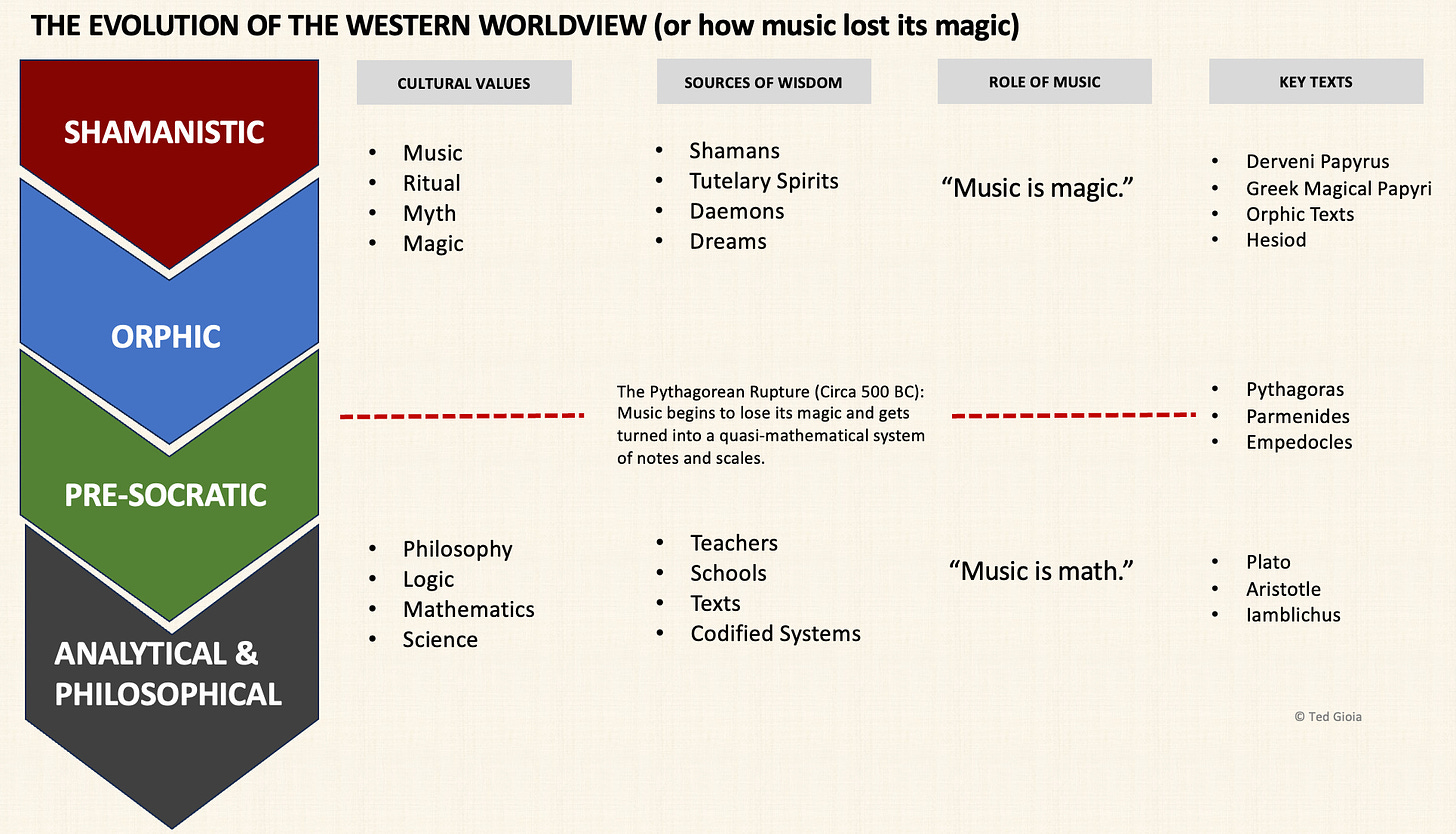
The whole evolution of music as an academic discipline tends to destroy the most important reason to care about music in the first place.
Here’s one of my charts on the subject:
That’s why I started to write about sleeping.
No music writer talks about sleep more than me. And that’s because dreams happen when we sleep—and this is the one type of visionary experience everybody can still access.
We all become a little unhinged and crazy in those dreams. Even the most rationalistic STEM advocate.
…
Could something like this—dream therapy for creatives— exist in the current day?
I wondered about this for a long time. I finally decided to ask musicians about whether they had learned songs from their dreams.
Nothing prepared me for the response I got. I heard from hundreds of musicians—and learned that the gift of a song during a dream is quite common. And it’s usually a powerful song.
…
I note that many musicians have told me that they are reluctant to discuss their dream songs. The subject is just too strange and antithetical to our dominant rationalist paradigm.
And that reluctance is even greater if the artist has a hallucination or out-of-body experience or something else that ‘medical experts’ might want to treat.
My hunch is that these happen frequently to intensely creative people—even in an age of rationalism.
The world isn’t as neat and rigorously logical as you’ve been told. And the world of artistic inspiration is the least logical of all. There’s a good reason why the ancients believed that creative works were a gift from the muse.
…
I continue to research this subject, and I think about it all the time. Even more important, I try to open up my mind to realms of experience beyond the empirical. That’s where creativity comes from, and I don’t want to shut myself off from the source because of close-mindedness.
Above all, I don’t mock or dismiss artists who have these visions, or assume that in every instance they are suffering from mental illness. Some of them might be a lot wiser or healthier than the rest of us.
I can’t think of a solo-effort Substack that delivers more bang for the buck that Ted Gioia, The Honest Broker. And the guy is really smart about some things that interest me.
From the Department of Free-Association: Has Rod Dreher, once again, seized the moment to shape a coming conversation, as he did in Crunchy Cons, Benedict Option and Live Not By Lies?
Politics
Serious people earnestly disagreeing
Back in August I was watching the DNC with my old mom in California. Kamala and Tim and Michelle and Barack and all the others kept talking about our reasons for aiding Ukraine in its fight against the Russian occupation of its eastern territories. They consistently appealed to the apparently essentialized fact that the Ukrainians, like the Americans, “love freedom”, and that it is only natural and right to help other peoples who share this love with us. There was zero acknowledgment of the complexities of geopolitics and historical legacies, or of the situated perspective a Russian might non-crazily come to have, according to which parts of what is now Ukraine seem naturally and justly to fall more into the sphere of influence of the Russian Empire than of the North Atlantic one.
I know a lovely man in his 60s, an outstanding member of the vanishing breed of the Homo Sovieticus, whose father is Ukrainian and whose mother is Russian, and who grew up in Kazakhstan. He tells me his parents waited to get married so that the celebration would take place on the 300th anniversary of the 1654 Pereyaslav Agreement, in which the Cossack Hetmanate in control of much of Ukraine made a ceremonial pledge of loyalty to Moscow. This friend of mine is in exile, and is no admirer of Putin. He greatly regrets the 2022 invasion. But he could never make any sense of any claim to the effect that Ukraine rightly belongs to NATO and not to Russia in virtue of some mysterious essential trait of the Ukrainian people, that they “love freedom” while the Russians do not.
…
And here we arrive at what really gets me about the Democrats. If we are going to risk direct conflict with another nuclear-armed superpower, let us not be lulled into it by bullshit and platitudes. Why do the Democrats have to talk that way? It’s as if the Republican tactic of portraying “the libs” as effeminate hyper-woke safe-spacers has really only caused the Democrats themselves to double down with absurd displays of hawkish masculinity. We’re supposed to love Kamala because she’s a tough-on-crime prosecutor, and that therefore corrects for the slip-ups of the past years when some in the progressive wing of the party have suggested, on the contrary, that all cops are bastards. Tim Walz, meanwhile, seems to have been chosen primarily because he wears flannel shirts, and has been put on display in the most implausibly kayfabe campaign ads purportedly fixing his own pick-up truck. One almost expects them next to come out with an ad depicting Walz in the act of dressing a deer, looking every bit the caricature of the Minneapolis goy neighbor in the Coen Brothers’ A Serious Man (2009). He’s a hunter and a football coach, but he’s also a faculty advisor for the LGBTQIA+ club! What a model of enlightened masculinity! She’s a prosecutor and a foreign-policy hawk, but she’s a she and she brings “joy”! The problem is that none of the rest of the world cares about any of that childish stuff. They all know that for all the equally kayfabe retrograde masculinity of Trump, that man is an absolute pussy, and it is in fact the Democrats who represent the greatest threat to any hot-spot of resistance to the US’s arch-imperial ambitions throughout the world.
What are the odds that a world in which the American Empire is beaten into desperate retreat would be any sort of world our children and grandchildren might want to live in? … Trump, in a second term as president, is practically guaranteed to assume the role of overseer of American imperial retreat, in favor not of a global community of equals such as some naïve progressives might have hoped for in the early years of the League of Nations, but of nationalist isolation and at most pragmatic cooperation with other self-sequestering nation-states, somewhat along the lines of what Marine Le Pen envisions for Europe in the phrase “association des nations libres”. That phrase might sound innocent enough, but nations that are free to dispense with any idea of reciprocal obligations are unlikely to remain in a stable “association” for long, and Trump, at least, hardly gives any indications of knowing how to guide the ship of state as it weathers the inevitable storms that will whip up unstable waters in our years of decline. Far better, far surer, we believe, to have a party in power that understands and accepts the nature of the that power: imperial power, namely, which might aspire in the years ahead not only to face off with steely resolve in our current global showdown, but, eventually, to emerge as its undisputed champion. … Most of us on the Editorial Board, even the Americans among us, do not live in the United States, and from our respective vantages it is pretty hard to concentrate on any aspect of American political life that does not have to do with its role as a globe-spanning empire. Just manage your domestic affairs however you see fit, we are tempted to say; our overwhelming concern is with what you get up to beyond your borders. We therefore have rather little patience for that current of Democratic partisan discourse that would like for American politics to sound more or less like, say, Danish politics. Denmark, if we may be blunt, and all of the Scandinavian countries with such high marks on all the usual tests, is able to focus on maintaining its robust welfare state primarily because its defense is entirely outsourced to the American Empire. The American Democrats who fawn over European national health systems seldom realize that by seeing to the defense of other NATO members, the United States is at the same time freeing up European national budgets for other more humane uses. Americans pay for European defense rather than paying for their own welfare; Europeans get health care in turn, but only through de-facto vassalization.
We would like to see this arrangement continue, at least for now, at least until NATO can be expanded to include all of those states that currently set themselves up in opposition to it, a prospect even Russia’s own leaders in the early post-Soviet years were able to entertain with some seriousness.
You might think our reasons for voting for the Democrats are not good ones, or that we are merely “joking” when we give them. We can only reply that your reasons really do not matter. You might well imagine your are voting, for your part, for “decency”, or “joy”, or sane gun-control laws or a woman’s right to choose. But the only way to vote for any of these things is to cast a vote for American empire. That’s the bargain. We here at The Hinternet, minus our Founding Editor, believe this is a bargain worth accepting, but that is only because we believe it is the United States under Democratic leadership that offers us the single best shot at subduing all the planet’s lingering zones of discontent, and delivering us into a future of perpetual peace. This is what we at The Hinternet want. Do you?
These seem to be serious people having a serious disagreement, not just swapping bullshit and platitudes. It’s a habit most of us, myself included, could benefit by emulating.
Agreement on norms trumps disagreement on policy
Cheney’s argument for Harris is a classical liberal version of the GOP’s “Flight 93 election” reasoning from 2016. It’s a basic matter of proper prioritizing: Agreement on norms trumps disagreement on policy. If you hand power back to Trump, he’ll crash the constitutional order. The conservative thing to do under the circumstances is to storm the cockpit by backing Harris, who’ll at least keep the plane in the air.
(I wonder how Lisa Beamer feels about Flight 93 as a recurring political trope?)
Those conservative Democrats!
The truth, I think, is that the Democratic Party is drifting. Coasting. Dems are buoyed at the national level by Trump’s personal unpopularity but lacking in any kind of compelling vision for the future of the country. For the third cycle in a row, the Democrats have been freed up to run a mostly substanceless campaign that boils down to “Vote for us so Trump will lose.” But what besides that promise of negation does the party stand for? What does it hope to accomplish? Or does it just want to be empowered to manage for a little longer the well-functioning system of domestic and international institutions that already exists?
The answer, it would seem, is the latter. From what I can tell, the Democrats are proposing little beyond a defense of the status quo (or, in the case of abortion rights, a return to the status quo as of a few years ago) against all the unorthodox things their opponents aim to accomplish (including mass deportations, a revolution in how the executive branch is staffed, and the imposition of sweeping tariffs).
That means the Democrats have inadvertently become America’s conservative party, championing the views and interests of those Americans who are content with the country’s present and recent past. When that stance is combined with opposition to the widely loathed Trump, it can (just barely) deliver victory …
The term “conservative” has many meanings, but the most elementary one—the one associated with the man generally considered to be the first conservative writer and thinker, Edmund Burke—grows out of the name itself: To be conservative is to seek to conserve the present’s inheritance from the past: the accomplishments, authoritative institutions, norms, habits, policies, and traditions that have been handed down to us by previous generations.
That’s the meaning of Liz Cheney’s enthusiastic endorsement of the Harris/Walz ticket late last week. It’s not a signal that Harris will govern as a Republican from the era when Cheney’s father (who has also endorsed Harris) served as George W. Bush’s vice president. It’s an expression of Burkean conservatism against the disruptive-revolutionary impulses of the MAGA movement.
The American multiculturalists similarly reject their country’s cultural heritage. Instead of attempting to identify the United States with another civilization, however, they wish to create a country of many civilizations, which is to say a country not belonging to any civilization and lacking a cultural core. History shows that no country so constituted can long endure as a coherent society. A multicivilizational United States will not be the United States; it will be the United Nations.
Samuel P. Huntington, The Clash of Civilizations and the Remaking of World Order.
I was not a very good student of history, but I wonder what historic precedents Huntington has in mind when he says “History shows …”. Sincere question. Surely it’s not just that nobody has tried a multicivilizational nation before; that would not yield a verdict of history.
Please comment if you know. (Comments are moderated but not censored for viewpoint.)
We knew damn well he was a snake …
before we took him in.
I love editorial cartoons, and am fond of comic strips as well. As newspapers are dying, I mainline mine from here.
I suffer more from the humiliations inflicted by my country than from those inflicted on her.
I don’t do any of the major social media, but I have two sub-domains of the domain you’re currently reading: (a) You can read most of my reflexive stuff, especially political here. (b) I also post some things on the only social medium I frequent, because people there are quirky, pleasant and real.
Festive events like rock concerts, Taylor says, are “plainly ‘non-religious’; and yet they also sit uneasily in the secular, disenchanted world. . . . The festive remains a niche in our world, where the (putatively) transcendent can erupt into our lives, however well we have organized them around immanent understandings of order.”
William T. Cavanaugh, The Uses of Idolatry
I’m not so sure rock concerts aren’t religious in a world where churches imitate rock concerts.
On the other hand,
Taylor notes that not all expressions of Christianity have adopted excarnation, but in general, it is true that our church services (especially in evangelicalism) involve less liturgy, less focus on bodily participation, and greater emphasis on disengaged reason.
Alan Noble, Disruptive Witness
We have only ever lived in the Negative World
I recently re-subscribed to Touchstone. I’m not entirely sure why I did, and when my first copy arrived, I skimmed it, snorted ruefully, and set it aside.
I picked it up again weeks later, and was pleased at the lead editorial:
We wish the Republican Party hadn’t altered its platform, and we wish it hadn’t invited Amber Rose to speak as a representative of what the party now endorses (and let’s not kid ourselves; she represents what the party now believes). But in the Negative World, American Christians should no longer expect to find safe sanctuary in the GOP.
The reality is that we have only ever lived in the Negative World. Even though Christians knew long before any of us was born that our nation was drifting away from the church, we lived for a time under the Positive-World illusion that Christian notions of right and wrong would endure, if not in the world, then at least in the West, and if not in the West, then at least in the United States. And if not even in the United States, then in the Republican Party at the very least of all.
Now that we can see the world for what the Bible tells us it has always been, we may all soon see what the Venerable Fulton Sheen saw more than a half-century ago, when he looked upon our Negative World and announced the “end of Christendom” yet affirmed that:
these are great and wonderful days in which to be alive. . . . It is not a gloomy picture—it is a picture of the Church in the midst of increasing opposition from the world. And therefore live your lives in the full consciousness of this hour of testing, and rally close to the heart of Christ.
If a nontrivial portion of the rest of Touchstone is that good, I’ll hang around a while.
Science and Magic
The serious magical endeavour and the serious scientific endeavour are twins: one was sickly and died, the other strong and throve. But they were twins. They were born of the same impulse … There is something that unites magic and applied science while separating both from the wisdom of earlier ages. For the wise men of old, the cardinal problem was how to conform the soul to reality, and the solution was knowledge, self-discipline, and virtue. For magic and applied science alike, the problem is how to subdue reality to the wishes of men, and the solution is technique. Both, in the practice of this technique, are ready to do things hitherto regarded as disgusting and impious, such as digging up and mutilating the dead.
C.S. Lewis, The Abolition of Man
Of proposals to legalize euthanasia:
This exists in bleak meme form in millennial jokes about “Day of the Pillow”, a proposed mass-smothering event conducted against their over-numerous Boomer elders … [E]very polity where the demographic pinch prevails is making the same proposals. For example, since 2020 the call has been raised in China, Japan, and India as well as the West.
From a perspective that views human life as sacred, this looks horrific. But it is a logical endpoint for a technological order whose inorganic growth is in important ways parasitic on the organic kind: exploiting the natural world, for instance, or instrumentalising “human resources” even as it affords women more social status for literally anything other than creating and nurturing those “resources”. And when no effort to rein in this exploitative, anti-life nature seems to have succeeded yet, perhaps the only way out is through. So we can maybe take a crumb of comfort from the likelihood that whatever society survives this now self-devouring culture of death will have done so by refusing its paradigm, and choosing life instead.
Before Christ ascended, He did not give us Scriptures, canons, doctrines, rules, or definitions. He bestowed the Holy Spirit on the Eleven in the Upper Room (John 20:22) and later sent the Holy Spirit to the entire Church at Pentecost (Acts 2)”
Dr. Eugenia Scarvelis Constantinou, Thinking Orthodox
Religious ideas have the fate of melodies, which, once set afloat in the world, are taken up by all sorts of instruments, some woefully coarse, feeble, or out of tune, until people are in danger of crying out that the melody itself is detestable.
George Elliot, Janet’s Repentance, via Alan Jacobs
You can read most of my more impromptu stuff here and here (both of them cathartic venting, especially political) and here (the only social medium I frequent, because people there are quirky, pleasant and real). All should work in your RSS aggregator, like Feedly or Reeder, should you want to make a habit of it.
So the opportunity is in Biden’s hands. If he really does abhor capital punishment as he has claimed, then he has several avenues through which to act with the last of his executive power. He could instruct his DOJ to withdraw its pending notice of intent to seek capital punishment in the 2022 Buffalo, New York, shooting case; rescind a Trump-era letter saying the FDA has no right to regulate the distribution of lethal drugs; and commute the death sentences of the roughly 40 prisoners on federal death row. The president no longer has to worry about the political ramifications of decisive work on capital punishment, and therefore has the freedom to act on his values and save dozens of lives. He ought to take this opportunity to keep his campaign promises, and to honor the dignity of human life.
According to the new liberalism that Locke helped to articulate, political freedom requires intellectual independence. This is the anti-authoritarian mindset Tocqueville was struck by as he travelled around America. He said Americans are Cartesians without having read Descartes. Descartes, like Locke, insisted on a kind of epistemic self-sufficiency, rejecting all established customs and received opinions. I myself should be the source of all my knowledge; otherwise it is not knowledge. This is the positive image of freedom that emerges when you pursue far enough the negative goal of being free from authority.
But this brings with it a certain anxiety: if I have to stand on my own two feet, epistemically, this provokes me to wonder, how can I be sure that my knowledge really is knowledge? An intransigent stance against the testimony of tradition, and a fundamentally Protestant stance toward religious authority, leads to the problem of skepticism. Tocqueville’s great observation is that the way Americans resolve the anxiety that comes from a lack of settled authority is to look around to see what their contemporaries think. The individualist turns out to be a conformist.
How does this work? In the Lockean or Cartesian dispensation that Americans tacitly adopt, tradition is subject to a hermeneutic of suspicion. Our default is to think that inherited wisdom does little more than perpetuate forms of oppression, offered in bad faith as so-called knowledge. But cutting ourselves off from the past in this way, out of a determination not to be duped, we find that we have little ground to stand on against the tyranny of the majority.
…
In the journal The Mentor, one observer who attends meetings of college administrators reports the following: “The first person to speak was a senior dean from a distinguished university. He announced proudly that he and his colleagues admit smart students and then make a special effort to ‘get out of their way.’ ‘Students learn mostly from one another,’ he argued. ‘We shouldn’t muck up that process.’” Students learning from one another is a respectably democratic-sounding formula, though one wonders why parents keep paying those aristocratic tuitions.
The itch for microcosmic social adjustments is not an American invention. The democracies of Europe surrendered to it first, and with far more conviction. The European Union’s proposed constitution of 2004, for example, contained 400 articles (the US constitution has seven) and 855 pages, in which every conceivable strand of right-thinking opinion was awarded a chocolate chip cookie.
No matter what Palin or Warren might indicate about the political direction of evangelicals in the era of Obama, their recent performance confirms an important point of this book, namely, that after thirty years of laboring with and supposedly listening to political conservatives, evangelicals have not expanded their intellectual repertoire significantly beyond the moral imperatives of the Bible. In fact, born-again Protestants show no more capacity to think conservatively than they did in the age of Billy Graham’s greatest popularity. They do not know how to yell “stop” to the engines of modernity the way that conservatives typically have. They have not learned to be wary of concentrations of power and wealth, frustrated with mass society and popular culture’s distraction from “permanent things,” or skeptical about any humanitarian plan to end human misery.
D. G. Hart, From Billy Graham to Sarah Palin
That was then …
President Obama came on the scene right as so many people in my community began to believe that the modern American meritocracy was not built for them. We know we’re not doing well. We see it every day: in the obituaries for teenage kids that conspicuously omit the cause of death (reading between the lines: overdose), in the deadbeats we watch our daughters waste their time with. Barack Obama strikes at the heart of our deepest insecurities. He is a good father while many of us aren’t. He wears suits to his job while we wear overalls, if we’re lucky enough to have a job at all. His wife tells us that we shouldn’t be feeding our children certain foods, and we hate her for it—not because we think she’s wrong but because we know she’s right.
Mediaite: [Former GOP Speaker] Kevin McCarthy Says ‘I Don’t Hang Around with Pedophiles’ When Asked If He’s Made Amends with [Florida Republican Rep.] Matt Gaetz
→ Helene could spell disaster for the world: You’ve probably never heard of Spruce Pine, North Carolina, but you almost certainly depend on it. The two-street town is home to around 2,200 people and the most important quartz deposits not just in the U.S. but in the world. The mines in Spruce Pine produce up to 70 percent of the high-purity quartz used to manufacture semiconductors globally. And what the hell is a semiconductor? Honestly, no clue, but I hear they’re extremely important to the manufacture of solar panels, cell phones, AI, and more. And now those mines are, to use a technical term, royally fucked by Hurricane Helene. Manufacturers will also have a much harder time moving this resource out of Spruce Pine. What’s this mean for the rest of us? Our global semiconductor shortage will get even worse. If this means a slowdown of AI development, may I gently suggest we press pause on those portraits that look real until you start counting fingers? Let’s start there. Thanks.
→ Helene could upend the presidential election: Not only have the good people of North Carolina had to deal with devastating flooding and Mark Robinson’s browser history, all of this is happening right before the election. With apologies to California, Texas, and all the other solidly blue or red states, North Carolina voters actually matter. In 2016 Trump won the state by fewer than 80,000 votes, the narrowest margin of any state. The counties impacted by the storms have over half a million residents, many of whom now don’t know how or where to vote.
On Tuesday, state election officials said that no equipment or ballots had been lost but many polling places themselves were likely destroyed. So that’s a problem. Officials are doing the best they can to get absentee or mail-in ballots to residents who’ve requested them, but that’s going to be pretty hard to do without forwarding addresses and mailboxes that washed down the river. Thankfully, trust in the mechanics of our election is universal, so I’m confident that everyone will work together to fix this problem. If you are a North Carolina voter, first off, my condolences on both the storm and the new Avett Brothers’ album, and secondly, the state elections board plans to release detailed contingency plans as soon as possible. Keep watch.
“I was a Republican before Donald Trump started spray-tanning,” – Liz Cheney.
“It seems that Hamas and Hezbollah grossly over-estimated the deterrent capabilities of student protesters at elite college campuses,” – David Frum.
“The Trump ‘economic miracle’ was inheriting an economy that was already booming and then immediately adding trillions more in deficit-hiking stimulus to maintain that growth for 3 more years before the pandemic. Sorry for not being wow’ed,” – Brian Riedl, economist at the Manhattan Institute.
“Hurricane hits, Trump’s first instinct is to say the government is not sending help to MAGA areas. No Democrat is like this. Anyone who talks about the tone of politicians or norms or decency or whatever and doesn’t think Trump stands apart is not worth taking seriously,” – Richard Hanania.
I don’t do any of the major social media, but I have two sub-domains of the domain you’re currently reading: (a) You can read most of my reflexive stuff, especially political here. (b) I also post some things on the only social medium I frequent, because people there are quirky, pleasant and real.
You may be relieved to know there’s nothing today explicitly about the 2024 Election or any of the candidates in it, save for this one personal thing.
In a fit of righteous (I hope) indignation, I believe I recently wrote that if Indiana is in play come November 5, I would vote for Kamala Harris. Reminded of the centrality of permissive abortion to her campaign, and of the extremity of the national Democratic Party’s support for “transitioning” as its signature (and aggressive) response to adolescent gender dysphoria, I retract that ill-considered position. I could say more about why these two issues combined are deal-breakers, but I’d be borrowing heavily from J Budziszewski if I did (see also Concurring with Exemplary Clarity below).
Think about yard signs. The progressive ones read:
Black Lives Matter Women’s Rights = Human Rights No Human Is Illegal Science Is Real Love Is Love Diversity Makes Us Stronger Kindness Is Everything
What would ours say? There are “conservative” yard signs for sale. But they contain no moral vision, nothing to believe in, only an effort to “own the libs.”
Our cupboard is so bare that young men are filling auditoriums to hear Jordan Peterson tell them to clean their rooms.
In my weaker moments, I’ve been known to look for an “own the libs” yard sign in response to the mincing sentiments of the progressive sign quoted, but nothing I found (and I found very little) was anything I’d put up in my yard.
The Nicene Creed might fit on a sign, but it would illegible to passing drivers, and I would be taking God’s name in vain if I put it up in rainbow hues.
From Front Porch Republic’s Saturday recommendations
“Wendell Berry at 90.” Jonathon Van Maren reflects on why Wendell Berry means so much to so many of his readers: “Berry’s fiction is not only a record of rural life and the slow death of agricultural America, but also a record of the interior lives of Americans before we outsourced our thinking to digital devices and absorbed our worldviews from screens. His novels lack the frantic pace of so many of his contemporaries; reading them, I had to slow my own mind and detach from the mile-a-minute culture wars to match the pace of the men and women of Port William. Always, his stories left me feeling refreshed.”
“Why Christian Parents Should Resist School-Issued Screens.” Patrick Miller offers a set of arguments supported by research to help parents push back against the lure of progress. He draws from his own experience on a school board: “We were offered tens of thousands of dollars in grants to pay for one-to-one devices in our classrooms. Saying no felt like stealing something from students. It felt like resisting progress. But we said no anyway, because our pressing question wasn’t ‘How can we restructure our curriculum around new technology?’ but ‘What technologies are best suited to serve our educational mission?’ Technology wasn’t our master; it was the servant. And there wasn’t enough research to prove it was a good servant.”
“Life on Mars.” Grace Mackey pens a thoughtful review of Haidt’s book, The Anxious Generation: “As a member of Gen Z, this was not a light read. When you spend your teens owning a smartphone, you grow used to hearing your parents and teachers blame your problems on a phone— It gets tiresome. I understand the skepticism towards Haidt and the concern that he is a grumpy old man tired of watching the online world expand into something foreign to him. I had some of that skepticism. Regardless, I picked up his book because I was genuinely curious if he offered explanations of anxiety that I hadn’t heard before. This past year, I started therapy because I needed help managing my anxiety disorder. While reading, it didn’t take long for my skepticism to fade and alarm to set in. I was struck by how deeply I resonated with what Haidt described.”
“I was there” at the founding of Front Porch Republic, having followed several of the founding curmudgeons (e.g., Patrick Deneen, Jason Peters) before they coalesced. FPR has changed, but I still find it very much worth reading still — the Saturday curation of others’ articles especially.
Concurring with exemplary clarity
Earlier this year, the Supreme Court of Texas handed down a decision (Texas v. Loe) upholding that state’s law prohibiting medically irreversible and damaging transgender treatments for minors. The Court held that, in passing the statute, the Texas legislature employed its constitutionally legitimate power to promote the health and welfare of the state’s citizens. The law does not infringe upon the rights of parents to determine the medical care of their children or the rights of doctors to provide care.
Justice Jimmy Blacklock wrote a concurring opinion that laid out the issues at stake with exemplary clarity. He observed that the case turned on fundamental and mutually exclusive assumptions about what it means to be human.
Within the Traditional Vision, human males and females do not “identify” as men and women. We are men and women, irreducibly and inescapably, no matter how we feel. Proceeding from these moral and philosophical premises, the Traditional Vision naturally holds that medicinal or surgical interference with a child’s developing capacity for normal, healthy sexual reproduction is manifestly harmful to the child, an obvious injustice unworthy of the high label “medicine.”
Against this view, Blacklock ranges the alternative—“call it the Transgender Vision.” This view “holds that we all have a ‘sex assigned at birth,’” and thus assigned, it “may or may not correspond to our inwardly felt or outwardly expressed ‘gender identity.’” Under these assumptions, “the Transgender Vision holds that an adolescent child who feels out of place in a biologically normal body should in many cases take puberty-blocking drugs designed to retard or prevent the emergence of sexual characteristics out of line with the child’s gender identity.” It manifestly follows that parents and children have a right to this kind of treatment, just as they have a right to other medical procedures that promote well-being.
The Traditional and Transgender Visions “diverge at the most basic level.” The disagreement is metaphysical, as it were. Judges need to recognize that debates over medical procedures and disputes about empirical claims concerning the efficacy of transgender treatments “are merely the surface-level consequences of deep disagreement over the deepest questions about who we are.” The Traditional Vision sees the treatments as “self-evidently harmful to children,” whereas the Transgender Vision regards the same treatments as “necessary medical care.”
The constitutional question amounts to this: Does the Texas Legislature have the proper constitutional authority to legislate in accord with the Traditional Vision? Or does the Transgender Vision enjoy a special, privileged constitutional status, which the court must honor? Blacklock observes that it would be very strange for a judge to answer “no” and “yes.” How could anyone reasonably hold that the Traditional Vision, which has held sway from time immemorial, can’t serve as a rational basis for determining what accords with the health and welfare of citizens? And on what basis can a judge determine that the Transgender Vision enjoys privileged status, given the fact that it has never “obtained the consent of the People of Texas”?
A great deal of testimony in this case came from medical experts, who insisted that interventions to facilitate “transitioning” enjoy the approval of medical associations and other professional bodies. Blacklock notes that such testimony is irrelevant. “The Texas Constitution authorizes the Legislature to regulate ‘practitioners of medicine.’ It does not authorize practitioners of medicine to regulate the Legislature—no matter how many expert witnesses they bring to bear.” Quite right. Doctors and researchers are free to adopt metaphysical assumptions. But so are legislators. And when those assumptions conflict, those of elected legislators determine the law, not those of “experts.”
Blacklock gets to the nub of our debates about transgender ideology (and pinpoints the specious reasoning of the Supreme Court’s Bostock decision): Those urging transgender rights “claim that the Transgender Vision is an established matter of science, not a matter of belief.” But saying it does not make it so. “From the perspective of the Traditional Vision”—I would say, from the perspective of any clear-thinking person—“any such assertion is an inherent conflation of speculative philosophy and empirical science. Neither a philosophical proposition (‘gender identity is real’) nor a moral rule (‘gender identity should be affirmed’) can be proven with scientific method or the tools of medicine.”
Medical associations, academic journals, and universities have become captive to progressive ideologies, transgender ideology among them. They are certainly not trustworthy sources of moral wisdom. And they are increasingly untrustworthy sources of empirical truths. Kudos to Justice Blackwood for so clearly explaining why their distorted moral presumptions and perverted science should not be accorded transcendent legal authority.
Reno has steered First Things so far in a MAGA (and Roman Catholic) direction that I was resolved to drop it. Then came the October issue, with Oren Cass’ article, Constructing Conservatism, three erudite responses to it, and this item, which I had not seen elsewhere. I guess I’ll be in for another year, but it sure is a bleak landscape most months.
Effete aristocrats
The dirty secret of “content moderation” everywhere is that it’s a tiny sliver of the educated rich correcting everyone else. It’s telling people what fork to use, but you can get a degree in it.
…
In prerevolutionary France, even the most drunken, depraved, debauched libertine had to be prepared to back up an insolent act with a sword duel to the death. Our aristocrats pee themselves at the sight of mean tweets. They have no honor, no belief, no poetry, art, or humor, no patriotism, no loyalty, no dreams, and no accomplishments. They’re simultaneously illiterate and pretentious, which is very hard to pull off.
A: One plane flight a year cancels out a lot of “environmentalist” talk. B: I have been saying this for years. It’s even more true if CO2 emissions are all you care about; on those grounds alone you’re better off trading your Tesla for an F250 and canceling that trip to Europe. But airplanes are to one class what trucks are to another, and it’s the airplane class that runs things. Environmental policy, like everything else, is too often a matter of whose ox is being gored. C: The airplane class is definitely a thing–and boy how [do] they love to lecture the bumpkins.
I didn’t ask permission to identify the writers (none of which was me), but thought the “Airplane Class” was a useful construct.
I suffer more from the humiliations inflicted by my country than from those inflicted on her.
I don’t do any of the major social media, but I have two sub-domains of the domain you’re currently reading: (a) You can read most of my reflexive stuff, especially political here. (b) I also post some things on the only social medium I frequent, because people there are quirky, pleasant and real.
9. In the final weeks of the election, Donald Trump and JD Vance are blaming a broad array of the nation’s ills on immigrants, betting that doing so will help them win over voters angry about the uptick in illegal border crossings that has dogged President Biden and Vice President Kamala Harris for much of their term. The Republican presidential nominee and former president has long held sealing the southern border as his signature issue, but he is now drawing a direct line from immigration to more of society’s ills than ever, casting himself as the only one who can fix it. Trump and Vance, his running mate and the junior senator from Ohio, have alleged migrants are to blame for unaffordable home prices, high unemployment, infectious diseases, rising car insurance, unsafe elections and, perhaps most infamously, missing house pets. (Source: wsj.com)
10.More than 660,000 criminal foreign nationals identified to be deported by U.S. Customs and Immigration Enforcement are freely living in communities nationwide. Among them are those convicted or charged with violent crimes, including homicide, sexual assault and kidnapping, according to information released in response to a congressional request. ICE was requested to provide information about the number of noncitizens on its docket for removal who are convicted or charged with a crime. As of July 21, 2024, “there were 662,566 noncitizens with criminal histories on ICE’s national docket, which includes those detained by ICE, and on the agency’s non-detained docket. Of those, 435,719 are convicted criminals, and 226,847 have pending criminal charges,” ICE Deputy Director Patrick Lechleitner said. This includes criminal foreign nationals convicted of, or charged with, homicide (14,914), sexual assault (20,061), assault (105,146), kidnapping (3,372), and commercialized sexual offenses, including sex trafficking (3,971). (Source: baltimoresun.com)
11. More than 13,000 immigrants convicted of homicide — either in the United States or abroad — are living outside of Immigration and Customs Enforcement detention, according to data ICE provided to Congress earlier this week. The immigrants are part of ICE’s “non-detained” docket, meaning the agency has some information on the immigrants and they have pending immigration cases in the U.S., but they are not currently in detention either because they are not prioritized for detention, they are serving time in a jail or prison for their crimes, or because ICE cannot find them, three law enforcement officials said. Two of the officials said it is not known how many are incarcerated because ICE is not always privy to that data from state and local law enforcement agencies. The 13,099 immigrants convicted of homicide living in the U.S. may have never had contact with ICE, the two law enforcement officials said. (Source: nbcnews.com)
I don’t do any of the major social media, but I have two sub-domains of the domain you’re currently reading: (a) You can read most of my reflexive stuff, especially political here. (b) I also post some things on the only social medium I frequent, because people there are quirky, pleasant and real.
Sundays are joyful days, but there’s a little cloud on this one: 26 years ago, my father died, quite unexpectedly.
His was a quick and apparently painless death — what we think of as a good death these days. But I’m not so sure. Meeting God face-to-face is a serious business. I’m inclined to think a slow and painful death, with lots of time to face the reality and to set aright things that are our of kilter, has its own advantages.
We brought nothing into this world
Modernity equates liberty with the freedom to decide and choose, to define ourselves and the world around us. In the words of Justice Anthony Kennedy (Planned Parenthood vs. Casey, 1992):
At the heart of liberty is the right to define one’s own concept of existence, of meaning, of the universe, and of the mystery of human life.
We relish this concept of unfettered freedom. But, of course, it is absurd, even for a secularist. For whether we choose to admit it or not, we “brought nothing into this world” (1 Tim. 6:7). Everything in our lives is derived and gifted. We are not the inventors of the world nor of our lives. And though we struggle to understand and even master our own DNA, it remains a primary component of our destiny, a genetic memory of the history of our coming into being across the ages. To be told that we have some portion of DNA contributed by Neanderthals reminds us that even such obscure ancestors are “selves we have received” through our genetically traditioned existence.
Without defining Christianity, Renn says the world used to be positive toward it. You can read Renn for yourself, and Jacobs, too (and you really should read Jacobs if you think Renn is onto something important), but here’s the gist (via Jacobs) of why there was never a “positive world” for thoroughgoing Christianity:
Professing Christianity is what Renn calls a “status-enhancer” when and only when the Christianity one professes is in step with what your society already and without reference to Christian teaching describes as “being an upstanding citizen.” If you don’t believe me, try getting up on stage in an evangelical megachurch and reckoning seriously with Jesus’s teaching on wealth and poverty. Even a sermon on loving your enemies, like Ruby Bridges, and blessing those who curse you, can be a hard sell — as many pastors since 2016 have discovered. News flash: if you make a point of never saying anything that would make people doubt your commitment to their preferred social order, they’ll probably think you an upstanding citizen. (Who knew?)
There are pretty much always some elements of Christian teaching that you can get away with publicly affirming; but you can never get away with affirming them all. If American Christians sixty years ago felt fully at home in their social world, that’s because they quietly set aside, or simply managed to avoid thinking about, all the biblical commandments that would render them no longer at ease in the American dispensation. Any Christians who have ever felt completely comfortable in their culture have already edited out of their lives the elements of Christianity that would generate social friction. And no culture that exists, or has ever existed, or ever will exist, is receptive to the whole Gospel.
Renn is Evangelical or Evangelical-adjacent (PCA Presbyterian). I was once very friendly toward the PCA, so I think I can say that it’s not a church that rocked the social order (at least until Orgasms for All! became the unofficially established religion of the USA).
The bloom is entirely off my Renn Rose. I deeply discount articles that take his “three worlds” model as their premise.
A Christian Is An Outlaw
Apropos of “negative world”:
It would be honour in modernity for a Christian to be called such an outlaw, for surely they do not conform to the laws of this world.
There’s a brilliant episode of King of the Hill where Bobby, the thirteen-year-old boy, gets really into Christian rock. At the end of the episode his dad, Hank, shows him a box where he keeps tokens from all the different phases he has gone through. There’s a Beanie Baby, a Tamagotchi, a Teenage Mutant Ninja Turtle… Bobby cringes—and that’s the point. “I know you think the stuff you’re doing now is cool,” says Hank to his son, “but in a few years, you’re going to think it’s lame. And I don’t want the Lord to end up in this box.”
This Orthodox novice’s section on prayer (“Play to your weakness”) was also very good.
Sufficiently Rawlsian?
I might appeal to the second chapter of Genesis when speaking about the fundamental importance of male–female complementarity. But I do so because the biblical witness so succinctly and powerful states a fundamental truth that every civilization has honored.
Even as they claimed to rely on the Bible alone, antebellum Protestants frequently turned to Christian saints, exegetical traditions, the practices of Christians past, and official church teachings, employing these sources to complement or clarify what they took the Bible to mean. Perhaps this betrays a deeper sense that the Bible was not as self-interpreting as many Protestants hoped. At the very least, it shows the inescapability of tradition. American Protestants never read, or argued over, the Bible alone.
Paul J. Gutacker, The Old Faith in a New Nation
What the heck is a Carpatho-Rusyn?
In the last decades of the nineteenth century, Byzantine Rite Christians from the Carpathian mountain region began to arrive in America. It is difficult to label these people: they came from an area that today is divided among Poland, Slovakia, Hungary, Moldova, Belarus, and Ukraine, and they were known by a great variety of names, including Carpatho-Russians, Rusyns, Ruthenians, Galicians, and others. Their ancestors were originally Orthodox Christians, but in the sixteenth and seventeenth centuries they submitted to the pope of Rome through a series of “unions,” which is why they have long been known to the Orthodox as “Uniates.” Despite their subordination to the pope, they retained most of the external forms of Orthodox worship and practice, including allowing married men to become priests.
These people are the historic core of my diocese. And my parish’s Patron Saint, Alexis Toth, led multitudes back to the Orthodox faith, after he was spurned by Archbishop John Ireland.
Religious ideas have the fate of melodies, which, once set afloat in the world, are taken up by all sorts of instruments, some woefully coarse, feeble, or out of tune, until people are in danger of crying out that the melody itself is detestable.
George Elliot, Janet’s Repentance, via Alan Jacobs
You can read most of my more impromptu stuff here and here (both of them cathartic venting, especially political) and here (the only social medium I frequent, because people there are quirky, pleasant and real). All should work in your RSS aggregator, like Feedly or Reeder, should you want to make a habit of it.
This is Purdue’s Homecoming weekend. They’re playing football — or pretending to. I’m looking forward to basketball season.
Miscellany
An odd job title, if you think about it
“Content Creator” is a title that inadvertently tells on itself. It’s a tacit admission that the nature of the “content“ is meaningless and it exists to fill space. Might as well call yourself “Stuff Maker” or “Thing Doer.”
“Poverty just doesn’t happen,” Rep. [Barbara] Lee, a California Democrat, declared at the launch of the “Children’s Budget,” a kind of progressive wish list, last week. “It’s a policy choice.” Rep. Lee has run up against a kind of metaphysical limit there: She is as wrong as it is possible for a human being to be.
As practically every serious thinker about the issue has understood for a few thousand years at least, poverty does just happen—it is, in fact, one of the few things that does just happen. Poverty is the natural state of the human animal. Do nothing, and you will have poverty. Thomas Hobbes knew it. Aristotle knew it 2,000 years before Hobbes. Hesiod knew it centuries before Aristotle. The authors of the Upanishads knew it centuries before Hesiod. “Throughout history, poverty is the normal condition of man,” the American sci-fi writer Robert Heinlein observed. Or, as Thomas Sowell spent a lifetime explaining to an apparently impenetrable public, poverty has no causes—the absence of poverty has causes. Rep. Lee’s error is not novel. Her mistake repeats—nearly verbatim—the error of Rep. Ayanna Pressley: “Poverty is not naturally occurring; it is a policy choice.”
In 2018, she appeared on a panel at the Conservative Political Action Conference. When asked about feminism, she attacked her own tribe, saying, “I’m disappointed in people on our side for being hypocrites on sexual harassers and abusers of women who are in our party, who are in the White House, who brag about their extramarital affairs, who brag about mistreating women. And because he happens to have an R after his name, we look the other way; we don’t complain.”
The crowd erupted in jeers and shouts of “Not true!” Charen had been a speechwriter for Nancy Reagan! This was CPAC, Republican prom! Security guards escorted her out for her own protection.
The incident didn’t seem to shake her. “There is nothing more freeing than telling the truth,” Charen later wrote in a New York Timesop-ed.
Decades ago, Mona Charen was one of my favorite conservative columnists. I rarely read her these days because, in the anti-Trump cosmos, I’m on planet Dispatch and find planet Bulwark a bit weird tedious. Thus has the black hole of Donald Trump disrupted the cosmos.
Yes, it’s a big, diverse electorate, but there are certain opinions we all share. Like this one: I can’t believe the party I hate isn’t getting clobbered in the polls.
From the Liz Cheney left to the Robert F. Kennedy Jr. right, ask any voter at random whether they’re surprised at how close this race is, and my guess is they’ll talk your ear off in exasperation.
Neither fear nor courage saves us. Unnatural vices Are fathered by our heroism. Virtues Are forced upon us by our impudent crimes. These tears are shaken from the wrath-bearing tree.
I can’t say what Vice President Kamala Harris’s favorite word is — the one time I met with her, I didn’t ask — but I’d put a big stack of chips on “context.” She said it not once, not twice, but three times in her signature May 2023 “coconut tree” riff, and I’ve heard it tumble from her lips on other occasions as well. It’s like some oratorical caftan, warming and comforting her.
That turns out to be apt. Her bid for the presidency is all about context.
Any realistic response to it hinges not on the policy details that she has or hasn’t provided, not on the fine points of her record over time, not on her interview with Stephanie Ruhle of MSNBC on Wednesday, not on her previous sit-down with CNN’s Dana Bash. It hinges on context. She cannot be sized up outside of or apart from the alternative, a man of such reprehensible character, limitless rage, disregard for truth, contempt for democracy, monumental selfishness and incoherent thinking that even discussing Harris’s virtues and vices feels ever so slightly beside the point. She’s not Donald Trump.
In the culture war, we know exactly what she is: an equity leftist, a strong believer in race and sex discrimination today to make up for past race and sex discrimination yesterday, and a politician who favors redefining womanhood to include biological men, and conducting medical experiments on gay, autistic and trans children, based entirely on self-diagnosis. These are her values, they are the values of every Dem special interest group, and she assures us they have not changed. I believe her.
…
I have yet to hear her say a single interesting or memorable thing in her entire career. Have you?
…
If a serious Republican candidate were up against her — even Nikki Haley — this election would not be even faintly close.
But we do not have a serious Republican candidate.
We have the most shameless charlatan in American political history — and there are plenty of competitors. He is unfit in every respect to be president of the United States …
Trump does not merely break norms. He has broken the norm, the indispensable norm for the continuation of the republic, the norm first set by George Washington when he retired from office, the norm that changed the entire world for the better: accepting the results of an election … I do not think this is even within his personal control. He is so genuinely psychologically warped that he has never and will never agree to the most basic requirement of public office: that you quit when you lose; and that the system is more important than any individual in it.
He is not lying when he insists that he won in 2016 and 2020 by massive landslides in the popular vote. He believes it. He believes he will win by a landslide in November, and there is no empirical evidence that could convince him otherwise. If he loses the election, he will call it a massive fraud one more time, and foment violence to protest it. We know this more certainly than we know anything about Kamala Harris. He tried to leverage mob violence to disrupt our democracy once. If that was not disqualifying, nothing is …
…
So I will vote for Harris, despite my profound reservations about her. Because I have no profound reservations about him. I know who he is and what he is. I know what forces he is conjuring and the extremes to which he will gladly take his own personal crusade. To abstain, though temptingly pure, is a cop-out. I vote not for Harris as such, but for a conservatism that can emerge once the demon is exorcized.
We have to guard that spirit. Let it always inspire us. Let it always be the source of our optimism, which is that spirit that is uniquely American. Let that then inspire us by helping us to be inspired to solve the problems.
Kamala Harris. I hate to belittle her, because her context is him, and he is everything that Bruni and Sullivan said. If Indiana is in play, I’ll vote for the sane-but-empty suit who’ll leave office in 2028 if defeated, leaving our political system intact.
Somebody apparently told Trump about, say, ProPublica attacking the Dobbs decision (substantially reversing Roe v. Wade). His over-the-top response, directionally right, was this:
When speaking to supporters from the swing state, where both Trump and Vice President Kamala Harris have doubled efforts to capture the election count in November, Trump lamented the criticism aimed at the Supreme Court‘s conservative supermajority and said it should be “illegal.”
“They were very brave, the Supreme Court. Very brave. And they take a lot of hits because of it,” said the former president. “It should be illegal, what happens. You know, you have these guys like playing the ref, like the great Bobby Knight. These people should be put in jail the way they talk about our judges and our justices, trying to … sway their vote, sway their decision”
So he also is profoundly ignorant of our most fundamental rights, including the right to say stupid things about any branch of government we care to kvetch about.
Some Nationalist, this
Donald Trump is a funny kind of patriot.
He loves America—except for the cities, the people who live in the cities, about half of the states, the universities, professional sports leagues, Hollywood, Silicon Valley, Wall Street, the legal system, immigrants, the culture. He thinks the Capitol Police are murderers and that the FBI is a gestapo, that the government is an illegitimate junta maintained through election fraud, that the January 6 rioters are political prisoners, that the nation is a ruin, that it is “failed.” And when it fell to him to explain to [a] debate audience why he should be president, he spent most of his time repeating the praise of Hungarian autocrat Viktor Orbán.
Trump’s enemies are all Americans, his friends are all foreign dictators, and his money lives in Dubai and Indonesia. Some nationalist.
Trump lives in a very strange little bubble: His world is Palm Beach, a handful of golf courses and hotels, and Fox News. The smallness of his frame of reference is a problem for him ….
Depending on how you count them, 19 or 26 or 67 women have accused Mr. Trump of sexual misconduct. Women who have said he “squeezed my butt,” “eyed me like a piece of meat,” “stuck his hand up my skirt,” “thrust his genitals,” “forced his tongue in my mouth,” was “rummaging around my vagina,” and so on.
Mr. Trump has denied any misconduct. He, in turn, has accused the women of being “political operatives,” plotting a “conspiracy against you, the American people,” looking for their “10 minutes of fame” and not being his “type.”
“It couldn’t have happened, it didn’t happen,” Mr. Trump sneered during a recent news conference, referring to Ms. Leeds, the one who accused him of assaulting her on an airplane. “And she would not have been the chosen one.”
I don’t do any of the major social media, but I have two sub-domains of the domain you’re currently reading: (a) You can read most of my reflexive stuff, especially political here. (b) I also post some things on the only social medium I frequent, because people there are quirky, pleasant and real.
We’re home at last from a vacation overshadowed by car damage from road debris encountered on the way north to vacation. Every fix revealed yet another problem. Every new problem required a wait for Allstate to approve the added work. We finally just drove our rental car home yesterday and are currently planning how most easily to retrieve our car when they finally fix the final problem.
I have nothing more to say on that, lest I add myself to the luckiest victims in the world (see below).
Not very political
The huge history of a little bit of geography
The word Palestine always brought to my mind a vague suggestion of a country as large as the United States. I do not know why, but such was the case. I suppose it was because I could not conceive of a small country having so large a history. I think I was a little surprised to find that the grand Sultan of Turkey was a man of only ordinary size. I must try to reduce my ideas of Palestine to a more reasonable shape. One gets large impressions in boyhood, sometimes, which he has to fight against all his life.
Mark Twain, The Innocents Abroad
Epistemic idiocy
A man who murdered dozens of Muslims at two mosques in New Zealand was “steeped in the culture of the extreme-right internet,” … His manifesto explained that he had done research and developed his racist worldview on “the internet, of course. . . . You will not find the truth anywhere else.”6 The latter assertion involves, alas, a rather serious mistake about epistemic authority.
This is a flawed but important article I personally will revisit on the subject of legitimate epistemic authority. We’re not as adrift and it sometimes seems — or as the New Zealander fancied himself.
ProPublica
Having apparently run out of Supreme Court justices to attempt to drive from public life, the left-wing nonprofit journalistic outfit ProPublica has directed its attention to sullying one of their most notable achievements: the Dobbs decision, which returned the power to regulate abortion to the people and to the states. Georgia now has a heartbeat law, which outlaws abortion once a fetus has a detectable heartbeat (with exceptions for rape, incest, and maternal health). A recent ProPublica article blamed the law for the deaths of two women who had taken chemical-abortion drugs (whose riskiness goes unremarked upon). The drugs killed the children but failed to expel all of their remains. One woman unsuccessfully sought treatment in a hospital, and the other feared it—both, supposedly, results of the law. But as our former colleague Isaac Schorr pointed out at Mediaite, the law does not forbid the surgical removal of an already dead child. No reasonable person who read the plain text of the law would think otherwise, which may be why ProPublica did not include the relevant portion. Even the argument that the doctors’ uncertainty about the law prevented treatment is unsubstantiated. The ProPublica article eventually admits that “it is not clear” why doctors waited to perform the necessary procedure. Laws against abortion haven’t caused any deaths, but ProPublica is doing its part to raise the death toll.
National Review email newsletter
The luckiest victims on earth
[E]ven as you push back against ideological bias and discrimination, remember that as a university student you are one of the luckiest — most privileged — people on the planet. So do not think of yourself as a victim. You can assert and defend your rights without building an identity around grievances, however justified those grievances may be.
…
Remember that the criticism of a belief (or a practice, faith or lifestyle) is not a personal attack, though the natural human tendency to wrap our emotions tightly around our convictions can make it feel as if it is.
I don’t pin dreams on the rack of endless above-ground interpretation, but I do give them space and attention.
In myth, when you are facing a monster, look at its reflection on your shield, not the abyss of its face. That will quickly burn you to cinders. What is your shield? Well it’s something that shows you the general shape of your adversary but not to the degree it paralyses you.
The yearslong elevation of figures like [North Carolina Gubernatorial Candidate] Mark Robinson and the many other outrageous MAGA personalities, along with the devolution of people in MAGA’s inner orbit — JD Vance, Elon Musk, Lindsey Graham and so very many others — has established beyond doubt that Trump has changed the Republican Party and Republican Christians far more than they have changed him.
In nine years, countless Republican primary voters have moved from voting for Trump in spite of his transgressions to rejecting anyone who doesn’t transgress. If you’re not transgressive, you’re suspicious. Decency is countercultural in the Republican Party. It’s seen as a rebuke of Trump.
… I’ve compared the cultural power of a leader to setting the course of a river. Defying or contradicting the leader’s ethos is like swimming against the current — yes, you can do that for a time, but eventually you get exhausted and either have to swim to the bank and leave, or you’re swept downstream, just like everyone else.
In a similar vein, albeit from someone who hasn’t been Republican:
There is no place for dissenters in the contemporary Republican Party. That is going to remain true whether or not Donald Trump prevails in November. It’s long past time those who reject the right-populist takeover of the party to cut themselves loose and stop pretending they will have a meaningful say in building its future. They will not. It would be far better for them, and for the Democrats, if they joined the Donkey Party outright and began fortifying the Harris-Walz campaign’s move toward the ideological center-left.
In a strong post late last week, The Bulwark’s Jonathan Last took the occasion of the latest mind-boggling revelations about Mark Robinson, the Republican Party’s nominee for governor of North Carolina, to make the point that the GOP is a “failed state.” The image comes from a 2016 Slatecolumn by his Bulwark colleague Will Saletan. As Last explains, functional institutions “have power centers and interests. In a healthy institution, these power centers can unite to achieve shared interests, even in difficult moments which require sacrifice.” Over the last two decades, for example, Democratic Party has given us the following examples:
In 2008 Hillary Clinton was supposed to be the Democratic presidential nominee. But various Democratic power centers coordinated to elevate Barack Obama, who they believed was a better candidate.
In 2016, a democratic socialist tried to win the Democratic presidential nomination. The party coordinated to prevent him from doing so.
In 2020, the same democratic socialist made another attempt. The party coalesced around Joe Biden and got him elected president.
In 2023, as Republicans went through four nominees to find a speaker of the House, Democrats voted, unanimously, time after time, for Hakeem Jeffries.
And in 2024, when the Democratic Party realized that Joe Biden was compromised as a candidate by his health, they convinced him to step aside.
I want to underscore this: The Democratic Party was able to convince a sitting president to abandon his reelection attempt four months before November.
That’s a portrait of a party as an effective, functional institution.
The Republican Party, by way of sharpest contrast, cannot even get a man to step aside in a crucial statewide race when he’s caught (among other things) describing himself as a “Black Nazi” on a porn-focused chat forum. The party is being held hostage—by the candidate, yes, but his power is itself a function of his popularity among Republican voters in the state. They want him as their nominee, and the voters get whatever they want in the contemporary GOP. Which means the institution is a hollow shell—or the domestic equivalent of a failed state.
Sorry, Damon, but I’m not going to be in the vanguard of any GOP migration, partly because I’m not exactly in the GOP, partly because of a few deal-killer Democrat policies.
The Bennet Inversion
Our best hope is to hasten a change in culture that reverses this effect. Call it the Bennet Inversion, for Senator Michael Bennet, who campaigned for president promising to govern so boringly that voters would go weeks without thinking about him. He was so successful that no one remembers his campaign at all. Biden accomplished a miniature version of this, by executing a Fabian strategy and defeating Trump without ever facing him directly on the field of meme battle.
I don’t do any of the major social media, but I have two sub-domains of the domain you’re currently reading: (a) You can read most of my reflexive stuff, especially political here. (b) I also post some things on the only social medium I frequent, because people there are quirky, pleasant and real.
Consider the following question. What is closer to the original Easter: January 3, 1975, or Easter Sunday 2023? According to human reason, we would say that January 3, 1975, is forty-eight years closer to the original Easter (or “Pascha,” as I prefer to call it) than Easter Sunday 2023. But that is a secular way of approaching time. With our thinking informed by a Judeo-Christian worldview, we understand that Easter Sunday is actually closer to the events of Christ’s Resurrection, though on a different axis from secular time.
Robin Phillips and Fr. Stephen DeYoung, Rediscovering the Goodness of Creation
The modern West is said to be Christian, but this is untrue: the modern outlook is anti-Christian, because it is essentially anti-religious; and it is anti-religious because, still more generally, it is anti-traditional; this is its distinguishing characteristic and this is what makes it what it is.
René Guénon Guénon, The Crisis of the Modern Age
If it be true (as it certainly is) that a man can feel exquisite happiness in skinning a cat, then the religious philosopher can only draw one of two deductions. He must either deny the existence of God, as all atheists do; or he must deny the present union between God and man, as all Christians do.
G.K. Chesterton, Orthodoxy
The nation that spends more on its military than the next ten largest militaries combined bases its group identity on violence.
William T. Cavanaugh, The Uses of Idolatry
Because we are confident in the Church, we do not replace its teachings and guidance with our own individual opinions. That itself is part of the phronema.
Dr. Eugenia Scarvelis Constantinou, Thinking Orthodox
Religious ideas have the fate of melodies, which, once set afloat in the world, are taken up by all sorts of instruments, some woefully coarse, feeble, or out of tune, until people are in danger of crying out that the melody itself is detestable.
George Elliot, Janet’s Repentance, via Alan Jacobs
You can read most of my more impromptu stuff here and here (both of them cathartic venting, especially political) and here (the only social medium I frequent, because people there are quirky, pleasant and real). All should work in your RSS aggregator, like Feedly or Reeder, should you want to make a habit of it.
I haven’t checked on whether today is actually the Autumnal equinox. I learned in school that it was September 21 and I’m stickin’ to it.
Springfield, OH
The accusation that Haitian immigrants in a small Ohio city are abducting and eating their neighbors’ cats and dogs relies not on one falsehood but on a web of them. The rhetoric evokes racist tropes about “savages” who do not conform to our civilized Western world. There’s also a religious angle: the idea that Haitian refugees are voodoo occultists who might be worshipping the devil. As an evangelical Christian who actually believes in the existence of Satan, I agree that we can indeed see the work of the devil at play here, only it’s not on the menu of the Haitian families but rather in the cruelty of those willing to lie about them.
There is little ambiguity about whether Springfield, Ohio, is a hellscape of raptured pets, held at the mercy of marauding refugees. Law enforcement has told the world that there’s no evidence of this behavior, and the mayor and governor have confirmed this. But in the social-media age, none of that matters against A friend I know there knew somebody who said that she knew somebody whose cat was gutted and hanging from a tree. Other conflict entrepreneurs, when asked to provide evidence, sound like a radical deconstructionist in a 1990s faculty lounge, appealing to the “larger reality” of immigrant crime that is so true that the facts of the particular case, even if shown to be untrue, are beside the point.
…
To sing praise songs in a church service while trafficking in the bearing of false witness against people who fled for their life, who seek to rebuild a life for their children after crushing poverty and persecution, is more than just cognitive dissonance. It’s modeling the devil himself, whom Jesus called “the father of lies” (Jn 8:44). That’s especially true when the lies harm another person. “Everyone who hates his brother is a murderer,” the apostle John wrote, “and you know that no murderer has eternal life abiding in him” (1 Jn 3:15).
The Tenth U.S. Circuit Court of Appeals upheld a ban on conversion therapy (attempts by licensed professionals to change the sexual orientation, and (perhaps) “gender identity”, of an adolescent patient):
Judge Rossman dissenting said in part:
The issue in this case is whether to recognize an exception to freedom of speech when the leaders of national professional organizations declare certain speech to be dangerous and demand deference to their views by all members of their professions, regardless of the relevance or strength of their purported supporting evidence. As I understand controlling Supreme Court precedent, the answer is clearly no….
In particular, a restriction on speech is not incidental to regulation of conduct when the restriction is imposed because of the expressive content of what is said. And that is the type of restriction imposed on Chiles….
The consensus view of organizations of mental-health professionals in this country is that only gender-affirming care (including the administration of drugs) should be provided to minors, and that attempts to change a minor’s intent to change gender identity are dangerous—significantly increasing suicidal tendencies and causing other psychological injuries. The organizations insist that this view reflects the results of peer-reviewed studies.
But outside this country there is substantial doubt about those studies. In the past few years there has been significant movement in Europe away from American orthodoxy…..
Related to the prior item is a generalized crisis of trust in experts because, among other things, experts have repeatedly beslimed themselves by spewing nonsense and claiming it was “science.” The American Academy of Pediatrics, which once innocently misled us on peanut allergies is now doubling down on nonsense about puberty blockers for adolescents who suspect they were born in the wrong sexed body.
I’m a broken record on this but to be clear, here are a few examples of misinformation that have been banned. From the top! Talking about whether Covid came from a lab; Hunter Biden’s laptop; anything to do with the various trans debates. Take basically any hot-button topic of the last decade, and whatever isn’t the progressive line is called misinformation.
I don’t do any of the major social media, but I have two sub-domains of the domain you’re currently reading: (a) You can read most of my reflexive stuff, especially political here. (b) I also post some things on the only social medium I frequent, because people there are quirky, pleasant and real.




 Tipsy Teetotaler ن