From grim to grimmer

Bummer

I could have filled this post with many clippings colorfully describing how bad things are. I’ve done it before and I’ll probably do it again. That’s just the kind of guy I am: melancholic.

But it just seems too much this week. I’m having trouble identifying anything going right in the USA.

I came of age in the 60s, and although I’ve been expecting our collapse for a long time, the manner and speed of the seeming collapse are a surprise.

I’ll summarize what’s a bit unsettling, even for me, thus:

  • We are moving rapidly from American hegemony to a multipolar world.
  • The very best President imaginable couldn’t stop, but could at best slow, our relative decline.
  • The very best President imaginable wouldn’t even run because of the politics of personal destruction.
  • But a toxic narcissist, jilted by voters in 2020, would run again in 2024 on a platform of vengeance. “Vengeance” turned out to mean turning America into a “shithole country.” (That will teach us!)
  • The Mainstream media are whistling past the cemetery as all this goes down.
  • UPDATE: Charlie Kirk, who it seems was more consequential than I had realized, gunned down Wednesday. I wrote everything in this post, other than this bullet point, before the murder of young Kirk. I knew little about him. My first impression was unfavorable because he was associated with Jerry Falwell, Jr. at the time that Falwell’s Potemkin Piety was collapsing. Thereafter? Well, I’m about 50 years older than his target demographic. (My wife didn’t even know who he was.) I’ve read a lot about him this morning, but the most interesting observation I read was too frank for this raw moment, so I’ll let you ferret out your own information if you care to.

With that off my chest, I’ll try to edify y’all for a while.

Repelled by conservatism, but not a liberal

Conservatism, as you know, is a complete mess in America right now. But reading conservative authors like Edmund Burke, Samuel Johnson, Fyodor Dostoyevsky, Gertrude Himmelfarb and James Q. Wilson does give you an adequate appreciation for the power of nonmaterial forces — culture, moral norms, traditions, religious ideals, personal responsibility and community cohesion.

I’ve been driven away from the right over the past decade, but I can’t join the left because I just don’t think that tradition of thought grasps reality in all its fullness. I wish both right and left could embrace the more complex truth that the neocon Democrat Daniel Patrick Moynihan expressed in his famous maxim: “The central conservative truth is that it is culture, not politics, that determines the success of a society. The central liberal truth is that politics can change culture and save it from itself.”

David Brooks, Why I Am Not a Liberal. This pretty clearly was one of the ten best things I’ll see in the New York Times this month, so that’s one of my gift links.

Breakneck: what you get in an engineered society

Publishers have figured out how to get limelight for their new titles, and one new title that’s deservedly getting a lot is Dan Wang’s Breakneck, about the astonishing ascendancy of China.

For a solid interview with Dan Wang (interviewer Ross Douthat), click this shared link: This Is Why America Is Losing to China.

Wang attributes this in substantial part to the relative influence of engineers in China versus that of lawyers in the USA. Engineers build; lawyers obstruct.

I find that somewhat plausible. But I write this precis not as an uncritical defense of my former profession, but to call attention to where engineered China went off the rails: trying to engineer China’s demographics led to over 300,000,000 abortions, over 100,000,000 sterilizations, and a population that’s skewed toward males.

That is, in my experience of engineers, classic engineering myopia. China could have benefitted from a bit more rule of law, less engineering “logic.”

What’s “fair” got to do with it?

There are people who get outraged when a court — especially the Supreme Court — impose or affirm what seems like an “unfair” result.

The scare-quote is not because fairness is a fantasy. It’s there because courts’ “unfair” decisions are mostly decisions to follow the law despite any countervailing sense of fairness.

And I approve of that approach. Consider: what is truly “fair” about denying a win to a guy who followed all the legal rules and then got sued by a guy who ignored the rules but somehow feels cheated (and has a good lawyer to sell his sob story)?

Liberalism without illusions

William A. Galston, a blast from the Clintonian past, has a wonderful article in Democracy Journal. I summarize, but I fully intend to read it several more times.

My summary:

Liberal democracy (a/k/a classical liberalism) has some inherent weaknesses:

  1. Because liberal democracy restrains majorities and gives even small minorities a say, it slows the achievement of goals that majorities support. In other words, it requires more patience than many possess.
  2. Liberal democracy requires tolerance for minority views and ways of life to which many citizens are deeply opposed.
  3. Liberal democracy requires a distinction between civic identity and personal or group identity.
  4. Liberal democracy requires compromise.

Liberals (left-liberals, or “liberals” in the modern pejorative sense) complicate these weaknesses with characteristic illusions:

  1. Myopic materialism: the belief, especially pervasive among elites, that economic issues are the real issues and that cultural issues are diversionary, deliberately heightened by unscrupulous leaders to gain support for their anti-liberal agendas.
  2. Parochialism. Yes, transnationalism is the parochialism of elites, because most people in advanced democracies as well as “developing” nations value particular attachments—to local communities and to the nation, to friends and family and compatriots.
  3. Naivete about the course of human events and the possibilities of human nature.

Credit for my discovery of this article goes to Rod Dreher.

Broken Windows

Okay, everyone is writing about it, and Trump’s vehement denials and $10 Billion lawsuit against Dow Jones makes it newsworthy that there’s now potent corroboration of Dow Jones’ (via the Wall Street Journal) claim about Trump’s hand-rendered birthday card for ephebophile Jeffrey Epstein’s 50th birthday. But I can’t say anything smarter than this:

From what I can tell, in fact, there’s no actual theory underlying the impromptu new conspiracy theory that the letter was forged. No one can explain how or why a birthday message purporting to be from Trump to one of his close associates would have been doctored for a privately published book compiled in 2003. Did time-travelers from the present day fake the letter and plant it knowing that it would come out someday and damage him—after he’d already been elected president twice?

If so, their plot failed. This isn’t going to damage him. It’s just another broken window in a neighborhood that’s full of them.

Andrew Egger explains at The Bulwark:

In a way, Donald Trump and his allies have spent their entire political lives preparing for this moment. The whole miserable decade of “alternative facts,” of witch hunts, of flooding the zone with sh-t—it all amounted to a long, powerful education for his base. It’s a training in a certain kind of zen meditation, in which stories damaging to Trump pass from the eyes and ears directly out of the body without ever intersecting the brain. By now, the base has gotten in their 10,000 hours. They’ve become masters of the craft. They can perform all sorts of remarkable feats—the media-cope equivalent of lying on beds of nails while cinderblocks are smashed on their chests. These cinderblocks, they whisper serenely, are just a liberal plot. If I pay attention, the Democrats win.

The Epstein scandal is the “final boss” of Trump scandals, the supreme test of reality-defying propaganda skills that MAGA has acquired over the course of 10 years. The crime involved, pedophilia, is one of their obsessions; the villain, Jeffrey Epstein, is a lead character in their hysteria about an elite child-abuse cabal; yet the evidence continues to mount that their own messiah, Donald Trump, knew what was happening as it happened and—at best—did nothing to stop it. It’s like the Access Hollywood scandal but with the spin difficulty dialed up by a factor of 10. 

Think of American government as a big neighborhood. The neighborhood has started to go to hell. Its residents are adjusting their expectations for it accordingly.

Bad things happen when neighborhoods start to go to hell. As public evidence of minor disorder and neglect rises, crime gets worse. That’s the “broken windows” theory of criminology—the idea that letting lesser offenses like window-breaking go unpunished signals to good guys and bad guys alike that laws won’t be enforced. Criminals respond by escalating to more serious offenses and law-abiding locals become fatalistic or apathetic.

Trump has broken a lot of windows in our government. How can we expect Americans to maintain the same expectations for civic order that they used to have as the proverbial neighborhood falls into disrepair?

Nick Catoggio.


Somehow, this seemed like the time to resurrect an item I only recently deleted from my footer:

Your enemies are not demonic, and they are not all-powerful and the right hasn’t always lost and the left hasn’t always won. But if you convince yourself of that, you give yourselves all sorts of permission to do a lot of stupid and terrible things under the rubric of “Do you know what time it is?”

Jonah Goldberg.

[A] critical mass of the American people … no longer want[s] to govern themselves, … are sick of this republic and no longer want to keep it if it means sharing power with those they despise.

Nick Catoggio

I don’t do any of the major social media, but I have two sub-domains of the domain you’re currently reading: (a) You can read most of my reflexive stuff, especially political here. (b) I also post some things on my favorite social mediu

Independence Day

We hold these truths to be … awfully inconvenient. 

We are coming up on Independence Day, when those of us dumb enough to be innocently going around in public places across these fruited plains are going to be treated to the ghastly spectacle of a great many Donald Trump sycophants in dopey red caps reading aloud from the Declaration of Independence. 

And I am going to throw up in my mouth a little bit. 

The founding generation more or less ignored the Declaration, for reasons that are easy to understand (no sense waving around a manifesto for revolution while you’re trying to set up a new state), but the Trump cultists approach that inspired document the way certain superstitious ignoramuses treat the Bible, i.e., venerating the object itself as a kind of magical totem while ignoring, inverting, or perverting what the text actually has to say. As they do with the Constitution, they treat the Declaration of Independence the way the German composer Max Reger treated hostile assessments of his musical works: “I am sitting in the smallest room of my house,” he wrote to one unimpressed critic. “I have your review before me. In a moment it will be behind me.”

The people who most loudly proclaim themselves “patriots” are, in point of fact, adherents of a politics that is fundamentally opposed to the principles spelled out in the Declaration, hewing to a vaguely articulated ideology that is not only illiberal but anti-liberal, autocratically personalist to a degree that would have made poor old King George puke from anxiety, and entirely hostile to the revolutionary document’s universalism. Above all, they reject its theology, operating from the assumption that liberty is not an endowment from the Creator but the gift from patron to client, from the powerful man to his abject petitioners. 

It is a Caesarist politics, not an American politics. It is gross, low, and atavistic. 

Whom do I mean? There is in our politics at the moment something that calls itself the “new right” or MAGA or “national conservatism,” and one name is as good as another for a movement that does not quite exist: In practice, there is only Donald Trump and his concentric circles of sycophancy, and everything else is intellectual pretense. 

But even pretense can be revealing: The Trump world’s leading intellectual (“tallest building in Wichita”) is probably Patrick Deneen, author of Why Liberalism Failed and Regime Change: Towards a Postliberal Future, and the school of thought (“thought”) associated with him is sometimes called “postliberalism.” Deneen castigates the pantheon of classical liberal thinkers from Adam Smith to John Locke, whose prose Thomas Jefferson freely plagiarized when writing the Declaration: “Long train of abuses”? “More disposed to suffer … than right themselves”? All that jazz? Quotations from Locke, the grand poohbah of Anglo-American liberalism. Locke’s famous list of basic rights—“life, liberty, and property” became “life, liberty, and the pursuit of happiness” under the editorial quill of Thomas Jefferson, relying on George Mason’s earlier adaptation. But the mark of Lockean liberalism cannot be missed. 

It is not only a few phrases here and there that marks the Declaration as a quintessentially liberal document. Mike Huckabee and the other Elmer Gantry-type figures of the Evangelical world talk of Trump as divinely appointed in approximately the same way European kings understood themselves to be selected by God with His favor; the Declaration rejects that monarchical pretense: “Governments are instituted among Men, deriving their just powers from the consent of the governed.” Trump treats the powers of the presidency as a kind of personal fief, handing out financial favors and pardons to friends and donors while using the awesome powers of the national state to target political enemies ranging from Harvard to the City of Los Angeles, a personalist and might-makes-right approach that cannot be squared with the notions that “all men are created equal, that they are endowed by their Creator with certain unalienable Rights.” American liberalism, as attested to by the Declaration of Independence, is founded on the notion that rights reside in the individual—not in the nation as a whole, in the race, in a class, or in a caste or a guild—and that these rights are both inherent and non-negotiable rather than subject to ad hoc revision as demanded by the vagaries of political reality or the national situation. Trumpism is all adhoc-ism all the time.

The thing that calls itself the “new right” rejects liberalism partly out of illiterate linguistic habit (in U.S. political jargon, liberal long meant the left wing of the Democratic Party rather than the British liberty tradition, George McGovern rather than Adam Smith) but also, in its more intelligent (and, hence, more blameworthy) quarters in full knowledge of what is being rejected—which is the American proposition itself as expressed most famously in the Declaration of Independence. Free trade, a liberal immigration policy, due process—these are not mere policy preferences appended to some Völkisch ethno-nationalist uprising in New England, but the foundation of the thing itself. 

Everybody knows the preamble. But have you dug lately into the specific complaints the Founders catalogued? If Mark Twain was correct that history doesn’t repeat but rhymes, then there’s a whole sonnet lurking in the text of the Declaration for anybody who will bother to read it. 

“To prove this, let Facts be submitted to a candid world.” 

King George was faulted for setting aside duly enacted laws and frustrating their intents; Donald Trump simply refuses to enforce the law when it doesn’t suit him, as in the matter of the TikTok ban, laws that remain effectively “suspended in their operation till his Assent should be obtained.” Trump may not have “called together legislative bodies at places unusual, uncomfortable, and distant from the depository,” but who can deny that he has usurped congressional power at every turn, from unilaterally enacting tariffs with no legal authorization to creating new executive “departments” such as DOGE ex nihilo (“he has erected a multitude of new offices”) with no legal power to do so, gutting legally authorized programs, abusing “acting” appointments to avoid confirmation hearings, etc.? The colonists condemned King George for going to great lengths to prevent immigration and for seeking to make “judges dependent on his will alone for the tenure of their offices,” etc. The Founders blamed the English king “for cutting off our trade with all parts of the world, for imposing taxes on us without our consent,” which is Trump’s go-to economic policy. For now, it is mostly only immigrants that Trump is engaged in “transporting … beyond seas, to be tried for pretended offenses,” but give him time. 

What else did the Founders say about rotten, batty old George? “He has excited domestic insurrections amongst us.” Well, there’s that, sure. And they proclaimed that a national leader “whose character is thus marked by every act which may define a tyrant is unfit to be the ruler of a free people.” 

Indeed—well said.

With the Declaration of Independence, the American Founders elevated themselves from a lower state—that of subjects—to a higher state: that of citizens. Americans in our time—too many Americans—have devolved from citizens to subjects and then all the way down to beggars: “Please, Mr. President, may we have your permission to buy some lumber from the Canadians to build our houses? Without incurring ruinous taxes that have no legal basis? Pretty please?”

When they write the history of the Trump years, it will be “a history of repeated injuries and usurpations, all having in direct object the establishment of an absolute tyranny over these States.” The tyrannical project will fail, not because we are such firm and unwavering patriots but because Donald Trump is too lazy and stupid to make himself into a Napoleon, and the worst of those around him mainly care about making a little easy money and playing big shots on social media rather than becoming a proper junta

Our hope is not in our virtues but in their vices. 

The Founders set down their objections to the king in writing out of a “decent respect to the opinions of mankind.” Never mind the whole of mankind: We cannot even muster the self-respect to tell ourselves the truth about our situation.

Kevin D. Williamson


Your enemies are not demonic, and they are not all-powerful and the right hasn’t always lost and the left hasn’t always won. But if you convince yourself of that, you give yourselves all sorts of permission to do a lot of stupid and terrible things under the rubric of “Do you know what time it is?”

Jonah Goldberg.

Trumpism can be seen as a giant attempt to amputate the highest aspirations of the human spirit and to reduce us to our most primitive, atavistic tendencies.

David Brooks

I don’t do any of the major social media, but I have two sub-domains of the domain you’re currently reading: (a) You can read most of my reflexive stuff, especially political here. (b) I also post some things on my favorite social medium.

Birth of John the Baptist

So far as I know, we have little or no evidence for when John the Forerunner/Baptist was born, but both Orthodox and Roman Catholics commemorate it on June 24. It’s a big enough deal that my parish had a liturgy for it.

The rest of this post has nothing to do with that.

At Stake in Harvard Grants

Harvard is unique both in the volume of its research output and the extent of these cuts — the government has threatened to end every research dollar to the university. The canceled grants accounted for here add up to about $2.6 billion in awarded federal funds, nearly half of which has already been spent according to government data.

“Even ‘grant’ is a problematic word, because people think they’re just sort of handing this money out for us to do what we want with,” said Marc Weisskopf, who directs a center for environmental health at Harvard that lost its funding from the National Institute of Environmental Health Sciences.

On the contrary, the government is much more explicit in competitive research applications and grant reviews: It wants more neuroscientists. It wants better opioid treatment. It wants to know how lightweight origami-inspired shelters and antennas can be unfurled in war zones.

The money the government sends to Harvard is, in effect, not a subsidy to advance the university’s mission. It’s a payment for the role Harvard plays in advancing the research mission of the United States.

This is the science model the U.S. has developed over 80 years: The government sets the agenda and funds the work; university scientists design the studies and find the answers. The president’s willingness to upend that model has revealed its fragility. There is no alternative in the U.S. to produce the kind of scientific advancements represented by these grants.

Emily Badger, Aatish Bhatia and Ethan Singer, Here Is All the Science at Risk in Trump’s Clash With Harvard

GOP 2012 redux

Many have made the point, but it’s nonetheless true: Presidents can now do pretty anything they want in foreign policy without seeking congressional authorization, provided it involves dropping bombs on other countries.

Five months into the second Trump administration, isn’t it astonishing that we have a Republican president: pushing for passage of a budget bill that cuts Medicaid and Medicare; pursuing an immigration policy focused on workplace enforcement, deportation of non-criminals, and the encouragement of “self-deportation”; and a happy John Bolton cheering the bombing of Iran? After a decade of debates about What Trump Means for the Right, we’ve ended up governed by the GOP circa 2012, as if the Trump administration were just the asshole version of the Romney/Ryan administration we were spared by Obama’s successful bid for re-election that year.

Damon Linker

Received financial wisdom

The longer I live, the more I appreciate that we can’t know everything, and that we live our lives mostly on the basis of trust. What we trust depends largely on our milieu (the polite term for “tribe” for present purposes), despite trying to avoid echo chambers.

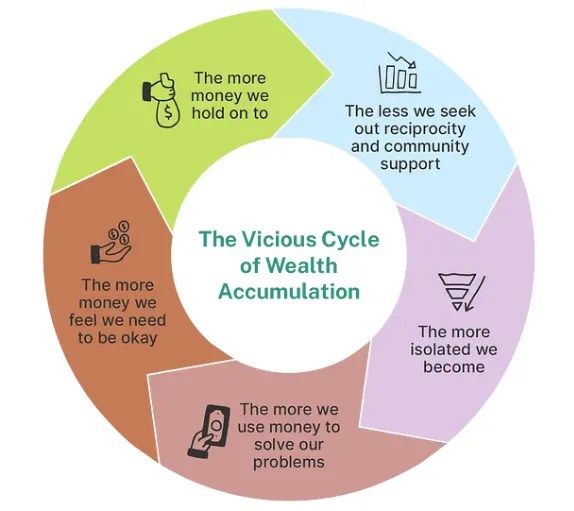
Several of my social media cyberfriends (see footer) are living quite counterculturally, and one of them introduced me to the Dense Discovery newsletter. I probably give it awfully short shrift most weeks, but today caught my attention and led to something pretty thought-provoking, starting with a graph:

Okay, but let’s talk about the prescribed wealth hoarding model in the United States, otherwise known as prudent financial planning (supposedly). The conventional advice from financial planners is that people of my age are supposed to accumulate something like $1 million in order to retire. Or maybe $1.5 million.1 In case you’re not hip to the logic here – I wasn’t until I married a very specific kind of nerd – we’re supposed to amass so much wealth that we can live off the interest and dividends until we die. It’s not enough to save what we’ll need to make it to the end of our life; we need (ostensibly) way more than that. We need to accumulate so much wealth that we can live off the wealth that our wealth earns. We need – we are told – enough that we never have to touch the principal, and we can pass our wealth along to our next of kin, whoever they may be.2

Interdependence is My New Retirement Plan – by Lisa Sibbett

My father, a professional, seemed to live fairly consistently with the values Lisa Sibbett suggests. My widowed mother had enough and to spare, but their church saw a lot of money over the years, too, and his kids occasionally got gifts at the end of a bountiful year.

My father-in-law, a tradesman, lived the “conventional advice from financial planners,” and we are now benefitting from his success at that model.

I’ve lived somewhere in between those two models. Though I (credulously?) aspired to the “conventional advice” model, I just couldn’t resist living life along the way, and not waiting until I was properly fixed for life. Unlike my parents’ generation, I did not live through any Great Depression and didn’t feel that possibility in my bones. I don’t regret it.

One caveat with Sibbett’s approach is that it requires long-enduring personal bonds. You’ll need to sink roots somewhere, and that somewhere will need to be where others are sinking roots as well. It requires long-enduring personal bonds. It’s not for individualist nomads.

The unmentionable elephant in the room

I confess that I struggled with the reasoning of the Supreme Court in Skrmetti although I reluctantly welcomed the outcome.

I was not alone. Josh Blackman and Hadley Arkes (not a lawyer, but an Amherst professor of Jurisprudence) were in the same position as me, but Arkes in particular pointed to the root problem:

The truth that dares not speak its name here is that this wide array of gender-affirming therapies and surgeries is simply predicated on a falsehood. And yet those are the words that the conservative justices apparently see themselves as barred from speaking. Something in conservative jurisprudence holds them back from appealing to the inescapable and objective truth that lies at the heart of these cases. But without it, what were these accomplished jurists able to explain here? What was their ground of justification in overriding the judgments of those parents who were absorbed in the grief and confusion that seized their children? . . . .

The only “instruction” that would be relevant, Justice Thomas, is the unyielding fact that the child is in a state of confusion: he is not occupying some body apart from his own; his sex was not “assigned” at birth but marked inescapably in the organs of reproduction, in the arrangement of his body. His sex is immutable and printed plainly upon him.

Those were the words that Chief Justice Roberts and five colleagues could not move themselves to speak. Or they thought they were constrained from speaking by a jurisprudence that bars them from invoking truths beyond the text of the Constitution—even on the question of what is a human being, the bearer of rights, and when does that “human person” begin? . . .

Without those points in place, the judgment of the Court simply dissolves into a chain of ipse dixits. Why was it not legitimate for the parents of stricken youngsters to order the procedures that might relieve their “gender dysphoria?” Answer: The legislature of Tennessee did not think it a legitimate medical remedy to choose—even though the children and the parents did not share that judgment and were willing to take their risks. One judgment had to prevail, and it was the judgment backed by the power of the State. To put a high finish on it, that “power” represented the authority of a people to govern itself through elected representatives. But when the people speak through their representatives, and override the judgments of parents about their children, they are still obliged to say something more than “we have brute the power to impose this judgment through brute enactment of the law.”

Arkes singles out Justice Thomas, I suspect, because he said “so-called experts have no license to countermand the ‘wisdom, fairness, or logic of legislative choices.’” (Justice Thomas, concurring in U.S. v. Skrmetti, via Eugene Volokh.) Arkes’ re-formulation, I guess, is that the legislature can tell the experts “your elaborations are predicated on the falsehood that a person can be inhabiting a body of the wrong sex.”

That’s not the end of the story, but it’s a starting point for re-writing a story written up to now by activists hiding something only a few clicks less deranged than the whack-a-doodle Chase Strangio ideology:

Strangio disputed that a trans woman could be “born with a male body” or “born male”; in his view, a trans woman was born a woman just like any other woman. There was no such thing as a “male body,” Strangio told his colleagues: “A penis is not a male body part. It’s just an unusual body part for a woman.” Before the advertisement aired, Strangio elaborated on his critique in an article in Slate. “Many advocates defend the use of the ‘born male’ or ‘born with a male body’ narrative as being easier for nontransgender people to understand,” Strangio wrote. “Of course it is easier to understand, since it reinforces deeply entrenched views about what makes a man and what makes a woman. But it is precisely these views that we must change.”

My own position hasn’t changed in 39 months. I think we’re still seeing a cultural contagion of trans claims in adolescents and must be very cautious – which is a bit easier now that even Strangio has given up on the “live son or dead daughter” emotional blackmail.

Patience, Mercy, Tolerance

For defenders of political liberalism there is perhaps no more pressing problem than this: How do you make a compelling case for liberalism in an era of ascendant [illiberalism or] strong gods? The idea of “strong gods” comes from the book Return of the Strong Gods by R. R. Reno, editor of the conservative ecumenical journal First Things.

By “strong gods” Reno means the kind of visceral or agonistic forces that can compel political or social action through deeper existential or even guttural appeals. The strong gods work not by chiefly targeting the intellect, but the appetites.

Michael Reneau, Evan Spear, and Jake Meador, A Virtue-Centric Argument for Political Liberalism (shared link). This article was welcome in light of the ascendance of various illiberalisms.

With a little help from AI, I got this summary table:

VirtueRole Against Postliberalism & Strong GodsRoot/Source
PatienceProvides long-term perspective, allowing growth and changeChristian theology & history
MercyBreaks cycles of retribution, fosters trust and forgivenessScripture, Shakespeare
ToleranceIntellectual humility; suspends harsh judgment; enables coexistenceLiberal philosophy & Scripture (e.g., parable of wheat and tares)

Wordplay

I know every one of these carries political freight, but that’s the burden of many writers these days:

  • Glenn Thrush, Alan Feuer and Adam Goldman remarked on the right-wing ire confronting Patel and Pam Bondi, the attorney general, as they fail to substantiate the accusations that they hurled in their bid for power: “They are running what amounts to a conspiracy theory fulfillment center with unstocked shelves.” (Jeff Lebsack, Buffalo, and Marianne Painter, Tacoma, Wash., among others)
  • In The Financial Times, Edward Luce worried that certain scenes from the Los Angeles protests played into the president’s hands: “Every rock hurled lands like a penny in Trump’s wishing well.” (Todd Lowe, Simpsonville, Ky., and Al Gallo, Huntersville, N.C., among others)
  • In The Washington Post, Philip Bump expressed skepticism about the government’s claim that immigration officers must wear masks for self-protection: “We should not and cannot take ICE’s representations about the need for its officers to obscure their identities at face value.” (Patrick Bell, Carmichael, Calif.)
  • Also in The Post, Dana Milbank took in Trump’s pleasure at some sycophantic Republicans’ suggestion that the D.C. Metro be renamed the “Trump Train”: “It’s a great idea. Qatar will donate the subway cars, which will be powered by coal. Passengers will pay for fares with cryptocurrency after first showing proof of citizenship. And the trains will reverse themselves regularly and without warning — never quite reaching their original destination.” (Mary Ellen Maher-Harkins, Orwigsburg, Pa., and Stan Shatenstein, Montreal)

Via Frank Bruni

Ceci n’est pas un phone

Methaphone. Like Methadone. Get it?

In case you’ve been wondering …

No, you’re not imagining it. The main source of political violence in the USA in this century has been right-wing, not left. Jamelle Bouie, Right-Wing Violence Is Not a Fringe Issue:

It is simply a fact that the far right has been responsible for most of the political violence committed in the United States since the start of the 21st century.

I had been wondering, because there has been some leftwing violence against persons, and much against property.

Poor fit

If it seems that America’s colleges and universities are poorly suited to the average American eighteen-year-old, perhaps that’s because they were never designed to serve him.

Oren Cass, The Once and Future Worker


Your enemies are not demonic, and they are not all-powerful and the right hasn’t always lost and the left hasn’t always won. But if you convince yourself of that, you give yourselves all sorts of permission to do a lot of stupid and terrible things under the rubric of “Do you know what time it is?”

Jonah Goldberg.

Trumpism can be seen as a giant attempt to amputate the highest aspirations of the human spirit and to reduce us to our most primitive, atavistic tendencies.

David Brooks

I don’t do any of the major social media, but I have two sub-domains of the domain you’re currently reading: (a) You can read most of my reflexive stuff, especially political here. (b) I also post some things on my favorite social medium.

Friday, 5-17-24

Pearl-clutchers

“I have heard from a good number of people in the S.D.N.Y. who have said, ‘Why the heck would Todd [Blanche] do this — why would he ever take this case?’” Elie Honig, a CNN senior legal analyst who worked with Mr. Blanche at the Southern District of New York, said in a recent profile. “My response is, generally, when did we become pearl-clutchers about defense lawyers defending defendants?”

Michael Wilson, Todd Blanche, Trump’s Lawyer in Hush-Money Trial, Cross-Examines Cohen

Just so.

The Culture Generally

Seeing whole people

[W]e have to stop just seeing these [gender dysphoric] young people through the lens of their gender and see them as whole people, and address the much broader range of challenges that they have, sometimes with their mental health, sometimes with undiagnosed neurodiversity. It’s really about helping them to thrive, not just saying “How do we address the gender?” in isolation.

Dr. Hilary Cass to the New York Times

Thinking small

Ted Gioia, Why Creatives Will Win by Thinking Small pulls together a convincing case that “Even the gatekeepers are sick of dealing with gatekeepers” and are going independent and/or small to evade them. Taylor Swift and Substack are two examples, evading the gatekeepers of the sclerotic music and publishing industries respectively.

Maybe we could say that small is getting pretty big.

Ted Gioia’s got one of the best culture-analyzing Substacks going.

Living off inherited moral capital

“I wouldn’t call it a change of mind,” Will said of his transition from classical liberalism to traditionalist conservatism. “I would say that I had become much more sensitive to the problem that Gertrude Himmelfarb, her husband, Irving Kristol, and others were to cite. And that is: Does classic liberalism provide for its own continuation, or does it live off the moral capital of a different age?”

Guy Denton, George Will Stands Against Vehemence

Presented without comment

A female friend expressed outrage that Caitlin Clark would be paid a piddling $76,000 in her first year in the WNBA. (By comparison, the first pick in the 2023 NBA draft signed a four-year contract for $55 million.) I asked her what team drafted Clark. She did not know. I asked her whether she knew the name of New York’s WNBA team. She did not. The name of any team in the WNBA? Nope. A famous player in the WNBA? Again, no answer.

R. R. Reno

Ready, fire, aim

Staff at The New York Times are circulating a draft of a letter to their boss, executive editor Joe Kahn, criticizing him for saying that some young reporters are not fully committed to independent journalism. Pro tip: if you’re worried your boss thinks you’re all whiny activists, campaigning against him from within the newsroom is only proving his point. (Semafor)

Oliver Wiseman

Politics

Boondogglia, USA

[A]rena subsidies are a terrible use of finite government resources and a ridiculously egregious redistribution of wealth from regular Americans—fans and haters alike—to some of the wealthiest people and organizations on the planet. And, to top it all off, they’re a classic case of political malpractice—local officials delivering massive rents to various cronies by promising unwitting voters the world yet delivering far fewer—but still “seen”—economic and social benefits to their communities.

Maybe all this government support might be worth the costs if the subsidized facilities at issue produced even a fraction of the benefits that supporters promise, but they don’t. Instead, there are few positions on which more economists agree than the terribleness of sports arena subsidies.

Scott Lincicome, Sports Are Great, but Stadium Subsidies Stink

Election 2024

The default position of American conservative Christians in this Fall’s Presidential Election should be to abstain or to vote for a Third-Party Candidate. Neither major party candidate is acceptable, so we should avoid complicity with both. It’s a painful situation, but not complicated.

My unspoken premise is that America is, and long has been, off course, and like all empires is waning, slowly, then all at once. (I could be wrong about the all-at-once part; that may come from the part of Evangelical apocalypticism that I did not avoid and have not fully recovered from. “Babylon the Great is fallen, is fallen” and all that.)

Neither major party has what it takes to fix that. Maybe no party does. Still, I intend to vote for Peter Sonski for President. That’s not just a protest vote. My values line up better with the American Solidarity Party than with either the Republicans or the Democrats.

Am I throwing my vote away? No. I’m telling both parties that they’re unacceptable. That’s a message well worth sending, not a waste. If enough people tell them that, they’ll change or fade into irrelevance. The first step toward changing our unsatisfactory two-party system, if it’s not entirely incorrigible, is to stop voting for lesser evils.

Am I voting for the other guy by not voting for your guy? No. I know how my home state is going to vote; my vote won’t be decisive — not in 2024, anyway. If polling was close enough that I thought it might make a difference, my correct decision would admittedly be harder emotionally. (I last voted for a “lesser evil” in, I believe, 2008.)

That’s it.

POTUS 2024

It was like he made you feel everything’s gonna be OK. The economy’s gonna get better; everybody’s freaking out about the border, but he’ll get it stopped.

Dee, a friend of Peggy Noonan, explaining why she’s voting for Trump.

Polls suggest that a felony conviction would lose him some votes ….

David Graham. What kind of world are we living in that a felony conviction wouldn’t be the death of a campaign?

Liberalism versus authoritarianism

I’ve tried to understand the appeal of Donald Trump. David Brooks gives it an oblique stab, and I thought there was a lot to like in his analysis, which is about liberalism versus authoritarianism, and the draw of the latter.

Now I understand how we keep electing bozos

As it happens, a new survey of registered voters was released last week from Navigator Research showing that a sizable number of Americans, incredibly enough, held Biden responsible for “the overturning of Roe v. Wade and the elimination of the federal right to an abortion.” That opinion was held by 34 percent of self-identified independents, 32 percent of Black voters, and 42 percent of Hispanic voters. It helps explain why the Biden campaign is devoting so much energy to connecting the dots between Trump’s Supreme Court appointments and the Dobbs decision. But it also suggests public perceptions of Trump are very hard to change, and that’s a big problem for Democrats.

Wall Street Journal.

Might there be, among those misinformed folks, people who give Biden credit for Dobbs as well as those who blame him? Or is ignorance a “pro-choice” exclusive?

Female success in Trumplandia

  • In The Los Angeles Times, Robin Abcarian noted that Noem, Marjorie Taylor Greene and Sarah Palin, among others, conform to a certain MAGA model for women leaders: “First, they want to prove how tough they are by shooting guns, preferably at animals, though occasionally at cars that Democrats drive. And second, they aspire to beauty standards set by Fox News anchors. Dental veneers. Cheek and lip fillers. Botox. Hair extensions. Performative cruelty and pouty lips are what it takes to succeed as a woman in the party of Trump.” (Judy Moise, Seattle)
  • In The Arizona Republic, Ed Masley appraised a recent Rolling Stones concert and wrote that Mick Jagger’s physicality “invites you to imagine Mikhail Baryshnikov raised by a family of overcaffeinated roosters.” (Paul Welch, Phoenix, and Dan Olson, Spokane, Wash., among others)

Frank Bruni

How MAGAworld grew

Of all passions the passion for the Inner [Circle] is most skillful in making a man who is not yet a very bad man do very bad things.

C.S. Lewis, The Weight of Glory

I have watched this play out powerfully since 2016.

De-polarizing maxims to live by

  • The people you think of as your enemies aren’t as wicked as you believe them to be.
  • If you believe that your ordinary political opponents are not merely mistaken, but are evil, you have ceased to do politics and begun to do heretical religion.

Putting things in perspective

  • In a gloomy mood about the state of the world, I was reminded that the big actors of today, Trump, Biden, Putin, etc. etc. will mostly be dead, and very soon. Thinking in terms of living so that our communities outlast the current commotions is important.
  • Leonard Woolf: “One of the most horrible things … was to listen on the wireless to the speeches of Hitler — the savage and insane ravings of a vindictive underdog who suddenly saw himself to be all-powerful. … One afternoon I was planting in the orchard under an apple-tree iris reticulata, those lovely violet flowers. … Suddenly I heard Virginia’s voice calling to me from the sitting room window: ‘Hitler is making a speech.’ I shouted back, ‘I shan’t come. I’m planting iris and they will be flowering long after he is dead.’”

John Brady and Jim Rain, respectively, on the best social medium in the cosmos.


So: where did all my mockery of Trump go?

I suffer more from the humiliations inflicted by my country than from those inflicted on her.

Simone Weil, from a letter to Georges Bernanos.

You can read most of my more impromptu stuff here and here (both of them cathartic venting, especially political) and here (the only social medium I frequent, because people there are quirky, pleasant and real). All should work in your RSS aggregator, like Feedly or Reeder, should you want to make a habit of it.

Wednesday, 8/30/23

Culture

Industrialism

It is a monstrous piece of bogus liberalism to deny that industrialism has done much for the highest interests of humanity by raising the standard of living. It is as foolish as to deny the harm it has done them by not raising it enough, by poisoning the skies and fields with cheap cities, and taking away the will of its employees by keeping them in political and economic subjection.

Rebecca West, Black Lamb and Grey Falcon

Who thinks learning is the point of university?

[I]n the American university system the vast expansion of DEI apparat simply follows the previous (and not yet complete) expansion of the mental-health apparat, all of which siphons resources away from the teaching of students. But that’s okay, because almost no one — least of all students and their parents — thinks that learning is the point of university. The university is for socialization, networking, and credentialing, and I expect to see a continuing expansion of the bureaucracies that promote these imperatives and a corresponding contraction of the number of teachers. And anyway, insofar as teaching and learning remain a burdensome necessity, if an annoying one, much of that work can be outsourced to ed-teach products and, now, to chatbots

Genuine teaching and genuine learning will always go on, but for the foreseeable future it will happen at the margins of our universities or outside the universities altogether. Meanwhile, the symbolic work of the party-state will grind on ….

Alan Jacobs

… that all men are created equal …

This meant bringing together supporters and opponents of slavery. (Not free and slave states: in 1776, every state recognized slavery. The Betsy Ross flag shows us thirteen stars in a circle, and every star represents a slave state.) Some of the colonists disliked slavery; others were very attached to it. In consequence, the Declaration adopts a political theory that has no direct implications for slavery: it is about the rights of insiders and focused on the question of when the governed may reject the legitimate political authority of their governors.

Kermit Roosevelt III, The Nation That Never Was

1619 Project versus the Standard Story

What the 1619 Project is, really, is the extreme progressive version of the standard story: it tells us that we have fallen further short of our ideals, more frequently, more consistently, and more deliberately than we realize. Yet it still tells us that “our founding ideals” were written in 1776—and it is still a profession of faith in them, of faith in an America we can work to perfect.

Kermit Roosevelt III, The Nation That Never Was

Protesters and vigilantes

From Tuesday more motorists must pay to drive in London. The Ultra-Low Emissions Zone—in which a surcharge applies to high-polluting vehicles—will be expanded to all 32 boroughs of Britain’s capital. The £12.50 ($15.75) daily levy will cover diesel cars and vans that do not meet “Euro 6” standards (typically those bought before 2015), and cars that don’t meet “Euro 4” (which typically predate 2006). A scrappage scheme has been introduced to help owners of non-compliant cars buy greener vehicles.

London’s mayor, Sadiq Khan, a member of the Labour Party, argues that the move will improve health, especially of children. But it has provoked a fierce backlash, particularly among drivers who live in peripheral parts of the city. That has been seized upon by Britain’s ruling Conservative Party, which has had a hard time winning votes in London in recent years. The party is now portraying Labour as anti-driver. Some vigilantes have vandalised the cameras used to enforce the clean-air scheme.

The Economist’s World in Brief 8/29/23. A thousand takes on this story could be, and probably are being, written. I noted it for the trajectory of western governments and to note that another publication might have used “protesters” where the Economist chose “vigilantes.” After all, it’s “mostly peaceful,” isn’t it?

Travel

People travel to faraway places to watch, in fascination, the kind of people they ignore at home.

Dagobert D. Runes. But God help me, I love it anyway.

Legalia

No-fault divorce

Professor Lynn Wardle has shown that the American Law Institute’s Principles of the Law of Family Dissolution approach to fault has serious inconsistencies. If one party squanders family wealth, this fact can be considered in the property settlement, almost like an “economic fault.” Allegations of assault, battery, or abuse of the children can be handled as criminal acts.

So, if the ALI’s Principles still effectively permit the consideration of economic faults and abuse faults, what does no-fault amount to? It means that the major fault removed by “no-fault” was adultery or sexual infidelity.

Jennifer Roback Morse, The Sexual State

(I gritted and ground my teeth through this book not because of its substance but because of a style I found grating. Caveat emptor.)

Tortious spam filters?

U.S. District Court Judge Daniel Calabretta granted Google’s motion to dismiss a lawsuit filed by the Republican National Committee (RNC) claiming the company’s Gmail spam filter unfairly suppressed RNC messages. “While it is a close case,” the judge wrote, “the court concludes that … the RNC has not sufficiently pled that Google acted in bad faith in filtering the RNC’s messages into Gmail users’ spam folders, and that doing so was protected by section 230.” As Sarah wrote last year, Republican fundraising appeals are likely flagged by spam filters at higher rates due to abuse of email lists.

The Morning Dispatch

Sobering statistic

The prison population roughly doubled during Reagan’s years in office, from 329,000 Americans in jail in 1980 to 627,000 in 1988. This trend accelerated during the Bush and Clinton presidencies. By 2008, there were 1.6 million people in American prisons, with the US leading the world in total prison population and imprisonment rate.

Jon Ward, Testimony. That should be enough to make anyone think twice, two or three times, about how “free” we really are.

Politics

What is this “white trash”?

Once, coming back on his plane with a billionaire friend who had brought along a foreign model, Trump, trying to move in on his friend’s date, urged a stop in Atlantic City. He would provide a tour of his casino. His friend assured the model that there was nothing to recommend Atlantic City. It was a place overrun by white trash. “What is this ‘white trash’?” asked the model. “They’re people just like me,” said Trump, “only they’re poor.”

Michael Wolff, Fire and Fury (I have not read this book but ran across this quote anyway.)

Manly men

[Ted] Cruz is one of the many singing the totally-normal-and-not-at-all-weirdly-homoerotic praises of Donald Trump’s recent Fulton County Jail mugshot: “Trump’s mugshot where he looks like a pissed off and angry badass is an iconic historic photo. It’s going viral, and it’s making a heck of a statement.” Jesse Watters of Fox News, affirming his “unblemished record of heterosexuality,” said of Trump: “He looks good and he looks hard.”

In reality, Trump looks like the Grinch after a makeover performed by John Wayne Gacy—I’d love to know what the last man booked into that jail while wearing that much makeup was charged with, and I’ll bet it was hilarious—but it is of interest to me what these guys with their unblemished records of heterosexuality think looks and seems tough. Donald Trump is a guy who has never lifted anything heavier than money and blasts Broadway show tunes and the Village People at his rallies for totally normal people who are by no means members of a cult. I don’t know how much time you can spend dancing to “Macho Man” before your record of heterosexuality gets a blemish, or at least a footnote. And then there’s the inevitable playing of the music from Cats.

Kevin D. Williamson

Williamson doesn’t have much use for Mike Pence, either (same column, titled The Whited Sepulcher. Ouch!).


We are in the grip of a grim, despairing rebellion against reality that imagines itself to be the engine of moral progress.

R.R. Reno

The end of the world as we know it is not the end of the world.

You can read most of my more impromptu stuff here (cathartic venting) and here (the only social medium I frequent, because people there are quirky, pleasant and real). Both should work in your RSS aggregator, like Feedly or Reeder, should you want to make a habit of it.

Groundhog Day 2023

Culture

Why would we even want immortality?

Whenever I read about someone who sees a technological route to immortality I think about this “ravenous desire for personal immortality” combined with “a total indifference to all that could, on a sane view, make immortality desirable.” So you want a digital imitation of yourself to live on after you die. But why?

A few people have asked me to write more about recent AI endeavors, but here’s the problem: I can’t summon the interest to become sufficiently well-informed. I wrote a bit about the responses of some writers to the opportunity (as they see it) to outsource their work, but I haven’t used ChatGPT or LaMDA or DALL·E or Stable Diffusion or any other recent AI project — and I haven’t used them because the very idea bores me stiff. It’s as simple as that. I just can’t think of a reason to be interested. So instead I’ll do the things that I am interested in. It’s a good policy, I find.

From Alan Jacobs’ compilation of his limited writing on Artificial Intelligence.

Wouldn’t you want to sell?

Is Jeff Bezos trying to sell The Washington Post? It sure looks like the Bezos team is planting stories that the Post is for sale, because his favored publications are saying, well, it’s for sale. Bezos denies these reports. But when I see something in The Daily Mail, I know someone, somewhere, is scheming. (The Daily Mail also seems like the go-to publication for Bezos’ girlfriend Lauren Sanchez, who it frequently describes as stylish and rocking.) If you owned _The Washington Post—_a place with a few great reporters, and then hundreds of screaming activists who hate journalism, hate each other, and hate you—wouldn’t you want to get the hell out? Meanwhile this week, the Post announced layoffs.

Nellie Bowles

French Laziness

I am determined to retire in order to spend what little remains of my life, now more than half run out … consecrated to my freedom, tranquillity, and leisure.

Montaigne, via Are French People Just Lazy?

Books

“I’m very skeptical of books,” he expands. “I don’t want to say no book is ever worth reading, but I actually do believe something pretty close to that. I think, if you wrote a book, you f***ed up, and it should have been a six-paragraph blog post.”

Sam Bankman-Fried, quoted by Thomas Chatterton Williams

I have read books that (slight hyperbole) could and should have been 6-paragraph blogs. The authors, however, were paid quite well. Those books make me feel cheated.

I have read books that (slight hyperbole) could have been 6-paragraph blogs, but would have been opaque or misunderstood without unpacking those six tight paragraphs. Once that was worthwhile, usually not.

I have read books that never could have been 6-paragraph blogs because they just keep on delivering good stuff and they trust the reader think through most of the ramifications. Those books are hardest to read, but the most rewarding.

Civilizational conflicts, Ideological conflicts

European governments and publics have largely supported and rarely criticized actions the United States has taken against its Muslim opponents, in striking contrast to the strenuous opposition they often expressed to American actions against the Soviet Union and communism during the Cold War. In civilizational conflicts, unlike ideological ones, kin stand by their kin.

Samuel P. Huntington, The Clash of Civilizations and the Remaking of World Order

Ideology in Disguise

As [Patrick Deneen’s Why Liberalism Failed] tells it, what happened when the wall fell was not the triumph of freedom over oppression so much as the defeat of one Western ideology by another. The one that came through was the oldest, subtlest and longest-lasting, one which disguised itself so well that we didn’t know it was an ideology at all: liberalism.

Paul Kingsnorth, In This Free World

Antimodernity

To be resolutely ‘anti-modern’ is not to be in any way ‘anti-Western’; on the contrary, it only means making an effort to save the West from its own confusion.

René Guénon Guénon, The Crisis of the Modern World

Politics

Bermuda Triangle Party

The G.O.P. should be renamed B.T.P., for Bermuda Triangle Party. Enter it, weird stuff happens, and you go straight to the bottom … George Santos is what you inevitably get once you’ve already normalized Donald Trump, Roy Moore, Lauren Boebert and “Space Laser” Greene.

Bret Stephens

Vice President Marjorie Taylor Greene?

We’re in a dark place if Donald J. Trump is no longer crazy enough to win a Republican primary without help from someone crazier, but, well, we are in a dark place. The Dispatch wouldn’t exist if we weren’t.

The core of hardcore partisanship is the belief that the worst member of your party is preferable to whatever the other party is offering. Trump/Greene would test that faith like few other things could. If you can tolerate helping those two to power, you can tolerate anything in the name of brainless Team Red loyalty.

Nick Cattogio, VP MTG?

When Everything Is Classified, Nothing is Classified

“Everything’s secret,” Michael Hayden, former CIA and NSA director, once said. “I mean, I got an email saying, ‘Merry Christmas.’ It carried a Top Secret NSA classification marking.”

The Morning Dispatch

If Mick Mulvaney could get a do-over …

Consensus Winner of Most Embarrassing Op-Ed Ever: If He Loses, Trump Will Concede Gracefully, (Mick Mulvaney, 11/7/2000)


Tradition is a bulwark against the power of commerce and the dissolving acid of money, and by removing these, all revolutions in the modern period have ended up accelerating the commercial and technological shift towards the Machine.

Paul Kingsnorth

You can read most of my more impromptu stuff here (cathartic venting) and here (the only social medium I frequent, because people there are quirky, pleasant and real). Both should work in your RSS aggregator, like Feedly or Reeder, should you want to make a habit of it.

Sunday before Nativity 2022

Antiquity envy

By Lingard’s day, the Church of England held the smug and self-affirming view that the old Anglo-Saxon Church—that is to say, Christianity in the British Isles prior to 1066—was in fact, proto-Protestant; concluding that Anglicanism was nothing more than English Christianity as it had always been before all those pesky Papists showed up and ruined things. From the actual historical record, to accomplish this, you must turn your head just right and squint at one isolated primary source, and then use 17th-century Protestant speculations as your guide for its interpretation. Lingard lays waste to such pretensions, but is always a slightly bemused gentleman in doing so.

Terry Cowan

Thus does Terry introduce the theme of what I’ll call “antiquity envy” in various 200-year-old sects. He even (blush!) gives me a shout-out as his favorite aggregator. What’s not to like?

Accommodating brute facts

In May 2021, a time when public gatherings in England were strictly limited because of the coronavirus pandemic, the British tabloids were caught off guard by a stealth celebrity wedding in London. Westminster Cathedral—the “mother church” of Roman Catholics in England and Wales—was abruptly closed on a Saturday afternoon. Soon the groom and bride arrived: Prime Minister Boris Johnson and Carrie Symonds, a Catholic and a former Conservative Party press officer with whom he had fathered a child the previous year. A priest duly presided over the marriage, despite the fact that the Catholic Church opposes divorce and sex outside marriage, and that Johnson had been married twice before and had taken up with Symonds before securing a divorce. It was an inadvertently vivid display of the Church’s efforts to accommodate its teachings to worldly circumstances.

Paul Elie, The Reinvention of the Catholic Church – The Atlantic (emphasis added)

I assume that accommodating Orthodoxy to worldly circumstances (which isn’t exactly changing its teachings, but may eventuate in that) is what Archbishop Elpidophoros of America was thinking at the ”First Greek Orthodox Baptism for Child of Gay Couple in Greece”

It is a fearful thing to be responsible for a multitude of human souls, as are priests and, a fortiori, Bishops, Archbishops and Patriarchs.

Deny baptism to the children “of” the gay couple and you’re mean or homophobic. Grant it and, among other problems, it is seen as “a sign of great progress in the Greek Orthodox Church in terms of acceptance of the LGBT community,” a not entirely salutary development. Do the wedding and you’re countenancing adultery and divorce; deny it and you’re promoting bastardy.

The only way I know of squaring the circle is that you consider stepping beyond the letter of the law only if you have reason to think that doing so will conduce to the salvation of one or more parties to the irregular circumstance, which in all the cases I can imagine will mean that there’s already some repentance for the circumstances they’ve created.

But then I’m not a Priest or a Bishop, am I?

Humble in theory, arrogant in fact

Over the last two centuries, an egalitarian culture has given rise to a diverse array of powerful religious leaders, whose humble origins and common touch seem strangely at odds with the authoritarian mantle that people allow them to assume.

Nathan Hatch, The Democratization of American Christianity

I cannot help but think of a law school classmate’s description of leaving the Protestantism of southern Indiana for the Roman Catholic Church: he gave up untutored and pompadoured tyrants who denied any authority beyond expounding the Bible in exchange for priests who claimed to be God’s authoritative presence but who let him live his own life.

We’re all liberals now

The late conservative philosopher Roger Scruton once referred to conservatism as ‘a hesitation within liberalism’ rather than an alternative to it, and Deneen too believes that while left and right might want to liberate different things, they are both onboard with the overall project:

What is bemoaned by the the right is not due to the left but to the consequences of its own deepest commitments, especially to liberal economics. And what is bemoaned by the left is not due to the right but to the consequences of its own deepest commitments, especially to the dissolution of social norms, particularly those regarding sexual behaviour and identity. The ‘wedding’ between global corporations and this sexual agenda is one of the most revealing yet widely ignored manifestations of this deeper synergy.

Paul Kingsnorth, In This Free World


[S]ubordinating truth to politics is a game which tyrants and bullies always win.

Jonathan Rauch, The Constitution of Knowledge

To believe that wealth is the only significant measure of the worth of an individual, a family, or a community is to reject the teaching of nearly every religion and wisdom tradition that ever was.

Mark Mitchell and Nathan Schlueter, The Humane Vision of Wendell Berry

The Orthodox “phronema” [roughly, mind-set] cannot be programmitized or reduced to shibboleths.

Fr. Jonathan Tobias

You can read most of my more impromptu stuff here (cathartic venting) and here (the only social medium I frequent, because people there are quirky, pleasant and real). Both should work in your RSS aggregator, like Feedly or Reeder, should you want to make a habit of it.

Tuesday, 12/6/22

It’s been awfully long since I flushed the pipes.

Politicalish

A not-so-great realignment

Alex Jones: The Nazis were thugs.
Kanye West: "But they did good things too. We gotta stop dissing the Nazis all the time."

@Rightwingwatch

So “Ye” is now to the right of Alex Jones?!

Viktor ticks me off

I know that Viktor Orbán isn’t running a liberal democracy. He says it’s an illiberal democracy. “If I could count on American post-liberals being as competent and honest as Orbán,” I thought, “I could tolerate illiberal democracy, even though it wouldn’t be my first choice.”

But now he’s pulled a stunt that bothers me even more than some of the other ways he’s manipulated things to keep winning elections:

In December 2020, when Hungary’s health authority set up a website for citizens to register for covid-19 vaccinations, it included a tick-box for those who wanted to receive further information. Gabor Toka, a political-science professor, found it odd that the box did not specify that future communications should be about covid. To see what would happen, he ticked the box for his own registration but left it unticked for his mother’s. Some months later, when Hungary’s general-election campaign swung into gear, he found that he (but not his mother) started to get campaign emails from the ruling party, Fidesz.

Mr Toka was not the only one. A report published on December 1st by Human Rights Watch suggests that Fidesz seems to have gained access to state databases and used them to send campaign messages to voters. In addition to emails, people got phone calls and text messages from Fidesz candidates urging them to vote and reminding them what a wonderful job the government was doing.

How Hungary used citizens’ covid data to help the ruling party (The Economist)

Thesis Statement

I was just reminded of the excellent capacity of Readwise to share a quote as an eye-grabbing image. Expect to see more.

What authoritarianism does to decent people

Yesterday a friend messaged me to say that one passage from Monday’s newsletter had rung his bell. It had to do with motives. Perhaps some conservatives who’ve moved away from right-wing policies during the Trump era have done so, I wrote, because they’ve begun to doubt the good intentions of leaders who support those policies.

If the average Republican says the law should be harder on drug dealers, you and I might eagerly agree. If an aspiring strongman in the mold of Rodrigo Duterte says the same thing, you and I might worry instead about how a more draconian legal regime would eventually be abused.

Authoritarianism brings out the libertarian in decent people.

All it took was a bare assertion without credible evidence that the election had been rigged against a right-wing president to flip Stewart Rhodes from freedom warrior to fascist goon.

Nick Cattagio

This is a remarkably thought-provoking piece. One more excerpt:

Years ago a fellow Never Trumper told me the great irony of the Tea Party era is that those of us who were viewed at the time as moderates and “RINOs” turned out to be the ones who took conservative principles seriously. We the squishes were told that conservatism was about X, Y, and Z, then suddenly Trump arrived and it wasn’t about those things anymore. So we left.

It was the firebreathing hyper-principled “true conservatives” and small-government radicals who were easily co-opted by a nationalist strongman. They simply adapted and carried on.

I’ve always taken pride in that. But it also feeds my insecurity that on a fundamental level I don’t understand how most people practice politics. I can cite chapter and verse on What Classical Liberalism means, but if 90 percent of those who used to—and maybe still—call themselves classical liberals are okay with an authoritarian personality cult so long as it’s advancing their interests by owning the libs, then how “real” is classical liberalism really?

Legalish

Balancing negative externalities

Free Speech

We still enjoy free speech in the U.S. partly because good people are willing to “sue the bastards” when the bastards try to punish or chill free speech. Eugene Volokh and F.I.R.E., for instance, are suing New York State (New York State Wants to Conscript Me to Violate the Constitution)

One reason why I’m not a Ron DeSantis fan is that his popular (for the GOP’s Florida base, at least) “Stop Woke Act” also violates free speech norms of not the letter of the 1st Amendment (which I think it probably does; caveat: I haven’t thought about that a lot.).

Getting the Analogy Right

SCOTUS heard arguments Monday on another case that people will incline to call gay rights versus religious freedom, though it was argued on free speech grounds. As is so often the case, the questions from the Justices were probing.

Remarkably, a non-lawyer comment aptly summarizes a key point:

[T]he right analogy is crucial here, and correct distinctions are critical. In order to justify racial violence and oppression, white people in America and Europe essentially invented a novel theology, baptizing white supremacy. It was racism in search of an ethic. Sexual ethics, by contrast, are named and addressed in religious scriptures in specific terms. Unlike white supremacy, religious teachings regarding sex, including prohibitions on extramarital and premarital sex, pornography, lust and same-sex sexual activity have been part of the Christian faith from its earliest days. This is not an aberrant view rooted in bigotry but a sincere belief that flows from ancient texts and teaching shared by believers all over the world.

Tish Harrison Warren, When gay rights clash with religious freedom

Culture

What I wouldn’t do if I had #1 billion

If you had $1 billion, what would you do with your life?

How about $190 billion?

The difference between those two seems academic to a middle-class schlub like me, as there’s not a lot one can do with $190 billion that one can’t do with $1 billion. Although if one of your highest ambitions is to make social media safe again for chuds with Pepe avatars, I suppose the distinction is meaningful.

I can tell you what I wouldn’t be doing if my net worth surged to 10 figures. I wouldn’t be spending much time online.

And to the extent that I did, I wouldn’t be using it to sh-tpost.

Nick Cattogio, Kanye. Elon. Trump. (The Dispatch).

Academics and Intellectuals

An academic or a scholar is a specialist in one area of knowledge, whereas an intellectual is a “specialist in generalizations.” That’s a line from one of my intellectual heroes, the sociologist Daniel Bell, and I love it because it’s so delightfully paradoxical. An intellectual is someone who isn’t necessarily a specialist in anything but who reads widely in many subjects and grasps enough of the important aspects of specialized knowledge to render illuminating generalizations about lots of topics.

Another way to put it is to say that an intellectual is a bit of a dilettante or an amateur. I know a little bit about a lot of subjects, and I use that little bit of knowledge to try and understand what’s going on around me in an informed way. But I’m not a specialist in anything—not even the intellectual history and political theory I studied in graduate school, because I finished my studies 24 years ago and haven’t kept up with the latest scholarship.

Damon Linker, Ask Me Anything

This was an interesting installment from Linker, who also deftly fielded this final question:

I would love to get your opinion on what you think Ben Shapiro is up to. He seems to want to be both a conservative intellectual and a purveyor of sensationalist clickbait. And he seems to get a pass from most of the responsible conservative media.

Ben Shapiro interacts with and retweets me from time to time on Twitter. I suspect if you asked him, he’d say I’m one of the few sane and honest liberals around. Because of that, I don’t want to be mean to him here. But I will say that my view of him is precisely the one you sketch in your question. He’s obviously very smart, and the kind of conservatism (in policy terms) that he pushes is continuous with the Reagan-Bush 43 era. That’s not my thing these days, but it once was, and I respect smart people who advocate for those views, even today.

But in style, Shapiro is very much a child of Breitbart—and he appears not to recognize how corrosive that approach to engaging in politics ends up being for the very things he cares most about. If you spend all your days treating the opposition as evil and highlighting only the worst, most ridiculous arguments they make, you’re going to produce an audience that thinks the opposition is evil, stupid, and a threat to the country. And that might get members of this audience to elect someone who views the opposition with so much contempt that acting to overturn an election seems preferable to letting that opposition take power.

So I’d say Shapiro should spend some time re-watching episodes of the old William F. Buckley, Jr. Firing Line and remind himself of a better way—a way that seeks to elevate one’s own side rather than merely denigrate and demonize the other side. (Though it’s also true that this “better way” would probably generate considerably less revenue for The Daily Wire.)

Jesse Jackson’s long-lost daughter?

Nellie Bowles’ crap detector failed her as she joined the world-wide mimetic soccer-flop about British Royal racism.

I didn’t think the exchange was very racist, but one reader knew some detailed backstory that casts it as even more benign:

Nellie, I think you need to do some more digging into the supposedly racist godmother of Prince William, Lady Susan Hussey. When someone shows up at a charity event in African garb and an African name on their nametag, it is neither racist nor offensive to ask about their birthplace.

When the querent is 83 years old, you answer the intent of her question politely: "I don’t know where in Africa my ancestors came from, because they were brought to the Caribbean as slaves, but I myself was born in London."

Considering that Ngozi Fulani has made a career of race hustling, including accusing the Windsors of committing domestic violence against Meghan Markle, I can’t take her obnoxious failure to communicate with an elderly lady as anything but an effort to make trouble.

Race hucksters live on, in Britain, too.

Liberal, but uncivilized

In the era of populism there is a lively debate about when a democracy ceases to be liberal. But the advance of euthanasia presents a different question: What if a society remains liberal but ceases to be civilized?

The rules of civilization necessarily include gray areas. It is not barbaric for the law to acknowledge hard choices in end-of-life care, about when to withdraw life support or how aggressively to manage agonizing pain.

It is barbaric, however, to establish a bureaucratic system that offers death as a reliable treatment for suffering and enlists the healing profession in delivering this “cure.” And while there may be worse evils ahead, this isn’t a slippery slope argument: When 10,000 people are availing themselves of your euthanasia system every year, you have already entered the dystopia.

Ross Douthat

SBF, barbarian

I think, if you wrote a book, you fucked up, and it should have been a six-paragraph blog post.

Sam Bankman-Friedman, to writer Adam Friedman. (H/T L. M. Sacasas)

I hesitate to defend “SBF,” but I have read, or at least started to read, books that could, and perhaps should, have been a six-paragraph blog post. (Smarter people than me, though, aver that though one might convey the “facts” in six paragraphs, the nuances might warrant a full book.)

YouTube TV

I tried YouTube TV for about 15 hours, most of which I spent sleeping, singing, or otherwise not watching it. The low-definition images were annoying. That one must get in bed with Google again is really annoying. Trial ended.

Now maybe I need to figure out how to DVR late sports events on standard cable.

Just sayin’

If a team is going to beat a complete team with a lot of complemetary contributors like Purdue boasts, they’re going to have to catch the Boilermakers on the off-est of off days.

Garrett Shearman, Hammer and Nails, December 4.

Trumpish

A Bad Trip

Napoleon Bonaparte was born on the island of Corsica in 1769, rose to become a French military commander and emperor, and died on the island of Saint Helena in 1821. If I encounter a person on the street in Philadelphia in early December 2022 who insists he is this same Napoleon Bonaparte, I will be quite certain he is wrong about this, which means he is either lying or truly believes it and is insane.

How do I know this? Because I know history. Because I know when the actual Napoleon lived and died. Because I live in a social (intersubjective) world in which widely trusted cultural authorities will vouch for these truths.

But what if other people on the street believe this man and respond to his claim as if what he says about himself is true? What if another set of “experts” emerges to proclaim that, actually, this man is correct? And what if this is followed by the belief spreading further and large numbers of people throughout the country coming to believe it? Before long, newspaper headlines and cable news chyrons scream, “Napoleon Bonaparte Alive and Well in Philadelphia,” as I stand back and observe the spectacle in disbelief and mounting horror.

At what point does this man become sane and I become the madman?

This is a post about a feeling. And the feeling isn’t one in which the whole world, except for you, flips from affirming X to affirming not-X. It’s about the feeling of living in a world in which some of the people—not all of them, but also not just one or a small handful—begin to affirm an alternative reality from within our still-shared world. I’m convinced the emergence and widespread use of the word “gaslighting” during the Trump presidency was an effort to name this feeling of our social world being invaded by elements of psychosis. That feeling repeatedly surged while Trump was in office, and it reached a peak on January 6, when the madness actually burst into physical reality and briefly tried to remake the concrete political world in its image.

Damon Linker, The Week America’s Collective Bad Trip Resumed

The Red-letter Day that fizzled

This ought to be a red-letter day:

Donald Trump called for the “termination” of America’s constitution, in service to the lie that he won the presidential election of 2020. On his own social-media network he said that revoking “all rules” might be necessary to reinstall himself in the White House (notwithstanding his new electoral campaign).

The Economist Daily Briefing for December 4.

I don’t know why I bother clipping these. He called for ignoring the freakin’ constitution and all it has gotten from GOP leaders is disapproving murmurs.

I guess it befalls me and those like me who do not covet public office to keep beating the drum: this man is not fit for Dog-Catcher.


[S]ubordinating truth to politics is a game which tyrants and bullies always win.

Jonathan Rauch, The Constitution of Knowledge

To believe that wealth is the only significant measure of the worth of an individual, a family, or a community is to reject the teaching of nearly every religion and wisdom tradition that ever was.

Mark Mitchell and Nathan Schlueter, The Humane Vision of Wendell Berry

The Orthodox "phronema" [roughly, mind-set] cannot be programmitized or reduced to shibboleths.

Fr. Jonathan Tobias

You can read most of my more impromptu stuff here (cathartic venting) and here (the only social medium I frequent, because people there are quirky, pleasant and real). Both should work in your RSS aggregator, like Feedly or Reeder, should you want to make a habit of it.

Public Affairs, 11/19/22

I’ve been on a bit of a roll lately, blogging daily. That’s not a goal, but I’ve just stumbled into it.

I’m going to try to separate any blogging about Florida Man into separate posts. If we are lucky, he’ll continue fading from memory and relevance anyway. Today is not a day when I write about him.

My (Other) Man Mitch

I’ve long been an admirer of outgoing Purdue President Mitch Daniels, who adopted Dubya’s praise of “my man Mitch” and made it his own when he ran for Governor of Indiana.

But I also respect the heck out of Mitch McConnell, and am pleased that Senate Republicans spared no time re-electing him as their leader over a Trumpier challenger.

McConnell is shrewd, stable, and flexible. He cooperated with Trump a lot without becoming a sycophant. He also criticized Trump without becoming an unhinged never-Trumper, and that even in the face of Trump’s racist attacks on his asian wife. He carefully assesses electability when parsing out dollars to candidates from funds he effectively controls, and I have little doubt that the Republicans would have a majority in the Senate come January if primary voters had picked his preferred candidates over Trump’s parade of grotesques.

In other words, he’s a grown-up in a city of petulant, limelight-seeking adolescent Republicans and soccer-flopping progressives.

Democrats like to demonize McConnell as Republicans demonize Nancy Pelosi and Chuck Schumer, but we’d put an end to the “do-nothing Congress” if we had more Senators and Representatives of his temperament and experience.

What does he know, anyway?

Reacting to an uncommonly silly pronouncement from Peter Thiel:

Wait. What? The three options for the liberal democracies of Western Europe are Sharia law, “Chinese communist AI,” and some kind of green energy state? And there are “no other doors?” The only thing that separates that comment from a light-night, weed-infused dorm room bull session is his few billion dollars. That’s the person who should reshape the GOP? 

I’ve come to your inbox less to condemn the gurus (though people who commit fraud should pay the price), but to ask a different question. Why do we fall for them time and again?

I’m not someone who tells celebrities to “shut up and sing” or athletes to “shut up and dribble.” And I’d never tell Elon Musk to “shut up and get to Mars” or tell Peter Thiel, “shut up and facilitate cashless transactions.” I like the marketplace of ideas. I’m open to interesting thoughts from unlikely sources. 

But I object to the presumption of insight from famous or successful people. I object to the hero worship (or greed) I’ve seen with my own eyes, where sycophants and fans won’t tell the wealthy and famous obvious truths because they hope to bask in their reflected glory or benefit from their largesse.

David French, America, Can We Talk About Our Guru Problem?

It used to be stars and starlots on whose every oracular word we waited. Now it’s billionaires, more than one of whose bubbles could turn them into mere millionaires by tomorrow.

Blake Masters

Speaking of Peter Thiel, the George Soros of the Right (and neither of those two is as dumb or evil as their detractors think), one of his boys, Blake Masters, lost in Arizona.

I don’t need to have, and don’t have, an overall impression of Masters. But I’ve got some litmus tests and one of them is “if a candidate quotes the late Sam Francis without caveats, don’t vote for him.”

Francis was brilliant, atheist, and deeply racist. I appreciated his brilliance until his racism became undeniable, and it is why he should be “consigned to the dustbin of history.”

Federalist Society at a Crossroad

Peter Cannelos thinks the Federalist Society was all about reversing Roe v. Wade and is adrift now. (“You get your white whale and what do you do? What’s the next thing?”)

“Not so fast,” say David French and Sarah Isgur on Thursday’s Advisory Opinions podcast. That was never the purpose of the Society and its actual purpose remains vital. The real question is whether the Society will stand by its principles when populist Republicans, not liberals or progressives, are the ones trampling on the Constitution, as the Society has become closely identified with the GOP and the GOP has become performatively populist at the state level in particular.

David and Sarah seem to think FedSoc will stand by its principles initially, but that losing its “conservative” friends when it does so will intensify long-term pressure to forsake principle for politics. It’s the nature of those long-term pressures that make Cannelos’s piece worth reading. And he’s not necessarily wrong that abortion is what FedSoc was about in public impression.

Begin listening at 46:33.

EA

Although SBF and the collapse of FTX have cast a pall over EA, that’s unwarranted.

(If you find the prior paragraph undecipherable, congratulations: you’re more immune to ephemera than I am.)

We really should think about how much our charitable giving actually helps, not about how virtuous it makes us feel. That doesn’t mean we all should suddenly start giving only to deploy mosquito nets against malaria, but:

Aw, heck! I wrote most of the preceding before Ross Douthat weighed in. He touched on some of the same themes but added other good stuff. This link is supposed to get you through the New York Times paywall to read his take.

Michael Gerson, RIP

Still, Gerson deserves high marks for his criticism of Donald Trump and, above all, for his readiness to call out fellow evangelicals for their abject obeisance. The day after the assault on the Capitol, he wrote a column holding them more responsible than anyone else for “unleashing insurrectionists and domestic terrorists.”

I come back to this group repeatedly, not only because I share an evangelical background and resent those who dishonor it, but because the overwhelming support of evangelicals is the single largest reason that Trump possesses power in the first place. It was their malignant approach to politics that forced our country into its current nightmare. As white nationalists, conspiracy theorists, misogynists, anarchists, criminals and terrorists took hold of the Republican Party, many evangelicals blessed it under the banner “Jesus Saves.”

Nor did he hesitate to name names: Franklin Graham, Jerry Falwell Jr., Robert Jeffress, Ralph Reed, Penny Nance.

Mark Silk, Two cheers for Michael Gerson

Gerson’s reasons for coming back to evangelicals in the Trumposene were closely akin to my reasons.

For what it’s worth, I don’t share Silk’s condemnation of him for his role in selling the Iraq war. I voted for Bush’s “humbler foreign policy” in 2000, but I understood on 9/11 that the pressure for a strong military response against someone-or-other was going to prevail, and better people than I backed it at the time. I don’t think I ever supported the war (God forgive me if I did), but relentless resistance was futile.

Remembering our collective sins

He asked me if I had been to Auschwitz, in Poland. I hadn’t. “Don’t go there,” he said, shaking his head. “People are all with their phones. It should be prevented. And they go”—he raised his hand a few feet from his face and looked at his palm, emulating someone taking a selfie—“ ‘Me in front of the crematorium.’ ‘Me in front of the ramp.’ I mean, it’s so obscene.”

In the United States there are 41 million Black people; we make up 12.5 percent of the population. In Germany, there are approximately 120,000 Jewish people, out of a population of more than 80 million. They represent less than a quarter of 1 percent of the population. More Jewish people live in Boston than in all of Germany. (Today, many Jews in Germany are immigrants from the former Soviet Union and their descendants.) Lots of Germans do not personally know a Jewish person.

This is part of the reason, Steiner believes, that Germany is able to make Holocaust remembrance a prominent part of national life; Jewish people are a historical abstraction more than they are actual people. In the United States, there are still millions of Black people. You cannot simply build some monuments, lay down some wreaths each year, and apologize for what happened without seeing the manifestation of those past actions in the inequality between Black and white people all around you.

Steiner also believes that the small number of Jewish people who do reside in Germany exist in the collective imagination less as people, and more as empty canvases upon which Germans can paint their repentance.

Clint Smith, How Germany Remembers the Holocaust

The story was so long that I almost didn’t read it, despite some trusted person’s recommendation. I’m glad I did. It brought tears to my eyes in places.

The explicit challenge is “how will America remember its sins?”, but that feels like an afterthought, to add a touch of “relevance,” and few answers are suggested.

Superwoman

“I would just like to announce that I am in my third trimester and I am an absolute powerhouse that can create human life. I can do ANYTHING … except sit or stand or lie down or recline,” – Mary Katharine Ham. (Via Andrew Sullivan).

New Category!

Today, I’m introducing a new category, “soccer-flopping.” All honor to David French for introducing me to the metaphor. The bad news is that “grievance mongering” may fall into disuse


[S]ubordinating truth to politics is a game which tyrants and bullies always win.

Jonathan Rauch, The Constitution of Knowledge

The Orthodox “phronema” [roughly, mind-set] cannot be programmitized or reduced to shibboleths.

Fr. Jonathan Tobias

You can read most of my more impromptu stuff here (cathartic venting) and here (the only social medium I frequent, because people there are quirky, pleasant and real). Both should work in your RSS aggregator, like Feedly or Reeder, should you want to make a habit of it.

Friday, 8/19/22, political

I’ve collected so much that I’m breaking it in two. Herewith, the political, writ large and smaller. The rest will come in the morniing.

Politics Writ Large

The point of these items is not partisan, but rather a view of the political field “from 30,000 feet.”

Conservatism

Three outstanding paragraphs:

I shuddered when, within a matter of months following the Obergefell decision, I began to hear activists from (otherwise obsolete?) gay-rights organizations talking about the need to push transgender issues as the next front on the leftward side of the culture war. These activists weren’t just calling for legal protections from discrimination, which wouldn’t have been especially controversial. They were demanding that the country at large give up on “the gender binary” and reject belief in any kind of biological component of sexual identity.

In its place, people were now expected to embrace an ideology of absolute gender fluidity. Boys could be girls, girls could be boys, requests on the part of children to physically change from one to the other using a range of sometimes quite radical medical interventions needed to be respected and heeded, and any and all resistance to this agenda was henceforth declared to be an expression of rank bigotry. The change even extended to pronoun usage, which went in the matter of a couple of years from something perfectly obvious and unworthy of thought for native speakers of American English to a highly fraught matter of social propriety and potential insult.

Can anyone really be surprised that this push for dramatic sociocultural change, with much of it focused on minors, coincided with a surge of support for right-wing populism, which promised to fight the left with greater ferocity than ever before?

Damon Linker, On Being a Conservative Liberal

One of my favorite sayings used to be Cet animal est très méchant. Quand on l’attaque, il se défend. It was my (conservative) response to progressive aggressors who found conservatives très méchant.

“Back in the day”, 20-30 years ago, it was invariably the progressives who aggressed, the conservatives who defended. I cannot say that categorically any more. Death threats and death plots against progressive-to-center-right public figures, by the far right, caution me against that. But Linker reminds me that the Left remains an aggressor.

Dave Hopkins, a political scientist at Boston College, told The Dispatch last month that “the definition of conservatism has changed a bit in the Trump years.”

“What counts as being a true conservative has become more about cultural issues and more about fidelity to Trump himself than it’s been about size of government,” he said.

Price St. Clair, Wyoming Voters Deal Lopsided Loss to Cheney

Another of my favorite sayings (very loosely paraphrased from memory) comes from the late William F. Buckley: "The problem with most liberals is that they cannot begin to describe the world in which they’d say ‘enough!’ and become conservatives." That certainly is the case with those who, having totally triumphed on homosexuality, thought they could put one over on us with gender theory, thus keeping their little sinecures intact.

No American Oakeshottians

Back to Damon Linker’s rewarding essay of Friday, On Being a Conservative Liberal:

The great British conservative Michael Oakeshott has a lovely essay titled “On Being Conservative” that does a fabulous job of summarizing the impulse to resist change. Here is that essay’s most famous passage: “To be conservative … is to prefer the familiar to the unknown, … the tried to the untried, fact to mystery, the actual to the possible, the limited to the unbounded, the near to the distant, the sufficient to the superabundant, the convenient to the perfect, present laughter to utopian bliss.”

Those sentiments speak to me on a very personal level … Deep into adulthood, the announcement of an unanticipated change in plans would provoke intense anxiety that manifested itself in anger, as my brain short-circuited and I did everything I could to repress an instinct to panic.

No wonder I ended up a conservative—though of a peculiar kind … I had no real attraction to the surging, striving form of American conservatism that leads some to lament decadence and stagnation or to propose schemes that might inspire greater economic and cultural dynamism. It placed me miles away from Ronald Reagan’s endorsement of Thomas Paine’s line about how it’s possible and desirable to “begin the world over again.” (That quintessentially American sentiment has always struck me as delusional and potentially dangerous.)

There are, it seems, no American Oakeshottians.

Except, perhaps, in a certain underpopulated corner of the Democratic Party—the corner in which I’ve found a de facto political home for the past two decades.

This is probably the best argument I’ve read on why a conservative “of a peculiar kind” might end up voting Democrat.

Epistemic humility

As the leader of a country that within living memory had wiped out six million Jews, she was understandably anxious not to appear prescriptive about what might constitute European identity.

Tom Holland, Dominion, distilling a lot of history and shame to 190-proof.

Religion and Politics

“I was thinking about that Marx quote that religion is the opium of the people,” Elizabeth Oldfield, the former director of the Christian think tank Theos, told me. “I think what we’ve got now is [that] politics is the amphetamines of the people.”

Helen Lewis, How Social Justice Became a New Religion

Politics Writ Smaller

New policies, maybe; barbarian behavior, no

Cheney and Romney (and Adam Kinzinger and Peter Meijer and other dissenting Republicans) are defending the party. They’re upholding its ideals. And to understand why, we have to understand the core argument of the Trump right. If I’ve heard it once, I’ve heard it a thousand times. It has two parts:

First, it’s time to end the old ways. As a policy matter, Reagan Republicanism is dead. We need more government intervention in the market, fewer military entanglements abroad, and the greater use of state power to enforce conservative moral norms. A new “workers’ party” or “parents’ party” is going to be more progressive economically and more conservative socially than Reagan’s party. We appreciate The Gipper, but he was a man of his time, and that time has passed.

Second, it’s not just the old policies we reject. We reject the old rules of behavior. The left punches hard. We’ll punch harder. We tried nominating “good” people—like Mitt—and the left painted them as racist and misogynist. We didn’t make the new rules, but we’ll play by those rules, and the new rules tell us to fight fire with fire. Never back down. Never apologize. If cruelty works, be cruel. If lies work, then lie. Support for classical liberalism and the rule of law are luxury beliefs for a protected elite that doesn’t understand the present emergency. The existence of the nation is at stake. Act like it.

As times change, policies will change. The Republican Party wasn’t going to remain the anti-slavery party when slavery ended, just as it wasn’t going to remain the Cold War party when the Soviet Union fell. Ideological fights and ideological change are normal and healthy. Not every economic problem can be fixed with a tax cut, and not every foreign challenge can be met with military power.

And so the first paragraph of the case for the new Trump right isn’t particularly alarming …

It’s the second paragraph that represents the threat. It’s the second paragraph that triggers the crisis. It’s the abandonment of truth, character, and respect for the institutions of our pluralistic republic that places our entire democratic experiment at risk ….

David French, Who Is a True ‘Turncoat’?

A rant against “normal” Republicans

Oh, my! Too much good stuff for me to quote in good conscience (since it’s copyrighted and the author makes his living writing). Excerpts to whet your appetite:

What the “Team Normal” Republicans would like is the arrangement they had before 2015 — they would like Trump to help stir up their own voters and generate “energy,” but they don’t want to have to defend his unpopular actions and characteristics to swing voters who have a negative view of him and they also don’t want to have intraparty fights with the candidates he supports.

That your party is led by an inept, impulsive, criminally inclined man, who is viewed negatively by most voters, who cares very little about whether your party wins elections or achieves policy goals, and who keeps causing the party to nominate his unappealing weirdo personal friends in otherwise-winnable Senate races, is your problem — one largely of your own making. No self-respecting set of political opponents would respond to this in any other way than by putting the screws to you as hard as is possible.

Josh Barro, A Rant: ‘Team Normal’ Republicans, Stop Whining That Democrats Won’t Help You

How to irk Trump and live to win again

Not all those who have irked Mr Trump have been purged from the party’s ranks. Georgia’s governor, Brian Kemp, and its secretary of state (chief elections officer), Brad Raffensperger, both helped thwart Mr Trump’s attempts at post-election cheating. Despite efforts to unseat them, Georgia’s primary voters made them the party’s nominees in May. But the price of self-preservation was silence. “I’ve never said a bad word about [Mr Trump’s] administration and I don’t plan on doing that,” Mr Kemp said.

The election of the Trump-appointed slate means that the “rule of law is teetering” in Arizona, according to Bill Gates (not that one), a Republican member of the Maricopa County Board of Supervisors. In other times a man like Mr Gates, a Harvard-educated lawyer and businessman who supports tighter voter-identification laws and low rates of taxation, might have aspired to statewide office, too. But with openness to electoral nullification a new litmus test for such candidates he counts himself out. He says his party has a tumour which is metastasising, and that its nature has changed fundamentally. “We’ve become a European far-right party.”

Donald Trump’s hold on the Republican Party is unquestionable (The Economist)

Trump as Ransomware must might have legs

Republicans weren’t able to uninstall the Trump ransomware this year, Chris argues in this week’s Stirewaltisms (🔒). “In a midterm election that party leaders had hoped would unite the right and focus on an unpopular sitting president and grinding inflation, Republicans in their primaries showed almost no ability to set aside their own civil war,” he writes. “Nor is there any question about which side came out ahead.”

The Morning Dispatch, 8/19/22

Trump loves to be loved. He loves to be hated. He hates to be ignored.

The press loves looks and clicks.

The Trumpist Right loves trolling and demolition.

Ain’t a chance in hell that we’re going to get relief from all the Trump-related news any time soon, Nellie. They’ll cover him even if it means his notoriety gets him elected again.

Epiphenomenon

The term “post-truth” was declared the Oxford Dictionaries’ “Word of the Year” in 2016. Post-truth is an adjective defined as “relating to or denoting circumstances in which objective facts are less influential in shaping public opinion than appeals to emotion and personal belief.”

Michael Ward, After Humanity.

Liz Cheney’s 2024

“Of course she doesn’t win,” Bill Kristol, the longtime strategist who has become one of Trump’s fiercest conservative critics, told me. But, he added, if Cheney “makes the point over and over again” that Trump represents a unique threat to American democracy and “forces the other candidates to come to grips” with that argument, she “could have a pretty significant effect” on Trump’s chances.

Ronald Brownstein, Liz Cheney Already Has a 2024 Strategy

Creepy is not the same as illegal

I still have no use for Alabama’s cornpone former Chief Justice Roy Moore, but let the record reflect that certain of his detractors have gotten an $8.2 million slapdown.


"The Frenchman works until he can play. The American works until he can’t play; and then thanks the devil, his master, that he is donkey enough to die in harness …." (G.K. Chesterton)

You can read most of my more impromptu stuff here (cathartic venting) and here (the only social medium I frequent, because people there are quirky, pleasant and real). Both should work in your RSS aggregator, like Feedly or Reeder, should you want to make a habit of it.