More taking stock

I don’t claim to understand what’s going on with Trump 2.0, but these are among the things that seem to contain glimmers of insight.

Vance’s “true self”

Normal people puzzling over which version of Vance is his “true self” should consider the possibility that, for politicians of extreme ambition, there is no “true self” as the concept is commonly understood. They are what they need to be to get ahead, period, irrespective of moral or civic considerations. They’re less “converts” than reptiles, a distinct species.

Jonah Goldberg

This was written last July and has aged very well.

Flag worship

President Trump responded with horror: “There are other things you can protest, but not our Great American Flag—NO KNEELING!” For Trump, kneeling before the flag was enough potentially to disqualify one from membership in the nation: “You have to stand proudly for the national anthem or you shouldn’t be playing, you shouldn’t be there. Maybe you shouldn’t be in the country.”

William T. Cavanaugh, Nationalism as Religion, in The Uses of Idolatry

USAID

The role of the president is merely to enforce the laws made by Congress in institutions created and funded by the legislature. If Congress has funded a government agency for certain reasons, for example, only the Congress can defund it. So a huge amount of Elon Musk’s manic destruction of the administrative state is thereby illegal on its face. Which means it almost certainly cannot last.

This is not to say that Musk hasn’t exposed predictable waste. Why are we surprised that our enlightened elites would use USAID for their pet ideological projects: $3.9 million to promote critical gender and queer theory in — checks notes — the western Balkans; $2.1 million to help the BBC “value the diversity of Libyan society” (is the British government funding insufficient?); $8.3 million for “USAID Education: Equity and Inclusion,” and $7.9 million to teach Sri Lankan journalists how to avoid “binary-gendered language.” Exposing this is fantastic — and could lead to real reform; but instantly shutting down whole agencies, freezing funding for others, laying off thousands and thousands, without any congressional approval, is the path to nowhere.

Andrew Sullivan

Rod Flunks the Marshmallow Test

[I]t feels so, so good that we don’t have to pretend anymore that all the crazy-ass nonsense imposed on us all over the past decade is good or normal. That makes me happier than if the Tigers had shut out the Crimson Tide. I know I’m dumb about this, but it feels like the first day of spring after a long and miserable winter, and that feels great.

I was having pints with a fellow American expatriate conservative at a pub near Paddington on Saturday, and we were both on a big high about how Trump and his team are wrecking wokeness and all its pomps and works. Yet my friend said that he has this nagging feeling that this might not end well. “It feels like the way I felt leading up to the Iraq War,” he said, and I got what he meant. Conservatives like him and me, we felt this surge of heroic destiny for America. It was clear who we were as a country, and what we had to do. It felt great! And it ended in disaster.

Rod Dreher

Zero-sum

I don’t believe there’s anything more morally corrupting than an utterly single-minded focus on defeating your political enemies, even when those political enemies really deserve to be defeated. To think only in terms of Winning and Losing is dehumanizing, both to your enemies and to yourself. It’s virtually animalistic, and it makes you forget a lot of things you need to remember.

Alan Jacobs

Don’t hold your breath

A lot of conservatives, myself included, appreciate some of Trump’s Executive Orders on Culture War issues, but we need to get a grip.

If you are waiting for the media to stop calling surgical mutilation of young people “gender-affirming care,” don’t hold your breath.

The reasons why these lunacies persist have to do less with politics than with profound shifts in how we think about right and wrong, life and death, truth and falsehood — about God and man, men and women, adults and children – and about the nature of our bonds with each other.

These shifts have been going on for a long, long time, and the dirty secret is this: Milder versions of the lunacies of which progressives are so fond are widely accepted among conservatives too. They want to embrace lunatic premises, without coming to lunatic conclusions. They want the poison apple, without the worm.

J Budziszewski

This was written last July and has aged very well.

Government’s chief adversary

Donald Trump’s election has created real opportunities for advancing needed change. But the new administration seems intent on squandering those opportunities because it does not see itself as responsible for the federal government. Eager to demonstrate how corrupt our institutions have become rather than to facilitate their improvement, it is opting for lawless and performative iconoclasm over the more mundane but potentially transformative work of governance.

Yuval Levin

Kennedy Center

The VSG (Very Stable Genius) has indicated that he is planning on (and may perhaps have already begun?) firing the members of the Kennedy Center Board of Trustees (including chairman David Rubinstein), replacing them with his own appointees, and naming himself as Chairman of the Board.

… This is a guy who, as far as we know, has never, with all his millions and billions of dollars tucked away in some hedge fund somewhere, given $25.00 to any cultural or artistic institution of any kind. Not a nickel, as far as I can tell (and I’ve looked).

He’s not, of course, much given to philanthropy in support of anything; it’s as though he’s taken the “Reverse Giving Pledge” in which he promises to keep most of his money rather than giving it away to try to make the world a better place.

It is, I candidly admit, one of the things I dislike most about him.

David Post, The Kennedy Center? Really?

Government’s chief adversary

Donald Trump’s election has created real opportunities for advancing needed change. But the new administration seems intent on squandering those opportunities because it does not see itself as responsible for the federal government. Eager to demonstrate how corrupt our institutions have become rather than to facilitate their improvement, it is opting for lawless and performative iconoclasm over the more mundane but potentially transformative work of governance.

Yuval Levin


I suffer more from the humiliations inflicted by my country than from those inflicted on her.

Simone Weil, from a letter to Georges Bernanos.

[N]one of the things that I care about most have ever proven susceptible to systematic exposition.

Alan Jacobs, Breaking Bread With the Dead

I don’t do any of the major social media, but I have two sub-domains of the domain you’re currently reading: (a) You can read most of my reflexive stuff, especially political here. (b) I also post some things on the only social medium I frequent, because people there are quirky, pleasant and real.
Friday, January 10, 2025

Trump 47

I’m leading with Trump because his coronation is imminent and I’ve encountered a few unfamiliar worthy “takes” on him.

The Solzhenitsyn test

In his 1970 Nobel lecture, Aleksandr Solzhenitsyn said, “You can resolve to live your life with integrity. Let your credo be this: Let the lie come into the world, let it even triumph. But not through me.” The problem presently before the United States is that the Trump administration will be staffed in its upper reaches by political appointees who, without exception, have failed this test.

To get their positions, these men and women have to be willing to declare, publicly if necessary, that Donald Trump won the 2020 election and that the insurrectionary riot of January 6, 2021, was not instigated by a president seeking to overturn that election. These are not merely matters that might be disputed, or on which reasonable people can disagree, or of which citizens in the public square can claim ignorance. They are lies, big, consequential lies that strike at the heart of the American system of government, that deny the history through which we have all lived, that reject the unambiguous facts that are in front of our noses. They are lies that require exceptional brazenness, or exceptional cowardice, or a break with reality to assert.

Whatever the defenses they come up with, however, the senior appointees of the Trump administration will have to enter public service having affirmed an ugly lie, or several. No matter what other qualities they have to their credit, that will remain with them. That, in turns, means that we can never really trust them: We must always suppose that, having told an egregious lie to get their positions, they will be willing to tell others to hold on to them. They can have no presumption of truthfulness in their government service.

That in turn will change them fundamentally. In Robert Bolt’s marvelous A Man for All Seasons, Sir Thomas More explains to his daughter why he cannot yield to Henry VIII’s demand that he declare the king’s first marriage invalid, allowing Henry to marry Anne Boleyn, and hopefully get the male heir the kingdom desperately needs. More knows that that declaration is in the public interest. He also knows that his refusal will sooner or later lead him to the execution block.

When a man takes an oath, Meg, he’s holding his own self in his own hands. Like water. And if he opens his fingers thenhe needn’t hope to find himself again.

To land a top job with Donald Trump, you have to open your fingers. It is, as Solzhenitsyn suggested, the end of your integrity.

Eliot A. Cohen, The Solzhenitsyn Test

The imbecilic clown show 1/6/21 was the least of it

We use “January 6” as a shorthand to talk about what Trump did after losing the 2020 election, but it is important to understand—and I think historians will agree about this—that the imbecilic clown show at the Capitol was the least important and least dangerous part of that episode. Trump’s attempt to suborn election fraud—which is what he was up to on that telephone call with the Georgia secretary of state on January 2, 2021—was the more serious part of the attempted coup d’état. Some coup-plotters are generalissimos who just march their troops into the capital and seize power, but many of them—many of the worst of them—take pains to come up with some legal or constitutional pretext for their actions. Often, the pretext is an emergency, as it was with Indira Gandhi, Augusto Pinochet, the coup that brought Francisco Franco to power, etc. You’ll remember that Donald Trump called for the termination of the Constitution as an emergency measure: “A Massive Fraud of this type and magnitude allows for the termination of all rules, regulations, and articles, even those found in the Constitution,” Trump wrote in his trademark kindergartner’s prose. “Our great ‘Founders’ did not want, and would not condone, False & Fraudulent Elections!”

John Adams knew the secret in the heart of democracy: a death wish. “There never was a democracy yet that did not commit suicide,” he wrote. And so the American people, in their belligerent stupidity, have again given the awesome power of the presidency to the man who attempted to overthrow the government the last time he was entrusted with that power. Trump has, of course, promised to pardon those who carried out the violence and chaos of January 6, which is no surprise: The riot was conducted on his behalf, and that is the kind of riot he likes. His contempt for the law is utter and complete, and the only law that he honors is the one inscribed on his heart: “I should get whatever I want.”

Kevin D. Williamson

Cheap date

Trump is the CCP’s cheapest date: Trump is scrambling to save TikTok. He’s filed an amicus brief to the Supreme Court asking them to treat him like he’s already president and to stop this terrible ban of his favorite piece of Chinese spyware. As The Wall Street Journal editorial board puts it: “The brief is extraordinary in several ways, none of them good.”

As background, Trump was against TikTok until. . . TikTok investor Jeff Yass and his wife Janine dropped about $100 million into Republicans in recent years. And then, what do you know, he’s all in for TikTok! Trump asked the Supreme Court not to act all sus on TikTok’s rizz.

Shadow president Elon Musk has deep business entanglements with China, so it’s a given he’s going to be compromised on this. But Trumpo—Mr. CHYNA—made nationalism his whole thing. And all it took was one Republican donor with cash, but not even that much for China, to continue the colonization of teenage American minds through the infectious disease known as TikTok. Democrats at least genuinely believe in the CCP. Like, they prefer it on an intellectual level. Republicans don’t; they’re just for sale, and cheap.

Meanwhile, the White House confirmed this week that a ninth American telecommunications firm has been hacked by China. Per the AP: “Though the FBI has not publicly identified any of the victims, officials believe senior U.S. government officials and prominent political figures are among those whose communications were accessed.” China just reads all our texts and no one even cares. To explain this in a way you TikTok-addled people might understand: America is the unconscious patient in surgery, and our lawmakers are the surgeons and nurses doing a viral dance around our slack-jawed body.

Nellie Bowles. Remember: This is part of Bowles’ weekly sardonic news wrap-up. Take it seriously, not literally.

Simon won his bet with Ehrlich

Be it remembered that Julian (“The Ultimate Resource Simon, in my younger lifetime, made a wager with Paul (“The Population Bomb”) Ehrlich about what would happen to five key commodity prices over the period of the wager. Ehrich predicted that the prices would rise, Simon that they would fall.

As I read The Ultimate Resource, I thought “surely this is some very clever sophistry.” But Simon won the wager. All five commodities fell in real price.

Infinite growth in a finite world still seems impossible (though Simon probably would say the world isn’t finite in any economically significant way because of human ingenuity). There’s also the matter of externalities, about which “human ingenuity” seems kind of cavalier.

But Simon won the wager. That’s not nothing, and it doesn’t fit the left narrative.

Northstar

Dreher proposed the best way forward for the Republican Party when he wrote Crunchy Cons. In case anyone has forgotten the manifesto, here it is again in brief:

* Conservatism should focus more on the character of society than on the material conditions of life found in consumerism.
* Big business deserves as much skepticism as big government.
* Culture is more important than politics and economics.
* A conservatism that does not practice restraint, humility, and good stewardship—especially of the natural world—is not fundamentally conservative.
* Small, local, old, and particular are almost always better than big, global, new, and abstract.
* Beauty is more important than efficiency.
* The relentlessness of media-driven pop culture deadens our senses to authentic truth, beauty, and wisdom.
* The institution most essential to conserve is the traditional family.

Live Not by Lies From Neither the Left Nor Right (Front Porch Republic)

This is the version of Rod Dreher that first caught my so favorable attention. I’m keeping a wary eye on the current version.

UBI

→ UBI really doesn’t work: It pains me to write this. But yet another study was published that shows universal basic income (UBI) doesn’t work.

Researchers gave $500 a month to a group of California households and compared them to a control group who received no money—quite the short straw to draw. The households that received the stipend ended up only $100 richer and actually purchased more cigarettes. So basically, UBI makes people French. They found that UBI had no positive effect on psychological or financial well-being. It didn’t even improve food security. Except that cigarettes make it so you don’t need lunch, so I guess food security is relative.

I was hoping universal basic income would become a reality nationwide. Then I could pursue my true passions: horseback riding, debutante balls, and cyberbullying.

Nellie Bowles, TGIF

Title IX

The entire point of Title IX is to prevent discrimination based on sex. Throwing gender identity into the mix eviscerates the statute and renders it largely meaningless.

Chief Judge Danny C. Reeves of the Eastern District of Kentucky, rejecting the Biden administration’s novel interpretation of Title IX through federal rule-making.

First-world problems

The FBI has issued a formal warning to sports leagues about organized robberies of professional athletes. Since September, nine pro athletes have had their homes broken into, including Kansas City Chiefs stars Patrick Mahomes and Travis Kelce, Dallas Mavericks guard Luka Dončić, and Bengals quarterback Joe Burrow. According to the FBI, organized crime groups from South America have used high-tech surveillance and hacking methods to spy on athletes and disable their security systems. (It also helps to know when a team is playing an away game.)

Madeleine Kearns, The Free Press

Terrifying Parenting advice

What answer did writer Fyodor Dostoevsky give a concerned mother about how to teach her son the difference between good and evil? “His answer both eased my anxiety and terrified me,” Vika Pechersky wrote for Christianity Today. “On the one hand, Dostoevsky gives simple advice to a set of very complex questions. There is no need to master elaborate philosophical systems and social theories to teach my children the meaning of good and evil. According to Dostoevsky, people have a natural yearning for truth, and this yearning comes to our aid in the work of parenting. Herein lies the terrifying part, for the work of parenting starts with my own self—my love of truth, rectitude, goodness of heart, freedom from false shame, and constant reluctance to deceive. I have to embody the love of truth and goodness and live them out in my daily life if I want to teach my children to love what is good.”

Happy New Year From The Dispatch!

In my anecdotal experience, he’s right.

AI Update

I am, relatively speaking, a grouch about AI, so I’m happy to pass along the bad news.

AI is losing money faster than any technology in human history.

I was stunned when OpenAI said it would charge $200 per month for an AI subscription.

That adds up to $2,400 for a full year. Who pays that much for a chatbot?

But the story gets crazier. OpenAI CEO Sam Altman now admits that the company still loses money at that price—the cost of providing AI to premium subscribers is more than $200 per month.

Ted Gioia

Traffic congention

An online forum was getting slower and slower, and users were complaining. An investigation found that the traffic was not coming from users.

Dennis Schubert, who discovered this, shared his irritation in a testy post:

Looks like my server is doing 70% of all its work for these fucking LLM training bots that don’t to anything except for crawling the fucking internet over and over again.

Oh, and of course, they don’t just crawl a page once and then move on. Oh, no, they come back every 6 hours because lol why not. They also don’t give a single flying fuck… [about making] my database server very unhappy, causing load spikes, and effective downtime/slowness for the human users.

I guess this is the new role for human beings in the digital economy. We teach the bots how to replace us.

Those greedy bots will come back again in a few hours—they always do. So get busy and start posting.

Ted Gioia again.

Why would anyone want to read that?

AI F1 A -FRIEND of mine who sings the praises of AI has suggested that I might farm out Touchstone fundraising letters to Al or perhaps even have it write an article or two for the magazine. What could I say? I shook my head in silence. Failing to catch my meaning, he assured me that improvements to Al over the past year have it writing at a professional level.

“So what?” I said. “Why would anyone want to read it?”

“Because,” he said, “it writes well.”

Again I said, “So what?”

I have all but given up trying to explain my opposition to Al to those who seem to think that, if Al can be programmed to mimic the best writing of which men are capable, then why wouldn’t I want to use it? I tell them that I presume Al is now every bit as capable as they say and will be doubly so six months from now. And still I say, “So what?” And still they earnestly try to convince me that Al writes every bit as well as I just conceded it does.

My friend is a Formula 1 racing fan, so I tried a new angle: “I am certain that if they took the men out of the cars (and the pit crews out of the pits), Al drivers could churn out better lap times than their human counterparts every time.”

He found my suggestion ridiculous. “Who would want to watch that?”

-J. Douglas Johnson, Touchstone magazine, January/February 2025

Patience takes a lot out of you

His father said, “Kindness takes more strength than I have now. I didn’t realize how much effort I used to put into it. It’s like everything else that way, I guess.” … “Maybe I’m finding out I’m not such a good man as I thought I was. Now that I don’t have the strength—patience takes a lot out of you. Hope, too.”

Marilynne Robinson, The Gilead Novels (I can’t way which Gilead novel; I have a Kindle version including all three.)


I suffer more from the humiliations inflicted by my country than from those inflicted on her.

Simone Weil, from a letter to Georges Bernanos.

[N]one of the things that I care about most have ever proven susceptible to systematic exposition.

Alan Jacobs, Breaking Bread With the Dead

I don’t do any of the major social media, but I have two sub-domains of the domain you’re currently reading: (a) You can read most of my reflexive stuff, especially political here. (b) I also post some things on the only social medium I frequent, because people there are quirky, pleasant and real.

December 28, 2024

Culture

Texas

Also, whenever I read this paragraph to people who don’t live in the South, they get hung up on the fact that we had furniture devoted to just guns, but in rural Texas pretty much everyone has a gun cabinet. Unless they’re gay. Then they have gun armoires.

Jenny Lawson, Let’s Pretend This Never Happened (a book that I haven’t read, but this quote came to my appreciative attention).

Pacifying the bathroom battlefield

I have a solution to this kind of nonsense: why do we need separate men’s a women’s bathrooms?

In parts of Europe or the Middle East (two areas where I’ve traveled; I can’t remember in which I saw this), toilet cubicles have walls that extend to the floor and close to the ceiling. The doors close against jambs, leaving no vertical cracks people can see through. Men and women queue up, using the same sinks for handwashing but using cubicles one at a time without sexual distinction.

Maybe that’s too grown-up for America, though.

Burke

Society is “a kind of inheritance we receive and are responsible for; we have obligations toward those who came before and to those who will come after, and those obligations take priority over our rights.”

Damon Linker’s summary of Edmund Burke’s conservative view.

Exiting the bubble

To work at The Free Press, though, you have to completely exit the bubble. This is one of the things I’ve come to value most about it. My colleagues and our contributors have opinions across the political spectrum—and consequently, we publish articles across the political spectrum. I’ll admit I found it annoying during the presidential campaign that many of my colleagues kept hitting Kamala Harris over the head with a two-by-four. But I couldn’t deny the rationale—that the Democratic presidential candidate fundamentally had nothing to say. When Bari was asked why we focused more on Harris than Donald Trump, she replied that the legacy media was all over Trump, and somebody needed to hold Harris’s feet to the fire. I couldn’t disagree.

Joe Nocera, It’s Okay to Change Your Mind

Pity the pacific

Some poor, phoneless fool is probably sitting next to a waterfall somewhere totally unaware of how angry and scared he’s supposed to be.

Duncan Trussell via Andrew Sullivan

Abigail Shrier

What she learned in 2024

As my friend Caitlin Flanagan likes to say: “The truth bats last.” Boy, does it ever. And sometimes, the truth knocks it out of the park.

Abigail Shrier, author in 2021 of Irreversible Damage: The Transgender Craze Seducing Our Daughters, who had a very solid vindication in 2024. That the initial reaction to her sensible observations by the bien pensants was so hysterically negative shows that “craze” was a well-chosen word.

Duplicity

The Free Press had a celebrative article about Abigail Shrier’s vindication:

History should also note that some of the individuals and institutions that are supposed to protect our freedom of expression actively tried to suppress Shrier’s work.

Chase Strangio, the co-director of the ACLU’s LGBTQ & HIV Project, and a transgender man, pronounced a kind of epitaph for what the ACLU used to stand for when he tweeted about Irreversible Damage: “stopping the circulation of this book and these ideas is 100% a hill I will die on.”

This is the same Chase Strangio who, a few weeks ago, was forced to admit to the Supreme Court that the “dead daughter or live son?” question whereby the trans cult emotionally blackmails parents into consenting to medical transition for gender dysphoric daughters is a lie, that suicide is not a major problem in gender dysphoria even without transitioning.

Trump 47

Taming the press

Trump has figured out how to emasculate the media and make them tame lap-dogs. Freedom of press is enshrined in the 1st Amendment, but much of the press (e.g., Washington Post, Los Angeles Times) is owned by billionaires with multiple other business interests that don’t have clear constitutional protection:

The leverage point Trump has recognized is that most major media properties are tied to some larger fortune: Amazon, Disney, NantWorks (the technology conglomerate owned by Soon-Shiong), and so on. All those business interests benefit from government cooperation and can be harmed by unfavorable policy choices. Trump can threaten these owners because he mostly does not care about policy for its own sake, is able to bring Republicans along with almost any stance he adopts, and has no public-spirited image to maintain. To the contrary, he has cultivated a reputation for venality and corruption (his allies euphemistically call him “transactional”), which makes his strongman threats exceedingly credible.

Jonathan Chait, Trump Has Found the Media’s Biggest Vulnerability

A lot of very powerful people seem to have reached the same conclusion. The behavior of corporate America toward Trump this past week can be understood as a product of two beliefs. One: Under the new administration, the U.S. government will function like a protection racket. Threats will be the currency of politics. Either you pay for the president’s “protection” or you get squeezed.

Two: As this unfolds, most Americans won’t care a bit.

A news industry owned and operated by oligarchs is easy pickings for an unscrupulous authoritarian because those oligarchs have many points of financial vulnerability. Trump doesn’t need to hurdle ABC News’ First Amendment rights in order to win his suit when he can sidestep those rights by squeezing [ABC’s owner] Disney instead.

Nick Catoggio

The answer may be to get a higher proportion of your news from sources like The Free Press (see Joe Nocera, above) or The Dispatch. (see Nick Catoggio, immediately above, though Nick only does commentary, not news).

Cover the children’s eyes and ears

Is Mr. Trump an irrevocable break with the past?

He isn’t the old-style president who allows you to say to the kids, “I’d like you to be like that man.” Jimmy Carter with his personal rectitude, Ronald Reagan and George H.W. Bush with their virtues—Mr. Trump is a break with that, and the way he spoke when he first announced in 2015 made it clear. When he spoke of Mexican immigrants as criminals and rapists, “and some, I assume, are good people,” which is a very Trumpian formulation, I thought, that’s not how presidents talk, you have to be measured, thoughtful, kindly.

I thought: That’s bad. But my sister and uncle thought it was good. They understood what he was saying and why he was saying it, they agreed with him, but they also knew he couldn’t walk it back. He couldn’t be elected and then say, “Oh, I changed my mind, on second thought we need more illegal immigration.” They felt the crudeness of his language meant that he was actually telling them the truth. It was a relief to them. “Forget eloquence, close the border!” They felt if the right policy requires a brute, get the brute.

Could a Lincoln become president today, a Reagan?

Peggy Noonan

Health Care

We have lots and lots and lots of ordinary, routine, foreseeable medical expenses that we should be paying for as though they were a cup of coffee or a Honda Civic, and we would almost certainly have radically better and more affordable care in those areas if we did. If your complaint is that people can’t afford to do that, then you have a tricky question to answer: If Americans as individuals and families cannot afford to pay for routine health care, then how the hell are Americans as one big indiscriminate national lump supposed to afford paying for routine health care? If nobody can afford it, then how can everybody afford it? Even if you deduct private profit and corporate administrative costs and such from the equation (which is nonsense, but, arguendo), the math doesn’t get a lot better. If your answer is “My nurse practitioner is too greedy—she drives a Lexus!—and rich people don’t pay enough taxes!” then you are a very silly person who doesn’t deserve to be taken seriously.

Kevin D. Williamson


I suffer more from the humiliations inflicted by my country than from those inflicted on her.

Simone Weil, from a letter to Georges Bernanos.

I don’t do any of the major social media, but I have two sub-domains of the domain you’re currently reading: (a) You can read most of my reflexive stuff, especially political here. (b) I also post some things on the only social medium I frequent, because people there are quirky, pleasant and real.

On “not going back” (and more)

On “not going back”

Indeed, we’re not going back

While many people voted against Trump because they felt that liberalism or democracy was under threat, many other people moved rightward for the same reason — because they felt that was the way to defend liberal norms against the speech police, or democratic power against control by technocratic elites.

Ross Douthat (unlocked). This is the sort of thing that finally became clear to me in the weeks before the election. I still voted for my third party, but with greater sympathy for Trump voters.

More Douthat:

[T]he first way that we are not going back: We are not returning to the narrowing of political debate that characterized the world after 1989, the converging worldviews of the Reaganite center-right and the Clinton-Blairite center-left, the ruling-out of radical and reactionary possibilities.

Yes, my blog category of “Zombie Reaganism” seems well and truly dead. I haven’t used it in year — probably at least nine — because there isn’t any Zombie Reaganism around any more.

[W]e are also not going back to a world where there is a set of trusted truth-mediating institutions, core sources of news and information that everyone recognizes and trusts, a “mainstream” of argument and opinion-shaping that sets the parameters of debate … the internet remains an acid for trust in institutions and an enabler of rebellions in a way that makes consensus and conformism extremely difficult to sustain.

Then there is the global backdrop: After the past four years, it’s clear that we are not going back to a world of unchallenged American primacy or a liberal international order expanding to encompass more and more regions of the globe … The “global” alliance in support of Ukraine is functionally mostly an American and European coalition, with much of the non-Western world distinctly not on our side.

The dynamics of the 21st century will favor belief over secularism, Orthodox Jews over their modernized coreligionists, the Amish over their modern neighbors, “trads” of all kinds over more lukewarm kinds of spirituality.

It took a lot of links to this article to make me realize that there was something worthwhile in it — even though it felt much different than most Douthat columns. Again: Ross Douthat (unlocked).

Still defining deviancy down

It’s been a little more than three decades since Daniel Patrick Moynihan published his famous essay on “Defining Deviancy Down.”

If Moynihan were writing his essay today, he might have added a section about politics. In 1980, when Ronald Reagan won the presidency, it was still considered something of a political liability that he had been divorced 32 years earlier. In 1987, one of Reagan’s nominees for the Supreme Court, Douglas Ginsburg, had to withdraw his name after NPR’s Nina Totenberg revealed that, years earlier, the judge had smoked pot. A few years later, two of Bill Clinton’s early candidates for attorney general, Zoë Baird and Kimba Wood, were felled by revelations of hiring illegal immigrants as nannies (and, in Baird’s case, of not paying Social Security taxes).

How quaint.

On Monday, a lawyer for two women told several news outlets that former Representative Matt Gaetz used Venmo to pay for sex with multiple women, one of whom says she saw him having sex with a 17-year-old girl at a drug-fueled house party in 2017. Donald Trump is doubling down on Gaetz’s nomination as attorney general, even as the president-elect privately acknowledges that the chances of confirmation are not great.

Still, all this misses the meaning of the Gaetz nomination, the point of which has nothing to do with his suitability for the job. His virtue, in Trump’s eyes, is his unsuitability. He is the proverbial tip of the spear in a larger effort to define deviancy down …

There’s a guiding logic here — and it isn’t to “own the libs,” in the sense of driving Trump’s opponents to fits of moralistic rage (even if, from the president-elect’s perspective, that’s an ancillary benefit). It’s to perpetuate the spirit of cynicism, which is the core of Trumpism. If truth has no currency, you cannot use it. If power is the only coin of the realm, you’d better be on the side of it. If the government is run by cads and lackeys, you’ll need to make your peace with them.

Bret Stephens, Defining Deviancy Down. And Down. And Down. (unlocked)

Donald Trump’s deviancy doesn’t start with nominees. His entire scorched-earth speaking style is nothing any decent person would want to emulate or have his child emulate. (And I’m biting my tongue on at least one other topic.)

Louche is the new Cabinet Qualification

The press is obsessed with whether Fox talking head and Secretary of Defense nominee Pete Hegseth sexually assaulted a woman in 2017. I guess none of the proven stuff even matters any more because, hey!, no fault divorce:

The point of my tweet was to mock the efforts of the Trump-supporting right to use photographs like the one I was commenting on to portray the president-elect’s nomination of Fox & Friends co-host Pete Hegseth for Secretary of Defense as some kind of triumph of wholesome masculinity and family-focused fertility.

Hegseth is 44 years old. He’s been married three times. He was unfaithful to his first two wives. Three of his seven children were born from his second wife. Another of the children was born of his third wife, whom he impregnated while he was still married to his second wife. The other three children come from his third wife’s previous marriage.

Then there’s the story about the late wife of Trump’s nominee to be Secretary of Health and Human Services, Robert F. Kennedy, Jr. Kennedy’s wife killed herself after finding and reading his diary, which recorded details of 37 extramarital affairs, coded by sexual act.

It’s not good that John F. Kennedy got away with appalling behavior with women, just as it’s unfortunate that the Democratic Party circled the wagons around Bill Clinton after his Oval Office liaisons with a 22-year-old White House intern were revealed. Yet it’s healthier for a culture when such behavior is concealed, as Kennedy’s was—and even when partisans defend a perpetrator who already holds high office and will be reaching the end of his final term before long—than it is for a culture seemingly to reward such actions when they are already publicly known.

The old line about hypocrisy—that it’s the tribute that vice pays to virtue—is correct: Hypocritical responses from past Democrats were compatible with continuing to uphold the old standards. Actively elevating, and thereby rewarding, men who are known to treat women like playthings to be used, abused, and discarded at will is, quite obviously, not.

Yet that is precisely where we find ourselves today—confronting the predation unleashed by the rise of a thoroughly post-conservative right.

Damon Linker

Admitting the inadmissible

Consider the ways in which both the Right and the Left now routinely avail themselves of what might be called “the appeal to the calendar.” The Left, including former president Barack Obama, have long spoken of the possibility of being “on the wrong side of history,” as if history itself is a moral force that calls us to certain choices and will judge us should we choose wrongly. Yet the Right makes its own appeal to the calendar. Any number of moral horrors are tolerated and justified through the claim that the offending party “knows what time it is,” and therefore must be allowed or even encouraged. Here the claim is that we live in a unique apocalyptic moment in human history and, given the threats facing us, certain actions and words that might have once been beyond the pale are now admissible.

Jake Meador, The Long Defeat of History. Overall, this pairs nicely with Paul Kingsnorth, The Moses Option.

Standards of proof

I think it is likely that Matt Gaetz is guilty of everything of which he is accused and more. But I do not know what to do with that opinion. 

The accusations against Brett Kavanaugh during his confirmation hearings seemed to me absurd—out of character for the man, based on supposed wrongdoing when he was a teenager, and obviously timed for a specific political purpose, i.e., to prevent his confirmation to the Supreme Court. The accusations against Gaetz are perfectly in character for the man, they preceded his nomination but are based on relatively recent events, they are attested to by more than one person, etc. But they are only accusations. 

There is a kind of no-man’s-land between the sort of proof that will suffice to send somebody to prison and the kind of proof that will suffice to convince us that a man should not be attorney general or hold some other high office and the kind of proof that just makes us recoil from a man on grounds of general ick. The legal and ethical accusations Gaetz faces are both tawdry and serious–the most serious of them involve an underage prostitute–and, if they are substantiated, losing the AG spot would be the least of his worries. In the case of Gaetz, senators—and the public—are spared the necessity of diving too deeply into that to resolve this issue, inasmuch as there are perfectly adequate reasons to reject the Gaetz nomination that do not require any further proof at all: Gaetz is a cretin and a flunky, his low character is attested to publicly by members of his own party in Congress, he lacks any relevant preparation for the job at hand, etc.

Kevin D. Williamson

Miscellany

Ain’t gonna happen. Nope.

Sophia Feingold writing on homeschooling:

Despite parents’ clear desire for alternatives to public schools, progressives remain concerned about homeschooling. Besides concerns rooted in individual children’s welfare, progressives will sometimes hint that too many homeschoolers might lead to disruption in the civil sphere. (See, for instance, the recent Amazon documentary Shiny Happy People.) These latter fears are overblown. Homeschoolers are nowhere near replacing the American liberal regime with a Christian commonwealth (and even if they were, the evangelicals and the Catholic integralists would never be able to agree on a constitution).

Tricksters

I can’t call The Donald a Trickster in the folkloric sense of the word, mythically, because the Trickster in folklore is a regenerative, taboo-busting energy that is still – in the end in service, somehow – to a sacred outcome. I wouldn’t dream of bestowing that kind of generativity on The Donald. His Tourette level fabrications are mesmerically troubling, and yet his story won. A sizeable amount of the American public is not-yet-done with his tale. Sure, here he comes to ‘fix’ Gaza and the Ukraine, he just needs even more power than last time.

… As my old friend Lewis Hyde states:

Most of the travellers, liars, thieves and shameless personalities of the twentieth century (now 21st) are not tricksters at all, then. Their disruptions are not subtle enough, or pitched at a high enough level… when he lies and steals, it isn’t so much to get away with something or get rich as to disturb the established categories of truth and property and, by doing so, open the road to possible new worlds. When Pablo Picasso says that “art is a lie that tells the truth,” we are closer to the old Trickster spirit.

Lewis Hyde and myself on the Trickster, back in 2017

So here we go, another four years on the merry-go-round of what will he do next? I turn to the Teacher and ask:

What shall we do Yeshua?

Don’t freak out, says Jesus. He said this two thousand years ago for just this kind of moment.

And Auden pipes up:

Don’t die in your dread.

It’s a liminal moment, as the anthropologists liked to call it. It’s not business as usual. That’s got to make us curious at the very least.

Martin Shaw

Silliness from Nellie Bowles

  • As a reminder of the official Dem line, here is a real-life sentence in Scientific American on the topic: “Inequity between male and female athletes is a result not of inherent biological differences between the sexes but of biases in how they are treated in sports.” Right. Biases. Nothing inherent going on here. I don’t dominate in football because of biases.
  • Employees at the Federal Emergency Management Agency were told not to help people after Hurricane Milton if those people displayed Trump signage around their homes … So we have the taxpayer-funded federal relief agency explicitly denying certain Americans lifesaving service because of their politics. Basically, you get a lifeboat only if you’re also wearing a pride flag pin. But. . . but I was reliably told by The New York Times that this was a conspiracy theory?! … My worldview is shattered! NYT says something is categorically false but it is, in fact, completely true and simply politically inconvenient. Who can I ever trust?
  • Republicans latched on to the left’s strangest political beliefs and exploited them, spending $143 million on ads that highlighted Kamala’s policies around gender, which most Dems can barely defend. Because she really did support federally funded gender transition surgeries for illegal immigrants in jail. The idea sounds like something a dad would say after taking too much cough syrup. It’s like “Okay, Dad, I’m sure she said that, now let’s get you to bed.” But she really did.

Nellie Bowles, TGIF

It occurred to me recently that Nellie Bowles reminds me of the late Molly Ivins, she who said of Dubya that he couldn’t help himself verbally because “he was born with a silver foot in his mouth.” Treasure Nellie while we’ve got her.

Gaining Independence

[R]eal independence of mind can be won only by a sustained process of submission to authority.

Matthew Crawford, Individualism creates mass men, not individuals

Bad first-world theater

As a Colombia-born friend often reminds me, most of today’s American left has no experience of real poverty or hunger, real political repression, or real civil violence—the kind that leaves a river of blood in the streets. We Americans live in a cocoon of comfort and security compared to most of the rest of the world. MSNBC’s Rachel Maddow earns $30 million a year for her progressive views. In effect, American radicalism on the left, especially in our cultural elite, is a performative faith, a kind of ongoing, immanent religious liturgy. It’s bad First World theater produced by the pampered, the privileged, the intellectually extreme, and hangers-on unaware of the uglier ironies of recent history.

Francis X. Maier, Woke Ideology Is Not Dead and Buried

Death of a menschess

One of my heroines has died: Diane Coleman, Fierce Foe of the Right-to-Die Movement, Dies at 71 – The New York Times.


[H]istory is well and truly back. Even Francis Fukuyama agrees.

Mary Harrington at UnHerd

I suffer more from the humiliations inflicted by my country than from those inflicted on her.

Simone Weil, from a letter to Georges Bernanos.

I don’t do any of the major social media, but I have two sub-domains of the domain you’re currently reading: (a) You can read most of my reflexive stuff, especially political here. (b) I also post some things on the only social medium I frequent, because people there are quirky, pleasant and real.

Halloween 2024

I’ve been relentlessly venting my spleen against one of the two candidates for President of the United States. Today, I will completely spare you vitriol except to offer this link.

There are, however, a few political comments today, along with much else.

The Machine

That’s not a very imaginative title I came up with. R.S. Thomas is a poet whose Collected Later Poems I bought for some reason, though Thomas was not acclaimed like, say, Dylan Thomas, his fellow Welchman. But I’m very fond of many of his poems.

‘The body is mine and the soul is mine’
says the machine. ‘I am at the dark source
where the good is indistinguishable
from evil. I fill my tanks up
and there is war. I empty them and there is not peace.
I am the sound,
not of the world breathing, but
of the catch rather in the world’s breath.’

Is there a contraceptive
for the machine, that we may enjoy
intercourse with it without being overrun
by vocabulary? We go up
into the temple of ourselves
and give thanks that we are not
as the machine is. But it waits
for us outside, knowing that when
we emerge it is into the noise
of its hand beating on the breast’s
iron as Pharisaically as ourselves.

R.S. Thomas, Collected Later Poems 1988-2000. Bloodaxe Books. Kindle Edition.

Excising personhood

Every attempt to implement machine learning will come at the cost of removing features of personhood from the world. Already, the cost of housing in person-scale environments like the neighborhood where Jacobs herself lived—Manhattan’s Greenwich Village—has soared beyond the reach of almost everyone, leaving those with more modest means to move to places dominated by highways.

Andy Crouch, The Life We’re Looking For

Trusting obliging liars

When I tell people here in Tennessee that I work for The New York Times, I often get a visible negative reaction. Sometimes, the negative reaction is verbal and I’m condemned to my face as “fake news.”

I try to respond with a spirit of curiosity. I know that we make mistakes and I’m curious as to what specifically made them angry. Rarely do I get a precise answer. There is simply a sense that we can’t be trusted, that we’re on the other side.

When I ask which news outlets they follow, invariably they give me a list of channels and sites that were so comprehensively dishonest and irresponsible in 2020 and 2021 that many of them have been forced into settlements, have retracted stories and have issued apologies under pressure.

Yet all these outlets are all still popular on the right. Long after their dishonesty was exposed, the MAGA faithful continue to believe their reports and share their stories. It turns out that people will in fact trust liars — so long as the liars keep telling them what they want to hear.

David French, Four Lessons From Nine Years of Being ‘Never Trump’ (unlocked)

Here are French’s four lessons in summary:

  1. Community is more powerful than ideology
  2. We don’t know our true values until they’re tested
  3. Hatred is the prime motivating force in our politics
  4. Trust is tribal

Problematizing Geography

How Many Continents Are There? You May Not Like the Answers.
Recent earth science developments suggest that how we count our planet’s largest land masses is less clear than we learned in school.

NYT

Sweeties, everything is less clear than you learned in school.

A Moral Choice

Valerie Pavilonis gives a shout-out to the American Solidarity Party in the pages of the New York Times (Is There a Moral Choice for Catholic Voters?) (unlocked).

The imperfection she cites — questioning no-fault divorce — is just fine with me, by the way. I know the arguments that sold no-fault to America, but I also know the reality, and I don’t like it. No-fault deserves to be questioned.

Frivolous pursuits

“Talking? But what about?” Walking and talking—that seemed a very odd way of spending an afternoon. In the end she persuaded him, much against his will, to fly over to Amsterdam to see the Semi-Demi-Finals of the Women’s Heavyweight Wrestling Championship.

Aldous Huxley, Brave New World. I read 1984 long before I read Brave New World. Who in their right mind thinks Orwell saw the future more clearly than Huxley?

Brides of the State

Fifty percent of married women vote Republican, and 45% vote Democratic, which mirrors the GOP advantage in other demographic groups. But, according to Pew, “Women who have never been married are three times as likely to associate with the Democratic Party as with the Republican Party (72% vs. 24%).” In 1980, the number of women over 40 who had never married was around 6%. Now it is 22%, and this has become a crucial bloc for the Democrats.

Matthew Crawford, Brides of the State

A Conservative Case Against Trump

Bret Stephens makes A Conservative Case Against Trump (unlocked). It’s not his best anti-Trump case, in my opinion, but you can judge its persuasiveness for yourself if you like, since the end of the month is nigh and I have unlocked articles to give away still.

An Academic’s Case for Trump

The ideology that believes that humans can change sex; treats children’s and young people’s fantasies as truth; and is willing to put children on puberty blockers, cross-sex hormones, and even butcher them with surgery, is barbaric. There is no other word for it. Men who give themselves female names and pronouns, and put on lipstick and a dress, do not magically become women. Pretending that such men are women puts actual women directly at risk. Men, no matter how they dress or what they call themselves, have no place in women’s bathrooms, in women’s domestic crisis centers, in women’s prisons, or—less critically but somehow more obvious to everyone—in women’s sports.

Heather Heying, discussing one of the reasons she is, surprisingly, voting for Trump.


I suffer more from the humiliations inflicted by my country than from those inflicted on her.

Simone Weil, from a letter to Georges Bernanos.

I don’t do any of the major social media, but I have two sub-domains of the domain you’re currently reading: (a) You can read most of my reflexive stuff, especially political here. (b) I also post some things on the only social medium I frequent, because people there are quirky, pleasant and real.

Wednesday, 10/16/24

Not Politics

Iatrogenic Customer Dissatisfaction

I took my Lincoln into the dealer last week because wiper fluid wouldn’t spray. They fixed it and suggested wiper blades, too.

I of course got a Customer Satisfaction Survey afterword because — well, this is Weimar America 2024.

In my value system, a 3 out of 5 means this was a perfectly okay experience, no problem. I don’t expect bliss or epiphanies from a car repair.

But to Ford-Lincoln, anything less that straight 5s triggers a message to the dealer that it desperately needs to call me to fix things. So the dealer called, and I told him his corporate overlords are idiots.

And then, incredibly, another survey came to ask whether the dealer called me, and now what are my answers to the other questions (how likely are you to recommend, etc.)? I couldn’t just say the dealer called me; the other questions were mandatory so I couldn’t submit the form without answering them.

But, aha!, they had a field for free-form comments, which I filled and submitted thus:

I am never going to answer another customer satisfaction survey. You won’t be satisfied until I’ve lied and given you all fives, so I’m going to lie like a dog and give them to you. But the truth is that Ford-Lincoln has burnt some goodwill by the refusal to accept “this was a satisfactory service call.” You won’t even let me say the dealer followed up and leave it at that, because I can’t say that (which is true) without answering all the other questions and risking another round of fawning attention if the answers are less than 5.
I DON’T WANT FAWNING ATTENTION. I WANTED MY CAR FIXED. I GOT MY CAR FIXED. NOW LEAVE ME ALONE! WHAT KIND OF IDIOTS ARE TELLING YOU THAT THIS HARASSMENT IS A WAY TO BUILD CUSTOMER SATISFACTION?!

(That felt good, but I’m not sure my pulse and blood pressure are back down yet. I claim no copyright on this, and you can substitute another “f-word” for “fawning.”)

Gratitude Grievance

I beam with pride when I see companies like Shopify, GitHub, Gusto, Zendesk, Instacart, Procore, Doximity, Coinbase, and others claim billion-dollar valuations from work done with Rails. It’s beyond satisfying to see this much value created with a web framework I’ve spent the last two decades evolving and maintaining. A beautiful prize from a life’s work realized.

But it’s also possible to look at this through another lens, and see a huge missed opportunity! If hundreds of billions of dollars in valuations came to be from tools that I originated, why am I not at least a pétit billionaire?! …

This line of thinking is lethal to the open source spirit.

The moment you go down the path of gratitude grievances, you’ll see ungrateful ghosts everywhere. People who owe you something, if they succeed. A ratio that’s never quite right between what you’ve helped create and what you’ve managed to capture. If you let it, it’ll haunt you forever.

Thou shall not lust after thy open source’s users and their success.

David Heinemeier Hansson

The Meaning of Existence

Everything except language
knows the meaning of existence.
Trees, planets, rivers, time
know nothing else. They express it
moment by moment as the universe.

Even this fool of a body
lives it in part,
and would have full dignity within it
but for the ignorant freedom
of my talking mind.

Les Murray, New Selected Poems

Religion (whatever that is)

Papering over an abyss of waste and horror

[T]he 2024 presidential campaign is a type of tragedy. For many Evangelicals, choosing between the two is a near-existential psycho-intellectual crisis. Because we lack an understanding of the tragic, we tend to think that everything we do must somehow be “redemptive.” …

Evangelical treatment of politics as nearly sacramental, rather than a part of temporal or natural life, has left them unable to conceive of political tragedy. Greg Wolfe in Image sees this as an essentially American failing, and he’s probably right. “My youthful, earnest religiosity” Wolfe writes, papered over “an abyss of waste and horror with innocuous pieties.”

Evangelicals seem convinced that they could never be a part of a national political tragedy, and their refusal to concede the essentially tragic nature of American politics is to their peril. Every succeeding generation of evangelicals, left right and center, seem convinced that salvation lies in their own political exertions, seemingly unaware that they too could be a part of a national political tragedy, wherein God’s judgment comes on the moral and immoral, on the pious and impious. There are cases, I am sure, to be made for voting for Trump, and that is who most of my tribe will tend towards. Maybe it is necessary. Maybe it is prudent. But don’t tell me it is anything other than tragic that either of the two leading candidates for the presidency will eventually govern the American republic.

Miles Smith at Mere Orthodoxy.

“Charismatics” didn’t used to be “Evangelicals”

There was in fact a strange mix of Evangelicalism clericalism and charismatic political action that Trump effectively harnessed in unique ways.

It is not coincidental that many, if not most, exvangelical memoirs are written by people who have had some background with charismatic influence, and why the specific Cold War confluence of legacy Evangelicals and charismatics created the conditions for the exvangelical movement. In their Washington Post piece Erica Ramirez and Leah Payne rightly note that while the “Pentecostal-Charismatic movement overlaps with evangelical traditions in many ways, especially in their conservative ideas about political issues such as abortion, marriage and prayer in schools,” evangelicals and Pentecostals are “historically distinct — until the mid-20th century, Pentecostals and their Charismatic descendants weren’t routinely grouped with their evangelical counterparts.”

There was in fact a strange mix of Evangelicalism clericalism and charismatic political action that Trump effectively harnessed in unique ways.

Miles Smith, Reading the Exvangelicals

It’s tempting to muse about why both “sides” consented to the conflation of pentecostal/charismatic and evangelical.

Perhaps another day. If I tried it today, I’d be neglecting other things and my take would probably be too cynical.

Politics

New Nadir

The Rutherford County, North Carolina, Sheriff’s Office said on Monday that police officers arrested a 44-year-old man on Saturday suspected of threatening violence against Federal Emergency Management Agency (FEMA) disaster workers. The Washington Post reported over the weekend that FEMA ordered its employees to temporarily evacuate the county after National Guard service members reported seeing a truck of armed militants who were “out hunting FEMA,” though law enforcement said the suspect acted alone. The man—carrying a handgun and rifle at the time of his arrest—was charged with “going armed to the terror of the public” and released later that day on $10,000 bail.

Via The Dispatch.

Militants hunting for FEMA workers in hurricane devastation because — why, in God’s name!? Can we sink any lower?

Kamala’s best case?

Bret Stephens, Harris Needs a Closing Argument. Here’s One. is very appealing.

With Harris I’m pretty sure there will be another Election in four years; I’m not at all sure with Trump. But with Trump at +16 in my state, I have the luxury of voting for neither of them.

Poetic justice

Less than four weeks from the election, Michigan’s Democratic governor made an in-kind contribution to Donald Trump’s campaign. Gretchen Whitmer appeared last week in a video featuring her placing a Dorito chip on the tongue of a kneeling social-media influencer. After Michigan’s bishops denounced the clip as “specifically imitating the posture and gestures of Catholics receiving the Holy Eucharist,” Ms. Whitmer apologized.

The kicker: She was wearing a Harris-Walz campaign hat in the video.

The swing-state governor says she had no idea people might find the post offensive, which speaks to how out of touch Democratic elites are ….

William McGurn

This may qualify as poetic justice. Kamala Harris deserves to be outed as anti-Catholic (see this as well as the McGurn column) quite apart from Gretchen Whitmer’s mockery of the eucharist.

But I’m kind of waiting for the rest of the Whitmer story. What’s above is suspiciously weird; I just don’t know how Whitmer could have blundered her way into that highly-scripted gaff unless it was some kind of Borat or Project Veritas entrapment. Maybe that kneeling social-media influencer was a conservative provocateur, in which case I’d fault her (him?) equally with Whitmer in staging the mockery.

Russian 1988, China 2024

So: Why didn’t Gorbachev’s reforms succeed and save an empire?

Regarding the key figure, opinion was split at least five ways: some said it had been Ukrainian President Leonid Kravchuk; others, Russian President Boris Yeltsin; still others, Soviet President Mikhail Gorbachev or KGB Chairman Vladimir Kryuchkov. Finally, one or two passed the credit (or guilt) back to Leonid Brezhnev.

Each had a cogent reason for his answer. Moscow’s Mayor Gavriil Popov and Alexander Yakovlev fingered Kravchuk because his action in leading Ukraine to complete independence had removed an essential component of any possible union. Without Ukraine, their argument went, a union would be unworkable, since the discrepancy in size between Russia and each of the other republics was so great. At least one unit of intermediate size was needed to create the sort of balance a federation, or even confederation, would require.nov Others, such as Anatoly Sobchak and Konstantin Lubenchenko, the last speaker of the USSR Supreme Soviet, did not agree with this logic.

Russia, Belarus, the countries of Central Asia, and perhaps one or two from the Transcaucasus could have formed a viable union even without Ukraine, they argued. Only one republic was irreplaceable, and that was Russia. Ergo, Yeltsin had been the key figure. If he had not conspired with the leaders of Ukraine and Belarus to form the Commonwealth of Independent States, some form of confederation could have been cobbled together to the benefit of all.

“No,” said others, including Vladislav Starkov and Sergei Stankevich, who felt that Gorbachev’s stubbornness, his failure to understand the force of nationalism, his devotion to a discredited socialism, and the authoritarian streak in his personality had prevented him from voluntarily transferring the sort of power to the republics that their leaders demanded. His failures in leadership, in short, had determined the collapse of the state he headed, and no other political figure could have saved it.

Anatoly Chernyayev, ever loyal to his boss, would have none of that. He felt that a union treaty would have been signed if the attempted coup had not occurred in August. This implied that Vladimir Kryuchkov had been the key figure. He, after all, had organized the coup, and nobody else could have done it without his cooperation.

Starkov, who named Gorbachev as the principal culprit, also pointed out that Leonid Brezhnev had shared much of the responsibility, for he was the Soviet leader who had set the stage for collapse by neglecting the country’s economic, social, and ethnic problems and by permitting local “mafias” under the guise of the Communist Party to obtain a hammerlock on power in many of the union republics.

Jack Matlock, Autopsy on an Empire

This stuff’s complicated and most of us Americans haven’t got a clue what Russia is about. Gobachev tried major reform, but there were too many moving pieces and personalities — so he got collapse in the end.

China seems to be in similar bind as Gorbachev: economic dysfunction, the cure of which might bring down the CCP.


I suffer more from the humiliations inflicted by my country than from those inflicted on her.

Simone Weil, from a letter to Georges Bernanos.

I don’t do any of the major social media, but I have two sub-domains of the domain you’re currently reading: (a) You can read most of my reflexive stuff, especially political here. (b) I also post some things on the only social medium I frequent, because people there are quirky, pleasant and real.

Wednesday, 10/2/24

You may be relieved to know there’s nothing today explicitly about the 2024 Election or any of the candidates in it, save for this one personal thing.

In a fit of righteous (I hope) indignation, I believe I recently wrote that if Indiana is in play come November 5, I would vote for Kamala Harris. Reminded of the centrality of permissive abortion to her campaign, and of the extremity of the national Democratic Party’s support for “transitioning” as its signature (and aggressive) response to adolescent gender dysphoria, I retract that ill-considered position. I could say more about why these two issues combined are deal-breakers, but I’d be borrowing heavily from J Budziszewski if I did (see also Concurring with Exemplary Clarity below).

I re-affirm that I will write in Peter Sonski & Lauren Onak.

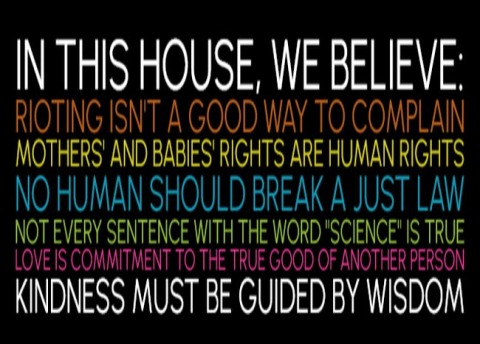
Where are the conservative yard signs?

Think about yard signs. The progressive ones read:

Black Lives Matter
Women’s Rights = Human Rights
No Human Is Illegal
Science Is Real
Love Is Love
Diversity Makes Us Stronger
Kindness Is Everything

What would ours say? There are “conservative” yard signs for sale. But they contain no moral vision, nothing to believe in, only an effort to “own the libs.”

Our cupboard is so bare that young men are filling auditoriums to hear Jordan Peterson tell them to clean their rooms.

Oren Cass, Constructing Conservatism.

In my weaker moments, I’ve been known to look for an “own the libs” yard sign in response to the mincing sentiments of the progressive sign quoted, but nothing I found (and I found very little) was anything I’d put up in my yard.

The Nicene Creed might fit on a sign, but it would illegible to passing drivers, and I would be taking God’s name in vain if I put it up in rainbow hues.

From Front Porch Republic’s Saturday recommendations

  • Wendell Berry at 90.” Jonathon Van Maren reflects on why Wendell Berry means so much to so many of his readers: “Berry’s fiction is not only a record of rural life and the slow death of agricultural America, but also a record of the interior lives of Americans before we outsourced our thinking to digital devices and absorbed our worldviews from screens. His novels lack the frantic pace of so many of his contemporaries; reading them, I had to slow my own mind and detach from the mile-a-minute culture wars to match the pace of the men and women of Port William. Always, his stories left me feeling refreshed.”
  • Why Christian Parents Should Resist School-Issued Screens.” Patrick Miller offers a set of arguments supported by research to help parents push back against the lure of progress. He draws from his own experience on a school board: “We were offered tens of thousands of dollars in grants to pay for one-to-one devices in our classrooms. Saying no felt like stealing something from students. It felt like resisting progress. But we said no anyway, because our pressing question wasn’t ‘How can we restructure our curriculum around new technology?’ but ‘What technologies are best suited to serve our educational mission?’ Technology wasn’t our master; it was the servant. And there wasn’t enough research to prove it was a good servant.”
  • Life on Mars.” Grace Mackey pens a thoughtful review of Haidt’s book, The Anxious Generation: “As a member of Gen Z, this was not a light read. When you spend your teens owning a smartphone, you grow used to hearing your parents and teachers blame your problems on a phone— It gets tiresome. I understand the skepticism towards Haidt and the concern that he is a grumpy old man tired of watching the online world expand into something foreign to him. I had some of that skepticism. Regardless, I picked up his book because I was genuinely curious if he offered explanations of anxiety that I hadn’t heard before. This past year, I started therapy because I needed help managing my anxiety disorder. While reading, it didn’t take long for my skepticism to fade and alarm to set in. I was struck by how deeply I resonated with what Haidt described.”

Front Porch Republic

“I was there” at the founding of Front Porch Republic, having followed several of the founding curmudgeons (e.g., Patrick Deneen, Jason Peters) before they coalesced. FPR has changed, but I still find it very much worth reading still — the Saturday curation of others’ articles especially.

Concurring with exemplary clarity

Earlier this year, the Supreme Court of Texas handed down a decision (Texas v. Loe) upholding that state’s law prohibiting medically irreversible and damaging transgender treatments for minors. The Court held that, in passing the statute, the Texas legislature employed its constitutionally legitimate power to promote the health and welfare of the state’s citizens. The law does not infringe upon the rights of parents to determine the medical care of their children or the rights of doctors to provide care.

Justice Jimmy Blacklock wrote a concurring opinion that laid out the issues at stake with exemplary clarity. He observed that the case turned on fundamental and mutually exclusive assumptions about what it means to be human.

Within the Traditional Vision, human males and females do not “identify” as men and women. We are men and women, irreducibly and inescapably, no matter how we feel. Proceeding from these moral and philosophical premises, the Traditional Vision naturally holds that medicinal or surgical interference with a child’s developing capacity for normal, healthy sexual reproduction is manifestly harmful to the child, an obvious injustice unworthy of the high label “medicine.”

Against this view, Blacklock ranges the alternative—“call it the Transgender Vision.” This view “holds that we all have a ‘sex assigned at birth,’” and thus assigned, it “may or may not correspond to our inwardly felt or outwardly expressed ‘gender identity.’” Under these assumptions, “the Transgender Vision holds that an adolescent child who feels out of place in a biologically normal body should in many cases take puberty-blocking drugs designed to retard or prevent the emergence of sexual characteristics out of line with the child’s gender identity.” It manifestly follows that parents and children have a right to this kind of treatment, just as they have a right to other medical procedures that promote well-being.

The Traditional and Transgender Visions “diverge at the most basic level.” The disagreement is metaphysical, as it were. Judges need to recognize that debates over medical procedures and disputes about empirical claims concerning the efficacy of transgender treatments “are merely the surface-level consequences of deep disagreement over the deepest questions about who we are.” The Traditional Vision sees the treatments as “self-evidently harmful to children,” whereas the Transgender Vision regards the same treatments as “necessary medical care.”

The constitutional question amounts to this: Does the Texas Legislature have the proper constitutional authority to legislate in accord with the Traditional Vision? Or does the Transgender Vision enjoy a special, privileged constitutional status, which the court must honor? Blacklock observes that it would be very strange for a judge to answer “no” and “yes.” How could anyone reasonably hold that the Traditional Vision, which has held sway from time immemorial, can’t serve as a rational basis for determining what accords with the health and welfare of citizens? And on what basis can a judge determine that the Transgender Vision enjoys privileged status, given the fact that it has never “obtained the consent of the People of Texas”?

A great deal of testimony in this case came from medical experts, who insisted that interventions to facilitate “transitioning” enjoy the approval of medical associations and other professional bodies. Blacklock notes that such testimony is irrelevant. “The Texas Constitution authorizes the Legislature to regulate ‘practitioners of medicine.’ It does not authorize practitioners of medicine to regulate the Legislature—no matter how many expert witnesses they bring to bear.” Quite right. Doctors and researchers are free to adopt metaphysical assumptions. But so are legislators. And when those assumptions conflict, those of elected legislators determine the law, not those of “experts.”

Blacklock gets to the nub of our debates about transgender ideology (and pinpoints the specious reasoning of the Supreme Court’s Bostock decision): Those urging transgender rights “claim that the Transgender Vision is an established matter of science, not a matter of belief.” But saying it does not make it so. “From the perspective of the Traditional Vision”—I would say, from the perspective of any clear-thinking person—“any such assertion is an inherent conflation of speculative philosophy and empirical science. Neither a philosophical proposition (‘gender identity is real’) nor a moral rule (‘gender identity should be affirmed’) can be proven with scientific method or the tools of medicine.”

Medical associations, academic journals, and universities have become captive to progressive ideologies, transgender ideology among them. They are certainly not trustworthy sources of moral wisdom. And they are increasingly untrustworthy sources of empirical truths. Kudos to Justice Blackwood for so clearly explaining why their distorted moral presumptions and perverted science should not be accorded transcendent legal authority.

R. R. Reno in First Things.

Reno has steered First Things so far in a MAGA (and Roman Catholic) direction that I was resolved to drop it. Then came the October issue, with Oren Cass’ article, Constructing Conservatism, three erudite responses to it, and this item, which I had not seen elsewhere. I guess I’ll be in for another year, but it sure is a bleak landscape most months.

Effete aristocrats

The dirty secret of “content moderation” everywhere is that it’s a tiny sliver of the educated rich correcting everyone else. It’s telling people what fork to use, but you can get a degree in it.

In prerevolutionary France, even the most drunken, depraved, debauched libertine had to be prepared to back up an insolent act with a sword duel to the death. Our aristocrats pee themselves at the sight of mean tweets. They have no honor, no belief, no poetry, art, or humor, no patriotism, no loyalty, no dreams, and no accomplishments. They’re simultaneously illiterate and pretentious, which is very hard to pull off.

Matt Taibbi on fighting back against the censors

The Airplane Class

A: One plane flight a year cancels out a lot of “environmentalist” talk.
B: I have been saying this for years. It’s even more true if CO2 emissions are all you care about; on those grounds alone you’re better off trading your Tesla for an F250 and canceling that trip to Europe. But airplanes are to one class what trucks are to another, and it’s the airplane class that runs things. Environmental policy, like everything else, is too often a matter of whose ox is being gored.
C: The airplane class is definitely a thing–and boy how [do] they love to lecture the bumpkins.

I didn’t ask permission to identify the writers (none of which was me), but thought the “Airplane Class” was a useful construct.


I suffer more from the humiliations inflicted by my country than from those inflicted on her.

Simone Weil, from a letter to Georges Bernanos.

I don’t do any of the major social media, but I have two sub-domains of the domain you’re currently reading: (a) You can read most of my reflexive stuff, especially political here. (b) I also post some things on the only social medium I frequent, because people there are quirky, pleasant and real.

Saturday politics

Convention and its dramatis personae

Convention tidbits

All political conventions are cringe-worthy idolatry fests. But even by those low standards, there was so much abject Trump flattery going on among his cultish speakers that if this had been Kim Jong-un’s convention, he’d have told his propagandists, “Hey, fellas, dial it back a little.”

Matt Labash

I do not take idolatry as a harmless pecadillo.

Trump made many false claims about immigration throughout his remarks, but the most absurd was: “You know who’s taking the jobs, the jobs that are created? One hundred and seven percent of those jobs are taken by illegal aliens.”

Katherine Mangu-Ward

How does one take that “seriously but not literally”?

Compared with Trump’s acceptance speeches in 2016 and 2020, which were unusual enough, this one was unrestrained, self-indulgent and undisciplined, radiating a sense of grievance. It was Trump untethered, which is the right way to understand what his second term would be. We can’t say we haven’t been warned.

Peter Wehner

Oh give him a break. He’s an old man who has a limited playlist.

60 seconds of unified tone

It was then that Trump struck the tone of national unity that he had teased in interviews leading up to the convention, promising to be a president for all Americans. “I am running to be president for all of America, not half of America, because there is no victory in winning for half of America,” he said. “I’m here tonight to lay out a vision for the whole nation, to every citizen. Whether you’re young or old, man or woman, Democrat, Republican, or independent, black or white, Asian or Hispanic—I extend to you a hand of loyalty and of friendship. Together, we will lead America to new heights of greatness like the world has never seen before.”

That unified tone last for about … a full 60 seconds. No, Trump went on to spend most of the more than 90-minute speech—the longest nomination acceptance speech in modern history—riffing on old motifs like, as Drucker put it on Dispatch Live late last night, the Grateful Dead at a jam: Same song, different flavor. Far from revealing a changed man, reformed by a near-death experience, Trump’s speech showed a man unchained and more-or-less as he’s ever been.

The Morning Dispatch

Hold onto your hat

We saw something epochal: the finalization and ratification of a change in the essential nature of one of the two major political parties of the world’s most powerful nation. It is now a populist, working-class, nationalist party. That is where its sympathies, identification and affiliation lie. There will be shifts, stops and accommodations in the future, no party ever has a clear line, history intervenes, but it is changed, and there will be no going back.

It should be added that it was creepy to see members of the Trump family dominating prime speaking slots all week. This was carelessly cultish, and in its carelessness insolent. Mr. Trump’s speech was surprisingly muted, scattered and low-energy. It lacked drama even though he was narrating what it is like to be shot.

A final point. We have, many of us, for some time—months, certainly the past few weeks—felt various degrees and kinds of horror. But oh these are exciting times. Things are moving, shifting. Again, this is big history. Hold on to your hat.

Peggy Noonan

Bootstrapping

Vance had a grandmother who encouraged him—and, perhaps equally important, discouraged him—in the right ways. And Vance did what poor white trash types who do not wish to remain poor white trash do: He got out, in his case by joining the Marine Corps, one of the great exemplars of American meritocracy. He went to a good state college and an Ivy League law school, he married a woman from an immigrant family with values superior to the ones exhibited by the Real Americans™ who brought him into the world, took a job that paid a lot of money, and made the kind of social and economic connections that give a man options in life. He rails against multinational corporations and “woke” colleges and then goes home to his wife, a lawyer whose clients have included the Walt Disney Co. and the University of California; he himself is a former Silicon Valley venture capitalist, not a small-town hardware-shop owner. He rails against self-interested billionaires while Peter Thiel scratches him behind the ear

One must respect the hustle. Even if one retches, just a little.

Kevin D. Williamson

But Kevin: Isn’t this pretty low-hanging fruit? Won’t any Presidential or Vice-Presidential nominee be, ipso facto, “privileged”? Does every up-from-poverty success per se disprove a populist “they’re screwing you” pitch to those still in poverty? Isn’t Biden screwing “the working man” by forgiving elites’ student loans? Have I left out any Latin shorthand?

Let’s try another language then. ¿Porque no los dos? Why can’t oppression be real yet surmountable for a few?

Absolution and a call for revenge

Vance talked about working-class white people the way liberal Democrats used to talk about Black communities in the early 1970s. At 39, he is too young to remember those days, but Republicans back then charged liberals with abetting the misery of Black communities by making excuses for their challenges. And they had a point: Half a century ago, some liberals did indulge in a kind of cringey, paternalistic excuse-making that depicted Black people as mindless victims, unable to control themselves when faced with the relentless forces of capitalism and consumerism.

Conservatives countered that the narrative of victimhood never serves anyone except the political leaders who reap votes from convincing people that they are merely hapless targets who need to be protected from a world full of sinister conspirators. Those who genuinely cared about the collapse of the cities (and there were more than a few who didn’t, to be sure) stressed the importance of personal choices and the power of individual responsibility. They refused to accept policies that led, in their view, to permanent dependence on the state. Perhaps most important, they sharply criticized the language of victimhood. And Vance, until recently, seemed to embrace those old-school, center-right views.

So it was particularly jarring to hear Vance talking down to Appalachians and working-class households in ways that he himself likely would have found insulting before ambition snuffed out his ability to feel shame. All his previous talk of responsibility and initiative was gone, replaced by images of a heartland full of victims, a Norman Rockwell world now inundated with fentanyl and cheap Chinese electronics by Washington’s scheming elites.

Through it all, you could almost hear the issuance of absolution and the call for revenge: It’s not your fault that your unemployed son lives at home, staring at screens and getting high all day. Biden and Beijing and Wall Street did that. We’ll settle the score somehow. It was a night of messages every bit as infantilizing and degrading as any Vance and the old GOP would have once castigated had they been offered by the old left.

Tom Nichols, Hillbilly Excuses

What jumped out at me here wasn’t “JD Vance is a phony” but “Republicans are now treating dysfunctional white people as Democrats once treated black people” (and unlike Vance, I’m old enough personally to remember those days).

In this, Tom Nichols is running on a track perfectly parallel to Kevin D. Williamson:

I’d been writing about lower-class, mainly white dysfunction for a few years at that point, and Vance had just published his famous book, which I had reviewed in Commentary. I admired his work tremendously—and, naturally, envied him some, too. We had a good conversation. 

Watching his descent into … whatever it is he has become … has been dispiriting. Have you ever had an acquaintance, someone you see only infrequently, who had a terrible problem with addiction or some sickness, and every time you saw them they were noticeably worse? I see Vance only in the news, but that is kind of what it is like. Or like visiting your hometown every few years and seeing it decline. 

Declining hometowns are a theme of Vance’s. It’s mostly bulls—t, of course. What’s true of much of Appalachia is true of much of the Rust Belt: Nothing happened to those communities. Eastern Kentucky isn’t poor because of NAFTA or the WTO—it was poor when Andrew Jackson was president, and it has been poor since.

(See more of this Williamson column above)

Second-hand synthesis

Synthesizing what I read of it, the GOP Convention was a big, cheerful, sexy, vulgar, idolatrous pagan bacchanalia.

Of course, when the line between enthusiasm and idolatry is crossed at a political convention can be subtle, but I’m in a Christian tradition oft-accused of idolatry for saying of the Theotokos and the Saints things less hyperbolic than were repeatedly said of Trump this week.

One silver lining: Zombie Reaganism is as good and truly dead as conservatism in GOP version 2024.

Twixt now and November

Still beatable?

After beginning his speech with calls for unity — “There is no victory in winning for half of America” — the former president turned the convention into a Trump rally, attacking “crazy Nancy Pelosi” and slamming Biden by name after Republicans said that he would rise above the insults and not mention the president.

He ripped into Democrats on Social Security, Medicare, the border and energy policy, saying America was “stupid” under Biden while ad-libbing about Hannibal Lecter and having the next Republican convention in Venezuela.

Trump was suddenly thin on the unity and heavy on the unhinged, as his speech became tiresome and stretched past midnight on the East Coast. Biden may have messed up the June debate, but Trump’s own cognitive functioning was messing up the July convention.

Patrick Healy, Trump Goes Off the Rails. This Guy Is Still Beatable

Where the Democratic opportunity lies

[T]he problem with MAGA — and here is where the Democratic opportunity lies — is that it emerges from a mode of consciousness that is very different from the traditional American consciousness.

The American consciousness has traditionally been an abundance consciousness …

Many foreign observers saw us, and we saw ourselves, as the dynamic nation par excellence. We didn’t have a common past, but we dreamed of a common future. Our sense of home was not rooted in blood-and-soil nationalism; our home was something we were building together. Through most of our history, we were not known for our profundity or culture but for living at full throttle.

MAGA, on the other hand, emerges from a scarcity consciousness, a zero-sum mentality: If we let in tons of immigrants they will take all our jobs; if America gets browner, “they” will replace “us.” MAGA is based on a series of victim stories: The elites are out to screw us. Our allies are freeloading off us. Secular America is oppressing Christian America.

Viewed from the traditional American abundance mind-set, MAGA looks less like an American brand of conservatism and more like a European brand of conservatism. It resembles all those generations of Russian chauvinists who argued that the Russian masses embody all that is good but they are threatened by aliens from the outside. MAGA looks like a kind of right-wing Marxism, which assumes that class struggle is the permanent defining feature of politics. MAGA is a fortress mentality, but America has traditionally been defined by a pioneering mentality. MAGA offers a strong shell, but not much in the way of wings needed to soar.

If Democrats are to thrive, they need to tap into America’s dynamic cultural roots and show how they can be applied to the 21st century ….

David Brooks, What Democrats Need to Do Now

On the other hand …

[C]anceling student loan debt would be a massive unforced error for the newly minted Biden administration. It would show that one of the new Democratic president’s highest priorities during a pandemic and a destabilizing economic shock is to provide a bailout to people who are overwhelmingly likely to end up as members of the upper-middle class. It would amount to a transfer payment from contractors and service workers to high-earning knowledge workers and other white-collar employees. As such, it would also accelerate trends in the Democratic Party that would leave it vulnerable to a Republican Party increasingly trying to rebrand itself as a champion of the working class.

As economist Thomas Piketty and others have pointed out in recent years, center-left political parties suffer at the ballot-box when they come to represent the interests of the upper-middle class at the expense of the working class, allowing the nationalist-populist right to make inroads with the latter. This has happened in a series of European countries in recent years, and it’s happening in the U.S. as well, with the Democrats enjoying surging support in inner-ring suburbs but losing ground in working-class, exurban, and rural areas. In the 2020 election, Democrats were able to defeat Donald Trump with this coalition, but they got tripped up down ballot, most likely falling short of a Senate majority, losing seats in the House, and failing to flip even a single state legislature.

Sixty-five percent of Americans haven’t graduated from a four-year college. Will that large majority really favor a multi-billion-dollar bailout for people who hold those degrees when their indebtedness was freely taken on and has granted them a credential that gives them a ticket to lifetime higher earnings?

Damon Linker, The Class Folly of Canceling Student Loans (11/18/2020)

I don’t know that Trump or Vance has spoken about this, but if I judge persuadable undecideds accurately, they should, because despite warnings from people like Linker, Biden pandered to the wealthy in this way and others.

Whence conspiracism?

When you don’t know how things work, everything looks like a conspiracy.

Jonah Goldberg


I suffer more from the humiliations inflicted by my country than from those inflicted on her.

Simone Weil, from a letter to Georges Bernanos.

I don’t do any of the major social media, but I have two sub-domains of the domain you’re currently reading: (a) You can read most of my reflexive stuff, especially political here. (b) I also post some things on the only social medium I frequent, because people there are quirky, pleasant and real.

Independence Day

Public Affairs

The Immunity Ruling

The mark of an iconic Supreme Court decision is timelessness. With every read, the opinion teaches new insights and provides new lessons on our Constitution. Each semester when I prepare a case like Marbury or McCulloch, I learn something new.

Opinions from Chief Justice Roberts, however, are just the opposite. They are best read once. After the first read, you will come away entirely persuaded that Roberts’s analysis was not only the best answer (to use the Loper Bright framing), but the only conceivable answer, as any contrary positions are unfounded. That’s the first read.

But when you read a Roberts decision a a second, a third, and a fourth time, all of the fancy veneers and window dressing start to come off ….

Josh Blackman.

On Trump v. United States, people I trust who’ve taken the time to work through the case (I was never a prosecutor, rarely a criminal defense attorney) say it’s going to be very hard to prosecute a President for anything. That is not the impression Justice Roberts created on first reading of his opinion.

That means, in essence, that “the President is not above the law” is substantially false now.

And that means that Trump may soon no longer be a convicted felon (because Judge Merchan admitted testimony of a sort that Justice Roberts dubiously says may not be admitted).

I guess we’ll just have to elect someone else. What crueler punishment for Trump than an emphatic electoral drubbing? (But what crueler punishment for the USA than to re-elect the zombie currently in the Oval Office?)

Some thoughts, though:

  1. I just about freaked out when, in law school, I learned that “immunity” was a thing. Lots of people are “above the law” in various circumstances, including crooked prosecutors, judges, policemen (“qualified immunity” in too many circumstances), trash-talking Congressmenpersons. I’ve even figured out why that’s often the lesser evil compared to no immunity. So get it out of your head that keening about “they made him above the law” communicates anything salient.
  2. This isn’t just about Trump. It’s about all Presidents. Good luck prosecuting Joe Biden, Cheeto Benito — or Mike Pence, or Barack Obama, for that matter.
  3. Do you really think that none of the Presidents in your lifetime until Trump has crimed — if only to protect the country from, for instance, terrorists whose location we knew?
  4. That we have an ex-President who is almost certainly guilty of vile, self-serving, delusional crimes is a very, very, very sorry commentary. That his crimes commend him to so many voters is even worse.
  5. Just about everyone agreed that the court would extend, and should extend, some measure of immunity from criminal prosecution to our Presidents. The decisions of the lower courts that Presidents have zero immunity were surprising (likelier, shocking) and unlikely to stand. But few expected the court to give Presidents the extensive practical immunity that emerges from the weeds when you get deeply enough into them.
  6. The lack of constitutional language making the President immune to criminal prosecution is barely interesting, let alone dispositive. There’s no “separation of powers” clause, either and for instance, but it’s fundamental to our system and implied by what is specified.
  7. If and when Trump issues a lawless order, the people he orders should consider refusing to carry it out because I don’t believe they’ll ride his immunity coat-tails. I can only hope that Project 2025 hasn’t vetted a full slate of Trumpist sociopaths who’ll never threaten mass walkouts.
  8. We need to get it through our heads that our Presidents are, pretty much, above the law and that we should try to elect people who aren’t, for instance, promising a retributive crime spree against their adversaries.
  9. When Trump crimes in his second term, I hope we’ll have a Congress willing to impeach, because the Senate will no longer have the excuse that the criminal justice system can deal with it.

I don’t mean to say it will all work out okay. We’re in unchartered territory with Zombie Joe v. Cheeto Benito and his merry band of Project 2025 vandals. I’ve been bearish on the USA for quite a while now, heaven help me — the cultural equivalent of “the financial doomsayers who has correctly predicted 10 of the last three recessions” (see below).

The Unitary Executive

Not unrelated to the matter of Presidential immunity is the “unitary executive” theory.

I thought I was fairly sophisticated on matters of Constitutional Law, but an article in the New York Times lays out with unusual clarity a sort of meta-battle going on in the legal ether above some recent SCOTUS decisions: Charlie Savage, Conservative Legal Movement’s Agenda Unites Court’s Rulings on Executive Power. That’s freebie “shared link,” by the way.

It leaves me feeling freshly conflicted about the independent regulatory agencies we have. They’re “a headless fourth branch of the U.S. government” as Justice Kavanaugh once put it in his pre-SCOTUS days. But the Project 2025 vandals are not at all conflicted; they want to domesticate all regulatory agencies. That would mean that we would have even wider swings in policy from Administration-to-Administration, as far fewer career civil servants would carry over, and far fewer good people would be willing to go into low-profile career governmental service.

I highly recommend the article, and plan to re-read it at least once in a few weeks.

UPDATE: A recommended companion read for Savage is from Josh Blackman again, The Goal Of The “Architects of the Supreme Court” Was Always Overruling Chevron, and not Overruling Roe.

Bare-faced lies

Earlier this year, New York Times columnist Paul Krugman was boasting of the personal time he spent with Biden, who he proclaimed to be “completely lucid and with excellent grasp of detail”. After the debate, Krugman called on Biden to step down. Senile dementia is a clever disease. Or maybe Krugman didn’t like the face he saw in the mirror the morning after Biden’s debate performance.

What astounded Krugman and his fellow bold-faced journalist types about Biden’s rotten debate performance wasn’t the obviousness of Biden’s mental decline, but the fear that they were now publicly shown to have been lying. Krugman’s fellow in-house NYT author of Soviet state propaganda, Thomas Friedman, who fancies himself an “old friend” of Biden’s, was writing fibs about Biden as late as last month while boasting of his long off-the-record conversations with the President about the future of the Middle East. It took Friedman less than 24 hours to proclaim that Biden’s debate performance had made him “weep”. Poor man — no doubt it did. David Remnick of The New Yorker, who authored a door-stopper-sized hagiography of Barack Obama during the President’s first year in office, was equally quick to go public with his discovery that Joe Biden was maybe not exactly up to sorting marbles by size or colour, just in time to become a virgin for the next election.

It’s hard to be revealed as a fibber — especially when your job is ostensibly to tell the truth. But the sight of journalistic worthies suddenly grabbing hand towels to cover their proximity to power was not by itself enough to explain the Night of the Journalistic Long Knives.

David Samuels

Whataboutism comes home

On the center-left, Mark Leibovich isn’t pulling his punches in a piece on the Democrats sticking with Biden: “Since President Joe Biden’s debate debacle on Thursday, I’ve learned two things for sure: first, that Republicans are not the only party being led by a geriatric egotist who puts himself before the country. And second, that Republicans are not the only party whose putative leaders have a toxic lemming mindset and are willing to lead American democracy off a cliff.” (The Atlantic)

The Free Press

History will, if necessary, judge between the harm wrought by the two geriatric egotists.

Without comment

Lighter fare

One movie is worth how many words?

The shocking decline of the city—driven by any number of factors, but most certainly liberal policies high among them—drove massive white flight and deindustrialization of the city. Vast numbers of New Yorkers moved to the suburbs in Long Island, New Jersey, or in enclaves in the outer boroughs.

(An interesting exercise is to look at the movies set in the Big Apple in the early sixties compared to those in the early 70s and you can see the suddenness of the decline. From Breakfast at Tiffanys, That Touch of Mink, and Barefoot in the Park_to _Death Wish, Taxi Driver, Dog Day Afternoon, and Serpico in about a decade.).

Jonah Goldberg

Past its sell-by date

MoveOn is the textbook example of an organization that has outlived its purpose. Founded more than a quarter-century ago to argue that the country needed to “move on” from Bill Clinton’s intern-diddling impeachment drama, it had two things that confer a very long life in American politics: office space and a good fundraising list. And so, while the country has moved on, MoveOn hasn’t. Which is weird, but this is America.

Kevin D. Williamson.

Frank Bruni’s beloved sentences this week

  • In The New Yorker, Susan B. Glasser reflected on a micro-tussle toward the end of last Thursday night’s presidential debate: “Is this how democracy dies, in a shouting match between two seniors about their golf game?” (Thanks to Mike Greenwald of Melville, N.Y., for nominating this.)
  • In The Connecticut Post, Colin McEnroe pondered the president’s proper course: “I’m guardedly a ‘replace him’ guy. Some of you may recall that in 2019, I compared Biden to a Subaru with 310,000 miles on the odometer … But Thursday night was 90 minutes of the ‘check engine’ light flashing desperately in the darkness.” (Holly Franquet, Fairfield, Conn.)
  • In The Atlantic, Caitlin Flanagan evaluated Americans’ attitudes toward NATO … NATO is the rotary phone of geopolitical alliances.” (Richard Reams, San Antonio)

Frank Bruni

Quickies

a matryoshka doll of mendacity

George Conway’s description of Trump, apropos of the New York records falsification case.

one of those financial doomsayers who has correctly predicted 10 of the last three recessions.

The Free Press

Slate, which, as we all know, employs lab monkeys escaped from federal cocaine experiments as fact-checkers

Kevin D. Williamson

An aphorism can never be the whole truth; it is either a half-truth or a truth-and-a-half

Karl Kraus

(Economist World in Brief)

Plaintiff Accused of Being “Litigious” Sues for Slander

Eugene Volokh

Male and female

This view would understand the division of man into male and female as, of course, a biological actuality; i.e., this is the way it is. It seems to be a necessity; it is at least a convenience; and it is certainly a delight.

Thomas Howard, Chance or the Dance?, written before gender ideology was a thing.


I suffer more from the humiliations inflicted by my country than from those inflicted on her.

Simone Weil, from a letter to Georges Bernanos.

I don’t do any of the major social media, but I have two sub-domains of the domain you’re currently reading: (a) You can read most of my reflexive stuff, especially political here. (b) I also post some things on the only social medium I frequent, because people there are quirky, pleasant and real.

Saturday 5-18-24

Single Father repatriates

For several years, I’ve been reading the blog of Hal Freeman, an American who was living in Russia with his younger Russian wife and their children.

But then his wife, Oksana, died, leaving him a single father in a land whose language he hadn’t mastered. His lack of mastery made daily life difficult, and to an extent left him at the mercy of his late wife’s family. And with them, the clash of cultures, American versus Russian, became a big problem.

So he and his youngest daughter returned to the U.S., leaving some sons in Russia. After a month or so of visiting his U.S. sons from a prior marriage, he posted again, including this touching passage:

It has been very hard moving without a wife. I am not just talking about the help in getting things packed and unpacked. It is hard not having someone so close with whom I can discuss what is going on and what we are going through. I have appealed more than once to C.S. Lewis’ book, “A Grief Observed,” and the analogy he used of a man who had a leg amputated. At first the pain can be sharp and overwhelming when touched. Over time, there is healing. The sharp pain and the extreme sensitivity fades. He learns to get around much easier over time. Nevertheless, when he gets into a car or the bath, he remembers that he is an amputee. 

It has been well over two and a half years since Oksana departed this life. I don’t have those times of sharp, excruciating pain in my soul anymore. I have learned to move on and accept that I am a single father. Yet, the move has made the memory of her departure more difficult again. And, I am facing the reality that at my age and with my rather different circumstances, I probably will never have the joy and contentment of a life companion again. And I can honestly say–and I believe I speak for many others who have lost their spouse–it really isn’t so much about missing what she could do for me. I miss doing things for her. There is great emotional reward in caring for and doing things for the one you love. As someone else who had gone through the grief said to me, “Grief is love that has nowhere to go.”

Life Begins Again in America

Barring simultaneous death in an accident or something, my wife and I face that prospect sooner rather than later, both of us having attained our allotted threescore and ten. She, having kept up roughly four close friendships, probably would cope better than I would.

Transing the gay away

At the risk of being accused of concern-trolling, I’m passing this along because it really does bother me.

[T]he entire category of gay kids has been abolished by, yes, gay groups. Gay kids are now conflated with entirely different groups: children who believe they are the opposite sex, straight kids who call themselves “queer,” an entirely new category of human beings called “nonbinaries,” and a few hundred new “orientations” and “genders” — including eunuchs! All of these kids are now deemed “gender diverse,” essentially living the same “LGBTQIA+” life, defined as being queer and subverting any and all cultural and social norms. Homosexuality? It has effectively evaporated into “gender diversity.”

The last thing a gay boy needs to be told is that he might actually be a girl inside — and that might be the source of all his troubles. It’s psychologically brutalizing and scarring.

… It’s the deepest, oldest homophobic trope: that gay boys aren’t really boys. And it is now being deployed by gender theorists as gleefully as it once was by bigots.

… The overwhelming majority of detransitioners are gay men and lesbians who were persuaded they were trans in childhood. In the old days, sorting through these feelings just required growing up — no need to make a decision until you’re an adult — and every decision was reversible. In the age of “affirmation-only” and “gender-affirming care,” all this becomes ever more fraught as kids are required to make a decision against a pubertal clock. And this is not a hypothetical. We know it has happened; we know it is happening. For many gender-dysphoric children, there is no doubt that “gender-affirming care” is literally transing the gay away.

Andrew Sullivan (emphasis added).

What greater manifestation of “internalized homophobia” could there be than deciding that my attraction toward boys must mean I’m a girl (or vice-versa)? Yet, valorizing this madness has become “progressive” dogma.

Presidential “debates”

The first televised presidential debates were between John F. Kennedy and Richard Nixon in 1960. The contrast between them and the last debates between Trump and Biden is striking—and appalling. The 1960 candidates soberly aired their views on issues of the day, differing with one another firmly but in a civil manner. The events were reasoned, mature, and valuable. There were reasons Nixon’s sobriquet was “Tricky Dick” and they were widely known. But on camera in those debates he, from today’s vantage-point, seems almost professorial, measuring his words and tackling serious issues.

Donald Trump is incapable of meaningful participation in such an event. Only in the sense that “match” can apply to both chess and mud wrestling could the word “debate” apply both to the Kennedy-Nixon event and to Trump’s on-stage behavior. Trump cannot help but distort a debate into a cage-fight. He will, again, shamelessly lie and endlessly interrupt.

This is especially problematic because Trump’s behavior during such events can be misleadingly seductive … To many, Trump’s unplugged alpha splatter lends an enticing sense of vigor, strength, and even leadership quality … Trump’s verbal towel-snapping is extreme—he is now renowned for the ability to entrance an audience while communicating all but nothing of importance.

John McWhorter

I not infrequently post provocative things I may not agree with. This is not one of those posts. There are other ways Biden could have declined “debate” (e.g., “I will not debase the office of the Presidency by engaging with a man under 91 criminal indictments”), but he’s made that harder by getting his Irish up and smack-talking Trump.

Body-snatched?

It seems that the home of Supreme Court Justice Samuel Alito flew and upside-down American flag for as many as several days shortly after the January 6, 2021 insurrection. Justice Alito attributes that to his wife’s response to a pissing contest with progressive neighbors.

Nick Cattogio isn’t unequivocally buying that explanation. After a trip into the weeds, he ascends to a higher-level overview:

Our friend David French reminded his readers today of one of Jonah Goldberg’s most famous columns, the Invasion of the Body Snatchers piece from March 2016. It was written just as Trump was locking up the Republican presidential nomination for the first time. The influence of ascendant MAGA populism on conservatives whom he’d known for years wasn’t merely profound, Jonah wrote. It was eerie.

He described the change his way: “Someone you know or love goes to sleep one night and appears the next day to be the exact same person you always knew … Except they’re different, somehow. They talk funny. They don’t care about the same things they used to.”

That was eight years ago. By now, every person reading this has had extensive personal experience with the phenomenon he observed. It’s happened again and again, in plain sight.

That experience is inescapable context for the reaction to the Times’ story. Maybe the Alitos are getting a bad rap about the flag. Maybe the justice is prepared to thwart Trump’s unconstitutional ambitions in a second term.

Or maybe another body is on its way to being snatched. Why should the Supreme Court be immune from to an ideological virus that’s convinced right-wingers that vindicating America’s constitutional vision requires empowering Donald Trump?

Until the body-snatcher era ends, no one who shows evidence of having been snatched gets the benefit of the doubt. Not at the bottom of the conservative movement and not at the top either.

Culture war debt forgiveness

You’ll notice we are not having a national debate about paying off poor people’s mortgages. We could do that just as easily if the self-declared champions of the poor had any interest in anything other than their own status and their own appetites. They don’t.

National Review, The College-Debt Debate Is a Culture-War Battle

When theology fails

Harm to you is not harm to me in the strict sense, and that is a great part of the problem. He could knock me down the stairs and I would have worked out the theology for forgiving him before I reached the bottom. But if he harmed you in the slightest way, I’m afraid theology would fail me. That may be one great part of what I fear, now that I think of it.

Marilynne Robinson (one of her Gilead novels)


So: where did all my mockery of Trump go?

I suffer more from the humiliations inflicted by my country than from those inflicted on her.

Simone Weil, from a letter to Georges Bernanos.

You can read most of my more impromptu stuff here and here (both of them cathartic venting, especially political) and here (the only social medium I frequent, because people there are quirky, pleasant and real). All should work in your RSS aggregator, like Feedly or Reeder, should you want to make a habit of it.