A campaign led by the kings of France and England to recapture it had failed. A second expedition, launched in 1202 in obedience to Innocent’s own summons, had been diverted to Constantinople. In 1204 it had stormed and sacked the city. A stronghold that for long centuries had withstood the envy of pagan warlords had fallen at last—to a Christian army. Its captors justified their storming of the city by charging that its inhabitants were rebels against the papacy: for the churches of Rome and Constantinople, ever since the age of Gregory VII, had been divided by an ever-widening schism. Innocent, however, appalled by the despoliation of Christendom’s bulwark, lamented the fall of Constantinople as a work of hell.
Tom Holland, Dominion.
The Great Schism between the papacy and Eastern Christian patriarchs is conventionally dated 1054, and not without reason. But those who dig deeper (or, like me, who read those who have dug deeper) tend to think that the 1054 schism was curable until this sacking of Constantinople by Crusaders.
A quintessential American heresy
[L]iving by no rule but the Bible turned out to be a defense against virtually the same list of enemies as living up to the standards of republicanism: “Many are republicans as to government, and are yet half republicans, being in matters of religion still bent to a Catechism, creed, covenant, or a superstitious priest. Venture to be as independent in things of religion as in those which respect the government in which you live.” Few Protestants expressed themselves as flamboyantly as [Elias] Smith in the early republic, but most followed where he led.
I was reminded this week of a distinction that’s relevant here. I believe I learned it from the late Richard John Neuhaus, who I followed closely starting sometime in the 1980s. I won’t give a name (other than “quintessential American heresy”) to the view expressed so flamboyantly by Elias Smith, a view which I once effectively held, but I’m now in the camp of “ecclesial Christians”: those for whom faith in Christ and faith in His Church is one act of faith, not two.
I decidedly do not venture to be independent in things of religion, but very consciously submitted to the tradition of the Church particularly about Mary, the Mother of God-in-the-flesh, who was a stumbling-block to me as she has been to other Protestants (who in our generation call her “blessed” only sullenly, bound by scripture to do so).
The worst of the worst
Church management is a tricky and complicated business. I am glad that it is not my job. But I do know this much: The church is there for Gyp the Blood and Humpty Jackson, for Charlie Whitman and John Wilkes Booth and me. If there is no room for the worst of the worst in your church, then you do not have a church: You have a crappy book club.
But there is the question. What, precisely, is “the business of life”? We can get onto an endless carousel if we try to decide which is the serious stuff of life, work or play. It is possible to take either view: either we toil away our eight hours so that we can get down to the real stuff—pleasure and love and recreation—or we enjoy periodic intervals of escape from the real stuff, the work.
Thomas Howard, Chance or the Dance? I would not have retired had I thought the real stuff was work; that’s just livelihood, not life.
What evangelism can obscure
With the clergy focused on the task of evangelism, their doctrines received so little scrutiny that laypeople took them for granted: the Bible was an infallible guide in every situation, and the church taught what was written in it. Coming into contact with people who read the Bible differently, southerners, unconscious of their own scrim of interpretation, concluded that those others were not Christians.
There’s probably a better moral to this little story than I can write: convention is no assurance of morality.
Upright life, sound doctrine
Over and over again he insisted that in electing an abbot upright life and soundness of doctrine were to be the prime considerations, not rank or family influence. ’I tell you in all sincerity,’ he said, ‘that as a choice of evils I would far rather have this whole place where I have built the monastery revert forever, should God so decide, to the wilderness it once was, rather than have my brother in the flesh, who has not entered upon the way of truth, succeed me as abbot. Take the greatest care, brothers, never to appoint a man as father over you because of his birth; and always appoint from among yourselves, never from outside the monastery.
Religious ideas have the fate of melodies, which, once set afloat in the world, are taken up by all sorts of instruments, some woefully coarse, feeble, or out of tune, until people are in danger of crying out that the melody itself is detestable.
George Elliot, Janet’s Repentance, via Alan Jacobs
[N]one of the things that I care about most have ever proven susceptible to systematic exposition.
You can read most of my more impromptu stuff here and here (both of them cathartic venting, especially political) and here (the only social medium I frequent, because people there are quirky, pleasant and real and it has no-algorithms). All should work in your RSS aggregator, like Feedly or Reeder, should you want to make a habit of it.
Just as the Bishop of Oxford refused to consider that he might be descended from an ape, so now are many in the West reluctant to contemplate that their values, and even their very lack of belief, might be traceable back to Christian origins.
Tom Holland, Dominion
The virtue of essays
I write here not as a teacher to students but rather as a reader to other readers, a citizen to other citizens. I write because I think I have learned a few things in my teaching life that are relevant to our common life. You will see what those are if you read on.
My approach here is anything but systematic. Of all the literary genres, I am fondest of the essay, with its meandering course that (we hope) faithfully represents the meanderings of the human mind … certain images in advance and people will recur throughout this book, returning perhaps when you think we’re done with them. I write this way because none of the things that I care about most have ever proven susceptible to systematic exposition.
Alan Jacobs, Breaking Bread with the Dead. That last sentence is a gem.
Notional Evangelical Bibicism
As a public relations stunt, Trump’s Bible photo might seem unserious, but the president certainly understood the importance of Christian scripture to a significant voting bloc. Evangelicals are biblicists, and the extent to which American religiosity has been dominated by evangelical Protestantism correlates to the degree to which American culture has been shaped by the Bible.
When I try to explain to people why we need to recover patristic interpretation, the biggest obstacle I face is the desire of my interlocutors to establish the one, true meaning of the text. When I assert that there is no such thing, I provoke raised eyebrows: I must be playing fast and loose with the biblical text, making it echo my preconceptions. My insistence that biblical texts have multiple, even innumerable meanings contradicts our modern objectivism. My defense of patristic allegorizing likewise elicits fears of arbitrariness and subjectivism.
Nearly two decades ago, Bruce McCormack, professor of systematic theology at Princeton Seminary, wrote: “The situation in which Christian theology is done in the United States today is shaped most dramatically by the slow death of the Protestant churches.” He went on:
if current rates of decline in membership continue, all that will be left by mid-century will be Roman Catholic, Eastern Orthodox and non-denominational evangelical churches. . . . The churches of the Reformation will have passed from the scene—and with their demise, there will be no obvious institutional bearers of the message of the Reformation. What all of this means in practice is that it will become more and more necessary, for the sake of the future of Christianity, to establish stronger ecumenical relations with the Catholics and the Orthodox.
This is a grave prediction, but its sobriety makes it not just prescient but practical. Non-catholic varieties of Christendom are here for good, but Goldilocks Protestantism was always doomed to fail. It presumed too much, relying on a common inheritance—patristic, medieval, and cultural—that was bound to be called into question by future reformers in search of their own style of biblical renewal.
In any case, McCormack is right: Whether, in the coming decades, magisterial Christians look “up” or “down” for friendship and cooperation, they will be living in a world without Protestantism. In truth, they already are.
Many a man will live and die upon a dogma: no man will be a martyr for a conclusion.
John Henry Newman
Religious ideas have the fate of melodies, which, once set afloat in the world, are taken up by all sorts of instruments, some woefully coarse, feeble, or out of tune, until people are in danger of crying out that the melody itself is detestable.
George Elliot, Janet’s Repentance, via Alan Jacobs
You can read most of my more impromptu stuff here and here (both of them cathartic venting, especially political) and here (the only social medium I frequent, because people there are quirky, pleasant and real). All should work in your RSS aggregator, like Feedly or Reeder, should you want to make a habit of it.
I was familiar with all the intellectuals named except Jordan Hall, and they all seem to fit Brad East’s year-old Conversions, Protestantism, and a new mainline commenting on the rarity of intellectual conversions to Protestantism as opposed to catholic traditions. Add to Brad East’s exploratory hypotheses about that phenomenon those of Fergus McCullough, Why don’t intellectuals convert to Protestantism?.
Not too long ago, I was telling Ezra Klein that I had noticed a relatively new development in classical liberalism. If a meet an intellectual non-Leftist, increasingly they are Nietzschean, compared to days of yore. But if they are classical liberal instead, typically they are religious as well. That could be Catholic or Jewish or LDS or Eastern Orthodox, with some Protestant thrown into the mix, but Protestants coming in last.
As an Orthodox Christian, I take no offense at intellectual converts gravitating in a catholic direction, but for a number of reasons, I’m not doing an end-zone dance about it, either, unlike one (Roman) Catholic bishop in Texas:
Catholicism will be nihilism’s last competitor on the dance floor of history, and Catholicism will see it drop from exhaustion as the orchestra plays on. The music itself will testify.
Bishop Daniel E. Flores of Brownsville, Texas
But so what?
Men are apt to prefer prosperous error to an afflicted truth.
Those evangelicals of intellectual bent should be wrestling with this question, though.
Carefully Rehearsed Spontaneity
The framers of the Directory [for the Publique Worship of God] were not unaware of its paradoxical stance vis-à-vis ritual, either. Its preface obliquely acknowledged the oddity of institutionalizing a prescribed means of praying when Puritan teaching held that converted people would pray aright by the Spirit, but offered it as “some help and furniture” to the minister, so that he might “furnish his heart and tongue with Materials of Prayer and Exhortation, as shall be needful” (7-8). The careful, italicized language of the Directory, meant to be paraphrased but not displaced altogether, embodies a sort of anxious, secret checking of spontaneity that is in fact part and parcel of its logic. In spite of the selection of a man who appeared a trustworthy minister of God’s word, not only might his prayers stray from sound doctrine, but more than that, they might not flow freely, spontaneously, and affectively at all. In referring to the guide as “help and furniture,” the Directory portrays what it believes should be a modern, rational, self-transparent, and spontaneous self, operating under what it figures as deformities, weaknesses, and handicaps: seeking to authenticate its goodness and wholeness, yet perennially afraid of its inner divisions, the demand of its repeated performance, and perhaps most of all of its silences.
In this way, the Directory also looks toward the spiraling anxiety. That is one of the enduring legacies of Protestant and English dissenting spirituality in the restoration and enlightenment. More paradoxically than the writers of the Directory, Dissenters later wrote a vast literature to instruct those within their camp in the art of praying spontaneously. This literature too begs the question of why free prayer needed coaching, a query many dealt with directly. But it also sets forth as its most common recommendation for achieving true prayer the collection of lists of phrases, usually from Scripture, which once memorized would roll off the tongue and be easily assembled into prayer on the spur of the moment. Where the Directory‘s very form expresses the implicit knowledge that spontaneity is no real guarantor of (doctrinal or spiritual) truth, these free-prayer guides murmur with the fear that spontaneity may not come at all. While they seek to fill the mind with scriptural phrases, constructing, in Matthew Henry’s words, a “Storehouse of Materials for Prayer,” they also speak another truth. Besides being furnished with nonorthodox materials, the self that flees performativity and ritual, looking inward for authentic substance, finds itself fluctuating and, in the face of the demands of performance and empirical, experimental repetition, often silent and empty.
…
[Matthew] Henry’s Method culminates with his most fascinating phrase-collection of all, “A Paraphrase on the Lord’s Prayer, in Scripture Expressions.” Christ’s own form of prayer given to his disciples had long been a thorn in Puritans’ sides, to be plucked out by being understood as only a general guideline. Henry’s strategy is to neutralize the prayer’s form in a similar method; he provides, for instance, and amazing two and a half pages of verses elaborating on the one phrase “Our Father, who art Heaven” (MP, 163-65), a general topos, he says, from which prayer begins. Many editions of the Method were printed as Henry intended, interleaved with one blank page between each printed one, to enable the reader to pen in his own collection of phrases to supplement Henry’s own. Like Bunyan’s demand for scrupulous sincerity, Henry’s lists and blank pages, figures of accumulation and abstraction, combine literally to efface the Lord’s Prayer and erase it from Dissenting practice.
…
The more individualized these spiritual practices became, like the personalized collections of scriptural phrases, the more readily their constructedness-their nonspontaneity-was apparent, opening the believer to a sense of isolation and perpetual, nearly neurotic self-critique …
This fake spontaneity persists in verbal tics like “Father God, we just” this, that, or the other thing. It’s like refrigerator magnet poetry only less creative.
The sober prayers of the Book of Common Prayer always secretly guided me when, as a Calvinist Elder, I was to lead congregational prayer, and those of the Orthodox Prayer books had an outsized influence on my eventual embrace of Orthodoxy.
Watch what they do, not what they say
Paradoxically, therefore, the structures necessary for the Reformers to extend the sacred into all of life included a whole constellation of structures and practices that they undermined. For if everything is sacred, then in another sense, nothing is sacred. This struck me in a particularly visceral way one Sunday morning at the Calvinist church in Idaho. After the service, I went to use the restroom and found leftovers of Communion bread in the bathroom garbage. The clergy routinely gave leftover bread and wine to the children to consume as a snack, which the children could then take wherever they wished.
You can read most of my more impromptu stuff here and here (both of them cathartic venting, especially political) and here (the only social medium I frequent, because people there are quirky, pleasant and real). All should work in your RSS aggregator, like Feedly or Reeder, should you want to make a habit of it.
Formatting things a bit differently today, without “headlines.”
After he had twice visited the United States in the 1930s, Dietrich Bonhoeffer wrote a perceptive essay contrasting Christian development in America with parallel developments in the parts of Europe most directly shaped by the Protestant Reformation. His assessment included an observation that was as shrewd in its comparative wisdom as it is relevant for the themes of this book: “The secularization of the church on the continent of Europe arises from the misinterpretation of the reformers’ distinction of the two realms [of church and society]; American secularization derives precisely from the imperfect distinction of the kingdoms and offices of church and state, from the enthusiastic claim of the church to universal influence in the world.” What Bonhoeffer saw has been described with other terms here: The key moves in the creation of evangelical America were also the key moves that created secular America.
It is a matter of great historical significance that American Protestants almost never cited biblical chapter and verse to defend their interpretive practices. Precisely as it worked on Scripture, the Reformed, literal hermeneutic revealed most clearly how it arose from the special circumstances of American life. Yet even if this hermeneutic itself was not necessarily rooted in a literal reading of Scripture, it was nonetheless the American norm for the generations between the writing of the Constitution and the end of the Civil War.
Mark Noll, America’s God. (You may need to chew on that a bit. Or read the book.)
Religions devised for a social purpose, like Roman emperor-worship or modern attempts to ‘sell Christianity as a means of saving civilisation’, do not come to much. The little knots of Friends who turn their backs on the ‘World’ are those who really transform it.
C.S. Lewis via Paul Kingsnorth, who situates Lewis’ insight in our age.
Brad East once pondered:
Why do people convert to Christianity? Why do intellectuals and other public figures convert so often to Catholicism (or Eastern Orthodoxy) and so rarely to Protestantism?
I keep coming back to the article deliberately, feeling as if I haven’t exhausted it. Maybe you’d find it helpful, too.
The west, so it seems to them, tends to think of the Crucifixion in isolation, separating it too sharply from the Resurrection. As a result the vision of Christ as a suffering God is in practice replaced by the picture of Christ’s suffering humanity: the western worshipper, when he meditates upon the Cross, is encouraged all too often to feel an emotional sympathy with the Man of Sorrows, rather than to adore the victorious and triumphant king.
When teaching non-Jewish Christians, one of the most radical disjunctions with their former way of life was sexual morality. Sexual continence had simply not been a concern for most of them before, so it became Paul’s focus. Paul’s frequent emphasis on this area was not based on prurient interest but on the continuing education and reorientation of former pagans.
Fr. Stephen De Young, Saint Paul the Pharisee. Actually (I’m sure Fr. Stephen noted it elsewhere), fornication with temple prostitutes was the former practice of some of these non-Jewish Christians. That’s why Paul had to focus there.
“Man is what he eats.” With this statement the German materialistic philosopher Feuerbach thought he had put an end to all “idealistic” speculations about human nature. In fact, however, he was expressing, without knowing it, the most religious idea of man. For long before Feuerbach the same definition of man was given by the Bible.
Fr. Alexander Schmemann, For the Life of the World
“The clock,” [Lewis] Mumford has concluded, “is a piece of power machinery whose ‘product’ is seconds and minutes.” … [A]s Mumford points out, with the invention of the clock, Eternity ceased to serve as the measure and focus of human events.
Neil Postman, Amusing Ourselves to Death
It’s profoundly significant that of all the Christian groups, only the Orthodox include the babies at the Holy Chalice, completely recognizing and demon-strating their full incorporation into the Church, the Body of Christ. This alone, it seems to me, shows forth the truthfulness of our Church’s claim to be the One, Holy, Catholic, and Apostolic Church, alone preserving the fullness of the Christian Faith.
Frederica Mathewes-Green & Rod Dreher, Healing Humanity
Only a few peoples—the odd German tribe and, inevitably, the Jews—had stood aloof from the exposure of unwanted children. Pretty much everyone else had always taken it for granted. Until, that was, the emergence of a Christian people.
Islamic the Islamic State may have been; but it also stood in a line of descent from Anabaptist Münster. It was, perhaps, the most gruesome irony in the whole history of Protestantism.
When scholars in Europe sought to justify the Spanish conquest of the New World, they reached not for the Church Fathers, but for Aristotle. ‘As the Philosopher says, it is clear that some men are slaves by nature and others free by nature.’
The concept of secularism—for all that it was promoted by the editor who invented the word as an antidote to religion—testified not to Christianity’s decline, but to its seemingly infinite capacity for evolution.
Tom Holland, Dominion
Several narrower books linger more persistently in my mind, but Dominion has in a sense penetrated deeper than mere “mind.”
Even after His Resurrection, Christ instructed disciples on the road to Emmaus when “beginning with Moses and all the prophets, he interpreted to them in all the scriptures the things concerning himself” (Luke 24:27). The Christological key to unlock the Jewish Scriptures was given to the Church by Christ Himself…
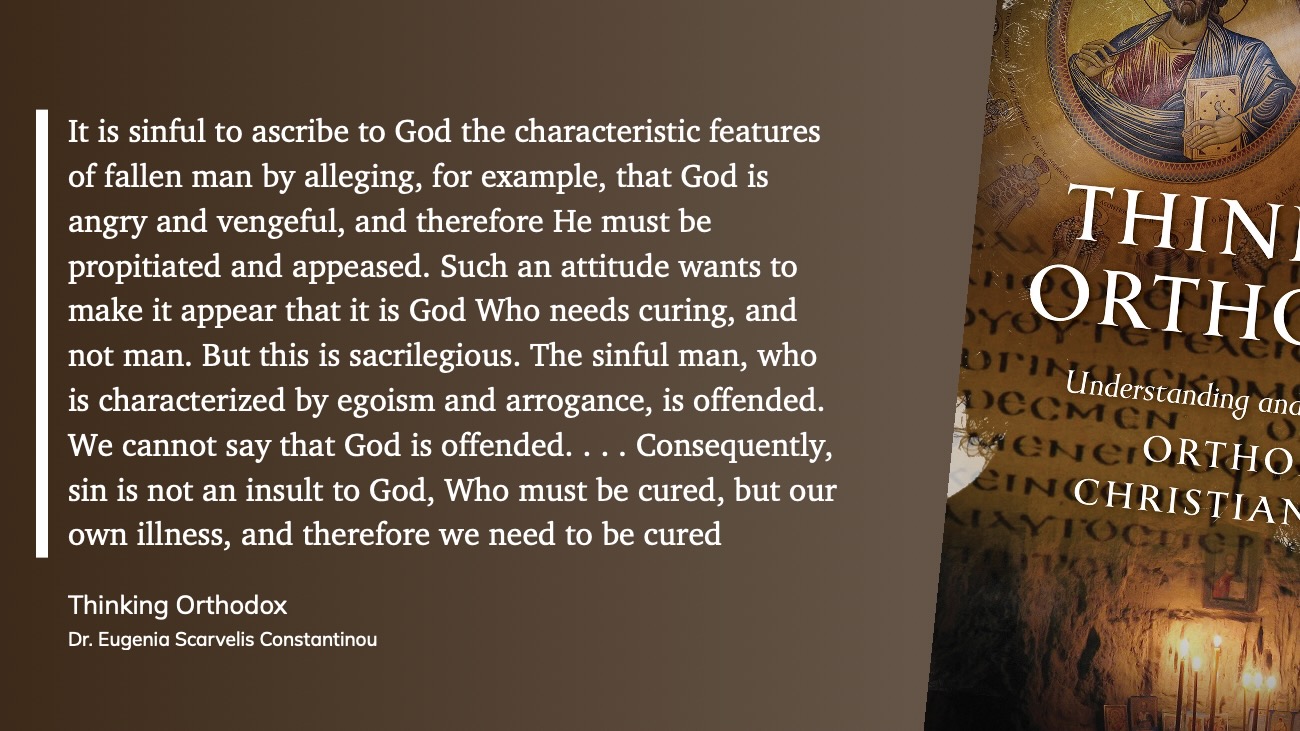
Two centuries later, fundamental differences in phronema would again be an obstacle to union between the West and the East at the Council of Florence in 1439. Catholics presented rational arguments for their positions, and the Orthodox responded by citing apostolic Tradition. It was “the constant conviction of the Latins that they always won the disputation, and of the Greeks that no Latin argument ever touched the heart of the problem.”
Dr. Eugenia Scarvelis Constantinou, Thinking Orthodox
Sometimes this whole 2000-year-old faith seems like a living koan. Chew on this until you are enlightened. Keep walking.
You can read most of my more impromptu stuff here and here (both of them cathartic venting, especially political) and here (the only social medium I frequent, because people there are quirky, pleasant and real). All should work in your RSS aggregator, like Feedly or Reeder, should you want to make a habit of it.
Sundays are joyful days, but there’s a little cloud on this one: 26 years ago, my father died, quite unexpectedly.
His was a quick and apparently painless death — what we think of as a good death these days. But I’m not so sure. Meeting God face-to-face is a serious business. I’m inclined to think a slow and painful death, with lots of time to face the reality and to set aright things that are our of kilter, has its own advantages.
We brought nothing into this world
Modernity equates liberty with the freedom to decide and choose, to define ourselves and the world around us. In the words of Justice Anthony Kennedy (Planned Parenthood vs. Casey, 1992):
At the heart of liberty is the right to define one’s own concept of existence, of meaning, of the universe, and of the mystery of human life.
We relish this concept of unfettered freedom. But, of course, it is absurd, even for a secularist. For whether we choose to admit it or not, we “brought nothing into this world” (1 Tim. 6:7). Everything in our lives is derived and gifted. We are not the inventors of the world nor of our lives. And though we struggle to understand and even master our own DNA, it remains a primary component of our destiny, a genetic memory of the history of our coming into being across the ages. To be told that we have some portion of DNA contributed by Neanderthals reminds us that even such obscure ancestors are “selves we have received” through our genetically traditioned existence.
Without defining Christianity, Renn says the world used to be positive toward it. You can read Renn for yourself, and Jacobs, too (and you really should read Jacobs if you think Renn is onto something important), but here’s the gist (via Jacobs) of why there was never a “positive world” for thoroughgoing Christianity:
Professing Christianity is what Renn calls a “status-enhancer” when and only when the Christianity one professes is in step with what your society already and without reference to Christian teaching describes as “being an upstanding citizen.” If you don’t believe me, try getting up on stage in an evangelical megachurch and reckoning seriously with Jesus’s teaching on wealth and poverty. Even a sermon on loving your enemies, like Ruby Bridges, and blessing those who curse you, can be a hard sell — as many pastors since 2016 have discovered. News flash: if you make a point of never saying anything that would make people doubt your commitment to their preferred social order, they’ll probably think you an upstanding citizen. (Who knew?)
There are pretty much always some elements of Christian teaching that you can get away with publicly affirming; but you can never get away with affirming them all. If American Christians sixty years ago felt fully at home in their social world, that’s because they quietly set aside, or simply managed to avoid thinking about, all the biblical commandments that would render them no longer at ease in the American dispensation. Any Christians who have ever felt completely comfortable in their culture have already edited out of their lives the elements of Christianity that would generate social friction. And no culture that exists, or has ever existed, or ever will exist, is receptive to the whole Gospel.
Renn is Evangelical or Evangelical-adjacent (PCA Presbyterian). I was once very friendly toward the PCA, so I think I can say that it’s not a church that rocked the social order (at least until Orgasms for All! became the unofficially established religion of the USA).
The bloom is entirely off my Renn Rose. I deeply discount articles that take his “three worlds” model as their premise.
A Christian Is An Outlaw
Apropos of “negative world”:
It would be honour in modernity for a Christian to be called such an outlaw, for surely they do not conform to the laws of this world.
There’s a brilliant episode of King of the Hill where Bobby, the thirteen-year-old boy, gets really into Christian rock. At the end of the episode his dad, Hank, shows him a box where he keeps tokens from all the different phases he has gone through. There’s a Beanie Baby, a Tamagotchi, a Teenage Mutant Ninja Turtle… Bobby cringes—and that’s the point. “I know you think the stuff you’re doing now is cool,” says Hank to his son, “but in a few years, you’re going to think it’s lame. And I don’t want the Lord to end up in this box.”
This Orthodox novice’s section on prayer (“Play to your weakness”) was also very good.
Sufficiently Rawlsian?
I might appeal to the second chapter of Genesis when speaking about the fundamental importance of male–female complementarity. But I do so because the biblical witness so succinctly and powerful states a fundamental truth that every civilization has honored.
Even as they claimed to rely on the Bible alone, antebellum Protestants frequently turned to Christian saints, exegetical traditions, the practices of Christians past, and official church teachings, employing these sources to complement or clarify what they took the Bible to mean. Perhaps this betrays a deeper sense that the Bible was not as self-interpreting as many Protestants hoped. At the very least, it shows the inescapability of tradition. American Protestants never read, or argued over, the Bible alone.
Paul J. Gutacker, The Old Faith in a New Nation
What the heck is a Carpatho-Rusyn?
In the last decades of the nineteenth century, Byzantine Rite Christians from the Carpathian mountain region began to arrive in America. It is difficult to label these people: they came from an area that today is divided among Poland, Slovakia, Hungary, Moldova, Belarus, and Ukraine, and they were known by a great variety of names, including Carpatho-Russians, Rusyns, Ruthenians, Galicians, and others. Their ancestors were originally Orthodox Christians, but in the sixteenth and seventeenth centuries they submitted to the pope of Rome through a series of “unions,” which is why they have long been known to the Orthodox as “Uniates.” Despite their subordination to the pope, they retained most of the external forms of Orthodox worship and practice, including allowing married men to become priests.
These people are the historic core of my diocese. And my parish’s Patron Saint, Alexis Toth, led multitudes back to the Orthodox faith, after he was spurned by Archbishop John Ireland.
Religious ideas have the fate of melodies, which, once set afloat in the world, are taken up by all sorts of instruments, some woefully coarse, feeble, or out of tune, until people are in danger of crying out that the melody itself is detestable.
George Elliot, Janet’s Repentance, via Alan Jacobs
You can read most of my more impromptu stuff here and here (both of them cathartic venting, especially political) and here (the only social medium I frequent, because people there are quirky, pleasant and real). All should work in your RSS aggregator, like Feedly or Reeder, should you want to make a habit of it.
I’m on vacation, so I’m not going to take the time to sort these into topics.
Also, it’s a major Feast day in the Eastern Church. The Orthodox Church at my vacation destination appears to be postponing observance to tomorrow — an Orthodox oddity in my limited experience.
Selling hoi polloi a delusion
Those with a material interest in doing so have learned to speak autonomy talk, and to tap into the deep psychology of autonomy in ways that lead to its opposite.
Matthew Crawford, The World Beyond Your Head
Purposeful to a fault
Himmler quite aptly defined the SS member as the new type of man who under no circumstances will ever do “a thing for its own sake.”
Hannah Arendt, The Origins of Totalitarianism
Sit quietly with that one for a minute. Then consider Josef Pieper, Leisure, The Basis of Culture.
“Televangelists”
Fugitive Televangelist Wanted by F.B.I. Is Caught in the Philippines Weeks of tense standoff in the Philippines have ended in the capture of a pastor accused of leading an international ring of sex abuse and trafficking of young women and girls.
I don’t believe it would be fair to saddle any Christian tradition or denomination with this guy. From what the Times says about the idolatrous adulation he cultivated, he was plainly some kind of one-off cultist.
But I have no idea how many one-off cultists are abroad in the world, when this admonition currently being featured at the end of my Sunday blog posts:
Religious ideas have the fate of melodies, which, once set afloat in the world, are taken up by all sorts of instruments, some woefully coarse, feeble, or out of tune, until people are in danger of crying out that the melody itself is detestable.
George Elliot, Janet’s Repentance, via Alan Jacobs
Huge (if true)
Donald Trump runs no risk of going to prison in the middle of his campaign, thanks to Judge Juan Merchan’s decision Friday to postpone sentencing until Nov. 26. The delay gives his lawyers more time to prepare an appeal. Fortunately for Mr. Trump, his trial was overwhelmingly flawed, and a well-constructed appeal would ensure its ultimate reversal.
A central problem for the prosecution and Judge Merchan lies in Article VI of the U.S. Constitution, which makes federal law the “supreme law of the land.” That pre-empts state law when it conflicts with federal law, including by asserting jurisdiction over areas in which the federal government has exclusive authority.
Mr. Trump’s conviction violates this principle because it hinges on alleged violations of state election law governing campaign spending and contributions. The Federal Election Campaign Act pre-empts these laws as applied to federal campaigns. If it didn’t, there would be chaos. Partisan state and local prosecutors could interfere in federal elections by entangling candidates in litigation, devouring precious time and resources.
That hasn’t happened except in the Trump case, because the Justice Department has always guarded its exclusive jurisdiction even when states have pushed back, as has happened in recent decades over immigration enforcement.
The normal approach would have been for the Justice Department to inform District Attorney Alvin Bragg, who was contemplating charges against Mr. Trump, of the FECA pre-emption issue. If Mr. Bragg didn’t follow the department’s guidance, it would have intervened at the start of the case to have it dismissed. Instead the department allowed a state prosecutor to interfere with the electoral prospects of the chief political rival of President Biden, the attorney general’s boss.
In the summer of 2015, back when he was still talking to traitorous reporters like me, I spent extended stretches with Donald Trump. He was in the early phase of his first campaign for president, though he had quickly made himself the inescapable figure of that race—as he would in pretty much every Republican contest since. We would hop around his various clubs, buildings, holding rooms, limos, planes, golf carts, and mob scenes, Trump disgorging his usual bluster, slander, flattery, and obvious lies. The diatribes were exhausting and disjointed.
But I was struck by one theme that Trump kept pounding on over and over: that he was used to dealing with “brutal, vicious killers”—by which he meant his fellow ruthless operators in showbiz, real estate, casinos, and other big-boy industries. In contrast, he told me, politicians are saps and weaklings.
“I will roll over them,” he boasted, referring to the flaccid field of Republican challengers he was about to debate at the Ronald Reagan Presidential Library that September. They were “puppets,” “not strong people.” He welcomed their contempt, he told me, because that would make his turning them into supplicants all the more humiliating.
“They might speak badly about me now, but they won’t later,” Trump said. They like to say they are “public servants,” he added, his voice dripping with derision at the word servant. But they would eventually submit to him and fear him. They would “evolve,” as they say in politics. “It will be very easy; I can make them evolve,” Trump told me. “They will evolve.”
Like most people who’d been around politics for a while, I was dubious. And wrong. They evolved.
The eighteenth-century Humean slave of the passions is thus indistinguishable from the liberated, twentieth-century Sartrean individual living authentically.
Brad S. Gregory, The Unintended Reformation
All that matters is strength
Part of the reason Trump is less constrained on [the abortion] issue than his predecessors is that he’s transformed the Christian right just as he has the broader conservative movement, dethroning serious-seeming figures while promoting those once regarded as flamboyant cranks. In Republican politics, Steve Bannon and Alex Jones now have far more influence than erstwhile conservative stalwarts like Paul Ryan and Dick Cheney. Similarly, in the religious realm, the ex-president has elevated a class of faith healers, prosperity gospel preachers and roadshow revivalists over the kind of respectable evangelicals who clustered around George W. Bush. “Independent charismatic leaders, who 20 years ago would have been mocked by mainstream religious right leaders, are now frontline captains in the American culture wars,” writes the scholar Matthew D. Taylor in his fascinating new book, “The Violent Take It by Force: The Christian Movement That Is Threatening Our Democracy.”
The churches Taylor is writing about exist outside the structures and doctrines of denominations like the Southern Baptists. They’re led by flashy spiritual entrepreneurs who fashion themselves as modern apostles and prophets with supernatural spiritual gifts, and they represent one of the fastest-growing movements in American Christianity. Among many of these churches, Trump remains the anointed one, chosen by God to restore Christian rule to the United States. These Christians care a great deal about abortion, but they appear to care at least as much about Trump. Many of them see him as a modern-day version of the Persian emperor Cyrus, a heathen who, in the sixth century B.C.E., rescued God’s chosen people from Babylonian captivity. In this framework, Trump’s piety is irrelevant; all that matters is his strength.
I think Goldberg, no Christian, is right. And that means that it’s hard to say that MAGA and I share the Christian tradition; their religion seems from a darker source.
Ted Cruz is no dummie
Liz Cheney famously endorsed Kamala Harris over Donald Trump, and less famously endorsed Democratic U.S. Representative Colin Allred over Ted Cruz for Cruz’s Texas Senate seat.
So has she abandoned the GOP?
I can’t speak for Cheney, but I can tell you why I’m voting for Allred over Cruz—and it has nothing to do with policy or burning anything down.
Since January 6, the threshold question I ask when considering whether to vote for a Republican is how that candidate responded to Trump’s coup attempt. There’s a spectrum of behavior on that point, with Cheney and Kinzinger on one end, Trump himself on the other, and the mass of congressional Republicans somewhere in between.
At the two extremes of the spectrum, policy doesn’t matter to me. Policy debates are things you get to have when everyone agrees on the rules of the game. Rewarding those who defended democratic norms and punishing those who undermined them is more important.
I would vote for Cheney and every other Republican who voted to impeach or convict Trump following the insurrection in hopes that their victories would embolden others in the party to resist his power grabs in a second term. And I would vote against Trump and all of his co-conspirators for the opposite reason, in hopes that their defeats would convince others that civic crime, like trying to overturn an election on false pretenses, doesn’t pay.
Ted Cruz was Trump’s chief co-conspirator in the Senate after the 2020 election, initially agreeing to argue before the Supreme Court that the electoral votes of swing states won by Joe Biden should be thrown out. When the court declined to hear that case, Cruz switched to Plan B and ring-led a scheme on January 6 to stop Congress from certifying Biden’s victory by objecting to those swing-state electoral votes. Had he gotten his way, some sort of chaotic ad hoc election “commission” would have been thrown together before Inauguration Day to decide who the next president should be.
He did all of this knowing full well that Trump was and is a loon and that egging on Americans to doubt the fairness of their own elections will destabilize the country long-term. But he was willing to pay that price because he thought making himself useful to the coup would give him a leg up with Trump’s base when he runs for president again someday.
You don’t need to agree with Colin Allred on a single policy issue to grasp that a person like Ted Cruz cannot be trusted to defend the constitutional order. He was tested and failed grievously. If you believe that a second Trump presidency would create a “unique threat” to American government, as Liz Cheney and I do, it’s urgent that Trump’s most unethical enablers in Congress be replaced by people who won’t rubber-stamp anything he does.
Republicans in Texas had their chance to replace Cruz with a candidate like that in this year’s primary, just as Republicans nationally had their chance to replace Trump. They made their choice. Cheney and I have made ours.
It’s frankly amazing to me that so many conservatives have been left struggling to understand Cheney’s endorsement of Allred. To a certain sort of partisan, it seems, Trump is the only elected Republican who bears meaningful responsibility for the attempt to overturn the 2020 election. Ted Cruz, Mike Lee, the scores of House GOPers who voted to object on January 6—they’re all off the hook because, well, there are just too many of them to punish. Beating them at the polls would wipe out the party, and partisans won’t tolerate that. Even for just one election cycle, to teach their representatives a hard lesson about authoritarian bootlicking.
If you feel obliged to excuse Ted Cruz for his role in a coup plot because that’s what hating Democrats requires of you, you do you. But let’s please stop memory-holing his part in it by feigning confusion as to why Liz Cheney might want to drive him from politics. It’s pathetic.
Ted Cruz is no dummie. He’s whip-smart and cunning. He also is a contemptible human being with no core. His mentor, Princeton’s Robert P. George, must be deeply grieved.
Shanghaied
Few cities in Asia match Shanghai’s level of economic development. In the fanciest shopping streets in the city center you can go miles without leaving the realm of luxury stores, with a Hermes outlet abutting a Louis Vuitton outlet, which in turn abuts a Rolex outlet. At times, the city reminded me of an acquaintance’s semi-humorous observation that, in a hundred years, luxury brands may be all that remains of Europe’s once enormous influence on the world.
In Postwar, Tony Judt argues that in the 1960s, the restive mood of Europe’s young was in part fueled by the ugliness of the homes in which they had been raised and the new universities in which they were being educated. Comparisons between Europe sixty years ago and China today are certain to be wrong for any number of reasons, but my mind kept going back to Judt’s observation every time I drove past another island of identical, unadorned housing blocks.
Preferences about the next American president seem to be nearly as divided among Chinese intellectuals as they are among the American electorate. A senior scholar of international relations told me that Donald Trump would likely be more willing to cut deals with China but that he preferred Kamala Harris because of her greater predictability on the international stage. A senior economist told me that Kamala Harris might prove softer on tariffs but that she would prefer Donald Trump because of his greater predictability on economic policy. The only consistent refrain was the preference for perceived predictability: Chinese elites seem as discombobulated by the sense that it’s impossible to predict what Washington might do as they are by any specific action the next president might take.
The chief petty officers aboard the USS Manchester (LCS-14) were caught illicitly placing and using a Starlink satellite-internet antenna while the ship was under way. The conspiracy, involving all senior enlisted sailors attached to the littoral combat ship, came to light after months of use, when a civilian contractor came aboard and stumbled upon the bootleg setup. The ship’s command senior chief and ringleader of the operation was convicted at court-martial and reduced in rank from E-8 to E-7: an outrageously light penalty considering her repeated lies to her commanding officer, her background in Navy IT that ensures she was absolutely aware of her transgression, and the cover-up campaign that involved the intimidation and silencing of those below her. This betrayal of the ship’s whereabouts in service to movie-streaming, texting, and other forms of personal entertainment is especially egregious because of the role that chiefs have in preserving good order and discipline among the ranks while upholding Navy traditions. A bad chief is the ruin of a ship and its crew, and the legal equivalent of keelhauling the only correct recourse.
National Review’s The Week Friday email. See also the Navy Times.
Donald Trump after the debate
The Hill: Trump Floats Punishment For ABC After Debate
I mean, to be honest, they’re a news organization. They have to be licensed to do it. They ought to take away their license for the way they did that.
This response is fractally wrong. ABC doesn’t need a license to be a news organization (thank God and the First Amendment).
If they did have a license, it would be dictatorial to revoke it for displeasing the President or anyone else.
Trump once again exhibits his anti-democratic impulses, though once again it probably will deter no fans.
Lesser evils
“Sending migrants away, not allowing them to grow, not letting them have life is something wrong; it is cruelty,” Francis said in a news conference on the plane as he returned to Rome after his long trip to Southeast Asia and Oceania. “Sending a child away from the womb of the mother is murder because there is life. And we must speak clearly about these things.”
…
But when asked whether it would be morally admissible to vote for someone who favored the right to abortion, he responded: “One must vote. And one must choose the lesser evil. Which is the lesser evil? That lady or that gentleman? I don’t know. Each person must think and decide according to his or her own conscience.”
Donald Trump seemingly is Teflon-coated, but explicit Papal permission to vote for the (more) pro-abortion candidate could logically be a factor in this election.
Even WSJ is appalled
Ms. Loomer is usually described in the press as “far right,” but that’s unfair to the fever swamps. On Sunday she posted on X that if Ms. Harris wins the election, “the White House will smell like curry,” a gibe against Ms. Harris’s Indian heritage.
She added that Ms. Harris’s speeches “will be facilitated via a call center.” U.S. companies often farm out their information lines to Indian firms, get it? We wonder if JD Vance’s Indian-American wife thinks that’s funny.
In 2018 Ms. Loomer chained herself to Twitter’s New York headquarters after the platform banned her. She suggested that Casey DeSantis, the wife of Florida Gov. Ron DeSantis, might have lied about having breast cancer: “I’ve never seen the medical records.” This week she smeared Sen. Lindsey Graham after he criticized her association with Mr. Trump.
All of this would be ignorable, except that others close to Mr. Trump say he is listening to Ms. Loomer’s advice. People in the Trump campaign are trying to get her out of the former President’s entourage, to no avail. Even Rep. Marjorie Taylor Greene thinks Ms. Loomer is damaging the former President’s election chances.
As North Carolina Sen. Thom Tillis put it on Friday: “Laura Loomer is a crazy conspiracy theorist who regularly utters disgusting garbage intended to divide Republicans. A DNC plant couldn’t do a better job than she is doing to hurt President Trump’s chances of winning re-election. Enough.”
If anyone is looking for facts to support a vote for Trump despite loony Loomer (and everything else), these two graphs may be just the ticket. The Biden administration has not covered itself in glory on illegal immigration.
The yellow bar is illegal immigrants and those awaiting adjudication of asylum claims or other claims to remain.
Delta wants to know what I thought of my flight. Honda wants to know what I thought of my oil change. The company that inspects my HVAC system twice yearly wants to know what I thought of … the air filter replacements? The technician’s demeanor? I’m not sure because I’ve read only the subject lines of the emails, which keep coming, imploring me to reflect on the experience and charting some strange new territory where customer service and stalking overlap. It may be time for a restraining order. Or, minimally, a different kind of filter, the one that consigns certain senders’ electronic missives to the Spam or Trash folders.
I don’t do any of the major social media, but I have two sub-domains of the domain you’re currently reading: (a) You can read most of my reflexive stuff, especially political here. (b) I also post some things on the only social medium I frequent, because people there are quirky, pleasant and real.
I came of age in the sixties. I was intrigued by LSD to the point that a roommate and I imagined tripping one at a time (so the one who wasn’t tripping could prevent leaps out of upper-story windows and such).
I never did it. I had no idea where to get LSD and was too little motivated to find out.
I never even did marijuana. Not once. Not even without inhaling. Through the grapevine, I understand that that roommate did. I only saw him twice in later years, once at my wedding, once at a reunion (to which he came only after much cajoling). His life pretty clearly was not a happy one, but it’s over now.
I do vacation, though, in a state that has legalized weed, and let’s just say a thought has crossed my mind a time or two. But I have categorically ruled out weed, let alone more potent hallucinogens.
I’m aware of a number of risks with psychedelics, including that any spirits encountered are demons. But risk-benefit analysis isn’t why I’ve ruled out drugs.
The Orthodox Church forms me in everything I need for salvation. I’ve been at it for a while now, and not once have I caught of whiff of “why not do a Rosie Ruiz with plants or chemicals?” It’s pretty clear that I’m supposed to run the full race, fair and square.
Regrets, Repairs, Restoration — and Faces
Steve Robinson posts again, on “On Regrets, Repairs, and Restoration.” The following is not representative of the whole post, but struck me as perceptive and lovely.
I guess you never really have an “ex”, you just have a person who lives in the basement of your soul and keeps you honest about who you are and what you’ve done and on a good day, might even give you some hope that you are someone different, or even better than the person they once knew and tried to love.
Then along comes Father Stephen Freeman, with something that resonates with Robinson:
As we grow older, we never again gaze into the eyes of a person as we once did with our mothers. Lovers are often drawn to the eyes of the beloved, and find a measure of communion, but wounds and injuries eventually interrupt the initial innocence of such eyes …
The Fr. Stephen goes deeper:
… The same is at least as true with regard to God.
Regarding the face of God, there is this very telling passage in Revelation:
And the kings of the earth, the great men, the rich men, the commanders, the mighty men, every slave and every free man, hid themselves in the caves and in the rocks of the mountains, and said to the mountains and rocks, “Fall on us and hide us from the face of Him who sits on the throne and from the wrath of the Lamb! (Rev. 6:16)
It is of note that Revelation does not simply speak of the wrath of the Lamb, nor merely of His presence. It is specifically a fear of His face. Our experience of the face is an experience of nakedness and vulnerability. On the positive side, the result is identification, communion and oneness. On the negative side, it is the pain of shame and the felt need to hide. I can think of nothing else in nature that so closely parallels and reveals the fundamental character of our relationship with God. Salvation is communion. Sin is an enduring shame.
If you really care about the outward forms of religious devotion; if you miss a time when politicians felt the need to pay lip service to Christian piety even when they didn’t believe a word of it; if you wish that your church had the same kind of pull in the corridors of power that it had 40 years ago; if you really care whether the signs at the White House say “Merry Christmas” instead of “Happy Holidays” — then of course the Republican Party will seem inseparable from Christianity. But if you care that much about popularity and power, you probably shouldn’t have picked a poor, despised, crucified man to be the object of your religious devotion.
[P]erhaps the most common title for our times is secular. Ours is, so the story goes, a secular age. In its usual telling, it goes something like this: Once upon a time we were young and naïve and religious. The world was enchanted, back then, and the sacred was near at hand. But now, for good or ill—because the story can be told with glee or lament in the voice—now we live in a universe, not a cosmos; we believe not in a deity but in ourselves. Now we inhabit an immanent frame and have no need for the hypothesis of God.
Whether told in one tone or another, this is a familiar story, and we know where we fit in it. Are we on the side of tradition or of progress, of immanence or transcendence? Are we for disenchantment or re-enchantment? Whichever part we play in this theater of argument, it seems, the positions come premade; the script is already written, all we have to do is act it out.
The aim of political theologian William T. Cavanaugh’s new book is to shatter this stained-glass drama by introducing what he takes to be a better term for describing our age: idolatrous. In The Uses of Idolatry, he argues that we ought not think of ourselves as disenchanted but mis-enchanted, and in so doing he not only critiques the old secularization narrative, but begins to write us a new story through which we might better understand ourselves and our times.
… “What has declined in the modern West is not belief in transcendence,” Cavanaugh contends, “what has declined is belief in God.” What is different is that the sacred is no longer “confined to gods but applies to all sorts of realities commonly labeled ‘political’ or ‘economic’.” The holy has not fled through the wardrobe into Narnia, in other words; it has fragmented. And this means that the problem with secularization stories is that worship remains as prevalent as ever—it’s just that what (or who) is being worshiped has changed.
I really liked the author’s 2009 The Myth of Religious Violence, and this too is now on my Kindle.
Religious ideas have the fate of melodies, which, once set afloat in the world, are taken up by all sorts of instruments, some woefully coarse, feeble, or out of tune, until people are in danger of crying out that the melody itself is detestable.
George Elliot, Janet’s Repentance, via Alan Jacobs
You can read most of my more impromptu stuff here and here (both of them cathartic venting, especially political) and here (the only social medium I frequent, because people there are quirky, pleasant and real). All should work in your RSS aggregator, like Feedly or Reeder, should you want to make a habit of it.
Sorry if the headline is misleading; I really don’t know more about Ayan Hirsi Ali’s conversion from “New Atheist” to some kind of Christian. But I have been thinking about what I do know.
I listened this week to a predictably futile, moderated public discussion between New Atheist Richard Dawkins and his friend, lapsed New Atheist Ayaan Hirsi Ali. If you, too, want to waste some time on something that seems like the sort of thing that smart people should listen to, break a leg.
Ali said one thing in the discussion that I thought was worth preserving. When she was one of the elite New Atheists, the author of Infidel, probably the leading vocal apostate from Islam in the democratic West, and a despiser of Christianity as well, she travelled with 8 bodyguards. They were not there to protect her from angry Christians. Instead, she recalls Christians contacting her to say “we think you’re mistaken and we’re praying for you.”
Some of Ali’s answers in the discussion bothered me. They are not the answers of a well-formed Western Christian, let alone of an Orthodox Christian. But then (duh!) she hasn’t really been at this long enough to be a well-formed Christian of any sort, and they were things Dawkins pressed her on — not prideful heresies she blurted out to ingratiate herself with someone. Moreover, her conversion, like many (most?) seems to be kind of a “right-brain” thing, not as easily articulated as syllogisms.
“Why don’t you just say ‘I trust the Church on some things I haven’t personally grokked yet’,” I wanted to say. But I’m not even certain that she has settled in any church yet; I just don’t know.
Further, her path into the faith from atheism surely is vastly different from my path within the faith (very broadly construed) from a Protestant tradition to Orthodoxy. Of that path I wrote almost two decades later:
I had my qualms about some specifics, like the Theotokos, who is a hangup or blind spot for many low-church Protestants. But I had reached the point where I trusted the Church’s dogma (the title “Theotokos” is a dogma of an Ecumenical Council) more than I trusted my own, likely-skewed, judgment.
(Hyperlink added) I don’t think that paragraph distorts the reality of my 1997 formal conversion. I was becoming for the first time an “ecclesial Christian,” which the late Richard John Neuhaus described:
An ecclesial Christian is one who understands with mind and heart, and even feels with his fingertips, that Christ and his Church, head and body, are inseparable. For the ecclesial Christian, the act of faith in Christ and the act of faith in the Church are not two acts of faith but one. In the words of the third century St. Cyprian, martyr bishop of Carthage, “He who would have God as his Father must have the Church as his mother.”
And I indeed have come to agree with the Church, not just to trust it while holding my doubts in abeyance.
But for now, I think Ali is sorting through the good she sees in Western Christendom (and post-Christendom) and the doctrinal and ecclesial specifics of the faith that gave birth to it. That’s not a quick or easy task — or so I imagine, having not walked that particular path myself.
I’m praying for her to grow up into her new faith, to shun limelight as much as she can for a while, and to preface her doubts, if she must voice them at all, with something like “I’m still learning and settling in, but for now, no, I don’t quite believe [X]. Maybe I will later.”
I am skeptical of press alarmism about “Christian Nationalism” in the U.S. It’s generally a cheap trick to marginalize some conservative-ish folks without getting into the weeds on what they actually believe and teach.
But I believe there are two Christian Nationalist movements worth a wary and sustained eye:
C. Peter Wagner and his merry Seven Mountain Mandate heretics. I hate to cite Wikipedia on this, but the other information I have is too scattered. If you want to go the the source, search Amazon books for “Seven Mountain Mandate” focusing on books by Johnny Enlow and Lance Wallnau, two figures who I know are mandate fans.
I rather doubt that these two groups could make common cause. Wilson’s folks are Calvinists, Wagner’s spawn charismatic flakes who claim to have prophetic apostles. That’s oil and water, folks.
Wagner’s group probably is a bigger threat because its following is excitable and flaky; Wilson’s young, intellectual Calvinists are unlikely to match their volatility (American Evangelicalism was pretty much born in anti-Calvinism 200-ish years ago).
Proto-Jihad
Of the Crusades:
Daringly, he offered his listeners an electrifying new formula for salvation. Listed as an official decree of the council held at Clermont, it promised warriors a means by which their trade of arms, rather than offending Christ and requiring penance to be forgiven, might itself serve to cleanse them of their sin. ‘For, if any man sets out from devotion, not for reputation or monetary gain, to liberate the Church of God at Jerusalem, his journey shall be reckoned in place of all penance.’
Tom Holland, Dominion
Secularist concessions
A modern secularist quite often accepts the idea of God. What, however, he emphatically negates is precisely the sacramentality of man and world.
… that Christ may dwell in your hearts through faith; that you, being rooted and grounded in love, may be able to comprehend with all the saints what is the width and length and depth and height — to know the love of Christ which passes knowledge; that you may be filled with all the fullness of God.
You can read most of my more impromptu stuff here and here (both of them cathartic venting, especially political) and here (the only social medium I frequent, because people there are quirky, pleasant and real). All should work in your RSS aggregator, like Feedly or Reeder, should you want to make a habit of it.
I just finished reading The Old Faith in a New Nation, a 2023 book by one Paul J. Gutacker. I can write no better summary of the author’s purpose than the publisher’s:
Conventional wisdom holds that tradition and history meant little to nineteenth-century American Protestants, who relied on common sense and “the Bible alone.” The Old Faith in a New Nation challenges this portrayal by recovering evangelical engagement with the Christian past. Even when they appeared to be most scornful toward tradition, most optimistic and forward-looking, and most confident in their grasp of the Bible, evangelicals found themselves returning, time and again, to Christian history. They studied religious historiography, reinterpreted the history of the church, and argued over its implications for the present. Between the Revolution and the Civil War, American Protestants were deeply interested in the meaning of the Christian past.
The book
I concur with the 4-star rating at Amazon, mostly because the sympathetic academic author obviously spent a lot of time researching a narrow topic, off-the-beaten track. When I stumbled across it, I knew that I needed it to challenge the “conventional wisdom” resident in my own imagination.
It would be churlish to complain of faults in a book that did what I wanted it to do, and was passably readable to boot. I now have a better idea of how nineteenth-century American Evangelicals (and a few mainstream Protestants and Unitarians) treated Christian history.
Generally, the Evangelicals settled for tendentious 18th-Century historiography. It’s hard to blame them — the laymen, at least. There are only 24 hours in a day, and the 8-hour workday didn’t exist. We’re still that way:
The instinctual shortcut that we take when we have “too much information” is to engage with it selectively, picking out the parts we like and ignoring the remainder, making allies with those who have made the same choices and enemies of the rest.
A lover of obscure mots justes, I was pleased to meet the word mnemohistory, which to my disappointment isn’t even in the online Merriam-Webster. It is “the history of memory … The past is not only remembered by later generations, it also exerts by itself an influence on later times.” A near-equivalent, I guess, is “cultural history.”
The 19th-century American Evangelical mnemohistory was fiercely anti-Catholic — especially, and oddly, anti-celibacy, though the anti-Catholicism was comprehensive.
Somewhat to my surprise (I had already read in Frances Fitzgerald that it was anti-Calvinist), it was quite contemptuous of the Protestant Reformation as well — largely because the Reformation wasn’t adequately anti-Catholic. The Reformers baptized infants? Mumbled vague nothings about Christ’s presence in the Eucharistic elements? Damnable papacy!
Though the Magisterial Reformation opened Pandora’s box with its sola scriptura même, I’m newly-appreciative of its merits, at least compared to what followed. The Magisterial Reformers didn’t intendthe whirlwind, and Rome did need reform.
That the best-laid plans chronically go astray is enough to make one suspect all is not right in the pre-eschaton world. (It’s also an imaginative buttress for temperamental conservatism.)
The acid test
The acid test of American Evangelical mnemohistory came in the debates over slavery, when there arose an urgent need to shuffle the deck chairs. Gutacker summarizes:
This was only one of many ironies in the debates over slavery, which saw Catholics ignoring or reinterpreting papal decrees, Episcopalians celebrating early American Puritans, Presbyterians defending medieval society while criticizing the Reformation, Baptists treating patristic exegesis as authoritative, and anticlerical abolitionists praising the pope. Not all of this irony was lost on contemporaries. As has been discussed, African American historians, in particular, took pleasure in pointing out the hypocrisy of proslavery authors who cited North African church fathers in their arguments for white supremacy.
Antebellum 19th-century American Evangelicals didn’t so much revere history as to use it to confirm their priors. They rejected tradition and precedent, those inconvenient facts, in favor of congenial theories they called “history” — again, a relatable vice, but it’s how we got Baptists andSouthern Baptists, Methodists andSouthern Methodists, and even Presbyterians and Southern Presbyterians (a division that leaves fewer contemporary traces than the Baptist and Methodist schisms).
Oh, yeah, almost forgot: It’s also a substantial explanation of how we got a Civil War.
I think that qualifies as failing the acid test.
Bless their hearts!
I’m fond of the expression “making a virtue of necessity.” 19th-century schisms over slavery were lamented at the time. Today’s more mercenary schisms pass without much objection as “isn’t-it-nice-that-there’s-a-church-for-all-preferences?” nondenominationalism. All hail the religiopreneur! (Bless their hearts!)
Christians were until recently (and in ecclesial Christianity, still are) horrified by schism. But what to make of the continued fissiparousness of movements themselves born in conscious schism, as was post-Second Great Awakening evangelicalism? Is it all that bad when badness can’t cohere?*
I confess a bit of schadenfreude, mitigated morally by faint hope for the epiphany “this isn’t working; our first principles must be wrong” — and for return to the Church that remained, albeit centered outside the West, when the Roman Church went into schism from it. There, Holy Tradition is preserved and transmitted as the warp and woof of liturgies, hymns, prayers, scripture, and all that goes into a lived faith.
* (An aside about coherence: Ken Myers, muse of Mars Hill Audio Journal, once suggested that today’s evangelicalism coheres, is united, not by orthodoxy but by orthpathos — not rightshareddoctrine but right shared feeling. Insofar as it does loosely cohere, I have no better explanation, and if I did it would be a topic for another day.)
… that Christ may dwell in your hearts through faith; that you, being rooted and grounded in love, may be able to comprehend with all the saints what is the width and length and depth and height — to know the love of Christ which passes knowledge; that you may be filled with all the fullness of God.
You can read most of my more impromptu stuff here and here (both of them cathartic venting, especially political) and here (the only social medium I frequent, because people there are quirky, pleasant and real). All should work in your RSS aggregator, like Feedly or Reeder, should you want to make a habit of it.
Yes, we’re that much later than the West this year.
This wild Christ
We are living in a time where we need more imagination, more courage, and a deeper understanding of freedom. We are told we are free than ever; then why do we feel so? so tyrannized.
I went out into a forest to be wedded to the wild and came out wedded to the Galilee Druid. There is no easy way to talk about what happened.
So, I’m going to go to the forest and see what happened.
The God of the Christians is a scandal from the beginning, born a fugitive, dies an outlaw is butchered on a hill and has the audacity to return. Jesus of the slaves, Jesus of the desert, Jesus of love, Jesus of hard and troubling ideas. This mystical egalitarian, this burning wheel, this one who kneels and drinks the darkness of the world. He is the fundamental poetic event, and he is nothing at all like what I thought he was.
But this wild Christ may be the strangest God of all.
Martin Shaw, in the narration of the embedded film clip here (italics added).
Zwingli
I attended a socially obligatory reception and dinner recently, where I was seated with an Evangelical couple of my acquaintance. Discussion turned to European travels (there was a reason for that turn), and it developed that both of us had visited, indeed sung in, Grossmunster Church in Zurich.
I commented that I had been particularly thrilled at singing there, but now consider its most famous pastor, Zwingli, an arch-villain of the Reformation. The husband was clearly puzzled. I answered him, but his puzzlement remained. I think we now occupy different religious worlds, divided by our common “Christianity.”
Here’s an expression of my side:
The memorialism of certain Reformation groups, in which the presence of Christ in the Eucharist is reduced to a simple remembrance on the part of believers, is among the most egregious examples of the triumph of linearity. Here, the Eucharist is celebrated, but the presence of Christ is reduced to historical memory, the weakest possible interpretation of His words and commandments and a deep distortion of the role of anamnesis (memory).
The Orthodox Tradition, which is often described by many as “mystical,” is not “mystical” in any sense of “esoteric” or “strange.” Such adjectives for the faith are simply a reaching for words to describe a reality that is richer than any merely rational scheme or metaphysical explanation. It is the largeness of a Kingdom that cannot be described or circumscribed, and yet is found in the very heart of the believer. What words do we use to describe something which dwarfs the universe and yet dwells within us?
…
It is for such reasons that I always find myself repelled by efforts to reduce doctrine to simplified formulas. Doctrine – the teaching of the faith should not reduce our understanding but enlarge it – to the very point of silence – and beyond. It is why it is so frustrating to try and explain icons. No one has an argument with the presence of words in the Church – the icons do the same things words do – only with color and in the language of silence. I can enter the Church, remain in silence and yet see (and hear!) something other than the incessant chatter of my own mind. The icons speak with the texture of the Kingdom – opening windows and doors that transcend every height and depth, things present and things to come.
“I thought it is a state of being cut off from God.“
“It is that, of course. It is ignorance of God, but it is not only that. According to the Holy Elders, hell is the experience of God, not as light and eternal grace, but as eternal fire instead. God, however, is not eternal fire. It is human beings who create the distortions, not God. It is therefore the souls of human beings that need to be healed so that they may be able to have the version of God as light and not as fire that torments.”
Kyriakos C. Markides, The Mountain of Silence
Sometimes (and this is one of those times), I feel as if I need to say You don’t need to read this book; rather, you need an Orthodox Christian Church.
Settling for everything
[I]t is in fact impossible to combine Christian virtues, for example meekness or the search for spiritual salvation, with a satisfactory, stable, vigorous, strong society on earth. Consequently a man must choose. To choose to lead a Christian life is to condemn oneself to political impotence: to being used and crushed by powerful, ambitious, clever, unscrupulous men; if one wishes to build a glorious community like those of Athens or Rome at their best, then one must abandon Christian education and substitute one better suited to the purpose.
…
The whole argument illustrates Berlin’s one great theme: the incompatibility of certain “Great Goods” with one another. The more I think about it, the more convinced I am that the inability to grasp this point is one of the greatest causes of personal unhappiness and social unrest. Millions of American Christians don’t see how it might be impossible to reconcile (a) being a disciple of Jesus Christ with (b) ruling over their fellow citizens and seeking retribution against them …
Everybody wants everything, that’s all. They’re willing to settle for everything.
… that Christ may dwell in your hearts through faith; that you, being rooted and grounded in love, may be able to comprehend with all the saints what is the width and length and depth and height — to know the love of Christ which passes knowledge; that you may be filled with all the fullness of God.
You can read most of my more impromptu stuff here and here (both of them cathartic venting, especially political) and here (the only social medium I frequent, because people there are quirky, pleasant and real). All should work in your RSS aggregator, like Feedly or Reeder, should you want to make a habit of it.



 Tipsy Teetotaler ن