Trump rants 3/19/25

The stripping away of illusions

President Trump does not seem to notice or care that if you betray people, or jerk them around, they will revile you. Over the last few weeks, the Europeans have gone from shock to bewilderment to revulsion. This period was for them what 9/11 was for us — the stripping away of illusions, the exposure of an existential threat. The Europeans have realized that America, the nation they thought was their friend, is actually a rogue superpower.

In Canada and Mexico you now win popularity by treating America as your foe. Over the next few years, I predict, Trump will cut a deal with China, doing to Taiwan some version of what he has already done to Ukraine — betray the little guy to suck up to the big guy. Nations across Asia will come to the same conclusion the Europeans have already reached: America is a Judas.

This is not just a Trump problem; America’s whole reputation is shot. I don’t care if Abraham Lincoln himself walked into the White House in 2029, no foreign leader can responsibly trust a nation that is perpetually four years away from electing another authoritarian nihilist.

David Brooks

Anti-Constitutional

An anti-constitutional act is one that rejects the basic premises of constitutionalism. It rejects the premise that sovereignty lies with the people, that ours is a government of limited and enumerated powers and that the officers of that government are bound by law.

The new president has, in just the first two months of his second term, performed a number of illegal and unconstitutional acts. But the defining attribute of his administration thus far is its anti-constitutional orientation. Both of its most aggressive and far-reaching efforts — the impoundment of billions of dollars in congressionally authorized spending and the attempt to realize the president’s promise of mass deportation — rest on fundamentally anti-constitutional assertions of executive authority.

There is much to say about the administration’s decision to seemingly ignore a court order to halt or reroute deportation flights for these people and return them to United States. For now, let’s focus on the Justice Department’s initial defense of the president’s order, in which government lawyers argued the following: “Beyond the statute, the President’s inherent Article II authority is plainly violated by the district court’s order. As a function of his inherent Article II authority to protect the nation, the President may determine that [Tren de Aragua, a criminal gang] represents a significant risk to the United States … and that its members should be summarily removed from this country as part of that threat.”

In other words, according to the Justice Department, the president of the United States has an “inherent” power to summarily deport any accused member of Tren de Aragua (and presumably, any foreign national accused of membership in any gang) without so much as a hearing. What’s more, under this logic, the president can then direct his administration to send that person, without due process, to prison in a foreign country.

This is a claim of sovereign authority. This is a claim that the president has the power to declare a state of exception around a group of people and expel them from the nation — no questions asked. It is anti-constitutional — a negation of the right to be free, in Locke’s words, of “the inconstant, uncertain, unknown, arbitrary will of another man.”

There is nothing in this vision of presidential power that limits it to foreign nationals. Who is to say, under the logic of the Department of Justice, that the president could not do the same to a citizen?

Jamelle Bouie, Trump Has Gone From Unconstitutional to Anti-Constitutional (shared article).

If Congressional Republicans took their oaths of office seriously, they’d be impeaching Trump and removing him from office. He has already destroyed many of our most important international relationships (see David Brooks, above), and by “destroyed,” I mean that we face a long period of repair even if he were removed this afternoon.

Dems and Damon in the same headspace?

[M]y assumptions and style of analysis bring me back again and again to a feeling of fatalism rooted in the conviction that the time to stop Trump was in November 2016, in the immediate aftermath of the January 6 insurrection (via conviction in his second impeachment trial), or in November 2024. I don’t want to succumb to the feeling that it’s already too late to stop him. It’s just that I’m still trying to figure out how to break out of that cul-de-sac.

Damon Linker

How to create a legal banana republic

To collapse the structure of American justice and replace it with a proper banana republic, each pillar holding it up needs to be weakened.

The president spent most of his first two months in office focused on a single pillar: law enforcement. He purged officials at the Justice Department and FBI and replaced them with clownish toadies like Pam Bondi, Kash Patel, and Dan Bongino. That was a sensible way for an authoritarian to prioritize: Of the institutional players I’ve mentioned, corrupt cops and prosecutors can do the most damage. As long as the DOJ is willing to behave like a secret police force, Donald Trump doesn’t need to send Liz Cheney or Mark Milley to prison to make their lives miserable. Investigations are punishment enough.

His Castro-esque speech on Friday to Justice Department officials reflected his priorities. The president labeled political enemies like former special counsel Jack Smith “scum,” claimed that CNN and MSNBC are behaving “illegally” somehow, babbled about the supposedly rigged 2020 election, and insisted that the January 6 defendants he pardoned were “grossly mistreated.” The speech ended with the song “YMCA,” as you might hear at one of his political rallies.

Watching it felt like watching a dog mark his territory.

Nick Catoggio

Trying not to try

I may not have said this before: Trump’s shock and awe assault on norms, perceived enemies, constitutional limitations and the independence of “independent agencies” are so comprehensive, and so blur together in news coverage, that I couldn’t keep up, and couldn’t cogently predict which actions will ultimately be found unlawful, even if I tried.

And I’m trying not to try.

Oh, I still listen to legal podcasts, and they typically cover some of the cases brewing. If you get an opinion from me on a case, I’ll probably be regurgitating some of them, lightly post-processed.

I don’t feel responsible for Trump. He’s something I’m suffering along with everyone else — and my situation means I’m not personally suffering all that much except anxiety for my living descendants.

I don’t think Trump is the eventuality of true conservatism, though he may be the eventuality of the Moral Majority and other Religious Right activism starting in the 70s. I was never on board with them; I’m even less on board with them since becoming an Orthodox Christian; and I’m pleased to contemplate a knife fight between the New, Improved Religious Right (The New Apostolic Reformation! All you loved about the Moral Majority, but now with added Charismatic flakery!) and the Catholic Integralist “Common Good Constitutionalism.”

(Thoughts prompted by my deciding not to read a Wall Street Journal article on a Federal District court ruling against the demolition of USAID.)

Inflicting trauma

Russell Vought, a graduate of Wheaton College, now describes himself as a “Christian nationalist.” He also says:

“We want the bureaucrats to be traumatically affected,” he said. “When they wake up in the morning, we want them to not want to go to work because they are increasingly viewed as the villains. We want their funding to be shut down so that the EPA can’t do all of the rules against our energy industry because they have no bandwidth financially to do so.

“We want to put them in trauma.”

He may be a nationalist, but he puts his Christianity open to serious question by such hateful intentions. (Mark 8:36.) He’s rather unpopular at Wheaton, too, which is much to its credit.

Free speech lies

The president brags about ‘ending censorship’ while describing negative coverage about him as ‘illegal.’

Jonah Goldberg’s subheadline to his recent The Trump Administration’s Free Speech Hypocrisy. The whole (relatively short) thing is worth reading.

Weaponizing government

War is Peace. Freedom is Slavery. Ignorance is Strength. And Donald Trump is “Ending the Weaponization of Government”

David Post, Paul, Weiss Next on the Chopping Block


I suffer more from the humiliations inflicted by my country than from those inflicted on her.

Simone Weil, from a letter to Georges Bernanos.

[N]one of the things that I care about most have ever proven susceptible to systematic exposition.

Alan Jacobs, Breaking Bread With the Dead

I don’t do any of the major social media, but I have two sub-domains of the domain you’re currently reading: (a) You can read most of my reflexive stuff, especially political here. (b) I also post some things on the only social medium I frequent, because people there are quirky, pleasant and real.

Sunday, 3/16/25

God making the world

As Peter Geach puts it, for Aquinas the claim that God made the world “is more like ‘the minstrel made music’ than ‘the blacksmith made a shoe’”; that is to say, creation is an ongoing activity rather than a once-and-for-all event. While the shoe might continue to exist even if the blacksmith dies, the music necessarily stops when the minstrel stops playing, and the world would necessarily go out of existence if God stopped creating it.

Edward Feser, Aquinas

Sitting with the dead

Walking backwards into our own graves, so filled with denial because we lived not really once thinking that such a thing could one day happen to us. We miss the needed consciousness that sitting with a dead body will sober and sanctify us into. We haven’t been done a favour by having the end of life ushered out of sight.

Part of getting made into a human is the final part. Getting un-made. That preparing for death is not the same as what was before it. Denial is not just a river in Egypt. It’s not my time is not the appropriate mantra of a grown up. One day, any day, it will be my time, is better.

Martin Shaw, On Death

“American Christianity”

After playing whataboutism with the Manicheanism of the Seven Mountain Mandate and shrill progressives like Anne Applebaum, R.R. Reno sums up:

A friend recently argued that “evangelicalism” is a spent label. It gained currency during the postwar era, but cultural changes, not just in American society at large, but within conservative Protestant churches have made the term impossible to define. Better, he said, to speak of “American Christianity,” the free-wheeling, entrepreneurial, and populist form of Bible-only Christianity that has its roots in the Second Great Awakening and was supercharged by the Pentecostal revivals of the twentieth century.

American Christianity has always been deeply embedded in and responsive to the social realities that shape the lives of non-elite Americans. We’re in a populist moment in our politics, because these non-elite Americans have decided to use their votes to fight back. The same thing is happening in our home-grown American Christianity. I may dismiss the reasoning behind the New Apostolic Reformation (not least because it is anti-theological) and rue its blustering political biblicism. But I won’t criticize the activist spirit. Why should the great American tradition of reformist zeal be the sole possession of secular progressives?

R.R. Reno

I tend to agree with the uselessness of the “evangelical” label, though I’m not ready to cede “American Christianity” to the sectarians.

I think I’ve tacitly undertaken to undermine the the free-wheeling, entrepreneurial, populist and anti-intellectual aspects in which, for lack of a better term, American evangelicalism specializes — in hopes that evangelicals who love Christ more than political power will wise up and come take a look at Orthodoxy.

How to work up a crusade

The surest way to work up a crusade in favor of a good cause is to promise people they will have a chance of maltreating someone. To be able to destroy with a good conscience, to be able to behave badly and call your behavior “righteous indignation”—this is the height of psychological luxury, the most delicious of moral treats.

Aldous Huxley via R.R. Reno. Surely this concept is behind Mafia Don’s campaign promise “I am your retribution.”

I’ve known for decades that there’s something corrupt about an economy based on competitive acquisitiveness and the promise of endless growth. The politics of retribution is no less corrupt.

I’m using “corrupt” in the third adjectival sense.

God sees the heart

There was once a monk who lived on Mount Athos, in Karyes. He was drinking and getting drunk every day, scandalizing the pilgrims. After a while he died and this relieved some of the believers who went and told elder Paisios they were pleased that finally this huge problem was resolved.

Father Paisios replied that he knew about the monk’s death, because he saw a whole battalion of angels who came to pick up his soul.

Fr. Stephen Freeman

Relgio-Political wisdom

A devil is no less a devil if the lie he tells flatters you and stands to help you defeat your enemies and achieve power.

Rod Dreher, Something Demonic Is In The Air, 1/13/2021

There’s more than thinking to life

Contemporary western Christianity trained us how to think and what to think; whereas Christ himself, as did Lao Tzu before Him, taught us how not to need to think.

Christ the Eternal Tao


Religious ideas have the fate of melodies, which, once set afloat in the world, are taken up by all sorts of instruments, some woefully coarse, feeble, or out of tune, until people are in danger of crying out that the melody itself is detestable.

George Elliot, Janet’s Repentance, via Alan Jacobs

[N]one of the things that I care about most have ever proven susceptible to systematic exposition.

Alan Jacobs, Breaking Bread With the Dead

You can read most of my more impromptu stuff here and here (both of them cathartic venting, especially political) and here (the only social medium I frequent, because people there are quirky, pleasant and real). All should work in your RSS aggregator, like Feedly or Reeder, should you want to make a habit of it.

Sunday, 3/9/25

Superpower

Contentment in our current world is a superpower. Contentment sets you free.

Contentment isn’t having all your desires fulfilled, but being at peace with having unfulfilled desires.

Contentment is something we need to practice, like patience. And because of the way our society is organized, when you try to practice contentment, nobody will understand it. You’ll be called unambitious, unmotivated, lazy. But the people who say that are the ones that are still enslaved.

(Fr. Stephen De Young), paraphrased and slightly glossed.

Another thought, from the same podcast and again paraphrased and glossed:

Kennth Hagen, Benny Hinn, Paula White Cain and their ilk are not Christians. Their preaching is not Christian. Instead of repentance and faithfulness to Christ, they preach that you can speak things into reality. That’s sorcery, not Christianity. And it usually doesn’t work (the Deceiver, like a casino, knows how to addict people with random reinforcement).

And when people’s pocket have been emptied, and the riches they tried to speak into reality have not materialized (of course, it’s their own fault: their faith was too feeble), they’ll have no interest in real Christianity because they’ve been told that’s what they’re currently practicing.

I’m not poor. Far from it. But even apart from my advancing age, I’d stay content with much less if the price of more was a millstone around my neck like these prosperity preachers have donned.

Religion

“Religion” is not easy to define. Here’s an attempt by Fr. Stephen De Young again:

Religion is a way of being in the world that encompasses all levels of reality and expresses itself in practices.

Lord of Spirits Podcast, Bible, the Prequel.

This is a singular, or at least unusual, hyperlink right to the relevant part of the YouTube version of this podcast.

Marx, Nietzsche, Freud and other Protestants

Paul Tillich has frequently paid tribute to Nietzsche’s influence on his own thought, actually hailing Marx, Nietzsche, and Freud as the greatest modern “Protestants.”

Basic Writings of Nietzsche, (Walter Kaufmann, Translator). Hyperlink added because I’m getting old enough that some readers may not remember him.


Religious ideas have the fate of melodies, which, once set afloat in the world, are taken up by all sorts of instruments, some woefully coarse, feeble, or out of tune, until people are in danger of crying out that the melody itself is detestable.

George Elliot, Janet’s Repentance, via Alan Jacobs

[N]one of the things that I care about most have ever proven susceptible to systematic exposition.

Alan Jacobs, Breaking Bread With the Dead

You can read most of my more impromptu stuff here and here (both of them cathartic venting, especially political) and here (the only social medium I frequent, because people there are quirky, pleasant and real). All should work in your RSS aggregator, like Feedly or Reeder, should you want to make a habit of it.

Belated thoughts on the Olympic opening ceremony kerfuffle

Since I finally decided that the content of the Lord of Spirits podcast outweighed the obscure pop-culture references and other drollery, I’ve been binge-listening, and I’m now within seven months of being current.

Seven months ago, the Summer Olympics were airing, and you may recall the calculated provocation of one Opening Ceremony tableau, reminiscent of Leonardo’s Last Supper:

So those people freaking out about this whole Olympics thing. It is if they’ve suddenly discovered that the Olympics are pagan. And if you’re one of those folks who just discovered this I have bad news for you because the Olympics have always been pagan. They started out pagan.

… Like the first one a guy sacrificed a baby. [He] committed an act of cannibalism to get demonic power to win the Olympics, okay? The Olympics are pagan.

Why am I pointing this out? Not just to say like, “yeah duh, why do you think the opening ceremonies look like that?” But I think this is emblematic of a larger thing, a larger cultural thing, that while it’s not germane to tonight’s topic, it’s very germane to the theme of our show, as a whole.

And that’s that we’ve been sold this bill of goods. since we were kids in our education. We’ve been taught about this thing that isn’t real, and it’s called Western civilization where they try to draw a historical throughline starting in like ancient Sumer and ending — depending on your vintage — either in like 19th century Germany, or 19th century British Empire, or if you’re more my age, ending in late 20th century United States of America. And this is the March of Civilization. This is all one thing, one stream.

And uh, religiously, what this does, is it tries to draw through line from Sumerian religion, a development line from there to 19th century German Lutheranism, the 19th century Church of England, or 20th century, late 20th century American evangelicalism, as the culmination not just of Christianity but is of human religion as a whole. Finally got it right, but everything along the way is part of this tapestry part of this one tradition, right? We all grew up thinking that cupids were cherubs; they’re not.

When this whole idea was concocted through the Renaissance and the Enlightenment, when the basically European pagan tradition was fusing itself to the Western Christian tradition, it was sort of a devil’s bargain from both sides, right? There were people who, didn’t much like the Western Christian tradition and were chafing at it, because they wanted to live their lives or exercise their intellects in other ways, and so they wanted the freedom that a revised and hollowed-out version of the Western pagan tradition offered them. And then on the other side, there were people who were still loyal to the Western Christian tradition, but who wanted to claim credit for the glories of Greece and Rome and all the pagan stuff and pagan art and culture. And so they came to this agreement we’ll just fuse all this together and call it Western culture and Western civilization.

And now very timely you can go all over YouTube — you know it’s in some of our own circles, so shall we say — people talking about the demise of the West, and the demise of Western civilization and Western culture — this thing that was phony and never existed, that we were all pretending to exist it.

It’s not that this thing was real and now it’s going away. It’s that those two things which are fundamentally incompatible, Christianity and paganism, are pulling themselves apart again. And guess what: The paganism side is rediscovering its antipathy toward Christianity faster than the opposite is happening.

Because the folks who are still on the Western Christian side still want to keep things like the Olympics. still want to keep a bunch of these things that ultimately are not germane to the Christian tradition that come out of the Renaissance and the Enlightenment and the pagan alt recovery they’re in — they want to cling to those they want to keep those right and just keep pretending that they’re Christian. But… the pagan side won’t accept that bargain anymore. They’re feeling their oats now right and they want to take the back (sic) and just be pagan, as pagan as they could be.

Now that’s going to lead to them to very dark places; hopefully some of them will yo-yo back to Christianity and realize what they’ve lost. But that’s what’s happening in our culture right now. That’s what everybody could observe in the opening ceremony of the Olympics was, oh, the Olympics are now just being openly pagan again. They’re not pretending anymore.

The nations worshiped demons, not God. Both the Torah and St. Paul say so, and we need to stop trying to fuse the city of God and the city of man and trying to hold those things together and pretend that they’re the same city.

Fr. Stephen De Young, August 1, 2024 (emphasis added)


I suffer more from the humiliations inflicted by my country than from those inflicted on her.

Simone Weil, from a letter to Georges Bernanos.

[N]one of the things that I care about most have ever proven susceptible to systematic exposition.

Alan Jacobs, Breaking Bread With the Dead

I don’t do any of the major social media, but I have two sub-domains of the domain you’re currently reading: (a) You can read most of my reflexive stuff, especially political here. (b) I also post some things on the only social medium I frequent, because people there are quirky, pleasant and real.

Cheesefare 2025

Gymnasiums

The gym where God retrains our hearts

Worship is the arena in which God recalibrates our hearts, reforms our desires, and rehabituates our loves. Worship isn’t just something we do; it is where God does something to us. Worship is the heart of discipleship because it is the gymnasium in which God retrains our hearts.

James K.A. Smith, You Are What You Love

And that, my friend, is why I [still] don’t mind singing in an empty Church.

Smith gets a lot of things right.

The gym where amnesiacs stultify our hearts

[T]he practices and prayers set out for God’s people in the prayer book have been amongst the most formative in western and, indeed, global Christianity. But to American evangelicals in the 2020s, living after nearly 50 years in which our corporate liturgy and prayer life has soaked in the corrosive acid of seeker sensitive church life, the practices and even the language of the prayer book can feel strange and foreign and even a bit frightening, I think. We have become accustomed to three songs and a TED talk, to spectacle, and to spontaneity. And while I think there are a great many of us who are quite tired of such things, it is not easy for those on the far side of a great forgetting to regain what previous generations misplaced—unless they have help ….

Jake Meador.

Jake is a young man, so it’s understandable that he thinks the great forgetting began with seeker-sensitivity. I think it started earlier, perhaps more than a century earlier. But I’m neither a historian nor an eyewitness.

Miscellany

Out of my yawns, a grabber

Ross Douthat was being interviewed by Andrew Sullivan about his forthcoming book, Believe. For the most part, I am uninterested in this book (which gives all kinds of rational, scientific arguments for the reasonableness of belief and some kind of God) simply because I think God‘s existence per se is not very interesting.

However, there was one argument of a sort that I had not heard before, and that caught my attention: Why is mankind so gifted with intelligence and curiosity that he penetrates many of the secrets of the universe? Why was our intelligence not limited to that degree that, for instance, would allow us to be subsistence, farmers or herders? If we merely evolved, why didn’t evolution stop there? Might it be that we are given much greater intelligence than that in order that we could both discover facts about the universe and commune more fully with God?

(I’m not sure where Douthat ends and I begin in the prior paragraph.)

Some day, a story

I’m fatigued by politics at the moment – I have to be careful with attempting punditry in this state – as Gary Snyder said, “Don’t be a slave to your lesser talents”. But at some point a story rather than a polemic will appear that speaks to the moment we are in and I will proceed from there. Nobody needs more clever arguments. I miss the woods, the sea, the swooping buzzard, I don’t miss any more retina-blitzing bit of adrenal-wrecking rhetoric.

Martin Shaw, 2/23/25

Correctness < Theology

Nothing is as difficult as true theology. Simply saying something correct is beside the point. Correctness does not rise to the level of theology. Theology, rightly done, is a path towards union with God. It is absolutely more than an academic exercise. Theology is not the recitation of correct facts, it is the apprehension and statement of Beauty.

It is this aspect of liturgical life that makes it truly theological. It is also the failure of most contemporary Christian worship efforts. Gimmicks, emotional manipulation and a musical culture that barely rises above kitsch reveal nothing of God – and embarrassingly much about us.

Fr. Stephen Freeman

Catholic or Orthodox?

It happened one afternoon last autumn. I was praying before an icon of the Holy Family. “What should I do? Should I stay Catholic or become Orthodox? Please give me some sign.”

A tear rolled down Mary’s face. I wiped it away. My fingers were wet. I burst into the living room and called to my wife. “The icon is weeping,” I told her. She looked incredulous. “Call Father T.,” she said.

Father T. was the priest of our Eastern-Catholic parish. He retired from the local police force as a homicide detective before taking holy orders. I told him what happened. “I’m an old cop,” he said, “so I assume there are natural causes before I start looking for supernatural ones.” As we were talking, I watched a tear form in Joseph’s eye and roll down his face.

“It’s happening again,” I said.

Father T. was silent for a moment. “Oh.”

We hung up. I was staring at the icon when another tear formed in Mary’s eye. This time I brought it to my wife. “Do you see this?” I asked her. She wiped the tear from the icon and tasted it. “It’s sweet.”

A few hours later I called Father T. back. He said that, in his opinion, the weeping icon was a sign to remain Catholic. Surely, Mary and Joseph were crying because I was thinking about leaving the Church. Also, icons of the Holy Family are definitely “Western-style.” (Mrs. Davis and I bought the icon shortly after we were married, at a conference hosted by the Society of St. Pius X.) Isn’t that significant? Besides, in the East, miraculous icons usually stream myrrh all over, like a glass of ice water sweating in the hot sun. Ours wept tears from its eyes, more like the miraculous statues one finds in the West. This was a “hybrid” miracle: no doubt a sign to remain Eastern Catholic. All of which are perfectly good arguments.

Afterwards I called Father A., an old Russian priest in whom I’d been confiding. Father A. also happens to be a master iconographer. I asked him, “Is this a sign to become Orthodox?” To my surprise, he demurred. Weeping icons are not like Ouija boards, he said. They don’t give yes-or-no answers to the questions we ask God in prayer. First and foremost, they are gifts. They remind us of God’s presence in our lives, and of His love for us. Secondly, they call us to repentance—to enter more deeply into a life of prayer and fasting.

Father A. told me that, of course, he would love for us to become Orthodox. He felt that our fasting and prayer would, in time, lead us to the Orthodox Church. But God is not like you and me, he said. His gifts are never purely utilitarian.

Michael Warren Davis

It may well be that “Father T” opined badly by the standards of his own Church and that Orthodox Priests exist who, unlike Father A, would play the same game. But I’m pretty sure Father A is in the Orthodox mainstream.

Lazarus on Cyprus

It is well-known among Cypriots, not to mention a matter of national pride, that St. Lazarus lived on the island of Cyprus after the Lord’s Resurrection. Saint John’s Gospel tells us that the Jewish leaders had resolved to kill both Jesus and Lazarus. They considered it necessary to kill Lazarus because belief in Jesus as the Messiah increased after he raised Lazarus to life when he had been dead for four days (John 12:9–11). Lazarus was literally living proof of this extraordinary miracle. The New Testament itself does not tell us that Lazarus went to Cyprus later, but this was known in the tradition of the Church of Cyprus. The gospel message came to Cyprus very early, and the Church was established there even before St. Paul became a missionary (Acts 11:19–21).

My husband, Fr. Costas, was born and lived on the island of Cyprus when it was still a British colony. He related to me that the Cypriots would boast about St. Lazarus to the British there. But the British would often scoff at this claim, saying there was no proof that Lazarus had ever come to Cyprus.

A very old church dedicated to St. Lazarus, dating back to the 800s, is located in Larnaca, Cyprus. In 1972 a fire caused serious damage to the church building. The subsequent renovation required digging beneath the church to support the structure during reconstruction. In the process of digging, workers uncovered the relics of St. Lazarus located directly below the altar in a marble sarcophagus engraved with the words “Lazarus, the four-day dead and friend of Christ.”

Dr. Eugenia Scarvelis Constantinou, Thinking Orthodox

Why do we find it implausible that Lazarus lived somewhere after Christ raised him, and that it/he was important enough that people there preserved the memory?


Religious ideas have the fate of melodies, which, once set afloat in the world, are taken up by all sorts of instruments, some woefully coarse, feeble, or out of tune, until people are in danger of crying out that the melody itself is detestable.

George Elliot, Janet’s Repentance, via Alan Jacobs

[N]one of the things that I care about most have ever proven susceptible to systematic exposition.

Alan Jacobs, Breaking Bread With the Dead

You can read most of my more impromptu stuff here and here (both of them cathartic venting, especially political) and here (the only social medium I frequent, because people there are quirky, pleasant and real). All should work in your RSS aggregator, like Feedly or Reeder, should you want to make a habit of it.

Sunday of the Last Judgment

No, that’s not a prediction. That’s the formal name of this last pre-Lenten Sunday in Orthodox Christianity. It’s also known as “meatfare,” because tomorrow we begin abstaining from meat until Pascha, April 20 this year.

State of the Union, February 23

A lot of people are trying to find precedents for what’s going on with the USA over the last 34 days. May I suggest that this is a fall of Babylon?

The US as Babylon was first suggested to me by a schismatic (when I was unwittingly schismatic) almost 60 years ago. I’ve never quite shaken it, and I think that there was a seed of truth there that’s compatible with Orthodoxy. One important divergence in my application is that I absolutely wouldn’t say “When the Bible says ‘Babylon,’ it means the USA.” Rather, I think Babylon is a typology, and that the USA fits it to a “T” today. In a few hundred years (“if the Lord tarries,” as they say), it could be China.

On the other hand, we don’t read Revelation liturgically, and I’ve never heard an Orthodox Priest or academic suggest this directly. I can’t rule out that the thought is just a bit of mental baggage from my past. It hasn’t caught on in white American Evangelicalism because — well, read the passage. It’s not holding up a flattering mirror.

In all this, friends, remember that God’s judgments are true and righteous, that He is gracious and loves mankind, and that the end of a world isn’t the end of the world.

Atheism in the Church

Last week, I quoted the ever-provocative Stanley Hauerwas

Atheism slips into the church where God really does not matter, as we go about building bigger and better congregations (church administration), confirming people’s self-esteem (worship), enabling people to adjust to their anxieties brought on by their materialism (pastoral care), and making Christ a worthy subject for poetic reflection (preaching). At every turn the church must ask itself, Does it really make any difference, in our life together, in what we do, that in Jesus Christ God is reconciling the world to himself?

Might this be profitably expanded to include political mobilization? …

The Atheist Liturgical Calendar

… Or our “liturgical calendars”?

Fr. Stephen: Right, and so … what any calendar does, because any calendar you use is going to be cyclical, is going to be a series of weeks that make up a series of months that make up a series of years, and that cycle is going to repeat. There’s going to be a May 23 every year. It loops back around.

Even if you want to talk about— Let’s talk about the most secular calendar I can think of, which is the American consumer calendar, meaning it’s structured around holidays that are built to sell things. So we just had Memorial Day: sell barbecue supplies and flags. We’re going to have—now, Juneteenth has been added to the list; I think that’s also going to be a lot of barbecuing for most people. Fourth of July, sell fireworks, sell flags. Mother’s Day, Father’s Day is in there: buy gifts for Dad, get the tie cake from Carvel. Valentine’s Day. St. Patrick’s Day: sell a lot of beer and green stuff, etc. So this is the most— about as secular as you can get of a calendar; even though some of those dates are still named after saints, it’s pretty secular.

That calendar, if you follow it, will shape the rhythm of your life. And that’s what it’s designed for! … Retail establishments want that to shape the rhythm of your life. That “seasonal” section at your local Walmart, where they have the stuff for whatever the next one of these holidays that aren’t really holy days per se in most cases— They’re counting on that cycle. They want that to shape your life. “Oh, now I go and buy and consume this. Now I go and buy and consume that.” They’ll shape your life; it’ll form you.

This, to me, is one of the worst backlashes of particularly the Puritan movements that come out of the Protestant Reformation. Bear with me here, Protestant friends. Really think about this. They had such an antipathy for [things] like saints’ days… Some of those Puritan movements— Well, most of those Puritan movements wouldn’t celebrate Christmas, the birth of Christ. Some of them won’t even celebrate Easter, Pascha. But definitely we don’t want a lot of, you know, feast days. I think it’s in the Westminster Standards that says you must guard against the proliferation of saints’ days.

Fr. Andrew: Nice! [Laughter]

Fr. Stephen: Protect everyone from this, right? So all of this stuff from the Christian liturgical calendar gets removed. And most American Christianity, American Evangelicalism really comes out of those Puritan movements, just historically. But then what do you end up centering even your church life around? You’ve got Mother’s Day sermons, Father’s Day sermons.

Fr. Andrew: You’re going to have a liturgical calendar one way or another.

Fr. Stephen: Yeah! Fourth of July sermons when you sing patriotic songs in a church!

Fr. Andrew: I know.

Fr. Stephen: All of these things. It’s the same thing! You’ve just chosen the most secular possible version!

Fr. Andrew: What I want to know is—and I’m pretty sure the answer to this question is yes; I just haven’t encountered it yet because I haven’t googled it up yet— Are there Amazon Prime Day sermons?

Fr. Stephen: Oh, I’m sure. I know there are Black Friday sermons.

Fr. Andrew: Oh, absolutely. Yeah, of course!

Fr. Stephen: [Sigh] Right? Just pause and think about it for a minute. What’s better: to base and structure your liturgical life on the life of Christ and the stories about Christ recounted in the Bible, or to base the cycles of your church life on random national holidays that often don’t even have any particular religious significance? I mean, the answer to that seems so obvious to me. I think the Puritans would be horrified by Fourth of July sermons and Mother’s Day and Father’s Day sermons! So think about that. But this is why, again, the calendar is so important.

Fr. Andrew Stephen Damick and (mostly) Fr. Stephen De Young

Science and religion

Just as colonial officials and missionaries, traveling to India, had imposed the concept of ‘religion’ on the societies they found there, so did agnostics colonize the past in similar manner. The ancient Egyptians, and Babylonians, and Romans: all were assumed to have had a ‘religion’. Some peoples—most notably the Greeks—were also assumed to have had ‘science’. It was this that had enabled their civilization to serve as the wellspring of progress. Philosophers had been the prototypes of scientists. The library of Alexandria had been ‘the birthplace of modern science’. Only Christians, with their fanatical hatred of reason and their determination to eradicate pagan learning, had prevented the ancient world from being set on a path towards steam engines and cotton mills.

Tom Holland, Dominion (spelling Americanized)

History Rhymes

Most Church leaders—conscious that to condemn Nazis for blasphemous kitsch might prove risky—opted to bite their tongues. Some, though, actively lent it their imprimatur. In 1933, the year that Hitler was appointed chancellor, Protestant churches across Germany marked the annual celebration of the Reformation by singing Wessel’s battle hymn. In Berlin Cathedral, a pastor shamelessly aped Goebbels. Wessel, he preached, had died just as Jesus had died. Then, just for good measure, he added that Hitler was ‘a man sent by God’.

Tom Holland, Dominion

Naked suffering

My grandparents did not have a car, but they hired one to go in to the hospital, when the end finally came. I went with them in the car, but was not allowed to enter the hospital. Perhaps it was just as well. What would have been the good of my being plunged into a lot of naked suffering and emotional crisis without any prayer, any Sacrament to stabilize and order it, and make some kind of meaning out of it? In that sense, Mother was right. Death, under those circumstances, was nothing but ugliness, and if it could not possibly have any ultimate meaning, why burden a child’s mind with the sight of it?

Thomas Merton, The Seven-Story Mountain


Religious ideas have the fate of melodies, which, once set afloat in the world, are taken up by all sorts of instruments, some woefully coarse, feeble, or out of tune, until people are in danger of crying out that the melody itself is detestable.

George Elliot, Janet’s Repentance, via Alan Jacobs

[N]one of the things that I care about most have ever proven susceptible to systematic exposition.

Alan Jacobs, Breaking Bread With the Dead

You can read most of my more impromptu stuff here and here (both of them cathartic venting, especially political) and here (the only social medium I frequent, because people there are quirky, pleasant and real). All should work in your RSS aggregator, like Feedly or Reeder, should you want to make a habit of it.

Sunday of the Prodigal Son

What if …?

What happens when a biblicist church (non-creedal, non-liturgical, congregationalist) becomes biblically illiterate? Brad East (Biblicist Churches that Don’t Read the Bible) thinks it’s happening, and that:

there is nothing left; at least, not if you remain, on the surface or even beneath the skin, biblicist-primitivist-congregationalist in polity, doctrine, and practice. The rug has been pulled out beneath your feet, the branch you were sitting on has been sawed off, the pillars have all been thrown down: there is nothing left.

Besides, that is, the Zeitgeist. But discerning the spirits is no longer possible when the word of the Lord in Holy Scripture is no longer known, cherished, prized, read. Where else is there to turn? Either to tradition or to the culture. I see no third option.

As he has defined the problem, the only third option probably is, as he “Updated,” “the singular authority of a charismatic, entrepreneurial, popular pastor.”

But as a former member of biblicist, non-creedal, notionally non-liturgical, congregational churches, I’d suggest thinking outside that box: creed, liturgy, hierarchy. That means admitting you’ve been wrong, but I ate that humble pie 27-plus years ago, and it was awfully good.

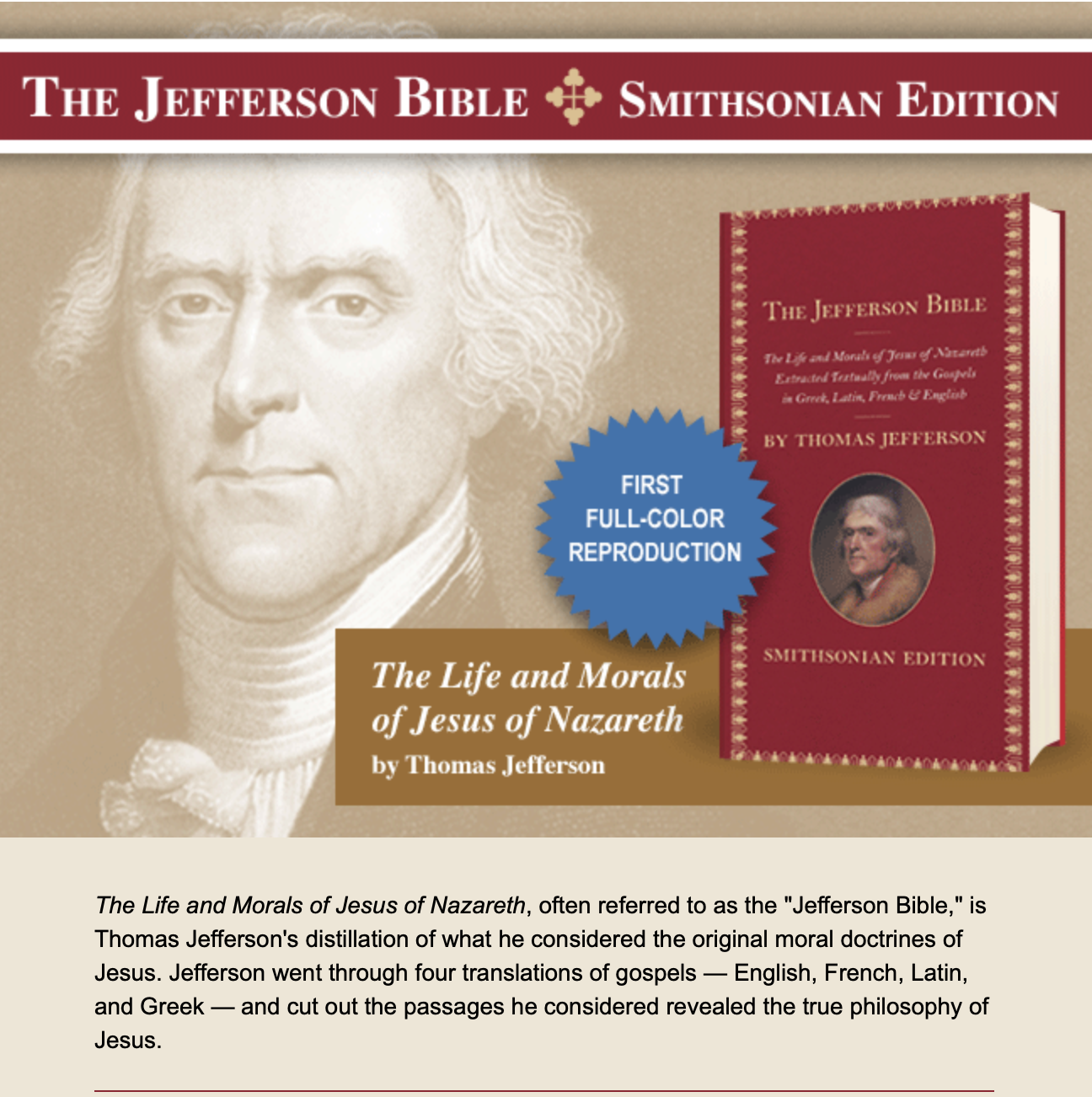
The Jefferson Bible

What was that again you were saying about our Christian Founding Fathers?

Practical Atheism in the Church

Atheism slips into the church where God really does not matter, as we go about building bigger and better congregations (church administration), confirming people’s self-esteem (worship), enabling people to adjust to their anxieties brought on by their materialism (pastoral care), and making Christ a worthy subject for poetic reflection (preaching). At every turn the church must ask itself, Does it really make any difference, in our life together, in what we do, that in Jesus Christ God is reconciling the world to himself?

Stanley Hauerwas, Resident Aliens

The Grand Myth

That grand myth which I asked you to admire a few minutes ago is not for me a hostile novelty breaking in on my traditional beliefs. On the contrary, that cosmology is what I started from. Deepening distrust and final abandonment of it long preceded my conversion to Christianity. Long before I believed Theology to be true I had already decided that the popular scientific picture at any rate was false.

C.S. Lewis, The Weight of Glory


Religious ideas have the fate of melodies, which, once set afloat in the world, are taken up by all sorts of instruments, some woefully coarse, feeble, or out of tune, until people are in danger of crying out that the melody itself is detestable.

George Elliot, Janet’s Repentance, via Alan Jacobs

[N]one of the things that I care about most have ever proven susceptible to systematic exposition.

Alan Jacobs, Breaking Bread With the Dead

You can read most of my more impromptu stuff here and here (both of them cathartic venting, especially political) and here (the only social medium I frequent, because people there are quirky, pleasant and real). All should work in your RSS aggregator, like Feedly or Reeder, should you want to make a habit of it.

Saturday, 2/15/25

Conservatives versus Nihilists

Trump really seems not to give a crap about the working class. Trump is not a populist. He campaigns as a populist, but once he has power, he is the betrayer of populism.

What’s going on here is not a working-class revolt against the elites. All I see is one section of the educated elite going after another section of the educated elite. This is like a civil war in a fancy prep school in which the sleazy kids are going after the pretentious kids.

Conservatives believe in constant and incremental change. Nihilists believe in sudden and chaotic disruption. Conservatism came into being opposing the arrogant radicalism of the French Revolution. The Trump people are basically the French revolutionaries in red hats — there are the same crude distinctions between good and evil, the same contempt for existing arrangements, the same descent into fanaticism, the same tendency to let the revolution devour its own.

David Brooks (emphasis added; unlocked).

The evils of revolutions almost invariably outweigh the goods. We’re getting what we voted for good and hard.

What’s radical about Trump?

[Trump]’s simply not as radical a departure from his predecessors’ worst policy instincts as we’d like to believe. But he is a radical departure in cultivating fear as a tool of leverage, right out in the open. And not just fear of political repercussions either.

In his earliest days as a Republican candidate for president, he half-joked with fans that he’d pay their legal bills if they punched protesters at his rallies. As he moved toward the GOP nomination in 2016, he warned there’d be riots if conservatives tried to block him at the convention. … It flatters his ego to know that his fans might be willing to kill for him and it pleases him to have an extra lever most politicians lack to pressure others into giving him what he wants. His amoral willingness and charismatic ability to intimidate is the molten core of his strongman persona.

January 6 is the supreme illustration … More than one Republican member of Congress has claimed that fear of rabid Trump supporters harming their families led some of their GOP colleagues to oppose his impeachment and removal after the insurrection. 

Encouraging unrest if he doesn’t get his way isn’t the only tool he uses to intimidate opponents, though.

He yanked federal protection details from John Bolton, Mike Pompeo, Mark Milley, and Anthony Fauci, placing them in danger for no better reason than that they criticized him in the past.

If you cross the president, you should expect your career, your finances, or even your life to be imperiled if it’s within his power to facilitate that. And rather than obscure that horrifying fact, Trump seems eager to advertise it: Freeing the thugs who broke into the Capitol on January 6 hoping to hang Mike Pence was his way of showing opponents that there’s no sin he won’t countenance if it’s committed in service to him.

Nick Catoggio (emphasis added)

Trump will never forgive Ukraine

Trump is no friend of Ukraine. Earlier this week he dipped into his stream of consciousness to pronounce that Ukraine “might be Russian someday” as J.D. Vance, the poor man’s Tucker Carlson, prepared to meet with Ukrainian leader Volodymyr Zelensky. He is surrounded by people who derive some weird kind of jollies from smearing and vilifying the Ukrainians—the vice president and other so-called nationalists who are all too happy to see a nationality exterminated if that pleases Vladimir Putin—as well as by people such as Kash Patel, the Kremlin stooge (on the cheap, no less) whom Trump has nominated to run the FBI. Trump will simply never forgive Ukraine for its government’s failure to help him manufacture a phony scandal (entirely superfluous, given the real ones) involving corrupt business practices and the Biden family.

Kevin D. Williamson

Softening, a little, on Trump

[Howard] Kurtz: It’s been reported, and feel free to push back on this, that when Trump won in 2016, you were at The Wall Street Journal and you were sobbing at your desk. . . . Has your view of him evolved since then?

[Bari] Weiss: It’s a good question. I mean, look, I’m the first to admit that I was a sufferer of what conservatives at the time would have called TDS, Trump Derangement Syndrome. . . . I’m someone that believes, call me old-fashioned, that everything is sort of downstream of character. And the kinds of things that he had said, and the way that he talked, and the way I felt he would coarsen our public discourse, those are all real. . . .

There were two things, I think, that I didn’t know in that moment when I was crying at my desk. One would be the sort of overzealous, out-of-touch, hysterical reaction to him, and the kind of illiberalism that was born out of the reaction to him that calls itself democratic, that calls itself progressive, but is actually extraordinarily authoritarian and totalitarian in its impulses. . . .

The other thing that I didn’t see was that Trump was going to do a lot of policies that I agreed with. I thought the Abraham Accords were historic and excellent. I thought his policy vis-à-vis Iran was excellent. The economy was better.

Howard Kurtz interviewing Bari Weiss of the Free Press on Fox News Channel’s “Media Buzz,” Feb. 9, via Wall Street Journal.

That’s a fair summary of longer comments, which you can view in less than 5 minutes via the “interviewing” link. The character issue remains.

J.D. Vance

A Trump presidency would have been completely unbelievable to me when I wrote my book about the G.O.P. and younger voters, so I approach political prediction with humility. Republicans do not have a robust modern record of vice presidents becoming their party’s presidential nominee — just ask Dan Quayle, Dick Cheney and Mike Pence. And those working under Mr. Trump do not always emerge from the experience unscathed. Four years is an eternity in politics, and if America ultimately concludes that the Trump-Vance administration was a failure, the Republican Party could look to turn the page.

But so far a good many voters like the direction this administration is going in, and Mr. Vance is finding his own moments, as at the A.I. conference, to show how he’s different from our recent generation of presidents. Mr. Trump may think it’s too soon to anoint successors, but he finds himself with a vice president who is better aligned with the spirit of what he is trying to achieve than virtually any other Republican.

Kristen Soltis Anderson. a Republican pollster

Clarity achieved

Imagine what they might have done. Trump could have announced that Musk and his minions were going in to audit the federal government. Within a few months, they’d bring a report, outlining every insane piece of waste or DEI excess or fraud they could find. Trump would then urge Congress to vote on these reforms. Win, win, win. It’s a great idea to shake up the joint with an outsider! But nah. They are busy ensuring that any cuts they make are brutal, dumb, and destined to expire.

Last year, a ton of readers who agreed with me on immigration, DEI, the transing of children, and the need for a more restrained foreign policy asked, in frustration, why I still couldn’t endorse Trump.

I hope that’s clearer now.

Andrew Sullivan.

I fear that for tribalist Trump-supporters, anything that owns the libs is just fine; they will not see more clearly now.

I shoulda listened

A binary system dictates binary choices. The Democrats were out for me. Donald Trump was the alternative.

Hunter Baker, When Pragmatic Politics Goes Bad: An Apology to the Never-Trumpers

Unlike Andrew Sullivan, Baker did vote for Trump and regrets it.

Ordo Amoris

I’m not personally going to enter into the little debate that has been going on about J.D. Vance’s characterization of Ordo Amoris, the ordering of loves, in Christian ethics. Here’s where the debate seems to stand:

Last month in a Fox News interview Vice President JD Vance articulated a … vision of a Catholic doctrine, ordo amoris. He said, “You love your family, and then you love your neighbor, and then you love your community, and then you love your fellow citizens in your own country. And then after that, you can focus and prioritize the rest of the world.”

While there were Catholics who agreed with Vance and defended his argument, Pope Francis was not among them.

On Tuesday the pope published a letter attacking Trump’s policy of mass deportations that appeared to directly address Vance’s argument. “Christian love is not a concentric expansion of interests that little by little extend to other persons and groups,” Francis wrote.

“The true ordo amoris that must be promoted,” he said, is “love that builds a fraternity open to all, without exception.”

David French

Make of that what you will, but don’t make too much of it because it’s a red herring:

Even if you agree with Vance’s formulation of ordo amoris, it strains credulity to argue that the United States isn’t prioritizing its own citizens when it spends such a small fraction of its budget on foreign aid — and when that aid provides concrete strategic benefits to the United States.

It’s also just bizarre to argue that describing the consequences of a policy is somehow emotionally manipulative when avoiding those consequences was the purpose of the program that’s being frozen or cut.

So, yes, you say that children might die without a certain program when the very purpose of the program is to prevent children from dying. That’s not manipulation. It’s confronting individuals with facts. It’s making them understand exactly what they are choosing to do.

There are few things more symbolic of the decline of the Republican Party than this radical turn against humanitarian aid ….

David French again (bold added).

I got a real punch-in-the-face reminder just days ago of how out of touch I am on today’s Evangelicalism. So all I’ll say on French’s perception that “Trump is influencing the evangelical church more than the church is influencing him” is that:

  1. It’s plausible: American evangelicalism has always been “plastic” (H/T Mark Noll, America’s God).
  2. I appreciate French’s tacit acknowledgement that there’s more to the Church than its distorted-but-prominent evangelical presentation.

The waning of family

“Like the waning of Christianity, the waning of the traditional family means that all of us in the modern West lead lives our ancestors could not have imagined. We are less fettered than they in innumerable ways; we are perhaps the freest people in the history of all humanity. At the same time, we are also more deprived of the consolations of tight bonds of family and faith known to most of the men and women coming before us—and this fact, it will be argued, has had wider repercussions than have yet been understood.”

Mary Eberstadt, How the West Really Lost God (Disclaimer: This book has long been in my queue because of quotes like this, but I have not read it.)

Colluding on the narrative

When, on a single day in 2018, more than 300 newspapers ran synchronized editorials against the president’s claim that the news media were the enemy of the American people, they sent a message about journalism’s independence.

Jonathan Rauch, The Constitution of Knowledge

I like Jonathan Rauch, but it seems to me that the message was that the media collude to set the narrative.

Most of the time, it’s not so patent.

A new form of ideological aggression

Dugin is extremely critical of modern Western society, and has written that “the entirety of Russian history is a dialectical argument with the West and against Western culture, the struggle for upholding our own (often only intuitively grasped) Russian truth.” But he also says: I am not anti-Western. I am anti-liberal. In fact, I love the West.… … I simply cannot accept the West in its current condition, at the end of modernity.… … He complains that “spiritually, globalization is the creation of a grand parody, the kingdom of the Antichrist.… American values pretend to be ‘universal’ ones. In reality, they are a new form of ideological aggression against the multiplicity of cultures and traditions still existing in the rest of the world.”

Paul Robinson, Russian Conservatism

This is one respect in which Trump may well be better than the Democrats.


I suffer more from the humiliations inflicted by my country than from those inflicted on her.

Simone Weil, from a letter to Georges Bernanos.

[N]one of the things that I care about most have ever proven susceptible to systematic exposition.

Alan Jacobs, Breaking Bread With the Dead

I don’t do any of the major social media, but I have two sub-domains of the domain you’re currently reading: (a) You can read most of my reflexive stuff, especially political here. (b) I also post some things on the only social medium I frequent, because people there are quirky, pleasant and real.

Sunday of the Publican and Pharisee

An American Orthodox Church?

There is no American Orthodox Church. It’s going to take centuries for there to be an American Orthodox Church. It took centuries for there to be a Russian Orthodox Church. There was a metropolitan of Kiev … who was appointed by the patriarch of Constantinople, who was a Greek for a long time, the metropolitan of Kiev. Because Russian Orthodoxy didn’t exist yet. It took centuries for it to come into existence.

Gentile Christianity took a long time to come into existence. The core of every church St. Paul founded was Jewish Christians, and he argued vehemently that that did not mean the Gentiles did not need to become Jews to become part of the community. So the fact that we have— Well, there have been attempts, but the fact that the Orthodox Church has not tried to boot-strap an American Orthodoxy is a very good thing, because the thing that would be produced by that would be a nightmare. It would be American in all the worst ways. There are forms of Christianity in the United States that are very, very American in all the worst ways: consumerism, obsession with entertainment culture and celebrity, this men’s conference this week that was like: “Saturday, Saturday, Saturday, monster trucks! UFC fights…” Like, it’s pathetic. It’s a distortion of Christianity in favor of Americanism.

[T]he Orthodox Church [in the USA] is still very close to its immigrant roots. That’s a good thing. That’s one of the things that’s protected Orthodox Christianity in this country from the way that American culture colonizes everything and corrupts it, frankly, with consumerism and these other traits, these other negative traits. It’s not just consumerism either. It’s pornification; it’s all kinds of things in American culture … But those immigrant ties have protected the Orthodox Church from that, and those immigrant ties are not going to last forever. My concern is less with how do we make the Orthodox Church more American; my concern is how do we stop it from becoming too American too fast and becoming some weird chimera.

Our goal has to be preserving what’s been handed down to us, preserving it intact, preserving it free from corruption, and then presenting it to people because it will bring about their salvation. But it’s going to challenge them. It’s going to be difficult.

Fr. Stephen De Young

Muscular Christianity?

One reason I became Orthodox is that the heart of this faith is not to be found in the legacy of Imperial Byzantium but in the spirit of the Desert Fathers, the hesychasts and the saints of the prisons. I don’t think many of my critics really understand Orthodoxy; but the life and teachings of, say, St John Chrysostom, St Isaac the Syrian, St Moses the Black or modern saints such as St Porphyrios or St Nektarios are more than enough to refute some of the cruder arguments for a ‘muscular Christianity’ that the Internet is currently coughing up.

Paul Kingsnorth

White Man’s Burden

My morning prayers used to include “thwart our meddling in traditional cultures, teaching them acquisativeness and perversion as the new White Man’s Burden.” If you have no idea why I would pray such a thing, go back and read this week’s news stories about some of the liberal groin pieties that USAID has been funding of late. Or this distilled version:

I doubt that it was necessary (not to mention legal) to feed USAID to the wood chipper to stop that crap, and I strongly suspect that some very meritorious work that enhances our image in the world will be collateral damage of Elon and his band of snot-nosed barbarians.

But my prayer for thwarting has been answered — a reminder to “be careful what you pray for.”

What’s better than joy?

‘Milton was right,’ said my Teacher. ‘The choice of every lost soul can be expressed in the words “Better to reign in Hell than serve in Heaven.” There is always something they insist on keeping even at the price of misery. There is always something they prefer to joy—that is, to reality.

C.S. Lewis, The Great Divorce


Religious ideas have the fate of melodies, which, once set afloat in the world, are taken up by all sorts of instruments, some woefully coarse, feeble, or out of tune, until people are in danger of crying out that the melody itself is detestable.

George Elliot, Janet’s Repentance, via Alan Jacobs

[N]one of the things that I care about most have ever proven susceptible to systematic exposition.

Alan Jacobs, Breaking Bread With the Dead

You can read most of my more impromptu stuff here and here (both of them cathartic venting, especially political) and here (the only social medium I frequent, because people there are quirky, pleasant and real). All should work in your RSS aggregator, like Feedly or Reeder, should you want to make a habit of it.

Presentation in the Temple

Today, the Orthodox Christian world celebrates Christ’s presentation in the Temple on the 40th day after His birth. And after 76 years on earth, I notice for the first time that “the righteous Simeon” who received Him and prayed the Nunc dimittis was not a priest in the Temple, but a righteous man who was there frequently and was led there by the spirit that day.

UPDATE: One of the hymns in Matins calls him a Priest, though that fact doesn’t appear in Luke 2. So I stand corrected.

Nondenominationalism and crypto-baptists

I stand corrected: not every non-denominational church is functionally Baptist.

Oh, I could quibble and say the LARPing Anglicanism without a bishop is sort of Baptist-adjacent. But when it includes an organized vestry and infant baptism, I wave the white flag.

Dechurching

[T]here are more people who dechurch into a kind of right-wing political religion than into a left-wing political religion.

Jake Meador, The Rise of the Right-Wing Exvangelical, citing The Great Dechurching

Race and the Bible

The problem with race and the Bible was far more profound than the interpretation of any one text. It was a problem brought about by the intuitive character of the reigning American hermeneutic. This hermeneutic merged three positions: (1) The Bible was a plain book whose meanings could be reliably ascertained through the exercise of an ordinary person’s intelligence; (2) a main reason for trusting the Bible as true was an intuitive sense, sealed by the Holy Spirit; (3) the same intelligence that through ordinary means and intuitions could trust the Bible as true also gained much additional truth about the world through intuitive processes that were also deliverances of universal common sense. The first position was a traditional Protestant teaching intensified by the American environment; the second was historically Protestant and Reformed; the third was simply a function of the American hermeneutic.

Mark A. Noll, America’s God

“Religion”

Just as colonial officials and missionaries, travelling to India, had imposed the concept of ‘religion’ on the societies they found there, so did agnostics colonise the past in similar manner. The ancient Egyptians, and Babylonians, and Romans: all were assumed to have had a ‘religion’. Some peoples—most notably the Greeks—were also assumed to have had ‘science’. It was this that had enabled their civilisation to serve as the wellspring of progress. Philosophers had been the prototypes of scientists. The library of Alexandria had been ‘the birthplace of modern science’.26 Only Christians, with their fanatical hatred of reason and their determination to eradicate pagan learning, had prevented the ancient world from being set on a path towards steam engines and cotton mills.

Tom Holland, Dominion

Belonging nowhere

Yesterday my family and I went to a wedding in Dublin. We got up in the dark, lit the candles, heated water on a gas stove I’d set up in the garden and washed in a plastic tub in the bath. Then we put our best duds on and drove out of the darkness. [They were in a storm-caused power outage of several days’ duration.] There was light in the city, of course. The wedding was beautiful. I’d never been to an Orthodox wedding before. Our friend, the groom, was lit up from within.

After the ceremony I got talking to another guest, a Romanian woman now living in Ireland. ‘When I go home now’, she said, ‘I feel like a stranger. It doesn’t feel like home, really. But I am not Irish either. I don’t belong anywhere.’ It could have been the familiar lament of the immigrant, but it was not that. ‘Except here,’ she went on, gesturing about her. ‘In the Church, there are people from all sorts of countries, but we all come together and everything makes sense. Nothing seems to make sense outside it any more.’

I nodded my head and agreed. I feel the same these days. My secular friends, my atheist relatives: I love them, but some of them think I’ve gone mad, or already was. This journey of prayer takes you away from the world, lifts your feet slightly above the ground, away from the electric spectacle, with its currents that drag you down. They can’t see that. How could they? It can’t be accessed through argument. It’s nobody’s fault, but the river that runs between us is real.

Later, my wife and I got talking to a priest we know around the dinner table. Here we were, an English Christian convert to the Eastern Church, a British-Indian Sikh, a Romanian Orthodox priest, all of us talking about religion in the capital of Ireland, and all of us agreeing on one thing: that we could understand and connect much better, on some deep level, with each other, and with other religious people, whatever their faith, than we could with people from our own culture who had no religion at all.

The English, said the priest, seem to be a very irreligious people. I told him he was right. It makes me sad, but there it is. I could talk more easily now, I think, to an African Christian, an Indonesian Muslim or an Indian Hindu than I could to a secular British atheist immersed in what passes for culture in my homeland. I’m not judging. I’m just laying it out.

You can aim towards God, I think now, or you can aim somewhere else. You can open up all of your inner rooms and say, come on in, Father, clear out all the crap I have stored in here, and fill these rooms with light. You can say that in a lot of different languages, in a lot of different dialects, with a lot of different approaches. Or you can keep the doors closed.

Paul Kingsnorth

We shall not cease from exploration

“We are all atheists about most of the gods that humanity has ever believed in,” Richard Dawkins has argued. “Some of us just go one god further.” The idea behind this aphorism is that every serious religious worldview is a closed system and that to really practice and believe in one is to necessarily reject all the rest as incredible and false.

Dawkins is simply wrong about the requirement for believers to disbelieve in every other faith. The bookstore of all religions isn’t necessarily a library of total falsehoods with one lonely truth hidden somewhere on the shelves, and embracing one revelation doesn’t require believing that every other religion is made up.

Consider the story of religious pilgrimage offered recently by the British novelist Paul Kingsnorth. Raised to experience his isle’s Christianity as a hopeless antiquarianism, he found that spiritual interests grew naturally out of his environmentalism, which led into a commitment to Zen Buddhism, which lasted years but felt insufficient, lacking (he felt) a mode of true worship.

He found that worship in actual paganism, and he went so far as to become a priest of Wicca, a practitioner of what he took to be white magic. At which point, and only at that point, he began to feel impelled toward Christianity — by coincidence and dreams, ideas and arguments and some stark mystical experiences as well.

But it would have been unimaginable to him at the start of the journey that the Christian faith imparted to him weakly in his childhood — that “ancient, tired religion” as he put it — could have possibly been his destination in the end. Only the act of questing delivered him back to the initial place, no longer old and tired but fresh and new.

“We shall not cease from exploration,” wrote T.S. Eliot in “Four Quartets.” “And the end of all our exploring / Will be to arrive where we started / And know the place for the first time.” That’s a nice encapsulation for Kingsnorth’s journey. But for the general obligation imposed upon us all, as time-bound creatures in a world shot through with intimations of transcendence, a different Eliot line is apt: “For us, there is only the trying. The rest is not our business.”

Ross Douthat, excerpted from his forthcoming book Believe: Why Everyone Should Be Religious.


Religious ideas have the fate of melodies, which, once set afloat in the world, are taken up by all sorts of instruments, some woefully coarse, feeble, or out of tune, until people are in danger of crying out that the melody itself is detestable.

George Elliot, Janet’s Repentance, via Alan Jacobs

[N]one of the things that I care about most have ever proven susceptible to systematic exposition.

Alan Jacobs, Breaking Bread With the Dead

You can read most of my more impromptu stuff here and here (both of them cathartic venting, especially political) and here (the only social medium I frequent, because people there are quirky, pleasant and real). All should work in your RSS aggregator, like Feedly or Reeder, should you want to make a habit of it.