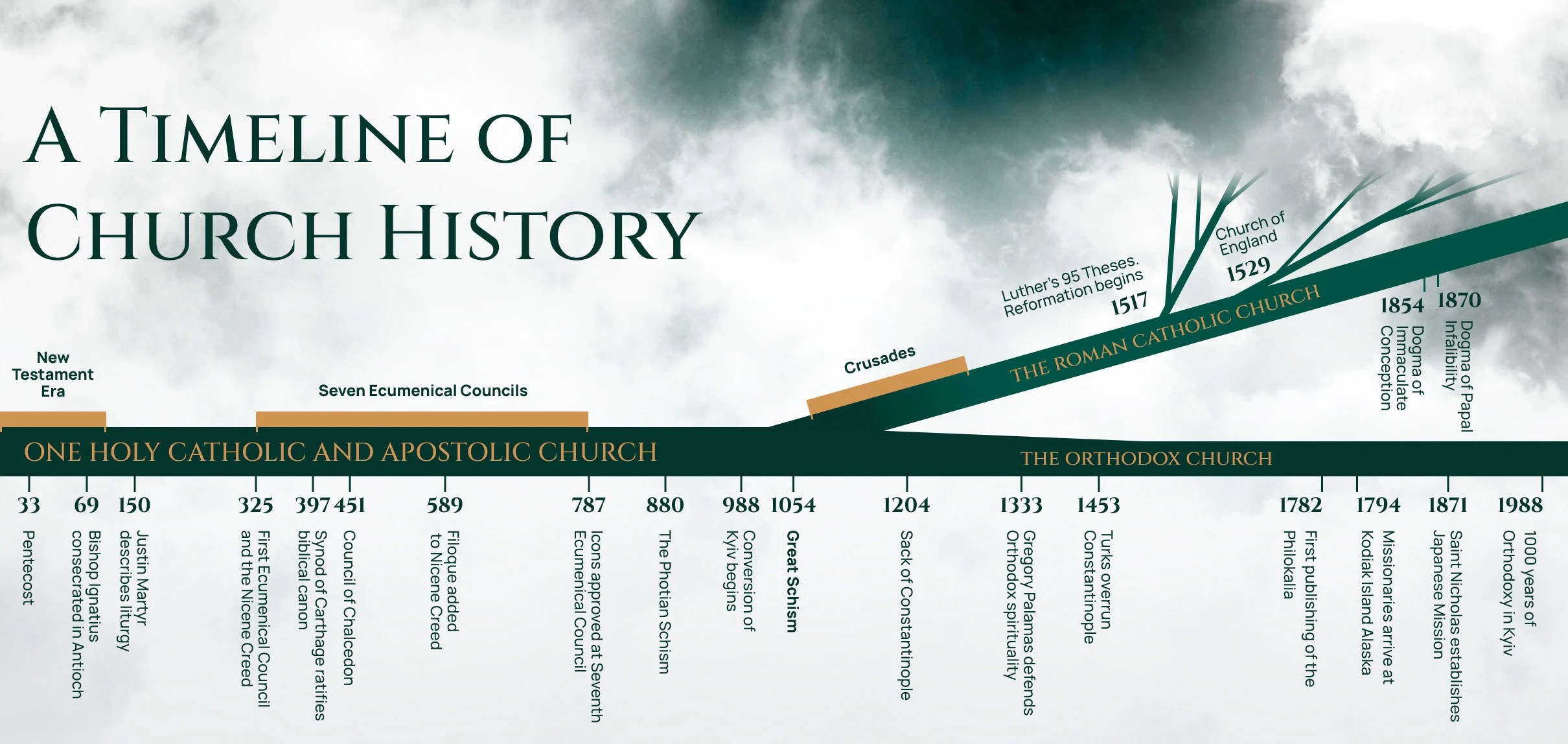
Holy Fathers of the First Ecumenical Council, Afterfeast of Ascension

What am I to do?

“Man is in his actions and practice, as well as in his fictions, essentially a story-telling animal.” Ethical questions presuppose narrative questions. As he put it, “I can only answer the question, ‘What am I to do?’ if I can answer the prior question, ‘Of what story or stories do I find myself a part?’”

Alasdair Macintyre, 1929-2025, via Christopher Kaczor

Inoculated

C. S. Lewis once claimed that it was much harder to present the Christian story to a post-Christian culture than to a pre-Christian one, and today we can see how true this claim is. Where I come from, people are largely inoculated against Christianity, or what they imagine Christianity to be. The history, the cultural baggage, the half-formed prejudices: all of these are compounded by a stark lack of understanding of what the Christian Way really is.

Paul Kingsnorth, Prose and Principalities

Not Mincing Words

On Memorial Day, I stumbled onto an Orthodox Priest in Texas who is gung-ho on “masculinity” and other click-baity stuff. I don’t link to indecent material, and this stuff felt indecent, twisted — Mark Driscoll in a cassock.

Since the story was from BBC, it came to the attention of the Russian Orthodox Bishop of London and Western Europe, who felt compelled to speak.

If he was speaking spontaneous, unprepared remarks, then he’s a remarkable man and Bishop. I want to quote every pointed, potent word, because my effort to excerpt it could leave out things that might be just what you need to “hear.”

So I give you a link to the full remarks: ‘Seeking After Worldly Visions of “Masculinity” is Not an Orthodox Pursuit’: A Word From Bishop Irenei.

I cannot deny that growth of the Orthodox Church in North America has been disproportionately from men coming in, and young men particularly. The appeal of Orthodoxy to men had been noted before I entered the Church, but I’m not sure it has ever been explained.

What I can tell you from my own parish (and my personal experience doesn’t extend much further than that) is that it’s not because our Priest obsesses over masculinity, or because the parish has special men’s ministries, or any other gimmick. It seems to be “a God thing,” and I can go no further than that.

Christ, the Life of all

To be Christian, to believe in Christ, means and has always meant this: to know in a transrational and yet absolutely certain way called faith, that Christ is the Life of all life, that He is Life itself and, therefore, my life. “In him was life; and the life was the light of men.” All Christian doctrines—those of the incarnation, redemption, atonement—are explanations, consequences, but not the “cause” of that faith. Only when we believe in Christ do all these affirmations become “valid” and “consistent.” But faith itself is the acceptance not of this or that “proposition” about Christ, but of Christ Himself as the Life and the light of life. “For the life was manifested and we have seen it, and bear witness, and show unto you that eternal life, which was with the Father, and was manifested unto us” (1 Jn. 1:2). In this sense Christian faith is radically different from “religious belief.” Its starting point is not “belief” but love.

Alexander Schmemann, For the Life of the World


Religious ideas have the fate of melodies, which, once set afloat in the world, are taken up by all sorts of instruments, some woefully coarse, feeble, or out of tune, until people are in danger of crying out that the melody itself is detestable.

George Elliot, Janet’s Repentance, via Alan Jacobs

[N]one of the things that I care about most have ever proven susceptible to systematic exposition.

Alan Jacobs, Breaking Bread With the Dead

You can read most of my more impromptu stuff here and here (both of them cathartic venting, especially political) and here (the only social medium I frequent, because people there are quirky, pleasant and real). All should work in your RSS aggregator, like Feedly or Reeder, should you want to make a habit of it.

Political (5/27/25)

Shooting us in the foot

Defunding Science

I don’t think I elevate science unduly, and I even try to burst the bubbles of those who do. I think we’ve neglected the humanities in worshiping the almight STEM.

But Steven Pincker has a long and passionate defense of Harvard in the New York Times opinion section. Remembering that Trump’s attack is largely based on alleged antisemitism at Harvard, this in particular struck me as key:

Just as clear is what won’t work: the Trump administration’s punitive defunding of science at Harvard. Contrary to a widespread misunderstanding, a federal grant is not alms to the university, nor may the executive branch dangle it to force grantees to do whatever it wants. It is a fee for a service — namely, a research project that the government decides (after fierce competitive review) would benefit the country. The grant pays for the people and equipment needed to carry out that research, which would not be done otherwise.

Mr. Trump’s strangling of this support will harm Jews more than any president in my lifetime. Many practicing and aspiring scientists are Jewish, and his funding embargo has them watching in horror as they are laid off, their labs are shut down or their dreams of a career in science go up in smoke. This is immensely more harmful than walking past a “Globalize the Intifada” sign. Worse still is the effect on the far larger number of gentiles in science, who are being told that their labs and careers are being snuffed out to advance Jewish interests. Likewise for the current patients whose experimental treatments will be halted, and the future patients who may be deprived of cures. None of this is good for the Jews.

The concern for Jews is patently disingenuous, given Mr. Trump’s sympathy for Holocaust deniers and Hitler fans. The obvious motivation is to cripple civil society institutions that serve as loci of influence outside the executive branch. As JD Vance put it in the title of a 2021 speech: “The Universities Are the Enemy.”

Steven Pinker, Harvard Derangement Syndrome (shared link)

Leave them all alone

A German concept used to validate the society-saturating politics infecting Europe 90 years ago was Gleichschaltung. It denoted totalistic government: the “coordinating” or “harmonizing” of all important social institutions. A foreign word, but no longer a foreign practice.

As a candidate in 2023, Donald Trump vowed to “choke off the money” to schools assaulting “Western civilization itself.” As he defines this, and as he defines “assaulting” it. What could go wrong?

America’s research universities are sources of U.S. economic dynamism and vital to technology-dependent national security. It is folly (and unlawful) to punish entire institutions for the foolishness of a few departments. When English departments are “decolonized” — dead White men purged from the curriculum — the only victims are students deprived of Shakespeare. Ideological indoctrination is rarer in engineering departments, where knowing the right facts rather than having the right feelings matters, otherwise bridges crumble and skyscrapers tumble. Leave all departments alone, some because their silliness does not matter much, others because their excellence matters greatly. (Source: washingtonpost.com)

George Will via John Ellis

Keeping score

SCOTUS and the “Shadow Docket”

We have plenty of things to worry about in constitutional law today. But those worried about how the court will confront the unprecedented and sometimes unlawful actions of the Trump administration should save their outrage for other cases.

In the two cases here, the court held that the president was likely to prevail in his unitary executive claim, that the administration was unduly harmed by allowing the officials to keep their offices while the case was pending, and that this reasoning would not imperil the independence of the Federal Reserve. It did all of this in an emergency order, rather than waiting for the issues to arrive on the court’s regular docket.

The president’s ruinous tariffs, purported cancellation of birthright citizenship, renditions to foreign prisons and retaliations against his political opponents all raise far graver constitutional problems than the court’s ultimately unsurprising order in these cases. We should focus our concern there.

Will Baude in the New York Times.

I had Will’s father, Pat Baude, for several Constitutional Law classes, and he, too, was brilliant. I only wish he had lived long enough to bust his buttons at his son’s brilliance and esteem in the legal community.

The Big Picture: A Hostage Crisis

This newsletter concerns itself with the great patriotic project to turn America into a banana republic, but something gets lost by doing that episodically. Each day we study some crooked new tree that Donald Trump’s administration has planted; rarely do we step back and consider how large the forest has already become.

Here’s Andy Craig at The UnPopulist, stepping back:

Since Jan. 20, the United States has been in a state of rapid constitutional collapse. Congress’ power of the purse, its most fundamental prerogative, has been usurped; statutory laws have been suspended by claimed “emergency” powers; the requirement for Senate confirmation has been made irrelevant; a transparently political purge of both the civil service and the armed forces has been launched; the president has threatened aggressive military force against longtime allies; a decree was issued to strip constitutional citizenship rights; our treaty obligations have been blown up with a self-sabotaging trade war; mass pardons have been used to gleefully sanction political violence; courts have been defied to send innocent people to a Central American torture camp; the world’s richest man has deployed a gaggle of racist hackers to shut down government agencies on a whim; and, just as we were going to press, news broke that Harvard University has been barred from enrolling foreign students because of its refusal to hew to the president’s ideological demands.

What Craig is describing is essentially a hostage crisis.

An authoritarian state is a national hostage crisis … Most hostage crises aren’t orchestrated by coolly ingenious master-planners. They’re what happens when someone who’s ruthless, audacious, volatile, and cunning but not very bright makes a mess of his caper, like a bank robber whose hold-up takes longer than expected. He turns to leave and finds cop cars pulling up outside, causing him to panic and to start taking hostages instead.

There’s no “plan.” He just doesn’t know what else to do now that a wildly reckless, dangerous course of action like robbing a bank has suddenly gone sideways.

That was also the theme of yesterday’s newsletter, not coincidentally. The One Big Beautiful Bill that passed the House on Thursday is incomprehensible as a plan to strengthen America fiscally. It makes sense only as a desperate act in the midst of a dangerous caper gone bad: Having decided long ago that making Trump happy is more important than protecting the country, House Republicans acted accordingly when forced to choose.

Nick Catoggio

Amnesiac Nation

The background fact of this second Trump impeachment trial was how broadly popular it was. In January, a Monmouth survey found that 56 percent of Americans wanted Trump convicted. Quinnipiac reported that 59 percent regard him as responsible for inciting violence against the U.S. government. According to ABC/The Washington Post, 66 percent believe that Trump acted irresponsibly during the post-election period. According to polls, fewer than a quarter believed that Trump did “nothing wrong” on January 6.

Those are not the numbers on which to base a Grover Cleveland–style comeback tour—especially not when the majority of Americans also believe that Donald Trump did a bad job handling the COVID-19 pandemic and that President Joe Biden is doing a good job.

David Frum.

There came a time when “President Joe Biden” became a legal fiction, and that boosted Trump’s stock.

Abundance Agenda

Jonathan Chait writes about the civil war in the Democrat party over a proposed “abundance agenda” for the party.

Here are the pieces of that agenda, according to Chait:

[T]he canonical abundance agenda consists of three primary domains.

The first, and most familiar, is the need to expand the supply of housing by removing zoning rules and other legal barriers that prevent supply from meeting demand …

The second focus of abundance is to cut back the web of laws and regulations that turns any attempt to build public infrastructure into an expensive, agonizing nightmare …

The third domain, and the one that has received the least attention from commentators, is freeing up the government, especially the federal government, to be able to function. Policy wonks call this issue “state capacity.” The government itself is hamstrung by a thicket of rules that makes taking action difficult and makes tying up the government in lawsuits easy. The abundance agenda wants to deregulate the government itself, in order to enable it to do things.

The problem is that there’s a bloc of progressive special interests within the party (“the groups,” per the abundance agenda proponents), and the groups are large and unified (or at least in alliance):

The progressive movement seeks to maintain solidarity among its component groups, expecting each to endorse the positions taken by the others.

Much of the most vociferous opposition to the abundance agenda has zeroed in on its betrayal of this principle. The Roosevelt Institute’s Todd Tucker attacked Ezra Klein on X for his “survivor island approach to coalitions—first unions and Dems team up to vote enviros off the island, and then Dems turn on labor.” David Sirota, a left-wing journalist, complained, “Abundance Libs are insisting the big problem isn’t corporate power & oligarchs, it’s zoning laws & The Groups? Come on.” Austin Ahlman, a researcher at the Open Markets Institute, an anti-monopoly advocacy organization, mused, “You have to wonder whether the Abundance faction stuff would have landed better if the proponents had not laid the groundwork for it by first broadsiding every other organized constituency in the democratic tent.”

This angry response is not merely a knee-jerk reaction to criticism, but the logical outgrowth of a well-developed belief system. Since the Obama era, many of the component groups in the progressive coalition have drifted further left on their core demands. (Single-issue lobbies are naturally incentivized to grow more extreme over time—what organization is going to decide its pet cause is too unpopular or costly to merit a strident defense?)

At the same time, they have grown more purposeful about their belief that each group must stand behind all the positions outlined by the others. That is why civil-rights groups will demand student-debt relief, abortion-rights groups endorse abolishing the police, or trans-rights groups insist that Palestine should be liberated. Leah Hunt-Hendrix, an heir to the Hunt oil fortune who became a full-time progressive organizer, and who has raised and donated millions to causes such as the Sunrise Movement, the Debt Collective, and Black Lives Matter, articulated the principle of cross-endorsements in her book, Solidarity. She argues for “the necessity of working in coalition with progressive social movements,” and of resisting the opposition’s efforts “to weaponize a movement’s fault lines.”

Such progressives are not wrong to see the abundance agenda as a broader attack on their movement.

The Coming Democratic Civil War – The Atlantic

I have long believed that “the groups” impede Democrat success by alienating Democrats in the cultural mainstream. And as I’ve long said, whatever else Trump’s triumph means, it means major political realignment. The Democrat party’s travails over the abundance agenda, and controlling the toxic “groups,” could further advance that realignment, but I’m not sure it will benefit the Democrats all that much.

But then what do I know? I’m almost completely alienated from a country that can elect Velveeta Voldemort.


Your enemies are not demonic, and they are not all-powerful and the right hasn’t always lost and the left hasn’t always won. But if you convince yourself of that, you give yourselves all sorts of permission to do a lot of stupid and terrible things under the rubric of “Do you know what time it is?”

Jonah Goldberg.

Regarding said “lot of stupid and terrible things,” my failure to call out anything about the current regime does not mean I approve. There’s just too much, and on some of the apparent illegalities I don’t want to abuse my rusty credentials without thinking it through.

I don’t do any of the major social media, but I have two sub-domains of the domain you’re currently reading: (a) You can read most of my reflexive stuff, especially political here. (b) I also post some things on my favorite social medium. I am now exploring Radiopaper.com as well.

Great and Holy Race Day

I’m situated geographically in a place so sports- and Indy500-obsessed that in my former Church, men would disappear en masse on “Race Day.” Granted, I lived away from here 20-ish years, but it’s still a point of sinful pride that I’ve never been. Not to the race, not to the trials, not to carburation day.

(I apologize for some funky formatting today. After all these years, I still have trouble dealing with numbered or bulleted lists within block quotes.)

Filioque

As a protestant, I had no idea that the filioque (the words “and from the Son” in the Nicean Creed concerning the procession of the Holy Spirit) was added to the Creed hundreds of years later, nor that it was rejected from the beginning by Christians outside the jurisdiction of the Roman Patriarch, nor even (very distinctly at least) that there were catholic Christians outside the jurisdiction of the Roman Patriarch.

Since becoming Orthodox, I have taken it as a matter of high importance to reject the filioque, but I don’t recall previously seeing all of these reasons for the rejection:

Eastern Europe was converted to Christianity by Byzantine missionaries, the most prominent of whom are Saint Cyril and Saint Methodius. These bonds of religion created a deep sympathy between Bulgar to Byzantine. The Franks attempted to sever these bonds by sending missionaries into Eastern Europe, claiming that the Byzantines had taught them a heterodox version of Christianity and encouraging them to use the filioque.

I know Catholics are tired of Orthodox apologists going on about the Franks. But this really is an important test-case, for the following reasons:

  1. The threat of Arianism was resolved 300 years before the Schism. So, adding the filioque served no pastoral function. On the contrary, it was deeply divisive.  
 2. The underlying theology of the filioque was hotly disputed, especially by the Eastern patriarchs. So, adding the filioque did not express the mind of the universal Church.  
 3. The original Creed had been drafted in Council for a reason: it was supposed to express the *consent* and *concensus* of the orthodox, catholic bishops. So, adding the filioque defeated the whole purpose of the Creed.  
 4. For about six hundred years, Popes had taught the dangers of inserting the filioque into the Creed. So, adding the filioque violated even Rome’s local customs.  
 5. The Ecumenical Councils had ruled that the Creed should not be modified. So, adding the filiioque violated the Holy Canons.  
 6. Rome was advancing the *filioque* for worldly reasons only. So, adding the filioque would have allowed a single bishop to advance his own political and economic interests at the whole Church’s expense.  

The Eastern Patriarchs had every reason to reject the insertion of the filioque, and no reason to accept it—none except, “The pope said so, and we have to do whatever the pope says.”

Michael Warren Davis, ‘Papal Minimalism’ Is Eastern Orthodoxy

Worship

To anyone who has had, be it only once, the true experience of worship, all this is revealed immediately as the ersatz it is. He knows that the secularist’s worship of relevance is simply incompatible with the true relevance of worship. And it is here, in this miserable liturgical failure, whose appalling results we are only beginning to see, that secularism reveals its ultimate religious emptiness and, I will not hesitate to say, its utterly anti-Christian essence.

Alexander Schmemann, For the Life of the World

Protestant, Catholic, Non-Denom

As my readers know, I’ve been an Orthodox Christian ever since I began blogging. The more attentive readers may know that before that I was Reformed (i.e., Calvinist, and specifically Christian Reformed) and before that, I was a generic Wheaton-College type evangelical.

Or maybe I should say “a generic Wheaton-College type evangelical as evangelicalism was configured in the 1950s through the mid-1970s.” Because it has come to my attention more forcefully, and in a way that more painfully implicates and pronounces doom on the kinds of Christian I once was, that things are changing. The evangelicalism I knew is not as powerful as it once was; evangelical denominations are shrinking and dying. So are Calvinist denominations. The Protestantism I knew most closely is increasingly nondenominational, and doesn’t care much about doctrine or sacraments, and increasingly doesn’t even want to be called “evangelical” or even “Protestant.”

This affects me closely because my wife remains Christian Reformed, and I consider it a pretty good penultimate tradition for an Orthodox Christian. And there is a very strong trend toward those denominational Churches dying out in favor of non-denoms.

And it worries me because those nondenominational Churches tend far too much to be personality cults and hotbeds of rampant sexual and other clergy abuse. And God only knows what they’re teaching, insofar as they’re teaching anything other than a mooshy-gooshy relationship with Jesus and a firm commitment to the GOP as a way of gaining power.

Yeah, this means I’ve gained some fresh respect even for the progressive Protestant denominations (which are also dying, even faster than the conservatives). At least there’s some accountability to hierarchies less likely than local parishioners to be mesmerized by Mr. Charisma. And some of them retain a liturgy that will expose worshippers to more scripture and doctrine than Joel Osteen can even imagine.

In any event, I say all that to introduce you to four of the thought-provoking articles (presented in the order in which I encountered them) that brought to my attention how much things are changing in my former haunts. A common thread is that denominational Protestantism is in deep, deep trouble; one goes so far as to suggest that nondenominational Churches are not really Protestant, but a whole new tradition:

  1. Goldilocks Protestantism – First Things
  2. LONG FORM: Does Traditional Protestantism Have a Future?
  3. How ‘Christian’ Overtook the ‘Protestant’ Label – Christianity Today
  4. Low Church in High Places: The Fate and Future of American Protestantism – Public Discourse

Religious ideas have the fate of melodies, which, once set afloat in the world, are taken up by all sorts of instruments, some woefully coarse, feeble, or out of tune, until people are in danger of crying out that the melody itself is detestable.

George Elliot, Janet’s Repentance, via Alan Jacobs

[N]one of the things that I care about most have ever proven susceptible to systematic exposition.

Alan Jacobs, Breaking Bread With the Dead

You can read most of my more impromptu stuff here and here (both of them cathartic venting, especially political) and here (the only social medium I frequent, because people there are quirky, pleasant and real). All should work in your RSS aggregator, like Feedly or Reeder, should you want to make a habit of it.

Sunday of the Samaritan Woman

Sorry to be so much later than usual with this. I had a very busy Saturday and Sunday.

Beauty First

Let me commend to any artistic sorts reading this the video embedded in Beauty First: Envisioning a Civilization Worth Restoring. Jonathan Pageau’s introduction should tell you whether it merits your further attention.

Live the life of the Church

Having largely lost our religion(s), modernity has seen fit to create new ones. If we wonder what constitutes a modern religion (or efforts to create one) we need look no further than our public liturgies. Various months of the year are now designated as holy seasons set-aside to honor various oppressed groups or causes. It is an effort to liturgize the nation as the bringer and guardian of justice in the world, an effort that seeks to renew our sense of mission and to portray our nation as something that we believe in. It must be noted that as a nation, we have not been content to be one among many. We have found it necessary to “believe” in our country. It is a symptom of religious bankruptcy. As often as not, major sports events (Super Bowls) are pressed into duty as bearers of significance and meaning. The pious liturgies that surround them have become pathetic as they try ever-harder to say things that simply are not true or do not matter. This game is not important – it’s just a game.

I am often asked, when writing on this topic, what response Christians should make. What do we do about the state? How do we respond to modernity? For the state – quit “believing” in it. We are commanded in Scripture to pray for those in authority. We are not commanded to make the state better or participate in its projects. We are commanded to serve our neighbors as we fulfill the law of God. However, I think it is important to work at “clearing the fog” of modern propaganda regarding the place of the nation state in the scheme of things. I would frame a response to modernity in this manner: we are not responsible for foreign religions. Though Christian language and carefully selected ideas are often employed in the selling of modernity’s many projects, it is a mistake to honor its false claims. Make no mistake, modernity will offer no credit, in the end, to Christ, the Church, or to people of faith. Its interests lie elsewhere.

The proper response to these things will seem modest. Live the life of the Church. The cure of modernity’s neurasthenia is found not in yet one more successful project, but in the long work of salvation set in our midst in Christ’s death and resurrection. Our faith is not a chaplaincy to the culture, or a mere artifact of an older world. The Church is the Body of Christ into which all things will be gathered, both in heaven and on earth. It is the Way of Life as well as a way of life. It is not given to us to control how we are seen by the world, or whether the world thinks us useful. It is for us to be swallowed up by Christ and to manifest His salvation to the world. We were told from the very beginning that we should be patient, just as we were promised from the beginning that we would suffer with Christ.

I think the sickness that haunts our culture is that we fail to know and see what is good and to give thanks for the grace that permeates all things. When that is forgotten, nothing will satisfy, nothing will transcend. There is no better world to be built, nor are there great wars to be won. There is today, and that is enough.

Fr. Stephen Freeman, When America Got Sick

Astronomical accuracy

I don’t think I’d ever read the tart Orthodox response (from one Patriarch at least) when Pope Gregory invite the Orthodox to adopt his new, more astronomically-accurate calendar:

By the 16th century, concerns about secular or humanistic trends in Catholic theology had become a major theme in Orthodox apologetics. For instance, the dating of Easter was fixed by the First Ecumenical Council imn A.D. 325. At the time, their calculation was made using the Julian Calendar. However, in 1582, Pope Gregory XIII issued his new liturgical calendar—now known as the Gregorian Calendar, which he held to be more scientifically accurate. Gregory wrote to the Orthodox patriarchs inviting them to adopt his new calendar. Patriarch Joachim V of Antioch commissioned a reply from his disciple Metropolitan Athanasius al-Marmariti ibn-al Mujalla, who wrote to Pope Gregory:

Our community, our bishops, our kings and all our people, scattered in the four cardinal directions—Greeks, Russians, Georgians, Vlachs, Serbs, Moldovans, Turks, Arabs, and others . . . from the time of the Holy Apostles and God-bearing fathers of the Seven Ecumenical Councils down to this day recognize one faith, one confession, one Church, and one baptism . . . and all our nations agree in the four corners of the inhabited world with one word and one affair . . . and we did not receive the confession and the holy tradition which is in our hands . . . from unknown people, like other, foreign communities.

But we pray with the Holy Apostles and the 318 fathers [of the Council of Nicaea] whose signs and miracles shine forth from them manifestly. And so how can we change the tradition of such holy fathers and follow after unknown people who have no other trade but to observe the stars and examine the sky?

As with the filioque, we see that there are really two complaints here. (1) The dating of Easter—like the text of the Creed—had been established by an Ecumenical Council. How, then, could it be modified unilaterally by the Pope? (2) Why should the Church prefer “scientific accuracy” to the longstanding custom of the Apostolic Church?

Michael Warren Davis, The Primacy of God.

Eventually, many Orthodox Churches in the West — including my own — adopted the Gregorian Calendar — except for Pascha/Easter and the preceding Lent and following Pentecost. For those, we stuck with the dating from the Ecumenical Council.

Departure from tradition

…as Nathan Hatch, Mark Noll, and E. Brooks Holifield argue, departure from tradition explains much of the growth, influence, and shortcomings of American Christianity—including the failure of the nation’s theologians and churches to resolve the question of slavery.

Paul J. Gutacker, The Old Faith in a New Nation

Spontaneity is not authenticity

In our desire to be real we start thinking that authenticity is another word for spontaneity, as if everything we say at the spur of the moment is more true, more sincere than words we craft carefully. For many, the Freudian slip is considered more authentic than the measured reply. Indeed, sometimes what we blurt out thoughtlessly is actually what we mean and feel. But more often than not, what we blurt out is ill-considered and something we either need to qualify or apologize for.

Mark Galli, Beyond Smells and Bells. I have not read this book, but appreciate Readwise suggesting it.

Homo liturgicus

[I]n Augustine’s view; we are homo liturgicus, and the basic human need to worship God can be diverted and misdirected, but it cannot be eliminated.

William T. Cavanaugh, The Uses of Idolatry

Miscellany

Religion’s closest cousin is not rigid logic but art.

David Tracy, who died April 29. I like that, but from what I read in his obituary, there’s a lot I would dislike.

The biblical significance of the modern state of Israel is exactly the same as the biblical significance of Finland.

Fr. Andrew Stephen Damick

  • Really great art should have a secret in it that the artist knows nothing about.
  • In each experience of beauty, we’re being prepared for eternity.

Martin Shaw


Religious ideas have the fate of melodies, which, once set afloat in the world, are taken up by all sorts of instruments, some woefully coarse, feeble, or out of tune, until people are in danger of crying out that the melody itself is detestable.

George Elliot, Janet’s Repentance, via Alan Jacobs

[N]one of the things that I care about most have ever proven susceptible to systematic exposition.

Alan Jacobs, Breaking Bread With the Dead

You can read most of my more impromptu stuff here and here (both of them cathartic venting, especially political) and here (the only social medium I frequent, because people there are quirky, pleasant and real). All should work in your RSS aggregator, like Feedly or Reeder, should you want to make a habit of it.

Sunday, May 11, 2025

Christians in politics

The lure of power

Cal Thomas and Ed Dobson, who had been Falwell’s chief lieutenants in the Moral Majority, published a book questioning not just the efficacy of political action but the righteousness of the enterprise. In Blinded by Might they argued that in the process of trying to win elections conservative Christians had been seduced by the lure of power. What had begun as an effort to restore Christian values to the nation had degenerated into an unbridled partisan struggle, creating an atmosphere in which it was assumed that Democrats could not be Christians and that Bill and Hillary Clinton were the Antichrist.

Frances Fitzgerald, The Evangelicals

So far as I can tell, this continues in full force except that the “Christian” bona fides of the Christian right are becoming ever more dubious.

The need for limits

Localism is modest … and in its modesty it is largely indifferent to the divisions that animate citizens who may hate each other but otherwise share the first premise of the modern age, which is that limits are there to be broken. When the success of the economy depends on perpetual growth fueled by boundless consumption, and the legitimacy of the state depends on a receding horizon of social progress fueled by an ever-expanding list of rights, “modest hopes” are obscene. Simply living as you should, without lending your energies to the machinery of progress, can be a mortal threat to the way things are.

… [I]f there is any such thing as an “ideal regime” it is the peasant village, “a gathering of human families for the sake of endurance across the harsh terrain of mortal life”. But many kinds of actually existing regimes have room for such gatherings, and our proper aim as citizens is not to transform the empires of progress into the Shire. Our business is not with ideals. We have a basic interest in existing institutions that support material life and in their competent management; beyond this realm of “normal politics,” we need not concern ourselves.

… Radner mentions the book of Ecclesiastes as the “scriptural ballast” for his political theory, and calls it “that most political book of the Bible.”

Adam Smith, reviewing Ephraim Radner, Mortal Goods. My copy of Mortal Goods was delivered yesterday and is near the top of the stack to read.

American Christianity

False binary

Christianity as we see it in eighteenth-century Britain or twenty-first-century America is not Christianity as it has always been, and the more fundamental changes may not be those that the received history of religion narrates. The cultural formations of western Christianity, growing as they do in good part from binary, Protestant-Catholic debates, can be thrown into stark relief, for instance, when studied in comparison to that much neglected third term in Christendom: the Eastern Orthodox churches from which Rome severed itself nearly half a millennium before the Reformation, charting a course for Western Christianity wed to rationalism and enamored of individual authority, whether papal or personal.

Lori Branch, Rituals of Spontaneity.

I don’t recall any other non-Orthodox (so far as I know) writer who doesn’t reflexively fall into the trap of treating the Eastern Orthodox as the schismatics, Rome as the orthodox continuation.

Cooties

“There never was a time when it was so much abused, when its simple narrations were so much perverted, and when its true and more important uses were so completely overlooked in following fanciful theories and false deductions; and such as seriously threaten the interests of Protestant Christianity.” [Professor David R. Kerr of the United Presbyterian Theological Seminary in Monmouth, Illinois] warned students to beware of two “fanciful theories”: the “Mercersburg theology” taught by Philip Schaff and John Williamson Nevin, which appeared to depart from traditional Reformed views of the sacraments and of church history, and the Oxford Movement, a group of High Church Anglicans whose writings in the 1830s and 1840s gave birth to Anglo-Catholicism. These errors could not be countered merely with scripture, Kerr argued, but required careful attention to church history, which alone could “correct the gross perversions and false glosses.”

Paul J. Gutacker, The Old Faith in a New Nation

As a Protestant Calvinist, I loved the Mercerburg theologians, who translated the Church Fathers, and was fascinated by the Oxford Movement. Considering where I’ve ended up, I guess it is no surprise that my favorite 19th century protestants, those of catholic leanings, had cooties in the eyes of evangelical sectarians.

Secularizations

After he had twice visited the United States in the 1930s, Dietrich Bonhoeffer wrote a perceptive essay contrasting Christian development in America with parallel developments in the parts of Europe most directly shaped by the Protestant Reformation. His assessment included an observation that was as shrewd in its comparative wisdom as it is relevant for the themes of this book: “The secularization of the church on the continent of Europe arises from the misinterpretation of the reformers’ distinction of the two realms [of church and society]; American secularization derives precisely from the imperfect distinction of the kingdoms and offices of church and state, from the enthusiastic claim of the church to universal influence in the world.” What Bonhoeffer saw has been described with other terms here: The key moves in the creation of evangelical America were also the key moves that created secular America.

Mark A. Noll, America’s God

Why smart atheists admit they’re cultural Christians

At the same time, you hold all sorts of Christian assumptions about the world, even if you do not believe in God. It is clear to you that there are such things as human rights, such that a certain level of dignity belongs to all people simply because they are members of the human race, and laws and customs should reflect this in practice. You reject polygamy. You believe in limitations on the power of the state and that the rule of law is essential to a healthy society, whereby the rex (king) is always subject to the lex (law). You think those with much should provide for those with little, whether this is expressed through a redistributive state, charitable giving, or both. You affirm the fundamental equality of all people before the law. You abhor slavery. You do not seek to justify inequalities in wealth or status seek to reduce them.

You think the central unit in human relations is the self, the sovereign individual, rather than the group to which the self belongs. You think all people are equally endowed with free will, reason, and moral agency. Humility in others is more attractive to you than pride. Love is more appealing to you than honor. You think colonialism is morally problematic, and that those who have benefited from it have obligations (however defined) to those who did not. You think of time as an arrow rather than a wheel: you believe that we are gradually making progress toward a better world rather than declining from a previous Golden Age or recurring in an endless series of cycles, and as such you would think “behind the times” is an insult and “ahead of her time” is a compliment. You admire people who forgive their enemies. You long for transcendence and are likely to describe yourself as spiritual, open to the supernatural, and even as praying sometimes. Even if the God of Abraham is dead to you, your language, legal framework, moral imagination, and sense of self are all haunted by his ghost.

Andrew Wilson, Remaking the World.

Penitence

The prayer of penitence leads us to reflect critically on our own lives. If it is uttered sincerely, it leads us to repent in humility, not just of particular wrongs we have done, but of our whole shameful and degraded state of being. The paradox is that, far from leading to lethargy or despair, such penitence brings a new kind of strength. Sexual sin is never merely sexual, but always has motives that are rooted in the passions—whether the need to be loved, or the lust for domination, or the desire to prove oneself attractive, or any of a dozen other motives that come readily to mind.

Healing Humanity

What fundamentalists and higher critics share

I’ve quoted this before, probably multiple times, but it’s so very perceptive:

Both the fundamentalist and the higher critic assume that it is possible to understand the biblical text without training, without moral transformation, without the confession and forgiveness that come about within the church. Unconsciously, both means of interpretation try to make everyone religious (that is, able to understand and appropriate scripture) without everyone’s being a member of the community for which the Bible is Scripture.

Stanley Hauerwas, Resident Aliens.

I’ve also echoed it when I’ve noted that people who don’t like Christianity cherry-pick hard passages, read them like fundamentalist literalists, and then object at how absurd the Scriptures are.

Cosmologies

The Copernican/Galilean worldview, that is the heliocentric worldview and its further development into our modern cosmology of galaxies and nebulas and black holes has two important aspects. It is an artificial vision and it is an alienating vision. It is artificial in the strictest sense of “art” or “techne”. It is a technical vision because we cannot experience this vision without technology, without telescopes and other apparatuses …

[T]he telescope and microscope are self-effacing artifices, they attempt to replace the eye, to convince us that they are not artificial but are more real than the eye. It is not only the physical gesture of looking at the world through a machine that demonstrates the radical change, though this is symbolic enough, but it is the very fact that people would do that and come to the conclusion that what they saw through these machines was truer than how they experienced the world without them. Yet the great revolution is not simply a technical rectification as it is presented by some today, it is not only that technically speaking we used to believe the earth to be a flat disk at the centre of the cosmos, and now we know the earth to be a big ball of water and dirt swirling around a giant nuclear reactor at the centre of our planetary system. The change happens in the very core of what Truth is, it is a change in the priority of knowledge, a change in what is important to us as human beings. That is the change. In a traditional world, all of reality is understood and expressed in an integrated manner. We describe phenomena in the manner we experience it because what is important is not so much the making of big mechanically precise machines that will increase our physical power, but rather the forming of human beings that have wisdom and virtue. The resistance to the heliocentric model was a desire to “save the phenomena”, the desire to express the world as we experience it because this expression must remain connected to how human beings live their lives and interact with God and their fellow men. So by projecting ourselves out through our machines into an physically augmented world, we “fall” into that materiality, we inevitably live in a more material and materialist world. And this is modern history itself.

What proceeds from this is my second point, which is that modern cosmology is not only artificial, but it is alienating, it moves Man away from himself. Once Man accepted that what he saw through his telescopes and microscopes is more real than his natural experience, he made inevitable the artificial world, he made inevitable as its end the plastic, synthetic, genetically modified, photoshopped, pornographic, social-networked reality we live in.

Jonathan Pageau, Most of The Time The Earth Is Flat.

I enjoyed re-reading this after eleven years and am enjoying (not quite as much) the three other articles Pageau wrote defending ancient cosmology (over “scientific” cosmology).

More:

In 1922 fr. Pavel Florensky wrote an article in his “Imaginary Values in Geometry” in which he attempted to use the general theory of relativity to show that considering the relativity of motion, one could develop a perfectly coherent mathematical model in which the Earth is the reference of motion. This model would in fact correspond to Ptolemy’s cosmological descriptions. This article was one of the reasons the Communist State gave for his trial and execution, a dark irony considering the usual “violent religion” vs. “enlightening science” rhetoric we are taught in primary school regarding Galileo’s censorship.

Jonathan Pageau, Where is Heaven?.

Ah! A kindred spirit! I long thought that Copernicus had the scientific advantage over Ptolemy because his scheme was more parsimonious, but that Ptolemy was coherent, too. The way it gets taught, though, is that Ptolemy was wrong and we know better now.


Religious ideas have the fate of melodies, which, once set afloat in the world, are taken up by all sorts of instruments, some woefully coarse, feeble, or out of tune, until people are in danger of crying out that the melody itself is detestable.

George Elliot, Janet’s Repentance, via Alan Jacobs

[N]one of the things that I care about most have ever proven susceptible to systematic exposition.

Alan Jacobs, Breaking Bread With the Dead

You can read most of my more impromptu stuff here and here (both of them cathartic venting, especially political) and here (the only social medium I frequent, because people there are quirky, pleasant and real). All should work in your RSS aggregator, like Feedly or Reeder, should you want to make a habit of it.

Pope Leo XIV

I didn’t anticipate blogging much about the new American Pope, but I’ve come across several surprisingly good and insightful (i.e., they fit my biases) commentaries.

Nick Catoggio

Nick Catoggio doesn’t entirely fall into the fallacy of reducing religion to crypto-politics (see Ross Douthat, below), but he does write for a politically-oriented Dispatch. So it’s no surprise to see him muse about political implications among other things:

The last thing Leo wants for his papacy, I’m sure, is to see it sucked into the sleazy reality show that is Trump-era American politics, a black hole of shame and nihilism from which no dignity can escape.

In fact, my guess is that he’s less likely to comment on policy in the United States than the other candidates to succeed Francis would have been. Doing so might tempt Catholics here to choose between their loyalty to an American-led church and their loyalty to Trumpism, and not all would choose the church. It would also demean the pontificate, as surely the Holy Father has more exalted business to attend to than serving as the president’s latest foil in America’s degenerate “politics as pro wrestling” populist spectacle.

Most of all, it would show a world that’s been dominated by the United States for 80 years that even the papacy can’t prevent an American from parochially and narcissistically prioritizing his own country’s affairs. In an age of “America First,” where Uncle Sam unapologetically cares only about himself, the so-called Ugly American has never looked uglier. If Leo really does mean to prove that he “cares about the entire world,” the easiest way to do it is to reject that narcissism by ignoring the United States as completely as possible.

Jonathan Last

Catoggio pointed me to another article that’s spicier than his summary:

I expected to see an African pope in my lifetime. I never expected to see an American pope.

Why?

Because the Vatican is dominated by Europeans and they are deeply suspicious of America and American Catholics. To them, we are toddlers with shotguns.

Earlier this week, Bishop Robert Barron explained to a reporter from CBS why the next pope wouldn’t be American:

Cardinal George of Chicago, of happy memory, was one of my great mentors, and he said: ‘Look, until America goes into political decline, there won’t be an American pope.’ And his point was, if America is kind of running the world politically, culturally, economically, they don’t want America running the world religiously. So, I think there’s some truth to that, that we’re such a superpower and so dominant, they don’t wanna give us, also, control over the church.

Barron is one of America’s MAGA priests, so naturally he could not imagine that anyone else in the world might view America as being in decline.

But we are and it’s obvious.

It’s obvious to the people of Canada, who just elected a prime minister exclusively on the grounds that the American century was over.

It’s obvious to the Chinese, who are planning to step into the vacuum and establish their own world order.

It’s obvious to our European allies, who are now making plans for a future in which America is toothless, lazy, and impotent.

And maybe—just maybe—this reality was obvious the College of Cardinals, too.

Maybe they looked at America and realized that it was no longer a colossus bestriding the globe. No longer exceptional. Not just in decline, but deluded about its reality.

Maybe Robert Prevost was elected pope because the Church realized they no longer needed to be concerned about America power.

Jonathan V. Last, MAGA and the American Pope

Ross Douthat

I hoped that someone who doesn’t focus on the crypto-politics of religions would write about Pope Leo.

Ross Douthat stepped up: What the World Needs From Pope Leo (shared link). If I could put it in a nutshell, I wouldn’t share the link, but this jumped out at me:

This is a much weirder landscape than the one in which liberal and conservative Catholics clashed over contraception or gay marriage, and it’s likely to get weirder still as we move deeper into a digital and virtual and artificial-intelligence-mediated existence.

Catholicism has had little of note to say thus far about what it means to be Christian and human under these conditions or how Catholics should think morally and spiritually about their relationships to these technologies. But if Leo XIV reigns as long as Leo XIII did, no issue may be more important to the faithful — or the world.

Why should I care?

My fascination with the Pope (and his precedessors since John Paul II) has a couple of sources:

  • He is seen as the very Vicar of Christ by 1.4 billion of my separated brethren.
  • He is one of a handful of distilled symbols of Christianity for my countrymen. (The MAGA response confirms that MAGA hates any remotely authentic Christianity because there’s too little hate in it. “Men loved darkness rather than light” and all that.)
  • UPDATE: Therefore, the only way to be an inconsequential Pope is to die quickly after elevation.
  • What he cannot yet undo are barriers to healing the Great Schism, but Popes can undermine (and have undermined) those barriers so that they may someday collapse.

Religious ideas have the fate of melodies, which, once set afloat in the world, are taken up by all sorts of instruments, some woefully coarse, feeble, or out of tune, until people are in danger of crying out that the melody itself is detestable.

George Elliot, Janet’s Repentance, via Alan Jacobs

[N]one of the things that I care about most have ever proven susceptible to systematic exposition.

Alan Jacobs, Breaking Bread With the Dead

You can read most of my more impromptu stuff here and here (both of them cathartic venting, especially political) and here (the only social medium I frequent, because people there are quirky, pleasant and real). All should work in your RSS aggregator, like Feedly or Reeder, should you want to make a habit of it.

3rd Sunday of Pascha

Who will be the next Pope?

We’ll probably know by next Sunday, but for now:

JD Vance, it seems, is responsible for the death of Pope Francis. In this case, I believe that to the victor should go the spoils, and Vance should be the next Roman pontiff. The circumstantial evidence is beyond doubt: Vance and Pope Francis had a public disagreement over the concept of ordo amoris, and then the pope died shortly after they met for the first time. There are no coincidences. This isn’t even without precedent: Pope Sergius III (allegedly) killed his two predecessors Pope Leo V and Antipope Christopher. Don’t we want a return to tradition? The tradcath convert Vance could take the name Sergius, and then even have one of his sons installed after him, just like his namesake. Besides, there’s nothing in the Constitution that says the vice president can’t also be the pope. Maybe in a few years Pope JD can also be President JD. This would also be very traditional and return secular power to the papacy, and I look forward to a return of Renaissance-era political intrigue in the Vatican. (Virginia Aabram)

David Bentley Hart’s election as pope would give the Church a leader who is sure of his own infallibility. As a dogmatic Catholic, I would welcome such a development. I would also be glad to have a pope with a first-class theological mind, a due appreciation for Robert Louis Stevenson, and a desire to heal the schism between East and West. There is of course a risk that Hart would seek to suppress people with my conservative theological views. But I believe that his doctrinal chief, Roland, would help to ensure a just and liberal policy. If Hart concludes that he must refuse the burdens of the papal office, I could reconcile myself to the election of Cardinal Sarah. (Matthew Schmitz)

The First Things Conclave

Okay, sex fiends, answer me these:

I was doing some computer housekeeping Thursday and came across this. It reminded me of one of the weirdest things I ever heard a fringe Christian say: “It would have been perverted if Mary and Joseph didn’t have sex after Jesus was born!”

For those who think it’s obvious that Joseph and Mary had normal marital relations, and younger brothers and sisters of Jesus, because the scriptures refer to his “brothers”:

  • When you say that they were his brothers, do you mean that they had the same parents?
  • If so, are you saying that Joseph was Jesus’ father?
  • If Joseph was not Jesus father, then wouldn’t any brothers spoken of in scripture be half-brothers?
  • Have you ever considered the possibility that Joseph and Mary were not teenagers in love, but that Joseph was an older man, a widower, with children by a prior marriage?
  • Did you know that this is the tradition of the orthodox church? (I believe it is the tradition of the Roman Catholic Church that the brothers and sisters were more like cousins.)
  • If the Orthodox church is right, then the brothers referred to are older stepbrothers, right?
  • Is it any stranger calling stepbrothers “brothers” then it is calling half-brothers “brothers”?
  • If not, and since Christians believe that Joseph was not Jesus father, but rather that Jesus was conceived of the Holy Spirit and the Virgin Mary, why not just accept that they were stepbrothers?
  • Considering the times when Jesus brothers tried to stage a sort of intervention, wouldn’t it make sense that they were older stepbrothers, rather than younger siblings?
  • Does it bother you at all that all of the protestant reformers believe that Mary remain a virgin, the rest of her life, after giving birth to Jesus as a virgin?

Transhumanism: Christianity without all those God parts

The Silicon Valley agenda, the transhumanist agenda, is extremely utopian, and actually very religious. I think it’s like if you took the Christian religion — which they’re all sort of steeped in because they’re in America — and you take out the actual bits about God and Jesus and things, you’re left with a desire for transcendence and utopia and life after death, living forever and universal justice — all of which are sort of Christian notions — and so they’ve decided they’re going to build those themselves.

Paul Kingsnorth, interviewed by Freddie Sayers

A pagan century?

We seem to be entering a pagan century. It’s not only Trump. It’s the whole phalanx of authoritarians, all those greatness-obsessed macho men like Vladimir Putin and Xi Jinping. It’s the tech bros. It’s Christian nationalism, which is paganism with worship music. (If you ever doubt the seductive power of paganism, remember it has conquered many of the churches that were explicitly founded to reject it.)

… Christianity is built on a series of inversions that make paganism look pompous and soulless: Blessed are the meek. Blessed are the poor in spirit. The last shall be first. The poor are closer to God than the rich. Jesus was perpetually performing outrageous acts of radical generosity, without calculating the cost.

David Brooks, How to Survive the Trump Years With Your Spirit Intact

Brooks’ impression will be hard to vindicate if we continue with our “religious revival,” so very much of which is crypto-pagan.

Ordinary

You have permission to be ordinary. To live a quiet life. To go for a walk without turning it into content. To do good work without chasing viral. To be present with your people instead of always ‘building something.’ Your life doesn’t have to be optimized to be meaningful. The Ordinary creates space for what truly matters.

David Keeler.

Thanks

Weep
If you can,
Weep,
But do not complain.
The way chose you –
And you
must be thankful.

(Dag Hammarskjold)


Religious ideas have the fate of melodies, which, once set afloat in the world, are taken up by all sorts of instruments, some woefully coarse, feeble, or out of tune, until people are in danger of crying out that the melody itself is detestable.

George Elliot, Janet’s Repentance, via Alan Jacobs

[N]one of the things that I care about most have ever proven susceptible to systematic exposition.

Alan Jacobs, Breaking Bread With the Dead

You can read most of my more impromptu stuff here and here (both of them cathartic venting, especially political) and here (the only social medium I frequent, because people there are quirky, pleasant and real). All should work in your RSS aggregator, like Feedly or Reeder, should you want to make a habit of it.

Thomas Sunday

Pope Francis

Friend of the Orthodox

  • In the Orthodox Churches they preserve that pristine liturgy. So beautiful. We have lost a bit the sense of adoration. They preserve it. They praise God, they adore God, singing. Time stops. The center is God. . . . Once, speaking about the western Church, of western Europe, above all the grown-up Church, they told me this phrase: Lux ex oriente, ex occidente luxus. [“Light comes from the East, luxury from the West.”] Consumerism, well-being, have done much harm. Instead, you preserve this beauty of God at the center, the point of reference. When reading Dostoyevsky, I believe that for all of us he must be an author to read and reread, because he has wisdom. One perceives the Russian soul, the Eastern soul. It is something that will do us all good. We need this renewal, this fresh air from the East, of this light from the Orient. . . . Too often, the luxus of the West causes us to lose the horizon. I don’t know. This is what I’m moved to say.
  • During the first millennium, the universal communion of the Churches in the ordinary course of events was maintained through fraternal relations between the bishops.
  • The bishop of Rome did not exercise canonical authority over the churches of the East.

Pope Francis via Michael Warren Davis

These are important concessions by a Pope. Much more remains to be done to heal the Great Schism. Meanwhile, against my initial gut reaction, I now pray for the soul of God’s servant, Francis.

The worst of all possible Christian worlds

Not everyone feels as kindly toward Francis as does Michael Warren Davis:

Francis was thus my own worst Protestant nightmare: an authoritarian Roman pope driving a liberal Protestant agenda, a leader who embodied the worst of all possible Christian worlds.

Time will tell whether the next pope will follow in Francis’s footstep and permit the continuation of liberal Protestant policies. It’s up to the men who will be gathering in the Sistine Chapel in the coming weeks. As a Catholic friend once said to me about the last papal election, the Holy Spirit never errs. But, he added, the same cannot be said for the College of Cardinals.

Carl Trueman

Prompted by Francis’ death

I’m not claiming to be a good Catholic. I’m far from it. I’m a terrible one in many ways. I honestly, sincerely believe the church is wrong in some — but by no means all — of its teachings on sexuality. Lust has undoubtedly mastered me at times the way it has many men, and always will. But I also know my soul has far deeper problems than my love for other men, however muddied with desire; and that the world has lost its way so much more profoundly in other parts of life: in our materialism, our selfishness, our wealth and comfort, our smugness and distraction, and our abuse of our sacred planet.

Andrew Sullivan, Why I Loved Pope Francis (italics added).

The italicized portion of the block-quote bespeaks a genuine Christian faith, and I don’t have to agree with the rest to view it so.

A bitter pill

for every advance, there was an asterisk, and for every proclamation of love, a delineation of limits, so that Francis — who died on Monday at the age of 88 — personified the indelible tension in the church’s official teaching about homosexuality, which he never squarely renounced. That teaching holds that being gay isn’t a sin but that acting on those feelings is “intrinsically disordered.”

That’s tough to get your head around in the abstract. It’s even more difficult if you’ve spent much time in the church and with its clergy ….

Frank Bruni (italics added)

I’ve never seen how Rome’s position is all that tough to get your head around. “A bitter pill to swallow” is what I think Bruni may intend.

Be it remembered

What’s church good for?

[O]ur religious institutions are most important not for reasons of civic utility, such as running soup kitchens or cleaning up after natural disasters. No, their highest function is offering us access to the fullest truth about our world.

Yuval Levin via Joshua T. Katz. I encountered this quote for the first time this week, and I love it because it defies every effort to instrumentalize Church (or Synagogue, as in Levin’s case, or Mosque).

God does not have an anger problem

It is sinful to ascribe to God the characteristic features of fallen man by alleging, for example, that God is angry and vengeful, and therefore He must be propitiated and appeased. Such an attitude wants to make it appear that it is God Who needs curing, and not man. But this is sacrilegious. The sinful man, who is characterized by egoism and arrogance, is offended. We cannot say that God is offended. . . . Consequently, sin is not an insult to God, Who must be cured, but our own illness, and therefore we need to be cured

Dr. Eugenia Scarvelis Constantinou, Thinking Orthodox

Other stuff

The Gramscian Heresy

The Protestant integralists belonging the New Apostolic Reformation school, with their Seven-Mountain Mandate, certainly look Gramscian, don’t they? They want the power that comes from control of key institutions.

That’s not necessarily a mike-drop observation. We have an overabundance of Gramscians trying to march through our institutions these days, but few who are Gramscian as part of an explicitly “religious” movement.

Orthodox hagiographies are full of Saints who had to be dragged kicking and screaming (as it were) to accept ordination to the Priesthood, or elevation to a Bishopric. I’ll drive my stake in the ground here: A Christian may legitimatly be led to office, but hunger for power over others is anti-Christian.

An old truth that we keep forgetting

Reason is an absolute—all is in ruins. Yet those who ask me to believe this world picture also ask me to believe that Reason is simply the unforeseen and unintended by-product of mindless matter at one stage of its endless and aimless becoming. Here is flat contradiction. They ask me at the same moment to accept a conclusion and to discredit the only testimony on which that conclusion can be based. The difficulty is to me a fatal one; and the fact that when you put it to many scientists, far from having an answer, they seem not even to understand what the difficulty is, assures me that I have not found a mare’s nest but detected a radical disease in their whole mode of thought from the very beginning.

C.S. Lewis, Weight of Glory

A surprising possibility

What’s driving young people to Christianity? In UnHerd, Niall Gooch argued the answer may lie in the strict moral demands of modern secularism. “At its best, Christianity is not a moralistic religion — in other words, it does not place the expectation of perfect behaviour at its core. It is repentance and reconciliation, not respectability, that are central to the internal logic of the faith. The Christian moral system is also coherent and predictable,” he wrote. “Modern secular morality, by contrast, is extremely censorious and has a strongly arbitrary element, as we have seen in the last decade or so of ‘cancel culture.’ People have been subjected to storms of anonymous criticism, resulting in lost jobs and lost livelihoods, with no clear limiting principle and no real interest in proportionality. To make matters worse, this is all highly impersonal and offers no clear pathway for restoration and forgiveness.”

The Morning Dispatch

Mystery, not random

To call the unknown “random” is to plant the flag by which to colonize and exploit the known. . . . To call the unknown by its right name, “mystery,” is to suggest that we had better respect the possibility of a larger, unseen pattern that can be damaged or destroyed and, with it, the smaller patterns. . . . But if we are up against mystery, then knowledge is relatively small, and the ancient program is the right one: Act on the basis of ignorance.

Mark Mitchell and Nathan Schlueter , The Humane Vision of Wendell Berry


Religious ideas have the fate of melodies, which, once set afloat in the world, are taken up by all sorts of instruments, some woefully coarse, feeble, or out of tune, until people are in danger of crying out that the melody itself is detestable.

George Elliot, Janet’s Repentance, via Alan Jacobs

[N]one of the things that I care about most have ever proven susceptible to systematic exposition.

Alan Jacobs, Breaking Bread With the Dead

You can read most of my more impromptu stuff here and here (both of them cathartic venting, especially political) and here (the only social medium I frequent, because people there are quirky, pleasant and real). All should work in your RSS aggregator, like Feedly or Reeder, should you want to make a habit of it.

Pascha 2025

I put the final touches on this as I waited for our Paschal/Easter Vigil. When it posts, I should be fat, happy — and sound asleep in a “meat coma.”

Fr. Stephen Freeman says “I can think of at least two times in my life that the failures of Church, or its hierarchy, drove me from the ranks of the Church, or what passed for Church at the time.” I can think of only one, but heightened apprehension of the Resurrection kept me from leaving what passed for Church at the time. So it seems personally fitting that this is Orthodoxy’s “Feast of Feasts,” surpassing even Christ’s Nativity (which seems more prominent in the West — forgive me if I err).

All around the world tonight and tomorrow, Orthodox priests will be spared writing an “Easter Sermon” because it’s customary to read this one from a master preacher. We even do a bit of call and response, shouting “It was embittered!”

Christ is Risen!

One more Easter thought

[Saint John] Chrysostom commented on this reality: I, for instance, feel differently about these subjects than an unbeliever. I hear, “Christ was crucified” and immediately I admire His loving-kindness to men. The other hears and esteems it as weakness. I hear, “He became a servant” and I wonder at his care for us. The other hears and counts it as dishonor. I hear, “He died” and I am astonished at His might, that He was not held in death, but even broke the bands of death. The other hears and surmises it to be helplessness. He, on hearing of the resurrection, says the thing is a legend. I, aware of the facts which demonstrate it, fall down and worship the dispensation of God. . . . For not by the sight do I judge the things that appear, but by the eyes of the mind. I hear of the “Body of Christ.” In one sense I understand the expression, in another sense the unbeliever.

Dr. Eugenia Scarvelis Constantinou, Thinking Orthodox

Heresy, not secularism

Ten years ago I published a book called “Bad Religion: How We Became a Nation of Heretics,” which offered an interpretation of the country’s shifting religious landscape, the sharp post-1960s decline of institutional faith. Before the book’s anniversary slips away, I thought I would revisit the argument, to see how it holds up as a guide to our now more de-Christianized society.

What the book proposed was that secularization wasn’t a useful label for the American religious transformation. Instead, I wrote, American culture seems “as God-besotted today as ever” — still fascinated with the figure of Jesus of Nazareth, still in search of divine favor and transcendence. But these interests and obsessions are much less likely to be channeled through churches, Protestant and Catholic, that maintain some connection to historical Christian orthodoxies. Instead, our longtime national impulse toward heresy — toward personalized revisions of Christian doctrine, Americanized updates of the Gospel — has finally completed its victory over older Christian institutions and traditions.

Ross Douthat, The Americanization of Religion – The New York Times

Redemption (a venerable poem)

Having been tenant long to a rich lord,
Not thriving, I resolvèd to be bold,
And make a suit unto him, to afford
A new small-rented lease, and cancel th’ old.

In heaven at his manor I him sought;
They told me there that he was lately gone
About some land, which he had dearly bought
Long since on earth, to take possessiòn.

I straight returned, and knowing his great birth,
Sought him accordingly in great resorts;
In cities, theaters, gardens, parks, and courts;
At length I heard a ragged noise and mirth

Of thieves and murderers; there I him espied,
Who straight, Your suit is granted, said, and died.

(George Herbert, Redemption, via Sally Thomas at Today’s Poem).

I’m sorry that this won’t format exactly like the original I saw without using some coding that ends up rendering an ugly post.

The search for certainty

The Reformation is the first great expression of the search for certainty in modern times. As Schleiermacher put it, the Reformation and the Enlightenment have this in common, that ‘everything mysterious and marvellous is proscribed. Imagination is not to be filled with [what are now thought of as] airy images.’ In their search for the one truth, both movements attempted to do away with the visual image, the vehicle par excellence of the right hemisphere, particularly in its mythical and metaphoric function, in favour of the word, the stronghold of the left hemisphere, in pursuit of unambiguous certainty. … What is so compelling here is that the motive force behind the Reformation was the urge to regain authenticity, with which one can only be profoundly sympathetic. The path it soon took was that of the destruction of all means whereby the authentic could have been recaptured.

Iain McGilchrist, The Master and His Emissary

Pecking Order Ecclesiology

It isn’t strange to learn that Prestigious Scholar X on the law/econ/poli-sci faculty at Ivy League School Y is Roman Catholic. It is a bit of a surprise to learn that he’s an evangelical. The moment you hear it, though, you wonder (or ask) whether he’s an evangelical Anglican or some such.

Brad East, Conversions, Protestantism, and a New Mainline

Misinterpreting the Bible

Both the fundamentalist and the higher critic assume that it is possible to understand the biblical text without training, without moral transformation, without the confession and forgiveness that come about within the church. Unconsciously, both means of interpretation try to make everyone religious (that is, able to understand and appropriate scripture) without everyone’s being a member of the community for which the Bible is Scripture.

Stanley Hauerwas, Resident Aliens

It’s not just the “higher critics.” Lots of lazy unbelievers have their little proof-texts to illustrate that absurdity or barbarity of the Bible. But they read them as fundamentalists do, not as the historic Church does.

Balancing Rites

The campaign for same-sex marriage has triumphed, and I can’t imagine a successful counter-offensive (Maybe some day when I’m long dead and gone?). Meanwhile:

Maybe the prospective customers, like many Americans, do not see transcendent meaning in the ceremonial commencement of matrimony, because they associate a wedding as admittance to an institutional legal fiction that allows one access to nothing more than a cluster of political and social privileges not available to other friendships. So, given this understanding, it is not surprising that the customers see the provider’s refusal as a negative judgment on the public legitimacy of their union. Thus, it’s easy to see why the customers would be offended by the provider’s refusal and subsequently seek legal redress. But what the customers fail to see is that their demand that the courts force the providers to rescind their denial and be punished for it is really a demand that the state force the providers not to exercise their freedom of worship, the liberty not to participate in, or not provide assistance to, ceremonies that one believes have sacramental significance.

Francis J. Beckwith, Taking Rites Seriously

Convert shock

Steve Robinson on his initial experience in an Antiochian (f/k/a Syrian) Orthodox parish back when they weren’t really used to Protestant converts:

I can summarize the mutual culture shock, ours and theirs, over the next few years pretty succinctly: They didn’t know why we were so serious about Orthodoxy and we didn’t know why they weren’t. We had zeal with a little knowledge and no experience, they had some knowledge, a lifetime of experience, and little zeal (at least for the things WE thought “real Christians” should be zealous about). And for all of our decades of zealous “Christianity” we brought to the table, we didn’t know what love looked like.

This is one of the sorts of culture clashes that make Fr. Stephen De Young think that there will be no single “American Orthodox Church,” independent of traditional Orthodox lands, for a very long time — and a good thing it is! We converts (e.g., Steve Robinson, Fr. Stephen, me) are good for the Church, but we don’t have everything right. We might well push the “cradle Orthodox” aside in our arrogance and create something syncretistic under the “Orthodox” name.

More:

I came to the Church for respite and healing of my evangelical battle scars. After all, it is “the hospital for sinners” originally founded by The Great Physician, who organized and staffed it with his own hand picked specialists who were guided by an inspired Mission Statement.

I think of all I have learned in twenty six years, perhaps this is the most important: The Hospital is also The Arena. It is a place of a brutal, to the death cage fight with my demons and I will not finish the battle un-scarred. The Hospital treats my wounds with the sacramental medicine of immortality and arms me with the gifts of the Holy Spirit, sometimes in spite of the attending physician. I cannot pick only one wing of the building, they co-exist in the same place.

Standing, Still

Evangelical political theology

Though it feels rather remote now, it is important to recall that back in the 2000s and 2010s, popular level evangelical political theology basically did not exist. The two dominant paradigms on offer were a kind of lazy baptizing of conservative fusionism that was shockingly indifferent to historic Christian reflection or a watered down evangelical Hauerwasianism that attempted to locate Christian political witness within the church, all while being mostly unaware of how impoverished evangelical ecclesiology had become.

Jake Meador, Anti-Wokeness and the Evangelical Fracturing


Religious ideas have the fate of melodies, which, once set afloat in the world, are taken up by all sorts of instruments, some woefully coarse, feeble, or out of tune, until people are in danger of crying out that the melody itself is detestable.

George Elliot, Janet’s Repentance, via Alan Jacobs

[N]one of the things that I care about most have ever proven susceptible to systematic exposition.

Alan Jacobs, Breaking Bread With the Dead

You can read most of my more impromptu stuff here and here (both of them cathartic venting, especially political) and here (the only social medium I frequent, because people there are quirky, pleasant and real). All should work in your RSS aggregator, like Feedly or Reeder, should you want to make a habit of it.

Balm for Those Battered and Bruised by Bad Religion

From early adolescence to age forty-nine, my life as a Christian (which started when I was very young) was very American, in Evangelical and Calvinist modes. I got into it pretty deeply, as I have a compulsion to figure things out, and that involved reading lots of stern explanations (“theology”).

Then, twenty-eight or so years ago, I stumbled into an Orthodox Christian Church:

Having settled in for a few decades, what have I found uniquely true about the Orthodox Church?

It’s hard to put into words. That’s why Orthodox evangelism tends to consist of “come and see.”

Harder still for me personally, I need to find words for feelings and tendencies that an intellectualoid has trouble trusting — things that may be true but approach ineffability. I have a Dostoyevsky “Beauty Will Save the World” sticker on my office window, but long habit and self-image keep pulling me back toward “Spock-like logic … will save the world.”

(A life in a string of epiphanies)

Yesterday, though, I heard something that can serve as a decent summary that I suspect that a lot of American Christians need to hear:

God loves you. Jesus said so. St. John’s Gospel, the Father Himself loves you. He is not angry at you. He does not want to destroy you for your sins. There is no power of justice that commands Him to do so. No one commands Him to do anything. He loves you. He wants you to find salvation, but salvation is a thing you have to actually do. He wants you to do it. The Bible says so. God wills that all men be saved and come to the knowledge of the truth. But you have to do it. He empowers you to do it. He forgives you when you mess up trying to do it. He heals you when you damage yourself trying to do it and failing. He is entirely on your side. The God who created the universe is entirely on your side and the saints are on your side and the church is on your side. Everyone is on your side. Christ is advocating for you. Everything is set up for us.

When Saint Paul says to us, “continue to work out your salvation with fear and trembling,” you don’t stop there like Kierkegaard did. Read the next verse because it is God who is working in you to will and to do according to His pleasure. We continue on and we work out our salvation because we know that God is on our side and empowering us to do it and loving us and loving other people through us. We need to pray about that. We need to pray it. We need to repeat it. … We need to say it out loud. We need to say it to each other. We need to say it to everyone who will listen right? That God loves you and wants you to find salvation, wants you to be healed, wants you to be set free from sin. He wants all these things for you. It doesn’t mean you have nothing to do. That doesn’t mean you’re fine just the way you are. You know you’re not fine just the way you are, right? But it means that He is there to help you to grow to be transformed into the person who you need to be and want to be. The person He created you to be for eternity. That’s the actual message of Christianity. Don’t accept any substitutes for that, ever at all, for any reason.

Fr. Stephen De Young

This Great and Holy Friday, I would add that the Son loves us, too, and is entirely on our side. We die with Him, and are raised with Him.