Pope Leo XIV

I didn’t anticipate blogging much about the new American Pope, but I’ve come across several surprisingly good and insightful (i.e., they fit my biases) commentaries.

Nick Catoggio

Nick Catoggio doesn’t entirely fall into the fallacy of reducing religion to crypto-politics (see Ross Douthat, below), but he does write for a politically-oriented Dispatch. So it’s no surprise to see him muse about political implications among other things:

The last thing Leo wants for his papacy, I’m sure, is to see it sucked into the sleazy reality show that is Trump-era American politics, a black hole of shame and nihilism from which no dignity can escape.

In fact, my guess is that he’s less likely to comment on policy in the United States than the other candidates to succeed Francis would have been. Doing so might tempt Catholics here to choose between their loyalty to an American-led church and their loyalty to Trumpism, and not all would choose the church. It would also demean the pontificate, as surely the Holy Father has more exalted business to attend to than serving as the president’s latest foil in America’s degenerate “politics as pro wrestling” populist spectacle.

Most of all, it would show a world that’s been dominated by the United States for 80 years that even the papacy can’t prevent an American from parochially and narcissistically prioritizing his own country’s affairs. In an age of “America First,” where Uncle Sam unapologetically cares only about himself, the so-called Ugly American has never looked uglier. If Leo really does mean to prove that he “cares about the entire world,” the easiest way to do it is to reject that narcissism by ignoring the United States as completely as possible.

Jonathan Last

Catoggio pointed me to another article that’s spicier than his summary:

I expected to see an African pope in my lifetime. I never expected to see an American pope.

Why?

Because the Vatican is dominated by Europeans and they are deeply suspicious of America and American Catholics. To them, we are toddlers with shotguns.

Earlier this week, Bishop Robert Barron explained to a reporter from CBS why the next pope wouldn’t be American:

Cardinal George of Chicago, of happy memory, was one of my great mentors, and he said: ‘Look, until America goes into political decline, there won’t be an American pope.’ And his point was, if America is kind of running the world politically, culturally, economically, they don’t want America running the world religiously. So, I think there’s some truth to that, that we’re such a superpower and so dominant, they don’t wanna give us, also, control over the church.

Barron is one of America’s MAGA priests, so naturally he could not imagine that anyone else in the world might view America as being in decline.

But we are and it’s obvious.

It’s obvious to the people of Canada, who just elected a prime minister exclusively on the grounds that the American century was over.

It’s obvious to the Chinese, who are planning to step into the vacuum and establish their own world order.

It’s obvious to our European allies, who are now making plans for a future in which America is toothless, lazy, and impotent.

And maybe—just maybe—this reality was obvious the College of Cardinals, too.

Maybe they looked at America and realized that it was no longer a colossus bestriding the globe. No longer exceptional. Not just in decline, but deluded about its reality.

Maybe Robert Prevost was elected pope because the Church realized they no longer needed to be concerned about America power.

Jonathan V. Last, MAGA and the American Pope

Ross Douthat

I hoped that someone who doesn’t focus on the crypto-politics of religions would write about Pope Leo.

Ross Douthat stepped up: What the World Needs From Pope Leo (shared link). If I could put it in a nutshell, I wouldn’t share the link, but this jumped out at me:

This is a much weirder landscape than the one in which liberal and conservative Catholics clashed over contraception or gay marriage, and it’s likely to get weirder still as we move deeper into a digital and virtual and artificial-intelligence-mediated existence.

Catholicism has had little of note to say thus far about what it means to be Christian and human under these conditions or how Catholics should think morally and spiritually about their relationships to these technologies. But if Leo XIV reigns as long as Leo XIII did, no issue may be more important to the faithful — or the world.

Why should I care?

My fascination with the Pope (and his precedessors since John Paul II) has a couple of sources:

  • He is seen as the very Vicar of Christ by 1.4 billion of my separated brethren.
  • He is one of a handful of distilled symbols of Christianity for my countrymen. (The MAGA response confirms that MAGA hates any remotely authentic Christianity because there’s too little hate in it. “Men loved darkness rather than light” and all that.)
  • UPDATE: Therefore, the only way to be an inconsequential Pope is to die quickly after elevation.
  • What he cannot yet undo are barriers to healing the Great Schism, but Popes can undermine (and have undermined) those barriers so that they may someday collapse.

Religious ideas have the fate of melodies, which, once set afloat in the world, are taken up by all sorts of instruments, some woefully coarse, feeble, or out of tune, until people are in danger of crying out that the melody itself is detestable.

George Elliot, Janet’s Repentance, via Alan Jacobs

[N]one of the things that I care about most have ever proven susceptible to systematic exposition.

Alan Jacobs, Breaking Bread With the Dead

You can read most of my more impromptu stuff here and here (both of them cathartic venting, especially political) and here (the only social medium I frequent, because people there are quirky, pleasant and real). All should work in your RSS aggregator, like Feedly or Reeder, should you want to make a habit of it.
3rd Sunday of Pascha

Who will be the next Pope?

We’ll probably know by next Sunday, but for now:

JD Vance, it seems, is responsible for the death of Pope Francis. In this case, I believe that to the victor should go the spoils, and Vance should be the next Roman pontiff. The circumstantial evidence is beyond doubt: Vance and Pope Francis had a public disagreement over the concept of ordo amoris, and then the pope died shortly after they met for the first time. There are no coincidences. This isn’t even without precedent: Pope Sergius III (allegedly) killed his two predecessors Pope Leo V and Antipope Christopher. Don’t we want a return to tradition? The tradcath convert Vance could take the name Sergius, and then even have one of his sons installed after him, just like his namesake. Besides, there’s nothing in the Constitution that says the vice president can’t also be the pope. Maybe in a few years Pope JD can also be President JD. This would also be very traditional and return secular power to the papacy, and I look forward to a return of Renaissance-era political intrigue in the Vatican. (Virginia Aabram)

David Bentley Hart’s election as pope would give the Church a leader who is sure of his own infallibility. As a dogmatic Catholic, I would welcome such a development. I would also be glad to have a pope with a first-class theological mind, a due appreciation for Robert Louis Stevenson, and a desire to heal the schism between East and West. There is of course a risk that Hart would seek to suppress people with my conservative theological views. But I believe that his doctrinal chief, Roland, would help to ensure a just and liberal policy. If Hart concludes that he must refuse the burdens of the papal office, I could reconcile myself to the election of Cardinal Sarah. (Matthew Schmitz)

The First Things Conclave

Okay, sex fiends, answer me these:

I was doing some computer housekeeping Thursday and came across this. It reminded me of one of the weirdest things I ever heard a fringe Christian say: “It would have been perverted if Mary and Joseph didn’t have sex after Jesus was born!”

For those who think it’s obvious that Joseph and Mary had normal marital relations, and younger brothers and sisters of Jesus, because the scriptures refer to his “brothers”:

  • When you say that they were his brothers, do you mean that they had the same parents?
  • If so, are you saying that Joseph was Jesus’ father?
  • If Joseph was not Jesus father, then wouldn’t any brothers spoken of in scripture be half-brothers?
  • Have you ever considered the possibility that Joseph and Mary were not teenagers in love, but that Joseph was an older man, a widower, with children by a prior marriage?
  • Did you know that this is the tradition of the orthodox church? (I believe it is the tradition of the Roman Catholic Church that the brothers and sisters were more like cousins.)
  • If the Orthodox church is right, then the brothers referred to are older stepbrothers, right?
  • Is it any stranger calling stepbrothers “brothers” then it is calling half-brothers “brothers”?
  • If not, and since Christians believe that Joseph was not Jesus father, but rather that Jesus was conceived of the Holy Spirit and the Virgin Mary, why not just accept that they were stepbrothers?
  • Considering the times when Jesus brothers tried to stage a sort of intervention, wouldn’t it make sense that they were older stepbrothers, rather than younger siblings?
  • Does it bother you at all that all of the protestant reformers believe that Mary remain a virgin, the rest of her life, after giving birth to Jesus as a virgin?

Transhumanism: Christianity without all those God parts

The Silicon Valley agenda, the transhumanist agenda, is extremely utopian, and actually very religious. I think it’s like if you took the Christian religion — which they’re all sort of steeped in because they’re in America — and you take out the actual bits about God and Jesus and things, you’re left with a desire for transcendence and utopia and life after death, living forever and universal justice — all of which are sort of Christian notions — and so they’ve decided they’re going to build those themselves.

Paul Kingsnorth, interviewed by Freddie Sayers

A pagan century?

We seem to be entering a pagan century. It’s not only Trump. It’s the whole phalanx of authoritarians, all those greatness-obsessed macho men like Vladimir Putin and Xi Jinping. It’s the tech bros. It’s Christian nationalism, which is paganism with worship music. (If you ever doubt the seductive power of paganism, remember it has conquered many of the churches that were explicitly founded to reject it.)

… Christianity is built on a series of inversions that make paganism look pompous and soulless: Blessed are the meek. Blessed are the poor in spirit. The last shall be first. The poor are closer to God than the rich. Jesus was perpetually performing outrageous acts of radical generosity, without calculating the cost.

David Brooks, How to Survive the Trump Years With Your Spirit Intact

Brooks’ impression will be hard to vindicate if we continue with our “religious revival,” so very much of which is crypto-pagan.

Ordinary

You have permission to be ordinary. To live a quiet life. To go for a walk without turning it into content. To do good work without chasing viral. To be present with your people instead of always ‘building something.’ Your life doesn’t have to be optimized to be meaningful. The Ordinary creates space for what truly matters.

David Keeler.

Thanks

Weep
If you can,
Weep,
But do not complain.
The way chose you –
And you
must be thankful.

(Dag Hammarskjold)


Religious ideas have the fate of melodies, which, once set afloat in the world, are taken up by all sorts of instruments, some woefully coarse, feeble, or out of tune, until people are in danger of crying out that the melody itself is detestable.

George Elliot, Janet’s Repentance, via Alan Jacobs

[N]one of the things that I care about most have ever proven susceptible to systematic exposition.

Alan Jacobs, Breaking Bread With the Dead

You can read most of my more impromptu stuff here and here (both of them cathartic venting, especially political) and here (the only social medium I frequent, because people there are quirky, pleasant and real). All should work in your RSS aggregator, like Feedly or Reeder, should you want to make a habit of it.

Thomas Sunday

Pope Francis

Friend of the Orthodox

  • In the Orthodox Churches they preserve that pristine liturgy. So beautiful. We have lost a bit the sense of adoration. They preserve it. They praise God, they adore God, singing. Time stops. The center is God. . . . Once, speaking about the western Church, of western Europe, above all the grown-up Church, they told me this phrase: Lux ex oriente, ex occidente luxus. [“Light comes from the East, luxury from the West.”] Consumerism, well-being, have done much harm. Instead, you preserve this beauty of God at the center, the point of reference. When reading Dostoyevsky, I believe that for all of us he must be an author to read and reread, because he has wisdom. One perceives the Russian soul, the Eastern soul. It is something that will do us all good. We need this renewal, this fresh air from the East, of this light from the Orient. . . . Too often, the luxus of the West causes us to lose the horizon. I don’t know. This is what I’m moved to say.
  • During the first millennium, the universal communion of the Churches in the ordinary course of events was maintained through fraternal relations between the bishops.
  • The bishop of Rome did not exercise canonical authority over the churches of the East.

Pope Francis via Michael Warren Davis

These are important concessions by a Pope. Much more remains to be done to heal the Great Schism. Meanwhile, against my initial gut reaction, I now pray for the soul of God’s servant, Francis.

The worst of all possible Christian worlds

Not everyone feels as kindly toward Francis as does Michael Warren Davis:

Francis was thus my own worst Protestant nightmare: an authoritarian Roman pope driving a liberal Protestant agenda, a leader who embodied the worst of all possible Christian worlds.

Time will tell whether the next pope will follow in Francis’s footstep and permit the continuation of liberal Protestant policies. It’s up to the men who will be gathering in the Sistine Chapel in the coming weeks. As a Catholic friend once said to me about the last papal election, the Holy Spirit never errs. But, he added, the same cannot be said for the College of Cardinals.

Carl Trueman

Prompted by Francis’ death

I’m not claiming to be a good Catholic. I’m far from it. I’m a terrible one in many ways. I honestly, sincerely believe the church is wrong in some — but by no means all — of its teachings on sexuality. Lust has undoubtedly mastered me at times the way it has many men, and always will. But I also know my soul has far deeper problems than my love for other men, however muddied with desire; and that the world has lost its way so much more profoundly in other parts of life: in our materialism, our selfishness, our wealth and comfort, our smugness and distraction, and our abuse of our sacred planet.

Andrew Sullivan, Why I Loved Pope Francis (italics added).

The italicized portion of the block-quote bespeaks a genuine Christian faith, and I don’t have to agree with the rest to view it so.

A bitter pill

for every advance, there was an asterisk, and for every proclamation of love, a delineation of limits, so that Francis — who died on Monday at the age of 88 — personified the indelible tension in the church’s official teaching about homosexuality, which he never squarely renounced. That teaching holds that being gay isn’t a sin but that acting on those feelings is “intrinsically disordered.”

That’s tough to get your head around in the abstract. It’s even more difficult if you’ve spent much time in the church and with its clergy ….

Frank Bruni (italics added)

I’ve never seen how Rome’s position is all that tough to get your head around. “A bitter pill to swallow” is what I think Bruni may intend.

Be it remembered

What’s church good for?

[O]ur religious institutions are most important not for reasons of civic utility, such as running soup kitchens or cleaning up after natural disasters. No, their highest function is offering us access to the fullest truth about our world.

Yuval Levin via Joshua T. Katz. I encountered this quote for the first time this week, and I love it because it defies every effort to instrumentalize Church (or Synagogue, as in Levin’s case, or Mosque).

God does not have an anger problem

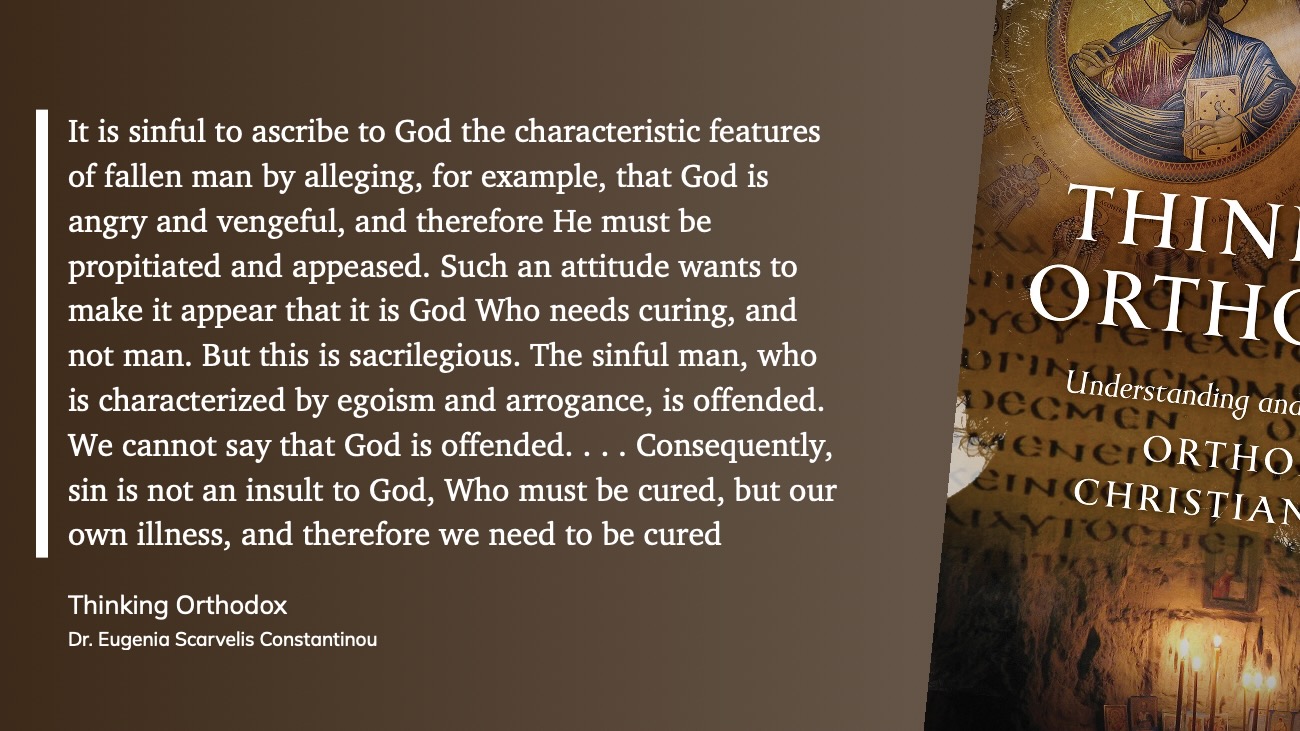
It is sinful to ascribe to God the characteristic features of fallen man by alleging, for example, that God is angry and vengeful, and therefore He must be propitiated and appeased. Such an attitude wants to make it appear that it is God Who needs curing, and not man. But this is sacrilegious. The sinful man, who is characterized by egoism and arrogance, is offended. We cannot say that God is offended. . . . Consequently, sin is not an insult to God, Who must be cured, but our own illness, and therefore we need to be cured

Dr. Eugenia Scarvelis Constantinou, Thinking Orthodox

Other stuff

The Gramscian Heresy

The Protestant integralists belonging the New Apostolic Reformation school, with their Seven-Mountain Mandate, certainly look Gramscian, don’t they? They want the power that comes from control of key institutions.

That’s not necessarily a mike-drop observation. We have an overabundance of Gramscians trying to march through our institutions these days, but few who are Gramscian as part of an explicitly “religious” movement.

Orthodox hagiographies are full of Saints who had to be dragged kicking and screaming (as it were) to accept ordination to the Priesthood, or elevation to a Bishopric. I’ll drive my stake in the ground here: A Christian may legitimatly be led to office, but hunger for power over others is anti-Christian.

An old truth that we keep forgetting

Reason is an absolute—all is in ruins. Yet those who ask me to believe this world picture also ask me to believe that Reason is simply the unforeseen and unintended by-product of mindless matter at one stage of its endless and aimless becoming. Here is flat contradiction. They ask me at the same moment to accept a conclusion and to discredit the only testimony on which that conclusion can be based. The difficulty is to me a fatal one; and the fact that when you put it to many scientists, far from having an answer, they seem not even to understand what the difficulty is, assures me that I have not found a mare’s nest but detected a radical disease in their whole mode of thought from the very beginning.

C.S. Lewis, Weight of Glory

A surprising possibility

What’s driving young people to Christianity? In UnHerd, Niall Gooch argued the answer may lie in the strict moral demands of modern secularism. “At its best, Christianity is not a moralistic religion — in other words, it does not place the expectation of perfect behaviour at its core. It is repentance and reconciliation, not respectability, that are central to the internal logic of the faith. The Christian moral system is also coherent and predictable,” he wrote. “Modern secular morality, by contrast, is extremely censorious and has a strongly arbitrary element, as we have seen in the last decade or so of ‘cancel culture.’ People have been subjected to storms of anonymous criticism, resulting in lost jobs and lost livelihoods, with no clear limiting principle and no real interest in proportionality. To make matters worse, this is all highly impersonal and offers no clear pathway for restoration and forgiveness.”

The Morning Dispatch

Mystery, not random

To call the unknown “random” is to plant the flag by which to colonize and exploit the known. . . . To call the unknown by its right name, “mystery,” is to suggest that we had better respect the possibility of a larger, unseen pattern that can be damaged or destroyed and, with it, the smaller patterns. . . . But if we are up against mystery, then knowledge is relatively small, and the ancient program is the right one: Act on the basis of ignorance.

Mark Mitchell and Nathan Schlueter , The Humane Vision of Wendell Berry


Religious ideas have the fate of melodies, which, once set afloat in the world, are taken up by all sorts of instruments, some woefully coarse, feeble, or out of tune, until people are in danger of crying out that the melody itself is detestable.

George Elliot, Janet’s Repentance, via Alan Jacobs

[N]one of the things that I care about most have ever proven susceptible to systematic exposition.

Alan Jacobs, Breaking Bread With the Dead

You can read most of my more impromptu stuff here and here (both of them cathartic venting, especially political) and here (the only social medium I frequent, because people there are quirky, pleasant and real). All should work in your RSS aggregator, like Feedly or Reeder, should you want to make a habit of it.

Pascha 2025

I put the final touches on this as I waited for our Paschal/Easter Vigil. When it posts, I should be fat, happy — and sound asleep in a “meat coma.”

Fr. Stephen Freeman says “I can think of at least two times in my life that the failures of Church, or its hierarchy, drove me from the ranks of the Church, or what passed for Church at the time.” I can think of only one, but heightened apprehension of the Resurrection kept me from leaving what passed for Church at the time. So it seems personally fitting that this is Orthodoxy’s “Feast of Feasts,” surpassing even Christ’s Nativity (which seems more prominent in the West — forgive me if I err).

All around the world tonight and tomorrow, Orthodox priests will be spared writing an “Easter Sermon” because it’s customary to read this one from a master preacher. We even do a bit of call and response, shouting “It was embittered!”

Christ is Risen!

One more Easter thought

[Saint John] Chrysostom commented on this reality: I, for instance, feel differently about these subjects than an unbeliever. I hear, “Christ was crucified” and immediately I admire His loving-kindness to men. The other hears and esteems it as weakness. I hear, “He became a servant” and I wonder at his care for us. The other hears and counts it as dishonor. I hear, “He died” and I am astonished at His might, that He was not held in death, but even broke the bands of death. The other hears and surmises it to be helplessness. He, on hearing of the resurrection, says the thing is a legend. I, aware of the facts which demonstrate it, fall down and worship the dispensation of God. . . . For not by the sight do I judge the things that appear, but by the eyes of the mind. I hear of the “Body of Christ.” In one sense I understand the expression, in another sense the unbeliever.

Dr. Eugenia Scarvelis Constantinou, Thinking Orthodox

Heresy, not secularism

Ten years ago I published a book called “Bad Religion: How We Became a Nation of Heretics,” which offered an interpretation of the country’s shifting religious landscape, the sharp post-1960s decline of institutional faith. Before the book’s anniversary slips away, I thought I would revisit the argument, to see how it holds up as a guide to our now more de-Christianized society.

What the book proposed was that secularization wasn’t a useful label for the American religious transformation. Instead, I wrote, American culture seems “as God-besotted today as ever” — still fascinated with the figure of Jesus of Nazareth, still in search of divine favor and transcendence. But these interests and obsessions are much less likely to be channeled through churches, Protestant and Catholic, that maintain some connection to historical Christian orthodoxies. Instead, our longtime national impulse toward heresy — toward personalized revisions of Christian doctrine, Americanized updates of the Gospel — has finally completed its victory over older Christian institutions and traditions.

Ross Douthat, The Americanization of Religion – The New York Times

Redemption (a venerable poem)

Having been tenant long to a rich lord,
Not thriving, I resolvèd to be bold,
And make a suit unto him, to afford
A new small-rented lease, and cancel th’ old.

In heaven at his manor I him sought;
They told me there that he was lately gone
About some land, which he had dearly bought
Long since on earth, to take possessiòn.

I straight returned, and knowing his great birth,
Sought him accordingly in great resorts;
In cities, theaters, gardens, parks, and courts;
At length I heard a ragged noise and mirth

Of thieves and murderers; there I him espied,
Who straight, Your suit is granted, said, and died.

(George Herbert, Redemption, via Sally Thomas at Today’s Poem).

I’m sorry that this won’t format exactly like the original I saw without using some coding that ends up rendering an ugly post.

The search for certainty

The Reformation is the first great expression of the search for certainty in modern times. As Schleiermacher put it, the Reformation and the Enlightenment have this in common, that ‘everything mysterious and marvellous is proscribed. Imagination is not to be filled with [what are now thought of as] airy images.’ In their search for the one truth, both movements attempted to do away with the visual image, the vehicle par excellence of the right hemisphere, particularly in its mythical and metaphoric function, in favour of the word, the stronghold of the left hemisphere, in pursuit of unambiguous certainty. … What is so compelling here is that the motive force behind the Reformation was the urge to regain authenticity, with which one can only be profoundly sympathetic. The path it soon took was that of the destruction of all means whereby the authentic could have been recaptured.

Iain McGilchrist, The Master and His Emissary

Pecking Order Ecclesiology

It isn’t strange to learn that Prestigious Scholar X on the law/econ/poli-sci faculty at Ivy League School Y is Roman Catholic. It is a bit of a surprise to learn that he’s an evangelical. The moment you hear it, though, you wonder (or ask) whether he’s an evangelical Anglican or some such.

Brad East, Conversions, Protestantism, and a New Mainline

Misinterpreting the Bible

Both the fundamentalist and the higher critic assume that it is possible to understand the biblical text without training, without moral transformation, without the confession and forgiveness that come about within the church. Unconsciously, both means of interpretation try to make everyone religious (that is, able to understand and appropriate scripture) without everyone’s being a member of the community for which the Bible is Scripture.

Stanley Hauerwas, Resident Aliens

It’s not just the “higher critics.” Lots of lazy unbelievers have their little proof-texts to illustrate that absurdity or barbarity of the Bible. But they read them as fundamentalists do, not as the historic Church does.

Balancing Rites

The campaign for same-sex marriage has triumphed, and I can’t imagine a successful counter-offensive (Maybe some day when I’m long dead and gone?). Meanwhile:

Maybe the prospective customers, like many Americans, do not see transcendent meaning in the ceremonial commencement of matrimony, because they associate a wedding as admittance to an institutional legal fiction that allows one access to nothing more than a cluster of political and social privileges not available to other friendships. So, given this understanding, it is not surprising that the customers see the provider’s refusal as a negative judgment on the public legitimacy of their union. Thus, it’s easy to see why the customers would be offended by the provider’s refusal and subsequently seek legal redress. But what the customers fail to see is that their demand that the courts force the providers to rescind their denial and be punished for it is really a demand that the state force the providers not to exercise their freedom of worship, the liberty not to participate in, or not provide assistance to, ceremonies that one believes have sacramental significance.

Francis J. Beckwith, Taking Rites Seriously

Convert shock

Steve Robinson on his initial experience in an Antiochian (f/k/a Syrian) Orthodox parish back when they weren’t really used to Protestant converts:

I can summarize the mutual culture shock, ours and theirs, over the next few years pretty succinctly: They didn’t know why we were so serious about Orthodoxy and we didn’t know why they weren’t. We had zeal with a little knowledge and no experience, they had some knowledge, a lifetime of experience, and little zeal (at least for the things WE thought “real Christians” should be zealous about). And for all of our decades of zealous “Christianity” we brought to the table, we didn’t know what love looked like.

This is one of the sorts of culture clashes that make Fr. Stephen De Young think that there will be no single “American Orthodox Church,” independent of traditional Orthodox lands, for a very long time — and a good thing it is! We converts (e.g., Steve Robinson, Fr. Stephen, me) are good for the Church, but we don’t have everything right. We might well push the “cradle Orthodox” aside in our arrogance and create something syncretistic under the “Orthodox” name.

More:

I came to the Church for respite and healing of my evangelical battle scars. After all, it is “the hospital for sinners” originally founded by The Great Physician, who organized and staffed it with his own hand picked specialists who were guided by an inspired Mission Statement.

I think of all I have learned in twenty six years, perhaps this is the most important: The Hospital is also The Arena. It is a place of a brutal, to the death cage fight with my demons and I will not finish the battle un-scarred. The Hospital treats my wounds with the sacramental medicine of immortality and arms me with the gifts of the Holy Spirit, sometimes in spite of the attending physician. I cannot pick only one wing of the building, they co-exist in the same place.

Standing, Still

Evangelical political theology

Though it feels rather remote now, it is important to recall that back in the 2000s and 2010s, popular level evangelical political theology basically did not exist. The two dominant paradigms on offer were a kind of lazy baptizing of conservative fusionism that was shockingly indifferent to historic Christian reflection or a watered down evangelical Hauerwasianism that attempted to locate Christian political witness within the church, all while being mostly unaware of how impoverished evangelical ecclesiology had become.

Jake Meador, Anti-Wokeness and the Evangelical Fracturing


Religious ideas have the fate of melodies, which, once set afloat in the world, are taken up by all sorts of instruments, some woefully coarse, feeble, or out of tune, until people are in danger of crying out that the melody itself is detestable.

George Elliot, Janet’s Repentance, via Alan Jacobs

[N]one of the things that I care about most have ever proven susceptible to systematic exposition.

Alan Jacobs, Breaking Bread With the Dead

You can read most of my more impromptu stuff here and here (both of them cathartic venting, especially political) and here (the only social medium I frequent, because people there are quirky, pleasant and real). All should work in your RSS aggregator, like Feedly or Reeder, should you want to make a habit of it.

Balm for Those Battered and Bruised by Bad Religion

From early adolescence to age forty-nine, my life as a Christian (which started when I was very young) was very American, in Evangelical and Calvinist modes. I got into it pretty deeply, as I have a compulsion to figure things out, and that involved reading lots of stern explanations (“theology”).

Then, twenty-eight or so years ago, I stumbled into an Orthodox Christian Church:

Having settled in for a few decades, what have I found uniquely true about the Orthodox Church?

It’s hard to put into words. That’s why Orthodox evangelism tends to consist of “come and see.”

Harder still for me personally, I need to find words for feelings and tendencies that an intellectualoid has trouble trusting — things that may be true but approach ineffability. I have a Dostoyevsky “Beauty Will Save the World” sticker on my office window, but long habit and self-image keep pulling me back toward “Spock-like logic … will save the world.”

(A life in a string of epiphanies)

Yesterday, though, I heard something that can serve as a decent summary that I suspect that a lot of American Christians need to hear:

God loves you. Jesus said so. St. John’s Gospel, the Father Himself loves you. He is not angry at you. He does not want to destroy you for your sins. There is no power of justice that commands Him to do so. No one commands Him to do anything. He loves you. He wants you to find salvation, but salvation is a thing you have to actually do. He wants you to do it. The Bible says so. God wills that all men be saved and come to the knowledge of the truth. But you have to do it. He empowers you to do it. He forgives you when you mess up trying to do it. He heals you when you damage yourself trying to do it and failing. He is entirely on your side. The God who created the universe is entirely on your side and the saints are on your side and the church is on your side. Everyone is on your side. Christ is advocating for you. Everything is set up for us.

When Saint Paul says to us, “continue to work out your salvation with fear and trembling,” you don’t stop there like Kierkegaard did. Read the next verse because it is God who is working in you to will and to do according to His pleasure. We continue on and we work out our salvation because we know that God is on our side and empowering us to do it and loving us and loving other people through us. We need to pray about that. We need to pray it. We need to repeat it. … We need to say it out loud. We need to say it to each other. We need to say it to everyone who will listen right? That God loves you and wants you to find salvation, wants you to be healed, wants you to be set free from sin. He wants all these things for you. It doesn’t mean you have nothing to do. That doesn’t mean you’re fine just the way you are. You know you’re not fine just the way you are, right? But it means that He is there to help you to grow to be transformed into the person who you need to be and want to be. The person He created you to be for eternity. That’s the actual message of Christianity. Don’t accept any substitutes for that, ever at all, for any reason.

Fr. Stephen De Young

This Great and Holy Friday, I would add that the Son loves us, too, and is entirely on our side. We die with Him, and are raised with Him.

Palm Sunday

There sails a young man still …

I can no longer hold my water and itch in places I haven’t scratched these twenty years for the clownish stiffness in my bones. It’s Reginald that has to swab my bum and deems the task a means of grace. I’ve got an old dam’s dugs. My privities hang loose as poultry from a hook. My head wags to and fro. There’s times my speech comes out so thick and gobbled I’d as well to save my wind. But the jest is bitterer yet, for deep inside this wrecked and ravaged hull, there sails a young man still.

How I rage at times to smite with these same fists I scarce can clench! How I long, when woods are green, to lark and leap on shanks grown dry sticks! Let a maid but pass my way with sport in her eye and her braid a-swinging, and I burn for her although my wick’s long since burnt out and in my heart’s eye see her as the elders saw Susanna at her bath-her belly pale and soft as whey, her pippins, her slender limbs and thistledown. So ever and again young Godric’s dreams well up flood old Godric’s prayers, or prayers and dreams reach God in such a snarl he has to comb the tangle out, and who knows which he counts more dear.

Godric, roughly 100 years old, speaking in Frederick Buechner’s Godric

This is my first time reading Buechner. I don’t think it will be my last.

Asperges me hyssopo

Asperges me hyssopo
the snatch of plainsong went,
Thou sprinklest me with hyssop
was the clerical intent,
not Asparagus with hiccups
and never autistic savant.

Asperger, mais. Asperg is me.
The coin took years to drop:

Lectures instead of chat. The want
of people skills. The need for Rules.
Never towing a line from the Ship of Fools.
The avoided eyes. Great memory.
Horror not seeming to perturb –
Hyssop can be a bitter herb.

Les Murray, The Tune on Your Mind, New Selected Poems.

Murray was an eccentric and on the autism spectrum. He also was a brilliant poet. (Caveat: Some of his poetry is a tough sail for someone like me, unfamiliar with the flora, fauna and geography of Australia.)


Religious ideas have the fate of melodies, which, once set afloat in the world, are taken up by all sorts of instruments, some woefully coarse, feeble, or out of tune, until people are in danger of crying out that the melody itself is detestable.

George Elliot, Janet’s Repentance, via Alan Jacobs

[N]one of the things that I care about most have ever proven susceptible to systematic exposition.

Alan Jacobs, Breaking Bread With the Dead

You can read most of my more impromptu stuff here and here (both of them cathartic venting, especially political) and here (the only social medium I frequent, because people there are quirky, pleasant and real). All should work in your RSS aggregator, like Feedly or Reeder, should you want to make a habit of it.

Sunday April 6

Perennial favorite

I believe that I am not mistaken in saying that Christianity is a demanding and serious religion. When it is delivered as easy and amusing, it is another kind of religion altogether.

Neil Postman, Amusing Ourselves to Death

Religion I

In the pre-modern era in the West, as in much of the world today still, there was no such thing as ‘religion’. The Christian story was the basis of peoples’ understanding of reality itself: it was widely assumed that it represented the truth about existence, and that no part of life could therefore be outside of it. There was no ‘religion’, because there was no notion that this truth was somehow optional or partial, any more than we today might assume that gravity or the roundness of the Earth were facts we could choose to engage with only on Sunday mornings.

Paul Kingsnorth, The Migration of the Holy

Religion II

Another book, less exhaustive but both more enjoyable and more useful to me, is Before Religion: A History of a Modern Concept by Brent Nongbri. He begins by recounting a conversation with his father in India, asking what word in their own Khasi language corresponded to the English word “religion.” The answer was a loan-word from Bengali, meaning simply “customs.” They had no word of their own for the category of action English-speakers thought of as religion.

Father Silouan Thompson, Why I’m Religious, and Not Spiritual.

Morality

The nature of true morality does not consist in our sentiments – how we feel or imagine ourselves to think about right and wrong. It does not even consist in how we act. Rather, true morality consists in who we are. Another way of describing this is to understand true morality as the acquisition of virtue, the forming and shaping of our character in the image and likeness of Christ. Mere moral rules and norms in the hands of a person whose character is flawed is similar to a child with an AK-47. The outcome is always predictable.

Fr. Stephen Freeman

Is “Evangelical” a useful word?

I am still a newcomer to the world of Artificial Intelligence, but I’ve found that it’s kind of useful for giving me the broad contours of an issue.

This week, I posed the following question to three of the leading AI services:

Summarize, with hyperlinks, the discussions among American Evangelicals (and Evangelical-adjacent) on whether the label “evangelical” has any remaining utility.

I believe the following should be shareable links to the results:

What prompted my question was the seeming incoherence of using the same label to describe, for instance, prosperity gospel flake Paula White Kane and Tim Keller. Gemini was the only service that flagged the identity issue (the definition of “Evangelical”) explicitly.

Mind-bender

Our salvation doesn’t depend on our opinions. That’s hard to grasp. at least for someone formed as I was. I believe it, but don’t fully grasp it.

There have been orthodox Saints who spent their lives in heretical churches because the bishop in their area was a heretic. Today, I think “we” would tell them to leave and start an orthodox church. Their ecclesiology was stronger than ours.

I think this sort of thing ramifies more widely than I’ve yet grasped.

Grow up!

The man who denies his relationship with God, who refuses to be His son, is not a real man but a man stunted, the unfinished plan of a man.

Father Alexander Elchaninov, Diary of a Russian Priest


Religious ideas have the fate of melodies, which, once set afloat in the world, are taken up by all sorts of instruments, some woefully coarse, feeble, or out of tune, until people are in danger of crying out that the melody itself is detestable.

George Elliot, Janet’s Repentance, via Alan Jacobs

[N]one of the things that I care about most have ever proven susceptible to systematic exposition.

Alan Jacobs, Breaking Bread With the Dead

You can read most of my more impromptu stuff here and here (both of them cathartic venting, especially political) and here (the only social medium I frequent, because people there are quirky, pleasant and real). All should work in your RSS aggregator, like Feedly or Reeder, should you want to make a habit of it.

St. John Climacus, 2025

Denying our ancestry

Just as the Bishop of Oxford refused to consider that he might be descended from an ape, so now are many in the West reluctant to contemplate that their values, and even their very lack of belief, might be traceable back to Christian origins.

Tom Holland, Dominion

The virtue of essays

I write here not as a teacher to students but rather as a reader to other readers, a citizen to other citizens. I write because I think I have learned a few things in my teaching life that are relevant to our common life. You will see what those are if you read on.

My approach here is anything but systematic. Of all the literary genres, I am fondest of the essay, with its meandering course that (we hope) faithfully represents the meanderings of the human mind … certain images in advance and people will recur throughout this book, returning perhaps when you think we’re done with them. I write this way because none of the things that I care about most have ever proven susceptible to systematic exposition.

Alan Jacobs, Breaking Bread with the Dead. That last sentence is a gem.

Notional Evangelical Bibicism

As a public relations stunt, Trump’s Bible photo might seem unserious, but the president certainly understood the importance of Christian scripture to a significant voting bloc. Evangelicals are biblicists, and the extent to which American religiosity has been dominated by evangelical Protestantism correlates to the degree to which American culture has been shaped by the Bible.

Paul J. Gutacker, The Old Faith in a New Nation

I would be remiss were I not to recommend Brad East’s ‌Biblicist churches that don’t read the Bible — Brad East. Historian Gutaker may be missing something contemporary.

The one, true meaning of the text

When I try to explain to people why we need to recover patristic interpretation, the biggest obstacle I face is the desire of my interlocutors to establish the one, true meaning of the text. When I assert that there is no such thing, I provoke raised eyebrows: I must be playing fast and loose with the biblical text, making it echo my preconceptions. My insistence that biblical texts have multiple, even innumerable meanings contradicts our modern objectivism. My defense of patristic allegorizing likewise elicits fears of arbitrariness and subjectivism.

Hans Boersma, No Method but Christ

Whither the magisterial Reformation?

Nearly two decades ago, Bruce McCormack, professor of systematic theology at Princeton ­Seminary, wrote: “The situation in which Christian theology is done in the United States today is shaped most dramatically by the slow death of the Protestant churches.” He went on:

if current rates of decline in membership continue, all that will be left by mid-century will be Roman Catholic, Eastern Orthodox and non-denominational evangelical churches. . . . The churches of the Reformation will have passed from the scene—and with their demise, there will be no obvious institutional bearers of the message of the Reformation. What all of this means in practice is that it will become more and more necessary, for the sake of the future of Christianity, to establish stronger ecumenical relations with the Catholics and the ­Orthodox.

This is a grave prediction, but its sobriety makes it not just prescient but practical. Non-catholic varieties of Christendom are here for good, but Goldilocks Protestantism was always doomed to fail. It presumed too much, relying on a common inheritance—patristic, medieval, and cultural—that was bound to be called into question by future reformers in search of their own style of biblical renewal.

In any case, McCormack is right: Whether, in the coming decades, magisterial Christians look “up” or “down” for friendship and cooperation, they will be living in a world without Protestantism. In truth, they already are.

Brad East, Goldilocks Protestantism

Martyrdom

Many a man will live and die upon a dogma: no man will be a martyr for a conclusion.

John Henry Newman


Religious ideas have the fate of melodies, which, once set afloat in the world, are taken up by all sorts of instruments, some woefully coarse, feeble, or out of tune, until people are in danger of crying out that the melody itself is detestable.

George Elliot, Janet’s Repentance, via Alan Jacobs

You can read most of my more impromptu stuff here and here (both of them cathartic venting, especially political) and here (the only social medium I frequent, because people there are quirky, pleasant and real). All should work in your RSS aggregator, like Feedly or Reeder, should you want to make a habit of it.

Third Sunday of Lent

Same data, different conclusions

Graham takes comfort in Trump’s election. “He did everything wrong, politically,” Graham told me. “He offended gays. He offended women. He offended the military. He offended black people. He offended the Hispanic people. He offended everybody! And he became president of the United States. Only God could do that.”

Emma Green, Franklin Graham Is the Evangelical ID

It seems to me that Franklin Graham thinks this proves Trump is okay. I thought then (2017) and think now (March 2025) that it proves God’s judgment is falling on us. And in the end, I’m okay with that. When I pray for America, as I do every morning, my first petition is “Let your judgment be merciful.”

Baptism in the fundagelical world

Brad East, writing in Christianity Today, on baptism, and how his nondenominational students marginalize it:

First, my students see baptism as purely symbolic. It does not do anything. Nothing “happens.” In terms of God’s action or presence, it is no different from any other spiritual practice ….

Bearing in mind that I’ve been out of this world for more than 45 years now, I suggest that they believe that because they’ve been taught it. It’s my second- or third-hand understanding that many nondenominational pastors take a few moments before baptism to explain that it’s purely symbolic and does nothing.

With the same caveat, I do not understand how anyone who purports to have the Bible as their final authority on matters of faith can teach that with so few of them being struck down by lightning as they do. But then I do not understand how scripture-twisting fundagelicals can so reliably make scripture teach something they want to believe — perhaps because it is a repudiation of that the Catholic Church believes.

I’m not going to say (or deny) that Brad East gets to the orthodox understanding in his item, but he gets a whole lot closer than his students have heard.

Porn

Caitlin Flanagan:

The internet’s biggest by-product is loneliness; porn isn’t special in that regard. You and I weren’t made to live this way; we barely are living this way. Many of the traits that make us human—our compassion, our ability to devote sustained thought to a problem, our capacity to fall in love and to sacrifice for the people we love—are meaningless to the algorithms that rule us. They’ve deformed us. Every time I hear a middle-class young woman make the utilitarian argument for why she makes sexual videos on OnlyFans—because she can make in two hours of work what would take her 40 hours to earn waitressing—I think, Here it is at last: end-stage capitalism. The phase in which nothing has any value or meaning other than its sale price. (Source: theatlantic.com/Read the rest)

via News Items

That’s quite a quote, but to my way of thinking it can’t top this one, which carries a weighty moral challenge:

As far as the moral equations of watching porn go, the one that matters is: Are you excited by the obvious abuse of women, or have you learned to countenance that abuse as a necessary cost of your own pleasure? And which of those is worse?

Caitlin Flanagan

If C.S. Lewis were to write The Great Divorce today, I think one of the vignettes would be of a male wraith from the hell-bus, met in heaven by his beautiful wife, made more beautiful by her heavenly transformation. They would discuss how they had drifted apart in life. He’d try to abuse her again (and fail — of course he would fail in The Great Divorce setting).

He ultimately would decide that he wouldn’t remain in heaven if the price were giving up porn.

And I think that may just be the price.


Religious ideas have the fate of melodies, which, once set afloat in the world, are taken up by all sorts of instruments, some woefully coarse, feeble, or out of tune, until people are in danger of crying out that the melody itself is detestable.

George Elliot, Janet’s Repentance, via Alan Jacobs

[N]one of the things that I care about most have ever proven susceptible to systematic exposition.

Alan Jacobs, Breaking Bread With the Dead

You can read most of my more impromptu stuff here and here (both of them cathartic venting, especially political) and here (the only social medium I frequent, because people there are quirky, pleasant and real). All should work in your RSS aggregator, like Feedly or Reeder, should you want to make a habit of it.

First weekend of Spring

Give it back!

Raphael Glucksmann, a member of the European Parliament, feels that America has reneged on the values that led to the statue being gifted. “We’re going to say to the Americans who have chosen to side with the tyrants, to the Americans who fired researchers for demanding scientific freedom: “Give us back the Statue of Liberty,” he said at a convention of his center-left party, Place Publique, Sunday. “We gave it to you as a gift, but apparently you despise it. So it will be just fine here at home,” Glucksmann added.

Daily Beast via The Morning Dispatch

Incel Integralists

The Harvard Law School chapter of the Federalist Society was taken over last week by “Common Good Constitutionalism” disciples of Professor Adrian Vermeule (i.e., wokesters of the Right). The chapter’s former president, Sarah Isgur, has some thoughts about the incel Integralists and their pyrrhic victory:

Freedom is turned on its head. Individual freedom does not exist if it does not enhance the general welfare (again, defined by them). To break it down: Speech that is good is protected. Speech that is bad is not. And the government gets to define what is good.

But they misunderstand Fed Soc’s strength. So let me explain: It came from its size and its diversity of thought. When you shrink it down to only those people who agree with you on outcomes, you have stripped it of its source of power.

The Vikings can be resentful that we didn’t let them into our club. They can even burn down the club. But they still won’t be in the club. They’ll just be standing over its ashes, still sad, and confused, and angry, and without clerkships, and without girlfriends.

History is littered with the stories of young men who are frustrated and can’t get chicks. They’re called “Jacobins.”

(A combination of Twitter, and the Advisory Opinions podcast.)

Regrets

Trigger warning: Do not read the following with your mouth full of scrambled eggs or hot coffee. I speak from experience.

In Oedipus Tex, the mathematician-composer P.D.Q. Bach’s 1990 comedic answer to Stravinsky’s tragic oratorio, the titular hero discovers the truth of his situation—that he has married his mother, Billy-Jo Costa, Queen of the Rodeo—and, fulfilling the requirements of tragedy, he takes the rhinestone-covered barrettes out of her hair and gouges out his eyes. At which point the chorus sings:

“And immediately after he’d put out both his eyes, he … kind of wished he hadn’t.”

Everybody has regrets. Nations and their governments do, too. When things are upside down in the state, you end up with Oedipus Rex, Macbeth, or the Trump administration. 

Mahmoud Khalil is a Palestinian activist involved in the Columbia protests who was arrested in a Keystone Kops-level caper launched by Marco Rubio’s incompetent State Department, which proposed to revoke a student visa that Khalil doesn’t have. Khalil is, in fact, the holder of a green card, meaning that he has been given permanent resident status in the United States by the U.S. government. Which is to say, Khalil is in this country as a permanent resident thanks to a decision of the U.S. government, which, after looking back on what it had done, kind of wished it hadn’t.

Kevin D. Williamson

My regret is that I cannot read Kevin D. Williamson or Nick Catoggio more regularly without breaking my promise to myself not to wallow in politics during the Trumposcene, but rather to enjoy the inumerable things that humans can enjoy even under the governance of jackasses or jackboots.

The corrupting effect of corrupt rulers

In Democracy in America, Alexis de Tocqueville, in a section on corruption and the vices of rulers in a democracy, warned:

In a democracy private citizens see a man of their own rank in life who rises from that obscure position in a few years to riches and power; the spectacle excites their surprise and their envy, and they are led to inquire how the person who was yesterday their equal is today their ruler. To attribute his rise to his talents or his virtues is unpleasant, for it is tacitly to acknowledge that they are themselves less virtuous or less talented than he was. They are therefore led, and often rightly, to impute his success mainly to some of his vices; and an odious connection is thus formed between the ideas of turpitude and power, unworthiness and success, utility and dishonor.

Tocqueville’s concern was that if citizens in a democracy saw that unethical and corrupt behavior led to “riches and power,” this would not only normalize such behavior; it would validate and even valorize it. The “odious connection” between immoral behavior and worldly success would be first made by the public, which would then emulate that behavior.

That is the great civic danger posed by Donald Trump, that the habits of his heart become the habits of our hearts; that his code of conduct becomes ours. That we delight in mistreating others almost as much as he does. That vengeance becomes nearly as important to us as it is to him. That dehumanization becomes de rigueur.

Peter Wehner, Trump’s Revenge Campaign

Thumbnail history of the GOP since 2008

David French, reflecting on his (supportive) relationship to the Tea Party movement and cautioning Democrats against trying to reproduce it in the Democrat party:

But it all turned bad, and the reasons it turned bad are directly relevant to Democrats today.

Republicans built a movement around both anger and ideology. My mistake was in believing that the ideology was more important than the anger, but it was the anger that gave the Tea Party its political momentum, and that anger eventually swallowed the ideology. Rage is now the defining characteristic of Trump’s Republican Party.

My first interpretation of Tea Party anger was precisely that it was in service of higher values, specifically a return to founding constitutional principles and an embrace of free markets and fiscal responsibility. But that was wrong. The ideology mattered only if it could serve the anger.

Another way of putting it is that Tea Party members embraced constitutional conservatism and libertarianism as a tactic, not as a principle, and the instant that a different, Trumpist ideology emerged — a better vehicle for the party’s raw rage — they welcomed it with open arms.

What’s your hurry?

Could this be the meta-explanation of what the ochre emperor is doing?:

DOGE is in a race with the courts. From the first days of the administration it was all shock and awe. Take an agency everyone knows is a problem, such as USAID, and kill it. Tell employees to go home, put a guard outside and lock the door, cover the agency’s name in gaffer’s tape, have a functionary send an email terminating employment, then disable email accounts. Staffers can’t reach each other, can’t find the reporter’s address—confusion kills the will to resist. Other agencies watch, and it puts the fear of God into them.

It’s all a race to get as much accomplished now as possible. Once something goes to the Supreme Court, there will be clear limits. Until then, maybe months, maybe a year, get it done.

Peggy Noonan. More:

Here I confess my conservative lizard brain likes seeing unhelpful and destructive parts of any organism, very much including government, cut and sometimes obliterated, and for the usual reasons. But the non-lizard parts—those that are analytical, involve experience, and have observed human nature and seen who’s doing the cutting, and at what size and speed—recoil, and see great danger ahead.

Judiciary 101

“The good news here is, we did put 235 judges, progressive judges, judges not under the control of Trump, last year on the bench, and they are ruling against Trump time after time after time,” Senate Minority Leader Chuck Schumer said a few days ago.

You do the judiciary no favors talking like that, Sen. Schumer.

  1. “[C]onservative judges, judges (supposedly) under the control of Trump,” are ruling against him, too — just as they did with his b*llsh*t 2020-21 election challenges.
  2. No federal judge is “under the control” of the President who appointed him or her. That’s kinda the point of life tenure on good behavior.

Miscellany

  • “If you weren’t outraged that the law and due process weren’t followed when Biden let 10+ million people into the country, don’t expect voters to be outraged by accusations Trump isn’t following due process when he deports them,” – Mark Hemingway.
  • “I still can’t get over the power of negative polarization where liberals genuinely convinced themselves that the lab leak was the racist theory of Covid origins, but the ‘it’s just the disgusting hygiene and superstition of Chinese wet market customers’ was the non-racist theory,” – Michael Brendan Dougherty.
  • Colin Wright: “‘Christ Is King’ Is the Woke Right’s ‘Black Lives Matter.’”

All via Andrew Sullivan

Sullivan’s main essay is on how Anthony Fauci intentionally misled us about the origins of Covid.

Why on earth would panicked scientists believe that Covid was probably a lab leak and then write a landmark paper “trying to disprove” it? It’s the essential question. One obvious answer is that Fauci realized that if his beloved gain-of-function research had led to the death of millions in a plague, he might not go down in history as a medical saint.

I have no need of any other hypothesis.


I suffer more from the humiliations inflicted by my country than from those inflicted on her.

Simone Weil, from a letter to Georges Bernanos.

[N]one of the things that I care about most have ever proven susceptible to systematic exposition.

Alan Jacobs, Breaking Bread With the Dead

I don’t do any of the major social media, but I have two sub-domains of the domain you’re currently reading: (a) You can read most of my reflexive stuff, especially political here. (b) I also post some things on the only social medium I frequent, because people there are quirky, pleasant and real.