Sunday 12/8/24

Yesterday was the 10th anniversary of my parish’s first Divine Liturgy in our purpose-built building. I have a handy way of remembering the date.

Two living churches

In England, the two kinds of churches I do still see filling appear rather different. In a local baptist church the pews are crammed with young families having powerful, intimate encounters with their faith. Something immediate is being accommodated. I remember seeing a guy fresh from a building site, dusty with a high viz jacket. Family with him, arms outstretched, tears on his cheeks. It would bring a lump to your throat.

Then I see my own parish, hushed and seemingly antique, but with more young people than ever before. In both I see people who look spiritually fed. Then out there in the wider audit of emptying churches there seems often to be a sense of weariness, or simple lack of oomph. There will be exceptions to this last sentence, I have no sneer in writing it. I sometimes go sit in those congregations simply out of love for the yards they’ve put in as parishioners. Solidarity, a hand held across the fence to a fellow worker bee.

It seems, from a distance, the two churches are very different, and I am well aware of the theological wrestles that create distance. What I don’t go along with is the notion that one is completely improvisational and unencumbered by tradition, and the other set-and-only-set in a kind of endless, ancient theatre or lifeless ceremony. Dame Mary Douglas, a cultural anthropologist, encapsulates something she calls the ‘anti-ritualist’ approach:

The confirmed anti-ritualist mistrusts external expression. He values a man’s inner convictions. Spontaneous speech that flows from the heart, unpremeditated, irregular in form, even somewhat incoherent, is good because it bears witness to the speaker’s real intentions.

I think actually, ritual is inevitable, even when tacit. We are ceremony people, no matter how spontaneous we think we may be. There will be a loved formula, a linguistic groove long established, a shared initiatory language in common for any community that lasts. It’s about the dynamic counterpoints of tradition and innovation. We may have done away with the candles, offerings and holy smoke, but simply to feel safe repetition will always have value.

Martin Shaw. I finally was able to begin reading Rituals of Spontaneity, which (if I’m not sorely mistaken) elaborates the folly of Christians dispensing with ritual.

Puritan Phobia

The Puritans quickly developed a phobia about ritual, going so far as to resist “rote” recitation of the Lord’s Prayer:

Henry’s Method culminates with his most fascinating phrase-collection of all, “A Paraphrase on the Lord’s Prayer, in Scripture Expressions.” Christ’s own form of prayer given to his disciples had long been a thorn in Puritans’ sides, to be plucked out by being understood as only a general guideline. Henry’s strategy is to neutralize the prayer’s form in a pages of verses elaborating on the one phrase “Our Father, who art in similar method; he provides, for instance, an amazing two and a half Heaven” (MP, 163-65), a general topos, he says, from which begins. Many editions of the Method were printed as Henry intended, interleaved with one blank page between each printed one, to enable the reader to pen in his own collection of phrases to supplement Henry’s own. Like Bunyan’s demand for scrupulous sincerity, Henry’s lists and blank pages, figures of accumulation and abstraction, combine literally to efface the Lord’s Prayer and erase it from Dissenting practice.

Between the ledgerlike pages of Henry’s collected phrases and the blank sheets for scribbled lists of readers’ personal prayer phrases, one senses of variety of fears: that without this careful accounting, the business might go bankrupt, that in the copious, nervous quoting from God’s word to talk and talk and talk to God, God might not listen or respond at all.

Lori Branch, Rituals of Spontaneity

Best listicle ever?

I have three lists of Maxims or such that I review regularly. This one, which I think was embedded in a longer blog post, seems more precious (in the good sense, not the snarky sense) every time I read it:

  1. First, live as though in the coming of Jesus Christ, the Kingdom of God has been inaugurated into the world and the outcome of history has already been determined. (Quit worrying)
  2. Second, love people as the very image of God and resist the temptation to improve them.
  3. Third, refuse to make economics the basis of your life. Your job is not even of secondary importance.
  4. Fourth, quit arguing about politics as though the political realm were the answer to the world’s problems. It gives it power that is not legitimate and enables a project that is anti-God.
  5. Fifth, learn to love your enemies. God did not place them in the world for us to fix or eliminate. If possible, refrain from violence.
  6. Sixth, raise the taking of human life to a matter of prime importance and refuse to accept violence as a means to peace. Every single life is a vast and irreplaceable treasure.
  7. Seventh, cultivate contentment rather than pleasure. It will help you consume less and free you from slavery to your economic masters.
  8. Eighth, as much as possible, think small. You are not in charge of the world. Love what is local, at hand, personal, intimate, unique, and natural. It’s a preference that matters.
  9. Ninth, learn another language. Very few things are better at teaching you about who you are not.
  10. Tenth, be thankful for everything, remembering that the world we live in and everything in it belongs to God.

A catholic vision of Christian faith

When I first opened A Severe Mercy nearly 20 years ago I had needed a vision of Christian faith that was unapologetically devoted to Christian doctrine without being materialistic, more American than Christian, and completely uprooted from history. Up to that point, the expressions of Christianity I had encountered were simply different forms of sectarian faith—a vapid progressivism or a parochial and narrow fundamentalism. Vanauken gave me catholicity ….

Jake Meador (hyperlink added)

Delusion

Christians can give their bodies over to the nation-state while continuing to express in textual terms that worship belongs to God alone.

William T. Cavanaugh, The Uses of Idolatry

Flipping the Script

On regular Christian campuses, there “are higher expectations for presidents than members of the faculty, and members of the faculty live with greater expectations than students,” noted religious-liberty activist David French, writing at The Dispatch. “Liberty flipped this script. The president lived life with greater freedom than his students or his faculty. The message sent was distinctly unbiblical – that some Christian leaders can discard integrity provided their other qualifications, from family name to fund-raising prowess, provided sufficient additional benefit.”

Terry Mattingly, What Next for Liberty University? Press Should Watch Future Campus Worship Services (September 2020)

Know-it-alls

In practical terms, the Reformed commitment to the theological significance of everyday life led to the development of something like Protestant metaphysics, Protestant epistemology, Protestant science, Protestant politics, Protestant social and economic theory, Protestant art, and Protestant poetics.19 The development of these Reformed spheres of intellectual and cultural activity never occurred without substantial influence from sources not specifically religious. In Switzerland, the southern German regions, Hungary, Holland, and the British Isles, the Reformed perspective could be used to mask economic or political aggression. More commonly, it emerged from a complicated mix of sacred and secular motives. Yet wherever sufficient Reformed strength existed, the assumption also existed that biblical Christianity had something fairly definite to say about everything.

Mark A. Noll, America’s God

Theology isn’t all deductive

Catholics find it impossible to theologize without deductive reasoning—a characteristic shared by virtually all Western Christians…

Dr. Eugenia Scarvelis Constantinou, Thinking Orthodox


Sometimes this whole 2000-year-old faith seems like a living koan. Chew on this until you are enlightened. Keep walking.

Paul Kingsnorth

You can read most of my more impromptu stuff here and here (both of them cathartic venting, especially political) and here (the only social medium I frequent, because people there are quirky, pleasant and real). All should work in your RSS aggregator, like Feedly or Reeder, should you want to make a habit of it.

Hal Lindsey, Nihilist Cathedral (and more)

Hal Lindsey

… it is appointed for men to die once, but after this the judgment …

Hebrews 9:27

Hal Lindsey’s appointed time came November 25.

Lindsey was the author of the notorious 1970 The Late Great Planet Earth.

Lindsey seemingly came by his kookery honestly, having studied at the feet of “Colonel” R.B. Thieme, Jr. (I once heard Thieme say that “the ovum is the only sinless cell in the human body”) and then pursuing a degree at Dallas Theological Seminary, a hotbed of dispensational premillenialism that was inordinately esteemed by Evangelicals back in the beforetimes.

Lindsey’s influence was such that his eschatology, or understanding of the Last Days, virtually became a part of accepted Christian orthodoxy for much of the church. Christians who did not understand the Trinity or know the Nicene Creed knew a lot about Lindsey’s End Times scenarios.

Mark Tooley, Juicy Ecumenism.

Tooley is correct — and though I had been heavily exposed to that genre of eschatological flakiness starting around 1964, Lindsey dialed it up to 11 in the Evangelical world.

By the end of the ’70s, having providentially discovered that dispensationalism was the worst and most novel of four basic Protestant eschatological schemes, I could bear its imposition as Evangelical dogma no longer. I left frank Evangelicalism for the Christian Reformed Church, which at least locally turned out to be Evangelical-adjacent in the pews because Lindseyist preoccupations were so contagious. It took even me a long time to realize that I, though born in 1948, was not particularly unlikely to celebrate my 40th birthday in the land of the living.

Well, apparently the novelty wore off while I wasn’t looking any more:

In the midst of his professional success, Lindsey’s personal life suffered. His first marriage failed around the time of his conversion. He got divorced and remarried to Jan Houghton, who worked alongside him at Campus Crusade and appeared with Lindsey in author photos until the mid-1980s, when an updated edition of Late Great Planet Earth used a different picture and removed her name from the dedication.

Lindsey’s second divorce—and subsequent third and fourth marriages—raised questions about his character for many evangelicals. But the biggest blow to his reputation was his failed predictions.

In his early books, Lindsey said all of the Bible’s prophecy would likely be fulfilled “within forty years or so of 1948,” when the nation of Israel was founded, based on his typological reading of Matthew 24. He qualified his prediction, giving himself an escape hatch with phrases like “or so.” But few readers came away with the impression that Lindsey was unsure whether Christ would return by 1988.

When 1988 came and went and the Soviet Union, one of the main objects of dispensational analyses, ultimately collapsed, Lindsey was forced to defend himself and his end times speculation. He directed his book The Road to Holocaust at evangelicals and fellow conservatives in 1989, making the case for the continued relevance of dispensationalist interpretations of Scripture and current events. 

While he was dismissed and marginalized by many evangelicals, Lindsey continued to see commercial success. Retooling his analysis for a post–Cold War geopolitics, he returned to bestseller lists with Planet Earth Two Thousand AD: Will Mankind Survive? in 1994.

That Hal Lindsey did not repent and shut up after 1988 came and went without a “Rapture” is one of life’s least vexing mysteries: he made beaucoups bucks off his spiritual thalidomide.

I hate dispensational premillenialism with a passion. I’d be more relieved at learning that it now is a bit passé were the Evangelical world in North American not running after political power instead now.

His appointed time having come, I strain to pray mercy on his soul at the judgment, but I do so anyway, as I would wish others to do for me.

One more thing

Here’s a suggestion about the influence of Hal Lindsey that had not occurred to me:

In retrospective (sic), Hal Lindsey’s popularity was a major harbinger of the decline of denominations. No longer were they the definitive teaching source for their flocks. Emerging new post denominational evangelicalism, with its own books, radio stations, television and entrepreneurial personalities displaced the old denominations and their traditional teachings.

The most favorable interpretation of Lindsey’s work is that hopefully many who read him or were influenced by him at least were drawn closer to God, even if amid much confusion and foreboding. It’s tempting to find in the Bible a direct explanation for disturbing events. It’s harder to live in the mystery of trusting God without knowing all His plans.

Mark Tooley, Juicy Ecumenism.

A place for perverse prayer

Continuing my drumbeat of dread and decline, the dead German Roman Catholic Church has a new Cathedral in Berlin — a whited sepulchre signaling fealty to something nihilistic:

Rod Dreher, writing for the European Conservative, is duly appalled:

There is scarcely anything visibly Christian about the space. Aesthetically and symbolically, it invites visitors to worship the sacred Nothing. It is a “clean, well-lighted place,” in the nihilistic sense of Ernest Hemingway’s 1933 short story of the same name. It is a hauntingly spare tale about an elderly, suicidal Spanish man who frequents a certain café, described in the story’s title, seeking refuge from nihilism. In the tale, an older waiter in the café reflects on why the clean, well-lighted café drew men like the suicidal customer:

What did he fear? It was not a fear or dread. It was a nothing that he knew too well. It was all a nothing and a man was a nothing too. It was only that and light was all it needed and a certain cleanness and order. Some lived in it and never felt it but he knew it all was nada y pues nada y nada y pues nada. Our nada who art in nada, nada be thy name thy kingdom nada thy will be nada in nada as it is in nada. Give us this nada our daily nada and nada us our nada as we nada our nadas and nada us not into nada but deliver us from nada; pues nada. Hail nothing full of nothing, nothing is with thee.

This is the perverse prayer one imagines visitors to the bleached-out St. Hedwig’s will pray, if they pray at all.

Devolution

It is not an exaggeration to claim that this nineteenth-century Protestant evangelicalism differed from the religion of the Protestant Reformation as much as sixteenth-century Reformation Protestantism differed from the Roman Catholic theology from which it emerged.

Mark A. Noll, America’s God

How many times can such devolutionary leaps happen before the result is not authentically Christian?

Spontaneity is the new requirement

Speaking of which:

I laughed out loud, paused the podcast where I heard the phrase, and wrote down Rituals of Spontaneity, which now sits in my book queue to complement America’s God and The Democratization of American Christianity. Although none of them writes as well as Kevin D. Williamson, I’m more interested in the religious aspects than in the prospect of President Dwayne Elizondo Mountain Dew Camacho in 2028.

Elastic “religion”

Taylor is not unaware that the term “religion” is fraught, but, as we have seen, he thinks the reason it defies definition is that its different manifestations are so diverse. But how do we know that these different manifestations are all “religion” to begin with? Taylor says “the phenomena we are tempted to call religious are so tremendously varied in human life.”175 But why are we “tempted” to call them all religious if they are so varied? More to the point, why do we want to call some things religious and some other, very similar things nonreligious? What makes nontheistic Buddhist rituals “religious,” by Taylor own reckoning, but rituals surrounding the proper treatment of the American flag—very precise rules for folding, displaying, venerating, and keeping it from touching the ground or being otherwise “desecrated”—are not? Taylor uses “religion” broadly when he wants to include Buddhism, but narrowly when he wants to exclude nationalism.

William T. Cavanaugh, The Uses of Idolatry

Migration of the Holy

After only a few years, America’s religious population, with Protestant evangelicals in the forefront, began in similar fashion to tailor their religious projects to fit the language of republicanism. The implications for both politics and religion from this tailoring were momentous. In the immediate context, the argument against Parliament acquired the emotive force of revival. In the longer term, religious values migrated along with religious terms into the political speech and so changed political values. But the migration also moved the other way: a religious language put to political use took on political values that altered the substance of religion.

Mark A. Noll, America’s God


Sometimes this whole 2000-year-old faith seems like a living koan. Chew on this until you are enlightened. Keep walking.

Paul Kingsnorth

You can read most of my more impromptu stuff here and here (both of them cathartic venting, especially political) and here (the only social medium I frequent, because people there are quirky, pleasant and real). All should work in your RSS aggregator, like Feedly or Reeder, should you want to make a habit of it.
Sunday, 11/24/24

Formatting things a bit differently today, without “headlines.”

  • After he had twice visited the United States in the 1930s, Dietrich Bonhoeffer wrote a perceptive essay contrasting Christian development in America with parallel developments in the parts of Europe most directly shaped by the Protestant Reformation. His assessment included an observation that was as shrewd in its comparative wisdom as it is relevant for the themes of this book: “The secularization of the church on the continent of Europe arises from the misinterpretation of the reformers’ distinction of the two realms [of church and society]; American secularization derives precisely from the imperfect distinction of the kingdoms and offices of church and state, from the enthusiastic claim of the church to universal influence in the world.” What Bonhoeffer saw has been described with other terms here: The key moves in the creation of evangelical America were also the key moves that created secular America.
  • It is a matter of great historical significance that American Protestants almost never cited biblical chapter and verse to defend their interpretive practices. Precisely as it worked on Scripture, the Reformed, literal hermeneutic revealed most clearly how it arose from the special circumstances of American life. Yet even if this hermeneutic itself was not necessarily rooted in a literal reading of Scripture, it was nonetheless the American norm for the generations between the writing of the Constitution and the end of the Civil War.

Mark Noll, America’s God. (You may need to chew on that a bit. Or read the book.)


Religions devised for a social purpose, like Roman emperor-worship or modern attempts to ‘sell Christianity as a means of saving civilisation’, do not come to much. The little knots of Friends who turn their backs on the ‘World’ are those who really transform it.

C.S. Lewis via Paul Kingsnorth, who situates Lewis’ insight in our age.


Brad East once pondered:

Why do people convert to Christianity? Why do intellectuals and other public figures convert so often to Catholicism (or Eastern Orthodoxy) and so rarely to Protestantism?

Conversions, Protestantism, and a new mainline. I suspect he’s still pondering, though I don’t think he’s addressed the topic as explicitly as in the quoted article.

I keep coming back to the article deliberately, feeling as if I haven’t exhausted it. Maybe you’d find it helpful, too.


The west, so it seems to them, tends to think of the Crucifixion in isolation, separating it too sharply from the Resurrection. As a result the vision of Christ as a suffering God is in practice replaced by the picture of Christ’s suffering humanity: the western worshipper, when he meditates upon the Cross, is encouraged all too often to feel an emotional sympathy with the Man of Sorrows, rather than to adore the victorious and triumphant king.

Timothy Ware, The Orthodox Church


No, St. Paul wasn’t a perv:

When teaching non-Jewish Christians, one of the most radical disjunctions with their former way of life was sexual morality. Sexual continence had simply not been a concern for most of them before, so it became Paul’s focus. Paul’s frequent emphasis on this area was not based on prurient interest but on the continuing education and reorientation of former pagans.

Fr. Stephen De Young, Saint Paul the Pharisee. Actually (I’m sure Fr. Stephen noted it elsewhere), fornication with temple prostitutes was the former practice of some of these non-Jewish Christians. That’s why Paul had to focus there.


“Man is what he eats.” With this statement the German materialistic philosopher Feuerbach thought he had put an end to all “idealistic” speculations about human nature. In fact, however, he was expressing, without knowing it, the most religious idea of man. For long before Feuerbach the same definition of man was given by the Bible.

Fr. Alexander Schmemann, For the Life of the World


“The clock,” [Lewis] Mumford has concluded, “is a piece of power machinery whose ‘product’ is seconds and minutes.” … [A]s Mumford points out, with the invention of the clock, Eternity ceased to serve as the measure and focus of human events.

Neil Postman, Amusing Ourselves to Death


It’s profoundly significant that of all the Christian groups, only the Orthodox include the babies at the Holy Chalice, completely recognizing and demon-strating their full incorporation into the Church, the Body of Christ. This alone, it seems to me, shows forth the truthfulness of our Church’s claim to be the One, Holy, Catholic, and Apostolic Church, alone preserving the fullness of the Christian Faith.

Frederica Mathewes-Green & Rod Dreher, Healing Humanity


  • Only a few peoples—the odd German tribe and, inevitably, the Jews—had stood aloof from the exposure of unwanted children. Pretty much everyone else had always taken it for granted. Until, that was, the emergence of a Christian people.
  • Islamic the Islamic State may have been; but it also stood in a line of descent from Anabaptist Münster. It was, perhaps, the most gruesome irony in the whole history of Protestantism.
  • When scholars in Europe sought to justify the Spanish conquest of the New World, they reached not for the Church Fathers, but for Aristotle. ‘As the Philosopher says, it is clear that some men are slaves by nature and others free by nature.’
  • The concept of secularism—for all that it was promoted by the editor who invented the word as an antidote to religion—testified not to Christianity’s decline, but to its seemingly infinite capacity for evolution.

Tom Holland, Dominion

Several narrower books linger more persistently in my mind, but Dominion has in a sense penetrated deeper than mere “mind.”


  • Even after His Resurrection, Christ instructed disciples on the road to Emmaus when “beginning with Moses and all the prophets, he interpreted to them in all the scriptures the things concerning himself” (Luke 24:27). The Christological key to unlock the Jewish Scriptures was given to the Church by Christ Himself…
  • Two centuries later, fundamental differences in phronema would again be an obstacle to union between the West and the East at the Council of Florence in 1439. Catholics presented rational arguments for their positions, and the Orthodox responded by citing apostolic Tradition. It was “the constant conviction of the Latins that they always won the disputation, and of the Greeks that no Latin argument ever touched the heart of the problem.”

Dr. Eugenia Scarvelis Constantinou, Thinking Orthodox


Sometimes this whole 2000-year-old faith seems like a living koan. Chew on this until you are enlightened. Keep walking.

Paul Kingsnorth

You can read most of my more impromptu stuff here and here (both of them cathartic venting, especially political) and here (the only social medium I frequent, because people there are quirky, pleasant and real). All should work in your RSS aggregator, like Feedly or Reeder, should you want to make a habit of it.

Sunday, 11/17/24

Permeable walls

Yesterday was the 27th anniversary of my formal entry into the Orthodox Christian Faith. Unlike my departure from frank evangelicalism for Calvinism two decades earlier, this felt like a conversion, not an incidental change of denomination.

Part of that feeling may have been that the evangelical-to-Calvinist transition was largely invisible to observers: I didn’t quit our Baptist church and go to the tiny PCA startup in town; instead I moved across the country to go back to school, so of course I had to find a new church; I graduated, moved, and began practicing law in my hometown, so again I had to find a new church.

That each of those steps was away from evangelicalism and toward Calvinism would have been apparent only to someone for whom the permeability of denominational walls in Protestantism seems odd, and I think there most Protestants who take that permeability for granted (if they even think about “denominations” in an age of tens of thousands of crypto-baptist nondenominational pastoral fiefdoms). Indeed, during this transition, I published a law journal note titled Church Property Disputes in an Age of Common-Core Protestantism, based on the premise that someone who became a Presbyterian or Methodist or Episcopalian was unlikely to be buying into denominational ownership or control of the local church’s temporalities that he (or she) now donated to maintaining.

But another part of the “conversion” sensation certainly was that I had to be catechized to enter Orthodoxy. Its walls are not permeable. I became an “ecclesial Christian” as Richard John Neuhaus described it: one for whom faith in Christ and faith in His Church is one act of faith, not two. I finally believed that the one holy, catholic and apostolic church is visible and distinct, not invisible and amorphous.

Today, I’m more interested in a question one could phrase in an article title as Church Discipline in an Age of Permeable-Wall Protestantism. Others have doubtless gone deeper into the topic of how there can be effective church discipline, how can flagrant sinners be brought to repentance, when they can just move to another church before the heat melts their hearts? Maybe he can even start and pastor his own church (or get nominated as Attorney General). In a largely Protestant nation, it’s hard for an ecclesial Christian convert not to at least dabble in other people’s business.

A bold claim

I’ve been reading Fr. Stephen De Young’s book St. Paul the Pharisee, which I hoped would focus on this bold claim:

Mostly it doesn’t, or it doesn’t do so explicitly except for that quote.

But Fr. Stephen’s “interpretive translation” of Paul’s epistles subtly undermines the tendency to view them as theological treatises rather than pastoral guidance.

Instrumentalist faith

In the last few years, there has been no shortage of political commentary—much of which I agree with—that has argued that Christianity is needed for Western civilization and its guiding principles to survive. Famously, the essay in which the writer and activist Ayaan Hirsi Ali spoke about her conversion—the authenticity of which I do not doubt —focused on the role that Christianity plays in Western civilization. But one should be clear-eyed about this matter. If the point of Christianity is the survival of the West, then Christianity may be treated as a useful fiction or a necessary evil alongside things like police forces and the military. The place of Jesus in such a Christianity is clear: he is a mascot, a long-dead victim of Roman imperialism and religious zealotry whom we invoke when we need a symbol, so that we may display him for all to see, pinned to the cross by our highest values and current political aspirations.

The outcome is not a secret. The churches that live as though Jesus is optional have been, despite their best verbal efforts, saying effectively and forcefully to their members and to the world that what the church uniquely has to offer is not needed, and that the church is here to serve those realities which already exist beyond the church’s baptismal boundaries.

I have become convinced that one of the primary challenges for Christians today is to come to terms with the overwhelming success of secularized Christianity. It is a great comfort to a Christian to say to himself or herself that secularized faith doesn’t actually work: it is how we tell ourselves that secularism will collapse under its own weight and that we’ll be here waiting when it happens, ready to welcome the world back into our arms. But of course, this is a fantasy about our own relevance. We are the secular culture’s ex-girlfriend, and telling ourselves that the new girlfriend isn’t pretty and that the culture will eventually see that it needs us is a pathetic expression of our need, not the world’s.

Matthew Burdette, Is the Church Obsolete? (H/T Brad East)

I honestly don’t think I’ve heard any Orthodox Christian talking about the importance of the Orthodox Church in secular instrumental terms. But to be honest, I sometimes think of the Catholic and Protestant churches as important to the survival of western civilization — and for some of its peculiarities.

Enculturation

Sometimes I have the unsettling sense that everyone possesses a spiritual secret but me. Other students speak of God as an intimate friend. They seem perfectly content studying the Bible all day, and unquestioningly accept whatever the professors say. More often, I conclude there is no secret, just a learned pattern of conformity, of mimicking others’ behavior and parroting the right words.

Philip Yancey, Where the Light Fell

Of this “learned pattern of conformity, of mimicking others’ behavior and parroting the right words,” I recently heard the sympathetic observation that people can believe absurd things, even contradictory things, because of where they are enculturated.

For anyone who thinks he (or she) has found the truth, and who can’t understand why others cannot see it, this is helpful to remember — in both directions. I don’t mean there’s no truth, only enculturation, but something about empathy and humility.

The American Hermeneutic

The problem with race and the Bible was far more profound than the interpretation of any one text. It was a problem brought about by the intuitive character of the reigning American hermeneutic. This hermeneutic merged three positions: (1) The Bible was a plain book whose meanings could be reliably ascertained through the exercise of an ordinary person’s intelligence; (2) a main reason for trusting the Bible as true was an intuitive sense, sealed by the Holy Spirit; (3) the same intelligence that through ordinary means and intuitions could trust the Bible as true also gained much additional truth about the world through intuitive processes that were also deliverances of universal common sense. The first position was a traditional Protestant teaching intensified by the American environment; the second was historically Protestant and Reformed; the third was simply a function of the American hermeneutic.

Mark A. Noll, America’s God

Of Nietzsche

Ironically, the fallen antichrist spent his long years of decline in the same female company that he claimed to have detested as a boy. He ended his life as the charge of his sister, but for many years after his collapse he was cared for by his mother. We know almost nothing about this quiet, pious woman, the widow of a Lutheran minister. But her act of taking the invalid into her home and enduring his catatonic silence, marked by occasional screaming fits, could only have been motivated by maternal love and Christian pity, two of the most debilitating values in what the philosopher had called the “slave morality.”

John Strickland, The Age of Nihilism

The flight into nondenominationalism

I’ve noticed Churches changing names to drop denominational identifiers. The Church I grew up in is considering dropping “Evangelical” from its name, not because it identifies the denomination but because of the debasement of the term into a political category.

Mites and motes

People who want to bring heaven upon earth have turned the earth into hell and made rivers run red with blood, because the first thing they must do is the one thing they cannot do, which is to cure themselves.

Anthony M. Esolen, Out of the Ashes

Complicit

The spectacle of [John] Lennon imagining a world without possessions while sitting in a huge mansion did nothing to put off his admirers. As Nietzsche spun furiously in his grave, ‘Imagine’ became the anthem of atheism.

Tom Holland, Dominion

Command performance

The logic of those prayers, if one was reading between the lines, was something like this:

“Dear Heavenly Father, in Your Word You say that when two or three are gathered together, You will be in the midst of them. Well, we’re gathered here, so do what we’re telling You to do because we have You over a barrel and can quote Your own book back at you! And in case You’re thinking of weaseling out of this deal, we claim Your promises, and because You can’t break any of those since You wrote it all in the Bible, You’ll do what we say, and You’ll do it NOW! Amen!”

Frank Schaeffer, Crazy for God

Any questions?

The early Church had no Scripture of its own, and the Jews had no defined canon of Scripture; therefore, sola scriptura as the foundation for what Christians believed was absolutely impossible.

Dr. Eugenia Scarvelis Constantinou, Thinking Orthodox


Religious ideas have the fate of melodies, which, once set afloat in the world, are taken up by all sorts of instruments, some woefully coarse, feeble, or out of tune, until people are in danger of crying out that the melody itself is detestable.

George Elliot, Janet’s Repentance, via Alan Jacobs

You can read most of my more impromptu stuff here and here (both of them cathartic venting, especially political) and here (the only social medium I frequent, because people there are quirky, pleasant and real). All should work in your RSS aggregator, like Feedly or Reeder, should you want to make a habit of it.
Sunday, November 10

On an American Orthodox Church

The beginning is context, analogy; just wait for the provocative “aside.”

Fr. Stephen: … [R]eligions that are separate things … didn’t exist in the ancient world. What it meant to be a Greek was not just to have grown up in Hellas or to have your people be from there for many generations; what it meant to be a Greek was also to worship the Greek gods and to participate in the ritual life of Greece that surrounded the gods, the public festivals, all of those things. That’s what it meant to be Greek.

So what does it mean to be a Greek Christian? Now we take that for granted, but for St. Paul that wasn’t something you could take for granted. And so you can understand why, in the early Church, you get the opponents of St. Paul in Galatians who were saying, “Well, okay, you can’t be pagans any more. So why don’t, uh, you be Jews? You can’t be a Greek any more. You have to have some culture. You have to be something. So you need to get circumcised, you need to keep Torah, you need to do all these things. You need to be Jewish. You can’t be Greeks any more, because being Greek is being a pagan.” And St. Paul is saying, “No! You’re not to become Jews, because you’re not Jews. You’re going to remain Greeks, but what it means to be Greek is going to change.” So a Greek Christian identity is forged, and that takes a couple centuries. St. Paul starts it, but you read all the problems he’s having, for example, in 1 and 2 Corinthians that we already referred to. This is a difficult process.

Fr. Andrew: And even while the concept and the way of life gets worked out, the terminology largely isn’t kept even, early on. By the time you get to the Cappadocians and so forth, “Greek” in terms of something other than language, “Greek” is used to refer to pagans. If you’re Christian, you’re a “Roman.”

Fr. Stephen: Right. Greeks are the ones still following that way of life.

Fr. Andrew: Right. I mean, the word “Greek” in various ways gets revived again in the 18th, 19th century for other reasons, but, yeah, that identification of “Greek” with “pagan” holds on for a long time, even while they’re kind of developing a Greek Christian life, just calling it something different

Fr. Stephen: Yeah. And so St. Paul is going to affirm… So he’s got those folks on the one side who want people to become Jewish; on the other side, he’s got the Jewish zealot tradition that wants to overthrow societal structures within Roman life. And St. Paul is going to want to keep those social structures. That’s the part of the Gentile identity that he can keep, sort of, you know: families! Marriage in general! We don’t need to get rid of marriage in general. All of these relationships, all of these structures we can keep, but they need to be re-infused. Paganism needs to be drawn out; they need to be re-infused with Christ. So that’s part of this transformation.

And as a kind of aside, when folks… One of many things I’m a pessimist about is there being an American Orthodox Church any time soon. The big reason is that we still have to do precisely this. Not figure out what it means to be American and Christian, because there’s an American Christianity, and the more American it gets, the less it looks like Christianity, frankly. But figuring out what it means to be American and Orthodox Christian: we can’t just take for granted that that’s just an easy sub.

In fact, the fact that America is deeply steeped in another form of Christianity—a sort of Puritan, Calvinist, Protestant Christianity—sometimes makes it harder for us to make the distinctions that we need to make in order to form an American Orthodox identity. If America was a Muslim country or a Hindu country, when we looked at cultural institutions, it would be a little easier for us to spot, in the Hinduism case, the paganism, in the Muslim case, the Islamic parts, but when it’s another form of Christianity, the distinctions get more subtle and more tricky, and that identity can be a little harder to form.

(Underlining added)

When an American Orthodox Christian steps to either side of the safe corridor cleared by the Church, she’s likely to hit a Puritan land mine or a Calvinist IED. When an American Orthodox Christian feels we’re missing out on something good in the larger society, what he wants us to import may well be a Puritan version of a Trojan Horse.

About that American brand of Christianity

William Craig Brownlee “contrasted the genuine religion that flourished in America with ‘the mixed Christianity that began its career at an early period in the history of the church’”.

Paul J. Gutacker, The Old Faith in a New Nation: American Protestants and the Christian Past.

To these Orthodox Christian eyes, that reads as perversely the opposite of reality. The religion that flourished in America, and of which we are still heirs, is the later, entropic version.

The starting point of Christian faith

To be Christian, to believe in Christ, means and has always meant this: to know in a transrational and yet absolutely certain way called faith, that Christ is the Life of all life, that He is Life itself and, therefore, my life. “In him was life; and the life was the light of men.” All Christian doctrines—those of the incarnation, redemption, atonement—are explanations, consequences, but not the “cause” of that faith. Only when we believe in Christ do all these affirmations become “valid” and “consistent.” But faith itself is the acceptance not of this or that “proposition” about Christ, but of Christ Himself as the Life and the light of life. “For the life was manifested and we have seen it, and bear witness, and show unto you that eternal life, which was with the Father, and was manifested unto us” (1 Jn. 1:2). In this sense Christian faith is radically different from “religious belief.” Its starting point is not “belief” but love.

Alexander Schmemann, For the Life of the World

When will they ever learn?

Only slightly tempered by a sense of their own limitations, these reformers espoused private judgment as the sure route to coherence and harmony. Unfortunately, the more confidently they attacked the traditional order and espoused individual autonomy, the more confusing their limitless world became. In one of the early republic’s severest ironies, the determination to quiet theological wrangling resulted in a proliferation of voices.

Nathan O. Hatch, The Democratization of American Christianity

Iconoclasm

God was understood to have physical form, but that form was to be described only verbally, not represented iconographically.

William T. Cavanaugh, The Uses of Idolatry

Purging

I am greatly looking forward to reading St. Paul the Pharisee by Fr. Stephen De Young. An ex-Calvinist Orthodox Priest with deep knowledge should be perfect for purging my involuntarily-retained Calvinist readings of St. Paul.

Mute

It is very difficult to make our contemporaries see that there are things which by their very nature cannot be discussed.

René Guénon Guénon, The Crisis of the Modern World


Religious ideas have the fate of melodies, which, once set afloat in the world, are taken up by all sorts of instruments, some woefully coarse, feeble, or out of tune, until people are in danger of crying out that the melody itself is detestable.

George Elliot, Janet’s Repentance, via Alan Jacobs

You can read most of my more impromptu stuff here and here (both of them cathartic venting, especially political) and here (the only social medium I frequent, because people there are quirky, pleasant and real). All should work in your RSS aggregator, like Feedly or Reeder, should you want to make a habit of it.

Sunday 11-3-24

Some ironies of American slavery

This was only one of many ironies in the debates over slavery, which saw Catholics ignoring or reinterpreting papal decrees, Episcopalians celebrating early American Puritans, Presbyterians defending medieval society while criticizing the Reformation, Baptists treating patristic exegesis as authoritative, and anticlerical abolitionists praising the pope. Not all of this irony was lost on contemporaries. As has been discussed, African American historians, in particular, took pleasure in pointing out the hypocrisy of proslavery authors who cited North African church fathers in their arguments for white supremacy.

Paul J. Gutacker, The Old Faith in a New Nation

No creed but the Bible?

Orthodoxy in America

Whatever else Orthodoxy in America is, it’s not bourgeois. It’s too weird for that. At the same time, bourgeois people like me come to it. The point is to be converted by it, to learn by the fasts, the prayers, and the way of Orthodox life to train our hearts to want what Christ says we should want.

Rod Dreher, Schmemann and Social Justice

Me too

I fear that I’m like the little girl in Flannery O’Connor’s short story, who was sure she could never be a saint, but thought she might could be a martyr if they killed her quick.

Rod Dreher, Sunday With St. Paraskeva


Religious ideas have the fate of melodies, which, once set afloat in the world, are taken up by all sorts of instruments, some woefully coarse, feeble, or out of tune, until people are in danger of crying out that the melody itself is detestable.

George Elliot, Janet’s Repentance, via Alan Jacobs

You can read most of my more impromptu stuff here and here (both of them cathartic venting, especially political) and here (the only social medium I frequent, because people there are quirky, pleasant and real). All should work in your RSS aggregator, like Feedly or Reeder, should you want to make a habit of it.

Are you exhausted too?

Today’s post is all politics — not particularly vitriolic, but political. Turn back if you can’t take any more commentary, howsoever sane.

Two Kamala Harris mysteries

There are for me two Kamala Harris mysteries. The first is why she didn’t give Republicans and conservatives any serious reassurance in terms of policy. I suppose I mean anything at all on cultural issues. She was a California progressive and was part of an administration that frequently bowed to progressives; in a special way it was on her to show to potential supporters some alignment of sympathies. There are many possible examples, but here are six words suburban mothers would have been satisfied to hear: No boys on the girls team. They’re with Ms. Harris on abortion and other issues, but they’ve got seventh-grade girls coming up on the swimming and running teams and they don’t want boys competing with their daughters or in the locker room. Because boys and girls aren’t the same and aren’t built the same. So find a new and humane arrangement. The answer to questions on this is not “I’ll follow the law,” it is, “Believe me, I think we get too extreme sometimes and I’ll push against this.”

The other speaks of something that confuses me as I look at Ms. Harris as a public figure. She slew Donald Trump in debate, live, in front of 67 million people. It was just her, the untried candidate, on a stage with Man Mountain Dean, and she betrayed no fear or tremor. This is someone who can take pressure! Who can think on her feet! If she could do that, why couldn’t she sit down and give an honest, forthright interview, or field questions thoughtfully in a way that coheres, in a live town hall? Why couldn’t she let people in on her real thinking? I don’t recall a single interview she did that didn’t seem full of doubletalk and evasion. When that’s what you give people they assume you’re hiding something. It makes them think, “Maybe stick with the devil I know.”

She veered from simplicity and struggled to answer simple questions. If asked, “Do you like to walk on the street on a sunny day?” She could not say, “Yes, I do.” Instead, she’d answer it in a way she thought a smart person would answer it, full of odd roundabouts and clauses.

“Do you like to walk on the street on a sunny day?”

“I will say that within the general context of weather, and added to that the strolling ability, whether to choose to or not, and reflecting the reality of precipitation, that such strolls, and I’ve always made this clear, are quite possible.”

Peggy Noonan (unlocked).

This is a beautiful, reassuring column, which I’ve unlocked for you.

(I was pleased to see that Peggy Noonan has not voted for either major-party POTUS candidate since 2012. Neither have I.)

So: two elderly men with broken brains walk into a media circus …

It feels right and just that this election will end with Americans arguing over what two elderly men with broken brains actually meant to say while rambling semi-lucidly about their political enemies.

Two days after Joe Biden supposedly described Donald Trump’s supporters as “garbage” (I think he did), Trump supposedly suggested executing Liz Cheney. I think he didn’t …

“Trump Fantasizes About Shooting Female Rival in the Face” is how the Daily Beast characterized his comments. The Washington Post, a bit more precisely, claimed “Trump suggests ‘war hawk’ Liz Cheney should have guns ‘trained on her face’.” Some outlets understood him to mean that Cheney should face a firing squad.

I don’t think Trump was threatening her with death. It would be useful to the cause of defeating him for me to say insincerely that he was, as a final nudge to civic-minded conservatives to vote for Kamala Harris on Tuesday. But only propagandists prioritize what’s useful over what’s true.

Trump wasn’t calling for a firing squad, he was resurrecting ye olde “chickenhawk” smear of the Iraq War era. Many doves at the time insisted that war supporters were hypocrites unless they were willing to enlist themselves—and that logic is tailor-made for an audience that would turn out for an event hosted by isolationist (and amateur demonologist) Tucker Carlson ….

Nick Catoggio

For what it’s worth, I think Catoggio is exactly right about what each of the two elderly men with broken brains actually meant to say — and that what Trump said was easily one of the more benign things he’s said in his mostly-malign campaign.

It’s worth noting because our mainstream media are full of propagandists prioritizing what’s useful over what’s true. I’ve seen several of them misrepresenting Trump’s jibe at hawkish Liz Cheney.

I am so ready for this election to be over, but if Trump wins, I don’t know that I’ll be able to endure press twisting his words for four years. Aren’t his words generally bad enough without twisting to rile the inattentive?

The Domestic Front of the 2024 Election

Sundry “conservatives” (including one I overwhelmingly admire, but who temporarily lost it) have their knickers in a knot over a pro-Harris ad reminding women that their ballot is secret if they want it to be. Damon Linker singles out Charlie Kirk and one other:

As [Jesse] Watters put it, speaking about his wife: “If I found out Emma was going to the voting booth and pulling the lever for Harris, that’s the same thing as having an affair. That violates the sanctity of our marriage. What else is she keeping from me? What is she lying about?”

So let me get this straight: A Democratic-aligned group made an ad implying women married to conservative men are like subjects living in a totalitarian dictatorship who should use the privacy of the voting booth to express their true political preferences and convictions—and the response of conservative men isn’t to laugh at or lightly mock the ludicrous insinuation but to confirm that they think of their wives as vassals who owe them deference when it comes to their voting decisions?

Is this what “Biblical headship” has come to mean in MAGAworld?

We wuz played!

The electoral benefits of encouraging the “anti-” more than the “pro-” are obvious. Anger stirs people and gets them involved. It is often easier to gin up contempt than enthusiasm. If that riles supporters of the other party, so be it. Motivating your own voters to turn out is easier than persuading the other lot to switch sides. Hatred also creates useful elbow room for policy. Because it makes voters care about party-political outcomes more than anything else, they are sometimes willing to support plans that cut against their interests merely for the satisfaction of seeing their enemies suffer.

But a magic potion for elections can be a poison for democracy—and America is a good example of a place that is suffering its ill effects. Before this year’s election campaign, Americans were asked by the Pew Research Centre, a polling organisation, for a word that describes their country’s politics; 79% of them used terms like “divided” or “corrupt”. Only 2% had something good to say. Roughly 90% of them were exhausted and angry; less than half were hopeful. It is hard to see how the contest between Kamala Harris and Donald Trump has done anything to cheer them up. Speaking to Pew this month, four-fifths of respondents said it had not made them proud of America.

Polities cannot sustain such cynicism without suffering grave harm. According to polling last year, almost two-thirds of Americans have little or no confidence in their political system. A bit less than a third have no confidence in either party. If politics is not working, then angry people are more likely to resort to violence, as they did against police officers after the murder of George Floyd in 2020 and against elected politicians in the storming of the Capitol six months later. A survey by the University of Chicago in January found that 12% of Democrats, 15% of independents and 19% of Republicans agree that the “use of force is justified to ensure members of Congress and other government officials do the right thing.” (Source: economist.com)

Via John Ellis

High-T and Pro-T

JD Vance … said that studies “connect testosterone levels in young men with conservative politics” during a three-hour episode of “The Joe Rogan Experience” that was released on Thursday.

New York Times article

At last, a scientific explanation of why this septegenarian conservative can’t connect to Donald Trump’s brand of “conservatism” (which objectively isn’t conservative in any traditional sense, but seems to attract many who I once thought were conservative).

Be it remembered

I tend to forget that one of my subsidiary reasons for opposing Donald Trump is his personal abuse of the legal system through preposterous lawsuits and, by reputation, cheating his creditors by promising a prolonged legal fights if they try to get what he agreed to pay instead of the cut-rate he’s now offering.


I suffer more from the humiliations inflicted by my country than from those inflicted on her.

Simone Weil, from a letter to Georges Bernanos.

I don’t do any of the major social media, but I have two sub-domains of the domain you’re currently reading: (a) You can read most of my reflexive stuff, especially political here. (b) I also post some things on the only social medium I frequent, because people there are quirky, pleasant and real.

Sunday, October 27

Booknotes

From Mark A. Noll, America’s God from Jonathan Edwards to Abraham Lincoln.

The startling reversal in which America’s religious leaders took up the language of republicanism was the most important ideological development for the future of theology in the United States.

Mark A. Noll, America’s God from Jonathan Edwards to Abraham Lincoln.

[I wish I had a better handle on this very central thesis of Noll’s dense book. All I really can say is that American Christians were essentially alone in embracing republicanism; European Christians rejected it fairly vehemently.]

Although identifiably evangelical churches by 1860 made up the vast majority of American congregations (at least 85%), these churches did not present a homogeneous faith. In fact, evangelicals fought each other over a host of Streitpunkte—over how to interpret the Scriptures; over the definition of many Christian doctrines, including human free will, the atonement, eschatology, the meaning of the sacraments, and the nature of the church; over slavery and other social issues; over the ecclesiastical roles of women and laymen; over whether to sing hymns or psalms only; over whether churches should use creeds; over principles and practices of the market economy; and over every imaginable kind of personality conflict. … Evangelicals called people to acknowledge their sin before God, to look upon Jesus Christ (crucified—dead—resurrected) as God’s means of redemption, and to exercise faith in this Redeemer as the way of reconciliation with God and orientation for life in the world.

The most important conclusion that can be drawn from a survey of writings about money, markets, and the economy in this period is that Protestants regularly, consistently, and without sense of contradiction both enunciated traditional Christian exhortations about careful financial stewardship and simply took for granted the workings of the United States’ expanding commercial society.

Finney’s Lectures on Revivals of Religion (1835), which is discussed at greater length below in chapter 15, was important for summarizing a new approach toward reaching the lost. Since God had established reliable laws in the natural world and since humans were created with the ability to discern those laws, it was obvious that the spiritual world worked on the same basis. Thus, to activate the proper causes for revivals was to produce the proper effects: “The connection between the right use of means for a revival and a revival is as philosophically [i.e., scientifically] sure as between the right use of means to raise grain and a crop of wheat. I believe, in fact, it is more certain, and there are fewer instances of failure.” Because the world spiritual was analogous to the world natural, observable cause and effect must work in religion as well as in physics. The wine of revival—confidence in God’s supernatural ability to convert the sinner—may have looked the same in antebellum America as it had in earlier centuries, but the wineskin was of recent manufacture.

[Finney’s “scientific” revivalism strikes me as a terrible error, but a persistent one. However, this mechanistic approach has been instantiated in evangelistic crusades during my adolescence, and I assume since then as well. The rising and falling of the preaching voice; the shouting followed by the whisper; these are the rhetorical tricks (science) to get people to “make decisions for Jesus” – or Amway or Tupperware or just about anything else.]

On that score there was for Smith not a dime’s worth of difference between Samuel Miller and John Henry Hobart. Through a life of energetic peripateticism (from Lyme, Connecticut, to Vermont and then Portsmouth, New Hampshire, later to Boston, Philadelphia, Providence, and Portland, Maine), as well as frequent redirection of career (as minister—successively Baptist, “Christian,” Universalist, and “Christian” again—physician, dentist, publisher, and merchant), and in the midst of incessant polemical creativity, one thing remained constant for Elias Smith. His anchor was unshakable belief in a radically egalitarian biblicism. If the religion of formalist Presbyterians and Episcopalians was tinctured with American values, Smith’s religion represented a more complete assimilation. That religion was, in the words of a solid recent biography, “a specifically Christian republicanism growing out of a New Light evangelical heritage, conjoined with a rapidly evolving national political culture in a climate of strident partisan conflict.”46 Smith was especially important as a founder of New England’s “Christian” movement, a radically antielitist drive that sought a harmonious, unified church for all who wished to live according to the New Testament’s “perfect law of liberty.” To build such a church, however, it was necessary to clear away traditional biblical interpretations, traditional denominations, and traditional clerical authority.

“The Bible is to the theologian what nature is to the man of science. It is his store-house of facts; and his method of ascertaining what the Bible teaches, is the same as that which the natural philosopher adopts to ascertain what nature teaches…. The duty of the Christian theologian is to ascertain, collect, and combine all the facts which God has revealed concerning himself and our relation to Him. These facts are all in the Bible.” On the basis of these assertions, Hodge then went on to suggest that “the Theologian [is] to be guided by the same rules as the Man of Science.”

[I once admired Hodge, and would have been pleased, if not thrilled, by this declaration.]

[No longer. But this sort of approach was part of how “America’s God” became so unlike the true God.]

Selective resistance to secularity

In his book Fault Lines, Voddie Baucham argues that

The social sciences may be useful tools, but they are far from necessary. ‘All Scripture is breathed out by God and profitable for teaching, for reproof, for correction, and for training in righteousness, that the man of God may be complete, equipped for every good work’ (2 Timothy 3:16–17). In no area does God require me to walk in a level of righteousness for which the Scriptures do not equip me — including any and all aspects of justice.

The logic of Baucham’s argument, which permeates his book, is that the Bible is enough. It is enough to parse the complexity of race in the United States, and enough to provide a roadmap for justice. Let’s be clear: Baucham agrees that the gospel has social implications. He is also clear that the social sciences are simply unnecessary to illuminate what those social implications are, and how the gospel compels us to act.

This is, in fact, explicitly outlined in the Dallas Statement:

We deny that Christian belief, character, or conduct can be dictated by any other authority, and we deny that the postmodern ideologies derived from intersectionality, radical feminism, and critical race theory are consistent with biblical teaching. We further deny that competency to teach on any biblical issue comes from any qualification for spiritual people other than clear understanding and simple communication of what is revealed in Scripture.

According to Baucham and the signers of the Dallas Statement, the claim that secular scholarship is necessary to understand and address the contemporary racial landscape are violating the doctrine of sufficiency, and compromising their fidelity to Scripture. Despite passing affirmations that Christians ought to read broadly, insofar as it pertains to matters of race and justice, Baucham, et al., clearly view secular scholarship as suspect, and inessential to comprehending and shaping responses to the social problems we face.

Of course, in their view, not all secular sources are suspect. Many of the signers of the Dallas Statement happily employ the work of James Lindsay or Thomas Sowell in their analysis of our social realities. The real concern lies in a particular set of sources: “postmodern ideologies derived from intersectionality, radical feminism, and critical race theory.” It is these sources which consume massive amounts of energy expended by Owen Strachan, Voddie Baucham, Tom Ascol, and many others. Summarized by many under the slushy appellation “wokeness,” these writers are convinced that reliance on anything that smacks of woke is deleterious to the faith given once for all to the saints.

Josh Fenska, Thin Discipleship


Religious ideas have the fate of melodies, which, once set afloat in the world, are taken up by all sorts of instruments, some woefully coarse, feeble, or out of tune, until people are in danger of crying out that the melody itself is detestable.

George Elliot, Janet’s Repentance, via Alan Jacobs

You can read most of my more impromptu stuff here and here (both of them cathartic venting, especially political) and here (the only social medium I frequent, because people there are quirky, pleasant and real). All should work in your RSS aggregator, like Feedly or Reeder, should you want to make a habit of it.

Election draweth near

Culture

Bad Religion

More than three decades ago, Nathan Hatch published The Democratization of American Christianity, a history of the Second Great Awakening, arguably the most important religious episode in American history. At the recent Intercollegiate Studies Institute annual homecoming, I served on a panel that discussed the award-winning book. It was a pleasure to do so. Hatch gives a magisterial account of the upsurge of religious populism that shaped the new American republic in decisive ways. Anyone who wants to understand the last ten years of American politics should read The Democratization of American Christianity.

Denunciations of the “swamp” echo the Second Great Awakening’s polemics against the clerical establishment of its day, which itinerate preachers derided as complacent, more interested in high salaries and comfortable parsonages than in gospel preaching. Trump rallies follow in the tradition of raucous, call-and-response camp meetings. Commentators wonder at the fact that respectable people support Trump, not knowing that some of the most important leaders of the religious populism of the early 1800s were elites such as Barton Stone, who embraced the new, raw, and uncouth style of religious revival.

Elias Smith was a renegade preacher and journalist who, in 1808, launched America’s first religious newspaper, Herald of Gospel Liberty. He mocked and abused the Calvinist grandees, the “clerical hierarchy” that dominated Protestantism at that time. Establishment clergy like Lyman Beecher raged against preachers like Smith who were disturbing the religious landscape. It does not take much imagination to cast Tucker Carlson in the role of a latter-day Elias Smith. He thrills his populist devotees and outrages the guardians of political respectability such as George Will, a Lyman Beecher of our time.

Hatch raises larger themes. The Second Great Awakening took place during a time of rapid social change. The new republic gave rise to radicalisms of many sorts. People were on the move, as territories west of the Appalachian Mountains were settled. Old institutions and authorities lost their power. As I note above, recent decades have seen similar changes. Globalization, demographic change, the sexual revolution, social media, and other factors have precipitated a quite different but equally significant crisis of authority. We should not be surprised, therefore, that populism has returned, as it did in the late 1800s, when America was transformed by industrialization, urbanization, and swelling waves of immigrants.

Hatch documents that revivalist preachers were confident that their individualist, evangelical Christianity would fulfill the sacred mission of America. In their sermons and broadsides, populist religion mixed freely with populist politics, as was the case for William Jennings Bryan and subsequent American populists. Today’s Trumpian populism is different. To be sure, many pious people support Trump and other populist politicians. Avatars of popular religion like Paula White lurk on the peripheries. But the movement lacks an explicitly religious dimension, which is striking when we compare it to the administration of George W. Bush, an establishment figure who was not shy about his evangelical convictions.

Which makes me wonder: In spite of fascinating parallels to the outpouring of Christian enthusiasm and political radicalism in the Second Great Awakening, does today’s populism ironically contribute to an important elite ambition, the establishment of a post-Christian, entirely secular political culture in America? I hope not.

R.R. Reno

After several readings, I’m not sure what Reno is trying to say here. My impression until that penultimate paragraph was that he though our last decade’s populism just fine and dandy, as was the ferment of the 19th century; then he raises the possibility that the lack of a “religious dimension” is at least a bit worrisome.

But what an odd thing for a Catholic (or Orthodox) to believe. In case after case, the wake of the Great Awakenings was destructive of the Christian institutions that evidenced stability and left us, in the characterization of Ross Douthat, A Nation of Heretics.

Slinging slurs, pitching pity parties

I have no idea how one is supposed to respond to polling questions about the morality of changing one’s gender.

That’s mostly because I don’t think changing gender is possible. How can an impossible thing be immoral?

It’s also partly because I hold open the possibility that presenting as the opposite sex, with or without surgery and hormonal interventions, may for some individuals be the optimal way to quiet intractable gender dysphoria. (Who am I to condemn cosplaying in the cause of lessening psychic pain?)

But I’ll tell you something that is immoral. This kind of un-empathetic poor-mouthing about people disapproving (or denying the reality of) “trans lives”:

Is it morally acceptable to change your gender?

Just over half the country doesn’t think so — a proportion that has stayed fairly stable since 2021, the year after I disclosed my gender transition. It’s disheartening to reflect on the fact that every other person you meet, statistically speaking, disapproves of your existence.

Gina Chua. Nothing in the Gallup poll in question suggests that anyone disapproves the existence of people who’ve carried through on the putatively immoral decision to transition.

We are a low-down, debased people who have made ourselves indisposed toward intelligent discussion of issues. We sling slurs and pitch pity parties.

Journalistic murmurations

World Ends in Nuclear conflagration. Women and children most affected.

Something like this was an old jab at the New York Times’s stylistic preoccupations.

New era, new media, new preoccupations:

Inside the U.S. Government-Bought Tool That Can Track Phones at Abortion Clinics

H/T Nellie Bowles, who didn’t seem to think it the least bit odd that 404 Media’s fears turned immediately to red states tracking their handmaidens to blue state abortuaries.

Politics

MVP of Election 2024?

Bret Stephens hits back-to-back homeruns.

With insanity supporters like this, sanity may stand a chance

Tucker Carlson spoke at the Turning Point USA Trump rally this week and gave the absolute best anti-Trump speech I’ve ever heard. Tucker’s speech is here and excerpted below, somehow kinky and alarming and rousing at the same time: 

“There has to be a point at which Dad comes home [crowd cheers]. Yeah, that’s right. Dad comes home, and he’s pissed. Dad is pissed. He’s not vengeful. He loves his children, disobedient as they may be. He loves them because they’re his children,” said Tucker Carlson, a grown man and a major respected figure on the right. “And when Dad gets home, you know what he says? ‘You’ve been a bad girl. You’ve been a bad little girl, and you’re getting a vigorous spanking right now. And no, it’s not gonna hurt me more than it hurts you. No, it’s not. I’m not gonna lie. It’s gonna hurt you a lot more than it hurts me. And you earned this. You’re getting a vigorous spanking because you’ve been a bad girl. And it has to be this way.’ ” 

If someone spoke like this to me on the street, I would pepper spray them. If I heard someone speak like this to someone else, I would pepper spray them and myself. Tucker Carlson’s endorsement of Trump makes me want to mainline MSNBC. Tucker’s endorsement makes me think Democracy Is On the Line, and Christopher Steele is a respected member of the intelligence community, and I heard there was a box of White House stationery at Mar-a-Lago illegally. Tucker’s endorsement just made me start knitting a pussy hat. Trump is not daddy. America is not his little girl. I believe in free speech except when a grown man is saying the words bad little girl. And Tucker Carlson needs to keep his kinks private and shameful like the rest of us.

Nellie Bowles

Nonsequiturland

Also from the echo chamber of Tucker Carlson’s Daily Caller:

Democrats have continued to liken Trump to Adolf Hitler and assert he poses a grave “danger” to the planet if he is reelected, even after two recent assassination attempts against him.

(Jason Cohen)

How pray tell, Mr. Cohen, do two assassination attempts disprove Trump being a grave danger (or require suppression of the truth)? Do you tacitly call on Trump to cool it when his rhetoric generates death threats to election officials?

(Note that all the hyperlinks in my quote are to other Daily Caller stories; that’s why I thought “echo chamber” was apt.)

Would it help if it were done by image rather than words?

(If you don’t get the allusion, search for “distracted boyfriend même.)

Kamala F.B. Harris

  • In The Bulwark, Jonathan V. Last thanked the vice president for taking on Trump: “I believe that for all her political ambition, Kamala Harris is carrying this burden for us. She’s not Barack Obama, basking in the warmth of a cultural moment en route to becoming a cultural icon. She’s more like Frodo Baggins, walking toward Mordor while carrying a millstone around her neck, in an attempt to save all of Middle-earth from a dark fate.” (Sally McDonald, Cairns, Australia)

Frank Bruni‌

Narcissism from a slightly different angle

I find his immodesty not only a serious character flaw but a danger to his governing ability. I don’t believe he wishes to abolish the Constitution, undermine our democracy, set himself up as dictator. But such full-court immodesty has to work against one’s perspective, make impossible anything resembling a sense of history, allow for necessary accommodations with reality. A man who sees no other picture but those with himself in the center is not a man you want to run your nation.

Joseph Epstein

I quote this not to beat a dead horse, but because it is almost identical in its insight to one of the points I made long ago: Trump’a narcissism distorts his vision of the world, and that kind of distortion is intolerable in a POTUS. It’s so disqualifying that I don’t care what his “positions” are on “the issues.”


I suffer more from the humiliations inflicted by my country than from those inflicted on her.

Simone Weil, from a letter to Georges Bernanos.

I don’t do any of the major social media, but I have two sub-domains of the domain you’re currently reading: (a) You can read most of my reflexive stuff, especially political here. (b) I also post some things on the only social medium I frequent, because people there are quirky, pleasant and real.

Sunday, 10/20/24

Good news for Kings and Princes

Predictably, secular authorities convinced by the reformers’ truth claims liked the distinction drawn between the necessity of obedience to them and of disobedience to Rome. They liked hearing “the Gospel” accompanied by such “good news”—it would allow them, for starters, to appropriate for themselves all ecclesiastical property, including the many buildings and lands that belonged to religious orders, and to use it or the money from its sale in whatever ways they saw fit. In two stages during the late 1530s, seizing for himself the vast holdings of all the hundreds of English monasteries and friaries, Henry VIII would demonstrate how thoroughly a ruler could learn this lesson without even having to accept Lutheran or Reformed Protestant doctrines about grace, faith, salvation, or worship.

Brad S. Gregory, The Unintended Reformation

Repentance in a nutshell

Repentance is everything you do to get sin, those inborn passions, out of you. It’s reading, thinking, praying, weeding out disruptive influences in your life, sharing time with fellow Christians, following the guidance of the saints. Repentance is the renunciation of what harms us and the acquisition of what is beneficial to us, writes a holy counselor.

Dee Pennock, God’s Path to Sanity

Prayer of Penitence

The prayer of penitence leads us to reflect critically on our own lives. If it is uttered sincerely, it leads us to repent in humility, not just of particular wrongs we have done, but of our whole shameful and degraded state of being. The paradox is that, far from leading to lethargy or despair, such penitence brings a new kind of strength. Sexual sin is never merely sexual, but always has motives that are rooted in the passions—whether the need to be loved, or the lust for domination, or the desire to prove oneself attractive, or any of a dozen other motives that come readily to mind.

Frederica Mathewes-Green & Rod Dreher, Healing Humanity

The worth of a man

… to believe that wealth is the only significant measure of the worth of an individual, a family, or a community is to reject the teaching of nearly every religion and wisdom tradition that ever was.

Mark Mitchell and Nathan Schlueter, The Humane Vision of Wendell Berry

Option preclusion

[T]he move from taking God for granted to disputing God’s existence is a move from naïve to reflective, from a position where one set of options is precluded to a position where that set of options is fully available. Underlying that move, however, is the move from porous to buffered selves, and that is a move from naïve to naïve. It is, in other words, a move from a position where one set of options is precluded to a position where another set of options is precluded.

William T. Cavanaugh, The Uses of Idolatry

Perdition

Miles Smith, Perdition. Potent.

Caveat: This touches on American electoral politics.

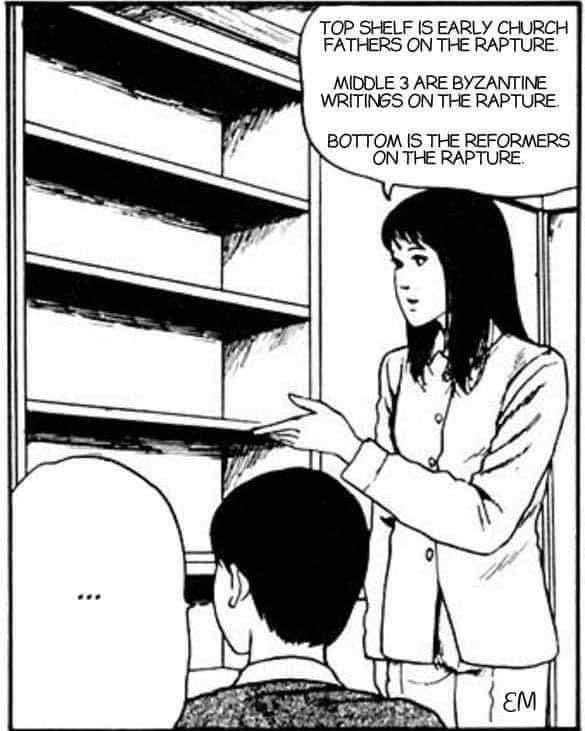
Historical views of the Rapture

Do you want to be like Tim?

If you are a writer or pastor who wants to preach like [the late Tim] Keller, you won’t get there if your strategy is “listen to Keller and copy him.” Keller himself would tell you that that’s a terrible idea.

Instead, do what Tim did: Go to seminary. After seminary, read everything George Whitefield wrote. Read Calvin’s Institutes and his sermons. Read The Lord of the Rings over and over and over. Read everything C. S. Lewis ever wrote. Read every Puritan paperback from Banner of Truth. Read sociology. Read social theory. Read Bavinck. Read current events books and a steady line up of journalists. Do all of that within the context of a family alongside your spouse and while talking to people facing ordinary life problems who are in need of counsel and aid and think about how to explain what you’re learning to them in ways that are sensible to them. Lewis had a rule that if he couldn’t say something in a way an ordinary British person could understand it meant that he wasn’t ready to say that thing yet. Follow that rule.

That is how you become a good missionary.

Jake Meador.

Heh, heh, heh! You had me going there for a minute, Jake. What’s the quick way to preaching like Tim Keller? I don’t want to be faithful for decades and decades with no assurance that I’ll ever become famous; I want a surefire to fame by next year.

East versus West

The thing is the cultural habit of rationalizing and abstracting has also made serious inroads into Catholic life and practice in the West. The crisis, Kingsnorth concluded, is not so much one of Catholic versus Protestant as it is of Eastern Christianity versus Western Christianity. It is a conclusion I arrived at not long after I left Catholicism for Orthodoxy in 2006, the result of a great spiritual trauma. I had thought of Catholicism as a mystic-friendly form of Christianity—which it is, but only by comparison to Protestantism. When seen from the East, both Catholicism and Protestantism—in the West, at least—are marooned primarily in the head and are futilely trying to think their way out of the civilizational shipwreck of the modern West.

Though Orthodoxy shares with Catholicism a fundamentally sacramental metaphysics, in practice Orthodoxy is far more mystical, emphasizing that the conversion of the heart must precede the conversion of the intellect. It does not deny the intellect, only orders it within an anthropological hierarchy.

One aspect of Orthodoxy that particularly appealed to Kingsnorth is its panentheism—the principle that God is, as the Orthodox prayer says, “everywhere present and filling all things.” It’s not the same as pantheism, which says that the material universe is God. Orthodoxy teaches that God is separate from his creation but also interpenetrates it with his energies, or his force. Consider how the warmth and pleasant glow of an English hillside on an August afternoon occur because the faraway sun penetrates the grass, the flowers, and the earth with its energies. The hillside is not the sun, but it testifies to the presence of the sun in its material being.

“The earth is not God, but God is there, present in nature, not in some far-off heaven,” Kingsnorth says. He goes on: “He’s deeply entwined in everything. Creation is the book of God, as Augustine said, I think. That is explicitly recognized in Orthodoxy. So what I was finding, weirdly enough, was a sort of ancestral Christianity that my ancestors in England would have had access to, and that the early Celtic saints certainly had access to. When I became Orthodox, a lot of people said to me, ‘Welcome home,’ and, strangely, it did feel like I was coming home. It felt like there’s something here that we had, that we lost.”

Rod Dreher.

I’ve been a fan of most of Rod Dreher’s books since Crunchy Cons. I want to distinguish his books from his columns, which I have frequently disagreed with. I also concede that one of his books was too raw, too transparent, too kiss-and-tell for my tastes.

Rod has been through a lot — openly for the last two years or so, quietly for a decade before that. Oh, heck: he’s been through a lot his whole life, much at the hands of family who lived in Louisiana at an extreme end of insularity. It’s hard to imagine a family that felt no pride in a member making it fairly big in New York City publishing because he dared to leave home, a family that affirmatively poisoned the minds of the next generation with refrains that Uncle Rod was uppity and no damn good.

I think he’s coming out of it, but he thought he had come out of it when he wrote How Dante Can Save Your Life. He’s voting for Donald Trump because Trump is the enemy of his enemies.. I cannot. I’m more with Miles Smith: “don’t tell me it is anything other than tragic that either of the two leading candidates for the presidency will eventually govern the American republic.”

Rod has a new book coming out tomorrow. It may be his most important; I’ve had it on pre-order for months.

This rave review struck me as capturing what’s special about Rod:

Dreher has an uncanny ability to articulate how religious conservatives feel, even to pre-empt it. Previous books gave us the Crunchy Cons (2006), whose eponymous conservatives want to turn the clock back; The Benedict Option (2017), which meant opting out of liberal culture; and Live Not By Lies (2020), which drew a line between “Marxist” and “woke”.

I can attest, spending much time among devout Christians, that Dreher has done it again, capturing our present mood: we’re trapped between wanting to throw ourselves into movement politics to defeat The Beast, or looking inwards in the hopes of becoming the change one wants to see in the world. Many of us are asking whether the best service we could do to Christianity is simply to become better Christians.

(Boldface added.) If you doubt that he has pre-empted conversations, ask yourself how often you’ve encountered the term “the Benedict Option,” which is literally his coinage.

These are a few of my favorite things

[N]one of the things that I care about most have ever proven susceptible to systematic exposition.

Alan Jacobs, Breaking Bread with the Dead

Christian fruits

“My people have been oppressed for nearly 2000 years. For 1200 years they endured Dhimmitude, a system of oppression made for the sole purpose of humiliating & breaking them. Today they face persecution in their homeland. And yet I don’t know of a single Coptic terrorist. Do you?”

Samuel Tadros.

Preaching the Gospel

“How do I get saved?” is not the gospel. And “So, would you like to get saved?” is not preaching the gospel.

Fr. Andrew Stephen Damick, Arise, O God

Pride

If you hide the gifts you have been given in order to appear humble, then you are very proud indeed. Wishing to appear humble is the worst form of pride.

Vassilios Papavassiliou, Thirty Steps to Heaven


Religious ideas have the fate of melodies, which, once set afloat in the world, are taken up by all sorts of instruments, some woefully coarse, feeble, or out of tune, until people are in danger of crying out that the melody itself is detestable.

George Elliot, Janet’s Repentance, via Alan Jacobs

You can read most of my more impromptu stuff here and here (both of them cathartic venting, especially political) and here (the only social medium I frequent, because people there are quirky, pleasant and real). All should work in your RSS aggregator, like Feedly or Reeder, should you want to make a habit of it.