Sunday 11-3-24

Some ironies of American slavery

This was only one of many ironies in the debates over slavery, which saw Catholics ignoring or reinterpreting papal decrees, Episcopalians celebrating early American Puritans, Presbyterians defending medieval society while criticizing the Reformation, Baptists treating patristic exegesis as authoritative, and anticlerical abolitionists praising the pope. Not all of this irony was lost on contemporaries. As has been discussed, African American historians, in particular, took pleasure in pointing out the hypocrisy of proslavery authors who cited North African church fathers in their arguments for white supremacy.

Paul J. Gutacker, The Old Faith in a New Nation

No creed but the Bible?

Orthodoxy in America

Whatever else Orthodoxy in America is, it’s not bourgeois. It’s too weird for that. At the same time, bourgeois people like me come to it. The point is to be converted by it, to learn by the fasts, the prayers, and the way of Orthodox life to train our hearts to want what Christ says we should want.

Rod Dreher, Schmemann and Social Justice

Me too

I fear that I’m like the little girl in Flannery O’Connor’s short story, who was sure she could never be a saint, but thought she might could be a martyr if they killed her quick.

Rod Dreher, Sunday With St. Paraskeva


Religious ideas have the fate of melodies, which, once set afloat in the world, are taken up by all sorts of instruments, some woefully coarse, feeble, or out of tune, until people are in danger of crying out that the melody itself is detestable.

George Elliot, Janet’s Repentance, via Alan Jacobs

You can read most of my more impromptu stuff here and here (both of them cathartic venting, especially political) and here (the only social medium I frequent, because people there are quirky, pleasant and real). All should work in your RSS aggregator, like Feedly or Reeder, should you want to make a habit of it.

Are you exhausted too?

Today’s post is all politics — not particularly vitriolic, but political. Turn back if you can’t take any more commentary, howsoever sane.

Two Kamala Harris mysteries

There are for me two Kamala Harris mysteries. The first is why she didn’t give Republicans and conservatives any serious reassurance in terms of policy. I suppose I mean anything at all on cultural issues. She was a California progressive and was part of an administration that frequently bowed to progressives; in a special way it was on her to show to potential supporters some alignment of sympathies. There are many possible examples, but here are six words suburban mothers would have been satisfied to hear: No boys on the girls team. They’re with Ms. Harris on abortion and other issues, but they’ve got seventh-grade girls coming up on the swimming and running teams and they don’t want boys competing with their daughters or in the locker room. Because boys and girls aren’t the same and aren’t built the same. So find a new and humane arrangement. The answer to questions on this is not “I’ll follow the law,” it is, “Believe me, I think we get too extreme sometimes and I’ll push against this.”

The other speaks of something that confuses me as I look at Ms. Harris as a public figure. She slew Donald Trump in debate, live, in front of 67 million people. It was just her, the untried candidate, on a stage with Man Mountain Dean, and she betrayed no fear or tremor. This is someone who can take pressure! Who can think on her feet! If she could do that, why couldn’t she sit down and give an honest, forthright interview, or field questions thoughtfully in a way that coheres, in a live town hall? Why couldn’t she let people in on her real thinking? I don’t recall a single interview she did that didn’t seem full of doubletalk and evasion. When that’s what you give people they assume you’re hiding something. It makes them think, “Maybe stick with the devil I know.”

She veered from simplicity and struggled to answer simple questions. If asked, “Do you like to walk on the street on a sunny day?” She could not say, “Yes, I do.” Instead, she’d answer it in a way she thought a smart person would answer it, full of odd roundabouts and clauses.

“Do you like to walk on the street on a sunny day?”

“I will say that within the general context of weather, and added to that the strolling ability, whether to choose to or not, and reflecting the reality of precipitation, that such strolls, and I’ve always made this clear, are quite possible.”

Peggy Noonan (unlocked).

This is a beautiful, reassuring column, which I’ve unlocked for you.

(I was pleased to see that Peggy Noonan has not voted for either major-party POTUS candidate since 2012. Neither have I.)

So: two elderly men with broken brains walk into a media circus …

It feels right and just that this election will end with Americans arguing over what two elderly men with broken brains actually meant to say while rambling semi-lucidly about their political enemies.

Two days after Joe Biden supposedly described Donald Trump’s supporters as “garbage” (I think he did), Trump supposedly suggested executing Liz Cheney. I think he didn’t …

“Trump Fantasizes About Shooting Female Rival in the Face” is how the Daily Beast characterized his comments. The Washington Post, a bit more precisely, claimed “Trump suggests ‘war hawk’ Liz Cheney should have guns ‘trained on her face’.” Some outlets understood him to mean that Cheney should face a firing squad.

I don’t think Trump was threatening her with death. It would be useful to the cause of defeating him for me to say insincerely that he was, as a final nudge to civic-minded conservatives to vote for Kamala Harris on Tuesday. But only propagandists prioritize what’s useful over what’s true.

Trump wasn’t calling for a firing squad, he was resurrecting ye olde “chickenhawk” smear of the Iraq War era. Many doves at the time insisted that war supporters were hypocrites unless they were willing to enlist themselves—and that logic is tailor-made for an audience that would turn out for an event hosted by isolationist (and amateur demonologist) Tucker Carlson ….

Nick Catoggio

For what it’s worth, I think Catoggio is exactly right about what each of the two elderly men with broken brains actually meant to say — and that what Trump said was easily one of the more benign things he’s said in his mostly-malign campaign.

It’s worth noting because our mainstream media are full of propagandists prioritizing what’s useful over what’s true. I’ve seen several of them misrepresenting Trump’s jibe at hawkish Liz Cheney.

I am so ready for this election to be over, but if Trump wins, I don’t know that I’ll be able to endure press twisting his words for four years. Aren’t his words generally bad enough without twisting to rile the inattentive?

The Domestic Front of the 2024 Election

Sundry “conservatives” (including one I overwhelmingly admire, but who temporarily lost it) have their knickers in a knot over a pro-Harris ad reminding women that their ballot is secret if they want it to be. Damon Linker singles out Charlie Kirk and one other:

As [Jesse] Watters put it, speaking about his wife: “If I found out Emma was going to the voting booth and pulling the lever for Harris, that’s the same thing as having an affair. That violates the sanctity of our marriage. What else is she keeping from me? What is she lying about?”

So let me get this straight: A Democratic-aligned group made an ad implying women married to conservative men are like subjects living in a totalitarian dictatorship who should use the privacy of the voting booth to express their true political preferences and convictions—and the response of conservative men isn’t to laugh at or lightly mock the ludicrous insinuation but to confirm that they think of their wives as vassals who owe them deference when it comes to their voting decisions?

Is this what “Biblical headship” has come to mean in MAGAworld?

We wuz played!

The electoral benefits of encouraging the “anti-” more than the “pro-” are obvious. Anger stirs people and gets them involved. It is often easier to gin up contempt than enthusiasm. If that riles supporters of the other party, so be it. Motivating your own voters to turn out is easier than persuading the other lot to switch sides. Hatred also creates useful elbow room for policy. Because it makes voters care about party-political outcomes more than anything else, they are sometimes willing to support plans that cut against their interests merely for the satisfaction of seeing their enemies suffer.

But a magic potion for elections can be a poison for democracy—and America is a good example of a place that is suffering its ill effects. Before this year’s election campaign, Americans were asked by the Pew Research Centre, a polling organisation, for a word that describes their country’s politics; 79% of them used terms like “divided” or “corrupt”. Only 2% had something good to say. Roughly 90% of them were exhausted and angry; less than half were hopeful. It is hard to see how the contest between Kamala Harris and Donald Trump has done anything to cheer them up. Speaking to Pew this month, four-fifths of respondents said it had not made them proud of America.

Polities cannot sustain such cynicism without suffering grave harm. According to polling last year, almost two-thirds of Americans have little or no confidence in their political system. A bit less than a third have no confidence in either party. If politics is not working, then angry people are more likely to resort to violence, as they did against police officers after the murder of George Floyd in 2020 and against elected politicians in the storming of the Capitol six months later. A survey by the University of Chicago in January found that 12% of Democrats, 15% of independents and 19% of Republicans agree that the “use of force is justified to ensure members of Congress and other government officials do the right thing.” (Source: economist.com)

Via John Ellis

High-T and Pro-T

JD Vance … said that studies “connect testosterone levels in young men with conservative politics” during a three-hour episode of “The Joe Rogan Experience” that was released on Thursday.

New York Times article

At last, a scientific explanation of why this septegenarian conservative can’t connect to Donald Trump’s brand of “conservatism” (which objectively isn’t conservative in any traditional sense, but seems to attract many who I once thought were conservative).

Be it remembered

I tend to forget that one of my subsidiary reasons for opposing Donald Trump is his personal abuse of the legal system through preposterous lawsuits and, by reputation, cheating his creditors by promising a prolonged legal fights if they try to get what he agreed to pay instead of the cut-rate he’s now offering.


I suffer more from the humiliations inflicted by my country than from those inflicted on her.

Simone Weil, from a letter to Georges Bernanos.

I don’t do any of the major social media, but I have two sub-domains of the domain you’re currently reading: (a) You can read most of my reflexive stuff, especially political here. (b) I also post some things on the only social medium I frequent, because people there are quirky, pleasant and real.

Sunday, October 27

Booknotes

From Mark A. Noll, America’s God from Jonathan Edwards to Abraham Lincoln.

The startling reversal in which America’s religious leaders took up the language of republicanism was the most important ideological development for the future of theology in the United States.

Mark A. Noll, America’s God from Jonathan Edwards to Abraham Lincoln.

[I wish I had a better handle on this very central thesis of Noll’s dense book. All I really can say is that American Christians were essentially alone in embracing republicanism; European Christians rejected it fairly vehemently.]

Although identifiably evangelical churches by 1860 made up the vast majority of American congregations (at least 85%), these churches did not present a homogeneous faith. In fact, evangelicals fought each other over a host of Streitpunkte—over how to interpret the Scriptures; over the definition of many Christian doctrines, including human free will, the atonement, eschatology, the meaning of the sacraments, and the nature of the church; over slavery and other social issues; over the ecclesiastical roles of women and laymen; over whether to sing hymns or psalms only; over whether churches should use creeds; over principles and practices of the market economy; and over every imaginable kind of personality conflict. … Evangelicals called people to acknowledge their sin before God, to look upon Jesus Christ (crucified—dead—resurrected) as God’s means of redemption, and to exercise faith in this Redeemer as the way of reconciliation with God and orientation for life in the world.

The most important conclusion that can be drawn from a survey of writings about money, markets, and the economy in this period is that Protestants regularly, consistently, and without sense of contradiction both enunciated traditional Christian exhortations about careful financial stewardship and simply took for granted the workings of the United States’ expanding commercial society.

Finney’s Lectures on Revivals of Religion (1835), which is discussed at greater length below in chapter 15, was important for summarizing a new approach toward reaching the lost. Since God had established reliable laws in the natural world and since humans were created with the ability to discern those laws, it was obvious that the spiritual world worked on the same basis. Thus, to activate the proper causes for revivals was to produce the proper effects: “The connection between the right use of means for a revival and a revival is as philosophically [i.e., scientifically] sure as between the right use of means to raise grain and a crop of wheat. I believe, in fact, it is more certain, and there are fewer instances of failure.” Because the world spiritual was analogous to the world natural, observable cause and effect must work in religion as well as in physics. The wine of revival—confidence in God’s supernatural ability to convert the sinner—may have looked the same in antebellum America as it had in earlier centuries, but the wineskin was of recent manufacture.

[Finney’s “scientific” revivalism strikes me as a terrible error, but a persistent one. However, this mechanistic approach has been instantiated in evangelistic crusades during my adolescence, and I assume since then as well. The rising and falling of the preaching voice; the shouting followed by the whisper; these are the rhetorical tricks (science) to get people to “make decisions for Jesus” – or Amway or Tupperware or just about anything else.]

On that score there was for Smith not a dime’s worth of difference between Samuel Miller and John Henry Hobart. Through a life of energetic peripateticism (from Lyme, Connecticut, to Vermont and then Portsmouth, New Hampshire, later to Boston, Philadelphia, Providence, and Portland, Maine), as well as frequent redirection of career (as minister—successively Baptist, “Christian,” Universalist, and “Christian” again—physician, dentist, publisher, and merchant), and in the midst of incessant polemical creativity, one thing remained constant for Elias Smith. His anchor was unshakable belief in a radically egalitarian biblicism. If the religion of formalist Presbyterians and Episcopalians was tinctured with American values, Smith’s religion represented a more complete assimilation. That religion was, in the words of a solid recent biography, “a specifically Christian republicanism growing out of a New Light evangelical heritage, conjoined with a rapidly evolving national political culture in a climate of strident partisan conflict.”46 Smith was especially important as a founder of New England’s “Christian” movement, a radically antielitist drive that sought a harmonious, unified church for all who wished to live according to the New Testament’s “perfect law of liberty.” To build such a church, however, it was necessary to clear away traditional biblical interpretations, traditional denominations, and traditional clerical authority.

“The Bible is to the theologian what nature is to the man of science. It is his store-house of facts; and his method of ascertaining what the Bible teaches, is the same as that which the natural philosopher adopts to ascertain what nature teaches…. The duty of the Christian theologian is to ascertain, collect, and combine all the facts which God has revealed concerning himself and our relation to Him. These facts are all in the Bible.” On the basis of these assertions, Hodge then went on to suggest that “the Theologian [is] to be guided by the same rules as the Man of Science.”

[I once admired Hodge, and would have been pleased, if not thrilled, by this declaration.]

[No longer. But this sort of approach was part of how “America’s God” became so unlike the true God.]

Selective resistance to secularity

In his book Fault Lines, Voddie Baucham argues that

The social sciences may be useful tools, but they are far from necessary. ‘All Scripture is breathed out by God and profitable for teaching, for reproof, for correction, and for training in righteousness, that the man of God may be complete, equipped for every good work’ (2 Timothy 3:16–17). In no area does God require me to walk in a level of righteousness for which the Scriptures do not equip me — including any and all aspects of justice.

The logic of Baucham’s argument, which permeates his book, is that the Bible is enough. It is enough to parse the complexity of race in the United States, and enough to provide a roadmap for justice. Let’s be clear: Baucham agrees that the gospel has social implications. He is also clear that the social sciences are simply unnecessary to illuminate what those social implications are, and how the gospel compels us to act.

This is, in fact, explicitly outlined in the Dallas Statement:

We deny that Christian belief, character, or conduct can be dictated by any other authority, and we deny that the postmodern ideologies derived from intersectionality, radical feminism, and critical race theory are consistent with biblical teaching. We further deny that competency to teach on any biblical issue comes from any qualification for spiritual people other than clear understanding and simple communication of what is revealed in Scripture.

According to Baucham and the signers of the Dallas Statement, the claim that secular scholarship is necessary to understand and address the contemporary racial landscape are violating the doctrine of sufficiency, and compromising their fidelity to Scripture. Despite passing affirmations that Christians ought to read broadly, insofar as it pertains to matters of race and justice, Baucham, et al., clearly view secular scholarship as suspect, and inessential to comprehending and shaping responses to the social problems we face.

Of course, in their view, not all secular sources are suspect. Many of the signers of the Dallas Statement happily employ the work of James Lindsay or Thomas Sowell in their analysis of our social realities. The real concern lies in a particular set of sources: “postmodern ideologies derived from intersectionality, radical feminism, and critical race theory.” It is these sources which consume massive amounts of energy expended by Owen Strachan, Voddie Baucham, Tom Ascol, and many others. Summarized by many under the slushy appellation “wokeness,” these writers are convinced that reliance on anything that smacks of woke is deleterious to the faith given once for all to the saints.

Josh Fenska, Thin Discipleship


Religious ideas have the fate of melodies, which, once set afloat in the world, are taken up by all sorts of instruments, some woefully coarse, feeble, or out of tune, until people are in danger of crying out that the melody itself is detestable.

George Elliot, Janet’s Repentance, via Alan Jacobs

You can read most of my more impromptu stuff here and here (both of them cathartic venting, especially political) and here (the only social medium I frequent, because people there are quirky, pleasant and real). All should work in your RSS aggregator, like Feedly or Reeder, should you want to make a habit of it.

Election draweth near

Culture

Bad Religion

More than three decades ago, Nathan Hatch published The Democratization of American Christianity, a history of the Second Great Awakening, arguably the most important religious episode in American history. At the recent Intercollegiate Studies Institute annual homecoming, I served on a panel that discussed the award-winning book. It was a pleasure to do so. Hatch gives a magisterial account of the upsurge of religious populism that shaped the new American republic in decisive ways. Anyone who wants to understand the last ten years of American politics should read The Democratization of American Christianity.

Denunciations of the “swamp” echo the Second Great Awakening’s polemics against the clerical establishment of its day, which itinerate preachers derided as complacent, more interested in high salaries and comfortable parsonages than in gospel preaching. Trump rallies follow in the tradition of raucous, call-and-response camp meetings. Commentators wonder at the fact that respectable people support Trump, not knowing that some of the most important leaders of the religious populism of the early 1800s were elites such as Barton Stone, who embraced the new, raw, and uncouth style of religious revival.

Elias Smith was a renegade preacher and journalist who, in 1808, launched America’s first religious newspaper, Herald of Gospel Liberty. He mocked and abused the Calvinist grandees, the “clerical hierarchy” that dominated Protestantism at that time. Establishment clergy like Lyman Beecher raged against preachers like Smith who were disturbing the religious landscape. It does not take much imagination to cast Tucker Carlson in the role of a latter-day Elias Smith. He thrills his populist devotees and outrages the guardians of political respectability such as George Will, a Lyman Beecher of our time.

Hatch raises larger themes. The Second Great Awakening took place during a time of rapid social change. The new republic gave rise to radicalisms of many sorts. People were on the move, as territories west of the Appalachian Mountains were settled. Old institutions and authorities lost their power. As I note above, recent decades have seen similar changes. Globalization, demographic change, the sexual revolution, social media, and other factors have precipitated a quite different but equally significant crisis of authority. We should not be surprised, therefore, that populism has returned, as it did in the late 1800s, when America was transformed by industrialization, urbanization, and swelling waves of immigrants.

Hatch documents that revivalist preachers were confident that their individualist, evangelical Christianity would fulfill the sacred mission of America. In their sermons and broadsides, populist religion mixed freely with populist politics, as was the case for William Jennings Bryan and subsequent American populists. Today’s Trumpian populism is different. To be sure, many pious people support Trump and other populist politicians. Avatars of popular religion like Paula White lurk on the peripheries. But the movement lacks an explicitly religious dimension, which is striking when we compare it to the administration of George W. Bush, an establishment figure who was not shy about his evangelical convictions.

Which makes me wonder: In spite of fascinating parallels to the outpouring of Christian enthusiasm and political radicalism in the Second Great Awakening, does today’s populism ironically contribute to an important elite ambition, the establishment of a post-Christian, entirely secular political culture in America? I hope not.

R.R. Reno

After several readings, I’m not sure what Reno is trying to say here. My impression until that penultimate paragraph was that he though our last decade’s populism just fine and dandy, as was the ferment of the 19th century; then he raises the possibility that the lack of a “religious dimension” is at least a bit worrisome.

But what an odd thing for a Catholic (or Orthodox) to believe. In case after case, the wake of the Great Awakenings was destructive of the Christian institutions that evidenced stability and left us, in the characterization of Ross Douthat, A Nation of Heretics.

Slinging slurs, pitching pity parties

I have no idea how one is supposed to respond to polling questions about the morality of changing one’s gender.

That’s mostly because I don’t think changing gender is possible. How can an impossible thing be immoral?

It’s also partly because I hold open the possibility that presenting as the opposite sex, with or without surgery and hormonal interventions, may for some individuals be the optimal way to quiet intractable gender dysphoria. (Who am I to condemn cosplaying in the cause of lessening psychic pain?)

But I’ll tell you something that is immoral. This kind of un-empathetic poor-mouthing about people disapproving (or denying the reality of) “trans lives”:

Is it morally acceptable to change your gender?

Just over half the country doesn’t think so — a proportion that has stayed fairly stable since 2021, the year after I disclosed my gender transition. It’s disheartening to reflect on the fact that every other person you meet, statistically speaking, disapproves of your existence.

Gina Chua. Nothing in the Gallup poll in question suggests that anyone disapproves the existence of people who’ve carried through on the putatively immoral decision to transition.

We are a low-down, debased people who have made ourselves indisposed toward intelligent discussion of issues. We sling slurs and pitch pity parties.

Journalistic murmurations

World Ends in Nuclear conflagration. Women and children most affected.

Something like this was an old jab at the New York Times’s stylistic preoccupations.

New era, new media, new preoccupations:

Inside the U.S. Government-Bought Tool That Can Track Phones at Abortion Clinics

H/T Nellie Bowles, who didn’t seem to think it the least bit odd that 404 Media’s fears turned immediately to red states tracking their handmaidens to blue state abortuaries.

Politics

MVP of Election 2024?

Bret Stephens hits back-to-back homeruns.

With insanity supporters like this, sanity may stand a chance

Tucker Carlson spoke at the Turning Point USA Trump rally this week and gave the absolute best anti-Trump speech I’ve ever heard. Tucker’s speech is here and excerpted below, somehow kinky and alarming and rousing at the same time: 

“There has to be a point at which Dad comes home [crowd cheers]. Yeah, that’s right. Dad comes home, and he’s pissed. Dad is pissed. He’s not vengeful. He loves his children, disobedient as they may be. He loves them because they’re his children,” said Tucker Carlson, a grown man and a major respected figure on the right. “And when Dad gets home, you know what he says? ‘You’ve been a bad girl. You’ve been a bad little girl, and you’re getting a vigorous spanking right now. And no, it’s not gonna hurt me more than it hurts you. No, it’s not. I’m not gonna lie. It’s gonna hurt you a lot more than it hurts me. And you earned this. You’re getting a vigorous spanking because you’ve been a bad girl. And it has to be this way.’ ” 

If someone spoke like this to me on the street, I would pepper spray them. If I heard someone speak like this to someone else, I would pepper spray them and myself. Tucker Carlson’s endorsement of Trump makes me want to mainline MSNBC. Tucker’s endorsement makes me think Democracy Is On the Line, and Christopher Steele is a respected member of the intelligence community, and I heard there was a box of White House stationery at Mar-a-Lago illegally. Tucker’s endorsement just made me start knitting a pussy hat. Trump is not daddy. America is not his little girl. I believe in free speech except when a grown man is saying the words bad little girl. And Tucker Carlson needs to keep his kinks private and shameful like the rest of us.

Nellie Bowles

Nonsequiturland

Also from the echo chamber of Tucker Carlson’s Daily Caller:

Democrats have continued to liken Trump to Adolf Hitler and assert he poses a grave “danger” to the planet if he is reelected, even after two recent assassination attempts against him.

(Jason Cohen)

How pray tell, Mr. Cohen, do two assassination attempts disprove Trump being a grave danger (or require suppression of the truth)? Do you tacitly call on Trump to cool it when his rhetoric generates death threats to election officials?

(Note that all the hyperlinks in my quote are to other Daily Caller stories; that’s why I thought “echo chamber” was apt.)

Would it help if it were done by image rather than words?

(If you don’t get the allusion, search for “distracted boyfriend même.)

Kamala F.B. Harris

  • In The Bulwark, Jonathan V. Last thanked the vice president for taking on Trump: “I believe that for all her political ambition, Kamala Harris is carrying this burden for us. She’s not Barack Obama, basking in the warmth of a cultural moment en route to becoming a cultural icon. She’s more like Frodo Baggins, walking toward Mordor while carrying a millstone around her neck, in an attempt to save all of Middle-earth from a dark fate.” (Sally McDonald, Cairns, Australia)

Frank Bruni‌

Narcissism from a slightly different angle

I find his immodesty not only a serious character flaw but a danger to his governing ability. I don’t believe he wishes to abolish the Constitution, undermine our democracy, set himself up as dictator. But such full-court immodesty has to work against one’s perspective, make impossible anything resembling a sense of history, allow for necessary accommodations with reality. A man who sees no other picture but those with himself in the center is not a man you want to run your nation.

Joseph Epstein

I quote this not to beat a dead horse, but because it is almost identical in its insight to one of the points I made long ago: Trump’a narcissism distorts his vision of the world, and that kind of distortion is intolerable in a POTUS. It’s so disqualifying that I don’t care what his “positions” are on “the issues.”


I suffer more from the humiliations inflicted by my country than from those inflicted on her.

Simone Weil, from a letter to Georges Bernanos.

I don’t do any of the major social media, but I have two sub-domains of the domain you’re currently reading: (a) You can read most of my reflexive stuff, especially political here. (b) I also post some things on the only social medium I frequent, because people there are quirky, pleasant and real.

Sunday, 10/20/24

Good news for Kings and Princes

Predictably, secular authorities convinced by the reformers’ truth claims liked the distinction drawn between the necessity of obedience to them and of disobedience to Rome. They liked hearing “the Gospel” accompanied by such “good news”—it would allow them, for starters, to appropriate for themselves all ecclesiastical property, including the many buildings and lands that belonged to religious orders, and to use it or the money from its sale in whatever ways they saw fit. In two stages during the late 1530s, seizing for himself the vast holdings of all the hundreds of English monasteries and friaries, Henry VIII would demonstrate how thoroughly a ruler could learn this lesson without even having to accept Lutheran or Reformed Protestant doctrines about grace, faith, salvation, or worship.

Brad S. Gregory, The Unintended Reformation

Repentance in a nutshell

Repentance is everything you do to get sin, those inborn passions, out of you. It’s reading, thinking, praying, weeding out disruptive influences in your life, sharing time with fellow Christians, following the guidance of the saints. Repentance is the renunciation of what harms us and the acquisition of what is beneficial to us, writes a holy counselor.

Dee Pennock, God’s Path to Sanity

Prayer of Penitence

The prayer of penitence leads us to reflect critically on our own lives. If it is uttered sincerely, it leads us to repent in humility, not just of particular wrongs we have done, but of our whole shameful and degraded state of being. The paradox is that, far from leading to lethargy or despair, such penitence brings a new kind of strength. Sexual sin is never merely sexual, but always has motives that are rooted in the passions—whether the need to be loved, or the lust for domination, or the desire to prove oneself attractive, or any of a dozen other motives that come readily to mind.

Frederica Mathewes-Green & Rod Dreher, Healing Humanity

The worth of a man

… to believe that wealth is the only significant measure of the worth of an individual, a family, or a community is to reject the teaching of nearly every religion and wisdom tradition that ever was.

Mark Mitchell and Nathan Schlueter, The Humane Vision of Wendell Berry

Option preclusion

[T]he move from taking God for granted to disputing God’s existence is a move from naïve to reflective, from a position where one set of options is precluded to a position where that set of options is fully available. Underlying that move, however, is the move from porous to buffered selves, and that is a move from naïve to naïve. It is, in other words, a move from a position where one set of options is precluded to a position where another set of options is precluded.

William T. Cavanaugh, The Uses of Idolatry

Perdition

Miles Smith, Perdition. Potent.

Caveat: This touches on American electoral politics.

Historical views of the Rapture

Do you want to be like Tim?

If you are a writer or pastor who wants to preach like [the late Tim] Keller, you won’t get there if your strategy is “listen to Keller and copy him.” Keller himself would tell you that that’s a terrible idea.

Instead, do what Tim did: Go to seminary. After seminary, read everything George Whitefield wrote. Read Calvin’s Institutes and his sermons. Read The Lord of the Rings over and over and over. Read everything C. S. Lewis ever wrote. Read every Puritan paperback from Banner of Truth. Read sociology. Read social theory. Read Bavinck. Read current events books and a steady line up of journalists. Do all of that within the context of a family alongside your spouse and while talking to people facing ordinary life problems who are in need of counsel and aid and think about how to explain what you’re learning to them in ways that are sensible to them. Lewis had a rule that if he couldn’t say something in a way an ordinary British person could understand it meant that he wasn’t ready to say that thing yet. Follow that rule.

That is how you become a good missionary.

Jake Meador.

Heh, heh, heh! You had me going there for a minute, Jake. What’s the quick way to preaching like Tim Keller? I don’t want to be faithful for decades and decades with no assurance that I’ll ever become famous; I want a surefire to fame by next year.

East versus West

The thing is the cultural habit of rationalizing and abstracting has also made serious inroads into Catholic life and practice in the West. The crisis, Kingsnorth concluded, is not so much one of Catholic versus Protestant as it is of Eastern Christianity versus Western Christianity. It is a conclusion I arrived at not long after I left Catholicism for Orthodoxy in 2006, the result of a great spiritual trauma. I had thought of Catholicism as a mystic-friendly form of Christianity—which it is, but only by comparison to Protestantism. When seen from the East, both Catholicism and Protestantism—in the West, at least—are marooned primarily in the head and are futilely trying to think their way out of the civilizational shipwreck of the modern West.

Though Orthodoxy shares with Catholicism a fundamentally sacramental metaphysics, in practice Orthodoxy is far more mystical, emphasizing that the conversion of the heart must precede the conversion of the intellect. It does not deny the intellect, only orders it within an anthropological hierarchy.

One aspect of Orthodoxy that particularly appealed to Kingsnorth is its panentheism—the principle that God is, as the Orthodox prayer says, “everywhere present and filling all things.” It’s not the same as pantheism, which says that the material universe is God. Orthodoxy teaches that God is separate from his creation but also interpenetrates it with his energies, or his force. Consider how the warmth and pleasant glow of an English hillside on an August afternoon occur because the faraway sun penetrates the grass, the flowers, and the earth with its energies. The hillside is not the sun, but it testifies to the presence of the sun in its material being.

“The earth is not God, but God is there, present in nature, not in some far-off heaven,” Kingsnorth says. He goes on: “He’s deeply entwined in everything. Creation is the book of God, as Augustine said, I think. That is explicitly recognized in Orthodoxy. So what I was finding, weirdly enough, was a sort of ancestral Christianity that my ancestors in England would have had access to, and that the early Celtic saints certainly had access to. When I became Orthodox, a lot of people said to me, ‘Welcome home,’ and, strangely, it did feel like I was coming home. It felt like there’s something here that we had, that we lost.”

Rod Dreher.

I’ve been a fan of most of Rod Dreher’s books since Crunchy Cons. I want to distinguish his books from his columns, which I have frequently disagreed with. I also concede that one of his books was too raw, too transparent, too kiss-and-tell for my tastes.

Rod has been through a lot — openly for the last two years or so, quietly for a decade before that. Oh, heck: he’s been through a lot his whole life, much at the hands of family who lived in Louisiana at an extreme end of insularity. It’s hard to imagine a family that felt no pride in a member making it fairly big in New York City publishing because he dared to leave home, a family that affirmatively poisoned the minds of the next generation with refrains that Uncle Rod was uppity and no damn good.

I think he’s coming out of it, but he thought he had come out of it when he wrote How Dante Can Save Your Life. He’s voting for Donald Trump because Trump is the enemy of his enemies.. I cannot. I’m more with Miles Smith: “don’t tell me it is anything other than tragic that either of the two leading candidates for the presidency will eventually govern the American republic.”

Rod has a new book coming out tomorrow. It may be his most important; I’ve had it on pre-order for months.

This rave review struck me as capturing what’s special about Rod:

Dreher has an uncanny ability to articulate how religious conservatives feel, even to pre-empt it. Previous books gave us the Crunchy Cons (2006), whose eponymous conservatives want to turn the clock back; The Benedict Option (2017), which meant opting out of liberal culture; and Live Not By Lies (2020), which drew a line between “Marxist” and “woke”.

I can attest, spending much time among devout Christians, that Dreher has done it again, capturing our present mood: we’re trapped between wanting to throw ourselves into movement politics to defeat The Beast, or looking inwards in the hopes of becoming the change one wants to see in the world. Many of us are asking whether the best service we could do to Christianity is simply to become better Christians.

(Boldface added.) If you doubt that he has pre-empted conversations, ask yourself how often you’ve encountered the term “the Benedict Option,” which is literally his coinage.

These are a few of my favorite things

[N]one of the things that I care about most have ever proven susceptible to systematic exposition.

Alan Jacobs, Breaking Bread with the Dead

Christian fruits

“My people have been oppressed for nearly 2000 years. For 1200 years they endured Dhimmitude, a system of oppression made for the sole purpose of humiliating & breaking them. Today they face persecution in their homeland. And yet I don’t know of a single Coptic terrorist. Do you?”

Samuel Tadros.

Preaching the Gospel

“How do I get saved?” is not the gospel. And “So, would you like to get saved?” is not preaching the gospel.

Fr. Andrew Stephen Damick, Arise, O God

Pride

If you hide the gifts you have been given in order to appear humble, then you are very proud indeed. Wishing to appear humble is the worst form of pride.

Vassilios Papavassiliou, Thirty Steps to Heaven


Religious ideas have the fate of melodies, which, once set afloat in the world, are taken up by all sorts of instruments, some woefully coarse, feeble, or out of tune, until people are in danger of crying out that the melody itself is detestable.

George Elliot, Janet’s Repentance, via Alan Jacobs

You can read most of my more impromptu stuff here and here (both of them cathartic venting, especially political) and here (the only social medium I frequent, because people there are quirky, pleasant and real). All should work in your RSS aggregator, like Feedly or Reeder, should you want to make a habit of it.

Wednesday, 10/16/24

Not Politics

Iatrogenic Customer Dissatisfaction

I took my Lincoln into the dealer last week because wiper fluid wouldn’t spray. They fixed it and suggested wiper blades, too.

I of course got a Customer Satisfaction Survey afterword because — well, this is Weimar America 2024.

In my value system, a 3 out of 5 means this was a perfectly okay experience, no problem. I don’t expect bliss or epiphanies from a car repair.

But to Ford-Lincoln, anything less that straight 5s triggers a message to the dealer that it desperately needs to call me to fix things. So the dealer called, and I told him his corporate overlords are idiots.

And then, incredibly, another survey came to ask whether the dealer called me, and now what are my answers to the other questions (how likely are you to recommend, etc.)? I couldn’t just say the dealer called me; the other questions were mandatory so I couldn’t submit the form without answering them.

But, aha!, they had a field for free-form comments, which I filled and submitted thus:

I am never going to answer another customer satisfaction survey. You won’t be satisfied until I’ve lied and given you all fives, so I’m going to lie like a dog and give them to you. But the truth is that Ford-Lincoln has burnt some goodwill by the refusal to accept “this was a satisfactory service call.” You won’t even let me say the dealer followed up and leave it at that, because I can’t say that (which is true) without answering all the other questions and risking another round of fawning attention if the answers are less than 5.
I DON’T WANT FAWNING ATTENTION. I WANTED MY CAR FIXED. I GOT MY CAR FIXED. NOW LEAVE ME ALONE! WHAT KIND OF IDIOTS ARE TELLING YOU THAT THIS HARASSMENT IS A WAY TO BUILD CUSTOMER SATISFACTION?!

(That felt good, but I’m not sure my pulse and blood pressure are back down yet. I claim no copyright on this, and you can substitute another “f-word” for “fawning.”)

Gratitude Grievance

I beam with pride when I see companies like Shopify, GitHub, Gusto, Zendesk, Instacart, Procore, Doximity, Coinbase, and others claim billion-dollar valuations from work done with Rails. It’s beyond satisfying to see this much value created with a web framework I’ve spent the last two decades evolving and maintaining. A beautiful prize from a life’s work realized.

But it’s also possible to look at this through another lens, and see a huge missed opportunity! If hundreds of billions of dollars in valuations came to be from tools that I originated, why am I not at least a pétit billionaire?! …

This line of thinking is lethal to the open source spirit.

The moment you go down the path of gratitude grievances, you’ll see ungrateful ghosts everywhere. People who owe you something, if they succeed. A ratio that’s never quite right between what you’ve helped create and what you’ve managed to capture. If you let it, it’ll haunt you forever.

Thou shall not lust after thy open source’s users and their success.

David Heinemeier Hansson

The Meaning of Existence

Everything except language
knows the meaning of existence.
Trees, planets, rivers, time
know nothing else. They express it
moment by moment as the universe.

Even this fool of a body
lives it in part,
and would have full dignity within it
but for the ignorant freedom
of my talking mind.

Les Murray, New Selected Poems

Religion (whatever that is)

Papering over an abyss of waste and horror

[T]he 2024 presidential campaign is a type of tragedy. For many Evangelicals, choosing between the two is a near-existential psycho-intellectual crisis. Because we lack an understanding of the tragic, we tend to think that everything we do must somehow be “redemptive.” …

Evangelical treatment of politics as nearly sacramental, rather than a part of temporal or natural life, has left them unable to conceive of political tragedy. Greg Wolfe in Image sees this as an essentially American failing, and he’s probably right. “My youthful, earnest religiosity” Wolfe writes, papered over “an abyss of waste and horror with innocuous pieties.”

Evangelicals seem convinced that they could never be a part of a national political tragedy, and their refusal to concede the essentially tragic nature of American politics is to their peril. Every succeeding generation of evangelicals, left right and center, seem convinced that salvation lies in their own political exertions, seemingly unaware that they too could be a part of a national political tragedy, wherein God’s judgment comes on the moral and immoral, on the pious and impious. There are cases, I am sure, to be made for voting for Trump, and that is who most of my tribe will tend towards. Maybe it is necessary. Maybe it is prudent. But don’t tell me it is anything other than tragic that either of the two leading candidates for the presidency will eventually govern the American republic.

Miles Smith at Mere Orthodoxy.

“Charismatics” didn’t used to be “Evangelicals”

There was in fact a strange mix of Evangelicalism clericalism and charismatic political action that Trump effectively harnessed in unique ways.

It is not coincidental that many, if not most, exvangelical memoirs are written by people who have had some background with charismatic influence, and why the specific Cold War confluence of legacy Evangelicals and charismatics created the conditions for the exvangelical movement. In their Washington Post piece Erica Ramirez and Leah Payne rightly note that while the “Pentecostal-Charismatic movement overlaps with evangelical traditions in many ways, especially in their conservative ideas about political issues such as abortion, marriage and prayer in schools,” evangelicals and Pentecostals are “historically distinct — until the mid-20th century, Pentecostals and their Charismatic descendants weren’t routinely grouped with their evangelical counterparts.”

There was in fact a strange mix of Evangelicalism clericalism and charismatic political action that Trump effectively harnessed in unique ways.

Miles Smith, Reading the Exvangelicals

It’s tempting to muse about why both “sides” consented to the conflation of pentecostal/charismatic and evangelical.

Perhaps another day. If I tried it today, I’d be neglecting other things and my take would probably be too cynical.

Politics

New Nadir

The Rutherford County, North Carolina, Sheriff’s Office said on Monday that police officers arrested a 44-year-old man on Saturday suspected of threatening violence against Federal Emergency Management Agency (FEMA) disaster workers. The Washington Post reported over the weekend that FEMA ordered its employees to temporarily evacuate the county after National Guard service members reported seeing a truck of armed militants who were “out hunting FEMA,” though law enforcement said the suspect acted alone. The man—carrying a handgun and rifle at the time of his arrest—was charged with “going armed to the terror of the public” and released later that day on $10,000 bail.

Via The Dispatch.

Militants hunting for FEMA workers in hurricane devastation because — why, in God’s name!? Can we sink any lower?

Kamala’s best case?

Bret Stephens, Harris Needs a Closing Argument. Here’s One. is very appealing.

With Harris I’m pretty sure there will be another Election in four years; I’m not at all sure with Trump. But with Trump at +16 in my state, I have the luxury of voting for neither of them.

Poetic justice

Less than four weeks from the election, Michigan’s Democratic governor made an in-kind contribution to Donald Trump’s campaign. Gretchen Whitmer appeared last week in a video featuring her placing a Dorito chip on the tongue of a kneeling social-media influencer. After Michigan’s bishops denounced the clip as “specifically imitating the posture and gestures of Catholics receiving the Holy Eucharist,” Ms. Whitmer apologized.

The kicker: She was wearing a Harris-Walz campaign hat in the video.

The swing-state governor says she had no idea people might find the post offensive, which speaks to how out of touch Democratic elites are ….

William McGurn

This may qualify as poetic justice. Kamala Harris deserves to be outed as anti-Catholic (see this as well as the McGurn column) quite apart from Gretchen Whitmer’s mockery of the eucharist.

But I’m kind of waiting for the rest of the Whitmer story. What’s above is suspiciously weird; I just don’t know how Whitmer could have blundered her way into that highly-scripted gaff unless it was some kind of Borat or Project Veritas entrapment. Maybe that kneeling social-media influencer was a conservative provocateur, in which case I’d fault her (him?) equally with Whitmer in staging the mockery.

Russian 1988, China 2024

So: Why didn’t Gorbachev’s reforms succeed and save an empire?

Regarding the key figure, opinion was split at least five ways: some said it had been Ukrainian President Leonid Kravchuk; others, Russian President Boris Yeltsin; still others, Soviet President Mikhail Gorbachev or KGB Chairman Vladimir Kryuchkov. Finally, one or two passed the credit (or guilt) back to Leonid Brezhnev.

Each had a cogent reason for his answer. Moscow’s Mayor Gavriil Popov and Alexander Yakovlev fingered Kravchuk because his action in leading Ukraine to complete independence had removed an essential component of any possible union. Without Ukraine, their argument went, a union would be unworkable, since the discrepancy in size between Russia and each of the other republics was so great. At least one unit of intermediate size was needed to create the sort of balance a federation, or even confederation, would require.nov Others, such as Anatoly Sobchak and Konstantin Lubenchenko, the last speaker of the USSR Supreme Soviet, did not agree with this logic.

Russia, Belarus, the countries of Central Asia, and perhaps one or two from the Transcaucasus could have formed a viable union even without Ukraine, they argued. Only one republic was irreplaceable, and that was Russia. Ergo, Yeltsin had been the key figure. If he had not conspired with the leaders of Ukraine and Belarus to form the Commonwealth of Independent States, some form of confederation could have been cobbled together to the benefit of all.

“No,” said others, including Vladislav Starkov and Sergei Stankevich, who felt that Gorbachev’s stubbornness, his failure to understand the force of nationalism, his devotion to a discredited socialism, and the authoritarian streak in his personality had prevented him from voluntarily transferring the sort of power to the republics that their leaders demanded. His failures in leadership, in short, had determined the collapse of the state he headed, and no other political figure could have saved it.

Anatoly Chernyayev, ever loyal to his boss, would have none of that. He felt that a union treaty would have been signed if the attempted coup had not occurred in August. This implied that Vladimir Kryuchkov had been the key figure. He, after all, had organized the coup, and nobody else could have done it without his cooperation.

Starkov, who named Gorbachev as the principal culprit, also pointed out that Leonid Brezhnev had shared much of the responsibility, for he was the Soviet leader who had set the stage for collapse by neglecting the country’s economic, social, and ethnic problems and by permitting local “mafias” under the guise of the Communist Party to obtain a hammerlock on power in many of the union republics.

Jack Matlock, Autopsy on an Empire

This stuff’s complicated and most of us Americans haven’t got a clue what Russia is about. Gobachev tried major reform, but there were too many moving pieces and personalities — so he got collapse in the end.

China seems to be in similar bind as Gorbachev: economic dysfunction, the cure of which might bring down the CCP.


I suffer more from the humiliations inflicted by my country than from those inflicted on her.

Simone Weil, from a letter to Georges Bernanos.

I don’t do any of the major social media, but I have two sub-domains of the domain you’re currently reading: (a) You can read most of my reflexive stuff, especially political here. (b) I also post some things on the only social medium I frequent, because people there are quirky, pleasant and real.

Sunday, 10/13/24

Tomorrow, we will bury my youngest brother, who died Tuesday. So it has been a busy and stressful week.

Jonathan’s life on earth was, by upper-middle class, first world standards, unusually afflicted, and he was not afraid of death. We, his surviving brothers, all practicing Christians of varying traditions (our parents did well), see God’s gracious hand in this in many ways.

If you do such things, pray for God’s servant, Jonathan, who has “fallen asleep” in hope of resurrection, though in his tradition he would have called it something else.

Here’s what I have for you today.

Christians did not worry that absence of the pagans from their services constituted a lost opportunity. Their worship was not evangelistic; it was not “seeker sensitive.” Their intent in worshiping was to glorify God rather than to attract outsiders. And since they believed that authentic worship formed the worshipers, they believed that in the course of time the behavior of those so formed would attract outsiders.

Alan Kreider, The Patient Ferment of the Early Church


In 1184, bishops who previously might have been content to let sleeping heretics lie had been instructed actively to sniff them out. Then, in 1215, at the great Lateran Council presided over by Innocent III, sanctions explicitly targeting heresy had provided the Church with an entire machinery of persecution.

Tom Holland, Dominion

For what it’s worth, I seem to recall a trustworthy source affirm that there was never any sort of inquisition in the Eastern (Orthodox) Church, and I know I have heard of none.


Those who, like him, had dared to repudiate the Roman Church but had then been guilty of what Luther condemned as a failure properly to understand the Spirit, had also been the objects of his ire. Theologians in Swiss or German cities who presumed to dispute his views on the eucharist; Anabaptists, with their wild contempt for infant baptism and secular authority; Henry VIII, who seemed to think he was God. Luther, fretting where it all might lead, had not shrunk from contemplating a nightmarish prospect: a world in which the very concept of truth might end up dissolving, and everything appear relative. ‘For whoever has gone astray in the faith may thereafter believe whatever he wants.’

Tom Holland, Dominion


Protestants made the sixteenth century an era of unprecedented emphasis on doctrine. In their divergent ways, all Protestants thought that the most fundamental problem with the Roman church was its mistaken truth claims, that is, its false doctrines. As we saw in the previous chapter, they offered their respective corrections based on scripture, variously supplemented by the inspiration of the Holy Spirit and the exercise of reason. Because Lutherans and Reformed Protestants were supported rather than suppressed by political authorities, theirs were the particular Protestant truth claims institutionalized in cities, territories, and countries whose leaders rejected Rome.

Brad S. Gregory, The Unintended Reformation


Religious ideas have the fate of melodies, which, once set afloat in the world, are taken up by all sorts of instruments, some woefully coarse, feeble, or out of tune, until people are in danger of crying out that the melody itself is detestable.

George Elliot, Janet’s Repentance, via Alan Jacobs

You can read most of my more impromptu stuff here and here (both of them cathartic venting, especially political) and here (the only social medium I frequent, because people there are quirky, pleasant and real). All should work in your RSS aggregator, like Feedly or Reeder, should you want to make a habit of it.

Sunday, 10/6/24

Going to church

Festive events like rock concerts, Taylor says, are “plainly ‘non-religious’; and yet they also sit uneasily in the secular, disenchanted world. . . . The festive remains a niche in our world, where the (putatively) transcendent can erupt into our lives, however well we have organized them around immanent understandings of order.”

William T. Cavanaugh, The Uses of Idolatry

I’m not so sure rock concerts aren’t religious in a world where churches imitate rock concerts.

On the other hand,

Taylor notes that not all expressions of Christianity have adopted excarnation, but in general, it is true that our church services (especially in evangelicalism) involve less liturgy, less focus on bodily participation, and greater emphasis on disengaged reason.

Alan Noble, Disruptive Witness

We have only ever lived in the Negative World

I recently re-subscribed to Touchstone. I’m not entirely sure why I did, and when my first copy arrived, I skimmed it, snorted ruefully, and set it aside.

I picked it up again weeks later, and was pleased at the lead editorial:

We wish the Republican Party hadn’t altered its platform, and we wish it hadn’t invited Amber Rose to speak as a representative of what the party now endorses (and let’s not kid ourselves; she represents what the party now believes). But in the Negative World, American Christians should no longer expect to find safe sanctuary in the GOP.

The reality is that we have only ever lived in the Negative World. Even though Christians knew long before any of us was born that our nation was drifting away from the church, we lived for a time under the Positive-World illusion that Christian notions of right and wrong would endure, if not in the world, then at least in the West, and if not in the West, then at least in the United States. And if not even in the United States, then in the Republican Party at the very least of all.

Now that we can see the world for what the Bible tells us it has always been, we may all soon see what the Venerable Fulton Sheen saw more than a half-century ago, when he looked upon our Negative World and announced the “end of Christendom” yet affirmed that:

these are great and wonderful days in which to be alive. . . . It is not a gloomy picture—it is a picture of the Church in the midst of increasing opposition from the world. And therefore live your lives in the full consciousness of this hour of testing, and rally close to the heart of Christ.

Douglas Johnson, Great and Wonderful Days (emphasis added).

If a nontrivial portion of the rest of Touchstone is that good, I’ll hang around a while.

Science and Magic

The serious magical endeavour and the serious scientific endeavour are twins: one was sickly and died, the other strong and throve. But they were twins. They were born of the same impulse … There is something that unites magic and applied science while separating both from the wisdom of earlier ages. For the wise men of old, the cardinal problem was how to conform the soul to reality, and the solution was knowledge, self-discipline, and virtue. For magic and applied science alike, the problem is how to subdue reality to the wishes of men, and the solution is technique. Both, in the practice of this technique, are ready to do things hitherto regarded as disgusting and impious, such as digging up and mutilating the dead.

C.S. Lewis, The Abolition of Man

Of proposals to legalize euthanasia:

This exists in bleak meme form in millennial jokes about “Day of the Pillow”, a proposed mass-smothering event conducted against their over-numerous Boomer elders … [E]very polity where the demographic pinch prevails is making the same proposals. For example, since 2020 the call has been raised in China, Japan, and India as well as the West.

From a perspective that views human life as sacred, this looks horrific. But it is a logical endpoint for a technological order whose inorganic growth is in important ways parasitic on the organic kind: exploiting the natural world, for instance, or instrumentalising “human resources” even as it affords women more social status for literally anything other than creating and nurturing those “resources”. And when no effort to rein in this exploitative, anti-life nature seems to have succeeded yet, perhaps the only way out is through. So we can maybe take a crumb of comfort from the likelihood that whatever society survives this now self-devouring culture of death will have done so by refusing its paradigm, and choosing life instead.

Mary Harrington, Why assisted dying is now inevitable

What Christ gave us before He ascended

Before Christ ascended, He did not give us Scriptures, canons, doctrines, rules, or definitions. He bestowed the Holy Spirit on the Eleven in the Upper Room (John 20:22) and later sent the Holy Spirit to the entire Church at Pentecost (Acts 2)”

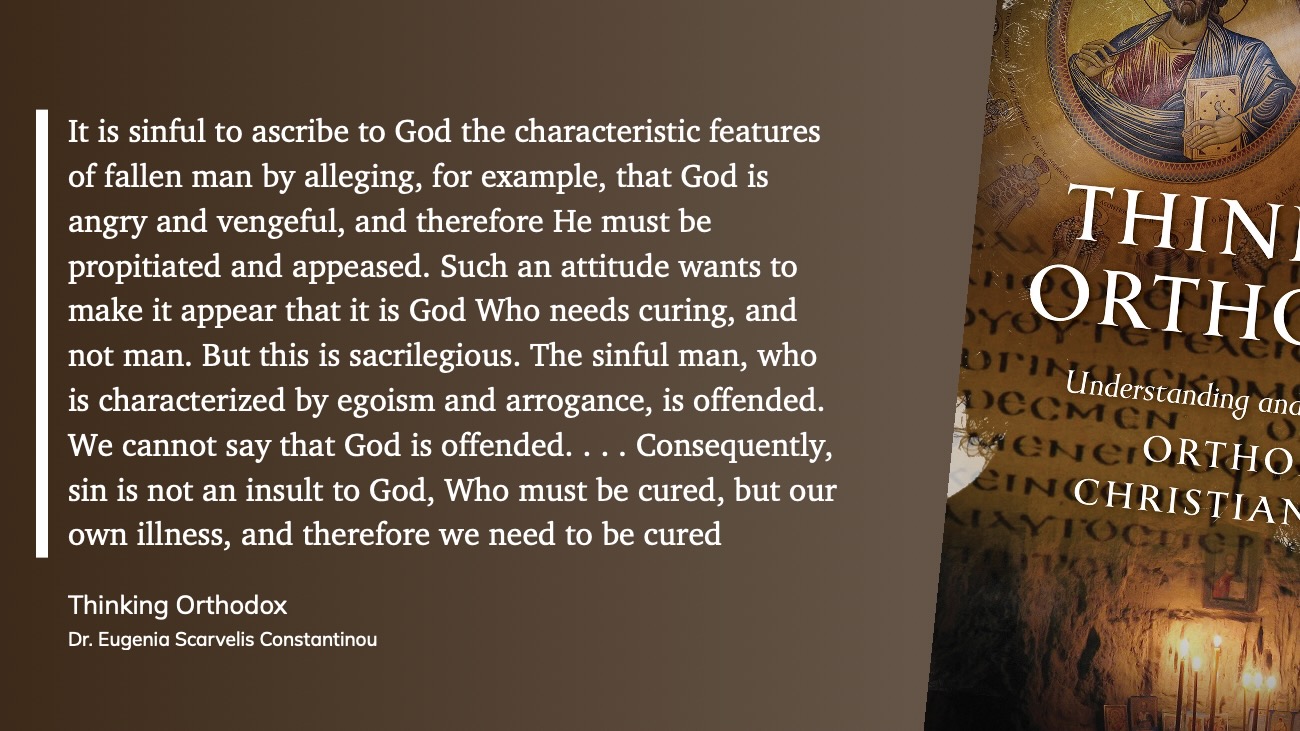
Dr. Eugenia Scarvelis Constantinou, Thinking Orthodox


Religious ideas have the fate of melodies, which, once set afloat in the world, are taken up by all sorts of instruments, some woefully coarse, feeble, or out of tune, until people are in danger of crying out that the melody itself is detestable.

George Elliot, Janet’s Repentance, via Alan Jacobs

You can read most of my more impromptu stuff here and here (both of them cathartic venting, especially political) and here (the only social medium I frequent, because people there are quirky, pleasant and real). All should work in your RSS aggregator, like Feedly or Reeder, should you want to make a habit of it.

Sundays are joyful days, but there’s a little cloud on this one: 26 years ago, my father died, quite unexpectedly.

His was a quick and apparently painless death — what we think of as a good death these days. But I’m not so sure. Meeting God face-to-face is a serious business. I’m inclined to think a slow and painful death, with lots of time to face the reality and to set aright things that are our of kilter, has its own advantages.

We brought nothing into this world

Modernity equates liberty with the freedom to decide and choose, to define ourselves and the world around us. In the words of Justice Anthony Kennedy (Planned Parenthood vs. Casey, 1992):

At the heart of liberty is the right to define one’s own concept of existence, of meaning, of the universe, and of the mystery of human life.

We relish this concept of unfettered freedom. But, of course, it is absurd, even for a secularist. For whether we choose to admit it or not, we “brought nothing into this world” (1 Tim. 6:7). Everything in our lives is derived and gifted. We are not the inventors of the world nor of our lives. And though we struggle to understand and even master our own DNA, it remains a primary component of our destiny, a genetic memory of the history of our coming into being across the ages. To be told that we have some portion of DNA contributed by Neanderthals reminds us that even such obscure ancestors are “selves we have received” through our genetically traditioned existence.

Fr. Stephen Freeman

There has never been a “Positive World”

I was a casual follower of Aaron Renn until Alan Jacobs demolished Renn’s famous February 2022 piece, The Three Worlds of Evangelicalism.

Without defining Christianity, Renn says the world used to be positive toward it. You can read Renn for yourself, and Jacobs, too (and you really should read Jacobs if you think Renn is onto something important), but here’s the gist (via Jacobs) of why there was never a “positive world” for thoroughgoing Christianity:

Professing Christianity is what Renn calls a “status-enhancer” when and only when the Christianity one professes is in step with what your society already and without reference to Christian teaching describes as “being an upstanding citizen.” If you don’t believe me, try getting up on stage in an evangelical megachurch and reckoning seriously with Jesus’s teaching on wealth and poverty. Even a sermon on loving your enemies, like Ruby Bridges, and blessing those who curse you, can be a hard sell — as many pastors since 2016 have discovered. News flash: if you make a point of never saying anything that would make people doubt your commitment to their preferred social order, they’ll probably think you an upstanding citizen. (Who knew?)

There are pretty much always some elements of Christian teaching that you can get away with publicly affirming; but you can never get away with affirming them all. If American Christians sixty years ago felt fully at home in their social world, that’s because they quietly set aside, or simply managed to avoid thinking about, all the biblical commandments that would render them no longer at ease in the American dispensation. Any Christians who have ever felt completely comfortable in their culture have already edited out of their lives the elements of Christianity that would generate social friction. And no culture that exists, or has ever existed, or ever will exist, is receptive to the whole Gospel. 

Renn is Evangelical or Evangelical-adjacent (PCA Presbyterian). I was once very friendly toward the PCA, so I think I can say that it’s not a church that rocked the social order (at least until Orgasms for All! became the unofficially established religion of the USA).

The bloom is entirely off my Renn Rose. I deeply discount articles that take his “three worlds” model as their premise.

A Christian Is An Outlaw

Apropos of “negative world”:

It would be honour in modernity for a Christian to be called such an outlaw, for surely they do not conform to the laws of this world.

Martin Shaw, A Christian Is An Outlaw

God in a box

There’s a brilliant episode of King of the Hill where Bobby, the thirteen-year-old boy, gets really into Christian rock. At the end of the episode his dad, Hank, shows him a box where he keeps tokens from all the different phases he has gone through. There’s a Beanie Baby, a Tamagotchi, a Teenage Mutant Ninja Turtle… Bobby cringes—and that’s the point. “I know you think the stuff you’re doing now is cool,” says Hank to his son, “but in a few years, you’re going to think it’s lame. And I don’t want the Lord to end up in this box.”

Theophan Davis, How Not to Be a Saint

This Orthodox novice’s section on prayer (“Play to your weakness”) was also very good.

Sufficiently Rawlsian?

I might appeal to the second chapter of Genesis when speaking about the fundamental importance of male–female complementarity. But I do so because the biblical witness so succinctly and powerful states a fundamental truth that every civilization has honored.

R. R. Reno, responding to a transcribed speech of Oren Cass on how to construct a secular conservatism.

Would John Rawls accept this as public reasoning?

Sola Scriptura

Even as they claimed to rely on the Bible alone, antebellum Protestants frequently turned to Christian saints, exegetical traditions, the practices of Christians past, and official church teachings, employing these sources to complement or clarify what they took the Bible to mean. Perhaps this betrays a deeper sense that the Bible was not as self-interpreting as many Protestants hoped. At the very least, it shows the inescapability of tradition. American Protestants never read, or argued over, the Bible alone.

Paul J. Gutacker, The Old Faith in a New Nation

What the heck is a Carpatho-Rusyn?

In the last decades of the nineteenth century, Byzantine Rite Christians from the Carpathian mountain region began to arrive in America. It is difficult to label these people: they came from an area that today is divided among Poland, Slovakia, Hungary, Moldova, Belarus, and Ukraine, and they were known by a great variety of names, including Carpatho-Russians, Rusyns, Ruthenians, Galicians, and others. Their ancestors were originally Orthodox Christians, but in the sixteenth and seventeenth centuries they submitted to the pope of Rome through a series of “unions,” which is why they have long been known to the Orthodox as “Uniates.” Despite their subordination to the pope, they retained most of the external forms of Orthodox worship and practice, including allowing married men to become priests.

Matthew Namee, Lost Histories.

These people are the historic core of my diocese. And my parish’s Patron Saint, Alexis Toth, led multitudes back to the Orthodox faith, after he was spurned by Archbishop John Ireland.


Religious ideas have the fate of melodies, which, once set afloat in the world, are taken up by all sorts of instruments, some woefully coarse, feeble, or out of tune, until people are in danger of crying out that the melody itself is detestable.

George Elliot, Janet’s Repentance, via Alan Jacobs

You can read most of my more impromptu stuff here and here (both of them cathartic venting, especially political) and here (the only social medium I frequent, because people there are quirky, pleasant and real). All should work in your RSS aggregator, like Feedly or Reeder, should you want to make a habit of it.

Sunday Potpourri

Consider the following question. What is closer to the original Easter: January 3, 1975, or Easter Sunday 2023? According to human reason, we would say that January 3, 1975, is forty-eight years closer to the original Easter (or “Pascha,” as I prefer to call it) than Easter Sunday 2023. But that is a secular way of approaching time. With our thinking informed by a Judeo-Christian worldview, we understand that Easter Sunday is actually closer to the events of Christ’s Resurrection, though on a different axis from secular time.

Robin Phillips and Fr. Stephen DeYoung, Rediscovering the Goodness of Creation


The modern West is said to be Christian, but this is untrue: the modern outlook is anti-Christian, because it is essentially anti-religious; and it is anti-religious because, still more generally, it is anti-traditional; this is its distinguishing characteristic and this is what makes it what it is.

René Guénon Guénon, The Crisis of the Modern Age


If it be true (as it certainly is) that a man can feel exquisite happiness in skinning a cat, then the religious philosopher can only draw one of two deductions. He must either deny the existence of God, as all atheists do; or he must deny the present union between God and man, as all Christians do.

G.K. Chesterton, Orthodoxy


The nation that spends more on its military than the next ten largest militaries combined bases its group identity on violence.

William T. Cavanaugh, The Uses of Idolatry


Because we are confident in the Church, we do not replace its teachings and guidance with our own individual opinions. That itself is part of the phronema.

Dr. Eugenia Scarvelis Constantinou, Thinking Orthodox


Religious ideas have the fate of melodies, which, once set afloat in the world, are taken up by all sorts of instruments, some woefully coarse, feeble, or out of tune, until people are in danger of crying out that the melody itself is detestable.

George Elliot, Janet’s Repentance, via Alan Jacobs

You can read most of my more impromptu stuff here and here (both of them cathartic venting, especially political) and here (the only social medium I frequent, because people there are quirky, pleasant and real). All should work in your RSS aggregator, like Feedly or Reeder, should you want to make a habit of it.