St. John the Merciful, 2023

It’s my 75th birthday and my “Name Day.”

The coincidence of birthday and name day isn’t universal in Orthodoxy, but I chose St. John the Merciful (or Almsgiver) by looking at Saints commemorated on my birthday after a futile search for inspiring lawyer-saints (the jokes almost write themselves). I do find his open-handedness admirable, and I presumably was underwhelmed by Bl. John “the Hairy”, Fool-for-Christ, at Rostov, also commemorated today.

A timely Psalm

In the midst of our domestic political chaos, the wars and threats of war in the world, and three-quarters of a century on this earth, this Psalm hit a sweet spot:

If it had not been the Lord who was on our side, let Israel now say—
if it had not been the Lord who was on our side, when men rose up against us,
then they would have swallowed us up alive, when their anger was kindled against us;
then the flood would have swept us away, the torrent would have gone over us;
then over us would have gone the raging waters.
Blessed be the Lord, who has not given us as prey to their teeth!
We have escaped as a bird from the snare of the fowlers;
the snare is broken, and we have escaped!
Our help is in the name of the Lord, who made heaven and earth.

Psalm 123/124, Revised Standard Version, via Bible Gateway (reformatted)

“Religion”

Religion has played such a large part in the lives of human beings throughout human history. In some ways, I wish we could outgrow it; I think at this point it does a lot of harm. But then, I’m fairly sure that if we do outgrow it, we’ll find other reasons to kill and persecute each other. I wish we were able to depend on ethical systems that did not involve the Big Policeman in the sky.

Octavia Butler via Maria Popova

I’m not sure what religion she has in mind — nor, I suspect, is she.

“Religion” is, in the grand scheme of things, a neologism invented in the Western world. It obscures as much or more than it reveals. I’m reminded of a cartoon I saw more than 50 years ago:

Speaker 1: All religions are alike. Just name any two and I’ll prove it.
Speaker 2: Christian Science and Melanesian Frog Worship.

Despite all that, “religion” seems to have become an indispensable word, and I confess to using it even without scare quotes. But it worries me that discussion about religion may be a diversion from growing closer to God.

A possible example of where the term “religion” might be indispensable:

False religions, perpetuate the great divide between flesh and spirit, rather than between good and evil where Christianity says it lies.

Thomas Howard, Evangelical Is Not Enough.

Speaking of Tom Howard …

Tom Howard’s book, just quoted, cleared away some of my mental rubble and spiritual biases on my road to Orthodoxy (though Howard himself “swam the Tiber” to Catholicism).

Unlike many people from backgrounds roughly like mine, I found his approach more persuasive then Peter Gillquist’s Becoming Orthodox, written about a clique of Campus Crusade for Christ (now Cru) staffers who entered Orthodoxy en masse. Suffice that Howard’s evangelical millieu was more aligned with my temperament than Gillquist’s.

I would do well to emulate Howard, who wrote sincere appreciation for all he gained through his evangelical childhood before reaching his eponymous conclusion. My own evangelical childhood was not dissimilar, but then in adolescence I encountered a fuller evangelical culture, and that’s what I (too often) excoriate. And I won’t even get started on the devolution of “evangelical” to a political label, which is beyond the control of sober evangelicals to remedy.

More Howard:

The evangelicalism of my childhood church taught me true doctrine about the incarnation. It taught me about creation and about Eden and about the Fall. But somehow it never, at least in its piety, put Humpty-Dumpty back together again. … A whole array of pickets had been thrown up between us and civilizations, lovely diversions, such as ballet, theater, cinema, and wine, and each point had its rationale, certainly. But the net effect was the plant in our imaginations the notion that spirituality was more a matter of excision than of transfiguration.

Speaking of God …

Although one must think of God constantly, he said, one must not speak of God quickly or readily. One acquires knowledge of God through the mind, but only with the aid of prayer and ascetic discipline. Gregory taught that theology is not for all people or for all occasions. Knowledge of theological matters is not necessary for salvation; only simple faith is needed. Speaking of God is a great task, but spiritual purification is far more important.

Dr. Eugenia Scarvelis Constantinou, Thinking Orthodox

Who finds the Orthodox Church?

This is kind of the culture that we’re up against. The only people who are finding the Orthodox Church, essentially right now, are people who are discontented in a current Christian experience and who have read widely enough, or are theologically savvy enough, to at least have a intellectual connection to the existence of the Orthodox Church.

Steve Robinson (at 42:00)

Of the late Francis Schaeffer …

… a theory advanced by his son:

My father’s theology was formed in a particularly bitter moment and never evolved along with the rest of his thinking. The theological battles of the 1920s and 1930s shaped Dad in the same way that political battles would shape the Vietnam generation in the 1960s. Passions forged in those battles became part of a personal identity that was difficult for people who did not share the passionate and polarizing experiences to understand.

Frank Schaeffer, Crazy for God

It has been a long time since I mentioned or quoted from Frank(y) Schaeffer. Suffice that I’ve read most of his books and do not recommend that you do so. But this theory joins one other quote from him as worth sharing.

The most dangerous foe, as seen from Mercerburg

The most dangerous foe with which we are called to contend, is again not the Church of Rome but the sect plague in our own midst; not the single pope of the city of seven hills, but the numberless popes—German, English, and American—who would fain enslave Protestants once more to … mere private judgment and private will. … the deceived multitude, having no power to discern spirits, is converted not to Christ and his truth, but to the arbitrary fancies and baseless opinion of an individual, who is only of yesterday.

Nathan O. Hatch, The Democratization of American Christianity, quoting “Mercerburg Theologians” Philip Schaff and John W. Nevin.

I did not know of Mercerburg Theology until after I’d become Orthodox, though Philip Schaff compiled a collection of patristic writings that’s still popular, perhaps because it’s free on the internet.

Mercerburg is a fascinating “so near yet so far” moment in Protestantism.

Straight answers, true answers

We often avoid giving a straight answer because the nature of true answers [is] often not straight.

Fr. Stephen Freeman, Lost and Found: Playing Hide n Seek with God Session 1


The human voice: That we can sing seems basis for conjecture that, despite our stupidities and our sinfulness, we might be the reason the universe exists.

Alexander Riley

You can read most of my more impromptu stuff here (cathartic venting) and here (the only social medium I frequent, because people there are quirky, pleasant and real). Both should work in your RSS aggregator, like Feedly or Reeder, should you want to make a habit of it.

Sunday, 11/5/23

Blind spot

Like Billy Graham, [Francis Schaeffer] took American capitalism as a given and never thought about how it might be contributing to the secularization of the country.

Frances FitzGerald, The Evangelicals

Ecumenical Councils

In the century from 1123 to 1215, it was popes who called together synods of bishops that were thereby declared ecumenical. And they did so with the principal goal of reforming the Church. Historically, ecumenical councils had been called to address great heresies, such as Arianism, Nestorianism, or iconoclasm. Not so those designated ecumenical by the reform papacy. In less than one century, no fewer than four such councils were called at the papal headquarters at the Lateran Palace.

John Strickland, The Age of Division

Miracles you won’t see on TV

I shared a meal this week with some Orthodox friends. One had just returned from Thessaloniki, Greece, where he visited a parish where a newborn baby who had been pronounced dead was given a kind of baptism ritual, even though he was not alive. The child was born on the feast of St. Demetrios, the early fourth-century patron of the city. When the priest baptized him “Demetrios,” they all heard a sharp intake of breath, and the baby began to cry. This just happened.

[J]ust as the prayers of St. Demetrios raised a baby from the dead the other day, none of us know what God has in mind for us if we choose to turn away from our corruption and to Him. At that same meal with the Orthodox guys, another told a story about an American Orthodox priest of his acquaintance who was serving liturgy when an elderly man dropped dead. He rushed over to him to try to help, but it was too late. He was quite dead. Paramedics were called. The priest anointed the dead man with holy oil … and he woke up. It was a miracle. We need a miracle like that.

Rod Dreher

That hits home as I was in Thessaloniki, in Church named for St. Demetrios, within the past two weeks.

(I heard a more coherent version of the first story, no less miraculous, from another source, but I’m too lazy to transcribe that podcast account. I believe the accounts. Help, O Lord, my unbelief.)

Historic Christianity, Reformational Christianity, Evangelicalism

Catholicism had, by this time, reoriented my theological concerns around the concerns of the Church catholic. My assumptions, and the issues that animated me, were those of the Church of history. My evangelical upbringing had led me to believe that Protestantism entailed the rejection of these concerns. But this notion exploded upon contact with the Protestantism of history.

Onsi A. Kamel, Catholicism Made Me Protestant, H/T Rod Dreher. I’m not sure how I missed this four years ago; it’s quite good. The key, though, is that Evangelicalism, as Kamel experienced it, didn’t even seem to ask the right questions.

I recommend this review of In Search of Ancient Roots as a companion to the Kamel essay.

One of my favorite prayers

Bless my enemies, O Lord. Even I bless them and do not curse them.
Enemies have driven me into Your embrace more than friends have. Friends have bound me to earth, enemies have loosed me from earth and have demolished all my aspirations in the world.
Enemies have made me a stranger in worldly realms and an extraneous inhabitant of the world. Just as a hunted animal finds safer shelter than an unhunted animal, so have I, persecuted by enemies, found the safest sanctuary, having ensconced myself beneath Your tabernacle, where neither friends nor enemies can slay my soul. Bless my enemies, O Lord. Even I bless them and do not curse them.
They, rather than I, have confessed my sins before the world.
They have flagellated me, whenever I have hesitated to flagellate myself.
They have tormented me, whenever I have tried to flee torments.
They have scolded me, whenever I have flattered myself.
They have spat upon me, whenever I have filled myself with arrogance.
Bless my enemies, O Lord. Even I bless them and do not curse them.
Whenever I have made myself wise, they have called me foolish.
Whenever I have made myself mighty, they have mocked me as though I were a dwarf.
Whenever I have wanted to lead people, they have shoved me into the background.
Whenever I have rushed to enrich myself, they have prevented me with an iron hand.
Whenever I thought that I would sleep peacefully, they have wakened me from sleep.
Whenever I have tried to build a home for a long and tranquil life, they have demolished it and driven me out.
Truly, enemies have cut me loose from the world and have stretched out my hands to the hem of Your garment.
Bless my enemies, O Lord. Even I bless them and do not curse them.
Bless them and multiply them; multiply them and make them even more bitterly against me –
so that my fleeing to You may have no return; so that all hope in men may be scattered like cobwebs; so that absolute serenity may begin to reign in my soul; so that my heart may become the grave of my two evils twins: arrogance and anger;
so that I might amass all my treasure in heaven;
ah, so that I may for once be freed from self-deception, which is entangled me in the dreadful web of illusory life.
Enemies have taught me to know – what hardly anyone knows – that a person has no enemies in the world except himself.
One hates his enemies only when he fails to realize that they are not enemies, but cruel friends.
It is truly difficult for me to say who has done me more good and who has done me more evil in the world: friends or enemies.
Therefore bless, O Lord, both my friends and my enemies.
A slave curses enemies, for he does not understand. But a son blesses them, for he understands.
For a son knows that his enemies cannot touch his life.
Therefore he freely steps among them and prays to God for them.
Bless my enemies, O Lord. Even I bless them and do not curse them.

St. Nikolai Velimirovich, Prayers by the Lake

Where to begin an answer …?


A fundamental reality of human existence is that vice often leaves virtue with few good options. Evil men can attach catastrophic risks to virtually any course of action, however admirable.

David French

You can read most of my more impromptu stuff here (cathartic venting) and here (the only social medium I frequent, because people there are quirky, pleasant and real). Both should work in your RSS aggregator, like Feedly or Reeder, should you want to make a habit of it.

Sunday, 10/15/23

Orthodoxy

I came across a lot of things recently that illuminate the Orthodox Christian faith.

Collected thoughts on Orthodoxy

The knowledge about God results in definitions and distinctions. The knowledge of God leads to this one, incomprehensible, yet obvious and inescapable word: holy. And in this word we express both that God is the Absolutely Other, the One about whom we know nothing, and that He is the end of all our hunger, all our desires, the inaccessible One who mobilizes our wills, the mysterious treasure that attracts us, and there is really nothing to know but Him.

Fr. Alexander Schmemann, For the Life of the World

Tradition will always feel nebulous, indefinable, and inscrutable, and yet we differentiate between truth and falsehood, right and wrong, Orthodox and not Orthodox based on whether the idea comports with Tradition.

Dr. Eugenia Scarvelis Constantinou, Thinking Orthodox

Orthodoxy is not so much a series of doctrines and practices to be grasped once and for all, but a way of life that one takes up, growing in perfection with each passing year.

Rod Dreher, Reconciling With the Really Real

From the rising of the sun even to the place where it goes down, my name shall be great among the nations; and in every place incense shall be offered to my name, and a pure offering: for my name shall be great among the nations, says the Lord of Hosts.

Malachi 1:11 (emphasis pointedly added)

Grokking Orthodoxy

What changed my mind is my own writing. The older I got, the more I felt the need to share my belief with others. I felt it in a good and peaceful way in the Catholic Mass. I prefer the Orthodox Mass, but for a Westerner, it’s very hard to get into the Orthodox mindset — the references are quite different. I knew so much of the Catholic Church that I didn’t manage to jump over to the Orthodox Church.

Jon Fosse, Nobel Laureate in literature, 2023.

This comment surprised me yet, considering what I’d learned about Fosse’s prose style, didn’t entirely surprise me.

He is correct that “for a Westerner, it’s very hard to get into the Orthodox mindset.” I’ve been at it for more than 26 years now, and it’s still a challenge. But it seems to me that the “problem” is the Western mindset — drilled into me pervasively for almost 50 years, including in church to a shameful extent — not the Orthodox mindset.

For most of the world

Wise government, and knowledge in general, were deemed more likely to come from ancient learning than experimental progress. Similar things were true in the Islamic world. Europeans were the anomaly here. Historically speaking, virtually all cultures put a higher value on tried and tested ancestral wisdom than on newfangled, unproven contemporary innovation. That is easy to forget in the contemporary West, where we are so shaped by the notion of progress and the expectation that we will know more tomorrow than we do today. But from an eighteenth-century perspective, what needs explaining is not why Chinese education centered on two-thousand-year-old Confucian texts, or Islamic learning on the Koran, or why traditional societies prized certainty over possibility. These represent the norm in almost all times and places, including medieval Europe. What needs explaining is why early modern Westerners started doing the opposite. Why did their cafes, museums, and stately homes fill with “curiosities”? Why did the pursuit of novelty, discovery, and possibility begin to win out over antiquity, familiarity, and fidelity?

Three factors were particularly significant. The first was [Western] Christianity, whose influence on the psychology, sociology, eschatology, and theology of Western Europeans over the course of a millennium or more can scarcely be exaggerated. Psychologically, as we saw from Joseph Henrich’s work in chapter 2, we can thank the Roman Catholic Church and its theology of marriage for the “highly individualistic, self-obsessed, control-oriented, nonconformist and analytical” way our brains work. Sociologically, the Western Church also created the European bourgeoisie—the urbanized middle class of “burghers” or “townsfolk” with their charters, guilds, and universities—as an unintentional by-product of the papal revolution in the eleventh and twelfth centuries. Eschatologically, the hope of the coming kingdom generated an expectation that the future would be better than the present, and that progress was therefore possible (in contrast to religious systems in which history is a series of cycles, or even a steady decline from a Golden Age in the distant past).

Andrew Wilson, Remaking the World, pp. 231-32

There’s more to it than this, but this is important: Orthodoxy is more like the rest of the world than like the progress-seeking Westerners. Yet living here, I’m still subject to all the blandishments of our WEIRDER culture:

  • Western
  • Educated
  • Industrialized
  • Rich
  • Democratic
  • Ex-Christian
  • Romantic

Martin Shaw’s Christian journey

Of his Christian journey, fairly recently begun:

I’ve grown a little in a sense of theology and church history, but not, I hope, at the exclusion of the thing itself; a stumbling encounter with divine ground. And the more I experience that, the quieter I feel. I remember St Ignatios of Antioch: ‘he who possesses the word of Jesus can even hear his silence’. I would make no claims to have that mastery, but I do have experience – however briefly – of to what he’s referring.

And for us Christian worker-bees, some of us have to be careful of gargling with too much overt mysticism. It can distract us from the voluminous-ordinary. Me at least. We start proclaiming about hesychasm when we’ve spent roughly five minutes being vaguely quiet and twiddling our prayer rope.

(I think the silence of God is for me partially a sense of an abiding presence as well as active instruction. By their nature, these things require sitting with.)

Martin Shaw

I’ll be “sitting with” on Mt. Athos for a while, during which imminent trip I won’t be blogging.

Dogma

Dogmas are important, but not as the building blocks of some comprehensive account of the Divine Mysteries, but rather a series of decisions, arrived at by the Church, that are there to prevent ways of thinking that might obscure or bypass the mystery of God before which we stand in awe…

Andrew Louth via Martin Shaw

Christian voices from other traditions

The American religious scene

The result is a religious landscape dominated by popular Christian ideas that have “gone mad,” as G.K. Chesterton once put it, “because they have been isolated from each other and are wandering alone.” This America has a church of self-love, with prophets like Oprah Winfrey preaching a gospel of the divine self, a “God Within” spirituality that risks making selfishness a virtue. It has a church of prosperity, with figures like Joel Osteen as its bishops, that insists that God desires nothing more for his elect than American prosperity, capitalist success. And it has churches of politics, preaching redemption through political activism — a Christian nationalism on the right, by turns messianic and apocalyptic, and a progressive utopianism on the left, convinced that history’s arc bends always in its favor.

Ross Douthat, The Americanization of Religion

Re-enchantment as a luxury belief

Now that we are comfortably on the other side of scarcity, tyranny, ignorance, and the likelihood of dying young, it’s easy to overlook the material, moral, and political accomplishments of modernity and note only its fragmentation, irrationalities, alienation, and malaise. For some religious people, malaise provides a motivation to re-enchant the world, and, indeed, the theme and hope of re-enchantment is prevalent among young Christians. While I have genuine sympathy for their frustrations at the state of the world, too often they express a craving for meaning more than truth, and not always in entirely reasonable ways, including ways that exacerbate the anxieties and frustrations of the moment.

R.J. Snell, Life in the Ruins: Keeping Faith within the Immanent Frame

That paragraph encapsulates a lot. I’m one of those who tends “to overlook the material, moral, and political accomplishments of modernity and note only its fragmentation, irrationalities, alienation, and malaise”.


As noted, I’m heading for Mount Athos, and when this posts, I’ll already be in Thessaloniki, preparing for a Monday boat trip to the Mount. I’ll not be posting this week and will be largely incommunicado.

Sunday, 9/17/23

Novices in the limelight

I found myself very recently worrying about Paul Kingsnorth and his sorta-kindred spirit Martin Shaw:

It is dubious to thrust Paul Kingsnorth and Martin Shaw onto the Orthodox “Christian stage.” Nothing they’re saying offends me, but I see an analogy to the qualifications of deacons in the New Testament, who are not to be novices lest they get puffed up. I saw countless Evangelical let-downs as celebrity converts crashed and burned.

Both of these men — moderately famous overall and certainly with devoted fans — have arrived at Orthodox Christianity from paganish backgrounds (I mean pagan as a descriptor, not as dismissive) within the past five years. Both lost fans who felt betrayed, and both risked (or incurred) a financial hit as a result. Both have added Christian followers, especially from Orthodoxy, as well as losing followers.

But there’s a great risk in newbie Christians being thrust forward for adulation. (“Let them be tested first.” I Timothy 3:10) Am I being an enabler by subscribing to their Substacks? Am I spurning a brother in Christ who needs to replace his former, more pagan, income sources if I don’t subscribe?

So it came as a relief to read this from Kingsnorth:

A new Christian with a platform who wants to write about his Christian journey is sailing on a sea which could sink him any time. I have prayed about this consistently, of course, and I’ve asked advice of everyone I know. Friends, family, teachers, my spiritual father, wise heads both Christian and not. I’ve even sought – and been given – answers from monks on Mount Athos. Should I really be writing about this? I have asked, over and over. I don’t know anything.

The answer has always been the same, and it has always been: yes, you should. Sometimes that has excited me, and at other times it has felt like a millstone around my neck. Of course, the ‘yes’ always comes with important caveats. If I start writing as if I were a teacher or a leader or some kind of wise or accomplished Public Christian, or somebody who knows much at all of any depth, I will fall on my face. Probably some people would enjoy that, and perhaps it would be a good lesson in humility, but still, I am going to try and avoid it.

It’s good that he recognizes the risk and is asking wiser heads. It’s good that they have given, and he apparently has heard, cautions on how he should write as a Christian novice.

So here’s some of how he’s struggling with his new task:

Here I am, surprisingly and yet not suprisingly, a Christian. It is on the one hand not surprising, because I have never been a materialist; I have always had some intuition of God or gods or spirits, usually experienced for me through the natural world, and I have always been searching for the truth of that, always scanning the horizon for the true harbour. Yet it is surprising too, because I never imagined that, in the words of Seraphim Rose, patron saint of Lost Western People, the truth was ‘a person, not an idea.’

I have noticed in the last few years a constant temptation to systematise Christianity; to bend it into a shape that fits a pre-existing pattern in people’s heads…

My version of this temptation is to view the deep mystery of creation and creator through the prism of my attitudes to the Machine, and then to bend the former to suit the latter, rather than the other way around. I think that I have been stuck for words all week because I was struggling with this tendency. I found, when I stood outside myself and looked in, that I was almost unconsciously seeking a grand theory big enough to accommodate Christ. The old habit of constructing some thesis or other was refusing to die. It was as if I couldn’t write about this journey at all without knowing the destination in advance. As if this ancient spiritual pathway were not an exploration or an unfolding, but a thesis or an argument.

‘Ideas create idols’, said St Gregory of Nyssa. ‘Only wonder leads to knowing.’ St Augustine agreed. ‘If you understand,’ he said, ‘it is not God you understand.’

Paul Kingsnorth, Inis Cealtra

Christian Zionism

Christian Zionism is the term used to describe the view that the Old Testament prophecies of the return of exiled Israel to the Promised Land find their fulfillment in the establishment of the State of Israel in 1948, and not in Christ and the Christian Church.  This theological view is comparatively recent, and is totally at odds with the views of the Church Fathers.  A more detailed critique of this theology can be found here.

Fr. Lawrence Farley. I quote this for its succinctness, first, and to retell (briefly, I hope) why I have a particular wariness of Christian Zionism.

My Evangelical boarding school of 60 years ago was less homogenous in thought than I imagined going into it, but I didn’t tease out that observation until much later. (This is because “Bible only Christianity” has always produced flaky opinions and eventual schisms.) One teacher was, by Fr. Lawrence’s definition, a Christian Zionist, but with an overlay on that.

  • The founding of Israel in 1948 started the end-times clock running.
  • The Great Tribulation, the rule of Antichrist, and the return of Christ would all be within 40 years of the founding of Israel.
  • A Biblical generation is 40 years.
  • Therefore we would not see 1988 before Christ’s return.
  • (And therefore, I would not live to age 40.)

I add the obligatory caveat that my parents did not inculcate stuff like this, and I don’t recall whether I mentioned it to them. By God’s grace, and perhaps partly by the parents’ sobriety about “Bible prophecy,” I never fully bought into this. I thought this lurid schema stretched the plain meaning of the Bible past the breaking point and I (tacitly) rejected approaching the Bible as if it were some kind of cypher, which if broken could satisfy our curiosity about the near future.

Still, it haunted me a little.

So far as I can tell, the false prophets who peddled that sort of crap (I’m looking at you, Hal Lindsey) never repented but presumably came up with just-so stories on how they were fundamentally right all along — just like all the Adventists and other 19th-century sects they deride.

Young, headstrong, and hurtful

There must have been moments during those formational years when someone said something like this: “We don’t really know what we are doing. We need to join a larger group or institution or denomination. We need oversight and accountability and guidance.” But that attitude did not prevail. If these young, headstrong men had more fully embraced all that history and tradition had to teach them, they might not have tried to reinvent the wheel. It would have spared many people some of the pain to come.

Jon Ward, Testimony.

Irreligious Right

[W]e are far more likely to see the coming of a right-wing, essentially pagan political order than we are the restoration of anything meaningfully Christian … The Left, by attacking Christianity directly and indirectly, has torn down the greatest barrier holding back political paganism of the Right. Christian parents now have to worry that their children will be seduced by cultural leftism (including the sanctification of LGBT and other forms of sexual paganism), or by post-Christian right-wing paganism, which entails white identity and other forms of militant racism. We have to watch out for syncretism of white identity with hardline conservative Christianity …

You can lose your Christian soul to the far right as easily as you can to the far left. The devil doesn’t care how you lose it; he just wants you to lose it.

Rod Dreher.

I quote Rod much less than I used to for reasons I haven’t entirely sorted out in my own head. I’m not going to try to sort them out here in public.

But on this, I’m confident that he’s right, including about the infiltration of the most “conservative”-looking versions of Christianity. Pastors looking for disciples of Christ must be on alert; pastors happy with disguised pagans in the pews may be in for a bonanza.

Of what one may not speak one must remain silent

The full doctrine of the Church was made available only to baptized Christians. It still is. Much of it is written and so accessible to all, but the most important aspects are passed on orally and symbolically because they can only be transmitted to someone who is ready to receive them. And by their very nature they cannot be written. By taking the first step, by being baptized into the Orthodox Church, I had not experienced any new convictions but had opened myself to an evolving mystery which the Church has preserved and which exists to communicate to its members. And, on Patmos, I had become normal.

Peter France, Patmos: A Place of Healing for the Soul

New eyes

How do we become uncomplicated and unsophisticated? Can we simply unlearn all that we have learned?

No, we cannot, but what we can do is to separate ourselves from it in order to look at it with new eyes. For us Westerners to truly enter into the ancient Christian transmission and catch the essence of Christ’s teaching, it is necessary for us to crucify our rationalizing minds and arise above the level of thought and emo for a society founded on Descartes’ proposition “I think, therefore I am,” this of course means a kind of suicide; and it is to precisely such an ego-death that Christ calls us. Contemporary western Christianity trained us how to think and what to think; whereas Christ himself, as did Lao Tzu before Him, taught us how not to need to think.

Hieromonk Damascene, Christ the Eternal Tao

Invisible realities

To be a devout Christian or a believing Jew or Muslim is to be a bit like a conspiracy theorist, in the sense that you believe there is an invisible reality that secular knowledge can’t recognize. But the great religions are also full of warnings against false prophets and fraudulent revelations. My own faith, Roman Catholicism, is both drenched in the supernatural and extremely scrupulous about the miracles and seers that it validates. And it allows its flock to be simply agnostic about a range of possibly supernatural claims.

Ross Douthat, quoted in a lengthy New Yorker profile by Isaac Chotiner

Stagnation or permanence?

”How has it come about,” C. S. Lewis once asked, “that we use the highly emotive word ‘stagnation,’ with all its malodorous and malarial overtones, for what other ages would have called ‘permanence’?” It is, Lewis suggests, because the dominance of the machine in our culture altered our imagination. It gave us a “new archetypal image.”

Ken Myers, All God’s Children and Blue Suede Shoes

Just askin’

Why is it unjust for a nation, convinced of the truth of Islam or Christianity or Judaism, to give preference to truth over falsehood in education, law, and cultural institutions? Don’t all regimes claim to give preference to truth over falsehood? Or, to bring the question down from the metaphysical stratosphere: Is it unjust for, say, Ireland to give discriminating support to Irish holidays, cultural traditions, or language? If that is ­unobjectionable, why can’t Ireland give preference to its traditional Catholic religion? Questions of truth aside, why should religion be treated differently than other national traditions?

Peter J. Leithart, Rethinking Religious Freedom. Leithart presumably used and Irish example because he is not Roman Catholic.

Evangelistic gimmickry is nothing new

”Original sin, [Charles Finney] declared, is not a “constitutional depravity” but rather a deep-seated “selfishness” that people could overcome if they made themselves “a new heart.” “Sin and holiness,” he declared, “are voluntary acts of mind.” He was just as clear about the role of the preacher in bringing people to salvation. “A revival,” he wrote in 1835, “is not a miracle, or dependent on a miracle, in any sense. It is a purely philosophical result of the right use of the constituted means.””

Frances FitzGerald, The Evangelicals

And now for something quite different …

I syng of a m[a]yden that is makeles.
kyng of alle kynges to here sone che ches.
he cam also stylle there his moder was
as dew in aprylle, that fallyt on the gras.
He cam also stylle to his moderes bowr
as dew in aprille, that fallyt on the flour.
He cam also stylle ther his moder lay
as dew in aprille, that fallyt on the spray.
Moder & mayden was never non but che–
wel may swych a lady godes moder be.

Eamon Duffy, The Stripping of the Altars


A fundamental reality of human existence is that vice often leaves virtue with few good options. Evil men can attach catastrophic risks to virtually any course of action, however admirable.

David French

You can read most of my more impromptu stuff here (cathartic venting) and here (the only social medium I frequent, because people there are quirky, pleasant and real). Both should work in your RSS aggregator, like Feedly or Reeder, should you want to make a habit of it.

Sunday, 8/13/23

Phantom Jesuses

There have been too many historical Jesuses—a liberal Jesus, a pneumatic Jesus, a Barthian Jesus, a Marxist Jesus. They are the cheap crop of each publisher’s list, like the new Napoleons and new Queen Victorias. It is not to such phantoms that I look for my faith and my salvation.

C.S. Lewis, The Weight of Glory

Of false compassion

In the short run it causes me less conflict with other people, for I sympathize with whatever anyone may feel. It certainly requires less moral reflection, because I believe every sad story and give in to every tearful “I want”. It fits in particularly well with the inclinations of teenagers, who are discovering sympathy for the first time, find it as intoxicating as catnip, and love to hear sad stories of the heartlessness of the grown-up world. If they have not had clear moral training, it even seems to them to resemble the Golden Rule. “If I got pregnant, I know I wouldn’t want to have the baby; if I were gay, I know I wouldn’t want anyone telling me I couldn’t get married.” This property makes false compassion especially useful for corrupting the minds of the very young, stuffing them with false wisdom before the true wisdom has time to develop.

J Budziszewski, What We Can’t Not Know: A Guide

Presuppositions of modern science

Both presuppositions-the assimilation of God to the natural world and the mutual exclusivity of natural causes and divine presence-are implicitly part of modern science as it is conceived and practiced, although both have long ceased to be active concerns among practicing scientists qua scientists. Both indeed repudiate central claims of Christianity as discussed thus far.

Brad Gregory, The Unintended Reformation

It’s all in the delivery …

I believe that I am not mistaken in saying that Christianity is a demanding and serious religion. When it is delivered as easy and amusing, it is another kind of religion altogether.

Neil Postman, Amusing Ourselves to Death

A sensible reason for retirement from a prestige post

… writing publicly about God each week can do a number on one’s soul. Thomas Wingfold, a character in a novel by the Scottish minister and poet George MacDonald, said, “Nothing is so deadening to the divine as an habitual dealing with the outsides of holy things.” Holy things, sacred topics, spiritual ideas, I believe, have power. Dealing with them is a privilege and a joy, but habitually dealing with the outside of them is inherently dangerous.

Constant connectivity empties us out, as individuals and as a society, making us shallower thinkers and more impatient with others. When it comes to faith, it can yield a habitual dealing with the outsides of holy things, fostering an avoidance of those internal parts of life that are most difficult, things like prayer, uncertainty, humility and the nakedness of who we most truly are amid this confusing, heartbreaking and incandescently beautiful world.

Tish Harrison Warren, My Hope for American Discourse, her farewell column to the New York Times.

Legalism

“A SPIRIT OF LEGALISM IS foreign to the Orthodox phronema, especially with respect to sin and our relationship to God. For the Orthodox, sin indicates spiritual illness. The imagery used of salvation is medical. A common title for Christ in Orthodox prayers is “the One who loves mankind” (Philanthropos). He is also often described as the “Physician of our souls and bodies.” His Incarnation restored our relationship with God by restoring fallen humanity to physical, mental, and spiritual health and wholeness.”

Dr. Eugenia Scarvelis Constantinou, Thinking Orthodox


We are in the grip of a grim, despairing rebellion against reality that imagines itself to be the engine of moral progress.

R.R. Reno

The end of the world as we know it is not the end of the world.

You can read most of my more impromptu stuff here (cathartic venting) and here (the only social medium I frequent, because people there are quirky, pleasant and real). Both should work in your RSS aggregator, like Feedly or Reeder, should you want to make a habit of it. I’m even playing around a bit here, but uncertain whether I’ll persist.

Sunday, 7/23/23

Orthodoxy, adjacent, and approach

Local Parish Chrismates Four

Today, my Parish receives a family of four, who came, saw, stayed, sought instruction, and finally is ready — nay, eager — to leave the Roman Catholic communion. Though we’ve been receiving many new members, I feel a special affinity for this family because the husband is the son a Reformed pastor, and my penultimate tradition was Reformed as well.

I’m always particularly gratified when the decision to become Orthodox appears cautious and deliberate, as this family’s has been.

We don’t have to flim-flam people. My impression is that most Orthodox Priests are telling serious inquirers “Slow down. Take your time. Get to know us. Let’s see what happens.”

A Distinctive

The Orthodox Church does not offer exact definitions and explanations for theological mysteries. The Orthodox Church has always preferred apophatic theology, that is, expressing what God is not, since God is beyond description.

Eugenia Scarvelis Constantinou, Thinking Orthodox

Coming to Orthodoxy from a posture of know-it-all Calvinism, this was first unsettling, later liberating.

Learning how not to need to think

How do we become uncomplicated and unsophisticated? Can we simply unlearn all that we have learned?

No, we cannot, but what we can do is to separate ourselves from it in order to look at it with new eyes. For us Westerners to truly enter into the ancient Christian transmission and catch the essence of Christ’s teaching, it is necessary for us to crucify our rationalizing minds and arise above the level of thought and emotion. For a society founded on Descartes’ proposition “I think, therefore I am,” this of course means a kind of suicide; and it is to precisely such an ego-death that Christ calls us. Contemporary western Christianity trained us how to think and what to think; whereas Christ himself, as did Lao Tzu before Him, taught us how not to need to think.

Monk Damascene, Christ the Eternal Tao. If you think there’s something fishy about finding anticipations of Christianity in Lao Tsu, remember that this was a central theme of C.S. Lewis’s The Abolition of Man

Hell

How can I go out like this among a lot of people with real solid bodies? It’s far worse than going out with nothing on would have been on Earth. Have everyone staring through me.

C.S. Lewis, The Great Divorce. That was the reaction of one of Lewis’s day-trip visitors to heaven from hell.

No book by Lewis, including my favorites That Hideous Strength and The Abolition of Man, has affected me more profoundly than The Great Divorce. On second or third reading, roughly 27 years ago, a little light went on: what are you doing not to become the kind of self-absorbed person who’d get back on the bus instead of staying? And I found little to nothing in the Reformed tradition was receptive to such a question, because of the hated suggestion that what we do here and now might have something to do with our eternal happiness. That probably would have been dismissed as rank Pelagianism (though I was bound by my oath of office as an Elder not to discuss my doubts outside narrow channels, so I never found out).

Poet Dana Gioia glimpses a somewhat different alternative vision of hell that Lewis’s, but another in which God does not send people their against their wills:

V. Delegate, Delegate
 
“Watching the place unravel, Satan saw
An opportunity beyond the chaos.
What if he found a way to let the damned
Punish themselves? They liked to make bad choices.
Why not allow them to repeat their sins?
Let Hell become a game they never win,
A wheel that always hits on double zero.”

Our true telos

Each of us must become a saint to fulfill our human and Christian destiny.

C. S. Lewis anticipated this conciliar teaching when he noted that most of us, suddenly caught up to heaven, would probably feel a little uncomfortable. Why? Because we are not yet saints. And saints, Lewis suggested, are those who can live comfortably with God forever. How can the saints live that way? Because, in the Eastern Church Fathers’ striking image, they have been “deified.” So the entire point of the Christian “journey” is to cooperate with God’s grace so that we grow into the kind of people who will feel at home at the Wedding Feast of the Lamb: overflowing with gratitude for the invitation, and not feeling like party crashers.

George Weigel, Synodality and Sanctity.

I don’t remembers C.S. Lewis saying that in those words, but this is an extremely apt description of a conviction about my life (derived from my second or third reading of Lewis’ The Great Divorce) that lead me from Calvinistic Protestantism to the Orthodox Church — the permanent home of those Eastern Church Fathers.

Halfway conversions

There is no point in converting people to Christ if they do not convert their vision of the world and of life, since Christ then becomes merely a symbol for all that we love and want already – without Him. This kind of Christianity is more terrifying than agnosticism or hedonism.

Journals of Father Alexander Schmemann, 1973-83

Other

King Conscience?

Growing up evangelical, I was taught that your personal conscience is law …

True conscience is not a hyper-individual inner experience, but a knowing with others, a cleaving to the wisdom of God’s Word and the witness of the church.

Alan Noble, Living with Religious Scrupulosity or Moral OCD.

This article was painful to read. My immediate reaction, to the opening paragraph (which also opens my block-quote), was “I grew up Evangelical and was never taught such pernicious nonsense.” (I was taught a slightly less pernicious nonsense, and by teachers who were acting in good faith to all appearances.)

But the interesting point emerged much later: if “true conscience” is as Noble says, a “knowing with others” (and he is etymologically correct), then “personal conscience” is an oxymoron, and those who claim to follow such a thing are crypto-antinomians.

Martin Shaw on Job

Martin Shaw has been thinking about the book of Job, and especially its ending:

There’s not much in the warm and fuzzy feelings department. No more than I would have those feeling for a swooping hawk, or a grizzly on the path, or a bush suddenly erupting into flame. What I can feel is awe.

Reading Job has cleared this up. I can’t mainline Baby Jesu cosy cosy when I’ve got God walloping thunderbolts about and waxing poetically about how bad ass the leviathan is. Job strengthens my back in its final section, I’m out of the psychological and completely into the mythological, my wonder-eye is OPEN.

And – as I said last time – this is where I think modern Christianity often goes awry. We could cater less for our psychological needs and attend more to our mythological longings.

Speaking of Martin, here’s a description of him I came across recently:

Martin is like the Lost Inkling, the one who wandered into the forest of Devon as a child, and grew up in Tom Bombadil’s cottage.

(Rod Dreher, The Martin Shaw Interview, Part I). When I first read that last November, I had no idea how spot-on it was. Now I understand, after following Martin for a while, why Malcolm Guite (or someone) said Martin would become Orthodox “because he’s too wild for anything else” or words to that effect. (Not that we’re wild, but we have room for wild ones: I have an icon of a Georgian wild man — a “fool for Christ” — hanging in my prayer corner.)

I alone have seen the light

Zwingli’s work also repudiated the entire patristic and medieval theology of the sacrament: “I can conclude nothing else but that all the doctors have greatly erred [vil geirret habend] from the time of the apostles…. Therefore we want to see what baptism actually is, at many points indeed taking a different path against that which ancient, more recent, and contemporary authors have taken, not according to our own whim [nitt mit unserem tandt] but rather according to God’s word.” Just like his Anabaptist opponents, Zwingli was following God’s word.

Brad S. Gregory, The Unintended Reformation.

The multiplication of denominations, not to mention the countless non-denominational religious fiefdoms, was a major factor in my disenthrallment with sola scriptura Protestantism. (I provide the link because I discovered ~25 years ago that not all Protestants have even heard the historic term for what they claim to live by.)

Pick one: Modernity or Christendom

The West was Christian in the Middle Ages, but is so no longer; if anyone should reply that it may again become so, we will rejoinder that no one desires this more than we do, and may it come about sooner than all we see round about us would lead us to expect. But let no one delude himself on this point: if this should happen, the modern world will have lived its day.

René Guénon Guénon, ‌The Crisis of the Modern World

If Indiana Jones were real, wouldn’t he be a Christian by now?

By the end of “Raiders of the Lost Ark,” archaeologist Indiana Jones had learned enough to know that he should close his eyes when facing the wrath of God.

Apparently, that kind of power can melt Nazis – without changing the hero’s soul.

“Why won’t Indiana Jones convert? We aren’t insisting that he convert to our faith or to his father’s faith or really to any faith in particular,” noted Jack Bennett, in a Popcorn Cathedral video marking the “Indiana Jones and the Dial of Destiny” release.

“What we want to know is why he is always back to square one at the start of every adventure – a skeptic, or even a scoffer. I mean, think about it: He has seen the Ark of the Covenant opened and the destroying angels pour out God’s vengeance on his enemies. He has seen the sacred Hindu stones come to life. …He has seen the true cup of Christ heal his own father from a fatal gunshot wound – on screen, with no ambiguity.”

After all of the miracles he has seen in his life, why doesn’t Indiana Jones truly believe?

Modern worship

[A]ny attempt to “modernise” liturgy in terms of making it more acceptable to modern society (i.e. “pastoral respectability”) should be undertaken with extreme caution; the warning of Charles Davis is paramount here:

My thesis is that there is no modern form of worship, because worship itself is outdated in the modern world and Christian Faith a state of deviancy from contemporary culture.

Bryan D. Spinks, “Christian Worship or Cultural Incantations?”, Studia Liturgical, vol. 12 (1977), 1, 12-13 (quoting Charles Davis, “Ghetto or Desert: Liturgy in a Cultural Dilemma” in Worship and Secularization (1970), pp. 10-27, p. 12).

Thanks to @letters on micro.blog who appears to read such things voraciously.

Wordplay

Blink

neglect, fail to acknowledge

John McWhorter on Justice Ketanji Brown Jackson’s usage of blink: “This contention blinks both history and reality in ways too numerous to count.”

McWhorter’s whole column on this is enjoyable. (Paywall)

Exploitation

We are all to some extent the products of an exploitive society, and it would be foolish and self-defeating to pretend that we do not bear its stamp.

Wendell Berry, The Unsettling of America

“Times smaller”

But I can’t help wondering about how it feels on those dark Welsh evenings — in a house so big he could be comfortable if it was ten times smaller.

Ben Sixsmith (emphasis added)

Is there something wrong with me, some blind spot, that instinctively and invariably recoils from the locution “[X] times smaller”?

Something can be “ten times larger,” or “a tenth as big,” but I just cannot accept 1/X being “X times smaller.”

Immigration

Gratitude is of the essence of immigration.

Carl R. Trueman, Why I Became an American Citizen

Bombast

Bombastic does not mean “overly emotional” or “excited” or anything like that: It refers to language that is artificially refined or formal, made high-sounding in an attempt to sound smart, “high-sounding but with little meaning,” as the Oxford people put it.

Kevin D. Williamson.

Williamson said most people use bombastic incorrectly. When I
use it, which I don’t think is often, I’ve certainly been misusing it.

Toes

We don’t appreciate toes enough.

John Brady, commiserating with someone who injured a toe and is surprisingly debilitated thereby.

Bad Luck

You never know what worse luck your bad luck has saved you from.

Cormac McCarthy via the Economist

Barbie & Ken

Simply existing in America over the past few months meant having the bronzed images of Margot Robbie as Barbie and Ryan Gosling as Ken staring you down everywhere you turned, not unlike Mao Zedong’s portrait in Tiananmen Square.

Suzy Weiss, Don’t Hate the Barbie Girl, Hate the Barbie World

‘Mur’cans

This fellow said: “I am a free-born sovereign, sir, an American, sir, and I want everybody to know it!” He did not mention that he was a lineal descendant of Balaam’s ass, but everybody knew that without his telling it.

Mark Twain, The Innocents Abroad

Martin Shaw

Martin is like the Lost Inkling, the one who wandered into the forest of Devon as a child, and grew up in Tom Bombadil’s cottage.

(Rod Dreher, The Martin Shaw Interview, Part I).


We are in the grip of a grim, despairing rebellion against reality that imagines itself to be the engine of moral progress.

R.R. Reno

The end of the world as we know it is not the end of the world.

You can read most of my more impromptu stuff here (cathartic venting) and here (the only social medium I frequent, because people there are quirky, pleasant and real). Both should work in your RSS aggregator, like Feedly or Reeder, should you want to make a habit of it. I’m even playing around a bit here, but uncertain whether I’ll persist.

Sunday, 7/16/23

Imagine there’s no Rapture …

Orthodox Holy Tradition says clearly that the Second Coming, the General Resurrection, and the Last Judgment are three facets of one single, overwhelming event. There is no divide (which is the meaning of the heresy of chiliasm, which was rejected in the Second Ecumenical Council, and the reason why we say “and His Kingdom shall have no end” in the Creed). There is no Rapture. There is no Seven Year Tribulation. There is no single human individual who is the Antichrist or the Beast — the Antichrist is not a Jew, not a Muslim, not a Communist, nor is he the Pope or any one of the many theories that have been published over the centuries.

There is no literal thousand-year-long Millennium. There is no reappearance of Satan setting off the last Armageddon.

There will indeed come the Great Universal Transfiguration that overwhelms time and space and all Creation.

This is the Kingdom if its infinite, almost terrifying fullness and glory.

Fr. Jonathan Tobias, the last judgment and the problem of goathood

This I believe.

I will not say that the Orthodox Church is the only church that rejects all the rapture crap, because I don’t believe it is. But it’s also true that not every church that rejects all the rapture crap still believes in the Second Coming, the General Resurrection, and the Last Judgment. That kind of narrows things down a lot.

A periodic reminder

I’ve no doubt posted this quote before:

The shift from church power to state power is not the victory of peaceable reason over irrational religious violence. The more we tell ourselves it is, the more we are capable of ignoring the violence we do in the name of reason and freedom.

William T. Cavanaugh, The Myth of Religious Violence

Liturgy

In a culture that values spontaneity, liturgy grounds us in something enduring. In a culture that assumes truth is a product of the mind, liturgy helps us experience truth in mind, body, and spirit.

Book blurb for Mark Galli’s Beyond Smells and Bells: The Wonder and Power of Christian Liturgy

Modern worship

On a related note:

[A]ny attempt to “modernise” liturgy in terms of making it more acceptable to modern society (i.e. “pastoral respectability”) should be undertaken with extreme caution; the warning of Charles Davis is paramount here:

My thesis is that there is no modern form of worship, because worship itself is outdated in the modern world and Christian Faith a state of deviancy from contemporary culture.

Bryan D. Spinks, “Christian Worship or Cultural Incantations?”, Studia Liturgical, vol. 12 (1977), 1, 12-13 (quoting Charles Davis, “Ghetto or Desert: Liturgy in a Cultural Dilemma” in Worship and Secularization (1970), pp. 10-27, p. 12).

Thanks to @letters on micro.blog who appears to read such things voraciously.

The teleological void

My college students have worked hard getting impressive credentials since at least middle school and will continue to do so long after college. When I ask them where this is all going, they are befuddled. “This is just what you do,” they often answer. Anything else is impractical, unrealistic, and useless. They have been going their whole lives without asking or being asked “where to?” Asking such a question means stopping, thinking, and perhaps changing direction, all things that religion and humanities have us do. But our society has no interest in silence or pausing.

Terence Sweeney, Why Religion and the Humanities Are in Decline

The evangelical soul

This baffling essay proves that although Mere Orthodoxy is consistently good, it’s not unvaryingly good. The author lost me at the construct “the evangelical soul.”

(Mere Orthodoxy, by the way and once again, is not a Orthodox website; it is a Reformed-leaning Protestant website that considers itself orthodox and “leans young.” It’s usually pretty good; I don’t subscribe to anything for the sole purpose of dissing it.)

What if?

Our professor asked a hypothetical question: “If the bones of Jesus were discovered, and if there were some way to absolutely confirm that they were the bones of Jesus, would you still be a Christian?”
Every other member of the class confirmed that he or she would remain a Christian, making statements such as “I would not lose my faith,” or “Jesus was a great teacher and philosopher.”

I was dumbfounded and utterly dismayed. How was it possible that such intelligent, committed, and educated Catholics could give such responses? Did they not realize the fundamental importance of the Resurrection of Christ? If not, why not? My response was, “If the bones of Jesus were discovered, I would be outta here! I would no longer be a Christian!” I explained that the Resurrection is an absolute necessity to the Christian faith. The class listened politely, but no one seemed at all impressed or influenced by my answer.

Dr. Eugenia Scarvelis Constantinou, Thinking Orthodox


We are in the grip of a grim, despairing rebellion against reality that imagines itself to be the engine of moral progress.

R.R. Reno

The end of the world as we know it is not the end of the world.

You can read most of my more impromptu stuff here (cathartic venting) and here (the only social medium I frequent, because people there are quirky, pleasant and real). Both should work in your RSS aggregator, like Feedly or Reeder, should you want to make a habit of it. I’m even playing around a bit here, but uncertain whether I’ll persist.

Sunday, July 2, 2023

Fretting about Orthodoxy in America

My priest went to a diocesan retreat this Spring and reported upon his return that our parish is relatively healthy. But our Bishop will be closing a lot of parishes this year because people haven’t returned after Covidtide and there’s a shortage of priests to boot.

This got me thinking again about a fact that I need better to reckon with: not all Orthodox parishes are both healthy and welcoming to American inquirers.

I’ve heaped much praise on Orthodox Christianity, but the truth is that I always had in mind some amalgam of my parish, a handful of other parishes I’ve visited, and the great Saints we venerate. I consistently block memories of perhaps half the parishes I’ve visited — parishes that, had they been the first Orthodox Churches I’d entered, might well have sent me away thinking “this isn’t for me.” I won’t name names (nor even ethnic adjectives).

But my bad impressions, too, are anecdotal, completely lacking in rigor. So I’m not going to say to inquirers “avoid parishes of [this or that] ethnic identity.” I’ll only give a rule of thumb to “find a parish that uses English for most of its liturgy.” I probably could find my way through the Divine Liturgy in just about any language, but that’s after 25+ years of being Orthodox.

I’m grateful for the lively, diverse and youthful parish I serve in my way as a tonsured Reader. I’m grateful because I’m human, and while I like decency and order in worship, those aren’t incompatible with a bit of enthusiasm, lusty congregational singing, beautiful icons and all that.

So maybe I need to focus on inviting local folks to my parish rather than inviting people on social media to visit an anglophone parish in their area.

But what advice can I give those social media “friends,” whose local parish may be pretty unattractive?

That question kind of stumps me. All I can think of is that we’re lucky to live in an age where we have many excellent resources available, both online and, even more, in print from major Orthodox publishers. That’s no substitute for Church, but since even good priest can have hobby-horses and skewed perceptions, it’s a good idea even for those in attractive parishes to supplement their church experience with reading.

Rough edges

I continue to be amused at the alarm sounded by our online Orthodox “Guardians of the Faith” regarding the growth of Orthodoxy in the South.  Apparently, there are Southern conservatives becoming Orthodox.  Lord, help us!  I think my sons and I must have been the last semi-moderate converts to Orthodoxy down here–everyone since has been more conservative than us.  Somehow, we worship together just fine.  And, if  these converts stick with it, Orthodoxy will hone off the rough edges; as it did for me.  It is not the end of the world.

Terry Cowan (bold added).

Quest for Certainty

The Reformation is the first great expression of the search for certainty in modern times. As Schleiermacher put it, the Reformation and the Enlightenment have this in common, that ‘everything mysterious and marvellous is proscribed. Imagination is not to be filled with [what are now thought of as] airy images.’ In their search for the one truth, both movements attempted to do away with the visual image, the vehicle par excellence of the right hemisphere, particularly in its mythical and metaphoric function, in favour of the word, the stronghold of the left hemisphere, in pursuit of unambiguous certainty. … What is so compelling here is that the motive force behind the Reformation was the urge to regain authenticity, with which one can only be profoundly sympathetic. The path it soon took was that of the destruction of all means whereby the authentic could have been recaptured.

Iain McGilchrist, The Master and His Emissary

Undeniable propositions versus rites, ceremonies and sacred mysteries

These five Common Notions, described as “five undeniable Propositions” in De religione gentilium, are: 1. That there is one Supreme God. 2. That he ought to be worshipped. 3. That Vertue and Piety are the chief Parts of Divine Worship. 4. That we ought to be sorry for our Sins, and repent of them. 5. That Divine Goodness doth dispense Rewards and Punishments both in this Life, and after it … By shearing away all the practices of ancient people in his discussions of what was essential and original in these religions, Herbert contributed to the growing sense that religion was a matter of beliefs apart from “various Rites, Ceremonies, and Sacred Mysteries.” Religion was for Herbert a mental phenomenon. This view of religion as a set of beliefs that could be either true or false would become standard in the next century.

Brent Nongbri, Before Religion: A History of a Modern Concept (emphasis added)

Larping Christendom

Note, however, that reentry by travel and also exile (see below) nearly always takes place in a motion from a northern place to a southern place, generally a Mediterranean or Hispanic-American place, from a Protestant or post-Protestant place stripped by religion of sacrament and stripped by the self of all else, to a Catholic or Catholic-pagan place, a culture exotic but not too exotic (Bali wouldn’t work), vividly informed by rite, fiesta, ceremony, quaint custom, manners, and the like. This is by no means a Counter-Reformation victory because the attraction is not the Catholic faith— which is absolutely the last thing the autonomous self wants—but the decor and artifact of Catholic belief: the Pamplona festival, the Taxco cathedral, Mardi Gras, and such.

Walker Percy, Lost in the Cosmos (italics added).

(Yes, I’m aware that Lost in the Cosmos is a mock self-help book.)

Going to the gym

Worship is the arena in which God recalibrates our hearts, reforms our desires, and rehabituates our loves. Worship isn’t just something we do; it is where God does something to us. Worship is the heart of discipleship because it is the gymnasium in which God retrains our hearts.

James K.A. Smith, You Are What You Love

Chastening

For those who, like me, have led charmed lives, one of the really disturbing scriptures is “whom the Lord loveth, He chasteneth.“

Is my “chastening” to bear a few annoyances with less petulance? Really?

Platonic Christianity

That the soul was immortal; that it was incorporeal; that it was immaterial: all these were propositions that Augustine had derived not from scripture, but from Athens’ greatest philosopher. Plato’s influence on the Western Church had, in the long run, proven decisive.

Tom Holland, Dominion

No fundamental divide?

Although Europeans universally acknowledge the fundamental significance of the dividing line between Western Christendom, on the one hand, and Orthodoxy and Islam, on the other, the United States, its secretary of state said, would “not recognize any fundamental divide among the Catholic, Orthodox, and Islamic parts of Europe.”

Samuel P. Huntington, The Clash of Civilizations and the Remaking of World Order

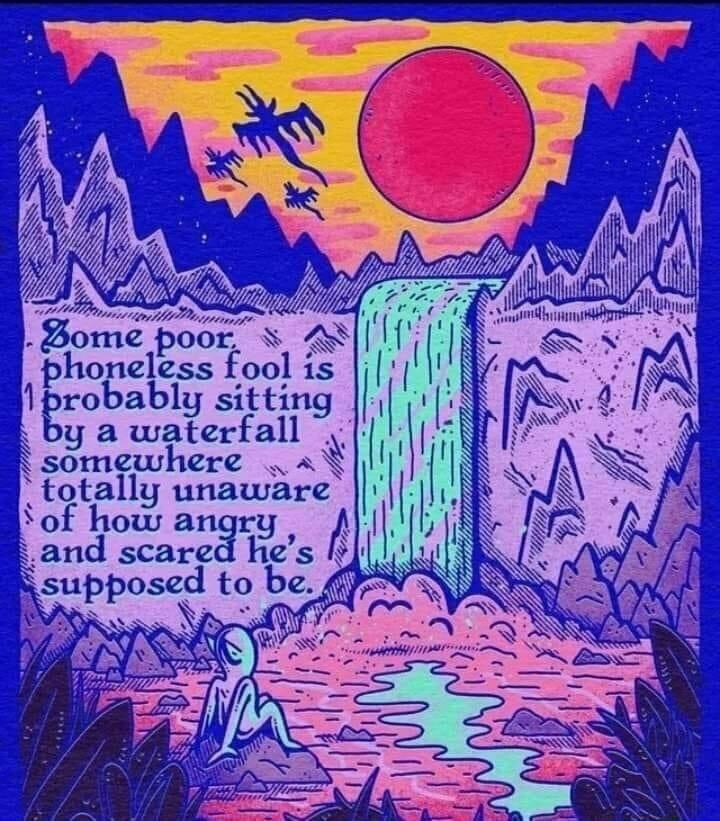
Some poor, phoneless fool

Via @letters on micro.blog


We are in the grip of a grim, despairing rebellion against reality that imagines itself to be the engine of moral progress.

R.R. Reno

The end of the world as we know it is not the end of the world.

You can read most of my more impromptu stuff here (cathartic venting) and here (the only social medium I frequent, because people there are quirky, pleasant and real). Both should work in your RSS aggregator, like Feedly or Reeder, should you want to make a habit of it. I’m even playing around a bit here, but uncertain whether I’ll persist.

All Saints, 2023

A Fatal Difficulty

The perennial temptation

Old-style blasphemy involved desecrating God because it was God who was sacred. Today’s blasphemy involves suggesting that man is not all-powerful, that he cannot create himself in any way he chooses.

Carl R. Trueman’s summary of Blasphemy Then and Now, a posting at First Things. I’m starting to think this is one of the most important things to keep ever in mind about some cultural tsunamis.

Everybody knows there is something very wrong with us, but not everybody knows what it is. If you would know, then go back to the beginning.

There we find the primordial sin: acting out our desire to be God.

Kingsnorth spoke about transhumanists openly talking about creating God. Martine Rothblatt, born Martin, says proudly that transgenderism is an onramp to transhumanism. We are reliving the drama of the Garden of Eden all over again. Kingsnorth said we have lost touch with biological reality, with nature, and knowledge of our own telos — that is, for what we were created.

Rod Dreher, channeling Paul Kingsnorth.

Did dispensationalism die when I wasn’t looking?!

Maybe I’ve been beating a dead horse in my criticisms of dispensationalism. But I have some concern here:

When our grandkids find themselves alone in the house on a summer afternoon, few will find themselves gripped by a sudden fear that everyone except them has been taken in the rapture. By itself, that is a good thing. The eclipse of an unbiblical and thoroughly annoying doctrine is hardly something to mourn. Yet Hummel is perceptive enough not to allow the reader such a hasty judgment. The Rise and Fall of Dispensationalism obliquely but powerfully gestures toward a hole often found in the gospel that post-dispensationalist evangelicals believe today. “In the wake of dispensationalism’s collapse,” he writes in the epilogue, “the eschatological sight of the American church has blurred.” That means that our hope is less fervent, thinner, colder.

The emphasized part makes me crazy! It’s like an invitation to make up some new heresy to fill an eschatological “hole,” the old heresy having passed its sell-by date and been swept from the shelves (unnoticed by me).

If evangelicals need something to fill the eschatological-expectation hole, let me suggest (the first and maybe the last time I’ll commend syncretism) that they adopt Orthodox Bridegroom Matins for Monday, Tuesday and Wednesday of their Holy Week, which could use a bit of thickening up anyway.

Bridegroom Matins even has a catchy theme song:

Behold, the Bridegroom comes at midnight,
and blessed is the servant whom He shall find watching;
and again, unworthy is the servant whom He shall find heedless.
Beware, therefore, O my soul, do not be weighed down with sleep,
lest you be given up to death,
and lest you be shut out of the Kingdom!
But rouse yourself, crying: “Holy, holy, holy, are You, O our God!”
Through the Theotokos have mercy on us!

Voilà! Eschatological problem solved! And it’s better than some idiotic “prophecy conference” at maintaining memento mori and a sane expectation that “He shall come to judge the living and the dead.”

Shiny Happy People

Speaking of fundamentalists, for my many sins I did penance by watching Amazon Prime’s Shiny Happy People. I don’t give a rip about the hyper-fertile Duggars, but I had a brush with the series villain Bill Gothard in 1966-67 and wanted to catch up.

He was a weird little man then and appears to have gotten a bit weirder over the decades, right down to the absence of any grey hair and his ephebophilia.

His message was not a healthy Christian message. It’s not even biblical except in the formulaic sense of “proof-texts for nearly everything,” as if scripture-twisting weren’t a real thing.

I know a few people in the Protestant world who are devoted to IBLP, more fully known as Institute on Basic Life Principles — the organization that survives Gothard’s scandal and forced retirement — and I’m kind of worried about them now. Judging from a visit to the IBLP website’s “Statement of Faith,” Shiny Happy People is correct to classify IBLP as fundamentalist, though the line between fundamentalism and the evangelicalism of my youth is a fine one.

A few thoughts:

  • That I thought it necessary to check out IBLP for myself reflects how unpersuasive Shiny Happy People was at nailing down hard facts, preferring innuendo and the charges of critics, some of whom had no first-hand knowledge.
  • That IBLP feels it necessary to publish a roll-your-own statement of faith, eschewing the Nicene Creed and elevating its obsessions to creedal status, reflects how far removed it is from historic Christianity. (IBLP’s statement of faith is sorely lacking, too.)
  • That IBLP is “parachurch” means it can infiltrate most any Protestant denomination and makes it harder to unequivocally speak of it as a “cult” — though that label is tempting.

You could probably find better ways to spend three or four hours unless you have some compelling personal motivation (as did I) to watch this poorly-aimed shotgun blast toward unhealthily patriarchal fundamentalists.

Distress

The distress this insight speaks of was the beginning of my conscious Christian commitment, long ago (but not very far away):

To have offended God is more distressing than to be punished … If only we loved Christ as we should love Him, we would have known that to offend Him whom we love is more painful than hell.

St. John Chrysostom, Homily V on Romans 1, citing II Samuel 24:17.

Continuity

The primary aim of this book is to demonstrate the absolute continuity of ancient Israelite religion, the religion of the Second Temple, first-century Christianity, and the religious life preserved and practiced in the Orthodox Church …

Fr. Stephen DeYoung makes a bold claim. Something lured him out of a Reformed Protestant pulpit into Orthodoxy. It might merit investigation.


For all its piety and fervor, today’s United States needs to be recognized for what it really is: not a Christian country, but a nation of heretics.

Ross Douthat, Bad Religion

We are in the grip of a grim, despairing rebellion against reality that imagines itself to be the engine of moral progress.

R.R. Reno

The end of the world as we know it is not the end of the world.

You can read most of my more impromptu stuff here (cathartic venting) and here (the only social medium I frequent, because people there are quirky, pleasant and real). Both should work in your RSS aggregator, like Feedly or Reeder, should you want to make a habit of it.

Repose of St. Alexis Toth

Today we mark the repose of Alexis Toth, my parish’s Patron Saint.

He’s not a “nice” saint. He wasn’t very ecumenical.

When Archbishop John Ireland, an Americanizer of the Latin Church, forbade him, contrary to Canon Law, to observe the Eastern Rite, he returned to Orthodoxy (he had been a Uniate) and eventually brought tens of thousands of Uniates out of the Latin Church back into Orthodoxy. He thought it mattered more than potayto/potahto.

Many of those people were, like him, from Carpatho Rus, which makes him a dandy Patron in my diocese.

***

Since many smart high-churchmen don’t talk much about it, I’m perhaps off-base in thinking the lex orandi, lex credendi (“a motto in Christian tradition, which means that prayer and belief are integral to each other and that liturgy is not distinct from theology”) is a key to getting people off the idiotic idea that worship is just a neutral “container” for the “content” of the Gospel.

That is an idiotic idea professed by some very smart people, but this is one instance when I’m confident that they’re wrong, I’m right.

And there are some smart Protestants flirting with ideas rather like mine:

If I worship in order to show God how much I love him, I might start to feel hypocritical if I just keep doing the same thing over and over and over again. My expression will start to feel less “authentic.” And so we need to find new ways to worship, new ways to show our devotion, fresh new forms to express our praise. Novelty is how we try to maintain the fresh sincerity of worship that is fundamentally understood as expression. With the best of intentions, this “expressive” paradigm is then allied to a questionable distinction between the form of worship and the content of the gospel. The concrete shape and practices of Christian worship, passed down through the centuries, are considered merely optional forms—or even whited sepulchers of dead ritual—that can and should be discarded in order to communicate the gospel “message” in ways that are contemporary, attractive, and relevant. So we remake the church in order to “speak to” contemporary culture.

Rather than the daunting, spooky ambience of the Gothic cathedral, we invite people to worship in the ethos of the coffee shop, the concert, or the mall. Confident in the form/content distinction, we believe we can distill the gospel content and embed it in these new forms, since the various practices are effectively neutral: just temporal containers for an eternal message.

James K.A. Smith, You Are What You Love: The Spiritual Power of Habit

A preliminary question

In his important book After Virtue, Alasdair MacIntyre famously says, “I cannot answer the question, ‘What ought I to do?’ unless I first answer the question, ‘Of which story am I a part?’”

James K.A. Smith, You Are What You Love: The Spiritual Power of Habit

When sola scriptura was impossible

The early Church had no Scripture of its own, and the Jews had no defined canon of Scripture; therefore, sola scriptura as the foundation for what Christians believed was absolutely impossible.

Eugenia Scarvelis Constantinou, Thinking Orthodox: Understanding and Acquiring the Orthodox Christian Mind

Book note

The idea that religion has a dangerous tendency to promote violence is part of the conventional wisdom of Western societies, and it underlies many of our institutions and policies, from limits on the public role of religion to efforts to promote liberal democracy in the Middle East. William T. Cavanaugh challenges this conventional wisdom by examining how the twin categories of religion and the secular are constructed. A growing body of scholarly work explores how the category ‘religion’ has been constructed in the modern West and in colonial contexts according to specific configurations of political power. Cavanaugh draws on this scholarship to examine how timeless and transcultural categories of ‘religion and ‘the secular’ are used in arguments that religion causes violence. He argues three points: 1) There is no transhistorical and transcultural essence of religion. What counts as religious or secular in any given context is a function of political configurations of power; 2) Such a transhistorical and transcultural concept of religion as non-rational and prone to violence is one of the foundational legitimating myths of Western society; 3) This myth can be and is used to legitimate neo-colonial violence against non-Western others, particularly the Muslim world.

Booknote on William T. Cavanaugh’s The Myth of Religious Violence. I am not the author of that note, by the way.

I have quoted from this book very often, but just this week realized that Cavanaugh penned another book with a title that has long intrigued me: Migrations of the Holy.

I’m reading Migrations of the Holy now, concurrently with the Aenid (a coincidence, not a study plan). And I can vouch for the readability of the highly-praised Fagles translation of the Aenid.

Sad but true

Many cradle Orthodox Christians unfortunately do not realize that they have remained infants in the faith in spite of spending a lifetime as Orthodox Christians. They have no greater understanding or experience of God nor any deeper faith than they had as children, because for them Orthodoxy has been reduced to a series of practices or obligations rather than embraced as a complete life in Christ animated by the Holy Spirit.

Eugenia Scarvelis Constantinou, Thinking Orthodox: Understanding and Acquiring the Orthodox Christian Mind

I know from personal experience, however, that the decisionalist model of salvation prevalent in Evangelicalism produces its own kind of forever-infancy:

We might term Finney’s understanding of regeneration as “decisionalism.” And I would argue that much of what we see today in evangelicalism is a rehash of Charles Finneyism. Since all that separates God and man is a “decision” for Christ, all sorts of emotive and, in some cases, even manipulative means may be employed in order to push the sinner over the edge to choose Jesus. It is not the removal of a stone heart one needs but only the prompting of influential argumentation. Thus, it is a misunderstanding and underemphasis of this doctrine of regeneration that has contributed to the unraveling of evangelicalism in the 21st century.

The problem with decisionalism, which continues to be preached a lot today, is not only is it unbiblical and ultimately sets the grace of God aside as something not ultimately efficacious, but it also results in all sorts of tomfoolery in order to get a person to make a decision for Christ.

Amen to that!

New Apostolic Reformation, the muse behind the Jericho March

You can’t simply call most of these folks evangelicals. It’s absolutely crucial that most of these people are charismatic evangelicals. There’s roughly 76 million evangelicals of this kind in the United States, if you take 23% of 33 (sic) million people. There’s an equal amount of Pentecostal/charismatics because the latter include charismatic Catholics, which the former does not.

Julia Duin, Jericho March in DC: Coming-Out Party for a Movement Journalists Haven’t Really Covered

A cyber-friend wrote the other day:

I’m much more worried about FOX News coming for my relatives than LGBTQ people coming for my kids.

@JoshuaPSteele on micro.blog

I appreciated the vividness of that, but after four days of fermentation, I’m pretty sure I’m more afraid of the New Apostolic Reformation cult than I am of FOX news. NAR was the muse of the mad Jericho March preceding the January 6 insurrection, and its adherents have willed themselves into blind credulity toward their “apostles” and “prophets.”


For all its piety and fervor, today’s United States needs to be recognized for what it really is: not a Christian country, but a nation of heretics.

Ross Douthat, Bad Religion

You can read most of my more impromptu stuff here (cathartic venting) and here (the only social medium I frequent, because people there are quirky, pleasant and real). Both should work in your RSS aggregator, like Feedly or Reeder, should you want to make a habit of it.