
Category: Culture
Monday, 11/4/13
Anca Petrescu, B.I.H.
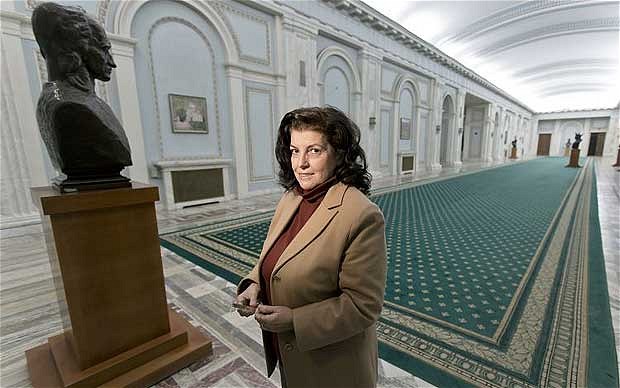
Oh, my! The Telegraph has an obituary of Romanian Architect Anca Petrescu that might as well conclude “Burn in Hell, you brazen hussy”:
Anca Petrescu, who has died following a road accident aged 64, was an architect known as the “Albert Speer of Communism”, responsible for the Romanian dictator Nicolai Ceausescu’s “Palace of the People” in Bucharest — the world’s greatest monument to totalitarian kitsch.
…
In February 1982, at the age of 32, Anca Petrescu was appointed chief architect of a project whose raison d’être, in Ceausescu’s tautological phrase, was to be “a grandiose edifice that reflects the epoch of the time”.
…
When interviewed about her role in building the People’s Palace, Anca Petrescu tended to lapse into evasive, Soviet-style doublespeak, cutting off interviewers brusquely if they enquired about her relationship with Ceausescu. When asked by one western journalist how she justified the suffering Romanians went through as a result of her work, she retorted: “That is a question originating from someone who can only understand a system based on profit as motivation.” Her favourite novels, she revealed, were the “sick works of Dostoevsky and Tolstoy, because they fit my soul”.
The story brings back a bit of the horror of Ceausescu. I recall my then-Calvinist heart swelling with pride as I read about how he was toppled by a doughty band of Romanian Calvinists, who probably toppled him from calloused knees.
I forget the details (but the New York Times remembers) and you’ve probably never heard them since the story’s pretty implausible in retrospect when everyone knows Ronald Reagan toppled Communism on his feet.
Oh. Margaret Thatcher, too. And ordinary Polish Catholics. Led by Lech Walesa. Sound track by the late Lou Reed. With a cameo appearance by Plastic People of the Universe.
But oddly, apart from episodes like the capture of Hussein or the death of Bin Laden, I don’t hear anyone claiming the success someone or other pulled off in Iraq and Afghanistan.
* * * * *
“The remarks made in this essay do not represent scholarly research. They are intended as topical stimulations for conversation among intelligent and informed people.” (Gerhart Niemeyer)
Saturday, 11/2/13
Friday, November 1, 2013
When confusion is the refuge of scoundrels
Steve Viars, a local Pastor, normally quite irenic, sort of lost it when gay Episcopal Bishop Gene Robinson came to Purdue for a series of provocations.
I say “sort of” because his response was uncharacteristically testy, plowed no new ground (is there any new ground left?) and used an example known to infuriate homophiles and people who just want the whole debate to go away, whatever the result. His was a solid if unimaginative column.
His example, polyamory, however, raises a legitimate question, however little people want to deal with it:
So here’s my question for Lowell, Gene and Peter: Is polyamory right or wrong? If a group of five polyamorists wanted to have a family because that is their perceived identity, should that desire be celebrated? And if they wanted to be married, should Indiana law allow them to be?
Gale Charlotte decidedly doesn’t want to deal with that. Days later he claimed that the Pastor’s column left him “confused”:
Here are some facts: From almost the beginning of time, people have “pair bonded,” to provide stability in child-rearing and organization for the larger group. One man and one woman were together for purposes of procreation, and then it behooved them to stay together to protect their offspring and the larger group from predators. Over time, people signed a legal document of “marriage” in an effort to form alliances, to produce legitimate heirs or for purely economic reasons.
In western cultures, the Christian religion did not get involved in defining or even “blessing” marriages until the fifth century AD, and it was not until the 13th century that the Catholic Church declared marriage to be a Holy Sacrament, thus needing to be a ceremony involving a priest, and also involving only one man and one woman.
…
[W]e all agree: Committed relationships between two people are the “gold standard.” Is it any surprise to discover that most of us want this very thing — to have the state “bless” our commitment to another person?
I gather from this that Charlotte believes:
- Until “over time” began, pair-bonds for stability in child-rearing included procreative pairs but wasn’t limited to them.
- From the beginning of “over time” until the 5th century, marriage was whatever people’s private legal documents said.
- In the 5th century, the Christian religion defined marriage, but as something other than involving only one man and one woman, since only in the 13th century did the Catholic Church narrow marriage to one man and one woman (and inject Priestcraft – boo! hiss! – into it).
- That Baptist Viars maybe is in mental slavery to medieval Roman Catholic Priestcraft.
- That Charlotte is liberated from slavery to religious dogma; he wants the state to bless hiss commitment to another person.
- That Charlotte has seen into my heart (and yours) and knows that I want the state’s blessing, too. We all do.
I suspect that Charlotte’s confusion is a mere rhetorical launching pad into his gauzy plea that we all all gather on his proprietary “bridge of understanding” where, over coffee, we’ll eventually decide to compromise his way. He sure didn’t step onto Viars bridge to answer the questions Viars pointedly posed.
Sometimes “confusion,” the inability to comprehend even fairly elementary stuff, is the real refuge of scoundrels.
But I’ll not let Charlotte set the rules for what contributes to understanding. My contribution du jour is to suggest, as I think I have above, that Charlotte’s invitation isn’t bona fide, that his notion of understanding is oriented to achieving his own pre-ordained conclusions.
UPDATE: I’m informed that Gale Charlotte is a woman. It would be sexist for me to withdraw what I wrote under a false impression from the spelling of her first name.
* * * * *
“The remarks made in this essay do not represent scholarly research. They are intended as topical stimulations for conversation among intelligent and informed people.” (Gerhart Niemeyer)
 Tipsy Teetotaler ن