Saturday, 12/2/23

A comment about my less-frequent blogging.

I’ve resumed, for several months now, use of my (digital) Journal and Common Place Book to collect many of the items I find amusing or that confirm my biases. A relative few of them I also still blog, along with items I judge are of more general interest than what gets logged only privately. That’s why I’m posting less total volume of material.

As this blog’s free for the taking, I don’t apologize, but wanted to explain.

Politics

The people

Character is destiny

Trump will never himself be a tragic figure as he sits alone wondering why the “quality people” want nothing to do with him. A tragic figure is someone who meets a sorry end despite his virtues. Trump, by his own choosing, never had use for virtue. His pathetic end—in this life and certainly in the history books—is the direct result of his admitted vices. As I’ve said from the beginning of all this, character is destiny.

Jonah Goldberg, Something Short of Tragic

Chuck Schumer’s Sister Souljah moment

Senate Majority Leader Chuck Schumer, the country’s highest-ranking Jewish official, gave a roughly 40-minute speech on the Senate floor Wednesday condemning the antisemitism that has exploded across the United States following Hamas’ October 7 attack on Israel, calling it “a five-alarm fire that must be extinguished.” The address, aimed largely at those on the political left, called out progressives who celebrated Hamas’ brutal attack and repeatedly invoked the memory of the Holocaust. “Many Jewish Americans fear what the future may bring, based on the repeated lessons of history,” he said. Meanwhile, the presidents of Harvard University, the University of Pennsylvania, and the Massachusetts Institute of Technology were called to appear before the House Education and Workforce Committee on December 5 to give testimony regarding antisemitism at their respective institutions.

TMD

The parties

Tone-deaf lefties

Voters want to hear how problems can be solved—not told they’re doomed unless obviously impractical steps are taken. And it doesn’t help that the Left’s version of the steps that must be taken includes a raft of unrelated social programs that would be nice to have but don’t do anything about climate change (see, for instance, the Green New Deal proposed in Congress). Nor does it help that obviously necessary components of a clean energy program like nuclear power are ruled out because, well, people on the Left don’t like nuclear power.

Ruy Teixeira, The Five Deadly Sins of the Left

The dynamics of Left and Right

[W]e’re just really confused how people are not acknowledging that the democrats are just as in bed with corporate and pharmaceutical interests as republicans … I don’t know enough about psychology to say for sure why this has happened. Why when finally, finally, the Republicans are saying, “Woah, looks like the police are sometimes racist. We do need police reform!” the left had to then go, “Reform? Who said anything about reform? We need to defund the police!”… The truth is that neither party represents working class Americans. And these supposed “socialists” – what are they running on? Free college and banning fracking. It’s maddening.

Highly Qualified: What Does Liberalism Even Mean Anymore?.

This is from some Readwise highlights. I have no memory of who linked to the original enticingly enough to get me there. I swear I’m not a regular at The Dandy, which appears to be for upstate New York elitist pot-heads.

Epigraph or epitaph?

When the history of this era is written, “I just want Republicans to win; that’s all I care about” should be its epigraph.

Nick Cattogio, quoting equivocally Anti-Trump Chris Sununu.

How reticent Republicans will come around to Trump

One of the shining lessons of the past eight years is that however low your expectations might be for Republican voters, they’re not low enough. Most of those on the right who should know better but have stuck it out this far will get to “yes” on Trump 2.0, I suspect. Some might do so after determined efforts at self-persuasion, but most will back Trump without much strain.

There are various rationalizations to which they’ll turn to resolve the tension between their nagging fear that Trump is a poisonous threat to America’s civic heritage and their partisan duty to believe that government by the far right is preferable to government by the far left—and that every Democrat is supposedly a member, or a puppet, of the far left. Those rationalizations are a strange brew of magical thinking and hard-nosed “binary choice” partisan logic.

[A] Republican-controlled Congress would either tolerate or actively enable Trump’s power grabs in a second term, the same way that congressional Republicans tolerated or actively enabled his aggressive deficit spending during his first term. We are very late in the game for anyone to still pretend that the GOP cares about restraining the federal government whenever they’re in charge of it, but that’s the sort of silliness in which one must indulge to imagine reelecting Trump as some sort of civic good.

Nick Cattogio

Mis-judging what “real Americans” want

Follow me for what is going to long like a sudden left turn: Do you know why the Republicans’ bad reputation on racial questions is a problem for the GOP politically? It isn’t because it costs them among black voters—it is because it costs them among white voters, of whom there are a whole lot more, many of whom do not wish to associate themselves with a party that is known (not without reason) for harboring politicians and activists with ugly and atavistic racial attitudes. These same voters—many of whom would be more or less on board with traditional Republican economic policies—are put off by other characteristics of the GOP coalition: its anti-intellectualism, its rural orientation, etc. That isn’t to say that everybody in the Republican Party is a rube on a turnip truck—but if you see a bunch of rubes piled into a turnip truck, you can bet that the turnip truck is going to have a “Jesus Is My Savior Trump Is My President!” bumper sticker on it. It isn’t going to say “Biden-Harris 2024.”

The Democrats have wisely offered themselves up as the natural political home of those upwardly mobile urban-suburban professionals the Republican Party doesn’t want. The Martin Center’s main man George Leef can sneer at the elite universities three times a week in the pages of National Review, but there is a great many young Americans who very much would like to attend one of those universities, and a great many middle-aged Americans who would like their children to attend such a school and who care a great deal about who gets in and why. But, even among people for whom Harvard’s admissions standards are not an immediate and urgent issue, the question remains: Do you want to associate yourself with the Ivy League crowd and the upwardly mobile strivers, or with the sneerers and scoffers who (though college-educated themselves, of course!) want you to believe that there’s a bright future in bumpkinism?

Republicans have spent the past 15 years or so micturating from a great height upon the aspirations of people who might want (for themselves or for their children) an Ivy League education, a high-paying job in technology or finance, a nice home in Silicon Valley or New York City or another big metropolitan area—in cities and suburbs that may not comport exactly with their politics on the whole but which offer (to everyone who is not a political monomaniac) many other important benefits, from economic opportunity to cultural interests to superior health care facilities. “Real Americans,” Republicans insist, do not aspire to such things—all Real Americans want to be farmers in Muleshoe, Texas, and diesel mechanics in Toad Suck, Arkansas.

Kevin D. Williamson

(Williamson suggests that the Democrats, too, are following policies apt to alienate strivers, but the Republican transmogrification is easier to caricature.)

So glad he solved that

How about it doesn’t matter whether progressives are liberals? We must move beyond the old labels. We are separated by rationalists and irrationalists.

What was once liberal is simply (as it mostly always has been) common sense, common decency, and management of inevitable change for the benefit of the general welfare and liberty and justice for all. Basically, what any reasonable and broad view of society would see as doing the right thing.

Almost anyone’s reading of social and political history would agree that we live in a better, more decent and fair nation because of the right things that rationalists did: abolish slavery, rein in the robber barons, establish labor laws, and approve women’s suffrage, civil rights, voting rights, Social Security and Medicare. The right things to do, which the irrationalists opposed.

In this new century social attitudes have changed, geopolitical power has changed, technology has exploded, the climate has changed. But what hasn’t changed is the need and desire to do the right and decent thing. And there is only one side that continues that fight.

When we finally pull our heads above the surface of the water we’re swimming in, we might see that there is no longer a divide of right and left, red and blue, liberal and conservative; it’s one simply of right and wrong. Rationality vs. irrationality.

Mansplaining Texan’s letter to the New York Times

I read this as “Let’s do away with an imperfectly nuanced political spectrum in favor of this useless but self-flattering binary.”

Foreign follies

“Many sober voices warned that an expansion of NATO to Russia’s border would poke the Bear, leading to an inevitable war. As long ago as 1998, following the U.S. decision to expand NATO eastwards, George Kennan said the following to Thomas Friedman:

I think it is the beginning of a new cold war. I think the Russians will gradually react quite adversely and it will affect their policies. I think it is a tragic mistake. There was no reason for this whatsoever. No one was threatening anybody else. This expansion would make the founding fathers of this country turn over in their graves.

Patrick J. Deneen, Russia, America, and the Danger of Political Gnosticism

Culture

A brutalizing and stupid idea

The idea was that when faced with abundance one should consume abundantly – an idea that has survived to become the basis of our present economy. It is neither natural nor civilized, and even from a ‘practical’ point of view it is to the last degree brutalizing and stupid.

Wendell Berry, The World-Ending Fire

A Matter of Principle

Less than a decade ago, I had high regard for “conservative” Hillsdale College. Its hiring of Michael (“Flight 93 Election”) Anton, who is at it again, together with the populist, rabble-rousing tone of its mailings, have brought that high regard to an bitter end.

Nevertheless, I’m in Hillsdale’s corner on this pernicious lawsuit. Hillsdale accepts no federal aid, but left activists, acting in the name of two co-eds who allegedly were acquaintance-raped by two Hillsdale men, are trying to impose Title IX processes on Hillsdale or else strip it of tax exemption.

SCOTUS sowed bad seed when it let the IRS strip Bob Jones University of tax exemption because of its odious policies on race. This is going to be a battlefront in the Left/Right wars for some time to come (and I have little doubt that the Right will try a tit-for-tat attack on some leftish nonprofits).

EA

Defined in these broad terms, effective altruism is no more a meaningful philosophy than “do politics good” is a political platform or “be a good person” is a moral system. In the piece linked above Matthews says that “what’s distinctive about EA is that… its whole purpose is to shine light on important problems and solutions in the world that are being neglected.” But that isn’t distinctive at all! Every do-gooder I have ever known has thought of themselves as shining a light on problems that are neglected. So what?

This is why EA leads people to believe that hoarding money for interstellar colonization is more important than feeding the poor, why researching EA leads you to debates about how sentient termites are. In the past, I’ve pointed to the EA argument, which I assure you sincerely exists, that we should push all carnivorous species in the wild into extinction, in order to reduce the negative utility caused by the death of prey animals. (This would seem to require a belief that prey animals dying of disease and starvation is superior to dying from predation, but ah well.) … [T]hose examples are essential because they demonstrate the problem with hitching a moral program to a social and intellectual culture that will inevitably reward the more extreme expressions of that culture. It’s not nut-picking if your entire project amounts to a machine for attracting nuts.

Freddie deBoer, The Effective Altruism Shell Game

Fox Porn

From my point of view, the case against Fox News isn’t that it is dangerous or that Tucker Carlson’s work is likely to incite anybody to violence. (Maybe it will, but I doubt it. This country may generate a few school-shooters every year, but I don’t think it has the energy for a sustained intifada.) The case against Fox News is that it is tedious, repetitive, and lurid. Aesthetically and emotionally, it more often resembles pornography than it does, say, the commentary of Paul Harvey.

Kevin D. Williamson (paywall)

They voted their lying eyes

We disagreed—and still do—with Wilders’ calls for blanket bans on additional asylum seekers, with the notion of banning the Quran (let alone any book), and with his consistent failure to draw a distinction between Islam and Islamism. 

But we understand how and why his message resonated with the public.

While elites over the past two decades have told the public to ignore their lying eyes, Wilders continued to emphasize the hot-button subjects that resonated with the public: the struggling economy, the importance of borders, the risks of devolving too much power to Brussels, the threat of Islamism, and the challenge of mass migration. 

While elites told the public that opposing migration was xenophobic, ordinary people noticed structural changes in their country and felt they—the public—had not been adequately consulted.

Ayaan Hirsi Ali and Evelyn Markus, The Death of the Old Europe—and the Rise of the Right

The horseshoe theory of politics

[Marx and Engels] write,

The history of all hitherto existing society is the history of class struggles.

Freeman and slave, patrician and plebeian, lord and serf, guild-master and journeyman, in a word, oppressor and oppressed, stood in constant opposition to one another, carried on an uninterrupted, now hidden, now open fight, a fight that each time ended, either in a revolutionary reconstitution of society at large, or in the common ruin of the contending classes.

The key phrase: “in a word, oppressor and oppressed.” The essential point is not that there are different social classes, but that the differentiation is always (a) binary and (b) morally asymmetrical …

At the outset I said that these principles effectively constitute the modern Left. But they constitute the modern populist Right as well. Replace “bourgeoisie” with “coastal elites” and the “deep state”; replace “workers of the world, unite” with Trump’s “I am your retribution” and J. D. Vance’s “Our people hate the right people.” Different targets, same logic. It’s conceptual Marxism — a conceptual order that gets extracted from the political-economic specifics of the argument and then is redeployed.

(This is also, not incidentally, how Judenhass works: Jew and gentile are “oppressor and oppressed”; it is not possible for Jews to have virtues; genocide is baked into the system.) 

The single most significant political division in the Western world today is between those who deploy this logic and those who don’t; between, in other words, Manichaeans and Humanists. The only two parties that matter.

Alan Jacobs, Conceptual Marxism

The expiration of small-c conservatism

London has become its own country in a way, leaving the hinterlands further behind, its elites still gnashing their teeth about Boris and Brexit, while picking at their octopus starters. The prime minister is Hindu, the mayor of London is Muslim, and the first minister of Scotland is Muslim. The abandoned husks of churches contrast with the bustle of new mosques. This is a Britain unlike anything before.

And some of it clearly works: close your eyes and listen to young non-white Brits on the buses or trains, and all the accents and slang are instantly recognizable from my youth. The humor is still rich. Civility is fraying but still there. Crime is nowhere near American levels. The new Elizabeth underground line is marvelous. A city with the cultural cohesion of the Heathrow departure lounge somehow hangs together. The Brits are still a nation of high-functioning alcoholics and retain their strange, hysterical aversion to cannabis. It’s a miracle of multicultural harmony, but you can feel its internal tensions rising.

And the fear of the crazy right has gone. Milei and Wilders instantly moderated on some of their most outlandish positions, as soon as power was within reach. No, Milei won’t dollarize the Argentine economy, it turns out; and no, Wilders won’t ban mosques, as he tries to build a coalition government. Meloni has talked up immigration control, but in power, she hasn’t done much about it, and her support for Ukraine and the EU has been a big surprise. Poland’s hard-right party showed it could not stay in power forever this year, and in Spain, Vox lost ground. But in all this, a taboo has been broken — the same kind of taboo that the election of Donald Trump represented. The small-c conservatism of the Western electorate has expired.

Andrew Sullivan

Another new category for this blog

I once fancied that racism in the classic “dark people are inferior to light people” sense had largely vanished from the U.S. I conceded that racial stereotypes remained, but thought that even those fled in the face of a nicely-dressed darker person who spoke standard English — someone like, say, Thomas Sowell, Condoleeza Rice, or Barack Obama.

Birtherism and other bizarre attacks on said Obama persuaded me that I had been mistaken. People weren’t calling him [racial epithet omitted], but something dark and atavistic was afoot. Maybe I need to get out more.

I was less naïve about antisemitism, but it has so shamelessly reared its ugly head since October 7 that I’ve added it as a “category,” appearing today for the first time as such (earlier blogs no doubt had it as a “tag”).


The human voice: That we can sing seems basis for conjecture that, despite our stupidities and our sinfulness, we might be the reason the universe exists.

Alexander Riley

You can read most of my more impromptu stuff here (cathartic venting) and here (the only social medium I frequent, because people there are quirky, pleasant and real). Both should work in your RSS aggregator, like Feedly or Reeder, should you want to make a habit of it.
Sunday, 11/26/23

Prescient if not prophetic

  • Shortly after …, Cal Thomas and Ed Dobson, who had been Falwell’s chief lieutenants in the Moral Majority, published a book questioning not just the efficacy of political action but the righteousness of the enterprise. In Blinded by Might they argued that in the process of trying to win elections conservative Christians had been seduced by the lure of power. What had begun as an effort to restore Christian values to the nation had degenerated into an unbridled partisan struggle, creating an atmosphere in which it was assumed that Democrats could not be Christians and that Bill and Hillary Clinton were the Antichrist.

Frances FitzGerald, The Evangelicals (hyperlink added)

That feels prescient, doesn’t it? Things feel exactly like that today, and Jerry Falwell and Paul Weyrich may have shoved us down that slippery slope.

I also sense a parallel between Simon Magus and those who used the name of Christ as if it was a magic incantation, only to be mocked by the demons they were trying to cast out.

There’s always a temptation to try to use some variety of magic to make god(s) do what one wants, and it’s healthy for me to remember that at least two Evangelicals recognized what was happening.

In a similar vein, but with a historic perspective:

Even when Fundamentalists set out to defend the truth, their temptation was to rally large constituencies to the cause rather than to prepare for scholarly exchange.

Nathan O. Hatch, The Democratization of American Christianity

Undefined

Orthodoxy theology defines only what is necessary and always leaves unspoken that which cannot be explained. This approach was part of the Christian faith from the beginning. But the Western phronema often suppresses, dismisses, minimizes, or ignores this stance. The Western mind is compelled to define and explain everything, since without a rational explanation a concept or fact cannot be considered true, or, conversely, all truth can be proven rationally.

Dr. Eugenia Scarvelis Constantinou, Thinking Orthodox

Rebel energy

With this in mind, as a storyteller, I think of Christianity remembering its own myths. Digging into the dark wonder of it all.

Not the stuff of empire and conquest, not the mega-churches and donation box, but the sheer radical eccentricity of its stories, the quiet devastation of love that circles the Beatitudes. The call to adventure. The voluntary abdication of consumer-friendly outcomes. Not building a shopping mall around a Grail. The unfashionable weight of such a thought. The five fathoms depth of it. That’s a rebel energy these days, a whispered thing.

Martin Shaw

Distinctions

On my one-and-only active social medium, I happened upon a religious/antireligious discussion, chimed in with my 2-centsworth, and watched the discussion shift.

The odd thing was that the antireligious side was reacting to evangelicals/fundamentalists, “and by extension all Christians.” That was odd because this medium is chock-full of sane Christians, including some sane evangelicals.

I for one detest the assumption that my cosmology and demeanor toward the world is identical with that of any self-styled Christian who ever offended the one making the assumption about me. There’s more to Christianity than superficially ticking off “yes” to a bunch of checklist affirmations, and anyone who can’t tell the difference between, say, Mother Theresa and Jerry Falwell, Jr., because “both believe a myth,” is an idiot.

(Yes, that makes me guilty of “but I’m not that kind of Christian” — because Christianity in North American is manifest in tens of thousands of clumpings, quite apart from they tens of millions who try to go it solo. I do hope, though, that if a day comes when the idiots decide to actively persecute all Christians without distinction, I’ll not betray my embarrassing brothers and sisters.)

Thanksgiving morning, one participant came up with the mike-drop quote, from Marilynne Robinson, who also “isn’t that kind”:

“Over the years many a good soul has let me know by one means or another that this living out of the religious/ethical/aesthetic/intellectual tradition that is so essentially compelling to me is not, shall we say, cool. There are little jokes about being born again. There are little lectures about religion as a cheap cure for existential anxiety. …

“Am I the last one to get the news that this religion that has so profoundly influenced world civilization over centuries has been ceded to the clods and the obscurantists? Don’t I know that J. S. Bach and Martin Luther King have been entirely eclipsed by Jerry Falwell? The question has been put to me very directly: Am I not afraid to be associated with religious people? These nudges would have their coercive effect precisely because those who want to put me right know that I am not a fundamentalist. That is, I am to avoid association with religion completely or else be embarrassed by punitive association with beliefs I do not hold. What sense does that make? What good does it serve? I suspect it demonstrates the existence of a human herding instinct. After all, “egregious” means at root “outside the flock.” There are always a great many people who are confident that they recognize deviation from group mores, and so they police the boundaries and round up the strays.”

Yes! This!

My Lord is the One who resurrects. He resurrects the dead from morning until dusk, and from dusk until dawn.”
What the morning buries, the Lord brings to life in the evening; and what the evening buries, the Lord brings to life in the morning.
What work is more fitting for the living God than to resurrect the dead into life?
Let others believe in the God who brings men to trial and judges them.
I shall cling to the God who resurrects the dead.

St. Nikolai of Zhicha, Prayers by the Lake

In a slightly less poetic vein, Fr. Stephen Freeman used to say “God didn’t come to make bad men good. He came to make dead men live.”

Whether to swim the Tiber or the Bosphorus

[T]here seems to be a shift [in the evangelical world] away from the attractiveness of Catholicism toward Orthodoxy, especially for those who don’t have career ambitions within movement conservatism.

Aaron Renn (italics added; H/T Rod Dreher)

That “ambition” distinction between who converts to Catholicism and who to Orthodoxy hadn’t occurred to me. I’m not sure I agree (if only because, in Renn’s context, the alternative to ambitions in “movement conservatism” may be something like involvement in more extreme “dissident conservatism”).

I found the comments to Renn’s posting interesting, especially insofar as they identified the Eastern-ness of Orthodoxy as an impediment. It’s always interesting to see ourselves as other see us.

Mainlining

Bear with me here for two paragraphs of necessary context before the heart of the item:

In terms of political ideology, only 23% of all mainline white American churchgoers identify as liberal, while 55% of their clergy leaders do so. Thirty-two percent of white mainline churchgoers consider themselves moderates and 43% conservative. In contrast, among the clergy who serve these conservative mainliners, 22% consider themselves moderate and only 22% conservative.

Half of mainline clergy identify as Democrats and only 14% as Republican (those who identify as “moderate” make up the rest). Among United Methodists, 60% of laity say they are Republican and 40% Democrat. While UM clergy are far more apt to be Democrat than Republican, among bishops and board and agency staff the percentage may be as high as 80% to 20%.

This, of course, is hardly news to many. I knew a United Methodist ministerial candidate who graduated from one of our premier United Methodist-related universities and then from one of the most highly regarded (liberal) seminaries in the nation. After all of this preparation he received his first appointment, to a circuit in a rural area in a midwestern state. After two months he not only resigned from his church but dropped out of the ministry.

“This has been a terrible mistake,” he explained.

The best ministerial education possible, at least from an institutional perspective, failed to equip him to minister to ordinary people in an ordinary American setting.

I became keenly aware that a number of churches were asking for  “conservative” pastors. I do not recall a single instance where a church requested a “more liberal” pastor …

Riley B. Case

Christendom?

I sometimes wonder if Christians claim too much credit for Western culture. But Ayaan Hirsi Ali apparently believes that credit is deserved, as her appreciation of the culture factored prominently into her recently-announced conversion.

And then there’s this:

“The international human rights regime of 1945,” an American human rights supporter remarked, “is no more. American hegemony has eroded. Europe, even with the events of 1992, is little more than a peninsula. The world is now as Arab, Asian, and African, as it is Western. Today the Universal Declaration of Human Rights and the International Covenants are less relevant to much of the planet than during the immediate post-World War II era.” An Asian critic of the West had similar views: “For the first time since the Universal Declaration was adopted in 1948, countries not thoroughly steeped in the Judeo-Christian and natural law traditions are in the first rank. That unprecedented situation will define the new international politics of human rights. It will also multiply the occasions for conflict.”

Samuel P. Huntington, The Clash of Civilizations and the Remaking of World Order

It seems to me that the waning of the Universal Declaration of Human Rights due to the rise of “countries not thoroughly steeped in the Judeo-Christian and natural law traditions” testifies, too, that credit is not undue.

The question remains, though, whether the vices of Western culture were baked into the Protestant Reformation, the emergence of a particular kind of Christianity.

Humility

Don’t overdramatize either your sins or your virtues. Frankly, chances are good that neither are spectacular.

Peter Bouteneff, How to Be a Sinner

Noted

I have definitely tended for decades toward catastrophism. I hope I haven’t overburdened this blog with that.

But I’m taking heart recently. Paul Kingsnorth and Martin Shaw becoming not just Christians, but Orthodox Christians, bringing some enchantment with them. Ayaan Hirsi Ali becoming a Christian of some sort. Now, within the past 24 hours, I’ve learned that Matthew B. Crawford, author of Shop Class as Soulcraft and The World Outside Your Head has become Christian (I had no idea he’d been raised by left coast flakes and lived in an Ashram from roughly ages 10 to 15). He declined to expand on that conversion in an Andrew Sullivan podcast, aware that he’s a novice.

Bearing in mind that the plural of anecdote is data, emotionally if not scientifically, I’m growing in confidence that God is up to something good, and I was sure ready for it.


The human voice: That we can sing seems basis for conjecture that, despite our stupidities and our sinfulness, we might be the reason the universe exists.

Alexander Riley

You can read most of my more impromptu stuff here (cathartic venting) and here (the only social medium I frequent, because people there are quirky, pleasant and real). Both should work in your RSS aggregator, like Feedly or Reeder, should you want to make a habit of it.

Black Friday

Thanksgiving thoughts

Let’s look at the rest of the world briefly, which is all it requires: China? Communists. The Middle East? We’re getting off oil sooner rather than later, and there will come a day when a Saudi prince, without his precious oil allowance, suddenly has to work a real job, and it will be a disaster. Europe? A lovely museum to a special culture that decided it was done, stopped procreating and stopped inventing, and now has to be liquidated for sensitivity purposes (I’m hearing that the English language is Islamophobic colonialism). That leaves us with America. The US of A. Land of the free. Land of invention. Bastion of the world’s brightest minds and hardest workers. Despite the nuts wandering around—and yes, there are many—we’re still the best party on earth. I’m so thankful to have had the profound luck of being born here. I’m grateful for America.

Nellie Bowles

My standard line when somebody tries to bait me into a political debate is, “I’m a professional; I only do this when I’m getting paid.”

Kevin D. Williamson

Williamson goes on to get a lot deeper than “how I avoid politics at the Thanksgiving table” — a perennial topic that’s losing its fragrance. Here’s some of that deeper:

Thanksgiving is, among other things, a reminder of the pleasures of private life, which are almost always superior to their public and commercial competitors. Dinner at home with family and friends is better than dinner at the best restaurant in New York City or London. Sleeping in your own bed is better than a suite at the Ritz-Carlton …

Especially at this time of year, a fire and a book and children and a dog in one’s own home are nonpareil pleasures. I am not saying everybody should move into a cabin in the woods: There is a reason the very wealthy use their money to expand the scope of their private lives: private jets, private clubs, or, if you’ve really got piles of it, private islands. But the point isn’t to have a gold-plated toilet on your personal 747—the point is to have things just the way you like them.

I read a bizarre story a few months ago about private-jet owners who make a little money back on their travel by renting their planes out between flights—for substantial amounts of money—to would-be social-media influencers who simply want to be photographed inside them, pretending to be flying. … I do not get the demand side of that market.

The guy who posts Instagram pictures of himself on a private jet doesn’t know what a private jet is for, because he doesn’t know what private life is for—what he wants is to be envied. Fake wealth isn’t going to solve his problem–but neither is real wealth. His orientation is fundamentally exterior and public, dominated by the desire to be seen and by the need to see himself through the eyes of others, as though he would cease to exist if he ceased being looked at. As David Foster Wallace pointed out in a memorable passage in Infinite Jest, the ache that envy makes us feel turns out not to have a reciprocal: There isn’t actually any pleasure or joy in being envied. The man who spends his time and energy manufacturing advertisements for his own (supposed) happiness is not made larger by the attention of others but instead is made smaller by his desperate scrambling after it.

There is a difference between living one’s life and performing it. Performing life for some unseen audience on social media is perverse. Every time I hear someone use the term “personal brand,” I cringe a little. That is the worst kind of faux-sophistication, and it speaks to a real deficiency in the interior life.

Nowhere in particular

This one’s evergreen. I’ve almost certainly blogged it before:

I can take a virtual tour of the Forbidden City in Beijing, or of the deepest underwater caverns, nearly as easily as I glance across the room. Every foreign wonder, hidden place, and obscure subculture is immediately available to my idle curiosity; they are lumped together into a uniform distancelessness that revolves around me. But where am I? There doesn’t seem to be any nonarbitrary basis on which I can draw a horizon around myself—a zone of relevance—by which I might take my bearings and get oriented. When the axis of closer-to-me and farther-from-me is collapsed, I can be anywhere, and find that I am rarely in any place in particular.” (Matthew B. Crawford, The World Beyond Your Head)”I can take a virtual tour of the Forbidden City in Beijing, or of the deepest underwater caverns, nearly as easily as I glance across the room. Every foreign wonder, hidden place, and obscure subculture is immediately available to my idle curiosity; they are lumped together into a uniform distancelessness that revolves around me. But where am I? There doesn’t seem to be any nonarbitrary basis on which I can draw a horizon around myself—a zone of relevance—by which I might take my bearings and get oriented. When the axis of closer-to-me and farther-from-me is collapsed, I can be anywhere, and find that I am rarely in any place in particular.

Matthew B. Crawford, The World Beyond Your Head (emphasis added).

Postliberalism

Today’s post-liberal conservatives appear to think they’re distinguished by the belief that virtue matters. They behave as if their core disagreement with fusionists is about whether human beings have moral obligations that go beyond leaving others alone to do as they please. This could hardly be more wrong. Anyone who holds to the Judeo-Christian tradition—as fusionists by definition do—accepts that we have manifold duties to one another. The disagreement is about whether it’s the state’s job to enforce those moral obligations.

(Stephanie Slade, Is There a Future for Fusionism?

Lacunae

Reading Marilynne Robinson, Gilead. 📚

I reached my 75th birthday recently, having never read one of her novels. I’m thinking that was a terrible mistake.

I’ll probably try Annie Dillard next, despite learning to my shock that Pilgrim at Tinker Creek isn’t a novel. I’ve got something in me that responds to certain kinds of women writers.

Political-ish

Hard-core pornography and far-right politics

Years and years ago, preachers inveighed against “hard-core pornography.” (Today, few if any do because they don’t want to drive away all the young men.) I knew then that there was some big-time hyperbole going on when Playboy fell in the “hard-core” category. It contributed to my growing sense that a lot of preachers really didn’t have anything edifying to say.

Today, mainstream media similarly fling around “far right.” I know they’re engaging in hyperbole some of the time they do that (e.g., Viktor Orban — there, I’ve outed myself!), and in so doing they debase themselves and make the discerning reader skeptical of all they say. (They also prove that conservatives don’t own all the echo chambers.)

All that to ask: Is Geert Wilders really far-right, or does he just offend progressive media biases? Is he within or outside the Overton Window? Is “far right” generally within or without? I do not know, but I know not to trust the Economist’s take.

Book-banning

Wait, who banned those books? A lot of celebrities and politicians like doing activism to fight against “book banning,” but they often accidentally point to books that were banned by their own team. This week: pop star Pink. She claims that Florida banned To Kill a Mockingbird. . . but. . . actually, To Kill a Mockingbird is required reading in Florida schools. It was recently banned—by a district in Washington State. Those teachers in Washington State said this: “ ‘To Kill a Mockingbird centers on whiteness,’ ” and “ ‘it presents a barrier to understanding and celebrating an authentic Black point of view in Civil Rights era literature and should be removed.’ ” 

A good rule of thumb for Pink and other celebrities: anything written about race by a white person? That’s going to be banned in the states you live in. Anything written about sex by a person who enjoyed sex a little too much or has brightly dyed hair? That’s gonna be banned in your red states. Easy peasy.

Nellie Bowles

Undue process, due unprocess, whatever.

I suppose that when Ayaan Hirsi Ali sought asylum from Sudan, she had even worse than this in mind: Washington Court Refuses to Enforce Saudi Child Custody Decree.

We do well to remember the benefits even of post-Christendom (at least until the fumes from the empty bottle dissipate and we descend further).

In other words, he won’t run … right?

Retiring Sen. Joe Manchin of West Virginia said Wednesday that he is “absolutely” considering running for president in 2024 and will travel the country in the coming months to see if there is a desire for a moderate option in the presidential contest. “I’m totally, absolutely scared to death that Donald Trump would become president again,” Manchin told NBC News. Manchin also addressed concerns that he could siphon votes away from President Joe Biden. “I’ve never been a spoiler in my life of anything,” he said, “and I would never be a spoiler now.”

TMD

Hard to believe he wouldn’t be a spoiler.


The human voice: That we can sing seems basis for conjecture that, despite our stupidities and our sinfulness, we might be the reason the universe exists.

Alexander Riley

You can read most of my more impromptu stuff here (cathartic venting) and here (the only social medium I frequent, because people there are quirky, pleasant and real). Both should work in your RSS aggregator, like Feedly or Reeder, should you want to make a habit of it.

Sunday, 11/19/23

Orthodox

“Necessary to Salvation”

One of the oddest thoughts to have crept its way into the Christian mind is the notion of what is “necessary to salvation.” The simple questions within the New Testament, “What must we do to be saved?” quickly become the stuff of bumper-stickers and a reduced version of Christianity unable to sustain a genuine spiritual life.

Anglicanism (as did many other versions of Protestantism) enshrined some of this sentiment in the Oath of Ordination required of its clergy. In this they swore that they believed the “Scriptures of the Old and New Testaments to contain all things necessary to salvation.” In the hands of more extreme Reformers, this notion became a slogan with which to eliminate everything from Christianity other than those things that could be found in the Scriptures. A white-washed (literally) Christianity, devoid of ceremony and with only a hint of sacrament was the result. It is easily the primary culprit in the creation of secularism. All the “unnecessary stuff” is removed from Christianity, leaving the world with huge collections of unchristian, “neutral” things. This instinct and principle is both contrary to the Scriptures themselves as well as destructive of the very nature of the Christian faith.

A not inaccurate polemic against this reductionist form of Christianity is to describe it as an increasing Islamification of the faith. I have written before of the influence of Islam on the notion of Sola Scriptura. Christianity, viewed as essentially an act of submission to God through Christ, is not Christianity. It is a Christianized Islam. It’s useful. It need have none of the problems concomitant with a genuine historical Church. It is quite portable and can be kept entirely private, offering no disturbance to the structures and agreements of the secular world. Individual Christians are never a problem for the world. It’s only when two or three of them gather together that they become dangerous.

Fr. Stephen Freeman, An Unnecessary Salvation (emphasis added).

I have long (at least since my earliest days as an Orthodox Christian) thought that the urge to identify what is “necessary to salvation” was, at the popular level (perhaps not in seminary), a begrudging attitude — an effort not to give God anything that wasn’t absolutely necessary to give Him.

I still think that. If you stopped reading my post now and read and meditated on the whole Fr. Stephen post instead, I’d be very content.

Humans

  1. Humans are not the point and purpose of the planet. Our art will begin with the attempt to step outside the human bubble. By careful attention, we will reengage with the non-human world.

Paul Kingsnorth, Principles of the Dark Mountain Manifesto, before his conversion to any form of Christianity. I’m not sure what he’d say now, but it might be like what another Christian said:

The human voice: That we can sing seems basis for conjecture that, despite our stupidities and our sinfulness, we might be the reason the universe exists.

Alexander Riley

Theophanies

The feasts on the calendar are not appointments with memorials, the recollection of events long past. They are invitations to present tense moments in the liturgical life of the world. In those moments there is an intersection of the present and the eternal. They are theophanies into which we may enter.

Fr. Stephen Freeman

I’ve listened recently to a lot of recorded talks by Fr. Stephen and feel affirmed in something I said 25 years or so ago: “I know that St. Irenaus said ‘God became man so that man might become God,’ but I’m aiming for now at just becoming human.”

Leaving all to follow

Each disciple must decide about the risks of discipleship. As the Lord warns: “For which of you, intending to build a tower, does not sit down first and count the cost, whether he has enough to finish it, lest, after he has laid the foundation, and is not able to finish, all who see it begin to mock him, saying, ‘This man began to build and was not able to finish’” (Lk. 14:28-30). Some have faced demands in the work place to compromise the truth or have been expected to help defraud customers or investors. Some have faced demands for sexual favors. Some have had their parents cut them off from the warmth and affection of the family for choosing to become Orthodox Christians. Be advised, and count the cost. Consider seriously, should the demand come: how ready am I to forsake all?

Many will say, “But to belong to the Church is not highly risky. Are not all these images a little overstated?” At this moment for you and me risks are minimal; but conditions change. There are, today, implacable enemies of Christian commitment ready to destroy us.

Dynamis daily devotional for November 16, the Feast of St. Matthew, who left all and followed Christ.

Latin

Pope Francis removed a Texas Bishop, Joseph Strickland, from his bishopric. He apparently had harshly criticized the Pope on social media.

I thought this was another instance of “Liberal Pope Francis does bad thing to liberalize Church.” But maybe not:

Bishops should probably write books and letters rather than tweets and Facebook posts. That would be more in keeping with the character and purpose of the office—and not only the bishops. Congressmen, professors, prominent figures in scientific and medical establishments, would all be better served communicating to a smaller, more refined audience at a slower, more reflective tempo. But the allure of instant feedback from a large readership is very seductive. 

It works on prelates the same way it works on senators, which perhaps is one reason Bishop Strickland has so often sounded like Ted Cruz in a cassock, sharing the usual obsessions—vaccines, the purportedly stolen election, etc.—as that one uncle every progressive with a byline apparently has to endure at Thanksgiving dinner. There are prominent figures in conservative Catholic circles, including bitter critics of the current pope, who privately dismiss Bishop Strickland as a publicity hound and a clown.

Kevin D. Williamson

Protestant

The Mainline

Mainline American Protestantism, as is often the case, plodded wearily along as if nothing had changed. Like an aging dowager, living in a decaying mansion on the edge of town, bankrupt and penniless, house decaying around her but acting as if her family still controlled the city, our theologians and church leaders continued to think and act as if we were in charge, as if the old arrangements were still valid.

Stanley Hauerwas, Resident Aliens

The Christian’s natural state

It should be the Christian’s natural state to feel that the times are out of joint and that we do not truly belong here. Yet lamentation can too often become just another form of worldliness, and polemic simply a means of making ourselves feel righteous.

Carl R. Trueman, The Rise and Triumph of the Modern Self. The book gives Rod Dreher credit for co-authorship, but the book appeared to me to be 99% Trueman.

This, by the way, is a pretty penetrating observation, isn’t it?

Among the Evangelicals at ATS

Carl Trueman notes a real laxity in Protestant doctrine, particularly among evangelicals:

A recovery of classical theology also raises an interesting ecumenical question. Why do Protestants, especially those of an evangelical stripe, typically prioritize the doctrine of salvation over the doctrine of God? If an evangelical rejects simplicity or impassibility or eternal generation, he is typically free to do so. But why should those properly committed to the creeds and confessions consider that person closer spiritually to them than those who affirm classical theism but share a different understanding of justification? 

This is a real issue. At an Association of Theological Schools accreditation meeting I once found myself placed among the “evangelical” attendees. In that group was someone who denied simplicity, impassibility, and the fact that God knows the future—all doctrines that I affirm. Those are not minor differences. Wistfully my eyes wandered to the Dominicans at another table, all of whom would at least have agreed with me on who God is, even if not on how he saves his church. We would at least have shared some common ground upon which to set forth our significant differences. The Reformed Orthodox of the Westminster Assembly would have considered deviance on the doctrine of God to be anathema and, if forced to choose, would certainly have preferred the company of a Thomist to that of someone who denied simplicity, eternal generation, or God’s foreknowledge. Why do we not think the same? The modern Protestant imagination is oddly different from that of our ancestors.

I’m not sure I’ve ever heard the words “simplicity”, “impassibility” or “eternal generation” in an Orthodox Church. Perhaps they come up in catechesis of those without Christian background. I also assume our Priests, Bishops and academics know them well enough to engage in ecumenical theology settings. But I don’t think they’re our native tongue.

Populism

The English sociologist David Martin comments that while both England and America share an anti-intellectual populism, in America such populists have worked within rather than without the walls of the church.

Nathan O. Hatch, The Democratization of American Christianity

I think this is the first time since Trump rode down that escalator that I came across this quote. It could unlock some of the mysteries of Evangelicals supporting Trump.

More on the Christian Conversion of Ayaan Hirsi Ali

Douthat

[T]o set out to practice Christianity because you love the civilization that sprang from it and feel some kind of spiritual response to its teachings seems much more reasonable than hovering forever in agnosticism while you wait to achieve perfect theological certainty about the divinity of Christ.

Ross Douthat, Where Does Religion Come From?

DeBoer

I knew there’s be Christian critics of her conversion story; I should have realized that there would be bitter atheist critics as well — though it took the particular genius of Freddie deBoer to center criticism around consequentialist professions of religion — which Hirsi Ali’s apologia does appear to be in substantial part.

Still, this was not Freddie at his best; it seems to me that he usually gives people the benefit of the doubt and avoids construing their words in ways that make them look stupid. Not this time, though. It’s almost as if atheists resent apostates from their religion as much (or more) than other religions do.

Alan Jacobs

Which brings me to Alan Jacobs, responding to Freddie:

I would also note that while most people think that Buddhism is a religion, it typically doesn’t do or have any of the things that Freddie says religion does and has. I can’t now remember who said it, but one scholar of religion said that the only thing all religions have in common is that they use candles. That seems right to me. 

So “religion” is an intractably fuzzy concept, the many religions of the world do many different things and do them in many different ways, and even within a given religion people may believe and may commit themselves for as astonishing variety of reasons. The whole enterprise, if indeed we can call religion an enterprise, is so fraught with complications that I don’t think there’s anything that can be legitimately said in general about it. It’s like life itself in that respect. 

Relatedly: Freddie (like many people, it seems) is critical of the reasons Ayaan Hirsi Ali has cited for her conversion to Christianity. I’m not. My view is that everyone has to start somewhere — she’s very forthright about being a newcomer to all this — and what matters is not where you start but where you end up ….

Just so, Alan.

(Side note: I doubt that megachurces use candles. Are they, then, not practitioners of a religion? An affirmative answer is tempting.)

I, too, am leery of purely consequentialist arguments for Christianity, but I’m far from sure that’s all Hirsi Ali has.

Andrew Sullivan

Andrew Sullivan was uncharacteristically hostile and incoherent. It was as if he was figuring out his position by writing, but instead of tidying up after he reached a conclusion, he left in all the messiness of the exercise.

In the end, I think he decided the conversion may be real, if embryonic. None of it seemed worth quoting.

PEG

Finally, though he wasn’t responding to Freddy, Pascal-Emmanuel Gobry, notes that “the model of religious conversion implied by the notorious Protestant evangelization phrase [“Do you have a personal relationship with Jesus Christ?”] is far from the only one found in Christian tradition”:

“The best argument for the Catholic faith, in the end, is the beauty of her art, and the life of her saints,” once said none other than Benedict XVI, and the argument presented there is really a different version of Ali’s: look at what Christian civilization has produced, look at how uniquely beautiful and praiseworthy it is; the fact that a civilization animated by such ideas produced such unique and surpassing greatness must be an indication that these ideas are in a profound way true.

Christianity Today

[A] world after liberalism will be morally worse than the world before it. That was a tyranny of ignorance. This would be a tyranny of amnesia.

This quote, and the book review around it, is not intended to be about Ayaan Hirsi Ali. But coincidentally, Bonnie Kristian at Christianity Today (the flagship magazine of what I consider the most serious Evangelicals), reviewing John Gray’s The New Leviathans: Thoughts after Liberalism, chose the title Christianity Has Anchored Free Societies. What Happens as They Deconvert?.

What happens, then, as the West deconverts? Our culture’s post-Christianity and its post-liberalism go hand in hand, Gray suggests. Christendom is supplanted not by a reversion to paganism, as some conservatives think, but by a perversion of Puritanism, bloated with rules and bereft of redemption.

“Christian values continue to be widely authoritative if not often practiced,” Gray observes. But “unmoored from their theological matrix, they become inordinate and extreme. Society descends into a state of moral warfare unrestrained by the Christian insight into human imperfection.”

If you’ve read Hirsi Ali’s conversion account, you’ll surely note some parallels. And I don’t mind planting a “consequentialist” seed in my readers’ minds, either.


The human voice: That we can sing seems basis for conjecture that, despite our stupidities and our sinfulness, we might be the reason the universe exists.

Alexander Riley

You can read most of my more impromptu stuff here (cathartic venting) and here (the only social medium I frequent, because people there are quirky, pleasant and real). Both should work in your RSS aggregator, like Feedly or Reeder, should you want to make a habit of it.

Thursday, 11/16/23

Culture

Mind-bender

As we are wont to do, we sent “help” to Rwanda after genocide there. At least one, they got a tart and stinging reception:

We had a lot of trouble with western mental health workers who came here immediately after the genocide and we had to ask some of them to leave. They came and their practice did not involve being outside in the sun where you begin to feel better, there was no music or drumming to get your blood flowing again, there was no sense that everyone had taken the day off so that the entire community could come together to try to lift you up and bring you back to joy, there was no acknowledgement of the depression as something invasive and external that could actually be cast out again. Instead they would take people one at a time into these dingy little rooms and have them sit around for an hour or so and talk about bad things that had happened to them. We had to ask them to leave.

A Rwandan talking to a western writer, Andrew Solomon, about his experience with western mental health and depression. Via Letters.

Strange congruence

It’s a real dog-bites-man story, to write about how religious liberalism is dying. But Ryan Burge, a political scientist who specializes in religion (and a pastor of a liberal Baptist congregation), notes a new academic paper producing more evidence that liberals abandon religion, while conservatives find churches where they feel comfortable with their politics. Read the paper via the link.

Via Rod Dreher (emphasis added).

I consider it a shame and a scandal that there should be a measurable link between conservative politics and religiosity. I could be wrong — specifically, I could be over-reacting to the toxicity of so much of American politicized religion (the bane of my existence for more than 30 years) — but I think authentic Christianity is substantially orthogonal to American political categories, or at least can accommodate a bit more than center-left to center-right. Churches should make very few feel like aliens because of their politics.

Magnificent scatological rant

Silicon Valley’s worldview is not just an ideology; it’s a personality disorder. It even drove me to the dictionary twice. (I had no idea what a fluffer was.)

City Lights go out

On Monday, Rachel Swan reported for the San Francisco Chronicle:

Czech TV journalist Bohumil Vostal was capturing what he thought would be a majestic shot — San Francisco’s iconic City Lights bookstore, steeped in the gathering dusk — when three masked assailants approached with guns pointed.

“They were heading at my camera man, aiming a gun at his stomach, and one at my head,” Vostal said in an interview Monday, growing breathless as he recounted the harrowing incident at 5 p.m. the night before.

…Like many reporters, Vostal had seen news coverage of unruly shoplifters, open-air drug markets and commercial vacancies, but he hoped to portray the city in a more positive light…

The Chronicle notes that Mr. Vostal and his colleagues are from a public television station, so perhaps they were just as eager as U.S. public broadcasters to paint flattering portraits of jurisdictions run by leftists. But that was before the harrowing incident. And if you’ve lost Bohumil Vostal, you’ve lost middle America.

Heather Knight [reports](https://www.nytimes.com/2023/11/14/us/san-francisco-apec-czech-reporter.html#:~:text=The thieves grabbed $18,000 worth,lost all of his footage.) for the New York Times:

The thieves grabbed $18,000 worth of equipment, including a camera, lights and a tripod, and jumped into a getaway car as a stunned Mr. Vostal futilely tried to memorize its license plate.

“They took my research, my time, my ideas,” Mr. Vostal said, distraught that he lost all of his footage. “That is why I’m angry, you know?”

James Freeman, Wall Street Journal

I’m not gloating. I’m not feeling schadenfreude. I was fond of San Francisco, though I visited only once and only very briefly. Now they’ve taken it away by crime.

I’m not certain, though, about the Wall Street Journal’s habitual spin about “jurisdictions run by leftists” or such. My midwestern city is hugely more crime-ridden than when I was growing up, and it’s run by Chamber of Commerce types from center left to, occasionally, center-right (the further right seems unable to field appealing candidates).

Authoritarian, Totalitarian

“To grasp the threat of totalitarianism, it’s important to understand the difference between it and simple authoritarianism. Authoritarianism is what you have when the state monopolizes political control. That is mere dictatorship—bad, certainly, but totalitarianism is much worse. According to Hannah Arendt, the foremost scholar of totalitarianism, a totalitarian society is one in which an ideology seeks to displace all prior traditions and institutions, with the goal of bringing all aspects of society under control of that ideology.

Rod Dreher, Live Not by Lies.

Two lawyers agree: lawyering is for lawyers, and in courtrooms

David French: You know, I’m glad you said what you said about the importance of legal advocates because I mean, it’s just absolutely indispensable as a truth seeking mechanism to have smart people on 100% on the side of their respective clients, but I haven’t found a better way to get to truth.

Sarah Isgur: Haven’t found a better way.

David French: But for that Sarah that I think people haven’t really absorbed and that the “but” is that only works in the court system, okay.

Because in the court system you have rules of evidence you have rules of decorum you have all of that energy, and advocacy is channeled through a code of ethics into a formalized system where your advocacy is tested in front of an impartial judge or impartial jury, where you have a capable opponent, where you have rules of evidence.

Here’s what’s really hurting our society, is we have people who adopt a lawyer mentality in life, in activism writ large, where there aren’t rules of evidence, where there aren’t codes of ethics, and so what’s happening is we’re having this activism-driven world, where people are approaching their political cause, or their political candidate, with all the zeal that a lawyer has for their client and none of the rules and none of the limitations. And it’s creating this activist-driven culture where, as opposed to in courts, where the two advocates going at each other is a truth-seeking function because it’s channeled through all the rules with an impartial jurist. And outside of the courtroom, that same zealous advocacy mindset. becomes a truth-obscuring function. And it’s one of the reasons why we have such a problem with just knowing basic simple facts in this country right now is that we have two sides that are treating their life as partisans as if they’re lawyers unbounded by rules of ethics.

And that is really destroying … our society’s truth-seeking ability because it’s a bastardized form of the truth-seeking function we pour into our court system. And this activist mindset and the sort of activist ethos is really sort of eating our institutions alive, and so, yeah, it’s honorable to be a lawyer as a lawyer in a court system. If you’re going to take the lawyer mindset, just as a citizen, talking about your sort of favorite ideas or your political ideas. political party or your candidate, et cetera, you’re missing it, you’re missing it.

We need a lot more jurists, people who are trying to discover the truth, then we need more activists, and we’re overrun with activists right now.

Advisory Opinions

Add the vote of this retired lawyer to those of David and Sarah.

Half right

Subsidies for electric vehicles are a huge mistake. These cars are conceptually the same battery and motor as a fourth-grade science project—not a great innovation. And given high prices for EVs, subsidies are mainly a giveaway to the already well-off. If you add up carbon emissions from manufacturing, daily use and end of life, EVs have total life-cycle emissions 30% lower than gasoline-powered autos. In Silicon Valley, something is considered truly transformational if it’s 10 times better, not a third.

Andy Kesler, Wall Street Journal. Kesler thinks that infrastructure for autonomous cars is a better investment. He makes a good case, but I can’t entirely shake Matthew Crawford’s Why We Drive

Political-ish

Looking back

The reality of Biden becoming president on Wednesday is too difficult to square away, so it is simply not being squared. Instead, some are falling deeper into delusion, expanding a divide on the right that New York Times columnist Ross Douthat called “not a normal ideological division or an argument about strategy or tactics, but a split between reality and fantasy that may be uniquely hard for either self-interest or statesmanship to bridge.”

Rosie Gray, Trump Supporters’s Break With Reality Will Outlast Him, January 18, 2021.

I’d say she nailed that. We have not bridged it yet, nearly three years later, and I don’t even see much progress on bridge-building.

Contrasting demeanors

Trump has built a base of fanatic messianic support on the right preaching that America is terrible and only he can save it. Scott, essentially, is arguing that America is wonderful and his ascension to the Senate in the first state to secede from the Union before the Civil War proves it. For the party to suddenly shift from Trumpism to Scottism would be as disorienting and unlikely as shifting from, er, Tea Party conservatism to Trumpism.

Nick Cattogio, How Tim Scott Wins, published May 5 of this year.

Judging by his own rhetoric, Trump’s become the most overtly fascist major-party candidate in American history, yet he’s trouncing respectable opponents like Tim Scott in the Republican primary and would likely defeat Biden if the election were held today. How can that be? Do American voters agree with the right about “what time it is”? (You wouldn’t know it from last week’s election result.) Or have they not realized yet what they’re getting themselves into?

Nick Cattogio, What Time It Is

I hope you don’t need my commentary on this

Mike Davis, who’s a likely pick for Attorney General in a restored Trump administration, has listed five top-priority agenda items for such a restoration:

  1. Fire members of the deep state executive branch [using Schedule F reform];
  2. Indict the entire Biden family;  
  3. Deport 10 million people;
  4. Detain people at Gitmo;
  5. Pardon all people serving time or on trial for acts undertaken on January 6.

Via Damon Linker


The human voice: That we can sing seems basis for conjecture that, despite our stupidities and our sinfulness, we might be the reason the universe exists.

Alexander Riley

You can read most of my more impromptu stuff here (cathartic venting) and here (the only social medium I frequent, because people there are quirky, pleasant and real). Both should work in your RSS aggregator, like Feedly or Reeder, should you want to make a habit of it.

The Christian Conversion of Ayaan Hirsi Ali

Ayaan Hirsi Ali very recently announced that she now identifies as a Christian. She followed up the announcement with an essay in UnHerd explaining somewhat more fully.

I noted the UnHerd essay, and noted its arguable inadequacy, but held counsel, commenting only guardedly in my personal journal. Now two others,* Rod Dreher and Mark Tooley, have published comments, and they’re on roughly the same wavelength with me.

Both note the arguable inadequacies of her UnHerd essay, but both graciously defend her.

Tooley:

It sounds like she is church going but not does not describe herself as a confessional Christian. Maybe she is where the English journalist Malcolm Muggeridge was after his conversion from atheism (also like Ali disdaining British atheist Bertrand Russell), at which point he affirmed the idea but not the specific historicity of Christianity.

There are of course many, many people who convert to Christianity not because of an intense personal spiritual crisis resulting in a cathartic acceptance of Jesus Christ but because of revulsion against the world’s distortions. For such converts, Christianity is at first an intellectual and aesthetic oasis to which they flee from an arid desert. Later they often in their spiritual journey become more theologically specific. Muggeridge, in his interview with William Buckley, said he did not care if Jesus Christ physically arose from the dead. Presumably later, upon joining the Catholic Church, he did in fact care.

Dreher, who definitely suffers logorrhea and bouts of exhibitionistic transparency, had more to say:

Absent a ‘road to Damascus’ conversion moment for Hirsi Ali, it seems to these critics that she is merely a ‘cultural Christian’ as opposed to a believing one.

My fellow conservative Christian intellectuals who call out Hirsi Ali’s ‘instrumentalist’ Christianity may mean well, but they are making a serious mistake. For one, they lack charity. It is an astonishing thing to see a woman who renounced the idea of God because of the cruel and insane treatment she received from Muslims, and who turned herself into a prophet of atheism, now publicly attest to being a follower of Jesus Christ. Note well that she has done this while living around Stanford University in northern California, one of the most woke and anti-Christian places in America. This is difficult and very brave. It seems to me that we owed her more understanding than some of us gave her in light of her news.

More importantly, these critics misunderstand the nature of religious conversion, and do so in a way that is particular to intellectuals. St. Paul’s dramatic experience on the aforementioned road to Damascus is the paradigmatic conversion: in a flash of overwhelming awe, a man experiences God, and is changed instantly. That’s not how it works with most people.

The thing is, faith is poetry, not syllogism.

To be honest, I was for a long time ashamed of my conversion to Orthodoxy, because it wasn’t intellectually clean. I wanted to be able to state with the kind of clarity of an expert witness in the dock that I had examined the claims for authority of the Roman church, and of the Eastern churches, and the weight of evidence lay with Byzantium. It didn’t happen that way. I came into Orthodoxy as a drowning man desperate to keep his head above water. In the end, this was the best way for me to have done it. My intellectual pride—my sin, not the Catholic Church’s—had led to my spiritual shipwreck. By showing me the primacy of the conversion of the heart, and teaching me how to achieve it, Orthodox Christianity showed me out of the dark wood.

I say all this not to make a pitch for Orthodoxy, but simply to show, by using my own example, how ragged these things can be.

When I heard her in London, and read her testimony in Unherd, I felt not like marking down a theology undergraduate paper with a red pen, but like rushing in with my prayers to help a broken angel learn to fly. She is imperfectly Christian today; she may be more perfectly Christian tomorrow. And so, by God’s grace, will you and I.

Note especially Dreher’s identification of an “astonishing thing.” This is not a woman who would just go along to get along with her current post-Christendom milieu; her announcement means something.

Now, please! please! please! please! please!, just leave her alone and don’t try to put her on the Christian speaking circuit. Give this seedling a chance to grow.

* Doubtless more than two have commented, but I try to stay away from the internet’s garbage pails.

Tuesday, 11/14/23

Middle East

Evidence is what confirms your priors

It’s not just the activists. Congresswoman Tlaib has accused Biden of “funding Netanyahu’s genocide,” and said “We are literally watching people commit genocide” — referring to the blast next to a Gaza hospital caused by a Hamas rocket. Congresswoman Omar retweeted a photo of dead kids with the caption “CHILD GENOCIDE IN PALESTINE” — but the photo was from a 2013 chemical weapons attack in Syria.

Andrew Sullivan

Culpably loose translation

At the pro-Palestine/anti-Israel protests and in various “We Will Not Condemn Hamas” letters from academia, there are a lot of Arabic phrases bandied about. A lot of Arabic words showing up on posters. And those words are a translation, of a sort. So: when it says Free Palestine in English, in Arabic it often says Palestine Is Arab. The phrase Free Palestine sounds nebulous and nice. And sure! Free Everyone, I say! In Arabic, it’s a little less subtle: Palestine Is Arab. Palestine is not Jewish. It’s a call for the end of Jews in the area. (H/t Matt Yglesias for pointing this out.) You see, the same translation in the big “Academics and Intellectuals for a Free Palestine” letter. There, in English, it says Free Palestine. In Arabic: Palestine Is Arab.

Nellie Bowles

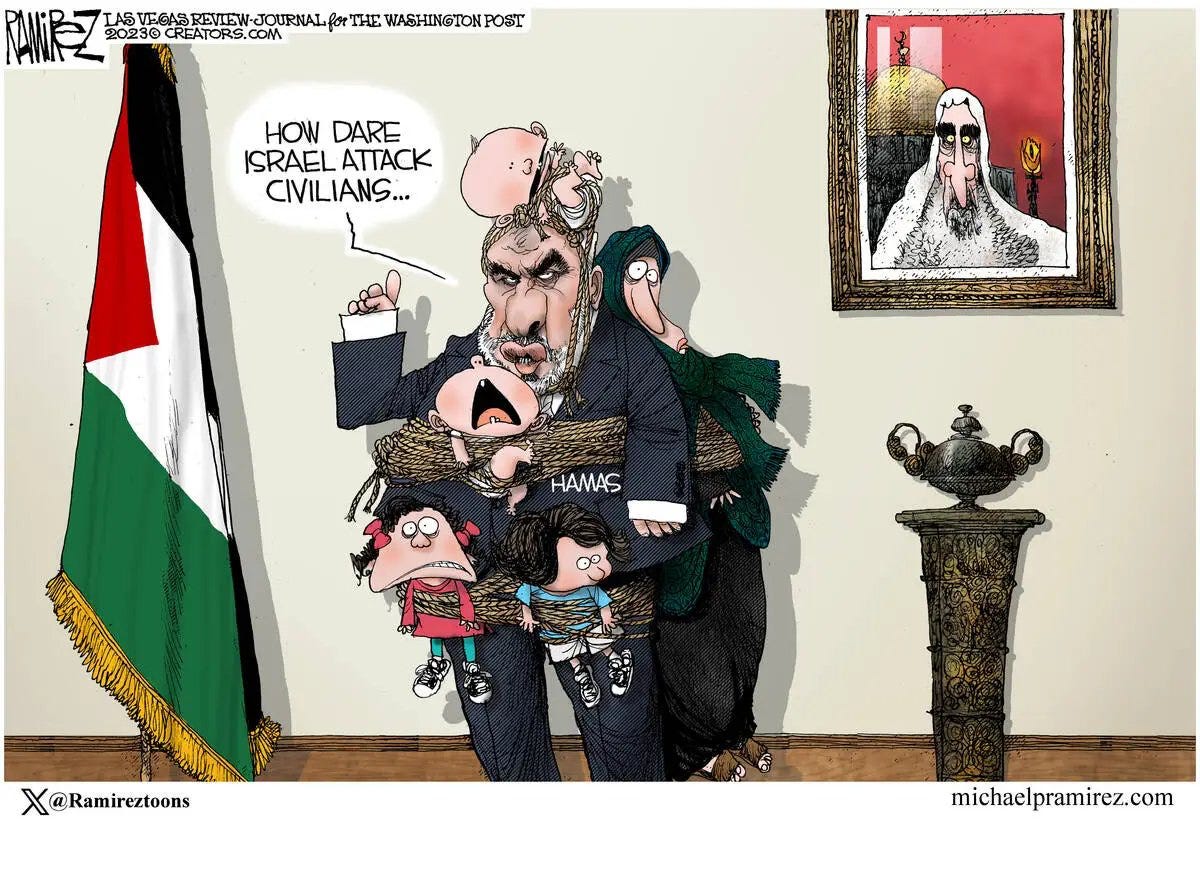
One picture’s worth …

Via Nellie Bowles

Anti-Zionist, antisemitic

Anti-Zionists claim the moral high-ground and often take great offense at any suggestion they are antisemitic. 

But that’s the amazing thing. 

We spend so much time on that debate, everyone thinks it’s just normal to say, “I don’t think Israel should exist.” Because that’s what anti-Zionism means. Zionism is the idea that Israel should exist as a Jewish homeland. It’s not more complicated than that. Anti-Zionism is the idea that Israel shouldn’t exist as a Jewish homeland.

Jonah Goldberg, How Anti-Zionism Shrugs Off Antisemitism

Moral clarity on Gaza

Barack Obama returns to the arena: Former president Obama jetted in from Martha’s Vineyard to say one quick thing, guys: the war’s kinda Israel’s fault! Or at least, we’re all guilty here, man. Hamas is the same as you and me. I’m reactive and need to learn how to take a deep breath before writing emails; Hamas tortured children and livestreamed it. Point is, we’ve all got issues. Here’s Obama: “If you want to solve the problem, then you have to take in the whole truth. And you then have to admit nobody’s hands are clean, that all of us are complicit to some degree.” It takes two to tango. Hamas killed infants point-blank; I never replace the toilet paper roll. 

You know who’s not talking like that? My woman, Hillary Rodham Clinton, who went on The View to deliver a shot of moral clarity straight into Stay-at-Home America’s veins. Here’s Mrs. Clinton: “Remember, there was a cease-fire on October 6 that Hamas broke by their barbaric assault on peaceful civilians and their kidnapping, their killing, their beheading, their terrible, inhumane savagery. It did not hold because Hamas chose to break it.” Moms around the country heard that call and are gathering arms. Hillary’s been through everything, so tarnished in battle she actually became clean again. I’m. With. Her, we all bellowed.

Trendy cultural relativists like 2023-era Obama can never really believe there’s a good guy. Nothing is ever better or worse than anything else. To the cultural relativists, Hamas is just another modern dance—a wild and beautiful expression of the human condition. The old-school feminists like Hilz are not so easily taken. They cut their teeth on brass tacks. They spend Saturday night preparing for the Model UN Conference, where they will crush. It does not take two to tango in the mind of Hillary Rodham Clinton.

Nellie Bowles

Abortion

Abortion in perspective: politique and mystique

The string of political losses since Dobbs overturned Roe has some thoughtful Christian conservatives reconsidering — and a few suggesting that their past writings have been vindicated:

Several years ago Matthew Lee Anderson wrote in these pages that there is no pro-life case for Donald Trump …:

If abortions happen because of the breakdown of marriage, then there is nothing ‘pro-life’ about electing someone who is at best a serial monogamist. If the abortion culture has anything to do with the wider degradation of our society’s sex and morals — as pro-lifers have argued it does for as long as I have been alive — then there is nothing pro-life in endorsing a candidate who has bragged about the number of his sexual partners. It matters that Trump is unwilling to answer whether he personally has funded abortions. It matters a great deal.

Let me be as explicit as possible about what pro-lifers supporting Trump means: It means lending their aid to someone who (with Bill Clinton) was friends with Jeffrey Epstein who was eventually convicted of pedophilia. And Trump knew of it and commended Epstein. I mean, look at this glowing endorsement: “I’ve known Jeff for fifteen years. Terrific guy. He’s a lot of fun to be with. It is even said that he likes beautiful women as much as I do, and many of them are on the younger side. No doubt about it — Jeffrey enjoys his social life.”

Think about that for a second: Conservative evangelicals and other pro-lifers have rushed to find any justification they can think of to vote for a fellow who almost certainly knew of pedophilia occurring, and, for all we do know of him, did nothing to prevent it. At the very least, he was not the one who went to the police about it. That pro-lifers have been reduced to this beguiles the mind, to put it gently.

As long as our laws allow for the killing of the unborn we cannot claim to be such a society. But the erasure of such laws will not, in itself, absolve us of the charge of being a society that is deeply inhumane and hostile to life.

[T]his is what makes the embrace of Trump as a pro-life champion so damaging to the movement: It … diminishes the goals of the pro-life movement, reducing them from the lofty and inspiring ideal of creating a society hospitable to life down [mystique]to simply overturning a badly argued Supreme Court ruling [politique]. And by reducing the ideal in this way it actually drains the life from the pro-life movement, rendering it equivalent to any other political advocacy group whose sole objective is narrowly political in nature.

To secure an admittedly significant political victory the pro-life movement has had to give up this broader vision, for how can you credibly claim to resist the culture of death when your champion is Donald Trump?

Of course, that may be precisely the point. There may be no eulogy more fitting for American Christian conservatism than this: That we secured our continued relevance in American society by giving up the things that might have made us a distinctive society ourselves. We have gained a political victory but even if we triumph, what will we have to say? And can we say any of it with even a modicum of credibility?

Jake Meador, The Mystique of the Pro-Life Movement: On Trump & the March for Life, a reprint from January 24, 2020.

Why Abortion is a losing issue for the GOP

In the eight years since the so-called New Right emerged on the scene and Trump began to dominate the Republican landscape, the Republican Party has become less libertarian but more libertine, and libertinism is ultimately incompatible with a holistic pro-life worldview … Libertarianism says that your rights are more important than my desires. Libertinism says my desires are more important than your rights, and this means that libertines are terrible ambassadors for any cause that requires self-sacrifice.

David French

(Note the congruence of these two perspectives.)

Culture

Liberal democracy’s tacit orthodoxy

Liberal democracy has created its own orthodoxy, which causes it to become less of a forum for articulating positions and agreeing on actions than—to a much higher extent—a political mechanism for the selection of people, organizations, and ideas in line with the orthodoxy. This phenomenon can be seen especially in Europe, where in the past few decades there has been a major ideological rapprochement of the right-and left-wing parties. This resulted in the formation of what is called “the political mainstream,” which includes Socialists, Christian Democrats, the Greens, Social Democrats, Liberals, and even Conservatives. The mainstream that runs in Europe today is tilted far more to the left than to the right. Within it, the left has made a slight shift to the right in some matters (mostly economic) and made a further move to the left in other matters (mainly moral), while the right-wing movement’s shift to the left was huge.

Ryszard Legutko, The Demon in Democracy

Bittersweet resolution of nostalgia

(James Matthew Wilson ached for Michigan during his long exile:)

We had chosen a difficult time to return. Michigan had legalized recreational marijuana use in 2018, and cannabis shops had sprung up all over the place, with their ridiculous names and vulgar slogans appearing on billboards along the highways. The whole state has been defaced with bad puns on words like “high” and “stoned.” And in 2022, the citizens of the state voted to lock abortion rights into the state constitution. It also elected its first Democratic legislature in forty years, and in the short time that coalition has been in power, it has pushed through a slew of left-leaning programs that will further erode the moral and educational standards of the place—all done, ironically, in hopes of luring new residents to the state. Michigan risks becoming a state where the slaughter of the innocent and the drugging of citizens into inertia and schizophrenia are celebrated as pastimes. Its governor proudly speaks of these things as part of a golden vision of the future, alongside the construction of a new Chinese-owned plant for electric vehicle batteries.

These changes have given my family occasion to see why the love of country, the piety of Virgil, is so essential. When one feels betrayed or disappointed—or wounded by the legal establishment of grave evil—the loving reaction is not to withdraw but to abide, to recommit oneself to the saving of what risks being lost. “It is good that you exist!” Love sees through the faults and perversions of the hour. It stands firm, when other kinds of commitment or affection would crumble. This kind of love has to be wound about the bone and deep within the sinew, just as its vision of the object loved is not subject to present appearances. Our truest loves are not universalizing, free, and deliberate, but stubborn, unaccountable, and particular. We do not love immutability, eternity, or omniscience. We yearn to see God’s face, which we find in the human countenance of Jesus. The same holds for natural pieties, especially love of one’s home.

I have a favorite Michigan vacation destination, Traverse City, and agree with him on the “ridiculous names and vulgar [marijuana] slogans.”

What happened to the ACLU

The ACLU really did stand for sincere liberalism during the middle decades of its existence, and perhaps for even longer than that. In the 1990s, when New York City’s Ancient Order of Hibernians wanted to keep a gay pride float out of its century-old St. Patrick’s Day Parade, the local affiliate of the ACLU took the parade organizers’ side. From the 1980s until recently, ACLU lawyers filed numerous amicus briefs against ordinances that banned protest and prayer outside abortion clinics, even though the organization was institutionally pro-choice and had its own “reproductive rights” division. For ACLU lawyers, it was a point of pride that they defended the free speech rights of pro-lifers with whom they disagreed.

Recently, something changed. Impartial liberalism is no longer the ruling ideology at the ACLU. The organization’s social media accounts now regularly weigh in on matters in which civil liberties either are not at issue or seem to lie on the other side. When Kyle Rittenhouse was acquitted on grounds of self-defense after shooting three assailants at a protest in Kenosha, Wisconsin, the ACLU Twitter account lamented that Rittenhouse “was not held responsible for his actions.” In a departure from longstanding practice, the organization began making political ads on behalf of candidates, $25 million worth in the 2018 midterm cycle. A million dollars were spent on an ad opposing Brett Kavanaugh’s Supreme Court confirmation, not because of his legal views but because he had been accused, on flimsy evidence, of sexual assault.

In 2018, a memo titled “ACLU Case Selection Guidelines: Conflicts Between Competing Values or Priorities” formalized the end of the old era. Due to “limited resources” and the ACLU’s need “to recruit and retain a diverse staff,” its lawyers would now avoid taking clients whose “views are contrary to our values.” Among the criteria its lawyers would use when choosing cases were “the potential effect on marginalized communities” and the “harmful impact on the equality and justice work to which we are also committed.”

The ACLU had come full circle. The new generation of left-wing “woke” lawyers is trying to impose on the American justice system the attitude to the law that prevails in Communist countries, where the most important question in any trial is whether a person belongs to a favored class, and where rights such as free speech and the presumption of innocence are derided as bourgeois proceduralism. And they are well on their way to succeeding.

Helen Andrews, What Happened to the ACLU

Things at hand

Now if it is my inclination to tune out the national news, or if I claim that being obsessed with it is a sign not of engagement in the world but of a pathological boredom with it, I do so because I believe that, by comparison, what’s “at hand” is far more important. And I leave aside asking whether there are no Shakespeare plays or sonnets or Melville novels we haven’t read yet that we could go and read instead of glutting our boredom on Fox and CNN. Are we really going to surrender our attention to what the precious twenty-somethings on NPR believe we should care about when we ourselves can take charge of our own attention and attending?

I am not suggesting that anyone abstain from voting in presidential elections, though I confess to having abstained on grounds that seem perfectly reasonable to me: I didn’t want to be implicated in the shenanigans of either of the clowns on offer. But what I am saying is that there are duties of citizenship confronting us not once every four years but every day. And those who account themselves citizens because they vote in abstract elections but cannot be bothered by the “things at hand” are, in my view, not citizens in any sense of the word. They are people sitting on their couches watching the Super Bowl or the Election News, elbow deep in Cheeze Doodles, too busy being consumers of far-away news or sports to be citizens of the near-at-hand—citizens performing, at scale, the offices of neighbor.

Jason Peters, in an essay well worth a few minutes, Citizens of the Things at Hand.

Why is such advice so hard to follow?

Politics

Long-term consquences of Trumpism

One of the many tragedies of this era for the American right is how Trump and Trumpism have consumed young Republican political talent.

The most promising young governor in the party is being steamrolled in this year’s presidential primary, a casualty of Trump’s hubris and ambition. He may never recover from the ridicule he’s endured for his “disloyalty.”

Successful young(-ish) governors like Chris Sununu and Doug Ducey are either out of politics or soon will be, despite how formidable they’d be as Senate candidates. They ran afoul of Trump and therefore would struggle to get through a primary, so they’ve decided not to bother.

Smart young conservatives like Elise Stefanik converted to Trumpism for the same reason, to not run afoul of him or his voters. There’s little left to distinguish phony, opportunistic populists like Stefanik from true believers like Marjorie Taylor Greene. They’re rubber stamps for Trump in equal measure; the only difference is that one mutters sotto voce while doing the stamping.

Right-wing political stars now tend to be made from charismatic charlatans who are good on television, in the image of the party’s leader, not from policy mavens. Kari Lake and Vivek Ramaswamy are better known than most Republican officeholders despite never having won an election.

The closest thing Trumpism has to a next-gen political success story is J.D. Vance in Ohio. In unguarded moments, Vance sounds like a fascist.

That’s a lot of political capital that Republicans have spoiled or squandered.

Nick Cataggio

Our libertarian land

Ross Douthat

I don’t find this surprising at all. I think America is a pro-choice, pro-pot, and pro-gun society. I think the legalization of marijuana in Ohio is going to be a total disaster. But I think social conservatism is largely correct, and unfortunately, fairly unpopular, and that’s bad for the country. But such is life.

Michelle Cottle

Such is a democracy. So you’re saying you believe in thermostatic voting, more or less.

Ross Douthat

I think that America has shifted meaningfully to the individualist left on a range of, quote unquote, “social issues” over the last 20 years, including not just issues about sex and reproduction, but also issues like marijuana.

And I think guns falls into this category. One reason I think the liberals lose on guns in certain ways for the same reason maybe pro-lifers lose on abortion, where if you poll people about specific gun control provisions, they might support them, but they don’t trust Democrats because they think Democrats want to take away their guns. And in the same way, I think it might be that people who would support a 12-week abortion ban in theory don’t trust Republicans to implement it because they think Republicans want to just ban all abortions. I think there may be similar dynamics in play there, in a very libertarian country.

New York Times

Don’t say he didn’t tell us

“If I happen to be President and I see somebody who’s doing well and beating me very badly, I say, ‘Go down and indict them.’ They’d be out of business. They’d be out of the election,” – likely future president Donald Trump, to Univision.

Via Andrew Sullivan

Humpty Elon

“When I use a word,’ Humpty Dumpty said in rather a scornful tone, ‘it means just what I choose it to mean — neither more nor less.’

’The question is,’ said Alice, ‘whether you can make words mean so many different things.’

’The question is,’ said Humpty Dumpty, ‘which is to be master — that’s all.”

Lewis Carroll, Through the Looking Glass, via Goodreads.

We tweeted a line from Louise Perry’s remarkable essay, “We Are Repaganizing” (October 2023): “Abortion is not just ‘healthcare’; it is not at all like getting a tooth or a tonsil removed.” When we turned to promote the tweet as part of an X Ads campaign, the Ministry of Truth at X (formerly known as Twitter) informed us that the ad would not run. Its communication specified a violation of a policy that prohibits the promotion of health and pharmaceutical products and services. But the thrust of Louise’s observation is analytical, not promotional. It concerns what abortion is. Welcome to the Free Society™, brought to you by Silicon Valley. (Via First Things)

When we apply a rule, it means just what we choose it to mean — neither more nor less. The question is who is to be master — that’s all.

Living your faith

For me, faith is about uniting all people. It says all children are children of God. And if you’re truly living out your faith, you’re not playing into these anger and hatred games.

Kentucky Governor Andy Beshear, who won re-election November 7, via E.J. Dionne and David Brooks.

If divine law and human reason condemn hatred of anyone who is “Other” simply because of who he or she is, then even more so do they condemn the irrational and too-often lethal hatred of the People to whom God first made his promises—promises, the Second Vatican Council taught, of which God has never repented (see Nostra Aetate 4). Jew-hatred that leads to cries of “Kill the Jews!” and “Gas the Jews!” is as clear an example of a deliberate choice that “destroys in us the charity without which eternal beatitude is impossible” as one can imagine. It is loathsome. It is a gangrenous wound eating away at everything from higher education to politics. It cannot be tolerated, and those who advocate such barbarities should not be tolerated either. 

For Christians to engage in any form of anti-Semitism is to add further blows to the smitten back of Christ, tied to the Pillar of Flagellation. It is to press more thorns upon his bleeding brow. It is to pound more nails into his hands and feet. It is to thrust another spear into his side. For he was and is, eternally, the Son of David as well as the Son of God, and to scorn his kinsmen is to scorn him.

George Weigel


The human voice: That we can sing seems basis for conjecture that, despite our stupidities and our sinfulness, we might be the reason the universe exists.

Alexander Riley

You can read most of my more impromptu stuff here (cathartic venting) and here (the only social medium I frequent, because people there are quirky, pleasant and real). Both should work in your RSS aggregator, like Feedly or Reeder, should you want to make a habit of it.

St. John the Merciful, 2023

It’s my 75th birthday and my “Name Day.”

The coincidence of birthday and name day isn’t universal in Orthodoxy, but I chose St. John the Merciful (or Almsgiver) by looking at Saints commemorated on my birthday after a futile search for inspiring lawyer-saints (the jokes almost write themselves). I do find his open-handedness admirable, and I presumably was underwhelmed by Bl. John “the Hairy”, Fool-for-Christ, at Rostov, also commemorated today.

A timely Psalm

In the midst of our domestic political chaos, the wars and threats of war in the world, and three-quarters of a century on this earth, this Psalm hit a sweet spot:

If it had not been the Lord who was on our side, let Israel now say—
if it had not been the Lord who was on our side, when men rose up against us,
then they would have swallowed us up alive, when their anger was kindled against us;
then the flood would have swept us away, the torrent would have gone over us;
then over us would have gone the raging waters.
Blessed be the Lord, who has not given us as prey to their teeth!
We have escaped as a bird from the snare of the fowlers;
the snare is broken, and we have escaped!
Our help is in the name of the Lord, who made heaven and earth.

Psalm 123/124, Revised Standard Version, via Bible Gateway (reformatted)

“Religion”

Religion has played such a large part in the lives of human beings throughout human history. In some ways, I wish we could outgrow it; I think at this point it does a lot of harm. But then, I’m fairly sure that if we do outgrow it, we’ll find other reasons to kill and persecute each other. I wish we were able to depend on ethical systems that did not involve the Big Policeman in the sky.

Octavia Butler via Maria Popova

I’m not sure what religion she has in mind — nor, I suspect, is she.

“Religion” is, in the grand scheme of things, a neologism invented in the Western world. It obscures as much or more than it reveals. I’m reminded of a cartoon I saw more than 50 years ago:

Speaker 1: All religions are alike. Just name any two and I’ll prove it.
Speaker 2: Christian Science and Melanesian Frog Worship.

Despite all that, “religion” seems to have become an indispensable word, and I confess to using it even without scare quotes. But it worries me that discussion about religion may be a diversion from growing closer to God.

A possible example of where the term “religion” might be indispensable:

False religions, perpetuate the great divide between flesh and spirit, rather than between good and evil where Christianity says it lies.

Thomas Howard, Evangelical Is Not Enough.

Speaking of Tom Howard …

Tom Howard’s book, just quoted, cleared away some of my mental rubble and spiritual biases on my road to Orthodoxy (though Howard himself “swam the Tiber” to Catholicism).

Unlike many people from backgrounds roughly like mine, I found his approach more persuasive then Peter Gillquist’s Becoming Orthodox, written about a clique of Campus Crusade for Christ (now Cru) staffers who entered Orthodoxy en masse. Suffice that Howard’s evangelical millieu was more aligned with my temperament than Gillquist’s.

I would do well to emulate Howard, who wrote sincere appreciation for all he gained through his evangelical childhood before reaching his eponymous conclusion. My own evangelical childhood was not dissimilar, but then in adolescence I encountered a fuller evangelical culture, and that’s what I (too often) excoriate. And I won’t even get started on the devolution of “evangelical” to a political label, which is beyond the control of sober evangelicals to remedy.

More Howard:

The evangelicalism of my childhood church taught me true doctrine about the incarnation. It taught me about creation and about Eden and about the Fall. But somehow it never, at least in its piety, put Humpty-Dumpty back together again. … A whole array of pickets had been thrown up between us and civilizations, lovely diversions, such as ballet, theater, cinema, and wine, and each point had its rationale, certainly. But the net effect was the plant in our imaginations the notion that spirituality was more a matter of excision than of transfiguration.

Speaking of God …

Although one must think of God constantly, he said, one must not speak of God quickly or readily. One acquires knowledge of God through the mind, but only with the aid of prayer and ascetic discipline. Gregory taught that theology is not for all people or for all occasions. Knowledge of theological matters is not necessary for salvation; only simple faith is needed. Speaking of God is a great task, but spiritual purification is far more important.

Dr. Eugenia Scarvelis Constantinou, Thinking Orthodox

Who finds the Orthodox Church?

This is kind of the culture that we’re up against. The only people who are finding the Orthodox Church, essentially right now, are people who are discontented in a current Christian experience and who have read widely enough, or are theologically savvy enough, to at least have a intellectual connection to the existence of the Orthodox Church.

Steve Robinson (at 42:00)

Of the late Francis Schaeffer …

… a theory advanced by his son:

My father’s theology was formed in a particularly bitter moment and never evolved along with the rest of his thinking. The theological battles of the 1920s and 1930s shaped Dad in the same way that political battles would shape the Vietnam generation in the 1960s. Passions forged in those battles became part of a personal identity that was difficult for people who did not share the passionate and polarizing experiences to understand.

Frank Schaeffer, Crazy for God

It has been a long time since I mentioned or quoted from Frank(y) Schaeffer. Suffice that I’ve read most of his books and do not recommend that you do so. But this theory joins one other quote from him as worth sharing.

The most dangerous foe, as seen from Mercerburg

The most dangerous foe with which we are called to contend, is again not the Church of Rome but the sect plague in our own midst; not the single pope of the city of seven hills, but the numberless popes—German, English, and American—who would fain enslave Protestants once more to … mere private judgment and private will. … the deceived multitude, having no power to discern spirits, is converted not to Christ and his truth, but to the arbitrary fancies and baseless opinion of an individual, who is only of yesterday.

Nathan O. Hatch, The Democratization of American Christianity, quoting “Mercerburg Theologians” Philip Schaff and John W. Nevin.

I did not know of Mercerburg Theology until after I’d become Orthodox, though Philip Schaff compiled a collection of patristic writings that’s still popular, perhaps because it’s free on the internet.

Mercerburg is a fascinating “so near yet so far” moment in Protestantism.

Straight answers, true answers

We often avoid giving a straight answer because the nature of true answers [is] often not straight.

Fr. Stephen Freeman, Lost and Found: Playing Hide n Seek with God Session 1


The human voice: That we can sing seems basis for conjecture that, despite our stupidities and our sinfulness, we might be the reason the universe exists.

Alexander Riley

You can read most of my more impromptu stuff here (cathartic venting) and here (the only social medium I frequent, because people there are quirky, pleasant and real). Both should work in your RSS aggregator, like Feedly or Reeder, should you want to make a habit of it.

Kristallnacht 2023

Today is the 85th Anniversary of Kristallnacht.

If you don’t know, look it up (and may God have mercy on your soul).

Culture

Swifties

I do not follow Taylor Swift (I know that she has not taken on the affect of a whore, a pop music rarity I appreciate), but other sure do — even the august Economist:

Taylor Swift’s re-recording of her album “1989” sold nearly 1.7m copies in its first week post-release, surpassing the 1.3m sales of the original in 2014. The pop singer started re-recording her albums in 2021 as a way of regaining control of her master tapes, after Big Machine, her former record label, sold the original masters to Scooter Braun, a music mogul.

Pretty sharp thinking, that — and another 1.7 million album sales to boot.

VR

Virtual reality is friction-free. The dissidents are removed from the system. People get used to that, and real life seems intimidating. Maybe that’s why so many internet pioneers are tempted by going to space or the metaverse. That sense of a clean slate. In real life, there is history.

Sherry Turkle at Crooked Timber

Humblebragging

David Bernstein’s conclusion to Bill Ackman’s Letter to Harvard re Widespread Antisemitism on Campus

The Jewish intellect

May heaven have mercy on the European intellect if one wanted to subtract the Jewish intellect from it.

Walter Kaufmann in his translator’s preface to Basic Writings of Nietzsche.

Things nobody’d dare say today

If ever an oppressed race existed, it is this one we see fettered around us under the inhuman tyranny of the Ottoman Empire. I wish Europe would let Russia annihilate Turkey a little—not much, but enough to make it difficult to find the place again without a divining-rod or a diving-bell.

Mark Twain, The Innocents Abroad

Did we forsake our sin or vice-versa?

Fewer men are needed as gang workers in the fields: slavery has become uneconomical.

Ivan Illich, Tools for Conviviality

(But I’m sure we abolished slavery purely out of the goodness of our hearts. Right?)

The Feast of Hot Takes

In many cultures, holidays are celebrated in tandem, on consecutive days. Halloween is followed by the Day of the Dead; Christmas is followed by Boxing Day; Thanksgiving is followed by Black Friday; New Year’s Eve is followed by, uh, New Year’s Day.

There’s a special pairing for pundits: Election Day is followed by The Feast of Hot Takes.

On The Feast of Hot Takes, you gather piecemeal results spread across different regions from the previous evening and arrange them to form a mosaic that perfectly matches your priors.

Nick Cattogio

Politics

At or over the brink

I have been a reluctant liberal democrat (small l, small d) because I cannot think of a better and more just way to govern a fractious, highly diverse polity like the United States. Christian nationalism? It could work in Hungary, which is far less religious but far more monocultural than America, but it is very hard to see how America could pull it off and remain a democracy. Anyway, whose Christianity? The Catholic integralists? The Calvinist integralists? Seems to me that if we Christians can’t keep our own churches from bleeding out, the idea of ruling the country is a pipe dream.

… Please understand, I want to live in a properly liberal democratic society. But liberal democracy doesn’t exist outside of a context. You have to hold prior beliefs that serve as a foundation for equal treatment under law, for free speech, freedom of the press, freedom of assembly, freedom of religion, and all the rest. The moment, for example, that you believe that some people deserve preferential treatment under the law because of their race, sexual orientation, or gender identity, you have largely ceased to be a liberal democrat, whether you know it or not.

… [I]f it comes down to a choice of having to support Caesarism as a way to protect the rights and interests, and even the lives, of my family and people I care about, or keep bowing to the idol of liberal democracy while the radical Left takes over, then I’ll be a reluctant Caesarist.

Rod Dreher (italics added).

Despite my italics, it’s that last paragraph that’s the most dangerous, because millions of MAGA Americans have concluded (delusionally, I think) that it has come down to that — that the Democrats truly are an immanent and existential threat. (I understand that the Democrats may reciprocate, but despite not having voted Democrat in a Presidential race since 1972, I’m more sympathetic to their conclusion than the MAGA conclusion. See the next item.)

I read a bit about the French Revolutionaries very recently, and they brought to my mind not Antifa, but MAGAworld; not the Summer of 2020 but January 6, 2021.

But in the spirit of refusing to pick my poison, I remain a reluctant liberal democrat who expects for vote for neither major-party POTUS candidate next year.

More Dreher:

The message is clear: … the people vote the way the ruling class in the US and western Europe want, and you’ve got a democracy; if not, well, there’s nothing wrong with your authoritarian bigot country that a Washington-financed Color Revolution can’t fix.

There’s truth in that even if Rod’s catastrophism has pushed him to or over the edge.

Why the far Right is worse than the far Left

Trump’s extremism isn’t mainly a function of policy commitments, however much his positions on immigration, trade, and foreign policy are heretical in the context of the Reaganite conservatism that dominated the GOP from 1980 until 2016. No, Trump is a threat to American democracy primarily because of his tactical extremism—that is, his indifference to the rule of law, procedural norms, and above all his defiance of the democratic rules by attempting a self-coup in the two months following the 2020 election. Not even the most radically left-wing faction of the Democratic Party has shown any indication of favoring such flagrantly anti-democratic tactics for gaining and holding political power.

The right-wing media ecosystem is a machine that runs on the fallacy of composition.

Damon Linker. As hinted, I’m inclined to agree with Linker in the rather abstract way of one committed to despising both major parties.

DeSantis’ disqualifying “signature move”

Just once, … I’d like to see [Ron DeSantis] debate without proposing a policy that violates the Constitution. Yet there he went again, proposing plainly unconstitutional summary executions for fentanyl smugglers at the border and bragging about violating the First Amendment rights of pro-Palestinian student groups on Florida campuses. Unconstitutional policymaking is a divisive waste of time, but that remains DeSantis’s signature move.

David French, part of a New York Times panel analyzing performances in the third GOP Presidential debate.

DeSantis isn’t just shooting off his mouth. Several of his “successful” signature legislative initiatives in Florida have been unconstitutional.

Jamelle Bouie, on the same panel, had one of his periodic flashes of insight:

Ron DeSantis cannot escape the fact that it makes no real sense to try to run as a more competent Donald Trump, for the simple reason that the entire question of competence is orthogonal to Trump’s appeal. There’s not really much of an audience in the Republican primary electorate for what DeSantis is trying to sell, and it doesn’t help him that it seems he hates being a salesman of any sort.

That really wraps up my impression of DeSantis and puts a bow on it.

A flash of sanity; settled mendacity

It’s not a question between right versus left anymore. It’s normal versus crazy …

Arkansas Governor Sarah Huckabee Sanders says something sensible. Unfortunately, she didn’t stop there:

… and President Biden and the left are doubling down on crazy.

Wut?!?!

Bummer of the day

I had understood that the poll showing Trump ahead of Biden in six swing states was a piece of crap that only called landlines. That was encouraging.

Unfortunately, it appears to have been false:

The New York Times/Siena College polls of 3,662 registered voters in Arizona, Georgia, Michigan, Nevada, Pennsylvania and Wisconsin were conducted in English and Spanish on cellular and landline telephones from Oct. 22 to Nov. 3, 2023. When all states are joined together, the margin of sampling error is plus or minus 1.8 percentage points for all registered voters and plus or minus 2 percentage points for the likely electorate. The margin of sampling error for each state poll is plus or minus 4.4 percentage points in Arizona, Michigan and Nevada, plus or minus 4.5 points in Georgia, plus or minus 4.6 points in Pennsylvania and plus or minus 4.8 points in Wisconsin.

So now I’m relying on my impression that those margins of error are awfully big.

Silver lining: My home state is still showing solid red, which means I at least can again vote my conscience instead of trying to suss out who’s the lesser evil between the major parties.

The Left Made Us Do It!

So how did a party and a political movement that once saw itself as a vanguard of objective truth end up on the side that gets to make up its own facts, its own scripts, its own realities?

Rich Tafel, the chief executive of Public Squared, developed a training called Cultural Translation, which teaches participants how to find shared values to build bridges across different worldviews. He told me the narrative he’s heard from people on the right is that they tried fighting the left for years, nominating admirable people like John McCain and Mitt Romney, but these leaders failed to understand how the game had changed. “Those on the right argue that claiming that there are objective truths and hard realities didn’t work against the identity politics of the postmodern left,” according to Mr. Tafel. “Now, they’d say, they are playing by the same rules.” In fact, he said, “MAGA has weaponized postmodernism in a way the left never did.”

Mr. Tafel added that MAGA world “likes the trolling nature of the postmodern right and the vicious attacks” against those they oppose. “The right likes the snark, irony and sarcasm of it all.”

Peter Wehner, Donald Trump Has Closed the Republican Mind


A fundamental reality of human existence is that vice often leaves virtue with few good options. Evil men can attach catastrophic risks to virtually any course of action, however admirable.

David French

You can read most of my more impromptu stuff here (cathartic venting) and here (the only social medium I frequent, because people there are quirky, pleasant and real). Both should work in your RSS aggregator, like Feedly or Reeder, should you want to make a habit of it.

Monday, 11/6/23

Will you live?

[A]ll death is certain. We don’t get to choose whether we live or die. We only get to choose if we live before we die.

Konstantin Kisin

New York

  • In Grub Street, Mark Byrne took issue with a friend’s comment that the Greenwich Village restaurant Cafe Cluny is “too expensive for what it is.” “This is Manhattan: ‘Too expensive for what it is’ is written in rat’s blood on the stoops of our walk-ups,” he riffed.

Frank Bruni

Revolution

Revolutionaries ask Americans to do not simply what is bad but also what is impossible. To a revolutionary who believes in racial immanence, only a reinvention of America as we know it would suffice. Yet even then, racial immanence presents further obstacles. Any revolution would, in time, prove insufficiently revolutionary. Such is the nature of maximalist thinking. After all, the white people remaining in the theoretical new nation would have been socialized by the ancient regime into white supremacy and conditioned to uphold it at all costs. What do we do about them? There is no end to the matter—at least not one that anyone cares to identify.

Tal Fortgang, The Incrementalists and the Revolutionaries

Lighting lanterns

That’s the best we can do in life — be truthful and hope those truths become lanterns for others as they wander through the dark.

Patty Davis, paying tribute to Matthew Perry’s candor about addiction, via Frank Bruni

In a lot of ways, my blogging is striving toward such lantern-lighting — posting provocative thoughts about questions to which I may have no answers. It may be untrue that “together we can do anything,” but I believe that we can do more together than we do fussin’ and fightin’ with one another.

How to fight The Machine

How to fight back? Religion is one way. Have a family at a young age instead of wasting your life buying crap on Amazon. Become a carpenter or a welder. Keep bees.

David Samuels, Year Zero: The Age of the Machines Demands Its Own Samizdat

Heroes in their own little minds

This week, I watched videos of people literally burning Harry Potter books, like latter-day Nazis, in the cause of transgender liberation. It’s safe to say, I think, that many of these people have lost their minds — just by staying online. And they not only think they’re perfectly sane; they think they’re heroes.

Andrew Sullivan, We Are All Algorithms Now

Shorts

  • Israel omitted from online maps in China amid war on Hamas in Gaza
  • A professor at an esteemed college mentioned this week that when he likened the airport mob in Dagestan to a “pogrom,” not one of his students knew what the word meant. (Peggy Noonan, hyperlink added)
  • Here is a truth: Anything good for cable news is bad for humanity. (Peggy Noonan)
  • No man will give his life for a question mark; he will for an exclamation point! (Cardinal Timothy Dolan, who attributed it to John Paul II via Cardinal Edwin O’Brien. All this via Raymond de Souza)
  • There’s a certain amount of chutzpah among Democrats to assume that it’s only the other side pursuing a culture war. (Ruy Teixeira)
  • Nobody ever quite knew what to make of [Edward] Abbey, which is a status we should all aspire to. (Paul Kingsnorth)
  • Donald Trump dishonors America in so many ways that it isn’t possible to keep them all in mind and still remember to brush your teeth. (George Packer in 2020)

You can read most of my more impromptu stuff here (cathartic venting) and here (the only social medium I frequent, because people there are quirky, pleasant and real). Both should work in your RSS aggregator, like Feedly or Reeder, should you want to make a habit of it.