June 11, 2025

Culture

Beauty

Many catholic young people should have arrived at Chartres Tuesday or Wenesday, having averaged about 20 miles a day in pilgrimage since leaving St. Sulpice in Paris on Sunday:

I spoke with a 32-year-old American priest who was there with a group of teenage boys from his local high school. He talked about the appeal of the old mass, and Catholic tradition, to kids today. They had been earlier on a retreat at the traditionalist Benedictine abbey of Fontgombault, and he said these American boys had been blown away by what they had seen and done there. The priest predicted that they were going to be overwhelmed by the beauty of Chartres. He said that most American boys their age have already seen the worst of humanity in hardcore porn, before they have ever seen real beauty. So Chartres is going to be a revelation for them.

Rod Dreher, Surprising Hope in the Streets of Paris (bold added)

What a thought! There is precious little “real beauty” around us in the USA, especially real manmade beauty. But there’s plenty of rot.

A part of the American ethic

Take, for instance, when the doctors were asked whether they would go to court to override the parents’ wishes if the child did not have Down Syndrome. They responded unanimously that they would, and they gave the following rationale: “When a retarded (sic) child presents us with the same problem, a different value system comes in; and not only does the staff acquiesce in the parent’s decision to let the child die, but it’s probable that the courts would also. That is, there is a different standard. . . . There is this tendency to value life on the basis of intelligence. . . . [It’s] a part of the American ethic.”

Justin Hawkins, Dignity Beyond Accomplishment – Mere Orthodoxy (bold added)

Sexual stereotypes

Popular sites like What to Expect verify that some aspects of child development differ by gender, yet even such sites advise parents to try to equalize or neutralize the differences. We’re so influenced by the Gender Ideology that we don’t seem to consider the possibility of embracing the children’s own preferences for activities that are “stereotypically” male or female.

Jennifer Roback Morse, The Sexual State

I do not recommend this book. How little did I like it? Enough that having read it when considering a conference where the author was a keynote speaker, I forewent the conference.

But it’s hard to write a whole book without an observation or two that’s both accurate and temperately made.

I am also adamant that breaking sexual stereotypes is not a sign that one is “in the wrong body.”

Marriage today

… marriage American-style, an obligation easier to walk away from than student loans or credit card debt …

Kevin D. Williamson, Husbandry Matters

Custom

I’ve been watching enough BritBox to reflexively view Elon as in the driver’s seat.

AI

Yeah, everybody’s got to prattle about AI as the topic du jour for countless jours now. I’ll try not to be anodyne or banal.

The rule of Nobody

What with expectations that AI will become our new deity, coupled with the profit motive and AI hallucinations, Matthew Crawford returns to a variation on the theme that first made him famous 16 years ago:

In the year of our Lord 2025, getting things done often requires finding, not the recent hire who just reads through the prompts on his screen and is trapped in the same hall of mirrors as you, but the guy or the gal with enough institutional knowledge to be able to thwart the system.

AI will get rid of those people. What then? The dystopia I fear is not one in which superintelligent machines achieve self-awareness and wipe out the human race, it is the prospect of a tightening grid of dysfunction and paralysis, achieved through the final victory of “the rule of Nobody,” to borrow a phrase from Hannah Arendt. The Nobody cannot be addressed.

Oh sure, there will probably still be a counter you can walk up to, with a very charming robot-lady behind it. Detecting the emotional register of your voice, she will express empathy for your plight. “I understand this can be frustrating. Let me see what I can do.” But this will turn out to be just a creepier version of “your call is important to us,” which is Business English for “fuck off, we don’t want to talk to you.”

Your call is important to us…. This post was remarkably persuasive to me, with a dandy analogy from “work-to-rule slowdowns” in labor disputes.

Language no longer implies thinking

LLMs (the so-called AI process) are impressive probability gadgets that have been fed nearly the entire internet, and produce writing not by thinking but by making statistically informed guesses about which lexical item is likely to follow another …

People have trouble wrapping their heads around the nature of a machine that produces language and regurgitates knowledge without having humanlike intelligence. The authors observe that large language models take advantage of the brain’s tendency to associate language with thinking: “We encounter text that looks just like something a person might have said and reflexively interpret it, through our usual process of imagining a mind behind the text. But there is no mind there, and we need to be conscientious to let go of that imaginary mind we have constructed.”

Witness, too, how seamlessly Mark Zuckerberg went from selling the idea that Facebook would lead to a flourishing of human friendship to, now, selling the notion that Meta will provide you with AI friends to replace the human pals you have lost in our alienated social-media age.

Tyler Austin Harper, What Happens When People Don’t Understand How AI Works

Enough

The question with which to start my investigation is obviously this: Is there enough to go round? Immediately we encounter a serious difficulty: What is “enough”? Who can tell us? Certainly not the economist who pursues “economic growth” as the highest of all values, and therefore has no concept of “enough.” There are poor societies which have too little; but where is the rich society that says: “Halt! We have enough”? There is none.

E.F. Schumacher, Small Is Beautiful

Denying our Civil Religion

America has a civil religion that is the equal of any other religion. “Why something so obvious should have escaped serious analytical attention is in itself an interesting problem.” If American nationalism is so obviously a religion, in other words, why do we deny it? Bellah posits that conservative religious groups deny it because they believe that Christianity is, in fact, the national religion. As recently as the 1950s they proposed a constitutional amendment recognizing the sovereignty of Jesus Christ. Secularists deny that America has a civil religion because they do not believe the nation-state does or should have anything to do with religion.

William T. Cavanaugh, The Uses of Idolatry

Short-form social media

[W]hether on Twitter or Bluesky, there are five major varieties of short-form social-media post:

  • “Here is some information”
  • “Look at how funny I am”
  • “Look at how stupid my enemies are”
  • “Look at how smart my allies are for pointing out how stupid my enemies are”
  • “Hello total stranger! You’re an idiot”

Obviously, posts in the first category are useful; posts in the second can be enjoyable when the poster actually is funny; and the remaining three are poisonous.

(Alan Jacobs)

Sorta political

Henry and Thomas

Each of Henry II and Henry VIII had a Thomas, Becket and More respectively, who were martyred for their resistance to totalitarian pretentions:

Washington has passed a law requiring that Catholic [also Orthodox, I’m sure, though with progressives one never knows] priests report certain sexual crimes that might be communicated to them in the confessional …

What Henry II and Henry VIII could not live with was the idea that there were centers of power independent of the state—that the power of the king was limited. Americans supposedly cherish the notion of limited government and insist that we would abide no king, but we are in most things perfectly happy to let presidents behave as though they were Louis XIV—as long as they are doing what we want them to do, or at least as long as they are irritating and discomfiting those we regard as our rivals and enemies.

If you cleave to a political philosophy holding that there is nothing outside of the state, then you are a partisan, however well-meaning, of absolutism and totalitarianism. Not every totalitarian temptation indulged leads directly to 1984. … There are many stops, many way stations, and (one prays) many off-ramps along the road to serfdom. But allowing the state to shove its stupid snout into the confessional is a big step in the wrong direction. It is one that should be resisted not only by litigation but also through civil disobedience, if necessary.

You may have heard these famous lines from Cardinal Francis George, the late archbishop of Chicago, envisioning life under such totalitarian assumptions:

I expect to die in bed. My successor will die in prison. And his successor will die a martyr in the public square. His successor will pick up the shards of a ruined society and slowly help rebuild civilization, as the church has done so often in human history.

The cardinal’s words had more impact than he intended: “I was responding to a question and I never wrote down what I said,” he later said about his famous statement, “but the words were captured on somebody’s smartphone and have now gone viral.” But his views were no less dramatic when expressed in less dramatic language: “The greatest threat to world peace and international justice is the nation state gone bad, claiming an absolute power, deciding questions and making ‘laws’ beyond its competence,” he later wrote. And his actions bore out his convictions: When the state of Illinois insisted that funding for adoption and foster care providers would be restricted to those that agreed to provide services to same-sex couples, the cardinal, with regret, instructed Catholic Charities to refuse to comply, and the archdiocese eventually discontinued those services. That is the totalitarian tendency at work: The question wasn’t whether there would be 500 adoption agencies that serve same-sex couples but whether the 12.7 million people of Illinois could tolerate one that did not.

Kevin D. Williamson, The Totalitarian Tendency and the Confessional

For what it’s worth: How do the bien pensants of Washington expect that a violation of this law will ever be discovered?

Department of Justice crashes

The Administration’s bad faith comes home to roost already.

Can’t be bothered to learn

Elon Musk’s disinterest in learning the first thing about government, combined with his enthusiasm for performatively cutting the parts of it that irked him politically (in at least some cases because he has become a deranged conspiracy theorist), led him to eviscerate USAID, and to brag about it on Twitter:

We spent the weekend feeding USAID into the wood chipper.

Could gone [sic] to some great parties.

Did that instead.

This decision led and will continue to lead to a heartbreaking amount of suffering and death — to children and babies dying because they were cut off from access to, for example, U.S.-provided peanut paste (cost: $1 a day). One statistical model published by a Boston University public health researcher projects that Musk’s cuts will cause hundreds of thousands of child deaths. I have not looked closely into that model, but let’s say its estimate of 300,000 is off by a massive amount and Musk’s actions only led to 75,000 deaths. Was it worth it?

I don’t think Elon Musk woke up one day and decided to starve some Yemeni children to death. Rather, I think he couldn’t be arsed to learn the details of what he was doing, and instead succumbed to conspiracy theories about USAID (the drug use can’t have helped here), until he really did convince himself USAID was “a criminal organization” that needed to “die.”

Jesse Singal

Bro, you gave up a podcast. And you’re not divorced. Or separated.

It is easy to make fun of Dan Bongino, the emotionally incontinent former cop turned podcaster appointed for some inexplicable reason by Donald Trump to serve as deputy director of the FBI as a subordinate to Kash Patel, whose main qualification for the job was having been the author of … a children’s book about the Steele dossier, a fact that sounds totally made-up but that is totally not made-up.

And it is a good week for making fun of Bongino, who recently had a public emotional breakdown on Fox News—where else?—about how he “gave up everything” to take on a thankless job in public service. About which: Bro, you gave up a podcast. Bongino went on to say that the job was so hard that he was now divorced from his wife, only to realize that he didn’t exactly mean what he said. The bombastic mode of speech that is apparently obligatory in Trump’s orbit had served him poorly, and so he corrected himself: “separated.” But he didn’t mean “separated” the way it sounds when it is used in conjunction with “divorce.” He just meant that he’s spending a lot of time at the office away from his family.

Kevin D. Williamson


Your enemies are not demonic, and they are not all-powerful and the right hasn’t always lost and the left hasn’t always won. But if you convince yourself of that, you give yourselves all sorts of permission to do a lot of stupid and terrible things under the rubric of “Do you know what time it is?”

Jonah Goldberg.

Trumpism can be seen as a giant attempt to amputate the highest aspirations of the human spirit and to reduce us to our most primitive, atavistic tendencies.

David Brooks)

I don’t do any of the major social media, but I have two sub-domains of the domain you’re currently reading: (a) You can read most of my reflexive stuff, especially political here. (b) I also post some things on my favorite social medium. I am now exploring Radiopaper.com as well.
Pentecost 2025

AI at Prayer

At a recent Gospel Coalition conference, celebrity pastor John Piper told his audience about a task he had given ChatGPT: Write a prayer informed by the theology of Don Carson. He proceeded to read the resulting text. ChatGPT’s “prayer” seemed to tick all the theological boxes; the crowd murmured, seemingly impressed. But John Piper was not. He declared that such a “prayer” was not a prayer at all, being the product of a soulless machine rather than the expression of a worshipful human heart.

Machine-generated prayers really can sound just like human-generated ones, prone as we are to fall back on generic formulations and common clichés. If an AI prayer isn’t truly prayer, what implications might that have for our own praise and petition, which too often evince our programming in Christianese and other habitual forms?

In the Sermon on the Mount, Jesus warns his disciples not to “heap up empty phrases [“use vain repetitions,” in other translations] as the Gentiles do” (Matt. 6:7, ESV throughout). He then proceeds to teach the disciples the specific words of the Lord’s Prayer.

In the Lord’s Prayer, Jesus addressed the problem of “vain repetitions” not by extolling the authenticity of spontaneous and personally composed—or generated?—prayers but by giving his hearers a specific prayer, with petitions whose depths his followers have meditated on for around 2,000 years.

[Jesus Christ] is forming people as living words. In 2 Corinthians 3:3, the apostle Paul described the Corinthian Christians as a “letter from Christ delivered by us, written not with ink but with the Spirit of the living God, not on tablets of stone but on tablets of human hearts.” Elsewhere, in Colossians 3:16, he spoke of “the word of Christ dwell[ing] in you richly” in the singing of psalms and hymns and spiritual songs. The church is a living message of Christ, a people who are formed as word bearers as Holy Scripture is metabolized into us through memorization, meditation, song, prayer, sermons, reading, and praise.

This, of course, is the purpose of something like the Lord’s Prayer: that in constantly returning to these words, we might be formed by them, becoming the sort of people who can pray them fully. Spontaneity and originality can be worthwhile in their place, but far more important than the words that we produce are the words that go down into our bones and are treasured in our hearts.

Alastair Roberts

It has been a very long time now since I ascribed any value to the “spontaneous” part of “spontaneous prayer” because I long ago picked up on the generic formulations, clichés, and faux fervency.

Contrariwise, when I found the Orthodox faith, the exalted words of its prayer books immediately struck me as (a) better than my own and (b) something that would form me if I continued praying them. They still are the backbone of my daily prayers.

Knowing for the first time

People in American think they know what Christianity is. Some of them intensely dislike it. Some of them dislike it for what it truly is (it was ever so), some for what they mistakenly imagine that it is.

The first of my daily prayers for America is:

Prosper your one holy, catholic and apostolic Church in America, drawing all to your Church and to true repentance and faith in You. May we remember You once more, “knowing You for the first time” in an Orthodox manner.

The quote is from T.S. Eliot’s Little Gidding, part of his famous Four Quartets:

We shall not cease from exploration
And the end of all our exploring
Will be to arrive where we started
And know the place for the first time.

I came across it Saturday as the epigraph for Addison Hart’s Orthodox “conversion story.” He nearly became Orthodox in 1982, but settled for a halfway measure:

Since my “first” conversion during my early twenties, these convictions have remained in me like bedrock, though they were briefly obscured. That earlier conversion consisted in a turn to a richly liturgical, mystically inclined, patristically informed, uncompromisingly traditional Anglo-Catholicism, from out of an anemic liberal Protestant Episcopalianism – a sort of “in-house” conversion since both were nominally Anglican.

Wildernesses don’t come with marked directions, and in recent years my intellectual religious life likewise seemed directionless. I had tried to “come home” to Anglicanism, but it wasn’t home anymore. For one thing, its sheer unrelieved blandness left me at times feeling stultified.

I’m not Orthodox with any other goal than to be within the historical Church (and I emphatically do not believe in an “invisible church” where affiliation is of no matter).

Addison Hodges Hart, How I wandered into Orthodoxy: an uncharacteristically personal reflection

One of the causes I’ve consciously taken on in my 27+ years as an Orthodox Christian is to entice people who are mistaken about Christianity to take a look at Orthodox Christianity. Part of that is to help them see things they “can’t unsee” about other traditions that I think I’m competent to comment on. Another part is to feature winsome things from Orthodoxy — winsome enough to entice them into exposure to the Orthodox Faith.

“I’m the man behind the curtain”

When I first started looking into the Orthodox Church, I was still working as a stagehand. So I worked in theaters. I did big concerts, all this kind of stuff, and I was going, as I said, to the beginnings of a megachurch, and there was one point on Sunday morning that as I looked around me and I saw the people lifting up their hands and clearly having, you know, some kind of experience, I thought to myself — and it was a very cynical thought, but this was the thought that I had — “I can, through my professional skills, make them have this experience — whether I believe in it or not, through the technique of the music and the lights and so forth.”

I went to, professionally, I went to a few Dave Matthews band concerts. And so Dave Matthews band, they had this song called Ants Marching, and there’s this one moment in the song when they always turn on this huge bank of lights towards the audience, and I watched this happens three times. The audience gets very excited, goes crazy, has a big emotional experience. That is pure technique, and you can absolutely press a button and they’re suddenly having an experience. And I realized at that moment, I said to myself, “I’m the man behind the curtain. I can do this.”

Now, I don’t doubt the sincerity of those people. I grew up with those people. They’re my family. Absolutely, and I believe in their sincerity. I believe in their love for God. But at the same time, knowing that I could make that happen myself, and … that disillusioned me in a very real way.

And then my experience of orthodox worship, even a very poor version of it in terms of its its wealth, was the thing that actually overwhelmed me and not in like an emotional way like I didn’t have big emotions there was something there was a sense of being of connecting another world.

Fr. Andrew Stephen Damick to Justin Brierly.

Fr. Andrew wasn’t wrong that he could use rock concert techniques to induce “spiritual” ecstasies. My experiences in Evangelicalism were fairly low-tech, but not low on technique. Tone of voice, shouting and then dropping to a whisper; “Now every head bowed and every eye closed … I see that hand; is there another” when there was no hand raised in the first place (to signify that the sermon had landed, and the fruit was ready for harvest).

I was lucky enough not to be quite good enough to be in the proto- “Praise Band,” on stage, watching the manipulation first-hand. Had I actually participated in such, I might well have lost my faith — as some who did participate lost theirs.

One of those was a friend of mine. He was good enough to be in the band. He saw that there were no hands raised when the bandleader/evangelist asked if there were others. He questioned the bandleader, who shot back angrily “I learned that from Thurlow Spurr! Don’t you dare question it!”

When the genuineness of Christian conversion is gauged by a “born-again experience,” and that experience can be produced on demand by manipulative techniques, how can you keep believing?

As it was, I (who heard the Thurlow Spurr story second-hand) only lost the kind of faith you can gin up with trickery. Instead of losing Christianity, I eventually found what Fr. Andrew found.

Come and see.

Filled with all the fullness of God

For this reason I bow my knees to the Father of our Lord Jesus Christ, from whom the whole family in heaven and earth is named, that He would grant you, according to the riches of His glory, to be strengthened with might through His Spirit in the inner man, that Christ may dwell in your hearts through faith; that you, being rooted and grounded in love, may be able to comprehend with all saints what is the width and length and depth and height—to know the love of Christ which passes knowledge; that you may be filled with all the fullness of God ….

Ephesians 3:17-19 (emphasis added).

This has been a favorite passage of mine for almost 60 years now( I believe I even signed high school yearbooks with the citation). My love of that last phrase in particular, it seems to me, is an anticipation of my almost instant love Orthodox Christianity once I encountered it.

A very, very low bar

What the Fathers decried as schism is now regarded as normal church growth. So long as the new church does not make a point of denying the Trinity, it remains a part of the [one holy church].

Fr. Lawrence Farley

Creation

As Peter Geach puts it, for Aquinas the claim that God made the world “is more like ‘the minstrel made music’ than ‘the blacksmith made a shoe’”; that is to say, creation is an ongoing activity rather than a once-and-for-all event. While the shoe might continue to exist even if the blacksmith dies, the music necessarily stops when the minstrel stops playing, and the world would necessarily go out of existence if God stopped creating it.

Edward Feser, Aquinas

Team Christian

Sometimes people hear about my religious journey and ask me about my “conversion,” but that word is a relic from the rationalist mentality — as if I traded one belief system for another. The process felt more like an inspiration, like someone had breathed life into those old biblical stories so that they now appeared true.

Today, I feel more Jewish than ever, but as I once told some friends, I can’t unread Matthew. For me, the Beatitudes are the part of the Bible where the celestial grandeur most dazzlingly shines through. So these days I’m enchanted by both Judaism and Christianity. I assent to the whole shebang. My Jewish friends, who have been universally generous and forbearing, point out that when you believe in both the Old and New Testaments, you’ve crossed over to Team Christian, which is a fair point.

David Brooks, The Shock of Faith: It’s Nothing Like I Thought It Would Be

Last Meal

I frequent a health club where they post a question on the corkboard daily. A few weeks back, one went like this:

You’re on death row. You’re to be executed tomorrow. What do you want your last meal to be?

I said “the Eucharist.”* It gratified me to hear that my Missouri Synod Lutheran friend who trains in the slot ahead of me had said the same.

I dare say that not one in ten white American evangelical would say that in 2025.

I confess that I struggle to see how “Christian” can meaningfully cover both wanting a last meal of prime rib and wanting a last meal of the body and blood of Christ.

* Confession: “Lobster” flickered in my imagination for about a half-second.


Religious ideas have the fate of melodies, which, once set afloat in the world, are taken up by all sorts of instruments, some woefully coarse, feeble, or out of tune, until people are in danger of crying out that the melody itself is detestable.

George Elliot, Janet’s Repentance, via Alan Jacobs

[N]one of the things that I care about most have ever proven susceptible to systematic exposition.

Alan Jacobs, Breaking Bread With the Dead

You can read most of my more impromptu stuff here and here (both of them cathartic venting, especially political) and here (the only social medium I frequent, because people there are quirky, pleasant and real). All should work in your RSS aggregator, like Feedly or Reeder, should you want to make a habit of it.

Pure politics, 6/5/25

The Courts

Petulant Trump disavows his signature success (1)

Mr. Trump lashed out at the Federalist Society, blaming it for bad advice on whom to appoint to judgeships. He singled out Leonard Leo, a former longtime leader of the Federalist Society who helped recommend his first-term nominees and who exemplifies the conservative legal movement.

“I was new to Washington, and it was suggested that I use the Federalist Society as a recommending source on judges,” the president wrote. “I did so, openly and freely, but then realized that they were under the thumb of a real ‘sleazebag’ named Leonard Leo, a bad person who, in his own way, probably hates America, and obviously has his own separate ambitions.”

Mr. Leo and Mr. Trump had a falling out in 2020, but the personal attack was a sharp escalation. In a statement, Mr. Leo said, “I’m very grateful for President Trump transforming the federal courts, and it was a privilege being involved.”

Still, Mr. Trump’s tirade strained an already uneasy relationship with traditional legal conservatives.

Many share the president’s goals of strengthening border security, curbing the administrative state and ending “diversity, equity and inclusion” programs, said John Yoo, a conservative law professor. But, he added, they dislike some of Mr. Trump’s methods, whether that is prolifically invoking emergency powers or insulting judges who rule against his administration.

And Professor Yoo, who wrote memos advancing sweeping theories of presidential power as a Bush administration lawyer, said Mr. Trump’s attacks on Mr. Leo were “outrageous.”

“Calling for the impeachment of judges, attacking Leonard Leo personally and basically calling him as traitor as far as I can tell — Trump is basically turning his back on one of his biggest achievements of his first term,” he added, referring to the reshaping of the federal judiciary.

Charlie Savage, Trump, Bashing the Federalist Society, Asserts Autonomy on Judge Picks

For what it’s worth, Trump’s pledge to appoint federal judges from a list compiled by Leonard Leo (not the Federalist Society, which doesn’t do endorsements) was pivotal to his 2016 Election victory, especially among abortion foes who understandably did not trust a twice-divorced narcissist playboy with gambling and porn connections. Charlie Savage hasn’t forgotten that, but I shouldn’t quote his whole article.

If the Senate has a couple of Republicans with integrity, hack appointees like Emil Bove will not be confirmed. C’mon, guys! Save him from himself!

Petulant Trump disavows his signature success (2)

There are many stories in literature about people making deals with the devil. Weirdly, in most of them the devil is a square dealer.

That is, he keeps up his end of the bargain. He offers the protagonist wealth or power in exchange for something ethereal, like their immortal soul, and when they agree he delivers. The Prince of Lies turns out not to be a swindler. Most of the drama happens after he makes good on his promise and comes to collect.

The moral of those stories isn’t that you’re a fool to trade with Beelzebub because you’ll be cheated. It’s that you’re a fool to sacrifice your noblest self for something as fleeting as worldly power.

Conservatives made a deal like that in 2016. Donald Trump offered to stock the federal judiciary with their favorite judges, beginning with the vacancy left by Antonin Scalia on the Supreme Court; in return they would set aside their moral, civic, and ideological objections to him and support him in virtually anything he wanted to do, even if it affronted their conservative beliefs. Or basic decency.

The bargain was struck—and he delivered. Three eminent conservative jurists were added to the Supreme Court. Hundreds more were confirmed to federal appellate and district courts. The great white whale of social conservatism, Roe v. Wade, was harpooned in 2022 after a 50-year chase. Many other landmark legal victories for the American right have accumulated since Trump took office in 2017.

Conservatives weren’t cheated. The devil made good.

Fast-forward to last night …

[Leonard] Leo spent many years as the Federalist Society’s sherpa on judicial nominees, advising Republican presidents on whom to appoint and helping to shepherd candidates through the confirmation process. With the exception of Mitch McConnell, no one has done more this century to build a federal bench of originalist judges. But Trump didn’t want originalists—he wanted flunkies—and so Leo’s influence, and the influence of the organization he serves, have gone up in smoke …

Conservatives got the judiciary they wanted in exchange for supporting a man who radiates contempt for the constitutional order. In doing so, they empowered a postliberal movement that despises judges who do their jobs conscientiously instead of dutifully midwifing a Trumpist autocracy. As the Republican Party proceeds further down the path to fascism that those conservatives enabled, eventually the federal judiciary will consist entirely of believers in the “living Constitution,” half authoritarian and half progressive. In the long run, as Reaganites age out and are replaced by younger Trumpists, conservative judges as we’ve known them will go mostly extinct.

That’s what conservatives got for their bargain. The devil has come to collect.

Nick Catoggio

Pardons

The concept of a pardon, of course, is extremely hard for Trump to understand. Traditionally, a pardon is due to someone who has completed (or nearly completed) their sentence, expressed remorse, and turned their life around — and thereby been the recipient of mercy. But remorse is a concept unknown to a pathological narcissist. Mercy is even stranger. After all, who wins and who loses in an act of mercy? It’s one of those acts defined by grace — another literally meaningless concept for Trump. For him, all human conduct is built on a zero-sum, winner-vs-loser foundation. So a pardon is always instrumental — a way to reward allies, win credits, and enlarge his power by announcing to the world that he alone is the ultimate rule of law, and can intervene at any point to ensure his version of justice is the dispositive one. A monarch, in other words.

But Trump is the real outlier (and Biden, in his defense, used Trump’s abuse as a justification for his own self-dealing). In recent times he’s out in front in numbers: more than 1,700 full pardons so far, and we have three-and-a-half years to go. Nixon’s 863, Carter’s 574, Clinton’s 396, W’s 189, and Obama’s 212 put it in perspective. But these previous presidents abused the power occasionally — it’s an absolute power after all — while largely respecting the contours of the rule of law.

Trump has dispensed with any pretense of that. He is an instinctual tyrant — see his immigration overreach and his unilateral tariff mania — and the pardon power was almost made for him. The weakness of any constitution is the virtue — or, more often, the lack of it — in its office-holders. And Trump has the civic virtue of Jeffrey Epstein. The pardon power was always going to be a loaded gun in his tiny, careless hands.

… [H]e is using the pardon power all the time, rather than waiting till the end of his term. It replaces the rule of law with monarchical discretion. That’s why he could not tolerate Jeff Sessions all those years ago. Because Sessions, for all his passionate partisanship, still understood the system he was operating in and still believed that the appearance of impartial justice was integral to liberal democracy’s survival. Sessions was an American.

A majority of the American electorate, mind you, endorsed this lawlessness last November. It’s hard to pity them, as they absorb or ignore all the corruption they voted for and are still content to tolerate. They love crypto-monarchy as long as their king is on the throne. They do not seem to understand that this version of monarchy is still an elected one, and that another king from the other tribe may wear the crown some day. They may miss the benefits of liberal democracy once they have succeeded in killing it.

Andrew Sullivan, Pardon The Death Of Liberal Democracy

TACO

I’m not an active investor. I tend to buy and hold Mutual Funds and ETFs. (That’s just me; you do you.) But it did not escape my notice, even before the term was coined, that what’s now dubbed “TACO trades” could be profitable.

Wall Street is all over the “TACO trade,” another instance of people realizing they shouldn’t take the president at face value. “TACO” is short for “Trump always chickens out.” Markets have tended to go down when Trump announces new tariffs, but investors have recognized that a lot of this is bluffing, so they’re buying the dip and then profiting off the inevitable rally.

A reporter asked Trump about the expression on Wednesday, and he was furious. “I chicken out? I’ve never heard that,” he said. “Don’t ever say what you said. That’s a nasty question. To me, that’s the nastiest question.” The reaction demonstrates that the traders are right, because—to mix zoological metaphors—a hit dog will holler. The White House keeps talking tough about levying new tariffs on friends and geopolitical rivals alike, but Trump has frequently gone on to lower the measures or delay them for weeks or months.

Foreign leaders had figured out that Trump was a pushover by May 2017, and a year later, I laid out in detail his pattern of nearly always folding. He’s a desirable negotiating foil, despite his unpredictable nature, because he doesn’t tend to know his material well, has a short attention span, and can be easily manipulated by flattery. The remarkable thing is that it’s taken this long for Wall Street to catch on.

David A. Graham, The TACO Presidency

Now that the cat’s out of the bag, the profitability will diminish and what’s left will mostly be the pleasure of annoying Velveeta Voldemort.

The most incompetent administration ever

A federal appeals panel ordered officials not to deport a 31-year-old to El Salvador. Minutes later, it happened anyway. The government blamed “administrative errors.”

Alan Feuer, NYT

Will Trump pay any price for this fishy string of “administrative errors”?

Among his voters, I doubt it. But with the courts, the toll is steep and rising. They just cannot believe anything Administration lawyers promise. And they shouldn’t.

DJT, the anti-conservative

[I]t’s hard to think of a more anti-conservative figure than President Donald Trump or a more anti-conservative movement than MAGA. Trump and his supporters evince a disdain for laws, procedures, and the Constitution. They want to empower the federal government in order to turn it into an instrument of brute force that can be used to reward allies and destroy opponents.

Trump and his administration have abolished agencies and imposed sweeping tariffs even when they don’t have the legal authority to do so. They are deporting people without due process. Top aides are floating the idea of suspending the writ of habeas corpus, one of the most important constitutional protections against unlawful detention. Judges, who are the target of threats from the president, fear for their safety. So do the very few Republicans who are willing to assert their independence from Trump.

In one of his first official acts, Trump granted clemency to more than 1,500 people charged in connection with the violent attack on the Capitol on January 6, 2021, including those convicted of seditious conspiracy. The president and his family are engaging in a level of corruption that was previously unfathomable. And he and his administration have shown no qualms about using the federal government to target private companies, law firms, and universities; suing news organizations for baseless reasons; and ordering criminal probes into former administration officials who criticized Trump.

The Trump administration is a thugocracy, and the Republican Party he controls supports him each step of the way. Almost every principle to which Republicans once professed fealty has been jettisoned. The party is now devoted to the abuse of power and to vengeance.

The significance of this shift can hardly be overstated. A party that formerly proclaimed allegiance to the Constitution and the rule of law, warned about the concentration and abuse of power, and championed virtue, restraint, and moral formation has been transmogrified. The Republican Party now stands for everything it once loathed.

Peter Wehner

Thugocracy update

And she has been frank about the dilemma faced by Republicans like her who are dismayed about the president’s policies and pronouncements but worried that speaking out about them could bring death threats or worse.

“We are all afraid,” she told constituents in April, adding: “I’m oftentimes very anxious myself about using my voice, because retaliation is real. And that’s not right.”

Catie Edmondson, Lisa Murkowski Isn’t Using ‘Nice Words’ About Life Under Trump

I do acknowledge threats against Trump’s life, too. Several isolated nuts have been arrested and charged. But it seems to me that a President and his supporters holding Congress hostage for fear of their lives is an order of magnitude worse.

No laughing matter

Next month will be the first anniversary of Tim Walz’s branding of Donald Trump, JD Vance and, by implication, some of their political associates as “weird,” and it’s obvious now that Walz spoke too soon, before Trump won in November and his administration turned weirdness into a credential and an operating principle, before weirdness started afflicting Trump allies who seemed a little less weird in the past, before episodes of Trump-adjacent weirdness proliferated.

… [T]his pageant of peculiarity isn’t a laughing matter. It reflects Trump’s confusion of nonconformity with boldness. It speaks to his love of performance, even if it’s the fruit of a loopy performer. It demonstrates his desire to rattle, no matter how infantile the rattling.

Frank Bruni

Same column, change of topic:

If I’m subjected to one more lamentation, one more rant, about how lost and pitiable and shameful the Democratic Party is, my head is going to explode. Not because the Democratic Party is in good shape — it isn’t. Not because it can make do with only minor adjustments — it can’t. It’s guilty of the arrogance and incompetence of which it’s accused. And the country’s future as a reasonably healthy and prosperous democracy depends on Democrats’ recognition and remedy of that.

But some of the extravagant lashing of the party carries the implicit suggestion that Republicans, by contrast, have their act together. Excuse me? If success at the polls is the only metric for that, then sure, yes, they’re in an enviable spot. But it’s a wretched (and, I have to believe, vulnerable) one. Republican lawmakers who rightly gaped in horror at the events of Jan. 6, 2021, later developed collective amnesia, putting power several light-years above principle. They then indulged or outright applauded Trump’s laughable cabinet picks and his adoration of Musk and his cockamamie tariffs and his abandonment of due process and his swag from Qatar and his sadistic humiliation of President Volodymyr Zelensky of Ukraine and so many other cruelties and outrages that this sentence could go on forever. I struggle to admire Republicans’ political chops. I’m too distracted by their moral rot.

For love of sentences

In Esquire, Dave Holmes marveled at Senator Lindsey Graham’s suggestion, in a social media post before the conclave, that cardinals consider the idea of Trump as the next pope: “I guess he had not yet closed the day’s humiliation ring on his Apple Watch.” Holmes added that while Graham was probably joking, “You can’t be tongue-in-cheek when you are actively licking the boot. There is just not enough tongue for both jobs.” (Susan Fitzgerald, Las Cruces, N.M.)

Frank Bruni (a prior week)

Dissing the Dems

I confess that my laser-focus on Trump can sound like excusing the Democrats’ problems. It really isn’t. I’m just madder at my former party than at the I party whose Presidential nominee I voted for only once, 53 years ago.

An Andrew Sullivan podcast this week with the authors of Original Sin reminded me of just how screwed we are in the other of our major-party choices, the Dems, and how Joe Biden fooled me with his “nice guy” schtick. Though I didn’t vote for him, I would have done so if my fair state hadn’t been a lock for Trump.

Hypocrisy

Hypocrisy is the tribute paid to virtue by vice.

I will give Trump 2.0 credit for not adding hypocrisy to its countless other sins.

On second thought, his attacks on Ivy League universities for suffering antisemites gladly may qualify.

The best jokes

It has been said that the best jokes are dangerous because they are in some way truthful.

On Wednesday, a dangerous joke was told in the Oval Office. The South African president turned to the American president and said: “I’m sorry I don’t have a plane to give you.”

NYT

FWIW

  • Trump lost 96% of federal court cases in May. Even GOP-appointed judges ruled against him 72% of the time,” – Jack Hopkins.
  • “The Washington Post has now confirmed that it was Trump who asked the Qataris to gift him the plane for free (rather than the Qataris offering it), and that Qatar is demanding a written memo from the White House to this effect before the deal is finalized,” – Tom Malinowski.

Andrew Sullivan, Pardon The Death Of Liberal Democracy

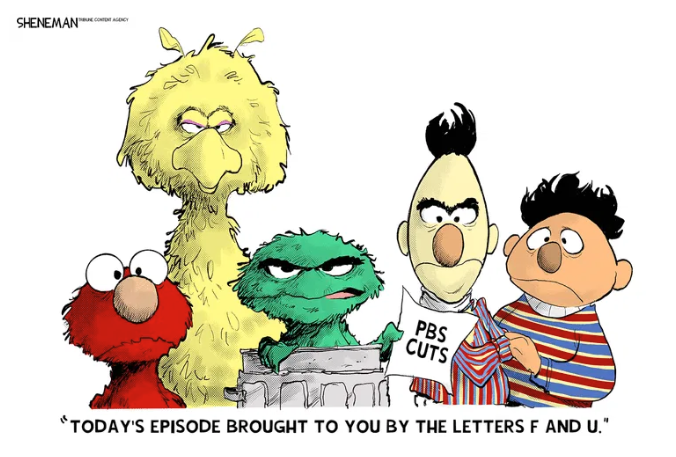
PBS

… and by the numbers 86 and 47.


Your enemies are not demonic, and they are not all-powerful and the right hasn’t always lost and the left hasn’t always won. But if you convince yourself of that, you give yourselves all sorts of permission to do a lot of stupid and terrible things under the rubric of “Do you know what time it is?”

Jonah Goldberg.

Trumpism can be seen as a giant attempt to amputate the highest aspirations of the human spirit and to reduce us to our most primitive, atavistic tendencies.

David Brooks)

I don’t do any of the major social media, but I have two sub-domains of the domain you’re currently reading: (a) You can read most of my reflexive stuff, especially political here. (b) I also post some things on my favorite social medium. I am now exploring Radiopaper.com as well.

Holy Fathers of the First Ecumenical Council, Afterfeast of Ascension

What am I to do?

“Man is in his actions and practice, as well as in his fictions, essentially a story-telling animal.” Ethical questions presuppose narrative questions. As he put it, “I can only answer the question, ‘What am I to do?’ if I can answer the prior question, ‘Of what story or stories do I find myself a part?’”

Alasdair Macintyre, 1929-2025, via Christopher Kaczor

Inoculated

C. S. Lewis once claimed that it was much harder to present the Christian story to a post-Christian culture than to a pre-Christian one, and today we can see how true this claim is. Where I come from, people are largely inoculated against Christianity, or what they imagine Christianity to be. The history, the cultural baggage, the half-formed prejudices: all of these are compounded by a stark lack of understanding of what the Christian Way really is.

Paul Kingsnorth, Prose and Principalities

Not Mincing Words

On Memorial Day, I stumbled onto an Orthodox Priest in Texas who is gung-ho on “masculinity” and other click-baity stuff. I don’t link to indecent material, and this stuff felt indecent, twisted — Mark Driscoll in a cassock.

Since the story was from BBC, it came to the attention of the Russian Orthodox Bishop of London and Western Europe, who felt compelled to speak.

If he was speaking spontaneous, unprepared remarks, then he’s a remarkable man and Bishop. I want to quote every pointed, potent word, because my effort to excerpt it could leave out things that might be just what you need to “hear.”

So I give you a link to the full remarks: ‘Seeking After Worldly Visions of “Masculinity” is Not an Orthodox Pursuit’: A Word From Bishop Irenei.

I cannot deny that growth of the Orthodox Church in North America has been disproportionately from men coming in, and young men particularly. The appeal of Orthodoxy to men had been noted before I entered the Church, but I’m not sure it has ever been explained.

What I can tell you from my own parish (and my personal experience doesn’t extend much further than that) is that it’s not because our Priest obsesses over masculinity, or because the parish has special men’s ministries, or any other gimmick. It seems to be “a God thing,” and I can go no further than that.

Christ, the Life of all

To be Christian, to believe in Christ, means and has always meant this: to know in a transrational and yet absolutely certain way called faith, that Christ is the Life of all life, that He is Life itself and, therefore, my life. “In him was life; and the life was the light of men.” All Christian doctrines—those of the incarnation, redemption, atonement—are explanations, consequences, but not the “cause” of that faith. Only when we believe in Christ do all these affirmations become “valid” and “consistent.” But faith itself is the acceptance not of this or that “proposition” about Christ, but of Christ Himself as the Life and the light of life. “For the life was manifested and we have seen it, and bear witness, and show unto you that eternal life, which was with the Father, and was manifested unto us” (1 Jn. 1:2). In this sense Christian faith is radically different from “religious belief.” Its starting point is not “belief” but love.

Alexander Schmemann, For the Life of the World


Religious ideas have the fate of melodies, which, once set afloat in the world, are taken up by all sorts of instruments, some woefully coarse, feeble, or out of tune, until people are in danger of crying out that the melody itself is detestable.

George Elliot, Janet’s Repentance, via Alan Jacobs

[N]one of the things that I care about most have ever proven susceptible to systematic exposition.

Alan Jacobs, Breaking Bread With the Dead

You can read most of my more impromptu stuff here and here (both of them cathartic venting, especially political) and here (the only social medium I frequent, because people there are quirky, pleasant and real). All should work in your RSS aggregator, like Feedly or Reeder, should you want to make a habit of it.