Black Friday?

For how much longer will “Black Friday” remain a thing when its sales started at least over the last weekend?

Miscellany

Nellie Bowles gives thanks

  • After watching a funny short video that shows Joe Biden seeming to wander into an Amazon rainforest, I realized to my shock that Joe Biden is still there. He’s still standing at podiums looking translucent and confused, but technically upright. When I see him, every fiber in my body wants to put a blanket over his shoulders. And so this year, I’m thankful for our presumed president: Dr. Jill Biden.
  • I’m thankful for Kamala Harris’s campaign. First of all, they raised $1.5 billion dollars and spent it in 15 weeks. It sounds wasteful. But in fact, taking $1.5 billion dollars from some of America’s silliest people and then giving it away to hardworking ones is what I call distributive justice. Just think of the caterers who had to work around literally dozens of Kamala staff’s allergies and gluten intolerances. They deserved that cash. Think of the event planners, young women who want to save up for their own extravagant eco resort weddings. Kamala gave them a shot at Hawaii instead of the Dominican Republic. Think of the driver of that abortion van clocking overtime during the DNC who just told himself “eyes ahead, not your problem, eyes ahead.” So many worthy Americans.
  • I’m thankful this year for the First Amendment. I never understood how precious it was, or how rare, but watching European countries send cops to people’s houses for barely controversial Facebook posts has shocked me. I know we have European readers and writers, so please know I stand with you, and I hope you don’t take it personally when I say I’m so glad our forefathers fled your lands and burned the boats. We’ll do our best now to save you through a process that I can only describe as colonialism (Free Press expansion into Europe). God bless America. And Little America, as we’ll call England!

TGIF

How the Ivy League Broke America

James Conant and his colleagues dreamed of building a world with a lot of class-mixing and relative social comity; we ended up with a world of rigid caste lines and pervasive cultural and political war. Conant dreamed of a nation ruled by brilliant leaders. We ended up with President Trump.

David Brooks, How the Ivy League Broke America

Let’s blame Occam’s nominalism

Ideas, he said, was not a work of philosophy but “an intuition of a situation,” namely, a situation in which the “world . . . has lost its center.” Weaver traced that loss back to the rise of nominalism in the twelfth century, a familiar pedigree that is both accurate and comical. It is accurate because the modern world—a world deeply shaped by a commitment to scientific rationality—does have a root in the disabusing speculations of nominalism. It is comical because to locate the source of our present difficulties on so distant and so elevated a plane is simply to underscore our impotence. If William of Occam is responsible for what’s wrong with the world, there’s not much we can do about it.

Richard M. Weaver, Ideas Have Consequences

Understanding Russia (a little better)

Finding a way in which Russia could make a genuine contribution to the “common good of mankind” was a key objective of Russian intellectuals at this time. Some concluded that the only way of doing so was by deepening the process of Westernization. Others felt that Russia could never contribute original ideas to humanity if all it did was copy the West. Thus was born the split between the Westernizers and the Slavophiles. It is necessary to bear in mind, however, that the Westernizers and the Slavophiles had the same objective—to enable Russia to contribute to universal progress.

Paul Robinson, Russian Conservatism

Politics

Perfidious political coin

Challenged by a letter to the editor for his former column, Liel Leibovitz gives nary an inch:

Never do I argue that the perfidy which is our political coin emanates exclusively from one side of the political aisle. But any dispassionate student of American history, observing the chaos of the previous decade, will emerge with a rather clear picture and a rather clear culprit.

It was the omnivorous machine, controlled by Barack Obama’s Democratic Party but now incorporating everything from our newsrooms to our classrooms to our boardrooms, that spread the wild conspiracy that America’s forty-fifth president was a Russian asset. It was the same machine that refused to repudiate this story, even when the facts were available and clear. It was the same machine that harnessed law enforcement agencies to harass and intimidate public servants, and that pursued the flimsiest of legal pretexts to pursue political enemies.

This sordid history doesn’t lack documentation. Nor is it, sadly, history: When fifty-one former heads of our intelligence community, including several retired heads of the Central Intelligence Agency, vow that the “rumor” concerning Hunter Biden’s laptop is misinformation peddled by Moscow, only to remain completely silent when said laptop appears in court and confirms precisely what anyone willing to listen and think had known all along—namely, that Hunter Biden Jr., and most likely his father as well, have had some questionable dealings for fun and profit with Ukrainian magnates and other shady characters—then you know we’re in Screwtape territory.

None of this is to suggest that the only morally commendable solution is a vote for Donald J. Trump come November, or, for that matter, that the Republican candidate is an unblemished moralist worthy of the priesthood. That, of course, is equally untrue. But, as a great American once said, the bastards changed the rules and they didn’t tell us. Now that we know, though, we’ve but one obligation: Fight back, fight hard, and win.

I don’t agree with his conclusion about our “obligation” (my convictions are with Paul Kingsnorth’s Moses Option on that), but his premises seem sound — which is why, in the end, I endure the Election of Donald Trump with substantial equanimity.

On the oddly disparate cabinet picks

Ross Douthat, Three Theories of the Trump Cabinet (unlocked). Douthat seldom disappoints me, and this wasn’t one of those occasions.

Destruction in the wake

It has long been clear that the rise of Donald J. Trump meant the end of the Republican Party as we once knew it.

It has belatedly become clear that his rise may have meant the end of the Democratic Party as we knew it as well.

After three Trump elections, almost every traditional Democratic constituency has swung to the right. In fact, Mr. Trump has made larger gains among Black, Hispanic, Asian American and young voters in his three campaigns since 2016 than he has among white voters without a college degree, according to New York Times estimates. In each case, Mr. Trump fared better than any Republican in decades.

Nate Cohn, How Democrats Lost Their Base and Their Message

If you have any appreciation at all for silver linings, surely you should appreciate that Trump was not, relatively speaking, elected along racial lines.

The Very Online Culture Wars

Whether it calls itself the Right or the Left, the real content of all online politics is the internet itself, and the arc of online politics always bends towards a bunch of strangers who spend their entire lives on the computer demanding that you publicly denounce your friends.

… To pun on Wilde, it would take a heart of stone not to laugh at the ritual outrage performed by the [Very Online Left] in the wake of the 2024 election.

Insofar as the election was an affirmation of the [Very Online Right], I find much less to applaud …

Pretending to ourselves that Trump II represents a culture war victory threatens to render traditionalist accounts of the true, the good, and the beautiful incoherent …

Is there anything truly conservative about Trump II? Can a party whose convention platforms an unrepentant stripper with a face tattoo be conservative? Can a party that valorizes a techno narcissist who has proudly fathered twelve children, one of whom is named X Æ A-Xii and another of whom is named Techno Mechanicus, with three different mothers still pretend to be conservative? And this is not even to mention Trump himself, whose public persona is built on violations of nearly every verse from Proverbs and the Sermon on the Mount. The VOR represents the Silicon Valley mantra “move fast and break things” with more enthusiasm than it does any of the principles articulated by Kirk.

There is no place in the [Very Online Right] for Kirk’s elaboration of the conservative principle “that there exists an enduring moral order” and that this order “is made for man, and man is made for it: human nature is a constant, and moral truths are permanent”.

Matt Stewart, The Very Online Culture Wars

Kudos to Seth Moulton, truth-teller

Here we are calling Republicans weird, and we’re the party that makes people put pronouns in their email signature

Rep. Seth Moulton, (D. Mass) via this Times article (paywall)

Now is the FIRE’s hour

Trump’s team has announced an aggressive agenda to do exactly what his critics called for: use the power of government to attach expression they think is false, misleading, disloyal, or otherwise bad. The Trumpists want the FCC to assert more power over cable and the internet and use that power to punish enemies. They want the government to use its power to attack journalists they hate. They want to protect protestors they agree with, however violent they were, but use state force and authority and deportation to suppress protests they don’t agree with. The Trumpists have a long record of abuse of defamation lawsuits and are aligned with Federalist Society luminaries who want to make it easier for the rich and powerful to sue for defamation. Trumpists want to impose ideological requirement for vast numbers of civil servants and to investigate government employees for disloyalty. In short, they want to flex government power to punish speech they don’t like.

… Private actors, emboldened, may escalate violence and abusive litigation. Norms and traditions and values, we’ve seen, can fail.

Popehat


[H]istory is well and truly back. Even Francis Fukuyama agrees.

Mary Harrington at UnHerd

I suffer more from the humiliations inflicted by my country than from those inflicted on her.

Simone Weil, from a letter to Georges Bernanos.

I don’t do any of the major social media, but I have two sub-domains of the domain you’re currently reading: (a) You can read most of my reflexive stuff, especially political here. (b) I also post some things on the only social medium I frequent, because people there are quirky, pleasant and real.
Sunday, 11/24/24

Formatting things a bit differently today, without “headlines.”

  • After he had twice visited the United States in the 1930s, Dietrich Bonhoeffer wrote a perceptive essay contrasting Christian development in America with parallel developments in the parts of Europe most directly shaped by the Protestant Reformation. His assessment included an observation that was as shrewd in its comparative wisdom as it is relevant for the themes of this book: “The secularization of the church on the continent of Europe arises from the misinterpretation of the reformers’ distinction of the two realms [of church and society]; American secularization derives precisely from the imperfect distinction of the kingdoms and offices of church and state, from the enthusiastic claim of the church to universal influence in the world.” What Bonhoeffer saw has been described with other terms here: The key moves in the creation of evangelical America were also the key moves that created secular America.
  • It is a matter of great historical significance that American Protestants almost never cited biblical chapter and verse to defend their interpretive practices. Precisely as it worked on Scripture, the Reformed, literal hermeneutic revealed most clearly how it arose from the special circumstances of American life. Yet even if this hermeneutic itself was not necessarily rooted in a literal reading of Scripture, it was nonetheless the American norm for the generations between the writing of the Constitution and the end of the Civil War.

Mark Noll, America’s God. (You may need to chew on that a bit. Or read the book.)


Religions devised for a social purpose, like Roman emperor-worship or modern attempts to ‘sell Christianity as a means of saving civilisation’, do not come to much. The little knots of Friends who turn their backs on the ‘World’ are those who really transform it.

C.S. Lewis via Paul Kingsnorth, who situates Lewis’ insight in our age.


Brad East once pondered:

Why do people convert to Christianity? Why do intellectuals and other public figures convert so often to Catholicism (or Eastern Orthodoxy) and so rarely to Protestantism?

Conversions, Protestantism, and a new mainline. I suspect he’s still pondering, though I don’t think he’s addressed the topic as explicitly as in the quoted article.

I keep coming back to the article deliberately, feeling as if I haven’t exhausted it. Maybe you’d find it helpful, too.


The west, so it seems to them, tends to think of the Crucifixion in isolation, separating it too sharply from the Resurrection. As a result the vision of Christ as a suffering God is in practice replaced by the picture of Christ’s suffering humanity: the western worshipper, when he meditates upon the Cross, is encouraged all too often to feel an emotional sympathy with the Man of Sorrows, rather than to adore the victorious and triumphant king.

Timothy Ware, The Orthodox Church


No, St. Paul wasn’t a perv:

When teaching non-Jewish Christians, one of the most radical disjunctions with their former way of life was sexual morality. Sexual continence had simply not been a concern for most of them before, so it became Paul’s focus. Paul’s frequent emphasis on this area was not based on prurient interest but on the continuing education and reorientation of former pagans.

Fr. Stephen De Young, Saint Paul the Pharisee. Actually (I’m sure Fr. Stephen noted it elsewhere), fornication with temple prostitutes was the former practice of some of these non-Jewish Christians. That’s why Paul had to focus there.


“Man is what he eats.” With this statement the German materialistic philosopher Feuerbach thought he had put an end to all “idealistic” speculations about human nature. In fact, however, he was expressing, without knowing it, the most religious idea of man. For long before Feuerbach the same definition of man was given by the Bible.

Fr. Alexander Schmemann, For the Life of the World


“The clock,” [Lewis] Mumford has concluded, “is a piece of power machinery whose ‘product’ is seconds and minutes.” … [A]s Mumford points out, with the invention of the clock, Eternity ceased to serve as the measure and focus of human events.

Neil Postman, Amusing Ourselves to Death


It’s profoundly significant that of all the Christian groups, only the Orthodox include the babies at the Holy Chalice, completely recognizing and demon-strating their full incorporation into the Church, the Body of Christ. This alone, it seems to me, shows forth the truthfulness of our Church’s claim to be the One, Holy, Catholic, and Apostolic Church, alone preserving the fullness of the Christian Faith.

Frederica Mathewes-Green & Rod Dreher, Healing Humanity


  • Only a few peoples—the odd German tribe and, inevitably, the Jews—had stood aloof from the exposure of unwanted children. Pretty much everyone else had always taken it for granted. Until, that was, the emergence of a Christian people.
  • Islamic the Islamic State may have been; but it also stood in a line of descent from Anabaptist Münster. It was, perhaps, the most gruesome irony in the whole history of Protestantism.
  • When scholars in Europe sought to justify the Spanish conquest of the New World, they reached not for the Church Fathers, but for Aristotle. ‘As the Philosopher says, it is clear that some men are slaves by nature and others free by nature.’
  • The concept of secularism—for all that it was promoted by the editor who invented the word as an antidote to religion—testified not to Christianity’s decline, but to its seemingly infinite capacity for evolution.

Tom Holland, Dominion

Several narrower books linger more persistently in my mind, but Dominion has in a sense penetrated deeper than mere “mind.”


  • Even after His Resurrection, Christ instructed disciples on the road to Emmaus when “beginning with Moses and all the prophets, he interpreted to them in all the scriptures the things concerning himself” (Luke 24:27). The Christological key to unlock the Jewish Scriptures was given to the Church by Christ Himself…
  • Two centuries later, fundamental differences in phronema would again be an obstacle to union between the West and the East at the Council of Florence in 1439. Catholics presented rational arguments for their positions, and the Orthodox responded by citing apostolic Tradition. It was “the constant conviction of the Latins that they always won the disputation, and of the Greeks that no Latin argument ever touched the heart of the problem.”

Dr. Eugenia Scarvelis Constantinou, Thinking Orthodox


Sometimes this whole 2000-year-old faith seems like a living koan. Chew on this until you are enlightened. Keep walking.

Paul Kingsnorth

You can read most of my more impromptu stuff here and here (both of them cathartic venting, especially political) and here (the only social medium I frequent, because people there are quirky, pleasant and real). All should work in your RSS aggregator, like Feedly or Reeder, should you want to make a habit of it.

Nominees, Essential Workers and Half-Truths

Trump’s nominees

In The Washington Post, Catherine Rampell evaluated the naming of Musk and Vivek Ramaswamy as heads of a new government agency: “How can you tell Donald Trump’s plan to improve ‘government efficiency’ is off to a promising start? Because his first step was appointing two people to do the same job.” (Gerard Farrell, Summit, N.J., and Bruno Momont, Manhattan)

Also in The Post, Ruth Marcus took in Trump’s galling choice for attorney general: “No mother says to her son, ‘Why can’t you be more like Matt Gaetz.’” (David Sherman, Arlington, Va.) Her Post colleague George F. Will called Gaetz “an arrested-development adolescent with the swagger of a sequined guitarist in a low-rent casino.” (Korleen Kraft, Portland, Ore., and Bill Tanski, Stratford, Conn., among many others)

Via Frank Bruni

Manly men

What’s with all the sociopaths, serial adulterers and accused rapists Trump wants in high office?

Is RFK Jr. a manly man while Mitt Romney is a soy boy?

Noah Millman has an hypothesis about what’s up, and I think it’s a good start on figuring out yet another division in how Americans view the world.

By the way: Trump is throwing out a lot of names that haven’t been vetted by the FBI. Is the Senate going to let him get away with that?

Three lessons from the Gaetz débâcle

Kimberly Strassel draws three lessons from the Matt Gaetz débâcle:

And so, Lesson No 1: Not all allegations against Republicans are partisan shams. That’s surely hard for Republicans to swallow …

The Trump transition team might have also read the insider room. Republicans are well versed in defending their brethren against nonsense attacks—even their unpopular brethren. There was a reason few if any Republican members rushed to Mr. Gaetz’s defense: They know him. Congress is a close space, and most all members had seen or heard something unpleasant enough to make them suspect fire accompanied the smoke. Ergo, Lesson No. 2: Take your lead from people who know, not MAGA Twitter insurgents.

The name of the Trump nominations game is clearly “shakeup”—and that’s to be applauded. Few doubt that Washington is in desperate need of some rattling. But note Lesson No. 3: The Gaetz fiasco is a reminder that there remains a bright line between a candidate who is aggressive, committed and professional and one who is unthinking, partisan and a liability … Mr. Gaetz was always clearly the latter—big on bravado, short on ideas and temperament. While not as discussed as the ethics question, it’s also an important reason his nomination was destined to fail.

(Bold added)

Essential workers

Another vulnerability that the novel coronavirus has exposed is the paradoxical notion of “essential” workers who are grossly underpaid and whose lives are treated as disposable.

Michael Pollan, The Sickness in Our Food Supply

Too good not to be true

Sometimes they lie to you because a story’s too good not to be true. (I hope I’m not doing that.)


[H]istory is well and truly back. Even Francis Fukuyama agrees.

Mary Harrington at UnHerd

I suffer more from the humiliations inflicted by my country than from those inflicted on her.

Simone Weil, from a letter to Georges Bernanos.

I don’t do any of the major social media, but I have two sub-domains of the domain you’re currently reading: (a) You can read most of my reflexive stuff, especially political here. (b) I also post some things on the only social medium I frequent, because people there are quirky, pleasant and real.

On “not going back” (and more)

On “not going back”

Indeed, we’re not going back

While many people voted against Trump because they felt that liberalism or democracy was under threat, many other people moved rightward for the same reason — because they felt that was the way to defend liberal norms against the speech police, or democratic power against control by technocratic elites.

Ross Douthat (unlocked). This is the sort of thing that finally became clear to me in the weeks before the election. I still voted for my third party, but with greater sympathy for Trump voters.

More Douthat:

[T]he first way that we are not going back: We are not returning to the narrowing of political debate that characterized the world after 1989, the converging worldviews of the Reaganite center-right and the Clinton-Blairite center-left, the ruling-out of radical and reactionary possibilities.

Yes, my blog category of “Zombie Reaganism” seems well and truly dead. I haven’t used it in year — probably at least nine — because there isn’t any Zombie Reaganism around any more.

[W]e are also not going back to a world where there is a set of trusted truth-mediating institutions, core sources of news and information that everyone recognizes and trusts, a “mainstream” of argument and opinion-shaping that sets the parameters of debate … the internet remains an acid for trust in institutions and an enabler of rebellions in a way that makes consensus and conformism extremely difficult to sustain.

Then there is the global backdrop: After the past four years, it’s clear that we are not going back to a world of unchallenged American primacy or a liberal international order expanding to encompass more and more regions of the globe … The “global” alliance in support of Ukraine is functionally mostly an American and European coalition, with much of the non-Western world distinctly not on our side.

The dynamics of the 21st century will favor belief over secularism, Orthodox Jews over their modernized coreligionists, the Amish over their modern neighbors, “trads” of all kinds over more lukewarm kinds of spirituality.

It took a lot of links to this article to make me realize that there was something worthwhile in it — even though it felt much different than most Douthat columns. Again: Ross Douthat (unlocked).

Still defining deviancy down

It’s been a little more than three decades since Daniel Patrick Moynihan published his famous essay on “Defining Deviancy Down.”

If Moynihan were writing his essay today, he might have added a section about politics. In 1980, when Ronald Reagan won the presidency, it was still considered something of a political liability that he had been divorced 32 years earlier. In 1987, one of Reagan’s nominees for the Supreme Court, Douglas Ginsburg, had to withdraw his name after NPR’s Nina Totenberg revealed that, years earlier, the judge had smoked pot. A few years later, two of Bill Clinton’s early candidates for attorney general, Zoë Baird and Kimba Wood, were felled by revelations of hiring illegal immigrants as nannies (and, in Baird’s case, of not paying Social Security taxes).

How quaint.

On Monday, a lawyer for two women told several news outlets that former Representative Matt Gaetz used Venmo to pay for sex with multiple women, one of whom says she saw him having sex with a 17-year-old girl at a drug-fueled house party in 2017. Donald Trump is doubling down on Gaetz’s nomination as attorney general, even as the president-elect privately acknowledges that the chances of confirmation are not great.

Still, all this misses the meaning of the Gaetz nomination, the point of which has nothing to do with his suitability for the job. His virtue, in Trump’s eyes, is his unsuitability. He is the proverbial tip of the spear in a larger effort to define deviancy down …

There’s a guiding logic here — and it isn’t to “own the libs,” in the sense of driving Trump’s opponents to fits of moralistic rage (even if, from the president-elect’s perspective, that’s an ancillary benefit). It’s to perpetuate the spirit of cynicism, which is the core of Trumpism. If truth has no currency, you cannot use it. If power is the only coin of the realm, you’d better be on the side of it. If the government is run by cads and lackeys, you’ll need to make your peace with them.

Bret Stephens, Defining Deviancy Down. And Down. And Down. (unlocked)

Donald Trump’s deviancy doesn’t start with nominees. His entire scorched-earth speaking style is nothing any decent person would want to emulate or have his child emulate. (And I’m biting my tongue on at least one other topic.)

Louche is the new Cabinet Qualification

The press is obsessed with whether Fox talking head and Secretary of Defense nominee Pete Hegseth sexually assaulted a woman in 2017. I guess none of the proven stuff even matters any more because, hey!, no fault divorce:

The point of my tweet was to mock the efforts of the Trump-supporting right to use photographs like the one I was commenting on to portray the president-elect’s nomination of Fox & Friends co-host Pete Hegseth for Secretary of Defense as some kind of triumph of wholesome masculinity and family-focused fertility.

Hegseth is 44 years old. He’s been married three times. He was unfaithful to his first two wives. Three of his seven children were born from his second wife. Another of the children was born of his third wife, whom he impregnated while he was still married to his second wife. The other three children come from his third wife’s previous marriage.

Then there’s the story about the late wife of Trump’s nominee to be Secretary of Health and Human Services, Robert F. Kennedy, Jr. Kennedy’s wife killed herself after finding and reading his diary, which recorded details of 37 extramarital affairs, coded by sexual act.

It’s not good that John F. Kennedy got away with appalling behavior with women, just as it’s unfortunate that the Democratic Party circled the wagons around Bill Clinton after his Oval Office liaisons with a 22-year-old White House intern were revealed. Yet it’s healthier for a culture when such behavior is concealed, as Kennedy’s was—and even when partisans defend a perpetrator who already holds high office and will be reaching the end of his final term before long—than it is for a culture seemingly to reward such actions when they are already publicly known.

The old line about hypocrisy—that it’s the tribute that vice pays to virtue—is correct: Hypocritical responses from past Democrats were compatible with continuing to uphold the old standards. Actively elevating, and thereby rewarding, men who are known to treat women like playthings to be used, abused, and discarded at will is, quite obviously, not.

Yet that is precisely where we find ourselves today—confronting the predation unleashed by the rise of a thoroughly post-conservative right.

Damon Linker

Admitting the inadmissible

Consider the ways in which both the Right and the Left now routinely avail themselves of what might be called “the appeal to the calendar.” The Left, including former president Barack Obama, have long spoken of the possibility of being “on the wrong side of history,” as if history itself is a moral force that calls us to certain choices and will judge us should we choose wrongly. Yet the Right makes its own appeal to the calendar. Any number of moral horrors are tolerated and justified through the claim that the offending party “knows what time it is,” and therefore must be allowed or even encouraged. Here the claim is that we live in a unique apocalyptic moment in human history and, given the threats facing us, certain actions and words that might have once been beyond the pale are now admissible.

Jake Meador, The Long Defeat of History. Overall, this pairs nicely with Paul Kingsnorth, The Moses Option.

Standards of proof

I think it is likely that Matt Gaetz is guilty of everything of which he is accused and more. But I do not know what to do with that opinion. 

The accusations against Brett Kavanaugh during his confirmation hearings seemed to me absurd—out of character for the man, based on supposed wrongdoing when he was a teenager, and obviously timed for a specific political purpose, i.e., to prevent his confirmation to the Supreme Court. The accusations against Gaetz are perfectly in character for the man, they preceded his nomination but are based on relatively recent events, they are attested to by more than one person, etc. But they are only accusations. 

There is a kind of no-man’s-land between the sort of proof that will suffice to send somebody to prison and the kind of proof that will suffice to convince us that a man should not be attorney general or hold some other high office and the kind of proof that just makes us recoil from a man on grounds of general ick. The legal and ethical accusations Gaetz faces are both tawdry and serious–the most serious of them involve an underage prostitute–and, if they are substantiated, losing the AG spot would be the least of his worries. In the case of Gaetz, senators—and the public—are spared the necessity of diving too deeply into that to resolve this issue, inasmuch as there are perfectly adequate reasons to reject the Gaetz nomination that do not require any further proof at all: Gaetz is a cretin and a flunky, his low character is attested to publicly by members of his own party in Congress, he lacks any relevant preparation for the job at hand, etc.

Kevin D. Williamson

Miscellany

Ain’t gonna happen. Nope.

Sophia Feingold writing on homeschooling:

Despite parents’ clear desire for alternatives to public schools, progressives remain concerned about homeschooling. Besides concerns rooted in individual children’s welfare, progressives will sometimes hint that too many homeschoolers might lead to disruption in the civil sphere. (See, for instance, the recent Amazon documentary Shiny Happy People.) These latter fears are overblown. Homeschoolers are nowhere near replacing the American liberal regime with a Christian commonwealth (and even if they were, the evangelicals and the Catholic integralists would never be able to agree on a constitution).

Tricksters

I can’t call The Donald a Trickster in the folkloric sense of the word, mythically, because the Trickster in folklore is a regenerative, taboo-busting energy that is still – in the end in service, somehow – to a sacred outcome. I wouldn’t dream of bestowing that kind of generativity on The Donald. His Tourette level fabrications are mesmerically troubling, and yet his story won. A sizeable amount of the American public is not-yet-done with his tale. Sure, here he comes to ‘fix’ Gaza and the Ukraine, he just needs even more power than last time.

… As my old friend Lewis Hyde states:

Most of the travellers, liars, thieves and shameless personalities of the twentieth century (now 21st) are not tricksters at all, then. Their disruptions are not subtle enough, or pitched at a high enough level… when he lies and steals, it isn’t so much to get away with something or get rich as to disturb the established categories of truth and property and, by doing so, open the road to possible new worlds. When Pablo Picasso says that “art is a lie that tells the truth,” we are closer to the old Trickster spirit.

Lewis Hyde and myself on the Trickster, back in 2017

So here we go, another four years on the merry-go-round of what will he do next? I turn to the Teacher and ask:

What shall we do Yeshua?

Don’t freak out, says Jesus. He said this two thousand years ago for just this kind of moment.

And Auden pipes up:

Don’t die in your dread.

It’s a liminal moment, as the anthropologists liked to call it. It’s not business as usual. That’s got to make us curious at the very least.

Martin Shaw

Silliness from Nellie Bowles

  • As a reminder of the official Dem line, here is a real-life sentence in Scientific American on the topic: “Inequity between male and female athletes is a result not of inherent biological differences between the sexes but of biases in how they are treated in sports.” Right. Biases. Nothing inherent going on here. I don’t dominate in football because of biases.
  • Employees at the Federal Emergency Management Agency were told not to help people after Hurricane Milton if those people displayed Trump signage around their homes … So we have the taxpayer-funded federal relief agency explicitly denying certain Americans lifesaving service because of their politics. Basically, you get a lifeboat only if you’re also wearing a pride flag pin. But. . . but I was reliably told by The New York Times that this was a conspiracy theory?! … My worldview is shattered! NYT says something is categorically false but it is, in fact, completely true and simply politically inconvenient. Who can I ever trust?
  • Republicans latched on to the left’s strangest political beliefs and exploited them, spending $143 million on ads that highlighted Kamala’s policies around gender, which most Dems can barely defend. Because she really did support federally funded gender transition surgeries for illegal immigrants in jail. The idea sounds like something a dad would say after taking too much cough syrup. It’s like “Okay, Dad, I’m sure she said that, now let’s get you to bed.” But she really did.

Nellie Bowles, TGIF

It occurred to me recently that Nellie Bowles reminds me of the late Molly Ivins, she who said of Dubya that he couldn’t help himself verbally because “he was born with a silver foot in his mouth.” Treasure Nellie while we’ve got her.

Gaining Independence

[R]eal independence of mind can be won only by a sustained process of submission to authority.

Matthew Crawford, Individualism creates mass men, not individuals

Bad first-world theater

As a Colombia-born friend often reminds me, most of today’s American left has no experience of real poverty or hunger, real political repression, or real civil violence—the kind that leaves a river of blood in the streets. We Americans live in a cocoon of comfort and security compared to most of the rest of the world. MSNBC’s Rachel Maddow earns $30 million a year for her progressive views. In effect, American radicalism on the left, especially in our cultural elite, is a performative faith, a kind of ongoing, immanent religious liturgy. It’s bad First World theater produced by the pampered, the privileged, the intellectually extreme, and hangers-on unaware of the uglier ironies of recent history.

Francis X. Maier, Woke Ideology Is Not Dead and Buried

Death of a menschess

One of my heroines has died: Diane Coleman, Fierce Foe of the Right-to-Die Movement, Dies at 71 – The New York Times.


[H]istory is well and truly back. Even Francis Fukuyama agrees.

Mary Harrington at UnHerd

I suffer more from the humiliations inflicted by my country than from those inflicted on her.

Simone Weil, from a letter to Georges Bernanos.

I don’t do any of the major social media, but I have two sub-domains of the domain you’re currently reading: (a) You can read most of my reflexive stuff, especially political here. (b) I also post some things on the only social medium I frequent, because people there are quirky, pleasant and real.

Sunday, 11/17/24

Permeable walls

Yesterday was the 27th anniversary of my formal entry into the Orthodox Christian Faith. Unlike my departure from frank evangelicalism for Calvinism two decades earlier, this felt like a conversion, not an incidental change of denomination.

Part of that feeling may have been that the evangelical-to-Calvinist transition was largely invisible to observers: I didn’t quit our Baptist church and go to the tiny PCA startup in town; instead I moved across the country to go back to school, so of course I had to find a new church; I graduated, moved, and began practicing law in my hometown, so again I had to find a new church.

That each of those steps was away from evangelicalism and toward Calvinism would have been apparent only to someone for whom the permeability of denominational walls in Protestantism seems odd, and I think there most Protestants who take that permeability for granted (if they even think about “denominations” in an age of tens of thousands of crypto-baptist nondenominational pastoral fiefdoms). Indeed, during this transition, I published a law journal note titled Church Property Disputes in an Age of Common-Core Protestantism, based on the premise that someone who became a Presbyterian or Methodist or Episcopalian was unlikely to be buying into denominational ownership or control of the local church’s temporalities that he (or she) now donated to maintaining.

But another part of the “conversion” sensation certainly was that I had to be catechized to enter Orthodoxy. Its walls are not permeable. I became an “ecclesial Christian” as Richard John Neuhaus described it: one for whom faith in Christ and faith in His Church is one act of faith, not two. I finally believed that the one holy, catholic and apostolic church is visible and distinct, not invisible and amorphous.

Today, I’m more interested in a question one could phrase in an article title as Church Discipline in an Age of Permeable-Wall Protestantism. Others have doubtless gone deeper into the topic of how there can be effective church discipline, how can flagrant sinners be brought to repentance, when they can just move to another church before the heat melts their hearts? Maybe he can even start and pastor his own church (or get nominated as Attorney General). In a largely Protestant nation, it’s hard for an ecclesial Christian convert not to at least dabble in other people’s business.

A bold claim

I’ve been reading Fr. Stephen De Young’s book St. Paul the Pharisee, which I hoped would focus on this bold claim:

Mostly it doesn’t, or it doesn’t do so explicitly except for that quote.

But Fr. Stephen’s “interpretive translation” of Paul’s epistles subtly undermines the tendency to view them as theological treatises rather than pastoral guidance.

Instrumentalist faith

In the last few years, there has been no shortage of political commentary—much of which I agree with—that has argued that Christianity is needed for Western civilization and its guiding principles to survive. Famously, the essay in which the writer and activist Ayaan Hirsi Ali spoke about her conversion—the authenticity of which I do not doubt —focused on the role that Christianity plays in Western civilization. But one should be clear-eyed about this matter. If the point of Christianity is the survival of the West, then Christianity may be treated as a useful fiction or a necessary evil alongside things like police forces and the military. The place of Jesus in such a Christianity is clear: he is a mascot, a long-dead victim of Roman imperialism and religious zealotry whom we invoke when we need a symbol, so that we may display him for all to see, pinned to the cross by our highest values and current political aspirations.

The outcome is not a secret. The churches that live as though Jesus is optional have been, despite their best verbal efforts, saying effectively and forcefully to their members and to the world that what the church uniquely has to offer is not needed, and that the church is here to serve those realities which already exist beyond the church’s baptismal boundaries.

I have become convinced that one of the primary challenges for Christians today is to come to terms with the overwhelming success of secularized Christianity. It is a great comfort to a Christian to say to himself or herself that secularized faith doesn’t actually work: it is how we tell ourselves that secularism will collapse under its own weight and that we’ll be here waiting when it happens, ready to welcome the world back into our arms. But of course, this is a fantasy about our own relevance. We are the secular culture’s ex-girlfriend, and telling ourselves that the new girlfriend isn’t pretty and that the culture will eventually see that it needs us is a pathetic expression of our need, not the world’s.

Matthew Burdette, Is the Church Obsolete? (H/T Brad East)

I honestly don’t think I’ve heard any Orthodox Christian talking about the importance of the Orthodox Church in secular instrumental terms. But to be honest, I sometimes think of the Catholic and Protestant churches as important to the survival of western civilization — and for some of its peculiarities.

Enculturation

Sometimes I have the unsettling sense that everyone possesses a spiritual secret but me. Other students speak of God as an intimate friend. They seem perfectly content studying the Bible all day, and unquestioningly accept whatever the professors say. More often, I conclude there is no secret, just a learned pattern of conformity, of mimicking others’ behavior and parroting the right words.

Philip Yancey, Where the Light Fell

Of this “learned pattern of conformity, of mimicking others’ behavior and parroting the right words,” I recently heard the sympathetic observation that people can believe absurd things, even contradictory things, because of where they are enculturated.

For anyone who thinks he (or she) has found the truth, and who can’t understand why others cannot see it, this is helpful to remember — in both directions. I don’t mean there’s no truth, only enculturation, but something about empathy and humility.

The American Hermeneutic

The problem with race and the Bible was far more profound than the interpretation of any one text. It was a problem brought about by the intuitive character of the reigning American hermeneutic. This hermeneutic merged three positions: (1) The Bible was a plain book whose meanings could be reliably ascertained through the exercise of an ordinary person’s intelligence; (2) a main reason for trusting the Bible as true was an intuitive sense, sealed by the Holy Spirit; (3) the same intelligence that through ordinary means and intuitions could trust the Bible as true also gained much additional truth about the world through intuitive processes that were also deliverances of universal common sense. The first position was a traditional Protestant teaching intensified by the American environment; the second was historically Protestant and Reformed; the third was simply a function of the American hermeneutic.

Mark A. Noll, America’s God

Of Nietzsche

Ironically, the fallen antichrist spent his long years of decline in the same female company that he claimed to have detested as a boy. He ended his life as the charge of his sister, but for many years after his collapse he was cared for by his mother. We know almost nothing about this quiet, pious woman, the widow of a Lutheran minister. But her act of taking the invalid into her home and enduring his catatonic silence, marked by occasional screaming fits, could only have been motivated by maternal love and Christian pity, two of the most debilitating values in what the philosopher had called the “slave morality.”

John Strickland, The Age of Nihilism

The flight into nondenominationalism

I’ve noticed Churches changing names to drop denominational identifiers. The Church I grew up in is considering dropping “Evangelical” from its name, not because it identifies the denomination but because of the debasement of the term into a political category.

Mites and motes

People who want to bring heaven upon earth have turned the earth into hell and made rivers run red with blood, because the first thing they must do is the one thing they cannot do, which is to cure themselves.

Anthony M. Esolen, Out of the Ashes

Complicit

The spectacle of [John] Lennon imagining a world without possessions while sitting in a huge mansion did nothing to put off his admirers. As Nietzsche spun furiously in his grave, ‘Imagine’ became the anthem of atheism.

Tom Holland, Dominion

Command performance

The logic of those prayers, if one was reading between the lines, was something like this:

“Dear Heavenly Father, in Your Word You say that when two or three are gathered together, You will be in the midst of them. Well, we’re gathered here, so do what we’re telling You to do because we have You over a barrel and can quote Your own book back at you! And in case You’re thinking of weaseling out of this deal, we claim Your promises, and because You can’t break any of those since You wrote it all in the Bible, You’ll do what we say, and You’ll do it NOW! Amen!”

Frank Schaeffer, Crazy for God

Any questions?

The early Church had no Scripture of its own, and the Jews had no defined canon of Scripture; therefore, sola scriptura as the foundation for what Christians believed was absolutely impossible.

Dr. Eugenia Scarvelis Constantinou, Thinking Orthodox


Religious ideas have the fate of melodies, which, once set afloat in the world, are taken up by all sorts of instruments, some woefully coarse, feeble, or out of tune, until people are in danger of crying out that the melody itself is detestable.

George Elliot, Janet’s Repentance, via Alan Jacobs

You can read most of my more impromptu stuff here and here (both of them cathartic venting, especially political) and here (the only social medium I frequent, because people there are quirky, pleasant and real). All should work in your RSS aggregator, like Feedly or Reeder, should you want to make a habit of it.

Elections and consequences

The Election Generally

Finally grokking Trump — as a repudiation of Democrat attitudes and positions

I don’t recall how much, or even whether, I have written about my little epiphany in the last two weeks or so before November election.

I was “never Trump” since I first realized that his candidacy was serious in 2015 or 2016. I confess that I could not imagine anything other than a “tear it all down!” mentality motivating Trump voters. The way I avoided contemning them was to assume that there was some nobler reason that was invisible to me for some mysterious reason.

My little epiphany in the weeks before the election was that the evils of the Democrat party could make it plausible to vote against them, even if doing so meant voting for Trump.

I considered writing about this in last Thursday’s post, but I thought it would be tedious to try to name all the Democrat evils that could repel a voter. After I posted on Thursday, though, Mary Eberstadt kindly posted an item at First Things that listed many of them for me. As does this:

Although Eberstadt specifically refers to Democrat antipathy toward Roman Catholics and Catholic teaching, I’m in the same target zone, just as when I was a conservative Protestant in my beforetimes.

Were my vote determined solely by which party is likelier to persecute me and mine over the next four years, I could imagine voting for Trump, pretty darned confident that he’ll leave me and mine alone. (Even though this little blog has dissed him for 8 years, I don’t flatter myself that he’s noticed.) But my vote tends less toward short-term self-protection and more toward fiat justitia ruat caelum.

Still: the people have spoken, and what they said means I’m likely to be left alone at least until 2029. There’s some small comfort in that.

Is identitarianism a dying delusion?

David Brooks looks at many of the ways the pre-election expectations (of how groups would vote) were dashed.

Why were so many of our expectations wrong? Well, we all walk around with mental models of reality in our heads. Our mental models help us make sense of the buzzing, blooming confusion of the world. Our mental models help us anticipate what’s about to happen. Our mental models guide us as we make decisions about how to get the results we want.

Many of us are walking around with broken mental models. Many of us go through life with false assumptions about how the world works.

Where did we get our current models? Well, we get models from our experience, our peers, the educational system, the media and popular culture. Over the past few generations, a certain worldview that emphasizes racial, gender and ethnic identity has been prevalent in the circles where highly educated people congregate …

The crucial assertion of the identitarian mind-set is that all politics and all history can be seen through the lens of liberation movements. Society is divided between the privileged (straight white males) and the marginalized (pretty much everyone else). History and politics are the struggle between oppressors and oppressed groups.

In this model, people are seen as members of a group before they are seen as individuals …

In this model, society is seen as an agglomeration of different communities. Democrats thus produce separate agendas designed to mobilize Black men, women and so on. The goal of Democratic politics is to link all the oppressed and marginalized groups into one majority coalition.

But this mind-set has just crashed against the rocks of reality. This model assumes that people are primarily motivated by identity group solidarity. This model assumes that the struggle against oppressive systems and groups is the central subject of politics. This model has no room for what just happened.

It turns out a lot of people don’t behave like ambassadors from this or that group. They think for themselves in unexpected ways.

Why We Got It So Wrong (unlocked article)

Liberal democracy vs. populism

For those bewildered by why so many Americans apparently voted against the values of liberal democracy, Balint Magyar has a useful formulation. “Liberal democracy,” he says, “offers moral constraints without problem-solving” — a lot of rules, not a lot of change — while “populism offers problem-solving without moral constraints.” Magyar, a scholar of autocracy, isn’t interested in calling Donald Trump a fascist. He sees the president-elect’s appeal in terms of something more primal: “Trump promises that you don’t have to think about other people.”

Around the world, populist autocrats have leveraged the thrilling power of that promise to transform their countries into vehicles for their own singular will … What they delivered was permission to abandon societal inhibitions, to amplify the grievances of one’s own group and heap hate on assorted others, particularly on groups that cannot speak up for themselves. Magyar calls this “morally unconstrained collective egoism.”

M. Gessen in the New York Times

Go stick your head in a cold Bulwark

A reader did not like Andrew Sullivan’s first post-election post:

When I opened your Dish email last Friday, I fully expected a big serving of both-sides-y handwringing — as in, “Trump is bad, but Harris is also bad, because wokeness/inflation/illegal immigrants … poor voters, what were they to do?” But I was also hoping for an acknowledgement of how terribly painful it is that the lawless kakistocrat has been reelected, more resoundingly than the first time. 

Instead, I got a celebration of the multiracial, multiethnic coalition that brought us Clown Car Horror Show 2: Electric Boogaloo. 

Not a single solitary goddamn word about all the reasons why Agent Orange deserved to lose. Attempting to overturn a free election in 2020? Inciting a mob to attack the Capitol? Running on “retribution” and promising to deploy the justice system against his political opponents? Routine use of crass, ugly insults and normalizing his surrogates’ use of same? Musing about how he wants to be “dictator for a day”? Wanting to fire government workers and replace them with incompetent sycophants? Never heard of it.

Sullivan responded: 

In the immediate wake of the Trump victory, did we really need another account of why I didn’t vote for him? Especially when those arguments failed to work in the campaign yet again? Go read The Bulwark.

The Clown-Car Nominations

A sober lament

On Trump’s choice of Matt Gaetz as Attorney General:

The choice obviously isn’t meant to reassure anyone outside the MAGA base—or even those within it who are intelligent. It is an insolent appointment, guaranteed to cause trouble and meant to cause friction.

We are back to the Island of Misfit Toys. What a mistake. Mr. Trump often confuses his own antic malice for daring, his own unseriousness for boldness. How amazing that in the rosy glow of election, he will spend so much political capital and goodwill on confirmation fights he may well, and certainly deserves to, lose.

Peggy Noonan

Shambolic Kakistocracy

[H]ere is a glimmer of hope: Team Trump’s most human failings may thwart some of their most evil plans.

Take, for instance, appointing Representative Matt Gaetz to be the Attorney General of the United States. If this is a sincere appointment — in other words, if it isn’t a head-fake to get the Senate to accept another candidate later, or a ruse to let Gaetz resign from Congress and avoid a damaging ethics report — it’s an example of self-indulgence thwarting malign intent. Gaetz is a buffoon. He has absolutely no qualifications to run the Department of Justice. Can he wander around firing everyone? Yes. Does he understand how the Department of Justice works in a way that would allow him to maximize its potential for abuse? No. Is he smart enough to figure it out? Also no. Is he charismatic enough to persuade insiders to help him use it effectively? Very much no. Gaetz as Attorney General will do petty, flamboyant, stupid things in clumsy ways. Some of those things will be very bad. But clown shoes are preferable to jackboots. We’d be in much more trouble if someone evil in a smart and competent way who understands how the machine works — say, Jeff Clark or Ken Paxton — took over. That would be terrifying.

Trump’s decision shows his tendency to vent his spleen. Appointing Gaetz owns the libs, humiliates the hated Justice Department, elevates someone who is a vulgar elbow-thrower like him, and is a thumb in the eye to the Republicans who hate Gaetz. It’s not a decision reflecting self-control; it’s a decision reflecting unconstrained anger and resentment. It’s like making your horse a Senator. The point isn’t that the horse will vote the way you want it to. The point is to humiliate the senate and show them you can do what you want. It’s bad, but it’s not smart bad.

[P]erhaps they will not be as bad as they could be because God, in His wisdom, has chosen to make these people weird freaks along the way to letting them run the place. This is a time to cherish every hope and embrace every ally. Trump and Trumpists are dysfunctional weirdos and that fact is our ally. Cold comfort is still comfort.

Popehat, Refuge in Kakistocracy

A vital pardon

Pardon Trump’s Critics Now
President Biden has a moral obligation to do what he can for patriotic Americans who have risked it all.

Paul Rosenzweig


[H]istory is well and truly back. Even Francis Fukuyama agrees.

Mary Harrington at UnHerd

I suffer more from the humiliations inflicted by my country than from those inflicted on her.

Simone Weil, from a letter to Georges Bernanos.

I don’t do any of the major social media, but I have two sub-domains of the domain you’re currently reading: (a) You can read most of my reflexive stuff, especially political here. (b) I also post some things on the only social medium I frequent, because people there are quirky, pleasant and real.

Thursday, 11/14/24

On seeing Trump differently

I’ve already acknowledged that I see Trump differently now than I did in 2016, and I’ll now acknowledge that that change in perception has only been further solidified in the wake of his shooting. Part of this change means that I no longer think it’s useful or meaningful to call him a charlatan, to insist that he’s “faking it”, that he’s actually a really bad businessman who only pretends to be a successful one on TV, that he’s a common low-end huckster of bad steaks and worthless paraphernalia. All of this implies that there are other actors on the world stage who, by contrast, are the real deal, and unlike in 2016 I just don’t believe that’s the case anymore.

Justin Smith-Ruiu, World Spirit on Feedback

Think at least a little bit about the math

One of the problems with being a grievance party for minority interests is that minorities are a minority. If your vision of politics is that what is most important about us is our demographic characteristics—race, sex, education level, etc.—and you understand political life as, essentially, a zero-sum competition between rival groups, then you should probably think at least a little bit about the math, just in case people start to take you seriously. … Doubling down on minority positions is how you become a minority party—and stay one. 

This is Ruy Teixeira’s revenge. 

Teixeira was the co-author (with John Judis) of a very famous book called The Emerging Democratic Majority. The thesis of the book was that as the U.S. electorate became younger, less white, and more immigrant-heavy, Democrats would be able to assemble a durable electoral majority—provided they held on to the working-class voters who had been the keystone of the New Deal coalition

(Teixeira, who has won very little love for himself telling Democrats things they do not want to hear, now hangs his hat at the American Enterprise Institute, which is not famously full of Democrats but is absolutely packed to the rafters with people who know how to count.)

Democrats forgot to do the second part of the Teixeira two-step and keep those working-class voters ….

Kevin D. Williamson

Reactionary Biden

Mr Biden resharpened Mr Trump’s most effective political wedge by doing away with obstacles he had created to illegal immigration, providing no alternative. By the time he restored some of Mr Trump’s restrictions this spring, more than 4m migrants had crossed the southern border, compared with fewer than 1m under Mr Trump.

The Economist’s Lexington, Democrats need to understand: Americans think they’re worse

Little pitchers …

… have big ears.

Trump … is winning culturally in shaping America’s manners and mores.

Peter Wehner

It was such a cozy moment in the Oval Office on Wednesday morning, with the roaring fire and the warm handshake and the past presidents — including George Washington, Abraham Lincoln and F.D.R. — looking down benignly on the scene.

So why did it feel so nauseating?

It is hard to watch Donald Trump be gracious, because he is gracious only when he wins, and that’s not a good lesson for the children of America. When he loses, he tries to burn the democracy down.

Maureen Dowd

I will pray for America and its rulers, but I could not in good conscience tell a child to look up to 47 as an example of goodness or manliness.

They will do so anyway unless, perhaps, their parents tell them not to.

The Kakistocracy

When I first saw and article saying the new word to master was “kakistocracy,” I (incorrectly) confounded it with “kleptocracy.”

I reckon we’ll have both for four years. We’re certainly getting the kakistocracy. Matt Gaetz for Attorney General is banana republic stuff. Hegeth, or whatever his name is, may be a decent human being, but there is no reason to think he can run any large organization, let alone our huge and euphemistically misnamed Department of War.

On the other hand, remember the morass our Best and Brightest got us into.


[H]istory is well and truly back. Even Francis Fukuyama agrees.

Mary Harrington at UnHerd

I don’t do any of the major social media, but I have two sub-domains of the domain you’re currently reading: (a) You can read most of my reflexive stuff, especially political here. (b) I also post some things on the only social medium I frequent, because people there are quirky, pleasant and real.

Sunday, November 10

On an American Orthodox Church

The beginning is context, analogy; just wait for the provocative “aside.”

Fr. Stephen: … [R]eligions that are separate things … didn’t exist in the ancient world. What it meant to be a Greek was not just to have grown up in Hellas or to have your people be from there for many generations; what it meant to be a Greek was also to worship the Greek gods and to participate in the ritual life of Greece that surrounded the gods, the public festivals, all of those things. That’s what it meant to be Greek.

So what does it mean to be a Greek Christian? Now we take that for granted, but for St. Paul that wasn’t something you could take for granted. And so you can understand why, in the early Church, you get the opponents of St. Paul in Galatians who were saying, “Well, okay, you can’t be pagans any more. So why don’t, uh, you be Jews? You can’t be a Greek any more. You have to have some culture. You have to be something. So you need to get circumcised, you need to keep Torah, you need to do all these things. You need to be Jewish. You can’t be Greeks any more, because being Greek is being a pagan.” And St. Paul is saying, “No! You’re not to become Jews, because you’re not Jews. You’re going to remain Greeks, but what it means to be Greek is going to change.” So a Greek Christian identity is forged, and that takes a couple centuries. St. Paul starts it, but you read all the problems he’s having, for example, in 1 and 2 Corinthians that we already referred to. This is a difficult process.

Fr. Andrew: And even while the concept and the way of life gets worked out, the terminology largely isn’t kept even, early on. By the time you get to the Cappadocians and so forth, “Greek” in terms of something other than language, “Greek” is used to refer to pagans. If you’re Christian, you’re a “Roman.”

Fr. Stephen: Right. Greeks are the ones still following that way of life.

Fr. Andrew: Right. I mean, the word “Greek” in various ways gets revived again in the 18th, 19th century for other reasons, but, yeah, that identification of “Greek” with “pagan” holds on for a long time, even while they’re kind of developing a Greek Christian life, just calling it something different

Fr. Stephen: Yeah. And so St. Paul is going to affirm… So he’s got those folks on the one side who want people to become Jewish; on the other side, he’s got the Jewish zealot tradition that wants to overthrow societal structures within Roman life. And St. Paul is going to want to keep those social structures. That’s the part of the Gentile identity that he can keep, sort of, you know: families! Marriage in general! We don’t need to get rid of marriage in general. All of these relationships, all of these structures we can keep, but they need to be re-infused. Paganism needs to be drawn out; they need to be re-infused with Christ. So that’s part of this transformation.

And as a kind of aside, when folks… One of many things I’m a pessimist about is there being an American Orthodox Church any time soon. The big reason is that we still have to do precisely this. Not figure out what it means to be American and Christian, because there’s an American Christianity, and the more American it gets, the less it looks like Christianity, frankly. But figuring out what it means to be American and Orthodox Christian: we can’t just take for granted that that’s just an easy sub.

In fact, the fact that America is deeply steeped in another form of Christianity—a sort of Puritan, Calvinist, Protestant Christianity—sometimes makes it harder for us to make the distinctions that we need to make in order to form an American Orthodox identity. If America was a Muslim country or a Hindu country, when we looked at cultural institutions, it would be a little easier for us to spot, in the Hinduism case, the paganism, in the Muslim case, the Islamic parts, but when it’s another form of Christianity, the distinctions get more subtle and more tricky, and that identity can be a little harder to form.

(Underlining added)

When an American Orthodox Christian steps to either side of the safe corridor cleared by the Church, she’s likely to hit a Puritan land mine or a Calvinist IED. When an American Orthodox Christian feels we’re missing out on something good in the larger society, what he wants us to import may well be a Puritan version of a Trojan Horse.

About that American brand of Christianity

William Craig Brownlee “contrasted the genuine religion that flourished in America with ‘the mixed Christianity that began its career at an early period in the history of the church’”.

Paul J. Gutacker, The Old Faith in a New Nation: American Protestants and the Christian Past.

To these Orthodox Christian eyes, that reads as perversely the opposite of reality. The religion that flourished in America, and of which we are still heirs, is the later, entropic version.

The starting point of Christian faith

To be Christian, to believe in Christ, means and has always meant this: to know in a transrational and yet absolutely certain way called faith, that Christ is the Life of all life, that He is Life itself and, therefore, my life. “In him was life; and the life was the light of men.” All Christian doctrines—those of the incarnation, redemption, atonement—are explanations, consequences, but not the “cause” of that faith. Only when we believe in Christ do all these affirmations become “valid” and “consistent.” But faith itself is the acceptance not of this or that “proposition” about Christ, but of Christ Himself as the Life and the light of life. “For the life was manifested and we have seen it, and bear witness, and show unto you that eternal life, which was with the Father, and was manifested unto us” (1 Jn. 1:2). In this sense Christian faith is radically different from “religious belief.” Its starting point is not “belief” but love.

Alexander Schmemann, For the Life of the World

When will they ever learn?

Only slightly tempered by a sense of their own limitations, these reformers espoused private judgment as the sure route to coherence and harmony. Unfortunately, the more confidently they attacked the traditional order and espoused individual autonomy, the more confusing their limitless world became. In one of the early republic’s severest ironies, the determination to quiet theological wrangling resulted in a proliferation of voices.

Nathan O. Hatch, The Democratization of American Christianity

Iconoclasm

God was understood to have physical form, but that form was to be described only verbally, not represented iconographically.

William T. Cavanaugh, The Uses of Idolatry

Purging

I am greatly looking forward to reading St. Paul the Pharisee by Fr. Stephen De Young. An ex-Calvinist Orthodox Priest with deep knowledge should be perfect for purging my involuntarily-retained Calvinist readings of St. Paul.

Mute

It is very difficult to make our contemporaries see that there are things which by their very nature cannot be discussed.

René Guénon Guénon, The Crisis of the Modern World


Religious ideas have the fate of melodies, which, once set afloat in the world, are taken up by all sorts of instruments, some woefully coarse, feeble, or out of tune, until people are in danger of crying out that the melody itself is detestable.

George Elliot, Janet’s Repentance, via Alan Jacobs

You can read most of my more impromptu stuff here and here (both of them cathartic venting, especially political) and here (the only social medium I frequent, because people there are quirky, pleasant and real). All should work in your RSS aggregator, like Feedly or Reeder, should you want to make a habit of it.

I for one welcome our new insect overlords

Someone used that on micro.blog this week. I liked it. But it was in quotes, so I think he stole it, too. I think that may be a line from a movie.

The pollsters blow it again

So: the pollsters blew it again. They underestimated Trump support. I should be sitting here in suspense as counts continue; instead, I’m blogging about the soothsayers who couldn’t brace me for what happened Tuesday.

What’s the problem:

  1. They don’t know how to count to 270? In other words, they do polling of the (meaningless) national popular vote but don’t get granular, state-by-state?
  2. Many respondents lie because they’re shy (embarrassed? shamefaced? guilt-wracked?) Trump voters?
  3. Has the historic script flipped so that higher voter turnout benefits Team Red?
  4. Some other durned thing?

No, the Problem Isn’t the Voters

Ever since Donald J. Trump arrived on the political scene in 2015, elites have claimed his rise signals the last gasp of a dying white-majority America alarmed by cultural and demographic shifts. This was always a kind of security blanket—an excuse to ignore uncomfortable truths.

If Tuesday’s election results do not demolish that cope once and for all, we’re not sure what will …

The only group Kamala Harris made gains with was white college-educated women and those over 65.

Just take a look at what has transpired over the last 36 hours: 

  • On MSNBC, Joy Ann Reid said, “anyone who has experienced this country’s history. . . and knows it, cannot have believed that it would be easy to elect a woman president, let alone a woman of color.” Of Harris’s election effort, she added: “I mean, this really was a historic, flawlessly run campaign.”
  • On The View, Sunny Hostin said: “I was so hopeful that a mixed-race woman married to a Jewish guy could be elected president of this country. And I think that it had nothing to do with policy. I think this was a referendum of cultural resentment in this country.”
  • On Morning Joe, Joe Scarborough said to a nodding Al Sharpton that “It’s not just misogyny from white men; it’s misogyny from Hispanic men, it’s misogyny from black men—things we’ve all been talking about—who do not want a woman leading them.” He added that it “might be race issues with Hispanics. They don’t want a black woman as president.” (He left out the fact that Trump performed nine points better with Hispanic women this year compared to 2020.)
  • Laura Helmuth, the editor in chief of Scientific American, chimed in with a now-deleted tweet: “I apologize to younger voters that my Gen X is so full of fucking fascists.” (Fifty-four percent of Gen X voted Trump.)
  • The pastor and activist John Pavlovitz, who has 400,000 followers on X, declared: “Kamala Harris was the perfect candidate and she ran a beautiful campaign of joy, empathy, and unity. She just happened to run in a nation that is addicted to nihilism, cruelty, and division.”
  • Nikole Hannah-Jones, creator of The 1619 Project at The New York Times, warned that: “We must not delude ourselves in this moment.” Among “shifting demographics where white Americans will lose their numeric majority,” she added, there is “a growing embrace of autocracy to keep the ‘legitimate’ rulers of this country in power.”

We could go on, but you get the point. And their point is: Don’t blame Harris, blame the voters.

But you don’t succeed in an election by calling the common people racist or sexist or stupid. You win by listening to them.

And our media elite have put their heads in the sand. Again. They seem to think that if they keep calling Americans knuckle-dragging bigots, one day they’ll get the message.

That’s why you’ll get more insight from our nine-year-old election-night livestream star Josie Savodnik than from some of the best-paid cable hosts on TV. Josie’s take on why Kamala lost? “Maybe because of the border. Maybe it’s because of Kamala’s personality. And she also did kind of a terrible job at being vice president.” 

She’s not wrong.

Bari Weiss and Oliver Wiseman, No, the Problem Isn’t the Voters

Wall Street has rarely been more excited by an election.

U.S. stocks’ capitalization rose by $1.62 trillion on Wednesday, their fifth-best one-day showing ever, following Donald Trump’s decisive election victory. The surge highlights the opportunity that investors, bankers and others in finance are hoping to embrace over four years of tax cuts, deregulation and economic expansion. “Investors are celebrating,” said Jack Ablin, chief investment officer at Cresset Capital in Chicago. He was among those buying shares of smaller companies, on the bet that Trump’s policies will rev up the economy. The enthusiasm is especially heated in a few areas, investors and bankers said. Banks and other financial companies climbed, with the KBW Bank Index rising 11%. Investors expect regulatory scrutiny will ease in a Trump administration. Some also expect more dealmaking, potentially among smaller and midsize banks. The expected departure of Lina Khan, who leads the Federal Trade Commission and has been a thorn in the side of executives hoping to work out tech acquisitions, was cheered by investors and bankers. (Source: wsj.com)

John Ellis

The point is, in Germany, if you didn’t go along with the party line, you would be demonized. You would get in trouble. People just think, I hope I don’t get in trouble, so what do I have to say or not say to get in trouble? At that moment, you cease to be free.

We’re kind of getting there. Even a millimeter in that direction is too close for comfort for me.

Emma Green, quoting the execrable Eric Metaxas.

Metaxas is not entirely wrong about this, but it’s on both sides, albeit asymmetrically.

If you dissent from “liberal” orthodoxy, you may get censored by the Assistant Executive Supernumerary of the Department of Truth whispering in the ears of social media, who then block you in one of several available ways available to them.

If you dissent from the MAGA right, you’ll get death threats. Ask David French about that.

I voted against both.

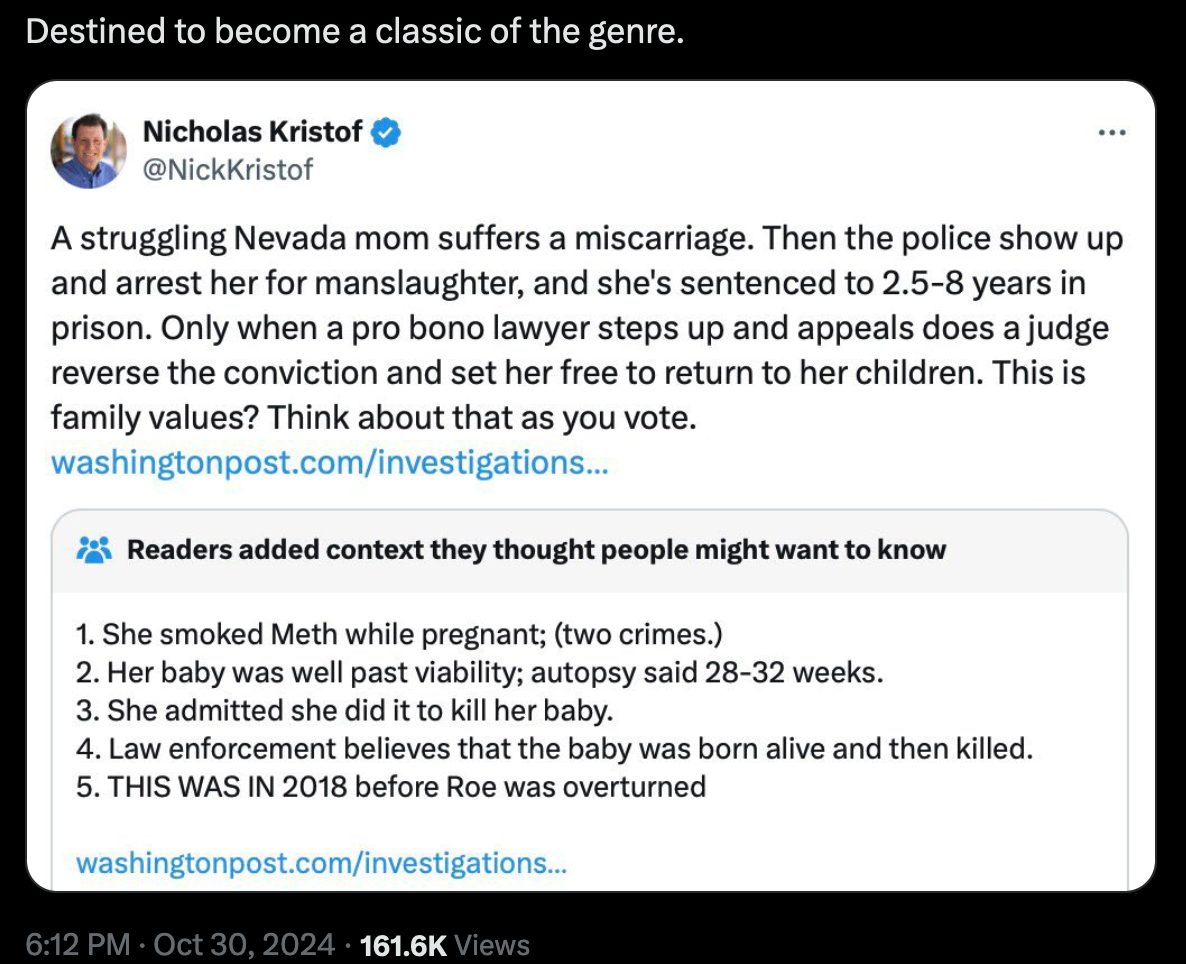
Nicholas Kristof Manifests

Nicholas Kristof issues a Manifesto for Despairing Democrats, and it’s not all bad:

My country has elected a felon whose former top aides have described him as a fascist and “the most dangerous person to this country.” Yet in an election that wasn’t even close, voters not only chose him but also picked a Republican Senate to empower him further.

This will be a test of our country and of each of us, so let me offer a manifesto for how ordinary Americans of my ilk can respond.

1. I accept Donald Trump’s victory.

2. I will be a watchdog, not a lap dog.

3. I will back organizations fighting to uphold human values.

5. I will try to understand why so many Americans disagree with me. Too many Democrats reflexively assume that any person backing Trump must be a bigot or an idiot. But let’s beware of invidious stereotypes, for finger-wagging condescension alienates centrist voters; it’s difficult to win support from people you’re calling idiots and racists. Many working-class Americans have been left behind economically and have reason to feel angry. And Democrats aren’t going to win elections as long as they seethe at a majority of voters.

7. I will care for my mental health. There’ll be many, many times in the next four years when we’ll be irritated, anxious and alarmed, probably with good reason, so we need to find a way to relax and mellow out. For me, that’s backpacking and wine- and cider-making. In my day job, I shout at the world, and it pays no attention, so it’s a relief to raise grapes and apples and have them listen to me. And remember that sometimes the best therapist has four legs. A few years ago, many families got a pandemic dog, and for some this may be time to get a Trump dog.

12. I will temper my strong views with humility. The challenge is to unflinchingly proclaim our values even as we appreciate that we are fallible and may eventually be proven wrong. Accepting that contradiction curbs the tendency toward arrogance and self-righteousness, which in any case are utterly unhelpful in promoting those values.

13. I will share Thanksgiving with relatives, even if I think they’re nuts. There’s too much division in America, and we hang out too much with people who think just as we do. So if you’re debating whether to break bread with family members whose politics you can’t stand, go for it. Don’t let Trump get between you and your family or friendships.

Loss of faith

[W]e must learn to live in an America where an overwhelming number of our fellow citizens have chosen a president who holds the most fundamental values and traditions of our democracy, our Constitution, even our military in contempt. Over the past decade, opinion polls showed Americans’ faith in their institutions waning. But no opinion poll could make this shift in values any clearer than this vote.

David Frum, Trump Won. Now What?

From across the pond

Why did he win? There might be a thousand particular answers, but the broader reason seems clear: a lot of people are sick of the political-media-cultural establishment, and they want to blow it up. This is the same reason people voted for Brexit in 2016 and continue voting for ‘populist’ parties across Europe today. People feel – correctly – that this establishment serves the elite but not the masses. Worse: it has become so self-referential that it barely even knows who the masses are. I have been writing about how this establishment developed, and about the people opposing it, for thirty years. I can say with some confidence that this is not over yet.

Given all this, I thought it might be useful to reprint this essay, which first appeared here with the title Down the River in April 2022, and will also appear in my forthcoming book. It attempts to understand this moment by exploring how progressive leftism and corporate capitalism, once supposedly sworn enemies, ended up marching in lockstep to build the world we now inhabit. Those who are swept to power on the back of the rejection of that world do not necessarily have any better alternatives – and this post is not an endorsement of Trump or anyone else. The great saviours of the moment often end up making things worse. But they have walked into history for a reason. Maybe this essay will help dig into it.

Paul Kingsnorth

Counting Chickens (and more)

  • In The Washington Post on the eve of Election Day, Monica Hesse imagined Harris winning in spite of many American men’s desires and on the strength of the gender gap: “Their sense of world order is about to be undone by the women in their lives grabbing democracy by the ballot box. (When you’re a registered voter, they let you do it.)” (Douglas Steffes, Madison, Wis., and Stephanie Logan, Centennial, Colo., among others)
  • In The New Yorker, Bruce Handy detailed the stylist Michelle Côté’s ministrations to give Sebastian Stan, the star of the new movie “The Apprentice,” the Trump coiffure: “Stan’s real hair was covered in part by a fake scalp, which was covered in turn by a wig — a tonsorial turducken.” (Betsy Frank, Mattituck, N.Y., and Ann Madonia Casey, Fairview, Texas)
  • And in a less hairy New Yorker essay, Sloane Crosley revisited Dorothy Parker’s book reviews and remarked on how much less efficient critics’ pans are today. “It takes us four times as long to kill our prey,” Crosley wrote, adding: “Our literary criticism features a great deal of ‘I,’ the pronoun most likely to overstay its welcome. In the right hands, this conflation of narrative and critique can have dazzling results. But on the whole? Imagine waiting 20 minutes for a medical diagnosis while your doctor walks you through her commute.” (Nancy Chek, Silver Spring, Md.)

Via Frank Bruni

The Perfectly Blank Face for the Democrats

A very elegant concession from Kamala: For a few hours on Wednesday, her campaign was silent. They didn’t play games and pretend they were winning. They didn’t give comment to the press. They collected themselves. They grabbed the screw cap Oyster Bay out of the fridge and considered it hard before saying, “It’s a gin night, girls.” And then the next day Kamala Harris delivered a beautiful concession speech, which you can read here. It gave me goosebumps and also made me furious, because she’s a good and fine person who ran a truly terrible campaign. It was a campaign that exemplified all of the delusions of the modern Democrats: that you never need to say what you stand for (because people should just assume you know what’s best for them), that you should never answer hard questions or appear with questionable figures, and that the only issue any American woman should care about is abortion.

Nellie Bowles at the Free Press. Nellie’s weekly TGIF is mostly tongue-in-cheek, but that doesn’t keep her from telling the truth.

Peggy Noonan’s debriefing

What are the Democrats? What’s that party for? When I was a kid they were the party of the working man, the little guy. That’s the Trumpian GOP now. When I was a young woman they were the antiwar party. That’s the Trumpian GOP. The party of generous spending? The Trumpian party says hold my beer. What belief do the Democrats hold that distinguishes them? LGBTQ, woke, gender theory, teachers unions, higher taxes? Why not throw in cholera and chlamydia?

The party has lost its specific character and nature; it’s no longer a thing you can name. Democrats have to sit down with a yellow legal pad and figure themselves out. All defeat carries a gift: You get to figure out what you’re getting wrong.

As for me, I don’t like the SOB [Trump], I think him a bad man who’ll cause and bungle crises almost from day one, but he’ll be the American president, and we all deserve grace. I will pray for him, support what I think constructive and oppose what I think destructive, call it straight as I can and take whatever follows. As someone once said, the real story of American life is where you stand and the price you’ll pay to stand there.

Peggy Noonan

Ruy Teixeira maps a route forward

Ruy Teixeira is a wise Democrat:

The Democratic Party may be the party of blue America, especially deep-blue metro America, but its bid to be the party of the ordinary American, the common man and woman, is falling short.

There is a simple—and painful—reason for this. The Democrats really are no longer the party of the common man and woman. The priorities and values that dominate the party today are those of educated, liberal America. They only partially overlap with those of ordinary Americans.

He suggests a list of “principles” Democrat leaders should endorse to win back the eyes, ears, and eventually the votes of voters they’ve lost. Most of them are anodyne. Some are too equivocal to be true “principles” (trying to have it both ways through smooth words). But it looks like a good start.

(Selected) Money Quotes for the Week

  • “To all who celebrate, happy third consecutive Last Election Ever!” – Seth Mandel.
  • “You can’t blame losing the popular vote and all seven swing states on Putin and the Russians,” – Freddie deBoer.
  • “Dem-friendly pundits said one reason for picking Tim Walz was that he’d appeal to blue-collar guys in the industrial Midwest because they’d identify so much with him. He wears flannel shirts and everything. Kamala lost his home county,” – Glenn Greenwald.
  • “[T]he federal government that only got seven electric vehicle charging stations built in two years has performed zero transgender surgeries on detained migrants. That’s the Democrats in a nutshell: the party that promises trans surgeries for illegal immigrants but doesn’t deliver them,” – Josh Barro.
  • “Turns out no one likes neocons. Who knew?” – Ana Kasparian.
  • “Democrats spent the final weeks of the campaign browbeating and shaming black and brown voters and telling them basically that they were stupid to even consider voting for Trump. This is what they got in return,” – Shadi Hamid.
  • “Kamala Harris will fall without a trace, just as she rose without a trace, but she’s nevertheless worth studying, in all her hollowness and banality, as an example of what has gone wrong with modern liberalism,” – Adrian Wooldridge.

Andrew Sullivan


I suffer more from the humiliations inflicted by my country than from those inflicted on her.

Simone Weil, from a letter to Georges Bernanos.

I don’t do any of the major social media, but I have two sub-domains of the domain you’re currently reading: (a) You can read most of my reflexive stuff, especially political here. (b) I also post some things on the only social medium I frequent, because people there are quirky, pleasant and real.

Can anyone top this?

There will be ten thousand times ten thousand post-mortems on Tuesday’s election, but it’s going to be hard to top this hot-take:

[T]here’s very little, if anything, about the Democratic Party that is normal in 2024. It’s not just that the party of the working man is now the party of the Davoisie. It’s that, in the midst of shedding its loyalty to the working and middle classes, the party has transformed itself into a corporatized, single-cell organism. It no longer appears to represent a true coalition of interest groups—the way parties normally do. It is made up of platform surfers building their social media audiences on the backs of the very people they claim to bleed for: marginalized peoples, birthing people, Gazans, whoever.

They didn’t lose because they didn’t spend enough money. They didn’t lose because they failed to trot out enough celebrity influencers. They lost because they were consumed by their own self-flattery, their own sense of self-importance. They should have spent the past eight years learning from the Republicans’ very honest, if flawed, conversation about the plight of America. But they insisted on talking to themselves about the things that made them feel morally superior.

Worst of all … the party that portrayed itself as the nation’s answer to fascism nominated its standard-bearer without consulting a single voter. They just figured that no one would mind, that most Americans would feel the way they felt—happy that they finally had a viable candidate to challenge Donald Trump.

It was insulting, and it was deeply dishonest.

Peter Savodnik, We Blew It, Joe

Do read it all if it’s not paywalled — I left out a lot that didn’t fit my perceptions or that I thought went beyond “fair use.”

By the way: I’m in the camp that was not offended that Kamala was coronated, not elected, and I don’t know how helpful it would have been for the country to announce that President Biden was incompetent as our adversaries looked on and salivated.


I suffer more from the humiliations inflicted by my country than from those inflicted on her.

Simone Weil, from a letter to Georges Bernanos.

I don’t do any of the major social media, but I have two sub-domains of the domain you’re currently reading: (a) You can read most of my reflexive stuff, especially political here. (b) I also post some things on the only social medium I frequent, because people there are quirky, pleasant and real.