
Month: November 2013
Not polite society and rated (PG-13)
Well this is embarrassing.
I thought the Todd Akins gaff about “legitimate rape” was an embarrassment largely because it acknowledged the occasional making of false accusations. One isn’t supposed to acknowledge the sometime mendacity of certified victims of patriarchy. All men are rotten bastards, period. “It takes incredible courage for a woman to come forward and report a rape.” And children always tell the truth about molestations, too; they’re not at all suggestible in the hands of experts.
The truth, though, could be far worse than political incorrectness. The basis of the claim that women rarely become pregnant by rape (because that’s traumatic and disrupts ovulation) is plausibly alleged by Emily Bazelon to be experiments by a Nazi doctor. The “experiments,” by the way, didn’t actually involve rape. They involved mock executions – a presursor of waterboarding, and may have been misinterpreted to boot:
Stieve published 230 anatomical papers. With the data he gathered pre-execution, as well as the tissues and organs he harvested and studied, he could chart the effect of an impending execution on ovulation. Stieve found that women living with a looming death sentence ovulated less predictably and sometimes experienced what he called “shock bleedings.” In a book published after the war, Stieve included an illustration of the left ovary of a 22-year-old woman, noting that she “had not menstruated for 157 days due to nervous agitation.”
Stieve drew two conclusions that continue to be cited (for the most part, uncritically). He figured out that the rhythm method doesn’t effectively prevent pregnancy. (He got the physiological details wrong but the conclusion right.) And he discovered that chronic stress—awaiting execution—affects the female reproductive system.
…
The American College of Obstetricians and Gynecologists warned that saying rape victims rarely get pregnant was “medically inaccurate, offensive, and dangerous.” But the anti-abortion doctor Jack Willke, former head of the National Right to Life Committee, insisted otherwise. “This goes back 30 and 40 years,”he told the Los Angeles Times in the midst of the Akin furor. “When a woman is assaulted and raped, there’s a tremendous amount of emotional upset within her body.” Willke has written that “one of the most important reasons why a rape victim rarely gets pregnant” is “physical trauma.”
Medical people who promulgated the theory in the pro-life cause have even more egg on the face than do I.
I’ve often said “I’ve never argued [this or that discreditable theory]” on various topics. Mea culpa, mea culpa! I have argued that pregnancy rarely results from forcible rape. But there are mitigating factors (since this isn’t a real Confessional, I can whine about mitigating factors).
The issue was highly politicized, and I was in one of the two camps, distrustful of the other with more than a little justification, since “they” tactically focused on “the hard cases” and argued out of both sides of their mouths. Remember “rape is a crime of violence, not of passion”? Citing that, I usually, if not invariably, accompanied the “trauma-disrupted ovulation” claim with the related claim that forcible rapists, bent more on humiliation of the victim than sexual satisfaction, typically don’t linger long enough to ejaculate. I haven’t heard that one refuted yet. But confirmation bias was there, too, and I did buy the “trauma-disrupted ovulation” argument at least a little.
Oh: the Friends of Feticide aren’t the only ones to argue out of both sides of their mouths. We pro-lifers focused and continue to focus on what ought to be easy cases: partial-birth abortion and sex-selection abortion, for instance. “Not only,” saith the fictive pro-lifer, “is pregnancy from rape vanishingly rare, but we have a Speaker’s Bureau full of beautiful and accomplished young women who were conceive by rape, for whose mothers we should all be ever-so-grateful for doing the right thing, bringing them to full term to brighten the world by their beautiful, accomplished countenances. Did we mention that they’re beautiful? And accomplished. And pious?”
Still, I’d be much obliged if someone could prove that it’s Bazelon, not Jack Willkie, who conned me. I’d appreciate a morally pristine and medically reliable source for my former talking point. (Chirrup. Chirrup. Chirrup.)
But until then, my default position now is that if a rapist ejaculates, however common or uncommon that is, pregnancy is as common as from any other “unprotected” sexual act.
Comments on the merits welcome. Comments suggesting that I’m a bastard aren’t – as aren’t suggestions that I be beatified for admitting, with mitigators, that I was wrong.
* * * * *
“The remarks made in this essay do not represent scholarly research. They are intended as topical stimulations for conversation among intelligent and informed people.” (Gerhart Niemeyer)
Saturday potpourri, 11/9/13
First Things (also 2nd through 6th)
I’m glad I re-subscribed to First Things. I can’t read it cover-to-cover, but it has some real gems.
Thursday, 11/7/13
Mostly tidbits, with a whiff of insight. 11/6/13
Tuesday, 11/5/13
Monday, 11/4/13
Reflecting on the Reformation
I must begin by telling you that I do not like to preach on Reformation Sunday. Actually I have to put it more strongly than that. I do not like Reformation Sunday, period. I do not understand why it is part of the church year. Reformation Sunday does not name a happy event for the Church Catholic; on the contrary, it names failure. Of course, the church rightly names failure, or at least horror, as part of our church year. We do, after all, go through crucifixion as part of Holy Week. Certainly if the Reformation is to be narrated rightly, it is to be narrated as part of those dark days.
Coincidentally, on Halloween/Reformation Day, I began listening to a two-hour podcast, Perspectives on the Church Fathers, featuring two notable guests. I finished it on Feast of Saints Cosmas and Damien (All Saints Day, if you’re into that Western Christian stuff).
So what’s the coincidence?
In this two-hour edition, host Kevin Allen speaks with two early Church scholars—Reformed Christian James R. Payton, Jr. (editor of the newly published A Patristic Treasury: Early Church Wisdom for Today) and Orthodox Christian Bradley Nassif (a leading expert on the relationship between Orthodox and Evangelical Christians)—about the Church Fathers, including who they are, what they taught, and their significance in the Evangelical and Orthodox church traditions.
(Podcast Description, hyperlinks added) Protestant Payton is well enough acquainted with the Fathers of the Church that an Orthodox publisher published his book. And both Nassif and Payton agree that the Reformers had a solid appreciation of the Fathers and retained catholic views on most Christian doctrine.
I remain skeptical about even the original Reformation. I accept the dark view that it was a schism from an already-schismatic group, the Roman Catholic Church. It seems to me that it threw Pandora’s Box wide open, as, for example, Luther was already fighting the Radical Reformation before his death, and today’s debased, rootless American Evangelicalism is heavily influence by radical reformation ideas.
When Protestantism becomes an end in itself, which it certainly has through the mainstream denominations in America, it becomes anathema. If we no longer have broken hearts at the church’s division, then we cannot help but unfaithfully celebrate Reformation Sunday.
(Hauerwas) There’s a lot of anathematized religion in America. Read the whole Hauerwas piece for confirmation.
But I’ve been reminded by the podcast, by a commenter to a recent blog, by my older brother’s catholic-minded Lutheranism, by the semi-historicity of Calvinism that attracted me 35 years ago (in contrast to the largely ahistorical Evangelicalism I’d been immersed in for a decade-plus), and by the re-appropriation of the Fathers by serious-minded Protestants, that some greater respect may be due than I’ve been giving.
And I’m reminded by Hauerwas that the ethnic labels remaining on American Orthodox jurisdictions give rise to a suspicion – not entirely unwarranted – that the catholicity of Orthodoxy is flawed. Ouch!
Yeah, yeah: I know how it came about. But I know how the Reformation came about, too. There comes a time when historical explanation falls short of contemporary justification.
* * * * *
“The remarks made in this essay do not represent scholarly research. They are intended as topical stimulations for conversation among intelligent and informed people.” (Gerhart Niemeyer)
Anca Petrescu, B.I.H.
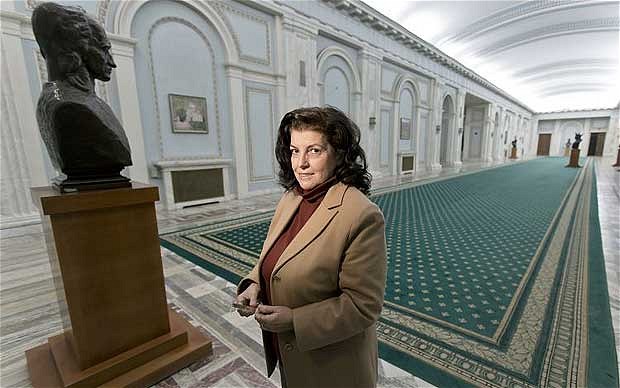
Oh, my! The Telegraph has an obituary of Romanian Architect Anca Petrescu that might as well conclude “Burn in Hell, you brazen hussy”:
Anca Petrescu, who has died following a road accident aged 64, was an architect known as the “Albert Speer of Communism”, responsible for the Romanian dictator Nicolai Ceausescu’s “Palace of the People” in Bucharest — the world’s greatest monument to totalitarian kitsch.
…
In February 1982, at the age of 32, Anca Petrescu was appointed chief architect of a project whose raison d’être, in Ceausescu’s tautological phrase, was to be “a grandiose edifice that reflects the epoch of the time”.
…
When interviewed about her role in building the People’s Palace, Anca Petrescu tended to lapse into evasive, Soviet-style doublespeak, cutting off interviewers brusquely if they enquired about her relationship with Ceausescu. When asked by one western journalist how she justified the suffering Romanians went through as a result of her work, she retorted: “That is a question originating from someone who can only understand a system based on profit as motivation.” Her favourite novels, she revealed, were the “sick works of Dostoevsky and Tolstoy, because they fit my soul”.
The story brings back a bit of the horror of Ceausescu. I recall my then-Calvinist heart swelling with pride as I read about how he was toppled by a doughty band of Romanian Calvinists, who probably toppled him from calloused knees.
I forget the details (but the New York Times remembers) and you’ve probably never heard them since the story’s pretty implausible in retrospect when everyone knows Ronald Reagan toppled Communism on his feet.
Oh. Margaret Thatcher, too. And ordinary Polish Catholics. Led by Lech Walesa. Sound track by the late Lou Reed. With a cameo appearance by Plastic People of the Universe.
But oddly, apart from episodes like the capture of Hussein or the death of Bin Laden, I don’t hear anyone claiming the success someone or other pulled off in Iraq and Afghanistan.
* * * * *
“The remarks made in this essay do not represent scholarly research. They are intended as topical stimulations for conversation among intelligent and informed people.” (Gerhart Niemeyer)
 Tipsy Teetotaler ن