Pulling out all the stops

Trigger warning: Although I have taken to posting my criticisms of Trump 2.0 elsewhere (and then offering links to those interested), this post is all criticism of Trump 2.0.

Are careful legal arguments irrelevant?

This past Friday afternoon, President Trump openly attacked the Supreme Court majority for failing to side with him in Learning Resources and praised the three dissenting conservatives by name for doing exactly that. … Vice President JD Vance also accused the SCOTUS majority of “lawlessness.”

It should be obvious to everyone, but just in case it isn’t: This is a purely nihilistic way to treat a branch of the federal government that justifies its decision in lengthy, reasoned opinions. It presumes that good-faith arguments and competing forms of legal interpretation are irrelevant in the work of the courts—and that justices picked by a given president are expected to serve as loyal supporters of anything that president (or another of the same party) might do in office, regardless of what the Constitution and/or the statutory record might say. There are six conservatives on the high court; therefore Trump should have won Learning Resources by a vote of 6-3. It’s that simple, and anything that diverges from a thoughtless display of partisan fealty is supposed to stand as transparent evidence of corruption.

In a world where most voters view the judiciary this way, there really is no place for a judicial branch at all ….

Damon Linker, Seven Observations About the Supreme Court’s Tariff Decision.

Linker’s first observation (what the court holds) is inaccurate, but I thought this excerpt from his fifth observation was pretty sharp, and as a “courts man” I wanted to pass it along.

Are we the baddies?

On a note not unrelated to the prior item:

[W]ith fleeting exceptions, every one before Trump 2.0 accepted two core principles: There is space between the president’s every wish and what the law permits. And, relatedly, executive branch lawyers should not merely rubber stamp presidential initiatives.

The system has always been imperfect because the law is often unclear and government lawyers face pressure to approve presidential action. But the basic arrangement has been that government lawyers interpret law with some independence from the president, and that some policies are blocked or modified when lawyers identify clear legal problems. Presidents embraced this arrangement because legal compliance demands it and because systemic inattention to law leads to bad policy or undesirable political or legal risk.

Until Trump 2.0, that is. The Trump administration since January 2025 has rejected this system root and branch.

First, it has sought to ensure that the senior ranks of lawyers are filled with loyalists. I don’t mean loyalists in the sense in which past administrations typically hired people supportive of the president’s program and in line with the president’s outlook and politics. I mean lawyers who are willing to do whatever the president (or a senior proxy) asks, including in legal decision making, despite what law and professional norms say.

Second, the administration has issued formal directives to eliminate lawyers’ independence judgment. The most important one says:

No employee of the executive branch acting in their official capacity may advance an interpretation of the law as the position of the United States that contravenes the President or the Attorney General’s opinion on a matter of law, including but not limited to the issuance of regulations, guidance, and positions advanced in litigation, unless authorized to do so by the President or in writing by the Attorney General.

Since the president is indifferent or hostile to law, and since the attorney general is a sieve for the president, this directive makes the president’s policy whims—which he thinks by definition are lawful (“I . . . have the right to do anything I want to do”)—the governing rule.

Third, the administration has fired, threatened, or sidelined lawyers in the government who express disagreement with the party line established in the White House (or who were connected to past legal actions against Trump). Every lawyer not directly subject to this regime gets the message.

Jack Goldsmith

How does this cash out in Pete Hegseth’s “Department of War”?

TopicSummary
Military Legal CultureTraditionally strong post-Vietnam; lawyers integral to lawful military conduct.
Hegseth’s ApproachSeeks to reduce lawyers’ independence; prioritizes loyalty; hostile to existing legal culture.
Trump 2.0 Legal ModelPresidential interpretations override traditional legal checks; lawyers must follow party line.
Boat StrikesLegally questionable strikes justified by dubious administration definitions of “armed conflict.”
CongressLargely inactive in oversight; failed to challenge changes weakening DOD’s legal integrity.
OutlookPossible future exposure of legal violations; need for Congressional accountability.

This is a scandal, but if it lies, as I think it does, at the intersection of Absolute Presidential Immunity and the Unitary Executive, I don’t readily see a legal remedy. Trump is immune because SCOTUS says so. His minions are immune because Unitary Executive.

So suck it up, America, and get used to us being the baddies.

Kinsley gaffes

Chief Justice John Roberts does Thomas the courtesy of a very thoughtful response to his dissent in the recent tariffs case, a response that contains what I think we might consider a “Kinsley gaffe,” i.e., stating a truth that is more than one meant to say. The chief justice writes:

Suppose for argument’s sake that Congress can delegate its tariff powers to the President as completely as Justice Thomas suggests. Even then, the question remains whether Congress has given the President the tariff authority he claims in this case—or whether the President is seeking to exploit questionable statutory language to aggrandize his own power.

Chief Justice Roberts is a very careful writer, and his words here, while couched in the form of a question, are plainer than I am accustomed to reading from him or from any other member of the court: “the President is seeking to exploit questionable statutory language to aggrandize his own power.” One need not be an esoteric Straussian to assume that the word whether should be omitted to access the sentence’s true meaning. 

Of course “the President is seeking to exploit questionable statutory language to aggrandize his own power.” He also seeks to exploit imaginary statutory language to aggrandize his own power, and seeks to exploit phony emergencies to aggrandize his own power, to exploit imaginary Venezuelan fentanyl to aggrandize his own power, to exploit imaginary Haitian cat-eaters in Ohio to aggrandize his own power, to exploit an absolutely ignorant misunderstanding of trade deficits to aggrandize his own power, etc. The president of these United States is not an aspiring autocrat but an actual autocrat acting outside of the constitutional powers of his office in matters ranging from imposing illegal taxes on Americans to carrying out massacres of civilians in the Caribbean. Speaking with his trademark stroke victim’s diction, Trump insisted: 

I am allowed to cut off any and all trade or business with that same country. In other words, I can destroy the trade. I can destroy the country! I’m even allowed to impose a foreign country-destroying embargo. I can embargo. I can do anything I want, but I can’t charge $1. Because that’s not what it says, and that’s the way it even reads. I can do anything I wanted to do to them but can’t charge any money. So I’m allowed to destroy the country, but it can’t be a little fee.

Kevin D. Williamson

U.S. humanitarian aid

A year after the Trump administration began the dismantlement of USAID, it is initiating a new round of significant cuts to foreign assistance. This time, programs that survived the initial purge precisely because they were judged to be lifesaving are slated for cancellation.

… Each of them is classified as lifesaving according to the Trump administration’s standards.

The administration had already canceled the entire aid packages of two nations, Afghanistan and Yemen, where the State Department said terrorists were diverting resources. The new email, sent on February 12 to officials in the State Department’s Bureau of African Affairs, makes no such claims about the seven countries now losing all U.S. humanitarian aid: Burkina Faso, Cameroon, Malawi, Mali, Niger, Somalia, and Zimbabwe. Instead, according to the email, these projects are being canceled because “there is no strong nexus between the humanitarian response and U.S. national interests.”

Hana Kiros, The Trump Administration Is Ending Aid That It Says Saves Lives

Like I said, get used to us being the baddies.


I don’t do any of the major social media, but I have two sub-domains of the domain you’re currently reading: (a) You can read most of my reflexive stuff, especially political here. (b) I also post some things on my favorite no-algorithm social medium.

February 16, 2026

Corriging the incorrigible

For some years now, I’ve been tearing my hair out over the faddish dogmas of adolescent gender dysphoria — the dogmas that treated as axiomatic the appropriateness of medical and surgical interventions for kids claiming gender dysphoria, and opposition as genocidal. Let’s try that again: dogmas that insisted on allowing sexual mutilation of kids experiencing some discomfort about their biological sex and that hated and defamed anyone urging caution.

The dogmas seemed incorrigible. And then, just like that, they seem to gotten corriged, or whatever the participle is for corrigible. The turning point appears to have been the Cass Report, which was officially rejected by the U.S. medical establishment but appears to have been tacitly adopted in public discourse and acquiesced in even among the medical establishment.

It doesn’t hurt that there’s been a malpractice verdict against some medical butchers with a $2 million dollar damage award to the breastless female plaintiff.

So, my inner Eeyore sometimes gets stymied by something, somewhere, getting better. Gloria in excelsis deo.

A southern stoic gets religion

In the mid-1950s, Walker Percy’s southern gentry stoicism pointed one way, his new Catholicism another:

“Faith had led him away from the plantation. Philosophy had given faith an intellectual basis and a practical rationale. Far from turning him abstract, as Shelby Foote had warned him it would do, philosophy had coaxed him down off the magic mountain and onto level ground to consider the mortal struggle of everydayness. It emancipated him from his Uncle Will and the scheme of Stoic noblesse oblige. It helped him to solve his own problems and ponder the affairs of the day. It made him, finally, an ordinary man.”

Paul Elie, The Life You Save May Be Your Own. I can’t put my finger on just why, but I think the short section including this quote was worth the price of the book (and the hours I’ve already spent reading it).

Maybe I just don’t know what time it is

Dreher’s writing is a useful indication of just how angry and pessimistic even the most thoughtful conservatives have become in recent years. He seems to see America as a hellscape, drained of religion and hope, drugged and distracted by the false gods of the internet. The renewal he imagines is not the sunlit, future-oriented conservatism of the Reagan era, and he doesn’t look to the Founding Fathers for inspiration. If anything, Dreher’s compass points in the opposite direction. He wants his country to turn back toward Europe—not the homogenized, secular continent of today but premodern Christian Europe, before the Enlightenment and the disenchantment set in.

His greatest admiration is reserved for people who commit themselves to “a fixed place and way of life,” as he wrote about Saint Benedict.

Yet Dreher seems resigned to living as a rootless exile, shorn of his family and condemned to wander a landscape of what the philosopher Zygmunt Bauman—one of Dreher’s favorite thinkers—called “liquid modernity.”

Robert F. Worth, Rod Dreher Thinks the Enlightenment Was a Mistake.

One additional, and very disheartening, item from this story:

But lately Dreher’s insights have come with an ominous political corollary. He believes our institutions are so rotten that they need a good slap from people like Trump and Orbán, even if it means losing some of them. “Maybe what’s being born now will be worse, I dunno,” he wrote as Trump and Elon Musk were using DOGE to dismantle the federal bureaucracy in early 2025. “We’ll see. But bring it on. I’ve had it.”

I quote this to observe that “bring it on” equals “burn it down,” and that glee about burning down institutions because something better might rise from the ashes is the paradigmatic marker of a revolutionary, not a conservative.

Maybe I just don’t know “what time it is.”

Political

I’ve generally been relegating political commentary to “Elsewhere in Tipsyworld,” below. But these are too important.

America’s concentration camps

“A concentration camp exists wherever a government holds groups of civilians outside the normal legal process — sometimes to segregate people considered foreigners or outsiders, sometimes to punish,” Andrea Pitzer writes in “One Long Night: A Global History of Concentration Camps.” Conditions within the administration’s detention facilities certainly meet the bill.

Here’s how a Russian family described its four-month ordeal at the Dilley Immigration Processing Center in an interview with NBC News:

“Worms in their food. Guards shouting orders and snatching toys from small hands. Restless nights under fluorescent lights that never fully go dark. Hours in line for a single pill. “We left one tyranny and came to another kind of tyranny,” Nikita said in Russian. “Even in Russia, they don’t treat children like this.”

Or consider this ProPublica exposé of the same facility, focused on the children who have been caught in the administration’s immigration dragnet.

Kheilin Valero from Venezuela, who was being held with her 18-month-old, Amalia Arrieta, said shortly after they were detained following an ICE appointment on Dec. 11 in El Paso, Texas, the baby fell ill. For two weeks, she said, medical staff gave her ibuprofen and eventually antibiotics, but Amalia’s breathing worsened to the point that she was hospitalized in San Antonio for 10 days. She was diagnosed with Covid-19 and RSV. “Because she went so many days without treatment, and because it’s so cold here, she developed pneumonia and bronchitis,” Kheilin said. “She was malnourished, too, because she was vomiting everything.”

During the 2024 presidential campaign, I asked readers to think seriously about Trump’s plan to remove millions of people from the United States:

Now, imagine the conditions that might prevail for hundreds of thousands of people crammed into hastily constructed camps, the targets of a vicious campaign of demonization meant to build support for their detention and deportation. If undocumented immigrants really are, as Trump says, “poisoning the blood of our country,” then how do we respond? What do we do about poison? Well, we neutralize it.

What we see now, with the immigration dragnets in American cities and the horrific conditions in the administration’s detention facilities, is what the president promised in his campaign. He said he was going to punish immigrants for being immigrants, and here he is, punishing immigrants for being immigrants, with every tool he has at his disposal.

Jamelle Bouie (gift link)

Are you cool with the concentration camps, Rod?

History Rhymes

With his contempt for elections he did not win, Lenin put an end to all semblance of democratic procedure. He made it clear that he would insist on ruling whether he had popular support or not. The legitimacy of Bolshevik rule was to be based on Marxist theory, not on the sovereignty of the people, and that made a police state ruled by force inevitable.

Jack Matlock, Autopsy on an Empire.

“Why haven’t you killed anyone?”

Several decades ago I realised I had a temper, and I went to see a specialist about this. I didn’t want anger slouching into my approaching parenting. How do you feel the second before you erupt? they asked.

Vulnerable.

That was the gold, that two minute conversation. I’m generally wired now to recognise the state and stay there as long as necessary.

But the red mist comes down and I can’t control it, I said. The specialist looked me right in the eye:

Then why haven’t you killed anyone?

Learnt behaviour. I would go far, but not that far. They showed me I could create a new boundary, and through repetition, walk it into my psyche.

Martin Shaw, storyteller and author of the New York Times bestseller Liturgies of the Wild.

Anti-Zionism versus Antisemitism

There is a difference between anti-Zionism and anti-Semitism. I just know there is.

Surely it’s theoretically possible to oppose the state of Israel’s behavior without animus toward Jews per se, right?

Oddly, in the realm of thought experiments, it’s even possible to hate Jews and be pro-Zionist, on the theory that Zion is where all the hated Jews should be sent. (I don’t think I’ve seen this kind of jackalope in the wild.)

But whatever the difference is, I cannot say that the line is “clear” because people keep insisting they (or their ideological allies) are merely anti-Zionist, not anti-Semite when it seems reasonably clear to me that they’re anti-Semites.

With the caveat that I hurt especially for the plight of Palestinian Christians (especially the Orthodox) at the hands of the Israeli government, I’m staying away from either label.

The AI Revolution

Damon Linker is in fairly close alignment with my hunches on AI:

What do you think is likely to follow from tens of millions of white-collar, college-educated workers finding over the coming years that their entire sector of the economy has been fed into a woodchipper? That they are becoming unemployed, are being forced to undertake a job search at roughly the same time as just about everyone else who held similar positions, and must face the reality that their practical, on-the-job experience and skills have become worthless in a workplace transformed by AI?

What will they have to do to make a living? How will they need to reinvent themselves? Will corporate middle managers need to repurpose themselves as nurse’s aides or orderlies, cleaning bedpans and changing soiled sheets? Or go back to school, taking on a second pile of student loans at midlife, to learn a new, more marketable skill? Or will AI be taking over so many jobs that require specialized education that they will be forced to downgrade their expectations still further, to seek out work in the service sector, for dramatically lower pay and status? Or scramble to learn how to use AI and then attempt to make a go of it as some kind of entrepreneur in a marketplace flooded with such self-starters, each trying to devise and market the Next Big Thing that might catapult them into a more comfortable income bracket? A few will do well at this; most will not.

Then this killer footnote:

For those inclined to discount the likelihood of such destabilizing events by predicting the adoption of a Universal Basic Income in the wake of widespread AI-induced job losses, I tend to think this gets the lines of causality wrong. There is no way the rich in this country would tolerate the imposition of tax rates necessary to pay for a UBI unless proverbial or literal guns were pointed at their heads. What I’m describing at the end of this post is the scenario that puts the guns there. Whether a UBI follows from it is another matter ….

Freddie DeBoer, on the other hand, isn’t buying all the revolution talk.

Shorts

  • The Bad Bunny dancing was too sexy, apparently, and also, it was almost entirely in Spanish, so TPUSA planned ahead to make a separate show with nothing sexy at all and everything in the Queen’s English. Which is why they tapped Kid Rock, conservative America’s greatest living artist. (Nellie Bowles)
  • “The ‘woke’ halftime show features a wedding, people dancing joyously and smiling. The conservative alternative was a grayscale grievance fest,” – Corey Walker.
  • Life involves divisions of labor, and conservative values just don’t make for groundbreaking art or incredible sourdough loaves, I don’t know why but it’s just the truth and we all know it. Like how the new conservative-run Kennedy Center is shutting down for two years, since too many artists were flaking. All the people with conservative values are busy at home or the office not doing art. (Nellie Bowles)
  • “Trump is delusional, okay? You need to know this. Trump is sick. He’s a delusional person … I know first-hand from people talking to the president,” – Nick Fuentes via Andrew Sullivan
  • “Small reminder: if you took conservative positions on the Constitution, the economy, foreign policy, or basic morality and then radically changed them solely because a Republican was elected president who changed the party’s positions, you were never really a conservative, you were just a Republican,” – Jonah Goldberg.
  • “My PhD student is being advised left and right to let Claude do her lit review, write her qualifying presentation, summarize the books she needs to read to prepare. She is holding fast to the conviction that this slow, frictionful work is the work she signed on for. Immensely proud of her.” (Sara Hendren on micro.blog) I guess (1) that’s the way of the world today, but (2) there are conscientious objectors.
  • “… a deliriously verbose writer on Substack.” Robert F. Worth, of Rod Dreher, in Worth’s Atlantic article Rod Dreher Thinks the Enlightenment Was a Mistake.

Elsewhere in Tipsyworld


I have two sub-domains of the domain you’re currently reading: (a) You can read most of my reflexive stuff, especially political here. (b) I also post some things on my favorite no-algorithm social medium.
Retire These Words!

I never, ever want to hear the phrase “Trump derangement syndrome” again.

There is no derangement among those of us horrified by Trump. There never was. There was simply honest recognition of a spectacularly dishonest and disgraceful bully who showed his colors from the start, before his first election to the presidency, when he mocked John McCain’s years of confinement and torture as a prisoner of war, when he mused about some gun enthusiast taking a shot at Hillary Clinton … He was as ready then to lay waste to democratic traditions and institutions as he is now. He was the same aspiring autocrat, just with less practice and power.

“Derangement syndrome” itself should go away. It’s a glib, hyperbolic dismissal of substantive concerns. People on the right who repeatedly raised alarms about Biden’s cognition and health were accused of “Biden derangement syndrome,” but beneath the exaggerations and gracelessness in which some of them indulged were rational observations. “Derangement syndrome,” like so much else these days, shuts down meaningful debate, turning it into so much mud slinging.

With Trump, language has been challenging. There was the period of respectful, reflexive disinclination to use “lies” or “lying,” until the growing tower of euphemisms and synonyms toppled under its own absurdity. “Fascist” was a red line that’s now receiving something of a green light.

“Until recently, I resisted using the F-word to describe President Trump,” Jonathan Rauch wrote in The Atlantic about a week ago, later adding: “Reluctance to use the term has now become perverse. That is not because of any one or two things he and his administration have done but because of the totality. Fascism is not a territory with clearly marked boundaries but a constellation of characteristics. When you view the stars together, the constellation plainly appears.”

How I wish I could label that assessment deranged.

Frank Bruni

Often I post things just because they’re interesting. Other times I post things to amplify them because I believe them. This post is one of those times.

I don’t expect ever to need to retract this. I can only hope that some day I can write “… but the American people finally got fed up and drove him from office.”


A devil is no less a devil if the lie he tells flatters you and stands to help you defeat your enemies and achieve power.

Rod Dreher

I don’t do any of the major social media, but I have two sub-domains of the domain you’re currently reading: (a) You can read most of my reflexive stuff, especially political here. (b) I also post some things on my favorite no-algorithm social medium.

Thursday, 1/22/26

Political Theory

The next two items, though illustrated by our present political circumstances, are intended to make points that will continue to be important in new circumstances.

Integrity matters

The health of the American experiment rests far more on the integrity of any given American president than we realized.

We trusted that presidents would impose accountability on the executive branch. We trusted that presidents wouldn’t abuse their pardon power — or, if they did, then Congress could impeach and convict any offenders. And so we manufactured doctrine after doctrine, year after year, that insulated the executive branch from legal accountability.

It’s hard to overstate how much this web of immunities — combined with the failure of Congress to step up and fulfill its powerful constitutional role — has made the United States vulnerable to authoritarian abuse.

In Federalist No. 51, James Madison wrote some of the most famous words of the American founding. “If men were angels, no government would be necessary,” Madison wrote. “If angels were to govern men, neither external nor internal controls on government would be necessary. In framing a government which is to be administered by men over men, the great difficulty lies in this: You must first enable the government to control the governed; and in the next place oblige it to control itself.”

David French (shared link)

The Prerogative State

The David French column continues. I broke it in two because I thought it was important, once again, to warn against ever again electing high officials of such low character.

But there’s a specific ramification I hadn’t identified:

[Y]ou can see the emerging dual state in action in Minneapolis right now. In much of the city, life is routine. People create new businesses, enter into contracts, file litigation and make deals as if life were completely normal and the rule of law exists, untainted by our deep political divide.

But if you interact with ICE, suddenly you risk coming up against the full force of the prerogative state. One of the most heartbreaking aspects of the ICE agent’s video of the fatal encounter between Renee Good and ICE is that it’s plain that Good thinks she’s still in the normative state. She has no idea of the peril she’s in.

She seems relaxed. She even seems to have told the agent that she’s not mad at him. In the normative state, your life almost never depends on immediate and unconditional compliance with police commands.

But she wasn’t in the normative state. She had crossed over the border to the prerogative state, and in that state you can be shot dead recklessly, irresponsibly and perhaps even illegally, and no one will pay the price. You might even be rewarded with more than $1 million in donations from friends and allies.

David French (shared link)

Competing, revealing, metaphors

In February … I spoke at a gathering of conservatives in London called the Alliance for Responsible Citizenship …

As the conference went on, I noticed a contest of metaphors. The true conservatives used metaphors of growth or spiritual recovery. Society is an organism that needs healing, or it is a social fabric that needs to be rewoven. A poet named Joshua Luke Smith said we needed to be the seeds of regrowth, to plant the trees for future generations. His incantation was beatitudinal: “Remember the poor. Remember the poor.”

But others relied on military metaphors. We are in the midst of civilizational war. “They”—the wokesters, the radical Muslims, the left—are destroying our culture. There were allusions to the final epochal battles in The Lord of the Rings. The implication was that Sauron is leading his Orc hordes to destroy us. We are the heroic remnant. We must crush or be crushed.

The warriors tend to think people like me are soft and naive. I tend to think they are catastrophizing narcissists. When I look at Trump acolytes, I see a swarm of Neville Chamberlains who think they’re Winston Churchill.

David Brooks, I Should Have Seen This Coming, April, 2025.

Occasionally, I achieve a complete mind-meld with Brooks. This was one of those times, at least for the first third of his article; after that, he notes some things that I hadn’t noticed until he pointed them out.

Sanctuary City primer

So-called “sanctuary cities” and “sanctuary states” choose not to assist the federal government in finding or deporting illegal aliens, and they have a constitutional right to make that choice.

What does noncooperation look like on the ground? A flash point involves immigration detainer orders, which call on state and local law enforcement agents to transfer into ICE custody illegal aliens who are about to be released from state custody.

The administration says that Minnesota is refusing to honor ICE detainers and has released hundreds of illegal aliens “onto the streets” instead of turning them over to ICE. Minnesota denies this accusation and insists that it’s honoring all immigration detainers.

Whichever side is correct, federal courts have held that ICE detainers issued to state agencies are “requests,” not “orders.” …

The federal government does have a mechanism for getting states and cities to voluntarily do what they can’t be forced to do. It’s called money. Congress could deny states or cities certain funds unless they abolish their sanctuary policies. There are limits to this strategy: Washington can’t shut off unrelated funds that states or cities need to keep functioning. But immigrant-related federal funding—for example, money devoted to sheltering new, legal immigrants—could presumably be denied to states and cities that maintain sanctuary policies.

On Tuesday, President Donald Trump declared that after February 1, “We are not making any payments to sanctuary cities or states having sanctuary cities.” But while Congress could condition state and local funding on cooperation with ICE, the president’s powers are more limited. Trump has tried this strategy before. Both in his first term and second, he issued executive orders calling for sanctuary states and cities to be denied federal monies. Except in narrow circumstances, courts have not been receptive, holding that without congressional approval, the president could not unilaterally deny states money that Congress had already appropriated for them.

Jed Rubenfeld

The name “Sanctuary City” has always struck me as a bit preening, but the principle that that cities and states are not (normally, though if there are exceptions, I can’t think of one) obliged to assist in enforcement of federal law or in advancement of federal priorities. A non-immigration example is marijuana legalization by the states, whereas marijuana remains illegal in national law. If and when the DEA comes to bust up a dispensary, local officials presumably won’t help, but the principle doesn’t allow them to interfere, either.

Of being a conservative radio talk-show host back in the day

So for years, when someone sent me something that was a conspiracy theory, or false, or just misleading or unfair, I would be able to push back and say “this is not true; there are not bodies stacked up in the Clinton warehouses; no this is not happening over here,” and people would say “thank you, Charlie for setting me straight” …

[I]n 2015 and 2016, what I found, very gradually but very forcefully, was that it became harder and harder to push back; it became harder and harder to give them any information that would change their mind.

And that’s when I realized that we had been too successful, that we had destroyed all the immune system to false information, to this kind of propaganda. And this was kind of an “Oh, shit!” moment for me.

Charlie Sykes, interviewed by Andrew Sullivan.

Morality, Law and Religion

The public should be absolutely concerned about whether a nominee for judicial office will be willing and able to set aside personal preferences. That’s not a challenge just for religious people. That’s a challenge for everyone.

Amy Coney Barrett (italics added)

Pet peeve: The idea that “separation of church and state” requires religious public officials and employees to set aside their religious beliefs when conducting public business. The tacit message in that is either that (1) morality and law are completely separate or (2) that religion is inherently irrational whereas other moral beliefs are not. In truth, there is no neutral, preference‑free judicial standpoint, and the available standpoints all are larded with moral intuitions that either can be accused of irrationality.

Yes, I have advocated in public meetings where I wished that others on “my side” would shut up if all they had to contribute was dubiously-applicable Bible proof-texts. But those kinds of folks never get nominated for any federal bench, and they’d be eaten alive if they were.

Consequences

The yield spread between three-month Treasury bills and 10-year bonds has widened by some 0.6 percentage points since early November. “The Fed may want lower interest rates, but the market ain’t buying it,” said Willian Adler, an Elliott Wave technical analyst.

He warns that the conditions are in place for a serious sell-off across risk assets. It could be similar to the bond rout that spooked Trump after the “liberation day” tariffs.

This rising spread may simply reflect fears of resurgent inflation as front-loaded stimulus from the “one big beautiful bill” juices the economy over the coming months, with the risk of full-blown overheating if Trump hands out $2,000 a head as a pre-electoral bribe.

But it may also be the first sign that America is starting to pay a price for the collapse of political credibility.

(Telegraph UK via John Ellis)

Unpopular opinions

I keep a private list of my truly unpopular opinions – opinions so far outside the Overton Window that I could lose friends if I voiced them.

I review and supplement the list occasionally, but never before have I decided that something doesn’t belong on the list any more (or maybe never belonged on it in the first place). This one probably never belonged on the list:

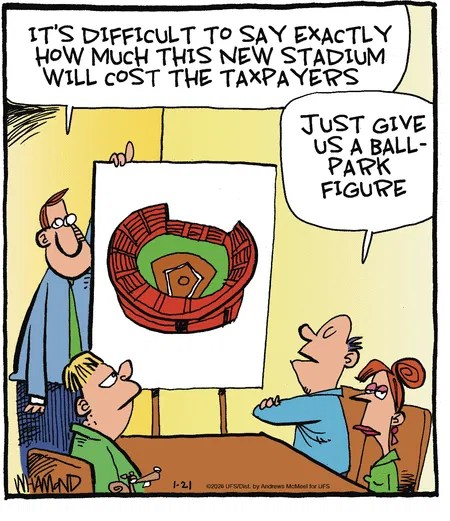
1. Subsidies for pro sports, including stadium construction, are damnable boondoggles. I would vote against every one of them until the franchise-owning billionaires ran me out of office.

While I’m at it, these too can come off the list:

2. Abolitions I supported that may well have hurt America:

  • The military draft Politicians who have anything to do with war policy should have skin in the game, even if it’s the skin of their descendants.
  • The Fairness Doctrine. We opened Pandora’s box before cable TV and the internet obliterated it. I don’t see a way back to sanity through reinstating the policy.

While I’m on a roll, here’s one that’s never been on the list:

3. The states should stop running primary elections. Neither major party is worth the powder to blow it up. Let them run their own elections or go back to “smoke-filled rooms” (which incidentally yielded better candidates than crackpot “base voters” have been yielding).

Logic mincing

Q: Which is better: a ham sandwich or complete happiness in life?
A: A ham sandwich, of course! Nothing is better than complete happiness in life and a ham sandwich is better than nothing.

  1. Something must be done!
  2. This is something.
  3. This must be done!

Shorts

  • No one is really working for peace unless he is working primarily for the restoration of wisdom. The assertion that “foul is useful and fair is not“ is the antithesis of wisdom. (E.F. Shumacher) Small Is Beautiful is a classic for good reason.
  • The national emergency is avoiding a national emergency. (Treasury Secretary Scott Bessent, citing the president’s authority to impose tariffs in an economic emergency, arguing that America’s supposed need to control Greenland is a national emergency.)
  • The health of the American experiment rests far more on the integrity of any given American president than we realized. (David French)
  • The pervasiveness of legal sports gambling can make an undefeated season and a 6-point victory in the national championship game feel like a loss if “the margin” was 7.5. (Moi)
  • At some point, we’ll reach the bottom of this dystopian populist abomination, but no one thinks we’re there yet, do they? (Nick Catoggio)
  • “The Trump Denmark letter is his Biden debate moment,” one Twitter user claimed.
  • Donald Trump is a peacock among the dull buzzards of American politics. (Martin Gurri, The Revolt of the Public and the Crisis of Authority in the New Millennium).
  • A clown with a flame thrower still has a flamethrower. (Charlie Sykes to Andrew Sullivan)
  • When you light a candle, you also cast a shadow. (Ursula K. Le Guin)
  • TikTok is still a danger. America no longer cares.
  • The souvenir is a fetish object that substitutes for the finite experience of the destination. (William T. Cavanaugh, The Uses of Idolatry)

Elsewhere in Tipsyworld


A devil is no less a devil if the lie he tells flatters you and stands to help you defeat your enemies and achieve power.

Rod Dreher

I don’t do any of the major social media, but I have two sub-domains of the domain you’re currently reading: (a) You can read most of my reflexive stuff, especially political here. (b) I also post some things on my favorite no-algorithm social medium.

Autogulpe Day

I’m fully aware that today is Epiphany in Western Christianity, Theophany in Orthodox Christianity. But it’s also the 5th anniversary of one of the darkest days in American history, the attempted autogulpe of 2021.

In some ways, I think 1-6-21 is worse than 9-11: we did this to ourselves, and to this day there are tens of millions of Americans who will insist that it was a great patriotic outpouring of love rather than an attempt to overturn a Presidential election that ousted the incumbent.

Baloney!, say I to keep this post as family fare.

With friends like this …

What I remember very well about that day was my own failure of imagination. I did not, to my knowledge, see Dempsey—he had positioned himself at the vanguard of the assault, and I had stayed near the White House to listen to Trump—but I did come across at least a dozen or more protesters dressed in similar tactical gear or wearing body armor, many of them carrying flex-cuffs. I particularly remember those plastic cuffs, but I understood them only as a performance of zealous commitment. Later we would learn that these men—some of whom were Proud Boys—believed that they would actually be arresting members of Congress in defense of the Constitution. I interviewed one of them. “It’s all in the Bible,” he said. “Everything is predicted. Donald Trump is in the Bible.” Grifters could not exist, of course, without a population primed to be grifted.

After the riot, Dempsey returned to California, where he was eventually arrested. In early 2024, he pleaded guilty to two felony counts of assaulting an officer with a dangerous weapon. He was sentenced to 20 years in prison.

Six months later, in the summer of 2024, Trump, who would come to describe the January 6 insurrection as a “day of love,” said that, if reelected, he would pardon rioters, but only “if they’re innocent.” Dempsey was not innocent, but on January 20, 2025, shortly after being inaugurated, Trump pardoned him and roughly 1,500 others charged with or convicted of offenses related to the Capitol insurrection ….

Jeffrey Goldberg, MAGA’s Foundational Lie. Subtitle: “The movement claims to stand with the police. Trump’s decision to pardon the cop-beaters of January 6 exposed his movement for what it is.”

And what have we gotten from the incorrigible electorate’s insistence on re-electing Trump four years after his defeat?

Defining “sedition” down

One indicator of a polity’s health is whether a citizen can be punished merely for telling the truth about the law. The signs for American democracy are not good.

This morning, Defense Secretary Pete Hegseth announced that he has begun the process to demote Mark Kelly, a retired Navy captain and NASA astronaut, and reduce his pension pay. The operative facts here, naturally, are not Kelly’s past service but his current rank and service: a Democrat serving in the U.S. Senate and a political adversary of President Donald Trump.

“Six weeks ago, Senator Mark Kelly—and five other members of Congress—released a reckless and seditious video that was clearly intended to undermine good order and military discipline,” Hegseth wrote on X this morning. He cited two articles of the Uniform Code of Military Justice; Kelly, unlike the other five, holds retired military status, which makes him subject to sanctions from the Defense Department.

What Hegseth did not cite was what Kelly and his colleagues actually said in the video, and for good reason. Doing so would expose the absurdity of the charge and the abuse of power involved in the attempt to demote him. “Our laws are clear: You can refuse illegal orders,” Kelly said. No one in the Trump administration has disputed that this is true. A more agile or even-keeled administration would have smoothly dismissed the video as irrelevant: This is true, but of course we would never issue an illegal order. (As Kelly and his lawyers have noted, Hegseth has cited the same law about disobeying illegal orders in the past.) Instead, Trump and his aides threw a fit, dubbing the Democrats the “Seditious Six.”

Members of the armed forces, and retirees like Kelly, are particularly susceptible to Hegseth’s abuse of power, because they can be punished by the Defense Department internally. But the chilling effect does not end with those who are serving or have served, or with the particular question of illegal orders. The administration has told the other five Democrats that it is investigating them as well. The core belief underlying all of this is as plain as it is dangerous: Criticizing Donald Trump and defending the rule of law is sedition.

David A. Graham, Hegseth’s Appalling Vengeance Campaign

Kelly responds tartly:

“My rank and retirement are things that I earned through my service and sacrifice for this country. I got shot at. I missed holidays and birthdays. I commanded a space shuttle mission while my wife,” former Representative Gabby Giffords, “recovered from a gunshot wound to the head—all while proudly wearing the American flag on my shoulder,” he said in a statement on X. “If Pete Hegseth, the most unqualified Secretary of Defense in our country’s history, thinks he can intimidate me with a censure or threats to demote me or prosecute me, he still doesn’t get it.”

Remember that Hegseth purports to be a devout Christian. He should bear in mind that “taking the name of the Lord in vain” has a deeper meaning than “don’t cuss.”


We are all gatekeepers now.

Peggy Noonan

Your enemies are not demonic, and they are not all-powerful and the right hasn’t always lost and the left hasn’t always won. But if you convince yourself of that, you give yourselves all sorts of permission to do a lot of stupid and terrible things under the rubric of “Do you know what time it is?”

Jonah Goldberg.

[A] critical mass of the American people … no longer want[s] to govern themselves, … are sick of this republic and no longer want to keep it if it means sharing power with those they despise.

Nick Catoggio

I don’t do any of the major social media, but I have two sub-domains of the domain you’re currently reading: (a) You can read most of my reflexive stuff, especially political here. (b) I also post some things on my favorite no-algorithm social medium.

November 1

MAGA nihilists

Sometime in 1985 I had lunch with Sam Francis in the cafeteria of The Washington Times, where we both worked. You may never have heard of Sam Francis, but MAGA people (at least the more intellectual ones) know him as one of the seminal thinkers of their movement.

The lunch was awkward because I found him dark and creepy (and he probably found me naïve). Back then I didn’t understand that his way of thinking would triumph in conservative circles and my way of thinking would be vanquished. I don’t think he won because he was a flat-out racist, though he was. (He was later fired for writing a column arguing that “neither ‘slavery’ nor ‘racism’ as an institution is a sin.”) I think he won because he was a revolutionary, while I was a conservative. I wanted to reform things; he wanted to burn it all down.

Sam Francis (who died in 2005) explicitly cited Gramsci as his role model as he waged his culture war struggles. Christopher Rufo does the same today. This is why Trump is going after the universities, public broadcasting and the Kennedy Center. Francis once wrote, “The main focus should be the reclamation of cultural power, the patient elaboration of an alternative culture within but against the regime — within the belly of the beast but indigestible by it.”

David Brooks, Hey, Lefties! Trump Has Stolen Your Game (Gift link)

I was reading Sam Francis at roughly the time Brooks had lunch with him and for some years thereafter. He was brilliant (which is little assurance of a sound mind). He also was purged by more respectable conservatives—my kind of conservatives—for his increasingly explicit antisemitism.

Joseph Sobran followed a similar trajectory. He, too, was brilliant, but less radical than Francis (and thus less consequential). He was a devout Catholic, and his antisemitism was never explicit, but William F. Buckley wouldn’t tolerate even a whiff of it.

I viscerally detested Christopher Rufo almost from my first notice of him, which involved his gloating over making the term “Critical Race Theory” toxic while leaving it vague enough that it could beslime anyone he cared to beslime. I doubt that Rufo will be as consequential as Francis or even Sobran in the long run, but we’re in an era of pas d’ennemis á Droite, and there’s no magisterial authority trying to purge him.

Sentient and respectable conservatives like me necessarily ask ourselves if MAGA was always the eventuality of our political preferences, if we were all embryonic Sam Fracises and Joe Sobrans all along.

I don’t think so, but I’m increasingly appreciating that some truths simply need not be uttered—because of how very, very foreseeably they can be abused. To deny them would be sin, to utter them, imprudent. I save them for my private journal now when I recognize that.

Pardon me?

On Tuesday morning, the Republican-led House Oversight Committee released a report on former President Joe Biden’s use of autopen signatures on the many pardons and commutations he handed out during his term, and particularly near its end. Many of these were scandalous enough taken on their own terms, but what made them particularly outrageous was the suspicion that the bulk of these acts were the work of Biden’s staff, not the senescent president himself. One might reasonably understand how Biden found the time to preemptively pardon his family members, breaking frequent promises never to do so, but it was harder to believe that he was setting aside personal time to commute the sentences of people like Maryland’s thrice-murdering “Black Widow” killer. The House report confirms what voters long suspected: Biden’s inner circle hid the extent of his mental decline from the American people and, after he dropped out of the race, used his autopen as part of their campaign to set a new record for presidential clemency.

The GOP argument that Biden abused his pardon power in an unacceptable way is undermined, however, by Trump’s nonchalant, even gleeful pardoning of absolute sleazeballs who have ties to his own family business. There aren’t a lot of large financial institutions that are willing to simultaneously do work with al-Qaeda, ISIS, Hamas, ransomware hackers, and kiddie-porn enthusiasts, but the crypto firm Binance did so. Back in November 2023, Binance founder Changpeng Zhao pleaded guilty to failing to maintain an effective anti-money-laundering program. In a court filing, U.S. Attorney Tessa Gorman said Zhao caused “significant harm to U.S national security” through his criminal acts and “violated U.S. law on an unprecedented scale.” But not only did Trump pardon him earlier this month, he claimed Zhao was in fact persecuted by the Biden administration. It gets worse. The Wall Street Journal reported in August: “The Trump family’s crypto venture has generated more wealth since the election—some $4.5 billion—than any other part of the president’s business empire.” Trump’s crypto fortune is of course facilitated by a partnership with “an under-the-radar trading platform quietly administered by Binance, the world’s largest crypto exchange.” It’s an egregious decision that is unlikely to generate more than a peep of objection from congressional Republicans.

National Review email.

Who damaged the nation more: Biden with his autopen pardons or Trump with his blanket pardon of the January 6 rioters and targeted pardons of lucrative cronies? (That’s a rhetorical question, of course.)

Indictment

Let us not belabor the obvious truth that what the Western world calls an “energy” crisis ineptly disguises what happens when you can no longer control markets, are chained to your colonies (instead of vice versa), are running out of slaves (and can’t trust those you think you still have), can’t, upon rigorously sober reflection, really send the Marines, or the Royal Navy, anywhere, or risk a global war, have no allies only business partners, or “satellites” and have broken every promise you ever made, anywhere, to anyone. I know what I am talking about: my grandfather never got the promised “forty acres, and a mule,” the Indians who survived that holocaust are either on reservations or dying in the streets, and not a single treaty between the United States and the Indian was ever honored. That is quite a record.

James Baldwin, Open Letter to the Born Again, p. 785.

My name is Ozymandias, King of Kings

The problem is that Trump, perhaps owing to his nouveau riche background and the carefully wrought deformity of his soul, has a taste for the trappings of aristocracy—a princely estate as imagined by a trust-fund dork from Queens. You can see it in his enthusiasm for ghastly imperial furnishings, in his love of monarchical pomp, and even in his sometimes evident desire to pass something of his political position along to the sons he obviously despises. … But what is most objectionably kingly about Trump is not his Caligula-by-way-of-Liberace bad taste but his personalist posture, e.g., treating the White House as though it were his personal property, to be knocked down and rebuilt at his whim, treating the Department of Justice as though it were his personal goon squad, treating judges as though they were his personal servants and factota, etc. Trump talks about “my generals” and unilaterally raised tariffs on Canadian goods because someone in Ontario hurt his personal feelings.

L’État, c’est moi—it is not only gilt moldings that Trump has taken from Louis XIV.

The king spoke, and said, “Is not this great Babylon, that I have built for the house of the kingdom by the might of my power, and for the honor of my majesty?”

While the word was in the king’s mouth, there fell a voice from heaven, saying, Oh, king Nebuchadnezzar, to thee it is spoken; The kingdom is departed from thee.

Nebuchadnezzar had to learn things the hard way. Julius Caesar, too. Why should Americans be any different?

Kevin D. Williamson

Pas d’ennemis à Droite, Heritage Foundation Edition

[A] video of Kevin Roberts, head of the Heritage Foundation, went viral. “There has been speculation that Heritage is distancing itself from Tucker Carlson over the past 24 hours,” Roberts tweeted, reacting to the uproar over Carlson’s notorious interview with head groyper Nick Fuentes. “I want to put that to rest right now.”

And that’s what he did. “We will always defend our friends against the slander of bad actors who serve someone else’s agenda,” he said in the clip, declining to explain why criticism of Carlson is “slander” and who that “someone else” whose agenda is being served might be. “That includes Tucker Carlson, who remains—and, as I have said before, always will be—a close friend of the Heritage Foundation. The venomous coalition attacking him are sowing division. Their attempt to cancel him will fail.”

Nick Catoggio

Stagnation

Today’s suburbs are different. Highways and zoning have broken the feedback loop between location and value. These developments are typically built to a fixed, finished state and then locked down through zoning codes that discourage or prohibit change. There’s no natural process of maturing or intensification. No organic evolution. Just a one-time buildout, followed by stagnation and decline.

America Should Sprawl? Not if We Want Strong Towns

Snippets

  • “Quantity is a quality of its own.” (Shyam Sankar, CTO of Palantir, on the United States advantage in WW II. German stuff was engineered better, but we made up for it with more stuff, much more stuff. Via Ross Douthat’s Interesting Times podcast (Gift link))
  • “[E]very good earnings report further entrenches Nvidia as a precariously placed, load-bearing piece of the global economy … What if AI’s promise for American business proves to be a mirage? What happens then?” (Matteo Wong, Charlie Warzel, Here’s How the AI Crash Happens)

I don’t do any of the major social media, but I have two sub-domains of the domain you’re currently reading: (a) You can read most of my reflexive stuff, especially political here. (b) I also post some things on my favorite no-algorithm social medium.

No Kings Saturday, 10/18/25

No kings!

Binding precedent

Protesters have protested at an ICE facility a few miles west of Chicago for the past 19 years—with somewhat more intensity recently following the announcement of Operation Midway Blitz. A month after the announcement, the president federalized the Illinois National Guard. District court: Enjoined. Seventh Circuit: Just so. Political opposition is not rebellion, and a protest doesn’t become a rebellion merely due to a few isolated incidents of violence. Without that, none of the statutory predicates for federalizing the National Guard have been met.

Institute for Justice, Short Circuits for 10/17/25 (bold added). This is now the law in the 7th U.S. Circuit – Indiana, Illinois and Wisconsin.

Look for the Administration to try to provoke a rebellion it can crush. Everyone who’s paying attention knows Trump wants to invoke the Insurrection Act (as he stuffs his pockets and those of his family).

Wanted: a viable counternarrative

Trump’s actions … are part of one project: creating a savage war of all against all and then using the presidency to profit and gain power from it. Trumpism can also be seen as a multipronged effort to amputate the higher elements of the human spirit—learning, compassion, science, the pursuit of justice—and supplant those virtues with greed, retribution, ego, appetite. Trumpism is an attempt to make the world a playground for the rich and ruthless, so it seeks to dissolve the sinews of moral and legal restraint that make civilization decent.

Trumpism, like populism, is more than a set of policies—it’s a culture. Trump offers people a sense of belonging, an identity, status, self-respect, and a comprehensive political ethic. Populists are not trying to pass this or that law; they are altering the climate of the age. And Democrats think they can fight that by offering some tax credits?

To beat a social movement, you must build a counter social movement. And to do that, you need a different narrative about where we are and where we should be heading, a different set of values dictating what is admirable and what is disgraceful. If we fail to build such a movement, authoritarian strongmen around the globe will dominate indefinitely.

David Brooks.

You can’t beat something with nothing. I can’t come up with a political counternarrative to Trumpism. The Democrats can’t come up with a political counternarrative, either. Brooks couldn’t come up with a strong political counternarrative.

I can only hope and pray that people will look for their compelling (counter-)narrative to the Gospel of Jesus Christ. (And that meantime there will be some legal counternarratives to prevent irretrievable damage, as in the preceding item.)

Music Reviews

There may be nothing better than old music reviews to let you know that it’s okay to like what you like, critics be damned.

I like Debussy’s La Mer, and I don’t care what the stupid early reviews said:

On today’s date in 1905, Claude Debussy’s orchestral suite La Mer or The Sea was performed for the first time in Paris. Today this music is regarded as an impressionistic masterpiece, but early audiences — especially those in America — found it rough sailing.

“We clung like a drowning man to a few fragments of the tonal wreck,” wrote a 1907 Boston critic, and suggested that instead of The Sea Debussy should have titled his piece Sea-Sickness.

“The Sea is persistently ugly,” wrote The New York Times that same year. “Debussy fails to give any impression of the sea … There is more of a barnyard cackle in it than anything else.”

And in 1909, this on La Mer from The Chicago Tribune: “It is safe to say that few understood what they heard and few heard anything they understood … There are no themes … There is nothing in the way of even a brief motif that can be grasped securely enough by the ear and brain to serve as a guiding line through the tonal maze. There is no end of queer and unusual effects, no end of harmonic complications and progressions that sound so hideously ugly.”

Ah, the perils of “modern music” in the early 20th century!

Giving the Devil his due, impressionism had to be a real mind-blower for critics attuned to, say, the sonata-allegro form.

Comprehensive tradition

We’re often not very aware of the “tradition” in which we live. A student in a classroom would readily agree that the words of a teacher or professor were a “traditioning” of sorts. But they will fail to notice that how the room is arranged, how the students sit, what the students wear (or don’t wear), how the professor is addressed, how students address one another, what questions are considered appropriate and what are not, and a whole world of unspoken, unwritten expectations are utterly required in the process. The modern world often imagines that “online” education is equivalent to classroom education since the goal is merely the transmission of information. But the transmission of information includes the process of acquiring the information and everything that surrounds it. Those receiving the “tradition” online will have perhaps similar information to those receiving it in a classroom – but they will not receive the same information.

Fr. Stephen Freeman, The Tradition of Being Human

Stages of life

Two questions:

  1. Do I want to read/watch/listen to this?
  2. Should I read/watch/listen to this?

When I was younger the second question often dominated my decision-making. Now that I am officially ancient that question has virtually disappeared and the first one is usually the only one I ask. That’s been the single most notable change in my personality in these my declining years.

Alan Jacobs

Alan is a decade or more younger than me, yet I only very recently seem to have arrived at this point, especially regarding political matters.

Note that he’s talking about a change in personality. This isn’t a life rule. There are things that younger people should read/watch/listen to, in order to become well-formed human beings.

Two ways

[R]evival begins with the people proclaiming, by word and deed, “I have sinned.”

MAGA Christianity has a different message. It looks at American culture and declares, “You have sinned.”

David French

Noteworthy

In the aftermath of Kirk’s murder, we witnessed young people at vigils rather than at “mostly peaceful” demonstrations.

R.R. Reno in First Things


We are all gatekeepers now.

Peggy Noonan

Your enemies are not demonic, and they are not all-powerful and the right hasn’t always lost and the left hasn’t always won. But if you convince yourself of that, you give yourselves all sorts of permission to do a lot of stupid and terrible things under the rubric of “Do you know what time it is?”

Jonah Goldberg.

[A] critical mass of the American people … no longer want[s] to govern themselves, … are sick of this republic and no longer want to keep it if it means sharing power with those they despise.

Nick Catoggio

I don’t do any of the major social media, but I have two sub-domains of the domain you’re currently reading: (a) You can read most of my reflexive stuff, especially political here. (b) I also post some things on my favorite no-algorithm social medium.

Sunday evening

“We took the freedom of speech away …”

At the round table … he diverted to a tangent about flag burning, saying he had instituted a “one-year penalty for inciting riots.”

“We took the freedom of speech away because that’s been through the courts and the courts said, you have freedom of speech,” Mr. Trump said. “But what has happened is when they burn a flag, it agitates and irritates crowds.”

Charlie Savage, Trump Baselessly Claims He ‘Took the Freedom of Speech Away’ From Flag Burners.

Trump’s word salads are incoherent, but I think he’s saying that he recognizes a heckler’s veto on flag-burning, like the one he tried on Colin Kaepernick for kneeling.

Sorry, Donnie: Street v. New York (1969).

Quick, easy, and stupid pigeon-holing

Using the old Left-Right duality distorts our political thinking. Consider what counts as “Leftist” today: Open immigration, transgenderism, antiracism, gay marriage, opposition to Israel’s incursion in Gaza, violence against conservatives and Christians, unbending support for Ukraine, pro-choice, anti-Trumpism.

Once these positions are grouped as “Left,” anyone who holds one “Left” position is labeled a “Leftist.” If you have reservations about Trump (as I do), question Trump’s immigration policies, believe African Americans have suffered and still suffer injustices, or express sympathy for Palestinians in Gaza, you’ll get lumped in with transgenders and homosexuals, rioters and assassins.

Everybody but everybody condemns “third way” Christian political agendas. That condemnation is childish, first because it’s utterly unhistorical. The specific contours of the American Left and Right are entirely contingent, constantly shifting political outlooks and moods. They don’t exhaust our political options.

Peter Leithart

Losing the real storyline

Ross Douthat is definitely one of my favorite journalists these days, but, bless his heart, whenever I see a column about Donald Trump’s “policies,” I get the feeling that the author is trying too hard to make him a normal President.

Setting the record straight on “sanctuary cities”

I have very high regard for professor J Budziszewski, who writes on natural law and blogs at the Underground Thomist. But his latest post blows it, not because of illogic, but because of a badly mistaken premises. I write because his mistake is very wide-spread.

The topic is so-called “sanctuary cities.” Here’s Budziszewski’s false premise:

So called sanctuary cities … claim … that … any locality may invalidate federal laws within its territory. This isn’t about the form of the federal union. It is a rejection of federal union.

Sanctuary cities claim no power to invalidate federal law. What they claim is the power to refuse cooperation in the enforcement of federal laws (typically involving immigration) that they don’t like (or even, during the reign of terror of Trump 2.0, if they don’t like the way the feds are enforcing the law via jack-booted, masked goons).

I don’t want to get into the weeds too far, but:

  • States are not obliged to cooperate with the federal government in enforcing federal law. “Commandeering” is the term frequently used to describe federal efforts to force cooperation.
  • Cities, as subdivisions of the state and as entities that normally have a degree of home rule to determine their financial priorities, are not necessarily obliged to cooperate with the federal government in enforcing federal law. This only becomes controversial when cities engage in grandstanding like “sanctuary city” declarations.
  • Non-cooperation isn’t the same as interference, which would be dubious at best.
  • States may forbid cities to withhold cooperation with the feds because cities are not in themselves sovereigns. Some states have purportedly done so, though laws forbidding sanctuary cities could easily stumble over their own sort of grandstanding.
  • Feds probably can retaliate by denying some or all federal aid to sanctuary cities.

I have not been a fan of sanctuary cities because they made a big, virtue-signaling deal out of what could be done quietly. The tactics of ICE under Trump is unlikely to change my mind, though even then I’m inclined to favor quiet non-cooperation. Trump, after all, is itching to declare insurrection and to impose martial law, and virtue-signaling declarations of non-cooperation provide a readier excuse than passive-aggression.


We are all gatekeepers now.

Peggy Noonan

Your enemies are not demonic, and they are not all-powerful and the right hasn’t always lost and the left hasn’t always won. But if you convince yourself of that, you give yourselves all sorts of permission to do a lot of stupid and terrible things under the rubric of “Do you know what time it is?”

Jonah Goldberg.

[A] critical mass of the American people … no longer want[s] to govern themselves, … are sick of this republic and no longer want to keep it if it means sharing power with those they despise.

Nick Catoggio

I don’t do any of the major social media, but I have two sub-domains of the domain you’re currently reading: (a) You can read most of my reflexive stuff, especially political here. (b) I also post some things on my favorite no-algorithm social medium.

Never say Never

I never imagined that I would recommend listening to an accordion player. But the YouTube channel Sergei Teleshev Accordion is astonishing. I’ve never (that I can recall) seen accordions like that (they’re called button accordions, I guess) or heard them making serious, even thrilling, music, like this father and daughter do. (The daughter is 16, by the way.)

Trigger warning: The remainder of this post is (more or less) political

The Calvinball Presidency

I like arguments about ideas. The only way to have a good argument about ideas is if the person or people you’re arguing with have some degree of sincerity about what they are arguing for—or against. Being a political commentator in the Trump era is like being a sportscaster covering a game of Calvinball. The rules change all the time, so arguing about them is an exhausting waste of time.

Jonah Goldberg, The Boredom of Writing in the Trump Era – The Dispatch

Inspectors General

When hoodlums start disabling security cameras, you can bet they’ve got nothing good in mind.

The Trump administration on Wednesday withdrew funding for the Council of Inspectors General, a federal watchdog group, and the entity’s website was disabled. The group oversaw a network of 72 inspectors general. According to the Washington Post, the Trump administration had decided last week to pull the group’s funding.

The Morning Dispatch

Algorithms

[W]e are a nation divided by algorithms. If your algorithm knows you as conservative and interested in military matters, you got a lot of videos of young soldiers and sailors acting out the past few years, and of service branches tweeting out showy political sentiments. You felt understandable alarm. If your algorithm knows you as liberal and not interested in military affairs, you haven’t seen that content, and will have been surprised by Mr. Hegseth’s reference to “dudes in dresses.” We are all getting different versions of reality every time we look at a screen, and it’s hurting us.

Peggy Noonan, The Embarrassing Pete Hegseth.

As if on cue, some folks known to the algorithm as conservative and interested in military matters let it be known that they thought Hegseth’s show was just fine:

Much depends on the details and execution, but if implemented with both verve and prudence, Hegseth’s commonsense reforms will profit the American profession of arms.

As noted in my standard footer for blog posts, I am a participant on something called micro.blog: I follow people I’ve found interesting and some of them follow me. Yet I sensed it wasn’t like Facebook or Twitter/X. It was pleasant. It was sane.

I think Noonan has put her finger on why it is so: it has no algorithms.

In fact, I don’t think I frequent any websites that use algorithms to target my inferred vulnerabilities.

Grooming codes and Flag Codes

Speaking of The Embarrassing Pete Hegseth, Kevin D. Williamson has a few choice words:

I will believe that Hegseth is serious about this stuff when Hegseth starts acting like he is serious about it. As a few observers have pointed out, Hegseth’s Beverly Hills, 90210-style sideburns often extend to a length that would be prohibited under military grooming standards. But there is another area of dress convention that Hegseth violates in practically every public appearance, one that is in fact relevant to his current position: the Flag Code.

The Flag Code is written into federal law, though there is no penalty for violating it. It forbids wearing the flag as an article of clothing, a rule Hegseth routinely flouts with his dopey flag-lined suits. It specifically forbids using the flag as a handkerchief, which Hegseth does habitually, tucking it into his chest pocket as a decorative pocket square—and surely, surely not because doing so makes it look like he is wearing some kind of military decoration. Hegseth, Donald Trump, and the members of the movement they represent are habitual violators of the Flag Code, which is not merely an aesthetic concern. 

Part of the point of the Flag Code is the notion that the flag is not to be treated as though it were merely an item of personal property. It is not to be used for tawdry, tacky, or self-interested purposes such as advertising. Hegseth has obvious contempt for rules of this kind, and Trump has equally obvious contempt for any kind of rule that would put any kind of limitation on his self-aggrandizement and vanity. You can be sure that if Hegseth or Trump preferred to wear a beard, then beards would be mandatory in the military, possibly even for women.

The allure of delusional self-adoration can be powerful. When a junior high vice principal made me cut my hair (picture your obedient correspondent at 15 with a blond Robert Smith-circa-Kiss Me, Kiss Me, Kiss Me rats’ nest), I was much offended. I believed, in the sincerest possible way, that I was a unique, very special, possibly heroic 15-year-old, one destined for great things, and, above all, one whose autonomy and personal sense of self had to be respected at all times, damn the rules. It all seemed incontrovertible at the time. But I am not in junior high school anymore. Pete Hegseth somehow is. Princeton owes him a refund. 

Mau-mauing the NFL

I’d bet a modest amount that our Censor-in-Chief will figure out some threat to the NFL sufficient to motivate a change of the Superbowl Halftime Show from Bad Bunny to someone markedly more WASPish.

In any event, I’ll miss the game and the show. I’m expecting an emergency call then.


We are all gatekeepers now.

Peggy Noonan

Your enemies are not demonic, and they are not all-powerful and the right hasn’t always lost and the left hasn’t always won. But if you convince yourself of that, you give yourselves all sorts of permission to do a lot of stupid and terrible things under the rubric of “Do you know what time it is?”

Jonah Goldberg.

[A] critical mass of the American people … no longer want[s] to govern themselves, … are sick of this republic and no longer want to keep it if it means sharing power with those they despise.

Nick Catoggio

I don’t do any of the major social media, but I have two sub-domains of the domain you’re currently reading: (a) You can read most of my reflexive stuff, especially political here. (b) I also post some things on my favorite no-algorithm social medium.

Authoritarianism in the 21st century

My father died 27 years ago today. It was too early, but I wouldn’t have wanted to see him at the age he’d be now.

This just might be faintly relevant

There isn’t a single instance of a fentanyl seizure in the Caribbean:

Last month, the U.S. cutter Hamilton returned to Florida with what the agency called “the largest quantity of drugs offloaded in Coast Guard history”: 61,740 pounds of cocaine and 14,400 pounds of marijuana (that’s the weight of about three city buses). The haul, gathered by multiple federal agencies during 19 seizure incidents in the Caribbean as well as the Pacific, had an estimated street value of $473 million. But there wasn’t any fentanyl on the boat.

(Nick Miroff)

Authoritarianism in the 21st century

We are living in an authoritarian state.

It didn’t feel that way this morning, when I took my dog for his usual walk in the park and dew from the grass glittered on my boots in the rising sunlight. It doesn’t feel that way when you’re ordering an iced mocha latte at Starbucks or watching the Patriots lose to the Steelers. The persistent normality of daily life is disorienting, even paralyzing. Yet it’s true.

We have in our heads specific images of authoritarianism that come from the 20th century: uniformed men goose-stepping in jackboots, masses of people chanting party slogans, streets lined with giant portraits of the leader, secret opposition meetings in basements, interrogations under naked light bulbs, executions by firing squad … I’d be surprised if this essay got me hauled off to prison in America. Authoritarianism in the 21st century looks different, because it is different. Political scientists have tried to find a new term for it: illiberal democracy, competitive authoritarianism, right-wing populism …

… To keep their jobs, civil servants have to prove not their competence but their personal loyalty to the leader. Independent government officers—prosecutors, inspectors general, federal commissioners, central bankers—are fired and their positions handed to flunkies. The legislature, in the hands of the ruling party, becomes a rubber stamp for the executive. Courts still hear cases, but judges are appointed for their political views, not their expertise … There are no meaningful checks on the leader’s power.

Today’s authoritarianism doesn’t move people to heroic feats on behalf of the Fatherland. The leader and his cronies, in and out of government, use their positions to hold on to power and enrich themselves. Corruption becomes so routine that it’s expected; the public grows desensitized, and violations of ethical norms that would have caused outrage in any other time go barely noticed. … At important political moments it mobilizes its core supporters with frenzies of hatred, but its overriding goal is to render most citizens passive. If the leader’s speech gets boring, you can even leave early (no one left Nuremberg early). Twenty-first-century authoritarianism keeps the public content with abundant calories and dazzling entertainment. Its dominant emotions aren’t euphoria and rage, but indifference and cynicism. Because most people still expect to have certain rights respected, blatant totalitarian mechanisms of repression are avoided. The most effective tools of control are distraction, confusion, and division.

“If everybody always lies to you, the consequence is not that you believe the lies, but rather that nobody believes anything any longer,” the political philosopher Hannah Arendt said near the end of her life. “And a people that no longer can believe anything cannot make up its mind. It is deprived not only of its capacity to act but also of its capacity to think and to judge. And with such a people you can then do what you please.”

These are the features of the modern authoritarian state. Every one of them exists today in this country …

… It sometimes seems as if the only check on Trump’s power is his own attention span.

George Packer, America’s Zombie Democracy.

Railway to the Moon

Imagine if you were trying to write intelligently about the socioeconomic impact of the railroad in the middle of the 19th century, and half the people investing in trains were convinced that the next step after transcontinental railways would be a railway to the moon, a skeptical minority was sure that the investors in the Union Pacific would all go bankrupt, many analysts were convinced that trains were developing their own form of consciousness, reasonable-seeming observers pegged the likelihood of a train-driven apocalypse at 20 or 30 percent, and peculiar cults of engine worship were developing on the fringes of the industry.

What would you reasonably say about this world? The prime minister of Denmark already gave the only possible answer: Raise your alert levels, and prepare for various scenarios.

Ross Douthat, Drones, Denmark and Dark Magic

PK snippets

  • “I’m not proposing a political program,” he told me. “This isn’t some Christian civilizational vision. It’s much more personal.” You decide how and where to wage battle: at a community garden, on the Appalachian Trail, in a mosque.
  • He was struck by how commonplace legal cannabis had become. “It’s a really, really useful drug for the state to be legalizing,” he said. “Because it’s not like alcohol. It doesn’t get you violent. And maybe life is a bit less crappy. It’s the best antidote to revolution that you could possibly have.”
  • “When you’re sitting in your living room with your Punjabi wife reading a bunch of stuff about how you’re a white nationalist, it makes you want to punch people in the face,” he said. “Luckily, I’m a Christian, so I don’t do that.”

Paul Kingsnorth via Alexander Nazaryan in the New York Times


We are all gatekeepers now.

Peggy Noonan

Your enemies are not demonic, and they are not all-powerful and the right hasn’t always lost and the left hasn’t always won. But if you convince yourself of that, you give yourselves all sorts of permission to do a lot of stupid and terrible things under the rubric of “Do you know what time it is?”

Jonah Goldberg.

[A] critical mass of the American people … no longer want[s] to govern themselves, … are sick of this republic and no longer want to keep it if it means sharing power with those they despise.

Nick Catoggio

I don’t do any of the major social media, but I have two sub-domains of the domain you’re currently reading: (a) You can read most of my reflexive stuff, especially political here. (b) I also post some things on my favorite social medium.