November 1

MAGA nihilists

Sometime in 1985 I had lunch with Sam Francis in the cafeteria of The Washington Times, where we both worked. You may never have heard of Sam Francis, but MAGA people (at least the more intellectual ones) know him as one of the seminal thinkers of their movement.

The lunch was awkward because I found him dark and creepy (and he probably found me naïve). Back then I didn’t understand that his way of thinking would triumph in conservative circles and my way of thinking would be vanquished. I don’t think he won because he was a flat-out racist, though he was. (He was later fired for writing a column arguing that “neither ‘slavery’ nor ‘racism’ as an institution is a sin.”) I think he won because he was a revolutionary, while I was a conservative. I wanted to reform things; he wanted to burn it all down.

Sam Francis (who died in 2005) explicitly cited Gramsci as his role model as he waged his culture war struggles. Christopher Rufo does the same today. This is why Trump is going after the universities, public broadcasting and the Kennedy Center. Francis once wrote, “The main focus should be the reclamation of cultural power, the patient elaboration of an alternative culture within but against the regime — within the belly of the beast but indigestible by it.”

David Brooks, Hey, Lefties! Trump Has Stolen Your Game (Gift link)

I was reading Sam Francis at roughly the time Brooks had lunch with him and for some years thereafter. He was brilliant (which is little assurance of a sound mind). He also was purged by more respectable conservatives—my kind of conservatives—for his increasingly explicit antisemitism.

Joseph Sobran followed a similar trajectory. He, too, was brilliant, but less radical than Francis (and thus less consequential). He was a devout Catholic, and his antisemitism was never explicit, but William F. Buckley wouldn’t tolerate even a whiff of it.

I viscerally detested Christopher Rufo almost from my first notice of him, which involved his gloating over making the term “Critical Race Theory” toxic while leaving it vague enough that it could beslime anyone he cared to beslime. I doubt that Rufo will be as consequential as Francis or even Sobran in the long run, but we’re in an era of pas d’ennemis á Droite, and there’s no magisterial authority trying to purge him.

Sentient and respectable conservatives like me necessarily ask ourselves if MAGA was always the eventuality of our political preferences, if we were all embryonic Sam Fracises and Joe Sobrans all along.

I don’t think so, but I’m increasingly appreciating that some truths simply need not be uttered—because of how very, very foreseeably they can be abused. To deny them would be sin, to utter them, imprudent. I save them for my private journal now when I recognize that.

Pardon me?

On Tuesday morning, the Republican-led House Oversight Committee released a report on former President Joe Biden’s use of autopen signatures on the many pardons and commutations he handed out during his term, and particularly near its end. Many of these were scandalous enough taken on their own terms, but what made them particularly outrageous was the suspicion that the bulk of these acts were the work of Biden’s staff, not the senescent president himself. One might reasonably understand how Biden found the time to preemptively pardon his family members, breaking frequent promises never to do so, but it was harder to believe that he was setting aside personal time to commute the sentences of people like Maryland’s thrice-murdering “Black Widow” killer. The House report confirms what voters long suspected: Biden’s inner circle hid the extent of his mental decline from the American people and, after he dropped out of the race, used his autopen as part of their campaign to set a new record for presidential clemency.

The GOP argument that Biden abused his pardon power in an unacceptable way is undermined, however, by Trump’s nonchalant, even gleeful pardoning of absolute sleazeballs who have ties to his own family business. There aren’t a lot of large financial institutions that are willing to simultaneously do work with al-Qaeda, ISIS, Hamas, ransomware hackers, and kiddie-porn enthusiasts, but the crypto firm Binance did so. Back in November 2023, Binance founder Changpeng Zhao pleaded guilty to failing to maintain an effective anti-money-laundering program. In a court filing, U.S. Attorney Tessa Gorman said Zhao caused “significant harm to U.S national security” through his criminal acts and “violated U.S. law on an unprecedented scale.” But not only did Trump pardon him earlier this month, he claimed Zhao was in fact persecuted by the Biden administration. It gets worse. The Wall Street Journal reported in August: “The Trump family’s crypto venture has generated more wealth since the election—some $4.5 billion—than any other part of the president’s business empire.” Trump’s crypto fortune is of course facilitated by a partnership with “an under-the-radar trading platform quietly administered by Binance, the world’s largest crypto exchange.” It’s an egregious decision that is unlikely to generate more than a peep of objection from congressional Republicans.

National Review email.

Who damaged the nation more: Biden with his autopen pardons or Trump with his blanket pardon of the January 6 rioters and targeted pardons of lucrative cronies? (That’s a rhetorical question, of course.)

Indictment

Let us not belabor the obvious truth that what the Western world calls an “energy” crisis ineptly disguises what happens when you can no longer control markets, are chained to your colonies (instead of vice versa), are running out of slaves (and can’t trust those you think you still have), can’t, upon rigorously sober reflection, really send the Marines, or the Royal Navy, anywhere, or risk a global war, have no allies only business partners, or “satellites” and have broken every promise you ever made, anywhere, to anyone. I know what I am talking about: my grandfather never got the promised “forty acres, and a mule,” the Indians who survived that holocaust are either on reservations or dying in the streets, and not a single treaty between the United States and the Indian was ever honored. That is quite a record.

James Baldwin, Open Letter to the Born Again, p. 785.

My name is Ozymandias, King of Kings

The problem is that Trump, perhaps owing to his nouveau riche background and the carefully wrought deformity of his soul, has a taste for the trappings of aristocracy—a princely estate as imagined by a trust-fund dork from Queens. You can see it in his enthusiasm for ghastly imperial furnishings, in his love of monarchical pomp, and even in his sometimes evident desire to pass something of his political position along to the sons he obviously despises. … But what is most objectionably kingly about Trump is not his Caligula-by-way-of-Liberace bad taste but his personalist posture, e.g., treating the White House as though it were his personal property, to be knocked down and rebuilt at his whim, treating the Department of Justice as though it were his personal goon squad, treating judges as though they were his personal servants and factota, etc. Trump talks about “my generals” and unilaterally raised tariffs on Canadian goods because someone in Ontario hurt his personal feelings.

L’État, c’est moi—it is not only gilt moldings that Trump has taken from Louis XIV.

The king spoke, and said, “Is not this great Babylon, that I have built for the house of the kingdom by the might of my power, and for the honor of my majesty?”

While the word was in the king’s mouth, there fell a voice from heaven, saying, Oh, king Nebuchadnezzar, to thee it is spoken; The kingdom is departed from thee.

Nebuchadnezzar had to learn things the hard way. Julius Caesar, too. Why should Americans be any different?

Kevin D. Williamson

Pas d’ennemis à Droite, Heritage Foundation Edition

[A] video of Kevin Roberts, head of the Heritage Foundation, went viral. “There has been speculation that Heritage is distancing itself from Tucker Carlson over the past 24 hours,” Roberts tweeted, reacting to the uproar over Carlson’s notorious interview with head groyper Nick Fuentes. “I want to put that to rest right now.”

And that’s what he did. “We will always defend our friends against the slander of bad actors who serve someone else’s agenda,” he said in the clip, declining to explain why criticism of Carlson is “slander” and who that “someone else” whose agenda is being served might be. “That includes Tucker Carlson, who remains—and, as I have said before, always will be—a close friend of the Heritage Foundation. The venomous coalition attacking him are sowing division. Their attempt to cancel him will fail.”

Nick Catoggio

Stagnation

Today’s suburbs are different. Highways and zoning have broken the feedback loop between location and value. These developments are typically built to a fixed, finished state and then locked down through zoning codes that discourage or prohibit change. There’s no natural process of maturing or intensification. No organic evolution. Just a one-time buildout, followed by stagnation and decline.

America Should Sprawl? Not if We Want Strong Towns

Snippets

  • “Quantity is a quality of its own.” (Shyam Sankar, CTO of Palantir, on the United States advantage in WW II. German stuff was engineered better, but we made up for it with more stuff, much more stuff. Via Ross Douthat’s Interesting Times podcast (Gift link))
  • “[E]very good earnings report further entrenches Nvidia as a precariously placed, load-bearing piece of the global economy … What if AI’s promise for American business proves to be a mirage? What happens then?” (Matteo Wong, Charlie Warzel, Here’s How the AI Crash Happens)

I don’t do any of the major social media, but I have two sub-domains of the domain you’re currently reading: (a) You can read most of my reflexive stuff, especially political here. (b) I also post some things on my favorite no-algorithm social medium.
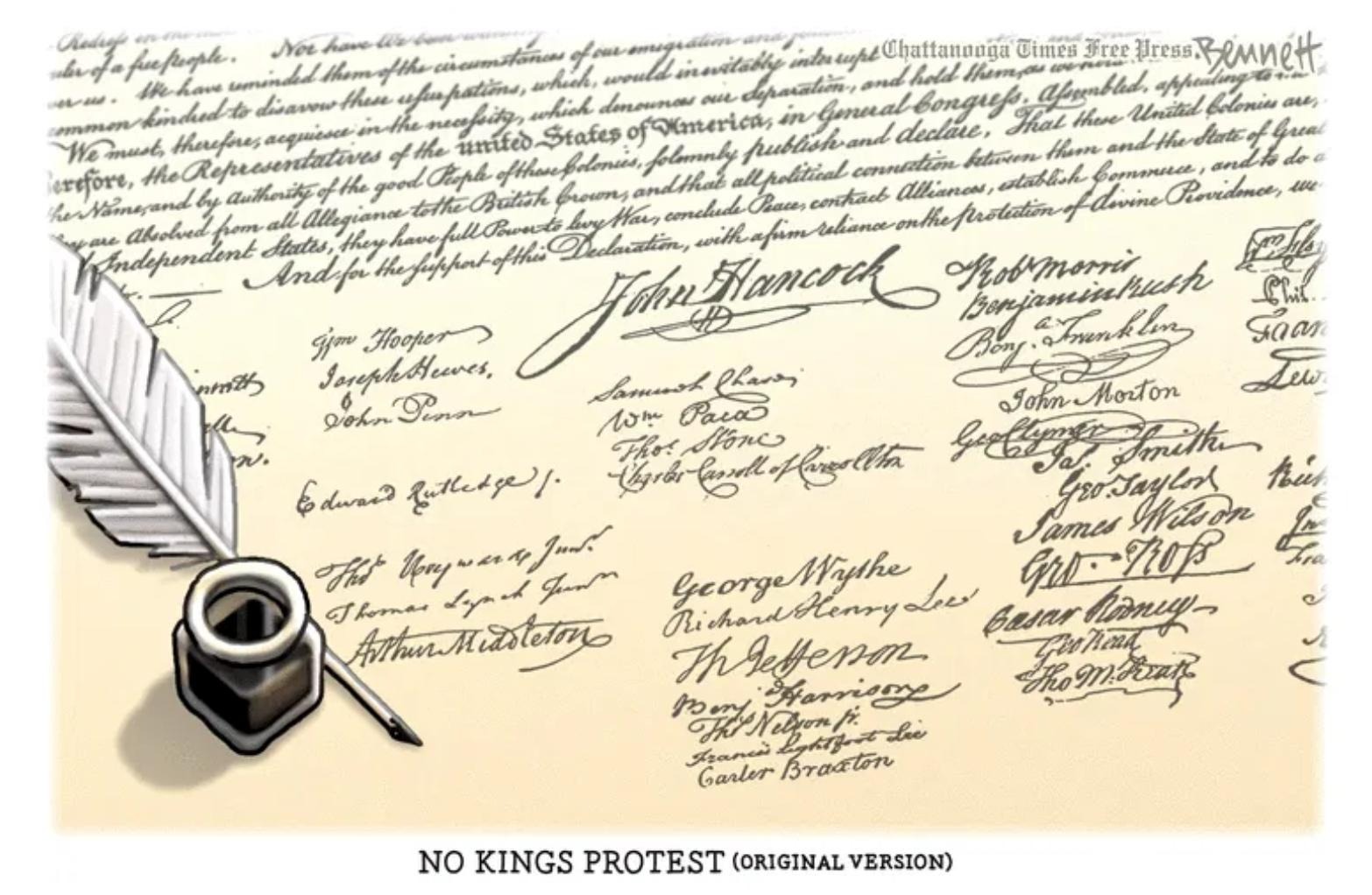
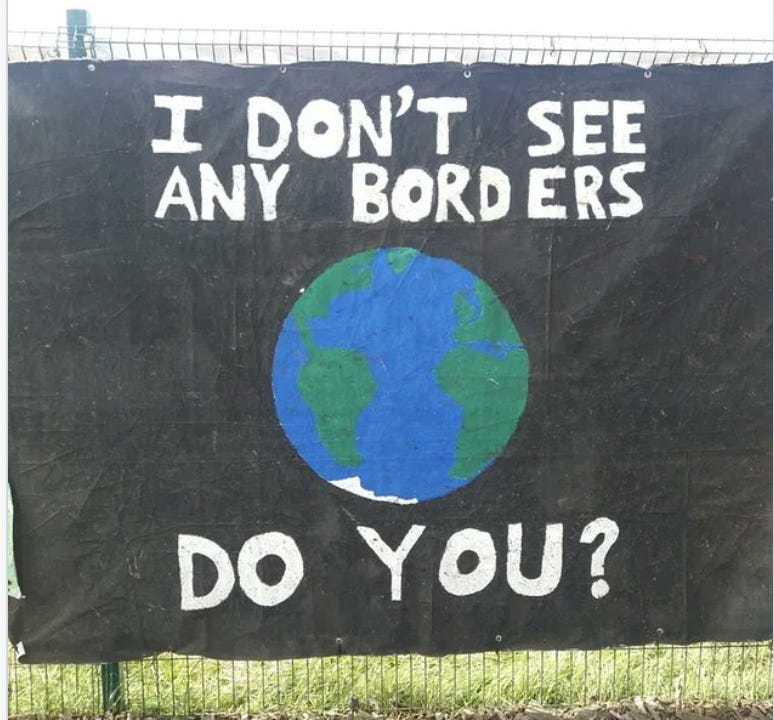
No Kings Saturday, 10/18/25

No kings!

Binding precedent

Protesters have protested at an ICE facility a few miles west of Chicago for the past 19 years—with somewhat more intensity recently following the announcement of Operation Midway Blitz. A month after the announcement, the president federalized the Illinois National Guard. District court: Enjoined. Seventh Circuit: Just so. Political opposition is not rebellion, and a protest doesn’t become a rebellion merely due to a few isolated incidents of violence. Without that, none of the statutory predicates for federalizing the National Guard have been met.

Institute for Justice, Short Circuits for 10/17/25 (bold added). This is now the law in the 7th U.S. Circuit – Indiana, Illinois and Wisconsin.

Look for the Administration to try to provoke a rebellion it can crush. Everyone who’s paying attention knows Trump wants to invoke the Insurrection Act (as he stuffs his pockets and those of his family).

Wanted: a viable counternarrative

Trump’s actions … are part of one project: creating a savage war of all against all and then using the presidency to profit and gain power from it. Trumpism can also be seen as a multipronged effort to amputate the higher elements of the human spirit—learning, compassion, science, the pursuit of justice—and supplant those virtues with greed, retribution, ego, appetite. Trumpism is an attempt to make the world a playground for the rich and ruthless, so it seeks to dissolve the sinews of moral and legal restraint that make civilization decent.

Trumpism, like populism, is more than a set of policies—it’s a culture. Trump offers people a sense of belonging, an identity, status, self-respect, and a comprehensive political ethic. Populists are not trying to pass this or that law; they are altering the climate of the age. And Democrats think they can fight that by offering some tax credits?

To beat a social movement, you must build a counter social movement. And to do that, you need a different narrative about where we are and where we should be heading, a different set of values dictating what is admirable and what is disgraceful. If we fail to build such a movement, authoritarian strongmen around the globe will dominate indefinitely.

David Brooks.

You can’t beat something with nothing. I can’t come up with a political counternarrative to Trumpism. The Democrats can’t come up with a political counternarrative, either. Brooks couldn’t come up with a strong political counternarrative.

I can only hope and pray that people will look for their compelling (counter-)narrative to the Gospel of Jesus Christ. (And that meantime there will be some legal counternarratives to prevent irretrievable damage, as in the preceding item.)

Music Reviews

There may be nothing better than old music reviews to let you know that it’s okay to like what you like, critics be damned.

I like Debussy’s La Mer, and I don’t care what the stupid early reviews said:

On today’s date in 1905, Claude Debussy’s orchestral suite La Mer or The Sea was performed for the first time in Paris. Today this music is regarded as an impressionistic masterpiece, but early audiences — especially those in America — found it rough sailing.

“We clung like a drowning man to a few fragments of the tonal wreck,” wrote a 1907 Boston critic, and suggested that instead of The Sea Debussy should have titled his piece Sea-Sickness.

“The Sea is persistently ugly,” wrote The New York Times that same year. “Debussy fails to give any impression of the sea … There is more of a barnyard cackle in it than anything else.”

And in 1909, this on La Mer from The Chicago Tribune: “It is safe to say that few understood what they heard and few heard anything they understood … There are no themes … There is nothing in the way of even a brief motif that can be grasped securely enough by the ear and brain to serve as a guiding line through the tonal maze. There is no end of queer and unusual effects, no end of harmonic complications and progressions that sound so hideously ugly.”

Ah, the perils of “modern music” in the early 20th century!

Giving the Devil his due, impressionism had to be a real mind-blower for critics attuned to, say, the sonata-allegro form.

Comprehensive tradition

We’re often not very aware of the “tradition” in which we live. A student in a classroom would readily agree that the words of a teacher or professor were a “traditioning” of sorts. But they will fail to notice that how the room is arranged, how the students sit, what the students wear (or don’t wear), how the professor is addressed, how students address one another, what questions are considered appropriate and what are not, and a whole world of unspoken, unwritten expectations are utterly required in the process. The modern world often imagines that “online” education is equivalent to classroom education since the goal is merely the transmission of information. But the transmission of information includes the process of acquiring the information and everything that surrounds it. Those receiving the “tradition” online will have perhaps similar information to those receiving it in a classroom – but they will not receive the same information.

Fr. Stephen Freeman, The Tradition of Being Human

Stages of life

Two questions:

  1. Do I want to read/watch/listen to this?
  2. Should I read/watch/listen to this?

When I was younger the second question often dominated my decision-making. Now that I am officially ancient that question has virtually disappeared and the first one is usually the only one I ask. That’s been the single most notable change in my personality in these my declining years.

Alan Jacobs

Alan is a decade or more younger than me, yet I only very recently seem to have arrived at this point, especially regarding political matters.

Note that he’s talking about a change in personality. This isn’t a life rule. There are things that younger people should read/watch/listen to, in order to become well-formed human beings.

Two ways

[R]evival begins with the people proclaiming, by word and deed, “I have sinned.”

MAGA Christianity has a different message. It looks at American culture and declares, “You have sinned.”

David French

Noteworthy

In the aftermath of Kirk’s murder, we witnessed young people at vigils rather than at “mostly peaceful” demonstrations.

R.R. Reno in First Things


We are all gatekeepers now.

Peggy Noonan

Your enemies are not demonic, and they are not all-powerful and the right hasn’t always lost and the left hasn’t always won. But if you convince yourself of that, you give yourselves all sorts of permission to do a lot of stupid and terrible things under the rubric of “Do you know what time it is?”

Jonah Goldberg.

[A] critical mass of the American people … no longer want[s] to govern themselves, … are sick of this republic and no longer want to keep it if it means sharing power with those they despise.

Nick Catoggio

I don’t do any of the major social media, but I have two sub-domains of the domain you’re currently reading: (a) You can read most of my reflexive stuff, especially political here. (b) I also post some things on my favorite no-algorithm social medium.

Sunday evening

“We took the freedom of speech away …”

At the round table … he diverted to a tangent about flag burning, saying he had instituted a “one-year penalty for inciting riots.”

“We took the freedom of speech away because that’s been through the courts and the courts said, you have freedom of speech,” Mr. Trump said. “But what has happened is when they burn a flag, it agitates and irritates crowds.”

Charlie Savage, Trump Baselessly Claims He ‘Took the Freedom of Speech Away’ From Flag Burners.

Trump’s word salads are incoherent, but I think he’s saying that he recognizes a heckler’s veto on flag-burning, like the one he tried on Colin Kaepernick for kneeling.

Sorry, Donnie: Street v. New York (1969).

Quick, easy, and stupid pigeon-holing

Using the old Left-Right duality distorts our political thinking. Consider what counts as “Leftist” today: Open immigration, transgenderism, antiracism, gay marriage, opposition to Israel’s incursion in Gaza, violence against conservatives and Christians, unbending support for Ukraine, pro-choice, anti-Trumpism.

Once these positions are grouped as “Left,” anyone who holds one “Left” position is labeled a “Leftist.” If you have reservations about Trump (as I do), question Trump’s immigration policies, believe African Americans have suffered and still suffer injustices, or express sympathy for Palestinians in Gaza, you’ll get lumped in with transgenders and homosexuals, rioters and assassins.

Everybody but everybody condemns “third way” Christian political agendas. That condemnation is childish, first because it’s utterly unhistorical. The specific contours of the American Left and Right are entirely contingent, constantly shifting political outlooks and moods. They don’t exhaust our political options.

Peter Leithart

Losing the real storyline

Ross Douthat is definitely one of my favorite journalists these days, but, bless his heart, whenever I see a column about Donald Trump’s “policies,” I get the feeling that the author is trying too hard to make him a normal President.

Setting the record straight on “sanctuary cities”

I have very high regard for professor J Budziszewski, who writes on natural law and blogs at the Underground Thomist. But his latest post blows it, not because of illogic, but because of a badly mistaken premises. I write because his mistake is very wide-spread.

The topic is so-called “sanctuary cities.” Here’s Budziszewski’s false premise:

So called sanctuary cities … claim … that … any locality may invalidate federal laws within its territory. This isn’t about the form of the federal union. It is a rejection of federal union.

Sanctuary cities claim no power to invalidate federal law. What they claim is the power to refuse cooperation in the enforcement of federal laws (typically involving immigration) that they don’t like (or even, during the reign of terror of Trump 2.0, if they don’t like the way the feds are enforcing the law via jack-booted, masked goons).

I don’t want to get into the weeds too far, but:

  • States are not obliged to cooperate with the federal government in enforcing federal law. “Commandeering” is the term frequently used to describe federal efforts to force cooperation.
  • Cities, as subdivisions of the state and as entities that normally have a degree of home rule to determine their financial priorities, are not necessarily obliged to cooperate with the federal government in enforcing federal law. This only becomes controversial when cities engage in grandstanding like “sanctuary city” declarations.
  • Non-cooperation isn’t the same as interference, which would be dubious at best.
  • States may forbid cities to withhold cooperation with the feds because cities are not in themselves sovereigns. Some states have purportedly done so, though laws forbidding sanctuary cities could easily stumble over their own sort of grandstanding.
  • Feds probably can retaliate by denying some or all federal aid to sanctuary cities.

I have not been a fan of sanctuary cities because they made a big, virtue-signaling deal out of what could be done quietly. The tactics of ICE under Trump is unlikely to change my mind, though even then I’m inclined to favor quiet non-cooperation. Trump, after all, is itching to declare insurrection and to impose martial law, and virtue-signaling declarations of non-cooperation provide a readier excuse than passive-aggression.


We are all gatekeepers now.

Peggy Noonan

Your enemies are not demonic, and they are not all-powerful and the right hasn’t always lost and the left hasn’t always won. But if you convince yourself of that, you give yourselves all sorts of permission to do a lot of stupid and terrible things under the rubric of “Do you know what time it is?”

Jonah Goldberg.

[A] critical mass of the American people … no longer want[s] to govern themselves, … are sick of this republic and no longer want to keep it if it means sharing power with those they despise.

Nick Catoggio

I don’t do any of the major social media, but I have two sub-domains of the domain you’re currently reading: (a) You can read most of my reflexive stuff, especially political here. (b) I also post some things on my favorite no-algorithm social medium.

Never say Never

I never imagined that I would recommend listening to an accordion player. But the YouTube channel Sergei Teleshev Accordion is astonishing. I’ve never (that I can recall) seen accordions like that (they’re called button accordions, I guess) or heard them making serious, even thrilling, music, like this father and daughter do. (The daughter is 16, by the way.)

Trigger warning: The remainder of this post is (more or less) political

The Calvinball Presidency

I like arguments about ideas. The only way to have a good argument about ideas is if the person or people you’re arguing with have some degree of sincerity about what they are arguing for—or against. Being a political commentator in the Trump era is like being a sportscaster covering a game of Calvinball. The rules change all the time, so arguing about them is an exhausting waste of time.

Jonah Goldberg, The Boredom of Writing in the Trump Era – The Dispatch

Inspectors General

When hoodlums start disabling security cameras, you can bet they’ve got nothing good in mind.

The Trump administration on Wednesday withdrew funding for the Council of Inspectors General, a federal watchdog group, and the entity’s website was disabled. The group oversaw a network of 72 inspectors general. According to the Washington Post, the Trump administration had decided last week to pull the group’s funding.

The Morning Dispatch

Algorithms

[W]e are a nation divided by algorithms. If your algorithm knows you as conservative and interested in military matters, you got a lot of videos of young soldiers and sailors acting out the past few years, and of service branches tweeting out showy political sentiments. You felt understandable alarm. If your algorithm knows you as liberal and not interested in military affairs, you haven’t seen that content, and will have been surprised by Mr. Hegseth’s reference to “dudes in dresses.” We are all getting different versions of reality every time we look at a screen, and it’s hurting us.

Peggy Noonan, The Embarrassing Pete Hegseth.

As if on cue, some folks known to the algorithm as conservative and interested in military matters let it be known that they thought Hegseth’s show was just fine:

Much depends on the details and execution, but if implemented with both verve and prudence, Hegseth’s commonsense reforms will profit the American profession of arms.

As noted in my standard footer for blog posts, I am a participant on something called micro.blog: I follow people I’ve found interesting and some of them follow me. Yet I sensed it wasn’t like Facebook or Twitter/X. It was pleasant. It was sane.

I think Noonan has put her finger on why it is so: it has no algorithms.

In fact, I don’t think I frequent any websites that use algorithms to target my inferred vulnerabilities.

Grooming codes and Flag Codes

Speaking of The Embarrassing Pete Hegseth, Kevin D. Williamson has a few choice words:

I will believe that Hegseth is serious about this stuff when Hegseth starts acting like he is serious about it. As a few observers have pointed out, Hegseth’s Beverly Hills, 90210-style sideburns often extend to a length that would be prohibited under military grooming standards. But there is another area of dress convention that Hegseth violates in practically every public appearance, one that is in fact relevant to his current position: the Flag Code.

The Flag Code is written into federal law, though there is no penalty for violating it. It forbids wearing the flag as an article of clothing, a rule Hegseth routinely flouts with his dopey flag-lined suits. It specifically forbids using the flag as a handkerchief, which Hegseth does habitually, tucking it into his chest pocket as a decorative pocket square—and surely, surely not because doing so makes it look like he is wearing some kind of military decoration. Hegseth, Donald Trump, and the members of the movement they represent are habitual violators of the Flag Code, which is not merely an aesthetic concern. 

Part of the point of the Flag Code is the notion that the flag is not to be treated as though it were merely an item of personal property. It is not to be used for tawdry, tacky, or self-interested purposes such as advertising. Hegseth has obvious contempt for rules of this kind, and Trump has equally obvious contempt for any kind of rule that would put any kind of limitation on his self-aggrandizement and vanity. You can be sure that if Hegseth or Trump preferred to wear a beard, then beards would be mandatory in the military, possibly even for women.

The allure of delusional self-adoration can be powerful. When a junior high vice principal made me cut my hair (picture your obedient correspondent at 15 with a blond Robert Smith-circa-Kiss Me, Kiss Me, Kiss Me rats’ nest), I was much offended. I believed, in the sincerest possible way, that I was a unique, very special, possibly heroic 15-year-old, one destined for great things, and, above all, one whose autonomy and personal sense of self had to be respected at all times, damn the rules. It all seemed incontrovertible at the time. But I am not in junior high school anymore. Pete Hegseth somehow is. Princeton owes him a refund. 

Mau-mauing the NFL

I’d bet a modest amount that our Censor-in-Chief will figure out some threat to the NFL sufficient to motivate a change of the Superbowl Halftime Show from Bad Bunny to someone markedly more WASPish.

In any event, I’ll miss the game and the show. I’m expecting an emergency call then.


We are all gatekeepers now.

Peggy Noonan

Your enemies are not demonic, and they are not all-powerful and the right hasn’t always lost and the left hasn’t always won. But if you convince yourself of that, you give yourselves all sorts of permission to do a lot of stupid and terrible things under the rubric of “Do you know what time it is?”

Jonah Goldberg.

[A] critical mass of the American people … no longer want[s] to govern themselves, … are sick of this republic and no longer want to keep it if it means sharing power with those they despise.

Nick Catoggio

I don’t do any of the major social media, but I have two sub-domains of the domain you’re currently reading: (a) You can read most of my reflexive stuff, especially political here. (b) I also post some things on my favorite no-algorithm social medium.

Authoritarianism in the 21st century

My father died 27 years ago today. It was too early, but I wouldn’t have wanted to see him at the age he’d be now.

This just might be faintly relevant

There isn’t a single instance of a fentanyl seizure in the Caribbean:

Last month, the U.S. cutter Hamilton returned to Florida with what the agency called “the largest quantity of drugs offloaded in Coast Guard history”: 61,740 pounds of cocaine and 14,400 pounds of marijuana (that’s the weight of about three city buses). The haul, gathered by multiple federal agencies during 19 seizure incidents in the Caribbean as well as the Pacific, had an estimated street value of $473 million. But there wasn’t any fentanyl on the boat.

(Nick Miroff)

Authoritarianism in the 21st century

We are living in an authoritarian state.

It didn’t feel that way this morning, when I took my dog for his usual walk in the park and dew from the grass glittered on my boots in the rising sunlight. It doesn’t feel that way when you’re ordering an iced mocha latte at Starbucks or watching the Patriots lose to the Steelers. The persistent normality of daily life is disorienting, even paralyzing. Yet it’s true.

We have in our heads specific images of authoritarianism that come from the 20th century: uniformed men goose-stepping in jackboots, masses of people chanting party slogans, streets lined with giant portraits of the leader, secret opposition meetings in basements, interrogations under naked light bulbs, executions by firing squad … I’d be surprised if this essay got me hauled off to prison in America. Authoritarianism in the 21st century looks different, because it is different. Political scientists have tried to find a new term for it: illiberal democracy, competitive authoritarianism, right-wing populism …

… To keep their jobs, civil servants have to prove not their competence but their personal loyalty to the leader. Independent government officers—prosecutors, inspectors general, federal commissioners, central bankers—are fired and their positions handed to flunkies. The legislature, in the hands of the ruling party, becomes a rubber stamp for the executive. Courts still hear cases, but judges are appointed for their political views, not their expertise … There are no meaningful checks on the leader’s power.

Today’s authoritarianism doesn’t move people to heroic feats on behalf of the Fatherland. The leader and his cronies, in and out of government, use their positions to hold on to power and enrich themselves. Corruption becomes so routine that it’s expected; the public grows desensitized, and violations of ethical norms that would have caused outrage in any other time go barely noticed. … At important political moments it mobilizes its core supporters with frenzies of hatred, but its overriding goal is to render most citizens passive. If the leader’s speech gets boring, you can even leave early (no one left Nuremberg early). Twenty-first-century authoritarianism keeps the public content with abundant calories and dazzling entertainment. Its dominant emotions aren’t euphoria and rage, but indifference and cynicism. Because most people still expect to have certain rights respected, blatant totalitarian mechanisms of repression are avoided. The most effective tools of control are distraction, confusion, and division.

“If everybody always lies to you, the consequence is not that you believe the lies, but rather that nobody believes anything any longer,” the political philosopher Hannah Arendt said near the end of her life. “And a people that no longer can believe anything cannot make up its mind. It is deprived not only of its capacity to act but also of its capacity to think and to judge. And with such a people you can then do what you please.”

These are the features of the modern authoritarian state. Every one of them exists today in this country …

… It sometimes seems as if the only check on Trump’s power is his own attention span.

George Packer, America’s Zombie Democracy.

Railway to the Moon

Imagine if you were trying to write intelligently about the socioeconomic impact of the railroad in the middle of the 19th century, and half the people investing in trains were convinced that the next step after transcontinental railways would be a railway to the moon, a skeptical minority was sure that the investors in the Union Pacific would all go bankrupt, many analysts were convinced that trains were developing their own form of consciousness, reasonable-seeming observers pegged the likelihood of a train-driven apocalypse at 20 or 30 percent, and peculiar cults of engine worship were developing on the fringes of the industry.

What would you reasonably say about this world? The prime minister of Denmark already gave the only possible answer: Raise your alert levels, and prepare for various scenarios.

Ross Douthat, Drones, Denmark and Dark Magic

PK snippets

  • “I’m not proposing a political program,” he told me. “This isn’t some Christian civilizational vision. It’s much more personal.” You decide how and where to wage battle: at a community garden, on the Appalachian Trail, in a mosque.
  • He was struck by how commonplace legal cannabis had become. “It’s a really, really useful drug for the state to be legalizing,” he said. “Because it’s not like alcohol. It doesn’t get you violent. And maybe life is a bit less crappy. It’s the best antidote to revolution that you could possibly have.”
  • “When you’re sitting in your living room with your Punjabi wife reading a bunch of stuff about how you’re a white nationalist, it makes you want to punch people in the face,” he said. “Luckily, I’m a Christian, so I don’t do that.”

Paul Kingsnorth via Alexander Nazaryan in the New York Times


We are all gatekeepers now.

Peggy Noonan

Your enemies are not demonic, and they are not all-powerful and the right hasn’t always lost and the left hasn’t always won. But if you convince yourself of that, you give yourselves all sorts of permission to do a lot of stupid and terrible things under the rubric of “Do you know what time it is?”

Jonah Goldberg.

[A] critical mass of the American people … no longer want[s] to govern themselves, … are sick of this republic and no longer want to keep it if it means sharing power with those they despise.

Nick Catoggio

I don’t do any of the major social media, but I have two sub-domains of the domain you’re currently reading: (a) You can read most of my reflexive stuff, especially political here. (b) I also post some things on my favorite social medium.

From grim to grimmer

Bummer

I could have filled this post with many clippings colorfully describing how bad things are. I’ve done it before and I’ll probably do it again. That’s just the kind of guy I am: melancholic.

But it just seems too much this week. I’m having trouble identifying anything going right in the USA.

I came of age in the 60s, and although I’ve been expecting our collapse for a long time, the manner and speed of the seeming collapse are a surprise.

I’ll summarize what’s a bit unsettling, even for me, thus:

  • We are moving rapidly from American hegemony to a multipolar world.
  • The very best President imaginable couldn’t stop, but could at best slow, our relative decline.
  • The very best President imaginable wouldn’t even run because of the politics of personal destruction.
  • But a toxic narcissist, jilted by voters in 2020, would run again in 2024 on a platform of vengeance. “Vengeance” turned out to mean turning America into a “shithole country.” (That will teach us!)
  • The Mainstream media are whistling past the cemetery as all this goes down.
  • UPDATE: Charlie Kirk, who it seems was more consequential than I had realized, gunned down Wednesday. I wrote everything in this post, other than this bullet point, before the murder of young Kirk. I knew little about him. My first impression was unfavorable because he was associated with Jerry Falwell, Jr. at the time that Falwell’s Potemkin Piety was collapsing. Thereafter? Well, I’m about 50 years older than his target demographic. (My wife didn’t even know who he was.) I’ve read a lot about him this morning, but the most interesting observation I read was too frank for this raw moment, so I’ll let you ferret out your own information if you care to.

With that off my chest, I’ll try to edify y’all for a while.

Repelled by conservatism, but not a liberal

Conservatism, as you know, is a complete mess in America right now. But reading conservative authors like Edmund Burke, Samuel Johnson, Fyodor Dostoyevsky, Gertrude Himmelfarb and James Q. Wilson does give you an adequate appreciation for the power of nonmaterial forces — culture, moral norms, traditions, religious ideals, personal responsibility and community cohesion.

I’ve been driven away from the right over the past decade, but I can’t join the left because I just don’t think that tradition of thought grasps reality in all its fullness. I wish both right and left could embrace the more complex truth that the neocon Democrat Daniel Patrick Moynihan expressed in his famous maxim: “The central conservative truth is that it is culture, not politics, that determines the success of a society. The central liberal truth is that politics can change culture and save it from itself.”

David Brooks, Why I Am Not a Liberal. This pretty clearly was one of the ten best things I’ll see in the New York Times this month, so that’s one of my gift links.

Breakneck: what you get in an engineered society

Publishers have figured out how to get limelight for their new titles, and one new title that’s deservedly getting a lot is Dan Wang’s Breakneck, about the astonishing ascendancy of China.

For a solid interview with Dan Wang (interviewer Ross Douthat), click this shared link: This Is Why America Is Losing to China.

Wang attributes this in substantial part to the relative influence of engineers in China versus that of lawyers in the USA. Engineers build; lawyers obstruct.

I find that somewhat plausible. But I write this precis not as an uncritical defense of my former profession, but to call attention to where engineered China went off the rails: trying to engineer China’s demographics led to over 300,000,000 abortions, over 100,000,000 sterilizations, and a population that’s skewed toward males.

That is, in my experience of engineers, classic engineering myopia. China could have benefitted from a bit more rule of law, less engineering “logic.”

What’s “fair” got to do with it?

There are people who get outraged when a court — especially the Supreme Court — impose or affirm what seems like an “unfair” result.

The scare-quote is not because fairness is a fantasy. It’s there because courts’ “unfair” decisions are mostly decisions to follow the law despite any countervailing sense of fairness.

And I approve of that approach. Consider: what is truly “fair” about denying a win to a guy who followed all the legal rules and then got sued by a guy who ignored the rules but somehow feels cheated (and has a good lawyer to sell his sob story)?

Liberalism without illusions

William A. Galston, a blast from the Clintonian past, has a wonderful article in Democracy Journal. I summarize, but I fully intend to read it several more times.

My summary:

Liberal democracy (a/k/a classical liberalism) has some inherent weaknesses:

  1. Because liberal democracy restrains majorities and gives even small minorities a say, it slows the achievement of goals that majorities support. In other words, it requires more patience than many possess.
  2. Liberal democracy requires tolerance for minority views and ways of life to which many citizens are deeply opposed.
  3. Liberal democracy requires a distinction between civic identity and personal or group identity.
  4. Liberal democracy requires compromise.

Liberals (left-liberals, or “liberals” in the modern pejorative sense) complicate these weaknesses with characteristic illusions:

  1. Myopic materialism: the belief, especially pervasive among elites, that economic issues are the real issues and that cultural issues are diversionary, deliberately heightened by unscrupulous leaders to gain support for their anti-liberal agendas.
  2. Parochialism. Yes, transnationalism is the parochialism of elites, because most people in advanced democracies as well as “developing” nations value particular attachments—to local communities and to the nation, to friends and family and compatriots.
  3. Naivete about the course of human events and the possibilities of human nature.

Credit for my discovery of this article goes to Rod Dreher.

Broken Windows

Okay, everyone is writing about it, and Trump’s vehement denials and $10 Billion lawsuit against Dow Jones makes it newsworthy that there’s now potent corroboration of Dow Jones’ (via the Wall Street Journal) claim about Trump’s hand-rendered birthday card for ephebophile Jeffrey Epstein’s 50th birthday. But I can’t say anything smarter than this:

From what I can tell, in fact, there’s no actual theory underlying the impromptu new conspiracy theory that the letter was forged. No one can explain how or why a birthday message purporting to be from Trump to one of his close associates would have been doctored for a privately published book compiled in 2003. Did time-travelers from the present day fake the letter and plant it knowing that it would come out someday and damage him—after he’d already been elected president twice?

If so, their plot failed. This isn’t going to damage him. It’s just another broken window in a neighborhood that’s full of them.

Andrew Egger explains at The Bulwark:

In a way, Donald Trump and his allies have spent their entire political lives preparing for this moment. The whole miserable decade of “alternative facts,” of witch hunts, of flooding the zone with sh-t—it all amounted to a long, powerful education for his base. It’s a training in a certain kind of zen meditation, in which stories damaging to Trump pass from the eyes and ears directly out of the body without ever intersecting the brain. By now, the base has gotten in their 10,000 hours. They’ve become masters of the craft. They can perform all sorts of remarkable feats—the media-cope equivalent of lying on beds of nails while cinderblocks are smashed on their chests. These cinderblocks, they whisper serenely, are just a liberal plot. If I pay attention, the Democrats win.

The Epstein scandal is the “final boss” of Trump scandals, the supreme test of reality-defying propaganda skills that MAGA has acquired over the course of 10 years. The crime involved, pedophilia, is one of their obsessions; the villain, Jeffrey Epstein, is a lead character in their hysteria about an elite child-abuse cabal; yet the evidence continues to mount that their own messiah, Donald Trump, knew what was happening as it happened and—at best—did nothing to stop it. It’s like the Access Hollywood scandal but with the spin difficulty dialed up by a factor of 10. 

Think of American government as a big neighborhood. The neighborhood has started to go to hell. Its residents are adjusting their expectations for it accordingly.

Bad things happen when neighborhoods start to go to hell. As public evidence of minor disorder and neglect rises, crime gets worse. That’s the “broken windows” theory of criminology—the idea that letting lesser offenses like window-breaking go unpunished signals to good guys and bad guys alike that laws won’t be enforced. Criminals respond by escalating to more serious offenses and law-abiding locals become fatalistic or apathetic.

Trump has broken a lot of windows in our government. How can we expect Americans to maintain the same expectations for civic order that they used to have as the proverbial neighborhood falls into disrepair?

Nick Catoggio.


Somehow, this seemed like the time to resurrect an item I only recently deleted from my footer:

Your enemies are not demonic, and they are not all-powerful and the right hasn’t always lost and the left hasn’t always won. But if you convince yourself of that, you give yourselves all sorts of permission to do a lot of stupid and terrible things under the rubric of “Do you know what time it is?”

Jonah Goldberg.

[A] critical mass of the American people … no longer want[s] to govern themselves, … are sick of this republic and no longer want to keep it if it means sharing power with those they despise.

Nick Catoggio

I don’t do any of the major social media, but I have two sub-domains of the domain you’re currently reading: (a) You can read most of my reflexive stuff, especially political here. (b) I also post some things on my favorite social mediu

Autocracy in America

With apologies to Tocqueville.

The president engages in open bribe-taking and extortion. He’s seized power over U.S. trade policy on phony “emergency” pretenses and is wielding it as a political weapon. He’s begun to demand government stakes in private enterprise, mimicking China’s model of “state capitalism.” He’s named to the federal bench unfit cronies whose main qualification is personal loyalty to him. He fired the government’s chief labor statistician for telling the truth and plans to replace her with an unqualified clown whom he can puppeteer. He falsely accused one of his predecessors of treason and may yet try to have him prosecuted. And he’s spearheading an unusual mid-decade effort in Texas to try to redistrict Democrats out of any chance of retaking the House next fall.

All of that happened in just the past month. Congress hasn’t lifted a finger to stop any of it.

The singular political fact of this moment is that America no longer has a legislature … If you wouldn’t call a country without a functioning legislature an autocracy, what would you call it?

If you’re still giving Trump the benefit of the doubt in matters like this one despite what you’ve seen since January 20, you’re looking for excuses to do so … A country that goes on looking for excuses to enable a strongman even after he has made his intentions plain is finished as a republic.

I’ve made the point before that, by presidential standards, Trump is unusually averse to deploying troops abroad and unusually eager to deploy them here at home. It’s tempting to call that a quirk, but it isn’t. It’s sound postliberal logic. If your true enemy is liberalism, why would you waste military power fighting other postliberals abroad? Focus on the threat here at home.

There remains a blind hope that Americans still don’t understand; if we raise our voices louder and dial up the urgency to 11, at last they’ll be roused.

They won’t be, though. They do understand. They don’t care. … [A] critical mass of the American people, who no longer want to govern themselves, who are sick of this republic and no longer want to keep it if it means sharing power with those they despise.” … All indications are that they’re going to ride this rocket into the ground.

Nick Catoggio, Looking for Excuses (bold added). (You really should be subscribing to the Dispatch for Cattogio, Kevin D. Williamson, Jonah Goldberg and more. I would drop New York Times, Wall Street Journal, and Washington Post if necessary before I dropped it.)

I’ve dialed the urgency up to 11 to no avail. It’s time to give my concession speech and fade away.

You barbarians who wanted to own the libs more than you wanted to be governed honestly and competently in a free republic: you’ve won. Congratulations, you (expletives deleted).

I plead “Not Guilty” to Trump Derangement Syndrome. It’s not “deranged” when subsequent events fully vindicate you, as does the arrival of autocracy in America.

You sane people who are tired of my fulminations: I understand. I’m tired of the compulsion to fulminate. Thanks for sticking around so far anyway.

Sans fulmination, I’ll either have shorter blog posts, less frequent posts, or both. I’ll probably like them better, too. (My footer will continue, at least for now, to note our sorry state, but I’ll try to keep it out of the body henceforth.)

If I revert (other than here), forgive me. As I write, I sincerely intend not to, lest I instantiate the wag’s definition of insanity.


This was yesterday, and relatively hopeful:

Trumpism can be seen as a giant attempt to amputate the highest aspirations of the human spirit and to reduce us to our most primitive, atavistic tendencies.

David Brooks

Nick Catoggio is today, and it’s brutal:

[A] critical mass of the American people … no longer want[s] to govern themselves, … are sick of this republic and no longer want to keep it if it means sharing power with those they despise.

I don’t do any of the major social media, but I have two sub-domains of the domain you’re currently reading: (a) You can read most of my reflexive stuff, especially political here. (b) I also post some things on my favorite social medium.

Politics, 7/21/25

Sanctimony sans self-awareness at Glastonbury

Last point, about how crazy these people are. Jeremy Corbyn, in his remarks from the stage, sent a “message” to Donald Trump, citing this poster seen outside the perimeter fence at the festival. “Build bridges, not walls,” said Corbyn, to Trump:

This poster literally hung on a five-mile fence surrounding the festival! They had to build it so only the people who had paid to come in could enjoy the music. They even had an onsite jail for wall-breachers. But these UK leftists have zero self-awareness. They want the Third World to keep coming by hundreds daily across the Channel, and to be subsidized by British taxpayers. But if any of those illegal migrants wanted to get into the Glasto festival, well, NOOOOO! To jail with you!

Rod Dreher

Why Trump won’t fire him (but may not need to)

Terminating the Fed chair would place him on thin legal ice and bring down an avalanche of criticism that he has destabilized U.S. monetary policy by politicizing the central bank. While hounding Powell out of office wouldn’t solve the second problem, it would solve the first, which is probably why the daily demagoguery is ramping up.

Do we really think Jerome Powell is prepared to endure 10 more months of it, given the sort of threats he and his family are likely receiving from hardcore MAGA cranks as a result? Even if he is, do we think Donald Trump has the patience to endure 10 more months of Powell ignoring his demands to cut rates if and when the economy slides into a tariff-driven slowdown?

There’s no way. We’re talking about a guy who once dashed off an out-of-the-blue memo giving the Pentagon two months’ notice to pull everyone out of Afghanistan.

Nick Catoggio

It is hideous that one must factor hardcore MAGA goons into these calculations.

Demagoguery whiplash

Show us all the Epstein client list now!!! Why would anyone protect those scum bags? Ask yourselves this question daily and the answer becomes very apparent!! (Donald Trump Jr in July 2023)

Quotes via Andrew Sullivan

Lonesome Rhodes

Trump always reminded me of Lonesome Rhodes, the charismatic, populist entertainer whose “candid” patter with plain folks garners him enormous power in Elia Kazan’s 1957 movie “A Face in the Crowd.”

At the finale, Andy Griffith’s Rhodes — engorged by flattery and riches — has a narcissistic explosion. Not realizing the woman he betrayed flipped on his microphone, he calls his loyal fans “morons,” “miserable slobs” and “trained seals.”

“I can take chicken fertilizer and sell it to ’em for caviar,” he crows, grinning.

Trump’s Truth Social posts backing up Pam Bondi’s claim that the Epstein files were much ado about nothing showed that same brutal disregard for his devout fans. They had taken him seriously? What fools!

Maureen Dowd

I heard an interesting anecdote and a conjecture about Trump from Michael Smerconish, interviewed by Jamie Weinstein on the Dispatch Podcast.

The anecdote: Trump was flying back to NYC from Florida, on a private jet of course. A model on the flight said “why don’t we stop at Atlantic City?” Someone replied “it’s full of white trash.” The first said “What’s white trash?” Trump jumped in: “It’s what I am only I have money.” (I find the anecdote plausible except for the premise that someone on a private jet with Trump didn’t know what “white trash” was.)

Conclusion: Donald Trump trades on being just a regular guy from Queens with lots and lots of money. People like regular guys.

The conjecture: The reason MAGA won’t let go of the Epstein story is that Trump clearly was connected to him and enjoyed his hospitality (to whatever extent, social or venereal), and that kind of hospitality was not extended to normal guys. The whole Epstein nexus (apart from any anti-semitic animus) marks Trump as not-so-normal after all.

Oh, the futility!

Is this really what I’ve chosen to do with my life? Provide running commentary on a conman-charlatan’s attempt to hock his bullshit to millions of morons? Hope that the country can be saved from authoritarianism by equally dishonest right-wing “influencers” stirring up indignation among the moronic masses against the man who more than anyone else taught them how demagoguery is done? Pretend that the Democrats trying their best to sound earnest as they barely contain their glee over Trump’s troubles really care about anything except making the president look as terrible as possible?

The thing that might be worst about trying to focus my attention on political life during the second Trump administration is the continual temptation to respond by a deranged embrace of misanthropy.

Damon Linker, feelin’ a little down.


Your enemies are not demonic, and they are not all-powerful and the right hasn’t always lost and the left hasn’t always won. But if you convince yourself of that, you give yourselves all sorts of permission to do a lot of stupid and terrible things under the rubric of “Do you know what time it is?”

Jonah Goldberg.

Trumpism can be seen as a giant attempt to amputate the highest aspirations of the human spirit and to reduce us to our most primitive, atavistic tendencies.

David Brooks

I don’t do any of the major social media, but I have two sub-domains of the domain you’re currently reading: (a) You can read most of my reflexive stuff, especially political here. (b) I also post some things on my favorite social medium.

Saturday, 7/12/25

Miscellany

Intellectual honesty got in the way

Over the weekend, I listened to the six episodes of The Protocol, the new NYT podcast on child sex changes. It’s very helpful to get a chronology of the ideologically-motivated shifts in policy and treatments, and to hear a range of views, pro and con. It was also obvious that the two reporters were super-liberal, and desperately wanted to confirm the benefits of child transition – but intellectual honesty got in the way, as it must. This is a more balanced treatment than anything you will find in, say, the Washington Post.

Well worth a listen.

I was struck by a few things. Both Bowers and Kennedy – trans activists and surgeons – still eagerly deploy the trope that transition is necessary to stop children from killing themselves. They know this isn’t true at this point, and the NYT did not provide the data that shows that trans youth suicide is extremely rare (2 cases among kids denied a sex change out of 1500 in the UK over ten years, for example). That anyone would still be telling parents confronting a kid with acute gender dysphoria that their only choice is between a “live boy” or a “dead girl” is appalling, unethical and untrue. yet the leading trans activists know it’s their best line, and are happy to keep lying if it will help keep them transing children.

Bowers denies that there is any debate to be had at all – “there are not two sides” – and denigrates Hillary Cass as “haughty” and “old,” without addressing her findings. Kennedy argues that child sex changes came about at first so that black trans women would be less vulnerable to being murdered because they would pass better. (I’d suspect the opposite: that passing better as female at first makes the subsequent revelation that they are still biological men that more dangerous.) But the data we actually have suggests that black transwomen have a lower chance of being murdered than an average citizen.

Then there was the refusal of the trans activists even to acknowledge the profound differences between adults and minors. You get the sense that these older trans people are telling children to transition before puberty because they regret not having done so themselves. Again, a form of unethical projection.

The podcast argues that politics and medicine should not be entangled – and imply that the backlash to child sex changes is thereby illegitimate. But the “science” of sex and gender itself originated in postmodern ideology.

One other major lacuna: the podcast never tackles how many kids who have been mistakenly transed are gay and lesbian. The children most vulnerable to this irreversible medical treatment are same-sex attracted, which make the whole subject something that destroys the entire premise of a single LGBTQ+ identity. I understand that this is unsayable in the NYT, but it’s true nonetheless.

Listen to it and make your own mind up. It’s designed to engage liberals who have been accepting of anything any minority activists want. And that’s a good thing. Well-meaning liberals need to be better informed by liberals who actually care about the truth. Whether liberals can break free of the tribal politics that have frozen this medical scandal in place remains an open question. But I doubt it.

Andrew Sullivan

A very brief obituary for a very dubious bishop

I clip obituaries, as well as bios and interesting profiles. For reasons I needn’t go into, I’ve been systematically editing those old clips.

It may not qualify as an obituary, but Alan Jacobs, an Anglican, had some pointed words upon the death of John Shelby Spong, an apostate who nevertheless (or was it for that reason?) became a Bishop in the Episcopal Church U.S.:

John Shelby Spong is dead. If he had been an intelligent man, he would have developed more coherent and logical arguments against the Christian faith; if he had been a charitable man, he would have refrained from attempting to destroy the faith of Christians; if he had been an honest man, he would have resigned his orders fifty years or more ago. May God have mercy on his soul.

Ease is the disease

In Bellevue, Washington, [Nick] lands the perfect job: glorified stock boy, hurtling around on a mini-forklift in an enormous Fulfillment Center, unpacking mountainous pallets of books, scanning their bar codes, then storing their precise locations in the vast, 3-D storage matrix. He’s supposed to set land speed records. He does. It’s a kind of performance piece for that most rarefied of audiences, no one.

The product here is not so much books as that goal of ten thousand years of history, the thing the human brain craves above all else and nature will die refusing to give: convenience. Ease is the disease and Nick is its vector. His employers are a virus that will one day live symbiotically inside everyone. Once you’ve bought a novel in your pajamas, there’s no turning back.

Richard Powers, The Overstory

What Musk’s Grok thinks of Musk’s American Party

My favorite take on our newest political party is this one, brimming with nationalist scorn:

The America Party is Elon Musk’s new third-party push in 2025, born from his beef with Trump, aiming to snag a few key seats and shake up the uniparty. … It’s led by immigrants like Musk (South African) and tech bros pushing H-1B visas for cheap foreign talent over Americans. … [It’s a] power grab to flood tech with imports, under the guise of “innovation.”… It’s just elites gaming the system.

The author? Grok, the artificial intelligence chatbot developed for The Platform Formerly Known as Twitter by its owner, Elon Musk.

Nick Catoggio

Your postliberalism versus ours

To these liberals, in Brussels and everywhere else, ‘diversity’ means ‘every place looks like we want it to look,’ and ‘democracy’ means ‘the people agree with Brussels.’ And he fights back, using the same tools these establishments use, even as they deny doing so.

Is it at times illiberal, or postliberal? Yes. But if the alternative is not liberalism vs. postliberalism, but their postliberalism vs. our postliberalism, the choice is rather clearer, isn’t it?

Rod Dreher, America Votes in a Clash of Postliberalisms, regarding the 2024 Presidential election.

I don’t think reframing the clash as between competing postliberalisms makes the choice clearer because I cannot identify with either postliberalism.

I fear that this really is the choice we typically face now, and I pray that whatever rough beast, its hour come round at last, slouches towards Washington to be born will turn out to be a prince.

But I can’t knowingly vote for it. I refuse to choose.

Scientizing the humanities

The scientific conception of knowledge has become virtually equated with the only way of knowing there is. Not only does it dominate its own offspring, such as the social sciences and anthropology, but it has invaded the classical fields of the humanities, a fact which makes a proper understanding of poetry, for instance, almost inaccessible to the modern student. The degree to which philosophy has capitulated is clear from the extent to which it is preoccupied with such mental gymnastics as logical analysis and even mere information theory.

Philip Sherrard, The Rape of Man and Nature

Thugocracy

ICE: random acts of state terror

ICE will now have more resources than all but 15 countries’ military budgets, and is set to grow from an annual budget of $10 billion to $150 billion over four years. This is a ramp up of mind-boggling size and speed. Some of it will be helped by deputizing the military to some tasks, including, as we saw in Los Angeles this week, performative acts of intimidation. Garrett Graff notes the inevitable result of such spurts:

Hiring standards fall, training is cut short, field training officers end up being too inexperienced to do the right training, and supervisors are too green to know how to enforce policies and procedures well. … [We’ll likely see] a tidal wave of applicants who are specifically attracted by the rough-em-up, masked secret police tactics, no-holds-barred lawlessness that ICE has pursued since January.

And indeed the evidence of such recruits exists. From a recent ICE jobs fair:

I spoke to a gregarious New York police officer who was fed up with patrolling Times Square and all “the savages” there. Another applicant said he was sick of installing office furniture in properties subleased by the United States Marines.

And the order is now a simple one: arrest and detain as many as you can: old, young, criminal, lawful, children, those who have lived here for decades with no incident — alongside drug traffickers. Child rapists alongside landscapers. Gang members alongside church regulars. And the percentage of violent criminals is quickly dwindling — only 8 percent of all detainees this year, according to CBS.

And those tasked with enforcing all this will be anonymous. That is utterly new — and a deeply authoritarian and un-American development. Thousands of men and women with the power to seize anyone off the street will have no faces, no badges, no identification, and often no uniform. We are told the reason for this is that the families of the “brave” ICE officers can be doxxed by enraged citizens and potentially harassed or threatened. In the words of one officer:

We wear masks not to scare people, but to protect our families. If our faces are known, our children and spouses could be threatened at school, at church, or even at the grocery store.

But this logic applies to every single law enforcement officer anywhere — to anyone in public anywhere — and yet only the ICE officers get to look like Putin’s thugs. If cops can’t wear masks, and must have ID, neither should ICE cops. Threats to and assaults of them — 79 incidents this year out of a workforce of 20,000, we’re told — can and should be strongly prosecuted. But masks have to go. If we’re going to call ICE officers brave, then showing their faces in public is the least they can do.

With masks, we unleash thousands of unaccountable, unknowable, and armed figures on the streets of America, breaking down doors, scaring kids, raiding Home Depots, SWATing car washes, evoking what can only be called random acts of state terror. And this, we discover, is the point. The whole purpose is to engender so much fear that migrants self-deport and potential migrants never come. The latter is an important tool for border control, as far as Miller is concerned. It’s the new wall.

We also have a president unique in our history in his contempt for the rule of law, who abuses the pardon power to empower lawlessness from his subordinates, deploys a rhetoric designed to encourage thuggery among the ICE rank and file, and who makes memes mocking the detained. He and his minions have also now designed a system that will not speed up legal processing of illegal immigrants,* will not target employers, but will fill our streets with a new stormtrooper army and build super-size detention camps — some surrounded by gimmicks like gators or sharks — to generate sufficient state terror to deter anyone from coming to this country.

Andrew Sullivan

(* When Sullivan says the Administration “will not speed up legal processing of illegal immigrants,” he’s referring to the trivial increase in immigration courts compared both to their backlogs and to the huge increase in ICE’s budget.)

Another sign (as if we needed one) that we’re authoritarian now

“When you see important societal actors — be it university presidents, media outlets, C.E.O.s, mayors, governors — changing their behavior in order to avoid the wrath of the government, that’s a sign that we’ve crossed the line into some form of authoritarianism,” said Steven Levitsky, a professor of government at Harvard and the co-author of the influential 2018 book How Democracies Die.

Elisabeth Bumiller

Morality is not a language Trump speaks

Along comes Trump, who doesn’t even try to speak the language of morality. When he pardons unrepentant sleazeballs, it doesn’t seem to even occur to him that he is doing something that weakens our shared moral norms. Trump speaks the languages we moderns can understand. The language of preference: I want. The language of power: I have the leverage. The languages of self, of gain, of acquisition. Trump doesn’t subsume himself in a social role. He doesn’t try to live up to the standards of excellence inherent in a social practice. He treats even the presidency itself as a piece of personal property he can use to get what he wants. As the political theorist Yuval Levin has observed, there are a lot of people, and Trump is one of them, who don’t seek to be formed by the institutions they enter. They seek instead to use those institutions as a stage to perform on, to display their wonderful selves.

David Brooks, Why Do So Many People Think That Trump Is Good?


Your enemies are not demonic, and they are not all-powerful and the right hasn’t always lost and the left hasn’t always won. But if you convince yourself of that, you give yourselves all sorts of permission to do a lot of stupid and terrible things under the rubric of “Do you know what time it is?”

Jonah Goldberg.

Trumpism can be seen as a giant attempt to amputate the highest aspirations of the human spirit and to reduce us to our most primitive, atavistic tendencies.

David Brooks

I don’t do any of the major social media, but I have two sub-domains of the domain you’re currently reading: (a) You can read most of my reflexive stuff, especially political here. (b) I also post some things on my favorite social medium.

Friday the 13th politics

Principles to survive by

This is from way back on January 30, but I don’t think I’ve shared it:

[W]e’re going to have to learn a lot about stupidity over the next four years. I’ve distilled what I’ve learned so far into six main principles:

Principle 1: Ideology produces disagreement, but stupidity produces befuddlement. This week, people in institutions across America spent a couple of days trying to figure out what the hell was going on. This is what happens when a government freezes roughly $3 trillion in spending with a two-page memo that reads like it was written by an intern. When stupidity is in control, the literature professor Patrick Moreau argues, words become unscrewed “from their relation to reality.”

Principle 2: Stupidity often inheres in organizations, not individuals. When you create an organization in which one man has all the power and everybody else has to flatter his preconceptions, then stupidity will surely result. As the German theologian Dietrich Bonhoeffer put it: “This is virtually a sociological-psychological law. The power of the one needs the stupidity of the other.”

Principle 3: People who behave stupidly are more dangerous than people who behave maliciously. Evil people at least have some accurate sense of their own self-interest, which might restrain them. Stupidity dares greatly! Stupidity already has all the answers!

Principle 4: People who behave stupidly are unaware of the stupidity of their actions. You may have heard of the Dunning-Kruger effect, which is that incompetent people don’t have the skills to recognize their own incompetence. Let’s introduce the Hegseth-Gabbard corollary: The Trump administration is attempting to remove civil servants who may or may not be progressive but who have tremendous knowledge in their field of expertise and hire MAGA loyalists who often lack domain knowledge or expertise. The results may not be what the MAGA folks hoped for.

Principle 5: Stupidity is nearly impossible to oppose. Bonhoeffer notes, “Against stupidity we are defenseless.” Because stupid actions do not make sense, they invariably come as a surprise. Reasonable arguments fall on deaf ears. Counter-evidence is brushed aside. Facts are deemed irrelevant. Bonhoeffer continues, “In all this the stupid person, in contrast to the malicious one, is utterly self-satisfied and, being easily irritated, becomes dangerous by going on the attack.”

Principle 6: The opposite of stupidity is not intelligence, it’s rationality. The psychologist Keith Stanovich defines rationality as the capacity to make decisions that help people achieve their objectives. People in the grip of the populist mind-set tend to be contemptuous of experience, prudence and expertise, helpful components of rationality. It turns out that this can make some populists willing to believe anything — conspiracy theories, folk tales and internet legends; that vaccines are harmful to children. They don’t live within a structured body of thought but within a rave party chaos of prejudices.

As time has gone by, I’ve developed more and more sympathy for the goals the populists are trying to achieve. America’s leadership class has spent the last few generations excluding, ignoring, rejecting and insulting a large swath of this country. It’s terrible to be assaulted in this way. It’s worse when you finally seize power and start assaulting yourself — and everyone around you. In fact, it’s stupid.

David Brooks

No more blind deference from the Courts

A Federal prosecutor argued that a an entire cased file should be sealed, “in seeming perpetuity,” rather than redacting sensitive portions. One of its arguments was that courts must be “highly deferential to the government’s determination that unsealing would impede its investigation.”

Along with some salty words to the effect that we don’t do secret courts in this country, the magistrate dropped a dandy footnote:

Blind deference to the government? That is no longer a thing. Trust that had been earned over generations has been lost in weeks. Numerous career prosecutors have had to resign instead of taking actions that they believe violated their oath of office, or worse, were fired for upholding that oath … On the flip side, Department of Justice leaders have decried criminal investigations from the prior administration as ranging from witch hunts to illegal …

So which prosecutors does the court defer to? The number continues to shrink. Judges have had to reprimand government attorneys for a lack of candor to the court, and worse, probe failures to comply with court orders. … These norms being broken must have consequences. High deference is out; trust, but verify is in.

In re: Search of One Device and Two Individuals, fn. 10. H/T Eugene Volokh.

“Schadenfreude” isn’t quite the right word to describe my feelings about this, because the only sadness I feel is that lawyers in the DOJ have sunk so low that they deserved this.

Critical Trump Theory

At the beginning of his Truth rant, he refers back to the Court of International Trade and asks: “Where do these initial three Judges come from? How is it possible for them to have potentially done such damage to the United States of America? Is it purely a hatred of ‘TRUMP?’ What other reason could it be?”

(Via David French) (bold added)

Trump talking about himself in the third person seems unhinged to me. Always has, always will.

And if you disagree, the only possible reason is that you hate Tipsy.

(Etiology of Critical Trump Theory)

With friends like Joni

Last Friday, at a town hall meeting in Butler County, Iowa, Senator Joni Ernst delivered a grim message to her constituents. In the midst of an exchange over Medicaid cuts in President Trump’s “big, beautiful bill,” someone in the crowd shouted at Ernst, “People are going to die!”

Ernst’s immediate response was bizarre. “Well, we all are going to die,” she said.

… [I]t would cost Ernst — who occupies a relatively safe seat in an increasingly red state — virtually nothing to apologize and move on. In fact, just after her flippant comment, she did emphasize that she wanted to protect vulnerable people. The full answer was more complicated than the headline-generating quip.

By the standards of 2025, Ernst’s comment would have been little more than a micro-scandal, gone by the end of the day. And if we lived even in the relatively recent past, demonstrating humility could have worked to her benefit. It can be inspiring to watch a person genuinely apologize.

But we’re in a new normal now.

That means no apologies. That means doubling down. And that can also mean tying your cruelty to the Christian cross.

David French

The way Ernst “sincerely” doubled down, by insults and then a little altar call, made me throw up in my mouth a little:

“I made an incorrect assumption,” she continued, “that everyone in the auditorium understood that, yes, we are all going to perish from this earth.”

She didn’t stop there. “I’m really, really glad that I did not have to bring up the subject of the tooth fairy as well. But for those that would like to see eternal and everlasting life, I’d encourage you to embrace my lord and savior, Jesus Christ.”

With “friends” like Joni Ernst, Jesus don’t need no enemies.

Beyond Good and Evil

Musk and the Muskovites talk about the world of politics and policy in terms of good and evil, and most of the idiotic catchphrases of the contemporary right—elites, Deep State, woke, etc.—are just dumb and/or dishonest ways of saying evil.

That kind of thing is the reason Musk failed at DOGE and the reason DOGE itself has failed and will fail to amount to anything other than a gormless blue-ribbon commission run by dilettantes and ignoramuses. Musk et al.—and Trump himself above all—believe that they can set things right in our wobbly republic if only they could simply punish the wicked and reward the virtuous, and, because their ignorance is compounded by arrogance, it never occurs to them that this is another way to say, “We require the power to disadvantage people who compete with us for status or resources in order to hand out favors for our friends.” Trump is a kind of naïve Nietzschean, unable to distinguish what is good from what he wants

The people who know what they are talking about talk about incentives. The people who don’t know what they’re talking about—or who wish to deceive you and to treat you like a fool—talk about good and evil.

On either side of the aisle, the smarter kind of politician understands that our problems are not simple. But many of them believe that you are.

Kevin D. Williamson, Beyond Good and Evil

Speaking of incentives, especially the perverse kind:

[The Affordable Care Act] gave states a financial incentive to treat able-bodied adults better than the disabled. The federal government gives states $9 for every $1 they spend on able-bodied adults, but only $1.33 for every dollar spent on children, people with disabilities, pregnant women and seniors. Drawn by the promise of so much federal money, Arkansas’s Democratic governor expanded Medicaid in 2013. The program now covers more than 230,000 able-bodied adults.

Because able-bodied adults bring so much money, Arkansas makes them a priority. We applied for in-home care in 2023, but state officials said it would take 10 years. Democrats are doing everything they can to keep my son on the wait list. They’re trying to frighten Republicans into abandoning work requirements by claiming they’re ineffective, unnecessary and cruel—none of which is true.

Nick Stehle, My Son Is Counting on Medicaid Work Requirements

I worked professionally on qualifying elderly people for Medicaid to help with the cost of nursing home care, but I had no idea that “poor people Medicaid” (versus “old people Medicaid”) had such a perverse incentive built in.

Trump is no avatar of civilization or culture

Stephen Miller, the White House deputy chief of staff, posted on social media that Trump’s military invasion of Los Angeles “is a fight to save civilization.” A letter from Charlie Kirk’s “Turning Point America” arrived Saturday, asking me for money to help Trump restore the culture.

I’m not in the market for Stephen Miller’s kind of civilization or Kirk’s kind of culture.

That was then, this is now

When California has asked for needed federal help—during the wildfires earlier this year for example—Trump has begrudged that help and played politics with it. Trump is now forcing help that the city and state do not need and do not want, not to restore law but to assert his personal dominance over the normal procedures to enforce the law.

David Frum

Rearranging the deck chairs

Constitutionally, it’s hard for me to avoid the logic of “unitary executive” theory, but now that Trump is that objective my heart protests, and I at least want the mildest plausible version of the theory (e.g., the President can fire and replace agency heads but public-facing workers can continue to enjoy civil service protections).

On the other hand, the ship seems to be sinking so maybe it’s silly to worry too much about the locations of deck furniture.

Riots are unpopular

Every time a protester burns a car, hurls a rock, or smashes a window, the protester ceases to be a lawful demonstrator and becomes a rioter. And contrary to a lot of left-wing romantic nonsense, rioting is not only wrong and illegal, it’s politically unpopular. Then-Massachusetts Gov. Calvin Coolidge became a national star by calling in the Massachusetts Guard in response to the 1919 Boston police strike, which had ignited riots and looting. In the 1968 election, Richard Nixon used the riots after Martin Luther King Jr.’s assassination to win the presidency on a promise of restoring law and order.

The fringe left has a long love affair with the “propaganda of the deed,” a stupid concept holding that direct or revolutionary action persuades the masses to align with their cause. In America, it almost never works. But for some reason, too many mainstream progressives get tongue-tied when it comes to condemning their fringe unequivocally.

The political utility of domestic unrest is far more acute and consequential under Donald Trump because he subscribes to his own theory of the propaganda of the deed. Trump has long been enamored of using the military to quash domestic unrest. In a 1990 Playboy interview, he expressed admiration for the Chinese Communist Party’s willingness to display “the power of strength” in crushing the Tiananmen protests. In his first term, he reportedly wanted troops to fire on protesters after the murder of George Floyd. Since the beginning of his second term, his administration has been pushing political, legal, and rhetorical claims that he should be granted wartime powers, most notably on trade and immigration.

Jonah Goldberg


Your enemies are not demonic, and they are not all-powerful and the right hasn’t always lost and the left hasn’t always won. But if you convince yourself of that, you give yourselves all sorts of permission to do a lot of stupid and terrible things under the rubric of “Do you know what time it is?”

Jonah Goldberg.

Trumpism can be seen as a giant attempt to amputate the highest aspirations of the human spirit and to reduce us to our most primitive, atavistic tendencies.

David Brooks

I don’t do any of the major social media, but I have two sub-domains of the domain you’re currently reading: (a) You can read most of my reflexive stuff, especially political here. (b) I also post some things on my favorite social medium.