Thomas Sunday

Pope Francis

Friend of the Orthodox

  • In the Orthodox Churches they preserve that pristine liturgy. So beautiful. We have lost a bit the sense of adoration. They preserve it. They praise God, they adore God, singing. Time stops. The center is God. . . . Once, speaking about the western Church, of western Europe, above all the grown-up Church, they told me this phrase: Lux ex oriente, ex occidente luxus. [“Light comes from the East, luxury from the West.”] Consumerism, well-being, have done much harm. Instead, you preserve this beauty of God at the center, the point of reference. When reading Dostoyevsky, I believe that for all of us he must be an author to read and reread, because he has wisdom. One perceives the Russian soul, the Eastern soul. It is something that will do us all good. We need this renewal, this fresh air from the East, of this light from the Orient. . . . Too often, the luxus of the West causes us to lose the horizon. I don’t know. This is what I’m moved to say.
  • During the first millennium, the universal communion of the Churches in the ordinary course of events was maintained through fraternal relations between the bishops.
  • The bishop of Rome did not exercise canonical authority over the churches of the East.

Pope Francis via Michael Warren Davis

These are important concessions by a Pope. Much more remains to be done to heal the Great Schism. Meanwhile, against my initial gut reaction, I now pray for the soul of God’s servant, Francis.

The worst of all possible Christian worlds

Not everyone feels as kindly toward Francis as does Michael Warren Davis:

Francis was thus my own worst Protestant nightmare: an authoritarian Roman pope driving a liberal Protestant agenda, a leader who embodied the worst of all possible Christian worlds.

Time will tell whether the next pope will follow in Francis’s footstep and permit the continuation of liberal Protestant policies. It’s up to the men who will be gathering in the Sistine Chapel in the coming weeks. As a Catholic friend once said to me about the last papal election, the Holy Spirit never errs. But, he added, the same cannot be said for the College of Cardinals.

Carl Trueman

Prompted by Francis’ death

I’m not claiming to be a good Catholic. I’m far from it. I’m a terrible one in many ways. I honestly, sincerely believe the church is wrong in some — but by no means all — of its teachings on sexuality. Lust has undoubtedly mastered me at times the way it has many men, and always will. But I also know my soul has far deeper problems than my love for other men, however muddied with desire; and that the world has lost its way so much more profoundly in other parts of life: in our materialism, our selfishness, our wealth and comfort, our smugness and distraction, and our abuse of our sacred planet.

Andrew Sullivan, Why I Loved Pope Francis (italics added).

The italicized portion of the block-quote bespeaks a genuine Christian faith, and I don’t have to agree with the rest to view it so.

A bitter pill

for every advance, there was an asterisk, and for every proclamation of love, a delineation of limits, so that Francis — who died on Monday at the age of 88 — personified the indelible tension in the church’s official teaching about homosexuality, which he never squarely renounced. That teaching holds that being gay isn’t a sin but that acting on those feelings is “intrinsically disordered.”

That’s tough to get your head around in the abstract. It’s even more difficult if you’ve spent much time in the church and with its clergy ….

Frank Bruni (italics added)

I’ve never seen how Rome’s position is all that tough to get your head around. “A bitter pill to swallow” is what I think Bruni may intend.

Be it remembered

What’s church good for?

[O]ur religious institutions are most important not for reasons of civic utility, such as running soup kitchens or cleaning up after natural disasters. No, their highest function is offering us access to the fullest truth about our world.

Yuval Levin via Joshua T. Katz. I encountered this quote for the first time this week, and I love it because it defies every effort to instrumentalize Church (or Synagogue, as in Levin’s case, or Mosque).

God does not have an anger problem

It is sinful to ascribe to God the characteristic features of fallen man by alleging, for example, that God is angry and vengeful, and therefore He must be propitiated and appeased. Such an attitude wants to make it appear that it is God Who needs curing, and not man. But this is sacrilegious. The sinful man, who is characterized by egoism and arrogance, is offended. We cannot say that God is offended. . . . Consequently, sin is not an insult to God, Who must be cured, but our own illness, and therefore we need to be cured

Dr. Eugenia Scarvelis Constantinou, Thinking Orthodox

Other stuff

The Gramscian Heresy

The Protestant integralists belonging the New Apostolic Reformation school, with their Seven-Mountain Mandate, certainly look Gramscian, don’t they? They want the power that comes from control of key institutions.

That’s not necessarily a mike-drop observation. We have an overabundance of Gramscians trying to march through our institutions these days, but few who are Gramscian as part of an explicitly “religious” movement.

Orthodox hagiographies are full of Saints who had to be dragged kicking and screaming (as it were) to accept ordination to the Priesthood, or elevation to a Bishopric. I’ll drive my stake in the ground here: A Christian may legitimatly be led to office, but hunger for power over others is anti-Christian.

An old truth that we keep forgetting

Reason is an absolute—all is in ruins. Yet those who ask me to believe this world picture also ask me to believe that Reason is simply the unforeseen and unintended by-product of mindless matter at one stage of its endless and aimless becoming. Here is flat contradiction. They ask me at the same moment to accept a conclusion and to discredit the only testimony on which that conclusion can be based. The difficulty is to me a fatal one; and the fact that when you put it to many scientists, far from having an answer, they seem not even to understand what the difficulty is, assures me that I have not found a mare’s nest but detected a radical disease in their whole mode of thought from the very beginning.

C.S. Lewis, Weight of Glory

A surprising possibility

What’s driving young people to Christianity? In UnHerd, Niall Gooch argued the answer may lie in the strict moral demands of modern secularism. “At its best, Christianity is not a moralistic religion — in other words, it does not place the expectation of perfect behaviour at its core. It is repentance and reconciliation, not respectability, that are central to the internal logic of the faith. The Christian moral system is also coherent and predictable,” he wrote. “Modern secular morality, by contrast, is extremely censorious and has a strongly arbitrary element, as we have seen in the last decade or so of ‘cancel culture.’ People have been subjected to storms of anonymous criticism, resulting in lost jobs and lost livelihoods, with no clear limiting principle and no real interest in proportionality. To make matters worse, this is all highly impersonal and offers no clear pathway for restoration and forgiveness.”

The Morning Dispatch

Mystery, not random

To call the unknown “random” is to plant the flag by which to colonize and exploit the known. . . . To call the unknown by its right name, “mystery,” is to suggest that we had better respect the possibility of a larger, unseen pattern that can be damaged or destroyed and, with it, the smaller patterns. . . . But if we are up against mystery, then knowledge is relatively small, and the ancient program is the right one: Act on the basis of ignorance.

Mark Mitchell and Nathan Schlueter , The Humane Vision of Wendell Berry


Religious ideas have the fate of melodies, which, once set afloat in the world, are taken up by all sorts of instruments, some woefully coarse, feeble, or out of tune, until people are in danger of crying out that the melody itself is detestable.

George Elliot, Janet’s Repentance, via Alan Jacobs

[N]one of the things that I care about most have ever proven susceptible to systematic exposition.

Alan Jacobs, Breaking Bread With the Dead

You can read most of my more impromptu stuff here and here (both of them cathartic venting, especially political) and here (the only social medium I frequent, because people there are quirky, pleasant and real). All should work in your RSS aggregator, like Feedly or Reeder, should you want to make a habit of it.
Sunday after Theophany

Mythbusting I

Despite sociological evidence to the contrary, it remains to all appearances virtually axiomatic that the acquisition of consumer goods is the presumptive means to human happiness-and the more and better the goods, the better one’s life and the happier one will be.

Brad S. Gregory, The Unintended Reformation

Paradox

The quest for unity that drove people to discard formal theology for the Scriptures drove them further asunder.

Nathan O. Hatch, The Democratization of American Christianity

“Every theological vagabond and peddler may drive here his bungling trade, without passport or license, and sell his false ware at pleasure.”

Frances FitzGerald, The Evangelicals, quoting Nathan O. Hatch, The Democratization of American Christianity, who in turn is quoting a mainstream Protestant pastor’s lament about the new sects.

Conversion

“There is no point in converting people to Christ if they do not convert their vision of the world and of life, since Christ then becomes merely a symbol for all that we love and want already –without Him. This kind of Christianity is more terrifying than agnosticism or hedonism.”

Rod Dreher, Schmemann and Social Justice (quoting Fr. Alexander Schmemann)

Listening to that other voice

[T]he real problem of the Christian life comes where people do not usually look for it. It comes the very moment you wake up each morning. All your wishes and hopes for the day rush at you like wild animals. And the first job each morning consists simply in shoving them all back; in listening to that other voice, taking that other point of view, letting that other larger, stronger, quieter life come flowing in. And so on, all day.  Standing back from all your natural fussings and frettings; coming in out of the wind.

We can only do it for moments at first.  But from those moments the new sort of life will be spreading through our system: because now we are letting Him work at the right part of us.  It is the difference between paint, which is merely laid on the surface, and a dye or stain which soaks right through.  He never talked vague, idealistic gas.  When he said, “Be perfect,” He meant it.  He meant that we must go in for the full treatment.

C. S. Lewis, Mere Christianity, via J Budziszewski

Sin or regrettable failure

In Orthodoxy, you won’t commit mortal sin for missing liturgy. There is no concept of “mortal sin”. That’s just not how the Orthodox “model” works. You are supposed to be at liturgy, not because you fear punishment, but because being present at liturgy is an aid to theosis. It draws you closer and closer to unity with God. On the occasion I miss liturgy, I regret it, and if I don’t have a good reason (traveling, or sick), I confess it when I next go to confession. But I don’t lie there fearing for my everlasting soul.

Rod Dreher

The power of repentance

The demons are still with us, but they have lost. They and their chief, the devil, are still trying to draw us into damnation with them, but they will never again wield the power they once did. All they have left to them is deception. Against their deceptions we have humility in repentance, and the reason that weapon is so powerful is because by humbling ourselves we join ourselves to Jesus Christ, who in His humility threw down that great dragon and banished him forever at the point of the swords of the archangels, angels, and all the saints.

Andrew Stephen Damick and Stephen De Young, The Lord of Spirits (book, not podcast)

Without comment

It’s dangerous to try analyzing a Christian tradition that’s not, and never has been, one’s own — though I’ve probably done so repeatedly. This time, I’ll leave Catholic commentary to a card-carrying Catholic, author of the authorized biography of John Paul II:

To make matters worse from a journalistic standpoint, the only witnesses cited in defense of today’s papal autocracy were such acolytes of the pontificate as Austen Ivereigh, David Gibson, and Massimo Faggioli—the functional equivalent of Tucker Carlson writing a piece entitled, “Donald Trump takes on unprecedented attacks from his opponents” and sourcing it with quotes from Marjorie Taylor Greene, Matt Gaetz, and Lauren Boebert. This isn’t journalism; it’s blatant advocacy. And it should be named as such.

George Weigel, The MAD Magazine Caricature of U.S. Catholicism

Father or Fathers?

Western Christian theology is founded on the phronema of Augustine. The East did not acquire the mind of one Father, but the mind of the Fathers.

Dr. Eugenia Scarvelis Constantinou, Thinking Orthodox

There’s a tremendous amount distilled there. You can’t read Augustine’s Confessions and easily deny that he was a saint. But he was peerless in the West and was not in serious dialog with the many Greek-speaking Fathers in the East, so he went awry in ways that have ramified mightily in the West and that accordingly lead us in the East to keep him at arm’s length.

Seems about right

The collapse of U.S. Mainline Protestantism also included a collapse in Protestant confidence, intellectual life, and public influence. Modern Evangelicalism lacked the institutions and traditions of centuries-old Mainline groups. They typically could not compete directly with vigorous Catholic intellectual life. And so rising Evangelicalism often relied on Catholic intellectual resources to make needed public arguments.

Mark Tooley

Mythbusting II

Looking for a news hook? Duke’s latest report in 2021 (.pdf here) showed evangelicals to be the nation’s least politicized Christian grouping. Only 43% of local evangelical congregations participated in even one of the 12 types of political involvements that were surveyed, compared with the more liberal “mainline” Protestants (at 52%), Catholics (81%) and Black Protestants (82%) or (not part of this study) the well-known activism at Jewish synagogues and Muslim mosques.

The Guy takes the savvy author to task on one detail, the tic of applying words like “Christian” or “church” while referring only to white evangelicals. We’re told that these past few years the radicals “seemed poised to capture the controls inside of the American Church.” True for Catholicism? For Black Protestantism? How about for mainstream evangelical denominations and parachurch groups?

Latest dissection of Trump-Era evangelicalism offers one dose of insider savvy — GetReligion.

“Tic.” I like that and should remember it.


… that Christ may dwell in your hearts through faith; that you, being rooted and grounded in love, may be able to comprehend with all the saints what is the width and length and depth and height — to know the love of Christ which passes knowledge; that you may be filled with all the fullness of God.

Ephesians 3:17-19 (NKJV)

You can read most of my more impromptu stuff here (cathartic venting) and here (the only social medium I frequent, because people there are quirky, pleasant and real). Both should work in your RSS aggregator, like Feedly or Reeder, should you want to make a habit of it.

Sunday, 11/19/23

Orthodox

“Necessary to Salvation”

One of the oddest thoughts to have crept its way into the Christian mind is the notion of what is “necessary to salvation.” The simple questions within the New Testament, “What must we do to be saved?” quickly become the stuff of bumper-stickers and a reduced version of Christianity unable to sustain a genuine spiritual life.

Anglicanism (as did many other versions of Protestantism) enshrined some of this sentiment in the Oath of Ordination required of its clergy. In this they swore that they believed the “Scriptures of the Old and New Testaments to contain all things necessary to salvation.” In the hands of more extreme Reformers, this notion became a slogan with which to eliminate everything from Christianity other than those things that could be found in the Scriptures. A white-washed (literally) Christianity, devoid of ceremony and with only a hint of sacrament was the result. It is easily the primary culprit in the creation of secularism. All the “unnecessary stuff” is removed from Christianity, leaving the world with huge collections of unchristian, “neutral” things. This instinct and principle is both contrary to the Scriptures themselves as well as destructive of the very nature of the Christian faith.

A not inaccurate polemic against this reductionist form of Christianity is to describe it as an increasing Islamification of the faith. I have written before of the influence of Islam on the notion of Sola Scriptura. Christianity, viewed as essentially an act of submission to God through Christ, is not Christianity. It is a Christianized Islam. It’s useful. It need have none of the problems concomitant with a genuine historical Church. It is quite portable and can be kept entirely private, offering no disturbance to the structures and agreements of the secular world. Individual Christians are never a problem for the world. It’s only when two or three of them gather together that they become dangerous.

Fr. Stephen Freeman, An Unnecessary Salvation (emphasis added).

I have long (at least since my earliest days as an Orthodox Christian) thought that the urge to identify what is “necessary to salvation” was, at the popular level (perhaps not in seminary), a begrudging attitude — an effort not to give God anything that wasn’t absolutely necessary to give Him.

I still think that. If you stopped reading my post now and read and meditated on the whole Fr. Stephen post instead, I’d be very content.

Humans

  1. Humans are not the point and purpose of the planet. Our art will begin with the attempt to step outside the human bubble. By careful attention, we will reengage with the non-human world.

Paul Kingsnorth, Principles of the Dark Mountain Manifesto, before his conversion to any form of Christianity. I’m not sure what he’d say now, but it might be like what another Christian said:

The human voice: That we can sing seems basis for conjecture that, despite our stupidities and our sinfulness, we might be the reason the universe exists.

Alexander Riley

Theophanies

The feasts on the calendar are not appointments with memorials, the recollection of events long past. They are invitations to present tense moments in the liturgical life of the world. In those moments there is an intersection of the present and the eternal. They are theophanies into which we may enter.

Fr. Stephen Freeman

I’ve listened recently to a lot of recorded talks by Fr. Stephen and feel affirmed in something I said 25 years or so ago: “I know that St. Irenaus said ‘God became man so that man might become God,’ but I’m aiming for now at just becoming human.”

Leaving all to follow

Each disciple must decide about the risks of discipleship. As the Lord warns: “For which of you, intending to build a tower, does not sit down first and count the cost, whether he has enough to finish it, lest, after he has laid the foundation, and is not able to finish, all who see it begin to mock him, saying, ‘This man began to build and was not able to finish’” (Lk. 14:28-30). Some have faced demands in the work place to compromise the truth or have been expected to help defraud customers or investors. Some have faced demands for sexual favors. Some have had their parents cut them off from the warmth and affection of the family for choosing to become Orthodox Christians. Be advised, and count the cost. Consider seriously, should the demand come: how ready am I to forsake all?

Many will say, “But to belong to the Church is not highly risky. Are not all these images a little overstated?” At this moment for you and me risks are minimal; but conditions change. There are, today, implacable enemies of Christian commitment ready to destroy us.

Dynamis daily devotional for November 16, the Feast of St. Matthew, who left all and followed Christ.

Latin

Pope Francis removed a Texas Bishop, Joseph Strickland, from his bishopric. He apparently had harshly criticized the Pope on social media.

I thought this was another instance of “Liberal Pope Francis does bad thing to liberalize Church.” But maybe not:

Bishops should probably write books and letters rather than tweets and Facebook posts. That would be more in keeping with the character and purpose of the office—and not only the bishops. Congressmen, professors, prominent figures in scientific and medical establishments, would all be better served communicating to a smaller, more refined audience at a slower, more reflective tempo. But the allure of instant feedback from a large readership is very seductive. 

It works on prelates the same way it works on senators, which perhaps is one reason Bishop Strickland has so often sounded like Ted Cruz in a cassock, sharing the usual obsessions—vaccines, the purportedly stolen election, etc.—as that one uncle every progressive with a byline apparently has to endure at Thanksgiving dinner. There are prominent figures in conservative Catholic circles, including bitter critics of the current pope, who privately dismiss Bishop Strickland as a publicity hound and a clown.

Kevin D. Williamson

Protestant

The Mainline

Mainline American Protestantism, as is often the case, plodded wearily along as if nothing had changed. Like an aging dowager, living in a decaying mansion on the edge of town, bankrupt and penniless, house decaying around her but acting as if her family still controlled the city, our theologians and church leaders continued to think and act as if we were in charge, as if the old arrangements were still valid.

Stanley Hauerwas, Resident Aliens

The Christian’s natural state

It should be the Christian’s natural state to feel that the times are out of joint and that we do not truly belong here. Yet lamentation can too often become just another form of worldliness, and polemic simply a means of making ourselves feel righteous.

Carl R. Trueman, The Rise and Triumph of the Modern Self. The book gives Rod Dreher credit for co-authorship, but the book appeared to me to be 99% Trueman.

This, by the way, is a pretty penetrating observation, isn’t it?

Among the Evangelicals at ATS

Carl Trueman notes a real laxity in Protestant doctrine, particularly among evangelicals:

A recovery of classical theology also raises an interesting ecumenical question. Why do Protestants, especially those of an evangelical stripe, typically prioritize the doctrine of salvation over the doctrine of God? If an evangelical rejects simplicity or impassibility or eternal generation, he is typically free to do so. But why should those properly committed to the creeds and confessions consider that person closer spiritually to them than those who affirm classical theism but share a different understanding of justification? 

This is a real issue. At an Association of Theological Schools accreditation meeting I once found myself placed among the “evangelical” attendees. In that group was someone who denied simplicity, impassibility, and the fact that God knows the future—all doctrines that I affirm. Those are not minor differences. Wistfully my eyes wandered to the Dominicans at another table, all of whom would at least have agreed with me on who God is, even if not on how he saves his church. We would at least have shared some common ground upon which to set forth our significant differences. The Reformed Orthodox of the Westminster Assembly would have considered deviance on the doctrine of God to be anathema and, if forced to choose, would certainly have preferred the company of a Thomist to that of someone who denied simplicity, eternal generation, or God’s foreknowledge. Why do we not think the same? The modern Protestant imagination is oddly different from that of our ancestors.

I’m not sure I’ve ever heard the words “simplicity”, “impassibility” or “eternal generation” in an Orthodox Church. Perhaps they come up in catechesis of those without Christian background. I also assume our Priests, Bishops and academics know them well enough to engage in ecumenical theology settings. But I don’t think they’re our native tongue.

Populism

The English sociologist David Martin comments that while both England and America share an anti-intellectual populism, in America such populists have worked within rather than without the walls of the church.

Nathan O. Hatch, The Democratization of American Christianity

I think this is the first time since Trump rode down that escalator that I came across this quote. It could unlock some of the mysteries of Evangelicals supporting Trump.

More on the Christian Conversion of Ayaan Hirsi Ali

Douthat

[T]o set out to practice Christianity because you love the civilization that sprang from it and feel some kind of spiritual response to its teachings seems much more reasonable than hovering forever in agnosticism while you wait to achieve perfect theological certainty about the divinity of Christ.

Ross Douthat, Where Does Religion Come From?

DeBoer

I knew there’s be Christian critics of her conversion story; I should have realized that there would be bitter atheist critics as well — though it took the particular genius of Freddie deBoer to center criticism around consequentialist professions of religion — which Hirsi Ali’s apologia does appear to be in substantial part.

Still, this was not Freddie at his best; it seems to me that he usually gives people the benefit of the doubt and avoids construing their words in ways that make them look stupid. Not this time, though. It’s almost as if atheists resent apostates from their religion as much (or more) than other religions do.

Alan Jacobs

Which brings me to Alan Jacobs, responding to Freddie:

I would also note that while most people think that Buddhism is a religion, it typically doesn’t do or have any of the things that Freddie says religion does and has. I can’t now remember who said it, but one scholar of religion said that the only thing all religions have in common is that they use candles. That seems right to me. 

So “religion” is an intractably fuzzy concept, the many religions of the world do many different things and do them in many different ways, and even within a given religion people may believe and may commit themselves for as astonishing variety of reasons. The whole enterprise, if indeed we can call religion an enterprise, is so fraught with complications that I don’t think there’s anything that can be legitimately said in general about it. It’s like life itself in that respect. 

Relatedly: Freddie (like many people, it seems) is critical of the reasons Ayaan Hirsi Ali has cited for her conversion to Christianity. I’m not. My view is that everyone has to start somewhere — she’s very forthright about being a newcomer to all this — and what matters is not where you start but where you end up ….

Just so, Alan.

(Side note: I doubt that megachurces use candles. Are they, then, not practitioners of a religion? An affirmative answer is tempting.)

I, too, am leery of purely consequentialist arguments for Christianity, but I’m far from sure that’s all Hirsi Ali has.

Andrew Sullivan

Andrew Sullivan was uncharacteristically hostile and incoherent. It was as if he was figuring out his position by writing, but instead of tidying up after he reached a conclusion, he left in all the messiness of the exercise.

In the end, I think he decided the conversion may be real, if embryonic. None of it seemed worth quoting.

PEG

Finally, though he wasn’t responding to Freddy, Pascal-Emmanuel Gobry, notes that “the model of religious conversion implied by the notorious Protestant evangelization phrase [“Do you have a personal relationship with Jesus Christ?”] is far from the only one found in Christian tradition”:

“The best argument for the Catholic faith, in the end, is the beauty of her art, and the life of her saints,” once said none other than Benedict XVI, and the argument presented there is really a different version of Ali’s: look at what Christian civilization has produced, look at how uniquely beautiful and praiseworthy it is; the fact that a civilization animated by such ideas produced such unique and surpassing greatness must be an indication that these ideas are in a profound way true.

Christianity Today

[A] world after liberalism will be morally worse than the world before it. That was a tyranny of ignorance. This would be a tyranny of amnesia.

This quote, and the book review around it, is not intended to be about Ayaan Hirsi Ali. But coincidentally, Bonnie Kristian at Christianity Today (the flagship magazine of what I consider the most serious Evangelicals), reviewing John Gray’s The New Leviathans: Thoughts after Liberalism, chose the title Christianity Has Anchored Free Societies. What Happens as They Deconvert?.

What happens, then, as the West deconverts? Our culture’s post-Christianity and its post-liberalism go hand in hand, Gray suggests. Christendom is supplanted not by a reversion to paganism, as some conservatives think, but by a perversion of Puritanism, bloated with rules and bereft of redemption.

“Christian values continue to be widely authoritative if not often practiced,” Gray observes. But “unmoored from their theological matrix, they become inordinate and extreme. Society descends into a state of moral warfare unrestrained by the Christian insight into human imperfection.”

If you’ve read Hirsi Ali’s conversion account, you’ll surely note some parallels. And I don’t mind planting a “consequentialist” seed in my readers’ minds, either.


The human voice: That we can sing seems basis for conjecture that, despite our stupidities and our sinfulness, we might be the reason the universe exists.

Alexander Riley

You can read most of my more impromptu stuff here (cathartic venting) and here (the only social medium I frequent, because people there are quirky, pleasant and real). Both should work in your RSS aggregator, like Feedly or Reeder, should you want to make a habit of it.

Amazing: No Politics

Innovation then and now

Henry Ford happily allowed his children to be chauffeured around town in the mass-market vehicles he pioneered, but today, Silicon Valley executives protect their children from smartphones and send them to schools without screens—a telling sign of their opinion of their own products.

Gladden Pappin, Advancing in Place

Pappin is an integralist or integralism-adjacent, so I read him guardedly. Still, it’s hard to resist that little ad hominem.

Pornification failure

Much later, Playboy magazine came along, in which girls removed their underwear and a boy could drive to a drugstore in a part of town where he was not known and tuck a copy into a Wall Street Journal and peruse it And later came Tropic of Cancer and Portnoy’s Complaint and now porn is freely available online though to me it has all the erotic allure of watching oil well pumps pumping in North Dakota.

Garrison Keillor

Le mot juste is "shibboleth"

I generally don’t like "why didn’t he write about this?" objections, but I think John McWhorter missed the boat by not using the term "shibboleth" in this piece.

Put not your trust in jury verdicts

There is a dissonance between what we invest in a trial and what it resolves. We rely on the criminal-justice process for the airing of important aspects and arguments around many public controversies that deeply divide us. The trial and its attendant litigation become our historical record. But in the end, a criminal proceeding settles only a very narrow point: Did the state present proof beyond a reasonable doubt to support the charges it alleged?

In the Rittenhouse trial — in what I continue to believe is a case that should never have been a criminal prosecution — the state did not meet its burden. That narrow finding is critical, and the jury made it.

Still, the trial has very little to tell us about the unrest on the streets, what caused it. It doesn’t address how the government dealt with, or rather was derelict in, its duty to provide security. It has nothing to say about prudential or moral questions unrelated to the proof vel non of charged crimes — e.g., should Kyle Rittenhouse have been on the violent scene in Kenosha that night, should he have been armed, and what does the fact that we can’t agree on these questions — indeed, can’t even seem to discuss them civilly much of the time — portend for our society? Nothing, because we’ve always been a rambunctious bunch, or disaster, because our disagreements are growing more fundamental?

Verdicts in a criminal case do not begin to address those matters.

But they are essential just the same. We can’t address anything effectively without the rule of law. Today, the rule of law won.

Andrew C. McCarthy, *‌Thoughts on the Rittenhouse Not-Guilty Verdicts *

Two paths of the novel

If the novelist cannot provide a window into reality, then he must ultimately write about himself; and his technique, or politics, or personal problems come to the forefront of his work. Like the postmodernist Pompidou Center in Paris, with all its pipes, wires, and elevators on the outside, the postmodern novel refuses the “hidden” artistry of the realistic tradition in order to flaunt its bag of tricks.

Gregory Wolfe, Beauty Will Save the World

A charitable surmise

One of the reasons that Pope Francis sometimes seems so frustrated with the state of the Church today may be that, in his experience, too many Christians tend to confuse doctrine and law and rituals and structures with the real experience of faith.

Abp. Charles J. Chaput, Strangers in a Strange Land

If Archbishop Chaput’s surmise is correct, I’ll give the Pope his props for a change — with a caveat: the "real experience of faith" can be absent even in a saint, and even for long "dry" spells. Witness St. Theresa of Calcutta, who suffered depression for decades, rarely if ever feeling God’s presence.

Deep paradox

In some sense, as dark to the intellect as it is unendurable to the feelings, we can be both banished from the presence of Him who is present everywhere and erased from the knowledge of Him who knows all.

C.S. Lewis, The Weight of Glory in The Weight of Glory

Tell me why I’m wrong

Having avoided the divisive topic of politics, I turn to the divisive subject of religion.

When I consider a story like David French’s The Moral Collapse of America’s Largest Christian University, I think that public-facing Evangelicalism is almost entirely religiopreneurs getting ego strokes and money, lots of money, and lots of — oh, never mind. This is a family blog.

Oh, those guys plus followers who will follow their leaders anywhere, including perdition, if the metrics are good (since good metrics are confused with God’s blessing).

I know there are faithful pastors laboring away far from the limelight, but the tone is set by the bozos, isn’t it?

Thinking much about politics

A sick society must think much about politics, as a sick man must think much about his digestion; to ignore the subject may be fatal cowardice for the one as for the other. But if either comes to regard it as the natural food of the mind—if either forgets that we think of such things only in order to be able to think of something else—then what was undertaken for the sake of health has become itself a new and deadly disease.

C.S. Lewis, Membership, in The Weight of Glory


You can read most of my more impromptu stuff at here. It should work in your RSS aggregator, like Feedly, should you want to make a habit of it.

Sparing the junk

Noticing that my clipping bin was awfully full, I set out to blog the bin to empty. But I was stunned at how much was junky. I’ve spared you that.

You can learn a lot by reading carefully.

Yes, faithful readers, I saw the New York TImes story that ran under this headline: “Catholic Officials on Edge After Reports of Priests Using Grindr.” …

In a way, this Times story was yet another example of an old truth: Conservatives are wrong — simplistic, at the very least — when they claim that elite mainstream news publications are “anti-religion.”

In this Times piece, it’s clear that there are good Catholics and bad Catholics and that the Gray Lady gets to tell readers who is who. …

Yes, this is a Times piece about bad Catholic journalists. But it’s clear that the Times is not an anti-Catholic newspaper; it’s using the same basic doctrinal lens as progressive Catholic newspapers. …

Terry Mattingly, [Wait] a minute: What do New York Times editors think Pope Francis believes about Grindr?‌

A lot of progressive types, including the Times, thinks it’s "bad Catholic" or homophobic to suggest any connection between priests engaging in consensual sexual relations with other adults and clergy sexual abuse of children. But so long as the suggestion includes heterosexual and homosexual clergy unchastity, the connection is pretty well known and agreed on the left and right. Mattingly:

"Sooner or later it will become broadly obvious that there is a systemic connection between the sexual activity by, among and between clerics in positions of authority and control, and the abuse of children," [the late A.W. Richard Sipe] wrote, in a 2016 letter to his local shepherd, San Diego Bishop Robert McElroy.

"When men in authority — cardinals, bishops, rectors, abbots, confessors, professors — are having or have had an unacknowledged secret-active-sex-life under the guise of celibacy an atmosphere of tolerance of behaviors within the system is made operative."

Sipe spent a half century investigating topics linked to sexuality and the Catholic priesthood — and was a man of the Catholic left.

The nexus between widespread unchastity in the Priesthood and keeping mum about pedophile priests is that anyone you blow the whistle on for child abuse might blow the whistle on you for Grindr or your mistress. It’s a kind of Mutual Assured Destruction, so it’s not surprising that few have dared launch the first missile.

Too dumb to fail

The Cyber Ninjas agreed to conduct the [rump Arizona Election 2020] audit for only $150,000–a figure that was always entirely too low to sort through Maricopa County’s 2.1 million ballots. Why? Probably because the company’s leadership knew they could make up for it with private money from Trump supporters desperate for someone to make their wildest voter-fraud fantasies come true—and indeed, the firm reportedly raked in $5.7 million. And then the Cyber Ninjas, entirely on their own timeline, are supposedly someday returning their “findings” back to the GOP-controlled judiciary committee in the state senate.

The entire thing is a closed feedback loop of election doom that’s, in all honesty, too dumb to fail. The Cyber Ninjas could allege that magic fairy-dust particles grown in a George Soros-funded Chinese bamboo lab blown into voter machines by Antifa changed the ballots from Trump to Biden. It would be accepted as gospel by people who think that OTC horse dewormer is a fine substitute for the COVID vaccine and that D.C. Police Officer Michael Fanone is a crisis actor. Stupidity is simply not a deterrent to conspiracy theorists. It’s their shared operating principle that gives them a reason to shitpost.

Amanda Carpenter, The Cyber Ninjas’ Real Finding: Other States Can Run Sham Audits, Too

I quoted this for the amusing second paragraph.

Journalism with Integrity

A quick correction before we get started. In yesterday’s Quick Hits, we wrote this: “Eighteen commercial aircraft will arrive in Kabul in the coming days to aid in the evacuation effort, the Pentagon said Sunday.” Commercial aircraft are assisting with the evacuation, but as the Pentagon statement we linked made clear, those planes are not flying into Kabul itself; rather, they are being used “for the onward movement of passengers from temporary safe havens and interim staging bases.” We apologize for the error.

The Morning Dispatch

One difference between the Dispatch and the New York Times is that the Times of 2021 would probably have just stealth-edited the story and never admitted error.

What matters is winning

… [T]here is the crux of the matter. Biden’s critics [on the Afghanistan withdrawal] are united in thinking that the United States is responsible for spreading liberal democracy around the world, that our safety depends on the success of this effort, that the effort requires us to use military force against opponents of liberal democracy, and that we must never pull back from that confrontation. Keeping up with the fight or expanding it is honorable. Withdrawing from the fight on grounds of waste or futility is disgraceful. What matters is winning, and winning is defined as keeping opponents of our system of government and moral ideals on the run and under pressure. Like Christian missionaries out to convert the world to their faith, the United States is animated by the messianic impulse to spread liberal democracy and smite its opponents.

Damon Linker, ‌America’s war over Afghanistan is just getting started

Be wise as serpents

Warning About The Woke Workplace fits a genre that frustrates me. The victim of this particular "woke workplace" (and he is the victim, not a wrongdoer) gives a vaguely Christianish rationale for his mad candor.

I highly respected her, and so I saw no alternative but to place my career literally in her hands and honor her with a gentle but honest answer.

Oh, really!? No alternative?

Something like "that’s not a good workplace topic" would have been easy and sufficient. Or "That’s above my pay grade" (the Obama dodge). Or "My faith is as precious to me as your spouse. If there’s a conflict between my faith and your love life, it surely is best not to bring it into the workplace as a source of tension." Or "That’s not for me ultimately to judge." Or even "If, hypothetically, my understanding of Christianity tells me that homosexual behavior is inconsistent with it, would you think I’m a real Christian?"

Gentle as doves, yes, but wise as serpents, too, good people. There are vindictive bastards and bitches out there.

Ill-conceived execution

I got information the other day from the producers raising money for a [Live Not by Lies] documentary here in the US. … I spoke to my friend Tucker Carlson the other day about the book … He agreed to be interviewed for the documentary.

The plan is to get this film made and in distribution in time for the 2022 election season ….

Documentary including Tucker Carlson timed to arrive "in time for the 2022 election season." What could possibly go wrong for Rod Dreher‘s reputation as a fairly honest broker?

I care about Rod, who I’ve "followed" for 15 years, since Crunchy Cons, and I fear this documentary will damage him.

Whatever happened to “strong women”?

At some point in the midst of my first pregnancy, all the official medical and government websites switched from “pregnant mothers” to “pregnant people” and from “nursing mothers” to “lactating people.” This is ridiculous. And it is offensive. I consider myself a deeply religious person [not a Christian], but becoming a mother has been the single most transformative experience of my life. The impact it has had on my relationship to my body, my femininity, my womanhood is profound. I refuse to pretend that this is a gender-neutral experience, and I am offended that it is now routine, considered enlightened even, to suggest as much. And although the physicality of motherhood may be different for adoptive mothers, I would expect they feel the same. It is past time for women to stand up and protest the erasure of our experiences, the theft of our private spaces, the attack on our achievements—not to mention the multifaceted assault on our daughters that the new gender ideology represents. (According to Abigail Shrier’s book (p. 62), schools are now describing women like Joan of Arc and Catherine the Great as “gender non-conforming.” What happened to “strong women”? I guess only [trans-]men can accomplish great things?) If that makes me a TERF, so be it.

Anonymous reader in Attention Cervix-Havers Of California!

Too lazy for long marches

You sometimes hear [“long march through the institutions”] from conservative commentators frustrated by the success of the left in making just such a march through American civil society, through the media and the arts and the universities … Instead of imitating the patience and persistence of the leftist marchers, they long for a strongman … to relieve them of the responsibility for reshaping civil society … Dreams of an omnicompetent strongman are the natural refuge of people too lazy and feckless to begin, much less complete, a long march.

Alan Jacobs

Craven condescension as antiracism

The University of Wisconsin has apparently done Black people a favor. It lifted away a rock.

It was a big one, 42 tons, and at least some Black students thought of it as a symbol of bigotry. Because, you see, 96 years ago, when the rock was placed where it was until just now, someone in a local newspaper called it — brace yourself — a “niggerhead.”

That didn’t settle in as a permanent nasty local moniker for the rock. It was just something some cigar-chomping scribbler wrote in 1925

The true fault here lies with the school’s administration, whose deer tails popped up as they bolted into the forest, out of a fear of going against the commandments of what we today call antiracism, which apparently includes treating Black people as simpletons and thinking of it as reckoning.

Kabuki as civil rights — it’s fake, it’s self-involved, and it helps no one. Yes, racism persists in our society in many ways, and administrators serving up craven condescension as antiracism are fine examples of it.

John McWhorter’s New York Times newsletter, 8/24/21

This item isn’t about J.D. Vance

I wasn’t all that interested in learning more about J.D. Vance’s Ohio Senate run, so I skipped James Pogue’s piece in American Conservative until the Dispatch praised it Tuesday morning.

It really is excellent, and it’s (mostly) not about J.D. Vance, but about Ohio, and about Ohio as a microcosm of disaffected America.

Oh: it’s also by a second-generation very Lefty.

Trumpist lickspittles forever!

Someone I generally respect quoted an item at thefederalist.com, so I went back to see if it (a bunch of Trumpist lickstpittles during the Trump regime) had become responsible in the Biden regime.

No. It’s still a partisan cesspool.

You are welcome.


You can read most of my more impromptu stuff at here. It should work in your RSS aggregator, like Feedly, should you want to make a habit of it.

Curated for your reading pleasure

MYOB

Once, when Berlioz sobbed at a musical performance a sympathetic onlooker remarked: ‘You seem to be greatly affected, monsieur. Had you not better retire for a while?’ In response, Berlioz snapped: ‘Are you under the impression that I am here to enjoy myself?’

Via Iain Mcgilchrist, The Master and His Emissary

Contemptible hyperbole

Books are violence, so says the American Violencesellers Association.

Tweet included in this story

If so, there’s something wrong with the regime.

The reason why what Francis has done matters is because some day the kind of liberalism he embodies will come for you — for the simple, sweet thing you were doing that wasn’t bothering anyone else but, by its mere existence, was an existential threat to the governing regime. You are next.

The Pope’s merciless war against the Old Rite

Evangelical/QAnon overlap

I don’t really trust Vice News, but this is a reasonable answer (because Ryan Burge it both a pastor and a serious sociologist of religion) to a question (‘why the big overlap between QAnon believers and Evangelical believers?’) that may not be as urgent as appears (because the premise that 34% of America is "Evangelical" ignores that many identify as "Evangelical" because they’re conservative-leaning and not atheist or agnostic, though they rarely go to church; further, if I wanted to be mischievous, I could affirm that I’m "born again" in both this historic sense — I’ve been baptized — and the Evangelical sense — I once had an emotional experience of "inviting Jesus into my heart").

Caveats aside, this could be worth 6 minutes of your time. The prevalence of Dispensationalism was the major reason I left Evangelicalism 40+ years ago.

Deconstructing "America is back"

In his Friday G-File, Jonah riffs on the Biden administration’s incessant “America is back” declarations. “For Biden, it seems to have two meanings. One is his narrow argument that we are rejoining all of the multilateral partnerships and alliances that Trump pulled out of or denigrated,” he writes. “But there’s another meaning to ‘America is back.’ It’s an unsubtle dig at Trump and a subtle bit of liberal nostalgia all at once. It’s kind of a progressive version of ‘Make America Great Again.’ It rests on the assumption that one group of liberal politicians speaks for the real America, and now that those politicians are back in power, the real America is back, too. But the problem is, there is no one real America. There are some 330 million Americans and they, collectively and individually, cannot be shoe-horned into a single vision regardless of what labels you yoke to the effort.”

The Morning Dispatch, 7/19.

Good points, Jonah.

Huxley > Orwell

With the benefit of hindsight, I concluded for long ago that Huxley was more prophetic than Orwell:

“Hug me till you drug me, honey; Kiss me till I’m in a coma: Hug me, honey, snuggly bunny; Love’s as good as soma.”

Aldous Huxley, Brave New World

Yes! But …

Censorship Circumvention Tool Helps 1.4 Million Cubans Get Internet Access | World News | US News

"The Toronto-based company’s Psiphon Network receives U.S. government financial support."

I think this is great, but:

  • I would not be surprised if Psiphon allows the U.S. to spy on its users as a quid pro quo for financial support.
  • This sort of thing just begs for retaliation — like ransomware attacks, maybe.

A rare naughty

Those who confuse burro and burrow don’t know their ass from a hole in the ground.

Spotted on Pinterest by the Missus.


You can read most of my more impromptu stuff at here. It should work in your RSS aggregator, like Feedly, should you want to make a habit of it.

Religious but not spiritual

What Modern Man can’t recognize

Though most contemporary conservatives (who are really libertarians) would not agree, I think Berry is very much an old-fashioned conservative — so old that the moderns can’t recognize him. But the same thing could be said of Christianity in general these days.

Fr. Jonathan Tobias, recommending — nay, urging — his readers to read Wendell Berry’s Jayber Crow.

"Thinking"

The healing that is inherent in Christian salvation is not just found in what (Who) is known, but in the manner of knowing as well. The abstraction that we call “thinking,” etc., in the contemporary world is a diminishment of what it means to be human. We have learned to focus on a very narrow stream of information, and, in turn, have come to be possessed by the information on which we focus.

Fr. Stephen Freeman, Saving Knowledge

Thoughts on Pope Francis’s crackdown on the Traditional Latin Liturgy

Alan Jacobs

It is sad and strange to me that Francis can be so warm in his sympathy for those who openly reject his Church and its teachings, but so icy-cold, so corrosively skeptical, towards some of that Church’s most faithful sons and daughters. Sad, strange — and, I believe, profoundly unwise.

Alan Jacobs, ‌asymmetrical charity

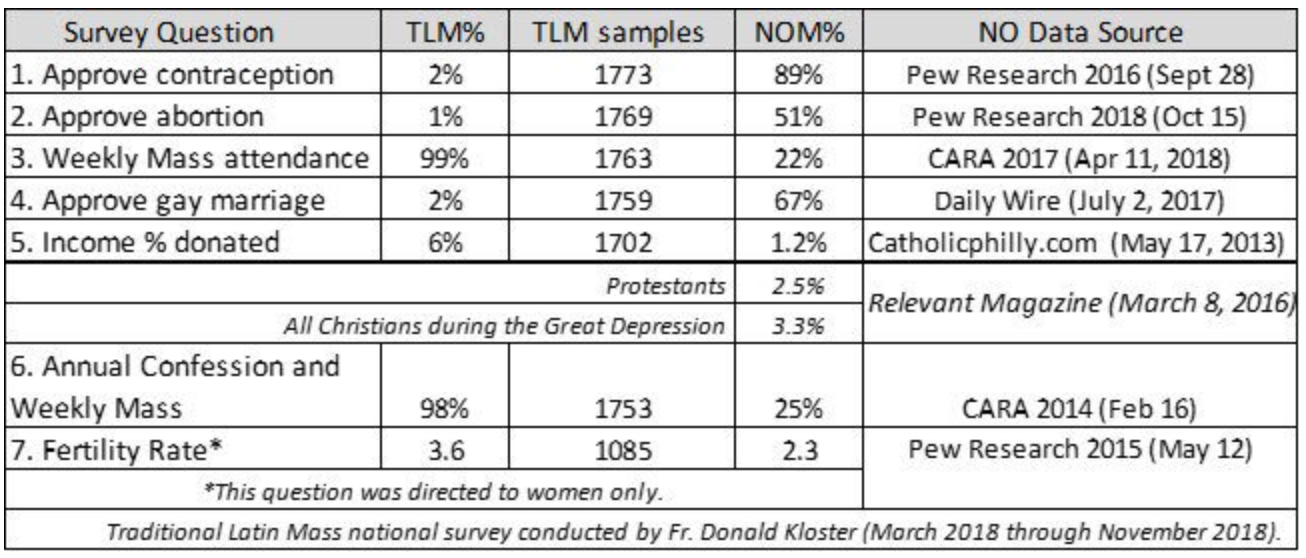
If this chart is accurate, "profoundly unwise" may be understatement. (TLM is Traditional Latin Mass; NOM is Novus Ordo Mass. Source via Rod Dreher.

Rorate Cæli

Bergoglio is in reality a man of vengeance. A pope of vengeance. An angry bitter Jesuit settling scores through vengeance.

What ought traditional Catholics to do in response to the latest attack on the Mass and all those who love tradition? Simply put: ignore it. Ignore its message. Ignore its motivation caused by pure hatred and vengeance. Keep calm and keep on going as if it does not even exist.

Ignore the Agent of Hatred and Vengeance, and all his works and all his pomps.

RORATE CÆLI: A RORATE CÆLI Editorial: The Attack of Hatred and Vengeance Against the Latin Mass Should be Ignored That last sentence is potent, pointed stuff.

Rod Dreher

Commenting on Rorate Cæli (with which he sympatizes):

How can you do that and still be Catholic? How can you defy the Pope in good conscience, as if his order was never made? I honestly don’t know how one remains Catholic if that’s what one believes about the Pope and the exercise of his authority. The only truly stable thing within Catholicism of the last sixty years has been the papacy. If you cast that aside — and that’s what Rorate is calling for in effect here — what do you have left? If you defy the Pope, even in the name of Catholic orthodoxy, how are you not a de facto Protestant? How is that remotely tenable? Somebody needs to explain this to me.

It seems to me that some Trads are in the same place I was back in 2005 with regard to the faith. I found it impossible to believe — not just unpleasant to believe, but impossible to believe — that my salvation depended on being in communion with the Catholic bishops. I came to the conclusion that I had probably been wrong about papal infallibility, and about Catholic claims to exclusive authority ….

Moi

I have feelings about this — maybe even thoughts — but I try to take myself by the scruff of my neck and say "This is not your church and never was, so butt out." I’ll only say this:

  • The Novus Ordo mass is, per se, a big impediment to healing the Great Schism.
  • The traditional Latin Mass was not, per se, a big impediment to healing the Great Schism.

For all their claims to ancient wisdom, there’s nothing remotely countercultural about the Tolles and Winfreys and Chopras. They’re telling an affluent, appetitive society exactly what it wants to hear: that all of its deepest desires are really God’s desires, and that He wouldn’t dream of judging.

Ross Douthat, Bad Religion: How We Became a Nation of Heretics


You can read most of my more impromptu stuff at here. It should work in your RSS aggregator, like Feedly, should you want to make a habit of it.

Populism and corruption

Last week I couldn’t shake Andrew Sullivan’s introduction: “We always knew this would happen — that the rule of law and Trump would at some point be unable to coexist.”

This week, I can’t shake Alan Jacobs:

Norms are created by institutions, and we live in an age of weak and despised institutions. This is how populist leaders arise: when a great many people believe that institutions exist merely to serve themselves, they come to despise not just those institutions but also the norms associated with them, and applaud leaders who scorn and seek to tear down the whole edifice. And if those leaders make their disdain known in sufficiently charismatic ways, few will notice when they are guilty of the very sins they decry. Moreover, when people see the sheer size of the institutions at which they’re so angry, they despair of any real change happening, and are content with listening to leaders who channel their own frustration.

General contempt for our institutions, government and church alike, makes them too weak to enforce their norms, which first enables corruption — the kind of corruption American Catholic bishops and members of the Congress of the United States are guilty of — and then produces populist figures who appear to want to undo that corruption. But the institutions are too weak to control the leaders either, so those leaders are empowered to do more or less whatever they want to do. This is the case with Trump, who will surely last at least until the 2020 election, and also, I think, with Francis, who will probably last until he dies or chooses like his predecessor to resign.

Moreover, since neither Trump nor Francis is interested in doing the work needed to repair their corrupt institutions — they don’t even have any incentive to do so: the ongoing presence of “swamps” is what lends them such legitimacy as they possessall the products and enablers of corruption are safe. This is why the American bishops who spent decades enabling and hiding sexual abuse are probably feeling pretty good about their prospects right now.

(Bold added, italics in original) I have read so many Catholics in this dreadful hour asking “Lord, where shall we go?” — specifically about the longing for a valid Eucharist, ex opere operato — that I sense another facet of why Francis has little incentive for repairing what’s broken.

Jacobs’ P.S. is an interesting speculation, too.

We’re conditioned to think of populist autocrats as reactionary conservatives, aren’t we? But remember that Trump was widely (and accurately in my opinion) excoriated as “no conservative” or things along those lines, and Pope Francis has been hailed as a “breath of fresh air” and such, suggesting a reformer of a stale and conservative institution.

I once read (sadly, I think around and of the Roman Church’s “long lent” the last time sexual abuse was in the spotlight) that sociology defines “corruption” along the lines of “lacking resources for self-correction.” It takes someone or something from outside to fix things.

Peter Beinart thinks he discerns a different, semi-fascist meaning of “corruption” at work among the President’s supporters, citing Yale philosophy professor Jason Stanley:

Corruption, to the fascist politician … is really about the corruption of purity rather than of the law. Officially, the fascist politician’s denunciations of corruption sound like a denunciation of political corruption. But such talk is intended to evoke corruption in the sense of the usurpation of the traditional order.

According to that school of “corruption,” I guess Trump is supposed to be America’s restorer of the traditional order, Pope Francis the Vatican’s bringer of a new, better order. The two construals of “corrupt” converge.

That, I guess, brings us back to Alan Jacobs sense that neither is going anywhere.

(This all feels a little bit half-baked and inelegantly written even to me, but it’s the best I can do on a notion (insight?) that came to me and has already exceeded any reasonable time budget for writing it down.)

* * * * *

Our lives were meant to be written in code, indecipherable to onlookers except through the cipher of Jesus.

Greg Coles.

Follow me on Micro.blog Follow me on Micro.blog, too, where I blog tweet-like shorter items and … well, it’s evolving. Or, if you prefer, those micro.blog items also appear now at microblog.intellectualoid.com.

Monday Potpourri, 8/27/18

1

I tend to think of the encyclical Humanae Vitae (which I’ve never finished reading) as all about the evils of artificial contraception. That’s a blind spot.

Carl Trueman points to its prediction of the moral and social chaos sexual revolution would leave in its wake, and to contemporaneous commentary by Dietrich von Hildebrand that entails “a moving account of human love and a critique of a society that reduces love to sex and sentiment.”

In this volume, von Hildebrand clearly draws upon earlier arguments from his 1927 book In Defense of Purity: Love is ecstatic and joyful, transcending rational analysis. Von Hildebrand’s key text is Song of Songs, the biblical poem that captures the mystery, power, longing, and exuberance of erotic love. Much conservative Protestant writing on marriage typically neglects the Song for a prosaic, patriarchal focus on male authority and female submission. Those tempted by such a drab view of love ought to read von Hildebrand, for whom passion, mystery, and ecstasy all play their biblical parts.

Still, the part of Humanae Vitae that leaves me leery is the insistence that every marital act instantiate both the unitive and procreative purposes of sex. I’m willing to admit mistakes in how I’ve lived my life (my blogs are not my confessional, but I’ll not deny here what I confess there), but I’m not conscience-wracked — even now, when I know so much more about the Christian tradition on contraception than I knew then — that my wife and I tooks steps to prevent pregnancy during our first year of marriage so she could complete her college degree.

Granted, the same contraceptive technologies, by Supreme Court decisions of half a century or so ago, must be available to fornicators and adulterers as well as married couples, but to put it in reductionist terms that the encyclical presumably avoids, is delaying or spacing pregnancy in marriage a slippery slope to all the evils of the sexual revolution?

Apart from the possibility that I’ve thought more about that than most people, my response lacks any authority, but here goes: that’s not my lived experience.

2

Alan Jacobs, who doesn’t write all that much about matters political, musing on two heads of state, the U.S. and the Vatican:

Norms are created by institutions, and we live in an age of weak and despised institutions. This is how populist leaders arise: when a great many people believe that institutions exist merely to serve themselves, they come to despise not just those institutions but also the norms associated with them, and applaud leaders who scorn and seek to tear down the whole edifice. And if those leaders make their disdain known in sufficiently charismatic ways, few will notice when they are guilty of the very sins they decry.

He’s not expecting either The Donald or Pope Francis to be “forced out” or to change course.

So why do we get the vapors so badly when news breaks?

The big social-media companies function as what I have called the Ministry of Amnesia, and the result is that we lack temporal bandwidth. Unless we work hard to cultivate that temporal bandwidth, we won’t have the “personal density” to resist the amnesia-producing forces that make us think that whatever happens today is more important than anything that has ever happened.

Increasingly, I think, the people who rule our society understand how all this works, and no one understands it better than Donald Trump …

[T]he greatest of social changes tend to happen, as Edward Gibbon put it, insensibly. Even when they seem sudden, it is almost always case that the suddenness is merely a very long gradual transformation finally bearing fruit. There’s a famous moment in Hemingway’s The Sun Also Rises when one character asks another how he went bankrupt. “Two ways,” the man replies. “Gradually and then suddenly.” But the “suddenly” happened because he was previously insensible to the “gradually.” Likewise, events are always appearing to us with extreme suddenness — but only because we are so amnesiac that we have failed to discern the long slow gradual forces that made this moment inevitable.

Alan Jacobs again, elsewhere. Do read it all. There’s a payoff.

3

Jeffrey Bilbro, Learning to Distinguish between Demonic and Redemptive Technologies, at Front Porch Republic responds to a Christianity Today essay that tends to reduces Agribiz to “genetic seed modification and GPS-guided harvesters,” ignoring assaults with on crops and earthy by chemical fertilizers and pesticides.

Bilbro’s most important contribution, it seems to me, is a not-too-vicious debunking of what the CT author seems to think is the only alternative to Agribiz in the manner Monsanto pursues, and some allusive hints we may just be cruising gradually toward sudden calamity.

* * * * *

Our lives were meant to be written in code, indecipherable to onlookers except through the cipher of Jesus.

Greg Coles.

Follow me on Micro.blog Follow me on Micro.blog, too, where I blog tweet-like shorter items and … well, it’s evolving. Or, if you prefer, those micro.blog items also appear now at microblog.intellectualoid.com.

Religious Calvinball

My first reaction to the Pope changing the Catechism on capital punishment was pretty much a yawn. It’s only slightly to the left of my own, though its reasoning differs much from mine.

But now I’m thinking I was wrong, and that it is a big, big deal because it repudiates earlier church teaching. Repudiates, not clarifies.

Consider first that the Church teaches that Scripture is divinely inspired and cannot teach error on matters of faith and morals. Yet there are a great many passages in Scripture that teach the legitimacy of capital punishment. For example, Genesis 9:6 states: “Whoever sheds the blood of man, by man shall his blood be shed; for God made man in his own image.” Romans 13:4 teaches that the state “does not bear the sword in vain [but] is the servant of God to execute his wrath on the wrongdoer.” Many other passages could be cited. The Fathers of the Church understood such passages to be sanctioning capital punishment, and the Church has for two thousand years consistently followed this interpretation. The Church also teaches (for example, at the First Vatican Council) that Catholics are obliged to interpret Scripture consistent with the way the Fathers understood it, and consistent with the Church’s traditional interpretation. Taken together, these teachings logically entail that the legitimacy of capital punishment is regarded by the Church as a divinely revealed doctrine.

Every pope who has addressed the subject of capital punishment up to Benedict XVI has reaffirmed this traditional teaching. For example, Pope St Innocent I taught that the state’s right to execute offenders has been “granted through the authority of God,” and that to condemn capital punishment in an absolute way would be to “go against the authority of the Lord.” Pope Innocent III made acceptance of the legitimacy of capital punishment a matter of Catholic orthodoxy when he required the Waldensian heretics to affirm its legitimacy as a condition of their reentry into the Church. The Roman Catechism issued under Pope St Pius V solemnly taught the legitimacy of capital punishment, as did the catechism issued under Pope St Pius X. Pope Pius XII affirmed the legitimacy of capital punishment on several occasions, and taught that a murderer has, by virtue of his crime, “deprived himself of the right to live.”

Even Pope St John Paul II explicitly reaffirmed in the Catechism he promulgated that “the traditional teaching of the Church does not exclude recourse to the death penalty” under certain conditions. It is true that John Paul thought that capital punishment was in practice best avoided, but this was a non-binding prudential judgment rather than a doctrinal matter. Cardinal Ratzinger, John Paul II’s doctrinal spokesman and later to become Pope Benedict XVI, made this clear when he stated in 2004 that:

If a Catholic were to be at odds with the Holy Father on the application of capital punishment…he would not for that reason be considered unworthy to present himself to receive Holy Communion. While the Church exhorts civil authorities… to exercise discretion and mercy in imposing punishment on criminals, it may still be permissible to…have recourse to capital punishment. There may be a legitimate diversity of opinion even among Catholics about… applying the death penalty. [Emphasis added]

Edward Feser, last October when a change was foreshadowed..

But it gets worse. The attempted change of doctrine on capital punishment doesn’t stand alone:

It’s important for Catholic advocates for LGBT equality to take note of this change because for decades Catholic opponents of LGBT equality argued that it is impossible to change church teaching. They often pointed to the fact that condemnations of same-sex relationships were inscribed in the Catechism, and so were not open for discussion or change. Yet, the teaching on the death penalty is in the Catechism, too, and, in fact, to make this change in teaching, it was the text of the Catechism that Francis changed.

Frances DeBernardo. DeBernardo is not a doom-and-gloomer from the fringes of the Catholic Right. He’s a gay rights activist within the Church, as his opening implies.

Michael Brendan Dougherty is not impressed:

(Calvinball explained if you are among the uninitiated.)

Since I recognize my tendency to be a glass-half-empty kind of guy, let me point out the silver lining in this cloud. If Pope Francis prestidigitates a similar change in the Catechism on sodomy, we Orthodox will have been handed high trump for the next time some Catholic triumphalist gloats that we have changed 2000 years of doctrine (on contraception, particularly).

* * * * *

Follow me on Micro.blog Follow me on Micro.blog, too, where I blog tweet-like shorter items and … well, it’s evolving. Or, if you prefer, those micro.blog items also appear now at microblog.intellectualoid.com.