Corporate Freedom of Religion?

I’ve been doing quite a bit of Tweeting and Facebook posting, as well as a couple of blogs (here and here), on various business challenges to the “employer contraceptive mandate” of the PPACA, a/k/a Affordable Care Act or “Obamacare.” I’ve been doing so because of important – and vexing – questions of religious freedom.

I’ve been a bit of a religious freedom head case all my adult life. Forty years ago or more I was reading the Seventh Day Adventists’ “Liberty” Magazine and writing letters to its editor. That was before my delayed law school entrance at age 30. (By the time I got my B.S., I’d been in school away from home, living in dorms or boarding houses, for nine years. I was ready to move on to “life.”)

In law school, I took a special religion clause elective class in Summer School, being edged out for the “A star” (the top A) by my friend Joe Rebone.

I take free exercise of religion very seriously, coming about as close to an absolutist position as one can coherently come without countenancing anarchy. I’m not a relativist – I’m a firm believer in capital-O Orthodox Christianity – but I give wide latitude to people’s right to be wrong, expecting in return that they’ll not try to harm me for calling them Krustians, Happy Clappies, Moralistic Therapeutic Deists, Gnostics, Dualists, Nominalists and other loathsome or risible things.

But even I pause at the idea that corporations and LLCs have a right to freely exercise religion — which comes into play when a smaller, or closely-held, business entity objects to buying contraceptive coverage for its employees on religious grounds. That’s the “vexing” part of these cases, and courts have split.

Personally and politically, I think the contraceptive mandate is sheer political pandering and a gratuitous insult to the kinds of folks who would almost certainly not vote for Obama.

First, it’s not insurance. It’s pre-payment of predictable “medical” expenses. But to talk much about that opens a can of worms because that’s exactly what “traditional” employer-provided health insurance has been since World War II. (For more on that topic, check this podcast.)

Second, to put it bluntly, young single women and single moms are disproportionately Democrat, compared to married women with children, who trend Republican. And the “Pro Choice” lobby is overwhelmingly Democrat, and loves slipping a wedge into the door, to be pounded on later to open it further. I don’t know how consciously the pandering to them figured in the initial passage of ACA, but the Julias of this world, dependent on government at all stages of life including their choice to have children out of wedlock, became a conscious target in the re-election campaign.

But legally, that doesn’t get us very far. Bad policy and political pandering isn’t necessarily unconstitutional.  Elections matter.

Nevertheless, a program like this that’s generally “constitutional albeit stupid and odious” (I just made up that category) might be unconstitutional as applied to particular employers. Howard Friedman, author of the Religion Clause blog, recently stepped out of his role as neutral chronicler to do some substantive commentary on the topic for Religion Dispatches:

Can business owners assert that their free exercise is being burdened when the coverage mandate is imposed not on them, but on their business? Does the for-profit corporation or LLC have religious beliefs of its own? Does General Motors practice religion? If not, do smaller corporations exercise religion? Or are the small businesses really asserting the religious rights of their owners?

It might seem strange to claim that a corporation (or an LLC) has religious freedom rights separate from those of the “real people” who own or manage it. An Oklahoma federal district court, rejecting a challenge by Hobby Lobby Stores to the coverage mandate, thought it was, finding:

General business corporations do not, separate and apart from the actions or belief systems of their individual owners or employees, exercise religion. They do not pray, worship, observe sacraments or take other religiously-motivated actions separate and apart from the intention and direction of their individual actors. Religious exercise is, by its nature, one of those “purely personal” matters… which is not the province of a general business corporation.

Hobby Lobby appealed, but the 10th Circuit Court refused to enjoin enforcement while the appeal is pending. So did Supreme Court Justice Sonia Sotomayor. Neither resolved the question of whether the business entity itself has religious rights.

However, in other ways, corporations often do have constitutional rights. A corporation cannot be convicted of a criminal offense without the protections given by the Constitution to criminal defendants. And in the famous 2010 Citizens United case, the Supreme Court held that corporations have the same First Amendment rights of political speech that “real people” do. If the First Amendment has been interpreted to guarantee a corporation’s free speech rights, does it also have free religious exercise rights guaranteed by the same Amendment?

…

This idea—that a corporation and its owners should be treated as the same person—is a well-known concept in corporate law, commonly referred to it as “piercing the corporate veil.” Most of the time, lawyers warn their corporate clients to do everything possible to avoid this “piercing,” since the doctrine is usually invoked when creditors of a business are making claims against the personal assets of a company’s shareholders, seeking to recoup their losses from an insolvent business by going after its owners. There is a vast amount of case law on when a court should allow “piercing the corporate veil” to reach shareholders’ personal assets, often focusing on abuse of the corporate form, misleading of creditors, or lack of corporate formalities. Business lawyers look to whether the corporation is the mere alter egoof its owners and routinely advise their corporate clients to emphasize the corporation’s separate existence from its owners.

However, the pleadings filed in many of the contraceptive mandate challenges purposely blur this line, collapsing the beliefs of the business with its owners, inviting “piercing.” As the district court concluded in a challenge brought by Tyndale House, a for-profit publisher of Bibles and Christian books:

when the beliefs of a closely-held corporation and its owners are inseparable, the corporation should be deemed the alter-ego of its owners for religious purposes.

Courts that have allowed businesses to assert the religious exercise rights of their owners have rarely, if ever, referred to the “piercing” cases brought by corporate creditors against business owners. This omission hides the unintended consequences that may be in store for small business owners who identify too closely with their business firms. These owners may be unaware of the new personal liability for business debts—including liabilities to the government—that they are risking by equating themselves with their business for purposes of religious expression. They may be inadvertently inviting the government to hold them to their word—that they and the business are one—when it comes to other matters as well.

I have become uncomfortable with the idea of corporations insofar as they are used to insulate owners from the consequences of reckless, high risk and speculative ventures whereby the owners hoped to “make a killing.” Any time a corporation goes broke, it saddles its creditors with the loss (unless it’s Too Big to Fail, in which case it saddles all of us with the loss, as its executives laugh all the way to the bank). I know one roofer wiped out by the bankruptcy of a large department store chain after he replaced one of their roofs on his own nickel, for instance. If he was smart, and he too was incorporated, he may have saddled his own creditors in turn.

This is exactly what corporations and limited liability companies are supposed to do in the case of honest failure. But after the last few years, “honest failures” barely are visible in the thicket of moral hazard.

Yet some pious business people have chosen to do business in those liability-limiting forms. Their seeking both to limit liability while claiming that the business entity is really them for purposes of free exercise of religion is both dubious (whence numerous losses as well as wins so far on contraceptive mandate challenges) and dangerous if successful, as Professor Friedman outlines.

If you’re even a bit of a religious freedom head case, stay tuned. This probably is going to some interesting and unanticipated places.

* * * * *
Some succinct standing advice on recurring themes.

Oppression in America

It’s hard to claim the place of the oppressed when you wield power like this.

So ends a Timothy Dalrymple reflection on the Louie Giglio incident, which he described thus:

An evangelical pastor with a sterling record, who had developed strong relationships with President Obama and particularly his office of faith-based initiatives headed by Joshua DuBois, who had turned his enormously successful Passion conferences against the problem of human trafficking, was just publicly humiliated and shouted out of the public square for professing fairly standard Christian views on human sexuality and the possible redemption of our desires through the transformative power of the gospel of Christ. On the advice of the faith-based office, Giglio was invited to deliver the benediction, the LGBT community raised a hue and cry, and the White House quite obviously (see here and here) pressured him to step aside.

I don’t think I’d ever heard of Louie Giglio until Friday. I’m an ex-evangelical, still a practicing Christian (in the most historic sense), and have ceased trying to keep up with the doings of the evangelical subculture. Still, as in the current kerfuffle, those doings come to my attention often anyway.

But it sounds as if Mr. Giglio is an exemplary and center- to center-left figure, except that he does, or once did, believe that what we do with our genitals matters.

I’m not going to oversell what happened to Giglio. He was going to get to give a very public prayer. Now he’s not going to get to give that very public prayer. That’s not exactly being sent to the Gulag.

But I do think it’s ominous that a guy with so stellar a record was keelhauled for a remark from 20 years ago, as Dalrymple’s links do pretty well confirm, and that mainstream media aren’t eager to let that cat out of the bag:

Here’s how the fourth paragraph of [Sheryl Gay Stolberg’s] report appeared on The New York Times website early yesterday afternoon.

An official with Mr. Obama’s Presidential Inaugural Committee said the committee, which operates separately from the White House, vetted Mr. Giglio. People familiar with internal discussions between administration and committee officials said the White House viewed the selection as a problem for Mr. Obama, and told the panel on Wednesday night to quickly fix it. By Thursday morning, Mr. Giglio said he had withdrawn.

This paragraph was one of the most significant that I read yesterday because it confirmed that the White House had initiated pulling Giglio from the inaugural program. Yet by yesterday evening and in today’ print edition, this part had been removed from Stolberg’s report.

(Denny Burk, another evangelical of whom I’d not heard until this morning.)

What kind of pressure was brought to bear? Well-reasoned?:

ThinkProgress discovered that Giglio had said some nasty things about homosexuality, including that it’s a sin, that it can be cured, and that it’s a “malfunction.”
As you can imagine, Malfunction-Americans weren’t terribly thrilled about yet another anti-gay bigot appearing at yet another Obama inaugural.
In the ensuing uproar, Louie Giglio was suddenly no longer giving the benediction.
…
Louie Giglio is free think gays have a malfunction that he can cure.  And we’re free to tell him to take a hike.  Religious bigots have an awfully hard time dealing with the concept of mutual free speech.  They love the idea that they can say whatever hateful thing they want.  But then they get very upset and confused when someone gives them a piece of their mind in return.
I can’t prove that the White House told Louie Giglio to take a hike.  I’m simply reading tea leaves.  And the tea leaves I’m reading are making me more and more pleased about how the White House has handled this issue.
I wasn’t pleased that Giglio was selected in the first place.  It was a huge oversight, considering past history.  But they fixed things fast, and to our satisfaction.

(John Aravosis) This is a “progressive” version of the right’s incorrigible misrepresentation about Obama’s “you didn’t build that” thought. “Nasty,” “anti-gay bigot,” “religious bigots,” and “hateful” are very broad-brush and very dubious. It is possible to “love the sinner” while hating the sin, and it does not sound to me as if Giglio is a hater in the mold of Fred Phelps.

The silver lining in this – and, yes, it’s an ominous cloud – is the adage that pigs get fat and hogs get slaughtered. A court recently declined to decree same-sex marriage into his state’s laws precisely because the lobby seeking it is powerful, well-funded, well-connected, and has gained such remarkable cachet in just a few decades that they really don’t need courts carrying water for them any more. They can make their case politically, as they did in several referenda last November.

Perhaps it is something of a paradox that as their political clout grows stronger, the constitutional claims of same-sex marriage advocates become weaker. But if powerlessness is a legitimate variable in judicial decision-making, it is hard to gainsay the view of Judge Jones:

The question of “powerlessness” under an equal protection analysis requires that the group’s chances of democratic success be virtually hopeless, not simply that its path to success is difficult or challenging because of democratic forces. . . . The relevant consideration is the group’s “ability to attract the attention of the lawmakers,” an ability homosexuals cannot seriously be said not to possess.

Of course the advocates of same-sex marriage will continue to press their case in courts of law. They would rather convince five justices of the Supreme Court to impose their agenda on the country than try convincing the country itself.

Yup: “It’s hard to claim the place of the oppressed when you wield power like this.”

* * * * *

Some succinct standing advice on recurring themes.

Too Big to Govern

Not too long ago, I encountered an item reminding me of a little-remarked feature of our national polity: the immense dilution of the meaningful individual voice in governance.

At our nation’s founding, each Congressman represented few people – 50,000 or something. Today he or she represents roughly 700,000. This historic figure may be wrong, but the difference is by orders of magnitude.

And even at that, with 435 members, Congress is pretty unruly. We really can’t grow Congress back to where a Congressman represents something like the relatively few of yesteryear. It would be totally unworkable.

This leaves voters alienated from the national government.

In contrast, I have for a number of years, on and off, participated in my local Chamber of Commerce’s “Third House” program. Every Saturday or two during the Indiana legislative session, the “Third House” meets to eat an excessively large breakfast, hear reports from our representatives and to give them feedback on Bills that affect us. They sit at table and break hash browns with us, sharing a common cup of orange juice. Thus there’s informal chatter as well as formal reports from them to us and votes by us to inform them. It’s not uncommon for as many as 5 State Senators and Representatives to be present, nor for our input to influence their votes.

So what if we broke up government and devolved power back to the states so as once again to empower and dis-alienate voters? We’d still need, I think, a national assembly to provide for the national defense and a few other limited functions, but there would be multiple more regional assemblies. Like, maybe, fifty of them. Doing meaningful things independently of what happens in Washington, DC.

This ought to appeal to the Left counterculture and to the Right as well. Indeed, although I still very much consider myself a conservative, I’m finding plenty of kindred spirits on the Left, courtesy of this wonderful gathering place of cyberspace.

But I just described (except for the cyberspace thingy) Federalism, the intent of the Founders. Somehow, some centripetal force has driven the real power toward Washington, DC contrary to the original design. We can argue about why (I have some half-baked theories, riffing off the trope “nation with the soul of a Church” the dogmas of that Church being “democracy” and “American Exceptionalism” and the undermining of Federalism’s political safeguards by the direct election of Senators), but it’s hard to argue that the effect has been entirely healthy (or so it seems to me).

This gives me great appreciation for the wisdom of the Founders, who gave us a Republic, if only we’d kept it.

These thoughts brought to you courtesy of a goading by this Wilfred McClay article on Federalism.

* * * * *

Some succinct standing advice on recurring themes.

Obama’s statist “religious freedom”

This, from Heritage Foundation’s Dominique Ludvigson via the Wall Street Journal, fleshes out what I mean when I call Obama’s insouciance on religious freedom “statist”:

Religious institutions and individuals should not have to sue the government to preserve the freedom to define their own missions. But they’re left with little choice in the brave new world unleashed by the national health-care law.

The HHS mandate breaks with our best traditions of recognizing the free exercise of religion as a public good and broadly accommodating religious practice and expression. It sees religion as “in the way” and interprets religious freedom as narrowly as possible – as freedom for worship and religious exercise within the walls of a church or only among its members.

The requirement also commandeers and marginalizes some of the very institutions of civil society that help preserve limited government.It’s the symptom of a broader disease – the Obama administration’s belief that government has unlimited power to curb freedom at will. Religious liberty is just the first casualty of that unchecked power.

Please remember that I’m pretty sparing in my criticisms of Obama and don’t just emote for or against this.

* * * * *

Some succinct standing advice on recurring themes.

Enduring Wisdom for Any Year

In 1991, Russell Kirk (venerated especially among traditional conservatives; I don’t know what neocons think of him) gave a speech to the Heritage Foundation, large portions of which are too good not to pass along at the start of a new year:

It is possible to describe certain attitudes that make up America’s conservative mentality, even though not all Americans could express coherently their belief in such general principles, and although some conservatives would dissent from one or more of the general assumptions or principles I now mention.

First, belief in some transcendent order in the universe, some law that is more than human: a religious understanding of the human condition, if you will; a belief in enduring moral norms. As the national pledge of allegiance puts it, “One nation under God…. ”

Second, opposition to totalist ideology and the totalist political order. The American conservative rejects the notion of a future earthly paradise — which the ideologue promises to attain.

Third, confidence in the American Constitution — both the written national Constitution and the intricate fabric of custom, belief, and habit that makes up the underlying “unwritten” constitution of a nation-state. Many decisions of the Supreme Court in recent decades are bitterly resented; nevertheless, attachment to the Constitution itself remains strong.

Fourth, maintenance of the rights of private property and of a free or competitive economy, as contrasted with a directed or socialist economy. This healthy prejudice persists despite the increasing consolidation of business and industry into large conglomerations or oligopolies.

Fifth, suspicion of central political direction, and preference for state and local powers: insistence upon private rights.

Sixth, a deep-rooted patriotism, joined to uneasiness at “entangling alliances”; this latter attitude, nevertheless, modified by determination to resist totalist powers that menace the American national interest.

Seventh, an awareness that change is not identical with healthy improvement; a relish for the American past; a genuine preference for the old and tried.

Such is the consensus of that very large body of Americans who choose to call themselves conservative in their politics. Within this crowd of conservative citizens exist various factions, each emphasizing some aspect or another of the general conservative attitude. There exists no “party line” to which conservatives of one persuasion or another are compelled to conform.

…

There have been ages when custom and inertia have lain insufferably upon humankind; and such an age may come to pass again; but such is not our age. Ours is an era when the moral and social heritage of many centuries of civilization stands in imminent peril from the forces of vertiginous indiscriminate change. Resistance to the folly of such change is the primary duty of the … conservative.

…

The critic Eliseo Vivas wrote once that “It is one of the marks of human decency to be ashamed of having been born into the twentieth century.” Spiritually and politically, the twentieth century has been a time of decadence. Yet, as that century draws near to its close, we may remind ourselves that ages of decadence often have been followed by ages of renewal.

…

The Roman Stoics taught that some things in life are good, and some are evil; but that the great majority of life’s happenings are neither good nor evil, but indifferent merely. Wealth is a thing indifferent, and so is poverty; fame is a thing indifferent, and so is obscurity. Shrug your shoulders at things indifferent; set your face against the things evil; and by doing God’s will, said the Stoics, find that peace which passes all understanding.

…

I am heartened from time to time by a stanza from Chesterton’s long poem, The Ballad of the White Horse. Chesterton is describing the prophets of doom, who tell us that nothing in life is permanent; that all is lost, or is being lost, in our culture; that we totter on the brink of an abyss. Such prophets of doom think themselves wise. Chesterton has in mind the typical intellectuals of the twentieth century, but he calls them the wise men of the East. Here I give you Chesterton’s lines:

The wise men know what wicked things
Are written on the sky,
They trim sad lamps, they touch sad strings
Hearing the heavy purple wings,
Where the forgotten seraph kings
Still plot how God shall die.

Such despairing souls, though possessed perhaps of much intelligence, in truth are not wise.

…

[T]he best way to insure a[nother] Generation of intelligent young conservatives is to beget children, and rear them well: the wise parent is the conservator of ancient truths. As Edmund Burke put it, “We learn to love the little platoon we belong to in society.” The institution most essential to conserve is the family.

…

I conclude with an exhortation which Orestes Brownson, that redoubtable conservative reformer, scholar, and journalist, delivered at Dartmouth College in 1843. His topic was “The Scholar’s Mission.” He concluded, as follows, his charge to the rising generation:

Ask not what your age wants, but what it needs, not what it will reward, but what, without which, it cannot be saved; and that go and do; and find your reward in the consciousness of having done your duty, and above all in the reflection, that you have been accounted to suffer somewhat for mankind.

You may find even brighter gems should you wish to read it all.

Happy New Year.

* * * * *

Some succinct standing advice on recurring themes.

Deer Hunting with Jesus

I learn a lot of things from a lot of places, especially from listening to people I formerly blew off.

A book with a title like Deer Hunting with Jesus: Dispatches from America’s Class War was kind of irresistible to someone – well, actually, it was my wife – who for some reason – well, actually, it’s because it was on my wish list – gave it to me for Christmas.

All things considered, I suppose it wasn’t too bad. At least I’ve now gotten a flavor of what’s meant by “Gonzo Journalism.”

Joe Bageant is, I guess, a gonzo journalist. He grew up in Winchester, Virginia – unless that’s one of many facts he made up on the fly – and returned to live there after some decades away:

A raucous, truth-telling look at the white working poor-and why they hate liberalism.

Deer Hunting with Jesus is web columnist Joe Bageant’s report on what he learned when he moved back to his hometown of Winchester, Virginia, which-like countless American small towns-is fast becoming the bedrock of a permanent underclass. By turns brutal, tender, incendiary, and seriously funny, this book is a call to arms for fellow progressives with little real understanding of “the great beery, NASCAR-loving, church-going, gun-owning America that has never set foot in a Starbucks.”

(From the book’s own description)

“Joe Bageant is the Sartre of Appalachia. His white-hot bourbon-fuelled prose shreds through the lies of our times like a weed-whacker in overdrive. Deer Hunting with Jesus is a deliciously vicious and wickedly funny chronicle of a thinking man’s life in God’s own backwoods.”
—Jeffrey St. Clair, author of Grand Theft Pentagon and co-editor of CounterPunch

I think “white-hot bourbon-fuelled prose” is a euphemism for “reckless advocacy, indifferent to factual accuracy.”

“Dead serious and damn funny…Bageant writes with the ghosts of Hunter S. Thompson, Will Rogers, and Frank Zappa kibitzing over his shoulder…Takes Thomas Frank’s What’s the Matter With Kansas, to the next level. “
—Mother Jones

“Informative, infuriating, terrifying, scintillating … Imagine a cross between Thomas Frank’s What’s the Matter with Kansas?, Hunter S. Thompson’s booze-and-dope-fueled meditations on Nixon’s political potency, and C. Wright Mills’s understanding of the durability of the power elite.”
—The American Prospect

What’s the Matter With Kansas, from what I hear, was a full-length “how effing stupid are these people!?” But I heard it from conservatives, who Thomas Frank thinks are the beneficiaries of Kansans’ effing stupidity. So maybe I was misinformed.

I’ve accused Bageant of factual inaccuracies, and I owe specifics, I think.

1. First, he says (Chapter 5, page 180 in mine) his parents met “at a Billy Graham tent revival during the Second World War.” I didn’t, and still don’t, think that Graham was doing tent revivals then, but he’s a couple of years older than I thought, and there’s some smallish chance, from his abbreviated biography at Wikipedia for instance, that he did tent revivals as part of his “other preaching engagements” during college. But I’d be willing to bet a modest amount that it was a tent revival by someone other than Billy Graham, or that it was later than World War II.

2. He riffs in the same chapter (page 186) on the “blood” motif in fundamentalist Protestantism, concluding with a quote from an English Professor:

There is a big leap from the liberation of Exodus, when Jews sprinkled blood on their doorposts, to the salvation proposed by Christians, in which blood is drunk by the community of faith. The Christian community not only lives after death by the blood of their Christ; but they feed on it in life. What can this mean, to drink blood?

Well, to a fundamentalist Protestant, “to drink blood” means precisely nothing. It’s pure symbolism. They reckon they’re supposed to have a communion service now and again to recollect Good Friday. The 6th Chapter of the Gospel According to John, where Christ says repeatedly, even to the point of driving away some of His disciples, that we must eat His body and drink His blood if we want life in us, is maybe the only Chapter in the Bible that they resolutely refuse to read literally (even in the loose sense of “literal” that’s pandemic these days). They have elaborate tapdances around that chapter, but basically they reject it because it sounds too damned Catholic.

Bageant was grasping for bloody imagery, grabbed the first faux scholarly blood quote he could find, and in the process confounded a sacrament in historic Christianity with the lurid locutions of Fundamentalism. Even he should know better than that.

3. In Chapter 7 (page 243),  Bageant writes about Medicare when he clearly means Medicaid. I know enough about both that I’d bet you any amount he’s wrong.

Still, the arc of Bageant’s story is credible. Despite the Medicare whopper, for instance, he “shreds through the lies of our times [about “nonprofit” hospitals] like a weed-whacker in overdrive,” in his chapter An Authorized Place to Die. I just wouldn’t rely on him for any little details, such as “and” and “the.” Read him like a good ole’ boy competing in a Whopper-Telling Contest.

Reading his chapter on guns (Valley of the Gun) was especially timely as the press and Hollywood goad us to “demand a plan” for gun control (i.e., “we must do something, even if it’s oppressive and counterproductive, about evil guns, not about an evil entertainment industry that feeds the imaginations of the unhinged with revenge and other gratuitously violent movies and video games.”):

In 1960 common sense was equally distributed between liberals and conservatives. In those days, even liberal personages such as Democratic senator and vice president Hubert Humphrey said repeatedly that guns had a place in the home because history has shown that governments, even the best of them, have a habit of oppressing people who cannot defend themselves at their own front doors. Imagine any Democrat saying that aloud today.

(Page 132.)

Now that most states have passed laws allowing honest citizens to carry concealed weapons, gun advocates are being proven more right than they ever hoped to be. Joy of joys, it is women – in fact, poor urban women – and the poor in general who benefit most from concealed carry laws. It doesn’t get any better than that when it comes to serving up cold crow to Democratic gun controllers. Large declines in rapes and attacks on women have occurred wherever the laws have been enacted. A study by John R Lott Jr., author of More Guns, Less Crime: Understanding Crime and Gun Control Laws, found that the urban poor and minorities lived more safely with guns in their pockets or purses: “Not only do urban areas tend to gain in their fight against crime, but reductions in crime rates are greatest precisely in those urban areas that have the highest crime rates, largest and most dense populations, and greatest concentrations of minorities.” …
Most liberal anti-gun advocates do not get off the city bus after working the second shift. Nor do they duck and dodge from streetlight to streetlight at 1 AM while dragging their laundry to the doozy duds, where they sit, usually alone, for an hour or so, fluorescently lit up behind the big plate glass window like so much fresh meat on display, garnished with a promising purse or wallet, before they make the corner-to-corner run for home with their now-fragrant laundered waitress or fast-food uniforms. Barack Obama never did it. Hillary Clinton never did it. Most of white middle-class America doesn’t do it either. The on-the-ground value of the second amendment completely escapes them.

(Pages 146-147.)

And he chronicles many other such blows as well, including “economic conscription.” The poor Scots Irish of places like Winchester make up a disproportionate share of our cannon fodder, by economic necessity. The Democrats are little or no better than the Republicans on feeding them to the coffins in our wars of choice.

Most of the young soldiers were fleeing economically depressed places, or dead-end jobs like the one Lynndie had held at the chicken processing plant, though many deny it or did not even see it in their quick and ready patriotism in useful blindness to the larger national scheme of things. These so-called volunteers are part of the nation’s defense code draft – economic conscription. Money is always the best whip to use on the laboring classes. 1300 a month, a signing bonus, and free room and board sure beats the hell out of yanking guts through a chicken’s ass.

(Page 200.)

Other select quotes:

When our town’s educators decided to hold a conference on the future employment needs of our youth, the keynote speaker was the CEO of a local rendering plant, Valley Protein, a vast stinking facility that cooks down roadkill and renders deep fryer fats into the goop they put in animal feed. He got a standing ovation from the school board and all the Main Street pickle vendors, and not a soul in that Best Western events room thought it was ironic. (Page 29.)

Even if we are one house payment away from homelessness, even if our kids can’t read and our asses are getting so big they have their own ZIP Codes, it’s comforting to know we are at least the best place on earth. There is America, and there is the rest of the world – envious and plotting to bring us down and “steal our freedom.” (Page 83.)

The reality is that our economy now consists of driving 250 million vehicles around the suburbs and mall and eating fried chicken. (Page 110.)

It has been an orgy so glorious and unholy, so mindless that we have now eaten our seed crop in our spiraling consumerism. (Page 112.)

Independent fundamentalist churches are theologically woolly places whose belief systems can accommodate just about any interpretation of the Good Book that a “Preacher Bob” or a “Pastor Donnie” can come up with. (Page 162.)

After a night of political discussion at Royal Lunch, a British relative, a distant continental member of the Bageant clan, called our gang of locals “the most intellectually squalid people I’ve ever met” – and he had chewed qat with Ugandan strongman Idi Amin’s bodyguards. (Page 206-07.)

We live in an age of corporate dominion just as we once lived in an age of domination by royal families, kings, and warlords. (Page 262.)

If middle-class Americans do not feel threatened by the slow encroachment of the police state or the Patriot Act, it is because they live comfortably and often exercise their liberties very lightly, never testing the boundaries. You never know you are in prison unless you try to open the door. (Page 263.)

I guess I’d give it four stars for the story arc, but I can’t give five stars or unequivocal endorsement to a book so riddled with unsettling errors.

* * * * *

Some succinct standing advice on recurring themes.

The Righteous Mind

It may sound impious to say it on the eve of the Feast of Christ’s Nativity, but I just finished maybe the most important “secular” book I’ve read this year, Jonathan Haidt’s The Righteous Mind: Why Good People Are Divided by Politics and Religion.

Frankly, I think the title may have overpromised on why good people are divided by religion, but I’m too concerned about our divisive (“Manichean” is how Haidt puts it at the end) politics, which he observes shrewdly, not to forgive him for that.

I’ve often had occasion in recent years to accuse liberals of being simplistic – a charge I especially savor since they started accusing conservatives of being simplistic about the time I was in college. It turns out that in a very important sense, I’m right in that charge.

In a prior iteration of moral psychologist Haidt’s work, he was testing only for five moral bases or foundation:

1) harm/care,
2) fairness/reciprocity (including issues of rights),
3) ingroup/loyalty,
4) authority/respect, and
5) purity/sanctity

You can see how you score by taking the Moral Foundations test at YourMorals.org

Liberals base their political views (instinctively – that’s how both sides do politics, with reasons being a sort of press agent to put a patina of intellectual plausibility on something much more visceral) on only the first one or two of those bases. Indeed, it sometimes appears that all they care about is helping folks they see as victims of oppression (the harm/care foundation).

Conservatives tend to use all five (now six, as liberty has been added) moral bases more or less equally.

Further, conservatives and moderates both understand liberals far better than liberals understand conservatives, who they caricature comically at times.

Now for my dirty little secret.  I’m not as well-balanced as the prototypical conservative. I’m almost as low as liberals on one foundation (and that’s lower than a snake’s belly). But I blow away liberals and conservative on another.

I’d say I’m weird, except Haidt uses WEIRD to describe Western, Educated, Industrialized, Rich, and Democratic folks — who are total outliers in the grand global scheme of things. If you want to study human nature, find a lot of subjects who aren’t WEIRD.

This book surely will promote mutual understanding, and in this instance, Tea Party shenanigans of recent years notwithstanding, it’s the liberals who especially need to up their understanding game.

(* I’m not really impious. We had more than 3 hours of Church services this morning and we’ll do another few hours starting at 11 pm. I’m just killing time right now.)

* * * * *

Some succinct standing advice on recurring themes.

Thoughts on Sandy Hook

I’m not impressed by claims that mass shootings aren’t becoming more common. Compared the when? Where?

I accuse, in part, the violent toxins Hollywood pours into Television screens and movie theaters. Cathartic? So’s a fix for a junkie – until next time.

It behooves us to remember that murderers are real people, with families and lives. They’re not stock villains. They’re us, messed up – which may be why we’re so eager for distance. Take a look here and here, for instance.

Father Jonathan Tobias made A Pledge. My Lutheran brother thought it had too much “I will,” and that “I will” is especially futile for the mentally ill. I perhaps misrepresented it as “A 12-step program for not becoming Adam Lanza.” So take it for exactly what the author says about it. I still think it’s wise and largely effectual (though brother has a point about mental illness). Then use it as you will. (My Lutheran brother and I, by the way, continue to disagree, primarily over sola scriptura and synergy. That’s why he’s Lutheran and I’m Orthodox. Either of us would lack integrity trying to switch religion while retaining our current convictions.)

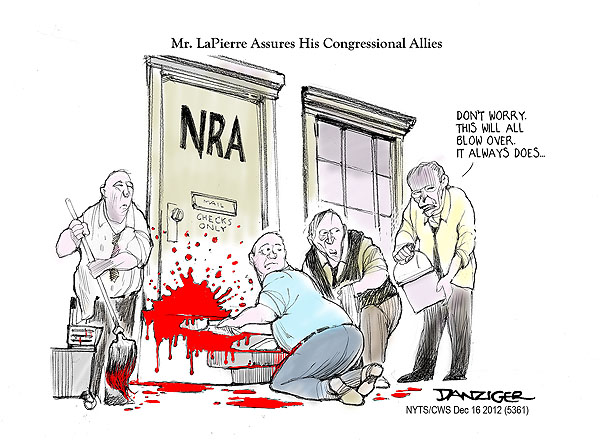
LaPierreNRA

http://www.danzigercartoons.com/

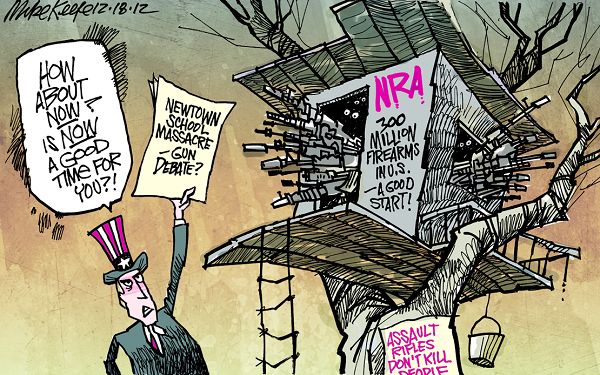
KeefeM20121218_low

http://editorialcartoonists.com/cartoon/display.cfm/117985

Why are we so quick to blame the NRA, single-minded defenders of the Second Amendment and nonprofit, while we run shrieking from the room if someone dares blame Hollywood, profiteers wrapped in the mantle of the First Amendment, or the makers of violent video games? As a friend asked on Facebook, “why give books for Christmas?” The answer is “because a scented candle never changed anyone’s life.” We are affected by what we read, view, and steep ourselves in. Quentin Tarantino has a lot more blood on his hands than Wayne LaPierre.

Quoting Eugene Volokh: “One can’t just deal with these questions through broad generalities, whether ‘we can’t do anything’ or ‘we must do something.’” You wouldn’t know that from the conversation that’s transpiring on the PBS News Hour as I write. The entire focus is gun control. There’s no focus on mental health care or on violent games. The only good thing is they’re focusing on the big clips, not on firearms generally. But what assurance have we that banning the clips will be effective? That’s not a rhetorical question.

* * * * *

Some succinct standing advice on recurring themes.