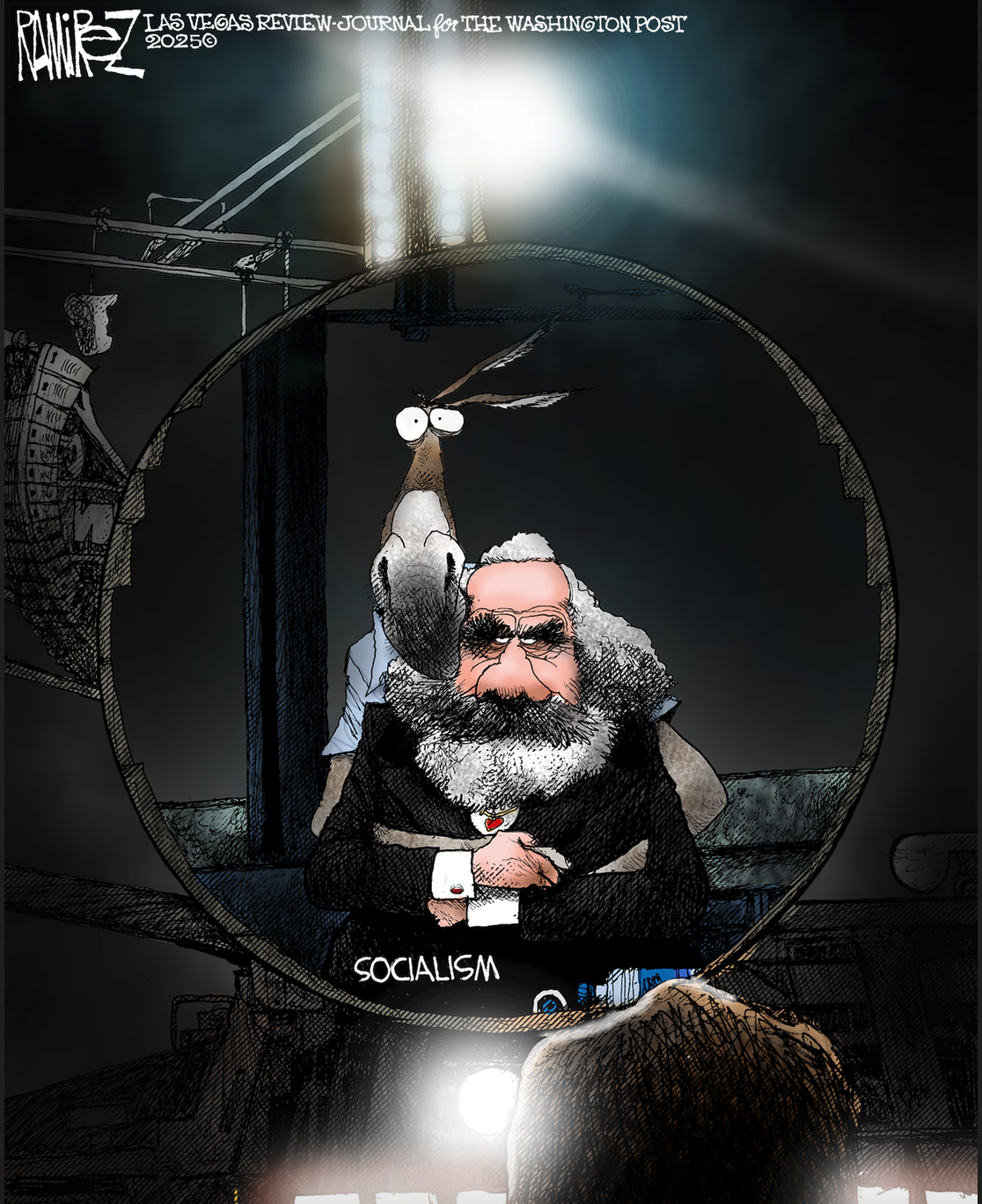
Thursday, 12/18/25

Quietly grassing up the neighbor

Of the Bondi Beach terrorist shootings by Muslim men Sajid Akram and Naveed Akram (unconfirmed by police at this writing) and the heroic intervention of one Ahmed al-Ahmed:

Let it be said, and said with firmness and gratitude, that a Muslim fruit seller named Ahmed al-Ahmed rushed one of the gunmen and disarmed him, saving Jewish lives and taking a couple of bullets himself for his trouble. May God bless that brave man. Here is video of him courageously tackling the gunman. This brings to mind something I was told back in 2002 by a Jewish friend who worked in counterterrorism. Be careful not to accuse every Muslim, she said. Some of our best sources are Muslims within Muslim communities who hate what they’re seeing, but know that if they speak out publicly against it, they will be killed. So they come to us quietly.

Rod Dreher

I wish we could figure out what makes many Muslims exemplary citizens, others murderous fanatics. Though I reject Islam as a false religion, I don’t want to think it’s simply that the former don’t take it seriously.

I have a theory, but it’s at a high enough level of generality that it’s not much use, I fear: that Islam, like Evangelicalism, has no authority beyond a sacred text, so Imams/Preachers can twist the text as they wish, limited only by what their congregants will tolerate.

The Other Terrorists

“Right-wing attacks and plots account for the majority of all terrorist incidents in the United States since 1994, and the total number of right-wing attacks and plots has grown significantly during the past six years,” the Center for Strategic & International Studies concluded after examining terror plots in the United States from 1994 to May of this year. “Right-wing extremists perpetrated two-thirds of the attacks and plots in the United States in 2019 and over 90 percent between January 1 and May 8, 2020.”

Nicholas Kristof, The Lawbreakers Trump Loves (August 29, 2020)

AI moves fast, breaks things

A woman in a service industry, an immigrant to America from Eastern Europe who’s been here about 20 years, took me aside recently. Her eldest child, a senior in high school, is looking around at local colleges. She was worried about AI and asked for advice on what her son might study so that in four years he could get a job. We asked ChatGPT, which advised “embodied in-person work” such as heating and air conditioning technician, pool cleaner. She wasn’t happy with that. She’d worked herself to the bone to get her son higher in the world than she is. She wants him to own the pool.

Peggy Noonan, Trump may be losing his touch

Grievance Memoirs

Political memoirs tend to fall into recognizable categories.

There is the sanitized precampaign memoir, gauzy life stories mixed with vague policy projects and odes to American goodness. There is the postcampaign memoir, usually by the losers, assessing the strategy and sifting through the wreckage. There are memoirs by up and comers who dream of joining the arena and by aging politicos rewriting their careers once more before the obits start to land. There are memoirs by former staff members who realize that proximity to power gives them a good story and memoirs by journalists who chronicle power so closely that they imagine themselves its protagonists.

But a recent spate of books highlights the presence of a new category, one well suited to our time: the grievance memoir. In their books, Eric Trump (“Under Siege”), Karine Jean-Pierre (“Independent”) and Olivia Nuzzi (“American Canto”) are all outraged by affronts real and imagined, fixated on nefarious, often unspecified enemies, obsessed with “the narrative” over the facts and oblivious to their complicity in the conditions they decry.

The authors (a third child embracing on to his father’s legal and political grudges, a former White House press secretary groping for a new brand, a boutique political journalist enmeshed in a self-made scandal) are animated, above all, by a certainty that they’ve been wronged not just by people or institutions but also by broader forces. They are ancillary characters inflating themselves into victims, heroes, even symbols. It is the inevitable memoir style for a moment when everyone feels resentful, oppressed, overlooked — in a word, aggrieved.

Carlos Lozado (who’s famous among his New York Times colleagues as a voracious book-reader).

Add to Lozado’s list a longish article by Jacob Savage in Compact magazine, which Rod Dreher found “one of the most powerful essays I’ve read all year.” Its gist seems to be that straight, white, young men can’t catch a break any more – for reasons predating AI.

Ross Douthat thinks Savage has a point; that Douthat has an opinion suggests that Dreher isn’t just playing Chicken Little again.

I’m fortunate to be chronologically beyond gathering personal straight white male grievance anecdotes (and that my grandson is thrilled at, not resigned to, the prospect of a sort of Shop Class As Soulcraft career).

Are we the baddies?

Remizov and other conservative democrats complain that modern Western liberalism is in fact anti-democratic, as it tramples on national traditions and subordinates national authorities to international ones and to the impersonal forces of globalization.

Paul Robinson, Russian Conservatism. This book is pretty good at giving the gift to see ourselves as others see us.

When your only tool is anger, every little problem looks infuriating

Trump has never shined in moments that call for dignity and restraint … This is what makes Trump’s post about the Reiners not just despicable and cruel but also bad for the country. In moments of national mourning or trauma, a president can seek to bring people together … But not Trump. He finds the most divisive way to insert himself … His choices … take moments that could be unifying—surely Americans of all political views can agree on the greatness of When Harry Met Sally and The Princess Bride—and turn them into opportunities for anger.

Which is, in effect, Trump’s political project.

David Graham, Trump Blames Rob Reiner for His Own Murder

Shorts

  • I like ebooks because nobody can tell that I’m performative reading. (@restlesslens on micro.blog)
  • Be regular and orderly in your life, so that you may be violent and original in your work. (Gustave Flaubert)
  • Insofar is not the same as inasmuch, and I don’t know why the current style is to break the former into three words.
  • I remember mocking people for thinking the Covid vaccine was Bill Gates’ way of getting microchips into us. Hmmm.
  • This is the paradox of politics: Every time you solve a major problem, you’re removing a weapon from your political arsenal. (Peggy Noonan, Trump may be losing his touch)
  • If “TDS” is the tendency to become irrationally obsessed with Donald Trump and project that obsession onto everyone else, then somebody is indeed deranged, and it wasn’t Rob Reiner. (David Graham, Trump Blames Rob Reiner for His Own Murder.
  • A tool always implies at least one small story[:] There is a situation; something needs doing. (L.M. Sacasas)
  • Anyone claiming to know the future is just trying to own it. (L.M. Sacasas)
  • After this awful weekend, Trump has once again lowered the bar for what we can expect from the president. (The Free Press, Mr. President, Don’t Mock the Dead)
  • The odds are good, but the goods are odd. (Advice given to incoming women at Georgia Tech).

Elsewhere in Tipsyworld


We are all gatekeepers now.

Peggy Noonan

Your enemies are not demonic, and they are not all-powerful and the right hasn’t always lost and the left hasn’t always won. But if you convince yourself of that, you give yourselves all sorts of permission to do a lot of stupid and terrible things under the rubric of “Do you know what time it is?”

Jonah Goldberg.

[A] critical mass of the American people … no longer want[s] to govern themselves, … are sick of this republic and no longer want to keep it if it means sharing power with those they despise.

Nick Catoggio

I don’t do any of the major social media, but I have two sub-domains of the domain you’re currently reading: (a) You can read most of my reflexive stuff, especially political here. (b) I also post some things on my favorite no-algorithm social medium.

Tuesday, 10/7/25

Epigrams

Dig in obituaries long enough and you may hit pay-dirt. Ashleigh Brilliant, Prolific ‘Pot-Shots’ Phrasemaker, Dies at 91. (Gift link)

Brilliant wrote such gems as “I may not be perfect, but parts of me are excellent.”

He wrote epigrams full-time. The most his business ever made was $100,000 per year.

We owe him.

Legal unethics

The strike suit is a pernicious business practice: It is deployed to extract cash, not to resolve a dispute. Its target must decide whether to pay the costs of legal defense or the costs of settlement. Essentially, the defendant must play a hand of poker against an opponent who pushes out a large and menacing raise: The options are to match the bet—and face the prospect of even more raises in the future—or fold. The settlements produced by strike suits are of little social value—they’re just one of the costs of doing business. 

Such a tactic is even more pernicious when the litigant is the president of the United States, because its target now faces even weightier reasons to settle: presidential control over federal bureaucracies with immense regulatory power. This new business model is lawfare on steroids.

Earlier this year, Paramount Global agreed to cut a settlement check for roughly $16 million to Trump’s future presidential library and his lawyers. That payment was the culmination of Trump’s suit last year accusing CBS News, a Paramount subsidiary, of broadcasting a deceptively edited interview of then-Vice President Kamala Harris. Trump’s complaint alleged that the edits were designed to “tip the scales in favor of the Democratic Party” in last year’s election. The theory was questionable: Trump argued that the broadcast edits had violated a Texas consumer protection statute and had caused him personal financial harm. 

The ultimate settlement was also questionable, and not just because of the cramped view of the First Amendment that Trump’s argument implied. Paramount’s sale to Skydance Media was on the horizon—a sale that the Federal Communications Commission (dominated by Trump-friendly Republicans) could either approve or scuttle. The pending merger made the specter of litigation significantly more costly for Paramount; a $16 million payoff is a small price to ensure an $8 billion sale.

Dan Greenburg.

I quote this not, for a change, to berate the President directly, but to ask a different question: Why has no lawyer been disbarred (or merely sanctioned) for filing these frivolous lawsuits?

There is a rule being breached:

(b) Representations to the Court. By presenting to the court a pleading, written motion, or other paper—whether by signing, filing, submitting, or later advocating it—an attorney or unrepresented party certifies that to the best of the person’s knowledge, information, and belief, formed after an inquiry reasonable under the circumstances:

(1) it is not being presented for any improper purpose, such as to harass, cause unnecessary delay, or needlessly increase the cost of litigation;

(2) the claims, defenses, and other legal contentions are warranted by existing law or by a nonfrivolous argument for extending, modifying, or reversing existing law or for establishing new law;

(3) the factual contentions have evidentiary support or, if specifically so identified, will likely have evidentiary support after a reasonable opportunity for further investigation or discovery; and

(4) the denials of factual contentions are warranted on the evidence or, if specifically so identified, are reasonably based on belief or a lack of information.

Federal Rule of Civil Procedure 11(b). Most state court rules mirror this Federal rule.

Trump’s strike suits are designed to harass and impose cost of litigation. They are frequently unwarranted by law or good faith arguments for changing the law.

So again: Why has no lawyer been punished for filing them? Why are the rules so toothless?

Please don’t tell my I’m majoring in minors. I’ve had plenty about the majors, and I’m a retired lawyer, son of a lawyer, and father of a lawyer, who oddly enough cares about the devolution of the legal profession. So sue humor me.

Progressive illiberalism, populist illiberalism

Progressivism in the last 10 years has pursued increasingly radical measures through complex, indirect and bureaucratic means, using state power subtly to reshape private institutions and creating systems that feel repressive without necessarily having an identifiable repressor in chief — McCarthyisms without McCarthy, you might say.

Over the same period, populism has consistently rallied around charismatic outsider politicians who attack the existing political class as hopelessly compromised and claim to have a mandate to sweep away any rule or norm that impedes their agenda.

There are exceptions to this pattern, but it’s pretty consistent across Western countries. Whether with Trump or Nigel Farage in Britain or Marine Le Pen in France or Viktor Orban in Hungary or Giorgia Meloni in Italy, the drama of postliberal populism is intensely personal, serving up figures who become the focus of profound loyalty and intense opposition, who present themselves as champions of the forgotten man while they’re attacked as strongmen in the making.

The drama of postliberal progressivism, in contrast, is a drama of ideological influence and institutional power, in which activists and elites effect dramatic change outside the democratic process and then try to survive or sidestep backlash from the voters. It’s a drama where sudden changes seem to just happen — unprecedented waves of immigration on both continents, a radical shift in official American norms around race or sex, a new regime of euthanasia in Canada — without having a singular progressive leader who claims responsibility and provides the policy with a charismatic face.

Ross Douthat, Can Left and Right Understand the Other Side’s Fears?. This is not an adequate summary, so I’m providing a gift link for you to get the rest.

Birthright citizenship

[Friday], the US Court of Appeals for the First Circuit issued a decision that Donald Trump’s executive order denying birthright citizenship to children of undocumented immigrants and non-citizens present on temporary visas is unconstitutional. It also ruled that it violates a 1952 law granting naturalization to children born in the United States, and upheld a nationwide injunction against implementation of the order. This is the second appellate court decision ruling against Trump’s order, following an earlier Ninth Circuit decision. Multiple district court judges (including both Democratic and Republican appointees) have also ruled that the order is illegal, and so far not a single judge has voted to uphold it.

Judge David Barron’s opinion for the First Circuit runs to 100 pages. But he emphasizes that this length is the product of the large number of issues (including several procedural ones) that had to be considered, and does not mean the case is a close one:

The analysis that follows is necessarily lengthy, as we must address the parties’ numerous arguments in each of the cases involved. But the length of our analysis should not be mistaken for a sign that the fundamental question that these cases raise about the scope of birthright citizenship is a difficult one. It is not, which may explain why it has been more than a century since a branch of our government has made as concerted an effort as the Executive Branch now makes to deny Americans their birthright.

I won’t try go to through all the points in the decision in detail. But I think Judge Barron’s reasoning is compelling and persuasive, particularly when it comes to explaining why this result is required under the Supreme Court’s ruling in the 1898 Wong Kim Ark case, and why the 1952 naturalization statute provides an independent ground for rejecting Trump’s order.

Ilya Somin, First Circuit Rules Trump’s Birthright Citizenship Executive Order is Unconstitutional

Giving the Devil his due

If I keep my perspective through this Administration’s deliberate sowing of chaos, its flooding of my zone with B.S., I will from time to time acknowledge something they’ve gotten more or less right. I’ll especially look for things that don’t require a parenthetical caveat along the lines of “but of course they should have done it this other way.”

Entry Number 1, not because it’s necessarily the most important: The purpose of our Armed Forces is to defend us through an obvious ability to win wars. It is not to conduct sociological experiments or to redress internal structural injustices.

I could indeed elaborate on that or insert caveats, but I’ll let it stand.

Oh, heck, I do need one caveat: I was (and believe I remain) a conscientious objector, so I don’t like it that nations keep stocks of sabers and rattle them menacingly at each other. But it’s futile to tell them to stop, and we’re still at a place where I’m not waiting for the barbarians.

Prediction

There is no serious doubt in my mind that Donald J. Trump fully intends to make his deportation efforts so odious that they will provoke mass protests (which probably will include some violence by the protestors – and there will be undercover provocateurs to assure that they do), to give himself an excuse for imposing martial law in many blue cities.

I’m not sure of his endgame, but utter corruption of the 2026 Election (a signature of authoritarianism) and suspension of 2028 no longer seems like a leftist fever-dream.

Deadening the creative spark

Loathing is hard to make interesting or readable. It’s one of the flattest emotions, and it deadens the creative spark.

Gareth Roberts. Fortunately for me, I’m generally satisfied with letting others express our shared loathing.


We are all gatekeepers now.

Peggy Noonan

Your enemies are not demonic, and they are not all-powerful and the right hasn’t always lost and the left hasn’t always won. But if you convince yourself of that, you give yourselves all sorts of permission to do a lot of stupid and terrible things under the rubric of “Do you know what time it is?”

Jonah Goldberg.

[A] critical mass of the American people … no longer want[s] to govern themselves, … are sick of this republic and no longer want to keep it if it means sharing power with those they despise.

Nick Catoggio

I don’t do any of the major social media, but I have two sub-domains of the domain you’re currently reading: (a) You can read most of my reflexive stuff, especially political here. (b) I also post some things on my favorite no-algorithm social medium.

From grim to grimmer

Bummer

I could have filled this post with many clippings colorfully describing how bad things are. I’ve done it before and I’ll probably do it again. That’s just the kind of guy I am: melancholic.

But it just seems too much this week. I’m having trouble identifying anything going right in the USA.

I came of age in the 60s, and although I’ve been expecting our collapse for a long time, the manner and speed of the seeming collapse are a surprise.

I’ll summarize what’s a bit unsettling, even for me, thus:

  • We are moving rapidly from American hegemony to a multipolar world.
  • The very best President imaginable couldn’t stop, but could at best slow, our relative decline.
  • The very best President imaginable wouldn’t even run because of the politics of personal destruction.
  • But a toxic narcissist, jilted by voters in 2020, would run again in 2024 on a platform of vengeance. “Vengeance” turned out to mean turning America into a “shithole country.” (That will teach us!)
  • The Mainstream media are whistling past the cemetery as all this goes down.
  • UPDATE: Charlie Kirk, who it seems was more consequential than I had realized, gunned down Wednesday. I wrote everything in this post, other than this bullet point, before the murder of young Kirk. I knew little about him. My first impression was unfavorable because he was associated with Jerry Falwell, Jr. at the time that Falwell’s Potemkin Piety was collapsing. Thereafter? Well, I’m about 50 years older than his target demographic. (My wife didn’t even know who he was.) I’ve read a lot about him this morning, but the most interesting observation I read was too frank for this raw moment, so I’ll let you ferret out your own information if you care to.

With that off my chest, I’ll try to edify y’all for a while.

Repelled by conservatism, but not a liberal

Conservatism, as you know, is a complete mess in America right now. But reading conservative authors like Edmund Burke, Samuel Johnson, Fyodor Dostoyevsky, Gertrude Himmelfarb and James Q. Wilson does give you an adequate appreciation for the power of nonmaterial forces — culture, moral norms, traditions, religious ideals, personal responsibility and community cohesion.

I’ve been driven away from the right over the past decade, but I can’t join the left because I just don’t think that tradition of thought grasps reality in all its fullness. I wish both right and left could embrace the more complex truth that the neocon Democrat Daniel Patrick Moynihan expressed in his famous maxim: “The central conservative truth is that it is culture, not politics, that determines the success of a society. The central liberal truth is that politics can change culture and save it from itself.”

David Brooks, Why I Am Not a Liberal. This pretty clearly was one of the ten best things I’ll see in the New York Times this month, so that’s one of my gift links.

Breakneck: what you get in an engineered society

Publishers have figured out how to get limelight for their new titles, and one new title that’s deservedly getting a lot is Dan Wang’s Breakneck, about the astonishing ascendancy of China.

For a solid interview with Dan Wang (interviewer Ross Douthat), click this shared link: This Is Why America Is Losing to China.

Wang attributes this in substantial part to the relative influence of engineers in China versus that of lawyers in the USA. Engineers build; lawyers obstruct.

I find that somewhat plausible. But I write this precis not as an uncritical defense of my former profession, but to call attention to where engineered China went off the rails: trying to engineer China’s demographics led to over 300,000,000 abortions, over 100,000,000 sterilizations, and a population that’s skewed toward males.

That is, in my experience of engineers, classic engineering myopia. China could have benefitted from a bit more rule of law, less engineering “logic.”

What’s “fair” got to do with it?

There are people who get outraged when a court — especially the Supreme Court — impose or affirm what seems like an “unfair” result.

The scare-quote is not because fairness is a fantasy. It’s there because courts’ “unfair” decisions are mostly decisions to follow the law despite any countervailing sense of fairness.

And I approve of that approach. Consider: what is truly “fair” about denying a win to a guy who followed all the legal rules and then got sued by a guy who ignored the rules but somehow feels cheated (and has a good lawyer to sell his sob story)?

Liberalism without illusions

William A. Galston, a blast from the Clintonian past, has a wonderful article in Democracy Journal. I summarize, but I fully intend to read it several more times.

My summary:

Liberal democracy (a/k/a classical liberalism) has some inherent weaknesses:

  1. Because liberal democracy restrains majorities and gives even small minorities a say, it slows the achievement of goals that majorities support. In other words, it requires more patience than many possess.
  2. Liberal democracy requires tolerance for minority views and ways of life to which many citizens are deeply opposed.
  3. Liberal democracy requires a distinction between civic identity and personal or group identity.
  4. Liberal democracy requires compromise.

Liberals (left-liberals, or “liberals” in the modern pejorative sense) complicate these weaknesses with characteristic illusions:

  1. Myopic materialism: the belief, especially pervasive among elites, that economic issues are the real issues and that cultural issues are diversionary, deliberately heightened by unscrupulous leaders to gain support for their anti-liberal agendas.
  2. Parochialism. Yes, transnationalism is the parochialism of elites, because most people in advanced democracies as well as “developing” nations value particular attachments—to local communities and to the nation, to friends and family and compatriots.
  3. Naivete about the course of human events and the possibilities of human nature.

Credit for my discovery of this article goes to Rod Dreher.

Broken Windows

Okay, everyone is writing about it, and Trump’s vehement denials and $10 Billion lawsuit against Dow Jones makes it newsworthy that there’s now potent corroboration of Dow Jones’ (via the Wall Street Journal) claim about Trump’s hand-rendered birthday card for ephebophile Jeffrey Epstein’s 50th birthday. But I can’t say anything smarter than this:

From what I can tell, in fact, there’s no actual theory underlying the impromptu new conspiracy theory that the letter was forged. No one can explain how or why a birthday message purporting to be from Trump to one of his close associates would have been doctored for a privately published book compiled in 2003. Did time-travelers from the present day fake the letter and plant it knowing that it would come out someday and damage him—after he’d already been elected president twice?

If so, their plot failed. This isn’t going to damage him. It’s just another broken window in a neighborhood that’s full of them.

Andrew Egger explains at The Bulwark:

In a way, Donald Trump and his allies have spent their entire political lives preparing for this moment. The whole miserable decade of “alternative facts,” of witch hunts, of flooding the zone with sh-t—it all amounted to a long, powerful education for his base. It’s a training in a certain kind of zen meditation, in which stories damaging to Trump pass from the eyes and ears directly out of the body without ever intersecting the brain. By now, the base has gotten in their 10,000 hours. They’ve become masters of the craft. They can perform all sorts of remarkable feats—the media-cope equivalent of lying on beds of nails while cinderblocks are smashed on their chests. These cinderblocks, they whisper serenely, are just a liberal plot. If I pay attention, the Democrats win.

The Epstein scandal is the “final boss” of Trump scandals, the supreme test of reality-defying propaganda skills that MAGA has acquired over the course of 10 years. The crime involved, pedophilia, is one of their obsessions; the villain, Jeffrey Epstein, is a lead character in their hysteria about an elite child-abuse cabal; yet the evidence continues to mount that their own messiah, Donald Trump, knew what was happening as it happened and—at best—did nothing to stop it. It’s like the Access Hollywood scandal but with the spin difficulty dialed up by a factor of 10. 

Think of American government as a big neighborhood. The neighborhood has started to go to hell. Its residents are adjusting their expectations for it accordingly.

Bad things happen when neighborhoods start to go to hell. As public evidence of minor disorder and neglect rises, crime gets worse. That’s the “broken windows” theory of criminology—the idea that letting lesser offenses like window-breaking go unpunished signals to good guys and bad guys alike that laws won’t be enforced. Criminals respond by escalating to more serious offenses and law-abiding locals become fatalistic or apathetic.

Trump has broken a lot of windows in our government. How can we expect Americans to maintain the same expectations for civic order that they used to have as the proverbial neighborhood falls into disrepair?

Nick Catoggio.


Somehow, this seemed like the time to resurrect an item I only recently deleted from my footer:

Your enemies are not demonic, and they are not all-powerful and the right hasn’t always lost and the left hasn’t always won. But if you convince yourself of that, you give yourselves all sorts of permission to do a lot of stupid and terrible things under the rubric of “Do you know what time it is?”

Jonah Goldberg.

[A] critical mass of the American people … no longer want[s] to govern themselves, … are sick of this republic and no longer want to keep it if it means sharing power with those they despise.

Nick Catoggio

I don’t do any of the major social media, but I have two sub-domains of the domain you’re currently reading: (a) You can read most of my reflexive stuff, especially political here. (b) I also post some things on my favorite social mediu

TDS, 8/8/25

Vibes all the way down

Trump, Claiming Weak Jobs Numbers Were ‘Rigged,’ Fires Labor Official
Economists said ousting the head of the Bureau of Labor Statistics could undermine confidence in government economic data.

New York Times

As Trump testified once in court

My net worth fluctuates, and it goes up and down with the markets and with attitudes and with feelings, even my own feelings … Yes, even my own feelings, as to where the world is, where the world is going, and that can change rapidly from day to day.

Some data, such as the number of votes he received at the polls in 2020, initially refused to budge. But with a little bit of threatening from some extra-patriotic patriots, the election turned out to have been a Trump blowout. Just ask any elected Republican; they’ll tell you!

Fumbling around in a fog of vibes and misinformation and things you saw on Fox News is good enough for the president; why should the rest of us ask for anything better? Soon, no one will know what is happening—what the problem is, or what remedies to apply. What sectors are booming and which are contracting, whether interest rates should be higher or lower, whether it’s hotter or colder than last year, whether mortality has gone up or gone down. It will be vibes all the way down. Soon we will all be bumping around helplessly in the dark.

That’s a good thing …

Alexandra Petri

Comprehensively failing the Solzhenitsyn test

In his 1970 Nobel lecture, Aleksandr Solzhenitsyn said, “You can resolve to live your life with integrity. Let your credo be this: Let the lie come into the world, let it even triumph. But not through me.” The problem presently before the United States is that the Trump administration will be staffed in its upper reaches by political appointees who, without exception, have failed this test.

To get their positions, these men and women have to be willing to declare, publicly if necessary, that Donald Trump won the 2020 election and that the insurrectionary riot of January 6, 2021, was not instigated by a president seeking to overturn that election.

Eliot A. Cohen

I’ve wondered how Republicans lost their balls. Apparently Putin got them and added them to his own:

Trump Has Soured on Putin. Putin Couldn’t Care Less.

Killing the messengers

Terminating BLS Commissioner Erika McEntarfer because her agency delivered bad news on the economy is the most cartoonishly banana republic move Trump has pulled in his second term so far (that is, apart from shipping people off to prison in an actual banana republic without due process to be abused).

His reaction to the latest jobs report isn’t much different, in fact, from his reaction to the early spread of COVID in the United States in 2020. “If we stop testing right now, we’d have very few cases, if any,” the president famously complained. Then, as now, when confronted with information that might create trouble for him, his instinct is to suppress it.

There’s a fourth way in which firing McEntarfer was stupid. Ironically, a weak jobs report combined with downward revisions of the May and June numbers greatly strengthens the president’s case to the Fed to lower interest rates. But Trump couldn’t seize the obvious opportunity here because his narcissism wouldn’t let him: He’d rather pretend that job growth is stronger than the BLS believes, undercutting his own argument for a rate cut, than allow that the economy is cooling off and needs some heat.

Stupid, stupid, stupid, stupid.

Nick Catoggio

If the President can fire the head of BLS, an agency whose purpose is the nonpartisan and objective collection, distillation and publication of economic data, I may need to think the Unitary Executive theory. Donald Trump’s willfulness will do that to you.

Four (more) flavors of stupid

“If there’s anything more important than my ego around, I want it caught and shot now.”

One of the major difficulties Trillian experienced in her relationship with Zaphod was learning to distinguish between him pretending to be stupid just to get people off their guard, pretending to be stupid because he couldn’t be bothered to think and wanted someone else to do it for him, pretending to be outrageously stupid to hide the fact that he actually didn’t understand what was going on, and really being genuinely stupid.

Douglas Adams, The Hitchhiker’s Guide to the Galaxy, quoting Zaphod Beeblebrox.

Hegseth’s stewardship of our military

Secretary of Defense Pete Hegseth, surely suffering from imposter syndrome, is systematically stripping military education of humanizing and broadening elements. Hegseth’s Headlong Pursuit of Academic Mediocrity. (gift link)

Cohen is not exaggerating. What could better illustrate David Brooks’s unsurpassed distillation of Trumpism:

Trumpism can be seen as a giant attempt to amputate the highest aspirations of the human spirit and to reduce us to our most primitive, atavistic tendencies.

Power is in the pain and humiliation

George Orwell is a useful guide to what we’re witnessing. He understood that it is possible for people to seek power without having any vision of the good. “The Party seeks power entirely for its own sake,” an apparatchik says in 1984. “We are not interested in the good of others; we are interested solely in power. Not wealth or luxury or long life or happiness: only power, pure power.” How is power demonstrated? By making others suffer. Orwell’s character continues: “Obedience is not enough. Unless he is suffering, how can you be sure that he is obeying your will and not his own? Power is in inflicting pain and humiliation.”

David Brooks, I Should Have Seen This Coming

Attacks on Judges

[N]ever forget this: Whenever you see a public attack on a judge, know that it is like a signal flare. It galvanizes some of the worst people in America to make threats, dox family members and harass public officials into a state of fear and misery.

David French on the explosion of death threats against Judges, their families, and their loved ones. (shared link)


Your enemies are not demonic, and they are not all-powerful and the right hasn’t always lost and the left hasn’t always won. But if you convince yourself of that, you give yourselves all sorts of permission to do a lot of stupid and terrible things under the rubric of “Do you know what time it is?”

Jonah Goldberg.

I don’t do any of the major social media, but I have two sub-domains of the domain you’re currently reading: (a) You can read most of my reflexive stuff, especially political here. (b) I also post some things on my favorite social medium.

Tuesday, 7/22/25

L’affaire Coldplay

If there’s a truly compelling reason not to normalize shaming as a global, always-on public spectator sport, it’s not that it degrades the humanity of the shamed; it’s not even the trite “who among us has not canoodled at a Coldplay concert with his sidepiece” justification. It’s simply this: When we take joy in the distress and ruination of other people, we make monsters of ourselves.

Kat Rosenfield

Apart from taking joy in distress and ruination, I have no reason to seek out the mêmes and other drollery about the ColdPlay kisscam. This, though, came to me unbidden:

Who’s killing the liberal arts?

An unpleasant truth has emerged in [the University of] Tulsa over the years. It’s not that traditional liberal learning is out of step with student demand. Instead, it’s out of step with the priorities, values and desires of a powerful board of trustees with no apparent commitment to liberal education, and an administrative class that won’t fight for the liberal arts even when it attracts both students and major financial gifts. The tragedy of the contemporary academy is that even when traditional liberal learning clearly wins with students and donors, it loses with those in power.

For those who do care to see liberal learning thrive on our campuses, the work my colleagues and I did at Tulsa should be a model. How did we do it? We created an intentional community where our students lived in the same dorm and studied the same texts. We shared wisdom, virtue and friendship as our goals. When a university education is truly rooted in the liberal arts, it can cultivate the interior habits of freedom that young people need to live well. Material success alone cannot help a person who lacks the ability to form a clear, informed vision of what is true, good and beautiful. But this vision is something our students both want and need.

Jennifer Frey, This Is Who’s Really Driving the Decline in Interest in Liberal Arts Education

Voting consequentially

When people justify their voting choice by its outcome, I always think of The Lord of the Rings. Tolkien emphasizes repeatedly that we cannot make decisions based on the hoped-for result. We can only control the means. If we validate our choice of voting for someone that may not be a good person in the hopes that he or she will use his power to our advantage, we succumb to the fallacy of Boromir, who assumed he too would use the Ring of Power for good. Power cannot be controlled; it enslaves you. To act freely is to acknowledge your limits, to see the journey as a long road that includes dozens of future elections, and to fight against the temptation for power.

Jessica Hooten Wilson, What ‘The Lord of the Rings’ can teach us about U.S. politics, Christianity and power

I met Jessica some years ago at a conference where she was the Protestant keynoter. We spoke a bit because she was teaching at a University that I don’t even bother putting on my resumé despite spending three semesters there in the very late 60s. I dare say her scholarship was an order of magnitude higher than any of the mediocrities teaching when I was there.

Even the one prof to whom I owe a debt of gratitude earned that by a pretty banal observation that just happened to be what I needed at the moment — and I can’t even remember his name because at the time I didn’t realize how consequential that moment would prove to be.

Shorts

  • We’ve been telling kids for 15 years to code. Learn to code, we said. Yeah well, AI is coming for the coders. They’re not coming for the welders. (Mike Rowe)
  • I grew up in San Francisco, walking with my family by the Golden Gate Bridge. I still remember the thick and iconic chain railing that gave the place a sense of distinctiveness. Now the chains are gone, and they’ve been replaced by a soulless metal railing that’s colder than a hospital waiting room. … This is how a culture loses its charm: slowly, quietly. (David Perell).

Quotes via Andrew Sullivan

The convoluted feelings behind the right to be killed

Let us first note that the demand for legal assisted suicide addresses not the legality of killing oneself, but the legality of assisting others to kill themselves. The suicidee (patient? victim?) is secondary. The primary object of the right-to-die movement is the living.

People may kill themselves at any time, without permission or even much pain. Even where it is not legally permitted, suicide, once accomplished, is beyond the reach of legal consequence.

… We must … focus on the desire for someone else to do the killing. Alongside fear of a botched attempt or leaving behind a mess for others, I suggest that the desire for assisted suicide is a perverse expression of the need for recognition. People who wish to kill themselves also want their choice to be socially approved.

… Its advocates say they wish to die with dignity, and then they ask to be euthanized like pets. … [T]he “right” to assisted suicide can only be the right not to be recognized as a human being.

When black Americans were struggling for civil and human rights—for the recognition of their humanity— they arrived at the profound conviction that it was dignified to risk death in that struggle. Assisted suicide represents a perverse inversion: a renunciation of dignity, the demand that one’s humanity go unrecognized. A society that honors that demand will not, in the end, recognize the humanity of anyone.

Matthew Burdette, The Right to Be Killed

From “worst of the worst” to “anybody will do”

Earlier this month, 25-year-old George Retes was arriving for work at a Southern California marijuana farm when federal agents circled his vehicle, broke his window, and sprayed him with tear gas and pepper spray before taking him into custody. Retes, among the more than 360 people to be arrested in the large-scale immigration raid, went on to spend three days in a Los Angeles detention center. 

The problem? Retes is a U.S. citizen and Army veteran, and was not charged with breaking any laws. “I want everyone to know what happened. This doesn’t just affect one person,” he told reporters following his release, sharing plans to sue for wrongful detention. “It doesn’t matter if you’re a veteran or you serve this country. They don’t care. They’re just there to fill a quota.”

It’s now been six months since President Donald Trump entered office with a promise to remove “the worst of the worst” from American soil. And indeed, arrests by Immigration and Customs Enforcement (ICE) have shot up as illegal border crossings—and, consequently, detentions by Customs and Border Protection—wane. Yet a significant portion of ICE detainees have no criminal record aside from being in the country illegally, with the Trump administration’s sweeping roundups seemingly targeting individuals on a more or less random basis.

The Morning Dispatch

I don’t particularly care if Trump deports everyone who is in the US illegally, though I doubt that any President will do that as long as we want people to do unattractive jobs for “dirt cheap” — including, I suspect, at Trump’s own Casinos and resorts. On the other hand, I’m not eager for him to do it.

What I definitely object to is the apparatus of terror, with masked ICE agents more-or-less indiscriminately grabbing and gassing people who just might help them meet quota. Or even doing that more discriminatingly, come to think of it.

Dreaming of Europe. And waking up.

Whenever I’m down; whenever I’m blue; whenever I think e.e. cummings retired the poet trophy with one poem; especially whenever I wonder whether it’s too late to become a naturalized Frenchman (or Italian, or …); I should by all means remember this: more Europeans die of heat death—largely due to lack of air-conditioning—than Americans die from gunshot wounds. (Factoid via Tyler Cowen)

I’m not so stupid as to think this is the ultimate answer to whether we’re the greatest country in the world. But even if it’s the best argument we’ve got, it’s not nothing.

It was and is ever so

You can take this to the bank: If the New York Times notices the Buddha, the enlightened one has already left town.

Ted Gioia, The Ten Warning Signs

Two political items

Jonathan Rauch had Trump 2.0 pegged years in advance

In August, 2022, Jonathan Rauch delineated what would happen if America elected Trump again: We Don’t Have to Speculate About Trump’s Next Term

I thought at the time that he was uncharacteristically shrill, even if he was right. But I came across it again, and he was remarkably accurate.

The (In)Effective Executive

President Donald Trump has a couple of problems when it comes to being an effective executive, the top two being: 1) He is an ignoramus and 2) He insists on surrounding himself with yes-men who are too afraid to tell him that he is an ignoramus.

Kevin D. Williamson


Your enemies are not demonic, and they are not all-powerful and the right hasn’t always lost and the left hasn’t always won. But if you convince yourself of that, you give yourselves all sorts of permission to do a lot of stupid and terrible things under the rubric of “Do you know what time it is?”

Jonah Goldberg.

Trumpism can be seen as a giant attempt to amputate the highest aspirations of the human spirit and to reduce us to our most primitive, atavistic tendencies.

David Brooks

I don’t do any of the major social media, but I have two sub-domains of the domain you’re currently reading: (a) You can read most of my reflexive stuff, especially political here. (b) I also post some things on my favorite social medium.

Politics, 7/21/25

Sanctimony sans self-awareness at Glastonbury

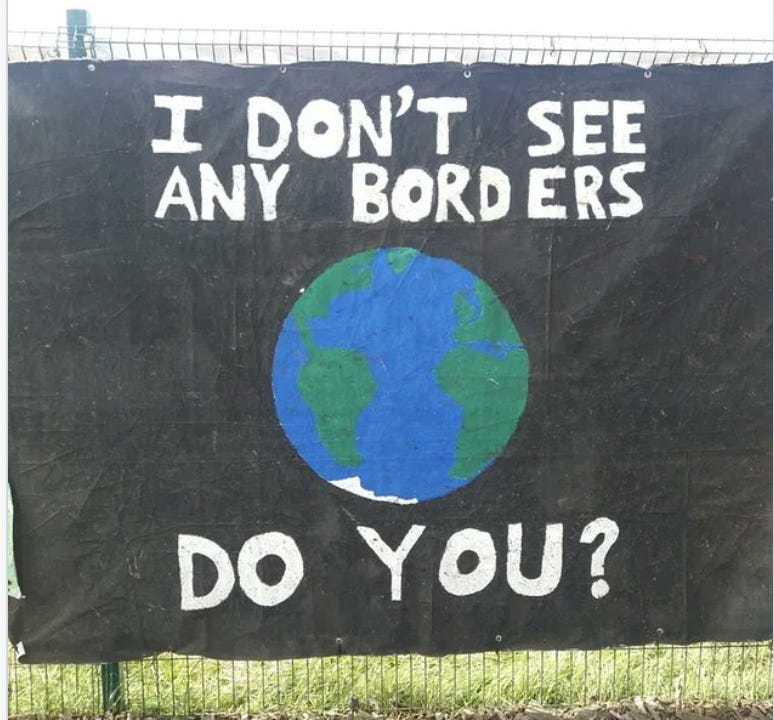
Last point, about how crazy these people are. Jeremy Corbyn, in his remarks from the stage, sent a “message” to Donald Trump, citing this poster seen outside the perimeter fence at the festival. “Build bridges, not walls,” said Corbyn, to Trump:

This poster literally hung on a five-mile fence surrounding the festival! They had to build it so only the people who had paid to come in could enjoy the music. They even had an onsite jail for wall-breachers. But these UK leftists have zero self-awareness. They want the Third World to keep coming by hundreds daily across the Channel, and to be subsidized by British taxpayers. But if any of those illegal migrants wanted to get into the Glasto festival, well, NOOOOO! To jail with you!

Rod Dreher

Why Trump won’t fire him (but may not need to)

Terminating the Fed chair would place him on thin legal ice and bring down an avalanche of criticism that he has destabilized U.S. monetary policy by politicizing the central bank. While hounding Powell out of office wouldn’t solve the second problem, it would solve the first, which is probably why the daily demagoguery is ramping up.

Do we really think Jerome Powell is prepared to endure 10 more months of it, given the sort of threats he and his family are likely receiving from hardcore MAGA cranks as a result? Even if he is, do we think Donald Trump has the patience to endure 10 more months of Powell ignoring his demands to cut rates if and when the economy slides into a tariff-driven slowdown?

There’s no way. We’re talking about a guy who once dashed off an out-of-the-blue memo giving the Pentagon two months’ notice to pull everyone out of Afghanistan.

Nick Catoggio

It is hideous that one must factor hardcore MAGA goons into these calculations.

Demagoguery whiplash

Show us all the Epstein client list now!!! Why would anyone protect those scum bags? Ask yourselves this question daily and the answer becomes very apparent!! (Donald Trump Jr in July 2023)

Quotes via Andrew Sullivan

Lonesome Rhodes

Trump always reminded me of Lonesome Rhodes, the charismatic, populist entertainer whose “candid” patter with plain folks garners him enormous power in Elia Kazan’s 1957 movie “A Face in the Crowd.”

At the finale, Andy Griffith’s Rhodes — engorged by flattery and riches — has a narcissistic explosion. Not realizing the woman he betrayed flipped on his microphone, he calls his loyal fans “morons,” “miserable slobs” and “trained seals.”

“I can take chicken fertilizer and sell it to ’em for caviar,” he crows, grinning.

Trump’s Truth Social posts backing up Pam Bondi’s claim that the Epstein files were much ado about nothing showed that same brutal disregard for his devout fans. They had taken him seriously? What fools!

Maureen Dowd

I heard an interesting anecdote and a conjecture about Trump from Michael Smerconish, interviewed by Jamie Weinstein on the Dispatch Podcast.

The anecdote: Trump was flying back to NYC from Florida, on a private jet of course. A model on the flight said “why don’t we stop at Atlantic City?” Someone replied “it’s full of white trash.” The first said “What’s white trash?” Trump jumped in: “It’s what I am only I have money.” (I find the anecdote plausible except for the premise that someone on a private jet with Trump didn’t know what “white trash” was.)

Conclusion: Donald Trump trades on being just a regular guy from Queens with lots and lots of money. People like regular guys.

The conjecture: The reason MAGA won’t let go of the Epstein story is that Trump clearly was connected to him and enjoyed his hospitality (to whatever extent, social or venereal), and that kind of hospitality was not extended to normal guys. The whole Epstein nexus (apart from any anti-semitic animus) marks Trump as not-so-normal after all.

Oh, the futility!

Is this really what I’ve chosen to do with my life? Provide running commentary on a conman-charlatan’s attempt to hock his bullshit to millions of morons? Hope that the country can be saved from authoritarianism by equally dishonest right-wing “influencers” stirring up indignation among the moronic masses against the man who more than anyone else taught them how demagoguery is done? Pretend that the Democrats trying their best to sound earnest as they barely contain their glee over Trump’s troubles really care about anything except making the president look as terrible as possible?

The thing that might be worst about trying to focus my attention on political life during the second Trump administration is the continual temptation to respond by a deranged embrace of misanthropy.

Damon Linker, feelin’ a little down.


Your enemies are not demonic, and they are not all-powerful and the right hasn’t always lost and the left hasn’t always won. But if you convince yourself of that, you give yourselves all sorts of permission to do a lot of stupid and terrible things under the rubric of “Do you know what time it is?”

Jonah Goldberg.

Trumpism can be seen as a giant attempt to amputate the highest aspirations of the human spirit and to reduce us to our most primitive, atavistic tendencies.

David Brooks

I don’t do any of the major social media, but I have two sub-domains of the domain you’re currently reading: (a) You can read most of my reflexive stuff, especially political here. (b) I also post some things on my favorite social medium.

Saturday, 2/15/25

Conservatives versus Nihilists

Trump really seems not to give a crap about the working class. Trump is not a populist. He campaigns as a populist, but once he has power, he is the betrayer of populism.

What’s going on here is not a working-class revolt against the elites. All I see is one section of the educated elite going after another section of the educated elite. This is like a civil war in a fancy prep school in which the sleazy kids are going after the pretentious kids.

Conservatives believe in constant and incremental change. Nihilists believe in sudden and chaotic disruption. Conservatism came into being opposing the arrogant radicalism of the French Revolution. The Trump people are basically the French revolutionaries in red hats — there are the same crude distinctions between good and evil, the same contempt for existing arrangements, the same descent into fanaticism, the same tendency to let the revolution devour its own.

David Brooks (emphasis added; unlocked).

The evils of revolutions almost invariably outweigh the goods. We’re getting what we voted for good and hard.

What’s radical about Trump?

[Trump]’s simply not as radical a departure from his predecessors’ worst policy instincts as we’d like to believe. But he is a radical departure in cultivating fear as a tool of leverage, right out in the open. And not just fear of political repercussions either.

In his earliest days as a Republican candidate for president, he half-joked with fans that he’d pay their legal bills if they punched protesters at his rallies. As he moved toward the GOP nomination in 2016, he warned there’d be riots if conservatives tried to block him at the convention. … It flatters his ego to know that his fans might be willing to kill for him and it pleases him to have an extra lever most politicians lack to pressure others into giving him what he wants. His amoral willingness and charismatic ability to intimidate is the molten core of his strongman persona.

January 6 is the supreme illustration … More than one Republican member of Congress has claimed that fear of rabid Trump supporters harming their families led some of their GOP colleagues to oppose his impeachment and removal after the insurrection. 

Encouraging unrest if he doesn’t get his way isn’t the only tool he uses to intimidate opponents, though.

He yanked federal protection details from John Bolton, Mike Pompeo, Mark Milley, and Anthony Fauci, placing them in danger for no better reason than that they criticized him in the past.

If you cross the president, you should expect your career, your finances, or even your life to be imperiled if it’s within his power to facilitate that. And rather than obscure that horrifying fact, Trump seems eager to advertise it: Freeing the thugs who broke into the Capitol on January 6 hoping to hang Mike Pence was his way of showing opponents that there’s no sin he won’t countenance if it’s committed in service to him.

Nick Catoggio (emphasis added)

Trump will never forgive Ukraine

Trump is no friend of Ukraine. Earlier this week he dipped into his stream of consciousness to pronounce that Ukraine “might be Russian someday” as J.D. Vance, the poor man’s Tucker Carlson, prepared to meet with Ukrainian leader Volodymyr Zelensky. He is surrounded by people who derive some weird kind of jollies from smearing and vilifying the Ukrainians—the vice president and other so-called nationalists who are all too happy to see a nationality exterminated if that pleases Vladimir Putin—as well as by people such as Kash Patel, the Kremlin stooge (on the cheap, no less) whom Trump has nominated to run the FBI. Trump will simply never forgive Ukraine for its government’s failure to help him manufacture a phony scandal (entirely superfluous, given the real ones) involving corrupt business practices and the Biden family.

Kevin D. Williamson

Softening, a little, on Trump

[Howard] Kurtz: It’s been reported, and feel free to push back on this, that when Trump won in 2016, you were at The Wall Street Journal and you were sobbing at your desk. . . . Has your view of him evolved since then?

[Bari] Weiss: It’s a good question. I mean, look, I’m the first to admit that I was a sufferer of what conservatives at the time would have called TDS, Trump Derangement Syndrome. . . . I’m someone that believes, call me old-fashioned, that everything is sort of downstream of character. And the kinds of things that he had said, and the way that he talked, and the way I felt he would coarsen our public discourse, those are all real. . . .

There were two things, I think, that I didn’t know in that moment when I was crying at my desk. One would be the sort of overzealous, out-of-touch, hysterical reaction to him, and the kind of illiberalism that was born out of the reaction to him that calls itself democratic, that calls itself progressive, but is actually extraordinarily authoritarian and totalitarian in its impulses. . . .

The other thing that I didn’t see was that Trump was going to do a lot of policies that I agreed with. I thought the Abraham Accords were historic and excellent. I thought his policy vis-à-vis Iran was excellent. The economy was better.

Howard Kurtz interviewing Bari Weiss of the Free Press on Fox News Channel’s “Media Buzz,” Feb. 9, via Wall Street Journal.

That’s a fair summary of longer comments, which you can view in less than 5 minutes via the “interviewing” link. The character issue remains.

J.D. Vance

A Trump presidency would have been completely unbelievable to me when I wrote my book about the G.O.P. and younger voters, so I approach political prediction with humility. Republicans do not have a robust modern record of vice presidents becoming their party’s presidential nominee — just ask Dan Quayle, Dick Cheney and Mike Pence. And those working under Mr. Trump do not always emerge from the experience unscathed. Four years is an eternity in politics, and if America ultimately concludes that the Trump-Vance administration was a failure, the Republican Party could look to turn the page.

But so far a good many voters like the direction this administration is going in, and Mr. Vance is finding his own moments, as at the A.I. conference, to show how he’s different from our recent generation of presidents. Mr. Trump may think it’s too soon to anoint successors, but he finds himself with a vice president who is better aligned with the spirit of what he is trying to achieve than virtually any other Republican.

Kristen Soltis Anderson. a Republican pollster

Clarity achieved

Imagine what they might have done. Trump could have announced that Musk and his minions were going in to audit the federal government. Within a few months, they’d bring a report, outlining every insane piece of waste or DEI excess or fraud they could find. Trump would then urge Congress to vote on these reforms. Win, win, win. It’s a great idea to shake up the joint with an outsider! But nah. They are busy ensuring that any cuts they make are brutal, dumb, and destined to expire.

Last year, a ton of readers who agreed with me on immigration, DEI, the transing of children, and the need for a more restrained foreign policy asked, in frustration, why I still couldn’t endorse Trump.

I hope that’s clearer now.

Andrew Sullivan.

I fear that for tribalist Trump-supporters, anything that owns the libs is just fine; they will not see more clearly now.

I shoulda listened

A binary system dictates binary choices. The Democrats were out for me. Donald Trump was the alternative.

Hunter Baker, When Pragmatic Politics Goes Bad: An Apology to the Never-Trumpers

Unlike Andrew Sullivan, Baker did vote for Trump and regrets it.

Ordo Amoris

I’m not personally going to enter into the little debate that has been going on about J.D. Vance’s characterization of Ordo Amoris, the ordering of loves, in Christian ethics. Here’s where the debate seems to stand:

Last month in a Fox News interview Vice President JD Vance articulated a … vision of a Catholic doctrine, ordo amoris. He said, “You love your family, and then you love your neighbor, and then you love your community, and then you love your fellow citizens in your own country. And then after that, you can focus and prioritize the rest of the world.”

While there were Catholics who agreed with Vance and defended his argument, Pope Francis was not among them.

On Tuesday the pope published a letter attacking Trump’s policy of mass deportations that appeared to directly address Vance’s argument. “Christian love is not a concentric expansion of interests that little by little extend to other persons and groups,” Francis wrote.

“The true ordo amoris that must be promoted,” he said, is “love that builds a fraternity open to all, without exception.”

David French

Make of that what you will, but don’t make too much of it because it’s a red herring:

Even if you agree with Vance’s formulation of ordo amoris, it strains credulity to argue that the United States isn’t prioritizing its own citizens when it spends such a small fraction of its budget on foreign aid — and when that aid provides concrete strategic benefits to the United States.

It’s also just bizarre to argue that describing the consequences of a policy is somehow emotionally manipulative when avoiding those consequences was the purpose of the program that’s being frozen or cut.

So, yes, you say that children might die without a certain program when the very purpose of the program is to prevent children from dying. That’s not manipulation. It’s confronting individuals with facts. It’s making them understand exactly what they are choosing to do.

There are few things more symbolic of the decline of the Republican Party than this radical turn against humanitarian aid ….

David French again (bold added).

I got a real punch-in-the-face reminder just days ago of how out of touch I am on today’s Evangelicalism. So all I’ll say on French’s perception that “Trump is influencing the evangelical church more than the church is influencing him” is that:

  1. It’s plausible: American evangelicalism has always been “plastic” (H/T Mark Noll, America’s God).
  2. I appreciate French’s tacit acknowledgement that there’s more to the Church than its distorted-but-prominent evangelical presentation.

The waning of family

“Like the waning of Christianity, the waning of the traditional family means that all of us in the modern West lead lives our ancestors could not have imagined. We are less fettered than they in innumerable ways; we are perhaps the freest people in the history of all humanity. At the same time, we are also more deprived of the consolations of tight bonds of family and faith known to most of the men and women coming before us—and this fact, it will be argued, has had wider repercussions than have yet been understood.”

Mary Eberstadt, How the West Really Lost God (Disclaimer: This book has long been in my queue because of quotes like this, but I have not read it.)

Colluding on the narrative

When, on a single day in 2018, more than 300 newspapers ran synchronized editorials against the president’s claim that the news media were the enemy of the American people, they sent a message about journalism’s independence.

Jonathan Rauch, The Constitution of Knowledge

I like Jonathan Rauch, but it seems to me that the message was that the media collude to set the narrative.

Most of the time, it’s not so patent.

A new form of ideological aggression

Dugin is extremely critical of modern Western society, and has written that “the entirety of Russian history is a dialectical argument with the West and against Western culture, the struggle for upholding our own (often only intuitively grasped) Russian truth.” But he also says: I am not anti-Western. I am anti-liberal. In fact, I love the West.… … I simply cannot accept the West in its current condition, at the end of modernity.… … He complains that “spiritually, globalization is the creation of a grand parody, the kingdom of the Antichrist.… American values pretend to be ‘universal’ ones. In reality, they are a new form of ideological aggression against the multiplicity of cultures and traditions still existing in the rest of the world.”

Paul Robinson, Russian Conservatism

This is one respect in which Trump may well be better than the Democrats.


I suffer more from the humiliations inflicted by my country than from those inflicted on her.

Simone Weil, from a letter to Georges Bernanos.

[N]one of the things that I care about most have ever proven susceptible to systematic exposition.

Alan Jacobs, Breaking Bread With the Dead

I don’t do any of the major social media, but I have two sub-domains of the domain you’re currently reading: (a) You can read most of my reflexive stuff, especially political here. (b) I also post some things on the only social medium I frequent, because people there are quirky, pleasant and real.

Public Affairs 7/15/24

Assassination attempt aside …

Republicans Will Regret a Second Trump Term

I have excluded from this essay some of the parade of horribles that Trump’s critics on the left expect from a second term, from anxieties about the Heritage Foundation’s “Project 2025” scheme (which Trump has distanced himself from) to terror about the end of democracy itself. Those are fears I don’t share because, like many conservatives, I don’t think Trump is strong or smart enough to blow down the pillars of American institutional life. On the contrary, it’s precisely because I think those pillars will hold that I expect that a second Trump term will mainly be shambolic, angry, divisive, not catastrophic but profoundly corrosive.

If this is considered a conservative win, I wonder what a loss looks like.

Bret Stephens, Republicans Will Regret a Second Trump Term

(Published before Saturday’s assassination attempt)

Is Project 2025 the spawn of demons?

Project 2025 [is] a populist-inflected restatement of movement-conservative priorities that the right has been trying and failing to implement for decades — plus a long list of résumés of potential footsoldiers for a guerrilla war inside the administrative state.

Ross Douthat

Ross is right and brilliantly succinct. I appreciate his swimming against the stream of Chicken Littleism.

At the same time, “movement-conservative priorities” include disrupting if not destroying the “deep state,” which includes Civil Service employees who might slow-walk an administration’s initiatives, and for that reason if no other I’m no fan of Project 2025 and it’s detailed plan for replacing civil servants with political cronies.

High floor, low ceiling

Just as there is an immense amount of rage against Trump’s enemies, Trump’s base also tends to have fun. They’re very angry at their enemies and very happy with each other. They’re not just energized by Trump, they’re entertained by him. Everything in the Republican Party — from the anger to the joy — is just more intense now. That intensity is a source of Trump’s strength — he has an incredibly high floor of support — and a source of his weakness. He has a low ceiling, in part because the entire culture of MAGA can be off-putting and even repulsive to those who don’t share its passion.

David French, in a New York Times panel discussion about this week’s GOP convention and related matters.

Assassination attempt aftermath

Genius

Mr. Trump had heard at least one shot, maybe a few. One grazed his ear. He hit the deck, was lifted up in shock, pale. He should have been swiftly rushed from the stage. But no, this is the great genius of American political theater and the reflex kicked in, the same reflex that kicked in after he had Covid and was returned to the White House from the hospital, and wanted to pose on the White House balcony in a Superman shirt with a big S, and somebody talked him out of it. So too at the rally Saturday—he got to his feet, he didn’t wipe the blood from his face, he wanted you to see and understand the whole picture. He got his look of tough-guy fury, the one he showed for weeks walking into court in New York, the one on the mug shot. He raised that fist, pumped it, shouted “Fight,” as part of the crowd began to chant “U.S.A.! U.S.A.!”

It was epic. Whatever you feel about him, whatever your stand, grant him one of the great gangsta moves of American political history.

Peggy Noonan

This, too:

The Compact editor Sohrab Ahmari tweeted that Trump’s instinct—to reflexively gesture in rebellion after being shot at—is “evidence of a truly extraordinary man.” He is more than a little right. Extraordinary, after all, is not so much a moral descriptor as an aesthetic one.

Tyler Austin Harper, A Legendary American Photograph

Trump went down as a fatmouthing politician, and rose as a pagan demigod. If Jesus Christ and George Washington came down from heaven to replace Joe Biden and Kamala Harris on the Democratic ticket, Trump would still likely win in a landslide.

Rod Dreher

Trump survived and followed his instincts as a showman and a democratic politician of uncommon instincts to transform it into an indelible image of courage and defiance that will help to shape the remainder of the presidential campaign and Trump’s long-term political legacy and reputation.

Damon Linker

I fear Trump will get a sympathy boost from this event. It may be only a couple percentage points in the upcoming election. But that could be decisive in a close contest. If so, it is even more imperative than before that the Democrats replace Biden with a stronger candidate.

Ilya Somin . Not sympathy, dummy; adulation for his “gangsta move” after standing back up.

Stochastic violence

Thinking about the attempted assassination, I appreciate that someone suggested that it was an instance of stochastic terrorism or stochastic violence. I appreciate it because it’s the Right that’s usually accused of fomenting such violence .

But I can’t see how that “stochastic” theory is falsifiable, nor can I imagine it providing a convincing explanation of any discrete act of violence. We have clever people who think that non-falsifiable propositions are gibberish, but that’s not the end of the subject for me.

Stochastic violence is almost self-evidently real, something one can know tacitly or intuitively, despite inability to falsify it. It is a reason for decent people freely to refrain from incendiary speech, but I reject legal restrictions on free speech based on it.


I suffer more from the humiliations inflicted by my country than from those inflicted on her.

Simone Weil, from a letter to Georges Bernanos.

I don’t do any of the major social media, but I have two sub-domains of the domain you’re currently reading: (a) You can read most of my reflexive stuff, especially political here. (b) I also post some things on the only social medium I frequent, because people there are quirky, pleasant and real.

Saturday Notebook Dump 5-11-24

Culture

Mind your own business

I have mixed feelings about Aaron Renn, of whom you may not even have heard. But he has a provocative suggestion, which I’ll paraphrase.

Why should conservatives, and especially Christian conservatives, oppose jackassery like the Columbia University occupation? Columbia doesn’t love conservatives, or Christians.

Columbia itself produced the brats who now threaten it. Do we even have a horse in this race? Would it be bad for us if Columbia paid the price for what it has become?

Such is liberal hegemony in the cultural institutions (arts, education, media) that we lament it constantly. Why then should we leap to defend these leftist institutions when they’re under threat from folks even further to the left?

There’s something to be said for sitting back and enjoying the show.

AR-15 as totem

In 2023, the Washington Post published a series of articles about AR-15-style rifles. The series was scientifically illiterate, error-ridden, propagandistic, and willfully misleading. 

Naturally, it has just been awarded the Pulitzer Prize.

Kevin D. Williamson. Williamson then really gets into the weeds. Though I’m not a huge gun enthusiast, I enjoy reading columns like this because of what they say about the sloppy journalism they’re critiquing and because I often learn things I didn’t know, like:

It is probably worth noting here that AR-style rifles are used in a very, very small share of shootings in the United States: All rifles together typically account for something less than 3 percent of the firearms homicides in the United States in a given year. Rifles are more commonly used in mass shootings, but, even in those high-profile crimes, they are used in a minority of cases, about 28 percent. The most common firearm used in a violent crime in the United States is the 9mm semiautomatic handgun—which is the most common handgun found in the United States.

Mass shooters often choose AR-style rifles for obvious reasons—because they are common, relatively easy to operate, and the rifle that most Americans are most familiar with—and for reasons that are best described as totemic. … Gun-control advocates who want to prohibit only AR-style rifles are seeking a merely symbolic victory—those other semiautomatic rifles would remain on the market and presumably would be used for the common legitimate and rare criminal purposes AR-style rifles are used for.

We could—and probably should—be more aggressive in prosecuting the crime of simple illegal firearm possession absent some additional violent offense, and we probably should hand down stiffer sentences more consistently for that crime rather than doing what we do now—which is dismissing the great majority of those cases or pleading them down to some trivial misdemeanor.

But rigorously enforcing the laws regarding firearm possession with prison sentences is going to mean a lot more young men becoming incarcerated felons earlier in life, and it is nearly certain that those young men will be disproportionately black and poor. … We should probably arrest and prosecute a lot more straw-buyers than we do, but we should be clear-eyed about who those straw-buyers are going to be—people with otherwise clean criminal records, often girlfriends or family members of convicted felons—before we start locking them up.

And they wonder why demagogues get so much mileage out of claims about “fake news.” It’s shameful stuff.

Whew! That’s a relief!

Even the most challenging writer will not always want to read works that constantly challenge or repudiate his or her expectations. Auden used to say that great masterpieces demand so much of their readers that you simply can’t take one on every day, not without either trivializing the experience or exhausting yourself.

Alan Jacobs, back to the brows

I know the internet has dumbed us down, and I’m not exempt from that. But I try to keep challenging books in my book list. My need to read other things, too, is hereby vindicated!

Jacobs throws out another thesis about “the brows” (low-, middle-, and high-):

For a long time now there has been no genuine lowbrow reading. Those who insist on all their expectations being fulfilled can get that hit much more efficiently through movies, TV, Instagram, TikTok, etc.

Intrinsic values

When people say that something is “valuable in and of itself,” I think what they mean is simply that it has no economic or social value — note Kirsch’s contrast between intrinsic value and something valued because it “makes us more virtuous citizens or more employable technicians of reading and writing.” Someone might say that when we say some artifact or experience is intrinsically valuable we’re saying that it does not have any instrumental value — but isn’t a song that delights me instrumental to that delight? And isn’t that okay? 

So I think that when we describe something as having intrinsic value, what we really mean is that the value it provides is higher than or nobler than any furthering of crassly economic or social ambitions. We’re indirectly and somewhat sloppily appealing to a hierarchy of goods. And maybe — especially in the context of debates about liberal education, which is at least partly the context of Kirsch’s essay — we should be more explicit about that, and conscious of what our hierarchy is and why we affirm it.

We are blessed that Alan Jacobs, (intrinsic values) uses this blog as a digital notebook, tagging his entries for future retrieval.

AI gonna sell us stuff

[W]hen the hysterical claims about the coming of “the Singularity” and quickly-approaching AI doom/utopia subside, what we’ll find is that most of what AI is doing is a more complex and sophisticated version of what Silicon Valley already does: giving us increasingly-aggressive recommendations for how to sate our various needs.

The longstanding battle between the individual and the state will come to look quaint in comparison to the battle of the human against the profit-maximizing AI, an entity that is distributed and depersonalized and so can have no personal accountability. And it will all be happening with a populace that has grown used to seeing digital systems as permanent authorities that they have no ability to defy.

Freddie deBoer

Peak Woke?

Both wokeness and anti-wokeness have lost their transgressive edge. Now they’re both kind of “cringe,” as the kids say.

And that is a sign of healing. 

One of the worst annoyances of polarized politics is the way the fringes symbiotically feed off each other. Like bootleggers and Baptists both benefiting from blue laws, the extreme left and extreme right need each other to justify their catastrophizing. The worst thing that could happen for Republican House fundraising efforts would be for the “Squad” of far-left members of Congress to be replaced by sensible Democrats. And the last thing the Democratic Congressional Campaign Committee wants is for Marjorie Taylor Greene to be primaried by an intelligent Republican who doesn’t talk about Jewish space lasers.

Jonah Goldberg

News-Be-Gone

The news industry is Society’s appendix – permanently inflamed and completely pointless. You’re better off simply having it removed.

Rolf Dobelli, Stop Reading the News

This is advice I’ve been unable to follow very far.

Legalia

Picking dead pigeons in the Park

Jonathan Alter has a better idea than putting Trump in jail for further contempt, with all the Secret Service and other complications. Jail for the Chief? There’s a Better Punishment.

Education

The beginning of the end … of this particular miserable chapter

MIT sours on DEI: MIT has done away with mandatory diversity statements in their hiring process. The president of the school, Sally Kornbluth, told John Sailer: “We can build an inclusive environment in many ways, but compelled statements impinge on freedom of expression, and they don’t work.” This is a watershed moment: MIT is the first elite school to reverse course on this policy. Let’s see what schools follow suit.

Oliver Wiseman, The Free Press

DEI was the latest chapter in the effort to purge wrongthinking conservatives from our institutions. Its end will be the beginning of a re-branded effort.

Campus

  • As university administrators nationwide grapple with how to deal with anti-Israel encampments, former Nebraska senator and current University of Florida President Ben Sasse wrote in the Wall Street Journal of a model to follow. “At the University of Florida, we have repeatedly, patiently explained two things to protesters: We will always defend your rights to free speech and free assembly—but if you cross the line on clearly prohibited activities, you will be thrown off campus and suspended,” he wrote. “We said it. We meant it. We enforced it. We wish we didn’t have to, but the students weighed the costs, made their decisions, and will own the consequences as adults. We’re a university, not a daycare. We don’t coddle emotions, we wrestle with ideas. … For a lonely subset of the anxious generation, these protest camps can become a place to find a rare taste of community. This is their stage to role-play revolution. … Universities have an obligation to combat this ignorance with rigorous teaching. Life-changing education explores alternatives, teaches the messiness of history, and questions every truth claim. Knowledge depends on healthy self-doubt and a humble willingness to question self-certainties.”

The Morning Dispatch

The World

Israel, Hamas, Gaza

  • A Palestinian man living in the U.S. offers both grief for his family who have died in Israel’s war against Hamas and condemnation for the terrorist organization that sacrificed his homeland. “Thirty-one,” Ahmed Fouad Alkhatib wrote for The Times of London. “That’s how many of my extended family members have died in Gaza since October 7. … The past seven months have entailed endless sleepless nights, close calls, false alarms and frantic attempts to help locate missing family members.” But the pro-Palestianian, anti-Israel narrative in the West misses a key truth, he argued. “Many believe Gaza was this unbelievably awful place before October 7, an unrelenting prison with nothing in it worth living for. They then conclude that Hamas’s horrendous attack was a legitimate reaction to Israeli policies that made Gaza a concentration camp. But this perspective misses an important truth. It fails to recognise that even with Israel’s multifaceted blockade, which has been in place since 2007, Gaza was a beautiful place that meant so much to its residents and people. … Hamas needlessly and criminally threw all of this away as part of nefarious calculations by violent and homicidal leaders who have utter disregard and contempt for the average Palestinian citizen.”

The Morning Dispatch

Politics

On not doubling down

Glenn Loury thought maybe the world — maybe he — had been wrong about Derek Chauvin, the police officer convicted of murdering George Floyd in 2020. Loury had watched a documentary, “The Fall of Minneapolis,” that had circulated largely on right-wing social media, arguing that Chauvin had been wrongly convicted, and found himself persuaded. Was it possible, he wondered, that Floyd had actually died of a drug overdose?

… Then Radley Balko, an independent journalist, published a lengthy and meticulous critique of the film, calling it “all nonsense.”

“I pride myself on remaining open to evidence and reason, even if they disconfirm something I had formerly thought to be true,” Loury wrote in a mea culpa for his Substack, calling his error egregious. …

How had he made such a mistake?

“The real story is I hated what happened in the summer of 2020,” he told me. “I think these moral panics we have around these police killings are over the top and it’s bad for the country.” He had supported the filmmakers, he confessed, because they were attacking people he opposed. “I let that cloud my judgment.”

Pamela Paul, One Black Conservative Continues to Stand Apart (emphasis added)

Forming alliances on the basis of shared hatreds is soul-scarring.

Of course he said the quiet part out loud

That brings us to a Washington Post article this morning. At a Mar-a-Lago meeting in April, oil executives complained that despite pouring hundreds of millions into lobbying the government, the Biden administration had pursued stronger environmental regulations. “Trump’s response stunned several of the executives in the room overlooking the ocean: You all are wealthy enough, he said, that you should raise $1 billion to return me to the White House,” the Post reports. In exchange, Trump vowed to roll back current regulations and freeze future ones. He told them that, given the savings, a billion bucks would be a “deal” for them.

What Trump was offering is entirely legal and absolutely corrupt. (Or to borrow a phrase: very legal and very uncool.) Thanks to Trump’s bluntness, there can be no hair-splitting about what’s going on here, and that’s good for public understanding. Trump asked special interests for an eye-popping fee in exchange explicit favors. Trump and the oil companies might argue (dubiously) that their preferred regime would actually be better for consumers, but they are cutting “the people” out of the discussion entirely, subverting democracy. The deal is getting done between Trump and the suits, behind closed doors. It’s a good reminder that Trump’s claim to being an outsider is a sham.

David A. Graham, Trump’s Legal, Corrupt Offer to Oil Executives

Bipartisanship today

Who’s responsible for the illegal immigration problem?

When it comes to immigration, it’s true that the Biden administration belatedly worked with legislators to settle on a compromise bill that would stem the flow of migrants (including refugees) to the southern border. But it’s also true that Republicans, led by Trump, decided they’d prefer to keep the border a festering problem through an election year in order to hurt the president.

That’s cynical, hardball politics. But that’s just another way of saying it’s politics well played. (It ain’t beanbag, after all.)

Damon Linker. The key words are belated, prefer, fester and cynic.

Momala

[2020] was the year when friendships were shattered and livelihoods ruined because someone didn’t post a black square on Instagram; when every suburban wine mom was frantically reading White Fragility for her anti-racist book club; when members of Congress posed for an absurdly self-serious photo shoot draped in kente cloth. It was the year when representation mattered—to the exclusion of basically everything else. 

This miasma of liberal white guilt and frantic, performative virtue-signaling was the birthplace of many a bizarre cultural artifact, like the anti-racism research center for which Ibram X. Kendi received (and squandered) $43 million, or the $250,000 “Woke Kindergarten” program that taught five-year-olds in San Francisco to “disrupt whiteness.” But its most lasting legacy, arguably, is Kamala Harris, who ended up a skipped heartbeat away from the top job for reasons that were primarily aesthetic: once Biden promised to pick a woman of color as his running mate, her selection was all but guaranteed.

[H]er social justice credentials are thoroughly undermined by her actual record: one of a career prosecutor with a penchant for authoritarian overreach and a hostility to civil liberties.

As an attorney, she—or people working on her behalf—routinely fought to keep innocent people in prison, to avoid compensating the wrongfully convicted, and to protect corrupt cops and prosecutors. In her capacity as California’s district attorney, she stood in the way of advanced DNA testing that could have proved the innocence of a man who had spent four decades on death row—until a 2018 story about the case created bad press for her presidential campaign, at which point she hastily (and uselessly) declared that she now supported the test.

==And then there’s her legal war against the founders of Backpage.com, a classified ads site with a robust “Adult Services” section. Harris charged Michael Lacey and James Larkin with conspiracy to commit pimping back in 2016. This eight-year effort is the clearest manifestation I have ever seen of the phrase “the process is the punishment.” In August 2023, on the eve of yet another court battle, James Larkin committed suicide. In reaction to this news, Reason’s Matt Welch noted: “You will see 100 times more ink spilled this year on chimerical right-wing book bans than you will on the vice president’s scapegoat blowing his brains out.” He was right, sort of; the actual ratio of book ban coverage as compared to Larkin’s suicide was more like 10,000 to one.

I’ve commented little on Kamala Harris because she has been nearly invisible as Vice President in these tumultuous times. But I’m grateful to Kat Rosenfield (America Doesn’t Need Momala Harris) for this reminder of why I detested her conduct in California government and rued Joe Biden selecting her for VP.

Misogyny

Last year, my colleague Sophie Gilbert wrote that a second Trump presidency would produce four more years of unchecked misogyny. “I don’t believe Donald Trump hates women. Not by default, anyway,” she wrote. “The misogyny that Trump embodies and champions is less about loathing than enforcement: underscoring his requirement that women look and behave a certain way, that we comply with his desires and submit to our required social function.” Daniels’s account of her encounter with him showed exactly how that can work. It’s not that Trump bore any malice toward Daniels (that came later); it’s that she mattered to him only as a vehicle to sex.

By now, Trump has gotten a great deal more than he expected or wanted that day in his Tahoe penthouse. Following a lunch break today, his attorneys argued for a mistrial on the basis of Daniels’s answers. Merchan refused but said several times that some things that came up would have been “better left unsaid.” The newly demure defendant would surely agree.

David A. Graham, Trump’s Misogyny and Stormy Daniels


So: where did all my mockery of Trump go?

I suffer more from the humiliations inflicted by my country than from those inflicted on her.

Simone Weil, from a letter to Georges Bernanos.

You can read most of my more impromptu stuff here and here (both of them cathartic venting, especially political) and here (the only social medium I frequent, because people there are quirky, pleasant and real). All should work in your RSS aggregator, like Feedly or Reeder, should you want to make a habit of it.

Culture

Made Men

I cannot remember the books I’ve read any more than the meals I have eaten; even so, they have made me.

Ralph Waldo Emerson

A perennial favorite for the internet age

I can take a virtual tour of the Forbidden City in Beijing, or of the deepest underwater caverns, nearly as easily as I glance across the room. Every foreign wonder, hidden place, and obscure subculture is immediately available to my idle curiosity; they are lumped together into a uniform distancelessness that revolves around me. But where am I? There doesn’t seem to be any nonarbitrary basis on which I can draw a horizon around myself—a zone of relevance—by which I might take my bearings and get oriented. When the axis of closer-to-me and farther-from-me is collapsed, I can be anywhere, and find that I am rarely in any place in particular.

Matthew Crawford, The World Beyond Your Head

Another oldie

To say that we and the Soviet Union are to be compared is the equivalent of saying that the man who pushes the old lady into the way of an oncoming bus, and the man who pushes the old lady out of the way of an oncoming bus, are both people who push old ladies around.

William F. Buckley via Douglas Murray

New Illustration for the Urban Dictionary

Cringe: It’s like this.

(H/T Nellie Bowles)

Owning the full weight of your worldview

One doesn’t see this sort of observation much any more:

Reason is an absolute … Yet those who ask me to believe this world picture also ask me to believe that Reason is simply the unforeseen and unintended by-product of mindless matter at one stage of its endless and aimless becoming. Here is flat contradiction. They ask me at the same moment to accept a conclusion and to discredit the only testimony on which that conclusion can be based. The difficulty is to me a fatal one; and the fact that when you put it to many scientists, far from having an answer, they seem not even to understand what the difficulty is, assures me that I have not found a mare’s nest but detected a radical disease in their whole mode of thought from the very beginning.

C.S. Lewis, Weight of Glory

Good Dad

Dad only had three stages in his day. He was either (1) drinking coffee, (2) had just finished drinking coffee, or (3) was brewing a fresh pot right now.

Ted Gioia, How Coffee Became a Joke. Unlike Ted, I rather like Starbucks, but the only frou-frou I ever ordered was one, and only ever one, Pumpkin Spice Latté, just to see what the buzz was about. Otherwise, I’m happy with whatever dark roast is on offer or even Pike Place if necessary.

Ruso-Ukraine war and NATO

Be it remembered:

Many sober voices warned that an expansion of NATO to Russia’s border would poke the Bear, leading to an inevitable war. As long ago as 1998, following the U.S. decision to expand NATO eastwards, George Kennan said the following to Thomas Friedman:

“I think it is the beginning of a new cold war. I think the Russians will gradually react quite adversely and it will affect their policies. I think it is a tragic mistake. There was no reason for this whatsoever. No one was threatening anybody else. This expansion would make the founding fathers of this country turn over in their graves.

“We have signed up to protect a whole series of countries, even though we have neither the resources nor the intention to do so in any serious way. [NATO expansion] was simply a lighthearted action by a Senate that has no real interest in foreign affairs. What bothers me is how superficial and ill informed the whole Senate debate was. I was particularly bothered by the references to Russia as a country dying to attack Western Europe.

Patrick J. Deneen, Russia, America, and the Danger of Political Gnosticism

And recently, we’ve had people in the know bragging that we are going to bring Ukraine itself into NATO, though “we have neither the resources nor the intention” of following through by vigorously defending, with troops, a new member that was already under attack when admitted to NATO.

Campus Protests

Coddled2

[S]ociety takes the attitudes and antics of the young far too seriously. In an era when we are reliably informed that adolescence persists well into the twenties, it is strange that we deem the views of anyone under the age of thirty to have any real significance or merit. Yet it seems to be an unspoken assumption that young people, especially young, angry, and opinionated people, are to be indulged as important … 

This exaltation of youth is simultaneously the exaltation of ignorance and incompetence. Early claims of Israeli occupation of Gaza and the continued sloppy use of the language of genocide, fueled by people at the U.N. who could benefit from using a dictionary, are two obvious examples of the former. As for the latter, when, for example, did adult revolutionaries hold hunger strikes lasting a whole twelve hours or seize buildings and then demand that the university authorities give them food and water? I have no affection for Che Guevara, but he did at least spend time in a Bolivian jungle while trying to foment revolution. I presume he never once considered whining to the Bolivian government about the harsh conditions of jungle life and had to find his own food and water. A cynic might say that even our revolutionaries are pathetic these days.

Carl R. Trueman, ‌What the Pro-Palestinian Campus Protests Are Really About

One of the voices on the Matter of Opinion podcast Friday likened Columbia University getting police to clear our an occupied hall to “calling the police on your own kids” because the University is in loco parentis. I think the voice belonged to someone named “Van Winkle.”

I was in college when students effectually abolished in loco parentis. They didn’t want anyone telling them what to do and what not to do. But, giving credit to Ms. Van Winkle, they did generally whistle a different tune when there was the threat of police being brought in.

I’ve long thought take your pick; you don’t deserve protective in loco parentis (“we’ll take care of this ourselves, officer”) if you’re not willing to live by university rules (“here’s the rules you’re expected to live by”).

Radical Revolutionaries on the cheap

And of course the protesters all want (and I’m sure will get) the arrests taken off their records. They want to be radical revolutionaries holding a radical protest. They also want the protest catered ASAP. And when it’s done for summer, they want good grades in all the classes and squeaky-clean records. McKinsey doesn’t staff itself!

Nellie Bowles.

Another thing I seem to remember is that civil disobedience includes taking the consequences for breaking an unjust law. Scott free for breaking a just law does not compute.

Forewarding illiberalism

As readers know, I’m deeply sympathetic to the argument that Israel has over-reached, over-bombed, and over-reacted in its near-unhinged overkill of Palestinian civilians, especially children, in the wake of 10/7’s horrors. It has been truly horrifying. I begrudge no one demonstrating passionately to protest this. But as I watch the rhetoric and tactics of many — but not all — of these students, I’m struck by how this humane concern is less prominent than the rank illiberalism and ideological extremism among many.

Preventing students from attending classes, taking exams, or even walking around their own campus freely is not a protest; it’s a crime. So is the destruction of property, and the use of physical intimidation and violence against dissenting students. The use of masks to conceal identity is reminiscent of the Klan, and antithetical to non-violent civil disobedience. It’s a way for outsiders to easily infiltrate and a way to escape responsibility for thuggishness. It’s menacing, ugly and cowardly.

It did not have to be this way. Imagine if students simply demonstrated peacefully for a cease-fire, placed the victims and hostages at the forefront of the narrative, and allowed themselves to be arrested proudly on camera and face legal consequences for their actions, as the civil rights movement did. Imagine if they were emphatically non-violent and always open to debate.

But they aren’t, because they are not the inheritors of the Christian, universalist civil rights movement but its illiberal, blood-and-soil nemesis, long curated in the Ivy League.

And they will help Trump get an Electoral College landslide, just as the new left handily elected Nixon in 1968 and 1972.

Andrew Sullivan

Politics

Life in the Stupid Party

(I don’t remember the source, but someone called our two major parties the Evil Party and the Stupid Party.)

The so-called hard right in the House is learning an old lesson: Life is hard, but it’s harder if you’re stupid.

Kevin D. Williamson

On Democrats’ promise to help defeat Marjorie Taylor Greene’s effort to oust Speaker Mike Johnson:

Republicans, rather than fume that Democrats have denied them a chance to self-destruct, should consider that perhaps this is the inevitable result of the mid-session motion-to-vacate game that has brought them to the brink of losing their majority without an intervening election. A conference that can’t bear to see any of its members lead the House will soon enough encounter a cure for that.

National Review, The Week email for 5/3/24.

Meanwhile, over at the Evil Party

Once someone determined Trump was so bad it was okay to lie about him, it set the precedent that the only thing that mattered was a subject’s politics.

Matt Taibbi via James Howard Kunstler


So: where did all my mockery of Trump go?

I suffer more from the humiliations inflicted by my country than from those inflicted on her.

Simone Weil, from a letter to Georges Bernanos.

You can read most of my more impromptu stuff here and here (both of them cathartic venting, especially political) and here (the only social medium I frequent, because people there are quirky, pleasant and real). All should work in your RSS aggregator, like Feedly or Reeder, should you want to make a habit of it.