Are gay rights in conflict with religious freedom?

I began a few days ago to write about (a) whether there’s a conflict between the robust religious freedom we’ve known in the past and “the gay rights movement” and (b) whether the Obama administration is friendly toward the latter to the detriment of the former.

The piece sort of spun out of control. Things are just too interconnected. So I’m starting fresh, determined not to allow my modest objective to sink beneath the waves of “TMI” (too much information). Continue reading “Are gay rights in conflict with religious freedom?”

Clarence Thomas for President?

I don’t know these guys, but I suspect them of disingenuous mischief.

Still, the times are fearful and polarized. The “left” (scare quotes because who really knows what the labels mean these days?) fears theocracy, and I increasingly see why they would fear it. The “right,” or at least “the religious right,” fears (whether they can name it or not) French-style glorious revolution secularization, with concommitant marginalization, persecution or even martyrdom of Christian believers. I have never had trouble seeing why that fear should arise, even though those of the “left” find it risible, since they perceive Christianity as dominant to the point of oppressiveness. (The phenomenon of multiple flavors of Christianity, however, is one to which I have often alluded, and they differ at a deep spiritual level, not just in their political valence. The same, I believe, is true of Islam — and for analogous reasons.)

We have dug ourselves a very deep hole economically, and if that plays out as I suspect it will, I see no sign that people are ready to repent of economic nonsense and start building something sustainable, since what’s sustainable won’t be as giddily distracting as the faux prosperity we currently experience — and which, truth be told, we enjoy if only as guilty pleasure.

And I’ve not really touched on “the culture” in a sense broader than politics, religion, and their respective discontents.

In such a millieu, some rough beast may well be slouching toward Bethlehem. I doubt that it’s Clarence Thomas (who I don’t find a rough beast at all). A political Peter Singer, with the rhetorical gifts of a Barack Obama, seems likelier to me. He (she?) must be seductive enough with nostrums to seduce — what is it? — 218 Electoral College Votes (assuming, contrary to the “Bible prophecy” wankers, that he’ll be American).

On that bright note, I close the computer and prepare to go sing the praises of The One whose incarnation in the flesh, with its Bethlehem nexus, makes me hopeful even in the most troubled of times.

Right diagnosis, wrong prescription

I often like Dennis Prager’s syndicated columns, and there’s some things to like about a recent one titled “The World is a Cruel Place and if America Weakens, It Will Get Crueler.”

Prager first, and pretty fairly, defends Christianity against today’s common calumnies. Then he realistically rehearses the woes of much of the world today, including the oddity that Russia, while remaining fiercely Orthodox in many ways, nevertheless lost its moral compass during 70 years of Communist tyranny and hasn’t regained it, functioning today as a nihilistic thugocracy.

Then he proposes that Lincoln’s America — “The Last Best Hope of Earth” — is the balm for the world’s woes — if only we can get the left out of power,  because the left thinks of America in post-Christian, Christendom-hating ways that render America impotent.

But there’s an odd asymmetry to that argument. It seems to presume that if we only get rid of left-leaning leaders, America will resume its role as the modern realization of Christendom rather than another nation rapidly becoming post-Christian. Although we’re lagging Europe in explicit secularization, we are implicitly secular right down to the pews of most Churches (see here for a long and evocative essay by Father Stephen, and here for a shorter piece explaining that “The default position of America is secular protestantism”).

Our foreign policy as carried out by both parties promotes our imperial goals, not Christianity, and muscular Krustian foreign policy will only make us more odious in the eyes of the world.

Sorry, Dennis: I’m not sure even you believe this one. If you want to make a case for voting out the Democrats and voting in Republicans, you’ll need to do better.

Bare breasts good, burqas bad

The Washington Post’s Michael Gerson explains, in terms I 95% agree with, why Europe’s burqa bans are a bad idea:

Belgium is moving toward a total ban on face-covering veils in public. Italian police recently fined a woman for wearing a burqa. In France, a law banning garments “designed to hide the face” is likely to be introduced in July. “The burqa is not a sign of religion,” says French President Nicolas Sarkozy, “it is a sign of subservience. It will not be welcome on the territory of the French Republic.”

The motives of European leaders in this controversy are [un]sympathetic. Some speak deceptively (and absurdly) of a security motive for banning Islamic covering. Who knows what they are hiding? But by this standard, the war on terrorism would mandate the wearing of bikinis. The real purpose of burqa bans is to assert European cultural identity — secular, liberal and individualistic — at the expense of a visible, traditional religious minority. A nation such as France, proudly relativistic on most issues, is convinced of its cultural superiority when it comes to sexual freedom. A country of topless beaches considers a ban on excessive modesty. The capital of the fashion world, where women are often overexposed and objectified, lectures others on the dignity of women.

For what the opinion of an outsider is worth, I do think the burqa is oppressive. It seems designed to restrict movement, leaving women clumsy, helpless, dependent and anonymous. The vast majority of Muslim women do not wear complete covering because the Koran mandates only modesty, not sartorial imprisonment.

But at issue in Europe is not social disapproval; it is criminalization. In matters of religious liberty, there are no easy or rigid rules … Some rights are so fundamental that they must be defended in every case. But if a democratic majority can impose its will on a religious minority for any reason, religious freedom has no meaning. The state must have strong, public justifications to compel conformity, especially on an issue such as the clothes that citizens wear.

In France — where only a few thousand women out of 5 million Muslims wear the burqa — a ban is merely a symbolic expression of disdain for an unpopular minority. It would achieve little but resentment.

Keys here for me:

  • The idea that we’re respecting the dignity of women by banning burqas is contemptible nonsense given how we treat women ourselves. Immodesty is not authentically liberating.
  • As intimated in Gerson’s opening (not quoted above), the ban is a kind of Western imperialism, only exercised over immigrants not “through colonialism but through migration.” As Gerson says, “Some rights are so fundamental that they must be defended in every case,” but burqa bans are not protecting fundamental rights.
  • I have long wanted to maintain a capacious middle ground between (1) crime and (2) legal right. I want to be able to disapprove and even, perhaps, to shun practitioners of bad behaviors (call them “(1.5) Vice”) that I wouldn’t want criminalized. As an Orthodox Christian, I would exercise that sparingly, but there are instances like excommunication where it is expected that arms-length will be maintained even as one prays for the repentance of the excommunicated one. And, yes, I willingly cede the same to others who disapprove of something I do; I’ve been wrong, and sometimes it was expressions of disapproval — not legal sanctions — that set me right again.

However, Gerson emphasizes the wrongness of burqas even on Islamic principle (“the Koran mandates only modesty, not sartorial imprisonment”). It strikes me as presumptuous for an outsider to hold much opinion about the teaching of another tradition’s holy books. Living religious traditions may well have interpretive traditions of some subtlety, or may have extratextual traditions that are considered legitimately binding. In that sense, Gerson himself applies his Protestant “Bible only” sensibility to Islam in an “imperialist” spirit that may differ from European secularists impositions of sexual freedom more in degree than in kind.

Situation hopeless, but not serious

The thoughtful Orthodoxen behind Notes from a Common-Place Book writes today his reflections on a “Country Wedding.”

The back roads drive down there and back was pleasant and gave my wife and I time to catch up on some things. We talked of a number of people who are close to us and whose current situations give cause for concern. (There’s the old joke: Southerners are not gossiping, they are just concerned.) But seriously, my wife and I were in complete agreement as to the particulars of the several problem situations. Of interest to me, however, was that we each arrived there following completely different paths.

The fact that I am Orthodox and she is Protestant is certainly part of it, but it really goes beyond that. I would say that my wife is perhaps too quick to resort to moralizing, just as she would likely say I am too quick to assert that morality has little or nothing to do with it. The older I get, the more I am convinced that morality, as currently defined, is only incidentally, or at most tangentially, connected to the Faith–and is certainly not the way one approaches Christianity. But I am equally guilty of overstating the case on most anything ….

We talked on, speculating about when everything changed and why. But here again, we were coming at it from different directions. First, I doubt that the past she misses was ever really all that grand, for I have never entertained any idealized image of my own childhood world. But beyond that, (and here is where the Orthodox view enters in) I find that things are only playing out much as one would expect them to, given the particulars of our society–our rampant materialism/consumerism, our notions of progress and technology, the inherent flaws within our Americanized Protestant/evangelical culture, and the adaptation of Americanism as a near religion itself. Why would we think that things would be any different? Events are taking their natural course. I am neither surprised nor alarmed at it—“situation hopeless, but not serious.” Between the two of us, I feel I got the better deal—she gets the angst, I settle for a “love among the ruins” resignation.

He then turns to some thoughts he had upon reading a review of George Barna’s The Seven Faith Tribes: Who They Are, What They Believe, and Why They Matter. The Seven Tribes?:

  • Casual Christians: Two-thirds of all adults, they profess to be Christian but it’s not a priority and not integrated into their lives.
  • Captive Christians: One-sixth of the population, they hold what Barna describes as “biblical beliefs” and live it out in their lives.
  • Skeptics: Nearly 11 percent of the population, it is the largest group of non-Christians. Includes atheists and agnostics.
  • Jewish: At two percent, he describes them as “more of a community with a shared history and culture than a group connected by a shared doctrine.”
  • Mormons: Less than two percent, Barna calls them the “Rodney Dangerfield of the Christian world.”
  • Pantheists: About 1.5 percent, includes Eastern religions and the hybrid of New Ageism.
  • Muslims: Barna says they are less than 1 percent of the population, but the most ethnically balanced.

Barna reportedly thinks these groups share some common values (forgiveness, respect for the elderly, generosity) that are the keys to America’s enduring success. Another reviewer concludes with “[Barna] believes that if the seven faith tribes assert themselves and promote their shared values, the United States will reverse the recent decades of ‘cultural chaos and disintegration.'”

I hope the leap doesn’t seem too bizarre, but I was struck by a comment of Ayaan Hirsi Ali, interviewed recently in the New York Times Magazine (their interviews are, by the way, some of the shallowest things in an otherwise serious newpaper). She apparently excludes Islam — or at least “radical Islam” — from Barna’s “shared values” reverie:

We who don’t want radical Islam to spread must compete with the agents of radical Islam. I want to see what would happen if Christians, feminists and Enlightenment thinkers were to start proselytizing in the Muslim community.

I don’t want to read too much into this, but Ali seems to me to be looking for concerted proselytizing by groups ostensibly at odds with each other on many points. But I’ve come to see over the past decade that “Enlightenment thinkers” is not at all a set with minimal overlap with the Christian set. The overlap is quite extensive. (I think that, insofar as it is true, represents a victory for the Enlightenment and a defeat for traditional Christianity, by the way.)

As the author of Country Wedding might say, those three can only get together to promote “materialism/consumerism, our notions of progress and technology, the inherent flaws within our Americanized Protestant/evangelical culture, and the adaptation of Americanism as a near religion itself.” Why would we think that this brew will entice Muslims? I suspect it’s near the heart of what offends them.


Atheist Delusions I

I recently read David Bentley Hart’s Atheist Delusions: The Christian Revolution and Its Fashionable Enemies (Yale, 2009). Although Hart is Orthodox, a world-class philosopher, and not half bad at popularizing, I hesitated to buy it.

For one thing, I’ve read plenty of books on the supposed historical conflict between “religion” and science, and my views have been pretty settled for rather a long time now. (Were I a scientist, I’d share them, but I’m not — and can’t imagine that they’re of keen interest to others.) I’m unfazed when I read some “New Atheist” screed. “Been there, done that, and other atheists do it better,” is my attitude in a yawn.

For another, I bogged down on Hart’s The Beauty of the Infinite: The Aesthetics of Christian Truth.

But people I respect kept recommending it, and it sounded as if he might take a different tack on The New Atheists. They were right.

I may be posting some more on this book over the next few days or weeks. What I post now is just some select thought.

First of all, Hart doesn’t make the mistake of arguing, in effect, that Christianity is safe and harmless and perfectly compatible with modernity, as if modernity were the measure of truth:

It is not difficult, for instance, to demonstrate the absurdity of the claim that the rise of Christianity impeded the progress of science; but if one thereby seems to concede that scientific progress is an absolute value, upon which Christianity “respectability” somehow depends, one grants far too much … That Christendom fostered rather than hindered the development of early modern science, and that modern empiricism was born not in the so-called Age of Enlightenment but during the late Middle Ages, are simply facts of history, which I record in response to certain popular legends, but not in order somehow to “justify” Christianity. And I would say very much in the same regard to any of the other distinctly modern presuppositions — political, ethical, economic, or cultural — by which we now live. My purpose in these pages is not (I must emphasize) to argue that Christianity is essentially a “benign” historical phenomenon that need not be feared because it is “compatible with” or was a necessary “preparation for” the modern world of its most cherished values … Above all, I am anxious to grant no credence whatsoever to the special mythology of “the Enlightenment.” Nothing strikes me as more tiresomely vapid than the notion that there is some sort of inherent opposition — or impermeable partition, between faith and reason, or that the modern period is marked by its unique devotion to the latter. One can believe that faith is mere credulous assent to unfounded premises,  while reason consists in pure obedience to empirical fact, only if one is largely ignorant of both.

Second, Hart isn’t trying to spark a religious revival, and a war against the New Atheist featherweights, on some utilitarian grounds that we need “religion” even if it’s false. For a few examples:

To be honest, my affection for institutional Christianity as a whole is rarely more than tepid; and there are numerous forms of Christian belief and practice for which I would be hard-pressed to muster a kind word from the depths of my heart, and the rejection of which by the atheist or skeptic strikes me as perfectly laudable.

I can honestly say that their many forms of atheism that I find far more admirable than many forms of Christianity or of religion in general.

I should note here — not in order to strike a mournful note on departing, but only to clarify my intentions — that I have not written this book as some sort of frantic exhortation to an improbable general religious renewal. Such a renewal may in fact take place, I imagine, as the spirit moves, and as a result of social and political forces I cannot hope to foresee. I have operated throughout from the presupposition that in the modern West, the situation of Christianity and culture at large is at least somewhat analogous to the condition of paganism in the days of Julian, though Christianity may not necessarily be quite as moribund. I do not, at any rate, anticipate a recovery under current circumstances, and I cannot at the moment envisage how those circumstances might change. Even in America, I assume, despite its special hospitality to transcendental ecstasies and enduring pieties, the intellectual and moral habits of materialism will ultimately prevail to an even greater degree than they have in Europe. And neither a person nor a people can will belief simply out of dread of the consequences of its absence. In one sense, Christianity permeates everything we are, but in another it is disappearing, and we are changing as a result; and something new is in the centuries-long process of being born.

(I heartily agree with Hart about lacking any deep commitment to “institutional Christianity as a whole,” and my appreciation for the superiority of some honest atheism to some Christian traditions.)

Third, Hart not only mocks the poseurs of the New Atheism, but mounts a systematic attack on myths about Christian history. He’s no Polyanna, but he ably defends Christianity (not “religion” generally, and he explains why) as a social and cultural revolution that is innocent of much of what it routinely and insouciantly stands accused of:

  • Special Irrationality
  • Destruction of sources of pagan wisdom and philosophy
  • Constraint on human freedom
  • Misogyny
  • Opposition to science or any special promotion of bad science
  • Persecution
  • Provocation of war — including “The Wars of Religion”

I would send one caution, however. I’m reminded as I read Hart, of the late Francis Schaeffer (not the mouthy, living Frank Schaeffer). Like some of Schaeffer’s polymath musings, I suspect that Hart’s history wouldn’t 100% hold up as history in a room full of historians, and that his social psychology (I think that’s probably the best phrase for his speculations about why the New Atheists have caught on better than their arguments merit) wouldn’t fare perfectly well in a room of whatever academics are expert about that.

But that’s a risk of writing of writing a broad book on a multi-faceted (or is it Hydra-headed?) phenomenon. Hart’s book overall strikes me as solid and moderately important.

Just don’t expect the push-back to cease. Hart doesn’t expect it and neither do I.

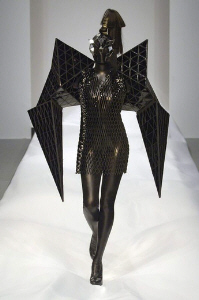
Faces, Burquas and Decolletage

There’s a bill in France proposing that “no one can wear a garment intended to hide the face in the public space”.

Unless it’s a fashion show, I guess:

Acceptable French face covering

The good folks over at Mercator.net ask if what’s going on really has to do the dignity of women as persons:

[I]t is difficult to escape the impression that the real issue at stake for the French is not the oppression of Muslim women but the visibility of Muslim culture and the way it challenges feminist and secularist assumptions.

Those assumptions also produce blind spots when it comes to the dignity of women. A person who takes that dignity seriously is more likely to be offended by the dress sense of the crowd rather than of an isolated Muslim in a burqa, for the typical European/American/Australian woman today also goes about with something that obscures her face: the exposed breast cleavage just below it.

As western women cling to fashions that aim to reveal everything about the body, they too are depersonalised. The stranger’s eye is not drawn to the face where they might encounter the person, but to the body as a sexual object. And this leads also to oppression, even if the woman, just like the one in the burqa, does not understand that she is oppressed.

Oppressed or not, Muslim women are fighting back. Some who wear the face veil told a group of reporters in France this week that they would not obey the ban (which is expected to come into force next year) and they would not leave the country. They say it is tantamount to denying freedom to practice one’s religion. They talked about having recourse to the European Court of Human Rights if arrested.

As for their dignity, they say it cannot be dictated by the state. The secularism of the state should guarantee religious freedom, they argue. Also, they ask, if the French are such feminists, why do women make up less than 20 per cent of the 577 members of the National Assembly, the lower house of parliament?

Good points, ladies. But the truth that human dignity is not defined by decrees of the state does not mean it is defined by the customs of any particular group, either. For all that some women embrace it willingly, there is something very undignified about hiding the face. The dignity of a woman is the dignity of a person, and the face veil suggests, quite simply, that the wearer is not a person — for her husband and children, maybe, but not for you and me.

This is a sad state of affairs but not one that governments can solve with bans. If anything, these will provoke resentment among Muslims at large and rebellion among the young (watch for more veils appearing, not less). As Muslim leaders themselves say, the answer lies with the education and empowerment of Muslim women.

What would help a lot is a decision by European women to dress and conduct themselves in a style consistent with feminine dignity. Half-bared bosoms and burqa rage are definitely not the way to persuade our Muslim sisters to give up the veil.

Despite all our surface feminism, we really don’t treat women with dignity.

(But do we treat men with dignity, either?)

Globalization + the Pill = Culture Wars

A very interesting post at FPR clued me in to a Jonathan Rauch article in National Journal, which in turn discusses a new book that essentially publishes a Grand Unification Theory of the origins of “Red” and “Blue” America.

I hesitate to summarize. Read either the Front Porch Republic piece or Rauch’s for a summary instead.

What this leaves me with is a couple of intuitions, none of which I’m remotely prepared to defend to the death:

  1. I have taken some solace that “Red America” is growing demographically while “Blue America” is at NPG. This new theory makes me think that teeming Red America will continue to work for Blue America and will continue to be relatively ineffectual in carrying out any red agenda.
  2. Any red agenda is already in trouble. Red America, relatively speaking, tramples on the values they profess and which, in their pulpits, they literally preach. Why? They’re spitting into a very, very strong headwind of sexuality and lower wages, and their early marriages, plus the newish necessity of both parents working, make musical beds a far more popular game in Red American than in Blue.
  3. What happens when the Trillion Dollar Ponzi Scheme collapses? Red America knows more about the practical arts like gardening, homebuilding, etc. than Blue America knows. Will Blue America be picking Red America’s asparagus in a few Springs?


In the works

I have several things going right now that are either time-consuming or interesting.

I’m reading David Bentley Hart’s book “Atheist Delusions,” which is, it seems to me, not just a deserved mocking of the inadequacies of the famous “New Atheist” authors, but a robust defense of the legacy of Christianity which, Hart would wager, none of the New Atheists would care to give up. It seems that Nietzche is just about the only atheist Hart takes seriously, because Nietzche alone dared savage Christianity for what it really is, while today’s pantywaists set up straw men, betraying either their dishonesty or their ignorance.

Not unrelated, but not by design either, I’m planning to re-listen to, and to outline, two Ancient Faith Radio “Illumined Heart” podcasts on “Living in the ruins of Christendom” that I essentially overlooked last fall when they came out. The blog post on them is begun, but not ready for prime time.

Plus ça change, plus c’est la même

Plus ça change, plus c’est la même. There’s no doubt in my mind that the Catholic Church gets extra scrutiny because it’s not 100% cool with modern prejudices and vices.

The Orthodox Church will get the same treatment as we grow and become better known. Orthodoxen: get used to it.

Yes, I just “compared” today’s sexual revolutionaries — i.e., about 90% now (or so it seems sometimes) — to Nazis, if you’re looking for merde to throw. No, I don’t think sexual revolution is Nazi or Nazi-inspired.