Sunday, 11/5/23

Blind spot

Like Billy Graham, [Francis Schaeffer] took American capitalism as a given and never thought about how it might be contributing to the secularization of the country.

Frances FitzGerald, The Evangelicals

Ecumenical Councils

In the century from 1123 to 1215, it was popes who called together synods of bishops that were thereby declared ecumenical. And they did so with the principal goal of reforming the Church. Historically, ecumenical councils had been called to address great heresies, such as Arianism, Nestorianism, or iconoclasm. Not so those designated ecumenical by the reform papacy. In less than one century, no fewer than four such councils were called at the papal headquarters at the Lateran Palace.

John Strickland, The Age of Division

Miracles you won’t see on TV

I shared a meal this week with some Orthodox friends. One had just returned from Thessaloniki, Greece, where he visited a parish where a newborn baby who had been pronounced dead was given a kind of baptism ritual, even though he was not alive. The child was born on the feast of St. Demetrios, the early fourth-century patron of the city. When the priest baptized him “Demetrios,” they all heard a sharp intake of breath, and the baby began to cry. This just happened.

[J]ust as the prayers of St. Demetrios raised a baby from the dead the other day, none of us know what God has in mind for us if we choose to turn away from our corruption and to Him. At that same meal with the Orthodox guys, another told a story about an American Orthodox priest of his acquaintance who was serving liturgy when an elderly man dropped dead. He rushed over to him to try to help, but it was too late. He was quite dead. Paramedics were called. The priest anointed the dead man with holy oil … and he woke up. It was a miracle. We need a miracle like that.

Rod Dreher

That hits home as I was in Thessaloniki, in Church named for St. Demetrios, within the past two weeks.

(I heard a more coherent version of the first story, no less miraculous, from another source, but I’m too lazy to transcribe that podcast account. I believe the accounts. Help, O Lord, my unbelief.)

Historic Christianity, Reformational Christianity, Evangelicalism

Catholicism had, by this time, reoriented my theological concerns around the concerns of the Church catholic. My assumptions, and the issues that animated me, were those of the Church of history. My evangelical upbringing had led me to believe that Protestantism entailed the rejection of these concerns. But this notion exploded upon contact with the Protestantism of history.

Onsi A. Kamel, Catholicism Made Me Protestant, H/T Rod Dreher. I’m not sure how I missed this four years ago; it’s quite good. The key, though, is that Evangelicalism, as Kamel experienced it, didn’t even seem to ask the right questions.

I recommend this review of In Search of Ancient Roots as a companion to the Kamel essay.

One of my favorite prayers

Bless my enemies, O Lord. Even I bless them and do not curse them.
Enemies have driven me into Your embrace more than friends have. Friends have bound me to earth, enemies have loosed me from earth and have demolished all my aspirations in the world.
Enemies have made me a stranger in worldly realms and an extraneous inhabitant of the world. Just as a hunted animal finds safer shelter than an unhunted animal, so have I, persecuted by enemies, found the safest sanctuary, having ensconced myself beneath Your tabernacle, where neither friends nor enemies can slay my soul. Bless my enemies, O Lord. Even I bless them and do not curse them.
They, rather than I, have confessed my sins before the world.
They have flagellated me, whenever I have hesitated to flagellate myself.
They have tormented me, whenever I have tried to flee torments.
They have scolded me, whenever I have flattered myself.
They have spat upon me, whenever I have filled myself with arrogance.
Bless my enemies, O Lord. Even I bless them and do not curse them.
Whenever I have made myself wise, they have called me foolish.
Whenever I have made myself mighty, they have mocked me as though I were a dwarf.
Whenever I have wanted to lead people, they have shoved me into the background.
Whenever I have rushed to enrich myself, they have prevented me with an iron hand.
Whenever I thought that I would sleep peacefully, they have wakened me from sleep.
Whenever I have tried to build a home for a long and tranquil life, they have demolished it and driven me out.
Truly, enemies have cut me loose from the world and have stretched out my hands to the hem of Your garment.
Bless my enemies, O Lord. Even I bless them and do not curse them.
Bless them and multiply them; multiply them and make them even more bitterly against me –
so that my fleeing to You may have no return; so that all hope in men may be scattered like cobwebs; so that absolute serenity may begin to reign in my soul; so that my heart may become the grave of my two evils twins: arrogance and anger;
so that I might amass all my treasure in heaven;
ah, so that I may for once be freed from self-deception, which is entangled me in the dreadful web of illusory life.
Enemies have taught me to know – what hardly anyone knows – that a person has no enemies in the world except himself.
One hates his enemies only when he fails to realize that they are not enemies, but cruel friends.
It is truly difficult for me to say who has done me more good and who has done me more evil in the world: friends or enemies.
Therefore bless, O Lord, both my friends and my enemies.
A slave curses enemies, for he does not understand. But a son blesses them, for he understands.
For a son knows that his enemies cannot touch his life.
Therefore he freely steps among them and prays to God for them.
Bless my enemies, O Lord. Even I bless them and do not curse them.

St. Nikolai Velimirovich, Prayers by the Lake

Where to begin an answer …?


A fundamental reality of human existence is that vice often leaves virtue with few good options. Evil men can attach catastrophic risks to virtually any course of action, however admirable.

David French

You can read most of my more impromptu stuff here (cathartic venting) and here (the only social medium I frequent, because people there are quirky, pleasant and real). Both should work in your RSS aggregator, like Feedly or Reeder, should you want to make a habit of it.

Sunday, 9/3/23

Three ways

Buddy Jesus

“We have effectively communicated to young people that sincerely following Jesus is synonymous with being ‘fired up’ for Jesus, with being excited for Jesus, as if discipleship were synonymous with fostering an exuberant, perky, cheerful, hurray-for-Jesus disposition like what we might find in the glee club or at a pep rally,” Smith wrote. “For those young people who are either scared or suspicious of happy-clappy versions of youth group Christianity, ancient Christian disciplines and historic Christian worship can be received as a life-giving gift. When you have only seen forms of piety that value spontaneous expression and clichéd sincerity, to be given the cadences and rhythms of the Book of Common Prayer can be like receiving the gift of tongues.”

Jon Ward, Testimony, quoting James K.A. Smith, You Are What You Love

For some reason, this way of being Christian never appealed to me, though it was in many ways my millieu for a long time in my formative years. I never took the Book of Common Prayer (Episcopalian/Anglican) route, but took a twenty-some-year detour through a Calvinism that, God be thanked, wasn’t very friendly to the second option:

The Hate Option

I’d never heard of the book The Boniface Option, and with any luck I’ll never hear of it again. Its premise (mediated to me by the reviewer) seems to be that following Jesus is synonymous with being pissed off at all the bad people and ideas around us.

But Rod Dreher fears it will fall into the hands of angry, Christianish young men who’ll take it as gospel. He also knows, from his own life experience and continuing propensities, how dangerous it is:

The Boniface Option is a strange book. I’d say eighty percent of it already appeared in The Benedict Option (I’m certainly not accusing author Andrew Isker of plagiarism; I’m simply saying that the ideas are not new). But this book is just over half as long, and the ideas have been re-imagined here as pugnacious and resentful. If you had ever wondered how The Benedict Option would have been if its author were a late-millennial Calvinist Memelord Of Moscow, Idaho, well, now you have your answer.

[I]f you aren’t angry at what this world has become, you aren’t paying attention. Who can live on that, though? Who should want to live on it? I’ve noticed over the years, watching how disciples of Douglas Wilson operate rhetorically, that they typically lead with a quarrelsome overstatement, and take strong negative reaction to it as a sign that they’ve really hit the mark with their criticism. Sometime that’s true, I suppose, but more often than not, it’s because they have been nasty for the sake of being nasty, or petulant because they think that shows strength. I once knew a nice young man who had been trained by Wilson, who leaned into being verbally obnoxious in public discussions, because he genuinely believed this was how one advanced the Kingdom. He truly thought that this was manly. He ended up mostly making people feel sorry for him, if they didn’t outright dislike him for what they took to be his arrogance.

Another Protestant pastor, of an earlier generation, wrote:

There’s another reason why you should love your enemies, and that is because hate distorts the personality of the hater. We usually think of what hate does for the individual hated or the individuals hated or the groups hated. But it is even more tragic, it is even more ruinous and injurious to the individual who hates…. For the person who hates, the true becomes false and the false becomes true. That’s what hate does.

Those are the words of Martin Luther King, Jr., commenting on the command of Our Lord to love those who hate us, and to pray for those who persecute us.

As a conservative Catholic in 2002, I took the Boniface Option in tearing into the corrupt clerics, rotten institutions, and hideous complacency in the Catholic Church, as revealed by the abuse scandal. I hated half-measures, and scorned fellow Catholics who hemmed and hawed about how it wasn’t as bad as all that. And you know what? To this day, seventeen years after I burned out and lost my Catholic faith, I believe I was far more right than wrong. Many of those people really were cowards. Some of those who encouraged me from behind to keep flailing away with my axe against the crooks and the cretins in the Church, while taking no risks themselves to do the same, were also among the first to criticize me when, spiritually exhausted, my faith collapsed.

My error was thinking I was strong enough to take down a tree as formidable as the evil one that had grown within the garden of the Catholic Church. I believed then that the only brave option was taking on the idol with the axe that was my pen, and chopping like a berserker. I lacked prudence, but more to the point, I did not have the internal spiritual resources necessary to see me through the fight. You readers know my story about how Father Tom Doyle warned me early on that I would be going to places darker than I could imagine, and that I would need to be ready for it. He was right — and I wasn’t ready.

This is the risk that Isker and his followers face.

Rod Dreher.

This is the sort of Christianity that says “Yeah, yeah, yeah! ‘Turn the other cheek.’ Look at what that‘s got us!”

Bible Jesus Option

Bruce Cockburn was once an angry young man, but age may be softening him:

The just, the merciful, the cruel
The stumbling well-intentioned fool
The deft, the oaf, the witless pawn
The golden one life smiles upon
The squalling infant in mid-squall
The neighbors fighting down the hall
The list is long – as I recall
Our orders said to love them all

The cynic and the crooked priest
The woman wise, the sullen beast
The enemy outside the gate
The friend who leaves it all to fate
The drunk who tags the bathroom stall
The proud boy headed to his fall,
The list is long – as I recall
Our orders said to love them all

The pastor preaching shades of hate
The self-inflating head of state
The black and blue, the starved for bread
The dread, the red, the better dead
The sweet, the vile, the small, the tall
The one who rises to the call
The list is long – as I recall
Our orders said to love them all

The one who lets his demons win
The one we think we’re better than
A challenge great – as I recall
Our orders said to love them all

Orders, from Bruce Cockburn’s recent album O Sun O Moon

What secularism rejects

A modern secularist quite often accepts the idea of God. What, however, he emphatically negates is precisely the sacramentality of man and world.

Alexander Schmemann, For the Life of the World

Hypocrisy

Then, throughout the entirety of Matthew 23, Jesus launched into a series of “Woes” and denunciations. He explained to one and all and to the Scribes and Pharisees to their face exactly why they were unable to understand the Kingdom, why they couldn’t recognize the Truth of it even though that Truth was standing and speaking and miraculously working right in front of them, just like He did with the Roman procurator in John 18.37, although Pilate was probably much more amenable.

The problem was simply hypocrisy. In the New Testament, hypocrisy is not inconsistency. That is a modern misunderstanding of the term.

Hypocrisy, rather, is existential schizophrenia. There is an exterior claim of piety, religiosity, and a prideful (but false) confidence of knowing the Kingdom. But on the inside, it’s all lies. There is a complete failure to love. There is a putrid cesspool of avarice and lust, pride and anger. And there is a demonic willingness to engage in domination, power, and violence, an enthusiasm for putting people in bondage and daring, horribly, to dress up their wickedness in religious clothing.

Second Terrace: the last judgment and the problem of goathood

Taking stock

I was (am?) a culture warring evangelical. But, like so many, I’ve seen what that has gotten us. And I’ve seen what we’ve lost, too. So as much as I still very much identify as evangelical and want to recover whatever in it that is good, I also lament what we have gotten wrong.

Karen Swallow Prior

When progress isn’t really progress

That was then, …

Pope Leo III ordered his northern allies and erstwhile protectors to desist immediately from using the filioque in the Creed. The fact that they had been doing so for generations, he observed, was irrelevant insofar as it was a violation of universal church order. Then, to teach the Franks a lesson and make his continued allegiance to the Byzantine East clear, the very pope who had crowned Charlemagne in Saint Peter’s Basilica commissioned an elaborate pair of silver shields to be forged. He ordered engraved upon their faces—in Latin and in Greek—the Nicene Creed without the filioque. Leo then had these “shields of faith” mounted inside Saint Peter’s Basilica, the most prominent church in Rome, on the tomb of the Apostle Peter—the most prominent place in that church ….

John Strickland, The Age of Paradise.

I believe the silver shields are still there, but the Western Church continues to violate universal church order by reciting the creed with the filioque.

Anselm’s atonement

The broad acceptance of Anselm’s logic speaks to the extreme legalism and the radical departure from apostolic Tradition that had developed in the medieval West. It is ironic that Anselm’s conclusion was so readily accepted in the West. The Catholic Church affirms the development of doctrine and holds that medieval and scholastic theologians understood the faith and expressed its concepts in a manner superior to that of the Fathers. And yet Anselm’s theology is crude, faulty, shallow, simplistic, and manifestly inferior to the understanding of salvation among the Church Fathers. It can hardly be considered superior to or an improvement on their work.

Dr. Eugenia Scarvelis Constantinou, Thinking Orthodox. I’m pretty sure that she had Anselm of Canterbury’s Cur Deus Homo in mind.

Chastity

And what about chastity? It’s a basic truth of Christian discipleship. And it does not mean, “Sorry, no sex for you.” Rather, God asks us to live our sexuality virtuously according to our calling. For some this means celibacy, setting aside marriage for love of the larger family of the Church and a different form of fertility in service. For most people, though, in most times, it means sexual intimacy within marriage.

Charles J. Chaput, Strangers in a Strange Land (italics added)


A fundamental reality of human existence is that vice often leaves virtue with few good options. Evil men can attach catastrophic risks to virtually any course of action, however admirable.

David French

You can read most of my more impromptu stuff here (cathartic venting) and here (the only social medium I frequent, because people there are quirky, pleasant and real). Both should work in your RSS aggregator, like Feedly or Reeder, should you want to make a habit of it.

Sunday, 7/16/23

Imagine there’s no Rapture …

Orthodox Holy Tradition says clearly that the Second Coming, the General Resurrection, and the Last Judgment are three facets of one single, overwhelming event. There is no divide (which is the meaning of the heresy of chiliasm, which was rejected in the Second Ecumenical Council, and the reason why we say “and His Kingdom shall have no end” in the Creed). There is no Rapture. There is no Seven Year Tribulation. There is no single human individual who is the Antichrist or the Beast — the Antichrist is not a Jew, not a Muslim, not a Communist, nor is he the Pope or any one of the many theories that have been published over the centuries.

There is no literal thousand-year-long Millennium. There is no reappearance of Satan setting off the last Armageddon.

There will indeed come the Great Universal Transfiguration that overwhelms time and space and all Creation.

This is the Kingdom if its infinite, almost terrifying fullness and glory.

Fr. Jonathan Tobias, the last judgment and the problem of goathood

This I believe.

I will not say that the Orthodox Church is the only church that rejects all the rapture crap, because I don’t believe it is. But it’s also true that not every church that rejects all the rapture crap still believes in the Second Coming, the General Resurrection, and the Last Judgment. That kind of narrows things down a lot.

A periodic reminder

I’ve no doubt posted this quote before:

The shift from church power to state power is not the victory of peaceable reason over irrational religious violence. The more we tell ourselves it is, the more we are capable of ignoring the violence we do in the name of reason and freedom.

William T. Cavanaugh, The Myth of Religious Violence

Liturgy

In a culture that values spontaneity, liturgy grounds us in something enduring. In a culture that assumes truth is a product of the mind, liturgy helps us experience truth in mind, body, and spirit.

Book blurb for Mark Galli’s Beyond Smells and Bells: The Wonder and Power of Christian Liturgy

Modern worship

On a related note:

[A]ny attempt to “modernise” liturgy in terms of making it more acceptable to modern society (i.e. “pastoral respectability”) should be undertaken with extreme caution; the warning of Charles Davis is paramount here:

My thesis is that there is no modern form of worship, because worship itself is outdated in the modern world and Christian Faith a state of deviancy from contemporary culture.

Bryan D. Spinks, “Christian Worship or Cultural Incantations?”, Studia Liturgical, vol. 12 (1977), 1, 12-13 (quoting Charles Davis, “Ghetto or Desert: Liturgy in a Cultural Dilemma” in Worship and Secularization (1970), pp. 10-27, p. 12).

Thanks to @letters on micro.blog who appears to read such things voraciously.

The teleological void

My college students have worked hard getting impressive credentials since at least middle school and will continue to do so long after college. When I ask them where this is all going, they are befuddled. “This is just what you do,” they often answer. Anything else is impractical, unrealistic, and useless. They have been going their whole lives without asking or being asked “where to?” Asking such a question means stopping, thinking, and perhaps changing direction, all things that religion and humanities have us do. But our society has no interest in silence or pausing.

Terence Sweeney, Why Religion and the Humanities Are in Decline

The evangelical soul

This baffling essay proves that although Mere Orthodoxy is consistently good, it’s not unvaryingly good. The author lost me at the construct “the evangelical soul.”

(Mere Orthodoxy, by the way and once again, is not a Orthodox website; it is a Reformed-leaning Protestant website that considers itself orthodox and “leans young.” It’s usually pretty good; I don’t subscribe to anything for the sole purpose of dissing it.)

What if?

Our professor asked a hypothetical question: “If the bones of Jesus were discovered, and if there were some way to absolutely confirm that they were the bones of Jesus, would you still be a Christian?”
Every other member of the class confirmed that he or she would remain a Christian, making statements such as “I would not lose my faith,” or “Jesus was a great teacher and philosopher.”

I was dumbfounded and utterly dismayed. How was it possible that such intelligent, committed, and educated Catholics could give such responses? Did they not realize the fundamental importance of the Resurrection of Christ? If not, why not? My response was, “If the bones of Jesus were discovered, I would be outta here! I would no longer be a Christian!” I explained that the Resurrection is an absolute necessity to the Christian faith. The class listened politely, but no one seemed at all impressed or influenced by my answer.

Dr. Eugenia Scarvelis Constantinou, Thinking Orthodox


We are in the grip of a grim, despairing rebellion against reality that imagines itself to be the engine of moral progress.

R.R. Reno

The end of the world as we know it is not the end of the world.

You can read most of my more impromptu stuff here (cathartic venting) and here (the only social medium I frequent, because people there are quirky, pleasant and real). Both should work in your RSS aggregator, like Feedly or Reeder, should you want to make a habit of it. I’m even playing around a bit here, but uncertain whether I’ll persist.

Repose of St. Alexis Toth

Today we mark the repose of Alexis Toth, my parish’s Patron Saint.

He’s not a “nice” saint. He wasn’t very ecumenical.

When Archbishop John Ireland, an Americanizer of the Latin Church, forbade him, contrary to Canon Law, to observe the Eastern Rite, he returned to Orthodoxy (he had been a Uniate) and eventually brought tens of thousands of Uniates out of the Latin Church back into Orthodoxy. He thought it mattered more than potayto/potahto.

Many of those people were, like him, from Carpatho Rus, which makes him a dandy Patron in my diocese.

***

Since many smart high-churchmen don’t talk much about it, I’m perhaps off-base in thinking the lex orandi, lex credendi (“a motto in Christian tradition, which means that prayer and belief are integral to each other and that liturgy is not distinct from theology”) is a key to getting people off the idiotic idea that worship is just a neutral “container” for the “content” of the Gospel.

That is an idiotic idea professed by some very smart people, but this is one instance when I’m confident that they’re wrong, I’m right.

And there are some smart Protestants flirting with ideas rather like mine:

If I worship in order to show God how much I love him, I might start to feel hypocritical if I just keep doing the same thing over and over and over again. My expression will start to feel less “authentic.” And so we need to find new ways to worship, new ways to show our devotion, fresh new forms to express our praise. Novelty is how we try to maintain the fresh sincerity of worship that is fundamentally understood as expression. With the best of intentions, this “expressive” paradigm is then allied to a questionable distinction between the form of worship and the content of the gospel. The concrete shape and practices of Christian worship, passed down through the centuries, are considered merely optional forms—or even whited sepulchers of dead ritual—that can and should be discarded in order to communicate the gospel “message” in ways that are contemporary, attractive, and relevant. So we remake the church in order to “speak to” contemporary culture.

Rather than the daunting, spooky ambience of the Gothic cathedral, we invite people to worship in the ethos of the coffee shop, the concert, or the mall. Confident in the form/content distinction, we believe we can distill the gospel content and embed it in these new forms, since the various practices are effectively neutral: just temporal containers for an eternal message.

James K.A. Smith, You Are What You Love: The Spiritual Power of Habit

A preliminary question

In his important book After Virtue, Alasdair MacIntyre famously says, “I cannot answer the question, ‘What ought I to do?’ unless I first answer the question, ‘Of which story am I a part?’”

James K.A. Smith, You Are What You Love: The Spiritual Power of Habit

When sola scriptura was impossible

The early Church had no Scripture of its own, and the Jews had no defined canon of Scripture; therefore, sola scriptura as the foundation for what Christians believed was absolutely impossible.

Eugenia Scarvelis Constantinou, Thinking Orthodox: Understanding and Acquiring the Orthodox Christian Mind

Book note

The idea that religion has a dangerous tendency to promote violence is part of the conventional wisdom of Western societies, and it underlies many of our institutions and policies, from limits on the public role of religion to efforts to promote liberal democracy in the Middle East. William T. Cavanaugh challenges this conventional wisdom by examining how the twin categories of religion and the secular are constructed. A growing body of scholarly work explores how the category ‘religion’ has been constructed in the modern West and in colonial contexts according to specific configurations of political power. Cavanaugh draws on this scholarship to examine how timeless and transcultural categories of ‘religion and ‘the secular’ are used in arguments that religion causes violence. He argues three points: 1) There is no transhistorical and transcultural essence of religion. What counts as religious or secular in any given context is a function of political configurations of power; 2) Such a transhistorical and transcultural concept of religion as non-rational and prone to violence is one of the foundational legitimating myths of Western society; 3) This myth can be and is used to legitimate neo-colonial violence against non-Western others, particularly the Muslim world.

Booknote on William T. Cavanaugh’s The Myth of Religious Violence. I am not the author of that note, by the way.

I have quoted from this book very often, but just this week realized that Cavanaugh penned another book with a title that has long intrigued me: Migrations of the Holy.

I’m reading Migrations of the Holy now, concurrently with the Aenid (a coincidence, not a study plan). And I can vouch for the readability of the highly-praised Fagles translation of the Aenid.

Sad but true

Many cradle Orthodox Christians unfortunately do not realize that they have remained infants in the faith in spite of spending a lifetime as Orthodox Christians. They have no greater understanding or experience of God nor any deeper faith than they had as children, because for them Orthodoxy has been reduced to a series of practices or obligations rather than embraced as a complete life in Christ animated by the Holy Spirit.

Eugenia Scarvelis Constantinou, Thinking Orthodox: Understanding and Acquiring the Orthodox Christian Mind

I know from personal experience, however, that the decisionalist model of salvation prevalent in Evangelicalism produces its own kind of forever-infancy:

We might term Finney’s understanding of regeneration as “decisionalism.” And I would argue that much of what we see today in evangelicalism is a rehash of Charles Finneyism. Since all that separates God and man is a “decision” for Christ, all sorts of emotive and, in some cases, even manipulative means may be employed in order to push the sinner over the edge to choose Jesus. It is not the removal of a stone heart one needs but only the prompting of influential argumentation. Thus, it is a misunderstanding and underemphasis of this doctrine of regeneration that has contributed to the unraveling of evangelicalism in the 21st century.

The problem with decisionalism, which continues to be preached a lot today, is not only is it unbiblical and ultimately sets the grace of God aside as something not ultimately efficacious, but it also results in all sorts of tomfoolery in order to get a person to make a decision for Christ.

Amen to that!

New Apostolic Reformation, the muse behind the Jericho March

You can’t simply call most of these folks evangelicals. It’s absolutely crucial that most of these people are charismatic evangelicals. There’s roughly 76 million evangelicals of this kind in the United States, if you take 23% of 33 (sic) million people. There’s an equal amount of Pentecostal/charismatics because the latter include charismatic Catholics, which the former does not.

Julia Duin, Jericho March in DC: Coming-Out Party for a Movement Journalists Haven’t Really Covered

A cyber-friend wrote the other day:

I’m much more worried about FOX News coming for my relatives than LGBTQ people coming for my kids.

@JoshuaPSteele on micro.blog

I appreciated the vividness of that, but after four days of fermentation, I’m pretty sure I’m more afraid of the New Apostolic Reformation cult than I am of FOX news. NAR was the muse of the mad Jericho March preceding the January 6 insurrection, and its adherents have willed themselves into blind credulity toward their “apostles” and “prophets.”


For all its piety and fervor, today’s United States needs to be recognized for what it really is: not a Christian country, but a nation of heretics.

Ross Douthat, Bad Religion

You can read most of my more impromptu stuff here (cathartic venting) and here (the only social medium I frequent, because people there are quirky, pleasant and real). Both should work in your RSS aggregator, like Feedly or Reeder, should you want to make a habit of it.

Sunday, 4/16/23

It’s Pascha (Easter) in Orthodoxy. Our Vigil was wonderful, but you had to be there to enjoy it, so I’ll not say any more.

Latins vs. Greeks

  • Two centuries later, fundamental differences in phronema [mindset] would again be an obstacle to union between the West and the East at the Council of Florence in 1439. Catholics presented rational arguments for their positions, and the Orthodox responded by citing apostolic Tradition. It was “the constant conviction of the Latins that they always won the disputation, and of the Greeks that no Latin argument ever touched the heart of the problem.”
  • Orthodoxy theology defines only what is necessary and always leaves unspoken that which cannot be explained. This approach was part of the Christian faith from the beginning. But the Western phronema often suppresses, dismisses, minimizes, or ignores this stance. The Western mind is compelled to define and explain everything, since without a rational explanation a concept or fact cannot be considered true, or, conversely, all truth can be proven rationally.

Eugenia Scarvelis Constantinou, Thinking Orthodox: Understanding and Acquiring the Orthodox Christian Mind

Ireland vs. America

Ireland is a palimpsest, a manuscript scraped imperfectly clean and reused, the old text bleeding through the new. A landscape with a long memory. As an American, I grieve the mnemonic emptiness of the New World. I long for ruins.

Justin Lee, Rewilding American Christianity

What the wrath of God looks like

I was nurtured on stories as a child that contrasted Christ’s “non-judging” (“Jesus, meek and mild”) with Christ the coming Judge (at His dread Second Coming). I was told that His second coming would be very unlike His first. There was a sense that Jesus, meek and mild, was something of a pretender, revealing His true and eternal character only later as the avenging Judge.

This, of course, is both distortion and heresy. The judgment of God is revealed in Holy Week. The crucified Christ is the fullness of the revelation of God. There is no further revelation to be made known, no unveiling of a wrath to come. The crucified Christ is what the wrath of God looks like.

Fr. Stephen Freeman, The Bridegroom and Judgment

This rings very true, although in my case “nurtured” refers mostly to my Christian high school and 2.5 years of Christian colleges. I do not recall my parents nurturing such a view.

But in your pondering whether you, too, were so nurtured, don’t fail to ponder the second paragraph.

Conservative Christian Europeans

The European experiment with trying to keep the Church alive amid dechristianization by making it more like the world has been a decisive failure. Christianity has to be different, and not be ashamed of that difference. In my European travels, the believers with whom I have spent time would be counted as conservative in moral and theological terms, but that, of course, does not track neatly with political conservatism.

Rod Dreher, Reconciling With The Really Real

Wild Christianity

“Wild Christianity” seems to have achieved almost (shudder!) même status, and predictably if being used in conflicting senses. But here’s a notable observer:

I have read an obscenely large number of articles and books on the decline of Christendom and the West, and even rushed in to write one myself, where angels fear to tread. But I have read absolutely nothing as close to the bull’s eye and as far from the bull’s opposite end as “A Wild Christianity” by Paul Kingsnorth, who, being a true poet, is not merely a singer but also a seer. Thank you, Gandalf.

Peter Kreeft, Boston College

I don’t disagree with Kreeft, who I have admired for more than 50 years. Read the worthy Kingnorth article.

Souls

[O]nce I was at an academic conference in Balamand, Lebanon, and I got a message that the Patriarch of Antioch, Ignatios IV at that time, wanted to meet me and another young theologian, who was from Greece, privately. What could this be about? We were ushered into a private drawing room, stood as His Beatitude entered, came forward to kiss his hand, and then sat down after he did. Well, he looks at us, and in perfect English exclaims, “The problem with you Greeks is that you are all dualists! Even a rock has a soul!!!” And that was it. He’d spoken his peace, he got up and left, and we were ushered back out.

‘Beauty First’ With Timothy Patitsas

Spiritual success

For those not fitting the NAR emotional profile (see below), there’s another option.

I have wondered how the “success” of the spiritual life would be measured? I could imagine that the number of persons baptized might be compared to the number of the baptized who fall short of salvation—but there is no way to discover such a thing. In lieu of that, we often set up our own way of measuring—some expectation of “success” that we use to judge the spiritual life. “I tried Christianity,” the now self-described agnostic relates, “and found that it did not live up to its claims.” [Laughter] I’ve seen things like that.

To my mind, the entire question is a little like complaining about your hammer because it doesn’t work well as a screw-driver. The problem is that the spiritual life doesn’t “work,” and it was never supposed to. It is not something that “works”; it is something that “lives.” And this is an extremely important distinction.

Fr. Stephen Freeman, The Slow Road to Heaven

It occurred to me within the last week or two that there’s at least one thing in America that’s immeasurably better than my childhood and adolescent status quo: there are Orthodox Christian Churches all over the place, and Orthodoxy has become a live option for Christians in other traditions they’re finding empty.

The Slow Road to Heaven

  • Despite every atheist protestation, religion abides – and if there is not one that is inherited, then a culture will invent new ones.
  • Power is an ever-present temptation in this world. It offers the notion that we can, by force (of arms or law), achieve our desired ends. That was true under emperors and tsars, and remains true within modern democracies. When Pilate questioned Jesus regarding the nature of His kingdom, Christ was very clear that His kingdom “is not of this world.” He adds that were His kingdom of this world – then His disciples would arm themselves and fight. That many Christians through the ages have imagined armed struggle to be an important element of the Christian life is a testament to our confidence in the weapons of this world and our lip-service to the Kingdom of God.
  • The crucified life is seen most clearly when it stands out against a background of worldliness.

Fr. Stephen Freeman, The Slow Road to Heaven

Safety check

“People aren’t asking whether Christianity is true, Abe. They aren’t even asking if it is good. My friends are wondering if Christianity is even safe.”

Jake Meador, quoting a friend of Abe Cho

I too readily accepted Cho’s quote as a valid indictment of (much) American Christianity. Meador does some helpful disambiguation of “safe.”

False mysticism

There’s a hymn that they used to sing at my childhood church that goes, “Turn your eyes upon Jesus, look full in his wonderful face, and the things of earth will grow strangely dim in the light of his glory and grace.” I get the point it’s trying to make: that encountering true hope, beauty and holiness puts pettier things in perspective. Still, my experience of faith is nearly the opposite of what the hymn describes. The more I have tried to seek God — the more I reach for truth, beauty and mystery that I know exceeds my grasp — the more bright, vivid and vital the things of earth become.

Tish Harrison Warren

New Apostolic Reformation

I usually park this provocative quote in the ending material of my blogs:

For all its piety and fervor, today’s United States needs to be recognized for what it really is: not a Christian country, but a nation of heretics.

Ross Douthat, Bad Religion

I had that point driven home powerfully in the last week, for I somehow stumbled upon an intriguing series within a podcast I almost certainly would never have visited otherwise.

The series was on the New Apostolic Reformation (NAR), about which I knew only three things fairly firmly:

  1. It emerged during my middle-age years.
  2. A formerly mainstream evangelical, C. Peter Wagner, who has been obsessed with “church growth” as long as I’ve known of him, was a prominent proponent.
  3. NAR believes it has Apostles leading the Church.

I now know much, much more, and it ain’t pretty.

The podcast was named “Straight White American Jesus.” With a title like that, it’s not the sort of place I frequent, just as I don’t dumpster-dive for my food. But despite the semiotics of that name, the podcast series, titled “Charismatic Revival Fury,” was delivered soberly and in scholarly fashion until the presenter got worked up for a while at the hypocrisy of NAR “Apostles” and “Prophets” backpedaling from the January 6 rioters, so many of whom they had inspired and whipped into frenzy. These were the rioters who apparently considered themselves Christian but who fit no pigeon-hole I knew — because their pigeon-hole was NAR.

I now realize that the NAR novelties have extended quite far, perhaps because C. Peter Wagner, even before his NAR days, would resort to just about anything in the name of “Church growth,” and NAR follows his example, thus keeping things at fever pitch with a stream of new “prophesies” and unchristian promises of political power (dominion).

Overall, the series was focused on the political ramifications of NAR. Usually, I think the press stupidly considers religion merely notional and fundamentally unreal until it eventuates in something political. And there was a bit of that sense here. I don’t think Straight White American Jesus would have been interested in exposing the heresies of NAR apart from its political ramifications. But when I went looking for analysis of NAR’s religious beliefs, the top hits were not from sources I think are reliable.

I’m not prepared to try to make sense of NAR here except that

  • it seems almost designed to be elusive, like nailing jello to the wall; and
  • it seems from the 30,000-foot level like an emotionalistic tradition led by a mixture of narcissistic “Apostles” and “Prophets.”

For all its piety and fervor, today’s United States needs to be recognized for what it really is: not a Christian country, but a nation of heretics.

Ross Douthat, Bad Religion

You can read most of my more impromptu stuff here (cathartic venting) and here (the only social medium I frequent, because people there are quirky, pleasant and real). Both should work in your RSS aggregator, like Feedly or Reeder, should you want to make a habit of it.

Veneration of the Cross, 3/19/23

The sacking of Troy

A scene from Wendell Berry’s Jayber Crow, narrated by the titular character, in which a man gets angry about the then-current protests against the Vietnam War:

One Saturday evening, while Troy was waiting his turn in the chair, the subject was started and Troy said — it was about the third thing said — “They ought to round up every one of them sons of bitches and put them right in front of the damned communists, and then whoever killed who, it would be all to the good.” […]

It was hard to do, but I quit cutting hair and looked at Troy. I said, “Love your enemies, bless them that curse you, do good to them that hate you.”

Troy jerked his head up and widened his eyes at me. “Where did you get that crap?”

I said, “Jesus Christ.”

And Troy said, “Oh.”

It would have been a great moment in the history of Christianity, except that I did not love Troy.

Via Alan Jacobs

Not a bad reminder during Lent. It almost certainly has salience in the political realm of American 2023 as well.

I’ve heard several real-life variations on this anecdote. American Christianity is a mile wide and an inch deep.

Desperate Christians?

My antennae were up at the headline: Five charts that explain the desperate turn to MAGA among conservative white Christians. Any variation on “desperate Christians” tells me I’m reading something sensational or that the “Christians” are adherents of some Christianish ideology rather than sound Christian faith.

… [U]nless I’ve been gravely misinformed, if it throws in for nothing else, surely Christianity is bullish on hope. Americans should take note. Stateside, hope is in short supply.

Liel Leibovitz

Reading the Five Charts article, I was inclined to think the headline was sensationalist more than substantive — a religious variation on “The GOP is all White Christian Nationalists now.”

Rigor, whether you like it or not

Rod Dreher watched The Paper Chase and was smitten by The Majesty Of Professor Kingsfield, whose approach to matters once was spiritually helpful for Rod:

Back in the summer of 1991, when at age 24 I had made a decision to enter the Catholic Church, I went to the university Catholic chapel, thinking — oh, sweet summer child that I was — that a college ministry would offer a more intellectually serious approach to Catholicism. After months of therapeutic, sentimental navel-gazing in which I had been invited over and over to get in touch with my okayness, I left in disgust.

I was sent to an inner-city parish, and there met with old Father Dermot Moloney, an Irishman who dyed his hair shoe-polish black, and who had a Kingsfieldian crust to him. He heard my story, and agreed to instruct me in the faith. He said, in his porridge-thick accent, “By da time I get troo with ye, ye might not want to be a Catlick, but ye’ll know what a Catlick is.” I was so grateful that Father Moloney, gruff though he was, respected the faith, the tradition, and me enough to present it that way.

German Catholicism

Germany already has a Protestant church [and] we don’t need two.

Pope Francis’ remark to Bishop George Bätzing, president of the German Bishops’ Conference, via George Weigel, Apostasy in Germany’s Catholic Church. More from Weigel:

As the Synodal Way, which some in Rome call the “Suicidal Way,” drew the attention of Catholics world-wide, many said that German Catholicism was heading into “schism”—an institutional rupture with Rome. That isn’t quite right. Schisms typically are caused by issues of church order. Thus the Catholic Church believes the Orthodox churches of the Christian East are “schismatic” because they don’t accept the pope’s primacy and universal authority. What is unfolding in Germany is different—akin to the 16th-century Lutheran Reformation: apostasy.

Rome jumps the shark on war and killing

Bernard [of Clairveaux] did not stop with the [Knights] Templar Rule. He went as far as writing a treatise entitled In Praise of the New Knighthood. In it he declared without hesitation that “the knights of Christ may safely do battle in the battles of their Lord, fearing neither the sin of smiting the enemy nor the danger of their own downfall, inasmuch as death for Christ, inflicted or endured, bears no taint of sin, but deserves abundant glory.” Perfectly aligned with the new papal doctrine of indulgences, such a claim encouraged Christians to do what traditional Christianity had always taught them never to do: to kill their enemies, with an assurance that doing so would open to them the kingdom of heaven.

Fr. John Strickland, The Age of Division


For all its piety and fervor, today’s United States needs to be recognized for what it really is: not a Christian country, but a nation of heretics.

Ross Douthat, Bad Religion

You can read most of my more impromptu stuff here (cathartic venting) and here (the only social medium I frequent, because people there are quirky, pleasant and real). Both should work in your RSS aggregator, like Feedly or Reeder, should you want to make a habit of it.

Thursday, 9/8/22

Culture

Bravery

“Many people praised me for my bravery for having done this — to which I could only say: Millions of people do this kind of work every day for their entire lives — haven’t you noticed them?” she said in 2018 in an acceptance speech after receiving the Erasmus Prize, given to a person or institution that has made an exceptional contribution to the humanities, the social sciences or the arts.

From the New York Times obituary for Barbara Ehrenreich, author of Nickel and Dimed: On (Not) Getting By in America. Ehrenreich went “underground,” trying to live on various minimum wage jobs.

I’m sure I read some of her journalistic writing, and even looked forward to the byline as a harbinger of good writing, but I apparently missed how well-regarded she really was.

Conservative academia

Do ten conservative American academics even exist? (Try naming ten outside of Hillsdale College. I’ll go: Harvey Mansfield, Niall Ferguson, Ruth Wisse, Robby George. Struggling to come up with a fifth without Google.) Then again, we wouldn’t know because they are closeted.

Bari Weiss, Dissidents and Doublethinkers in our Democracy

Too stupid for ranked-choice voting?

It seems to me that Damon Linker is arguing “America is too paranoid and too stupid for ranked-choice voting.”

I agree, though, that it’s not likely to prove a panacea.

Todd Rokita does something right for a change

In a stunning development, Indiana Attorney General Todd Rokita has done something necessary and with minimal fanfare:

Nineteen state attorneys general wrote a letter last month to BlackRock CEO Laurence D. Fink. They warned that BlackRock’s environmental, social and governance investment policies appear to involve “rampant violations” of the sole interest rule, a well-established legal principle. The sole interest rule requires investment fiduciaries to act to maximize financial returns, not to promote social or political objectives. Last week Attorneys General Jeff Landry and Todd Rokita of Louisiana and Indiana, respectively, went further. Each issued a letter warning his state pension board that ESG investing is likely a violation of fiduciary duty.

ESG Can’t Square With Fiduciary Duty

I am inclined to think that these (presumably Republican) Attorneys General are “on the wrong side of history.” I think the sole interest rule will fall because it ignores corporate externalities.

Think of it this way: would an institutional investor before the Clean Water Act have been morally justified in avoiding companies that used streams and rivers as a dumping ground for toxic byproducts? But it would have been unlawful under the sole interest rule.

Now draw analogies.

But meanwhile, we don’t elect attorneys general to be on the right side of history. We elect them to enforce the laws as they are.

A question not worth researching

Cable news is for idiots, so I’m not going to subject myself to hours and hours of watching it to evaluate whether the average political positioning of a CNN guest has changed. But I think the circulation of the particular Francesca Chambers clip you cite as supposed evidence of a Trumpy shift at CNN is weaksauce — and boy have I been seeing a lot of apoplectic liberals share it on Twitter. (Jesus, people, will you get a hobby already?)

Chambers, who covers the White House for USA Today, has been a fixture on cable news for years, not just on CNN but also on MSNBC and Fox News. That she made an inane jump to “optics” when asked about Trump bringing the aunt of Timothy Hale-Cusanelli on stage at a Pennsylvania rally — Hale-Cusanelli is the January 6 riot convict who praised Hitler and posed with a Hitler mustache (in order to be “ironic”, he says, of course) — does not say anything about CNN changing. It just reflects that cable news political panel discussions have always consisted of replacement-level-or-lower armchair political strategizing and posturing — there are hours and hours and hours of time to fill, and they have been filled with this crap my entire adult life. (By the way, Sara Fay and I wrote back in January about how to book an actually good political conversation panel, based on our experience at Left, Right & Center.)

Josh Barro

Politics

Metapolitics

The Right denies the reality of events, clueless to its eventual Emperor Has No Clothes moment. The Left, however, seeks to deny the very nature of humanity itself. Both worship at the same altar, but their beliefs are predicated upon differing hermeneutical approaches within the Cult of Progress. The former believes the fantasy of a technological harnessing of apparently limitless resources to produce an ever-expanding material prosperity, all without consequential damage to the society at large. The Left believes in the fantasy of a technological harnessing of the apparently limitless ability to refashion mankind itself, regardless of the demolition of existing societal structures, and again, all without serious consequences. This latter one, while indeed the more extreme, worries me the least, as it is the more difficult case to make—indeed, often farcical in its extremities—and seems likely to eventually collapse in upon itself. The former, however, I consider the more dangerous at this moment in history, as they appear fully ready and prepared to project and maintain their Will to Power. At these times, you cannot go wrong by referencing Shakespeare, “a plague of both your houses.”

Terry Cowan, Grand Delusions, Past and Present

Political promises then and now

It is, of course, true that wars never do half the good which the leaders of the belligerents say they are going to do. Nothing ever does half the good—perhaps nothing ever does half the evil—which is expected of it. And that may be a sound argument for not pitching one’s propaganda too high. But it is no argument against war.

C.S. Lewis, “Why I Am Not a Pacifist” in The Weight of Glory

Our last Conservative President

When I hear politicians promising that we can have it all — particularly that our postwar “happy motoring” can continue forever, only electrified instead of gas-powered — I’m reminded that Jimmy Carter, who urged some voluntary austerity, was our last conservative President.

Election heuristics

Years ago my friend Bill, an Army officer and fellow grad student, hosted our department for a cookout. While everyone was happy to eat his food and drink his beer, most of our colleagues despised Bill’s beliefs. One of them—call her Jane—took Bill’s small children aside, taught them a left-wing chant, then led them, her eyes glittering with hateful glee, on a little protest march through the gathering. Ever since that day, I’ve found voting to be a snap. I simply identify the candidate most likely to embody Jane’s hopes for America, and I vote against that son of a bitch with everything I’ve got.

Tony Woodlief, The American Conservative 2020 Presidential Symposium

That’s a pretty lousy heuristic, but a pretty good story.

Amtrack Joe’s Big Warning

Spare us the pieties while you knee-cap us, please

How can an American president go wrong in identifying threats to democracy? Biden offered a master class.

[I]n describing their goals, he cast a net so wide it included everyone from those who cheered the attack on the Capitol and the efforts to overturn the 2020 election, to those who oppose abortion rights and gay marriage.

As categories go, this one is capacious.

It includes violent Oath Keepers and Proud Boys — as well as every faithful Catholic or evangelical Christian whose deeply held moral convictions bring them to oppose legalized abortion.

In other words, Biden claimed to distinguish MAGA Republicans from mainstream ones and then proceeded to conflate them. That may resonate with partisan Democrats who have never seen a conservative they didn’t consider a bigot or a fool. But it gives the lie to the idea that dismantling MAGA Republicanism is the prime objective of the president or his party.

Bret Stephens, ‌With Malice Toward Quite a Few

I did not listen to the speech, but when someone as sober as Bret Stephens says Biden lumps together January 6 insurrectionists and faithful Catholics who vote Republican based on the abortion issue, I’ve got to think that’s a fair characterization.

And “devout Catholic” Biden invites just contempt for doing that.

Stephens again:

Is that smart as hardball politics? Maybe. But Biden could have spared us the pieties about timeless American values. As far as I can tell, he has yet to say a word in public against the [Democrat] ad buys [to elect MAGA candidates in GOP primaries], much less tried to stop them. Instead, his speech makes a neat bookend to a strategy of promoting MAGA extremists so they can be denounced as MAGA extremists. Some liberals took a similar approach in 2016, all but rooting for Trump to win the nomination on the theory that he’d be Hillary Clinton’s weakest opponent. Look how that worked out.

Dark Brandon

Surely it’s damning that what so many people seem to remember isn’t Mr. Biden’s message but the nakedly political use of the uniformed Marines behind him (calling Gen. Mark Milley)—and the neon illumination that made the stately face of Independence Hall look like the entrance to a bordello in some red-light district.

Even more striking was the tone. Gone was genial Joe from Scranton, the man who persuaded Americans that he would give them a calm and drama-free presidency. In its place was Dark Brandon, a superhero saving America from imaginary armies of fascism.

William McGurn, Biden is Angry, But Not Serious

Is his church the enemy?

Biden’s speech conflated the refusal to accept election outcomes with opposition to abortion and same-sex marriage — implying that the positions of his own Catholic Church are part of a “MAGA Republican” threat to democracy itself — while touting a State of the Union-style list of policy achievements, a cascade of liberal self-praise.

Ross Douthat, Does Biden Really Believe We Are in a Crisis of Democracy?

Realignment

Today’s Right implicitly understands itself as the outside party, oppressed by the powerful and banging on the windows of the institutions. Today’s Left implicitly understands itself as the insider, enforcing norms and demanding conformity.

Yuval Levin via Jason Willick

How small this narcissist is!

Yesterday, in Wilkes-Barre, Pennsylvania, Trump addressed a rally supposedly in support of Republican candidates in the state: Mehmet Oz for the Senate; the January 6 apologist Doug Mastriano for governor … [T]his was what led local news: “Donald Trump Blasts Philadelphia, President Biden During Rally for Doug Mastriano, Dr. Oz in Wilkes-Barre.”

Yes, you read that right: Campaigning in Pennsylvania, the ex-president denounced the state’s largest city …

The rally format allowed time for only brief remarks by the two candidates actually on the ballot, Oz and Mastriano. Its message was otherwise all Trump, Trump, Trump. A Republican vote is a Trump vote. A Republican vote is a vote to endorse lies about the 2020 presidential election.

On and on it went, in a protracted display of narcissistic injury that was exactly the behavior that Biden’s Philadelphia speech had been designed to elicit.

David Frum, Biden Laid the Trap. Trump Walked Into It.


[S]ubordinating truth to politics is a game which tyrants and bullies always win.

Jonathan Rauch, The Constitution of Knowledge

The Orthodox "phronema" [roughly, mind-set] cannot be programmitized or reduced into shibboleths.

Fr. Jonathan Tobias

You can read most of my more impromptu stuff here (cathartic venting) and here (the only social medium I frequent, because people there are quirky, pleasant and real). Both should work in your RSS aggregator, like Feedly or Reeder, should you want to make a habit of it.

Sunday, 9/4/22

Pray for your pastor

A pastor in Indiana told me that no one in her church denied the importance of Covid precautions, but the new demands that the pandemic placed on her contributed to a sense of burnout.

“I never got tired of pastoring or thinking about Scripture and preaching,” she said. “I just started associating ministry with having to learn new computer programs and having embarrassing, anxious moments around technology.” She continued, “Over time pastoral ministry started to seem like a total absurdity. The world around me was on fire and I was stuck in an empty church building figuring out Zoom.”

Tish Harrison Warren, Why Pastors Are Burning Out

Another difference between East and West

Even during the critical debates of the fourth century, when theological terminology was being fleshed out, Fathers such as Gregory the Theologian rejected the use of clever argumentation and Aristotelian syllogisms, preferring the philosophy of the fisherman, the Tradition of the Church.

Dr. Eugenia Scarvelis Constantinou, Thinking Orthodox

That the Christian Latin West turned eventually toward argumentation and syllogism is a major font of the differences between it and the Christian “Greek” East.

Therapeutic friendship

Since we last met, Marco lost his wife to cancer, and I lost mine to divorce. As I expected, my old friend was in great spirits. With Marco, he’s never faking cheerfulness. It comes from his faith. You can’t imagine faith like he has! When I was on French television a few years ago, the host asked me who my hero is. “Marco Sermarini,” I said, and it was true. I explained that it’s because here is an ordinary man, just like the rest of us, who loves life with great passion, and who has done extraordinary things because above all, he loves Christ.

Rod Dreher, The Gift Of Friendship

I’m glad Rod is spending some time with Marco. He needs it.

Blue Laws

Of course, “lowering religious participation” was always the intent and purpose of repealing blue laws, and this all negatively confirms that law is a teacher, and sometimes teaches what is false and demonstrably bad for a people. The activists who sought (in their hatred of Christianity) to repeal such laws, and the legislators and justices who did the repealing, failed to foresee how damaging the loss of such laws would be on “the social fabric of communities generally.” Among their findings is that the loss of blue laws depressed religious participation, and that this in turn made very significant portion of the population unstable, lacking the strength of “religiosity,” unable to deal with “enormous negative shocks” such as large-scale wars and natural disasters—which is to say, unable to deal with suffering.

Restoring blue laws is not a panacea. Yet as the authors show, the decline of religious adherence in America is not simply one correlative among many, but rather it is so highly correlative as to be reasonably considered the principal cause of our despair. Of course, as a theologian, I could’ve told you that, but it’s nice to have some confirmation from those who practice the dismal science as well.

Chad Pecknold, To Reverse Our Despair. (Emphasis added)

It’s sad to see Pecknold, a solid-enough guy most of the time, fairly obviously making shit up. I guess truth and sobriety come in second (or lower) behind promoting the "Postliberal Order."

Episcopalians

In the early 20th Century, there was extensive rapprochement between the Orthodox and Episcopalians. That eventually broke down, and the Episcopal Church in the U.S. has gone on to pioneer many deviations from historic Christianity, starting, by some accounts, with approving contraception. (What? You’re surprised that all Churches opposed contraception until a loosening began in the 1930s?)

For a variety of reasons, and increasingly as I grew older because of their deviations from historic Christianity, I have always been very leery of the Episcopal Church — so leery, in fact, that I could not quite imagine why a believing Christian from another tradition would become Episcopalian. (By “believing Christian” I mean to exclude those who would become Episcopalian to climb the social ladder.)

Yet I have seen that happen quite a few times in my life, and although I feel no personal draw in that direction, I think I have finally figured out why someone else might: revulsion at frivolousness or bigotry in their corner of Christianity, attraction to well-executed Episcopalian forms of worship, or both.

A large choir I’m in is preparing a celebration of Queen Elizabeth’s Platinum Anniversary, and our repertoire is entirely music that was sung at Westminster Abby at her Coronation in 1953. Some of it is still sung by my local Episcopal Church choir (there’s a lot of overlap between our choir and its choir). I have viewed on YouTube grainy black-and-white videos from the coronation itself, and more recent performances of the same music, and I’ve got to say: if sacred worship music in western Christendom gets any better than that, I sure as heck don’t know where. In fact, it’s widely agreed that Episcopalians do liturgy better than Roman Catholics. (I used to jibe that “Of course they do; it’s all they’ve got.” I’ve softened on any hint that having that isn’t worth much.)

As for frivolousness or bigotry elsewhere, if you can’t spot that on your own I’m not going to wade into fetid waters to point it out. Not today anyway. (And I don’t doubt that Episcopalians are vulnerable to their own peculiar bigotries.)

For me, sound doctrine (as I then saw it) without sound worship was less unpalatable than the opposite. It would be a closer call today, but I’m in a place that has both.

I think that’s all I’ll say for now.

A certain catholic je ne sais quoi

After Brebeuf Jesuit Preparatory School of Indianapolis did not comply with a directive to fire one of its teachers, Archbishop Charles Thompson tried to strip the school of its Catholic school status.

(Caption on an AP photo of the Archbishop, Lafayette Journal & Courier, 9/3/22)

“Tried to”? Really?

Brebeuf, by refusing to rid itself of a scandal as directed, is now just as Catholic as are the excommunicated schismatics styled “Roman Catholic Womenpriests.”

“Catholic” is not ineffable and interior, like “gender identity.”

Orwell in the Mediation Room

Maybe I’m missing something, but “Protocol of Reconciliation and Grace through Separation” has always sounded Orwellian to me. Then came Covid, and reconciliation and grace seem to have gone away.

Doing politics Christianly

Christians seeking social influence should do so not by joining interest groups that fight for their narrow rights and certainly not those animated by hatred, fear, phobias, vengeance or violence.

Michael Gerson, Washington Post, via Alan Jacobs

True Christians and sin

A true Christian is made so by faith and love toward Christ. Our sins do not in the least hinder our Christianity, according to the words of the Savior Himself. He deigned to say: ‘I came not to call the righteous, but sinners to salvation’ (cf. Luke 5:32); ‘There is more joy in heaven over one who repents than over ninety righteous ones’ (cf. Luke 15:7). Likewise concerning the sinful woman who touched his feet, He deigned to say to Simon the Pharisee: ‘To one who has love, a great debt is forgiven, but from one who has no love, even a small debt will be required’ (cf. Luke 7:47). From these considerations a Christian should bring himself to hope and joy, and pay not the least attention to despair that is inflicted on one.

St. Herman of Alaska

A recurring cautionary note

The shift from church power to state power is not the victory of peaceable reason over irrational religious violence. The more we tell ourselves it is, the more we are capable of ignoring the violence we do in the name of reason and freedom.

William T. Kavanaugh, The Myth of Religious Violence


[S]ubordinating truth to politics is a game which tyrants and bullies always win.

Jonathan Rauch, The Constitution of Knowledge

The Orthodox "phronema" [roughly, mind-set] cannot be programmitized or reduced into shibboleths.

Fr. Jonathan Tobias

You can read most of my more impromptu stuff here (cathartic venting) and here (the only social medium I frequent, because people there are quirky, pleasant and real). Both should work in your RSS aggregator, like Feedly or Reeder, should you want to make a habit of it.

Sunday, 8/28/22

Memory eternal!

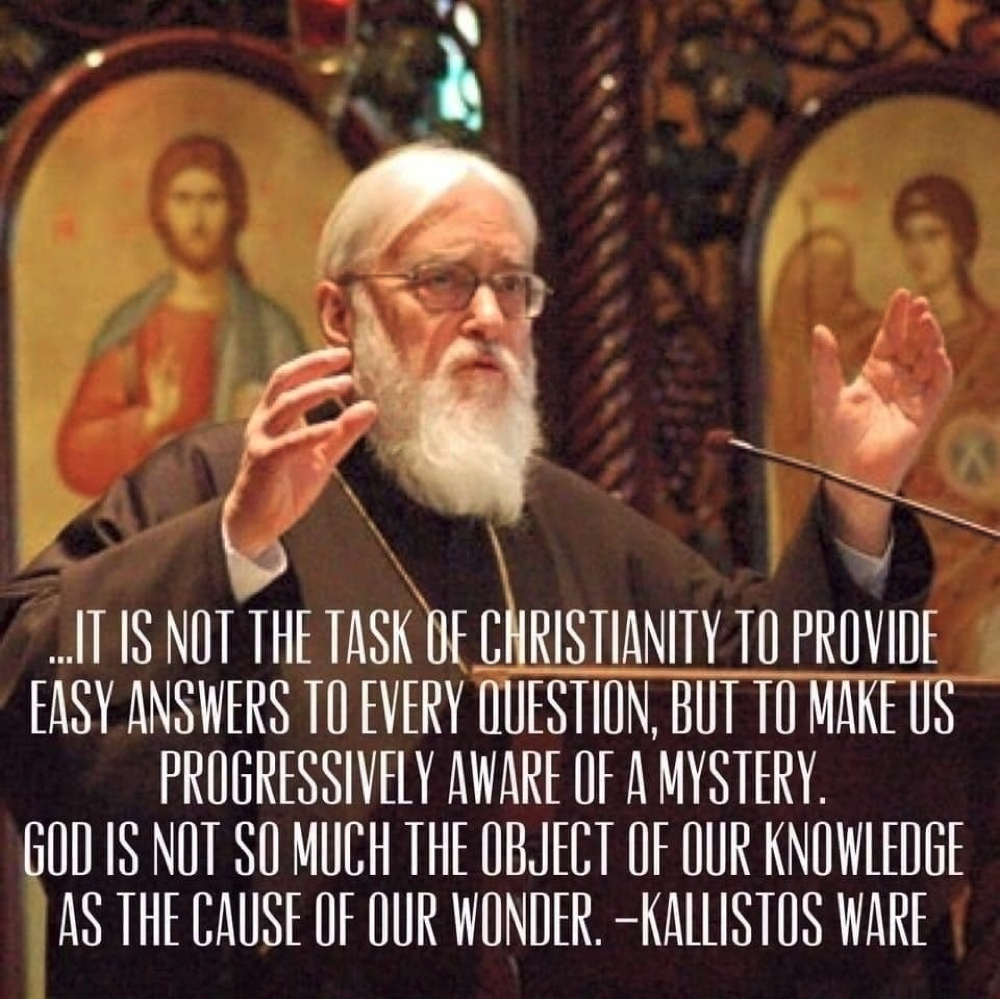
Metropolitan Kallistos Ware has reposed in the Lord

Metropolitan Kallistos Ware reposed in the Lord last Tuesday.

“Let me keep my distance, always, from those who think they have the answers.

Let me keep company always with those who say "Look!" and laugh in astonishment, and bow their heads.”

Mary Oliver, Evidence: Poems

Against David Frenchism

I may have finally reached a tipping point trying to process David French’s commentaries on religion and politics. Henceforth, I will either not bother at all or at least approach his columns and podcasts with an attitude of “tell me, in the first paragraph or two, why I should stick around and hear you out.”

I’ll still listen to him on law, but I don’t think he has anything I need to hear about the intersection of religion and politics.

That problem isn’t that he’s anti-Trump, goodness knows. The problem is that he’s reflexively parochial, and his “parish” is white Evangelicalism; that he says “Christians” when he means “white Evangelicals” drives me to distraction.

(Deep breath.)

I suppose this bugs me so much because French is writing and podcasting in secular, not Evangelical, spaces. He’s being read by people who may judge all of Christianity by his fixations on North American white Evangelical grotesqueries.

There is a Church that is rooted far deeper in history than the Second Great Awakening, utterly orthodox in its Christianity, and ambivalent-to-indifferent in its politics (the impressions of some American converts notwithstanding). If you’ve read me for long, you know where I think it’s found. All we ask of a polity is that we may lead a calm and peaceful lives in all godliness and sanctity.

But you’d never appreciate that by reading David French, who basically tells the Western world that “Christians be like Falwell Jr. and Orange Man.” That’s just not true, and eliding Christianity with Evangelicalism turns people off to the holy and life-giving potential of authentic, historic Christianity.

Up with Jake Meadorism

Here is one of the arguments some friends have made in defending the evangelical hard pivot toward Trump and right-wing politics more generally: The country is changing. No one will be friendly to all of our beliefs or values. However, if the progressives win, the likeliest outcome is some blending of dhimmitude and persecution. On the other hand, if the right wins, religious liberty will at least mostly be safe and we’ll be left alone. So it makes sense for orthodox Christians to migrate rightward.

The difficulty I see with this: Our churches do not exist within sealed spaces closed off from the world outside the congregation. Rather, our parishioners are being discipled all the time by the networks they participate in. So when we strengthen our ties to the political right and, in particular, when we tend to look past or gloss over the right’s sins for sakes of the political coalition (which is just a reality of life with any political coalition you try to participate in), we aren’t simply retreating into a stable space where right-wing governments protect our stable, faithful Christian communities. Rather, our communities are being shaped through the very act of partnering with specific groups, of speaking about some sins and not speaking about others. These things are, in themselves, formative.

To get his core insight, I had to quote most of his short post, but there is a bit of good stuff left, and with no paywall, either.

Jake Meador, Places of Refuge are Places of Discipleship. Meador, too, is Protestant, and as a Reformed Christian, he (as did I) appears to think himself Evangelical or Evangelical-adjacent. Unlike French, he doesn’t parochially collapse Christianity into Evangelicalism.

Why I Will Disregard any American Episcopalian Who Complains About Small States Getting As Many Senators as Big States

“Yes, a bishop’s episcopal charism does not depend on the number of worshipers in their see. But when almost all the micro-dioceses are in the west, and when western bishops are disproportionately present at Lambeth 2022, this is white privilege in action," he wrote. "Lambeth 2022 is taking place even though the bishops of half of African Anglicans have refused to come. Their dioceses constitute a third of the total Anglican Communion. Western bishops may say ‘it was their choice not to come.’ But this is not a good look."

Terry Mattingly, Some trends in global Anglican Communion are starting to look rather Black and White — GetReligion

Context:

  • Many western bishops lead "micro-dioceses" with under 1,000 active members or "mini-dioceses" with fewer than 5,000.
  • The Church of Nigeria claims 17 million members and 22 million active participants.
  • Uganda has 10 million members
  • Rwanda has 1 million members.

A Christian Culture (for the very first time)

By pretty much all measures, the Orthodox Christian countries of Eastern Europe take their faith more seriously than the Catholic countries further West or the Protestant countries which mainly lie around the continent’s fringes. I should really say ‘former Protestant countries’ because, as I have written here in the past, these countries – including mine, Britain – are now post-religious. Faith has been replaced by politics, ideology, activism or the material and technological idolatry which we call ‘progress.’

All of which means that I have until recently never seen a real Christian culture, of the kind my country used to be many centuries ago, and my adopted country, Ireland, used to be until more recently.

Paul Kingsnorth, Intermission: Monasteries of Romania #1

Godsplaining to the Archbishop

“If we say our God is an all-loving god, how do you explain that at any given time probably 400 million living on the planet at one time would be gay?” he asked. “Are the religions of the world, as does Catholicism, saying to those hundreds of millions of people, ‘You have to pass your whole life without any physical, genital expression of that love?’”

Archbishop Rembert G. Weakland, recently deceased, to the New York Times in 2009, roughly seven years after exposure of his hush money payment to a male lover (or rape victim).

It is suggestive that “the religions of the world” seem, to the disgraced Archbishop, to speak with one voice. How could that be if the idea of lifelong sexual abstinence is so stupid? Might it be that the spirit of our age is the anomaly, the deviation from the wisdom of the ages?

Did the Archbishop not confess that Mary, the “Mother of God,” remained ever a virgin? Or did he, like a highly multiparous protestant I corresponded with at some length, rule out Mary’s ever-virginity because that would be “perverted”?

Further, it is famously not just the Church that tells people “You have to” do something you’d rather not do, See, e.g., decalogue.

Still further, surely a substantial part of the work of the Church is dealing sacramentally and pastorally with people who fail to live up to divine expectations. See, e.g., confession.

Finally, the surmised number of gay people is irrelevant to the correct answer to the Archbishop’s tendentious question.

To get other glimpses of the odious decedent, see Rembert Weakland, Proud Vandal

Youth alienation then and now

[T]he thing that disturbs me the most right now is that the conversations often that I’m having with younger evangelicals. When someone says to me I’m thinking about walking away, it’s usually a very different conversation than I would have had 10 years ago. 10 years ago, it would have been with a younger person saying I just can’t believe the supernatural stuff that we believe anymore. Or I really think the moral ideas of the church are too strict and too judgmental, and I want to walk away.

Now it’s almost the reverse, almost directly the reverse. It’s people who are saying, I don’t think the church believes what it says it believes and what it’s taught me, or at least I fear that it doesn’t.

[W]e’re not looking for some Christian America in the past because in order to do that, we would have to redefine what we mean by Christian … [i]n all sorts of ways that I think are harmful.

Russell Moore

Repentance

Repentance is everything you do to get sin, those inborn passions, out of you. It’s reading, thinking, praying, weeding out disruptive influences in your life, sharing time with fellow Christians, following the guidance of the saints. Repentance is the renunciation of what harms us and the acquisition of what is beneficial to us, writes a holy counselor.

Dee Pennock, God’s Path to Sanity

Demoting free exercise

In essence, [Employment Division v.] Smith demoted the Free Exercise Clause of the First Amendment to a glorified nondiscrimination doctrine. Rather than granting Americans an affirmative right to practice their religion absent compelling governmental reasons to restrict that practice, the Free Exercise Clause becomes almost entirely defensive—impotent against government encroachment absent evidence of targeted attack or unequal treatment.

David French


[S]ubordinating truth to politics is a game which tyrants and bullies always win.

Jonathan Rauch, The Constitution of Knowledge

The Orthodox "phronema" [roughly, mind-set] cannot be programmitized or reduced into shibboleths.

Fr. Jonathan Tobias

You can read most of my more impromptu stuff here (cathartic venting) and here (the only social medium I frequent, because people there are quirky, pleasant and real). Both should work in your RSS aggregator, like Feedly or Reeder, should you want to make a habit of it.

Friday, 7/8/22

I didn’t have enough to share Thursday, but I’ve got some now. I also add a new category, "Mysticism," the first new one in quite a while.

You may want to skip the adiaphora, which is kind of a speen-venting exercise.

Things that matter

"Christian" Politics, Christian Piety

I quoted an excerpt of this recently, but a larger excerpt is worthy

There is a problem with Christian politics today, but it isn’t any of these options, or the fierce debates surrounding them. It isn’t this or that policy that Christians are in general for or against. In democratic politics, it’s just as legitimate for Christians as for any other group to advocate with passion, even granting that such passion regularly generates outlandish behavior and outsize rhetoric. That comes with the territory; it is the inevitable spillover from democratic give-and-take.

Is the problem the desire to win? Not at all. Who among us cares about the common good but doesn’t want to win? If you think your platform or candidate would make the world a better place – whether you are conservative or progressive, libertarian or socialist – you should want to win. The will to lose betrays a lack of confidence in your own proposals.

No, the problem isn’t wanting to win. The problem is the unwillingness to lose. That is, the problem is the impossibility of imagining that certain forms of losing might be preferable to certain forms of winning – that some things might not be worth doing even if not doing them would entail losing.

Brad East, Another Option for Christian Politics.

"Your power has been totally taken away,” but under a Trump administration, “you’ll have great power to do good things."

Donald Trump to a group of Christian pastors in Orlando, August 2016, via The Dispatch.

O Lord and Master of my life, take from me the spirit of sloth, despair, lust of power and idle talk.
Grant rather the spirit of chastity, humility, patience and love. Grant me to see my own transgressions and not to judge my brother. For blessed art Thou unto the ages of ages. Amen..

The Prayer of St. Ephraim of Syria, prayed by Orthodox Christians particularly in Lent (emphasis added).

In response to Trump’s campaign pitch aimed at them, 81 percent of White, self-identified evangelical voters cast their votes for him, and they remained a core base of his support throughout his presidency.

The Dispatch, excerpting Paul D. Miller, The Religion of American Greatness: What’s Wrong with Christian Nationalism.

Simone Weil on mysticism

She read the Gospels and was immediately convinced that Jesus is God, but she also studied classical texts from non-Christian religions, finding resonances therein with her own unexpected mystical encounters. She had always loved the Greeks, but now as she read her favorite authors–Plato and Homer–she found the former to be a mystic and the latter to be “bathed in Christian light.” Indeed, she found “intimations of Christianity” throughout Greek literature, from the early myths through the great tragedians. This confirmation of the universality of mystical experiences like hers, coupled with the Catholic Church’s exclusive claim to be the vehicle of God’s presence in the world, was the greatest impediment to her joining the church.

Simone Weil, Love in the Void: Where God Finds Us (Plough Spiritual Guides: Backpack Classics) . Plough Publishing House. Kindle Edition.

I had not recalled that explanation of why Weil held back from joining the Church. If the Catholic Church "claims to be the" sole "vehicle of God’s presence in the world," I’d reject it for that reason in addition to my other reasons.

I’ll leave it at that for now, but as it’s related to some current interests of mine, as reflected below.

Recapturing wonder

How to recapture this in adulthood? Wordsworth’s answer is given in his entire life’s work: in and through poetry, which with its reliance on metaphor and implicit meaning allows the right hemisphere to circumvent the ordinary processes of everyday language which inevitably return us to the familiar, and reduce the numinous to the quotidian. There is always a paradox involved, in that he is trying to reproduce the unself-consciousness that permits experience of the numinous, the condition of such unself-consciousness being that it cannot be consciously reproduced. In revisiting his childhood self and trying to bring him to life he is intently focussed on a being whose essential importance to the poet is that he was completely unself-aware.

Ian McGilchrist, The Master and His Emissary

Making things holy

It may not look like much, not with all these other distractions, but we make things holy by the kind of attention we give them. … I say it again: we make things holy by the kind of attention we give them.

Martin Shaw

Much ado about nothing

There was once a time when I would have found Liberty Counsel’s Naughty & Nice list (link is to a PDF that may download) mildly amusing: encouragement to shop at places that "recognize and celebrate Christmas" and to shun those that "silence and censor" Christmas. I now think it’s cheap, tawdry, and highly provincial.

For the historic Church, Christmas is not even the most important Christian Holiday. In fact, it’s not even called "Christmas."

Making such a big deal out of whether retailers "foreground" the distinctly Christianish trappings of our national consumer orgy is just preposterous.

Adiaphora

Four political vignettes

I cannot judge any of these folks in the sense of declaring (or even predicting) eternal destiny, but I’ve got a pretty good idea who I might and wouldn’t vote for.

One Sign of Hope …

Republicans see other areas outside of the spotlight, including data privacy, digital assets and mental health, as equally fertile ground. … "I have people back home saying, ‘You can’t agree with Biden on anything." And I say, "Well what happens if he’s right every once and a while?"

Jordain Carney in Politico quoting Reps. Don Bacon.

On the other hand, I’ve never heard of Don Bacon before. Maybe he’s just not doing enough of the truly vital work of appearing on Fox and MSNBC.

… Another of despair.

I thought my Congressman, Jim Baird, was just a cipher — harmless enough.

Wednesday, though, brought a fundraising letter than opened thus:

I didn’t fight to protect American Freedom and American Life in Vietnam to see it destroyed by Pinkos in Pink Hats 50 years later.

(formatting in original)

I can’t say it went downhill from there, but it sure kept up the hyperbole, preposterous capitalizations, and claims of existential threat.

I’ll never vote for Jim Baird. There are worse Congressmen, but my bar is a lot higher than "at least he’s not Matt Gaetz."

Boris

What Britain has is a prime minister with instincts, sometimes good, sometimes bad, who almost as a point of principle refuses ever to temper or abrogate them in any way … These same instincts now look as though they will cost Johnson his job. He continually disregards official advice, and attempts to bypass the rules or ignores them altogether, seeing them as little more than officialdom’s devices to control him. … This is the great paradox about Johnson: He is both the most self-aware political leader I’ve come across, a leader who seems to genuinely reflect on his character flaws, and the one who seems most determined to do absolutely nothing about them. And so Britain bounces from scandal to scandal, instinct to instinct, without direction or purpose, unmoored and ungoverned.

Tom McTague via The Morning Dispatch.

What a fascinating train-wreck Boris Johnson has been. I’ll probably miss him a bit.

Gavin Newsom

Dinner at The French Laundry during Covid lockdown, vacation in Montana, which he declared off-limits. Yeah, Gavin Newsom is a real piece of "rules for thee but not for me."

I’ll never vote for him, either.

Recommended reading

I try to read opposing views on current events, but find that in fact, my reading is narrowing mostly to center-Left to center-Right. Further to the Left or Right there’s too much lunacy. (Possible exceptions: Marxist Freddie deBoer on the Left, the Integralist and crypto-Integralist academics on the Right.)

Recent discovery on the center-Left, and recommended, is Heather Cox Richardson’s Letters from an American.


If people have always said it, it is probably true; it is the distilled wisdom of the ages. If people have not always said it, but everybody is saying it now, it is probably a lie; it is the concentrated madness of the moment.

Anthony Esolen, Out of the Ashes

You can read most of my more impromptu stuff here (cathartic venting) and here (the only social medium I frequent, because people there are quirky, pleasant and real). Both should work in your RSS aggregator, like Feedly or Reeder, should you want to make a habit of it.