Sunday, 12/7/25

Just a few items today.

A world without Protestantism

Imagine a world without Protestantism.

I don’t mean a world without Christians who are neither Catholic nor Orthodox. I mean a world in which there are only two groups of Christians. The first group encompasses believers who belong to ancient fellowships led by bishops and ordained priests, who confess the Creed and their sins and celebrate the Eucharist in a traditional liturgy of word and sacrament. These believers hand on tradition, petition the saints, venerate icons, and baptize their babies. Call them “catholic.”

Call the other group “evangelicals.” They have no creed but the Bible. They have no bishops or priests; instead, they have ministers and elders, who are rarely ordained. They baptize not infants but adults, who can make a public declaration of faith. They reject the interposition of anyone or anything between the individual and Jesus, who is known immediately in the soul and clearly through the Scriptures.

Imagine a world in which every Christian is either catholic or evangelical, with nothing in between. It is a world without Protestantism—for the religion of the magisterial Reformers in the sixteenth century did not desire, commend, or practice either of these options. Theirs was a via media. They baptized babies, recited the Creed, ordained pastors to the service of word and sacrament, practiced baptism and communion as sacraments (not as symbols), and insisted on the validity of the early councils.

The world I invite you to imagine, then, is one in which this middle way—neither Roman nor Anabaptist, both traditional and reformed—has vanished. Is such a world possible? It is. In fact, we are living in it right now. Ours is a world without Protestantism.

German Saucedo, Goldilocks Protestantism.

A very arresting five-paragraph introduction to an article earlier this year in First Things. Saucedo goes on to analyze how very few Christians remain “in between” the catholics and the evangelicals. My wife is part of that remnant, as was I before entering Orthodoxy (one of the “catholic” churches).

I think Saucedo may have a point that I need to digest: at some point (during my lifetime, I think, though maybe 200 or so years ago in the Second Great Awakening), the Venn Diagrams of “Protestant” and “Evangelical” lost most of their overlap.

I believe there’s no paywall for First Things articles older than the current issue.

Standpoint epistemology

I, for instance, feel differently about these subjects than an unbeliever. I hear, “Christ was crucified” and immediately I admire His loving-kindness to men. The other hears and esteems it as weakness. I hear, “He became a servant” and I wonder at his care for us. The other hears and counts it as dishonor. I hear, “He died” and I am astonished at His might, that He was not held in death, but even broke the bands of death. The other hears and surmises it to be helplessness. He, on hearing of the resurrection, says the thing is a legend. I, aware of the facts which demonstrate it, fall down and worship the dispensation of God. . . . For not by the sight do I judge the things that appear, but by the eyes of the mind. I hear of the “Body of Christ.” In one sense I understand the expression, in another sense the unbeliever.

Saint John Chrysostom


Religious ideas have the fate of melodies, which, once set afloat in the world, are taken up by all sorts of instruments, some woefully coarse, feeble, or out of tune, until people are in danger of crying out that the melody itself is detestable.

George Elliot, Janet’s Repentance, via Alan Jacobs

[N]one of the things that I care about most have ever proven susceptible to systematic exposition.

Alan Jacobs, Breaking Bread With the Dead

You can read most of my more impromptu stuff here and here (both of them cathartic venting, especially political) and here (the only social medium I frequent, because people there are quirky, pleasant and real and it has no-algorithms). All should work in your RSS aggregator, like Feedly or Reeder, should you want to make a habit of it.
Sunday, 10/12/25

Total apostasy?

… Mormons claim that “total” apostasy overcame the church following apostolic times, and that the Mormon Church (founded in 1830) is the “restored church.” …

A bullet-point in an anti-Mormon tweet after the attack on a Michigan Mormon meeting place. (My source identified the tweeter as “fundamentalist.”) The bullet-points built to the conclusion that Mormons (Latter-Day Saints) are not Christian.

Fine. But the Evangelical and Evangelical-adjacent world in which I spent many decades believes something very much like that Mormon “total apostasy” story. They may think it started in the 4th century and ended in the 16th instead of the 19th, but a lot of them (including former-me) functionally think it ended in the 19th, with the revivals of the “Second Great Awakening,” when the distinctive style of Evangelicalism emerged. (BTW: Try to define “Evangelical.”)

Here, I submit, is a more accurate summary of Church history:

There’s no need of a restored church because Christ’s One Holy Catholic and Apostolic Church never went away.

And I stumbled onto it …

Speaking of which, I had occasion this week to reread an eight year-old blog constituting, my only published spiritual biography (it was reprinted elsewhere one time). There are a few things I’ve written over the years that stick in my mind as worthy efforts, not throw-away lines or curations, and that post is one of them.

Some things bear repeating, and so I shall:

Having settled in for a few decades, what have I found uniquely true about the Orthodox Church?

It’s hard to put into words. That’s why Orthodox evangelism tends to consist of “come and see.”

Harder still for me personally, I need to find words for feelings and tendencies that an intellectualoid has trouble trusting — things that may be true but approach ineffability. I have a Dostoyevsky “Beauty Will Save the World” sticker on my office window, but long habit and self-image keep pulling me back toward “Spock-like logic (think of that tidy, air-tight 5-Point Calvinism) will save the world.”

But here goes. Turn on your feeler.

I’ve found, again, the love of God. Over and over and over and over we hear liturgical exclamations “for You are a gracious God and love mankind.” There’s no contrary stream of wrath that I’ve noted. The steadfast love of the Lord endures forever.
I’ve found true worship of God, which was something I longed for and agitated for in my prior Evangelicalism and Calvinism, as best as I then understood worship. For instance, I wanted no “hymns” in worship that were addressed to encouraging one another rather than praising God. Yet somehow bathos kept cropping up, and emotionally manipulative gospel songs kept elbowing out too many hymns. I really had no idea what real worship looked like, but my longing was wholesome. I am very much a member of homo adorans.
I have found sobriety and balance. The Christian Reformed Church was on the right track when it aspired to “Catechism Preaching,” an effort to tie sermons to the prescribed portion of the Heidelburg Catechism appointed for that Sunday, rather than letting pastors riff on whatever they read in Saturday’s newspaper or National Review. But Catechism Preaching was a tradition honored more in the breach than in the observance. I have found the Orthodox liturgical cycles (very complex and overlapping) to produce sobriety and balance in homilies, but more, in the entire service (hymnody, Epistle and Gospel readings, etc.)
I have found a hard path which, if I faithfully walk it, will make me more Christlike — a nice Protestant way of referring to becoming a “partaker of the divine nature.”
I have found a Church that really is a hospital for sinners instead of a club for self-styled saints. Some patients have more embarrassing ailments than others, but we’re all chronic cases; sacramental confession helps to drive that home. Not one of us is a hopeless case: the lives of the Saints help drive that home. Some check out of the hospital against medical advice, but we don’t do involuntary discharges of anyone who knows (s)he’s sick and wants to get well.

Another’s conversion

She elaborates the point with more than a little self-deprecation: “I’d backed myself into a corner. There wasn’t anyone else in the world who talked about ‘the Platonic ideal of the Good as an active agent with a special care for humankind’ without shortening that whole cumbersome phrase to simply God.”

In short, although she resisted the conclusion (or was it a solution?) with all her strength, she finally welcomed its inevitability. “I had just enough love in me to be able to be warmly surprised to find out the rules I loved, loved me back.”

… If one can know what she thinks by reading the Catechism, what’s left to surprise?

Answer: not her background convictions, but how she applies them to concrete questions, especially questions about public policy and the modern household ….

Brad East, quoting Leah Libresco Sargeant’s conversion from atheism to Roman Catholicism. The occasion, of course, is that she has written a new book, The Dignity of Dependence: A Feminist Manifesto.

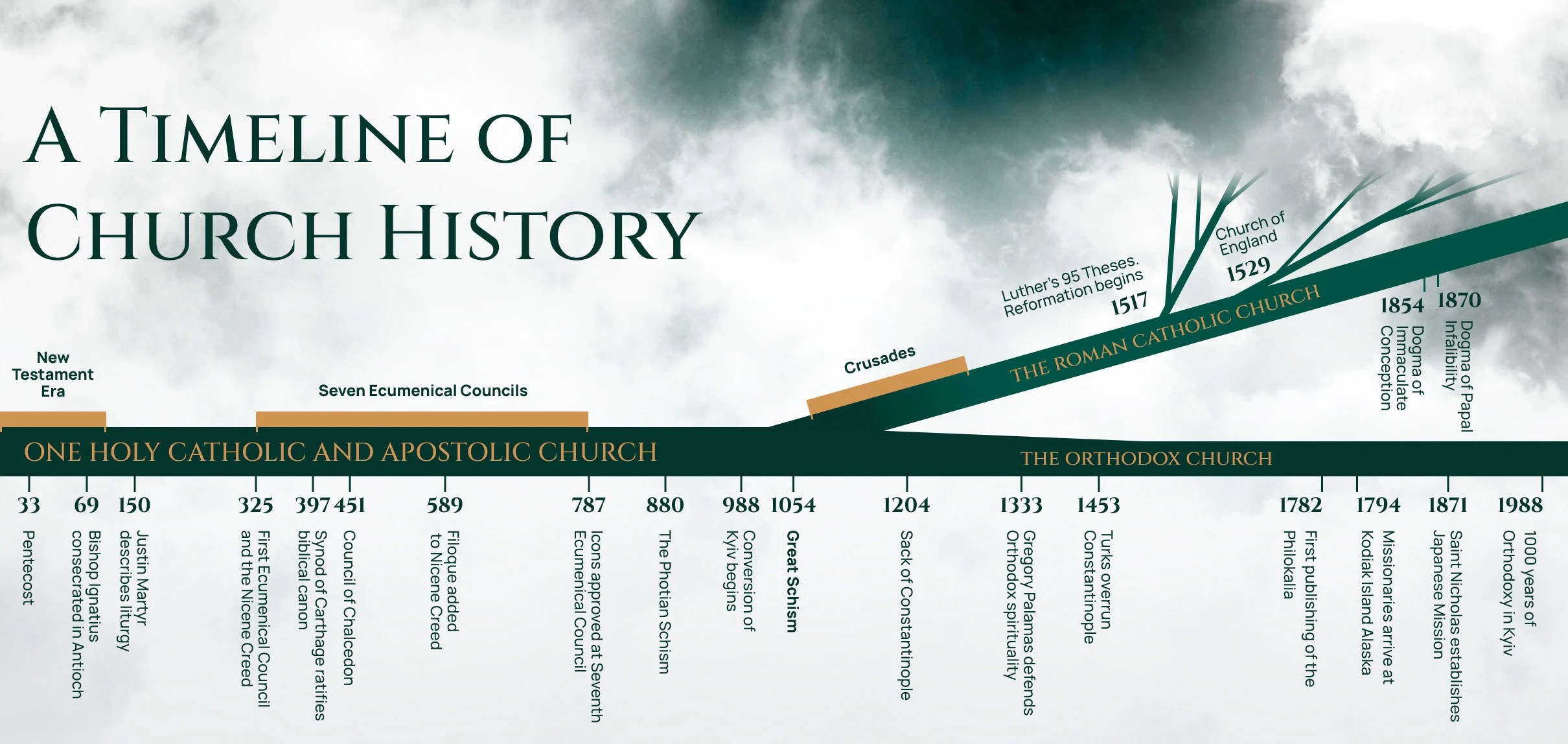
Orthodoxy and Roman Catholicism are not in communion with each other since, in the simplified version, the Great Schism of 1054 (see the timeline above). But a lot of people coming out of Protestant traditions have felt that those were the only two viable Christian alternatives, and I have never found it in me to criticize those who made the wrong-but-plausible choice, like Leah did.

Fallen

Of course, we speak of human beings as “fallen.” However, in Orthodox teaching, this does not refer to our nature itself. Rather, it refers to the fact that we have been made subject to death – we are mortal. It is “death at work in us” that we describe as “sin.” But the origin of sin is not found in our nature. Our nature is inherently good. Understanding this makes a huge difference when we think about human relationships and the character of our common life.

If you take the view (which is common in certain corners of Western Christianity) that human beings have a “sin nature” – that we are, in fact, essentially bad – then how we view one another and the character of our common life takes on a different caste. In an Orthodox understanding, a Bible verse such as, “Spare the rod and spoil the child,” can mean little more than “children need discipline in their lives to help them”. Whereas in a world in which human nature is held to be a “sin nature,” then “sparing the rod,” would be seen as letting evil run amok. It would hold that our nature not only needs to be restrained but requires a vigorous regime of reward and punishment. It has not been that long since the notion of “beating the evil out of a child” was common.

When we speak of our nature as “good,” we are not declaring that human beings are born as saints. Rather, we are saying that our nature (“what we are”) tends towards the good, desires the good. We desire beauty. We desire well-being. We desire truth. Even when we engage in evil actions, they are most often grounded in a misperception of the good. Dictators do not come to power by asking people to be evil – they come to power by distorting the image of the good.

Fr. Stephen Freeman, The Nature of Being Human


Religious ideas have the fate of melodies, which, once set afloat in the world, are taken up by all sorts of instruments, some woefully coarse, feeble, or out of tune, until people are in danger of crying out that the melody itself is detestable.

George Elliot, Janet’s Repentance, via Alan Jacobs

[N]one of the things that I care about most have ever proven susceptible to systematic exposition.

Alan Jacobs, Breaking Bread With the Dead

You can read most of my more impromptu stuff here and here (both of them cathartic venting, especially political) and here (the only social medium I frequent, because people there are quirky, pleasant and real and it has no-algorithms). All should work in your RSS aggregator, like Feedly or Reeder, should you want to make a habit of it.

Re-enchantment sans woo-woo

Ties that bind

Amid the hyperpluralism of divergent truth claims, metaphysical beliefs, moral values, and life priorities, ubiquitous practices of consumerism are more than anything else the cultural glue that holds Western societies together.

Brad S. Gregory, The Unintended Reformation

Subjection to the Roman Pontiff

Two years after Maifreda’s execution, Boniface VIII was prompted by the open defiance of Philip IV, the king of France, to issue the most ringing statement of papal supremacy ever made: ‘We declare, state and define that it is absolutely necessary for salvation that every human creature be subject to the Roman Pontiff.’

Tom Holland, Dominion. You would have a hard time finding Catholics who affirm this today, though I believe that “declare, state and define” makes it clear that this is an ex cathedra pronouncement of the sort that is supposed to be infallible.

Not my circus, not my monkeys. I’ll leave it to Catholics to reconcile the declaration and the on-the-ground reality of today.

Who’s for sale?

Today’s evangelical movement is a mess. Although they might disagree on much else, even most evangelicals can agree on that. The question is: Why?

Megan Basham, a writer for The Daily Wire, offers her answer in her new book Shepherds For Sale: How Evangelical Leaders Traded The Truth for a Leftist Agenda, the tone of which is summarized well right in the title.

Profiling evangelical leaders and institutions she claims have been co-opted or outright bought-off by funders and foundations on the left, Basham’s book asserts that such “evangelical elite” have betrayed Christian positions on issues such as abortion, immigration, and sexuality in order to curry favor with a more mainstream cultural elite. 

Basham is right that many “shepherds” are, in fact, “for sale.” But the unintended irony—and fundamental flaw—of her book is that the corrupting money is not on the evangelical left, as she claims, but on the populist right. The rise of such organizations as Turning Point USA (and its subsidiary Turning Point Faith), the Epoch Times, and The Daily Wire itself—organizations that combined bring in hundreds of millions of dollars in annual revenue—bear witness to the financial benefits of pandering to populists. Turning Point USA, for example, now hosts pastors conferences that feature evangelical MAGA apologists like Eric Metaxas, Sean Feucht, and Rob McCoy. A recent event in San Diego attracted 1,200 pastors. Turning Point USA’s annual revenue now tops $80 million.

If Basham is right that the evangelical movement is sick, she has misdiagnosed the true cause of the illness: departing from the Gospel to pursue ideology and political activism. The movement has moved well beyond the responsibilities of Christian citizenship in pursuit of realpolitik.

Warren Cole Smith, Which Shepherds Are For Sale?

I think this means that it’s the pundit, not (just?) the Shepherds, who are for sale.

Yes, Moscow, ID is in the fever swamps, but don’t discount it

If you asked an American Christian 40 years ago who his or her favorite public preacher or Christian commentator was, he or she would say Billy Graham or some nationally recognizable television evangelist. Twenty years ago, responses would include megachurch preacher/author Rick Warren, who wrote best-selling books like The Purpose Driven Life. When I ask today, the answers I invariably get are names usually unrecognizable to me, even as the president of a Christian think tank that studies these issues. American Christianity, like much of American politics and journalism, has become siloed. A favorite preacher or Christian writer today will be a personality who has a million followers on YouTube or for his podcast, but is not well known outside his own constituency. Wilson has fit that category for years, occupying a special niche of contrarian, very conservative evangelicalism. But recent publicity and controversies have elevated him to a new level.

Postliberal America is the ideal field for Wilson and his followers. His Washington church will not likely grow into the thousands. Nor will his denomination grow into the millions. But he is a suitable chaplain to a growing segment on the right that disdains classical liberalism as a failure, if not flawed from the start, and wants to completely rebuild America into a new postliberal order, where Christianity is not just central, but ideally legally privileged.

Mark Tooley, writing about Doug Wilson and his “Communion of Reformed Evangelical Churches,” based in Moscow, ID, but spreading like kudzu.

If you’re still dreaming martyrdom dreams about the Left coming to kill “real Christians,” get real. It seems likelier to me that hardcore postmillennialist Calvinists will seize power and persecute everything from (a) progressives to (b) those whose idea of Christian history goes back past the Reformation to the time of Christ and the Apostles. And I say that as someone who formerly was a pretty hardcore Calvinist and heard all kinds of weird things from my postmillennialist Calvinist friends.

When (if?) the postmillennialists seize power and begin the executions, they’ll call it “the Millennium.” They’re not charismatics like the New Apostolic Reformation flakes with their Seven-Mountain Mandate, but I could see the two groups temporarily making common cause. The common thread in “conservative” postmillennialism in the twentieth and twenty-first centuries is the striving for political power to bring in Christ’s kingdom.

What I believe about the end-times is that Christ will “come to judge the living and the dead” and “His Kingdom shall have no end.” In the Protestant world, they’d class that as “amilleniallism,” and it’s one of few carryovers from my Protestant days.

Another limitation of science

A boy may not approach his mother with the sexual rite in mind any more than a husband may try to make his wife over into a mother figure. Both attempts are confusion. Appropriateness is the test, and no merely scientific analysis of the situation will tell us why this body may not cohabit with this one. The forms are there (male body, female body), but the roles do not permit it.

Thomas Howard, Chance or the Dance (Second Edition).

Re-enchantment

I listened to podcast by a group of smart Evangelical or Evangelical-adjacent guys, talking about disenchantment and re-enchantment.

One of the concerns about re-enchantment was that it would get into “woo-woo” or syncretism or something else really dangerous. But then one of them said something that triggered this reaction in me: why not re-enchant with the words of a great ecumenical saint as guardrails?

I arise today
Through a mighty strength, the invocation of the Trinity,
Through belief in the Threeness,
Through confession of the Oneness
of the Creator of creation.

I arise today
Through the strength of Christ’s birth with His baptism,
Through the strength of His crucifixion with His burial,
Through the strength of His resurrection with His ascension,
Through the strength of His descent for the judgment of doom.

I arise today
Through the strength of the love of cherubim,
In the obedience of angels,
In the service of archangels,
In the hope of resurrection to meet with reward,
In the prayers of patriarchs,
In the predictions of prophets,
In the preaching of apostles,
In the faith of confessors,
In the innocence of holy virgins,
In the deeds of righteous men.

I arise today, through
The strength of heaven,
The light of the sun,
The radiance of the moon,
The splendor of fire,
The speed of lightning,
The swiftness of wind,
The depth of the sea,
The stability of the earth,
The firmness of rock.

I arise today, through
God’s strength to pilot me,
God’s might to uphold me,
God’s wisdom to guide me,
God’s eye to look before me,
God’s ear to hear me,
God’s word to speak for me,
God’s hand to guard me,
God’s shield to protect me,
God’s host to save me
From snares of devils,
From temptation of vices,
From everyone who shall wish me ill,
afar and near.

I summon today
All these powers between me and those evils,
Against every cruel and merciless power
that may oppose my body and soul,
Against incantations of false prophets,
Against black laws of pagandom,
Against false laws of heretics,
Against craft of idolatry,
Against spells of witches and smiths and wizards,
Against every knowledge that corrupts man’s body and soul;
Christ to shield me today
Against poison, against burning,
Against drowning, against wounding,
So that there may come to me an abundance of reward.

Christ with me,
Christ before me,
Christ behind me,
Christ in me,
Christ beneath me,
Christ above me,
Christ on my right,
Christ on my left,
Christ when I lie down,
Christ when I sit down,
Christ when I arise,
Christ in the heart of every man who thinks of me,
Christ in the mouth of everyone who speaks of me,
Christ in every eye that sees me,
Christ in every ear that hears me.

I arise today
Through a mighty strength, the invocation of the Trinity,
Through belief in the Threeness,
Through confession of the Oneness
of the Creator of creation.

(St. Patrick’s Breastplate) It’s got devils, false prophets, pagans, heretics, witches, smiths, and wizards. That’s pretty enchanted, no?

A bogus but popular story

There is a popular version of this story. The popular version goes like this: up until Constantine, the Christian church was a series of independent congregations following the path of the Carpenter from Nazareth, with varied beliefs about who and what he was; there was no canon law, no structure, no church hierarchy; mostly they didn’t think about theology. Then Constantine noticed the religion and decided that with some tweaking it could be made to be the spiritual substructure of a renewed centralized empire, and it was he who invented the idea of Jesus as an imperial God; he who established the list of books of the Canon, he who insisted on a defined creed and a hierarchical church government. This is the story that Dan Brown tells in The Da Vinci Code; it is a story that many spiritual-but-not-religious folk and (with some variation) some fundamentalist low church protestants share (of course the fundamentalists for some reason nevertheless accept the divinity of Christ.)

Alastair Roberts

Spiritual effects of AI

AI will seem to have godlike powers, and human nature being what it is, we will be hard-pressed to resist relating to it as such, even if we tell ourselves that it is “just” a machine.

Rod Dreher, UAP, AI, and the Naiveté of Moderns.

I have cooled on Rod for many reasons (I only get his free postings now, for instance), but this very accurately captures a key concern about the spiritual effects of AI.

There are other reasons for concern, but that’s a big one.


Religious ideas have the fate of melodies, which, once set afloat in the world, are taken up by all sorts of instruments, some woefully coarse, feeble, or out of tune, until people are in danger of crying out that the melody itself is detestable.

George Elliot, Janet’s Repentance, via Alan Jacobs

[N]one of the things that I care about most have ever proven susceptible to systematic exposition.

Alan Jacobs, Breaking Bread With the Dead

You can read most of my more impromptu stuff here and here (both of them cathartic venting, especially political) and here (the only social medium I frequent, because people there are quirky, pleasant and real). All should work in your RSS aggregator, like Feedly or Reeder, should you want to make a habit of it.

Sunday Sundries, 8/3/25

Shift of power

The shift from church power to state power is not the victory of peaceable reason over irrational religious violence. The more we tell ourselves it is, the more we are capable of ignoring the violence we do in the name of reason and freedom.

William T. Cavanaugh, The Myth of Religious Violence

I’ve always loved this quote, but it somehow seems even more salient these days.

Our cultural glue

Given the destructive fruitlessness of religio-political conflicts in the Reformation era, Catholics and Protestants alike built on trends that antedated the Reformation and decided to go shopping instead of continuing to fight about religion, thus permitting their self-colonization by capitalism in the industrious revolution. In combination with the exercise of power by hegemonic, liberal states, a symbiosis of capitalism and consumerism is today more than anything else the cultural glue that holds together the heterogeneity of Western hyperpluralism.

Brad S. Gregory, The Unintended Reformation

The shift (see first item) was not instantaneous.

The Gimlet Eye

So many well-meaning Christians believe that the best way for the Church to influence American culture is by imitating as much as possible whatever way of life happens to be fashionable and popular, in the hopes that people will like us and listen to us.

Ken Myers, All God’s Children and Blue Suede Shoes

What is “enough”?

The question with which to start my investigation is obviously this: Is there enough to go round? Immediately we encounter a serious difficulty: What is “enough”? Who can tell us? Certainly not the economist who pursues “economic growth” as the highest of all values, and therefore has no concept of “enough.” There are poor societies which have too little; but where is the rich society that says: “Halt! We have enough”? There is none.

E.F. Schumacher, Small Is Beautiful.

A reminder

I posted this scarcely sixteen months ago, but when I stumbled onto the source again, a was struck with how it addresses a real problem:

[I]t’s good to remind ourselves periodically of the first rule of Scriptural exegesis: You are not Jesus. Whenever you read a story about Jesus’s life, you should not identify with Jesus. You should identify with the sinner whom He is healing/converting/forgiving/upbraiding/flagellating/etc.

Whenever a traditional Christian defends some point of traditional Christian morality, you’ll hear one of our lefty friends cry, “I thought Jesus ate with prostitutes and tax collectors!” Once again, the proper response is: Do you identify with Jesus in that parable?

This is where liberal Christianity becomes—ironically; hilariously—elitist. Sorry, folks, but God’s not saying you must condescend to eat with sinners. No: you are the sinner. He condescends to eat with you.

As for us recovering sinners (i.e., Christians) Saint Paul gives us a different rule: “But now I have written to you not to keep company with anyone named a brother, who is sexually immoral, or covetous, or an idolater, or a reviler, or a drunkard, or an extortioner—not even to eat with such a person” (1 Cor. 5:11). Why? Because, not being Jesus, you can’t trust yourself not to fall into their vice.

Michael Warren Davis, then a Catholic, You’re Not Jesus

Wingman

He recognized that he couldn’t “convert me” to Orthodoxy; only Christ can do that. The Lord had to enter my heart and lead me into a deeper relationship with Him through His Body, the Orthodox Church. The Orthodox evangelist, then, isn’t a preacher or apologist. He’s more like a wingman.

Michael Warren Davis, now Orthodox, the Yankee Athonite

Ready to get strong?

Okay, I’m stealing this analogy from a Catholic podcast/YouTube channel, but I love it and it fits Orthodoxy, too:

Protestantism is like having some dumbells at home. Orthodoxy is like having a fully-equipped gym with a personal trainer.

A long and winding road

From a different episode of that Catholic podcast, Ridvan Ayedemir, a/k/a Apostate Prophet, talks of his spiritual journey:

  • out of Sunni Islam,
  • through agnosticism,
  • through atheism (of the “there’s-just-not-enough-evidence-for-god” variety, not the “theists are stupid” variety),
  • through adopting some Jewish practice and thinking of conversion,
  • through the Rosary and its mysteries (which he still prays), and
  • into the Orthodox Catechumenate.

It’s long, but fascinating. I figured with an adopted persona like “Apostate Prophet,” he would be very polemical and combative. He’s not, though the podcast features his very most polemical points as the teaser.

What I found most interesting is that he didn’t start really feeling attracted to Jesus Christ until he tried filling his “meaning” void with the Rosary! He liked it, started reading about the mysteries of the Rosary (which I’ve never read), and came to love Jesus through the Rosary meditations on His Crucifixion.

Most of us are so used to insisting on understanding and certainty before we take a religious step that taking a step, assessing its effects, and then coming to understanding (not always certainty) seems like a real man-bites-dog story.

I had already heard rumors that Ridvan/Apostate, who I’d never heard of until within the past two months or so, had become Orthodox. I was praying for him since he’s at least a minor celebrity and I don’t want him making shipwreck because of Christian limelight. Having now heard him for some 2.75 hours, my prayers will be more appreciative and fervent.


Religious ideas have the fate of melodies, which, once set afloat in the world, are taken up by all sorts of instruments, some woefully coarse, feeble, or out of tune, until people are in danger of crying out that the melody itself is detestable.

George Elliot, Janet’s Repentance, via Alan Jacobs

[N]one of the things that I care about most have ever proven susceptible to systematic exposition.

Alan Jacobs, Breaking Bread With the Dead

You can read most of my more impromptu stuff here and here (both of them cathartic venting, especially political) and here (the only social medium I frequent, because people there are quirky, pleasant and real). All should work in your RSS aggregator, like Feedly or Reeder, should you want to make a habit of it.

Sunday, 7/20/25

Divorce, penance, annulment

Roman Catholic apologists have long cited their Church’s ban on divorce and remarriage as commending it and condemning other Churches’ approaches. I have occasionally wondered if they were right.

Such doubts diminished when I began acquiring an Orthodox Christian way of thinking. I heard the somewhat penitential tone of the service for a second marriage. I gained empathy for some of those whose marriages ended, even through their own fault, because we are broken and we do break things. And God doesn’t give up on us when we do.

I also knew that Roman Catholic annulment practice could easily be cast as a (hypocritical) workaround for wealthy Catholics who cared to pursue it (like one of my very attractive law school classmates). I came to prefer the Orthodox practice; briefly:

  • some sort of penance being connected to the Church’s recognition of divorce and,
  • as mentioned earlier, the very service for a second marriage reflecting soberly that a second marriage is a concession to human weakness — “better to marry than to burn with lust”

Then a day or two ago I heard an Orthodox podcast’s treatment of the difference, and decided to dig in a bit deeper.

The Orthodox Church doesn’t give divorces; it penances divorces. Its approach is pastoral. Before remarriage, one must repent of his or her fault in the destruction of the first marriage. This helps those hurt by divorce to be healed and re-integrated into the community and set on the right path again. Since marriage is ordered to the salvation of the spouses, a second marriage is sometimes necessary (“better to marry than to burn with lust”). For a specific, albeit typical, “procedure” for Orthodox second marriages, see here.

The Roman Catholic Church officially does not permit divorce, but has a legal process for declaring, retroactively, that there was never a valid marriage in the first place. Suspecting that the Orthodox podcaster’s characterization of that process and its effects went a bit overboard, I sought out reliable Catholic sources, like here, here, and here.

You can read and judge for yourself (they’re not long), but I find that process described a legal and apologetical dodge with no repentance and spiritual healing for anyone. There’s nothing pastoral about it. In the three sources I consulted, there was only one whiff of examination of conscience about the broken marriage, and even that was in the form of “some people find that simply writing out their testimony helps them to understand what went wrong and why,” not “you really should pause, reflect and repent for your role.”

If the point is to get people into the Kingdom of Heaven, I see a clear winner as between the Orthodox approach and the Roman Catholic. And I’m ready to give as good as I get the next time a Catholic apologist tries the play the divorce card.

Biblical rules

I never hear the [college] administration admit they’re wrong about anything, even though you and I both know they’ve made some bad decisions. Rules get changed every year, but the deans never acknowledge the previous rules were arbitrary—they’re couched in all this talk of biblical principles.

Philip Yancey, Where the Light Fell (Kindle location 3371)

Yancey is very much my contemporary, and I think he was writing professionally before we were 25. Where the Light Fell is autobiographical, and I’m astonished that he retained any sort of Christian faith considering the spiritually abusive environment he grew up in.

The pretense that Christian college policies were from “biblical principles” is one that I knew well and saw through quickly. But it’s a pretext that Biblicists almost have to adopt if they’re going to (a) make rules without (b) appearing arbitrary.

It’s very much with us still. Ross Douthat this week interviews a proponent, one Allie Beth Stuckey, host of an evangelical podcast called “Relatable,” which I guess is a big deal.

For the most part, Ms. Stuckey acquits herself well (Ross is not an interviewer who goes on the attack, like a cross-examiner), but there’s one thing that bothered me. She podcasts on theology, lifestyle, politics, the leftward drift of evangelical leaders and probably other topics. She claims clear guidance from “biblical principles” on all these, and on such things as Donald Trump’s policies on immigration and deportation (which biblical principles predictably support).

And next year, when she changes her mind, it will be from “biblical principles,” too.

It’s false clarity. But the pretext of biblical principles on everything is de rigueur in the Evangelical world.

Most of the time, the earth is flat

Multiple cosmologies should be able to coexist and play different functions, some more philosophical and human and others more technical and mathematical. But in our lives most of the time, the Earth is flat. Most of the time, the Heaven is up and the Earth is down, most of the time means in those instances when I am interacting with my family, my society and my enemies. And most of all, if we wish to understand religion and its symbolism, if we wish to understand the Bible or icons or church architecture we must anchor ourselves to the world of human experience, for that is where we can love our neighbor. We must force ourselves to believe that the sun rises every morning, or that the moon waxes and wanes and honestly it should not be so difficult, because despite Galileo and Newton and Einstein I’m pretty sure I will find some Truth in tomorrow’s rosy fingered dawn.

Jonathan Pageau

Ties that still bind, at least a little

Amid the hyperpluralism of divergent truth claims, metaphysical beliefs, moral values, and life priorities, ubiquitous practices of consumerism are more than anything else the cultural glue that holds Western societies together.

Brad Gregory, The Unintended Reformation

Quotable

I am a slow unlearner. But I love my unteachers.

Ursula K. Le Guin, Dancing at the Edge of the World, via Phil Yancey


Religious ideas have the fate of melodies, which, once set afloat in the world, are taken up by all sorts of instruments, some woefully coarse, feeble, or out of tune, until people are in danger of crying out that the melody itself is detestable.

George Elliot, Janet’s Repentance, via Alan Jacobs

[N]one of the things that I care about most have ever proven susceptible to systematic exposition.

Alan Jacobs, Breaking Bread With the Dead

You can read most of my more impromptu stuff here and here (both of them cathartic venting, especially political) and here (the only social medium I frequent, because people there are quirky, pleasant and real). All should work in your RSS aggregator, like Feedly or Reeder, should you want to make a habit of it.

Ss. Peter and Paul

Entrenched myth

The picture of the world as divided among major “religions” offering alternative means to “salvation” or “enlightenment” is thoroughly entrenched in the modern imagination.

Brent Nongbri, ‌ Before Religion

Nationalist Churches

I trust that my Protestant friends will forgive this Puritan-friendly Catholic what might sound at first like a sectarian point, but: While most Protestants today not only accept but also cherish the principle of religious liberty, the entire point of the English Reformation—not merely an unintended consequence—was ending the separation of church and state. English religious history does more than rhyme: They had two kings called Henry (II and VIII) with chancellors called Thomas (Becket and More) who became martyrs (in 1170 and 1535, respectively) because they insisted that there were limits to what a king could do to the church, that altar could not be entirely subordinated to throne. There is a reason so many of the churches of the Reformation became state churches: The Catholic Church was the premier European multinational organization, and it was not only in England that the Reformation was a nationalist project that produced national and nationalist churches. If you ever heard Nigel Farage talking about the European Union in the days before Brexit, you heard a very old and very English voice—and I do not mean only his accent.

… [T]he Henrician line of thinking—that the church and its officers must ultimately bend the knee to the king rather than to the King of Kings—has never quite gone away.

You may have heard these famous lines from Cardinal Francis George, the late archbishop of Chicago, envisioning life under such totalitarian assumptions:

I expect to die in bed. My successor will die in prison. And his successor will die a martyr in the public square. His successor will pick up the shards of a ruined society and slowly help rebuild civilization, as the church has done so often in human history.

Kevin D. Williamson, inveighing against a Washington State law requiring that Catholic priests report certain sexual crimes that might be communicated to them in the confessional.

I would venture an educated guess that the law takes in Orthodox priests as well, and any other priests who hear confessions sacramentally and under seal.

It will not stand.

Philosophy infiltrating theology

[T]hat aspects of the Christian doctrine were now codified in forms which were binding upon, and therefore mentally accessible to, individuals regardless of the capacity of these latter to experience the Truth which they express, exposed the doctrine in a new and dangerous degree to what may be described as the infiltrations of the philosophical mentality.

What this means should, perhaps, be explained more clearly. We have noted that, where Christianity is concerned, there is an intimate connexion between doctrine and method: the Truth of the doctrine, that which doctrinal formulations not only ‘reveal’ but also ‘conceal’, is, in its essential and universal nature, something that can be known only by one who is ‘initiated’ into it through following the discipline of the Christian Way itself. It is not something which man can arrive at through the unaided processes of human thought. It transcends the reason, It transcends logic.

Rational and logical demonstrations are only ‘true’, and this in a relative sense, provided that they begin in, and develop from, an a priori realization of what is in itself supra-rational and supra-logical. If they do not begin in, and develop from, such a realization, but merely in and from some arbitrary fiat of the human mind, what they represent is no more than a blind and unreal operation, lacking all objective validity.

Logic is but the science of mental co-ordination and of arriving at rational conclusions from a given starting-point. If the starting-point is a supra-logical ‘visionary’ knowledge of the Truth attained through initiation, then logic has a positive content in the way we have indicated. But if man merely ‘thinks’ of the Truth with his mind, then all his logic is useless to him because he starts with an initial fallacy, the fallacy that the Truth attained by the unaided processes of human thought.

Philip Sherrard, The Greek East and the Latin West

Secular expressions

Liberalism is a secular expression of the Christian teaching that the individual is sacred and deserving of protection. Socialism is a secular expression of Christian concern for the poor and downtrodden. Globalism is a secular expression of the Christian hope that history is leading to a kingdom of universal peace and justice. … And here we reach the essence of the Christian Question. Christianity denied what antiquity had serenely assumed: that the strong are destined to rule the weak, that we have no obligations to strangers, and that our identities are constituted by our social status.

Matthew Rose, A World After Liberalism

Fullness

I wish everyone would convert to Orthodoxy, not because there is no truth in their own ecclesial communion, but because I believe Orthodoxy has the fullness of the truth.

… I don’t see the Church — Orthodox, Catholic, or Protestant — as an end in itself, but as a means to the end of theosis, or full unity with God.

Rod Dreher


Religious ideas have the fate of melodies, which, once set afloat in the world, are taken up by all sorts of instruments, some woefully coarse, feeble, or out of tune, until people are in danger of crying out that the melody itself is detestable.

George Elliot, Janet’s Repentance, via Alan Jacobs

[N]one of the things that I care about most have ever proven susceptible to systematic exposition.

Alan Jacobs, Breaking Bread With the Dead

You can read most of my more impromptu stuff here and here (both of them cathartic venting, especially political) and here (the only social medium I frequent, because people there are quirky, pleasant and real). All should work in your RSS aggregator, like Feedly or Reeder, should you want to make a habit of it.

June 11, 2025

Culture

Beauty

Many catholic young people should have arrived at Chartres Tuesday or Wenesday, having averaged about 20 miles a day in pilgrimage since leaving St. Sulpice in Paris on Sunday:

I spoke with a 32-year-old American priest who was there with a group of teenage boys from his local high school. He talked about the appeal of the old mass, and Catholic tradition, to kids today. They had been earlier on a retreat at the traditionalist Benedictine abbey of Fontgombault, and he said these American boys had been blown away by what they had seen and done there. The priest predicted that they were going to be overwhelmed by the beauty of Chartres. He said that most American boys their age have already seen the worst of humanity in hardcore porn, before they have ever seen real beauty. So Chartres is going to be a revelation for them.

Rod Dreher, Surprising Hope in the Streets of Paris (bold added)

What a thought! There is precious little “real beauty” around us in the USA, especially real manmade beauty. But there’s plenty of rot.

A part of the American ethic

Take, for instance, when the doctors were asked whether they would go to court to override the parents’ wishes if the child did not have Down Syndrome. They responded unanimously that they would, and they gave the following rationale: “When a retarded (sic) child presents us with the same problem, a different value system comes in; and not only does the staff acquiesce in the parent’s decision to let the child die, but it’s probable that the courts would also. That is, there is a different standard. . . . There is this tendency to value life on the basis of intelligence. . . . [It’s] a part of the American ethic.”

Justin Hawkins, Dignity Beyond Accomplishment – Mere Orthodoxy (bold added)

Sexual stereotypes

Popular sites like What to Expect verify that some aspects of child development differ by gender, yet even such sites advise parents to try to equalize or neutralize the differences. We’re so influenced by the Gender Ideology that we don’t seem to consider the possibility of embracing the children’s own preferences for activities that are “stereotypically” male or female.

Jennifer Roback Morse, The Sexual State

I do not recommend this book. How little did I like it? Enough that having read it when considering a conference where the author was a keynote speaker, I forewent the conference.

But it’s hard to write a whole book without an observation or two that’s both accurate and temperately made.

I am also adamant that breaking sexual stereotypes is not a sign that one is “in the wrong body.”

Marriage today

… marriage American-style, an obligation easier to walk away from than student loans or credit card debt …

Kevin D. Williamson, Husbandry Matters

Custom

I’ve been watching enough BritBox to reflexively view Elon as in the driver’s seat.

AI

Yeah, everybody’s got to prattle about AI as the topic du jour for countless jours now. I’ll try not to be anodyne or banal.

The rule of Nobody

What with expectations that AI will become our new deity, coupled with the profit motive and AI hallucinations, Matthew Crawford returns to a variation on the theme that first made him famous 16 years ago:

In the year of our Lord 2025, getting things done often requires finding, not the recent hire who just reads through the prompts on his screen and is trapped in the same hall of mirrors as you, but the guy or the gal with enough institutional knowledge to be able to thwart the system.

AI will get rid of those people. What then? The dystopia I fear is not one in which superintelligent machines achieve self-awareness and wipe out the human race, it is the prospect of a tightening grid of dysfunction and paralysis, achieved through the final victory of “the rule of Nobody,” to borrow a phrase from Hannah Arendt. The Nobody cannot be addressed.

Oh sure, there will probably still be a counter you can walk up to, with a very charming robot-lady behind it. Detecting the emotional register of your voice, she will express empathy for your plight. “I understand this can be frustrating. Let me see what I can do.” But this will turn out to be just a creepier version of “your call is important to us,” which is Business English for “fuck off, we don’t want to talk to you.”

Your call is important to us…. This post was remarkably persuasive to me, with a dandy analogy from “work-to-rule slowdowns” in labor disputes.

Language no longer implies thinking

LLMs (the so-called AI process) are impressive probability gadgets that have been fed nearly the entire internet, and produce writing not by thinking but by making statistically informed guesses about which lexical item is likely to follow another …

People have trouble wrapping their heads around the nature of a machine that produces language and regurgitates knowledge without having humanlike intelligence. The authors observe that large language models take advantage of the brain’s tendency to associate language with thinking: “We encounter text that looks just like something a person might have said and reflexively interpret it, through our usual process of imagining a mind behind the text. But there is no mind there, and we need to be conscientious to let go of that imaginary mind we have constructed.”

Witness, too, how seamlessly Mark Zuckerberg went from selling the idea that Facebook would lead to a flourishing of human friendship to, now, selling the notion that Meta will provide you with AI friends to replace the human pals you have lost in our alienated social-media age.

Tyler Austin Harper, What Happens When People Don’t Understand How AI Works

Enough

The question with which to start my investigation is obviously this: Is there enough to go round? Immediately we encounter a serious difficulty: What is “enough”? Who can tell us? Certainly not the economist who pursues “economic growth” as the highest of all values, and therefore has no concept of “enough.” There are poor societies which have too little; but where is the rich society that says: “Halt! We have enough”? There is none.

E.F. Schumacher, Small Is Beautiful

Denying our Civil Religion

America has a civil religion that is the equal of any other religion. “Why something so obvious should have escaped serious analytical attention is in itself an interesting problem.” If American nationalism is so obviously a religion, in other words, why do we deny it? Bellah posits that conservative religious groups deny it because they believe that Christianity is, in fact, the national religion. As recently as the 1950s they proposed a constitutional amendment recognizing the sovereignty of Jesus Christ. Secularists deny that America has a civil religion because they do not believe the nation-state does or should have anything to do with religion.

William T. Cavanaugh, The Uses of Idolatry

Short-form social media

[W]hether on Twitter or Bluesky, there are five major varieties of short-form social-media post:

  • “Here is some information”
  • “Look at how funny I am”
  • “Look at how stupid my enemies are”
  • “Look at how smart my allies are for pointing out how stupid my enemies are”
  • “Hello total stranger! You’re an idiot”

Obviously, posts in the first category are useful; posts in the second can be enjoyable when the poster actually is funny; and the remaining three are poisonous.

(Alan Jacobs)

Sorta political

Henry and Thomas

Each of Henry II and Henry VIII had a Thomas, Becket and More respectively, who were martyred for their resistance to totalitarian pretentions:

Washington has passed a law requiring that Catholic [also Orthodox, I’m sure, though with progressives one never knows] priests report certain sexual crimes that might be communicated to them in the confessional …

What Henry II and Henry VIII could not live with was the idea that there were centers of power independent of the state—that the power of the king was limited. Americans supposedly cherish the notion of limited government and insist that we would abide no king, but we are in most things perfectly happy to let presidents behave as though they were Louis XIV—as long as they are doing what we want them to do, or at least as long as they are irritating and discomfiting those we regard as our rivals and enemies.

If you cleave to a political philosophy holding that there is nothing outside of the state, then you are a partisan, however well-meaning, of absolutism and totalitarianism. Not every totalitarian temptation indulged leads directly to 1984. … There are many stops, many way stations, and (one prays) many off-ramps along the road to serfdom. But allowing the state to shove its stupid snout into the confessional is a big step in the wrong direction. It is one that should be resisted not only by litigation but also through civil disobedience, if necessary.

You may have heard these famous lines from Cardinal Francis George, the late archbishop of Chicago, envisioning life under such totalitarian assumptions:

I expect to die in bed. My successor will die in prison. And his successor will die a martyr in the public square. His successor will pick up the shards of a ruined society and slowly help rebuild civilization, as the church has done so often in human history.

The cardinal’s words had more impact than he intended: “I was responding to a question and I never wrote down what I said,” he later said about his famous statement, “but the words were captured on somebody’s smartphone and have now gone viral.” But his views were no less dramatic when expressed in less dramatic language: “The greatest threat to world peace and international justice is the nation state gone bad, claiming an absolute power, deciding questions and making ‘laws’ beyond its competence,” he later wrote. And his actions bore out his convictions: When the state of Illinois insisted that funding for adoption and foster care providers would be restricted to those that agreed to provide services to same-sex couples, the cardinal, with regret, instructed Catholic Charities to refuse to comply, and the archdiocese eventually discontinued those services. That is the totalitarian tendency at work: The question wasn’t whether there would be 500 adoption agencies that serve same-sex couples but whether the 12.7 million people of Illinois could tolerate one that did not.

Kevin D. Williamson, The Totalitarian Tendency and the Confessional

For what it’s worth: How do the bien pensants of Washington expect that a violation of this law will ever be discovered?

Department of Justice crashes

The Administration’s bad faith comes home to roost already.

Can’t be bothered to learn

Elon Musk’s disinterest in learning the first thing about government, combined with his enthusiasm for performatively cutting the parts of it that irked him politically (in at least some cases because he has become a deranged conspiracy theorist), led him to eviscerate USAID, and to brag about it on Twitter:

We spent the weekend feeding USAID into the wood chipper.

Could gone [sic] to some great parties.

Did that instead.

This decision led and will continue to lead to a heartbreaking amount of suffering and death — to children and babies dying because they were cut off from access to, for example, U.S.-provided peanut paste (cost: $1 a day). One statistical model published by a Boston University public health researcher projects that Musk’s cuts will cause hundreds of thousands of child deaths. I have not looked closely into that model, but let’s say its estimate of 300,000 is off by a massive amount and Musk’s actions only led to 75,000 deaths. Was it worth it?

I don’t think Elon Musk woke up one day and decided to starve some Yemeni children to death. Rather, I think he couldn’t be arsed to learn the details of what he was doing, and instead succumbed to conspiracy theories about USAID (the drug use can’t have helped here), until he really did convince himself USAID was “a criminal organization” that needed to “die.”

Jesse Singal

Bro, you gave up a podcast. And you’re not divorced. Or separated.

It is easy to make fun of Dan Bongino, the emotionally incontinent former cop turned podcaster appointed for some inexplicable reason by Donald Trump to serve as deputy director of the FBI as a subordinate to Kash Patel, whose main qualification for the job was having been the author of … a children’s book about the Steele dossier, a fact that sounds totally made-up but that is totally not made-up.

And it is a good week for making fun of Bongino, who recently had a public emotional breakdown on Fox News—where else?—about how he “gave up everything” to take on a thankless job in public service. About which: Bro, you gave up a podcast. Bongino went on to say that the job was so hard that he was now divorced from his wife, only to realize that he didn’t exactly mean what he said. The bombastic mode of speech that is apparently obligatory in Trump’s orbit had served him poorly, and so he corrected himself: “separated.” But he didn’t mean “separated” the way it sounds when it is used in conjunction with “divorce.” He just meant that he’s spending a lot of time at the office away from his family.

Kevin D. Williamson


Your enemies are not demonic, and they are not all-powerful and the right hasn’t always lost and the left hasn’t always won. But if you convince yourself of that, you give yourselves all sorts of permission to do a lot of stupid and terrible things under the rubric of “Do you know what time it is?”

Jonah Goldberg.

Trumpism can be seen as a giant attempt to amputate the highest aspirations of the human spirit and to reduce us to our most primitive, atavistic tendencies.

David Brooks)

I don’t do any of the major social media, but I have two sub-domains of the domain you’re currently reading: (a) You can read most of my reflexive stuff, especially political here. (b) I also post some things on my favorite social medium. I am now exploring Radiopaper.com as well.

Sunday of the Samaritan Woman

Sorry to be so much later than usual with this. I had a very busy Saturday and Sunday.

Beauty First

Let me commend to any artistic sorts reading this the video embedded in Beauty First: Envisioning a Civilization Worth Restoring. Jonathan Pageau’s introduction should tell you whether it merits your further attention.

Live the life of the Church

Having largely lost our religion(s), modernity has seen fit to create new ones. If we wonder what constitutes a modern religion (or efforts to create one) we need look no further than our public liturgies. Various months of the year are now designated as holy seasons set-aside to honor various oppressed groups or causes. It is an effort to liturgize the nation as the bringer and guardian of justice in the world, an effort that seeks to renew our sense of mission and to portray our nation as something that we believe in. It must be noted that as a nation, we have not been content to be one among many. We have found it necessary to “believe” in our country. It is a symptom of religious bankruptcy. As often as not, major sports events (Super Bowls) are pressed into duty as bearers of significance and meaning. The pious liturgies that surround them have become pathetic as they try ever-harder to say things that simply are not true or do not matter. This game is not important – it’s just a game.

I am often asked, when writing on this topic, what response Christians should make. What do we do about the state? How do we respond to modernity? For the state – quit “believing” in it. We are commanded in Scripture to pray for those in authority. We are not commanded to make the state better or participate in its projects. We are commanded to serve our neighbors as we fulfill the law of God. However, I think it is important to work at “clearing the fog” of modern propaganda regarding the place of the nation state in the scheme of things. I would frame a response to modernity in this manner: we are not responsible for foreign religions. Though Christian language and carefully selected ideas are often employed in the selling of modernity’s many projects, it is a mistake to honor its false claims. Make no mistake, modernity will offer no credit, in the end, to Christ, the Church, or to people of faith. Its interests lie elsewhere.

The proper response to these things will seem modest. Live the life of the Church. The cure of modernity’s neurasthenia is found not in yet one more successful project, but in the long work of salvation set in our midst in Christ’s death and resurrection. Our faith is not a chaplaincy to the culture, or a mere artifact of an older world. The Church is the Body of Christ into which all things will be gathered, both in heaven and on earth. It is the Way of Life as well as a way of life. It is not given to us to control how we are seen by the world, or whether the world thinks us useful. It is for us to be swallowed up by Christ and to manifest His salvation to the world. We were told from the very beginning that we should be patient, just as we were promised from the beginning that we would suffer with Christ.

I think the sickness that haunts our culture is that we fail to know and see what is good and to give thanks for the grace that permeates all things. When that is forgotten, nothing will satisfy, nothing will transcend. There is no better world to be built, nor are there great wars to be won. There is today, and that is enough.

Fr. Stephen Freeman, When America Got Sick

Astronomical accuracy

I don’t think I’d ever read the tart Orthodox response (from one Patriarch at least) when Pope Gregory invite the Orthodox to adopt his new, more astronomically-accurate calendar:

By the 16th century, concerns about secular or humanistic trends in Catholic theology had become a major theme in Orthodox apologetics. For instance, the dating of Easter was fixed by the First Ecumenical Council imn A.D. 325. At the time, their calculation was made using the Julian Calendar. However, in 1582, Pope Gregory XIII issued his new liturgical calendar—now known as the Gregorian Calendar, which he held to be more scientifically accurate. Gregory wrote to the Orthodox patriarchs inviting them to adopt his new calendar. Patriarch Joachim V of Antioch commissioned a reply from his disciple Metropolitan Athanasius al-Marmariti ibn-al Mujalla, who wrote to Pope Gregory:

Our community, our bishops, our kings and all our people, scattered in the four cardinal directions—Greeks, Russians, Georgians, Vlachs, Serbs, Moldovans, Turks, Arabs, and others . . . from the time of the Holy Apostles and God-bearing fathers of the Seven Ecumenical Councils down to this day recognize one faith, one confession, one Church, and one baptism . . . and all our nations agree in the four corners of the inhabited world with one word and one affair . . . and we did not receive the confession and the holy tradition which is in our hands . . . from unknown people, like other, foreign communities.

But we pray with the Holy Apostles and the 318 fathers [of the Council of Nicaea] whose signs and miracles shine forth from them manifestly. And so how can we change the tradition of such holy fathers and follow after unknown people who have no other trade but to observe the stars and examine the sky?

As with the filioque, we see that there are really two complaints here. (1) The dating of Easter—like the text of the Creed—had been established by an Ecumenical Council. How, then, could it be modified unilaterally by the Pope? (2) Why should the Church prefer “scientific accuracy” to the longstanding custom of the Apostolic Church?

Michael Warren Davis, The Primacy of God.

Eventually, many Orthodox Churches in the West — including my own — adopted the Gregorian Calendar — except for Pascha/Easter and the preceding Lent and following Pentecost. For those, we stuck with the dating from the Ecumenical Council.

Departure from tradition

…as Nathan Hatch, Mark Noll, and E. Brooks Holifield argue, departure from tradition explains much of the growth, influence, and shortcomings of American Christianity—including the failure of the nation’s theologians and churches to resolve the question of slavery.

Paul J. Gutacker, The Old Faith in a New Nation

Spontaneity is not authenticity

In our desire to be real we start thinking that authenticity is another word for spontaneity, as if everything we say at the spur of the moment is more true, more sincere than words we craft carefully. For many, the Freudian slip is considered more authentic than the measured reply. Indeed, sometimes what we blurt out thoughtlessly is actually what we mean and feel. But more often than not, what we blurt out is ill-considered and something we either need to qualify or apologize for.

Mark Galli, Beyond Smells and Bells. I have not read this book, but appreciate Readwise suggesting it.

Homo liturgicus

[I]n Augustine’s view; we are homo liturgicus, and the basic human need to worship God can be diverted and misdirected, but it cannot be eliminated.

William T. Cavanaugh, The Uses of Idolatry

Miscellany

Religion’s closest cousin is not rigid logic but art.

David Tracy, who died April 29. I like that, but from what I read in his obituary, there’s a lot I would dislike.

The biblical significance of the modern state of Israel is exactly the same as the biblical significance of Finland.

Fr. Andrew Stephen Damick

  • Really great art should have a secret in it that the artist knows nothing about.
  • In each experience of beauty, we’re being prepared for eternity.

Martin Shaw


Religious ideas have the fate of melodies, which, once set afloat in the world, are taken up by all sorts of instruments, some woefully coarse, feeble, or out of tune, until people are in danger of crying out that the melody itself is detestable.

George Elliot, Janet’s Repentance, via Alan Jacobs

[N]one of the things that I care about most have ever proven susceptible to systematic exposition.

Alan Jacobs, Breaking Bread With the Dead

You can read most of my more impromptu stuff here and here (both of them cathartic venting, especially political) and here (the only social medium I frequent, because people there are quirky, pleasant and real). All should work in your RSS aggregator, like Feedly or Reeder, should you want to make a habit of it.

3rd Sunday of Pascha

Who will be the next Pope?

We’ll probably know by next Sunday, but for now:

JD Vance, it seems, is responsible for the death of Pope Francis. In this case, I believe that to the victor should go the spoils, and Vance should be the next Roman pontiff. The circumstantial evidence is beyond doubt: Vance and Pope Francis had a public disagreement over the concept of ordo amoris, and then the pope died shortly after they met for the first time. There are no coincidences. This isn’t even without precedent: Pope Sergius III (allegedly) killed his two predecessors Pope Leo V and Antipope Christopher. Don’t we want a return to tradition? The tradcath convert Vance could take the name Sergius, and then even have one of his sons installed after him, just like his namesake. Besides, there’s nothing in the Constitution that says the vice president can’t also be the pope. Maybe in a few years Pope JD can also be President JD. This would also be very traditional and return secular power to the papacy, and I look forward to a return of Renaissance-era political intrigue in the Vatican. (Virginia Aabram)

David Bentley Hart’s election as pope would give the Church a leader who is sure of his own infallibility. As a dogmatic Catholic, I would welcome such a development. I would also be glad to have a pope with a first-class theological mind, a due appreciation for Robert Louis Stevenson, and a desire to heal the schism between East and West. There is of course a risk that Hart would seek to suppress people with my conservative theological views. But I believe that his doctrinal chief, Roland, would help to ensure a just and liberal policy. If Hart concludes that he must refuse the burdens of the papal office, I could reconcile myself to the election of Cardinal Sarah. (Matthew Schmitz)

The First Things Conclave

Okay, sex fiends, answer me these:

I was doing some computer housekeeping Thursday and came across this. It reminded me of one of the weirdest things I ever heard a fringe Christian say: “It would have been perverted if Mary and Joseph didn’t have sex after Jesus was born!”

For those who think it’s obvious that Joseph and Mary had normal marital relations, and younger brothers and sisters of Jesus, because the scriptures refer to his “brothers”:

  • When you say that they were his brothers, do you mean that they had the same parents?
  • If so, are you saying that Joseph was Jesus’ father?
  • If Joseph was not Jesus father, then wouldn’t any brothers spoken of in scripture be half-brothers?
  • Have you ever considered the possibility that Joseph and Mary were not teenagers in love, but that Joseph was an older man, a widower, with children by a prior marriage?
  • Did you know that this is the tradition of the orthodox church? (I believe it is the tradition of the Roman Catholic Church that the brothers and sisters were more like cousins.)
  • If the Orthodox church is right, then the brothers referred to are older stepbrothers, right?
  • Is it any stranger calling stepbrothers “brothers” then it is calling half-brothers “brothers”?
  • If not, and since Christians believe that Joseph was not Jesus father, but rather that Jesus was conceived of the Holy Spirit and the Virgin Mary, why not just accept that they were stepbrothers?
  • Considering the times when Jesus brothers tried to stage a sort of intervention, wouldn’t it make sense that they were older stepbrothers, rather than younger siblings?
  • Does it bother you at all that all of the protestant reformers believe that Mary remain a virgin, the rest of her life, after giving birth to Jesus as a virgin?

Transhumanism: Christianity without all those God parts

The Silicon Valley agenda, the transhumanist agenda, is extremely utopian, and actually very religious. I think it’s like if you took the Christian religion — which they’re all sort of steeped in because they’re in America — and you take out the actual bits about God and Jesus and things, you’re left with a desire for transcendence and utopia and life after death, living forever and universal justice — all of which are sort of Christian notions — and so they’ve decided they’re going to build those themselves.

Paul Kingsnorth, interviewed by Freddie Sayers

A pagan century?

We seem to be entering a pagan century. It’s not only Trump. It’s the whole phalanx of authoritarians, all those greatness-obsessed macho men like Vladimir Putin and Xi Jinping. It’s the tech bros. It’s Christian nationalism, which is paganism with worship music. (If you ever doubt the seductive power of paganism, remember it has conquered many of the churches that were explicitly founded to reject it.)

… Christianity is built on a series of inversions that make paganism look pompous and soulless: Blessed are the meek. Blessed are the poor in spirit. The last shall be first. The poor are closer to God than the rich. Jesus was perpetually performing outrageous acts of radical generosity, without calculating the cost.

David Brooks, How to Survive the Trump Years With Your Spirit Intact

Brooks’ impression will be hard to vindicate if we continue with our “religious revival,” so very much of which is crypto-pagan.

Ordinary

You have permission to be ordinary. To live a quiet life. To go for a walk without turning it into content. To do good work without chasing viral. To be present with your people instead of always ‘building something.’ Your life doesn’t have to be optimized to be meaningful. The Ordinary creates space for what truly matters.

David Keeler.

Thanks

Weep
If you can,
Weep,
But do not complain.
The way chose you –
And you
must be thankful.

(Dag Hammarskjold)


Religious ideas have the fate of melodies, which, once set afloat in the world, are taken up by all sorts of instruments, some woefully coarse, feeble, or out of tune, until people are in danger of crying out that the melody itself is detestable.

George Elliot, Janet’s Repentance, via Alan Jacobs

[N]one of the things that I care about most have ever proven susceptible to systematic exposition.

Alan Jacobs, Breaking Bread With the Dead

You can read most of my more impromptu stuff here and here (both of them cathartic venting, especially political) and here (the only social medium I frequent, because people there are quirky, pleasant and real). All should work in your RSS aggregator, like Feedly or Reeder, should you want to make a habit of it.

Thomas Sunday

Pope Francis

Friend of the Orthodox

  • In the Orthodox Churches they preserve that pristine liturgy. So beautiful. We have lost a bit the sense of adoration. They preserve it. They praise God, they adore God, singing. Time stops. The center is God. . . . Once, speaking about the western Church, of western Europe, above all the grown-up Church, they told me this phrase: Lux ex oriente, ex occidente luxus. [“Light comes from the East, luxury from the West.”] Consumerism, well-being, have done much harm. Instead, you preserve this beauty of God at the center, the point of reference. When reading Dostoyevsky, I believe that for all of us he must be an author to read and reread, because he has wisdom. One perceives the Russian soul, the Eastern soul. It is something that will do us all good. We need this renewal, this fresh air from the East, of this light from the Orient. . . . Too often, the luxus of the West causes us to lose the horizon. I don’t know. This is what I’m moved to say.
  • During the first millennium, the universal communion of the Churches in the ordinary course of events was maintained through fraternal relations between the bishops.
  • The bishop of Rome did not exercise canonical authority over the churches of the East.

Pope Francis via Michael Warren Davis

These are important concessions by a Pope. Much more remains to be done to heal the Great Schism. Meanwhile, against my initial gut reaction, I now pray for the soul of God’s servant, Francis.

The worst of all possible Christian worlds

Not everyone feels as kindly toward Francis as does Michael Warren Davis:

Francis was thus my own worst Protestant nightmare: an authoritarian Roman pope driving a liberal Protestant agenda, a leader who embodied the worst of all possible Christian worlds.

Time will tell whether the next pope will follow in Francis’s footstep and permit the continuation of liberal Protestant policies. It’s up to the men who will be gathering in the Sistine Chapel in the coming weeks. As a Catholic friend once said to me about the last papal election, the Holy Spirit never errs. But, he added, the same cannot be said for the College of Cardinals.

Carl Trueman

Prompted by Francis’ death

I’m not claiming to be a good Catholic. I’m far from it. I’m a terrible one in many ways. I honestly, sincerely believe the church is wrong in some — but by no means all — of its teachings on sexuality. Lust has undoubtedly mastered me at times the way it has many men, and always will. But I also know my soul has far deeper problems than my love for other men, however muddied with desire; and that the world has lost its way so much more profoundly in other parts of life: in our materialism, our selfishness, our wealth and comfort, our smugness and distraction, and our abuse of our sacred planet.

Andrew Sullivan, Why I Loved Pope Francis (italics added).

The italicized portion of the block-quote bespeaks a genuine Christian faith, and I don’t have to agree with the rest to view it so.

A bitter pill

for every advance, there was an asterisk, and for every proclamation of love, a delineation of limits, so that Francis — who died on Monday at the age of 88 — personified the indelible tension in the church’s official teaching about homosexuality, which he never squarely renounced. That teaching holds that being gay isn’t a sin but that acting on those feelings is “intrinsically disordered.”

That’s tough to get your head around in the abstract. It’s even more difficult if you’ve spent much time in the church and with its clergy ….

Frank Bruni (italics added)

I’ve never seen how Rome’s position is all that tough to get your head around. “A bitter pill to swallow” is what I think Bruni may intend.

Be it remembered

What’s church good for?

[O]ur religious institutions are most important not for reasons of civic utility, such as running soup kitchens or cleaning up after natural disasters. No, their highest function is offering us access to the fullest truth about our world.

Yuval Levin via Joshua T. Katz. I encountered this quote for the first time this week, and I love it because it defies every effort to instrumentalize Church (or Synagogue, as in Levin’s case, or Mosque).

God does not have an anger problem

It is sinful to ascribe to God the characteristic features of fallen man by alleging, for example, that God is angry and vengeful, and therefore He must be propitiated and appeased. Such an attitude wants to make it appear that it is God Who needs curing, and not man. But this is sacrilegious. The sinful man, who is characterized by egoism and arrogance, is offended. We cannot say that God is offended. . . . Consequently, sin is not an insult to God, Who must be cured, but our own illness, and therefore we need to be cured

Dr. Eugenia Scarvelis Constantinou, Thinking Orthodox

Other stuff

The Gramscian Heresy

The Protestant integralists belonging the New Apostolic Reformation school, with their Seven-Mountain Mandate, certainly look Gramscian, don’t they? They want the power that comes from control of key institutions.

That’s not necessarily a mike-drop observation. We have an overabundance of Gramscians trying to march through our institutions these days, but few who are Gramscian as part of an explicitly “religious” movement.

Orthodox hagiographies are full of Saints who had to be dragged kicking and screaming (as it were) to accept ordination to the Priesthood, or elevation to a Bishopric. I’ll drive my stake in the ground here: A Christian may legitimatly be led to office, but hunger for power over others is anti-Christian.

An old truth that we keep forgetting

Reason is an absolute—all is in ruins. Yet those who ask me to believe this world picture also ask me to believe that Reason is simply the unforeseen and unintended by-product of mindless matter at one stage of its endless and aimless becoming. Here is flat contradiction. They ask me at the same moment to accept a conclusion and to discredit the only testimony on which that conclusion can be based. The difficulty is to me a fatal one; and the fact that when you put it to many scientists, far from having an answer, they seem not even to understand what the difficulty is, assures me that I have not found a mare’s nest but detected a radical disease in their whole mode of thought from the very beginning.

C.S. Lewis, Weight of Glory

A surprising possibility

What’s driving young people to Christianity? In UnHerd, Niall Gooch argued the answer may lie in the strict moral demands of modern secularism. “At its best, Christianity is not a moralistic religion — in other words, it does not place the expectation of perfect behaviour at its core. It is repentance and reconciliation, not respectability, that are central to the internal logic of the faith. The Christian moral system is also coherent and predictable,” he wrote. “Modern secular morality, by contrast, is extremely censorious and has a strongly arbitrary element, as we have seen in the last decade or so of ‘cancel culture.’ People have been subjected to storms of anonymous criticism, resulting in lost jobs and lost livelihoods, with no clear limiting principle and no real interest in proportionality. To make matters worse, this is all highly impersonal and offers no clear pathway for restoration and forgiveness.”

The Morning Dispatch

Mystery, not random

To call the unknown “random” is to plant the flag by which to colonize and exploit the known. . . . To call the unknown by its right name, “mystery,” is to suggest that we had better respect the possibility of a larger, unseen pattern that can be damaged or destroyed and, with it, the smaller patterns. . . . But if we are up against mystery, then knowledge is relatively small, and the ancient program is the right one: Act on the basis of ignorance.

Mark Mitchell and Nathan Schlueter , The Humane Vision of Wendell Berry


Religious ideas have the fate of melodies, which, once set afloat in the world, are taken up by all sorts of instruments, some woefully coarse, feeble, or out of tune, until people are in danger of crying out that the melody itself is detestable.

George Elliot, Janet’s Repentance, via Alan Jacobs

[N]one of the things that I care about most have ever proven susceptible to systematic exposition.

Alan Jacobs, Breaking Bread With the Dead

You can read most of my more impromptu stuff here and here (both of them cathartic venting, especially political) and here (the only social medium I frequent, because people there are quirky, pleasant and real). All should work in your RSS aggregator, like Feedly or Reeder, should you want to make a habit of it.