Gregory Palamas Sunday

Evangelicals

Evangelical Subculture according to Russell Moore

I hesitate to share this, but not knowing who my readers are, I can’t know that somebody doesn’t need this as a wake-up call:

Writing for Christianity Today, Russell Moore unpacked how the evangelical subculture rejected virtue, “driven specifically by the very same white evangelical subculture that once insisted that personal character—virtue, to use a now distant-sounding word the American founders knew well—matters.” He continued: “Part of the vulgarization of the Right is due to the Barstool Sports/Joe Rogan secularization of the base, in which Kid Rock is an avatar more than Lee Greenwood or Michael W. Smith. But much more alarmingly, the coarsening and character-debasing is happening among politicized professing Christians. The member of Congress joking at a prayer breakfast about turning her fiancé down for sex to get there was there to talk about her faith and the importance of religious faith and values for America. The member of Congress telling a reporter to ‘f— off’ is a self-described ‘Christian nationalist.’ We’ve seen ‘Let’s Go Brandon’—a euphemism for a profanity that once would have resulted in church discipline—chanted in churches. If we are hated for attempted Christlikeness, let’s count it all joy. But if we are hated for our cruelty, our sexual hypocrisy, our quarrelsomeness, our hatefulness, and our vulgarity, then maybe we should ask what happened to our witness. Character matters. It is not the only thing that matters. But without character, nothing matters.”

The Morning Dispatch

Moore also wrote:

[W]ere he to emerge today, [Ned] Flanders would face withering mockery for his moral scruples—but more likely by his white evangelical co-religionists than by his beer-swilling secular cartoon neighbors.

On the other hand …

This makes sense to me. Evangelical Christianity emphasizes the personal relationship with Christ. It puts more emphasis on what Kierkegaard said was the core Christian way of responding to the Gospel: as something to be lived out actively, requiring personal conversion, not just a social habit.

Rod Dreher, Kierkegaard on Easter

It is, as they say, ironic. Evangelical theology is almost antinomian in terms of salvation having anything to do with what you do, versus the notions in your head (what you “believe”).

But there they are, bless their hearts, in Church oftener than not.

Reformational Protestants

Putting it bluntly

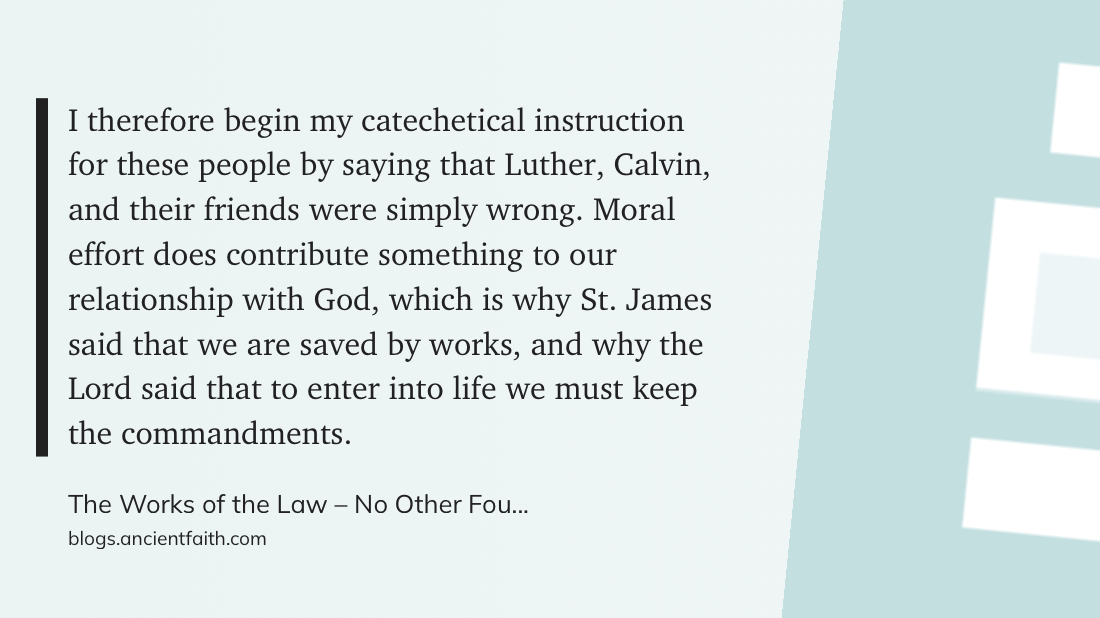
If you want the full posting: The Works of the Law

Every man a Pope

I frequently quote Nathan Hatch’s masterful The Democratization of American Christianity in my posts. It explains so much.

But I just discovered that one of my favorite Orthodox bloggers, Fr. Stephen Freeman, has noticed the same democratizing theme:

[I]n contemporary Christianity, it is said that “every man is a Pope.” Whereas a few generations ago, people asserted that the Bible alone had authority, today, that, too, has been overthrown. Each person is his own authority. And I will add, that if every person is his own authority, then there is no authority.

I am fully sympathetic with the political place of democracy …

I am, however, deeply interested in the spiritual disease that accompanies the interiorizing of the democratic project. We have not only structured our political world in a “democratic” manner, we have spiritualized the concept and made of it a description for how the world truly is and how it should be. The assumptions of democracy have become the assumptions of modern morality and the matrix of our worldview …

Much of what today passes for Protestantism is nothing of the sort. Rather, it is a thinly veiled cloak for the democratic spirit at “prayer.”  “Salvation by grace through faith” is a slogan for individualism, a Christianity “by right.” There are no works, no requirements, only a “grace-filled” entitlement. For the ultimate form of democracy is the person who needs no one else: no Church, no priest, no sacrament, only the God of my understanding who saves me by grace and guarantees that I can do it alone.

It is a great spiritual accomplishment to not be “conformed to this world.” The ideas and assumptions of modern consumer democracies permeate almost every aspect of our culture. They become an unavoidable part of our inner landscape. Only by examining such assumptions in the light of the larger Christian tradition can we hope to remain faithful to Christ in the truth. Those who insist on the absence of spiritual authority, or demand that nothing mediate grace will discover that their lives serve the most cruel master of all – the spirit of the age.

Fr. Stephen Freeman, The Madness of Democracy – A Spiritual Disease

The common feature of American religion

Nevin and Schaff also discerned certain common intellectual patterns and reflexes beneath the rampant pluralism of American Protestantism. They attributed the breakdown of theological coherence to attitudes that American Christians had assumed. These two felt that a radical Bible-centeredness was the reigning theory among Protestant sects. After surveying the statements of belief of fifty-three American denominations, Nevin surmised that the principle “no creed but the Bible” was the distinctive feature of American religion.

Nathan O. Hatch, The Democratization of American Christianity

Fifty-three denominations that just follow the Bible but cannot agree on what it means. What’s wrong with this picture?

Christianity generally

A constant temptation

Christianity in this instance is no longer even a worldview—or what John Rawls calls a “fully comprehensive doctrine”—much less an institutionalized worldview. It is conceived as one wedge in the pie of an individual life, a matter not of shared obedience to the Word incarnate with eternal life in the balance, but of preferred inclination toward the “company or conversation of those whose Customs and Humours, whose Talk and Disposition they like best.”

Brad S. Gregory, The Unintended Reformation

An article I keep coming back to

This is an article I’ve been revisiting and wrestling with regularly:

There is a reason why so many evangelical and Protestant graduate students in theology move toward “higher church” traditions. Intellectually, they discover thinkers and writings their own “lower church” traditions either ignore or lack; liturgically, they discover practices handed down century after century that function like a lifeline in a storm. Reading Saint Ignatius or Saint Justin or Saint Irenaeus or Saint Augustine, it occurs to them that they don’t have to imagine what the church’s ancient liturgy looked and felt like; they can simply visit a church down the street.

It isn’t strange to learn that Prestigious Scholar X on the law/econ/poli-sci faculty at Ivy League School Y is Roman Catholic. It is a bit of a surprise to learn that he’s an evangelical. The moment you hear it, though, you wonder (or ask) whether he’s an evangelical Anglican or some such.

Brad East, Conversions, Protestantism, and a new mainline

A cartoon for the rest of Election 2024

For those whose churches don’t have formal confession, understand that we confess our sins without suggesting that they were justified by our neighbor’s provocation. It sounds so easy, but not being able to self-justify, not even a eensy-weensy bit, can be surprisingly hard.

East and West

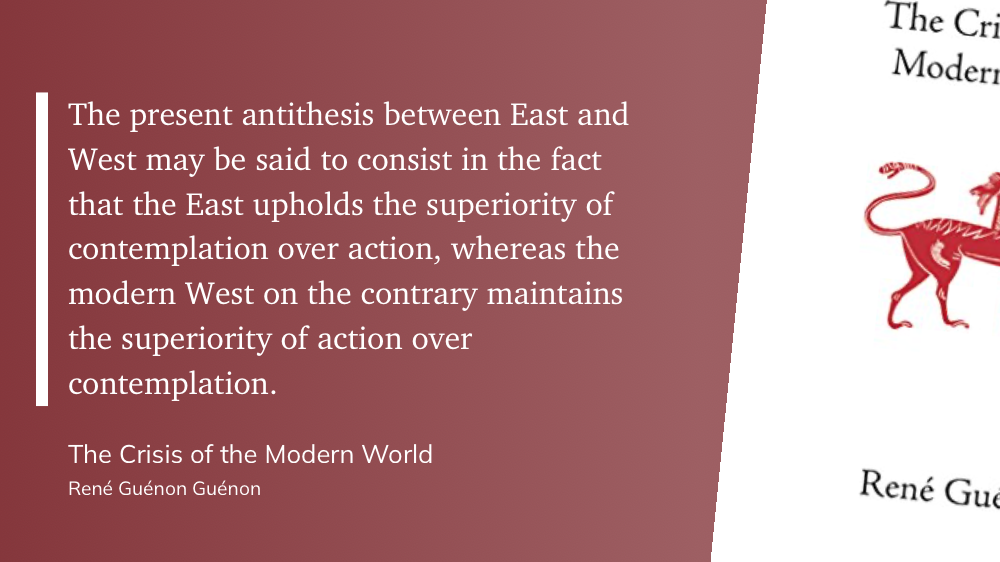
I don’t think his focus was Christianity, but Guenon was (inadvertently?) not wrong about the relative emphasis in Western versus Eastern Christianity.


… that Christ may dwell in your hearts through faith; that you, being rooted and grounded in love, may be able to comprehend with all the saints what is the width and length and depth and height — to know the love of Christ which passes knowledge; that you may be filled with all the fullness of God.

Ephesians 3:17-19 (NKJV)

You can read most of my more impromptu stuff here and here (both of them cathartic venting, especially political) and here (the only social medium I frequent, because people there are quirky, pleasant and real). All should work in your RSS aggregator, like Feedly or Reeder, should you want to make a habit of it.

Sunday, 1/21/24

Re-enchantment

The secularist’s cosmology

A modern secularist quite often accepts the idea of God. What, however, he emphatically negates is precisely the sacramentality of man and world.

Alexander Schmemann, For the Life of the World

I sometimes fear that tantalizing quotes like this will make a reader think “I ought to read that book.” What I really intend is that the reader think “Maybe I ought to become an Orthodox Christian.”

Iconoclasm

At the time of the Reformation, the effigies of saints had sometimes been dragged to the public square and there decapitated by the town’s executioner. This not only in itself prefigures the French Revolution, and emphasises the continuity between regicide and the abolition of the sacramental, but also powerfully enacts two other left-hemisphere tendencies that characterise both the Reformation and the Enlightenment, to which we now might turn.

Iain McGilchrist, The Master and His Emissary

Hubris

Zwingli’s work also repudiated the entire patristic and medieval theology of the sacrament: “I can conclude nothing else but that all the doctors have greatly erred [vil geirret habend] from the time of the apostles. . . . Therefore we want to see what baptism actually is, at many points indeed taking a different path against that which ancient, more recent, and contemporary authors have taken, not according to our own whim [nitt mit unserem tandt] but rather according to God’s word.” Just like his Anabaptist opponents, Zwingli was following God’s word.

Brad S. Gregory, The Unintended Reformation.

On a European Tour with the Wheaton College Men’s Glee Club, long ago and far away, I was thrilled to sing at Grossmünster Church in Zurich, where “Huldrych Zwingli initiated the Swiss-German Reformation in Switzerland from his pastoral office …, starting in 1520.” (Wikipedia)

That thrill is a mark of my delusion. I now think Zwingli a particularly fiendish Reformer, and as regards the sacraments, the true father of the kind of gnostic Evangelicalism I inhabited for 30 years, more or less. Neither Calvin nor Luther was so thoroughly iconoclastic.

And if you think “iconoclastic” is eulogistic, may God have mercy on your soul.

Imagine there’s no religion

In the the pre-modern West, as in much of the world today, there was no such thing as “religion”. The Christian story was the basis of peoples’ understanding of reality itself. There was no “religion”, because there was no notion that this truth was somehow optional or partial, any more than we today might assume that gravity or the roundness of the Earth are facts we could choose to engage with only on Sunday mornings.

Paul Kingsnorth, Is There Anything Left to Conserve?

The public effects of private matters

About a third of the way through the discussion, Douthat asks Ahmari to explain a couple of chapters in his recent book, The Unbroken Thread. The second chapter Ahmari discusses is entitled “Is Sex a Private Matter?” In that chapter, Ahmari turns to a surprising authority: Andrea Dworkin. Ahmari appeals to Dworkin to argue that sex is never purely private: what is done in the bedroom or viewed on a screen has inevitable public consequences …

Onsi Kamel, The Power of the Catholic Intellectual Ecosystem

Anthropogenic comological consequences

The plausibility of anthropogenic climate change ought to be abundantly evident to Christians; scripture is full of admonitions on how the sinfulness of man has cosmological consequences. See also Prayers by the Lake number 39. (H/T Fr. Steven DeYoung)

Do you know, my child …

Rod Dreher has a book coming out on re-enchantment of our world. This “prayer” may be all the re-enchantment I need:

Do you know, my child, why the clouds are closed when the fields are thirsty for rain, and why they open, when the fields have no desire for rain?
Nature has been confused by the wickedness of men, and has abandoned its order.
Do you know, my child, why the fields produce heavy fruit in the springtime, and yield a barren harvest in the summer?
Because the daughters of men have hated the fruit of their womb, and kill it while it is still in blossom.
Do you know, my child, why the springs have gone dry, and why the fruits of the earth no longer have the sweetness that they used to have?
Because of the sin of man, from which infirmity has invaded all of nature.
Do you know, my child, why a victorious nation suffers defeats as a result of its own disunity and discord, and eats bread made bitter by tears and malice?
Because it conquered the bloodthirsty enemies around it-self, but failed to conquer those within itself.
Do you know, my child, how a mother can feed her children without nourishing them?
By not singing a song of love to them while nursing them, but a song of hatred towards a neighbor.
Do you know, my child, why people have become ugly and have lost the beauty of their ancestors?
Because they have cast away the image of God, which fashions the beauty of that image out of the soul within, and removes the mask of earth.
Do you know, my child, why diseases and dreadful epidemics have multiplied?
Because men have begun to look upon good health as an abduction of nature and not as a gift from God. And what is abducted with difficulty must with double difficulty be protected.
Do you know, my child, why people fight over earthly territory, and are not ashamed to be on the same level as moles?
Because the world has sprouted through their heart, and their eyes see only what is growing in the heart; and because, my child, their sin has made them too weak to struggle for heaven.
Do not cry, my child, the Lord will soon return and set everything right.

(St. Nikolai Velimirovich, Prayers by the Lake, XXXIX)

Miscellany

Is silence violence?

There are more evil things going on in the world than any one person can respond to. You could spend all day every day on social media just declaring that you denounce X or Y or Z and never get to the end of what deserves to be denounced. If my silence about Gaza is complicit in the violence being done there, what about my silence regarding the Chinese government’s persecution of the Uighurs? Or the government of Myanmar’s persecution of the Rohingya? Or what Boko Haram has done in Nigeria? Or what multinational corporations do to destroy our environment? Or dogfighting rings? Or racism in the workplace? Or sexism in the workplace?

[P]ick your spots and pick them unapologetically. It’s perfectly fine for people to have their own causes, the causes that for whatever reason touch their hearts. We all have them, we are all moved more by some injustices than by others; not one of us is consistently concerned with all injustices, all acts of violence, nor do we have a clear system of weighting the various sufferings of the world on a scale and portioning out our attention and concern in accordance with a utilitarian calculus.

The silence-is-violence crowd, to their credit, don’t think that money is the only commodity we have to spend: they think we can and must spend our words also. And they always believe they know what, in a given moment, we must spend our words on. What they never seen to realize, though, is that some words are a debased currency. As the Lord says to Job, “Who is this that darkeneth counsel by words without knowledge?” To speak “words without knowledge” is to “darken counsel,” that is, confuse the issue, mislead or confuse one’s hearers. The purpose of counsel is to illuminate a situation; one does not illuminate anything by speaking out of ignorance or mere rage. 

Alan Jacobs, Silence, Violence, and the Human Condition

Pointed question

In 2024, do priests and pastors have influence on their people anywhere near as that of random internet influencers?

You can’t fight something with nothing

You can’t fight something with nothing. If the French don’t like the Islamification of French public life, then they aren’t going to stop it by doubling down on laïcisme.

Rod Dreher in the European Conservative (where he reins in his catastrophism)

Confessing others’ sins

Anthony Lusvardi, S.J., teaches sacramental theology at the Pontifical Gregorian University in Rome. In “Confessing Other People’s Sins” (The Lamp, Issue 19), he takes issue with the practice of apologizing for historic wrongs. In his experience, there’s a certain type who enters the confessional only to launch into complaints about other people’s misdeeds, which amounts to a spiritual evasion of his own sins. Is something like that happening when a city council or college president issues statements that repent of past harms? “The problem with historical apologies is that they never involve taking responsibility for one’s own actions but necessarily mean confessing sins committed by others.” And it is in the faux penitents’ interest to exaggerate those sins. “The more heinous the crimes of others, the more venial our own offenses seem. We can get off the hook for our smaller sins by spotlighting the graver sins of others.”

R. R. Reno at First Things.

Talking out of class

Christians are often tempted, particularly in this time called modern, to say more than we know. We are so tempted because we fear we do not believe what we say we believe. So we try to assure ourselves that we believe what we say we believe by convincing those who do not believe what we believe that they really believe what we believe once what we believe is properly explained.

Stanley Hauerwas via Jake Meador

Christian atheists

I believe there’s a rational way to begin sketching what people like Murray, Ali, Tom Holland, and other “Christian atheists” in this space are attempting to articulate. On Twitter, my friend Jay Richards proposes a sort of first inference to the best explanation. It goes something like this:

(1) I’m far more certain of the truth of my moral convictions A, B, and C than I am certain that atheism is true. So, let’s take A, B, and C as given.

(2) A, B, and C don’t make a lot of sense given atheism.

(3) A, B, and C are consistent with and seem to follow from the truth claims of Christianity.

(4) A, B, and C historically emerged from a broadly Christian culture.

(5) Given (1) through (4), the truth of Christianity seems more likely than the truth of materialism/atheism.

Bethel McGrew

Fine and good. I’ve heard far stranger ways that people began their Christian lives. But that’s only a beginning. Rationality is not the telos of the Logos.

However human reason is construed or understood, it cannot fathom what is by definition unfathomable, and so despite traditional Christian theology’s pervasive and variegated use of reason it can never finally grasp directly that with which it is chiefly concerned. This makes it a sort of intellectual endeavor different from any other.

Brad S. Gregory, The Unintended Reformation

Why true Christianity can’t be a political faith

Philip Sherrard has further noted that Christianity is uniquely ill-suited to function as a political religion because, alone among the Abrahamic faiths, it has no body of legislation intended to function as civil law. The Christian Church is set up to facilitate communion between the human and the divine. This is obviously a process from which the coercive sanction of positive law and coercive violence is excluded. If the Church is conceived of as a voluntary assembly of believers in communion with God, then no political party can claim to be a part of either its successes or its failures; politics is, after all, nothing more the organized use of violence.

Put Not Your Trust in Princes, an article I no longer can access at nationalreview.com, though I retain the URL. The title is from Psalm 146.

Incense

If you think there’s something fishy about incense in Christian worship, read Fr. Stephen Freeman, The Sweet Smoke of Prayer

Dogma

Dogmas are important, but not as the building blocks of some comprehensive account of the Divine Mysteries, but rather a series of decisions, arrived at by the Church, that are there to prevent ways of thinking that might obscure or bypass the mystery of God before which we stand in awe.

Andrew Louth via Martin Shaw, What We Don’t Know, We Don’t Know

This is a very Orthodox attitude toward dogma. I don’t know if there are any other Christian traditions that so view it. My former traditions definitely did not.

Reductionism

One of the oddest thoughts to have crept its way into the Christian mind is the notion of what is “necessary to salvation.” The simple questions within the New Testament, “What must we do to be saved?” quickly become the stuff of bumper-stickers and a reduced version of Christianity unable to sustain a genuine spiritual life.

In my seminary years (Anglican), I had a professor who stated that he did not believe in angels. I was puzzled and asked him why. “Because they are not necessary. Anything an angel can do can be done by the Holy Spirit.” And there you have it. Only things that are necessary need to be posited as existing …

Fr. Stephen Freeman, * An Unnecessary Salvation*, who disagrees.


… that Christ may dwell in your hearts through faith; that you, being rooted and grounded in love, may be able to comprehend with all the saints what is the width and length and depth and height — to know the love of Christ which passes knowledge; that you may be filled with all the fullness of God.

Ephesians 3:17-19 (NKJV)

You can read most of my more impromptu stuff here (cathartic venting) and here (the only social medium I frequent, because people there are quirky, pleasant and real). Both should work in your RSS aggregator, like Feedly or Reeder, should you want to make a habit of it.

Sunday, 12/17/23

As we close in on the Feast, artifacts of Western Christendom loom larger. I’ll spend this morning singing in my Orthodox Church, this afternoon singing two more-or-less traditional Lessons & Carols. (I’ll spend this evening and tomorrow resting my voice.)

Too obvious

Two young fish are swimming along when they are passed by an older fish. He says, “Good morning, boys. How’s the water?” And one of the younger fishes asks the other, “What’s water?”

Most famously attributed to David Foster Wallace

Exceedingly sad is the blindness of the sons of men, who do not see the power and glory of the Lord. A bird lives in the forest, and does not see the forest. A fish swims in the water, and does not see the water. A mole lives in the earth, and does not see the earth. In truth, the similarity of man to birds, fish, and moles is exceedingly sad.

People, like animals, do not pay attention to what exists in excessive abundance, but only open their eyes before what is rare or exceptional.

There is too much of You, O Lord, my breath, therefore people do not see You. You are too obvious, O Lord, my sighing, therefore the attention of people is diverted from You and directed toward polar bears, toward rarities in the distance.

St. Nikolai Velimirovich, Prayers by the Lake

Endless doctrinal controversies and formidable erudition

Most competing Protestant protagonists in the sixteenth century did not draw from their disagreements the conclusion that the Reformation’s foundational principle or its adjuncts were themselves the source of the new problem. (Those who did so tended to return to the Roman church. Rather, they usually reasserted—and argued, in endless doctrinal controversies and sometimes with formidable erudition—that they were right and their rivals wrong.

Brad S. Gregory, The Unintended Reformation

Why do people go to Church?

If there’s one thing I learned in all my research on religious enchantment, it’s that mankind’s religions emerge from a primal experience of awe; everything else is commentary. A highly intellectualized religion diminishes the experience of awe, and turns it into a moral and ethical system. Don’t misunderstand: morality and ethics are important, and should not be set in opposition to primal religious experience. But the point of religion is the encounter with God; anything less than that is a diminution of true religion. The way we in the West approach religion since the Enlightenment is an outlier on human experience — and, as we now see everywhere around us, a dead end.

A new Protestant friend here in Hungary asked to go with me to the Orthodox liturgy recently … He told me that after a lifetime in Protestantism, he has grown weary of church-as-academic-lecture. He explained that he appreciates the intelligence and the teaching of the kind of sermons he has become used to, but as he gets older, his soul craves “enchantment” (the word he used) in faith. A learned discussion of theology and morality leave him thirsting for more — which is why he approached me to ask me about Orthodoxy.

Rod Dreher, Why Do People Go to Church?

How do we measure what’s good?

In medieval England, just prior to the Reformation, there were between 40 and 50 days of the calendar (apart from Sundays) that were feasts of the Church on which little to no work was done … By the end of the Reformation period, such days had largely disappeared, with Christmas, Easter, and Pentecost (Whitsunday), alone remaining – with only Christmas being a possible weekday celebration …

It is possible to think about this shift in Christian thought in economic terms. Fifty days in the year on which work is interrupted can have an enormous impact on productivity and efficiency … The shift itself can be seen in the very use of economics to measure what is good and salutary in a society. … Strictly speaking, the modern world has not been disenchanted. Rather, it is now enchanted with money and the “invisible hand” of the market.

Fr. Stephen Freeman (emphasis added)

Conservation of energy

Religious energy once so animated cultures that massive wars were fought over interpretations of holy writ. Where did this energy go? I might get annoyed with excesses of other faiths, but I’m mostly in the “you do you” camp. Perhaps the energy has been sublimated into other areas, other arenas of focused attention. Its apparent dissipation must be accounted for.  

This energy has found a home in sports and politics 

These are the arenas in which we wage holy war. The war has jumped out of the arena and entered the stands. We are caught in our symbols, our totems, our liturgies. Can these energies be tamed and contained?

Kale Zelden


So walk on air against your better judgement

(Seamus Heaney)

You can read most of my more impromptu stuff here (cathartic venting) and here (the only social medium I frequent, because people there are quirky, pleasant and real). Both should work in your RSS aggregator, like Feedly or Reeder, should you want to make a habit of it.

The Christian Conversion of Ayaan Hirsi Ali

Ayaan Hirsi Ali very recently announced that she now identifies as a Christian. She followed up the announcement with an essay in UnHerd explaining somewhat more fully.

I noted the UnHerd essay, and noted its arguable inadequacy, but held counsel, commenting only guardedly in my personal journal. Now two others,* Rod Dreher and Mark Tooley, have published comments, and they’re on roughly the same wavelength with me.

Both note the arguable inadequacies of her UnHerd essay, but both graciously defend her.

Tooley:

It sounds like she is church going but not does not describe herself as a confessional Christian. Maybe she is where the English journalist Malcolm Muggeridge was after his conversion from atheism (also like Ali disdaining British atheist Bertrand Russell), at which point he affirmed the idea but not the specific historicity of Christianity.

There are of course many, many people who convert to Christianity not because of an intense personal spiritual crisis resulting in a cathartic acceptance of Jesus Christ but because of revulsion against the world’s distortions. For such converts, Christianity is at first an intellectual and aesthetic oasis to which they flee from an arid desert. Later they often in their spiritual journey become more theologically specific. Muggeridge, in his interview with William Buckley, said he did not care if Jesus Christ physically arose from the dead. Presumably later, upon joining the Catholic Church, he did in fact care.

Dreher, who definitely suffers logorrhea and bouts of exhibitionistic transparency, had more to say:

Absent a ‘road to Damascus’ conversion moment for Hirsi Ali, it seems to these critics that she is merely a ‘cultural Christian’ as opposed to a believing one.

My fellow conservative Christian intellectuals who call out Hirsi Ali’s ‘instrumentalist’ Christianity may mean well, but they are making a serious mistake. For one, they lack charity. It is an astonishing thing to see a woman who renounced the idea of God because of the cruel and insane treatment she received from Muslims, and who turned herself into a prophet of atheism, now publicly attest to being a follower of Jesus Christ. Note well that she has done this while living around Stanford University in northern California, one of the most woke and anti-Christian places in America. This is difficult and very brave. It seems to me that we owed her more understanding than some of us gave her in light of her news.

More importantly, these critics misunderstand the nature of religious conversion, and do so in a way that is particular to intellectuals. St. Paul’s dramatic experience on the aforementioned road to Damascus is the paradigmatic conversion: in a flash of overwhelming awe, a man experiences God, and is changed instantly. That’s not how it works with most people.

The thing is, faith is poetry, not syllogism.

To be honest, I was for a long time ashamed of my conversion to Orthodoxy, because it wasn’t intellectually clean. I wanted to be able to state with the kind of clarity of an expert witness in the dock that I had examined the claims for authority of the Roman church, and of the Eastern churches, and the weight of evidence lay with Byzantium. It didn’t happen that way. I came into Orthodoxy as a drowning man desperate to keep his head above water. In the end, this was the best way for me to have done it. My intellectual pride—my sin, not the Catholic Church’s—had led to my spiritual shipwreck. By showing me the primacy of the conversion of the heart, and teaching me how to achieve it, Orthodox Christianity showed me out of the dark wood.

I say all this not to make a pitch for Orthodoxy, but simply to show, by using my own example, how ragged these things can be.

When I heard her in London, and read her testimony in Unherd, I felt not like marking down a theology undergraduate paper with a red pen, but like rushing in with my prayers to help a broken angel learn to fly. She is imperfectly Christian today; she may be more perfectly Christian tomorrow. And so, by God’s grace, will you and I.

Note especially Dreher’s identification of an “astonishing thing.” This is not a woman who would just go along to get along with her current post-Christendom milieu; her announcement means something.

Now, please! please! please! please! please!, just leave her alone and don’t try to put her on the Christian speaking circuit. Give this seedling a chance to grow.

* Doubtless more than two have commented, but I try to stay away from the internet’s garbage pails.

The cost of living in a tolerably decent society

I roll my eyes every time I see the conspicuous virtue signaling at coffee shops that fly the rainbow flag, but if I like their coffee, and they treat me nice as a customer, why shouldn’t I be prepared to tolerate that as the cost of living in a tolerably decent, not to say pleasant, society?

This quote comes from one of the usual suspects and expresses my feelings pretty well.

The most intensely-pondered version of my own toleration began last Spring, when the Artistic Director of a chorus I sing in announced our performance season for 2024-24. Our Fall concert was to be an unfamiliar contemporary Oratorio called Considering Matthew Shepard. If you’re unfamiliar with the Matthew Shepard story, here’s a fair synopsis from Wikipedia:

Matthew Wayne Shepard (December 1, 1976 – October 12, 1998) was a gay American student at the University of Wyoming who was beaten, tortured, and left to die near Laramie on the night of October 6, 1998. He was taken by rescuers to Poudre Valley Hospital in Fort Collins, Colorado, where he died six days later from severe head injuries received during the attack.

Suspects Aaron McKinney and Russell Henderson were arrested shortly after the attack and charged with first-degree murder following Shepard’s death. Significant media coverage was given to the murder and what role Shepard’s sexual orientation played as a motive for the crime.

The prosecutor argued that the murder of Shepard was premeditated and driven by greed. McKinney’s defense counsel countered by arguing that he had intended only to rob Shepard but killed him in a rage when Shepard made a sexual advance toward him. McKinney’s girlfriend told police that he had been motivated by anti-gay sentiment but later recanted her statement, saying that she had lied because she thought it would help him. Both McKinney and Henderson were convicted of the murder, and each of them received two consecutive life sentences.

A few hours after Shepard was discovered, his friends Walt Boulden and Alex Trout began to contact media organizations, claiming that Shepard had been assaulted because he was gay. According to prosecutor Cal Rerucha, “They were calling the County Attorney’s office, they were calling the media and indicating Matthew Shepard is gay and we don’t want the fact that he is gay to go unnoticed.” Tina Labrie, a close friend of Shepard’s, said “[Boulden and Trout] wanted to make [Matt] a poster child or something for their cause”. Boulden linked the attack to the absence of a Wyoming criminal statute providing for a hate crimes charge.

That ill-founded conclusion (note: I don’t blame the young friends for trying to make sense of the shocking crime) went viral and remains extant to an extent that I call it the Matthew Shepard myth. It’s powerful enough to have led to the Matthew Shepard and James Byrd Jr. Hate Crimes Prevention Act.

But a gay author who investigated concluded that Matt was a methamphetamine dealer who knew his killers, and the murder was a drug transaction gone awry. As noted above the prosecutor argued that the murder of Shepard was premeditated and driven by greed. So “the Matthew Shepard myth” is mythical in at least two senses, including the one that connotes falsity. That’s my take.

Now, back to last Spring, when our upcoming season was announced.

I brushed the dust off my priors about the Matthew Shepard myth, looked again, and came to the same conclusion as before: the homophobic hate crime version is probably false. But it’s entrenched, and powerful; it’s Matt’s “Legacy”, and used occasionally as a bludgeon on anyone reticent about supporting the constellation of changes encompassed in the shorthand “the gay rights movement,” as am I.

Apart from that legacy, I’ve no doubt that Considering Matthew Shepard never would have been written. Could I in good conscience sing it?

I found a streaming audio recording of it (by a group the composer directs) and pored over the libretto. I found a pleasant composition with a libretto that paints “an ordinary boy,” the bereavement of his parents, a coy hint that the Jesus he’d come to know in the Episcopal Church had been with him as he hung comatose on the rural fence to which his attackers tied him, and the reality that he’d become a symbol. I found a slightly hyperbolic portrayal of the demonstrators at Matt’s funeral from Westboro Ba***** Church (the demonstrators didn’t literally cry out Kreuzige!). But I did not find the piece propagandistic per se (i.e., in and of itself); any propagandistic effect is contextual, from the reality I noted in the preceding paragraph.

I also thought of a few chorus members who are jewish, one California import who was astonishingly ignorant of the basic Christian story, and of untold numbers who probably had zero Christian commitment of any sort, orthodox or otherwise. These folks have joined in repeatedly in singing masses, passions, Christian oratorios, Christmas carols — the great music of the formerly-Christian West — without complaining that the music would never have been written had the Christian story not taken root. So too their families in the audience.

So I’m singing the Matthew Shepard oratorio, much as I preferentially buy my commercial coffee at a chain famous for pacific northwest progressivism. It seems like the cost of living in a tolerably decent society.


We are in the grip of a grim, despairing rebellion against reality that imagines itself to be the engine of moral progress.

R.R. Reno

The end of the world as we know it is not the end of the world.

You can read most of my more impromptu stuff here (cathartic venting) and here (the only social medium I frequent, because people there are quirky, pleasant and real). Both should work in your RSS aggregator, like Feedly or Reeder, should you want to make a habit of it. I’m even playing around a bit here, but uncertain whether I’ll persist.

Sunday, 8/13/23

Phantom Jesuses

There have been too many historical Jesuses—a liberal Jesus, a pneumatic Jesus, a Barthian Jesus, a Marxist Jesus. They are the cheap crop of each publisher’s list, like the new Napoleons and new Queen Victorias. It is not to such phantoms that I look for my faith and my salvation.

C.S. Lewis, The Weight of Glory

Of false compassion

In the short run it causes me less conflict with other people, for I sympathize with whatever anyone may feel. It certainly requires less moral reflection, because I believe every sad story and give in to every tearful “I want”. It fits in particularly well with the inclinations of teenagers, who are discovering sympathy for the first time, find it as intoxicating as catnip, and love to hear sad stories of the heartlessness of the grown-up world. If they have not had clear moral training, it even seems to them to resemble the Golden Rule. “If I got pregnant, I know I wouldn’t want to have the baby; if I were gay, I know I wouldn’t want anyone telling me I couldn’t get married.” This property makes false compassion especially useful for corrupting the minds of the very young, stuffing them with false wisdom before the true wisdom has time to develop.

J Budziszewski, What We Can’t Not Know: A Guide

Presuppositions of modern science

Both presuppositions-the assimilation of God to the natural world and the mutual exclusivity of natural causes and divine presence-are implicitly part of modern science as it is conceived and practiced, although both have long ceased to be active concerns among practicing scientists qua scientists. Both indeed repudiate central claims of Christianity as discussed thus far.

Brad Gregory, The Unintended Reformation

It’s all in the delivery …

I believe that I am not mistaken in saying that Christianity is a demanding and serious religion. When it is delivered as easy and amusing, it is another kind of religion altogether.

Neil Postman, Amusing Ourselves to Death

A sensible reason for retirement from a prestige post

… writing publicly about God each week can do a number on one’s soul. Thomas Wingfold, a character in a novel by the Scottish minister and poet George MacDonald, said, “Nothing is so deadening to the divine as an habitual dealing with the outsides of holy things.” Holy things, sacred topics, spiritual ideas, I believe, have power. Dealing with them is a privilege and a joy, but habitually dealing with the outside of them is inherently dangerous.

Constant connectivity empties us out, as individuals and as a society, making us shallower thinkers and more impatient with others. When it comes to faith, it can yield a habitual dealing with the outsides of holy things, fostering an avoidance of those internal parts of life that are most difficult, things like prayer, uncertainty, humility and the nakedness of who we most truly are amid this confusing, heartbreaking and incandescently beautiful world.

Tish Harrison Warren, My Hope for American Discourse, her farewell column to the New York Times.

Legalism

“A SPIRIT OF LEGALISM IS foreign to the Orthodox phronema, especially with respect to sin and our relationship to God. For the Orthodox, sin indicates spiritual illness. The imagery used of salvation is medical. A common title for Christ in Orthodox prayers is “the One who loves mankind” (Philanthropos). He is also often described as the “Physician of our souls and bodies.” His Incarnation restored our relationship with God by restoring fallen humanity to physical, mental, and spiritual health and wholeness.”

Dr. Eugenia Scarvelis Constantinou, Thinking Orthodox


We are in the grip of a grim, despairing rebellion against reality that imagines itself to be the engine of moral progress.

R.R. Reno

The end of the world as we know it is not the end of the world.

You can read most of my more impromptu stuff here (cathartic venting) and here (the only social medium I frequent, because people there are quirky, pleasant and real). Both should work in your RSS aggregator, like Feedly or Reeder, should you want to make a habit of it. I’m even playing around a bit here, but uncertain whether I’ll persist.

Sunday, 7/30/23

Sad if true

I am hard-pressed to think of one [evangelical] congregation that is not divided—or in an adrenal stance of tension about the imminence of division—over the turmoil of the political moment.

Russell Moore. If true, that points to some fundamental flaw in Evangelicalism, doesn’t it?

I commend to anyone who cares Frances FitzGerald’s The Evangelicals, which includes this pointer toward the fundamental flaw:

In their eagerness to save souls, the revivalists introduced vernacular preaching styles, de-emphasized religious instruction, and brought a populist, anti-intellectual strain into American Protestantism.

Though I left Evangelicalism more than half a lifetime ago, I can’t feel good about its humiliating behavior because America looks at Evangelicalism (decreasingly at Roman Catholicism, in my impression) and thinks “that’s what Christianity is, and ain’t nobody got time for ‘dat.”

That’s not what Christianity is, but nobody seems willing to listen.

The eventuality of anti-intellectualism

Speaking of anti-intellectualism:

If evangelicals do not take seriously the larger world of the intellect, we say, in effect, that we want our minds to be shaped by the conventions of our modern universities and the assumptions of Madison Avenue, instead of by God and the servants of God.

Mark A. Noll, The Scandal of the Evangelical Mind (quote is from first edition; link is to the 2022 second edition)

For what it’s worth …

Mainliners have “less deference toward and trust for clergy” and for church governance than evangelicals do. “Mainliners are typically not intimidated by clergy or distorted ideas about pastoral authority.” Their pastors are more like “hired help.” An evangelical pastor’s authority is exacerbated when he (almost always a he) is the founder or built up the ministry or has served a long span of years, or his governing board is laden with his pals. Such pastors “become nearly unassailable.”

Richard Ostling, Mainline Protestants and Sexual Abuse Scandals

He who has seen me …

[T]he disciples ask Jesus to show them the Father. Utilitarian. You’re the tool that can do this job. But Jesus says, “If you have seen me, you have seen the Father.” Jesus is not the “tool” but the Goal itself. Everyone who comes to Me sees the Father. It is only Christ who IS the image of the Father, no one sees the Father except in the person of Christ.

So then “no one comes to the Father except by Me” is not a threat, but a fact. What remains now is “what does it mean to know Christ, and how does one do that?”

Steve Robinson

Defending the West?

A lot of people who talk about “defending the West” these days are either trying to defend red in tooth and claw capitalism — the system which has done more to destroy culture and eternal values in the West than anything else — or they’re trying to defend free speech, individualism and the right to be rude on the internet. I would suggest that these things in themselves were the results of a settlement designed, in the process now known as “the Enlightenment” to replace the West’s original sacred story with a new, human-centred version.

Paul Kingsnorth, Is There Anything Left to Conserve

Sentimentality

Sentimentality is the subjecting of the church year to “Mother’s Day” and “Thanksgiving.” Sentimentality is the necessity of the church to side with the Sandinistas against the Contras. Sentimentality is “the family that prays together stays together.”

Stanley Hauerwas, Resident Aliens

Confessions and Creeds

Today we confess that we have not done enough to protect our planet. We confess that we have failed to insist that our government set standards based on precaution. We confess that we, as consumers, have allowed companies to release dangerous toxins that destroy fragile ecosystems and harm human beings, especially those among us who are most vulnerable. God of justice, help us understand the need and send a clear signal to our political leaders about making the crucial choice between the present path of “destructiveness”—or the morally responsible path of compassion and respect for life, acknowledging our dependence upon you and our interconnectedness with all creation. Not much danger of this being described as “poetic.” It is driven by a pure fixation on content, aims to be primarily didactic, and would be very difficult for a congregation to recite together precisely because it has no rhythm or cadence that makes it sing.

James K.A. Smith, dissecting a very unlovable confession in his book You Are What You Love

I would be inclined to argue that it’s also superficial — avoiding the root causes of the “sins” it so ploddingly and unconvincingly describes.

Compare the Sparkle Creed:

I believe in the nonbinary God, whose pronouns are plural. I believe in Jesus Christ, their child, who wore a fabulous tunic, and had two dads and saw everyone as a sibling child of God.
I believe in the rainbow spirit who shatters our image of one white light and refracts it into a rainbow of gorgeous diversity. I believe in the church of everyday saints, as numerous, creative and resilient as patches on the … quilt, whose feet are grounded in mud and whose eyes gaze at the stars in wonder. I believe in the calling to each of us that love is love is love, so beloved let us love.
I believe, glorious God, help my unbelief, Amen.

Here, at least, is a stab at something poetic, something that sings, but larded with fatuities and tropes that will not age well.

In a way — maybe several ways — I’m glad when heretics write faddish and foolish new creeds instead of mouthing historic creeds they no longer really believe.

Skipping Church

The No. 1 reason American churchgoers skip a worship service is bad weather.

The No. 2 reason is good weather.

(6 Reasons Bedside Baptist and Church of the Holy Comforter Are So Popular)


We are in the grip of a grim, despairing rebellion against reality that imagines itself to be the engine of moral progress.

R.R. Reno

The end of the world as we know it is not the end of the world.

You can read most of my more impromptu stuff here (cathartic venting) and here (the only social medium I frequent, because people there are quirky, pleasant and real). Both should work in your RSS aggregator, like Feedly or Reeder, should you want to make a habit of it. I’m even playing around a bit here, but uncertain whether I’ll persist.

Sunday, 7/9/23

Churches I have regularly attended in my life

This may well seem too personal and of low interest, but my life has been lived in and around the church to a great extent. These nine churches are important, not incidental, to my life story. (Minor updates since first posted.)

1. Evangelical Covenant Church, Lafayette, IN, 1948-1967

My parents, after conscious adult decisions for Christ, got their own Christian formation at a fundamentalist Baptist Church in Bloomington, Indiana as my dad finished law school after World War II. But for some reason, they settled us, as dad began his law practice, in the much more moderate Evangelical Covenant Church, part of a denomination rooted in Swedish pietism, and with an evangelical rather than fundamentalist identity.

My parents remained members there until death. While this was our family church, I made my very young “decision for Christ,” which I still count, in a sense, as the beginning of my “Christian life.”

The denomination was relatively broad. If parents wanted a baby baptized, the church would baptize by sprinkling. If parents, like my own, believed in “believers baptism,” the church would go so far as to baptize in a creek if one wanted immersion. They were not dispenationalist prophecy fanatics, but they had a few of those as members. They used the Apostles Creed; I don’t believe I ever heard the Nicene Creed there.

I attended two years of “confirmation class” on Saturday mornings in 7th and 8th grade; I remember no substance from them, and I did not get baptized and join the church at confirmation class conclusion. That’s probably on me or on the very idea of catechizing middle-schoolers. Maybe the theory is that kids can’t handle paradoxes like the Trinity until that age.

So far as I know, no other males in my age cohort still attends any church faithfully, though somewhere between one and three females did (one loses track). The main thing I got at ECC, consciously, was a taste for coffee, black, beginning at about age 12.

The current building is the third in my memory. The first was a different, old, building on this land. The second, where I took those confirmation classes, is now one of two Reformed Presbyterian Churches in town. I have never been regular at the third building.

2. Wheaton Bible Church, Wheaton, IL 1963-1974 (but not continuous)

This is where I was baptized on a winter’s night at age 17. I began attending while in boarding school nearby. We were bussed into town Sunday morning and the busses would make stops at (unofficially?) approved churches. I fell in love with pipe organ here. I heard good preaching and had good enough Sunday School classes here. I had a girlfriend who went here. I eventually attended here with my wife, who is not that former girlfriend, and its pastor did our wedding service (at a more intimate Evangelical Covenant Church in town, which church was without a pastor and could use the fee, I assume).

Today, if forced to attend WBC in its current incarnation or the Lutheran Church that now occupies WBC’s old building, I’d probably choose the latter: the Bible Church has gone happy-clappy megachurch, though they retain a “traditional service” in one of their “worship spaces.”

This makes me sad. I liked WBC a lot.

3. Westminster Presbyterian Church, Peoria, IL 1970-73

This is the church I attended during my terminal undergrad years, and my wife and I walked half a block here as newlyweds as well (while she finished her undergrad degree). Again, the pipe organ, music, and erudite preaching were the draw, but a plus was our InterVarsity Christian Fellowship faculty sponsor’s membership there.

I saw some things there that in retrospect were just flat wrong, such as the junior pastor’s involvement in a “clergy network” for abortion referrals before Roe v. Wade. I wonder now how Christian was the erudite preaching that so pleased me.

Occasionally I attended a larger, more evangelical and obsessively anti-Catholic Presbyterian Church in Peoria. But the obsession was too much even for me, though I, too, was hostile to Rome.

4. Lakewood Presbyterian Church, Dallas, TX 1974

When we arrived in Dallas on an employment assignment, we went next door the first Sunday to a Missouri Synod Lutheran Church. I think it was the first time I’d seen a more-or-less historical Christian liturgy, and I was having none of it. “Too Catholic” for me, was my thought.

So the second Sunday we walked past it to this church, which at the time was, oxymoronically, an “Independent Presbyterian Church.” They were independent, I think, because the available Presbyterian denominations were too hot or too cold, too soft or too hard. We rather liked it.

During our stay in Dallas, I had need (more than I knew) for a little pastoral correction. Rev. John Pyles pulled button-holed me and did it. I thank him.

During our too-short time there, it was approaching the new Presbyterian Church in America (PCA) for affiliation. I was in favor.

5. Watonga Christian Church, Watonga, OK 1974-1976

I had a 15- or 16-month, eventful job assignment to the municipal hospital in this small Oklahoma town. We had a terrible time finding a Church that we considered minimally acceptable, so we defined acceptable downward.

I believe, but would not bet anything I couldn’t afford to lose, that this is where we settled. I believe it was part of the Disciples of Christ denomination.

I don’t think it’s the same building (but it appears to be in the right neighborhood, so it could be an expansion and remodel). There was nothing memorable about the music, but I believe that the preaching included an “altar call” every Sunday.

While we were in Watonga, our son was born (albeit at a hospital in Enid — long story).

6. First Baptist Church, Prescott, AZ 1976-79

After Watonga, I left my employer and became a small-business proprietor in the mountains of Arizona. For some reason, I thought it was important that we be members of a church, not mere faithful attenders. After a visit here, we chose this church because it was large, the preaching was pretty good, and the young adult Sunday School was outstanding (Harold Waters, if you’re still living, thank you!). My wife’s baptism was deemed inadequate (sprinkling, and before she made a personal commitment to Christ) so she had to be baptized again — one of several things I’d do over if I had the chance.

In fact, if I had it to over, we probably would have attended the uninvitingly-named Church of All Christian Faiths which, unbeknownst to me before we committed to the Baptist Church, was becoming a PCA Presbyterian Church under Pastor Charles Turner. He and I talked quite a bit.

First Baptist was affiliated with the Conservative Baptist Conference (or Convention, or something), with a seminary in Denver.

It was during my time in Prescott that my reading took me from Evangelical to Calvinist. It was also during that time that I encountered Col. R.B. Thieme, Jr. Sadly, he had many fans at First Baptist Church, and I followed along for a week of meetings in a gym at a local college.

Col. Thieme was the rare dispensationalist whose other heresies and peculiarities were even more serious than his eschatological errors. Samples: Did you know that God loves nothing more than “doctrine in the frontal lobe”? Did you know that the ovum is the only human structure untainted by Original Sin? I learned both of those things during my distressing week of auditing his faux-erudite talks. I don’t recall if I was a Calvinist before he came to town, but I was not taken in by any of that, and it rather lowered my esteem for his followers in our church.

After, I ended up teaching a breakoff younger-adult Sunday School class, which of course had to be on the book of Revelation initially because … reasons … unhealthy obsessions. (Fun fact: Revelation is part of the Orthodox canon, but has zero appointed readings in Orthodox services. Having seen Evangelicals act as if it’s the centralmost book of the Bible, I appreciate that very much.) I told the Church leaders that I could no longer in good conscience teach dispensational premillennialism, which didn’t bar my Church membership but I thought would disqualify me to teach. I was wrong. So I picked fights with young dispensationalist students for a while before selling my business and heading for law school, my hometown in sight longer-term.

7. Bloomington United Presbyterian Church, Bloomington, IN 1979-81

This was an intimate, warm, evangelical Church (the pastor was a Wheaton College graduate) where we easily settled during law school. I was too busy with studying law to have deep involvement, and even may have missed a Sunday or two here and there.

8. Lafayette Christian Reformed Church, Lafayette, IN 1982-1997

After law school, returned to my hometown but not to my childhood church. I wanted a Calvinist Church as a permanent home, but the non-instrumental Reformed Presbyerian approach to worship left me cold (remember: I was a pipe organ fan).

This is where we comfortably settled. I served both as deacon and elder, and on the Pastoral Search Committee — twice, I think. During the second search, and after about fifteen years here, I discovered Orthodox Christianity and was emotionally committed to it before the pastor we called had arrived.

The Christian Reformed Church requires elders to sign a “Form of Subscription,” which basically says “I believe what the CRC teaches and if I develop doubts, I’ll pursue them only through proper channels, not stirring things up openly.” (I think that’s a pretty good idea, by the way.) So when I left this Church, it was a surprise to everyone but my wife and the pastor. I no doubt appeared impetuous — a cross to bear in the “first world problems” sense.

My wife still attends here.

9. Saint Alexis Orthodox Church, Lafayette/Battle Ground, IN 1997-present

Our home website is badly outdated: we have many more icons on the walls of the altar area; Subdeacon Gregory has moved on to a job out of state. This has now been my “church home” for more than 25 years.

Having decided to make the most momentous religious change of my life, I realized I should look at Roman Catholicism, which by then I considered the only serious contender to Orthodoxy. I had occasionally seen and admired “little old ladies” kneeling in prayer in Catholic churches at random times during the week. But when I looked with fresh eyes, it did not draw me; I probably had already absorbed the Orthodox version of the Great Schism (including that the sack of Constantinople by Latin Crusaders was the last straw in a 150-year rift). I’ve never regretted my decision, though I was something of a fan of Benedict XVI and even of John Paul II.

Throughline

There were occasional compromises, because no better Church was available (see Watonga) or because a church offered some recompense (see Prescott), but two common threads, through the parts of this ecclesial meandering that I freely chose, was a quest to worship God worthily, particularly in hymnody, and to be in historic continuity with my spiritual forefathers. I don’t expect I’ll ever need to move again. A picture of me about my Sunday business is here.

Tao Teh Ching

It is also not surprising that so many are turning to the profound and enigmatic work of pre-Christian China, the Tao Teh Ching. In reading Lao Tzu, they sent the spirit similar to that of Jesus Christ. They see a poetic glimpse of Christ in Lao Tzu — a reflection that is faint but somehow still pure. And to them, this faint but pure image is better than the more vivid but tarnished image of Him that they encounter in much of what now passes for Christianity.

In the traditions of ancient China, the western spiritual seeker can learn the basics of spiritual life which the churches failed to teach him: how to be free of compulsive thinking and acquire stillness of thoughts, how to cut off desires and addictions, and how to conquer negative emotions.

Monk Damascene, Christ the Eternal Tao

Secular versions of fullness

I would venture to say that most of us have already adopted parts of these secular visions of fullness. To take the most personally convicting example, many of us who profess faith in Christ actually find most of our existential justification in romance or career success or intelligence or beauty or popularity, and we find our meaning in a secular telos of achievement.

Alan Noble, Disruptive Witness

Setting the bar low

If in a hundred years, Christians are identified as the people who don’t kill their children or kill their elders, we will have done well.

Stanley Hauerwas on MAiD, Canada’s euthanasia program, via the epigram here.

Taking Rites comparatively*Byzantine Rite, Latin Mass, and Novus Ordo Compared*
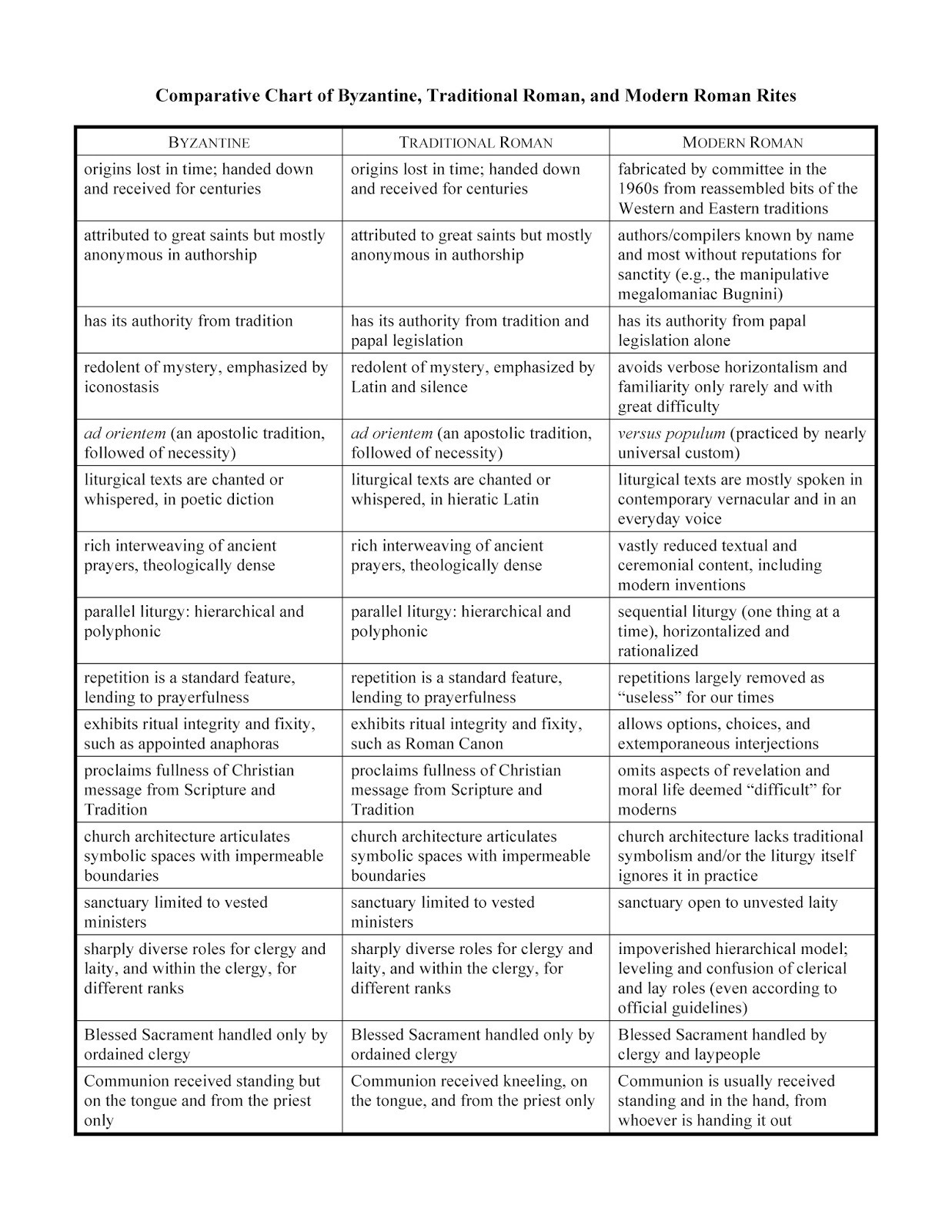
I can’t feel smug about this because I didn’t fashion the Byzantine Rite (used in Orthodox Churches) — and if I had fashioned it, much of the basis for smugness would vanish.

See New Liturgical Movement: The Byzantine Liturgy, the Traditional Latin Mass, and the Novus Ordo — Two Brothers and a Stranger as well.

My Orthodox friend John Brady has pointed out that even the Traditional Latin Mass had dropped the Epiclesis in favor of a supposed “consecration”, which this chart does not reflect.

A caution to culture warriors

No man can concentrate his attention upon evil, or even upon the idea of evil, and remain unaffected. To be more against the devil than for God is exceedingly dangerous. Every crusader is apt to go mad. He is haunted by the wickedness which he attributes to his enemies; it becomes in some sort a part of him.

Possession is more often secular than supernatural. Men are possessed by their thoughts of a hated person, a hated class, race or nation. At the present time the destinies of the world are in the hands of self-made demoniacs – of men who are possessed by, and who manifest, the evil they have chose to see in others. They do not believe in devils; but they have tried their hardest to be possessed – have tried and been triumphantly successful. And since they believe even less in God than in the devil, seems very unlikely that they will ever be able to cure themselves of their possession. Concentrating his attention upon the idea of a supernatural uncommon among secular demoniacs. But his idea of good was also supernatural and metaphysical, and in the end it saved him.

Aldous Huxley, The Devils of Loudun. (H/T Paul Kingnorth, who is ready to turn away from focusing on evil)

A writer I long greatly admired has seemingly fallen into the maw of focusing on evils. I will continue to pray for him, but I rarely can bear to read what he writes any more.

Religion is not a domesticated animal

Church and state would not be such a difficult subject if religion were, as the Court apparently thinks it to be, some purely personal avocation that can be indulged entirely in secret, like pornography, in the privacy of one’s room. For most believers it is not that, and has never been.

Antonin Scalia, quoted in Francis J. Beckwith, Taking Rites Seriously

Christian Nationalist cherry-pickers

Apparently, some self-styled Christian Nationalists have been taking refuge in a quote from St. Augustine:

[S]ince you cannot do good to all, you are to pay special regard to those who, by the accidents of time, or place, or circumstance, are brought into closer connection with you.

Our countrymen are closer than foreigners. Therefore, piss on everyone but our countrymen. Q.E.D.

Jake Meador schools these lame-brains, starting with, like y’know, the full Augustine quote.


We are in the grip of a grim, despairing rebellion against reality that imagines itself to be the engine of moral progress.

R.R. Reno

The end of the world as we know it is not the end of the world.

You can read most of my more impromptu stuff here (cathartic venting) and here (the only social medium I frequent, because people there are quirky, pleasant and real). Both should work in your RSS aggregator, like Feedly or Reeder, should you want to make a habit of it. I’m even playing around a bit here, but uncertain whether I’ll persist.

Sunday, 4/16/23

It’s Pascha (Easter) in Orthodoxy. Our Vigil was wonderful, but you had to be there to enjoy it, so I’ll not say any more.

Latins vs. Greeks

  • Two centuries later, fundamental differences in phronema [mindset] would again be an obstacle to union between the West and the East at the Council of Florence in 1439. Catholics presented rational arguments for their positions, and the Orthodox responded by citing apostolic Tradition. It was “the constant conviction of the Latins that they always won the disputation, and of the Greeks that no Latin argument ever touched the heart of the problem.”
  • Orthodoxy theology defines only what is necessary and always leaves unspoken that which cannot be explained. This approach was part of the Christian faith from the beginning. But the Western phronema often suppresses, dismisses, minimizes, or ignores this stance. The Western mind is compelled to define and explain everything, since without a rational explanation a concept or fact cannot be considered true, or, conversely, all truth can be proven rationally.

Eugenia Scarvelis Constantinou, Thinking Orthodox: Understanding and Acquiring the Orthodox Christian Mind

Ireland vs. America

Ireland is a palimpsest, a manuscript scraped imperfectly clean and reused, the old text bleeding through the new. A landscape with a long memory. As an American, I grieve the mnemonic emptiness of the New World. I long for ruins.

Justin Lee, Rewilding American Christianity

What the wrath of God looks like

I was nurtured on stories as a child that contrasted Christ’s “non-judging” (“Jesus, meek and mild”) with Christ the coming Judge (at His dread Second Coming). I was told that His second coming would be very unlike His first. There was a sense that Jesus, meek and mild, was something of a pretender, revealing His true and eternal character only later as the avenging Judge.

This, of course, is both distortion and heresy. The judgment of God is revealed in Holy Week. The crucified Christ is the fullness of the revelation of God. There is no further revelation to be made known, no unveiling of a wrath to come. The crucified Christ is what the wrath of God looks like.

Fr. Stephen Freeman, The Bridegroom and Judgment

This rings very true, although in my case “nurtured” refers mostly to my Christian high school and 2.5 years of Christian colleges. I do not recall my parents nurturing such a view.

But in your pondering whether you, too, were so nurtured, don’t fail to ponder the second paragraph.

Conservative Christian Europeans

The European experiment with trying to keep the Church alive amid dechristianization by making it more like the world has been a decisive failure. Christianity has to be different, and not be ashamed of that difference. In my European travels, the believers with whom I have spent time would be counted as conservative in moral and theological terms, but that, of course, does not track neatly with political conservatism.

Rod Dreher, Reconciling With The Really Real

Wild Christianity

“Wild Christianity” seems to have achieved almost (shudder!) même status, and predictably if being used in conflicting senses. But here’s a notable observer:

I have read an obscenely large number of articles and books on the decline of Christendom and the West, and even rushed in to write one myself, where angels fear to tread. But I have read absolutely nothing as close to the bull’s eye and as far from the bull’s opposite end as “A Wild Christianity” by Paul Kingsnorth, who, being a true poet, is not merely a singer but also a seer. Thank you, Gandalf.

Peter Kreeft, Boston College

I don’t disagree with Kreeft, who I have admired for more than 50 years. Read the worthy Kingnorth article.

Souls

[O]nce I was at an academic conference in Balamand, Lebanon, and I got a message that the Patriarch of Antioch, Ignatios IV at that time, wanted to meet me and another young theologian, who was from Greece, privately. What could this be about? We were ushered into a private drawing room, stood as His Beatitude entered, came forward to kiss his hand, and then sat down after he did. Well, he looks at us, and in perfect English exclaims, “The problem with you Greeks is that you are all dualists! Even a rock has a soul!!!” And that was it. He’d spoken his peace, he got up and left, and we were ushered back out.

‘Beauty First’ With Timothy Patitsas

Spiritual success

For those not fitting the NAR emotional profile (see below), there’s another option.

I have wondered how the “success” of the spiritual life would be measured? I could imagine that the number of persons baptized might be compared to the number of the baptized who fall short of salvation—but there is no way to discover such a thing. In lieu of that, we often set up our own way of measuring—some expectation of “success” that we use to judge the spiritual life. “I tried Christianity,” the now self-described agnostic relates, “and found that it did not live up to its claims.” [Laughter] I’ve seen things like that.

To my mind, the entire question is a little like complaining about your hammer because it doesn’t work well as a screw-driver. The problem is that the spiritual life doesn’t “work,” and it was never supposed to. It is not something that “works”; it is something that “lives.” And this is an extremely important distinction.

Fr. Stephen Freeman, The Slow Road to Heaven

It occurred to me within the last week or two that there’s at least one thing in America that’s immeasurably better than my childhood and adolescent status quo: there are Orthodox Christian Churches all over the place, and Orthodoxy has become a live option for Christians in other traditions they’re finding empty.

The Slow Road to Heaven

  • Despite every atheist protestation, religion abides – and if there is not one that is inherited, then a culture will invent new ones.
  • Power is an ever-present temptation in this world. It offers the notion that we can, by force (of arms or law), achieve our desired ends. That was true under emperors and tsars, and remains true within modern democracies. When Pilate questioned Jesus regarding the nature of His kingdom, Christ was very clear that His kingdom “is not of this world.” He adds that were His kingdom of this world – then His disciples would arm themselves and fight. That many Christians through the ages have imagined armed struggle to be an important element of the Christian life is a testament to our confidence in the weapons of this world and our lip-service to the Kingdom of God.
  • The crucified life is seen most clearly when it stands out against a background of worldliness.

Fr. Stephen Freeman, The Slow Road to Heaven

Safety check

“People aren’t asking whether Christianity is true, Abe. They aren’t even asking if it is good. My friends are wondering if Christianity is even safe.”

Jake Meador, quoting a friend of Abe Cho

I too readily accepted Cho’s quote as a valid indictment of (much) American Christianity. Meador does some helpful disambiguation of “safe.”

False mysticism

There’s a hymn that they used to sing at my childhood church that goes, “Turn your eyes upon Jesus, look full in his wonderful face, and the things of earth will grow strangely dim in the light of his glory and grace.” I get the point it’s trying to make: that encountering true hope, beauty and holiness puts pettier things in perspective. Still, my experience of faith is nearly the opposite of what the hymn describes. The more I have tried to seek God — the more I reach for truth, beauty and mystery that I know exceeds my grasp — the more bright, vivid and vital the things of earth become.

Tish Harrison Warren

New Apostolic Reformation

I usually park this provocative quote in the ending material of my blogs:

For all its piety and fervor, today’s United States needs to be recognized for what it really is: not a Christian country, but a nation of heretics.

Ross Douthat, Bad Religion

I had that point driven home powerfully in the last week, for I somehow stumbled upon an intriguing series within a podcast I almost certainly would never have visited otherwise.

The series was on the New Apostolic Reformation (NAR), about which I knew only three things fairly firmly:

  1. It emerged during my middle-age years.
  2. A formerly mainstream evangelical, C. Peter Wagner, who has been obsessed with “church growth” as long as I’ve known of him, was a prominent proponent.
  3. NAR believes it has Apostles leading the Church.

I now know much, much more, and it ain’t pretty.

The podcast was named “Straight White American Jesus.” With a title like that, it’s not the sort of place I frequent, just as I don’t dumpster-dive for my food. But despite the semiotics of that name, the podcast series, titled “Charismatic Revival Fury,” was delivered soberly and in scholarly fashion until the presenter got worked up for a while at the hypocrisy of NAR “Apostles” and “Prophets” backpedaling from the January 6 rioters, so many of whom they had inspired and whipped into frenzy. These were the rioters who apparently considered themselves Christian but who fit no pigeon-hole I knew — because their pigeon-hole was NAR.

I now realize that the NAR novelties have extended quite far, perhaps because C. Peter Wagner, even before his NAR days, would resort to just about anything in the name of “Church growth,” and NAR follows his example, thus keeping things at fever pitch with a stream of new “prophesies” and unchristian promises of political power (dominion).

Overall, the series was focused on the political ramifications of NAR. Usually, I think the press stupidly considers religion merely notional and fundamentally unreal until it eventuates in something political. And there was a bit of that sense here. I don’t think Straight White American Jesus would have been interested in exposing the heresies of NAR apart from its political ramifications. But when I went looking for analysis of NAR’s religious beliefs, the top hits were not from sources I think are reliable.

I’m not prepared to try to make sense of NAR here except that

  • it seems almost designed to be elusive, like nailing jello to the wall; and
  • it seems from the 30,000-foot level like an emotionalistic tradition led by a mixture of narcissistic “Apostles” and “Prophets.”

For all its piety and fervor, today’s United States needs to be recognized for what it really is: not a Christian country, but a nation of heretics.

Ross Douthat, Bad Religion

You can read most of my more impromptu stuff here (cathartic venting) and here (the only social medium I frequent, because people there are quirky, pleasant and real). Both should work in your RSS aggregator, like Feedly or Reeder, should you want to make a habit of it.

Sunday reading, 12/25/22

Church History 101

Don’t lose the first part of that quote by getting caught up in the important end of the quote — and end that defies pop Christian history. A lot of interpretive problems become easier if you remember that followers of The Way were originally a sect within Judaism (until eventually Judaism expelled them).

Islanded Selves

In late Western modernity we have constructed an atomized, value-free, material model in which our islanded selves are ultimately disconnected from one another. T.S. Eliot put his finger on it in the Choruses from the Rock:

When the Stranger says ‘What is the meaning of this city?
Do you huddle close together because you love each other?’
What will you answer? ‘We all dwell together
To make money from each other’? or ’this is a community’?

Malcolm Guite, Waiting on the Word

Three Maxims

  • I have never met a person that fasts faithfully who is at all more hypocritical or less virtuous than one who does not fast – not a single one … it is far more likely that the one who fasts is much more faithful.
  • Do not turn every virtue (like almsgiving or any “ministry”) into a program. This sort of administrative philosophy leads to despair.
  • Always remember that anger makes us temporarily energetic, but also stupid … I cannot think of one good thing I ever did or said in anger: but I can think of many regrets.

Father Jonathan Tobias, Second Terrace blog, January 29, 2018 (“Some maxims for the new wilderness”)

A Good Question

Rod Dreher, With the Bruderhof


You can read most of my more impromptu stuff here (cathartic venting) and here (the only social medium I frequent, because people there are quirky, pleasant and real). Both should work in your RSS aggregator, like Feedly or Reeder, should you want to make a habit of it.