Shattering a Shibboleth

I have increasingly come to respect the Evangelical Regent College (Eeeewwwww! I almost linked to Pat Robertson’s Regent “University”!) as a place of genuine learning (or that at least aspires to it). [Author’s note: there remains something called “Evangelicalism” that is a novel Christian sect rather than The Republican Party at Prayer. I was raised and educated in it.]

One of my favorite Protestants, Hans Boersma, was at Regent for a while until he left for the Anglican Nashota House. I stumbled across its podcast somehow a few months ago. Despite the giggliness of the hosts, many of the podcasts are quite good. But one that I just finished listening to made me exclaim “Glory to Jesus Christ!”

How do we understand a Christian conversion? Is it a static moment or is it a journey? Does our personal conversion experience match the experiences of our favourite Bible characters? In this episode, Gordon T. Smith, who by the way wrote 2 books and did a doctoral dissertation on this topic, challenges our concepts of conversion and tells us where all of our evangelical confusion around conversion started. You cannot miss this episode.

The notion of a “punctiliar” conversion (a new coinage, so far as I know, and not mine) — praying the Sinner’s Prayer, asking Jesus into your heart, etc. — was seemingly a sina qua non of evangelicalism as I grew up. If you couldn’t give the date when you so “got saved” you were highly suspect. The idea of just growing into the Christian faith was scorned.

But on this podcast, Gordon Smith challenges that head-on, tells its sorry history (which like most Evangelical errors is rooted in the 19th and 20th centuries — rarely even the late 18th century) and for my money demolishes it.

Smith’s understanding is not yet Orthodox, but freeing his mind, and those of his Regent College students, from a major Evangelical shibboleth* is huge.

May his tribe increase!

* I am aware that etymologically, a shibboleth is not something to be freed from or shattered, but I think it has evolved in usage to where both are apt.

* * * * *

Secularism, I submit, is above all a negation of worship. I stress:—not of God’s existence, not of some kind of transcendence and therefore of some kind of religion. If secularism in theological terms is a heresy, it is primarily a heresy about man. It is the negation of man as a worshiping being, as homo adorans: the one for whom worship is the essential act which both “posits” his humanity and fulfills it.

Alexander Schmemann, For the Life of the World, Appendix 1

[O]nce you say you are ashamed,
reading the page they hold out to you,
then such light as you have made
in your history will leave you.
They will no longer need to pursue you.
You will pursue them, begging forgiveness,
And they will not forgive you.
There is no power against them.
It is only candor that is aloof from them,
only an inward clarity, unashamed,
that they cannot reach ….

Wendell Berry, Do Not Be Ashamed

You can read most of my more impromptu stuff at here. It should work in your RSS aggregator, like Feedly, should you want to make a habit of it.

Perverse rejoicing

With a provenance like the Wall Street Journal’s “Houses of Worship” opinion series and a title like Thank God, American Churches Are Dying, you’d be justified in expecting a mix of self-conscious perversity and unhealthy, un-reflective antecedent bias.

You’d be right.

It’s true that denomination-based churches—Methodist, Baptist, Episcopal, Catholic—have been on a downward slope for years. But nondenominational evangelical churches are growing in number, from 54,000 in 1998 to 84,000 in 2012 …

Fresh churches replacing and created from old ones, armed with modern ideas to attract and tend to a new generation of believers …

… The leaders … generally focus on creating churches that cater to specific needs. There is a church exclusively for employees of Disney World. Spanish-language services are more popular than ever. “House churches,” composed of neighbors meeting for informal services—usually in living rooms—are on the rise as well. Popular Christian leaders like Francis Chan, a former megachurch pastor who now advocates house churches, offer free training for this model.

Those with denominational affinity will be sad to see a certain kind of church fall away. But the success of new models shows significant groups of people looking for ways to live faithfully, albeit in a less structured way. Could this really signify a religious awakening?

Ericka Andersen.

Wow:

  • “Nondenominational evangelical[s]” (but she repeat herself)
  • “armed with modern ideas” and
  • “cater[ing] to specific needs;”even
  • a church that excludes you based on who employs you.

Yet the cockles of my heart remain ice-cold. I must be some kind of monster. All I can think of is the one holy catholic and apostolic church, and the faith which was once for all delivered to the saints without any license to pander, negotiate over it, or erect barriers around it.

I will not deny a certain je ne sais pas, a certain frisson, at the closure of some churches. And God works in mysterious ways, about which circuitousness I can be awfully dense.

But if this is truly God’s work, it surely is to use these curated, Disneyfied simulacra to prepare postmoderns for the real thing.*

I fear, though, that it’s not God’s work at all. There’s another who sometimes appears as an angel of light, and who does his best work these days with counterfeits more than with frank apostasy.

(* The article’s reference to “House Churches” doesn’t trigger quite so strong a gag reflex. Those might prove to be Benedict-Option necessity in coming darkness here, as they have elsewhere in the world.)

* * * * *

Beloved, while I was very diligent to write to you concerning our common salvation, I found it necessary to write to you exhorting you to contend earnestly for the faith which was once for all delivered to the saints.

(Jude 3)

I appreciate Donald Trump’s judicial appointments and a few other things he has done, but I’m utterly opposed to allowing that hateful, unstable and completely self-serving man to serve as President. Maybe by saying it here, I’ll feel less compelled to fault his multiple daily outrages — mere corroboration of his dark soul and tormented mind — in the body of the blog.

You can read most of my more impromptu stuff at here. It should work in your RSS aggregator, like Feedly, should you want to make a habit of it.

Michael Gerson’s malice

Michael Gerson badly misrepresents Andrew Walker’s explanation for why many Evangelicals support Trump:

Walker is making the following claim: If you think abortion is a matter of life or death, then you must support whoever opposes it most vigorously, even if he or she is an immoral lout.

That is a maliciously bad misreading. Walker’s claim — and I read him attentively but critically — is far more like

that Trump opponents need to understand that because most of his fellow-Evangelicals think abortion is a matter of life or death, many of them have ended up uneasily supporting Trump, who opposes it while Democrats increasingly and defiantly support it and ban opponents from their ranks.

Walker said nothing about Trump votes actually being a moral imperative, but his premise is that it can feel like one. His column wasn’t even an argument for voting for Trump. It was a description of why some do. Thatt’s even plain from his title: Understanding Why Religious Conservatives Would Vote for Trump, not Why Serious Abortion Opponents Must Vote for Trump.

Remarkably, though, the rest of Gerson’s column explains lucidly, in five points (only the first of which is totally vitiated by what Walker actually explained), why supporting Trump is not a moral imperative for those who oppose abortion.

I even join Gerson in this:

I think Walker significantly (and strategically) overestimates the amount of moral angst amongst evangelical Trump supporters.

But then, I may agree with that just because of how both the press and Trump have treated Evangelicals as ipso facto Trumpista.

Anyone who thinks there’s a moral imperative to vote for Trump on anti-abortion grounds should read Gerson.

* * * * *

How small, of all that human hearts endure, that part which laws or kings can cause or cure.

(Samuel Johnson)

I appreciate Donald Trump’s judicial appointments and a few other things he has done, but I’m utterly opposed to allowing that hateful, unstable and completely self-serving man to serve as President. Maybe by saying it here, I’ll feel less compelled to fault his multiple daily outrages — mere corroboration of his dark soul and tormented mind — in the body of the blog.

You can read most of my more impromptu stuff at here. It should work in your RSS aggregator, like Feedly, should you want to make a habit of it.

Cultural Liturgies

America does not have a liturgy of repentance. The days of fasting once enjoined upon us are a thing of the past. Even then, for all the prayers and fasting of Lincoln’s republic, no particular liturgy ever marked the end of slavery, much less sought to repent for its evils. To this day, many seek to justify its history.

When the Soviet Union fell, within a few short years, Russians began to create memorials and liturgies for the atrocities of the Soviet Union. In Moscow, at the killing fields of Butovo, a Church now stands as a memorial to its victims. Public liturgies are held there on a regular basis. It is one of many such memorials across the country.

Our public narrative is very thin. The Church historian, Martin Marty, once said that American Christianity was “2,000 miles wide and 2 inches deep.” When our Christian theology mimics the triumphant patriotism of our culture, nothing deeper ever begins. Depth comes with suffering. Suffering creates sorrow, and sorrow, of a godly sort, produces repentance.

We are bad at enough stuff and have a history sufficiently marked with sorrow to create fertile ground for repentance. It lacks the humility to greet it.

It is ever so much more than a game.

Fr, Stephen Freeman

I suspect that Fr. Stephen’s blog entry was spurred by Sunday’s SuperBowl LIV, with the only liturgical elements our nation knows: patriotism with a dash of remembrance. It might even have been influenced by Fr. Steven browsing the Eighth Day Books book table at the Eighth Day Symposium a bit over a week ago, on which table I’m pretty sure James K.A. Smith’s Cultural Liturgies trio was on display.

* * * * *

Trump didn’t do the thing he’s accused of doing, but if he did it was fine, and in fact that’s exactly what he did, get over it, because it’s not only fine, it’s precisely what we want from a president, and can you believe that Biden did the same thing, shame on him.

Peter Sunderman

You can read most of my more impromptu stuff at here. It should work in your RSS aggregator, like Feedly, should you want to make a habit of it.

Job’s Comforters

I’ve never recoiled from Job’s Comforters. At least they were “there for him” after a fashion, right?

Maybe I’m on the Autism Spectrum, or haven’t shaken off the last of my “former delusion,” repudiated when I entered Orthodoxy.

But the promised blessings and cursings in Deuteronomy were not sui generis in the Old Testament henotheistic millieu. That gods reward their followers and punish deviants was hardly an outrageous or (if I may wax anachronistic) Pharisaical worldview before Christ.

Some of the Psalms presented a more equivocal view, and we’ve learned from the highest of authorities, through pericopes like the man born blind, that into each life some rain must fall.

But the lessons that grief is not the time for theodicy, and that “I’m so sorry” is generally the best thing we can say when we’re tempted to something more “pious,” are not learned and remembered easily.

I’ve even heard dubieties coming from the mouths of the putatively grieving, trying to comfort their comforters. I’m thinking especially of a Calvinist father whose young adult son wrapped his car around a tree while home on leave. “We prayed that God would keep him from apostasy, and this apparently was the answer.”

That seemed very pious at the time. Now it seems reptilian. Another of his children did apostatize, and wrote a kiss-and-tell book about growing up in that household. I couldn’t bear to read it, but it sounded all too plausible from the reviews.

I guess Job wouldn’t have been much of a story if three guys showed up and just kept saying “we’re so sorry, Job.”

And we can always be grateful for Bildad the Shuhite as the punchline for “Who’s the shorted man in the Bible?”

* * * * *

You can read most of my more impromptu stuff at here. It should work in your RSS aggregator, like Feedly, should you want to make a habit of it.

I highly recommend blot.im as a crazy-easy alternative to Twitter (if you’re just looking to get your stuff “out there” and not pick fights).

Sometimes, serendipity!

I blogged just yesterday, on the occasion of his death, about the odd metanarratives of “religion” Supreme Court Justice John Paul Stevens gratuitously spun in some of his religion clause opinions. I acknowledged (boasted?) that nobody else had noticed the falsity of his metanarrative.

And the response to yesterday’s blog seems to be that nobody noticed. Or they noticed and averted their eyes from my nakedness.

Today, in heat indices forecasted to reach 109° F and with a diagnosis of a torn ankle tendon requiring immobility, I decided to (among other things) catch up on some blogs I set aside because the author is always too substantive for a quick read.

And boy, was I ever rewarded! Sometimes, serendipity!

To appreciate why I was so delighted, you’ll need to go back to yesterday’s blog, painful though that may be, and see the parallels between what I wrote about what I called “integral Christianity” and what I found in The Struggle Against The Normal Life:

  • a better description of classical Christianity (I guess I was becoming a classical Christian long before I became one formally)
  • a contrast between it and modern Christianities (of the sort Justice Stevens had in mind),
  • acknowledgement that modern Christianities are ascendant, if facile and false, and
  • a call to the repentance and asceticism necessary to maintain classically Christian belief amid the hegemony of heterodoxy.

Excerpts (generous, but not exhaustive; this one needs to be read in full, then read again and again):

Within the Christianity of our time, the great spiritual conflict, unknown to almost all, is between a naturalistic/secular world of modernity and the sacramental world of classical Christianity. The first presumes that a literal take on the world is the most accurate. It tends to assume a closed system of cause and effect, ultimately explainable through science and manageable through technology. Modern Christians, quite innocently, accept this account of the world with the proviso that there is also a God who, on occasion, intervenes within this closed order. The naturalist unbeliever says, “Prove it.”

The sacramental world of classical Christianity speaks a wholly different language. It presumes that the world as we see it is an expression of a greater reality that is unseen. It presumes that everything is a continuing gift and a means of communion with the good God who created it. The meaning and purpose of things is found in that which is not seen, apart from which we can only reach false conclusions. The essential message of Christ, “The Kingdom of God is at hand,” is a proclamation of the primacy of this unseen world and its coming reign in the restoration of all things (apokatastasis, cf. Acts 3:21).

The assumptions of these two worldviews could hardly be more contradictory. The naturalistic/secular model has the advantage of sharing a worldview with contemporary culture. As such, it forms part of what most people would perceive as “common sense” and “normal.” Indeed, the larger portion of Christian believers within that model have no idea that any other Christian worldview exists.

The classical/sacramental worldview was the only Christian worldview for most of the centuries prior to the Reformation. Even then, that worldview was only displaced through revolution and state sponsorship. Nonetheless, the sacramental understanding continues within the life of the Orthodox Church, as well as many segments of Catholicism. Its abiding presence in the Scriptures guarantees that at least a suspicion of “something else” will haunt some modern Christian minds.

The classical model is, in fact, the teaching found in the Scriptures. It utterly rejects the notion of spiritual knowledge belonging to the same category as the naturalistic/secular world. It clearly understands that the truth of things is perceived only through the heart (nous) and that an inward change is required. It is impossible to encounter the truth and remain unchanged.

The classical model, particularly as found within Orthodoxy, demands repentance and asceticism as a normative part of the spiritual life. These actions do not earn a reward, but are an inherent part of the cleansing of the heart and the possibility of perceiving the truth.

The struggle between classical/sacramental Christianity and modernity (including its various Christianities) is not a battle over information. The heart of the struggle is for sacramental Christianity to simply remain faithful to what it is. That struggle is significant, simply for the fact that it takes place within a dominant culture that is largely its antithesis.

A complicating factor in this struggle is the fact that the dominant culture (naturalistic/secular) has taken up traditional Christian vocabulary and changed its meaning. This creates a situation in which classical Christianity is in constant need of defining and understanding its own language in contradistinction to the prevailing cultural mind. The most simple terms, “faith, belief, Baptism, Communion, icon, forgiveness, sin, repentance,” are among those things that have to be consistently re-defined. Every conversation outside a certain circle requires this effort, and, even within that circle, things are not always easy.

Such an effort might seem exhausting. The only position of relaxation within the culture is the effortless agreement with what the prevailing permutations tell us on any given day. Human instinct tends towards the effortless life – and the secular mentality constantly reassures us that only the effortless life is normal. Indeed, “normal, ordinary, common,” and such terms, are all words invented by modernity as a self-description. Such concepts are utterly absent from the world of Scripture. Oddly, no one lived a “normal” life until relatively recently.

That which is “normal” is nothing of the sort. It is the purblind self-assurance that all is well when nothing is well.

(Fr. Stephen Freeman, emphasis added)

So, among other (much more important) things, I should not be surprised that “the sacramental world of classical Christianity” was unknown to Justice Stevens, just as it is “unknown to almost all.”

This does nothing to relieve my concerns about his false metanarrative making its way into Supreme Court precedents. I can only hope that it’s seen as the obiter dicta that it is.

* * * * *

You can read most of my more impromptu stuff at here. It should work in your RSS aggregator, like Feedly, should you want to make a habit of it.

I highly recommend blot.im as a crazy-easy alternative to Twitter (if you’re just looking to get your stuff “out there” and not pick fights).

Forsaking lunacy, again and again

I have long thought that the best critique of Rod Dreher’s Benedict Option is that he’s just asking Christians to actually act like Christians, and asking the Church actually to do the work of the Church. (Long? Well, the book has barely been out for a year, hard as that is to believe, but I watched it gestate on his blog.)

I also have long thought that the best defense of the Benedict Option is that Dreher’s just asking Christians to actually act like Christians, and asking the Church actually to do the work of the Church.

Dreher’s seemingly anodyne requests are important in part because too damned many professing Christians are interested in God’s minimum requirements, when His minimum requirement is, and always has been, everything. Too many Churches (I didn’t use scare quotes. You’re welcome.) are interested only in institutional survival, and will pander to the basest fads to keep the coffers full and tushies in the pews.

Maybe just-enough-to-not-go-to-hell Christianity is nothing new. If not, that would explain the emergence in so many ages of prophetic voices. Alan Jacobs makes the same substantive prophetic point as Dreher in rather unprophetically winsome garb, coming at it from a much different direction, too. I cannot improve on Jacobs, so I’ll not try. Just go read it.

But I’m persuaded that to become an idiot rather than a lunatic (and I’ve demonstrated my lunacy today by spending too much time on the ramifications of Julian Assange’s indictment), I must read Jacobs’ beloved Black Lamb and Grey Falcon, toward which I have taken the necessary first step of getting it onto my Kindle.

* * * * *

You can read most of my more impromptu stuff at here. It should work in your RSS aggregator, like Feedly, should you want to make a habit of it.

I highly recommend blot.im as a crazy-easy alternative to Twitter (if you’re just looking to get your stuff “out there” and not pick fights).

Clippings, 1/4/19

1

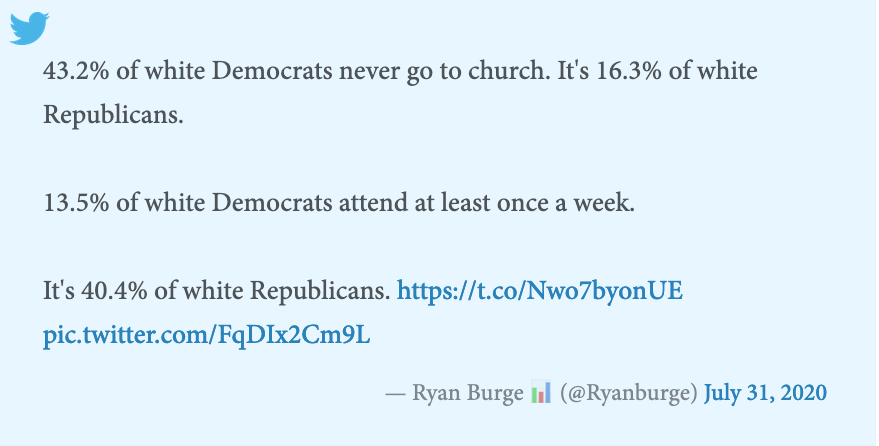
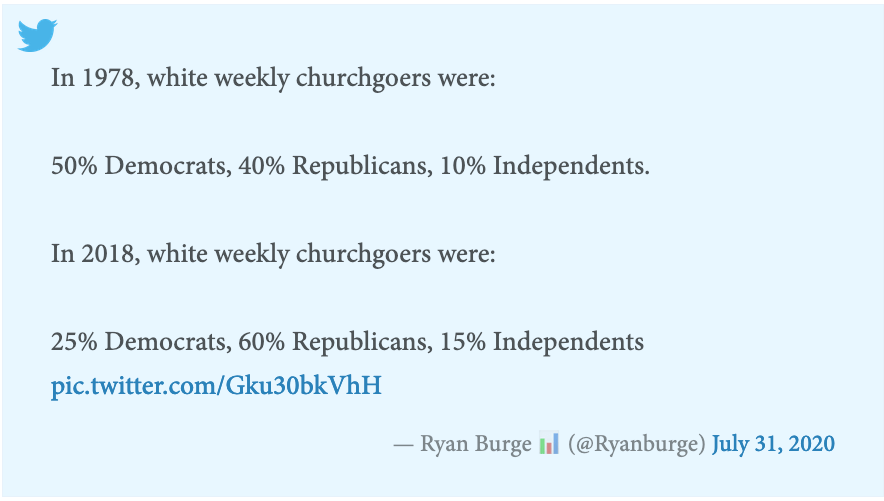
A reminder that not all “Evangelical” Trump supporters are merely self-described Evangelicals who do not actually go to church:

You and other white evangelical leaders have strongly supported President Trump. What about him exemplifies Christianity and earns him your support?

What earns him my support is his business acumen. Our country was so deep in debt and so mismanaged by career politicians that we needed someone who was not a career politician, but someone who’d been successful in business to run the country like a business. That’s the reason I supported him.

Is there anything President Trump could do that would endanger that support from you or other evangelical leaders?

No.

That’s the shortest answer we’ve had so far.

Only because I know that he only wants what’s best for this country, and I know anything he does, it may not be ideologically “conservative,” but it’s going to be what’s best for this country, and I can’t imagine him doing anything that’s not good for the country.

Washington Post interview with Jerry Fallwell Jr..

Don’t lose sight of the credulity amidst that idolatry. Jerry Fallwell Jr. actually believes that Trump is a successful businessman, not conman and tax fraudster who played a successful businessman on Reality TV.

I bow deeply to young, über-progressive Godbeat reporter Elizabeth Breunig for her synopsis:

Jerry Falwell Jr. is once again spreading his uniquely modern, American version of a business philosophy roughly based on the religion known as Christianity.

He seems … to have been reasoning backward, trying to explain in Christian terms why he holds the conclusions he does, rather than beginning from the religion and following it to its own conclusions ….

Breunig is not doing the usual cherry picking of progressive or secularist “clobber passages.” She reminds me instead of the conservative American Christian who went to Europe, found people who shared his religious convictions, but was stunned to find that they considered themselves socialists.

2

[T]he problem is the emergence, over the course of a century, of a fourth branch of government neither conceived by nor desired by the framers of the Constitution: a network of administrative agencies that combine legislative, executive and judicial powers and therefore threaten the integrity of the constitutional framework and the basic rights of the American people …

But conservatives often misdiagnose the process by which the administrative state has arisen. We emphasize the hyperactivity of the executive and judicial branches, and these are certainly part of the problem. But hiding in plain sight is a deeper cause: the willful underactivity of the legislative branch. In an effort to avoid hard choices and shirk responsibility, Congress enacts vague statutes that express broad goals, empower executive agencies to fill in the practical details, and leave courts to clean up the ensuing mess. The result can look like executive overreach and judicial activism, but the root of the problem is legislative dereliction.

Yuval Levin, reviewing Judicial Fortitude by Peter Wallison.

Exactly. Thank you.

More:

[A] certain kind of judicial activism is actually a necessary precondition to judicial restraint and to any form of originalism: Judges must make sure that each branch of government does no more but also no less than the job the Constitution assigns it. “If Congress were permitted to delegate its exclusive legislative authority to the administrative agencies in the executive branch,” he writes, “the separation of powers would be a nullity and the dangers to liberty envisioned by the Framers could become a reality.” To avoid that, judges must insist that Congress engage in actual legislating by preventing it from handing over its power to regulatory agencies.

I very much like this idea. I’m tempted to buy the book to see how Wallison elaborates on “statutes that express broad goals, [and] empower executive agencies to fill in the practical details.” Is it just laziness, or is it fear of dark money ads ominously saying that “Congressman Schmoe voted against the Apple Pie, Motherhood and the Flag Act.”

3

I haven’t kept a scorecard, but I’ve been watching Kamala Harris since her days as California Attorney General, and she is toxic and hostile to people like me. Her treatment of Catholic judicial nominee Brian Buescher is not an uncharacteristic break in a record of tolerance, but just another mark of her progressive totalitarianism, her intent to use the levers of government to silence religious conservatives.

She is a very dangerous woman. And she’s generating a lot of buzz as the 2020 Democrat Presidential nominee.

* * * * *

Follow me on Micro.blog Follow me on Micro.blog, too, where I blog tweet-like shorter items and … well, it’s evolving. Or, if you prefer, those micro.blog items also appear now at microblog.intellectualoid.com.

Put Mass back in Christmas

In the late 1600’s in colonial Boston, the celebration of Christmas was against the law. Indeed, anyone evidencing the “spirit of Christmas” could be fined five shillings.

English Churches outside of the Catholic and Anglican were non-liturgical. The “feast” of Christmas was as absent as the “feast” of anything else. It was not part of their consciousness. Thus, the growth of a popular Christmas in the mid to late 19th century took place outside the walls of the Church. It became a cultural holiday, with an emphasis on family and the home.

Surprisingly, Christmas is probably far more a part of Protestant Church life in America today than at any time in our history. But the echoes of cultural Christmas remain strong. When Christmas Day falls on a Sunday, Christianity in America revisits its conflicted past. It is not unusual to see Churches of a more Evangelical background cancelling Sunday services, deferring to Christmas as a “family” celebration. For liturgical Churches (Catholic, Orthodox, Anglican, Lutheran, etc.) such a practice seems scandalous in the extreme.

There are protests against the secular Christmas that say, “Put the Christ back in Christmas!” From a liturgical point of view I’ve wanted to add, “And put the Mass back in Christmas!” It is, after all, a feast of the Christian Church. Neither of these, however, will likely be dominant in a culture that once had little Christmas at all.

(Fr. Stephen Freeman)

* * * * *

Follow me on Micro.blog Follow me on Micro.blog, too, where I blog tweet-like shorter items and … well, it’s evolving. Or, if you prefer, those micro.blog items also appear now at microblog.intellectualoid.com.