Saturday, 11/8/25

Public affairs

Give me that old, boring gummint

An aspect of the modern conservative disposition is that we like the arts, culture and technology to be interesting and exciting, but we prefer government be boring, a stabilizing force while we act up in other areas. But it’s never boring now and likely won’t be in this century. Too bad.

Peggy Noonan

Nancy Pelosi

[F]or the anti-Trump right (insofar as such a thing exists outside the Dispatch break room), Pelosi’s departure is a grim symbol of the Duma-fication of Congress. It’s fitting that the most formidable Democratic legislator in modern U.S. history will leave office in 2027 on the same day as the most formidable Republican legislator in modern U.S. history. Serious institutionalists like Pelosi and Mitch McConnell have no business in a branch of government that no longer exists as a serious institution.

Nick Catoggio

Sorry, Senator Young

Sorry, Senator, but I won’t answer.

I could probably rank this list, but I fear I’d see it misrepresented as “my constituents’ most important issue is …”, whereas my real most important issue is the impeachment and conviction of Donald J. Trump, who defiles everything he touches.

Remember: the theory behind Presidential immunity from criminal prosecution was “that’s what impeachment is for.” Well, put on your big-boy pants and take out the trash.

(I was reminded yesterday that my sanctimony toward sleazy politicians is a persistent feature. I voted for McGovern because Nixon was a crook, McGovern an honorable guy I disagreed with on just about everything. I don’t vote for Democrats often, but I’ve found creative ways not to vote for Trump’s corruption and rapacity nonetheless.)

Clueless

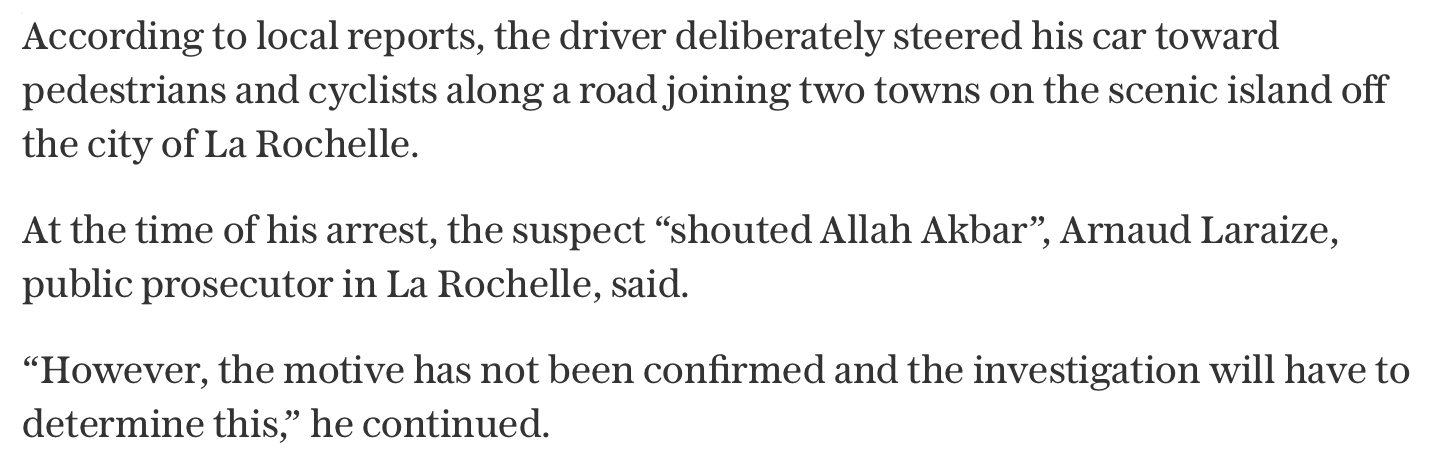
A driver smashed into pedestrians and bikers on the beautiful French island of Île d’Oléron.

I’m so excited for the investigation to reveal the motive behind someone driving their car into random French cyclists and screaming “Allahu Akbar.” I don’t know about you, but he sounds like a Christian nationalist to me. Anyone else smell a fresh pine and cinnamon Bath & Body Works candle? This guy is all in on Replacement Theory, I just know it.

Nellie Bowles

Culture

Grief

Grief turns out to be a place none of us know until we reach it. We anticipate (we know) that someone close to us could die, but we do not look beyond the few days or weeks that immediately follow such an imagined death. We misconstrue the nature of even those few days or weeks. We might expect if the death is sudden to feel shock. We do not expect this shock to be obliterative, dislocating to both body and mind. We might expect that we will be prostrate, inconsolable, crazy with loss. We do not expect to be literally crazy, cool customers who believe that their husband is about to return and need his shoes. In the version of grief we imagine, the model will be “healing.” A certain forward movement will prevail. The worst days will be the earliest days. We imagine that the moment to most severely test us will be the funeral, after which this hypothetical healing will take place.

Joan Didion, The Year of Magical Thinking.

This is the first Joan Didion I’ve read. I’m told that it’s not her best, but it was plenty good enough for me.

Me, too

(Yes, I know it’s more than a little absurd that I’m writing a post about a TV show that ended its run eight years in the past. The thing is, I almost never watch series when they first appear. I usually turn to them, instead, years later, after I’ve heard enough praise that I feel like their quality has been adequately verified to justify my time and attention. This way of proceeding has never let me down. And anyway, in an era of streaming, there’s nothing to keep a decade-old show from becoming someone’s big new discovery years after it drops.)

Damon Linker, winding up for a glowing post about an HBO Series, The Leftovers.

I’m with him on not rushing to watch a new series. Most of them are trash – precisely as most of all art, music and literature are trash. It was ever so. What’s good will endure.

Words of the Day

The words of the day are pareidolia and apophenia.

Well, I didn’t know them, and much as I love big words this may be the last time I ever use them.

Snippets

  • Mystery is a great embarrassment to the modern mind. (Flannery O’Connor)
  • Foul is fair and fair is foul. (Shakespeare, though I was thinking of John Maynard Keynes’ distillation of his case for temporary rapacity.)
  • What Stephen A. Smith is to sports talk, Tucker Carlson is to obsessive anti-Zionism. Rich Lowry
  • All civilizations are as transitory as the people now in cemeteries. And just as we must die, so too must we accept that there is no return to a civilization whose time has come and gone. (Abdülhak Şinasi Hisar via Orhan Pamuk, Istanbul)
  • The people [Trump] picks tend to be a grab bag of personality disorders who squabble and fight for power, he tends to screw them over when they annoy him, and they’re all quite annoying. (Ken White, Refuge in Kakistocracy, Popehat)
  • The problem with pornography is not that it shows too much of a person, but that it shows far too little. Pope John Paul II via Isabel Hogben
  • Populism is fundamentally a form of suspicion. Yuval Levin on the Remnant podcast.
  • We need to be a big tent so as to include neo-Nazi and Nazi-adjacent people, [and] if you have a problem with that, you need to get out of the tent. Jonah Golberg on the Remnant podcast criticizing the “popular front mind” on the Right.
  • Dick Cheney couldn’t get over Jan. 6. Ramesh Ponnuru (That’s got to be among the most understated things I’ve seen this week.)

We are all gatekeepers now.

Peggy Noonan

Your enemies are not demonic, and they are not all-powerful and the right hasn’t always lost and the left hasn’t always won. But if you convince yourself of that, you give yourselves all sorts of permission to do a lot of stupid and terrible things under the rubric of “Do you know what time it is?”

Jonah Goldberg.

[A] critical mass of the American people … no longer want[s] to govern themselves, … are sick of this republic and no longer want to keep it if it means sharing power with those they despise.

Nick Catoggio

I don’t do any of the major social media, but I have two sub-domains of the domain you’re currently reading: (a) You can read most of my reflexive stuff, especially political here. (b) I also post some things on my favorite no-algorithm social medium.

New World Order

[H]ere’s the real takeaway: Tianjin is not just hosting another international gathering; it is hosting the embryonic headquarters of a new world order. When half of humanity convenes to discuss not how to obey the old hegemon, but how to craft sovereign industrial futures, the game has already shifted. The West, stuck in yesterday’s script of divide and rule, cannot grasp that the 21st century is already unfolding elsewhere – in Russian engines powering Chinese jets, in oil tankers sailing east, in Modi and Putin shaking hands against the backdrop of an Asia that is no longer waiting for permission. The SCO in Tianjin is Eurasia writing history, while the West scribbles in the margins of its own decline.

My cyberfriend Terry Cowan, commenting on Shangai Cooperation Organization (the SCO) meeting in Tianjin, China — without us. Here’s how a few of our mainstream media covered it (not that Terry thinks they’ve got much true to say):

Then, a day later, Trump exerted his charm:

Twenty-six heads of state joined Xi Jinping to watch a military parade in Beijing. They included many autocrats, including from Russia and North Korea, but no leaders of big Western democracies. Beforehand Mr Xi said mankind faced a choice between peace and war, and called China “unstoppable”. Donald Trump told China’s leader to “give my warmest regards to Vladimir Putin, and Kim Jong Un, as you conspire against The United States”.

The Economist World in Brief, Wednesday 9/3. Fuller Economist coverage here.

John Ellis channels the Financial Times:

Xi Jinping has capped a week of frenetic diplomacy by presiding over one of China’s biggest military parades, projecting his nation’s growing power in a show of solidarity with fellow strongmen Vladimir Putin and Kim Jong Un. A procession of China’s newest tanks, drones and missiles rolled past Tiananmen Square on Wednesday to mark the 80th anniversary of the second world war victory over Japan. The People’s Liberation Army showed off its latest weapons, including hypersonic missiles, with Xi hailing troops as a “heroic force” that should develop into a “world-class military” — implying a full equal to the US’s armed forces. The Chinese president said the PLA would “resolutely safeguard national sovereignty, unity and territorial integrity” — code for Beijing’s goal of gaining control over Taiwan. “The great rejuvenation of the Chinese nation is unstoppable,” Xi added. (Source: ft.com)

I’m not going to blame Donald Trump for all this. I have little doubt that his various tarrifs, trash-talking, vacillation and so forth accelerated it, but the American empire didn’t much rally under Joe Biden, either. We’re at an inflection point, and I expect us to be much closer to “bit player” than to “hegemon” when it’s over.


[A] critical mass of the American people … no longer want[s] to govern themselves, … are sick of this republic and no longer want to keep it if it means sharing power with those they despise.

Nick Catoggio

I don’t do any of the major social media, but I have two sub-domains of the domain you’re currently reading: (a) You can read most of my reflexive stuff, especially political here. (b) I also post some things on my favorite social medium.

Tuesday, 7/22/25

L’affaire Coldplay

If there’s a truly compelling reason not to normalize shaming as a global, always-on public spectator sport, it’s not that it degrades the humanity of the shamed; it’s not even the trite “who among us has not canoodled at a Coldplay concert with his sidepiece” justification. It’s simply this: When we take joy in the distress and ruination of other people, we make monsters of ourselves.

Kat Rosenfield

Apart from taking joy in distress and ruination, I have no reason to seek out the mêmes and other drollery about the ColdPlay kisscam. This, though, came to me unbidden:

Who’s killing the liberal arts?

An unpleasant truth has emerged in [the University of] Tulsa over the years. It’s not that traditional liberal learning is out of step with student demand. Instead, it’s out of step with the priorities, values and desires of a powerful board of trustees with no apparent commitment to liberal education, and an administrative class that won’t fight for the liberal arts even when it attracts both students and major financial gifts. The tragedy of the contemporary academy is that even when traditional liberal learning clearly wins with students and donors, it loses with those in power.

For those who do care to see liberal learning thrive on our campuses, the work my colleagues and I did at Tulsa should be a model. How did we do it? We created an intentional community where our students lived in the same dorm and studied the same texts. We shared wisdom, virtue and friendship as our goals. When a university education is truly rooted in the liberal arts, it can cultivate the interior habits of freedom that young people need to live well. Material success alone cannot help a person who lacks the ability to form a clear, informed vision of what is true, good and beautiful. But this vision is something our students both want and need.

Jennifer Frey, This Is Who’s Really Driving the Decline in Interest in Liberal Arts Education

Voting consequentially

When people justify their voting choice by its outcome, I always think of The Lord of the Rings. Tolkien emphasizes repeatedly that we cannot make decisions based on the hoped-for result. We can only control the means. If we validate our choice of voting for someone that may not be a good person in the hopes that he or she will use his power to our advantage, we succumb to the fallacy of Boromir, who assumed he too would use the Ring of Power for good. Power cannot be controlled; it enslaves you. To act freely is to acknowledge your limits, to see the journey as a long road that includes dozens of future elections, and to fight against the temptation for power.

Jessica Hooten Wilson, What ‘The Lord of the Rings’ can teach us about U.S. politics, Christianity and power

I met Jessica some years ago at a conference where she was the Protestant keynoter. We spoke a bit because she was teaching at a University that I don’t even bother putting on my resumé despite spending three semesters there in the very late 60s. I dare say her scholarship was an order of magnitude higher than any of the mediocrities teaching when I was there.

Even the one prof to whom I owe a debt of gratitude earned that by a pretty banal observation that just happened to be what I needed at the moment — and I can’t even remember his name because at the time I didn’t realize how consequential that moment would prove to be.

Shorts

  • We’ve been telling kids for 15 years to code. Learn to code, we said. Yeah well, AI is coming for the coders. They’re not coming for the welders. (Mike Rowe)
  • I grew up in San Francisco, walking with my family by the Golden Gate Bridge. I still remember the thick and iconic chain railing that gave the place a sense of distinctiveness. Now the chains are gone, and they’ve been replaced by a soulless metal railing that’s colder than a hospital waiting room. … This is how a culture loses its charm: slowly, quietly. (David Perell).

Quotes via Andrew Sullivan

The convoluted feelings behind the right to be killed

Let us first note that the demand for legal assisted suicide addresses not the legality of killing oneself, but the legality of assisting others to kill themselves. The suicidee (patient? victim?) is secondary. The primary object of the right-to-die movement is the living.

People may kill themselves at any time, without permission or even much pain. Even where it is not legally permitted, suicide, once accomplished, is beyond the reach of legal consequence.

… We must … focus on the desire for someone else to do the killing. Alongside fear of a botched attempt or leaving behind a mess for others, I suggest that the desire for assisted suicide is a perverse expression of the need for recognition. People who wish to kill themselves also want their choice to be socially approved.

… Its advocates say they wish to die with dignity, and then they ask to be euthanized like pets. … [T]he “right” to assisted suicide can only be the right not to be recognized as a human being.

When black Americans were struggling for civil and human rights—for the recognition of their humanity— they arrived at the profound conviction that it was dignified to risk death in that struggle. Assisted suicide represents a perverse inversion: a renunciation of dignity, the demand that one’s humanity go unrecognized. A society that honors that demand will not, in the end, recognize the humanity of anyone.

Matthew Burdette, The Right to Be Killed

From “worst of the worst” to “anybody will do”

Earlier this month, 25-year-old George Retes was arriving for work at a Southern California marijuana farm when federal agents circled his vehicle, broke his window, and sprayed him with tear gas and pepper spray before taking him into custody. Retes, among the more than 360 people to be arrested in the large-scale immigration raid, went on to spend three days in a Los Angeles detention center. 

The problem? Retes is a U.S. citizen and Army veteran, and was not charged with breaking any laws. “I want everyone to know what happened. This doesn’t just affect one person,” he told reporters following his release, sharing plans to sue for wrongful detention. “It doesn’t matter if you’re a veteran or you serve this country. They don’t care. They’re just there to fill a quota.”

It’s now been six months since President Donald Trump entered office with a promise to remove “the worst of the worst” from American soil. And indeed, arrests by Immigration and Customs Enforcement (ICE) have shot up as illegal border crossings—and, consequently, detentions by Customs and Border Protection—wane. Yet a significant portion of ICE detainees have no criminal record aside from being in the country illegally, with the Trump administration’s sweeping roundups seemingly targeting individuals on a more or less random basis.

The Morning Dispatch

I don’t particularly care if Trump deports everyone who is in the US illegally, though I doubt that any President will do that as long as we want people to do unattractive jobs for “dirt cheap” — including, I suspect, at Trump’s own Casinos and resorts. On the other hand, I’m not eager for him to do it.

What I definitely object to is the apparatus of terror, with masked ICE agents more-or-less indiscriminately grabbing and gassing people who just might help them meet quota. Or even doing that more discriminatingly, come to think of it.

Dreaming of Europe. And waking up.

Whenever I’m down; whenever I’m blue; whenever I think e.e. cummings retired the poet trophy with one poem; especially whenever I wonder whether it’s too late to become a naturalized Frenchman (or Italian, or …); I should by all means remember this: more Europeans die of heat death—largely due to lack of air-conditioning—than Americans die from gunshot wounds. (Factoid via Tyler Cowen)

I’m not so stupid as to think this is the ultimate answer to whether we’re the greatest country in the world. But even if it’s the best argument we’ve got, it’s not nothing.

It was and is ever so

You can take this to the bank: If the New York Times notices the Buddha, the enlightened one has already left town.

Ted Gioia, The Ten Warning Signs

Two political items

Jonathan Rauch had Trump 2.0 pegged years in advance

In August, 2022, Jonathan Rauch delineated what would happen if America elected Trump again: We Don’t Have to Speculate About Trump’s Next Term

I thought at the time that he was uncharacteristically shrill, even if he was right. But I came across it again, and he was remarkably accurate.

The (In)Effective Executive

President Donald Trump has a couple of problems when it comes to being an effective executive, the top two being: 1) He is an ignoramus and 2) He insists on surrounding himself with yes-men who are too afraid to tell him that he is an ignoramus.

Kevin D. Williamson


Your enemies are not demonic, and they are not all-powerful and the right hasn’t always lost and the left hasn’t always won. But if you convince yourself of that, you give yourselves all sorts of permission to do a lot of stupid and terrible things under the rubric of “Do you know what time it is?”

Jonah Goldberg.

Trumpism can be seen as a giant attempt to amputate the highest aspirations of the human spirit and to reduce us to our most primitive, atavistic tendencies.

David Brooks

I don’t do any of the major social media, but I have two sub-domains of the domain you’re currently reading: (a) You can read most of my reflexive stuff, especially political here. (b) I also post some things on my favorite social medium.

Thursday, 7/17/25

The Main Event

Culture

You’d have to be stupid not to specialize in generalizing

[C]olleges’ pre-professional bent — reflected, too, in some schools’ elimination of such unpopular humanities majors as classics and art history — can be as imprudent as it is unimaginative. The modern job market has a flux and furious metabolism that routinely make a mockery of the best laid plans. “The Computer Science Bubble Is Bursting,” read the headline on an article in The Atlantic by Rose Horowitch last month. It noted that while the number of computer science majors in the United States had quadrupled between 2005 and 2023, it was now on the decline because of “a grim job outlook for entry-level coders.” “Artificial intelligence has proved to be even more valuable as a writer of computer code than as a writer of words,” Horowitch wrote. “This means it is ideally suited to replacing the very type of person who built it.”

So, consulting is the ticket? Not so fast. “If consulting was a stock, I’d be shorting it right now,” the entrepreneur and venture capitalist Peter Thiel told Joe Nocera for an article in The Free Press last week. Its headline: “The Consulting Crash Is Coming.” Its subhead explained that consultants, like coders, are being “outpaced by A.I.”

The moral of those two stories is that the smartest approach to college may be precisely the one that its trajectory of late has conspired against: range widely across subject offerings and focus not on a skill that could become obsolete but on intellectual dexterity and powers of judgment with better odds of enduring relevance. “A liberal arts degree is a pre-professional degree — you just don’t know what the profession is,” said Zimmerman, who teaches a seminar for first-year students at U-Penn called “Why College?”

Frank Bruni

“Learn to code” seemed the veriest wisdom, until suddenly it wasn’t. It has been so my whole lifetime: “We have a shortage of X; therefore, the smart college major is X” has never been very good at assuring that X is a remunerative profession even in the short-term.

Correctionist history

We have a view of the war that emphasizes the decisive American involvement, and with Hollywood’s aid, has become part of our national myth. I do not discount that. My mother had a brother who fought in the Pacific, my dad had three brothers who saw active duty, my father-in-law served, and countless kinsmen of my wife saw combat. But our victory in the West was made possible by the Russians pulverizing the Germans in the East. It was a great victory to us, but to the Russians it was existential. We think that the October Revolution of 1917 defined Russia. It did not, as it did not ultimately “take,” and died the death of all imposed ideologies. But the Great Patriotic War does define modern Russia. Their struggle to protect the Motherland is perhaps one of the most important components that define their national identity.

… Use any metric you want, the Russians far exceeded any of the other Allies.

Terry Cowan. If you doubt Terry, read Anthony Beever’s Stalingrad.

Pronouns

When the poet Andrea Gibson learned two years ago that their ovarian cancer was incurable, the news marked a turning point; Gibson would often say it led to some of the most joyous moments of their life.

Before the terminal prognosis, they were always afraid. They had severe anxiety and chronic panic attacks; they were petrified of the ocean; they couldn’t bring themselves to eat nuts on a plane, in case they turned out to have developed a new allergy and might suffocate in flight. For years, they’d lived in constant fear that everything would come crashing down. Then, of course, it did. And just at the moment when patients are frequently pushed to start “battling” cancer, Gibson finally learned to stop fighting. In an interview last year with the website Freethink, they remembered telling themself: “I will allow this.”

Faith Hill, Andrea Gibson Refused to ‘Battle’ Cancer

I am, I guess, a troglodyte. I cannot help but consider a person with ovarian cancer a woman, whose pronouns therefore are “she” and “her.”

Had I known Faith Hill, I would have tried to use her preferred pronouns in speaking to her as a matter of courtesy. But she’s gone now, and the two quoted post-mortem paragraphs speak for themselves about how awkward and artificial the pronoun thing can be.

Politics

GOP: You Are Dead to Me

JAN. 6 RIOTERS ARE THE NEW HOT EVENT IN TOWN FOR REPUBLICANS
County parties say they want to hear directly from people charged with storming the Capitol; former defendants are eager to recast the narrative

The Davis County Republican Party in the Salt Lake City suburbs held its annual Abraham Lincoln Day Dinner in March at $75 a plate. One marquee speaker was a pardoned defendant who federal prosecutors said knocked back a shot of Fireball whiskey in the conference room of then House Speaker Nancy Pelosi.

“This was not an insurrection,” the speaker, Treniss Evans, told the crowd. “This was Kent State. This was Tiananmen Square.”

Wall Street Journal

See Mona Charen, Why I’m a Single-Issue Voter, too.

I think what I need to do in response is the presume every Republican supports Trump and the insurrectionists unless they affirmatively show otherwise.

As always, this does not mean that I’ll begin default-voting for Democrats. They just get less of my bile because I had no high hopes that they have shattered.

Legalia – of my former profession and its practitioners

Thinking of the children

I think SkrmettiMahmoud, and Free Speech Coalition can be summed up in a meme: Won’t somebody please think of the Children? But more precisely, the Court was protecting children from misguided parents. https://www.youtube.com/embed/q3D8670smTI?feature=oembed

In Free Speech Coalition, the Court allowed the state to protect children from accessing pornography that their parents might wish to access. In Skrmetti, the Court allowed the state to protect children whose parents approved puberty blockers and cross-sex hormones. And in Mahmoud, the Court allowed parents to protect their children from the school board.

These three cases are not the same, but at bottom, they were all about protecting the children.

Josh Blackman

Integrity

The U.S. Justice Department unit charged with defending against legal challenges to signature Trump administration policies – such as restricting birthright citizenship and slashing funding to Harvard University – has lost nearly two-thirds of its staff, according to a list seen by Reuters.

Sixty-nine of the roughly 110 lawyers in the Federal Programs Branch have voluntarily left the unit since President Donald Trump’s election in November 2024 or have announced plans to leave, according to the list compiled by former Justice Department lawyers and reviewed by Reuters.

… Reuters spoke to four former lawyers in the unit and three other people familiar with the departures who said some staffers had grown demoralized and exhausted defending an onslaught of lawsuits against Trump’s administration.

‘Many of these people came to work at Federal Programs to defend aspects of our constitutional system,’ said one lawyer who left the unit during Trump’s second term. ‘How could they participate in the project of tearing it down?’

Reuters report via Lafayette Journal & Courier.

Adiaphora

I considered cutting these, especially the second, because everyone is talking about Jeffrey Epstein and MAGA bucking the Boss over his attempted denouement.

But I’m publishing the first largely because I share Kevin Williamson’s sense that a certain ink-stained wretch at the Daily Wire is particularly wretched, unreliable, and transgressive of the Ninth Commandment; the second because even on a subject as tired as Epstein’s ephibophilia, Freddie DeBoer is unlikely to write anything outworn; the third because it, too, is about l’affaire Epstein, and you might want to be spared it.

The high cost of low trust

There’s the obvious moral thing, of course, and the specifically religious scandal of a bunch of people who invoke their Christian faith every third sentence publicly taking consecutive high-volume hippopotamus dumps on the Ninth Commandment (“Thou shalt not bear false witness”) in each of the other two sentences. Watching my conservative-leaning, Trump-supporting, Christian friends, from the Catholics to the evangelicals, try to explain that away, twisting themselves into metaphorical knots that Dante would have done something awful with, fills me with dread. J.D. Vance, who lies about immigrants with comprehensively amoral facility, may be thinking about his place in history, but he should be thinking about his place in eternity.

Which brings me to Megan Basham, a dim, boring liar who is nonetheless useful as an example of what politics on the right looks like in our time. Basham, who plays in the right-wing Christian sandbox (you can read my review of her excruciatingly stupid and dishonest Shepherds for Sale here, and I don’t know whose cornflakes I pissed in to keep getting these assignments) recently tweeted this carefully composed casserole of imbecility and insipidity: “We need a new red scare. And a new McCarthy.”

McCarthy’s low character did not make it easier to fight Moscow’s agents in the United States—his sodden stupidity and willful dishonesty made it much, much more difficult, a fact for which his enablers bore some responsibility. In our time, the United States needs immigration reform, and consistent enforcement is going to have to be a part of that—and Donald Trump is going to make it a lot harder to get that done. J.D. Vance is going to make it harder to get that done. The clutch of fools around them—Kash Patel, Dan Bongino, Pam Bondi, Pete Hegseth, Robert Kennedy Jr.—is going to make it harder, because they have the net effect of undermining trust in government, including those such as Kennedy who are not directly involved in immigration. They do not seem untrustworthy—they are untrustworthy.  Cheerleaders and enablers and turd-polishers great and small, from big noises such as Sean Hannity and Robert Jeffress to little fish such as Megan Basham, are making the kinds of reform they purport to desire harder to achieve, too.

Kevin D. Williamson, The High Cost of Low Trust

Speaking of Megan Basham, this needs to be said about her demonization of George Soros, and Kevin D. Williamson said it better than I could:

There isn’t any question that Soros and his Open Society project hope to influence prominent institutions, including conservative-leaning churches and religious associations. Soros is engaged in a social change project, and that is what social change projects do. His ends are not generally ends that I share, but that doesn’t make it nefarious.

The Epstein Conspiracy Theory

It’s an old saw, but for good reason – conspiracy theories tend to flourish because they are in some strange sense comforting. They create the appearance of order in a universe filled with chaos. If a lone nutcase can kill John F. Kennedy, then there’s a certain inextinguishable randomness to the violence that governs human affairs. But if it was all a conspiracy, one involving the CIA and the FBI and the KGB and the mafia and the Freemasons and the Knights Templar and Opus Dei and – if it’s all a vast and magisterial conspiracy, well, then in a deep sense the world is governed by rules. Cruel and unjust rules, maybe, the kind that rob the country of their telegenic leader. But still, there is a logic to that injustice, a cold sort of stepwise purpose. No wonder even a president can be killed, if the most powerful forces in the world were conspiring to end his life! And that’s a lot more comforting, isn’t it? If Lee Harvey Oswald was just some guy with a gun, well… who among us is safe?

… And that’s exactly what I think of when I see all of this fixation on Jeffrey Epstein; it’s a record of our desire to force the most disturbing crime of all to make sense.

Epstein was a true monster and I wish he had not successfully avoided jail, even though he did so through suicide. I’m glad Ghislaine Maxwell will likely die in prison. I don’t doubt that powerful people were involved in their systematic abuse of underage women, and in a perfect world we’d be able to name them, shame them, and prosecute them. I want whatever was true of his death to come to light, and if there was a coverup, I want whoever was involved to face consequences. (But this is the United States so lol.)

Freddie DeBoer

Cui bono?

I haven’t been reading Michelle Goldberg, a progressive New York Times columnist, but recently read some praise for her writing. So despite my low interest in Jeffrey Epstein, I read her Monday musings (gift link) on the disappearance/nonexistence of Epstein’s client list.

I think she’s onto something, especially when she points out the curiosity that “Among those on the right who believe there’s an Epstein cover-up, few seem to be entertaining the idea that Trump is protecting himself.”

That he, Bondi and all are protecting him was my first thought when they sandbagged us. But not the QAnon-addled Trump-worshippers of MAGA. They thought he was secretly waging war on a cabal of child-molesting Democrat cannibals. (See Michelle Goldberg’s column on that.) That he, a serial-adulterer buddy of Epstein (who once non-judgmentally noted that Jeff “likes beautiful women as much as I do, and many of them are on the younger side”) might have enjoyed a bit of facilitated statutory rape himself never occurred to them.

On the same sorry topic, Jonathan Chait has an interesting opener:

Donald Trump’s ham-fisted reversal on his promise to release a secret list of Jeffrey Epstein’s clients has accomplished something long considered impossible by virtually everybody, including Trump himself: He has finally exceeded his followers’ credulity. The Epstein matter is so crucial to Trump’s base, and the excuse offered is so flimsy, that the about-face has raised questions within perhaps the most gullible movement in American history.

Bonus


Your enemies are not demonic, and they are not all-powerful and the right hasn’t always lost and the left hasn’t always won. But if you convince yourself of that, you give yourselves all sorts of permission to do a lot of stupid and terrible things under the rubric of “Do you know what time it is?”

Jonah Goldberg.

Trumpism can be seen as a giant attempt to amputate the highest aspirations of the human spirit and to reduce us to our most primitive, atavistic tendencies.

David Brooks

I don’t do any of the major social media, but I have two sub-domains of the domain you’re currently reading: (a) You can read most of my reflexive stuff, especially political here. (b) I also post some things on my favorite social medium.

Wednesday, 7/9/25

Culture and stuff

America: Belated July 4 preface

The America I love is not a stretch of soil or a place where the people of my blood lived and died. It’s a set of impudent and improbable goals: the rule of law and equality before it, liberty, freedom of speech and conscience, decency. We have always fallen short of them and always will, but we wrote them down and decided to dedicate ourselves to pursuing them. That’s worth something.

The people I despise, and who despise me, believe America’s values and goals are blood, soil, swagger, and an insipid and arrogant conformity. They are the values of bullies and their sycophants. They may prevail. There’s no promise they will not.

Yet I am still moved to tell this Fourth of July story. It’s become an act of defiance, because the story is contrary to the prevailing values of 2025 ….

Popehat (Ken White), introducing his annual July 4 post about a 1992 Naturalization Ceremony.

Legalia: Why now?

Will Baude at the Divided Argument blog has some speculation about why it took the Supreme Court so long to rein in universal injunctions issuing from Federal District Courts.

Remembering that it’s speculation, I nevertheless find it fairly convincing, and the answer I find convincing is not that the court is partisan hacks. There’s too much evidence to the contrary, such as conservative justices Gorsuch, Kavanaugh and Thomas, along with Justice Kagan, who’ve long said that the injunctions were dubious.

Journalism: Dumbest imaginable editorial

This has got to be one of the dumbest, most perverse uses of Opinion Page space ever: “AI fact-checked Donald Trump and this is what we learned”.

So the Washington Post writers asked major AI sites to opine on the truthfulness of 20 claims by Donald Trump. The AI sites, which learn their stuff from things like digesting newspaper opinion columns, plus the blogs and substacks of bien pensants, gave the answers that the columnist would have written without AI.

Mind you, I don’t disagree with the responses because I’m one of those bien pensants (in this context at least). But I have zero percent greater confidence than before AI reinforced my priors — and a 10% lower opinion of the Washington Post (which dropped its prices so low I couldn’t say “no” any longer) for effectively enlisting pattern engines (that’s what AI is, really) to write a literally mindless column.

Conversion therapy today

After the Supreme Court upheld Tennessee’s ban on puberty blockers and cross-sex hormones for minors, “LGBT” organizations issued statements condemning the court’s decision. I’m gay, and I welcome the court’s decision. So-called gender-affirming is a new form of “conversion therapy.” Instead of “praying away the gay,” we are “transing” it away.

When I reached adulthood and began to accept myself as the gay male that I am, I resolved to help create a world where children are told that it’s OK to be an unconventional boy or girl. For a while, I thought we were on the right track. But now, instead of making more space for nonconformity, we’re medicalizing it. Instead of telling kids they’re fine the way they are, we’re saying the opposite: No, it’s not OK to be this way. There is only one way to be a boy and one way to be a girl. You don’t fit. We have to fix you.

Two years ago I interviewed psychologist Laura Edwards-Leeper, who in 2007 adapted the Dutch protocol for use in the U.S. During that conversation, Ms. Edwards-Leeper used the word “cult” five times to describe what had become of pediatric gender medicine. When I told her about my own childhood, and said I feared that, if I were growing up now, I might have been falsely affirmed as a “trans girl,” she responded, “I’m sure you would have.”

Ben Appel, ‘Transgender’ Kids Usually Grow Up Gay

I listened to all of the New York Times podcast “The Protocol,” and read Nicholas Confessore’s long piece in the Times as well. I gained fresh appreciation for the subjective good faith of many youth gender medicine practitioners who I had tended to view as profiteers and limelight-seekers.

But I have not read or heard a mainstream treatment of these fraught transitioning issues in many months that acknowledges the truth of Appel’s title: untransitioned kids with gender dysphoria usually grow out of the dysphoria and end up gay. That’s is a constant premise of Andrew Sullivan writing on trans issues, for instance. I’ve never heard it refuted, and it sure seems relevant.

An example from Sullivan, frustrated at the takeover of his gay and lesbian world and feeling briefly liberated by one of Trump’s Executive Orders on the sexual binary:

Every human being in the entire history of our species produces either sperm or eggs — that is the core truth of our species’ reproductive strategy, and it applies to intersex people too. No sane society should replace this truth with ideology about purely subjective “genders” of which there are now over a hundred (and counting) …

But I feel particularly liberated in this moment as a man who has been openly gay before many of these transqueers were born, who lived through the AIDS epidemic, and was front and center in the fight for marriage equality and military service (and thereby loathed by the transqueers). My gay and lesbian world has been captured by gender and “LGBTQIA+” zealots ever since we won marriage equality. They control every aspect of our community with a grip that tolerates no debate or dissent. … Lesbian bars are being shut down by governments just like the old days. But this time, it’s because these lesbians don’t want biological men in their spaces. The left is now doing to gays and lesbians what the far right used to do: police our bars.

The transqueers and their MSM stenographers have renamed us — without any actual debate — as “LGBTQIA+”, deliberately stripping us of our identities as gay men and lesbians, and conflating us with trans people with whom we have almost nothing in common.

Andrew Sullivan.

The AI tell


Source

Before proceeding let me ask a simple question: Has there ever been a major innovation that helped society, but only 8% of the public would pay for it?

Ted Gioia.

This is why, Gioia postulates, Big Tech (notably Microsoft) is building AI into its products, upping the price, and giving consumers no choice to opt out.

That said, my means and interests led me to Voilà, an AI browser extension, for which I am paying since it saves me quite a lot of time reading articles with intriguing headlines but no substance that I’m really interested in. It’s even more amazing to have it to summarize a YouTube video, which turns a 2+ hour listen into an almost instantaneous outline.

Altruism processed through the left brain

Family relationships, or skilled roles within society, such as those of priests, teachers and doctors, which transcend what can be quantified or regulated, and in fact depend on a degree of altruism, would become the object of suspicion. The left hemisphere misunderstands the nature of such relationships, as it misunderstands altruism as a version of self-interest, and sees them as a threat to its power. We might even expect there to be attempts to damage the trust on which such relationships rely, and, if possible, to discredit them. In any case, strenuous efforts would be made to bring families and professions under bureaucratic control, a move that would be made possible, presumably, only by furthering fear and mistrust.

Iain McGilchrist, The Master and His Emissary

What are women good for?

Women, it turns out, are for what privileged, powerful men have decided everyone is for: working forty-plus hours per week to make enough money to support a consumerist lifestyle.

Charles Camosy, Beyond the Abortion Wars

Almost enough to make me a conspiracy theorist.

The Justice Department contradicted conspiracy theories about Jeffrey Epstein.

How? It released a memo saying case files on the sex offender and former financier do not include an incriminating “client list.” It also said Epstein killed himself in prison in 2019.

Why it matters: Attorney General Pam Bondi previously said a client list existed and was “on [her] desk.” Right-wing media personalities lashed out at her on social media yesterday.

Washington Post (italics added)

I thought “Right-wing media personalities” were just grifting about Epstein, but that “Bondi previously said a client list existed and was ‘on [her] desk’” is as good an excuse for a conspiracy theory as any. Too bad I don’t care enough about Epstein to join in the fracas.

Optimal trade-offs

Serious policy discussions are generally focused on things such as tradeoffs, incentives, and transaction costs; unserious policy discussions are almost always moralistic.

Most of us (including most pro-choice people, I think) would like to see fewer abortions—ideally none, from my point of view, but see above about why that probably isn’t the optimal number. There are also those among us who prefer anti-abortion policies that are vindictive or extreme because they are vindictive or extreme, irrespective of the practical effect these might have on the incidence of abortion. The more charitable reading of that familiar tendency is that the law is a teacher as well as a judge, communicating shared priorities and expectations, and, as such, a more stringent approach might pay long-term dividends by influencing public attitudes. The less charitable account is that vindictiveness and extremism are emotionally satisfying to the intellectually immature and the emotionally deformed.

Kevin D. Williamson, Clear But False

Politics

Gangster President

To bribe or not to bribe: When voters turn their country into a banana republic by making a gangster president, kickbacks become part of the cost of doing business. If I were a CFO in 2025 in need of government approval for some new project, I’d feel obliged to allot a certain amount of the budget for a “donation” to the Donald J. Trump Presidential Library and Casino.

Nick Catoggio

Will the Texas GOP nominate a gentleman incumbent or a lout?

If [John] Cornyn is renominated, his reelection would be highly probable, so securing it would not burden the national party. With [Ken] Paxton as its nominee, the Republican Party might have to spend $250 million (Texas’s 20 media markets devour $2 million a week for saturation advertising) to drag him to victory. Even that sum might fail to do so.

Also, every national dollar spent in Texas cannot be spent elsewhere. So, if Texas’s Republicans pick Paxton in the March 3 primary next year, this would improve Democrats’ now-slim hopes for capturing the Senate.

Another dimension to the Cornyn-Paxton contest is aesthetic but has civic importance. Plainly put, Cornyn is a gentleman. This might seem like an eccentric, because anachronistic, consideration. It has, however, contemporary relevance: Any subtraction from the Republican Party’s supply of civility increases the party’s already large quotient of loutishness.

George Will

I try to keep my nose out of other states’ business, but Ken Paxton is irresistibly odious.

Choose one. Is that too much to ask?

On the unsightly sausage-making of the One Big Beautiful Bill majority:

And there were oodles of lib-owning, each example stupider than the last.

On Wednesday, Rep. Warren Davidson of Ohio announced that he’d had a change of heart about the bill. He had voted against the original House legislation in May, but now planned to support the even worse Senate version. Why? Quote: “Democrats’ reaction helped me persuade that, wow, maybe this bill does, does do some really good things.”

J.D. Vance broke the news about another belated convert on Thursday morning as House Minority Leader Hakeem Jeffries delivered a lengthy floor speech attacking the legislation. Vance claimed on Twitter that a Republican congressman texted him, “I was undecided on the bill but then I watched Hakeem Jeffries performance and now I’m a firm yes.”

Dumbest of all was Trump flunky Jason Miller, who simplified the stakes of the debate for wary Republicans yesterday. “You can vote with [Donald Trump], or you can vote with the Democrats,” he wrote on X. “If you vote with the Democrats, you’re not voting with the Republicans. Buckle the f— up. It’s a binary choice.

“House Conservatives Warn They Can’t Back Senate Bill to Enact Trump’s Agenda,” the New York Times reported on June 24, in a piece written by Catie Edmondson.

The story was accompanied by a photo of—who else?—Rep. Chip Roy of Texas looking pensive. Roy is an old-school Tea Partier, always ready with a quote about the disgust he feels for Congress’ latest indefensible spending splurge. “I would not vote for it as it is,” he said last week of the Senate’s version of the One Big Beautiful Bill Act. As recently as Tuesday, he was posting point-by-point analyses on Twitter explaining why the bill was a nonstarter.

You know where this is going.

By Thursday morning his Twitter posts had shifted to explaining how, actually, the Senate bill is a win for conservatives on Medicaid. Hours later, he completed the cave by voting for the legislation.

I don’t fault Chip Roy, a politician, for being a politician. The Republican Party since 2015 is a comprehensive study in political cowardice; it feels churlish to single him out. What I fault him for is persisting in embarrassing ideological peacocking every time a terrible bill, which we all know conservatives are going to roll over for, hits the House floor. You can prioritize good policy or you can prioritize getting reelected: Just choose one and own it. Is that too much to ask?

Nick Catoggio


Your enemies are not demonic, and they are not all-powerful and the right hasn’t always lost and the left hasn’t always won. But if you convince yourself of that, you give yourselves all sorts of permission to do a lot of stupid and terrible things under the rubric of “Do you know what time it is?”

Jonah Goldberg.

Trumpism can be seen as a giant attempt to amputate the highest aspirations of the human spirit and to reduce us to our most primitive, atavistic tendencies.

David Brooks

I don’t do any of the major social media, but I have two sub-domains of the domain you’re currently reading: (a) You can read most of my reflexive stuff, especially political here. (b) I also post some things on my favorite social medium.

Fanatics and others

Fanaticism

The Minnesota Assassin

The Minnesota political assassin (who I won’t name) had some red flags in initial biographical information. From my perspective (Eastern Orthodox, formerly Evangelical and Calvinist, always active in my faith and never “charismatic”), the biggest one was his invocation of new apostles and prophets as what America needs spiritually — an indication of New Apostolic Reformation beliefs or something adjacent.

(Surprisingly few NAR advocates will own up to it; either it’s so loosely structured that adherence is ambiguous – which I suspect is the case – or they’re told to lie, or something.)

Now Stephanie McCrummen at the Atlantic has dug a little deeper and confirmed my suspicions.

Now comes the hard part: Assuming his guilt (which I’m allowed to do because I’m not a criminal court), dare we blame his assassinations, and the apparent intention to assassinate as many as 70 others, on his NAR ideas, or do we hold open the possibility of insanity or some other explanation?

Blaming NAR is tempting for me because I so detest it. But I have seen no information that NAR actually encourages physical violence, and not just vehement rhetoric. (Their “violent prayer” talk seems, preliminarily, to be a red herring.) The theory of stochastic terrorism has always struck me as plausible, but it’s hard to imagine any forcefully-expressed opinion that has zero chance of pushing some random person over some edge.

So I’m glad Stephanie McCrummen withheld judgment about causation. It’s still the extremely early days in the criminal proceedings, and more, if not all, will be revealed eventually.

Christianity is not an instrument of political power

David French comes closer than McCrummen to linking the assassination effect to the N.A.R. cause, and also had this observation:

Last election cycle I helped create a new Christian curriculum for political engagement …

As I talked about the curriculum in gatherings across the country, I was struck by the extent to which I was asked the same question time and again. “Sure,” people would say, “we need to be kind, but what if that doesn’t work?”

The implication was clear — victory was the imperative, and while kindness was desirable, it was the contingent value, to be discarded when it failed to deliver the desired political results.

David French

A “Christian” who thinks political victory is more important than living as Christ taught (let’s say, in the Beatitudes for instance) is a sorely confused Christian.

I’ve probably said it before, but I’ll say it again. One of the countless blessings I’ve received in Orthodox Christianity is the company of martyrs, many of whom died because they knew that gaining the world wasn’t worth losing one’s soul. If you’re in a “Christian” tradition where leaders or laity act as if that’s a good trade (none of them are wicked enough to actually teach it), get out before it’s too late.

Who are the fanatics?

We know now that the FBI’s infamous Richmond Memo, targeting traditional Catholics as potential terrorists and comparing them with Islamists, was not merely the product of a few rogues in a single field office, as the agency had claimed.  Multiple offices were involved in drafting it, and it was distributed to over a thousand employees.

This post is not going to be a rant against the Biden administration.  What interests me is what was going on in the analysts’ heads.  I credit them with sincerity.  But why did they think traditional Catholicism is comparable to the ideology of radical Islam?

The most generous interpretation which can be placed on the memo is that the analysts thought of fanaticism simply as strong belief, and assumed that any strong belief is potentially violent.

But a sensible definition of fanaticism would emphasize the content of belief, not its strength.  You aren’t a fanatic for believing very strongly that you should “Love your enemies and pray for those who persecute you, that you may be children of your Father in heaven.”  The more strongly you believe that, the less likely you are to be a terrorist.

On the other hand, you really are a fanatic for believing that you should “kill them wherever you find them,” meaning Jews and infidels.  The more strongly you believe that, the more likely you are to be a terrorist.

The content of belief did come into the analysts’ definition in one way.  They plainly believed strongly in their own ideology, yet it seems never to have occurred to them to view themselves as fanatics.  It seems, then, that in their view, the term “fanatic” must have meant not just “anyone who believes strongly,” but rather something like “Anyone who believes strongly enough in God, rather than in progressive dogma, for his belief to influence the rest of his life” – and the full force of the federal government must be used to surveil and suppress all such people.

So by their definition, yes, traditional Catholics are fanatics.  But by a more sensible definition, which ideology is a better candidate for being called by that label?

J Budziszewski

Evangelical Religion

I return to the subject of Evangelicalism so often, I think, because there is some stubborn something within me that believes, against so much journalistic “evidence” (thousands of profiles of self-identified Evangelicals doing bizarre things), that a significant number of Evangelicals are acting and believing in perfect good faith, and that I simply need to find the magic words to help them see what I can’t un-see.

There is some tenderness mixed with my frustration at 28 years of almost complete failure in that regard. And there is some perversity in my rejection of the wisdom of Orthodoxy, which really does not encourage trying to argue people into the Orthodox faith. “Acquire the Holy Spirit and thousands around you will be saved,” said Saint Seraphim of Sarov, but something there is about an American ex-Evangelical that still loves a short-cut.

Over the years, I have cast a lot of shade on the concept of “religion.” I’m starting to think I should have self-critically cast similar shade under the concept of “Evangelicalism.”

Here’s what I think I’ve been doing that’s sorely mistaken:

  1. The “good faith” Evangelicals I’m trying to persuade are basically wealthy white church-going Evangelicals in, or in orbit around, Wheaton, Illinois (and maybe Grand Rapids, Michigan). The former are the kind of people I hung out with for roughly 6 years of my life (five years in school plus one year in my young adulthood), the latter for 15 years. They are the kind of people I see at my Wheaton Academy homecomings every five years. I like them; no, I love them. We don’t talk politics when we get together. I fancy they’re not Trump fans, but I really don’t know and I fear I’d be disappointed if I found out.
  2. The evangelicals I’m yelling about are random self-identified Evangelicals or flakes identified as Evangelical by journalists in mainstream media, who may or may not attend church and who may have adopted the Evangelical label simply because they’re Trump supporters. I have little experience of them. The “good faith” Evangelicals may be as baffled by them as I am.

My impression, which I’ve had but suppressed for rather a long time, is that “Evangelicalism” isn’t coherent, though we seem not to be able to live without it. So when I shout at Evangelicals, it’s like shaking my fist and cursing at the clouds.

It has always been notoriously difficult to define what an Evangelical is. Probably the most widely-accepted attempt is the Bebbington Quadrilateral. But my favorite is from Ken Myers of Mars Hill Audio Journal. I’m not going to take the time to dig it up verbatim, but the gist was that Evangelicals recognize one another not by right doctrine, orthodoxy, but by “right feeling,” orthopathos. They sing the same songs, and pray similar extemporaneous prayers, supported Billy Graham Crusades, and so forth.

I don’t know whether that is even true today of the motley crew that journalists identify as Evangelical.

“Briefly stated, the Gell-Mann Amnesia effect is as follows: You open the newspaper to an article on some subject you know well … Often, the article is so wrong it actually presents the story backward—reversing cause and effect. I call these the ‘wet streets cause rain’ stories. Paper’s full of them.

In any case, you read with exasperation or amusement the multiple errors in a story—and then turn the page to national or international affairs, and read as if the rest of the newspaper was somehow more accurate about Palestine than the baloney you just read. You turn the page, and forget what you know.”

Michael Crichton (via ChatGPT because I couldn’t remember “Gell-Mann Amnesia effect”).

The press tends to garble Eastern Orthodoxy, so why should I believe them about Evangelicalism?

Many of them probably labeled the Minnesota assassin “evangelical.” Was he? Is the evidence that he wasn’t a No True Scotsman fallacy?

I know Orthodoxy; I just really don’t know Evangelicalism or its outer boundaries any more, if ever I did.

So you have my permission to go back to everything I’ve written about Evangelicals and Evangelicalism and say “he doesn’t know what he’s talking about,” because much of the time I’ve been Gell-Mann-ing it.

I’ll try to do better, but old habits die hard.

Sanity (a/k/a The Gospel for people battered by bad religion)

Having dwelt long on some pretty sorry stuff, a very long but infinitely more positive note:

I know that what I’m about to talk about is something I’ve talked about probably even fairly recently on the show, but I find myself in real life — meaning as a priest dealing with a group of parishioners, and trying to help them and guide them and just family members and everybody in general — I find myself having to say this over and over and over again, which tells me that probably if I say it over this microphone to people, there’s probably at least some folks out there who need to hear it again, even if I have talked about it recently.

The Christianity that those of us, at least in the United States — and I can only speak about that experience because I haven’t had any others — the Christianity we grew up around came from one of two categories largely. And people who want to defend those types of Christianity will call this a caricature. I don’t care anymore. But what I’m about to say, even if you think it’s a caricature of what they’re trying to teach, this is what a lot of the people within these traditions have actually received. Right? So it’s very easy to defend some tradition based on what’s in the books, and what we would mean to say, right? But I’m talking about what the people who I encounter, the people who talk to me about spiritual things. come to me and give confessions, what they’ve received from the Christianity they’ve grew up around, how that has shaped them, how they think because of it. And if people, representatives of those groups want to say that’s not what they meant to teach, cool, but maybe some introspection on why that’s not what people are receiving.

Anyway, what people have received comes in two categories. One is sort of the smilin’ Bob Shuler School of, “God loves you just the way you are and you don’t have to do anything. Just don’t worry about it. Just smile and be happy and listen to the hymns of your choice that you enjoy.” … That worked really well with boomers. That seemed to answer something they needed to hear. Maybe they’re a generation who grew up with very dissatisfied perfectionist parents, and so just hearing you’re fine just the way you are was what they needed, right? But that doesn’t work on subsequent generations, because subsequent generations are more realistic or nihilistic depending on your point of view, and know there’s something deeply wrong with themselves and with the world around them. So just telling them over again, “No, no, you’re fine, everything’s fine, it doesn’t work.” That’s why those kind of churches are all empty now.

The other school of thought is pretty much the exact opposite. It’s God doesn’t really love you. Right. In fact He’s pretty angry with you and He’s getting ready to send you to hell. Right? And the only way to avoid that is, depending on your tradition, right, is, for you to love him nonetheless, really sincerely — and there’s a rabbit hole to go down. How sincere am I ever really? — and do that plus live your life at a certain way and follow certain rules. Which will differ based on tradition, and which you will inevitably fail at.

That second one is most of the people who I interact with on spiritual matters, and it’s almost like they’ve been taught and they’ve internalized that. Their life in this world is this sort of really horrible reality show, almost like Squid Games, and like God is about weeding out contestants and narrowing it down to this faithful few and everybody else goes to hell, goes to eternal punishment except for this faithful few who, again, depending on your tradition, he may just pick. Or, you know, they’re the ones who really did it right. They’re the ones who really loved him sincerely, or they’re the ones who really lived their life the right way.

And any way you slice those things, most people again are realistic enough that when they look at their life, they don’t see a lot of evidence in their life and their actions that they’re one of the people God picked, or they don’t see a lot of evidence of their life that they’re really sincere about following God, or they don’t see a lot of evidence of their life that they’re really toeing the line and living the life they know they should be living, meaning most people are walking around — like religious people — walking around thinking they’re probably going to end up in hell. That God is probably mad at the most of the time, and that He’s looking for them to make some missteps so, boom!, they can get nailed.

Also most atheists are walking around doing the same thing they’re protesting constantly that there is no God because they can’t deal with that guilt and stuff that they’ve internalized. They can’t live like that. No one can live like that their route to trying to live like that and deal with the cognitive dissonance is just to deny that any of it’s true, over and over and over again publicly, loudly to everyone who will listen. Right.

Whereas the religious people are just in this kind of quiet desperation of how do I figure this out. Right.

So let me reiterate again, right, and Penal Substitution plays a big part in this. That’s why I’m bringing it up in this context:

God loves you. Jesus said so. St. John’s Gospel, the Father Himself loves you. He is not angry at you. He does not want to destroy you for your sins. There is no power of justice that commands him to do so. No one commands him to do anything. He loves you. He wants you to find salvation, but salvation is a thing you have to actually do. He wants you to do it. The Bible says so. God wills that all men be saved and come to the knowledge of the truth. But you have to do it. He empowers you to do it. He forgives you when you mess up trying to do it. He heals you when you damage yourself trying to do it and failing. He is entirely on your side. The God who created the universe is entirely on your side and the saints are on your side and the church is on your side. Everyone is on your side. Christ is advocating for you. Everything is set up for us.

When Saint Paul says to us, continue to work out your salvation with fear and trembling. You don’t stop them like Kierkegaard did. Read the next verse because it is God who is working in you to will and to do according to his pleasure. We continue on and we work out our salvation because we know that God is on our side and empowering us to do it and loving us and loving other people through us. We need to pray about that. We need to pray it. We need to repeat it. We need to kind of imitate what the atheists are doing. We need to say it out loud. We need to say it to each other. We need to say it to everyone who will listen right? That God loves you and wants you to find salvation, wants you to be healed, wants you to be set free from sin. He wants all these things for you. It doesn’t mean you have nothing to do. That doesn’t mean you’re fine just the way you are. You know you’re not fine just the way you are, right? But it means that He is there to help you to grow to be transformed into the person who you need to be and want to be. The person he created you to be for eternity. That’s the actual message of Christianity. Don’t accept any substitutes for that, ever at all for any reason.

Fr. Stephen De Young.

I probably will publish this from time to time for the rest of my blogging life.


Religious ideas have the fate of melodies, which, once set afloat in the world, are taken up by all sorts of instruments, some woefully coarse, feeble, or out of tune, until people are in danger of crying out that the melody itself is detestable.

George Elliot, Janet’s Repentance, via Alan Jacobs

[N]one of the things that I care about most have ever proven susceptible to systematic exposition.

Alan Jacobs, Breaking Bread With the Dead

You can read most of my more impromptu stuff here and here (both of them cathartic venting, especially political) and here (the only social medium I frequent, because people there are quirky, pleasant and real). All should work in your RSS aggregator, like Feedly or Reeder, should you want to make a habit of it.

May 9, 2025

Trump, Trumpism

Two Americas in a nutshell

America continues divided into two groups. One thinks, “He is something that happened to us.” The tone is shocked, still, and bewildered: Did I live in this country all this time and not understand it? The other thinks, “He is something we did.” The tone is pride and, still, surprise: I didn’t know we could seize things back.

Peggy Noonan

Ends and means

How can it be wrong when it feels so right?

I’ve now listened to two podcasts in which journalist Batya Ungar-Sargon defends Trump.

I don’t think she really believes it. Some verbal tics when challenged suggest she doesn’t really believe it (notably, her repeated retreats into “I’m just a journalist explaining why people like him” when that’s plainly false). I suspect she has just found a niche (Center-Left Journalist Becomes Ardent Trump Defender!) that gets attention.

But whether or not she believes it, most of it is gibberish, nonsense-on-stilts — and it ignores Trump’s norm-breaking, due process and other constitutional violations, focusing on the (supposed) policy goals which (refrain) 80% of voters want, so they’re entitled to it immediately.

Well no, they’re not necessarily entitled to it at all, let alone immediately. The Constitution of the United States is deliberately counter-majoritarian in several of its structural provisions (e.g., the Electoral College and the Senate) and even more of the Bill of Rights.

Even the “right” policy, if executed unconstitutionally, is wrong.

I’m resolved not to inflict Batya Ungar-Sargon on myself again. She’s a vexation to my soul. But I’m still waiting for a coherent defense of Trump. Surely I’m missing something.

Conservative critics of Trumpism

Perhaps the most frustrating thing about being a conservative critic of Trumpism is that you often start by agreeing with Trumpworld about ends while disagreeing about means.

This pleases nobody. The left, broadly speaking, considers the ends as illegitimate as the means, and the pro-Trump right thinks that if you’re against the means you really don’t desire the ends. I’m against the abuse of power, even for my own “side.”

Jonah Goldberg, Right Ends, Wrong Means

Gangster government

When Amazon reportedly considered displaying the added cost of tariffs on the price of items, Trump was furious. Here’s what an official anonymously told CNN: “Of course he was pissed. Why should a multibillion-dollar company pass off costs to consumers?” Fascinating. This is like when socialists, during the pandemic inflation, were talking about how greedy grocery store owners were to let prices go up. This is so phenomenally economically illiterate. Their argument is that Amazon should absorb the cost of the tariffs? What they really want is for Amazon not to point the tariffs out.

So Trump called Jeff Bezos, perhaps threatening to use the full weight of the U.S. government to make his life miserable (though Trump later described him as a “good guy” and said that Bezos “solved the problem very quickly.”). Amazon then told CNN “this was never approved and [was] not going to happen.” Right. . . so we’re in a gangster government now. The White House will personally target you if you don’t comply with their harebrained schemes. That’s a nice logistics and web services company you got there, Jeff, would be a real shame if the U.S. government went after it. Even Jeff Bezos—a man who is flying ladies to space for fun—caved. Our gangster government means conservative values are whatever Trumpo says they are, capisce? And Trumpo says it’s tariffs—or your other option is to buy $MELANIA coin, do you hear me? [Knee digs deeper into neck.] Am I not being clear, Jeff? Do I gotta enunciate more, Jeff?

Speaking of gangsters, a new private club for MAGA has launched in D.C. It’s called Executive Branch, and the membership fee is $500,000. Well, do you want your corporate merger approved or not?

Nellie Bowles

The great film menace

Of Trump’s Tweeted Truthed declaration Sunday, declaring that foreign flicks are a National Security threat and authorizing institution of “a 100% Tariff on any and all Movies coming into our Country that are produced in Foreign Lands.” (Since when do we tariff national security threats, by the way!?)

Hollywood and its foreign counterparts are “reeling” today from Sunday’s post, with studio executives reportedly convening emergency calls to plot a way forward financially. Billions of dollars and countless jobs here and abroad will turn on a random thought that the president had, one which he may or may not lift a finger to follow through on … We’re all living in a demented baby boomer’s endless nostalgia trip.

Nick Catoggio (emphasis added).

It never was about antisemitism

What you will not find in the [Secretary of Education Linda] McMahon letter [to Harvard] is any mention of the original justification for the Trump administration’s ongoing assault on elite universities: anti-Semitism. As a legal pretext for trying to financially hobble the Ivy League, anti-Semitism had some strategic merit. Many students and faculty justifiably feel that these schools failed to take harassment of Jews seriously enough during the protests that erupted after the October 7, 2023, terrorist attack on Israel by Hamas. By centering its critique on that issue, the administration was cannily appropriating for its own ends one of the progressive left’s highest priorities: protecting a minority from hostile acts.

Now, however, the mask is off. Aside from one oblique reference to congressional hearings about anti-Semitism (“the great work of Congresswoman Elise Stefanik”), the letter is silent on the subject. The administration is no longer pretending that it is standing up for Jewish students. The project has been revealed for what it is: an effort to punish liberal institutions for the crime of being liberal.

Rose Horowitch, Trump Finally Drops the Anti-Semitism Pretext

Crypto

Were I not already leery of cryptocurrency as a scam, Trump’s creation of a même-coin on the cusp of his second term, and the way it’s being openly used to buy access to him (putting untold millions of actual U.S. dollars into his pockets), would have made me leery.

Another impeachable offense (foreign emoluments clause, for instance), but I’m pissing into the wind to note that.

Congress’ default

Congress is not doing its job, and the vacuum that its dereliction has created is encouraging presidential and judicial overreach. Congress’s weakness is our deepest constitutional problem, because it is not a function of one man’s whims and won’t pass with one administration’s term. It is an institutional dynamic that has disordered our politics for a generation. It results from choices that members of Congress have made, and only those members can improve the situation. It is hard to imagine any meaningful constitutional renewal in America unless they do.

[Newt] Gingrich advanced an almost-parliamentary model of the House of Representatives. He empowered the speaker and majority leader at the expense of the policy-focused committees, and set in motion a process that robbed most members of the opportunity for meaningful legislative work. His moves dramatically accelerated what was by then a 20-year trend toward the centralization of authority in the hands of congressional leaders. House leaders of both parties have pushed further in that direction in this century, and the Senate has largely followed suit. These efforts were intended to make Congress more effective, but in practice, they rendered most legislators almost irrelevant.

As a result, many ambitious members of Congress have concluded that their path to prominence must run not through policy expertise and bargaining in committees but through political performance art on social media and punditry on cable news. Our broader political culture has pushed in the same direction, encouraging performative partisanship. And the narrowing of congressional majorities has put a premium on party loyalty, further empowering leaders, and leaving many members wary of the cross-partisan bargaining that is the essence of legislative work.

In his first 100 days, Donald Trump signed only five bills into law—fewer than any other modern president. In a period rife with constitutional conflict in Washington, the first branch has done essentially nothing.

Yuval Levin

Since Levin wrote this, Congress has gotten on the stick by passing the vital bill to rename the Gulf of Mexico. Marjorie Taylor Greene led the charge. And if that’s not serious enough for you, you’re probably out of luck.

Excerpts from Sully

  • “The Trump admin was about to send a former POLICE OFFICER to be imprisoned in El Salvador without trial because an ICE officer looked at his social media and said his ‘hand gestures’ meant he was a gang member,” – Aaron Reichlin-Melnick.
  • Bonus track (Not Suitable For Work) about the decor of the Trump Oval Office.

Andrew Sullivan

Without Comment

Other stuff

Transing the gay away isn’t entirely new

“It is of interest to note that [the patient’s family] were all reassured to discover that George was not a homosexual. The diagnosis of ‘transexual’ provided an explanation for his feminine behavior and was, especially for the parents, psychologically relieving,” – a 1970 report on teen transition..

Andrew Sullivan

Sports stadiums, data servers, and other boondoggles

Writing in Reason, Marc Oestreich explores what data server farms and new sports stadiums have in common. “The recent announcement that Microsoft is investing over a billion dollars into a vast new data center campus in La Porte, [ Indiana], is expected to be transformational for the town of 22,000 people. Microsoft was given a 40-year tax abatement on equipment, a renewable state sales tax exemption through 2068, and just $2.5 million of payments in lieu of taxes (PILOT) over four years—roughly 30 percent of what it would normally owe. After that? Nothing. Local utilities would cover the infrastructure.” For Oestreich, this sounds familiar. “Just 60 miles up the toll road sits Soldier Field, home of the Chicago Bears. The stadium’s 2002 post-modern renovation cost $587 million, $387 million of which was shouldered by taxpayers. Two decades and two dozen quarterbacks later, Chicago only has $640 million (thanks to $256 million in interest) left to pay,” Oestreich writes. “Today’s stadium boondoggle is a server farm … The sales pitch is nearly identical to the stadium era: ‘It’ll create jobs. It’ll put us on the map. It’s worth the investment.’”

The Dispatch

NYT stylesheet

A friend drew my attention to a January 21, 2025 article in the New York Times. The topic was the Trump administration’s effort to limit the scope of birthright citizenship, the constitutional provision that accords citizenship to anyone born in the United States. The article’s title: “Undocumented Women Ask: Will My Unborn Child be a Citizen?” When the issue is abortion, the New York Times would never dream of referring to an “unborn child.” Apparently, that editorial discretion falls away when illegal immigration is under discussion.

R.R. Reno (hyperlink added)

Datapoint

College is just how well I can use ChatGPT at this point.

Quoted in the Dispatch from a New York Magazine article.

A lighter note

We have seen some of the most grotesque costumes, along the line of the railroad, that can be imagined. I am glad that no possible combination of words could describe them, for I might then be foolish enough to attempt it.

Mark Twain, The Innocents Abroad


Your enemies are not demonic, and they are not all-powerful and the right hasn’t always lost and the left hasn’t always won. But if you convince yourself of that, you give yourselves all sorts of permission to do a lot of stupid and terrible things under the rubric of “Do you know what time it is?”

Jonah Goldberg.

Regarding said “lot of stupid and terrible things,” my failure to call out anything about the current regime does not mean I approve. There’s just too much, and on some of the apparent illegalities I don’t want to abuse my credentials without thinking it through.

I don’t do any of the major social media, but I have two sub-domains of the domain you’re currently reading: (a) You can read most of my reflexive stuff, especially political here. (b) I also post some things on the only social medium I frequent, because people there are quirky, pleasant and real.

First weekend of Spring

Give it back!

Raphael Glucksmann, a member of the European Parliament, feels that America has reneged on the values that led to the statue being gifted. “We’re going to say to the Americans who have chosen to side with the tyrants, to the Americans who fired researchers for demanding scientific freedom: “Give us back the Statue of Liberty,” he said at a convention of his center-left party, Place Publique, Sunday. “We gave it to you as a gift, but apparently you despise it. So it will be just fine here at home,” Glucksmann added.

Daily Beast via The Morning Dispatch

Incel Integralists

The Harvard Law School chapter of the Federalist Society was taken over last week by “Common Good Constitutionalism” disciples of Professor Adrian Vermeule (i.e., wokesters of the Right). The chapter’s former president, Sarah Isgur, has some thoughts about the incel Integralists and their pyrrhic victory:

Freedom is turned on its head. Individual freedom does not exist if it does not enhance the general welfare (again, defined by them). To break it down: Speech that is good is protected. Speech that is bad is not. And the government gets to define what is good.

But they misunderstand Fed Soc’s strength. So let me explain: It came from its size and its diversity of thought. When you shrink it down to only those people who agree with you on outcomes, you have stripped it of its source of power.

The Vikings can be resentful that we didn’t let them into our club. They can even burn down the club. But they still won’t be in the club. They’ll just be standing over its ashes, still sad, and confused, and angry, and without clerkships, and without girlfriends.

History is littered with the stories of young men who are frustrated and can’t get chicks. They’re called “Jacobins.”

(A combination of Twitter, and the Advisory Opinions podcast.)

Regrets

Trigger warning: Do not read the following with your mouth full of scrambled eggs or hot coffee. I speak from experience.

In Oedipus Tex, the mathematician-composer P.D.Q. Bach’s 1990 comedic answer to Stravinsky’s tragic oratorio, the titular hero discovers the truth of his situation—that he has married his mother, Billy-Jo Costa, Queen of the Rodeo—and, fulfilling the requirements of tragedy, he takes the rhinestone-covered barrettes out of her hair and gouges out his eyes. At which point the chorus sings:

“And immediately after he’d put out both his eyes, he … kind of wished he hadn’t.”

Everybody has regrets. Nations and their governments do, too. When things are upside down in the state, you end up with Oedipus Rex, Macbeth, or the Trump administration. 

Mahmoud Khalil is a Palestinian activist involved in the Columbia protests who was arrested in a Keystone Kops-level caper launched by Marco Rubio’s incompetent State Department, which proposed to revoke a student visa that Khalil doesn’t have. Khalil is, in fact, the holder of a green card, meaning that he has been given permanent resident status in the United States by the U.S. government. Which is to say, Khalil is in this country as a permanent resident thanks to a decision of the U.S. government, which, after looking back on what it had done, kind of wished it hadn’t.

Kevin D. Williamson

My regret is that I cannot read Kevin D. Williamson or Nick Catoggio more regularly without breaking my promise to myself not to wallow in politics during the Trumposcene, but rather to enjoy the inumerable things that humans can enjoy even under the governance of jackasses or jackboots.

The corrupting effect of corrupt rulers

In Democracy in America, Alexis de Tocqueville, in a section on corruption and the vices of rulers in a democracy, warned:

In a democracy private citizens see a man of their own rank in life who rises from that obscure position in a few years to riches and power; the spectacle excites their surprise and their envy, and they are led to inquire how the person who was yesterday their equal is today their ruler. To attribute his rise to his talents or his virtues is unpleasant, for it is tacitly to acknowledge that they are themselves less virtuous or less talented than he was. They are therefore led, and often rightly, to impute his success mainly to some of his vices; and an odious connection is thus formed between the ideas of turpitude and power, unworthiness and success, utility and dishonor.

Tocqueville’s concern was that if citizens in a democracy saw that unethical and corrupt behavior led to “riches and power,” this would not only normalize such behavior; it would validate and even valorize it. The “odious connection” between immoral behavior and worldly success would be first made by the public, which would then emulate that behavior.

That is the great civic danger posed by Donald Trump, that the habits of his heart become the habits of our hearts; that his code of conduct becomes ours. That we delight in mistreating others almost as much as he does. That vengeance becomes nearly as important to us as it is to him. That dehumanization becomes de rigueur.

Peter Wehner, Trump’s Revenge Campaign

Thumbnail history of the GOP since 2008

David French, reflecting on his (supportive) relationship to the Tea Party movement and cautioning Democrats against trying to reproduce it in the Democrat party:

But it all turned bad, and the reasons it turned bad are directly relevant to Democrats today.

Republicans built a movement around both anger and ideology. My mistake was in believing that the ideology was more important than the anger, but it was the anger that gave the Tea Party its political momentum, and that anger eventually swallowed the ideology. Rage is now the defining characteristic of Trump’s Republican Party.

My first interpretation of Tea Party anger was precisely that it was in service of higher values, specifically a return to founding constitutional principles and an embrace of free markets and fiscal responsibility. But that was wrong. The ideology mattered only if it could serve the anger.

Another way of putting it is that Tea Party members embraced constitutional conservatism and libertarianism as a tactic, not as a principle, and the instant that a different, Trumpist ideology emerged — a better vehicle for the party’s raw rage — they welcomed it with open arms.

What’s your hurry?

Could this be the meta-explanation of what the ochre emperor is doing?:

DOGE is in a race with the courts. From the first days of the administration it was all shock and awe. Take an agency everyone knows is a problem, such as USAID, and kill it. Tell employees to go home, put a guard outside and lock the door, cover the agency’s name in gaffer’s tape, have a functionary send an email terminating employment, then disable email accounts. Staffers can’t reach each other, can’t find the reporter’s address—confusion kills the will to resist. Other agencies watch, and it puts the fear of God into them.

It’s all a race to get as much accomplished now as possible. Once something goes to the Supreme Court, there will be clear limits. Until then, maybe months, maybe a year, get it done.

Peggy Noonan. More:

Here I confess my conservative lizard brain likes seeing unhelpful and destructive parts of any organism, very much including government, cut and sometimes obliterated, and for the usual reasons. But the non-lizard parts—those that are analytical, involve experience, and have observed human nature and seen who’s doing the cutting, and at what size and speed—recoil, and see great danger ahead.

Judiciary 101

“The good news here is, we did put 235 judges, progressive judges, judges not under the control of Trump, last year on the bench, and they are ruling against Trump time after time after time,” Senate Minority Leader Chuck Schumer said a few days ago.

You do the judiciary no favors talking like that, Sen. Schumer.

  1. “[C]onservative judges, judges (supposedly) under the control of Trump,” are ruling against him, too — just as they did with his b*llsh*t 2020-21 election challenges.
  2. No federal judge is “under the control” of the President who appointed him or her. That’s kinda the point of life tenure on good behavior.

Miscellany

  • “If you weren’t outraged that the law and due process weren’t followed when Biden let 10+ million people into the country, don’t expect voters to be outraged by accusations Trump isn’t following due process when he deports them,” – Mark Hemingway.
  • “I still can’t get over the power of negative polarization where liberals genuinely convinced themselves that the lab leak was the racist theory of Covid origins, but the ‘it’s just the disgusting hygiene and superstition of Chinese wet market customers’ was the non-racist theory,” – Michael Brendan Dougherty.
  • Colin Wright: “‘Christ Is King’ Is the Woke Right’s ‘Black Lives Matter.’”

All via Andrew Sullivan

Sullivan’s main essay is on how Anthony Fauci intentionally misled us about the origins of Covid.

Why on earth would panicked scientists believe that Covid was probably a lab leak and then write a landmark paper “trying to disprove” it? It’s the essential question. One obvious answer is that Fauci realized that if his beloved gain-of-function research had led to the death of millions in a plague, he might not go down in history as a medical saint.

I have no need of any other hypothesis.


I suffer more from the humiliations inflicted by my country than from those inflicted on her.

Simone Weil, from a letter to Georges Bernanos.

[N]one of the things that I care about most have ever proven susceptible to systematic exposition.

Alan Jacobs, Breaking Bread With the Dead

I don’t do any of the major social media, but I have two sub-domains of the domain you’re currently reading: (a) You can read most of my reflexive stuff, especially political here. (b) I also post some things on the only social medium I frequent, because people there are quirky, pleasant and real.

Ides of March

Simile of the week

[I] n The New Yorker, Ruth Marcus, who recently resigned from The Washington Post, explained that she and other columnists were confused by the Post owner Jeff Bezos’ new edict that the Opinions section write only in favor of “personal liberties and free markets”: “Without further clarification, we were like dogs that had been fitted with shock collars but had no clue where the invisible fence was.” (Susan Casey, Palm City, Fla.)

Via Frank Bruni

Justice Barrett

After a federal judge blocked the Trump administration’s effort to stop $2 billion in foreign-aid spending, Justice Amy Coney Barrett joined with Chief Justice John Roberts and all three Democratic-appointed justices to leave that order in place. The decision provoked a fiery and warranted dissent from Justice Samuel Alito, as well as some bitter complaints about Barrett from the right-leaning commentariat. It is understandable that conservatives might be nervous about the Supreme Court. For good reason, the names “Stevens,” “Souter,” “Kennedy,” and “O’Connor” echo eerily in the originalist mind. But while she was wrong in this particular case, there is no evidence that Barrett is at risk of joining their ranks. She concurred in Dobbs, the case that overturned Roe; in Students for Fair Admissions, Inc., the case that barred affirmative action; and in Bruen, the case that expanded the protections of the Second Amendment. More important than those outcomes is how she did so. Unlike the judicial nomads of the past, Barrett has a transparent and well-considered approach to the law that explains her actions even when she disappoints. In the case that prompted the criticisms, she was likely motivated by her mistrust of the shadow docket and her dislike of big cases built atop disputed facts. To conclude from this that Barrett was “a mistake”—or, worse, “a DEI hire”—is absurd. Judges are not supposed to play for a team.

National Review email for 3/14/25

Meritocracy is the death of noblesse oblige

In some ways, we’ve just reestablished the old hierarchy rooted in wealth and social status—only the new elites possess greater hubris, because they believe that their status has been won by hard work and talent rather than by birth. The sense that they “deserve” their success for having earned it can make them feel more entitled to the fruits of it, and less called to the spirit of noblesse oblige.

David Brooks, How the Ivy League Broke America

Gold and Bitcoin

I’ve shunned Bitcoin as an investment because it’s useless other than for criming and speculation.

I’ve always shunned gold for similar reasons. Its industrial and jewelry uses are not the reason for it rising to more than $3,000 per troy ounce.

Regarding this Presidency

Trump censorship worse than cancel culture

I’ve been relegating most of my bile toward Trump and his goons to another blog, referenced in the footer below, but this is so patently un-American that it needs the widest exposure I can give it:

[T]his is not about protection from woke professors or ideologically captured deans. It’s protection from direct surveillance by the federal government. The Trump administration has launched a massive, all-of-government, AI-assisted program called “Catch and Revoke,” which will scan every social media comment and anything online they can use to flush out any noncitizen who might be seen as anti-Semitic or anti-Zionist or anti-Israel or indeed just getting on Marco Rubio’s wrong side.

Mahmoud Khalil, a green card holder, has not been accused of a crime. And that is the point. …

JD Vance — who lectured Europeans on free speech online, while his own administration was using AI to police the web for dissent! — said on Fox that a green card holder “doesn’t have an indefinite right to stay in America.”

Andrew Sullivan

In a Feb. 6 editorial, [Purdue] Exponent editors wrote: “And don’t get it twisted: When letters of visa revocation arrive in these students’ mailboxes and federal agents come to Purdue’s campus, no distinction will be made between ‘pro-jihadist’ and pro-Palestinian. Pro-ceasefire will continue to be conflated with ‘antisemitic.’ Anti-war can only now mean ‘pro-Hamas.’ Such twisting of language to be used as a weapon is contrary to the First Amendment, which gives the Exponent its right to exist just as much as it gives the right to students to protest as they see fit. It is the opinion of the Exponent that standing back while our website is potentially used to identify the state’s enemies would be directly against those principles.”

Based in Lafayette, Indiana

The statute cited by the Trump administration for expelling Khalil is very broad — and vague. I don’t think it will be struck down in its entirety, but surely permanent residents are entitled to know with some clarity what behaviors could get them kicked out of the country.

So I think the likeliest outcome is “unconstitutional as applied” to Khalil.

Living in fear

I spoke on Thursday to a university president who told me he was just advised to hire a bodyguard. He said he’d never seen so much fear in the world of higher education that many college presidents are “scared to death” about the Trump administration cutting their funding, Elon Musk unleashing Twitter mobs on them, ICE agents coming on campus, angry email flooding their inboxes, student protests over Gaza and Israel, and worries about being targeted for violence. I was a higher education reporter two decades ago, when universities were widely admired in America, and so I asked this president — what went wrong?

He said presidents and professors had taken too many things for granted — they thought they’d always be seen as a “public good” benefiting society, but came to be seen as elitist and condescending toward regular Americans. And Americans hate a lot of things, but they really hate elites condescending to them. Now we are seeing a big reckoning for higher education — ideological, cultural, financial — driven by Donald Trump and the right.

Patrick Healy, introducing a conversation with M. Gessen, Tressie McMillan Cottom and Bret Stephens.

Just sayin’

Narcissism has a very high correlation with conspicuous consumption in an effort to boost social status and self-esteem. Narcissists are focused on the symbolic, rather than functional, importance of commodities, and the symbolism of the products they purchase is often used to compensate for fragile egos and fluctuating self-esteem.

William T. Cavanaugh, The Uses of Idolatry

Re-assessing

As I have said any number of times, I have voted for the American Solidarity Party in each of the last three election cycles. But in the 2024 election, I was beginning to feel some sympathy for the people who thought Trump was less bad than Kamala Harris in the forced binary choice too many voters feel.

I no longer have any sympathy for that position, although I’m obviously working with the benefit of hindsight: Ready, Fire, Aim — over and over again ad infinitum. This is no way to run anything, quite apart from the autocracy.


I suffer more from the humiliations inflicted by my country than from those inflicted on her.

Simone Weil, from a letter to Georges Bernanos.

[N]one of the things that I care about most have ever proven susceptible to systematic exposition.

Alan Jacobs, Breaking Bread With the Dead

I don’t do any of the major social media, but I have two sub-domains of the domain you’re currently reading: (a) You can read most of my reflexive stuff, especially political here. (b) I also post some things on the only social medium I frequent, because people there are quirky, pleasant and real.

Wednesday, 3/12/25

Trump-related

As is my wavering intent, I have moved my more vitriolic criticisms of Trump 2.0 to another blog. What remains is relatively temperate.

As the twig is bent …

“Dennis Burnham, who lived next door, was a toddler when his mother briefly put him in a playpen in their garden. She returned a few minutes later to find the current U.S. president, then aged five or six, standing at his fence throwing rocks at the little boy. Another neighbor, Steven Nachtigall, now a 66-year-old doctor, said he never forgot Trump … once jumping off his bike and beating up another boy: ‘It was so unusual and terrifying at that age,’” – Trump Revealed.

“When I look at myself in the first grade and I look at myself now, I’m basically the same,” – Donald J Trump.

Andrew Sullivan

Tripping over a very low bar

It doesn’t take much to persuade me that some new development in this Administration is really bad. But it takes more than this:

Defense Secretary Pete Hegseth’s appointment today of his personal lawyer, Timothy Parlatore, as a Navy commander in the Judge Advocate General’s Corps reflects not just the norm-breaking approach that Hegseth is bringing to the job, but an odious philosophy of warfare. Like his new boss at the Pentagon, Parlatore has a pattern of providing support to soldiers accused of grave misconduct, even war crimes. He notably represented Eddie Gallagher, a Navy SEAL court-martialed on charges including the murder of a captured fighter (though he was found guilty only of one, lesser charge), along with a second SEAL accused of serious sexual offenses. Elevating a lawyer with this record does not bode well for the armed services Hegseth hopes to build.

Jason Dempsey at the Atlantic.

If we really believe that every criminal defendant deserves competent legal counsel, we must stop insinuating that lawyers who have represented criminals are complicit in their crime and therefore evil. But we’ve done so (albeit selectively, sorted by tribe) all my adult life, and it has always bugged me — even before I was a lawyer.

Dare I think this nasty habit reflects what we really believe:

  1. We should have kangaroo courts or even summary executions without trial — except for members of our respective tribes.
  2. Anyone who facilitates real courts and frustrates summary executions is a money-grubbing lowlife.

For my friends, anything; for my enemies, the law

For all of Trump’s talk about rooting out “anti-Christian bias” from the United States, one of his administration’s first executive actions violated the free speech and religious freedom rights of several Christian congregations. It turns out that Trump wants to protect only his Christian allies from government reprisals. Dissenting believers will face his wrath, and the wrath of the state.

David French, who has the receipts.

This is one of the reasons I don’t buy Aaron Renn’s positive world/neutral world/negative world chronology of Christianity’s status in the US. True and consistent Christianity has never been viewed positively, and the negativity has come from the right as well as the left, albeit for different reasons.

The Plight of the Never-Trump Pundit

I woke up excited to write about the day’s most important political news—before remembering that I said most of what I wanted to say on the subject a few weeks ago.

Never Trumpers who work in media will face that problem every day for the next four years. Good luck finding something new and interesting to say as the president vindicates your arguments against him again and again and again.

Nick Catoggio

The Trumposcene is a great time not to be a professional pundit. Yes, I opine, but I don’t have to do it on a schedule, whether or not I’m feelin’ it.

And I mostly borrow.

Not Trump-related

Resurrecting de Gaulle

[T]he American right should consciously support a stronger France. It should encourage a special relationship between the two republics, support French primacy on the continent, treat Paris rather than Brussels as the European capital and the French military as the keystone of Europe’s security.

In effect, we should revisit Charles de Gaulle’s bid to maintain more French independence within the Western alliance, which made him a thorn in the American side during the Cold War, and recognize that he was right. It was not actually in America’s long-term interests to make Europe our full dependent, because vassaldom encourages weakness, and weakness reduces the value of the alliance in a world that America can no longer simply bestride alone.

The French military is limited but still “indisputably the most capable in Western Europe,” as Michael Shurkin noted in a 2023 analysis for War on the Rocks, with a resilient capacity for expeditionary action. Its nuclear-energy strategy has granted it a degree of energy independence that contrasts sharply with the reckless folly of German “green” de-industralization. Its pro-natal policies have given it a sustained demographic advantage; it is aging, but its fertility isn’t collapsing in the style of Italy, Spain or now Poland.

Then, psychologically, France lacks the crippling sense of historical guilt that still pervades Germany, and the junior-partner complex that has made Britain an unsuccessful adjunct of recent American foreign policy mistakes. It embodies two distinct forms of universalism, Roman Catholic and republican, that have more historical appeal across Europe than the Anglo-American style of empire. And the rapid renovation of Notre-Dame de Paris joined to the recent “gentle revival” of Catholic practice amid secularized conditions suggest stronger possibilities for spiritual renewal as well.

This last point is crucial for American conservatives. The current European establishment, secular and socially liberal even in its “conservative” forms, often feels like a natural ally not of the United States in full but of American progressivism alone. So the American right should wish to see a more substantial European conservatism re-emerge — more ambitious than today’s populist factions, and capable, as the right-wing Frenchman Pascal-Emmanuel Gobry put it this week, of affirming Europe’s “Greco-Roman and Judeo-Christian” roots in contrast to Anglo-American progressivism.

Ross Douthat

ACB

After Justice Amy Coney Barrett voted against the Administration on one of the many Trump 2.0 “Emergency Docket” cases, she has been attacked I’m told, by the kinds of trolls who trot out canards like “DEI hire” in place of “treacherous bitch.” (I’m not referring to Prof. Josh Blackman, who criticizes the decision on more defensible grounds.)

Kevin D. Williamson is having none of it:

Supreme Court Justice Amy Coney Barrett, who joined with the chief justice to rule against Trump in the matter of his attempt to unilaterally freeze certain federal spending, is a great loyalist—but not the kind of loyalist Donald Trump’s ghastly little sycophants demand that she be. Justice Barrett is loyal to her oath of office, to the law, to the Constitution, to certain principles governing her view of the judge’s role in American life—all of which amounts to approximately squat in the Trumpist mind, which demands only—exclusively—that she be loyal to Trump, and that she practice that loyalty by giving him what he wants in court, the statute books—and the Constitution—be damned. 

The usual dopes demand that she give Trump what he wants because he is “the man who put her on the Supreme Court.” Mike Davis of the Article III Project (not the author of Late Victorian Holocausts; his organization works to recruit Trump-friendly judges) sneers that the justice is “weak and timid” and, because he is a right-wing public intellectual in 2025, that “she is a rattled law professor with her head up her ass.” Davis, a former clerk for Justice Neil Gorsuch, presumably is not as titanically stupid as he sounds, but there is a reason Justice Barrett is on the Supreme Court and he is a right-wing media gadfly who describes his job as “punching back at the left’s attacks.”

There is a word for men such as Davis et al.: subjects.

Kevin D. Williamson

Debasing education

Even though I am certainly angry at those students who choose to cheat, the fact is that I also care about them and feel a certain degree of compassion for them. I don’t want them to miss out on the opportunity to become educated, not even as the result of their own poor choices. It’s a bit of a Catch-22. How can we expect them to make good choices, about their studies or anything else, if they have not yet been given the tools to think critically? How can we expect them to grasp what education means when we, as educators, haven’t begun to undo the years of cognitive and spiritual damage inflicted by a society that treats schooling as a means to a high-paying job, maybe some social status, but nothing more? Or, worse, to see it as bearing no value at all, as if it were a kind of confidence trick, an elaborate sham?

Troy Jollimore via Alan Jacobs

Moral clarity

A devil is no less a devil if the lie he tells flatters you and stands to help you defeat your enemies and achieve power.

Rod Dreher, Something Demonic Is In The Air, 1/13/2021

I don’t think Rod’s vision is as clear now as it was then.


I suffer more from the humiliations inflicted by my country than from those inflicted on her.

Simone Weil, from a letter to Georges Bernanos.

[N]one of the things that I care about most have ever proven susceptible to systematic exposition.

Alan Jacobs, Breaking Bread With the Dead

I don’t do any of the major social media, but I have two sub-domains of the domain you’re currently reading: (a) You can read most of my reflexive stuff, especially political here. (b) I also post some things on the only social medium I frequent, because people there are quirky, pleasant and real.