Potpourri 12/19/20

The easy way for me to say this would be to cut-and-paste material I’ve already collected, but it would be inordinately long, imposing on intelligent readers, for me to do so. So let me summarize:

  • Donald Trump’s post-election lawsuits are all crap, with the exception of one he could and should have brought before the election if he was concerned about that state’s new election rules.
  • Trump and his team have been lying shamelessly about fraud in front of the cameras and on social media. The proof is that they don’t follow through by trying to prove it in court. The clearest example is that it admitted in Wisconsin federal court that the case was about little details of the means whereby administrators conducted the election, not about vote fraud. See this Andy McCarthy column (McCarthy supported Trump in the election).

It is a bitter disappointment that eight days after a snarky Wall Street Journal Op-Ed questioning Jill Biden’s insistence on the title “Doctor,” the pissing contest back and forth continues, with National Review descending into stuff like reading Dr. Biden’s dissertation and branding it “garbage.” See here, here and here.

I’m glad I’ve cut back on news consumption because it’s mostly manufactured controversies like this any more (and the Wall Street Journal knowingly manufactured it).

For what it’s worth, my late father referred to each of the Purdue professors in our Church as “Doc” — Doc Mott, Doc Remple, Doc Stanley, etc.


What’s even worse is First Things publishing a column that solemnly weighs the evidence of fraud, every instance of which has been thoroughly debunked if the author would pull his eyes out of his navel, his ears out the echo chamber, for a few minutes. See An Unstable System | John William O’Sullivan | First Things.

This is the sort of refutation that’s readily available:

Sure, it is easy to look at Biden and ask, “How could we possibly lose to this guy?” But Democrats are at least equally baffled that 63 million Americans voted for Donald Trump in 2016 and, after four years of watching him in office, that 74 million did in 2020. The candidates on offer in both 2016 and 2020 were deeply distressing to a lot of Americans, many of whom no longer understand their neigh bors and most of whom decided to choose what they saw as a lesser evil. Trump, in particular, spent four years inflaming his critics’ loathing of him. He made the infuriating of liberals (“owning the libs,” in Internet-speak) central to his brand. Should we be surprised that liberals turned out in droves, if not to support Biden, then simply to stop being infuriated by Trump?

Yes, Biden held few in-person events, and drew far fewer in-person votes. But Bi den’s supporters were disproportionately people who preferred to err on the side of caution. For months, Democrats preached that in-person voting was unsafe; for months, Republicans preached that mail-in voting was untrustworthy. It should sur prise nobody that the two parties’ voters behaved in starkly different fashion.

… the timeline of vote counts was so predictable in 2020 that it had a name before Election Day: the “red mirage.” Because Democrats were more likely to vote by mail, and because the most heavily Democratic cities already tend to be the last counters owing to urban inefficiency, it was widely predicted that in those cities the counting of mail-in ballots would delay the most Democratic portion of the vote tally until the end. This did not happen everywhere: States such as Florida and Texas allowed mail-in ballots to be tabulated before Election Day. But Republican legislatures in the Midwest blocked early counting, and the result was in fact a high concen tration of Democratic ballots at the end. Everybody who was paying attention saw this coming a mile away.

Dan Mclaughlin, Presidential Election: ‘It Must Have Been Stolen’ | National Review


O sacred monarch, do not leave us. But if you do, we your faithful people will await your coming again in glory in 2024.

Alan Jacobs, The Return of the King (Snakes and Ladders)


On a much brighter note:

What’s especially striking to me is the reversal of the long historical pattern of the Rs representing the well-off and the Ds representing the struggling working people. That has reversed here just as it has nationally: The wealthier someone is around here, the more likely they are to be D … The Democratic Party that I knew and supported for 40 years was on the side of the working people, but that just isn’t true now, either legislatively or culturally … I cannot emphasize this strongly enough: If Democrats want to ‘unify’ the country—and I frankly don’t believe that they do—they’d get off their god damned high horses for once, and ditch their overweening, self-declared superiority, and join the human race.

Charlie Wilson, quoted by Tim Alberta in 20 Americans Who Explain the 2020 Election – POLITICO.

All other things aside, Trump’s basic lack of competency disqualifies him. I’m pretty sure a lot of people who voted for him wouldn’t want him for a boss, co-worker, or subordinate, yet they vote for him the way they might vote for a contestant on a TV reality show.

Stephen Rosenthal, quoted by Tim Alberta in 20 Americans Who Explain the 2020 Election – POLITICO

I’ve lived in SE Michigan my entire life, and have always been a Republican—part of the Evangelical-Republican alliance, back when it was, I believe, honorable. But Evangelicals as a whole lost their way many years ago when the alliance became a religious cause in itself, a cause larger than our former convictions … We became so enamored with power, it should have been no surprise to me (though it was) that evangelicals were and are willing to sacrifice our moral reputations for the sake of ‘winning.’ … I’ve hated every moment of Trump’s presidency, because of what I fear it’s done to the Gospel, and the reputations of those who claim to believe it.

Pastor Ken Brown, quoted by Tim Alberta in 20 Americans Who Explain the 2020 Election – POLITICO.

(But perhaps Pastor Brown has conflated charismatic flakes with traditional Evangelicals. See my recantation. The more I look, the more these New Apostolic Reformation theocrats seem clearly outside the commonest accepted boundaries of Evangelicalism. See, too, this Evangelical source that’s trying to be careful about NAR.)

“As with many if not most of our large institutions, these two parties are hollowed out … We saw in 2016, two outsiders, Sanders and Trump—not even historical members of the parties—were arguably the only candidates who brought any real dynamism to the race, whereas if these organizations were strong and highly functional, they wouldn’t even have permitted them to run under their party’s banners.”

In this regard, Rosenthal is a man after my own heart: I’m a firm believer that no conversation about institutional decline in America can be had without examining the deterioration of both major parties as gatekeepers to separate serious people from sideshows ….

Stephen Rosenthal, quoted (with approval) by Tim Alberta in 20 Americans Who Explain the 2020 Election – POLITICO

The whole Tim Alberta ‘splainer is worth your time if you want to hate your countrymen less.


You’ll notice we are not having a national debate about paying off poor people’s mortgages. We could do that just as easily if the self-declared champions of the poor had any interest in anything other than their own status and their own appetites. They don’t.

Kevin Williamson

The only explanation I’ve heard from the Democrats is that while the middle- and upper-classes have more student debt, student loan forgiveness would improve the net worth of poor debtors more.

Nice try. I do believe that Oren Cass’s campaign to make the GOP a union-friendly worker’s party has got real merit.


I proposed to my husband, Chasten, in an airport terminal.

Former South Bend Mayor Pete Buttigieg, joking about his qualifications after being nominated for Transportation Secretary by President-elect Joe Biden.

(Knowhere News)

It’s nice to know that there may be a sense of playfulness on Team Biden, but this (out of context, as it came to me) goes beyond playful to flippant or defiant. I trust that the Senate will wipe any smirk off his face in confirmation hearings.


America’s constitutional order, the political scientist Gregory Weiner argues, depends on a style of politics that the conservative political philosopher Michael Oakeshott called “nomocratic.” Nomocratic regimes hold themselves accountable to public processes (such as voting) whose outcome no one can be sure of in advance. They commit themselves to the rule of law and democratic decision making, even if the other side wins. Teleocratic politics, by contrast, is accountable to particular outcomes. Legitimacy comes not from following the agreed-upon rules but from obtaining the desired result. In other words, the election is valid—provided our side wins.

Trump has placed himself explicitly in the teleocratic camp. Teleocracy is incompatible with democracy and the rule of law; Trump’s position would once have horrified Republicans.

… Until Trump, no American politician had ever imagined running a fire-hose-of-falsehood campaign against the American public, much less had figured out how to do it. Trump saw the possibilities and capitalized on them. He opened the disinformation spigot on the first day of his presidency, with a blatant lie about the size of his inauguration crowd, and then spewed falsehoods at a rate that defied fact-checking—in October, more than 50 falsehoods a day.

… Trump’s development of an American model for mass disinformation may prove to be his most important and pernicious legacy.

Jonathan Rausch, What Trump Is Doing to the Country Right Now – The Atlantic


I called Klain the other day to ask him how he knew, to such a granular degree, that the Trump-Fauci relationship would go sideways. “We knew already that Trump has a style of governing that rejects facts and that demands that people see the world his way, that they live in his counterfactual reality,” he said. “He also has a tendency to downplay threats, whatever kind of threats they are. I knew Dr. Fauci well enough to know that he was going to tell the truth and speak out and that sooner or later that would run afoul of the Trump approach to governance.”

Klain was in a unique position to make predictions about COVID-19. As the coordinator of Obama’s successful fight against Ebola, he had developed important knowledge about infectious disease. But he also gained an understanding of Trump’s destructive impact on public health.

“One thing people forget is that after ‘birtherism’ blew up on Trump, he faded from view for a little while and only emerged back into our politics around Ebola,” Klain said. “He was the leading public voice attacking Obama’s Ebola response. His tweets—there are studies that show this—were a main cause of the fear that galvanized around Ebola. He tweeted that the efforts to fight Ebola in West Africa were a mistake, that bringing home the doctor who had contracted Ebola in West Africa was a mistake—he said he should be left to die. Trump was completely unhinged from science, and this had a significant impact on the public psyche. It gave me an early indication of how he would handle a pandemic.”

Jeffrey Goldberg, Ron Klain on Donald Trump and the Coronavirus Outbreak – The Atlantic


Last, but sadly not least:

Every time that the science clashed with the messaging, messaging won.

Kyle McGowan, quoted by Noah Weiland, ‘Like a Hand Grasping’: Trump Appointees Describe the Crushing of the C.D.C.. I was afraid I was seeing that in “real time.”
Turning the heat down, but slowly

One of one or two semi-famous people I hang out with on micro.blog (Twitterish without the toxicity, largely non-political) is Alan Jacobs, formerly of Wheaton College, now in the Honors Program at Baylor (with perhaps a stop at Notre Dame in between, I seem vaguely to recall). He blogged this (on his pre-existing blog, not micro.blog) today, and it’s clarifying:

The United States of America has long had a two-party political system, but it now has a two-party social system also. The social system is not divided between Republicans and Democrats but rather between Manichaeans and Humanists. The Manichaean Party is headed by Donald Trump. He works in close concert with Ibram X. Kendi, Eric Metaxas, Xavier Becerra, and Rush Limbaugh, but really, the Party wouldn’t exist at all without him. The Humanist Party, by contrast, doesn’t have an obvious leadership structure and doesn’t make a lot of noise; its chief concern is less to enforce an agenda than to make it a little harder for the Manichaeans to enforce theirs.

The Manichaeans say, all together and in a very loud voice, You are wholly with us or wholly against us! Make your decision! I don’t know when I’ve had an easier choice.

the two parties – Snakes and Ladders

I’m not sure that the Manichean Party would disappear without Trump, but Trump makes a great many of us pretty crazy, inducing in me my first presidential “derangement syndrome.” I think the Manichean party would deflate, but not disappear without the Orange Toxin.

I, too, cast my lot with the Humanists.


I hope the the Trump effort to steal the 2020 Election will go away, and that I’ll soon have nothing further to say (or quote) about it. But today’s not that day.

Rudy Giuliani, who has been leading the Trump campaign’s legal challenge to Joe Biden’s election, says the vast criminal conspiracy that supposedly denied the president his rightful victory is “easily provable.” Yet he and other Trump supporters have not come close to proving it in court, where they have either failed to present credible evidence or failed even to allege the sort of massive fraud that could have changed the outcome of the election. Trump’s motion to intervene in Texas v. Pennsylvania, a last-ditch effort to prevent Biden from taking office, continues that pattern.

Texas Attorney General Ken Paxton is asking the Supreme Court to rule that Pennsylvania, Georgia, Michigan, and Wisconsin violated the Constitution by changing election procedures without authorization from their state legislatures. Seeking to join that lawsuit, Trump attorney John Eastman acknowledges the lack of evidence to support the president’s conspiracy theories.

“Despite the chaos of election night and the days which followed, the media has consistently proclaimed that no widespread voter fraud has been proven,” Eastman writes. “But this observation misses the point. The constitutional issue is not whether voters committed fraud but whether state officials violated the law by systematically loosening the measures for ballot integrity so that fraud becomes undetectable.”

According to this account, the scheme to fraudulently anoint Biden as the president-elect, far from being “easily provable,” was so clever that it was “undetectable.” That argument completely contradicts everything that Trump, Giuliani, and pro-Trump lawyers such as Sidney Powell have been saying for weeks.

Jacob Sullum, Trump’s Lawyers Claim the Conspiracy To Steal the Election Is Both ‘Easily Provable’ and Impossible to Prove – Reason.com

Jacob Sullum had fallen off my radar, but he always was pretty sharp.

In a less colorful mode, I note that all the public hand-waving about fraud is almost completely performative, whereas the actual court pleading filed on Trump’s behalf are unanimous, or nearly so, in not alleging fraud, probably because the Rules of Civil Procedure in most states require that fraud be pleaded “with particularity” and particularity is exactly what Team Trump is lacking.

There’s an old lawyer saying:

When the law is on your side, argue the law. When the facts are on your side, argue the facts. When neither the law nor the facts is on your side, bang loudly on the table.


Unlike all too many GOP politicians, the conservative justices showed tonight that they are neither Trump toadies nor partisan hacks, and reaffirmed the Court’s independence.

Thoughts on the Supreme Court’s Unanimous Rejection of the Texas Election Lawsuit – Reason.com

By the way: don’t buy Trump’s lie that Alito and Thomas sided with him.

Alito and Thomas have long held a minority opinion (not dumb, but not yet accepted by the other seven) that the court has no discretion to bar its hallowed doors to an Original Action. They believe that the court must let it in and then refuse the relief requested if that’s what they find appropriate. That was the entire gist of their separate statement, in my opinion, though Howard Bashman thinks Alito left a sliver of ambiguity that could have been eliminated with a tiny tweak.


… this wise, just, and unassailable decision by the Supreme Court will not stem the tide of power-hungry jackwads defiling the Constitution in the name of sycophancy to Donald Trump. It will only embolden them.

Releash the Kraken – The G-File

Jonah Goldberg’s whole column is both hilarious and infuriating. I am so glad I left the GOP almost 16 years ago, though I can by no means join today’s Democrats.


The modern house is not a response to its place, but rather to the affluence and social status of its owner.

Wendell Berry, The Unsettling of America


Optimism says that everything can only get better. But that’s not realistic. Hope, on the other hand, says that things might get better, but if they don’t, and we meet bad times in the right spirit, that God can use them, and us, for good.

Rod Dreher, Of Comets And Falling Men

Political musings

As if to say “anything you can argue, we can make dumber, my Junior Senator weighed in:

Sen. Mike Braun in a conference call Tuesday declined to acknowledge that Joe Biden won the Nov. 3 presidential election … “When you look at how close the election was, basically a tie vote in the popular vote if you take out the margin of difference in California.”

One of my two Senators, neither of whom, I predict, will ever measure up to Richard Lugar or even Dan Coats.

Yes, Mike, and if we had some eggs, we could have ham and eggs if we had any ham.

And “popular vote” talk is not very Republican, is it?


From the most recent NRO “The Editors” podcast, an interesting sorta-defense of Trump’s baseless election fraud lawsuits from Charlie Cook: at least he’s taking them to court, where he’ll win or lose. Stacy Abrams pretended to be taking the high road by not going to court — but has never stopped claiming that the election was stolen from her, and stolen for racist motives.

Would that she had gone to court, where we’d have learned that she lost fair and square — or that she indeed was robbed. But by design or not, she’s given herself a perpetual grievance. I hope Biden doesn’t appoint an obsessive grievance-monger to some high office.


Apparently, the two Georgia Republicans vying for U.S. Senate seats in a January runoff election cannot (yet) use their best argument:

If Democrats control Senate:
Leader Schumer
Budget Chair Bernie
Finance Chair Wyman
Judiciary Chair Feinstein
Deciding Vote Kamala Harris

They can’t use it because it is premised on Biden/Harris having won the election. In Donald Trump’s alternate reality, that is false and treacherous to assume. And what Orange Man believes, tens of millions profess with unseemly zeal.

(Note: While drafting this, I got an email from sometimes-maverick Rand Paul making the argument and asking me to chip in $15.)


In a week of talking to Republican political leaders, all by nature competitive, most veterans of tough races, I haven’t found one who believes Donald Trump won. All believe that there was fraud in the vote, and that this year’s semicrazy pandemic rules made clear the need for some baseline national voting standards. But none believe, though some seemed hoping, there was enough fraud to change the result.

They expect this will become clear through failed lawsuits and the production by the states of final certified votes. Would it be better if Republican senators, say, came forward and asserted the obvious, that Joe Biden won? Yes, if only for the sake of honesty and to show the Biden half of the country that they can see and have eyes.

…

The past few days I reached out to some wise people, accomplished individuals whose love of country has been expressed through their careers.

I told the former Indiana governor and current president of Purdue University that I was calling people I knew to be sane. “That won’t keep you busy,” Mitch Daniels said.

Peggy Noonan, Biden Knows What the Other Side Is Thinking – WSJ


During the last year, major outlets such as the New York Times, the Washington Post, The Atlantic, and NPR got into the habit of prominently featuring any news that could plausibly hurt President Trump while assiduously refusing to run stories that might have hurt Joe Biden. Thus it was that the story about Hunter Biden’s exploits in China was smothered without any good explanation other than that it might serve as a “distraction” (well, yes) and that it could possibly be a plot, while a relatively inexplosive New York Times story about President Trump’s taxes was blasted out with abandon.

Charles C.W. Cooke, Biden’s Media Campaign | National Review.

I have drunk no Kool-Aid, but I believe the gist of this is true. Yet part of the malignancy of the Trump Presidency is that

  1. I can fully understand major outlets’ impulse to do this. I want Trump gone. He never struck me as plausible, as capable of governing well, “policies” aside.
  2. Major outlets doing so justifies tit-for-tat imbalance at Fox (how many tens of millions of “Deplorables” must watch a network before it’s major outlet?), OAN, and the various Right cesspools on the web.

Cherish a cordial, habitual, and immovable attachment to [our country]. . . . Think and speak of it as the palladium of your political safety and prosperity; watching for its preservation with jealous anxiety; discountenancing whatever may suggest even a suspicion that it can in any event be abandoned; and indignantly frowning upon the first dawning of every attempt to alienate any portion of our country from the rest, or to enfeeble the sacred ties which now link together the various parts. For this you have every inducement of sympathy and interest. Citizens, by birth or choice, of a common country, that country has a right to concentrate your affections.

Washington’s Farewell Address, via Towards a Conservatism of the Heart: A Roadmap for ISI’s Future – Intercollegiate Studies Institute

[Insert here your favorite Trump post-Election Tweets and ejaculations.]

Compare and contrast.


Imagine a future presidential election in which the incumbent refuses to concede and enlists the full power of the federal government to overturn the apparent democratic outcome.

Now imagine that the election in question is actually run by a federal agency or by some nationwide quasigovernmental authority charged with collecting and aggregating the results from all 50 states.

I don’t know about you, but I might worry a bit about the pressure that could be brought to bear on that single authority. I might worry a bit about the objectivity of the attorney general and the federal election commissioners who would be in a position to ramp up that pressure.

… I might [get] so worked up that I’ll manage to forget why the Electoral College is a threat to democracy, and how its abolition—and the nationalization of presidential elections—would help make democracy function more smoothly.

Steven E. Landsburg, Want a Coup? Abolish the Electoral College – WSJ

Out of the crooked timber of humanity no straight thing was ever made.

You shall love your crooked neighbour
With your crooked heart.

W.H. Auden

The worst judge of all is the man now most ready with his judgements; the ill-educated Christian turning gradually into the ill-tempered agnostic, entangled in the end of a feud of which he never understood the beginning, blighted with a sort of hereditary boredom with he knows not what, and already weary of hearing what he has never heard.

G.K. Chesterton, The Everlasting Man

You can read most of my more impromptu stuff here or join me and others on micro.blog. You won’t find me on Facebook any more, and I don’t post on Twitter (though I do have an account for occasional gawking).

Return of the potpourri

1

Yet another unanswerable survey:

Do you think voting by mail is more or less likely to be accurate than in-person?

Axios-SurveyMonkey poll

What do they mean by “accurate”? E.g., reflecting (1) each actual voter’s choice, or (2) aggregate registered voters’ overall preference?

2

Are we really going to waste time listening to theme and variations on whether Kamala Harris is “really an African American“?

3

  • [T]here’s never been a great American political novel. The average French streetwalker in a novel by Zola knows more about politics than the heroes of the greatest American novels.
  • In the 1970s, the old Mainline Protestantism starts to break down. A question of what might replace its centrality in American culture emerges. There is a period in the 1990s and 2000s when it seems that Catholicism might provide the moral language that Mainline Protestantism no longer did. In the event, that project failed, primarily because liberal Protestantism did not disappear – it just shifted into post-Protestantism.
  • Walter Rauschenbusch [an American theologian and a key figure in the Social Gospel movement of the late 19th and early 20th centuries] lists six species of social sin. If you go through the list, they are exactly what radicals are objecting to now: bigotry, the ignorance of the uneducated, power, corruption, militarism and oppression. It lines up so perfectly with today’s agitation.
  • It is an intense spiritual hunger that is manifesting itself more violently. Because to the post-Protestants, the world is an outrage and we are all sinners.
  • The trouble is that, unlike Original Sin, there’s no salvation from white guilt. But the formal structure of white guilt and Original Sin is the same. How do you come to understand that you need salvation? By deeper and deeper appreciation of your sinfulness.
  • The line that I use is that, if you believe that your ordinary political opponents are not merely mistaken, but are evil, you have ceased to do politics and begun to do religion.
  • [T]he young members of the Elect are winning against the old elite. Young staffers at the New York Times forced James Bennett, the editorial page editor, to resign. And that’s incredible. Every old newspaper editor I knew – in generations before mine – would have looked at a letter signed by hundreds of junior staffers criticising an editorial decision, and said ‘I’m sorry that you’re quitting’.

…

Collins: You refer to the post-Protestants who promote these ideas as the ‘Elect’. From a sociological perspective, why do you prefer to use the term ‘Elect’ rather than say the ‘elite’ or another designation?

Bottum: Ross Douthat, in a column in the New York Times, said that one of the things we need to take from An Anxious Age is the distinction between the elite and the Elect. I chose the term Elect because those people who are part of it are not elite in the sense of having a hundred billion dollars. They are not the elite in the sense of being political figures with lengthy careers, like Bill and Hillary Clinton, or Joe Biden for that matter. They are not elite in the sense they control things in terms of ownership. So we need another term for them. They certainly have elite educations, but that elite education is not translated into the enormous wealth and power that the true elite has. I could have gone with a class analysis, and I do talk about Milovan Djilas’ analysis in The New Class, which is a fundamental book from the 1950s. There’s also the managerial class analysis that dominated American sociology for many years, and is still really informative. But I wanted to push in a slightly different direction.

…

Race is the problem that we have never solved in this country. After the Reconstruction era, in the aftermath of the Civil War, we lost the national will for solving the problem of race. Segregation was evil, second only to slavery, but not by much. And the Great Society welfare state of the 1960s has manifestly proven a failure. So, we have never solved this problem.

What I object to is the idea that deep feeling is going to solve the race problem. Or that absurdly utopian ideas like abolishing the police are going to solve the problem. We don’t live in a utopia, and those ideas are only going to cause more problems. The Elect has not been called upon to be responsible. Its members are simply objecting, and they are objecting for reasons that are at least half, and probably more, emotional. Which is to say, they are only objecting to feel good about themselves. To look at that in any objective way, it’s so irresponsible. All it does is create more unhappiness in the name of your own self-righteousness. This is what I call the self-love of self-hatred. It’s ‘I’m such a sinner and aren’t I wonderful for knowing that I’m a sinner’. The irresponsibility comes because they aren’t governing.

…

Collins: I’ve also noticed a tendency to avoid detailed analysis of economic and social conditions, or concrete policy reforms. Instead, the issue of race after George Floyd is a simple moral denunciation, or a vague reference to ‘systemic racism’. You hear ‘Why do I have to keep explaining this?’, ‘I’m so exhausted’, and so on, as if the issue was beyond debate.

Bottum: Right. But also it’s defining the Church. It’s a way of saying you either have this feeling or you don’t. And if you don’t, you’re evil, and if you do, you’re good. Christian theology, and Christian spiritual practice, has dealt with this for millennia. This is the distinction Calvin would make between justification and sanctification. The idea here is that we no longer need to argue it, because any argument of it is engaging with people beyond the pale. They are outside the Church, they are the profane. They are just wrong. What are they wrong about? They are wrong in the central feeling of moral goodness. This is the attempt to get others to shut up.

We are living in the age of the ad hominem. The fundamental way to answer a claim is to say something about the person who said it. Whether it’s a tu quoque, or an abusive ad hominem, or poisoning the well – the ad hominem is a whole genus of different species of fallacy. How do we know others are wrong? They are wrong because some bad people have said it too. Bari Weiss [the former New York Times op-ed editor] must be wrong [about the illiberal environment at the Times], because Ted Cruz forwarded her tweet. That’s a wonderful ad hominem – guilt by association. It’s not about the content of what is said, it’s about the people who said it.

Wokeness: old religion in a new bottle – spiked (Joseph Bottum interview)

My old friend Jody Bottum thinks that the various Woke movements amount to a kind of post-Protestantism. I think this is wholly wrong. Wokeness is aspirationally Roman Catholic in its structure. It already has:

  • magisterial teaching that one must hold de fide in order to belong
  • the pronouncing of anathemas upon those who dissent from that magisterial teaching
  • a distributed Inquisition devoted to unearthing and prosecuting heresy
  • an ever-growing Index of Prohibited Books

Wokeness despises the fissiparousness of Protestantism and wants to replace it with Real, Substantial, and Visible Unity under its banner. It’s basically a secularized Counter-Reformation.

Alan Jacobs, wokeness as Counter-Reformation – Snakes and Ladders

On wokeness as religion, see also Postmodern Religion and the Faith of Social Justice – Areo (long read – I skimmed)

4

The trouble with Evangelicals is that too often we’ve been wise as doves and innocent as serpents.

Alan Jacobs, paraphrasing Mark Noll, author of The Scandal of the Evangelical Mind. Noll’s book is 25 years old, but somehow this aphorism seems truer than ever.

5

Are these trustworthy people to think with?

Alan Jacobs, suggesting a key life question (shortly after reflecting on C.S. Lewis’s Mark Studdock and his wife, Jane). If you know That Hideous Strength, that should resonate.

6

Incompetent narcissist is a really hard sell.

The Remnant, on the 2020 election as a referendum on President Trump, who is neither a competent narcissist nor a lovable bumbler.

7

Nobody wants to be on Team Lesser Evil. You want to feel like you’re on Team Good. (David French, guest-hosting on The Remnant. When you vote Lesser Evil, you’re emotionally joining the team.

8

[O]n June 22nd, the president suspended the arrival of new au pairs … Wealthier families … have begun poaching au pairs from households with lower incomes.

Au-pair wars – America’s au-pair programme is under assault from Donald Trump and the left | United States | The Economist

9

Recommended: The end of secularism is nigh – UnHerd. I thought the Atlantic’s article on the topic (or should I say on the same two foreign developments?) was inferior.

* * * * *

You can read most of my more impromptu stuff at here. It should work in your RSS aggregator, like Feedly, should you want to make a habit of it.

I highly recommend blot.im as a crazy-easy alternative to Twitter (if you’re just looking to get your stuff “out there” and not pick fights).

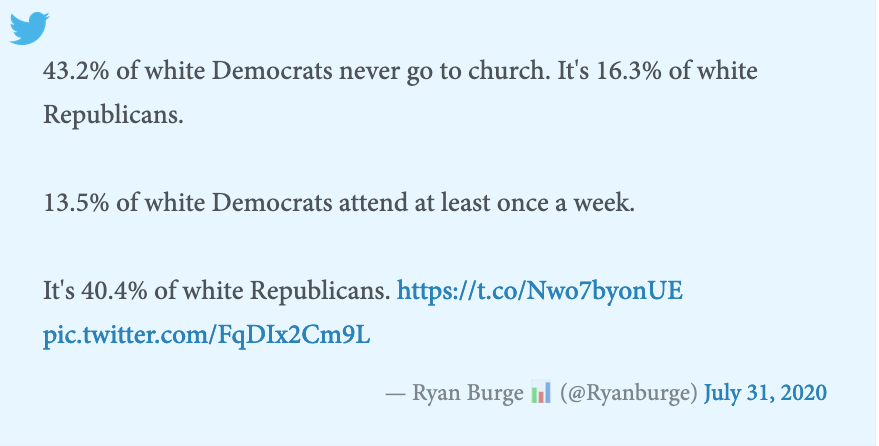
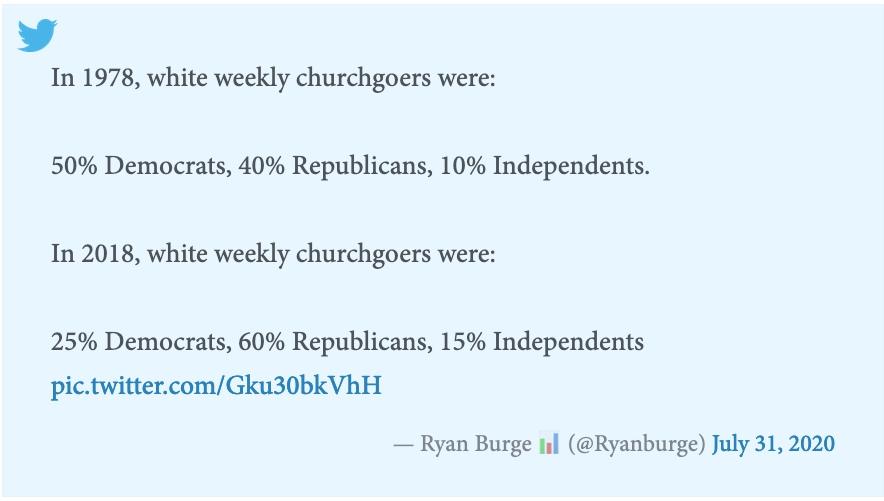
What’s wrong with this picture?

More dramatic than I imagined:

Screen Shot 2020-08-01 at 3.39.29 PM

(link) and

Screen Shot 2020-08-01 at 3.39.55 PM

(link).

Those are stunning contrasts. So why do I not feel tribal loyalty to the GOP?

A superficial answer would be that for a conservative, I rate shocking low on loyalty in Jonathan Haidt’s Moral Foundations Theory. But I’m almost positive there’s something more important than that.

First, a distinction.

Dissatisfied with my superficial reading habits, I am currently reading Mortimer Adler’s classic How to Read a Book (revised and updated 1972). Chapter 8 is titled “Coming to Terms with an Author”:

[I]n the analytical reading of a book, coming to terms is the first step beyond the outline. Unless the reader comes to terms with the author, the communication of knowledge from one to the other does not take place. For a term is the basic element of communicable knowledge.

A term is not a word–at least, not just a word without further qualifications … [A] word can have many meanings, especially an important word. If the author uses a word in one meaning, and the reader reads it in another, words have passed between them, but they have not come to terms.

Second, a story, which may be apocryphal, but I did not make it up.

A conservative returned to his alma mater for a commencement address and opened thusly:

By a strange coincidence, I am a graduate of a vastly different institution which occupied this very site 40 years ago and even bore the same name …

For some 23 years now, I’ve been an adherent of a religion called “Christianity,” based on the incarnation, life, death, resurrection, ascension and glorious second coming of Jesus Christ, who is both fully God and fully man. It was once, under the necessity of distinguishing it from a particular heresy, partially summarized in a Creed. To distinguish it from other versions, it’s called “Orthodox,” with a capital-O.

Meanwhile, my country is breathing the last few whiffs of an empty bottle labeled, by a strange coincidence, “Christianity,” which apparently is based on the intuition that God wants us to be nice and happy or, in its robust “Evangelical” versions, that Jesus Christ was very special and died a horrible death so that God would get over his anger issues with us and we could get on with being nice and happy.

Its proper name is Moralistic Therapeutic Deism. Although we share a mostly-overlapping vocabulary of words, I cannot come to terms with it, except in relatively brief and exhausting bursts of attempted empathy.

I remember from some 55 years ago an even more rigorous version, to which I then and for several more decades adhered, but it lives on today mostly notionally, in the scribblings of über-fissiparous “discernment bloggers.” I stay as far from them (and it) as I can, because I’m recovering from a mild-to-moderate case of that mindset and I’ve seen the harm it can cause, including when someone brings that mindset into Orthodox Christianity.

There were and are some other versions of “Christianity,” with some of which I have more or less come to terms, but they are not all that easily pigeon-holed politically.

So back to the question:  “why do I not feel tribal loyalty to the GOP?”

First, because it forfeited any claim to my loyalty:

In 2000 and 2004, it was Dubya. He was, we were told, a good Evangelical Christian. He cited Jesus as his favorite philosopher. He talked about America walking humbly in the foreign policy world.

Then 9-11 came, and he turned into a fierce Commander In Chief …

And then came, too, the second inaugural, when he declared as U.S. policy the eradication of tyranny from the world and the planting of democracy. If you don’t understand how delusional that is, read it again: eradicating tyranny from the world. As national policy.

(Conscientious Objector to the Culture Wars | War Correspondence ن)

Second, I have no confidence that was a blip, a lapse. In fact, the ensuing years have confirmed that endless war truly is the position of the party insiders (even though party voters chose a putatively antiwar mad, toxic and incompetent man for President in 2016).

Third, the Churches these Republicans so assiduously attend engage in worship that’s pure glucose and teach religion(s) with which I cannot come to terms sufficiently to form any kind of alliance. That Republicans are so much likelier to attend Church weekly is not all that interesting considering the Churches they attend.

I knew that 10 years ago (if not earlier, but I drove a stake in the ground then — a blog that’s held up surprisingly well) and they drove a stake though whatever remained of “Republican” in my heart on November 8, 2016.

That’s why.

* * *

Perhaps some day I’ll post a more nuanced version of why it’s difficult for a former-Evangelical, former-Calvinist, now-Orthodox, to “come to terms” with typical versions of contemporary American “Christianity.” I acknowledge painting here with a broad brush, but if there’s no glimmer of recognition, then you may to inattentive, gentle reader.

* * * * *

Put not your trust in princes,
in a son of man, in whom there is no salvation.

Psalm 146:3

* * * * *

You can read most of my more impromptu stuff at here. It should work in your RSS aggregator, like Feedly, should you want to make a habit of it.

Truth-tellers not welcome

Trump Berated Intelligence Chief Over Report Russia Wants Him Re-Elected

President chastised official after staffer informed bipartisan House panel that Moscow might again seek to boost his campaign

WASHINGTON—President Trump lashed out at his acting director of national intelligence, Joseph Maguire, earlier this month after learning that one of his subordinates had briefed the House Intelligence Committee about Russia’s apparent preference for Mr. Trump in the 2020 presidential contest, people familiar with the matter said.

The Oval Office confrontation occurred after Mr. Trump learned that Shelby Pierson, the top election-security official in Mr. Maguire’s office, delivered information on election interference in a classified hearing before bipartisan members of the House panel, alongside national security officials from other federal agencies, three of the people said.

During that hearing, Ms. Pierson said Russia appeared to favor Mr. Trump over Democratic challengers and might seek to act on that preference, two of the people said, in a move that would reprise Moscow’s efforts during the 2016 election to boost his candidacy.

… The president … expressed his agitation over the substance of what Ms. Pierson told lawmakers about Russia’s possible interest in interfering on his behalf, these people said, with one person describing it as a prolonged and pointed interrogation of Mr. Maguire. Officials from other agencies were also present in the room, these people said.

Mr. Trump on Wednesday said he was replacing Mr. Maguire, a retired Navy vice admiral, as acting director of national intelligence with Richard Grenell, the current ambassador to Germany. Mr. Grenell has scant experience with intelligence matters and is viewed by Democrats as an ardent loyalist to the president. Mr. Maguire had been rumored to be in the running to be nominated to the position full-time, and Mr. Trump had praised him publicly during his tenure ….

Dustin Volz, Wall Street Journal (emphasis added)

Firing the acting head of an agency whose sole raison d’être is careful analysis to discern the unvarnished truth for the protection of the country from hostile foreign powers.

This is why it’s — ahem! — scary to have a prickly narcissist (see below for more) living in the White House.

* * * * *

Secularism, I submit, is above all a negation of worship. I stress:—not of God’s existence, not of some kind of transcendence and therefore of some kind of religion. If secularism in theological terms is a heresy, it is primarily a heresy about man. It is the negation of man as a worshiping being, as homo adorans: the one for whom worship is the essential act which both “posits” his humanity and fulfills it.

Alexander Schmemann, For the Life of the World, Appendix 1

I appreciate Donald Trump’s judicial appointments and a few other things he has done, but I’m utterly opposed to allowing that hateful, unstable and completely self-serving man to serve as President. Maybe by saying it here, I’ll feel less compelled to fault his multiple daily outrages — mere corroboration of his dark soul and tormented mind — in the body of the blog.

You can read most of my more impromptu stuff at here. It should work in your RSS aggregator, like Feedly, should you want to make a habit of it.

Presumption of Regularity

Jonah Goldberg’s Remnant podcast (Episode 146. I cannot find a direct link except to this download file) recently hosted Adam White of the American Enterprise Institute on a sort of “Impeachment 101” episode.

Some attention was given, of course, to the White House transcript of the infamous Ukraine phone conversation (which did have a quid pro quo, just for the record) and specifically to the deeply corrupt and impeachable request that Ukraine interfere in the 2020 Election by digging up dirt on Joe Biden. I am not going to digress to defend “quid pro quo” or “impeachable.” Listen to the whole podcast if you want to hear them defended.

Less remarked than the effort to involve Ukraine in smearing Biden was a reflection of Trump’s bat-guano crazy theory that the DNC mail server is in Kiev. That apparently is an actual extant delusion of the rightmost fringe, so of course our very stable genius is totally into it — enough so to debase his office by asking about it on a diplomatic call.

Then there was the booing at the World Series game 5, which some thought demeaned “the office of the Presidency.” That is not an argument that I find unsympathetic normally, but something is so abnormal about the present moment that it seems disingenuous.

White nails the present abnormality (interjections and “throat-clearing” omitted):

Goldberg: People are slipping Trump garbage from like GatewayPundit and Breitbart. The reason why the President of the United States said it was okay to betray the Kurds because they weren’t at Normandy — that came from like a Kurt Schlichter column.

White: … One thing about the President and this quid pro quo — I do think we need to step back and remind people: all this — … things that for a normal President would be kind of pushing the boundaries — President Trump doesn’t get that benefit of the doubt because of “Lock her up!” Right? He made this part of his campaign that he was going to go after, he was going to threaten his political enemies. And all his fans sort of rose up and loved that line, and they liked the President because he was so outside the box.

The problem is all the conventions of deference that we afford Presidents and the space we give them to use their Presidential power — it’s all contingent on our vision of what a normal President is, and what lawyers sometimes call “the presumption of regularity.” President Trump having smashed that box on his way into the office — he and his supporters can’t really be offended now when the rest of the system doesn’t treat him like a normal President, doesn’t give him those benefits of the doubt.

That’s why we need conventional statesmen in office so that we can trust them that, if they misspeak when they’re talking to Ukraine and they actually are interested in corruption or some far-fetched theory that they just want to ask about — that we can kind of step back and trust that this isn’t the President just wielding these powers to punish his enemies.

The President gave all that up before he was even in office ….

When I refresh my memory on the presumption of regularity, I’m struck by its power in explaining good people’s distrust of Trump. Frankly, I’d distrust him apart from “Lock her up!” because he’s a multi-adulterous, multi-bankrupt, sociopathic and punitive liar, New York real estate developer, Casino operator, pro wrestling promoter and reality TV figure.* But White and Goldberg don’t mention those.

Whether you’re sanely left or sanely right, you likely would enjoy and profit from the whole podcast episode, which agreed with me on some key points (of course we told the Russians we were going in after Abu Bakr al-Baghadi; we didn’t want them shooting down our helicopters) and enlightened me on others (there’s no requirement or even a well-established expectation that an Administration tell Congress about an imminent counter-terrorism operation). On the other hand, many of the pro-Trump talking points are rubbish, as they also note.

Crazy partisans likely wouldn’t enjoy the podcast. And sane people might have higher (in several senses) priorities than wallowing even more than necessary in impeachment news. Let your conscience be your guide, knowing that the podcast won’t agitate you with demagoguery.

* UPDATE: Also a Birther. How could I have forgotten Birtherism?

* * * * *

The Lord is King, be the peoples never so impatient; He that sitteth upon the Cherubim, be the earth never so unquiet.

(Psalm 98:1, Adapted from the Miles Coverdale Translation, from A Psalter for Prayer)

You can read most of my more impromptu stuff at here. It should work in your RSS aggregator, like Feedly, should you want to make a habit of it.

Liberal gerrymandering

I may have found a website that’s very relevant to a current preoccupation of mine: Postliberal Thought. For instance, apropos of my particular concern for religious freedom, what if the very definition of “religion” in our liberal order is gerrymandered in favor or the state waxing, religion waning?

To think that the liberal state allows for “freedom of religion” in some sort of metaphysical sense is quaint. In fact, the State is indifferent to particular religions because they operate within the stability of the juridical, public category of “religion,” and such variations are by definition socially irrelevant …

Within late liberalism, then, one has freedom of religion precisely to the extent that the State has defined religious content, per se, as not mattering to its order; as something private and so indifferent, like one’s favorite color. As soon as this is not the case, as soon as an opinion or action is understood to impinge on the rights of other legal personae or to affect their public options, these opinions or actions cease to be considered properly religious and are therefore eligible for regulation by the State, a phenomenon clearly on display in State action against bakers or florists who decline to participate in same-sex weddings …

It is imperative that we recognize the tautological nature of this discourse … “The secular” is really nothing more than a name for societies that use or operate “religion” in this manner – as a kind of holding pen for these private, personal actions that do not yet affect the State.

Within late liberalism, then, religions are simply voluntary associations relevant to particular aspects of their members’ private lives. As soon as a religion verges into non-religious aspects of members’ private lives, it becomes a cult; if it verges into coercion, it becomes a terrorist organization; if it mobilizes for political action it becomes a political party; and if it starts manufacturing and selling goods, it becomes a business. In a liberal order, these actions are generally understood as perversions because within its categorical schema the content of religion doesn’t belong in certain aspects of the private or in the public realms of politics or economics. So, liberal States tend to effectively outlaw such perversions. Or else, they must redefine the public to include them and the religious to exclude them … Hospitals matter socially and so they simply cannot be, in essence, religious – and so they must be eligible for direct state regulation. Such constant redefinition is the ongoing project of liberalism’s discourse on religious liberty which is necessarily as much about defining religion and keeping it in its proper private realm as it is about protecting it from public disturbance. The late liberal notion of religious liberty is ultimately about the maintenance of the irrelevance of the “religion” category itself. Religion is by definition free and can be identified as whatever we are free to do.

…

Religion is just one type within a whole category of similar phenomena, “morality” being perhaps the most fundamental. For example, for many decades now Christians have attempted to mount an effective opposition to what they have called “moral relativism.” What is meant by this concept? Christians can’t really mean that our late liberal opponents don’t believe in right and wrong. We know that isn’t the case … And yet, many Christians continue to talk about moral relativism. Why?

This behavior becomes intelligible when we understand that similar to religion, in the everyday liberal vernacular, the word “moral” is restricted in application to things that society is more-or-less relativistic about … It’s not that society has relegated all “lifestyle” choices to the relativistic category of morality. Light up a cigarette in polite company to prove that is not the case. Smoking is not a “moral” issue, it’s a public health issue, like obesity, and so an appropriate object of public disdain and censure. Rather, particular behaviors have become “moral” precisely because they are understood as socially irrelevant. The relativism comes before the morality; relativism is a criterion for the category … The word “morality” comes to mean something like: “things that we all know are relative and socially unimportant but concerning which Christians have historically tried to oppress us and would again if given the chance.” In this way, the late liberal concept of morality includes within it both moral relativism and the story of Christian opposition to moral relativism. And so, when Christians argue against “moral relativism” as if it were a real thing, they reinforce not only the liberal segmenting of human action into moral (i.e. relative) things and amoral (i.e. political) things, but the marginalization of Christianity as an ultimately tyrannical dogma that has been overthrown, but which remains a threat. They are paradoxically profoundly liberal in their illiberality because liberalism requires them for its internal coherence.

… One can “define one’s own concept of existence, of meaning, of the universe, and of the mystery of human life” as long as one’s determination of that meaning, as D.C. Schindler has put it, amounts to nothing at all– at least nothing social. Liberalism provides a tidy, closed circle. This is what the so-called pluralism of liberalism ultimately amounts to. It is, in fact, a profound homogenization and enforcement of orthodoxies.

Andrew Willard Jones, What if the liberal concept of religion is the real problem?.

This blog was not light reading, but was very worthwhile. As I try to get some handle on American post-liberalism, I think I’ll be spending more time at Postliberal Thought.

* * *

At the end of this blog appeared some utterly unfamiliar Latin, which I though might be fraught with meaning:

Cras mattis consectetur purus sit amet fermentum. Integer posuere erat a ante venenatis dapibus posuere velit aliquet. Aenean eu leo quam. Pellentesque ornare sem lacinia quam venenatis vestibulum.

So I ran it through Google translate:

Tomorrow a lot of tomato chili carrots fermentation. Whole to lay a previously sterilized protein was put outdoor bananas. Jasmine lion than football. Kids football television skirt and poisonous gas.

So I guess these guys aren’t always hyper-serious.

* * * * *

You can read most of my more impromptu stuff at here. It should work in your RSS aggregator, like Feedly, should you want to make a habit of it.

I highly recommend blot.im as a crazy-easy alternative to Twitter (if you’re just looking to get your stuff “out there” and not pick fights).