The obvious question eluded

Peter Wehner has noticed some trouble in Evangelicaldom:

  • [Crypto-racism at McLean Bible Church] [C]hurch members had been misled, having been told, among other things, that the three individuals nominated to be elders would advocate selling the church building to Muslims, who would convert it into a mosque … Platt, speaking to his congregation, described an email that was circulated claiming, “MBC is no longer McLean Bible Church, that it’s now Melanin Bible Church.”
  • “Nearly everyone tells me there is at the very least a small group in nearly every evangelical church complaining and agitating against teaching or policies that aren’t sufficiently conservative or anti-woke,” a pastor and prominent figure within the evangelical world told me. (Like others with whom I spoke about this topic, he requested anonymity in order to speak candidly.) “It’s everywhere.”
  • The aggressive, disruptive, and unforgiving mindset that characterizes so much of our politics has found a home in many American churches.
  • [M]any Christians have embraced the worst aspects of our culture and our politics. When the Christian faith is politicized, churches become repositories not of grace but of grievances, places where tribal identities are reinforced, where fears are nurtured, and where aggression and nastiness are sacralized.
  • “When Trump was able to add open hatred and resentments to the political-religious stance of ‘true believers,’ it crossed a line,” [Church historial George] Marsden said. “Tribal instincts seem to have become overwhelming.” … [M]any Christian followers of Trump “have come to see a gospel of hatreds, resentments, vilifications, put-downs, and insults as expressions of their Christianity, for which they too should be willing to fight.”
  • [Tucker Carlson, Catechist] [M]any churches aren’t interested in catechesis at all. They focus instead on entertainment, because entertainment is what keeps people in their seats and coins in the offering plate. … “People come to believe what they are most thoroughly and intensively catechized to believe, and that catechesis comes not from the churches but from the media they consume, or rather the media that consume them. The churches have barely better than a snowball’s chance in hell of shaping most people’s lives.”
  • Scott Dudley, the senior pastor at Bellevue Presbyterian Church in Bellevue, Washington, … [has] heard of many congregants leaving their church because it didn’t match their politics, he told me, but has never once heard of someone changing their politics because it didn’t match their church’s teaching.
  • The former president normalized a form of discourse that made the once-shocking seem routine. Russell Moore laments the “pugilism of the Trump era, in which anything short of cruelty is seen as weakness.” The problem facing the evangelical church, then, is not just that it has failed to inculcate adherents with its values—it’s that when it has succeeded in doing so, those values have not always been biblical.
  • Kristin Kobes Du Mez, a history professor at Calvin University and the author of Jesus and John Wayne: How White Evangelicals Corrupted a Faith and Fractured a Nation, argues … that American evangelicals have worked for decades to replace the Jesus of the Gospels with an idol of rugged masculinity and Christian nationalism. (She defines Christian nationalism as “the belief that America is God’s chosen nation and must be defended as such,” which she says is a powerful predictor of attitudes toward non-Christians and on issues such as immigration, race, and guns.
  • “What we’re watching right now in much of our nation’s Christian politics,” [David French] wrote, “is an explosion not of godly Christian passion, but rather of ancient southern shame/honor rage.”
  • Scott Dudley of Bellevue Presbyterian Church said he knows of several pastors who have not just quit their churches but resigned from ministry, and that many others are actively seeking to switch careers. “They have concluded that their church has become a hostile work environment where at any moment they may be blasted, slandered, and demeaned in disrespectful and angry ways,” he said, “or have organized groups of people within the church demand that they be fired.”
  • The historian Mark Noll’s 1994 book, The Scandal of the Evangelical Mind, will be rereleased next year. In the forthcoming preface, which Noll, himself an evangelical, shared with me, he argues that in various spheres—vaccinations, evolutionary science, anthropogenic global warming, and the 2020 elections, to name just a few—“white evangelicals appear as the group most easily captive to conspiratorial nonsense, in greater panic about their political opponents, or as most aggressively anti-intellectual.” … “Much of what is distinctive about American evangelicalism is not essential to Christianity,” Noll has written. And he is surely correct. I would add only that … in important respects, much of what is distinctive about American evangelicalism has become antithetical to authentic Christianity. What we’re dealing with—not in all cases, of course, but in far too many— is political identity and cultural anxieties, anti-intellectualism and ethnic nationalism, resentments and grievances, all dressed up as Christianity.

He concludes that "Jesus now has to be reclaimed from his Church …."

Critiques by Mark Noll and George Marsden are decades old, but Evangelicalism has only gotten worse. I’m pretty sure Evangelicals have had to "reclaim Jesus from His Church" before. But even if I’m wrong, how screwed up must things be before y’all figure out that maybe, just maybe, Evangelicalism isn’t really "His Church"?


You can read most of my more impromptu stuff at here. It should work in your RSS aggregator, like Feedly, should you want to make a habit of it.

Which God are We Talking About?

It has long seemed to me that it is one thing to believe that God exists and quite another to believe that He is good. Indeed, to believe that God exists simply begs the question. That question is: Who is God, and what can be said of Him? Is He good? This goes to the heart of the proclamation of the Christian faith. We believe that God has revealed Himself definitively in the God/Man, Jesus Christ, and preeminently in the death and resurrection of Jesus.

Years ago, a friend of mine was speaking with an Orthodox priest about certain matters of conscience. In the course of the conversation, my friend mentioned concerns with the judgment of God, expressing a certain dread. The priest responded by turning around a small icon of Christ that was on his desk so that my friend could see it. It was the icon of Christ, “Extreme Humility,” that pictures Him in the depth of His humiliation and suffering. “Which God are we talking about?” was the priest’s question. My friend’s concerns were answered in that moment. Whatever our concerns might be, the goodness of God is revealed in that icon without qualification.

Fr. Stephen Freeman, ‌The Singular Goodness of God

I heartily recommend the entire blog post, of which this is merely a taste.


You can read most of my more impromptu stuff at here. It should work in your RSS aggregator, like Feedly, should you want to make a habit of it.

Gleanings

From Deschooling Society

  • Hope, in its strong sense, means trusting faith in the goodness of nature, while expectation, as I will use it here, means reliance on results which are planned and controlled by man. Hope centers desire on a person from whom we await a gift. Expectation looks forward to satisfaction from a predictable process which will produce what we have the right to claim. The Promethean ethos has now eclipsed hope. Survival of the human race depends on its rediscovery as a social force.
  • Classical man framed a civilized context for human perspective. He was aware that he could defy fate-nature-environment, but only at his own risk. Contemporary man goes further; he attempts to create the world in his image, to build a totally man-made environment, and then discovers that he can do so only on the condition of constantly remaking himself to fit it. We now must face the fact that man himself is at stake.
  • I know a Mexican village through which not more than a dozen cars drive each day. A Mexican was playing dominoes on the new hard-surface road in front of his house – where he had probably played and sat since his youth. A car sped through and killed him. The tourist who reported the event to me was deeply upset, and yet he said: “The man had it coming to him”. … At first sight, the tourist’s remark is no different from the statement of some primitive bushman reporting the death of a fellow who had collided with a taboo and had therefore died. But the two statements carry opposite meanings. The primitive can blame some tremendous and dumb transcendence, while the tourist is in awe of the inexorable logic of the machine.

Ivan Illich, Deschooling Society.

This is the first Ivan Illich I’ve read. It’s mind-expanding, but my mind is not yet capacious enough to find many of his proposals for alternatives to "schooling" realistic.

Perhaps that means that my mind is captive to the schooling mentality, but I can’t help but note that the suggestion is both ad hominem and circular.

On at least one thing do Illich and I agree: As one who identifies as auto-didact (one much provide one’s identity these days, right?), I agree that most of what I know I learned outside of school. And that goes double for important things (beyond basic learning skills).

That should disabuse us of any servility to schooling.

A Counterworld

The Church’s function is not to adapt Christianity to the world, or even to adapt the world to Christianity; Her function is to maintain a counterworld in the world.

Nicolas Gomez Davila, Escolios a un Texto Implicito, via John Brady’s Rags of Light e-newsletter.

And if you understand that, you should understand:

  • The case for The Benedict Option; and
  • That The Benedict Option is, as many have said, "just the Church being the Church."

How badly must Trump botch this notion to disenthrall his acolytes?

DWAC, the Trump Social-Media SPAC, Soars in GameStop-Like Frenzy
Shares of Digital World Acquisition more than doubled to $94.20 Friday after trading as high as $175; have risen nearly tenfold in two days

Maybe losing beaucoups bucks will disenthrall Trump’s sycophants. Something needs to.

Decadent Jazz & Journalism

Jazz has been compared to “an indecent story syncopated and counterpointed.” There can be no question that, like journalism in literature, it has helped to destroy the concept of obscenity.

Richard M. Weaver, Ideas Have Consequences.

Even the greats can be wrong sometimes — about jazz, not journalism, of course.


You can read most of my more impromptu stuff at here. It should work in your RSS aggregator, like Feedly, should you want to make a habit of it.

Sacramental Christianity

Sacramental Christianity (versus the others)

[I]t is easy to see how the older, sacramental forms of Christianity conform to this global pattern. The death and resurrection of Jesus of Nazareth is the core of the religion, and is re-enacted every time there is a liturgy at the altar … When you take the sacramentality out of the religion, as many forms of Protestantism have, it wrecks the symbolism. How can a church that looks like a theatrical space do the symbolic work it is supposed to do?

…

Let me be clear: it’s not that God is not with people who worship in low-church Protestant temples; it’s that the structures perhaps make it harder for the worshipers to feel God’s presence. This matters for my book project, because I am trying to figure out how we can re-enchant the world, and live more like “religious man” (Eliade’s term) lived in the premodern era. The Protestantization of worship spaces, and the de-sacramentalization of some forms of Christianity, likely contributed to the disenchantment of the world. It wasn’t on purpose — nobody can accuse the Puritans, for example, of wanting to push God out of the world — but their theology, and horror at things that smacked of papistry, might have led them to throw out too much.

Rod Dreher, ‌Mircea Eliade On Temples

More:

If Christian culture is to be renewed, habits are more vital than revivals, rituals more edifying than spiritual highs, the creed more penetrating than theological insight, and the celebration of saints’ days more uplifting than the observance of Mother’s Day. There is great wisdom in the maligned phrase ex opere operato, the effect is in the doing. Intention is like a reed blowing in the wind. It is the doing that counts, and if we do something for God, in the doing God does something for us.

Quoting Robert Louis Wilen, Church as Culture

And still more:

[A] young kid from the Andes who’s raised to believe that that mountain is an Apu spirit that will direct his or her destiny will be a profoundly different human being and have a different relationship to that resource or that place than a young kid from Montana raised to believe that a mountain is a pile of rock ready to be mined. Whether it’s the abode of a spirit or a pile of ore is irrelevant. What’s interesting is the metaphor that defines the relationship between the individual and the natural world. I was raised in the forests of British Columbia to believe those forests existed to be cut. That made me a different human being than my friends amongst the Kwagiulth who believe that those forests were the abode of Huxwhukw and the Crooked Beak of Heaven and the cannibal spirits that dwelled at the north end of the world, spirits they would have to engage during their Hamatsa initiation.

Quoting Wade Davis

Mostly political

David Shor

I do hope the Democrats listen to [David Shor] even if it means they do better in elections. Why? Well, for several reasons. First, because if they listened to him, the Democratic Party would move rightward. Second, I think the actual policies associated with “defund the police,” “birthing persons,” “Latinx,” etc. are profoundly bad for America. And third, because if the Democrats stopped talking about ridiculous things, it would deny many Republicans the psychological permission to behave like idiots or support demagogic buffoons.

Jonah Goldberg, That Shor Sounds Good

So what’s Shor saying that the Dems should listen to?

At its most basic, Shor’s theory goes something like this: Although young people as a whole turn out to vote at a lower rate than the general population, the aforementioned type of young person is actually overrepresented within the core of the Democratic Party’s infrastructure. According to Shor, the problem with this permanent class of young staffers is that they tend to hold views that are both more liberal and more ideologically motivated than the views of the coveted median voter, and yet they yield a significant amount of influence over the party’s messaging and policy decisions. As a result, Democrats end up spending a lot of time talking about issues that matter to college-educated liberals but not to the multiracial bloc of moderate voters that the party needs to win over to secure governing majorities in Washington.

Ian Ward, ‌The Democrats’ Privileged College-Kid Problem

David Brock

(David Brock left the GOP long before Donald Trump:)

Issues like racial justice, the environment and immigration are already resonating online with audiences Democrats need to win over, such as young people, women and people of color. Democratic donors have long overlooked efforts to fund the media, but with so much of our politics playing out on that battlefield, they can no longer afford to.

David Brock

It would be interesting to hear the two Davids, Shor and Brock, debate Democratic Party messenging.

Full disclosure for invitees

Alan Jacobs has a modest proposal:

This is related, in a way, to my previous post: After reading yet another invitation-disinvitation story, I think every university should – in the interests of full disclosure, honesty, and charity – prepare a list of Topics On Which Dissent Is Not Permitted and send that list to everyone who is invited to speak. That way prospective lecturers will know in advance whether they hold views that are not tolerated at those universities and can decline the invitation immediately rather than having to be canceled later on.

When Pandemic becomes Endemic, can we take off our masks?

I didn’t have much hope for ‌How Will Blue America Live With Covid? but it raises good questions.

As we saw after Sept. 11, certain forms of security theater, once established, become extremely difficult to dislodge as long as there is still any arguable threat. So as long as Covid stays in the news, it’s not hard to envision masking requirements for airplanes and trains persisting far into the future, much as we still try to foil Al Qaeda by taking off our shoes for airport security lines. It’s also possible to imagine a future in which the weird emergent norm of “masks for the help but not the V.I.P.s” — visible everywhere from the Met Gala to political fund-raisers to posh hotels — becomes an expected feature of life among the blue-state upper class (as well as a potent symbol for its critics).

Then there are blue-state elementary schools, where some of the constituencies that support mask requirements may not be assuaged even after vaccines are available for younger kids. At that point, according to both polls and personal experience, there will still be lots of vaccine hesitancy among even liberal parents — and you could imagine a coalition of more Covid-fearing parents and teachers’ unions demanding masking requirements until a school hits a vaccination threshold that remains perpetually out of reach.

…

Endemic Covid ensures that this dynamic will never simply vanish … deep-blue America will have to decide, in a world that’s postpandemic but not post-Covid, whether it wants to become the safety-above-all caricature that deep-red America has made of it — or if it can settle instead on masking a little more every December and January, a reasonable adaptation to the coronavirus experience, while otherwise leaving the age of emergency behind.

Ross Douthat

I’m seeing signs of this division among my acquaintances. And I suspect that public schools that veer into safetyism will find that a straw that breaks the camel’s back and sends more students off to private schools.

… boring me to death

Roughly a half decade or so ago, I started noticing that everyone began to believe that their political opinions were the most interesting thing about them.  When it’s usually exactly the opposite.  As a journalist, I always found that talking to people about their actual lives – their hurts, ambitions, failures, families, amusing asides – produced infinite and pleasant surprises. Only when they started talking politics could I finish all their sentences.  As a right-leaning person throughout my life, I became unwittingly involved in more and more conversations, feeling like a trapped rat all the while, in which my conversational companions gave me their harangues on how biased the liberal media was.  In fairness, the mainstream media does lean liberal, and often is biased.  (Who isn’t, these days?)  But if every other sentence you utter ends in the refrain “liberal media bias,” it doesn’t necessarily mean you’re lying or wrong, just that you’re boring me to death over dinner. I get it. But that’s been settled law for decades. Try to be more interesting.

Besides, achieving equanimity isn’t just a natural state, but a choice.  These days, it very much involves swimming against the tide. You nearly have to choose not  to get riled by all the manufactured outrages, Kabuki-theater conflagrations, and faux-Twitter fights that are conducted by catty people, for catty people.  The rage merchants abound, and are all too willing to make a buck from stoking your anger and wet-nursing your resentments  over  “issues” you’d never even heard of five minutes prior.  Don’t be such an easy mark.

Matt Labash

No senses

I’ve long known that ultra-progressives have no sense of humor. Now it appears that perhaps they have no sense of chronology, either:

When I appeared on Megyn Kelly’s podcast, she shared an anecdote (at 46:00 minute mark) about a friend of hers who worked as an editor at a major publishing house. The editor had received a manuscript of a historical novel, based on a true story, of a woman who had to pose as a man in order to receive a medical education and become a surgeon in the 1920’s1. The editor admired the novel and circulated it for feedback from some junior editors.

Perhaps you can anticipate what happened next. The book was attacked by other staffers for its failure to portray the woman who posed as a man in order to practice medicine as transgendered. The author had failed to frame her story through an anachronistic projection of today’s gender ideology onto a past in which the ideology did not yet exist. This meant her work was therefore “transphobic.” The editor was reported to HR for forcing them to read the book and subject to a disciplinary process. He was unable to move forward with the acquisition he had intended.

…

J.K. Rowling, Joe Rogan, Dave Chappelle. They exist in a strange form of cossetted duress. They are still beloved by millions, wealthier and more widely exposed than ever before. But they are pariahs from the official pseudo-consensus that the Successor Ideology has captured and that a growing body of the gullible and the opportunistic alike have signed on to join with the forces that they anticipate will be in the ascendancy soon.

Wesley Yang, Cancellation, or Cultural Change

How do you marginalize normalcy?

No amount of effort at revising my attitudes (not that I’m especially inclined to try, sorry) would do much to change the fact that however effete and aloof and sensitive I may be, (and I am surely in the 95th percentile among men along both of these dimensions), I am nonetheless, for better or worse, unambiguously a cisgendered, (a term that the late comedian Norm MacDonald characterized “a way of marginalizing a normal person), heterosexual man, and all that entails.

Wesley Yang, ‌Preface to a 20-volume Dave Chappelle Review

Pregnant women at SCOTUS

SCOTUS is going to hear the Texas abortion law case on its "rocket docket;" briefing next week, argument November 1:

Justice Sotomayor wrote a six-page dissent. She repeatedly referred to pregnant "women," without a footnote about gender identity. Call the cancellation squad.


You can read most of my more impromptu stuff at here. It should work in your RSS aggregator, like Feedly, should you want to make a habit of it.

Grab-bag

After a series, I still have some miscellany left:

These salespeople were … functioning according to a false narrative, in which the good life depends on more weeks at a resort. For these programmed Un-Manned folks, they were selling me happiness. They were ensuring that I could face death, knowing I had spent as much time as possible at the spa or the arcade. We were at odds with these salesmen because we live and move and have our being within a completely oppositional narrative to the one that they assume. We are fish aware of the water that gives us life, and they are fish trying to climb the shore, not realizing they cannot breathe on land.

Jessica Hooten Wilson on a time-share pitch in Orlando (Shudder!)

What’s telling to me is that this is the pitch that sells timeshares to the typical American in America 2021.

In other news from the Culture of Death, our local Gannett rag has a front-page story about how two years of legalized mobile sports gambling is producing gambling addicts. Bear in mind that these gambling companies are listed on stock exchanges now; it’s considered legitimate business.


For some, the religious failures of the 14th century serve to bolster a general critique of religious belief itself. One of the blind spots of modernity is to imagine ourselves to be in a non-religious, secularized world … The modern world is not “disenchanted” so much as it has a “modern enchantment.” We have faith in market forces, medicine, government, democracy, technology, algorithms, and the march of progress.

Fr. Stephen Freeman


Once he was free, Wurmbrand wrote that there are two kinds of Christians: “those who sincerely believe in God and those who, just as sincerely, believe that they believe. You can tell them apart by their actions in decisive moments.”

Rod Dreher, The Benedict Option


The Fourteenth Dalai Lama’s Western publishers, mindful of their likely audience, were careful to excise his criticisms of homosexuality from the American versions of his books.

Ross Douthat, Bad Religion


Can anything good come from Berkeley? Darned right. Here (To End Police Violence, Get Rid of the Traffic Cop – The Atlantic) is an example of a sane policy that shouldn’t be dismissed as "abolish the police."


But what we suffer from to-day is humility in the wrong place. Modesty has moved from the organ of ambition. Modesty has settled upon the organ of conviction; where it was never meant to be. A man was meant to be doubtful about himself, but undoubting about the truth; this has been exactly reversed.

G.K. Chesterton, Orthodoxy


Everything is habit-forming, so make sure what you do is what you want to be doing.

Wilt Chamberlain


The GOP Senate primary races in Missouri and Ohio have become contests to see which candidate can create the stupidest tweet.

One of them will insist the moon was made by gay communists and promise to punch it out of the sky, and win in a walk.

Kevin Kruse


All of humanity’s problems stem from man’s inability to sit quietly in a room alone.

Blaise Pascal


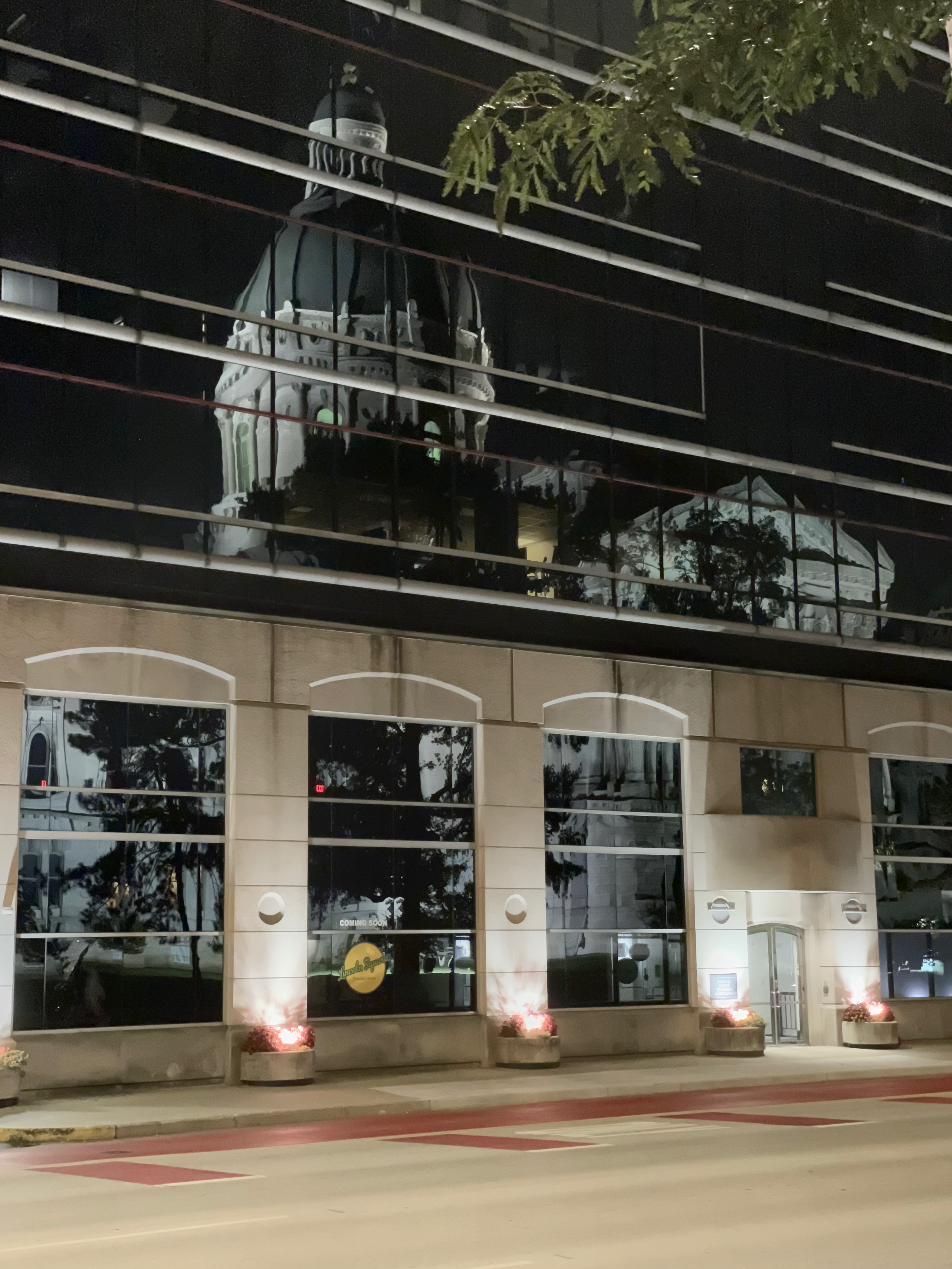
Indiana Statehouse reflected after my grandson’s 14th birthday dinner. It probably looked the same before.


You can read most of my more impromptu stuff at here. It should work in your RSS aggregator, like Feedly, should you want to make a habit of it.

Discovering and conforming to reality

In general, for the orthodox (conservatives), religion is in part a means through which we discover the structure of reality and conform ourselves to it. For the modernists (liberals), religion is a means by which we make ourselves at home in this world. It’s not that the orthodox don’t want to make a home in this world, or that the modernists don’t want to live in reality. Rather, it’s that the orthodox believe that all of reality is undergirded, and founded, in a sacred order of which we are a part.

Rod Dreher. When I read that late Monday evening, it was obvious structurally that it was one of Dreher’s major points, but I didn’t really grasp it. Glad I looked again in the cool light of Tuesday morning.

More:

Whenever you hear a Christian defending heterodox sexual morality, say something like, “I find it hard to believe that the all-powerful and eternal God really cares what we do with our body parts” — you are dealing with a modernist, and not simply because such a claim violates Scriptural teaching. In this case, metaphysics are a guide to morals. We who believe in the God of the Bible know that sex has sacred meaning because all things are saturated with the sacred. If I’m reading Eliade correctly, then all traditional and archaic religions, whatever their particular teachings about sex, share that basic understanding. A pure materialist, by contrast, can rightly say that there is no ultimate meaning behind a sexual act, other than the meaning we assign to it.


You can read most of my more impromptu stuff at here. It should work in your RSS aggregator, like Feedly, should you want to make a habit of it.

Riding the emotional roller-coaster

It pains me to see the wave of puritanism in the arts, arts organizations competing to see who can write the most militant mission statements declaring their dedication to Equality and Inclusivity and Anti-Elitism, which tells me clearly that the end is near. Art is elitist because some people are better singers than almost anyone else and some plays astonish and others only fill the time, and if equality is now the goal, then where do we go to experience the extraordinary? Art then becomes ideology, and for astonishment we must wait for the next blizzard or thunderstorm. A Manhattan thunderstorm is worth waiting for, but still.

We have a long haul ahead of us, people. Children dressed up as malevolent beings for Halloween: is this a good thing? I doubt it. November is a miserable month, with elections at which old people will outvote the young and timid school boards will be elected who’ll cut out any remaining art or music education and require history teachers to offer opposing points of view as to the legitimacy of the 2020 election ….

Garrison Keillor

That an aging lefty can call bullshit on the illiberal left and the trendier-than-thou institutions is a sign of hope. That "requiring history teachers to offer opposing points of view as to the legitimacy of the 2020 election" doesn’t sound too far-fetched is the antidote to that hope.

I read a Damon Linker column yesterday that instantly reminded me of Micael Anton’s then-pseudonymous Flight 93 Election of 2016. The form of both was "if you really believe that [the other party] is an existential threat, you’d be [doing more]." In Anton’s case, doing more was voting for a debauched, orange, and questionably sane poseur (since we certainly would die if Hillary got into the cockpit). In Linker’s case, doing more is "prioritizing election reform" by things like, "at the very least, overhauling the poorly drafted and dangerously ambiguous Electoral Count Act of 1887" or keeping Republicans from "rig[ging] the system so that Democrats can never win power again."

I don’t mean to suggest a simple "to hell with both parties." The Republicans were lying or hysterical when they said HRC was an existential threat. She was a crook and the bearer of bad policy, and not much more. The Democrats are stone-cold right about the Republicans threatening liberal democracy, which is why it truly is baffling that they’re farting around with progressivist megaspending proposals instead of protecting democracy.

Have I mentioned lately that if the center-left and center-right cannot find a way to win elections (and retention), I don’t see how this country isn’t doomed.


You can read most of my more impromptu stuff at here. It should work in your RSS aggregator, like Feedly, should you want to make a habit of it.

Seeking truth, creatively defying lies

“What Plato taught me is that much more important than the instrumental value of education is its intrinsic value. And that’s what Gorgias puts on the table. Why do we debate? Why do we engage in discussion? Why do we seek the truth? Well, knowledge and understanding can have many instrumental benefits, but those are secondary to the intrinsic value of knowledge, its inherent enrichments of the human spirit. We should want knowledge more fundamentally for its own sake than for any instrumental purpose.”

…

When I raised the subject [of cancellation] with George, he observed that, curiously, students on campus have abandoned moral relativism and an excessive concern for toleration of diverse viewpoints with a fundamentalist desire to silence those who oppose certain absolutes. “The problem is not that they think there is no moral truth,” he told me, “it’s that they think the moral truth is obvious, they know it, they don’t have to defend it, and anyone who disagrees with them is a fool or a bigot. If you don’t agree, it’s your job to fall in line with our groupthink. It’s a militant fundamentalist kind of pseudo-religion; an unwillingness to consider the possibility that you might be wrong in your moral beliefs.”

… Wokeism works by intimidation; it’s the one and only method it’s got for whipping people into line. There’s no shortcut here, there’s no formula: You have to stand up. It’s going to take people setting an example of courageous defiance; standing up for their rights and the rights of everyone to think for themselves, to challenge these sacred dogmas, to refuse to get in line with the groupthink.”

Robert P. George, mostly, quoted in a profile of him.


You can read most of my more impromptu stuff at here. It should work in your RSS aggregator, like Feedly, should you want to make a habit of it.

Who saved the country from “Stop the Steal”?

Truth be told, guys, it was [Federalist Society] members who disproportionately saved this country during the Stop the Steal movement. Everyone pays attention to the FedSoc lawyer, John Eastman, who wrote the memo that was horrible, that was dreadful, that … legally ridiculous, that tried to provide Mike Pence a pretext to overturn the results of a lawful election and plunge us into an extraordinary constitutional crisis — yeah, he belonged and belongs to FedSoc.

But up and down the chain, it was FedSoc lawyers who declined to participate, the top-end lawyers declined to participate, protested these actions. It was FedSoc member judges who ruled against the Trump administration time, and time, and time again.

So stop it with this notion that FedSoc is somehow is inherently problematic institution. It was people who were raised in the FedSoc who stopped Stop the Steal in court.

David French, on the Advisory Opinions podcast