February 23, 2026

The Continuing Battle of Minneapolis

Many of the people abducted by the government [in Minneapolis/St. Paul] are taken without cause. When the government runs out of excuses to hold them, or is forced to release them by the courts, they send them out the front door of the Whipple Building, often in the dead of night. Alone. No cell phone. No jacket. In the freezing cold and snow.

A civic group called Haven Watch now stands guard at Whipple around the clock so that former prisoners of the regime do not freeze to death after release. While we were at Whipple talking to observers, a mother and two small children emerged from the building. They had nothing with them other than the clothes on their backs. It was about 15 degrees, the day after an unexpected snow. The three small humans haltingly made their way across the ice and slush in the road. Someone from Haven Watch met them and ushered them into a warm car.

I ask you: What do you think would have happened to this woman and her children had the United States government sent them into the cold and snow, far from taxis or transport, with no way of contacting anyone for help?

What do you think would have become of these three vulnerable human beings at the hands of our government had the people of Minnesota not stepped in to care for them?

This is Anne Frank territory; the stuff of the Stasi and East Germany, or Kosovo and Sarajevo. And the only way it ends is with victory for the regime or a reckoning for all those who waged this war against America.

However alarmed you are, it’s not enough.

Jonathan V. Last, What I Saw at the Battle of Minneapolis

The Tariff Decision

The Tariff decision in wider context

Put on your thinking cap for this one; it’s fairly heavy going for someone who doesn’t follow the Supreme Court’s doings:

3. A very significant aspect of the Chief Justice’s MQD [Major Questions Doctrine] analysis is that three conservative justices embraced it to rule against President Trump’s signature policy. And they did so in the most difficult possible context, with an issue involving national security and foreign affairs. This is a rebuttal to those who have claimed that the Court, or at least those three justices, invoke the doctrine opportunistically and politically to hurt Democratic presidents. And I think it signals more clearly than ever that, going forward, this Court is going to view broad delegations of statutory authority to a president to act, and/or extravagant presidential interpretations of authorizations to act, with skepticism. The three justices firmly committed here to the MQD can (if they wish) ensure that outcome in a case of just about any political configuration.

To the extent this is true, it is a hugely important complement to the Court’s emerging broad view of the unitary executive. Put another way, it is a vindication of Sarah Isgur’s view that the tradeoff on the Court for enhancing vertical unitary presidential control is “for the court to rein in Congress’s bad habit of delegating vast and vague powers to the executive branch,” including through MQD. It also puts in a better light the Court’s interim orders [the so-called “shadow docket”] to date in Trump 2.0, a large number of which, due to the application strategy of the Solicitor General, involved issues of vertical control. The tariff opinion gives the lie to the notion that the Court is in the bag for the president and also makes its approach to issues of presidential power in Trump 2.0 both clearer and more nuanced.

Jack Goldsmith

Let’s see if I can make clearer (and broader) sense of that; Goldsmith, after all, is writing mostly for lawyerly types:

  1. As a preliminary matter, don’t worry about what the Major Question Doctrine is; it really didn’t control the outcome here as three of six justices voted to strike down the tariffs without it. (I don’t think they were wrong.)
  2. SCOTUS here signaled that Congress is going to have to clearly delegate sweeping powers to the Executive Branch for the court to uphold the Executive’s use of those powers.
  3. Combine that with the “vertical unitary executive” and you’ve got the President (including future Presidents) in almost absolute control of the Executive Branch but, importantly, an Executive Branch that has been slimmed down in the powers it lawfully wields. That’s Sarah Isgur’s take anyway.
  4. The administration has a very strong record in the Court because the Solicitor General has made sure that the adverse lower-court decisions (there are hundreds) they appeal are very likely winners, often under the “Unified Executive” theory. (i.e, If you don’t appeal losers, you’re likely to have a good appellate win record.)
  5. Contrary to almost every snot-nosed Democrat and crypto-Democrat in the commentariat, this Supreme Court is not in Trump’s pocket, dammit!

Trump’s tariff tantrum

Note that no one is even pretending that Trump’s new 15 percent tariffs for the entire world are being imposed for anything resembling legitimate economic reason. The president is angry about the Supreme Court defeat, and he wants to show members of the court’s majority that they can’t constrain him for long—and show the rest of the country and the world that he’s still The Boss. That’s it. That’s the entirety of the justification.

Trump wants to wield absolute, arbitrary power, because doing so allows him to project strength that he can deploy at will to reward friends, harm enemies, and exact monetary concessions (in the form of bribes and kickbacks from domestic and foreign companies and governments around the world). That is what all of this tariff nonsense has always been about. Tariffs in the abstract can play a role in helping to shape a country’s trade policy—but not when they are imposed in a capricious way and without even an elementary understanding of international economics. I, for one, would love to see the courts internalize the presumption of Trumpian bad will in their assessment of future cases involving tariffs—and hopefully in other areas of policymaking as well.

Damon Linker

I’m with Linker up to that last sentence, and I might even go along with it if by “internalize” he means “assume but do not say it out loud.” It’s as if Linker is not just abandoning the “presumption of regularity” but reversing it to a “presumption of irregularity.”

More Linker:

Learning Resources dealt the Trump administration a blow. But within hours, the president had pivoted to a different way of justifying its efforts to impose tariffs, requiring another round of slow-ball court review. This shows, I think, that when a president is determined to assert power, the judiciary has very limited powers at its disposal even if the president refrains from openly defying its decisions. The best it can do is fight the executive to a draw that requires the president to change tactics and try again by other means.

In order to truly check the power of a wayward executive, the courts need to be joined in the fight by Congress. Our system presumes each branch will fight jealously in defense of its institutional prerogatives. When that ceases to happen, the system is hobbled. Today, it only happens when Congress and the presidency are held by different parties. That’s bad. And until it changes, stopping the right by any means other than beating it in an election may prove impossible.

This is especially true because Trump has no desire whatsoever to seek congressional approval for specific tariffs. That’s what a president would do if his trade policies were motivated primarily by economic considerations. But as I noted above, Trump’s trade policies are motivated by the desire to use tariffs to boss countries and conglomerates around with an eye to winning concessions along with monetary rewards for himself and his family. Involving Congress in the process would make this kind of personalized imposition of rewards and punishments for friends and enemies much more cumbersome and therefore ineffective. So Trump simply won’t do it.

What the Supreme Court does

The justices did not determine whether or how to issue refunds for the duties.

(TMD).

It reflects civic ignorance that media have to write things like that.

SCOTUS is not an omniscient über-government. It’s not a second legislature setting up detailed mechanisms.

It decides issues. The issue decided Friday was whether IEPPA authorized tariffs. Yeah, this only kicks the ball down the road, but it wouldn’t be right or prudent for SCOTUS to try to negate all tariffs under all imaginable statutory or constitutional authorities.

If you want to avoid chaos, do not elect chaos agents – and don’t expect the courts to bail you out if you do.

They may well succeed

The America I love is not a stretch of soil or a place where the people of my blood lived and died. It’s a set of impudent and improbable goals: the rule of law and equality before it, liberty, freedom of speech and conscience, decency. We have always fallen short of them and always will, but we wrote them down and decided to dedicate ourselves to pursuing them. That’s worth something.

The people I despise, and who despise me, believe America’s values and goals are blood, soil, swagger, and an insipid and arrogant conformity. They are the values of bullies and their sycophants. They may prevail. There’s no promise they will not.

Ken White (Popehat), The Fourth of July, Rethought

Cozy Girls

Now for something cozier

There is a certain kind of person, usually self-styled as clear-eyed, hard-headed, and immune to trends, who regards the cozy girl lifestyle with undisguised contempt. She sees cozy culture as unserious, quiescent, and politically regressive. She insists that the things celebrated by cozy girls are so celebrated because they replicate the preferences of the wealthy, of the bourgieosie. … Some of these criticism have a little merit, but I find myself entirely unable to join in that contempt. In a winner-take-all society where ordinary life has been systematically stripped of dignity, the turn toward “cozy” is less a retreat from reality into the past and more a rational adaptation to the unhappy present.

You’ve heard this song from me before many times: we live in an era in which the range of lives publicly regarded as worthy of living has contracted almost to nothing. Our culture confers esteem on a vanishingly small number of roles, and those roles are largely defined by being visible – that is to say, by attracting public attention, of which there is a necessarily finite supply. … Everything else – teacher! paralegal! office manager! dental hygienist! retail supervisor! random white collar office email job that’s basically fine! – is flattened into an undifferentiated gray. These are necessary roles, some of them pay well, but they certainly aren’t glamorous ones, and young Americans seem increasingly convinced that a life that doesn’t inspire envy among others – when broadcast online, naturally – isn’t one worth living.

… [A]lmost everyone who tries to get rich quick will fail, but everyone can choose to be cozy.

The genius of the cozy aesthetic is that it identifies sources of pleasure that are widely accessible and modest and treats them as inherently worthy of serious cultivation: a soft sweater, a well-made cup of tea, a public library card, a crockpot recipe that reliably produces something warm and nourishing, a Saturday morning with nowhere to be. You may find any one or all of these more or less attractive based on your own preferences, but whatever they are, they’re not signifiers of elite achievement, they’re all available in low-cost forms, and they’re all reliable and attainable. They’re not blue-check credentials, they don’t require venture capital or viral reach, and you don’t need to chew your fingernails waiting for the wheel to spin to see if you’ve won them. These simple pleasures are, instead, elements of an ordinary life lived with intention.

Freddie DeBoer, Cozy Girl Lifestyle is a Rational Response to a Winner-Take-All Culture (Shared link)

Shorts

  • When people think you can’t tell the difference between a man and woman, they’re not going to buy anything else you say. (Andrew Sullivan, who doggedly keeps pointing out that L, G and B have very little in common with T, let alone with QIA2S+++.)
  • [T]his Congress is for Trump what the Duma is for Putin: an echo-chamber of irrelevance and submission. (Andrew Sullivan)
  • Poetry might be defined as the clear expression of mixed feelings. (W.H. Auden)
  • We do not understand the earth in terms either of what it offers us or of what it requires of us, and I think it is the rule that people inevitably destroy what they do not understand. (Wendell Berry, The World-Ending Fire) So much for Chesterton’s Fence.
  • Alan Jacobs contrasts modern and classic political invective.

Elsewhere in Tipsyworld

February 16, 2026

Corriging the incorrigible

For some years now, I’ve been tearing my hair out over the faddish dogmas of adolescent gender dysphoria — the dogmas that treated as axiomatic the appropriateness of medical and surgical interventions for kids claiming gender dysphoria, and opposition as genocidal. Let’s try that again: dogmas that insisted on allowing sexual mutilation of kids experiencing some discomfort about their biological sex and that hated and defamed anyone urging caution.

The dogmas seemed incorrigible. And then, just like that, they seem to gotten corriged, or whatever the participle is for corrigible. The turning point appears to have been the Cass Report, which was officially rejected by the U.S. medical establishment but appears to have been tacitly adopted in public discourse and acquiesced in even among the medical establishment.

It doesn’t hurt that there’s been a malpractice verdict against some medical butchers with a $2 million dollar damage award to the breastless female plaintiff.

So, my inner Eeyore sometimes gets stymied by something, somewhere, getting better. Gloria in excelsis deo.

A southern stoic gets religion

In the mid-1950s, Walker Percy’s southern gentry stoicism pointed one way, his new Catholicism another:

“Faith had led him away from the plantation. Philosophy had given faith an intellectual basis and a practical rationale. Far from turning him abstract, as Shelby Foote had warned him it would do, philosophy had coaxed him down off the magic mountain and onto level ground to consider the mortal struggle of everydayness. It emancipated him from his Uncle Will and the scheme of Stoic noblesse oblige. It helped him to solve his own problems and ponder the affairs of the day. It made him, finally, an ordinary man.”

Paul Elie, The Life You Save May Be Your Own. I can’t put my finger on just why, but I think the short section including this quote was worth the price of the book (and the hours I’ve already spent reading it).

Maybe I just don’t know what time it is

Dreher’s writing is a useful indication of just how angry and pessimistic even the most thoughtful conservatives have become in recent years. He seems to see America as a hellscape, drained of religion and hope, drugged and distracted by the false gods of the internet. The renewal he imagines is not the sunlit, future-oriented conservatism of the Reagan era, and he doesn’t look to the Founding Fathers for inspiration. If anything, Dreher’s compass points in the opposite direction. He wants his country to turn back toward Europe—not the homogenized, secular continent of today but premodern Christian Europe, before the Enlightenment and the disenchantment set in.

His greatest admiration is reserved for people who commit themselves to “a fixed place and way of life,” as he wrote about Saint Benedict.

Yet Dreher seems resigned to living as a rootless exile, shorn of his family and condemned to wander a landscape of what the philosopher Zygmunt Bauman—one of Dreher’s favorite thinkers—called “liquid modernity.”

Robert F. Worth, Rod Dreher Thinks the Enlightenment Was a Mistake.

One additional, and very disheartening, item from this story:

But lately Dreher’s insights have come with an ominous political corollary. He believes our institutions are so rotten that they need a good slap from people like Trump and Orbán, even if it means losing some of them. “Maybe what’s being born now will be worse, I dunno,” he wrote as Trump and Elon Musk were using DOGE to dismantle the federal bureaucracy in early 2025. “We’ll see. But bring it on. I’ve had it.”

I quote this to observe that “bring it on” equals “burn it down,” and that glee about burning down institutions because something better might rise from the ashes is the paradigmatic marker of a revolutionary, not a conservative.

Maybe I just don’t know “what time it is.”

Political

I’ve generally been relegating political commentary to “Elsewhere in Tipsyworld,” below. But these are too important.

America’s concentration camps

“A concentration camp exists wherever a government holds groups of civilians outside the normal legal process — sometimes to segregate people considered foreigners or outsiders, sometimes to punish,” Andrea Pitzer writes in “One Long Night: A Global History of Concentration Camps.” Conditions within the administration’s detention facilities certainly meet the bill.

Here’s how a Russian family described its four-month ordeal at the Dilley Immigration Processing Center in an interview with NBC News:

“Worms in their food. Guards shouting orders and snatching toys from small hands. Restless nights under fluorescent lights that never fully go dark. Hours in line for a single pill. “We left one tyranny and came to another kind of tyranny,” Nikita said in Russian. “Even in Russia, they don’t treat children like this.”

Or consider this ProPublica exposé of the same facility, focused on the children who have been caught in the administration’s immigration dragnet.

Kheilin Valero from Venezuela, who was being held with her 18-month-old, Amalia Arrieta, said shortly after they were detained following an ICE appointment on Dec. 11 in El Paso, Texas, the baby fell ill. For two weeks, she said, medical staff gave her ibuprofen and eventually antibiotics, but Amalia’s breathing worsened to the point that she was hospitalized in San Antonio for 10 days. She was diagnosed with Covid-19 and RSV. “Because she went so many days without treatment, and because it’s so cold here, she developed pneumonia and bronchitis,” Kheilin said. “She was malnourished, too, because she was vomiting everything.”

During the 2024 presidential campaign, I asked readers to think seriously about Trump’s plan to remove millions of people from the United States:

Now, imagine the conditions that might prevail for hundreds of thousands of people crammed into hastily constructed camps, the targets of a vicious campaign of demonization meant to build support for their detention and deportation. If undocumented immigrants really are, as Trump says, “poisoning the blood of our country,” then how do we respond? What do we do about poison? Well, we neutralize it.

What we see now, with the immigration dragnets in American cities and the horrific conditions in the administration’s detention facilities, is what the president promised in his campaign. He said he was going to punish immigrants for being immigrants, and here he is, punishing immigrants for being immigrants, with every tool he has at his disposal.

Jamelle Bouie (gift link)

Are you cool with the concentration camps, Rod?

History Rhymes

With his contempt for elections he did not win, Lenin put an end to all semblance of democratic procedure. He made it clear that he would insist on ruling whether he had popular support or not. The legitimacy of Bolshevik rule was to be based on Marxist theory, not on the sovereignty of the people, and that made a police state ruled by force inevitable.

Jack Matlock, Autopsy on an Empire.

“Why haven’t you killed anyone?”

Several decades ago I realised I had a temper, and I went to see a specialist about this. I didn’t want anger slouching into my approaching parenting. How do you feel the second before you erupt? they asked.

Vulnerable.

That was the gold, that two minute conversation. I’m generally wired now to recognise the state and stay there as long as necessary.

But the red mist comes down and I can’t control it, I said. The specialist looked me right in the eye:

Then why haven’t you killed anyone?

Learnt behaviour. I would go far, but not that far. They showed me I could create a new boundary, and through repetition, walk it into my psyche.

Martin Shaw, storyteller and author of the New York Times bestseller Liturgies of the Wild.

Anti-Zionism versus Antisemitism

There is a difference between anti-Zionism and anti-Semitism. I just know there is.

Surely it’s theoretically possible to oppose the state of Israel’s behavior without animus toward Jews per se, right?

Oddly, in the realm of thought experiments, it’s even possible to hate Jews and be pro-Zionist, on the theory that Zion is where all the hated Jews should be sent. (I don’t think I’ve seen this kind of jackalope in the wild.)

But whatever the difference is, I cannot say that the line is “clear” because people keep insisting they (or their ideological allies) are merely anti-Zionist, not anti-Semite when it seems reasonably clear to me that they’re anti-Semites.

With the caveat that I hurt especially for the plight of Palestinian Christians (especially the Orthodox) at the hands of the Israeli government, I’m staying away from either label.

The AI Revolution

Damon Linker is in fairly close alignment with my hunches on AI:

What do you think is likely to follow from tens of millions of white-collar, college-educated workers finding over the coming years that their entire sector of the economy has been fed into a woodchipper? That they are becoming unemployed, are being forced to undertake a job search at roughly the same time as just about everyone else who held similar positions, and must face the reality that their practical, on-the-job experience and skills have become worthless in a workplace transformed by AI?

What will they have to do to make a living? How will they need to reinvent themselves? Will corporate middle managers need to repurpose themselves as nurse’s aides or orderlies, cleaning bedpans and changing soiled sheets? Or go back to school, taking on a second pile of student loans at midlife, to learn a new, more marketable skill? Or will AI be taking over so many jobs that require specialized education that they will be forced to downgrade their expectations still further, to seek out work in the service sector, for dramatically lower pay and status? Or scramble to learn how to use AI and then attempt to make a go of it as some kind of entrepreneur in a marketplace flooded with such self-starters, each trying to devise and market the Next Big Thing that might catapult them into a more comfortable income bracket? A few will do well at this; most will not.

Then this killer footnote:

For those inclined to discount the likelihood of such destabilizing events by predicting the adoption of a Universal Basic Income in the wake of widespread AI-induced job losses, I tend to think this gets the lines of causality wrong. There is no way the rich in this country would tolerate the imposition of tax rates necessary to pay for a UBI unless proverbial or literal guns were pointed at their heads. What I’m describing at the end of this post is the scenario that puts the guns there. Whether a UBI follows from it is another matter ….

Freddie DeBoer, on the other hand, isn’t buying all the revolution talk.

Shorts

  • The Bad Bunny dancing was too sexy, apparently, and also, it was almost entirely in Spanish, so TPUSA planned ahead to make a separate show with nothing sexy at all and everything in the Queen’s English. Which is why they tapped Kid Rock, conservative America’s greatest living artist. (Nellie Bowles)
  • “The ‘woke’ halftime show features a wedding, people dancing joyously and smiling. The conservative alternative was a grayscale grievance fest,” – Corey Walker.
  • Life involves divisions of labor, and conservative values just don’t make for groundbreaking art or incredible sourdough loaves, I don’t know why but it’s just the truth and we all know it. Like how the new conservative-run Kennedy Center is shutting down for two years, since too many artists were flaking. All the people with conservative values are busy at home or the office not doing art. (Nellie Bowles)
  • “Trump is delusional, okay? You need to know this. Trump is sick. He’s a delusional person … I know first-hand from people talking to the president,” – Nick Fuentes via Andrew Sullivan
  • “Small reminder: if you took conservative positions on the Constitution, the economy, foreign policy, or basic morality and then radically changed them solely because a Republican was elected president who changed the party’s positions, you were never really a conservative, you were just a Republican,” – Jonah Goldberg.
  • “My PhD student is being advised left and right to let Claude do her lit review, write her qualifying presentation, summarize the books she needs to read to prepare. She is holding fast to the conviction that this slow, frictionful work is the work she signed on for. Immensely proud of her.” (Sara Hendren on micro.blog) I guess (1) that’s the way of the world today, but (2) there are conscientious objectors.
  • “… a deliriously verbose writer on Substack.” Robert F. Worth, of Rod Dreher, in Worth’s Atlantic article Rod Dreher Thinks the Enlightenment Was a Mistake.

Elsewhere in Tipsyworld


I have two sub-domains of the domain you’re currently reading: (a) You can read most of my reflexive stuff, especially political here. (b) I also post some things on my favorite no-algorithm social medium.

Retire These Words!

I never, ever want to hear the phrase “Trump derangement syndrome” again.

There is no derangement among those of us horrified by Trump. There never was. There was simply honest recognition of a spectacularly dishonest and disgraceful bully who showed his colors from the start, before his first election to the presidency, when he mocked John McCain’s years of confinement and torture as a prisoner of war, when he mused about some gun enthusiast taking a shot at Hillary Clinton … He was as ready then to lay waste to democratic traditions and institutions as he is now. He was the same aspiring autocrat, just with less practice and power.

“Derangement syndrome” itself should go away. It’s a glib, hyperbolic dismissal of substantive concerns. People on the right who repeatedly raised alarms about Biden’s cognition and health were accused of “Biden derangement syndrome,” but beneath the exaggerations and gracelessness in which some of them indulged were rational observations. “Derangement syndrome,” like so much else these days, shuts down meaningful debate, turning it into so much mud slinging.

With Trump, language has been challenging. There was the period of respectful, reflexive disinclination to use “lies” or “lying,” until the growing tower of euphemisms and synonyms toppled under its own absurdity. “Fascist” was a red line that’s now receiving something of a green light.

“Until recently, I resisted using the F-word to describe President Trump,” Jonathan Rauch wrote in The Atlantic about a week ago, later adding: “Reluctance to use the term has now become perverse. That is not because of any one or two things he and his administration have done but because of the totality. Fascism is not a territory with clearly marked boundaries but a constellation of characteristics. When you view the stars together, the constellation plainly appears.”

How I wish I could label that assessment deranged.

Frank Bruni

Often I post things just because they’re interesting. Other times I post things to amplify them because I believe them. This post is one of those times.

I don’t expect ever to need to retract this. I can only hope that some day I can write “… but the American people finally got fed up and drove him from office.”


A devil is no less a devil if the lie he tells flatters you and stands to help you defeat your enemies and achieve power.

Rod Dreher

I don’t do any of the major social media, but I have two sub-domains of the domain you’re currently reading: (a) You can read most of my reflexive stuff, especially political here. (b) I also post some things on my favorite no-algorithm social medium.

Friday, 1/30/26

David Brooks bids the Gray Lady farewell

I’ve long believed that there is a weird market failure in American culture. There are a lot of shows on politics, business and technology, but there are not enough on the fundamental questions of life that get addressed as part of a great liberal arts education: How do you become a better person? How do you find meaning in retirement? Does America still have a unifying national narrative? How do great nations recover from tyranny?

We have become a sadder, meaner and more pessimistic country. One recent historical study of American newspapers finds that public discourse is more negative now than at any time since the 1850s. Large majorities say our country is in decline, that experts are not to be trusted, that elites don’t care about regular people. Only 13 percent of young adults believe America is heading in the right direction. Sixty-nine percent of Americans say they do not believe in the American dream.

Loss of faith produces a belief in nothing. …

Nihilism is the mind-set that says that whatever is lower is more real … Disillusioned by life, the cynic gives himself permission to embrace brutality, saying: We won’t get fooled again. It’s dog eat dog. If we’re going to survive, we need to elect bullies to high places …

Multiple generations of students and their parents fled from the humanities and the liberal arts, driven by the belief that the prime purpose of education is to learn how to make money.

We’re abandoning our humanistic core. … As a result of technological progress and humanistic decay, life has become objectively better but subjectively worse. We have widened personal freedom but utterly failed to help people answer the question of what that freedom is for.

The most grievous cultural wound has been the loss of a shared moral order. We told multiple generations to come up with their own individual values. This privatization of morality burdened people with a task they could not possibly do, leaving them morally inarticulate and unformed. It created a naked public square where there was no broad agreement about what was true, beautiful and good. Without shared standards of right and wrong, it’s impossible to settle disputes; it’s impossible to maintain social cohesion and trust. Every healthy society rests on some shared conception of the sacred — sacred heroes, sacred texts, sacred ideals — and when that goes away, anxiety, atomization and a slow descent toward barbarism are the natural results.

It shouldn’t surprise us that, according to one Harvard survey, 58 percent of college students say they experienced no sense of “purpose or meaning” in their life in the month before being polled. It shouldn’t surprise us that people are so distrusting and demoralized. I’m haunted by an observation that Albert Camus made about his own continent 75 years ago: The men of Europe “no longer believe in the things that exist in the world and in living man; the secret of Europe is that it no longer loves life.”

David Brooks’ farewell column for the New York Times (gift link) reprises the concerns about which he has been writing of late, which writing made him my favorite at the Times. (See below for an example.) I hope he won’t just disappear into some Yale classroom, never again to share his wisdom with the wider world.

The idea that “the prime purpose of education is to learn how to make money” has outraged me for as long as I can remember — perhaps because I succumbed to it for what seemed like an adequate personal reason (an engagement to be married in a year when I was 19), but then never got back formally to the humanities when that reason vanished. I’ve been an autodidact ever since, envious of those who studied the humanities more formally, in the give-and-take of a well-run classroom.

Devouring “the news”

Something I still aspire to

One journalist I knew (who worked for a far bigger outlet as a political correspondent) once told me that the news was the first thing she read when she opened her eyes, and the last thing she saw before falling asleep.

Perhaps this is how some journalists need to live their lives. If reporting the daily news is their calling, they must be deeply aware of what is going on. Even if it means watching and reading all the time.

But it is not for you and me, friends. This sort of news consumption will reign your emotions: it will drive you to anger, terror, annoyance, and despair. It will make you feel helpless. It will divorce you from the daily, real things happening in your own home. Take it from someone who’s lived it: knowing absolutely everything that is happening right now—whether in Iran, or Ukraine, or Washington, D.C., or Minnesota—is not your calling. It can actually serve as a dangerous distraction from the vocations of your own life, neighborhood, and community.

Here are some boundaries I’ve set in place for my news consumption since 2020. They have been very helpful. I pray they are helpful to you.

  • Check one site, and check it once every couple days at most. If you can, check it once a week. That’s it. Find a reliable source that you trust—preferably a site that tries not to follow a party line. It is more likely to give you the nuance partisan news outlets neglect. If the events of the hour are truly and lastingly important, they will still be talked about a week later. If a credible news outlet, one you find trustworthy and careful, isn’t talking about it, there’s a good chance you should not worry about it. This filters out a lot of momentary “noise,” and allows you to attend to what truly matters.

Gracy Olmstead.

Olmstead is the second person who tacitly or explicitly recommends what strikes me, at the gut level, as excessive disengagement: once-weekly news exposure. Alan Jacobs, who only reads the Economist, and that only when it arrives at his home, is the other.

I was raised in such a way that, by precept or example (I don’t remember the precept being vocalized), I absorbed the message that “good citizens stay on top of the news.” I don’t know that it was ever right. Maybe it was in the 1950s. But “the news” is far vaster today than it was then, and more polarized, and frequently (especially if you get social media news) insane.

All that aside, I sense that I’m spending too much time on the news because, well, I sit down for morning devotions and news around 5:30 am and often am still sitting there at 10 am. Like today, for instance, he typed at 10:00 am.

I’m retired, so it’s not like I’m robbing from my employer. God, maybe, but not, god forbid, my employer.

I’m aware of this. I think I’m making progress.

Re-orientation

Alan Jacobs sympathizes with people who are tempted to give up reading the news because it’s too depressing. But that:

is an inadequate response; it has a tendency to leave you fretful and at loose ends. 

What helps is to read works from the past that deal with questions and challenges that are structurally similar to the ones we’re facing but that emerged in a wholly different context. Right now I am reading the Psalms, especially those that deal with questions of justice and injustice, and the Hebrew prophets. Though comparisons of the current moment to the rise of Nazism often strike me as overblown, they seem increasingly apt these days, so I am returning to Bonhoeffer’s Letters and Papers from Prison. I am also reading, perhaps surprisingly but quite appropriately and illuminatingly, Machiavelli’s Discourses. Machiavelli himself was breaking bread with the dead: reading Roman history as a way of understanding the challenges of 16th-century Florentine politics. 

This practice offers a threefold reorientation: 

  • Emotional, because it gives you a break from people who are continually trying to stoke your feelings of anger and hatred; 
  • Intellectual, because in comparing past situations with ours you get an increasingly clear sense of what about our current situation is familiar (and therefore subject to familiar remedies) and what unusual or even unique (and therefore in need of new strategies); 
  • Moral, because, as Aragorn says to Éomer, “Good and ill have not changed since yesteryear; nor are they one thing among Elves and Dwarves and another among Men. It is a man’s part to discern them, as much in the Golden Wood as in his own house.”

Radicalization

Ambition versus lust for domination

The 18th-century English historian Edward Wortley Montagu distinguished between ambition and the lust for domination. Ambition can be a laudable trait, since it can drive people to serve the community in order to win public admiration. The lust for domination, he wrote, is a different passion, a form of selfishness that causes us to “draw every thing to center in ourselves, which we think will enable us to gratify every other passion.”

The insatiable lust for domination, he continues “banishes all the social virtues.” The selfish tyrant attaches himself only to those others who share his selfishness, who are eager to wear the mask of perpetual lying. “His friendship and his enmity will be alike unreal, and easily convertible, if the change will serve his interest.”

Tacitus was especially good at describing the effect the tyrant has on the people around him. When the tyrant first takes power, there is a “rush into servitude” as great swarms of sycophants suck up to the great man. The flattery must forever escalate and grow more fawning, until every follower’s dignity is shorn away. Then comes what you might call the disappearance of the good, as morally healthy people lie low in order to survive. Meanwhile, the whole society tends to be anesthetized. The relentless flow of appalling events eventually overloads the nervous system; the rising tide of brutality, which once seemed shocking, comes to seem unremarkable.

David Brooks

History based on reality

I have suspected that part of the reason for a rightward swing in young people [blood-and-soil nationalism,, though] may be that the holocaust is not seared into their worldview and identity as it is in my generation. I was born after the war, but was acutely aware of its horrors. I specifically recall Life’s Picture History of World War II in my childhood home. A child who viewed that repeatedly, as I did, isn’t likely to forget.

When I think about the distortion of history, I remember when I was updating my history of Jerusalem and a friend rang me and said she had an “indispensable history of the Jewish people that you have to read.” She sent it over, all wrapped up. When I opened it, I was surprised to find it was The Protocols of the Elders of Zion, the antisemitic forgery created by the czar’s secret police. History matters, but more than ever, we need to assert that it be based on real events.

Simon Sebag Montefiore, How Holocaust Denial Became Mainstream

No natural immunity

As Harvard professor Stephen Pinker once said:

A way in which I do agree with my fellow panelist that political correctness has done an enormous amount of harm in the sliver of the population whose affiliation might be up for grabs comes from the often highly literate, highly intelligent people that gravitate to the alt-right – internet savvy, media savvy – who often are radicalized in that way – who “swallow the red pill” as the saying goes from the Matrix – when they are exposed for the first time to true statements that have never been voiced in college campuses or in the New York Times or in respectable media. It’s almost like a bacillus to which they have no immunity, and they are immediately infected with both an outrage that these truths are unsayable, and no defense against taking them to what we might consider rather repellent conclusions.

Aaron Renn, The Manosphere and the Church (September 2020)

Presumption of Regularity Redux

Early in Trump’s second administration, handwriting appeared on the walls of the Department of Justice and the offices Federal District Attorneys:

Integrity will not be tolerated if it requires candor to the court about weaknesses in the Administration’s position.

If you’ve ever been even a mediocre lawyer, you know that intransigence toward a judge who has figured out your case’s weakness is not wise even in the short term. In the longer term, it tells the court you can’t be trusted to be honest.

In Federal Courts, there was a longstanding “presumption of regularity” in the doings of government lawyers. That has been lost so completely that it’s no longer even talked about in the news, especially when there are new Administration theatrics to talk about.

But I’m going to talk about something related. Minneapolis is a “sanctuary city” of a fairly rigorous sort. It won’t cooperate with DHS/ICE even so modestly as to let them know when they have illegal immigrants convicted of violent crimes in their custody. That’s part of Trump’s rationale, at least after-the-fact, for sending in 3000 ICE agents ostensibly to deal with welfare fraud that didn’t involve illegal immigrants but US Citizens who were once immigrants. So something smells fishy.

Those ICE agents are wearing masks. They’re behaving provocatively. The news has stories about them grabbing brown kids as they leave school, then returning them hours later because they’re here legally, and about American citizens of foreign origin being snatched and sent to hellhole foreign prisons.

The new guy in charge of ICE in Minneapolis says he’ll draw down his troops if Minneapolis will start cooperating on the transfer of immigrant prisoners to ICE control.

Can you, Minneapolis official, entertain any presumption of regularity on the part of ICE? Can you presume that American Citizens won’t be manhandled, tortured, deported by these masked goons?

iPhone, the Kleenex for wiping up ICE

The iPhone [note iPhone standing in for all smartphones, like Kleenex=facial tissue] seems to be the only serious threat to ICE’s violence. We know they feel emboldened to do virtually anything to anybody and have been granted a rhetorical “absolute immunity.” We also know that the federal government will tell big, beautiful, massive lies to justify any and all ICE abuses — before any investigations.

So Renee Good was a “deranged lunatic,” Karoline Leavitt declared. Good didn’t just try to run over an ICE officer; she did run him over, and it was unclear if he would survive his injuries, said the president. She was engaged in “domestic terrorism,” according to Stephen Miller. Equally, Alex Pretti was another “would-be assassin” who walked up to ICE officers “brandishing” a gun, trying “to murder federal agents” who, fearing a “massacre,” fired solely in self-defense. He was an “insurrectionist” rightly “put down,” in the words of one MAGA congressman. Last night, Trump repeated his description of Pretti as an “insurrectionist” and “agitator.”

We’ve become worried — with very good reason — about the damage phones have done to our brains, our attention span, and our democracy. But without them, the Trump lies about Minneapolis might well have prevailed.

In a country with a fascistic government that disseminates massive lies — ours — iPhone videos become essential to keep democracy and objective truth on life support. There are dangers, of course. Lack of context can deceive; AI has made every video’s authenticity suspect; people can subjectively interpret things any way they want. But what happened this past week in America was that, even with all those caveats, a big majority of sane Americans emerged out of the woodwork, looked at the videos, rejected tribalism, and said: Nah, ICE is lying. And ICE had to retreat.

Andrew Sullivan, Can the iPhone Save Our Democracy?

Civic hygiene: another reason to hold onto my phone while many around me are (vocally) giving up theirs. I don’t struggle with compulsive smartphone use; if you do, your mileage may vary.

Really, the only qualms I have about my phone are about the Chinese factory workers who make them — and that’s always a tough call because some jobs just are hard or boring, and the line between that and metaphorical slavery is indistinct.

The death of the magazine

But a magazine I always thought of as a relatively small group of identifiable writers, connected with some broad themes. They could disagree with each other. They had some broad agreements, creating this little thing that would have a variety of their views.

The Atlantic is now just now a machine. I mean, it has hundreds of staffers. It has hundreds of writers. … The magazine itself, of course, was directly challenged by the internet in ways that probably impossible to recreate. The fact that you had to have these writers stapled together with paper really did create a particular cultural product that cannot be done anymore.

Kevin D. Williamson

It’s not easy being a lawyer in this DoJ

Throughout the extensive litigation over the [Alien Enemies Act], in this case and others, the Trump Administration has claimed the president deserves absolute deference when he claims that an “invasion” exists. The absurd implications of this position were highlighted in yesterday’s argument, when Fifth Circuit Chief Judge Jennifer Elrod (appointed by George W. Bush) asked whether the president could invoke the AEA in response to the “British Invasion” of rock stars, like the Beatles. “What if,” she asked “the [President’s] proclamation said ‘we’re having a British invasion.’ They’re sending all these musicians over to corrupt young minds…. They’re coming over and they’re taking over all kinds of establishments.” Could courts then rule the president’s invocation of the AEA was illegal? In response, Justice Department lawyer Drew Ensign admitted the government’s position would require courts to still defer to the president, and allow him to wield the extraordinary emergency powers that can only be triggered by an actual “invasion.”

Ilya Somin, Could the President Invoke the Alien Enemies Act in Response to the “British Invasion” of Rock Stars Like the Beatles?

Felicitous sentences

  • Rachel Louise Snyder appraised the Immigration and Customs Enforcement agent who killed Renee Good: “The man, with his face covering, his tactical vest, his handgun and his shorn hair, was kitted up to playact in a war against unarmed everybodies. He was frailty wrapped in fatigues.” (Karla Holomon, Cary, N.C., and Molly Gaffga, Sanatoga, Pa., among many others)
  • Maureen Dowd parsed this cursed second term of Trump’s: “Trump Redux is infatuated with drone strikes and airstrikes, tumescent with the power of the world’s greatest military, hungry to devour the hemisphere in one imperialistic gulp.” (Ellen Casey, Hope, R.I., and Kate Kavanagh, Concord, Mass.)

Via Frank Bruni.

Shorts

  • I’ve always been kind of anti-populist because I know people. And the more people you know, the less of a populist you are, I think. (Kevin D. Williamson)
  • From the perspective of political theory, my argument falls within the category of “political indifferentism”–that is, the notion that politics is mostly a matter “indifferent” to core human interests. (Ephraim Radner, Mortal Goods)
  • [T]he world is controlled by forces against which reason can do nothing …. [from Dietrich Bonhoeffer, in aid of the aforementioned re-orientation].
  • There are many who do not know they are Fascists, but will find it out when the time comes. (Ernest Hemingway via Kevin D. Williamson)
  • Of all his weaknesses that is one of his greatest, that he’d rather hurt himself than not fight. He’d rather hurt the country than not fight. The fight is all. (Peggy Noonan)
  • Creation is the gift that invents its recipient. (Andrew Davison, likely channeling Henri de Lubac)
  • “Today,” says de Lubac, “when the essential doctrine of the unity of the human race is attacked, mocked by racism,” we should feel anguish that it is so weakly defended by Christian leaders. (James R. Wood)
  • Nihilism is the mind-set that says that whatever is lower is more real. (David Brooks in his farewell NYT column)

Elsewhere in Tipsyworld


I don’t do any of the major social media, but I have two sub-domains of the domain you’re currently reading: (a) You can read most of my reflexive stuff, especially political here. (b) I also post some things on my favorite no-algorithm social medium.

Thursday, 1/22/26

Political Theory

The next two items, though illustrated by our present political circumstances, are intended to make points that will continue to be important in new circumstances.

Integrity matters

The health of the American experiment rests far more on the integrity of any given American president than we realized.

We trusted that presidents would impose accountability on the executive branch. We trusted that presidents wouldn’t abuse their pardon power — or, if they did, then Congress could impeach and convict any offenders. And so we manufactured doctrine after doctrine, year after year, that insulated the executive branch from legal accountability.

It’s hard to overstate how much this web of immunities — combined with the failure of Congress to step up and fulfill its powerful constitutional role — has made the United States vulnerable to authoritarian abuse.

In Federalist No. 51, James Madison wrote some of the most famous words of the American founding. “If men were angels, no government would be necessary,” Madison wrote. “If angels were to govern men, neither external nor internal controls on government would be necessary. In framing a government which is to be administered by men over men, the great difficulty lies in this: You must first enable the government to control the governed; and in the next place oblige it to control itself.”

David French (shared link)

The Prerogative State

The David French column continues. I broke it in two because I thought it was important, once again, to warn against ever again electing high officials of such low character.

But there’s a specific ramification I hadn’t identified:

[Y]ou can see the emerging dual state in action in Minneapolis right now. In much of the city, life is routine. People create new businesses, enter into contracts, file litigation and make deals as if life were completely normal and the rule of law exists, untainted by our deep political divide.

But if you interact with ICE, suddenly you risk coming up against the full force of the prerogative state. One of the most heartbreaking aspects of the ICE agent’s video of the fatal encounter between Renee Good and ICE is that it’s plain that Good thinks she’s still in the normative state. She has no idea of the peril she’s in.

She seems relaxed. She even seems to have told the agent that she’s not mad at him. In the normative state, your life almost never depends on immediate and unconditional compliance with police commands.

But she wasn’t in the normative state. She had crossed over the border to the prerogative state, and in that state you can be shot dead recklessly, irresponsibly and perhaps even illegally, and no one will pay the price. You might even be rewarded with more than $1 million in donations from friends and allies.

David French (shared link)

Competing, revealing, metaphors

In February … I spoke at a gathering of conservatives in London called the Alliance for Responsible Citizenship …

As the conference went on, I noticed a contest of metaphors. The true conservatives used metaphors of growth or spiritual recovery. Society is an organism that needs healing, or it is a social fabric that needs to be rewoven. A poet named Joshua Luke Smith said we needed to be the seeds of regrowth, to plant the trees for future generations. His incantation was beatitudinal: “Remember the poor. Remember the poor.”

But others relied on military metaphors. We are in the midst of civilizational war. “They”—the wokesters, the radical Muslims, the left—are destroying our culture. There were allusions to the final epochal battles in The Lord of the Rings. The implication was that Sauron is leading his Orc hordes to destroy us. We are the heroic remnant. We must crush or be crushed.

The warriors tend to think people like me are soft and naive. I tend to think they are catastrophizing narcissists. When I look at Trump acolytes, I see a swarm of Neville Chamberlains who think they’re Winston Churchill.

David Brooks, I Should Have Seen This Coming, April, 2025.

Occasionally, I achieve a complete mind-meld with Brooks. This was one of those times, at least for the first third of his article; after that, he notes some things that I hadn’t noticed until he pointed them out.

Sanctuary City primer

So-called “sanctuary cities” and “sanctuary states” choose not to assist the federal government in finding or deporting illegal aliens, and they have a constitutional right to make that choice.

What does noncooperation look like on the ground? A flash point involves immigration detainer orders, which call on state and local law enforcement agents to transfer into ICE custody illegal aliens who are about to be released from state custody.

The administration says that Minnesota is refusing to honor ICE detainers and has released hundreds of illegal aliens “onto the streets” instead of turning them over to ICE. Minnesota denies this accusation and insists that it’s honoring all immigration detainers.

Whichever side is correct, federal courts have held that ICE detainers issued to state agencies are “requests,” not “orders.” …

The federal government does have a mechanism for getting states and cities to voluntarily do what they can’t be forced to do. It’s called money. Congress could deny states or cities certain funds unless they abolish their sanctuary policies. There are limits to this strategy: Washington can’t shut off unrelated funds that states or cities need to keep functioning. But immigrant-related federal funding—for example, money devoted to sheltering new, legal immigrants—could presumably be denied to states and cities that maintain sanctuary policies.

On Tuesday, President Donald Trump declared that after February 1, “We are not making any payments to sanctuary cities or states having sanctuary cities.” But while Congress could condition state and local funding on cooperation with ICE, the president’s powers are more limited. Trump has tried this strategy before. Both in his first term and second, he issued executive orders calling for sanctuary states and cities to be denied federal monies. Except in narrow circumstances, courts have not been receptive, holding that without congressional approval, the president could not unilaterally deny states money that Congress had already appropriated for them.

Jed Rubenfeld

The name “Sanctuary City” has always struck me as a bit preening, but the principle that that cities and states are not (normally, though if there are exceptions, I can’t think of one) obliged to assist in enforcement of federal law or in advancement of federal priorities. A non-immigration example is marijuana legalization by the states, whereas marijuana remains illegal in national law. If and when the DEA comes to bust up a dispensary, local officials presumably won’t help, but the principle doesn’t allow them to interfere, either.

Of being a conservative radio talk-show host back in the day

So for years, when someone sent me something that was a conspiracy theory, or false, or just misleading or unfair, I would be able to push back and say “this is not true; there are not bodies stacked up in the Clinton warehouses; no this is not happening over here,” and people would say “thank you, Charlie for setting me straight” …

[I]n 2015 and 2016, what I found, very gradually but very forcefully, was that it became harder and harder to push back; it became harder and harder to give them any information that would change their mind.

And that’s when I realized that we had been too successful, that we had destroyed all the immune system to false information, to this kind of propaganda. And this was kind of an “Oh, shit!” moment for me.

Charlie Sykes, interviewed by Andrew Sullivan.

Morality, Law and Religion

The public should be absolutely concerned about whether a nominee for judicial office will be willing and able to set aside personal preferences. That’s not a challenge just for religious people. That’s a challenge for everyone.

Amy Coney Barrett (italics added)

Pet peeve: The idea that “separation of church and state” requires religious public officials and employees to set aside their religious beliefs when conducting public business. The tacit message in that is either that (1) morality and law are completely separate or (2) that religion is inherently irrational whereas other moral beliefs are not. In truth, there is no neutral, preference‑free judicial standpoint, and the available standpoints all are larded with moral intuitions that either can be accused of irrationality.

Yes, I have advocated in public meetings where I wished that others on “my side” would shut up if all they had to contribute was dubiously-applicable Bible proof-texts. But those kinds of folks never get nominated for any federal bench, and they’d be eaten alive if they were.

Consequences

The yield spread between three-month Treasury bills and 10-year bonds has widened by some 0.6 percentage points since early November. “The Fed may want lower interest rates, but the market ain’t buying it,” said Willian Adler, an Elliott Wave technical analyst.

He warns that the conditions are in place for a serious sell-off across risk assets. It could be similar to the bond rout that spooked Trump after the “liberation day” tariffs.

This rising spread may simply reflect fears of resurgent inflation as front-loaded stimulus from the “one big beautiful bill” juices the economy over the coming months, with the risk of full-blown overheating if Trump hands out $2,000 a head as a pre-electoral bribe.

But it may also be the first sign that America is starting to pay a price for the collapse of political credibility.

(Telegraph UK via John Ellis)

Unpopular opinions

I keep a private list of my truly unpopular opinions – opinions so far outside the Overton Window that I could lose friends if I voiced them.

I review and supplement the list occasionally, but never before have I decided that something doesn’t belong on the list any more (or maybe never belonged on it in the first place). This one probably never belonged on the list:

1. Subsidies for pro sports, including stadium construction, are damnable boondoggles. I would vote against every one of them until the franchise-owning billionaires ran me out of office.

While I’m at it, these too can come off the list:

2. Abolitions I supported that may well have hurt America:

  • The military draft Politicians who have anything to do with war policy should have skin in the game, even if it’s the skin of their descendants.
  • The Fairness Doctrine. We opened Pandora’s box before cable TV and the internet obliterated it. I don’t see a way back to sanity through reinstating the policy.

While I’m on a roll, here’s one that’s never been on the list:

3. The states should stop running primary elections. Neither major party is worth the powder to blow it up. Let them run their own elections or go back to “smoke-filled rooms” (which incidentally yielded better candidates than crackpot “base voters” have been yielding).

Logic mincing

Q: Which is better: a ham sandwich or complete happiness in life?
A: A ham sandwich, of course! Nothing is better than complete happiness in life and a ham sandwich is better than nothing.

  1. Something must be done!
  2. This is something.
  3. This must be done!

Shorts

  • No one is really working for peace unless he is working primarily for the restoration of wisdom. The assertion that “foul is useful and fair is not“ is the antithesis of wisdom. (E.F. Shumacher) Small Is Beautiful is a classic for good reason.
  • The national emergency is avoiding a national emergency. (Treasury Secretary Scott Bessent, citing the president’s authority to impose tariffs in an economic emergency, arguing that America’s supposed need to control Greenland is a national emergency.)
  • The health of the American experiment rests far more on the integrity of any given American president than we realized. (David French)
  • The pervasiveness of legal sports gambling can make an undefeated season and a 6-point victory in the national championship game feel like a loss if “the margin” was 7.5. (Moi)
  • At some point, we’ll reach the bottom of this dystopian populist abomination, but no one thinks we’re there yet, do they? (Nick Catoggio)
  • “The Trump Denmark letter is his Biden debate moment,” one Twitter user claimed.
  • Donald Trump is a peacock among the dull buzzards of American politics. (Martin Gurri, The Revolt of the Public and the Crisis of Authority in the New Millennium).
  • A clown with a flame thrower still has a flamethrower. (Charlie Sykes to Andrew Sullivan)
  • When you light a candle, you also cast a shadow. (Ursula K. Le Guin)
  • TikTok is still a danger. America no longer cares.
  • The souvenir is a fetish object that substitutes for the finite experience of the destination. (William T. Cavanaugh, The Uses of Idolatry)

Elsewhere in Tipsyworld


A devil is no less a devil if the lie he tells flatters you and stands to help you defeat your enemies and achieve power.

Rod Dreher

I don’t do any of the major social media, but I have two sub-domains of the domain you’re currently reading: (a) You can read most of my reflexive stuff, especially political here. (b) I also post some things on my favorite no-algorithm social medium.

Friday, 1/16/26

I apologize for all the politics in this post. I’m torn between (a) ignoring it all for the sake of my soul and (b) not being a good German as our Nazis threaten.

“Nazi” is a figure of speech, but it feels as if Trump is pushing things to Hitlerian lengths, and I’m having trouble ignoring that. History doesn’t repeat, but it rhymes.

But first, one item that’s not political

Taking no risks, exercising no imagination

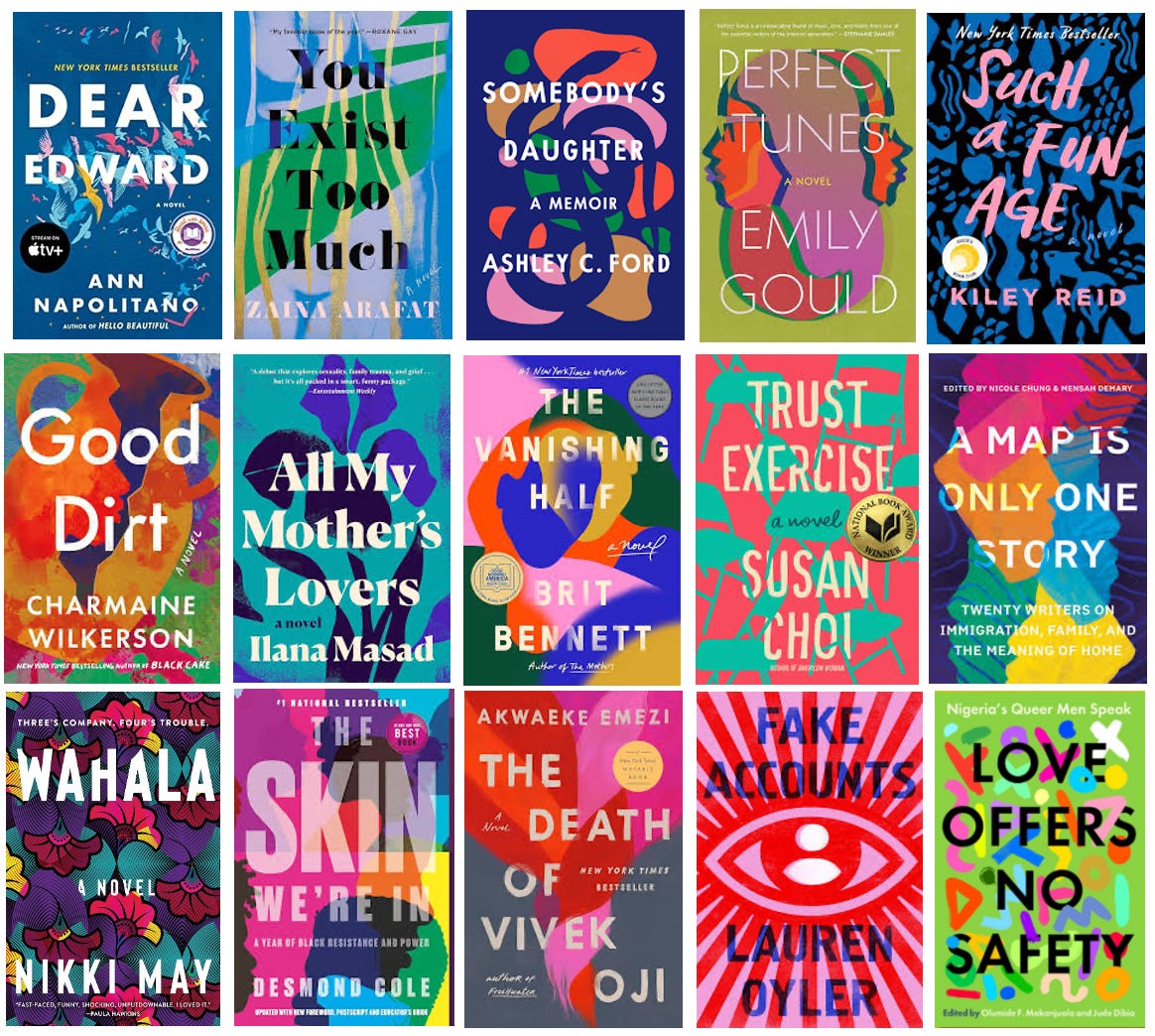
You can tell how stagnant things have become from the lookalike covers. I walk into a bookstore and every title I see is like this.

They must have fired the design team and replaced it with a lazy bot. You get big fonts, random shapes, and garish colors—again and again and again. Every cover looks like it was made with a circus clown’s makeup kit.

My wife is in a book club. If I didn’t know better, I’d think they read the same book every month. It’s those same goofy colors and shapes on every one.

Of course, you can’t judge a book by its cover. But if you read enough new releases, you get the same sense of familiarity from the stories. The publishers keep returning to proven formulas—which they keep flogging long after they’ve stopped working.

And that was a long time ago.

Ted Gioia, The Day NY Publishing Lost Its Soul

How can so many publishers go wrong at once? Whaddya mean “so many”?

“They” wanted Charlie Kirk dead

“They wanted the guy who was controlling our minds to be dead,” she said. “He had so much power over our generation.” When I asked who “they” were, she breezily suggested I do my own research. “We know who’s running the game,” she went on, glancing at her phone. I couldn’t tell how serious she was being. “You know, it’s a bigger picture. 9/11. MLK. JFK. Charlie Kirk.”

Lesley Lachman, President of Turning Point USA at Ole Miss, via Simon van Zuylen-Wood, Who Will Replace Charlie Kirk? The Takeover of TPUSA..

The first weird thing about that utterance is the insouciant phrasing that Charlie Kirk was controlling her mind, with “so much power” (with him gone, she sometimes turns to Nick Fuentes for mind-control). It’s kinda pathetic that the TPUSA President at a major university needs fixes of ideology.

But the most ominous thing is accusing an unidentified “they” (a “they” that has been around since at least the early 60s) of the murder. This kind of talk started while Charlie Kirk’s body was still drifting down toward room temperature. It is perhaps why Rod Dreher calls Kirk’s death the Radical Right’s Reichstag Fire.

These kids are very much a reverse mirror-image of lefist loonie like Antifa. They’re looking for meaning in politics. They’re so open to conspiracy theories that their brains have fallen out. They’re fools, whose only excuse (youth) is tempting to disregard since they think they’re so slick.

None of which is to deny that they may do a lot of damage.

Charlie Kirk was a time traveler?

Charlie Kirk was a time traveler? Even I draw the line at certain conspiracy theories. That’s why Candace Owens is so helpful, because she reminds me I’m actually not crazy—she is! Her latest is that Charlie Kirk was a time traveler. “Why did Charlie Kirk think he was a time traveler? He said, as I showed you in earlier messages, that he was a time traveler and he had to find me. . . . And again, not anything that I would have placed so much emphasis on back when he was saying it, but it came to fruition. The other parts. . . . I’m totally occupied by this. I tell you, I read these messages and I’m going,, what is this, what is reality, actually?” She alleges that there were “agents” who had Charlie Kirk “monitored. . . since he was young.” What is reality even, Candy? Actually, don’t answer that.

Nellie Bowles

Not-so-shorts

  • “The woman and her friend were highly disrespectful of law enforcement … Law enforcement should not be in a position where they have to put up with this stuff,” – President Trump asked if deadly force was necessary in the ICE killing of Renee Good.
  • “Seeing Vance’s comments about Minneapolis, I lived a similar moment 19 years ago in a Russian courtroom hearing a judge state that the police officer’s testimony had to be trusted over our video evidence because ‘he was wearing the uniform.’ Total immunity beats reality in a police state,” – Garry Kasparov.
  • “Heritage Americans: ‘You’re less American than I am because my ancestors built this country.’ Also Heritage Americans: ‘Don’t blame me for slavery or segregation. I’m not responsible for what my ancestors did,’” – Avik Roy.
  • “For years, I kicked against the image of the ‘ugly American.’ Nothing burned me more, when I was in Europe, as a student and after. I have written on this often. And now — there is nothing to say. There is only … bewilderment, anger, and shame,” – Jay Nordlinger on Trump’s thuggery over Greenland.

Via Andrew Sullivan

Shorts

Elsewhere in Tipsyworld


A devil is no less a devil if the lie he tells flatters you and stands to help you defeat your enemies and achieve power.

Rod Dreher

I don’t do any of the major social media, but I have two sub-domains of the domain you’re currently reading: (a) You can read most of my reflexive stuff, especially political here. (b) I also post some things on my favorite no-algorithm social medium.

Real-time ICE

ICE don’t care about da law

Minneapolis resident today:
I watched a young man get snatched by ICE outside yoga this morning. I filmed the whole thing.
His name is Lucio Fabian Navos Nietos.
I know this because they just left his passport and all other identification in his car. And left his car.
They don’t care who he is. They will deport him anyway.
12:50 pm

Indiana resident (not me)
They just left it all??? Lord almighty. They’re not even pretending anymore. Thanks for filming it.
1:27 pm

Minneapolis resident
Yep. Allowed me and others to find out a lot about him in a short amount of time, get the info to immigration attorneys, etc.
He has a wife who’s 5 months pregnant.
At least she’ll know what happened to him. Why he went to work in the morning and never came home.
I’m so sad and angry.
1:34 pm

Me:
I wish that, just this once, POTUS would admit “I overpromised. We can’t deport a million per year in ways consistent with American law and ethos.”
1:59 pm

Another respondent:
@patrickrhone these fascists need to be sent to Nuremberg
2:19 pm

(Actual Social Medium exchange January 10)

Block that Metaphor!

I need to get “Even a broken clock is right twice a day” in the front of my mind. I reflexively go to “Even a blind pig finds an acorn now and again” even though it’s (a) kind of Appalachian and (b) stupid (scent, not sight, is the primary way pigs find acorns, as prototypical Appalachians doubtless know).

What am I missing?

Nellie Bowles turns over the soil to reveal something weird:

  1. Biden puts a $25 million bounty on Venezuela’s Maduro.
  2. Trump raised it to $50 million.
  3. The Trump sends in the armed forces, with a soupçon of DEA, and takes Maduro to the US in handcuffs and masked.
  4. “Dems are aghast. What did they think bounties meant? Vibes? Papers? No, of course they understood it was fake!”

Too big a tent

The Heritage Foundation made a strategic choice to adapt to the current political moment by refusing to exclude anyone from its boundless tent. That led Heritage to depart from its principles and embrace people who have no credible claim to conservatism, even at the expense of pushing out the brains that built the foundation. By obsessing over “what time it is,” Heritage lost sight of hard lessons learned from the past.

For more than half a century, the Heritage Foundation’s work has rested on five ideological pillars listed in its mission statement: “free enterprise, limited government, individual freedom, traditional American values, and a strong national defense.” Yet in recent years Heritage has drifted from these precepts. Its trade policy centers on protectionism. Efforts to limit the federal government’s powers no longer seem like a priority. American values are shifting in unexpected ways. In 2024 Heritage flew the American flag upside-down to protest Donald Trump’s conviction in a New York criminal case. In foreign policy, the foundation has criticized longstanding alliances and is tending toward isolationism.

Josh Blackman, Ed Feulner, Ed Meese and the Heritage Foundation’s Exodus

Confabulation

If you don’t know how to explain something, why not just make it all up? Welcome to another important feature of the left hemisphere’s world: confabulation.

Iain McGilchrist, The Matter With Things, describing the left hemisphere when the right hemisphere is impaired or disabled.

Sounds a lot like AI, doesn’t it? McGilchrist has done wonders disenthralling me of AI techno-utopianism.

America is not authoritarian

“You’re not living in an authoritarian country. Except for the part where the president seizes unprecedented powers. And the part where he orders sham prosecutions. And the part where he invades countries to take their oil. And the part where his White House rewrites the history of his coup attempt,” – Will Saletan.

And the part where his masked anonymous agents gun down unarmed civilians in their cars. (Via Andrew Sullivan)

Panama, Venezuela

Our 1989 operation in Panama to capture Noriega was called “Operation Just Cause.” Our 2026 operation in Venezuela could be called “Operation … just cuz.” (H/T Carlos Lozado)

Shorts

Elsewhere in Tipsyworld:

Autogulpe Day

I’m fully aware that today is Epiphany in Western Christianity, Theophany in Orthodox Christianity. But it’s also the 5th anniversary of one of the darkest days in American history, the attempted autogulpe of 2021.

In some ways, I think 1-6-21 is worse than 9-11: we did this to ourselves, and to this day there are tens of millions of Americans who will insist that it was a great patriotic outpouring of love rather than an attempt to overturn a Presidential election that ousted the incumbent.

Baloney!, say I to keep this post as family fare.

With friends like this …

What I remember very well about that day was my own failure of imagination. I did not, to my knowledge, see Dempsey—he had positioned himself at the vanguard of the assault, and I had stayed near the White House to listen to Trump—but I did come across at least a dozen or more protesters dressed in similar tactical gear or wearing body armor, many of them carrying flex-cuffs. I particularly remember those plastic cuffs, but I understood them only as a performance of zealous commitment. Later we would learn that these men—some of whom were Proud Boys—believed that they would actually be arresting members of Congress in defense of the Constitution. I interviewed one of them. “It’s all in the Bible,” he said. “Everything is predicted. Donald Trump is in the Bible.” Grifters could not exist, of course, without a population primed to be grifted.

After the riot, Dempsey returned to California, where he was eventually arrested. In early 2024, he pleaded guilty to two felony counts of assaulting an officer with a dangerous weapon. He was sentenced to 20 years in prison.

Six months later, in the summer of 2024, Trump, who would come to describe the January 6 insurrection as a “day of love,” said that, if reelected, he would pardon rioters, but only “if they’re innocent.” Dempsey was not innocent, but on January 20, 2025, shortly after being inaugurated, Trump pardoned him and roughly 1,500 others charged with or convicted of offenses related to the Capitol insurrection ….

Jeffrey Goldberg, MAGA’s Foundational Lie. Subtitle: “The movement claims to stand with the police. Trump’s decision to pardon the cop-beaters of January 6 exposed his movement for what it is.”

And what have we gotten from the incorrigible electorate’s insistence on re-electing Trump four years after his defeat?

Defining “sedition” down

One indicator of a polity’s health is whether a citizen can be punished merely for telling the truth about the law. The signs for American democracy are not good.

This morning, Defense Secretary Pete Hegseth announced that he has begun the process to demote Mark Kelly, a retired Navy captain and NASA astronaut, and reduce his pension pay. The operative facts here, naturally, are not Kelly’s past service but his current rank and service: a Democrat serving in the U.S. Senate and a political adversary of President Donald Trump.

“Six weeks ago, Senator Mark Kelly—and five other members of Congress—released a reckless and seditious video that was clearly intended to undermine good order and military discipline,” Hegseth wrote on X this morning. He cited two articles of the Uniform Code of Military Justice; Kelly, unlike the other five, holds retired military status, which makes him subject to sanctions from the Defense Department.

What Hegseth did not cite was what Kelly and his colleagues actually said in the video, and for good reason. Doing so would expose the absurdity of the charge and the abuse of power involved in the attempt to demote him. “Our laws are clear: You can refuse illegal orders,” Kelly said. No one in the Trump administration has disputed that this is true. A more agile or even-keeled administration would have smoothly dismissed the video as irrelevant: This is true, but of course we would never issue an illegal order. (As Kelly and his lawyers have noted, Hegseth has cited the same law about disobeying illegal orders in the past.) Instead, Trump and his aides threw a fit, dubbing the Democrats the “Seditious Six.”

Members of the armed forces, and retirees like Kelly, are particularly susceptible to Hegseth’s abuse of power, because they can be punished by the Defense Department internally. But the chilling effect does not end with those who are serving or have served, or with the particular question of illegal orders. The administration has told the other five Democrats that it is investigating them as well. The core belief underlying all of this is as plain as it is dangerous: Criticizing Donald Trump and defending the rule of law is sedition.

David A. Graham, Hegseth’s Appalling Vengeance Campaign

Kelly responds tartly:

“My rank and retirement are things that I earned through my service and sacrifice for this country. I got shot at. I missed holidays and birthdays. I commanded a space shuttle mission while my wife,” former Representative Gabby Giffords, “recovered from a gunshot wound to the head—all while proudly wearing the American flag on my shoulder,” he said in a statement on X. “If Pete Hegseth, the most unqualified Secretary of Defense in our country’s history, thinks he can intimidate me with a censure or threats to demote me or prosecute me, he still doesn’t get it.”

Remember that Hegseth purports to be a devout Christian. He should bear in mind that “taking the name of the Lord in vain” has a deeper meaning than “don’t cuss.”


We are all gatekeepers now.

Peggy Noonan

Your enemies are not demonic, and they are not all-powerful and the right hasn’t always lost and the left hasn’t always won. But if you convince yourself of that, you give yourselves all sorts of permission to do a lot of stupid and terrible things under the rubric of “Do you know what time it is?”

Jonah Goldberg.

[A] critical mass of the American people … no longer want[s] to govern themselves, … are sick of this republic and no longer want to keep it if it means sharing power with those they despise.

Nick Catoggio

I don’t do any of the major social media, but I have two sub-domains of the domain you’re currently reading: (a) You can read most of my reflexive stuff, especially political here. (b) I also post some things on my favorite no-algorithm social medium.

Feast of St. Stephen …

… in the Christian East, that is. The West commemorated him yesterday.

A profitable political pairing

Two Right-coded voices, Glenn Loury and Ilya Somin, take up recent events, emblemized by Tucker Carlson’s softball interview of Nick Fuentes, and reach similar conclusions: a fundamental rift in the Right is between universalists and particularists/nationalists.

For figures such as Robert P. George, McCormick Professor of Jurisprudence at Princeton University and perhaps the single most influential moral philosopher within conservative intellectual circles, conservatism begins with the claims of natural law. Its founding premise is the inherent dignity of every human being—an anthropology that descends from classical philosophy, Christian theology, and the Enlightenment. For George, conservatism is first a moral project: It safeguards life, liberty, marriage, family, and religious freedom because these institutions reflect universal truths about the human person. George has spent his career articulating these principles in philosophy, public policy, and constitutional thought. His is an approach to conservatism that emphasizes the primacy of the permanent things, the universals that transcend time and place.

Opposing this universalist strand is the ascendant nationalist wing of the right—a coalition influenced by the populist energies that surged after 2016 and represented by Tucker Carlson, Kevin Roberts of the Heritage Foundation, and polemicists such as John Zmirak. This faction sees conservatism less as an expression of moral philosophy than as a defense of Western civilization: a concrete culture, a historical inheritance, with its own people, faith, memories, and vulnerabilities. This conservatism is particularist rather than universalist. It begins not with abstract principles but with cultural loyalties. Whereas George begins with human dignity, Carlson begins with civilizational survival. Whereas George sees imperatives and violations of the moral law, Carlson sees a beleaguered West beset by global elites, porous borders, and cultural disintegration.

Glenn C. Loury, Tucker and the Right

[T]he root of the problem is the Trump-era shift of most of the American right towards ethno-nationalism. For reasons outlined in detail in my recent UnPopulist essay on this topic, nationalist movements are inherently prone to anti-Semitism and other forms of racial and ethnic bigotry. It is not surprising that anti-Semitism among MAGA conservatives has risen alongside nativism and bigotry towards other minority groups, such as Indian-Americans.

As I explained in the UnPopulist article, the only sure way to avoid this problem is to reject ethnic nationalism and instead recommit to the universalist principles of the American Founding, which the Heritage Foundation once claimed to stand for, but has more recently betrayed ….

Ilya Somin, Lessons of the Heritage Foundation’s Implosion

As I skimmed Lourie’s article (which I’m pleased to see in First Things, which under R.R. Reno has been leaning increasingly toward particularist nationalism), I felt a flush of shame (or was it the shiver of a near-miss?) as I looked back on my admiration of “paleoconservative” thinkers and commentators — guys who now appear to be the ancestors of today’s ethno-nationalist types.

Even now, I sense the fortress America appeal of the nationalist appeal. But when I watch ICE trying to evict putative undesirables from the fortress before we pull up the drawbridge, and see antisemitism rising among the nationalists as well, I can’t help coming down on the side of human dignity: Fiat justitia ruat caelum.

Slouching Toward Something Worse

[Ben] Shapiro originally hired [Candace] Owens at The Daily Wire, thereby helping to launch her career into the stratosphere. The fact that he now feels the need to try and drive a stake through her heart “contains the entire story of the conservative movement within it,” in the words of Substacker John Ganz.

[Rod] Dreher longs for Vance to take a firm stand against Fuentes and his followers. But will he?

So far, there’s no sign of it. And yes, that includes in the recent UnHerd interview, where Vance told Fuentes (in the debased public rhetoric favored by populists) to “eat shit.” The vice president made clear that his rightward volley was provoked, not by any of Fuentes’ political views, but by him insulting Vance’s (South Asian) wife. “Anyone who attacks my wife,” Vance declared, will be attacked in turn, “whether their name is Jen Psaki or Nick Fuentes.”

That’s right: the sitting vice president of the United States made clear he was equally inclined to rise up in defensive anger against a former White House Press Secretary from the mainstream opposition party and a man who regularly proclaims his admiration for Adolf Hitler and loathing for Jews.

I’m afraid anyone placing their hopes in Vance serving in the role of gatekeeper or force for moderation is going to be sorely disappointed.

It’s not clear a right-populist political movement needs policy intellectuals at all. After all, intellectuals are elites who think they sometimes know better than the elected Leader of the People. That is unacceptable. What a right-populist political movement needs, instead, is propagandists to justify what the Leader already intends to do.

Damon Linker

In case you’ve forgotten, do not trust any high-generality assessment of JD Vance by Rod Dreher. Dreher “discovered” Vance’s book, Hillbilly Elegy, and his discovery elevated mediocre sales to stratospheric sales. He and Vance are now friends, Rod feels a personal investment in him, and Vance probably feels a debt of gratitude to Rod for launching his explosive political rise.

So Dreher is just not capable of objectivity about his friend, and that’s probably to his credit; dissecting friends is kinda reptilian — and certainly is a deviation from the conservative tendency on Jonathan Haidt’s Loyalty/betrayal moral foundations axis.

Too ad hoc to be fascist

Take the word fascism, properly applied to Franco’s Spain or Mussolini’s Italy, and to some extent beyond. The fasces were the bundles of rods carried by Roman lictors: symbols of punishment and magisterial authority, but in modern times also of a tightly unified society controlled from above, and organized in corporate form. The desire of totalitarians everywhere is to achieve harmonization, with all of society marching in military cadence under the guidance of an omnipresent government.

But the Trump administration is more interested in blowing up the state than in extending its power.

He is, to be sure, cruel and malicious, but unlike the others, has no real governing vision.

Trump himself is not Mussolini, or Hitler, or Orbán ….

Eliot A. Cohen, America Needs a Mirror, Not a Window

French Integrity

The headline read, “What It’s Like to Experience the 2016 Election as Both a Conservative and a Sex Abuse Survivor.”

Nancy French, Ghosted. As the book blurb has it, “when she was unwilling to endorse an unsuitable president, her allies turned on her and she found herself spiritually adrift, politically confused, and occupationally unemployable.”

Part of the reason for David French and Nancy French becoming personae non grata in much of the North American white Evangelical world was candor, like in the cited article Nancy wrote, and their various relatively unflinching looks at topics like sexual abuse at a very popular Evangelical summer camp for kids. I learned recently that they fairly quietly have moved out of their deep red part of Tennessee to the Chicago area (I was aware that Tennessee Evangelicalism exhibited pretty unrelenting and vocal antipaty to Frenches). That move won’t do much for Nancy’s work as a ghost-writer in Evangelical and Conservative circles, but they should at least be able to find a Church whose Christianity matches theirs (Reformed-tinged Evangelical) without the political tribalism. (That’s my read on it.)

(I have speculated that David might be on the road to Rome, too.)

The differences between their Evangelical/Reformed piety and my Orthodoxy manifests in my ill-ease with some of their takes on things (I will never again trust a David French endorsement of a movie or television series, for instance), but I’ll give them high marks for trying to act with integrity (which endears them to me despite reservations).

Quantum physics

Quantum entanglement blows my mind. How do they even find the entangled needles in the cosmic haystack to study entanglement?

That they manage to find and study them makes me sympathetic to the predictions that we’re going to figure out everything — predictions I nonetheless think are ultimately delusional.

Trying to deal with things like this has sent me back to Iain McGilchrist for a second round of mind-bending, this time via The Matter with Things.

I’m outvoted

A few days ago, I objected to the emerging cult of Charlie Kirk.

For what it’s worth, one of America’s top religious news experts, Terry Mattingly, thinks Kirk’s assassination was the top (American) religion story of the year, even higher than the selection of an American Pope (because, if I understood Mattingly, Kirk’s death liberates sinister tendencies on the political Right, like antisemitism and political violence, that Kirk was restraining).

The mixture of politics and religion in this theory makes my head hurt, and my eyes avert, but I suspect that Mattingly knows more about Kirk, and about the consequences of his assassination, than I do.

Jingoists and Patriots

The worst jingoes do not love England, but a theory of England. If we love England for being an empire, we may overrate the success with which we rule the Hindoos. But if we love it only for being a nation, we can face all events: for it would be a nation even if the Hindoos ruled us.

G. K. Chesterton, Orthodoxy

Shorts

Elsewhere in Tipsyworld


We are all gatekeepers now.

Peggy Noonan

Your enemies are not demonic, and they are not all-powerful and the right hasn’t always lost and the left hasn’t always won. But if you convince yourself of that, you give yourselves all sorts of permission to do a lot of stupid and terrible things under the rubric of “Do you know what time it is?”

Jonah Goldberg.

[A] critical mass of the American people … no longer want[s] to govern themselves, … are sick of this republic and no longer want to keep it if it means sharing power with those they despise.

Nick Catoggio

I don’t do any of the major social media, but I have two sub-domains of the domain you’re currently reading: (a) You can read most of my reflexive stuff, especially political here. (b) I also post some things on my favorite no-algorithm social medium.

Christmas Eve

Religion and secularity

The religious/secular distinction is not a neutral set of descriptive categories, and the idea that religion has a greater tendency than the secular to promote violence is not a commonsense observation about the world. Both are ideological constructs that privilege certain Western secularist arrangements.

William T. Cavanaugh, The Uses of Idoloatry

Don’t try to titrate poison

This French reactionary antisemitism came to a head in 1940, when the Nazis invaded, France surrendered, and Philippe Pétain became the dictator. Right-wing reactionaries, (including the vast majority of French bishops) were all too happy for the regime to enact laws that limited the civil rights of Jews. Many of those same bishops would later regret this when the cruelty of the anti-Jewish legislation became too blatant to ignore. In the end, around 70,000 Jews who had been under the jurisdiction of Vichy France would perish in concentration camps.

Thomas D. Howes, The Catholic Church Has Faced Antisemitism Before

I sometimes worry that populist rabble-rousers, with the roused rabble SWATting and making death threats against recalcitrant authorities, were the inevitable result of the “conservative” politics I long favored.

I don’t think that’s true, but once stung, twice cautious: these days, when I see an opinion piece that seems to make sense, but with comment boxes full of cheering conspiracy theorists and antisemites, I reflexively drop (or at least loosen my grip on) the opinion.

If you’re looking for rigorous logic in that, you’ll not find it. It’s just one geezer’s heuristic.

Primarying faithful legislators

The first time I recall hearing of Charlie Kirk was in connection with “The Falkirk Center,” the name being a portmanteau of “Falwell” and “Kirk.” Yeah, that Falwell. The Junior one. The sleazy one driven out of Liberty University eventually.

So I had a bias against Kirk from the start. No, he didn’t deserve to be murdered. Nowhere near. But 3+ months is long enough. I’m not going to bite my tongue any longer about the him and his Turning-Point-this-and-Turning-Point-that constellation of Christianish MAGA adjuncts.

He wasn’t my cup of tea. His Christianity was substantially alien to any traditional Christianity. I object to him being lionized as a Christian martyr and to the erection of a sort of cult around him. The more I learn about Turning Point shamelesslessly subordinating its version of Christianity to the will of über-pagan narcissist Donald Trump, the more it nauseates me.

All that to introduce much less:

[A]s early as August 18, Charlie Kirk said in an X post: “We will support primary opponents for Republicans in the Indiana State Legislature who refuse to support the team and redraw the maps.” Months later, on the eve of the vote, Trump ratcheted up the warnings to Indiana Republicans, saying as part of a lengthy post on Truth Social: “Indiana Senate ‘Leader’ Rod Bray enjoys being the only person in the United States of America who is against Republicans picking up extra seats. … He’s either a bad guy, or a very stupid one!”

David M. Drucker, Why Trump’s Redistricting Push Failed in Indiana.

The way primary elections tend to turn out the most extreme members of the party base, it’s possible that primarying Indiana Legislators who voted for the will expressed by the people of Indiana, rather than for the imperious wills of Donald Trump and Turning Point Action, will succeed. But I think not. I think the spell is broken. I’m looking forward to three years of quacking.(Yeah, that’s got a bit of wishcasting in it.)

Turning Point just concluded its conference

I suppose if Turning Point USA wanted its conference to make a big splash, it accomplished its mission. But a movement led by a president who made regular appearances in the world of professional wrestling now has rallies that resemble WrestleMania with podcasters, complete with boasts and threats and chest-thumping.

When you book a bunch of clowns, don’t be surprised if you end up with a circus.

Jim Geraghty, Turning Point USA conference was WrestleMania with podcasters

Wherein I register a rare disagreement with Kevin D. Williamson

A person who evacuates is emptying his bowels. A person removed from a place of danger is a person being evacuated. If you have 100,000 people evacuating all at once … well, maybe they won’t notice it too much in Seattle.

Those 100,000 were not ordered to evacuate; they were ordered to leave, to seek safety, to head for the hills, to make for higher ground, etc.

Kevin D. Williamson.

I love Williamson, but he’s lost me on this one. From the Department of Usage Makes Proper, evacuate has become broader than he insists. Even I, a card-carrying curmudgeon, would not use “evacuate” as he does; I’d add “evacuates his bowel” if that’s what I meant.

Having driven my stake in the ground, I confirmed my righteousness: the primary meaning of “evacuate” is to remove or empty.

I completely agree with Williamson on something else, though. After alluding to things like “messaging” in the upcoming election, he simplifies things:

I would like to suggest a relatively simple approach: Democrats should run on a platform of what it is they actually intend to do in office, and that platform should be what they believe to be the right thing. I would offer the same advice to Republicans if they had not made it so perfectly clear that they cannot and will not do any such thing, that their party and their movement is incapable of candor and good faith.

Thoughts at 3 am

That’s a metaphor. I rarely if ever fret about things at 3 am, and it I fret, it’s likelier to be about family or things closer to me than politics.

My current “political” concerns, though, seem to be antisemitism and the quest for certainty — even false certainty preferred to uncertainty.

  • According to the Manhattan Institute’s recent survey of registered Republicans and others who voted for Donald Trump last fall, no less than 25 percent of those under 50 admit—admit—to expressing antisemitic views. Among those over 50, just 4 percent do.

The Nazis gave antisemitism a bad name. The memory of that is fading.

On the quest for certainty, see Gary Morson, Wonder Confronts Certainty, Then and Now. This is from Public Discourse, which I formerly visited daily. They seem to be on a bit of a roll, so I’m going to resume that.

The journalistic enterprise

[Bari] Weiss has an impossible dilemma [in running CBS]. She’s in charge of a first-world news organization that aims to hold government accountable (especially when it’s run by Republicans) but was appointed to the position to satisfy a third-world regime led by a demagogic boor who believes “news” should look like … this.

“The Failing New York Times, and their lies and purposeful misrepresentations, is a serious threat to the National Security of our Nation,” the president declared this morning. “Their Radical Left, Unhinged Behavior, writing FAKE Articles and Opinions in a never ending way, must be dealt with and stopped. THEY ARE A TRUE ENEMY OF THE PEOPLE!” He didn’t specify the supposed “national security” threat that prompted that, but earlier this month he accused the Times of “seditious, perhaps even treasonous” behavior for reporting on his obviously declining health.

That’s the kind of media Trump wants. Not one where Stephen Miller does more interviews but one where you go to prison if you acknowledge the plainly observable fact that the president sounds addled.

Nick Catoggio

This particularly cursed holiday week kicked off in earnest last night when my father turned his iPad in my direction. On its screen was a terribly disturbing post on X containing two images. In the first, Jeffrey Epstein was hugging and kissing a little girl. In the second, that girl was bound and gagged on a bed.

Dad was rightly outraged and disgusted. He asked me if I’d seen the photos in my time going through the Epstein files. I immediately recognized the first image of Epstein and deduced that it had been Photoshopped from a widely distributed photo of Epstein hugging Ghislaine Maxwell. The second image seemed to be an AI rendering. (To add to the confusion, images reportedly do exist of Epstein cuddling children.) I let him know that the imagery was fake, and a distinctly non-yuletidy conversation ensued. Yes, Epstein was a heinous pedophile and convicted sex offender. Also, the internet is awash in fake, traumatizing slop that’s being used to score points in an ongoing information war. Happy holidays!

Charlie Warzel

Every journalist who is not too stupid or too full of himself to notice what is going on knows that what he does is morally indefensible. He is a kind of confidence man, preying on people’s vanity, ignorance, or loneliness, gaining their trust and betraying them without remorse.

Janet Malcolm, The Journalist and the Murderer, Via Peggy Noonan

Shorts

  • In such an ugly time, the true protest is beauty. (Phil Ochs)
  • He is like a strange general who can’t quietly establish camp or dig new fortifications. He shoots his cannon for no reason, just for the sound. (Peggy Noonan describing you-know-who)
  • He just can’t do intimacy. He can’t do reassurance. His fireside manner has always been gasoline. (Andrew Sullivan)
  • Prediction markets may promise clarity, but what they really offer is another way to feel excitement in a world that feels rigged. (Charlie Warzel)
  • Having elevated her in large part for her willingness to say outrageous things about her opponents, people on the right are now surprised by her willingness to say outrageous things about them. (Michelle Goldberg about the rise of toxic influencer Candace Owens)
  • In The Times, Glenn Thrush and Alan Feuer … mused about Trump’s troubles prosecuting his perceived enemies: “Revenge, it turns out, is a dish best served with evidence.” (Via Frank Bruni)
  • In her newsletter, Stacey Patton recognized the humiliation of the Trump administration’s repeated failures to convince a grand jury of its case against Letitia James: “In federal court, a prosecutor not getting an indictment is like a chef burning cereal.” (Via Frank Bruni)
  • A fundamentalist can see every person who’s wrong as a kind of Patient Zero in a potential pandemic of paganism. (David French)
  • AI Sends School Into Lockdown After It Mistook a Student’s Clarinet for a Gun. (Futurism – H/T TMD)
  • We take the state’s monopoly of violence for granted, but when that monopoly is challenged, people turn to gangsters to keep the peace. Eli Lake, A History of Tough Jews (podcast episode)
  • Why these people are coming our way is that Heritage and some other voices and commentators have embraced big-government populism and have been willing to tolerate antisemitism. (Former Vice President Mike Pence on the (ahem!) evacuation of the Heritage Foundation, with refugees fleeing to a Pence-founded, more traditionally conservative, alternative.)

We are all gatekeepers now.

Peggy Noonan

Your enemies are not demonic, and they are not all-powerful and the right hasn’t always lost and the left hasn’t always won. But if you convince yourself of that, you give yourselves all sorts of permission to do a lot of stupid and terrible things under the rubric of “Do you know what time it is?”

Jonah Goldberg.

[A] critical mass of the American people … no longer want[s] to govern themselves, … are sick of this republic and no longer want to keep it if it means sharing power with those they despise.

Nick Catoggio

I don’t do any of the major social media, but I have two sub-domains of the domain you’re currently reading: (a) You can read most of my reflexive stuff, especially political here. (b) I also post some things on my favorite no-algorithm social medium.