November 1

MAGA nihilists

Sometime in 1985 I had lunch with Sam Francis in the cafeteria of The Washington Times, where we both worked. You may never have heard of Sam Francis, but MAGA people (at least the more intellectual ones) know him as one of the seminal thinkers of their movement.

The lunch was awkward because I found him dark and creepy (and he probably found me naïve). Back then I didn’t understand that his way of thinking would triumph in conservative circles and my way of thinking would be vanquished. I don’t think he won because he was a flat-out racist, though he was. (He was later fired for writing a column arguing that “neither ‘slavery’ nor ‘racism’ as an institution is a sin.”) I think he won because he was a revolutionary, while I was a conservative. I wanted to reform things; he wanted to burn it all down.

Sam Francis (who died in 2005) explicitly cited Gramsci as his role model as he waged his culture war struggles. Christopher Rufo does the same today. This is why Trump is going after the universities, public broadcasting and the Kennedy Center. Francis once wrote, “The main focus should be the reclamation of cultural power, the patient elaboration of an alternative culture within but against the regime — within the belly of the beast but indigestible by it.”

David Brooks, Hey, Lefties! Trump Has Stolen Your Game (Gift link)

I was reading Sam Francis at roughly the time Brooks had lunch with him and for some years thereafter. He was brilliant (which is little assurance of a sound mind). He also was purged by more respectable conservatives—my kind of conservatives—for his increasingly explicit antisemitism.

Joseph Sobran followed a similar trajectory. He, too, was brilliant, but less radical than Francis (and thus less consequential). He was a devout Catholic, and his antisemitism was never explicit, but William F. Buckley wouldn’t tolerate even a whiff of it.

I viscerally detested Christopher Rufo almost from my first notice of him, which involved his gloating over making the term “Critical Race Theory” toxic while leaving it vague enough that it could beslime anyone he cared to beslime. I doubt that Rufo will be as consequential as Francis or even Sobran in the long run, but we’re in an era of pas d’ennemis á Droite, and there’s no magisterial authority trying to purge him.

Sentient and respectable conservatives like me necessarily ask ourselves if MAGA was always the eventuality of our political preferences, if we were all embryonic Sam Fracises and Joe Sobrans all along.

I don’t think so, but I’m increasingly appreciating that some truths simply need not be uttered—because of how very, very foreseeably they can be abused. To deny them would be sin, to utter them, imprudent. I save them for my private journal now when I recognize that.

Pardon me?

On Tuesday morning, the Republican-led House Oversight Committee released a report on former President Joe Biden’s use of autopen signatures on the many pardons and commutations he handed out during his term, and particularly near its end. Many of these were scandalous enough taken on their own terms, but what made them particularly outrageous was the suspicion that the bulk of these acts were the work of Biden’s staff, not the senescent president himself. One might reasonably understand how Biden found the time to preemptively pardon his family members, breaking frequent promises never to do so, but it was harder to believe that he was setting aside personal time to commute the sentences of people like Maryland’s thrice-murdering “Black Widow” killer. The House report confirms what voters long suspected: Biden’s inner circle hid the extent of his mental decline from the American people and, after he dropped out of the race, used his autopen as part of their campaign to set a new record for presidential clemency.

The GOP argument that Biden abused his pardon power in an unacceptable way is undermined, however, by Trump’s nonchalant, even gleeful pardoning of absolute sleazeballs who have ties to his own family business. There aren’t a lot of large financial institutions that are willing to simultaneously do work with al-Qaeda, ISIS, Hamas, ransomware hackers, and kiddie-porn enthusiasts, but the crypto firm Binance did so. Back in November 2023, Binance founder Changpeng Zhao pleaded guilty to failing to maintain an effective anti-money-laundering program. In a court filing, U.S. Attorney Tessa Gorman said Zhao caused “significant harm to U.S national security” through his criminal acts and “violated U.S. law on an unprecedented scale.” But not only did Trump pardon him earlier this month, he claimed Zhao was in fact persecuted by the Biden administration. It gets worse. The Wall Street Journal reported in August: “The Trump family’s crypto venture has generated more wealth since the election—some $4.5 billion—than any other part of the president’s business empire.” Trump’s crypto fortune is of course facilitated by a partnership with “an under-the-radar trading platform quietly administered by Binance, the world’s largest crypto exchange.” It’s an egregious decision that is unlikely to generate more than a peep of objection from congressional Republicans.

National Review email.

Who damaged the nation more: Biden with his autopen pardons or Trump with his blanket pardon of the January 6 rioters and targeted pardons of lucrative cronies? (That’s a rhetorical question, of course.)

Indictment

Let us not belabor the obvious truth that what the Western world calls an “energy” crisis ineptly disguises what happens when you can no longer control markets, are chained to your colonies (instead of vice versa), are running out of slaves (and can’t trust those you think you still have), can’t, upon rigorously sober reflection, really send the Marines, or the Royal Navy, anywhere, or risk a global war, have no allies only business partners, or “satellites” and have broken every promise you ever made, anywhere, to anyone. I know what I am talking about: my grandfather never got the promised “forty acres, and a mule,” the Indians who survived that holocaust are either on reservations or dying in the streets, and not a single treaty between the United States and the Indian was ever honored. That is quite a record.

James Baldwin, Open Letter to the Born Again, p. 785.

My name is Ozymandias, King of Kings

The problem is that Trump, perhaps owing to his nouveau riche background and the carefully wrought deformity of his soul, has a taste for the trappings of aristocracy—a princely estate as imagined by a trust-fund dork from Queens. You can see it in his enthusiasm for ghastly imperial furnishings, in his love of monarchical pomp, and even in his sometimes evident desire to pass something of his political position along to the sons he obviously despises. … But what is most objectionably kingly about Trump is not his Caligula-by-way-of-Liberace bad taste but his personalist posture, e.g., treating the White House as though it were his personal property, to be knocked down and rebuilt at his whim, treating the Department of Justice as though it were his personal goon squad, treating judges as though they were his personal servants and factota, etc. Trump talks about “my generals” and unilaterally raised tariffs on Canadian goods because someone in Ontario hurt his personal feelings.

L’État, c’est moi—it is not only gilt moldings that Trump has taken from Louis XIV.

The king spoke, and said, “Is not this great Babylon, that I have built for the house of the kingdom by the might of my power, and for the honor of my majesty?”

While the word was in the king’s mouth, there fell a voice from heaven, saying, Oh, king Nebuchadnezzar, to thee it is spoken; The kingdom is departed from thee.

Nebuchadnezzar had to learn things the hard way. Julius Caesar, too. Why should Americans be any different?

Kevin D. Williamson

Pas d’ennemis à Droite, Heritage Foundation Edition

[A] video of Kevin Roberts, head of the Heritage Foundation, went viral. “There has been speculation that Heritage is distancing itself from Tucker Carlson over the past 24 hours,” Roberts tweeted, reacting to the uproar over Carlson’s notorious interview with head groyper Nick Fuentes. “I want to put that to rest right now.”

And that’s what he did. “We will always defend our friends against the slander of bad actors who serve someone else’s agenda,” he said in the clip, declining to explain why criticism of Carlson is “slander” and who that “someone else” whose agenda is being served might be. “That includes Tucker Carlson, who remains—and, as I have said before, always will be—a close friend of the Heritage Foundation. The venomous coalition attacking him are sowing division. Their attempt to cancel him will fail.”

Nick Catoggio

Stagnation

Today’s suburbs are different. Highways and zoning have broken the feedback loop between location and value. These developments are typically built to a fixed, finished state and then locked down through zoning codes that discourage or prohibit change. There’s no natural process of maturing or intensification. No organic evolution. Just a one-time buildout, followed by stagnation and decline.

America Should Sprawl? Not if We Want Strong Towns

Snippets

  • “Quantity is a quality of its own.” (Shyam Sankar, CTO of Palantir, on the United States advantage in WW II. German stuff was engineered better, but we made up for it with more stuff, much more stuff. Via Ross Douthat’s Interesting Times podcast (Gift link))
  • “[E]very good earnings report further entrenches Nvidia as a precariously placed, load-bearing piece of the global economy … What if AI’s promise for American business proves to be a mirage? What happens then?” (Matteo Wong, Charlie Warzel, Here’s How the AI Crash Happens)

I don’t do any of the major social media, but I have two sub-domains of the domain you’re currently reading: (a) You can read most of my reflexive stuff, especially political here. (b) I also post some things on my favorite no-algorithm social medium.

Politics, 7/21/25

Sanctimony sans self-awareness at Glastonbury

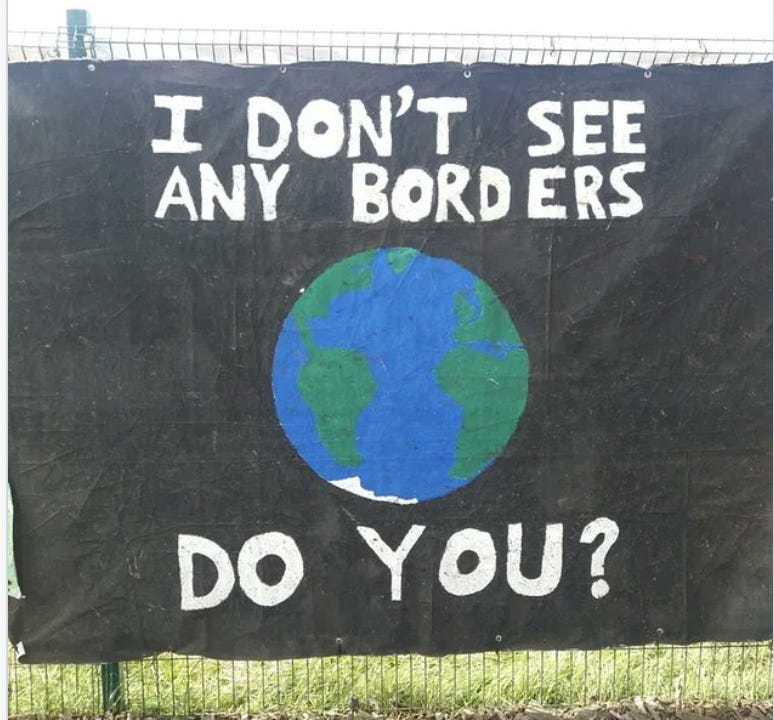
Last point, about how crazy these people are. Jeremy Corbyn, in his remarks from the stage, sent a “message” to Donald Trump, citing this poster seen outside the perimeter fence at the festival. “Build bridges, not walls,” said Corbyn, to Trump:

This poster literally hung on a five-mile fence surrounding the festival! They had to build it so only the people who had paid to come in could enjoy the music. They even had an onsite jail for wall-breachers. But these UK leftists have zero self-awareness. They want the Third World to keep coming by hundreds daily across the Channel, and to be subsidized by British taxpayers. But if any of those illegal migrants wanted to get into the Glasto festival, well, NOOOOO! To jail with you!

Rod Dreher

Why Trump won’t fire him (but may not need to)

Terminating the Fed chair would place him on thin legal ice and bring down an avalanche of criticism that he has destabilized U.S. monetary policy by politicizing the central bank. While hounding Powell out of office wouldn’t solve the second problem, it would solve the first, which is probably why the daily demagoguery is ramping up.

Do we really think Jerome Powell is prepared to endure 10 more months of it, given the sort of threats he and his family are likely receiving from hardcore MAGA cranks as a result? Even if he is, do we think Donald Trump has the patience to endure 10 more months of Powell ignoring his demands to cut rates if and when the economy slides into a tariff-driven slowdown?

There’s no way. We’re talking about a guy who once dashed off an out-of-the-blue memo giving the Pentagon two months’ notice to pull everyone out of Afghanistan.

Nick Catoggio

It is hideous that one must factor hardcore MAGA goons into these calculations.

Demagoguery whiplash

Show us all the Epstein client list now!!! Why would anyone protect those scum bags? Ask yourselves this question daily and the answer becomes very apparent!! (Donald Trump Jr in July 2023)

Quotes via Andrew Sullivan

Lonesome Rhodes

Trump always reminded me of Lonesome Rhodes, the charismatic, populist entertainer whose “candid” patter with plain folks garners him enormous power in Elia Kazan’s 1957 movie “A Face in the Crowd.”

At the finale, Andy Griffith’s Rhodes — engorged by flattery and riches — has a narcissistic explosion. Not realizing the woman he betrayed flipped on his microphone, he calls his loyal fans “morons,” “miserable slobs” and “trained seals.”

“I can take chicken fertilizer and sell it to ’em for caviar,” he crows, grinning.

Trump’s Truth Social posts backing up Pam Bondi’s claim that the Epstein files were much ado about nothing showed that same brutal disregard for his devout fans. They had taken him seriously? What fools!

Maureen Dowd

I heard an interesting anecdote and a conjecture about Trump from Michael Smerconish, interviewed by Jamie Weinstein on the Dispatch Podcast.

The anecdote: Trump was flying back to NYC from Florida, on a private jet of course. A model on the flight said “why don’t we stop at Atlantic City?” Someone replied “it’s full of white trash.” The first said “What’s white trash?” Trump jumped in: “It’s what I am only I have money.” (I find the anecdote plausible except for the premise that someone on a private jet with Trump didn’t know what “white trash” was.)

Conclusion: Donald Trump trades on being just a regular guy from Queens with lots and lots of money. People like regular guys.

The conjecture: The reason MAGA won’t let go of the Epstein story is that Trump clearly was connected to him and enjoyed his hospitality (to whatever extent, social or venereal), and that kind of hospitality was not extended to normal guys. The whole Epstein nexus (apart from any anti-semitic animus) marks Trump as not-so-normal after all.

Oh, the futility!

Is this really what I’ve chosen to do with my life? Provide running commentary on a conman-charlatan’s attempt to hock his bullshit to millions of morons? Hope that the country can be saved from authoritarianism by equally dishonest right-wing “influencers” stirring up indignation among the moronic masses against the man who more than anyone else taught them how demagoguery is done? Pretend that the Democrats trying their best to sound earnest as they barely contain their glee over Trump’s troubles really care about anything except making the president look as terrible as possible?

The thing that might be worst about trying to focus my attention on political life during the second Trump administration is the continual temptation to respond by a deranged embrace of misanthropy.

Damon Linker, feelin’ a little down.


Your enemies are not demonic, and they are not all-powerful and the right hasn’t always lost and the left hasn’t always won. But if you convince yourself of that, you give yourselves all sorts of permission to do a lot of stupid and terrible things under the rubric of “Do you know what time it is?”

Jonah Goldberg.

Trumpism can be seen as a giant attempt to amputate the highest aspirations of the human spirit and to reduce us to our most primitive, atavistic tendencies.

David Brooks

I don’t do any of the major social media, but I have two sub-domains of the domain you’re currently reading: (a) You can read most of my reflexive stuff, especially political here. (b) I also post some things on my favorite social medium.

Summer Solstice

Israeli ingenuity

As news circulated about the stupendous success of Israel’s attack on Iran, my first thought was that if you told me Mossad had figured out a way to part the Red Sea, at this point I’d believe you. The feats of intelligence and ingenuity that Israel has managed over the past year at the expense of Iran and its proxies would seem far-fetched as fiction, but here we are. It’s reassuring to see a Western nation demonstrate such competence as the United States descends into malevolent dark-age populist anarchy.

Nick Catoggio

Speed-reading

60 or so years ago, I took “Evelyn Woods Reading Dynamics” (a current version here) to increase my reading speed. After teaching us a technique for dragging our eyes down a page via a hand movement, they said “Resolve that from now on you’ll never read without this.”

I said to myself “The day I speed-read the Psalms that way would be a very sad day.”

I recently installed a browser extension to generate AI summaries of the current browser tab. It is saving me quite a bit of time on humdrum news and opinion.

But the day I settle for a structured outline of Nick Catoggio (or Kevin D. Williamson) instead of reading their own sprightly writing will be pretty sad, too.

Skrmetti

Experts

The Court rightly rejects efforts by the United States and the private plaintiffs to accord outsized credit to claims about medical consensus and expertise. The United States asserted that “the medical community and the nation’s leading hospitals overwhelmingly agree” with the Government’s position that the treatments outlawed by SB1 can be medically necessary. … The implication of these arguments is that courts should defer to so-called expert consensus.

There are several problems with appealing and deferring to the authority of the expert class. First, so-called experts have no license to countermand the “wisdom, fairness, or logic of legislative choices.” … Second, contrary to the representations of the United States and the private plaintiffs, there is no medical consensus on how best to treat gender dysphoria in children. Third, notwithstanding the alleged experts’ view that young children can provide informed consent to irreversible sex-transition treatments, whether such consent is possible is a question of medical ethics that States must decide for themselves. Fourth, there are particularly good reasons to question the expert class here, as recent revelations suggest that leading voices in this area have relied on questionable evidence, and have allowed ideology to influence their medical guidance.

Taken together, this case serves as a useful reminder that the American people and their representatives are entitled to disagree with those who hold themselves out as experts, and that courts may not “sit as a super-legislature to weigh the wisdom of legislation.” … By correctly concluding that SB1 warrants the “paradigm of judicial restraint,” … the Court reserves to the people of Tennessee the right to decide for themselves.

Justice Clarence Thomas, concurring in U.S. v. Skrmetti, via Eugene Volokh (citations omitted).

Strategic error

Representative Sarah (formerly Tim) McBride (D., Del.), the first transgender member of Congress, has admitted that the Democratic Party moved too quickly on pushing transgender issues. The lawmaker believes the left “went to Trans 201, Trans 301, when people were still at a very much Trans 101 stage.” Yet the representative still fails to understand the root of the problem: The left’s strategy on transgenderism failed because the left is wrong on transgenderism. Men cannot become women. Pretending like accepting the most outré claims of transgenderism is achievable through taking higher-level classes won’t change that. Besides, Americans are increasingly uninterested in enrolling in such courses. Polls show that support for so-called gender-transition procedures for children has declined, and Americans believe that trans people should use the bathroom that matches their sex, not their “gender identity.” The activists’ problem isn’t that they have failed to finesse their message; it’s that they have failed biology.

National Review Weekly email

The Barbarian Right

For many of the conservatives who embraced it—myself included—the Trumpian moment promised a more populist, pro-worker GOP. Yet the latest iteration of Donald Trump has dashed these hopes, playing down the themes that propelled his 2016 campaign, and sounding more and more like a conventional Republican nominee—only more erratic.

In the realm of right-wing ideas, meanwhile, something far grimmer is afoot: the rise of a cohort of writers, pseudo-scholars, and shitposters dedicated to reviving some of the darkest tendencies in the history of thought, including the idolatry of strength (as cartoonishly personified by the likes of Andrew Tate); the notion of supposedly “natural” hierarchies; IQ-based eugenics; overt racism and antisemitism.

Call them the Barbarian Right: The master subject of this worldview is the Nietzschean barbarian or “aristocrat of the spirit” who overthrows the egalitarian—and essentially feminine—structures that have long shackled him, restraining his yearning for adventure and excellence. Nazi apologia is par for the course.

Sohrab Ahmari

Christian Nationalist crackup

“Political idolatry,” he observes, “assumes worship, and worship assumes some kind of confidence in the thing being worshiped,” but few of the people obsessively following politics have much real faith in it anymore. It has become for many a kind of spectator sport, or live-action role-playing, far easier to participate through digital media, yet harder to take seriously. There is a performativity to our culture wars now that I suspect was not there in the 90s.

Over the past six months, I have observed two communities of discourse. One, which I’ve observed as a bemused spectator, is the increasingly inane conversation of Very Online Christian Nationalism. Much of this discourse had long since descended into self-parody, but the loss of a clear and present common enemy after Trump’s victory swiftly accelerated the splintering of the movement. At time of writing, many of the movements principles were publicly devouring one another over whether, and to what extent, one should blame the Jews for the moral rot of modernity.

Brad Littlejohn, The Resilience of America’s Hybrid-Enlightenment, Mere Orthodoxy (magazine) Winter 2025.

I’m reminded of how the New Atheists, having gathered around the non-existence of God, found that they had nothing else in common and dispersed again. I suspect the MAGA Right has nothing in common beyond worship of our Orange Sun King.

Golden Age

Kevin Roberts (Heritage Foundation, Project 2025) and Kellyanne Conway went north to Canada to take the affirmative on the debate question “Is this America’s Golden Age?.” It was shared with permission on the Ezra Klein show because Ezra was one of the debaters taking the negative.

Roberts and Conway beclowned themselves and offended the audience (e.g., mentioning Canada’s possible status as a 51st state) and then complained that the debate was rigged when they drew audible disapproval and contempt.

In my estimation, the negative side “chewed them up and spit them out,” but I grew too impatient and mortified at our national debasement to wait for the audience’s verdict.

Whence innovation?

Musical innovation tends to happen at crossroads and port cities. It’s spurred by outsiders not insiders. It rises from centers of multiculturalism and diversity—where different ideas come together.

The ruling class recognizes this, but it takes about 40 or 50 years. So fifty years elapse from Bob Dylan emerging as a rebel critic of the system, to becoming a Nobel Prize laureate. Almost fifty years elapse between Mick Jagger getting censored and becoming Sir Mick Jagger, an honored knight.

You eventually have this process of legitimization but the new style always starts on the outskirts—in the port cities and border cities.

Because of the internet, every place is now a port city.

Ted Gioia. So Ted thinks the venture capitalists in entertainment are at a dead end with sequels, prequels, and every other “do-it-again-and-again” strategy.

The slippery euthanasia slope

[A] justification for suicide that emphasizes the cry for help that medicine can’t answer, the need for control over the uncontrollable, the desire to cure suffering that doctors can’t relieve, will struggle to maintain terminal illness as a special category. There are just too many people in this exceptional position but with no endpoint to their pain.

Ross Douthat, Why the Euthanasia Slope is Slippery

Nellie snippets

  • Meanwhile, in the U.S. of A., Whoopi Goldberg says that being black in America is worse than being a woman in Iran. Here was The View co-host Alyssa Farah Griffin: “I think it’s very different to live in the United States in 2025 than it is to live in Iran.” Whoopi retorted: “Not if you’re black.” Alyssa, have you possibly considered sitting your ass down and letting Whoopi speak her truth? The only place worse than Iran to be a woman might well be the panel on The View. I’ll take the veil over fighting with Joy Behar about DEI any day of the week.
  • Asked about Tulsi’s earlier testimony on Iran, Trump said simply: “I don’t care what she said.” All jobs under Trump are fake. All titles are fake. He makes decisions alone, meditating in the comforting glow of Fox News, turned up to the highest volume. He gets vibes off Truth Social. He asks an empty Diet Coke can if she ever heard the wolf cry to the blue corn moon. He throws a groundhog in the air and sees if it lands on the bunker buster button. He shakes Marco Rubio and turns him upside down, and if the coins that fall out of his pockets land on heads, we’re going in.
  • Fascinating new scams: The Trump Organization announced it plans to sell a $499 smartphone, with a gold-colored, T-engraved case, set to be released this year. Trump Mobile will also offer a phone plan for $47.45 per month. The 47 Plan. What will the Golden Trump phone do? How bad will reception be? Who will it call? Will it automatically block my lib friends (Bari)? When it comes out, we’ll do an unboxing just for TGIF. In some ways, the Trump family are artists, true creatives. Week after week they come up with scams I’ve never imagined.
  • Obsessed with this mysterious Trump aide: Sergio Gor, director of presidential personnel, is one of the most powerful figures in the White House, responsible for vetting all potential employees—around 4,000 executive branch staff. But a recent report found that he himself was never vetted. Gor has not submitted Standard Form 86, or SF-86, a set of questions required of all those government employees who, like him, need security clearances. The form inquires into foreign connections and birth countries—and Gor, who claims to be from Malta (though Maltese officials could not confirm this), has mysterious origins and declined to provide his birthplace when the New York Post asked, which is apparently something people working in government can do. He also advocated to end the use of the SF-86 when hiring government employees. The man in charge of vetting new Trump admin employees is not vetted (poetic, isn’t it?). And he’s in the job now, specifically campaigning against vetting government employees. I desperately need to know more about Sergio. I need a movie about Sergio (which is absolutely not his real name).

Nellie Bowles, TGIF

Miscellany

Prerequisite

In order for a boy to believe he is a girl, he must first be taught that there is a wrong way to be a boy.

Sam Morgan via Andrew Sullivan

Schooling

In a schooled world the road to happiness is paved with a consumer’s index.

Ivan Illich, Deschooling Society

Obsessives

Henry Longfellow, who made a return visit to Paris in 1836, loved the crowds as much as anything about the city. When a friend from home, accompanying him on a walk, showed no interest in the passing parade, but insisted on talking about predestination and the depravity of human nature, it was more than Longfellow could bear.

David McCullough, The Greater Journey


Your enemies are not demonic, and they are not all-powerful and the right hasn’t always lost and the left hasn’t always won. But if you convince yourself of that, you give yourselves all sorts of permission to do a lot of stupid and terrible things under the rubric of “Do you know what time it is?”

Jonah Goldberg.

Trumpism can be seen as a giant attempt to amputate the highest aspirations of the human spirit and to reduce us to our most primitive, atavistic tendencies.

David Brooks

I don’t do any of the major social media, but I have two sub-domains of the domain you’re currently reading: (a) You can read most of my reflexive stuff, especially political here. (b) I also post some things on my favorite social medium.

Immigration

The firehose of commentary on last Thursday’s birthright citizenship/nationwide injunction Supreme Court argument is now more a squirt gun. But I’ve had two very smart takes clipped for days now, and I think it’s time to get them out to readers:

Justice Ketanji Brown Jackson put it well in [last Thursday’s] argument:

[T]he real concern, I think, is that your argument [meaning that of the federal government] seems to turn our justice system, in my view at least, into a “catch me if you can” kind of regime from the standpoint of the executive, where everybody has to have a lawyer and file a lawsuit in order for the government to stop violating people’s rights.

Justice Kagan says let’s assume for the purpose of this that you’re wrong about the merits, that the government is not allowed to do this under the Constitution. And yet it seems to me that your argument says we get to keep on doing it until everyone who is potentially harmed by it figures out how to… file a lawsuit, hire a lawyer, et cetera. And I don’t understand how that is remotely consistent with the rule of law

This is especially true when, as in the birthright citizenship case, there are hundreds of thousands of victims of the government’s illegal policies, and many of them are poor or otherwise unable to readily file a lawsuit.

Ilya Somin, A Simple Defense of Nationwide Injunctions

Only the Supreme Court, the Administration asserts, can declare the policy unconstitutional as to persons who are not party to any lawsuit, and only the Supreme Court can enjoin the government from revoking the citizenship of persons similarly-situated to Able, Baker, and Charlie but located in other judicial districts.

It’s not a totally unreasonable position: only the Supreme Court has truly nationwide jurisdiction, and it alone should be permitted to decide “the law of the land,” not some district court in Texas or Massachusetts or Colorado.

But Justice Kagan identified the fatal flaw in the argument:

If [the government] wins this challenge and we say that there is no nationwide injunction and it all has to be through individual cases, then I can’t see how an individual who is not being treated equivalently to the individual who brought the case would have any ability to bring the substantive question to us…. In a case like this, the government has no incentive to bring this case to the Supreme Court because it’s not really losing anything. It’s losing a lot of individual cases, which still allow it to enforce its EO against the vast majority of people to whom it applies. . . . I’m suggesting that in a case in which the government is losing constantly, there’s nobody else who’s going to appeal; they’re all winning! It’s up to you, [the government], to decide whether to take this case to us. If I were in your shoes, there is no way I’d approach the Supreme Court with this case.

Which is exactly what happened here! …

… paradoxically enough, the more egregious the executive’s conduct – the more obviously and incontrovertibly unconstitutional it is – the more likely it is that it will lose every case, which will mean that the question of its constitutionality never gets to the Supreme Court for a conclusive ruling.

Clever, no? Another seam, or fault-line, in the web of constitutional protections and the separation of powers has been exposed.

I regard this as a fatal objection to a rule prohibiting non-party injunctions in all cases because it fails what we might call the Hitler Test: if we are ever so unfortunate as to have a president who wanted to do Hitler-ian things, would this rule help to prevent that from happening or not? It’s not a terribly high bar, but a rule prohibiting non-party injunctions in all cases doesn’t make it over.

David Post, Nationwide Injunctions and the Rule of Law

I have almost no doubt that the Trump administration will never bring the merits of its absurd birthright citizenship theories to the Supreme Court so long as it can continue acting on them against everyone who lacks the moxie or the wherewithal to file a lawsuit and get an injunction preventing enforcement against them personally. It will feel just fine if 10,000 successful plaintiffs can’t be deported so long as hundreds of thousands or millions can be plausibly threatened because they haven’t sued.

By the way: there are almost no honest politicians in the immigration fights. Everyone knows how to reduce illegal immigration to almost nothing: Congress must make e-Verify mandatory. They won’t do it because the economy relies on the mostly-menial labor of illegal immigrants, but they will bluff and bluster. And I’d give you pretty good odds that Donald J. Trump won’t deport them all for that reason, too. There will be just enough performative cruelty to keep MAGA happy.


Your enemies are not demonic, and they are not all-powerful and the right hasn’t always lost and the left hasn’t always won. But if you convince yourself of that, you give yourselves all sorts of permission to do a lot of stupid and terrible things under the rubric of “Do you know what time it is?”

Jonah Goldberg.

Regarding said “lot of stupid and terrible things,” my failure to call out anything about the current regime does not mean I approve. There’s just too much, and on some of the apparent illegalities I don’t want to abuse my credentials without thinking it through.

I don’t do any of the major social media, but I have two sub-domains of the domain you’re currently reading: (a) You can read most of my reflexive stuff, especially political here. (b) I also post some things on the only social medium I frequent, because people there are quirky, pleasant and real.

Pope Leo XIV

I didn’t anticipate blogging much about the new American Pope, but I’ve come across several surprisingly good and insightful (i.e., they fit my biases) commentaries.

Nick Catoggio

Nick Catoggio doesn’t entirely fall into the fallacy of reducing religion to crypto-politics (see Ross Douthat, below), but he does write for a politically-oriented Dispatch. So it’s no surprise to see him muse about political implications among other things:

The last thing Leo wants for his papacy, I’m sure, is to see it sucked into the sleazy reality show that is Trump-era American politics, a black hole of shame and nihilism from which no dignity can escape.

In fact, my guess is that he’s less likely to comment on policy in the United States than the other candidates to succeed Francis would have been. Doing so might tempt Catholics here to choose between their loyalty to an American-led church and their loyalty to Trumpism, and not all would choose the church. It would also demean the pontificate, as surely the Holy Father has more exalted business to attend to than serving as the president’s latest foil in America’s degenerate “politics as pro wrestling” populist spectacle.

Most of all, it would show a world that’s been dominated by the United States for 80 years that even the papacy can’t prevent an American from parochially and narcissistically prioritizing his own country’s affairs. In an age of “America First,” where Uncle Sam unapologetically cares only about himself, the so-called Ugly American has never looked uglier. If Leo really does mean to prove that he “cares about the entire world,” the easiest way to do it is to reject that narcissism by ignoring the United States as completely as possible.

Jonathan Last

Catoggio pointed me to another article that’s spicier than his summary:

I expected to see an African pope in my lifetime. I never expected to see an American pope.

Why?

Because the Vatican is dominated by Europeans and they are deeply suspicious of America and American Catholics. To them, we are toddlers with shotguns.

Earlier this week, Bishop Robert Barron explained to a reporter from CBS why the next pope wouldn’t be American:

Cardinal George of Chicago, of happy memory, was one of my great mentors, and he said: ‘Look, until America goes into political decline, there won’t be an American pope.’ And his point was, if America is kind of running the world politically, culturally, economically, they don’t want America running the world religiously. So, I think there’s some truth to that, that we’re such a superpower and so dominant, they don’t wanna give us, also, control over the church.

Barron is one of America’s MAGA priests, so naturally he could not imagine that anyone else in the world might view America as being in decline.

But we are and it’s obvious.

It’s obvious to the people of Canada, who just elected a prime minister exclusively on the grounds that the American century was over.

It’s obvious to the Chinese, who are planning to step into the vacuum and establish their own world order.

It’s obvious to our European allies, who are now making plans for a future in which America is toothless, lazy, and impotent.

And maybe—just maybe—this reality was obvious the College of Cardinals, too.

Maybe they looked at America and realized that it was no longer a colossus bestriding the globe. No longer exceptional. Not just in decline, but deluded about its reality.

Maybe Robert Prevost was elected pope because the Church realized they no longer needed to be concerned about America power.

Jonathan V. Last, MAGA and the American Pope

Ross Douthat

I hoped that someone who doesn’t focus on the crypto-politics of religions would write about Pope Leo.

Ross Douthat stepped up: What the World Needs From Pope Leo (shared link). If I could put it in a nutshell, I wouldn’t share the link, but this jumped out at me:

This is a much weirder landscape than the one in which liberal and conservative Catholics clashed over contraception or gay marriage, and it’s likely to get weirder still as we move deeper into a digital and virtual and artificial-intelligence-mediated existence.

Catholicism has had little of note to say thus far about what it means to be Christian and human under these conditions or how Catholics should think morally and spiritually about their relationships to these technologies. But if Leo XIV reigns as long as Leo XIII did, no issue may be more important to the faithful — or the world.

Why should I care?

My fascination with the Pope (and his precedessors since John Paul II) has a couple of sources:

  • He is seen as the very Vicar of Christ by 1.4 billion of my separated brethren.
  • He is one of a handful of distilled symbols of Christianity for my countrymen. (The MAGA response confirms that MAGA hates any remotely authentic Christianity because there’s too little hate in it. “Men loved darkness rather than light” and all that.)
  • UPDATE: Therefore, the only way to be an inconsequential Pope is to die quickly after elevation.
  • What he cannot yet undo are barriers to healing the Great Schism, but Popes can undermine (and have undermined) those barriers so that they may someday collapse.

Religious ideas have the fate of melodies, which, once set afloat in the world, are taken up by all sorts of instruments, some woefully coarse, feeble, or out of tune, until people are in danger of crying out that the melody itself is detestable.

George Elliot, Janet’s Repentance, via Alan Jacobs

[N]one of the things that I care about most have ever proven susceptible to systematic exposition.

Alan Jacobs, Breaking Bread With the Dead

You can read most of my more impromptu stuff here and here (both of them cathartic venting, especially political) and here (the only social medium I frequent, because people there are quirky, pleasant and real). All should work in your RSS aggregator, like Feedly or Reeder, should you want to make a habit of it.

Monday, 9/16/24

Best distillation ever?

Since the populist surge that gave us Brexit and the rise of Donald Trump, politics in the Western world has polarized into a distinctive stalemate — an inconclusive struggle between a credentialed elite that keeps failing at basic tasks of governing and a populist rebellion that’s too chaotic and paranoid to be trusted with authority instead.

Ross Douthat

Ross goes on:

The 2024 campaign in its waning days is a grim illustration of this deadlock. We just watched Kamala Harris, the avatar of the liberal establishment, smoothly out-debate Trump by goading him into expressing populism at its worst — grievance-obsessed, demagogic, nakedly unfit.

But her smoothness was itself an evasion of the actual record of the administration in which she serves. Harris offered herself as the turn-the-page candidate while sidestepping almost every question about what the supposed adults in the room have wrought across the last four years.

The “ask” of the Democratic Party in 2024 is not, as some anti-Trump writers would have it, to merely compromise one’s convictions on this issue or that issue, to accept a few policies you dislike in order to keep an indecent and unstable populist out of office.

Rather, the “ask” is to ratify a record of substantial policy failure and conspicuous ideological fanaticism, dressed up for the moment in a thin promise that we won’t make those mistakes again.

This is the constant pattern of the Western elite over the last generation. A form of aggressive groupthink takes hold among the best and brightest, ideology gets laundered into supposed expertise or consensus, and the result is post-9/11 debacles in Iraq and Afghanistan and Libya … or Davos-man naïveté about the downsides of globalization and the rise of China … or Eurocrat myopia about the wisdom of a common currency, the manageability of mass migration and the true cost of Russian energy … or the recent phase of progressive mania that closed schools, legalized hard drugs, wrecked educational standards and warped curriculums, licensed dubious medical experiments in the name of transgender rights and turned the U.S. immigration system into a disaster area.

Then the bill comes due, the elites backpedal and obfuscate and conveniently forget (What do you mean, Kamala Harris endorsed publicly funded gender reassignment surgery for illegal aliens? Sounds like Fox News nonsense!) and the unhappy swing voter is informed that no real price can be exacted for any of this folly, because the populist alternative isn’t fit for power.

He can’t perceive reality

David French

When Trump repeated the ridiculous rumor that Haitian immigrants in Springfield were killing and eating household pets, he not only highlighted once again his own vulnerability to conspiracy theories, it put the immigrant community in Springfield in serious danger. Bomb threats have forced two consecutive days of school closings and some Haitian immigrants are now “scared for their lives.”

That’s dreadful. It’s inexcusable.

And it’s vintage Trump. He’s most himself when he’s spewing hatred.

French continues with Trump’s refusal to say he wants Ukraine to win the war waged on it by Russia. Much of French’s argument on that point leaves me cold, but this conclusion is evergreen:

When the stakes are highest — for the election, for the country or for the international order — Trump isn’t just thinking about himself, he’s thinking about himself in the most unstable of ways. He can’t perceive reality. After watching him up close for nine years, our adversaries and allies know this to be true. They know he is both gullible and impulsive.

Trump’s reluctance to say the plain truth — that a Ukrainian victory is in America’s national interest — demonstrates that he is still a prisoner to his own grievances, and there is no one left who can stop him from doing his worst.

(Emphasis added) I added that emphasis because the distortion of reality by narcissism has been at the core of my opposition to Trump since the run-up to the 2016 election, as reflected here.

Don’t blame Laura Loomer for Trump

The idea that but for Loomer’s baleful influence Trump would behave normally is a symptom of copium poisoning. This is the guy who while defending the National Enquirer’_s trial balloon about Ted Cruz’s dad assassinating JFK would refer to the tabloid as the news. This is the guy who _still thinks that Hillary Clinton used actual bleach on her server. He thinks all humans have a limited amount of energy in their batteries and therefore exercise is bad because it depletes your finite reserves.

Jonah Goldberg\

Some nationalist

Donald Trump is a funny kind of patriot. 

He loves America—except for the cities, the people who live in the cities, about half of the states, the universities, professional sports leagues, Hollywood, Silicon Valley, Wall Street, the legal system, immigrants, the culture. He thinks the Capitol Police are murderers and that the FBI is a gestapo, that the government is an illegitimate junta maintained through election fraud, that the January 6 rioters are political prisoners, that the nation is a ruin, that it is “failed.” And when it fell to him to explain to Tuesday’s debate audience why he should be president, he spent most of his time repeating the praise of Hungarian autocrat Viktor Orbán.

Trump’s enemies are all Americans, his friends are all foreign dictators, and his money lives in Dubai and Indonesia. Some nationalist.

Kevin D. Williamson

Inquisitors, wokesters, MAGA

If I gave in to the Inquisitors, I should at least know what creed to profess. But even if I yelled out a credo when the Eugenists had me on the rack, I should not know what creed to yell. I might get an extra turn of the rack for confessing to the creed they confessed quite a week ago.

G.K. Chesterton. Substitute “wokesters” for “Eugenists” and this is fully up-to-date. For that matter, it works with MAGA, too.


I suffer more from the humiliations inflicted by my country than from those inflicted on her.

Simone Weil, from a letter to Georges Bernanos.

I don’t do any of the major social media, but I have two sub-domains of the domain you’re currently reading: (a) You can read most of my reflexive stuff, especially political here. (b) I also post some things on the only social medium I frequent, because people there are quirky, pleasant and real.

Tuesday, 8/6/24

The Left

Cynics

Two years ago, Democratic outfits spent money in GOP primaries on ads designed to help crank populist candidates prevail over more formidable mainstream opponents. “Cynical” doesn’t begin to describe the mindset of liberals who routinely warn voters that MAGA Republicans are a threat to democracy and then quietly spend millions of dollars to help those same Republicans advance to the general election.

Nick Cattogion, The Nuclear Option – The Dispatch

Bait and switch, not “slippery slope”

Recall that gender ideology was never sold to the American people. Parents were sold on “inclusivity.” Gender ideology itself was sold to their grade-school kids. This was another of the Left’s “bait-and-switch” maneuvers, and it succeeded so well, the gender ideologues had essentially a decade’s head start on American parents.

Metaphors matter. They can elucidate, but they can also elide and confuse. For a long time, the conservative metaphor for the Left’s tactics has been “slippery slope.” It’s a bad metaphor. It suggests that radical efforts to harm American families are all just the result of the gravitational pull of the earth, or the inevitability of logical progression. That isn’t the case. The tactics used against American families are far more clever. And they invariably involve a “Bait and Switch.” Sell the American people on a principle we can all agree on: “inclusivity,” “tolerance” and “anti-bullying.” Then, smuggle in an entirely different program under its name. That is how gender ideology ended up part of the mandatory “anti-bullying” curriculum, as opposed to the “sex education curriculum,” which is subject to parental opt out.

Abigail Shrier, California’s New Law Lets Schools Keep Secrets from Parents

I like the bait-and-switch framing, which I think reflects the intentions of the core gender ideologues.

Grifters gonna grift

GLAAD Paid For CEO’s Lavish Spending, Documents Reveal – The New York Times

Kamala’s Lawfare against conservatives

We keep looking for an issue, any issue, on which Kamala Harris differs with the Democratic left, but we keep coming up empty. That includes her party’s use of lawfare against political opponents, as an episode while she was California Attorney General reminds us.

Ms. Harris made headlines a decade ago by threatening to punish nonprofit groups that refused to turn over unredacted donor information. She demanded they hand to the state their federal IRS Form 990 Schedule B in the name of discovering “self dealing” or “improper loans.” The real purpose was to learn the names of conservative donors and chill future political giving—that is, political speech.

Free-market nonprofits challenged the Harris dragnet, suing the AG’s office in a case that went to the U.S. Supreme Court. In Americans for Prosperity Foundation v. Bonta in 2021, the High Court ruled 6-3 that the AG’s disclosure demand broke the law. The Court pointed out that a lower court had found not “a single, concrete instance in which pre-investigation collection of a Schedule B did anything to advance the Attorney General’s investigative, regulatory or enforcement efforts.”

The Court said California’s claim that it would protect donor information lacked credibility, since during the litigation plaintiffs discovered nearly 2,000 Schedule B forms “inadvertently posted to the Attorney General’s website.” It noted that the petitioners and donors faced “threats” and “retaliation.”

The Supreme Court said Ms. Harris’s policy posed a risk of chilling free-speech rights, and it cited its 1958 NAACP v. Alabama precedent, which protected First Amendment “associational” rights. Ms. Harris is citing her experience as state AG as a political asset, but the Bonta case is a warning to voters that she’s willing to use the law as a weapon against political opponents.

WSJ, Harris and the First Amendment

The Donald

The Low Road

The outrageousness of Trump’s remarks at the National Association of Black Journalists’ annual convention on Wednesday afternoon reminded everyone that Trump will always choose the low road of bigotry and smarmy insinuation over any kind of debate about ideas or policy. This is a man who launched his political career by suggesting, without evidence, that the country’s first black president held the office illegitimately because he was born abroad and therefore not a true American.

Damon Linker

Trump’s Shtick

Can Mr. Trump shift gears? He grew up, as I did, watching “The Ed Sullivan Show.” I’m sure it was on every Sunday night at 8 at the Trump house in Queens. On that show you saw every week the great Borscht Belt comics of 1950-70. Their timing—“Take my wife—please!”—is ingrained in him. What he does now is shtick, because he likes to entertain and is a performer. The boat’s sinking, the battery’s spitting, the shark’s coming! As Hannibal Lecter said, “I’d love to have you for dinner!”

This works so perfectly for those who support him. For everyone else it’s just more evidence of psychopathology. He has to freshen up his act. Can he?

Peggy Noonan, who is taking Kamala Harris very seriously.

It had never in the last nine years occurred to me that what Trump is doing is shtick. That’s just perfect!

If Trump continues his bizarre race-baiting instead of beating up the Border Czar on her failures and her past radical positions, he deserves to lose. (He deserves to lose categorically, but that’s another matter; I’m writing about political stupidity here.)

“But wait!”, you say. “Kamala has repudiated all her past radical positions!”

Yeah, right. And Barack Obama was against same-sex marriage, too. On that, too, Noonan is pitch-perfect:

On policy she is bold to the point of shameless. This week she essentially said: You know those policies I stood for that you don’t like? I changed my mind! Her campaign began blithely disavowing previous stands, with no explanation. From the New York Times’s Reid Epstein: “The Harris campaign announced on Friday that the vice president no longer wanted to ban fracking, a significant shift from where she stood four years ago.” Campaign officials said she also now supports “increased funding for border enforcement; no longer supported a single-payer health insurance program; and echoed Mr. Biden’s call for banning assault weapons but not a requirement to sell them to the federal government.” It’s remarkable, she’s getting away with it, and it’s no doubt just the beginning. It will make it harder for the Trump campaign with its devastating videos.

Will the left of her party let her tack toward moderation? Yes. She’s what they’ve got, and in any case people on the wings of both parties have a way of recognizing their own. Progressives aren’t protesting her new stands: That’s the dog that didn’t bark.

(Emphasis added)

The Culture

LOTR goes New Right?

I was dumbstruck to read that

Critical factions of the new right at home and the far right in Europe have latched on to Tolkien’s work. By “new right” I mean the post-Reagan right, a movement that embraces state power as a means of fighting and winning the culture war.

I still can’t quite believe it. It’s just so utterly tone-deaf.

Tolkien, in fact, was concerned with the way that good can become evil. He understood that even the best of people are vulnerable to the temptations of evil, and that that temptation is perhaps most powerful when we believe we are engaged in a fight against darkness.

That’s the brilliance of the conceit of the One Ring, the ring of ultimate power, in Tolkien’s trilogy. Throughout the story the ring calls out to the heroes, speaking to their hearts, telling them that only by claiming power can they defeat power. In a very real way, the will to power is the true enemy in Tolkien’s work. The identity of the villain, whether it’s Morgoth and Sauron in “The Silmarillion” or Sauron and Saruman in “The Lord of the Rings,” is less relevant than grasping after power.

Anyone over the age of 14 or so (where’s Jean Piaget when I need him?) who reads LOTR and doesn’t get a glimmering of what the One Ring is about is not very ight-bray.

Thanks, I think, to David French for so heavily taxing my credulity.

Childless Cat Ladies

I’ll concede that it’s super-smelly to the tone-sniffing police dogs to quip, during a campaign for U.S. Senate (as I recall), about “childless cat ladies” being a problem. But J.D. Vance was at fault for being too colorful, not for being entirely wrong:

I have seen in the political discourse around J.D. and children a sense of resentment over the idea that having children gives one greater wisdom.

I’m sorry, but it does. Not in every case — it is possible to be a bad mother or bad father, and to learn nothing from the experience of parenthood (J.D.’s own troubled childhood testifies to this — but generally, yes, of course it does. This doesn’t make the childless morally less worthy, or the childbearing morally greater. But for most people, having kids gives you more wisdom about life — wisdom to which the young and childless ought to defer.

having a baby changed the way I thought about politics and a lot of things, and it did so for a predictable reason: when you have kids, you have a stake in the future in a way you could not have had as a childless person. I moved away from liberalism toward conservatism dramatically after 1989, when I graduated from college and moved off campus. Suddenly having to pay taxes, and having to deal with the reality of crime, made me start thinking hard about what the world would be like if most people held the liberal views I did. I saw — and I felt — that my liberal ideals were incommensurate with lived reality. So I changed.

In a similar way, some of my untested conservative views began to change after my son was born. Without realizing what was happening to me at first, I suddenly became aware of how thin some of my libertarian views were when I thought about the kind of world that libertarianism would create for my son to grow up in.

Being a parent doesn’t immunize you against stupidity, but it really is an apprenticeship for life beyond the confines of the home. Future historians, I suspect, will look back on our culture and civilization and see a people who had an insane disregard for the future. This is not a point I’m making against liberals. It’s almost as true of conservatives. We are not a civilization that makes proper provision for our descendants.

A people that ceases having children will cease to exist. It is not the case that everyone who can have children should have children, but a culture in which childbearing isn’t seen as the norm, and indeed a good and noble thing that all members of society should support, is a culture that is already dead and doesn’t know it.

Rod Dreher, The Secret Life of Parents

Be it remembered that Dreher is thick with JD Vance, and indeed did an interview with him that launched Hillbilly Elegy, theretofore languishing, to the Best Seller list. But don’t you dare dismiss his argument on that basis.

Seduced and abandoned

The postliberal Right, heavily Christian, went almost overnight from Benedict Option to MAGA:

The outcome is that the postliberal right, which began in conversations around The Benedict Option about how to better catechize young people and create thick communities of Christian belief has, in just under 10 years, shifted into something primarily partisan and quite often linked to white nationalism.

The irony in all this is that just as the postliberal right has become maximally partisan in its outlook and sensibilities, it has been abandoned by the very party and leader it looked to for security. Last month’s Republican National Convention included the GOP abandoning its commitment to the cause for life, leaving behind what little remained of its support for natural marriage, and platforming Amber Rose, a social media star who routinely posts pornographic images on her social media handles and only a few months ago praised Satanist groups for helping women secure abortions. Five years after Ahmari sold many on the notion that the authoritarian leadership of Trump was necessary to advance the good life, the party of Trump now resembles a more sexually progressive version of the 1990s-era Democratic Party.

… The false human story told by many progressives and conservatives alike in the years since Reagan, a story built around individual identity creation and the limitless pursuit of wealth through “free” (but to what end?) markets, often at the cost of transcendent truth, had left many people and places adrift. 

The signs are not hard to identify even now: soaring rates of reported loneliness, an increased openness to euthanasia, shattered trust within communities, a strong anti-natal turn among many young Americans which has correlated unsurprisingly with freefalling birth rates, and all of that with a rising generation coming that is racked by anxiety and depression. These realities were present in 2015 and still are a decade later. If anything, the GOP’s capitulation on life and marriage suggests it will become even more entrenched on the American right as the GOP comes to be ever more dominated by what Matthew Walther has called the barstool conservatives. Yet the devouring need for truth, for genuine life together, and for higher goods than a purely individualistic freedom remain.

Jake Meador, normally of Mere Orthodoxy but writing this time for The Dispatch

Institutional arsonist new media grifters

Given this inclination toward mistrust it is not surprising that media producers, often working in fairly desperate financial positions themselves, are finding ways to profit off that mistrust and sell it to others.

Viewed sympathetically, media projects working in this space are good and legitimate journalistic endeavors meant to shine a light on corruption or injustice and to aid those who wish to correct that problem. Corruption should be exposed, of course. But also presumptions of corruption should not be normalized or encouraged. In practice what these works can do is provide ordinary people with scripts that teach them how to interpret the behavior of institutional leaders: That pastor said something that made me uncomfortable (maybe it was the Holy Spirit convicting you?), therefore he must be abusive. That pastor quoted Tim Keller favorably, therefore he must be a shepherd for sale. In short, these projects of institutional arson encourage community members in habits and practices that corrode common life because they encourage them to assume the worst of their own leaders and ascribe motivations to them which may or may not even be true. The problem, at bottom, is simply this: Common life is not safe, nor does it necessarily tend toward each individual becoming exactly who they wish to be defined purely by themselves. To live in community is to be obstructed and offended and frustrated and then learning that oftentimes in those offenses and obstructions and frustrations that you were the one at fault. It is, in short, to be confronted by the truth that Eliot spoke of here:

You are not the same people who left that station …
Fare forward, you who think that you are voyaging;
You are not those who saw the harbour
Receding, or those who will disembark.
Here between the hither and the farther shore
While time is withdrawn, consider the future
And the past with an equal mind.

The common life we experienced through RUF and the church and the university and through many other places besides was a life that forced us to recognize that we needed to change, that we could not be the people who had once left that station, nor were we now the people who would one day disembark.

What is troubling about institutional arsonist media is that in its attempt to spotlight genuine abuses it often overreaches and consumes many good people and good places that unfortunately found themselves in the blast radius. And when those good institutions and good leaders are gone, how will the next generation have that experience that we did? Who will tell them the things we needed to hear? Who will walk with them as they learn and grow?

I cannot speak to the motives of the people who produce these works, of course. But I can see the ramifications by simply looking around and observing: Sometimes the sin of one institutional leader becomes a template that is then retroactively applied to anyone unfortunate enough to slightly resemble that failed leader. In other cases, the habits of suspicion and cynicism have caused us to leap to conclusions, ascribing the least charitable motives and not even pausing to consider if we might be wrong.

Healthy institutions, above all else, require trust. I am grateful that in my formative years that trust still held. I hope that by the time my kids are the age I was in those vital years that they will be as fortunate as I was. But that hope now hangs from rather slender threads.

Jake Meador again, back on his home turf (emphasis added).


I suffer more from the humiliations inflicted by my country than from those inflicted on her.

Simone Weil, from a letter to Georges Bernanos.

I don’t do any of the major social media, but I have two sub-domains of the domain you’re currently reading: (a) You can read most of my reflexive stuff, especially political here. (b) I also post some things on the only social medium I frequent, because people there are quirky, pleasant and real.

Saturday politics

Convention and its dramatis personae

Convention tidbits

All political conventions are cringe-worthy idolatry fests. But even by those low standards, there was so much abject Trump flattery going on among his cultish speakers that if this had been Kim Jong-un’s convention, he’d have told his propagandists, “Hey, fellas, dial it back a little.”

Matt Labash

I do not take idolatry as a harmless pecadillo.

Trump made many false claims about immigration throughout his remarks, but the most absurd was: “You know who’s taking the jobs, the jobs that are created? One hundred and seven percent of those jobs are taken by illegal aliens.”

Katherine Mangu-Ward

How does one take that “seriously but not literally”?

Compared with Trump’s acceptance speeches in 2016 and 2020, which were unusual enough, this one was unrestrained, self-indulgent and undisciplined, radiating a sense of grievance. It was Trump untethered, which is the right way to understand what his second term would be. We can’t say we haven’t been warned.

Peter Wehner

Oh give him a break. He’s an old man who has a limited playlist.

60 seconds of unified tone

It was then that Trump struck the tone of national unity that he had teased in interviews leading up to the convention, promising to be a president for all Americans. “I am running to be president for all of America, not half of America, because there is no victory in winning for half of America,” he said. “I’m here tonight to lay out a vision for the whole nation, to every citizen. Whether you’re young or old, man or woman, Democrat, Republican, or independent, black or white, Asian or Hispanic—I extend to you a hand of loyalty and of friendship. Together, we will lead America to new heights of greatness like the world has never seen before.”

That unified tone last for about … a full 60 seconds. No, Trump went on to spend most of the more than 90-minute speech—the longest nomination acceptance speech in modern history—riffing on old motifs like, as Drucker put it on Dispatch Live late last night, the Grateful Dead at a jam: Same song, different flavor. Far from revealing a changed man, reformed by a near-death experience, Trump’s speech showed a man unchained and more-or-less as he’s ever been.

The Morning Dispatch

Hold onto your hat

We saw something epochal: the finalization and ratification of a change in the essential nature of one of the two major political parties of the world’s most powerful nation. It is now a populist, working-class, nationalist party. That is where its sympathies, identification and affiliation lie. There will be shifts, stops and accommodations in the future, no party ever has a clear line, history intervenes, but it is changed, and there will be no going back.

It should be added that it was creepy to see members of the Trump family dominating prime speaking slots all week. This was carelessly cultish, and in its carelessness insolent. Mr. Trump’s speech was surprisingly muted, scattered and low-energy. It lacked drama even though he was narrating what it is like to be shot.

A final point. We have, many of us, for some time—months, certainly the past few weeks—felt various degrees and kinds of horror. But oh these are exciting times. Things are moving, shifting. Again, this is big history. Hold on to your hat.

Peggy Noonan

Bootstrapping

Vance had a grandmother who encouraged him—and, perhaps equally important, discouraged him—in the right ways. And Vance did what poor white trash types who do not wish to remain poor white trash do: He got out, in his case by joining the Marine Corps, one of the great exemplars of American meritocracy. He went to a good state college and an Ivy League law school, he married a woman from an immigrant family with values superior to the ones exhibited by the Real Americans™ who brought him into the world, took a job that paid a lot of money, and made the kind of social and economic connections that give a man options in life. He rails against multinational corporations and “woke” colleges and then goes home to his wife, a lawyer whose clients have included the Walt Disney Co. and the University of California; he himself is a former Silicon Valley venture capitalist, not a small-town hardware-shop owner. He rails against self-interested billionaires while Peter Thiel scratches him behind the ear

One must respect the hustle. Even if one retches, just a little.

Kevin D. Williamson

But Kevin: Isn’t this pretty low-hanging fruit? Won’t any Presidential or Vice-Presidential nominee be, ipso facto, “privileged”? Does every up-from-poverty success per se disprove a populist “they’re screwing you” pitch to those still in poverty? Isn’t Biden screwing “the working man” by forgiving elites’ student loans? Have I left out any Latin shorthand?

Let’s try another language then. ¿Porque no los dos? Why can’t oppression be real yet surmountable for a few?

Absolution and a call for revenge

Vance talked about working-class white people the way liberal Democrats used to talk about Black communities in the early 1970s. At 39, he is too young to remember those days, but Republicans back then charged liberals with abetting the misery of Black communities by making excuses for their challenges. And they had a point: Half a century ago, some liberals did indulge in a kind of cringey, paternalistic excuse-making that depicted Black people as mindless victims, unable to control themselves when faced with the relentless forces of capitalism and consumerism.

Conservatives countered that the narrative of victimhood never serves anyone except the political leaders who reap votes from convincing people that they are merely hapless targets who need to be protected from a world full of sinister conspirators. Those who genuinely cared about the collapse of the cities (and there were more than a few who didn’t, to be sure) stressed the importance of personal choices and the power of individual responsibility. They refused to accept policies that led, in their view, to permanent dependence on the state. Perhaps most important, they sharply criticized the language of victimhood. And Vance, until recently, seemed to embrace those old-school, center-right views.

So it was particularly jarring to hear Vance talking down to Appalachians and working-class households in ways that he himself likely would have found insulting before ambition snuffed out his ability to feel shame. All his previous talk of responsibility and initiative was gone, replaced by images of a heartland full of victims, a Norman Rockwell world now inundated with fentanyl and cheap Chinese electronics by Washington’s scheming elites.

Through it all, you could almost hear the issuance of absolution and the call for revenge: It’s not your fault that your unemployed son lives at home, staring at screens and getting high all day. Biden and Beijing and Wall Street did that. We’ll settle the score somehow. It was a night of messages every bit as infantilizing and degrading as any Vance and the old GOP would have once castigated had they been offered by the old left.

Tom Nichols, Hillbilly Excuses

What jumped out at me here wasn’t “JD Vance is a phony” but “Republicans are now treating dysfunctional white people as Democrats once treated black people” (and unlike Vance, I’m old enough personally to remember those days).

In this, Tom Nichols is running on a track perfectly parallel to Kevin D. Williamson:

I’d been writing about lower-class, mainly white dysfunction for a few years at that point, and Vance had just published his famous book, which I had reviewed in Commentary. I admired his work tremendously—and, naturally, envied him some, too. We had a good conversation. 

Watching his descent into … whatever it is he has become … has been dispiriting. Have you ever had an acquaintance, someone you see only infrequently, who had a terrible problem with addiction or some sickness, and every time you saw them they were noticeably worse? I see Vance only in the news, but that is kind of what it is like. Or like visiting your hometown every few years and seeing it decline. 

Declining hometowns are a theme of Vance’s. It’s mostly bulls—t, of course. What’s true of much of Appalachia is true of much of the Rust Belt: Nothing happened to those communities. Eastern Kentucky isn’t poor because of NAFTA or the WTO—it was poor when Andrew Jackson was president, and it has been poor since.

(See more of this Williamson column above)

Second-hand synthesis

Synthesizing what I read of it, the GOP Convention was a big, cheerful, sexy, vulgar, idolatrous pagan bacchanalia.

Of course, when the line between enthusiasm and idolatry is crossed at a political convention can be subtle, but I’m in a Christian tradition oft-accused of idolatry for saying of the Theotokos and the Saints things less hyperbolic than were repeatedly said of Trump this week.

One silver lining: Zombie Reaganism is as good and truly dead as conservatism in GOP version 2024.

Twixt now and November

Still beatable?

After beginning his speech with calls for unity — “There is no victory in winning for half of America” — the former president turned the convention into a Trump rally, attacking “crazy Nancy Pelosi” and slamming Biden by name after Republicans said that he would rise above the insults and not mention the president.

He ripped into Democrats on Social Security, Medicare, the border and energy policy, saying America was “stupid” under Biden while ad-libbing about Hannibal Lecter and having the next Republican convention in Venezuela.

Trump was suddenly thin on the unity and heavy on the unhinged, as his speech became tiresome and stretched past midnight on the East Coast. Biden may have messed up the June debate, but Trump’s own cognitive functioning was messing up the July convention.

Patrick Healy, Trump Goes Off the Rails. This Guy Is Still Beatable

Where the Democratic opportunity lies

[T]he problem with MAGA — and here is where the Democratic opportunity lies — is that it emerges from a mode of consciousness that is very different from the traditional American consciousness.

The American consciousness has traditionally been an abundance consciousness …

Many foreign observers saw us, and we saw ourselves, as the dynamic nation par excellence. We didn’t have a common past, but we dreamed of a common future. Our sense of home was not rooted in blood-and-soil nationalism; our home was something we were building together. Through most of our history, we were not known for our profundity or culture but for living at full throttle.

MAGA, on the other hand, emerges from a scarcity consciousness, a zero-sum mentality: If we let in tons of immigrants they will take all our jobs; if America gets browner, “they” will replace “us.” MAGA is based on a series of victim stories: The elites are out to screw us. Our allies are freeloading off us. Secular America is oppressing Christian America.

Viewed from the traditional American abundance mind-set, MAGA looks less like an American brand of conservatism and more like a European brand of conservatism. It resembles all those generations of Russian chauvinists who argued that the Russian masses embody all that is good but they are threatened by aliens from the outside. MAGA looks like a kind of right-wing Marxism, which assumes that class struggle is the permanent defining feature of politics. MAGA is a fortress mentality, but America has traditionally been defined by a pioneering mentality. MAGA offers a strong shell, but not much in the way of wings needed to soar.

If Democrats are to thrive, they need to tap into America’s dynamic cultural roots and show how they can be applied to the 21st century ….

David Brooks, What Democrats Need to Do Now

On the other hand …

[C]anceling student loan debt would be a massive unforced error for the newly minted Biden administration. It would show that one of the new Democratic president’s highest priorities during a pandemic and a destabilizing economic shock is to provide a bailout to people who are overwhelmingly likely to end up as members of the upper-middle class. It would amount to a transfer payment from contractors and service workers to high-earning knowledge workers and other white-collar employees. As such, it would also accelerate trends in the Democratic Party that would leave it vulnerable to a Republican Party increasingly trying to rebrand itself as a champion of the working class.

As economist Thomas Piketty and others have pointed out in recent years, center-left political parties suffer at the ballot-box when they come to represent the interests of the upper-middle class at the expense of the working class, allowing the nationalist-populist right to make inroads with the latter. This has happened in a series of European countries in recent years, and it’s happening in the U.S. as well, with the Democrats enjoying surging support in inner-ring suburbs but losing ground in working-class, exurban, and rural areas. In the 2020 election, Democrats were able to defeat Donald Trump with this coalition, but they got tripped up down ballot, most likely falling short of a Senate majority, losing seats in the House, and failing to flip even a single state legislature.

Sixty-five percent of Americans haven’t graduated from a four-year college. Will that large majority really favor a multi-billion-dollar bailout for people who hold those degrees when their indebtedness was freely taken on and has granted them a credential that gives them a ticket to lifetime higher earnings?

Damon Linker, The Class Folly of Canceling Student Loans (11/18/2020)

I don’t know that Trump or Vance has spoken about this, but if I judge persuadable undecideds accurately, they should, because despite warnings from people like Linker, Biden pandered to the wealthy in this way and others.

Whence conspiracism?

When you don’t know how things work, everything looks like a conspiracy.

Jonah Goldberg


I suffer more from the humiliations inflicted by my country than from those inflicted on her.

Simone Weil, from a letter to Georges Bernanos.

I don’t do any of the major social media, but I have two sub-domains of the domain you’re currently reading: (a) You can read most of my reflexive stuff, especially political here. (b) I also post some things on the only social medium I frequent, because people there are quirky, pleasant and real.

June!

Culture

Summertime wordplay

[I]n The Star Tribune of Minneapolis, James Lileks described the “glorious boredom” of a child’s summer with its “endlessly attenuated twilight, as the sun slides down like a hot coin and starts up the jukebox of crickets and frogs.” (Rudy Brynolfson, Minneapolis)

(Via Frank Bruni)

The fate of the humanities

There’s no shortage of voices lamenting the state of the humanities, or at least of humanities departments. I was going to compile some samples, but if you’re interested, you’re already aware of them.

Are they wrong? Are the humanities actually at a new dawn?

The math nerds built our world, from the apps we use to get to work to the way we order our toilet paper. But with the rise of AI, are the coders set to become victims of their own success? Peter Thiel thinks so. In a recent conversation with Tyler Cowen, the PayPal co-founder predicted that the new technology would be “worse for the math people than for the word people.” What use is spending four years learning how to code when AI can do it all for you? 

The author Luke Burgis, echoing Thiel, predicts a “bull market in the humanities.” As he put it in a recent post on his Substack, “the humanities, rightly understood, are things that technology cannot take away or substitute for.” By the humanities, Burgis doesn’t mean the “ideological programs of cultural change” at elite universities. He means the humanities broadly understood as the study of history, philosophy, religion, language, and arts that explores “what it truly means to be human.” 

We may be in the middle of a technological revolution, but paradoxically, what’s timeless and ancient might be more valuable than what’s timely and modern.

The Free Press

From a somewhat different perspective:

The best books about technology are about humanity—about what it means to be human and about life well lived and urgent threats to the good life. Because technology is essentially a human thing, good writing about technology is good writing about human things. A doctrine of technology is only as good as its doctrine of man; indeed, not only depends upon but is a doctrine of man. The technologist is an anthropologist, from first to last.

What, then, are the best books (not) about technology that I have read? A short list would include Abraham Joshua Heschel’s The Sabbath; Walker Percy’s Lost in the Cosmos; François Mauriac’s The Eucharist; Wendell Berry’s A Timbered Choir; Josef Pieper’s Leisure, the Basis of Culture; Jonathan Lear’s Radical Hope; Stephen King’s On Writing; Albert Murray’s The Omni-Americans; Pascal’s Pensées; and many more.

Brad East

Sportsball

[M]uch of the modern sports world has lost its luster for me.

The era is long gone when the lineups of professional teams had enough year-to-year continuity that one knew all the players’ names and stats. But the rotation in and out of teams, including now in college sports, has become such a blur that only TV commentators afflicted with hyperfocus can keep track.

Sure, money-ball’s metrics rule, but the reality remains that now you’re mostly rooting for mercenaries. And as cable TV fades, pro and college sports teams are disappearing into the permanent fog called streaming. Looking for the airtime of your favorite team can turn into a constant and costly snipe hunt. Is it worth it?

Daniel Henninger

Tap-dancing around the “W” word

Whether and when someone with a uterus gets their period — for the first time, and throughout their life — can reflect not only their reproductive health, but their risk of cardiovascular disease, cancer, miscarriage, and premature death ….

STAT, H/T John Ellis

Let’s see now. Slightly more than half the human race comes equipped with a uterus. Wouldn’t it be nice if there was a word for them less kludgy than “persons with uteruses” or the equivalent?

I wish they’d stop doing this

To journalists, this is a lazy visual for “this is a story about something-or-other related to Russia.”

To this American Orthodox Christian, it insinuates “Russian Orthodoxy is up to something sinister again.”

I object!

MAGA flag

Nobody knew the flag was MAGA until Justice Alito flew it. Justice Alito, however, should have known it was evil, so the argument goes, since by flying it he made it evil. Okay, well. Commenters, please add what else Justice Alito needs to endorse so that it can become shameful, and if you agree that he should start with the term fur baby. As for the other Alito flag controversy, the upside-down American flag, turns out The Washington Post saw that when it was briefly flying in 2021 and decided not to report on it since it wasn’t really a story, but now that the election’s coming up, everyone’s going through their diaries.

Nellie Bowles

Unplanned unparenthood

The obvious reasons for postponing or forgoing parenthood, such as lack of money or building a career, no doubt play a part. But another, more welcome, trend is also evident. Breaking the data down by age shows that fertility is in serious decline only among America’s youngest women. Since the 1990s the fertility rate for those aged between 15 and 19 has fallen by 77%; that for 20- to 24-year olds is down by 48%. Meanwhile, it is slowly increasing for women aged 30 and over (see charts). In 1990 teenage pregnancies accounted for one in eight births. By 2022 this had fallen to one in 25.

The Economist

Politics

Vice-signaling

“Vice-signaling.” Surely I’ve heard it before, but Michelle Goldberg brought it back as the overall branding of today’s GOP. (Killing Dogs. Taunting the Homeless. Praising Al Capone. This Is Trump’s Party.) To that list we can ad “voting for convicted felons if they’re really brazen about it.”

Speaking of which:

The blasphemy of the radical left is to deny human depravity; the radical right’s blasphemy is to enshrine this depravity as noble.

Matthew Beringer

Choosing

Eight years ago, I published an essay for Public Discourse about why I could not vote for either Hillary Clinton or Donald Trump. “Vote as if your ballot determines nothing whatsoever—except the shape of your own character,” the piece concluded. “Vote as if the public consequences of your action weigh nothing next to the private consequences. The country will go whither it will go, when all the votes are counted. What should matter the most to you is whither you will go, on and after this November’s election day.”

There is nothing in what I said then that I would now retract. I rejected the idea that I, as one individual, must treat my choice as confined to the binary of Clinton versus Trump, as though the weight of the outcome were on me alone. It is frequently the case that we vote for one major-party presidential candidate principally because we are against the other one—usually because we find “our guy” a less than optimal choice but “the other guy” strongly repellent. But when we conclude that both of them are wholly unfit for office, our habitual partisan commitments, and our fond hope that the one representing “our side” will be normal, or guided by normal people, do not compel us to cast a vote in that direction. What we must consider, I argued, is not our role in the outcome of the election (which is negligible, and unknown to us when voting), but the effect on our conscience and character of joining our will to a bad cause.

The last eight years have made me more certain I was right.

Matthew J. Franck, Choosing Not to Choose

Choosing Not to Choose” is the title of a new piece by Matthew Franck published today on the site. Trump is wholly unfit for office, Franck allows, but so is Biden for different reasons. And it’s important that Americans not vote for a political candidate they believe is unfit, as one’s vote inevitably influences one’s character. Invest in a corrupt political cause on lesser-of-two-evils grounds and eventually, by feeling obliged to defend it and perhaps embrace it, you too will be corrupted.

My dispute with Franck is simple. I disagree with how he’s framed the choice before voters.

The question isn’t “Biden or Trump?” so much as it’s “Should we continue with the constitutional order as we’ve known it or try something radically different?”

I’ll guarantee here and now that if Trump becomes president again and remains in good health he’ll try to extend his term in office past 2029. I won’t guarantee that he’ll succeed, but the attempt will be made as surely as you’re reading this. Trump is less a person than a personality type and his type is compelled to pursue its own interests remorselessly above all things. I think he’d honestly find it hard to comprehend why someone in his position shouldn’t try to extend their time in power.

Biden won’t do that if reelected. (And not just because he might be catatonic by 2029.) He won’t defy court orders. He won’t stock the leadership of the Justice Department with fanatics who have sworn an oath of allegiance to him personally. He won’t call the military out into the streets to confront people protesting him. And, contra Franck, I don’t believe he’ll claim a “mandate” if he wins, since he’s all but certain to do so with fewer electoral votes than he received in 2020 and with a Republican takeover of the Senate.

Nick Cattogio, Choosing to Choose


I suffer more from the humiliations inflicted by my country than from those inflicted on her.

Simone Weil, from a letter to Georges Bernanos.

I don’t do any of the major social media, but I have two sub-domains of the domain you’re currently reading: (a) You can read most of my cathartic venting, especially political here. (b) I also post some things on the only social medium I frequent, because people there are quirky, pleasant and real.

Wanted: a robust culture of free speech

David French had a powerful New York Times column (shared link) detailing how much the constant threat of violence, principally from MAGA sources, is warping American politics. “If you wonder why so few people in red America seem to stand up directly against the MAGA movement, are you aware of the price they might pay if they did?”

I’m sufficiently fed up with almost all things MAGA that I’m disinclined to engage in any whataboutism in its defense. But this bit from French seemed a little too facile:

And no, threats of ideological violence do not come exclusively from the right. We saw too much destruction accompanying the George Floyd protests to believe that. We’ve seen left-wing attacks and threats against Republicans and conservatives. The surge in antisemitic incidents since Oct. 7 is a sobering reminder that hatred lives on the right and the left alike.

But the tsunami of MAGA threats is different. The intimidation is systemic and ubiquitous, an acknowledged tactic in the playbook of the Trump right that flows all the way down from the violent fantasies of Donald Trump himself. It is rare to encounter a public-facing Trump critic who hasn’t faced threats and intimidation.

There’s a lot of play in the joints of “an acknowledged tactic in the playbook of the Trump right” — I wish he had corroborated that —but even apart from that it seems too facile not because the Left is engaged in systemic and ubiquitous threats of death to officials and their families, but because the Left’s less violent version of cancel culture does have some pretty deep systemic effects of its own, starting with epistemology:

  • When comes to science—whether something like vaccines, or climate change (which I use as examples in my book)—there’s a fear of going against the grain. It’s the same with things like conversations around gender, diversity, and geopolitics. The problem is that as a society, we do not know if we are making the right decisions on these fronts, or are even presented with all the relevant information because there’s this silencing culture where the moderate voices are too often afraid to speak due to the heavy consequences for doing so, and those on either extreme of an issue have a monopoly on the discourse, because they are loud and aggressive.
  • There’s no need for overt state enforcement if people voluntarily conform to oppressive ideologies and behaviors, policing themselves—often defined by those in power, even if not directly.  And like we discussed earlier, power isn’t always about the state—it’s also those on the fringes who are willing to, essentially, bully others into submission. They don’t necessarily need to use force. We are social creatures, so social ostracism, condemnation, and shaming are all really powerful tools when it comes to suppressing dissenting views that might goes against a seemingly prevailing ideology.
  • What kind of person demands or feels entitled to an apology for something that wasn’t even done to them? By answering that question, you’ll begin to understand who you’re really dealing with. It’s not about accountability, redemption, self-reflection, or protecting society. It’s about power.

Katherine Brodsky, a liberal who has experienced the Left’s version a lot.

Yes, one could say that you resist the Left be growing some balls, whereas resisting the Right could put spouse and children at risk of death, but the Left version ain’t nothing.

Our first amendment has held fairly well as a legal matter, but we need a more robust culture of free speech.


So: where did all my mockery of Trump go?

You can read most of my more impromptu stuff here and here (both of them cathartic venting, especially political) and here (the only social medium I frequent, because people there are quirky, pleasant and real). All should work in your RSS aggregator, like Feedly or Reeder, should you want to make a habit of it.