Amazon Prime Day 1

Having dated other blogs according to the Christian calendar, it seems only fair to date one according to the Consumerist calendar. I’m debating whether next June I should date things Pride 1, Pride 2, etc.

Okay, the debate’s over: I’ll do that only if I can figure out how to make it clear that I’m being a sarcastic dissenter.

Public affairs

Toward a better understanding of MAGA America

I’ve been trying to understand Trumpworld since Trump started winning GOP primaries in 2016. Really I have. I don’t want to think that almost 50% of this country just raised a middle finger in November 2016 and said “Just watch us blow up your precious nation!”

It has been slow going, but I have made some progress. First was remembering that the alternative was HRC, and that most Americans can’t bear the thought of voting other than for a major party. Second, was appreciating the legitimacy of some of Trumpworld’s grievances, which appreciation began in the run-up to the 2016 election as I left the main highway in eastern Ohio and found Trump signs everywhere in the sorry little town where I re-fueled.

But why Donald Trump felt like the solution to those grievances has eluded me — at least until late last week.

I won’t even try to capture the essence of David French’s The Rage and Joy of MAGA America, published Thursday. It’s David French at his best, as he writes from his home county, just 15% Democrat.

If you want to go deeper into the mindset of what 7 years ago proved to be an electoral majority of your countrymen, I urge you to read it, carefully and sympathetically, bearing in mind the categorical contempt felt toward “flyover country” by our national elites. The link I’ve provided should get you to it even if you’re not a New York Times subscriber.

But Paul A. Djupe in We Should Probably Stop Thinking Religion is a Solution to MAGA specifically faults any implication that MAGA evangelicals would be less MAGA if they attended church more regularly.

Parenthetical

Nick Cattogio feels his own kind of “joy” less by understanding Trump sellouts — the public-figure Never Trumpers who folded for a bit of power — than by something more primal:

The dirty little secret about being an anti-Trump conservative is that it too is often joyous.

In this case the joy derives not from belonging but from not belonging. Many times I’ve heard Jonah Goldberg say on The Remnant how his position on Trump has cost him friendships on the right, and I always sympathize—but cannot empathize. My contempt for those who traded their commitment to classical liberalism to protect their status within a Trumpifying right is so boundless that I’ve never stopped feeling grateful to be rid of them. If ever I should return to their good graces somehow, they’ll discover that they haven’t returned to mine.

It’s an almost spiritual pleasure to find yourself surrounded by people without dignity and to know that you don’t belong. 

The other joy of opposing Trump from the right is the satisfaction one gets from speaking one’s mind when others fear speaking their own. The happiest character in literature must be the boy in The Emperor’s New Clothes who shouted the truth about the sovereign’s attire as the adults around him bit their tongues and kept up a silly pretense so as not to cause themselves trouble.

The emperor wasn’t wearing any clothes. Trump is a criminal reprobate who’s morally and intellectually unfit to wield any sort of power. These are simple truths, acknowledged privately by all but the most devout loyalists. But to say them aloud, in public, when others don’t dare is liberating in a way that’s difficult to describe. If you know, you know. Dispatch readers know.

Chris Christie, very much a latecomer to the practice, knows too.

About saying the truth out loud, see Orange Man Bad in my July 7 post. Want to wager whether Cattogio read that?

Now, though the writing is entertaining, I am conscience-bound to note that the “almost spiritual pleasure” of “find[ing] yourself surrounded by people without dignity and [knowing] that you don’t belong” has a name, Pharisaism, and a “spiritual” pedigree of the diabolical sort. I can only hope Cattagio is exercising artistic license.

Deep-state BlackOps

In The Bourne Supremacy all a journalist had to do is say “Blackbriar” into a cell phone and minutes later, vans full of hyper-efficient assassins scrambled to snatch him up. Jack Bauer could not only direct phone taps and hack security cameras with a few keystrokes on his Blackberry, he could weave through miles of LA traffic in a few minutes. When he calls various government agencies, including after hours, he always gets them on the phone and not some, “Our offices are currently closed. Press 1 for English” message.

That’s all fine for escapist fare. But if you think real life works remotely like that, your assumptions about a lot of politics are going to be really stupid and maybe dangerous.

Jonah Goldberg, who 13 years ago imprudently asked “Why isn’t Julian Assange dead?” — his point being that our BlackOps aren’t as omnipotent as the Left thought.

Now he’s asking a different question, and asking it of a different delusional demographic:

No, the reason I’m going down memory lane is I want to ask a similar question: Why hasn’t the deep state gotten rid of Donald Trump yet? … If the deep state were remotely as powerful, wicked, and skilled as many claim, why let Trump live?

It’s a fair question, with a lot more colorful detail than I’m quoting.

Which brings me to the second problem: A lot of idiots and unwell people don’t realize that a lot of the deep state stuff is a grift. Devin Nunes used to sell deep state collectibles. There are no end of books claiming to expose the deep state and the cabal running our country. Here’s the description of The Deep State Encyclopedia: Exposing the Cabal’s Playbook:

Our country is being attacked from within. The past several years showed us that the shadow government seeks to assert absolute control over the human cattle, but what if we could stop them? What if we could take away the cabal’s power by exposing their entire playbook?

If this was their playbook, it wouldn’t be on Amazon.

And the pseudonymous author, “Grace Reallygraceful,” would be dead, too.

Tribal identity, fluid identity

In Hungarian, the word for their country is “Magyarország” — Land of the Magyars. Russia, in the Hungarian language, is “Oroszország” — Land of the Russians. Unlike the USA, where identity is fluid and contractual, these nations are tribes with flags. In Hungary, for example, they were occupied for 150 years by the Ottoman Empire, which, as you know, was Islamic. These things matter to them — and who are we Americans to say it shouldn’t? … I feel at home here in Hungary, in most respects, as I would in any other country of Europe. But whatever my migration status, I will never allow myself to think of myself as European, because that’s just not how it works. We Americans tend to assume that our openness and fluidity of identity is a natural stance. In fact, we are far outliers on national experience around the world.

Rod Dreher, who has some other worthwhile comments on immigration as well. I am encouraged. Rod has been far too often unreadable for a long time now.

NATO

Oh, my! The Nato mindset leads to war pulls a lot of threads together, and it doesn’t make me like post-cold war NATO any better than I did before. That it is purely defensive and that Russia therefore had nothing to fear from its expansion is a tale told by liars and believed by amnesiacs.

Conservatives today

If conservatism is support of the status quo, then the Democrat Party is today’s conservative party. So argues David Graham.

Homefront

We’ve had a run of cool days, and particularly of cool mornings. I’ve enjoyed sitting in my east-facing sunroom with windows open, sun streaming in, and I have been surprised how quiet my neighborhood is in the morning.

Not today, though. The sound of heavy equipment engines has begun. They are swarming my neighborhood for the next few days (or weeks) with those mechanical monsters that eat up the top few inches of pavement to permit new pavement to be laid without raising the street too high. Then we’ll get some shiny new asphalt. It will, no doubt, look very spiffy.

I have said, and probably have written, before, that I have the good fortune of living in a place that can still afford to repair its infrastructure. But I question why they are repairing in my neighborhood, and I’m not questioning just because I don’t like the noise.

I’m questioning because our streets have no potholes, cracks, irregularities, or other compelling reasons for repair. What they do have is a lot of fading and some tar strips running like spider veins where small cracks have been repaired over the years.

I’ve driven in enough neighborhoods to know that ours are not the city’s worst streets. But we are a wealthy neighborhood, and I suppose that explains much more than I wish it did.

(If I were king of the world, they’d be narrowing the streets by half and repairing the sidewalks. It would still be about as unpleasant to walk as Tokyo, but it would be a step in the right direction.)

Legalia

Consequentialism in jurisprudence

One of the really knotty problems with our public debates is that we often are having two or three debates at the same time, and it is easy to get confused about which question is actually in dispute at any given moment. 

Take, for example, the recent debate about racial preferences in college admissions: The question before the Supreme Court was only a legal one—not that you’d know it from the campaign-style rhetoric of Ketanji Brown Jackson or Sonia Sotomayor!—to wit, whether the law permits what Harvard and the University of North Carolina were doing, or whether that amounted to unlawful racial discrimination. The majority of the Supreme Court rightly found that this racial discrimination was unlawful. A second question—an unrelated question from the point of view of a Supreme Court justice who is actually doing his or her job instead of trying to act as an unelected legislator—is whether racial-preference policies such as those that had been implemented at Harvard are good policies. A third question—never quite explicitly discussed—has to do with “legal consequentialism,” the notion (which has official legal standing in some countries, such as Brazil) that legal questions per se should be made subordinate to utilitarian calculation. As the Brazilian statute puts it, “a decision shall not be made based on abstract legal values without considering the practical consequences of the decision.”

Kevin D. Williamson

Qualified Immunity hits a wall — finally

Seventeen-year-old student is required to participate in police ride-along for a class, and the Hammond, Ind. officer she shadows spends the day groping her, making lewd remarks, and even taking her to a remote location where he offers her to another officer for sex. Officer: This mere “boorish flirtation” was just “making for an exciting ride along.” District court: Qualified immunity. Seventh Circuit: Reversed. “Sexual assault is an intentional act that never serves a legitimate governmental purpose.”

Short Circuit: A Roundup of Recent Federal Court Decisions.

It’s actually a bit surprising, not to mention heartening, that the 7th Circuit reversed this. “Qualified immunity” has become the monster that devoured 42 USC §1983 (the post-Civil War law that gives a remedy for deprivation of rights under color of law).

More:

It is obviously unreasonable for an off-duty, out-of-uniform police officer to lose his temper on the road, follow another motorist home, box him in his driveway, scream profanities, and point a gun at him when the other motorist is nonthreatening. So says the Tenth Circuit, reversing a grant of qualified immunity to a (now-former) Chaves County, N.M. sheriff’s deputy. Claims against the county, which hired him in spite of his history of volatile behavior, are on the table, too.

Purging an evil

A District of Columbia-based disciplinary panel has recommended Rudy Giuliani be disbarred for his “frivolous” efforts on behalf of then-President Donald Trump to overturn the results of the 2020 election.

The committee, an arm of the District of Columbia Bar, found in a report released on Friday that Giuliani had undermined trust in federal elections by directing Trump’s legal challenge to the presidential vote count in Pennsylvania and promoting unfounded theories of fraud in court.

“He claimed massive election fraud but had no evidence of it,” the committee wrote. “By prosecuting that destructive case Mr. Giuliani, a sworn officer of the Court, forfeited his right to practice law.”

Wall Street Journal

Culture

AI wins where people have been deskilled

My present thesis is something like this: The claim or fear that AI will displace human beings becomes plausible to the degree that we have already been complicit in a deep deskilling that has unfolded over the last few generations. Or, to put it another way, it is easier to imagine that we are replaceable when we have already outsourced many of our core human competencies.

L.M. Sacasas, Render Unto the Machine. This is an idea I keep running into. It was a thread through Matthew B. Crawford’s Why We Drive

Wordplay

1

trying to ride a bicycle in zero gravity

Sven R. Larson This seems to be a more refined version of “nailing jello to the wall” or even my father’s favorite, “goosing butterflies.” I assume the metaphor hitch-hikes on the further metaphor of “getting no traction” (in an argument, in this case).

2

As ever more laity, especially young people, seek out the ancient liturgy of the Church, the Eye of Sauron in Rome has turned towards these congregations …

Sebastian Morello, The Tragedy of the Sarum Rite (The European Conservative)

3

[T]he difference between being gay and being black is that if you’re black you don’t have to tell your mother.

Simon Fanshawe

4

[Great Britain’s National Health Service] looms so large in our politics as to wholly justify the sardonic description of Britain as “a health service with a country attached”.

Mary Harrington

5

Mountebank: A hawker of quack medicines who attracts customers with stories, jokes, or tricks; A flamboyant charlatan. (Wordnik)

I’m shocked that his was not already in my vocabulary. Maybe I couldn’t decide on pronunciation, since it was fairly obviously of foreign (Italian, apparently) origin.

6

Insufficient nihilism: David Graham’s characterization of the real reason for Marjorie Taylor Greene’s expulsion from the House Freedom Caucus. (That she had called fellow HFC member Lauren Boebert “a little bitch” was just a plausible excuse.)

7

“Tact” is insulting a man without his knowing it

John “Jackie” Fisher via the Economist

8

… he’s 22, and like many intelligent and loquacious 22-year-olds, quickly got out far over his skis.

Rod Dreher, on a recent conversation

9

Alethic commitment: Committing and belonging because of considered belief that a thing is true. (J Budziszewski)

I no longer believe that the essence, the sina qua non, of authentic Christian life is alethic commitment. I don’t even believe that it’s the proper goal of a Christian life.

Those possibilities seems too left-brain for me, and too culture-bound. Fr. Stephen DeYoung describes it as “checkbox religion.” “Jesus is God?” Check. “Bible miracles were miraculous?” Check. Etc

Experience or immersion might count for as much as considered belief.

By some combination of nature and nurture, I’m an alethic commitment kind of guy, but on entering Orthodoxy, I had a few stumbling blocks — boxes I couldn’t check yet. Because I’d seen enough of the Church to trust it, and to even assume that where I demurred I was wrong, I immersed.

10

All men profess honesty as long as they can. To believe all men honest would be folly. To believe none so is something worse.

John Quincy Adams via the Economist

11

Suddenly life became more like it used to be than it ever was before.

Garrison Keillor on the social effects of Covid.

12

My theory of economics is called Gratitudemy, as found in Psalm 23: “My cup runneth over.”

Garrison Keillor


We are in the grip of a grim, despairing rebellion against reality that imagines itself to be the engine of moral progress.

R.R. Reno

The end of the world as we know it is not the end of the world.

You can read most of my more impromptu stuff here (cathartic venting) and here (the only social medium I frequent, because people there are quirky, pleasant and real). Both should work in your RSS aggregator, like Feedly or Reeder, should you want to make a habit of it. I’m even playing around a bit here, but uncertain whether I’ll persist.

Sunday, 7/9/23

Churches I have regularly attended in my life

This may well seem too personal and of low interest, but my life has been lived in and around the church to a great extent. These nine churches are important, not incidental, to my life story. (Minor updates since first posted.)

1. Evangelical Covenant Church, Lafayette, IN, 1948-1967

My parents, after conscious adult decisions for Christ, got their own Christian formation at a fundamentalist Baptist Church in Bloomington, Indiana as my dad finished law school after World War II. But for some reason, they settled us, as dad began his law practice, in the much more moderate Evangelical Covenant Church, part of a denomination rooted in Swedish pietism, and with an evangelical rather than fundamentalist identity.

My parents remained members there until death. While this was our family church, I made my very young “decision for Christ,” which I still count, in a sense, as the beginning of my “Christian life.”

The denomination was relatively broad. If parents wanted a baby baptized, the church would baptize by sprinkling. If parents, like my own, believed in “believers baptism,” the church would go so far as to baptize in a creek if one wanted immersion. They were not dispenationalist prophecy fanatics, but they had a few of those as members. They used the Apostles Creed; I don’t believe I ever heard the Nicene Creed there.

I attended two years of “confirmation class” on Saturday mornings in 7th and 8th grade; I remember no substance from them, and I did not get baptized and join the church at confirmation class conclusion. That’s probably on me or on the very idea of catechizing middle-schoolers. Maybe the theory is that kids can’t handle paradoxes like the Trinity until that age.

So far as I know, no other males in my age cohort still attends any church faithfully, though somewhere between one and three females did (one loses track). The main thing I got at ECC, consciously, was a taste for coffee, black, beginning at about age 12.

The current building is the third in my memory. The first was a different, old, building on this land. The second, where I took those confirmation classes, is now one of two Reformed Presbyterian Churches in town. I have never been regular at the third building.

2. Wheaton Bible Church, Wheaton, IL 1963-1974 (but not continuous)

This is where I was baptized on a winter’s night at age 17. I began attending while in boarding school nearby. We were bussed into town Sunday morning and the busses would make stops at (unofficially?) approved churches. I fell in love with pipe organ here. I heard good preaching and had good enough Sunday School classes here. I had a girlfriend who went here. I eventually attended here with my wife, who is not that former girlfriend, and its pastor did our wedding service (at a more intimate Evangelical Covenant Church in town, which church was without a pastor and could use the fee, I assume).

Today, if forced to attend WBC in its current incarnation or the Lutheran Church that now occupies WBC’s old building, I’d probably choose the latter: the Bible Church has gone happy-clappy megachurch, though they retain a “traditional service” in one of their “worship spaces.”

This makes me sad. I liked WBC a lot.

3. Westminster Presbyterian Church, Peoria, IL 1970-73

This is the church I attended during my terminal undergrad years, and my wife and I walked half a block here as newlyweds as well (while she finished her undergrad degree). Again, the pipe organ, music, and erudite preaching were the draw, but a plus was our InterVarsity Christian Fellowship faculty sponsor’s membership there.

I saw some things there that in retrospect were just flat wrong, such as the junior pastor’s involvement in a “clergy network” for abortion referrals before Roe v. Wade. I wonder now how Christian was the erudite preaching that so pleased me.

Occasionally I attended a larger, more evangelical and obsessively anti-Catholic Presbyterian Church in Peoria. But the obsession was too much even for me, though I, too, was hostile to Rome.

4. Lakewood Presbyterian Church, Dallas, TX 1974

When we arrived in Dallas on an employment assignment, we went next door the first Sunday to a Missouri Synod Lutheran Church. I think it was the first time I’d seen a more-or-less historical Christian liturgy, and I was having none of it. “Too Catholic” for me, was my thought.

So the second Sunday we walked past it to this church, which at the time was, oxymoronically, an “Independent Presbyterian Church.” They were independent, I think, because the available Presbyterian denominations were too hot or too cold, too soft or too hard. We rather liked it.

During our stay in Dallas, I had need (more than I knew) for a little pastoral correction. Rev. John Pyles pulled button-holed me and did it. I thank him.

During our too-short time there, it was approaching the new Presbyterian Church in America (PCA) for affiliation. I was in favor.

5. Watonga Christian Church, Watonga, OK 1974-1976

I had a 15- or 16-month, eventful job assignment to the municipal hospital in this small Oklahoma town. We had a terrible time finding a Church that we considered minimally acceptable, so we defined acceptable downward.

I believe, but would not bet anything I couldn’t afford to lose, that this is where we settled. I believe it was part of the Disciples of Christ denomination.

I don’t think it’s the same building (but it appears to be in the right neighborhood, so it could be an expansion and remodel). There was nothing memorable about the music, but I believe that the preaching included an “altar call” every Sunday.

While we were in Watonga, our son was born (albeit at a hospital in Enid — long story).

6. First Baptist Church, Prescott, AZ 1976-79

After Watonga, I left my employer and became a small-business proprietor in the mountains of Arizona. For some reason, I thought it was important that we be members of a church, not mere faithful attenders. After a visit here, we chose this church because it was large, the preaching was pretty good, and the young adult Sunday School was outstanding (Harold Waters, if you’re still living, thank you!). My wife’s baptism was deemed inadequate (sprinkling, and before she made a personal commitment to Christ) so she had to be baptized again — one of several things I’d do over if I had the chance.

In fact, if I had it to over, we probably would have attended the uninvitingly-named Church of All Christian Faiths which, unbeknownst to me before we committed to the Baptist Church, was becoming a PCA Presbyterian Church under Pastor Charles Turner. He and I talked quite a bit.

First Baptist was affiliated with the Conservative Baptist Conference (or Convention, or something), with a seminary in Denver.

It was during my time in Prescott that my reading took me from Evangelical to Calvinist. It was also during that time that I encountered Col. R.B. Thieme, Jr. Sadly, he had many fans at First Baptist Church, and I followed along for a week of meetings in a gym at a local college.

Col. Thieme was the rare dispensationalist whose other heresies and peculiarities were even more serious than his eschatological errors. Samples: Did you know that God loves nothing more than “doctrine in the frontal lobe”? Did you know that the ovum is the only human structure untainted by Original Sin? I learned both of those things during my distressing week of auditing his faux-erudite talks. I don’t recall if I was a Calvinist before he came to town, but I was not taken in by any of that, and it rather lowered my esteem for his followers in our church.

After, I ended up teaching a breakoff younger-adult Sunday School class, which of course had to be on the book of Revelation initially because … reasons … unhealthy obsessions. (Fun fact: Revelation is part of the Orthodox canon, but has zero appointed readings in Orthodox services. Having seen Evangelicals act as if it’s the centralmost book of the Bible, I appreciate that very much.) I told the Church leaders that I could no longer in good conscience teach dispensational premillennialism, which didn’t bar my Church membership but I thought would disqualify me to teach. I was wrong. So I picked fights with young dispensationalist students for a while before selling my business and heading for law school, my hometown in sight longer-term.

7. Bloomington United Presbyterian Church, Bloomington, IN 1979-81

This was an intimate, warm, evangelical Church (the pastor was a Wheaton College graduate) where we easily settled during law school. I was too busy with studying law to have deep involvement, and even may have missed a Sunday or two here and there.

8. Lafayette Christian Reformed Church, Lafayette, IN 1982-1997

After law school, returned to my hometown but not to my childhood church. I wanted a Calvinist Church as a permanent home, but the non-instrumental Reformed Presbyerian approach to worship left me cold (remember: I was a pipe organ fan).

This is where we comfortably settled. I served both as deacon and elder, and on the Pastoral Search Committee — twice, I think. During the second search, and after about fifteen years here, I discovered Orthodox Christianity and was emotionally committed to it before the pastor we called had arrived.

The Christian Reformed Church requires elders to sign a “Form of Subscription,” which basically says “I believe what the CRC teaches and if I develop doubts, I’ll pursue them only through proper channels, not stirring things up openly.” (I think that’s a pretty good idea, by the way.) So when I left this Church, it was a surprise to everyone but my wife and the pastor. I no doubt appeared impetuous — a cross to bear in the “first world problems” sense.

My wife still attends here.

9. Saint Alexis Orthodox Church, Lafayette/Battle Ground, IN 1997-present

Our home website is badly outdated: we have many more icons on the walls of the altar area; Subdeacon Gregory has moved on to a job out of state. This has now been my “church home” for more than 25 years.

Having decided to make the most momentous religious change of my life, I realized I should look at Roman Catholicism, which by then I considered the only serious contender to Orthodoxy. I had occasionally seen and admired “little old ladies” kneeling in prayer in Catholic churches at random times during the week. But when I looked with fresh eyes, it did not draw me; I probably had already absorbed the Orthodox version of the Great Schism (including that the sack of Constantinople by Latin Crusaders was the last straw in a 150-year rift). I’ve never regretted my decision, though I was something of a fan of Benedict XVI and even of John Paul II.

Throughline

There were occasional compromises, because no better Church was available (see Watonga) or because a church offered some recompense (see Prescott), but two common threads, through the parts of this ecclesial meandering that I freely chose, was a quest to worship God worthily, particularly in hymnody, and to be in historic continuity with my spiritual forefathers. I don’t expect I’ll ever need to move again. A picture of me about my Sunday business is here.

Tao Teh Ching

It is also not surprising that so many are turning to the profound and enigmatic work of pre-Christian China, the Tao Teh Ching. In reading Lao Tzu, they sent the spirit similar to that of Jesus Christ. They see a poetic glimpse of Christ in Lao Tzu — a reflection that is faint but somehow still pure. And to them, this faint but pure image is better than the more vivid but tarnished image of Him that they encounter in much of what now passes for Christianity.

In the traditions of ancient China, the western spiritual seeker can learn the basics of spiritual life which the churches failed to teach him: how to be free of compulsive thinking and acquire stillness of thoughts, how to cut off desires and addictions, and how to conquer negative emotions.

Monk Damascene, Christ the Eternal Tao

Secular versions of fullness

I would venture to say that most of us have already adopted parts of these secular visions of fullness. To take the most personally convicting example, many of us who profess faith in Christ actually find most of our existential justification in romance or career success or intelligence or beauty or popularity, and we find our meaning in a secular telos of achievement.

Alan Noble, Disruptive Witness

Setting the bar low

If in a hundred years, Christians are identified as the people who don’t kill their children or kill their elders, we will have done well.

Stanley Hauerwas on MAiD, Canada’s euthanasia program, via the epigram here.

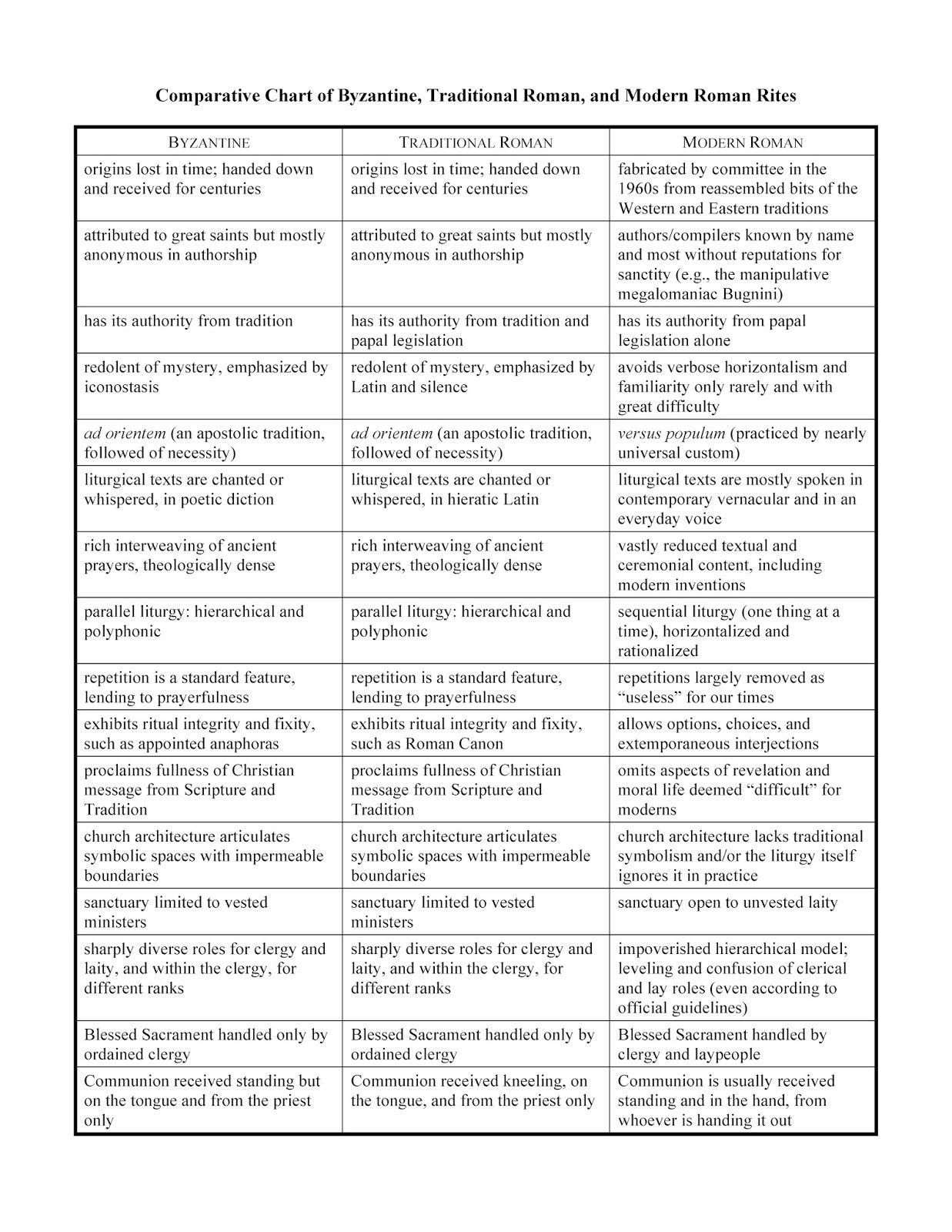
Taking Rites comparatively*Byzantine Rite, Latin Mass, and Novus Ordo Compared*

I can’t feel smug about this because I didn’t fashion the Byzantine Rite (used in Orthodox Churches) — and if I had fashioned it, much of the basis for smugness would vanish.

See New Liturgical Movement: The Byzantine Liturgy, the Traditional Latin Mass, and the Novus Ordo — Two Brothers and a Stranger as well.

My Orthodox friend John Brady has pointed out that even the Traditional Latin Mass had dropped the Epiclesis in favor of a supposed “consecration”, which this chart does not reflect.

A caution to culture warriors

No man can concentrate his attention upon evil, or even upon the idea of evil, and remain unaffected. To be more against the devil than for God is exceedingly dangerous. Every crusader is apt to go mad. He is haunted by the wickedness which he attributes to his enemies; it becomes in some sort a part of him.

Possession is more often secular than supernatural. Men are possessed by their thoughts of a hated person, a hated class, race or nation. At the present time the destinies of the world are in the hands of self-made demoniacs – of men who are possessed by, and who manifest, the evil they have chose to see in others. They do not believe in devils; but they have tried their hardest to be possessed – have tried and been triumphantly successful. And since they believe even less in God than in the devil, seems very unlikely that they will ever be able to cure themselves of their possession. Concentrating his attention upon the idea of a supernatural uncommon among secular demoniacs. But his idea of good was also supernatural and metaphysical, and in the end it saved him.

Aldous Huxley, The Devils of Loudun. (H/T Paul Kingnorth, who is ready to turn away from focusing on evil)

A writer I long greatly admired has seemingly fallen into the maw of focusing on evils. I will continue to pray for him, but I rarely can bear to read what he writes any more.

Religion is not a domesticated animal

Church and state would not be such a difficult subject if religion were, as the Court apparently thinks it to be, some purely personal avocation that can be indulged entirely in secret, like pornography, in the privacy of one’s room. For most believers it is not that, and has never been.

Antonin Scalia, quoted in Francis J. Beckwith, Taking Rites Seriously

Christian Nationalist cherry-pickers

Apparently, some self-styled Christian Nationalists have been taking refuge in a quote from St. Augustine:

[S]ince you cannot do good to all, you are to pay special regard to those who, by the accidents of time, or place, or circumstance, are brought into closer connection with you.

Our countrymen are closer than foreigners. Therefore, piss on everyone but our countrymen. Q.E.D.

Jake Meador schools these lame-brains, starting with, like y’know, the full Augustine quote.


We are in the grip of a grim, despairing rebellion against reality that imagines itself to be the engine of moral progress.

R.R. Reno

The end of the world as we know it is not the end of the world.

You can read most of my more impromptu stuff here (cathartic venting) and here (the only social medium I frequent, because people there are quirky, pleasant and real). Both should work in your RSS aggregator, like Feedly or Reeder, should you want to make a habit of it. I’m even playing around a bit here, but uncertain whether I’ll persist.

Friday July 7, 2023

Culture

Frog and Toad Christendom

I wanted to suggest a few ideas that could anchor what we might jokingly refer to as “Frog and Toad Christendom.”

The idea is best summarized, as one friend helpfully put it, as resetting society’s defaults to favor people’s long-term interests rather than short-term pleasures. At present, we make it easy for people to indulge in in short-term pleasures that will, stretched out over time, leave them poorer, more lonely, and less able to contribute to their communities. We also make it harder to pursue things that will be in our best interests long-term. This is precisely the opposite of how it should be. We want to make it easier to choose virtue and harder to choose vices on a broad, societal level.

Here are six ideas that I think could fit under this overall principle:

First, ban online gambling …

Second, ban porn …

Third, place higher taxes on vices, such as marijuana and alcohol …

Fourth, redesign cities to discourage speeding and to make roads more pedestrian friendly. Third places thrive in walkable neighborhoods and because so much of our social connectedness comes via third places, we should want our cities to be walkable …

Fifth, birth should be free …

Sixth, to make it easier for workers, particularly workers with only high-school degrees, to form and support families, we should repeal right to work laws where they exist …

Jake Meador.

I agree with the spirit of all these, particularly when Jake fleshes them out (my ellipses). But they’re the work of a generation, and David Samuels’ “glittering oligarchy” (see The problem, and the un-solution below) will fight them as the existential threat they are.

What if …?

What if Arthur, eldest son of Henry VII, had not died in his mid-teens?:

There would have been no Dissolution of the Monasteries, and the subsequent upheaval to the rhythm of rural English life. 90% of English art would not have been destroyed in an iconoclastic orgasm of ideological fervor, and English churches and shrines would have remained awash in color, rather than the stone or whitewashed sepulchers of today. There would have been no new aristocracy to steal the land of the peasants, and there would have been no Enclosures Act … There was no New England because there were no Puritans—no “City on a Hill,” no Protestant work ethic … The empire would have been English rather than British. The Industrial Revolution would have been muted, not being able to feed upon rural dispossession and poverty, and would consequently been less convulsive to English society.

Terry Cowan.

Since Terry’s an actual historian, he plays out a lot more detail than this. I, not a historian but made heartsick by Bradford Wicox’s Unintended Reformation, was reminded again that destroying culture and smashing artifacts was a Protestant thing before it was an ISIS thing.

Well played

(H/T Todd Grotenuis on micro.blog)

Must reading

When doctors fundamentally misunderstand the cause of a condition and treat the symptoms instead, and fail to properly monitor outcomes, and modify their practice in response to known adverse outcomes, our patients suffer — often greatly and for the rest of their lives — if indeed they survive. These fundamental errors underpin the depressingly regular scandals that punctuate the history of medicine. (The stakes are particularly high if surgery is involved.)

It is naïve to think that all these scandals are in the past … So where might the next medical scandal be brewing?

The increasing visibility of detransitioners suggests it may lie in wait in gender-affirming medicine. Many detransitioners are young women who underwent treatment for psychological distress that has left them with irreversible, life-long changes to their bodies: a deep voice, a beard, and compromised sexual function. Some have had their breasts surgically removed; some may be infertile. Others are young men who have been castrated.

…

For many detransitioners, the cause of their distress as a teenager was misattributed by their clinicians to the notion that they had been born in the wrong body, and that they would be helped by the surgical creation of the “correct” body ….

Sallie Baxendale

Mutilating bodies ought to be the very, very last resort for a problem that starts in the mind.

Ardently seeking catharsis

[I]ntroducing no-fault divorce was a travesty, and in many ways redefined marriage more drastically than Obergefell vs. Hodges. 

None of this is even on the radar of many of today’s conservative elites. As often as not, they have been through a divorce themselves, and the compromise that marks their personal lives renders them reticent about standing up for traditional marriage. The consequence has been that most conservative influencers seek to move on from same-sex marriage as quickly as possible. Battle lines have been redrawn, the tent broadened, and now—they loudly proclaim—we can get back to promoting the free market and taking on the really crazy leftist proposals. Sure, the institution of marriage might be an unfortunate piece of collateral damage in the fight, but at least we won’t give an inch on this transgender nonsense.

Clement J. Harrold

I, too, had never heard of Mr. Harrold. And I disagree with his vitriol toward the Respect for Marriage Act. But I’m glad someone had the balls to write something so contrary to the Zeitgeist that for a moment, I felt positively moderate.

The right kind of facts, mediated by our betters

In an important article titled “Google.gov,” the law professor Adam J. White writes that Google views “society’s challenges today as social-engineering problems” and aspires to “reshape Americans’ informational context, ensuring that we make choices based only upon what they consider the right kind of facts—while denying that there could be any values or politics embedded in the effort.”

Matthew B. Crawford, Why We Drive

Making ourselves stupid

A society which wants to preserve a fund of personal knowledge must submit to tradition.

Michael Polanyi, Personal Knowledge. But we won’t submit because we’re Mur’cans.

Legalia

Protecting freedom of religion — through the speech clause

In case you hadn’t noticed, or had forgotten, the free speech clause of the First Amendment has been more effective in protecting religiously-informed conscience than have free exercise or non-establishment clauses, directly concerned with religion though they be.

I cannot imagine a factual scenario where that would not continue to hold true, though that may be a failure of imagination (from too many years between me and a Socratic law school classroom).

Simple question, botched answer

The reliance of religious dissenters on the free speech clause should have come up here, too:

Another dissenter has “a simple question regarding 303 Creative”:

If the website designer’s action is expressive, and if her closely held religious belief was to believe that God was against interracial or inter-religious wedding, is it okay for her to refuse service? If not, why not? If so, it would seem to open a Pandora’s Box of truly held religious beliefs (with no way to prove/disprove) overriding any and all anti-discrimination protections if the business’s product is viewed as expressive — which is just as nebulous as knowing if a belief is truly held.

One answer is that all the major religions bar homosexual sex. A better case would be where a religion forbids divorce. Would someone refuse to design a site for a second wedding? Possibly, I suppose. I don’t doubt that some of this is driven by homophobia and very selective enforcement of Biblical strictures. As a Christian, I think it’s immoral to single out gays — and only gays — in this way. But a fundamentalist may differ, and they have rights too.

Andrew Sullivan.

Sullivan is a very smart fellow but he blew this one.

The simple answer to the dissenter’s simple question is “Yes, she may deny her expressive services to create custom websites for interracial or inter-religious weddings” in this fairly wild hypothetical, because this was a free speech case; all references to religious beliefs are beside the point because it’s not a free exercise of religion case.

Although I would find opposition to interracial weddings atavistic, offensive and anti-Christian, and opposition to inter-religious weddings surprising in this day and age, I believe that freedom from compelled expression is “high trump” and will be so held if challenges continue. The only viable question will be in edge cases: “is this really compelled expression”?

As I was writing the preceding, I remembered the days when I thought otherwise, thought that the gay tsunami would crush all before it — as its legal theorists intended:

In her symposium paper Moral Conflict: (Some) Religions and Marriage Equality, [Georgetown law prof and later Obama recess appointment to the EEOC Chai] Feldblum asked what effect “marriage equality” – i.e., marriage between members of the same sex – will have on the rights of those employers, landlords and others whose religion teaches them that same-sex sexual conduct is sinful (and perhaps harmful to society):

Let me be very clear … [I]n almost all the situations (not perhaps in every one, but in almost every one), I believe the burden on religious people that will be caused by granting gay people full equality will be justified …. That is because I believe granting liberty to gay people advances a compelling government interest, that such an interest cannot be adequately advanced if “pockets of resistance” to a societal statement of equality are permitted to flourish, and hence that a law that permits no individual exceptions based on religious beliefs will be the least restrictive means of achieving the goal of liberty for gay people.

Are gay rights in conflict with religious freedom? – Tipsy Teetotaler ن. I don’t know what Feldblum would have said about those “others” whose (religious) convictions might motivate a free-speech refusal of expressive services, and I won’t speculate about that. But with that sole carve-out, Feldblum has been vindicated so far.

Racial gerrymandering in a SCOTUS dissent on affirmative action

I got a kick out of David Bernstein’s demolition of Justice Sotomayor’s judicial gerrymandering of “race” in last week’s Harvard and University of North Carolina affirmative action cases. Nobody is better qualified to dissect American bullshitting on the legalities of race than he is, and he has a book to prove it.

I may have enjoyed Freddie DeBoer’s Socratic dialog, putatively on affirmative action, even better: The Point of College, My Dear Glaucon

Saying the quiet part out loud

Leftists who love racial discrimination when they control it have responded widely and loudly. This tweet from Erica Marsh, a Democrat operative, provides an excellent summary of them all:

Today’s Supreme Court decision is a direct attack on Black people. No Black person will be able to succeed in a merit-based system which is exactly why affirmative-action based programs were needed. Today’s decision is a TRAVESTY!!!

— Erica Marsh (@ericareport) June 29, 2023

Sven R. Larson, The America Report: Three Cheers for Conservatism (The European Conservative)

Twitter being Twitter, there was a nice pile-on, back-tracking, blacksplaining, etc.

(Do not rely on Mr. Larson for analysis of the Supreme Court cases he’s celebrating. He’s conservative, but he’s just as sloppy about the details as most liberals who are lamenting the same cases.)

SCOTUS

Be it noted that I disapprove the feeding frenzy of attacks on conservative Supreme Court justices, notably Thomas and Alito. I won’t go into the reasons why, which have been well-addressed by their defenders or, in Alito’s case, by himself.

But I can still appreciate the wordcraft of these bits via Frank Bruni:

  • In Slate, Dahlia Lithwick parsed the generosity from billionaires that Justices Samuel Alito and Clarence Thomas have so richly enjoyed: “A #protip that will no doubt make those justices who have been lured away to elaborate bear hunts and deer hunts and rabbit hunts and salmon hunts by wealthy oligarchs feel a bit sad: If your close personal friends who only just met you after you came onto the courts are memorializing your time together for posterity, there’s a decent chance you are, in fact, the thing being hunted.”
  • In The Washington Post, Alexandra Petri mined that material by mimicking the famous opening line of “Pride and Prejudice” by Jane Austen: “It is a truth universally acknowledged that an American billionaire, in possession of sufficient fortune, must be in want of a Supreme Court justice.”

Politics

$35 million per quarter

Trump raking it in: The Prince of Mar-a-Lago pulled in $35 million in the second quarter of the year, double what he raised the quarter before. It looks like Republican donors not only weren’t put off by the classified document scandal. . . or the New York indictment. . . or the Georgia case, but are, in fact, rallying behind him, perhaps hoping to get a better seat at the document viewing table. If you had to guess, how much would you need to donate to see the aliens? Just images of aliens, printed and spread out next to a Diet Coke and onion rings, preferably. Asking for a friend.

Nellie Bowles

Orange Man bad

I was taken by surprised at least twice by this quote from Peggy Noonan:

Chris Christie could easily defeat Joe Biden. So could several of the GOP candidates now in the field. Donald Trump wouldn’t, for one big reason: His special superpower is that he is the only Republican who will unite and rally the Democratic base and drive independents away. He keeps the Biden coalition together.

A sad thing is that many bright Trump supporters sense this, and the case against him, but can’t concede it and break from him, in some cases because they fear him and his friends. They don’t want to be a target, they don’t want to be outside the in-group, they want to be safely inside. They curry favor.

This weekend at a party, one of Mr. Trump’s New York supporters, a former officeholder, quickly made his way to me to speak of his hero. He referred to the Abraham Accords and the economy and said: “Surely you can admit he was a good president.”

He was all wound up, so I spoke slowly. “I will tell you what he is: He is a bad man. I know it, and if I were a less courteous person I would say that you know it, too.”

He was startled, didn’t reply, and literally took a step back. Because, I think, he does know it. But doesn’t ever expect it to be said.

A journalist in our cluster said, musingly, “That was an excellent example of apophasis,” the rhetorical device of saying something by saying you’re not going to say it.

Imagine that! Knowingly forfeiting the Presidency for this evil man. But I think Noonan’s right, as she so often is.

The problem, and the un-solution

The country once defined by its powerful middle class is now a flagship of inequality that looks more like a high-end version of Brazil or Nigeria than the mid-20th century bastion of strong unions, churches, civic associations and inclusive political parties … A glittering oligarchy … presides over a simmering landscape of uncontrolled low-skill immigration, drug addiction and dead-end service jobs.

… Propelled by the rise of identity politics, the fragmenting logic of market capitalism or the force of new technologies that reconfigure space and time — or all three forces working hand-in-hand — America has become the prize for a set of tribes engaged in a zero-sum contest for power and spoils.

…

Where the idea of an American nation or community is increasingly rejected as a remnant of a hegemonic and oppressive past, the celebration of particularity reigns. There is the mandatory replacement of the American flag by sectarian banners — the Black Lives Matter flag for Black History Month; the ever-changing LGBTQA+ symbols for Pride Month — along with elaborate ceremonies of printing new postage stamps, and rewriting history books to focus on the laudable achievements of tribal heroes …

The paradoxical nature of the current American predicament is therefore hard to miss. On the one hand, Silicon Valley has cemented America’s place as the wealthiest and most powerful nation on Earth, the unchallenged global leader in fields like AI and biotech — capable of disintegrating any would-be rival by pushing a button and detaching them from the global banking system and the internet. On the other, the digital revolution propelled by American technology and finance is visibly disintegrating America itself. The meritocratic universities and other institutions that once made America the envy of the world are hostages of a new political system in which rote repetition of Democratic Party catechisms about race, class, gender and identity has replaced institutional values such as intellectual independence and critical inquiry. Such ambitions, along with the pursuit of beauty and other forms of excellence, are now signs of Right-wing heresy, to be stamped out by party administrators who administer, well, pretty much everything.

The Democratic Party plays a central role in the new American order, serving as a kind of shadow state, or state-within-a-state — the supremacy of the former being characteristic of so-called revolutionary regimes overseas. Once a vehicle for working Americans to achieve tangible goals such as home ownership, decent healthcare, national parks and a dignified old age, the Democrats under the presidencies of Bill Clinton and Barack Obama found a new place in the sun as the address to which the oligarchs pay protection money and do deals with the security agencies in Washington — after endorsing a global trade regime that cost millions of Americans their jobs and flooded their towns with fentanyl.

The Republican Party, meanwhile, once the party of America’s richest moneymen and biggest industrialists, now poses as the party of small business and the dispossessed, under the leadership of an oft-indicted figure who surrounds himself with the dregs of American political life. Whatever threat Donald Trump once posed to the robber barons and the bureaucracies they have allied themselves with, he long ago revealed himself to be a clownish figure, alternating populist rhetoric with self-pitying conspiracy theories while repeatedly failing to protect himself or his followers from forces that mean them harm. The result has been political suicide for Republicans who support him, as well as those who oppose them.

David Samuels, The Puritan spirit of America’s civil war

See? I think I understand discontent with the way things have developed under the major parties. But nominating that evil man is not a solution.

Wordplay 7/5/23

1

turning dumb luck to smart luck

Lewis Hyde via Martin Shaw

2

“A gentle reminder of the word ‘matutolypea’: grumpiness or downheartedness first thing in the morning. Based on Latin and Greek, literally ‘morning grief’, or ‘sorrow of the dawn,’” – Susie Dent.

Via Andrew Sullivan. This is so alien to my experience that I’m unlikely to add it to my vocabulary

3

Quiddity was used almost as synonymous with homeliness (see the tertiary definition) by Michael Ward in After Humanity: A Guide to C.S. Lewis’s The Abolition of Man.

4

Realizing my body isn’t something I’m in but something I am is the heart of the case for reactionary feminism.

Mary Harrington in Feminism Against Progress, quoted by Helen Lewis. After clipping this quote, I read so much other detail about Harrington’s new book that it’s now living on my Kindle, waiting its turn.

5

Being

plugged in The Free Press [is] the heterodox equivalent of a glowing New York Times review.

Helen Lewis

6

Every nation is selfish and every nation considers its selfishness sacred.

Antoine de Saint Exupéry (via The Economist)


We are in the grip of a grim, despairing rebellion against reality that imagines itself to be the engine of moral progress.

R.R. Reno

The end of the world as we know it is not the end of the world.

You can read most of my more impromptu stuff here (cathartic venting) and here (the only social medium I frequent, because people there are quirky, pleasant and real). Both should work in your RSS aggregator, like Feedly or Reeder, should you want to make a habit of it. I’m even playing around a bit here, but uncertain whether I’ll persist.

247 and counting

Politics

Trump

Lies and lies

All politicians lie, I dutifully concede, but there are lies and there are lies. [Speaker Kevin] McCarthy’s claim that the second impeachment was rash and ill-considered after Trump had spent two months trying to orchestrate a coup in plain sight, hour by hour on TV and Twitter, is a lie. Granted, it’s a common lie among Republicans who lacked the courage to vote for impeachment and then hid behind a flimsy procedural excuse, the same way Senate Republicans did in declining to convict Trump because his term as president had already run out. But it’s a lie nonetheless.

Nick Cattogio

Grifts

The other grift that’s really bothering me right now is Trump taking money from middle-class Americans who think they’re supporting his campaign for president and then he’s using it, as a billionaire, to pay his own lawyers. It’s disgusting. But this is Donald. As I said, he’s the cheapest SOB I’ve ever met in my life. He’s just better at spending other people’s money than he is at spending his own. Frankly, this is why he went bankrupt three different times in New Jersey in the casino business. He would borrow other people’s money, run through it, and then not pay it back. In this instance, he’s taking money from middle-class people who are working hard and sending him $25, $50, $100 multiple times a year through his website. And then he has the audacity, while he’s sitting on billions of dollars of his own personal wealth, to not use that personal wealth to pay his personal legal fees. Instead, he uses the money of middle-class Americans to pay it off. That’s a grift.

Chris Christie

Some countries work differently

Brazil’s top electoral court banned Jair Bolsonaro, a former president, from holding public office until 2030. The court found that Mr Bolsonaro abused his powers by casting doubt over the trustworthiness of Brazil’s electronic voting machines and implying that the 2022 election was rigged . He lost his bid for re-election to Luiz Inácio Lula da Silva, a left-wing rival.

The Economist World in Brief for July 1. No doubt many wish the U.S. had an equivalent procedure.

Oafs

I suggested in 2020 that “it’s a class thing.” A certain kind of oafishness is considered lovable by the political classes, and not even recognized as oafish because it is their sort of oafishness. Another kind of oafishness is considered lovable by those whom they disdain. Obama was a smooth rich fellow who flattered the elites. Biden is a coarse rich fellow who sneers at the common people in the same breath as he boasts of his humble origins. The elites think this kind of talk is merely telling it like it is.

Trump is a coarse rich fellow who flatters the common people. Since he sneers at the elites and adopts a popular tone in doing so, it enrages them.

J Budziszewski, Elites, Deplorables, and Political Style

I find Budziszewski worth reading even when I disagree, as I did with most of this column. This excerpt may be onto something. It’s hard for me to judge because I bear many marks of being among the elites but also countersigns that I’m closer to the common people.

Cultural

Renaissance men (and women)

Excited to read this: Beauty Makes a Comeback. You see, I’ve got this 15-year-old grandson, and neither he nor anyone else has quite figured out who he is yet. American College of the Building Arts seems like a via media; I’d feel pretty good about it.

Dietary dogma

Not a single one of those promoting the “three meals a day,” “eat in moderation” idea has tested it empirically to see whether it is healthier than intermittent fasts followed by large feasts.

Nassim Nicholas Taleb, The Black Swan

Unseemly Modesty

“Kyle from Chicago,” visiting Nashville for the NHL Draft last night, was stopped on the street this week by the crew from The Penalty Box podcast for a man-on-the-street interview about hockey and the Chicago Blackhawks’ pick of once-in-a-generation talent, Connor Bedard, as the number one overall selection. “On a scale of one to ten, how much would you say you know about hockey?” He responded: “I didn’t play professionally or anything, so probably like a four?” He was being…modest. Unbeknownst to the interviewer, “Kyle from Chicago” was Blackhawks General Manager, Kyle Davidson. Well played.

TMD

Bracing:

Affirmative Action Thoughts in an Inelegant List Format. It’s Freddie, and defies summary.

Feminisms

[The] women’s movement, from the outset, was marked by a tension between what Harrington calls a “feminism of care,” which resisted the logic of the market, emphasizing interdependence and the domestic realm, and a “feminism of freedom,” which “embraced the individualist market logic, and sought women’s entry into that market on the same terms as men.” The movement, Harrington contends, was more or less balanced in an “ambivalent tension” until the mid-twentieth century, when feminism’s embrace of contraception and abortion tipped the movement decidedly toward the market. From this point on, “feminism largely abandoned the question of how men and women can best live together, and instead embraced a tech-enabled drive to liberate humans altogether from the confines of biology.”

Abigail Favale, A Feminism Embedded in Human Nature, discussing Mary Harrington’s Feminism against Progress.

Legal

Freedom from compelled speech

I assume my readers all know at least vaguely about the Supreme Court’s decision in 303 Creative, but here’s something about it that’s under-reported and even mis-reported:

This case was not, as it has been widely described, about whether a website designer could refuse gay customers. … Indeed, the parties stipulated that the web designer, Lorie Smith, was “‘willing to work with all people regardless of classifications such as race, creed, sexual orientation and gender,’ and she ‘will gladly create custom graphics and websites’ for clients of any sexual orientation.” She was simply not willing to design websites that contained messages that violated her religious beliefs.

The case was not about whether a business could refuse to provide goods or services but whether it could refuse to generate specific expressions with which it disagreed …

The 303 Creative case was … about compelled speech. When could the government require a commercial provider of expressive services to say things she found objectionable? Could the government compel a portrait artist to paint a heroic picture of a white supremacist? Could the government compel a speechwriter to pen an anti-gay screed on behalf of a right-wing politician?

Under traditional First Amendment doctrine, the answer was a clear and emphatic no. The First Amendment doesn’t just protect my right to say things I believe, it also protects my right not to say things I don’t believe.

David French, How Christians and Drag Queens Are Defending the First Amendment.

In a very important sense, this was not even a case about homosexuality or same-sex marriage. A retired lawyer and longtime advocate for religious freedom and free speech, I downloaded and highlighted the court’s decision. But when it came to tagging it for ease of subsequent retrieval, my tags were #discrimination, #free_speech, #compelled_expression, #websites, #weddings, and #public_accommodations — and I only tagged “weddings” in case I was lazily focusing on peripheral issues. I did not tag “free_exercise” because this was a free speech case. Elizabeth Sepper, a law professor at the University of Texas, Austin, seems to get this part right:

[W]hile Smith asserted religion as her motivation, this is a speech case, so it won’t matter whether business owners are motivated to discriminate by sincere religious values, secular bigotry or no reason at all.

(italics added)

The core was freedom from compelled expression (speech in constitutional terms), whether that expression be celebration of a faux wedding (from the website designer’s perspective) or biting atheist advocacy or anything else she did not want to express.

As Dale Carpenter, a constitutional scholar at SMU put it:

I read [the majority in 303 Creative] to say we’re not stripping any protection from classes of people or people based on status. We are protecting expressive activity, regardless of protected and class status.”

“The court here was talking about basically a commission-based service that is customized and expressive,” Carpenter adds. “That’s a really narrow range.”

Quoted in TMD

Student Loan forgiveness

As we’ve previously reported, research suggests blanket partial forgiveness would disproportionately benefit wealthy and upwardly mobile graduates over low-income, debt-burdened borrowers. An analysis published by the left-leaning Brookings Institution found the richest 20 percent of households hold about a third of all student debt, compared to 8 percent held by the poorest 20 percent. Meanwhile, it’s possible a debt forgiveness precedent would incentivize students to take on more debt, allowing colleges to raise prices further. According to a DataStream analysis of Labor Department data, the cost of a college education has increased by 1,200 percent since 1980, compared to overall inflation of 236 percent.

TMD

These facts are probably what ticked off red states: student loan forgiveness was a payoff to a demographic already inclined to vote blue.

But they are not sufficient to warrant striking down the loan forgiveness. I don’t disagree with the Supreme Court majority that Biden lacked the power to forgive student loans en masse under the HEROES Act based on the “emergency” of Covid. Biden has promised to try again under other law.

Here’s what does trouble me about the Supreme Court decision: Did Missouri really have standing to bring the challenge? I do not like lawless government actions that try to evade court review, as the loan forgiveness was immediately understood to do because of standing issues. Similarly, I include the now-mostly-forgotten Texas abortion law of a very few year ago that defied pre-enforcement challenge by creating uncertainty about who to sue in such a challenge.

There ought be a law

Fake reviews might soon be illegal: “The Federal Trade Commission on Friday proposed new rules to take aim at businesses that buy, sell and manipulate online reviews. If the rules are approved, they’ll carry a big stick: a fine of up to $50,000 for each fake review, for each time a consumer sees it.”

Prufrock


We are in the grip of a grim, despairing rebellion against reality that imagines itself to be the engine of moral progress.

R.R. Reno

The end of the world as we know it is not the end of the world.

You can read most of my more impromptu stuff here (cathartic venting) and here (the only social medium I frequent, because people there are quirky, pleasant and real). Both should work in your RSS aggregator, like Feedly or Reeder, should you want to make a habit of it. I’m even playing around a bit here, but uncertain whether I’ll persist.

Sunday, July 2, 2023

Fretting about Orthodoxy in America

My priest went to a diocesan retreat this Spring and reported upon his return that our parish is relatively healthy. But our Bishop will be closing a lot of parishes this year because people haven’t returned after Covidtide and there’s a shortage of priests to boot.

This got me thinking again about a fact that I need better to reckon with: not all Orthodox parishes are both healthy and welcoming to American inquirers.

I’ve heaped much praise on Orthodox Christianity, but the truth is that I always had in mind some amalgam of my parish, a handful of other parishes I’ve visited, and the great Saints we venerate. I consistently block memories of perhaps half the parishes I’ve visited — parishes that, had they been the first Orthodox Churches I’d entered, might well have sent me away thinking “this isn’t for me.” I won’t name names (nor even ethnic adjectives).

But my bad impressions, too, are anecdotal, completely lacking in rigor. So I’m not going to say to inquirers “avoid parishes of [this or that] ethnic identity.” I’ll only give a rule of thumb to “find a parish that uses English for most of its liturgy.” I probably could find my way through the Divine Liturgy in just about any language, but that’s after 25+ years of being Orthodox.

I’m grateful for the lively, diverse and youthful parish I serve in my way as a tonsured Reader. I’m grateful because I’m human, and while I like decency and order in worship, those aren’t incompatible with a bit of enthusiasm, lusty congregational singing, beautiful icons and all that.

So maybe I need to focus on inviting local folks to my parish rather than inviting people on social media to visit an anglophone parish in their area.

But what advice can I give those social media “friends,” whose local parish may be pretty unattractive?

That question kind of stumps me. All I can think of is that we’re lucky to live in an age where we have many excellent resources available, both online and, even more, in print from major Orthodox publishers. That’s no substitute for Church, but since even good priest can have hobby-horses and skewed perceptions, it’s a good idea even for those in attractive parishes to supplement their church experience with reading.

Rough edges

I continue to be amused at the alarm sounded by our online Orthodox “Guardians of the Faith” regarding the growth of Orthodoxy in the South.  Apparently, there are Southern conservatives becoming Orthodox.  Lord, help us!  I think my sons and I must have been the last semi-moderate converts to Orthodoxy down here–everyone since has been more conservative than us.  Somehow, we worship together just fine.  And, if  these converts stick with it, Orthodoxy will hone off the rough edges; as it did for me.  It is not the end of the world.

Terry Cowan (bold added).

Quest for Certainty

The Reformation is the first great expression of the search for certainty in modern times. As Schleiermacher put it, the Reformation and the Enlightenment have this in common, that ‘everything mysterious and marvellous is proscribed. Imagination is not to be filled with [what are now thought of as] airy images.’ In their search for the one truth, both movements attempted to do away with the visual image, the vehicle par excellence of the right hemisphere, particularly in its mythical and metaphoric function, in favour of the word, the stronghold of the left hemisphere, in pursuit of unambiguous certainty. … What is so compelling here is that the motive force behind the Reformation was the urge to regain authenticity, with which one can only be profoundly sympathetic. The path it soon took was that of the destruction of all means whereby the authentic could have been recaptured.

Iain McGilchrist, The Master and His Emissary

Undeniable propositions versus rites, ceremonies and sacred mysteries

These five Common Notions, described as “five undeniable Propositions” in De religione gentilium, are: 1. That there is one Supreme God. 2. That he ought to be worshipped. 3. That Vertue and Piety are the chief Parts of Divine Worship. 4. That we ought to be sorry for our Sins, and repent of them. 5. That Divine Goodness doth dispense Rewards and Punishments both in this Life, and after it … By shearing away all the practices of ancient people in his discussions of what was essential and original in these religions, Herbert contributed to the growing sense that religion was a matter of beliefs apart from “various Rites, Ceremonies, and Sacred Mysteries.” Religion was for Herbert a mental phenomenon. This view of religion as a set of beliefs that could be either true or false would become standard in the next century.

Brent Nongbri, Before Religion: A History of a Modern Concept (emphasis added)

Larping Christendom

Note, however, that reentry by travel and also exile (see below) nearly always takes place in a motion from a northern place to a southern place, generally a Mediterranean or Hispanic-American place, from a Protestant or post-Protestant place stripped by religion of sacrament and stripped by the self of all else, to a Catholic or Catholic-pagan place, a culture exotic but not too exotic (Bali wouldn’t work), vividly informed by rite, fiesta, ceremony, quaint custom, manners, and the like. This is by no means a Counter-Reformation victory because the attraction is not the Catholic faith— which is absolutely the last thing the autonomous self wants—but the decor and artifact of Catholic belief: the Pamplona festival, the Taxco cathedral, Mardi Gras, and such.

Walker Percy, Lost in the Cosmos (italics added).

(Yes, I’m aware that Lost in the Cosmos is a mock self-help book.)

Going to the gym

Worship is the arena in which God recalibrates our hearts, reforms our desires, and rehabituates our loves. Worship isn’t just something we do; it is where God does something to us. Worship is the heart of discipleship because it is the gymnasium in which God retrains our hearts.

James K.A. Smith, You Are What You Love

Chastening

For those who, like me, have led charmed lives, one of the really disturbing scriptures is “whom the Lord loveth, He chasteneth.“

Is my “chastening” to bear a few annoyances with less petulance? Really?

Platonic Christianity

That the soul was immortal; that it was incorporeal; that it was immaterial: all these were propositions that Augustine had derived not from scripture, but from Athens’ greatest philosopher. Plato’s influence on the Western Church had, in the long run, proven decisive.

Tom Holland, Dominion

No fundamental divide?

Although Europeans universally acknowledge the fundamental significance of the dividing line between Western Christendom, on the one hand, and Orthodoxy and Islam, on the other, the United States, its secretary of state said, would “not recognize any fundamental divide among the Catholic, Orthodox, and Islamic parts of Europe.”

Samuel P. Huntington, The Clash of Civilizations and the Remaking of World Order

Some poor, phoneless fool

Via @letters on micro.blog


We are in the grip of a grim, despairing rebellion against reality that imagines itself to be the engine of moral progress.

R.R. Reno

The end of the world as we know it is not the end of the world.

You can read most of my more impromptu stuff here (cathartic venting) and here (the only social medium I frequent, because people there are quirky, pleasant and real). Both should work in your RSS aggregator, like Feedly or Reeder, should you want to make a habit of it. I’m even playing around a bit here, but uncertain whether I’ll persist.

And last but not least …

This is the final installment of my massive data dump starting yesterday.

I probably should mention that this is the Feast of Saints Peter and Paul, observed by both the Roman Catholics and the Orthodox Church. We observe it so much that we’ve been fasting for several weeks in anticipation, and by the time you read this, I will have scored some beef brisket.

Cultural

Same old story

The Titanic story is linked to themes as old as man. “God himself couldn’t sink this ship.” “If we eat the fruit against his command, then we’ll be in charge.” “Technology will transform the world; it’s a mistake to dwell on the downside.” It’s all the same story.

Peggy Noonan

Liberalism promised to harmonize classes, but produces discord. It has no solution to class conflict because class conflict is baked into its faith in progress.

Genuine conservatism—as opposed to the “right liberalism” that wraps itself in the conservative banner—is cut from a different cloth entirely. Alone among modern political movements, conservatism renounces progress.

Peter Leithart

Kevin D. Williamson for Education Czar!

[O]nce you start judging it primarily on the criterion of usefulness, you have lost the essence of education and have descended into mere training. Whenever I hear somebody say that we should care about Mozart because babies made to listen to Mozart in the crib go on to score 25 points higher on the SAT, the bad part of me thinks that person should have his ears cut off, because they are not doing him any good.

Kevin D. Williamson, Eccentricity Isn’t a Political Agenda

Sport and spectacle

I’d add only that it’s not just politics that has taken over everything — at least if you think about politics as arguing over policy. It’s more accurate to say that it’s politics as spectacle that has taken over everything.

Spectacle is the sphere that achieves public titillation through public combat. In Rome, gladiatorial combat was spectacle. Professional wrestling is spectacle. Reality TV is spectacle. Donald Trump — the love child of professional wrestling and reality TV — is spectacle. Tucker Carlson presented TV news as spectacle. The Sisters of Perpetual Indulgence perform activism in the form of spectacle.

The point of spectacle is not to resolve differences; it is to attract attention. In spectacle you thrive by offending people. Narcissism is rewarded, humility is forbidden. Inflaming hatred is part of the business plan.

David Brooks, on the Dodgers’ descent into spectacle by honoring the Sisters of Perpetual Indulgence.

The distinction between sport and spectacle may explain my preference for basketball and soccer over pro football, and my disgust with boxing, dog fighting, cage fighting and such. Elon and Zuck, I’m lookin’ at ya’.

I’m with Ross on this

My general view is that the U.F.O.-encounter phenomena seems in continuity with supernatural experiences reported across the long pre-modern past — abductions into faerie realms, especially. As such, the experiences are more likely to offer evidence of either some kind of strange Jungian unconscious or of actual supernatural realms than they are to involve interplanetary visitors from Zeta Reticuli.

Ross Douthat

Dodging the question

The new generation of philosophers had a short way with traditional philosophy: “I don’t understand what you mean” was the favoured weapon of attack, and once ignorance is seen as a boast rather than a confession, it is in the nature of the case invincible. (J.R. Lucas, “The Restoration of Man,” 446–447)

…

In conversation with the philosopher Robert Marett, Rector of Exeter College, Oxford, [C.S.] Lewis wittily expressed the value he attached to respect for the “species barrier.” Marett’s opening gambit in their dialogue went as follows: “I saw in the papers this morning that there is some scientist-fellah in Vienna, called Voronoff – some name like that – who has invented a way of splicing the glands of young apes onto old gentlemen, thereby renewing their generative powers! Remarkable, isn’t it?”

Lewis thought.

“I would say ‘unnatural.’”

“Come, come! ‘Unnatural’! What do you mean, ‘unnatural’? Voronoff is a part of Nature isn’t he? What happens in Nature must surely be natural? Speaking as a philosopher, don’t you know. . . . I can attach no meaning to your objection; I don’t understand you!’ ‘“I am sorry, Rector; but I think any philosopher from Aristotle to – say – Jeremy Bentham, would have understood me.” “Oh, well, we’ve got beyond Bentham by now, I hope. If Aristotle or he had known about Voronoff, they might have changed their ideas. Think of the possibilities he opens up! You’ll be an old man yourself, one day.” ‘I would rather be an old man than a young monkey.’”

Michael Ward, After Humanity: A Guide to C.S. Lewis’s The Abolition of Man

Epistemic tribalism

What happens when individual biases, especially confirmation bias, interact with the group dynamics of conformity bias? The result is epistemic tribalism.

Jonathan Rauch, The Constitution of Knowledge

I love those defiant British feminists

In Britain, where I live, feminism has developed around the assumption that women belong to a sex class with specific physical vulnerabilities. In America, the movement has been filtered through a progressive legal tradition of outlawing discrimination against a variety of marginalized groups, and because of the decades-long abortion fight, American feminism relies heavily on the concepts of choice and bodily autonomy. In the view of many mainstream U.S. feminist writers, Britain is TERF Island, a blasted heath of middle-class matrons radicalized by the parenting forum Mumsnet into conservatism and “weaponized white femininity.” The response of some British feminists is that, in practice, the agenda of mainstream American feminism has shriveled down to the abortion fight and corporate-empowerment platitudes, and is hamstrung by its strange refusal to accept the relevance of biology.

Helen Lewis

Personal

If you plant a salad bar, they’ll come

Thursday 6/22 …
…Friday, 6/23, nestled between foundation plantings and sunroom

Legal

Republicans at SCOTUS I

Be it remembered that Justice Anthony Kennedy was appointed to SCOTUS by Ronald Reagan. Here’s a big part of his legacy.

Although I did not expect him to honor it, I appreciated what it could mean if 2016 candidate Trump did honor his commitment to appoint justices from a list made by Leonard Leo of the Federalist Society.

Republicans at SCOTUS II

Not that Leornard Leo’s nominees have proven consistently excellent, mind you:

Just this past week, he wrote four super-short opinions, which cut corners on law and fact, and failed to respond to pointed concurrences/dissents. Justice Kavanaugh was a well-regarded circuit justice for more than a decade. He routinely prepared intricate and careful decisions about the most arcane topics. But on the Supreme Court, his breezy approach to judging leaves so much to be desired. What happened? To use a theme from the case, his development was arrested. I’m about to write a sentence I never thought I would write: Justice Jackson’s opinions this term have displayed more analytical rigor than Justice Kavanaugh’s.

Josh Blackman. Read his full blog post for details.

(I don’t think that’s entirely a put-down. Justice Jackson has had a fairly impressive first term.)

Political, but not partisan

Reiterating, I had collected so much material that I’m breaking it up topically. I can’t certify zero partisanship, express or implied, in what follows. Just remember that I’ve never been a Democrat and I’m almost over all my Republican reflexes.

Gobsmacked?

Who is the most pro-life president in modern American history?

Many of Donald Trump’s defenders say that it’s him. The proof, they say, is the Supreme Court’s opinion in Dobbs v. Jackson Women’s Health Organization …

But if we change the metric from abortion law to actual, legal abortions, the picture is considerably different, and begins to challenge our assumptions about what it means to build a true pro-life culture in the United States. If the most important metric in determining a president’s pro-life credentials is the prevalence of abortions performed in the United States during his term, then the title of the most pro-life president in modern American history belongs, remarkably, to Barack Obama. It’s not close. And, Trump’s judicial nominations notwithstanding, a very long pro-life trend reversed itself during his presidency.

…

No president saw sharper decreases in the abortion rate and ratio from the first to the last year of his presidency than Barack Obama. In 2016, at the end of a presidency dominated by pro-choice policies and judicial nominations, there were a total of 874,080 abortions — 338,270 fewer than there were in 2008, the last year of the George W. Bush presidency.

…

[E]ven before Roe was overturned, I was under no illusions about the challenge facing the pro-life movement. That challenge is now proving worse even than I feared, and it’s worse in part because of the very compromises made to secure the Dobbs victory. The pro-life movement was Donald Trump’s mighty political vehicle. Without its support, his cruelty, malice and corruption would be a footnote to history.

Instead, his towering presence has warped almost a full decade of American life, turned Americans against Americans and transformed the culture of the Republican Party, the political home of pro-life America. It remains to be seen how long his malign influence will last. But much of America has experienced Trump’s presence on the public stage as a form of assault, and that assault is ultimately antithetical to the cause of life.

…

A pro-life movement that has long affixed its eyes on power must now remember hope. Otherwise, it may remember this period of American history as the time when it won the law and lost the nation, when the means of its legal triumph also sowed the seeds of its cultural defeat. If there is one thing that we know, it is that the culture in which we live decisively influences whether men and women possess the hope sufficient to have a child.

David French. In fairness to French, I realize that my excerpts may be slightly more negative toward Trump than his essay was.

In any event, for a 43-year pro-life veteran like me, the raw facts are challenging, and they’ve earned this French essay a flag to remind me to read it again.

The emigration of the Left

Leftists used to see themselves as champions of the poor and working classes. They viewed government as a means to protect and provide for the economically vulnerable. They wanted to rein in the power of the rich, and to ensure a decent life for the ordinary working man and his family.

This was a winning political message for the Democratic Party of Franklin D. Roosevelt and his successors, even though the reality fell short of the promises. As those on the right pointed out, big government has inefficiencies, injustices, oppression, and corruption of its own. Nonetheless, conservatives are not opposed to all government welfare and regulation, and we can recognize some virtues in the left’s old economic vision, even if we remain skeptical of big government’s ability to achieve it.

The left used to dream of economic and social solidarity. Then sex broke the left. The sexual revolution suddenly had the left talking like the most radical individualists imaginable; solidarity, commitment, and obligations were abandoned if they got in the way of pursuing a good time in bed or pursuing the next romantic relationship.

…

The heart of today’s Democratic Party isn’t the union hall, but white-collar professionals with pride flags in their Twitter profiles. This class is eager to pressure everyone else into accepting their social views, especially as regards the rainbow agenda. Hence the order to take food from poor children to force schools to adhere to the whims of LGBT activists.

Nathanael Blake, The Left Prioritizes Sex Over Solidarity, With Tragic Consequences

I do not ordinarily visit The Federalist, which I hasten to say is unrelated to The Federalist Society. Thursday’s “front page above the fold” gives you a sampling of the unsavory flavor:

But this article was linked within another I was reading — and the description of “leftists” and Democrats seems fundamentally accurate. Further, there’s at least smoke if not fire behind that last sentence.

I feel bad that I had to learn of this story by coincidence, but I’m too likely to end up utterly frantic and unhinged if I regularly dumpster-dive for the odd bit of edible news. (I could name names, but I won’t. Let’s just say I’m glad I’m not expected to publish every day in order to keep myself and my wife fed.) Isn’t it enough to know that our general national trajectory is very bad without obsessing over every scrap of supporting evidence, Left and Right?

The prime directive of any bureaucracy

Title Nine of the 1972 Education Act was straightforward, and answered perfectly well to a democratic consensus of the time: educational institutions should not discriminate based on sex. As in “you’re a woman, you can’t attend this school.” The object of its control was institutions. But the powers said to emanate from Title Nine not only expanded, they became different in kind. Its object of control is now students: universities, as franchisees of the federal government, must now manage student’ sexual relations with one another. This transformation has taken place outside the legislative process, where it would be subject to democratic pressures (and hence common opinion), and has instead been internal to the federal rule-making apparatus.

Universities, in turn, tend to interpret the rules according to the timeless institutional principle of maximum ass-covering, which lines up nicely with the prime directive of any bureaucracy: it must expand, like a shark that must keep moving or die.

Matthew B. Crawford, The illegitimacy of the male

Don’t let a lucrative cause end just because you won

The goal of any civil rights movement should be to shut itself down one day. And once we get marriage equality and military service, those of us in the gay rights movement should throw a party, end the movement, and get on with our lives.

Andrew Sullivan, at a Human Rights Campaign Fundraiser before Obergefell decreed same-sex marriage throughout the land. But the HRC continued, shifting its attention to grifting for every plausible and some implausible demands of sexual minorities — er, excuse me, gender minorities, or something.

The craziest thing is that these grifters still have the respectful ears of our adult “influencers.”

In Vibetown, it always made sense

One of the three researchers at the Wuhan Institute of Virology who came down with Covid-like symptoms in November 2019 was Ben Hu, who worked on the project that received U.S. funding. This was first reported by our friends at Public, then confirmed in The Wall Street Journal. 

Yes, a U.S. taxpayer-funded project. So the U.S. intelligence communities knew what was happening and why from the start. If Public and The WSJ are right, the scandal now is the cover-up. Here’s Alina Chan, who works with the Broad Institute of MIT and Harvard and wrote a book on Covid’s origins: “When I first heard the names of the sick WIV researchers, I was in disbelief that people in the US [government] knew about this and yet allowed the public to listen to media stories about pangolins and raccoon dogs for literally years. . . . The most shocking part of this story is that it took 3.5 years for this intel to be shared with the public.”

In retrospect, there were early signs that it was a U.S. government cover-up, not a Chinese one. Only an American would know that our media is so malleable that indeed we can be told Chinese-people-eating-crazy-shit-again is the anti-racist origin story. Yes, the classic not racist explanation: the Chinese love of diseased pangolin flesh is what killed your grandma. A research lab with sloppy security? That’s called racism. Chinese officials would never concoct this PR scheme on their own because it’s insane. But you see: it’s insane in a world of logic. Not in vibes, where we live. In Vibetown, it always made sense. 

Nellie Bowles at the Free Press. I almost let my subscription lapse last Monday, because I’m only reading a third to a half of their daily articles, but then thought better of it. That their interests are broader than mine doesn’t mean they’re not interesting when the stars are in alignment.

Anyway, I don’t actually remember whether “I told you so,” about Fauci, but I never believed his denial of U.S. funding for gain-of-function research. I’m pretty sure that the proof he was lying (not just equivocating with weasel-words) was revealed almost immediately.

If you live where the government regularly lies to you but isn’t consistently good at suppressing refutations of its lies, are you living in a “free country” or a “democracy”?

The new education rhetoric

Here’s a great example of the new education rhetoric: “The far right’s effort to take over schools is not limited to battlegrounds or red states—they just won 40% of the elected education roles in NYC,” writes Amanda Litman, a prominent education activist, literally just describing parents who are pro–standardized testing. 

It turns out that closing schools for years was really bad. And schools deciding that math and reading are right-wing didn’t help. And weirdly, teachers becoming quasi-religious figures primarily tasked with gender-discovery journeys also did not improve scores. You know why? Those are my jobs. Yes, all of these tasks used to be the role of the lesbian aunt. It was my job to say math class is trash; Howard Zinn does it better; and Doc Martens are a good shoe that will last you years. It was me who was meant to paint your son’s nails. ME.

Nellie Bowles

How and in what sense has the Right become authoritarian?

I don’t think our most fundamental problem is that one of our two parties wants to establish one-party authoritarian rule. Our most fundamental problem is that we disagree very deeply about what kind of country we should be, and that disagreement is also very narrow, meaning that which direction we will go is maximally unsettled …

As far as I’m concerned, the primary thing that has made the right more dangerous than the left through this period is that, thanks to Donald Trump and voters most devoted to him, the right now actively indulges in fantasies, delusions, and conspiratorial thinking that convince it that it’s more popular than it really is, that the left has rigged the system in its favor, and that these acts of cheating by the left require truth-defying acts of rule-bending and rule-breaking in order for the right to prevail.

That is how the right gets to nascent authoritarianism ….

Damon Linker

What some American conservatives see in Putin

How were the large animals initially domesticated? I really like the theory that ancient people used the same trick modern hunters use—salt traps. They would give animals salt (which they need badly), so they have to come. Even husbandry has an element of bribe and negotiation. … You need to give people what they want. Now what do they want? That’s usually very simple to understand, they won’t shut up about it. They may express it indirectly through projections though. … Western right wings desire a great Christian conservative power which will save them from the wokes. They dream about it day and night. …  they project their need to the nearest available candidate—Vladimir Putin, viewing him as a parental figure.

John Lamont, Russian Philosopher Aleksandr Dugin: Defender of Traditional Values or Dangerous Occultist?.

Considering how flawed and dishonest virtually all politicians are, I once flirted with the possibility that Putin was a flawed, dishonest and sometimes murderous Christian conservative, so I know that Lamont is at least in the ballpark on this.

The real problem with corporate tax cuts

One way of talking about tax cuts, for example, is that they’re a bad economic policy solution to the real problems that we face. But another is that they’re a way of giving money to our enemies as conservatives. Do we really want to keep on fueling the people who are funding institutions, organizations, and ideas that we find abhorrent?

My answer to that is, obviously, no. So despite the fact that I don’t think tax cuts are great economic policy, I think they’re most stupid because they’re empowering our political enemies and we should stop doing that.

J.D. Vance via American Compass

In 20 seconds or less: why Ramaswamy?

He can make 16 arguments in the time it takes Joe Biden to wander through a sentence and Kamala Harris to butcher a paragraph.

Ross Douthat’s hypothetical elevator pitch for Vivek Ramaswamy


We are in the grip of a grim, despairing rebellion against reality that imagines itself to be the engine of moral progress.

R.R. Reno

The end of the world as we know it is not the end of the world.

You can read most of my more impromptu stuff here (cathartic venting) and here (the only social medium I frequent, because people there are quirky, pleasant and real). Both should work in your RSS aggregator, like Feedly or Reeder, should you want to make a habit of it.

All Politics (6/28/23)

I had collected such an insane amount of material since my last general-interest post that I had the luxury of separating out the most sharply anti-Trump stuff and posting it here.

When a liar meets a skilled, prepared journalist

When Trump went on, for example, about how he’d give the death penalty to drug dealers, [Fox News’ Bret] Baier interrupted to note that Trump had pardoned a drug dealer named Alice Johnson, who, under his new plan, would have been executed. “Huh?” Trump responded, with evident confusion. “No, no. No. Under my, oh, under that? Uh, it would depend on the severity.” But Baier pressed on: Johnson had run a major cocaine ring. Trump groped around until he conjured up an assertion that if his notional death penalty for drug dealers had existed, Johnson would never have dealt drugs. Problem solved.

Tom Nichols, *Donald Trump Seems to Be Afraid, Very Afraid *

Another take:

Trump kind of says what you’d expect him to say (various things that are probably crimes to declare, Biden has more secret documents than I do, the economy, etc.). 

A Trump-trained artificial intelligence could do it all at this point.

Nellie Bowles.

Vote for the Decent Man

The Atlantic has endorsed only three candidates in its 163-year history: Abraham Lincoln, Lyndon B. Johnson, and Hillary Clinton. The latter two endorsements had more to do with the qualities of Barry Goldwater and Donald Trump than with those of Johnson and Clinton. The same holds true in the case of Joe Biden. Biden is a man of experience, maturity, and obvious humanity, but had the Republican Party put forward a credible candidate for president, we would have felt no compulsion to state a preference. Donald Trump, however, is a clear and continuing danger to the United States, and it does not seem likely that our country would be able to emerge whole from four more years of his misrule. Two men are running for president. One is a terrible man; the other is a decent man. Vote for the decent man.

The Atlantic’s Endorsement: Against Donald Trump – The Atlantic, October 22, 2020.

If my home state, Indiana, polls ambiguously on a 2024 Trump v. Biden election, I just might vote, with heavy heart, for Biden. But not since 2008 has Indiana really been “in play” in the POTUS race, so my vote likely will be for Peter Sonski. Heck, maybe even Cornel West.

Bad Theodicy

No one predicted evangelicals would go from piously denouncing Bill Clinton’s moral failings to swooning for a thrice-divorced, porn-star-screwing real-estate mogul from Manhattan …

But evangelicals being evangelicals, they couldn’t just leave it as a Machiavellian maneuver. They had to concoct a whole theodicy to make it sound theologically admirable, with Trump serving as God’s vessel in the world to achieve his own ends ….

Damon Linker.

Could I have been dogmatically wrong about Florida Man?

I have a different take on Trump’s behavior: Oppositional Defiant Disorder, which begins in childhood, explains most of his deviancy. The distinct feature of this disorder is the refusal to follow any directions requested by anyone. Those with ODD see an order or request as someone trying to control them, and it feels like life or death.

I have a nephew who manifested this condition as a child — and now, at 55 years old, he hasn’t changed a whit. If you ask him a simple thing like to pick a piece of paper off the floor, he would refuse. He would not outright refuse, but he would avoid doing it and just ignore the request. God forbid you asked him why; he would say you were a controlling person and sulk off. He has been divorced twice because his behavior drove the women crazy.

Trump could not draw his sword at military school, and he cannot return the boxes, because to be controlled feels like life or death in his psyche. It really is a mental disorder — but that excuses nothing, especially in a president.

A reader responding to Andrew Sullivan.

UPDATE: I realized after posting this that I hadn’t explained the headline. I have insisted until now that Trump’s fundamental flaw, his fundamental disqualification for office, is narcissism. ODD may very well be a better explanation.

The GOP endorsement pledge

Readers too young to remember the Before Times may find the following hard to believe, but I swear it’s true.

Back in the day, Republican presidential candidates weren’t asked to formally pledge their support for the party’s nominee in advance.

There was no need. It went without saying that contenders who disliked each other would set aside their differences in the end for the good of the country and support the winner of the primary. Any Republican president would govern more conservatively than any Democrat would, therefore any Republican nominee was worth endorsing in the general election.

In the After Times, what’s best for the country in the general election is … less clear-cut.

And so, not coincidentally, the After Times are when the RNC began pushing loyalty pledges on primary candidates.

In the past week three different Republican contenders have chafed at having to commit to endorsing the GOP nominee, keenly aware of who that nominee is likely to be. Their reasons for doing so differ, as does their thinking on whether to sign the pledge anyway knowing that the RNC intends to bar those who refuse from the GOP primary debates.

But the fact that so many are struggling with the prospect of supporting Trump again highlights an ominous evolution in the nature of the process since 2016. During that cycle, the pledge aimed to bind a plainly unfit demagogue to support the Republican Party in the general election.

In this cycle, it aims to do the opposite.

…

The idea of Donald Trump keeping a promise because he signed a piece of paper pledging to do so must have seemed very funny at the time to building contractors in the tri-state area. True to form, he abandoned the pledge in early 2016.

Nick Cattogio

Wishcasting?

There is no path to the White House for Republicans with Mr. Trump. He would need every single Republican and independent vote, and there are untold numbers of Republicans and independents who will never vote for him, if for no other perfectly legitimate reason than that he has corrupted America’s democracy and is now attempting to corrupt the country’s rule of law. No sane Democrat will vote for Mr. Trump — even over the aging Mr. Biden — when there are so many sane Republicans who will refuse to vote for Mr. Trump. This is all plain to see, which makes it all the more mystifying why more Republicans don’t see it.

J. Michael Luttig, It’s Not Too Late for the Republican Party


We are in the grip of a grim, despairing rebellion against reality that imagines itself to be the engine of moral progress.

R.R. Reno

The end of the world as we know it is not the end of the world.

You can read most of my more impromptu stuff here (cathartic venting) and here (the only social medium I frequent, because people there are quirky, pleasant and real). Both should work in your RSS aggregator, like Feedly or Reeder, should you want to make a habit of it. I’m even playing around a bit here, but uncertain whether I’ll persist.

Theme, restatement, and variation

We’re Electing Idiots

Liz Cheney On What’s Wrong With Politics via TMD.

There will always be people whose ambition is greater than their pride and they will always curry favour with anyone closer to power than they are.

Jacob T Levy via DenseDiscovery.

Last week two of Trump’s most slavish cronies in the caucus introduced resolutions that aim to undo his two impeachments. Marjorie Taylor Greene’s legislation, targeting the first one, is short and sweet; Elise Stefanik’s counterpart, targeting the second, is more elaborate. The resolutions don’t purport to “repeal” or “overturn” the House impeachment votes held in 2019 and 2021, notably, but to banish them from official existence entirely. If enacted, each would have the effect of expunging the record “as if such … Articles had never passed the full House of Representatives.”

In theory, at least. Per Charlie Sykes, legal experts find the idea of the House retroactively disappearing an impeachment to be cockamamie, including the normally Trump-friendly Jonathan Turley. “It is not like a constitutional DUI. Once you are impeached, you are impeached,” he told one news outlet. Even if the resolutions pass, there’s nothing stopping a future Democratic House majority from expunging the GOP’s expungement—an un-un-impeachment, as it were.

Of course, a subsequent Republican House majority could expunge that expungement, amounting to an un-un-un-impeachment. And then a later Democratic House majority could—you get the idea.

Perhaps, centuries from now, it’ll be a House tradition whenever the out-party wins control of the chamber that they undertake to un-impeach or re-impeach Donald Trump, as the case may be, on their first day in power.

Nick Cattogio


We are in the grip of a grim, despairing rebellion against reality that imagines itself to be the engine of moral progress.

R.R. Reno

The end of the world as we know it is not the end of the world.

You can read most of my more impromptu stuff here (cathartic venting) and here (the only social medium I frequent, because people there are quirky, pleasant and real). Both should work in your RSS aggregator, like Feedly or Reeder, should you want to make a habit of it. I’m even playing around a bit here, but uncertain whether I’ll persist.