Bearing reality

I anticipated reading in Monday’s newspapers some analysis of how Dr. Christine Blasey Ford’s potential corroborating witnesses (those she said were at the party where Brett Kavanaugh allegedly assaulted her) have all failed to corroborate anything about the party, including its existence, and that some even volunteered defenses of Kavanaugh.

That’s all true, and I wondered how the crypto-Resistant press would handle it.

But it was not to be. (Trigger warning for sexual assault):

Judge Kavanaugh’s prospects were further clouded on Sunday when The New Yorker reported on a new allegation of sexual impropriety: A woman who went to Yale with Judge Kavanaugh said that, during a drunken dormitory party their freshman year, he exposed himself to her, thrust his penis into her face and caused her to touch it without her consent.

In a statement, Judge Kavanaugh denied the allegation from the woman, Deborah Ramirez, and called it “a smear, plain and simple.” The New Yorker did not confirm with other eyewitnesses that Judge Kavanaugh was at the party.

The Times had interviewed several dozen people over the past week in an attempt to corroborate her story, and could find no one with firsthand knowledge. Ms. Ramirez herself contacted former Yale classmates asking if they recalled the incident and told some of them that she could not be certain Mr. Kavanaugh was the one who exposed himself.

New York Times. The New Yorker, though, makes the new allegation sound a bit more plausible.

I’ve had two simmering reactions to the whole picture, new allegation aside, lasting for a few days now, that I at first thought unsuitable for public consumption. They went in my personal journal today for that reason.

Standing alone, I suppose they are unfit for public consumption, in addition to or as a function of being cryptic, but I’m not going to let them stand alone:

  1. My oatmeal’s cold! I want the FBI to investigate!
  2. Hey, boys and girls! Aren’t drunken parties fun!?

* * *

It’s my understanding that FBI investigations of nominees are focused on whether the nominee is a national security threat. It certainly is not the role of the FBI to investigate the truth or falsity of allegations of decades-old violations of state law just because partisans want to know more for purposes of a political fight. (Such skeletons presumably might come out in response to the question “Any skeletons in his closet?” as the FBI interviews old acquaintances.)

When politicians demand an FBI investigation in circumstances like those now present, they’re just buying time. That’s why the calls are all coming from Democrats currently. They are performing so strongly in election polls that they just might re-take both House and Senate in January and force Trump to nominate, say, Merrick Garland (that is, someone sufficiently moderate that he won’t plausibly be cast as the vehicle for a nefarious agenda, and who will allow both POTUS and the Senate avoid the onus of leaving a seat vacant for years).

The echoed calls of others, not in politics, for FBI investigations are, it seems to me, at least one of at least two things (that’s not a typo; it’s an acknowledgement that beyond that, imagination currently fails me):

  1. Partisan efforts to buy time, just like the Senate Democrats.
  2. Tacit admissions that all the unfounded he-said-she-said accusations flying around are disorienting, and we want some putative neutral expert to tell us what to believe.

The first point requires no elaboration beyond that such calls come from Democrats or progressives even if they’re not personally involved in politics because they’re savvy enough to know the strategy.

As for the second point, I’ve known for decades that we turn inappropriately to “experts” to resolve our vexing problems. I first noticed it when physicians were asked about “quality of life” in the context of medical treatment, nutrition and hydration for gravely ill or injured people — typically, survivors of drug overdoses, traumatic head injuries or dementia.

But quality of life is not a medical question, something about which physicians by experience and training have special knowledge. It’s existential (for the person being evaluated), philosophical for the rest of us. Vexing, yes, but not in the doctor’s bailiwick. (I believe that a few curmudgeonly or pro-life lawyers successfully excluded such testimony on the basis that physicians have no expert qualifications on the subject.)

Another approach to those same tragic situations was to let a proxy decisionmaker, typically a close family member, make the non-treatment decision in the name of patient autonomy. (Yes, the desired decision was non-treatment; if the proxy chose treatment, the search for another proxy who wasn’t an “extremist” or “vitalist” would continue.)

But “autonomy by proxy” is a blatant oxymoron.

The main virtue of letting doctors opine on “quality of life” or letting proxy decisionmakers exercise a patient’s autonomy to refuse further treatment, food or water, was that it spared the rest of us the wrestling with such issues and permitted us to evade what was really going on.

A final example of the phenomenon is conducting capital punishment covertly, so the rest of us can pretend it’s somehow quick and humane. Lethal injection even made it clinical (and we know how expert doctors are about everything).

Similarly, the main virtue of letting the FBI investigate decades-old questions, beyond delay for delay’s sake, is the hope that it will come up with a plausible declaration that the accusation is clearly true or clearly false.

That a professional law enforcement agency is not designed to do, but if they did, we’d be back close to square one asking “so now what?” If true, is it disqualifying?

* * *

My second reaction (“Aren’t drunken parties fun!?”) is aimed at a social problem from which we’ve averted our gaze in a different way.

Instead of delegating amelioration or elimination of adolescent drinking to putative experts, we’ve just decided to ignore it. “Boys will be boys.” “When I was young and foolish, I was young and foolish.” “Harmless fun so long as they don’t drive.”

Or as long as it doesn’t get sexy somehow without full and informed consent. (Or whatever next decade’s #MeToo Moment will be focused on.)

Dare I suggest that a history of binge drinking is itself a problem, or at least a big ole warning flag of problems?

For a change, I’m suggesting something without the need to say “Yes, I did so myself, but have repented.” I never have binge-drunk. When they asked me in my character and fitness examination (for admission to practice law) about past law-breaking, I confessed two occasions where I had one alcoholic beverage where I was not of legal age. The examiner, a cop-turned-lawyer, laughed out loud. At least I’m pretty sure. My memory is fuzzy. That may be my sole qualification for high office.

We know that kids drink, if for no other reason, to lower their inhibitions. In some cases, to lower them specifically to facilitate hooking up, an unchivalrous and predatory act by men and an unnatural act by women.

Are we really shocked by what those inhibitions were holding back? Truly, humankind cannnot bear very much reality.

* * *

Here endeth my meditation, because I have no more expertise than your doctor to tell you what to think about all this. I’m mostly just cynical about our odds of resolving the factual questions.

For what it’s worth, I’m starting to think that Drunk Brett was or is different than Sober Brett, and that the difference may be revelatory. Your mileage may vary, as may your assessment of how that should affect confirmation.

My closest approach to a personal resolution for this whole saga came from reading this, published before the second accusation, which suggests a course of action for Sober Brett.

* * * * *

Follow me on Micro.blog Follow me on Micro.blog, too, where I blog tweet-like shorter items and … well, it’s evolving. Or, if you prefer, those micro.blog items also appear now at microblog.intellectualoid.com.
Brief collection 9/13/18

1

Pope Francis has called a global meeting of Catholic bishops to discuss how to prevent sex abuse …

The Vatican statement said the topic of the gathering, scheduled for Feb. 21-24, would be the “prevention of abuse of minors and vulnerable adults.” It wasn’t clear whether the agenda would also include the disciplining of abusive clergy and of bishops who cover up or neglect abuse by priests under their authority.

Wall Street Journal

I think the Roman Church has had a fairly good idea how to reduce pedophilic child abuse since the report 14 years ago in the wake on the 2002 scandal.

But I don’t see much sign that it has made progress on homosexual predation on adolescents, seminarians and priests, or any progress at all at dropping the hammer on high-ranking enablers.


2

What will the Supreme Court look like when neither side has to walk on eggs to win the favor of the one in the middle? It will be a more conservative court, for sure, and maybe a more honest one. Justices may feel more free to say what they really think, and the public will ultimately judge the result by expressing itself in electoral politics. History does not stop in 2018.

Linda Greenhouse

Greenhouse is often outrageously biased even in her news reporting, not just in opinion pieces, but this one’s worth reading — with a grain of salt.


3

Public health experts dismiss [Critical Reviews in Toxicology, and Regulatory Toxicology and Pharmacology] as unreliable vanity journals. “These two journals exist to manufacture and disseminate scientific doubt,” says David Michaels, a professor at the George Washington University School of Public Health and the author of “Doubt Is Their Product,” a book about product defense science. “They provide the appearance of peer review and credibility to ‘product defense’ science — mercenary studies not designed to contribute to the scientific enterprise but to forestall public health and environmental protections and to defeat litigation. Corporations opposing public health or environmental regulations enter the rigged studies and questionable analyses published in these mercenary journals into regulatory proceedings or lawsuits to manufacture scientific uncertainty.”

Then, Michaels says, companies can say, “Look, the studies have conflicting conclusions, so there is too much scientific uncertainty to issue regulations to protect the public or to compensate victims.” ….

Paul D. Thacker, Scientists know plastics are dangerous. Why won’t the government say so?

I had no idea. The industry didn’t want me to have any idea. The “forensic” scientists (as in “‘forensic dating’ is the world’s oldest profession”) did their dirty duty.

 * * * * *

Follow me on Micro.blog Follow me on Micro.blog, too, where I blog tweet-like shorter items and … well, it’s evolving. Or, if you prefer, those micro.blog items also appear now at microblog.intellectualoid.com.

My blog overfloweth

Oh dear! So much that’s shareable today!

The Clergy Sexual Abuse Scandal

1

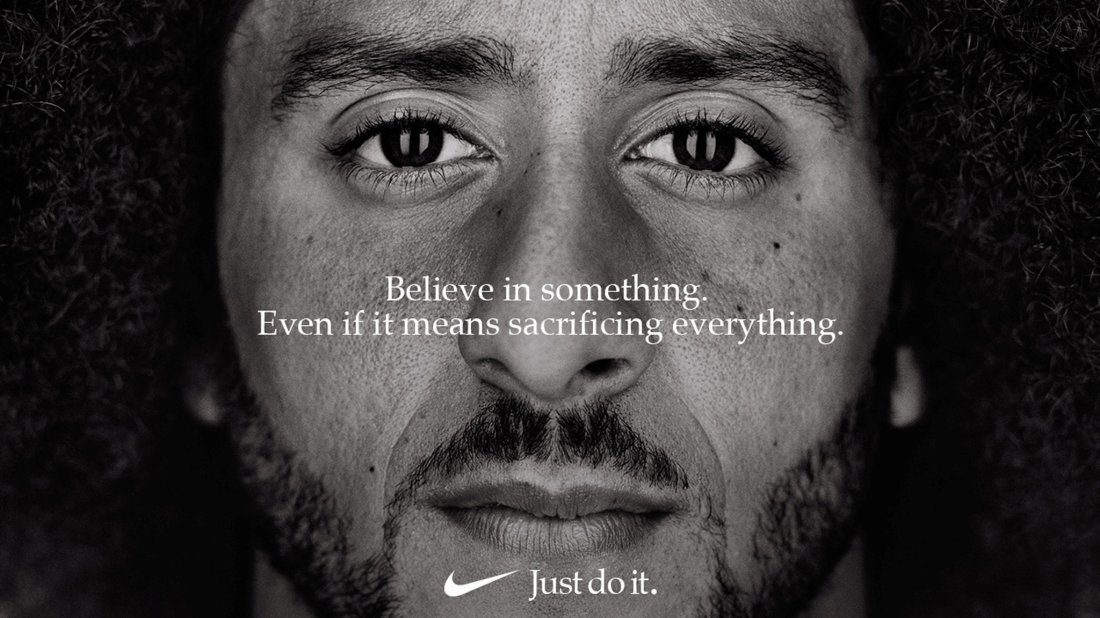
Nike reportedly is facing a boycott for an ad featuring Colin Kaepernick, who famously “took the knee” during the NFL’s repulsive and gratuitous pre-game patriotic frenzies.

Kaepernick

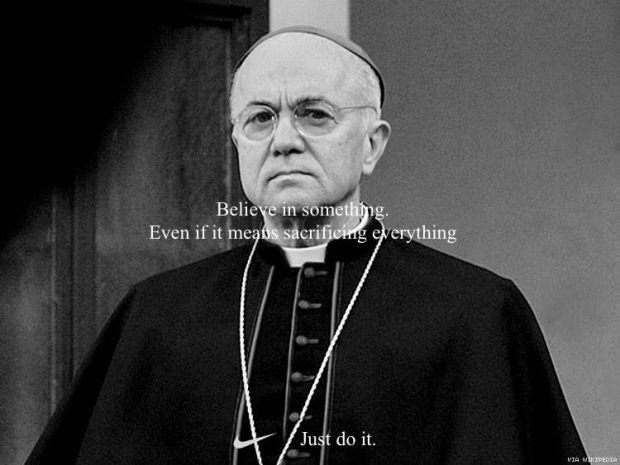
We’ll see if Nike actually believes in something, “even if it means sacrificing everything.” Nike has set itself up nicely to illustrate how “courage” no less than “patriotism” can be insincerely weaponized for commercial purposes.

Contrast:

Viganò

2

Ross Douthat … in a twitter thread which noted, among other things,

One of the striking things about the Hebrew Bible is that it’s the record of a people that makes extraordinary claims for itself — that their tribal god is the Only God, that they are His chosen people, that all nations will eventually worship him, etc.

And they buttress those claims with an extensive history in which they are … terrible. Morally terrible, politically impotent, constantly apostasizing, ignoring their prophets, the works.

Basically the Hebrew Bible says: “Hi, we’re the true chosen people of God, and to prove it let us tell a long series of stories about how our patriarchs were sinners, our kings were even worse, and we failed God completely time and time again.”

The best king of Israel, the awesome all-conquering one, is a philanderer and murderer. The second-best one, the temple-builder, becomes an idol-worshiper. And about the rest, the less said the better.

Pace certain evangelicals-for-Trump and certain RC churchmen, this is not an argument for tolerating ugliness in service of some higher good. God and His prophet deal very harshly w/David when he kills Uriah, and the attitude of the prophets throughout is horror at Israel’s sins.

But for all their horror the prophets never doubt that Israel is the elect, the chosen people, God’s intended bride. And if the Old Testament is supposed to be a revelation with big implications for the new covenant, for the Christian church, that part is important.

Eve Tushnet quoting, obviously, Ross Douthat.

Trump & the Vichy Republicans

3

News:

Two long running, Obama era, investigations of two very popular Republican Congressmen were brought to a well publicized charge, just ahead of the Mid-Terms, by the Jeff Sessions Justice Department. Two easy wins now in doubt because there is not enough time. Good job Jeff.

(Another damned Tweet by our Tweeter-in-Chief, who thinks an Attorney General is a wingman.)

News analysis by Peter Baker and Nicholas Fandos:

  • His tweet over the holiday weekend chastising Jeff Sessions, the attorney general, for the Justice Department’s recent indictments of two Republican congressmen because it could cost the party seats in November crossed lines that even he had not yet breached, asserting that specific continuing criminal prosecutions should be decided on the basis of partisan advantage.
  • “I think it was appalling,” Senator Susan Collins of Maine, another Republican, told reporters asking on Tuesday about the tweet. “It’s unbelievable. It’s unbelievable.”
  • Over nearly 20 months in office, Mr. Trump has repeatedly castigated the Justice Department and the F.B.I. for investigating his associates and not investigating his enemies. He has threatened time and again to fire Mr. Sessions because his recusal from the Russia investigation meant that he could not protect the president from the inquiry.
  • Mr. Trump’s suggestion would have been a major scandal under any other president, veterans of past administrations said. “His interference in an ongoing criminal investigation may be the single most shocking thing he’s done as president,” said Walter E. Dellinger, a former acting solicitor general under President Bill Clinton.
  • Senator Jeff Flake of Arizona, a Republican who has been among the president’s most outspoken critics in his own party, had the same reaction. “Those who study this kind of thing say it’s a lot more evidence for abuse of power or obstruction,” he said. “I just know it’s not healthy for the institutions of government to have the president want to use the Department of Justice that way.”
  • Senator Lisa Murkowski, Republican of Alaska, likewise criticized the president’s comments. “I’m looking at them just as you are looking at them,” she told reporters. “I thought that yesterday’s comments were not appropriate and they upset me.”

I agree with Walter Dellinger. If Trump is impeached, I hope his browbeating of law enforcement people for doing their jobs is prominent among the charges.

4

Ross Douthat imagines the defense theme of the Vichy Republicans in the court of public opinion:

Yes, they would say, the president is erratic, dangerous, unfit and bigoted. But notwithstanding certain columnist fantasies you can’t impeach somebody for all that — or for pretending to be a dictator on Twitter, for that matter. And by the standards of any normal presidency we still have him contained.

Sure, the trade wars are bad, but every president launches at least one dumb trade war. We stopped the child migrant business, his other immigration moves are just stepped-up enforcement of the law, we’ve stepped back from the brink (however bizarrely) with the North Koreans, we’re still sanctioning the Russians.

Meanwhile he’s nominated the most establishment Republican jurist possible to the Supreme Court, and we won’t even let him fire his own attorney general, let alone Bob Mueller.

Look, we’re not enabling an American Putin here. We’re just babysitting the most impotent chief executive we’ll ever see, and locking in some good judges before the Democrats sweep us out.

5

I have given my qualified approval to President Trump’s defense of religious freedom. The qualification is that he hasn’t shown any solicitude for the religious freedom of anyone other than Evangelical Protestants (though we other Christians collect crumbs from their State Dinner Table).

Here’s someone else’s expression of one instance of where Trump has been bad on religious freedom.

Kavanaugh Confirmation Hearings

6

Ben Sasse Conducts a Two-Minute Master Class in American Civics

7

Democrats Open Contentious Hearings With Attack on ‘Partisan’ Kavanaugh

When the New York Times puts in scare-quotes “partisan” as a description of a Republican Supreme Court nominee, I think it’s a sign that the Democrats beslimed themselves pretty good yesterday.

Is Steve Bannon fit for polite company?

8

A Venn diagram showing New Yorker readers and Trump fans would contain two circles miles apart. The folks in the New Yorker circle are far more likely to believe that Trump is a nascent despot than to believe that he is anything like a normal president. Nor are they likely to change their minds simply by spending an hour in the physical presence of Bannon.

Left-leaning cultural arbiters became too skillful with their weapon of choice, mastering those institutions so completely that certain kinds of progressivism became not merely normal, but mandatory. But by leaving less and less room for dissenters, the hegemons created a counter-tribe of outsiders who reject their authority as vehemently as they exert it. And thus, for the same reasons that the beliefs of New Yorker readers are in no danger from Steve Bannon, the views of Trump fans are entirely safe from David Remnick.

What’s left is a kind of ceremonial cleansing of the sacred city, a mighty labor to make sure that the two circles on the Venn diagram never, ever come into contact. There’s something admirable about uncompromising ethical purity, but also something rather dangerous. For it means that outside your circle, there’s an entirely different normal. And if you abdicate any influence over that alternate normality, while rigorously expelling your own heretics, you may one day awake to find that your impeccably maintained ring of truth has been swamped by that other normal, now grown entirely beyond your control.

Megan McArdle

9

I agree with those who think that he should never have been invited. Steve Bannon keeps failing in his various projects to overthrow the establishment or create a political mass movement. Were it not for the lavish media attention he still gets, he’d be a classic coffee-house revolutionary, regaling strangers about how he came “this close” to ruling and how, with a little help from you, he can get the revolution restarted. But because he provides relatively good quotes and calls back journalists, the mainstream media have an investment in keeping him more relevant that he really is. He was fired by Trump, defenestrated by Breitbart and the Mercers, and lives on largely as a useful prop for the media he claims to despise.

Jonah Goldberg

10

New Yorker, editor David Remnick, explaining why he had extended, and then quickly rescinded, an invitation to former presidential adviser Stephen K. Bannon to be interviewed on a public stage.

[I]t’s worth considering what Remnick’s disinvitation has actually achieved. Here’s my list:

It has kept Bannon’s name prominently in the news, no doubt to his considerable delight. It has turned a nativist bigot into a victim of liberal censorship. It has lent credence to the belief that journalists are, as Bannon said of Remnick, “gutless.” It has corroborated the view that the news media is a collection of left-wing group thinkers who, if they aren’t quite peddling “fake news,” are mainly interested in advancing only their own truths. It has kept readers of The New Yorker locked in their usual echo chamber. It has strengthened the belief that vulnerable institutions can be hounded into submitting to the irascible (and unappeasable) demands of social media mobs. Above all, it has foreclosed an opportunity to submit Bannon to the kind of probing examination that Remnick had initially promised, and that is journalism at its best.

The next time we journalists demand “courage” of the politicians, let’s first take care to prove that we know what the word means, and to exhibit some courage ourselves.

Bret Stephens

As Rod Dreher points out, The Economist did it better.

Miscellany

11

John McCain, well aware of his impending death, orchestrated a Resistance Funeral.

It’s currently obligatory to overlook his flaws as well as to remember his virtues, and I’ll not breach my obligation just yet. Indeed, I expect canonization forthwith.

But what I didn’t expect is hectoring pundits posing “WWJMD” criticisms every time Republicans do something deemed insufficiently bipartisan.

12

If you consider yourself a sane conservative, I’d suggest you bookmark the US edition of the Spectator. It’s pretty lively, with some voices other than the usual suspects.

It was there, for instance, that I learned that:

The Pussy Church of Modern Witchcraft (PCMW) in Maryland has just been afforded Tax Exempt Status by the IRS, which recognised it as a legitimate place of worship, or rather a ‘place of lesbian faith’. Serving a lesbian-feminist congregation, the PCMW is described on its website as, ‘a congregation of female-born, lesbian-led Women devoted to the liberation of Women and Girls from the oppression we face based on our sex.’


* * * * *

Follow me on Micro.blog Follow me on Micro.blog, too, where I blog tweet-like shorter items and … well, it’s evolving. Or, if you prefer, those micro.blog items also appear now at microblog.intellectualoid.com.

We always knew this would happen

There was a sense among some this week that we had at last reached that golden “inflection point” when all of Trump’s lies, scams, cons, and crimes finally sink in with Republicans, and the cult begins to crack.

I tend to think something else is happening: that we are entering the most dangerous phase of Donald Trump’s presidency. We always knew this would happen — that the rule of law and Trump would at some point be unable to coexist — but we had no idea how it would specifically play out. Now we see the lay of the land a little more clearly.

He is still incensed at his attorney general Jeff Sessions … The entire notion that one of his appointees actually swears loyalty to the Constitution, rather than personal fealty to Trump, is incomprehensible — no, infuriating — to him.

… the criminality has now become text rather than subtext …

Who else … do you know has spent four decades of his life “watching” the intricacies of mob round-ups? Yes, I know Trump made his fortune in part through the mob. They were regulars at his Taj Mahal casino, which was found to have “willfully violated” the money-laundering rules of the Bank Secrecy Act, was the subject of four separate IRS investigations for “repeated and significant” deviations from money-laundering laws, and was forced to pay what was then an industry record for the largest money-laundering fine. The Russian mob was critical to buying his real estate in secret as well. This is a president who has surrounded himself with criminals, especially Russian criminals, for decades. But still: the man who took an oath to enforce the laws of the land is openly touting the logic of mobsters in their battle with law enforcement. Before this presidency, that would have been inconceivable.

A republic cannot be governed by a man who acts like a mafia boss, following mafia rules. The minute that happens, the corrosion begins. Every day such a crook holds the highest office in the land represents yet another crack in the law of the land. If this figure decides to wage an actual war on the rule of law, and retains the solid support of his own party, all bets are off. And it is a staggering fact that in the wake of this week’s verdicts and Trump’s responses, no Republican leaders have yet decisively called their president out, and no right-wing media outlet has sounded any kind of alarm. It has fallen to Jeff Sessions to issue a statement defending the DOJ.

Andrew Sullivan (emphasis added), who struck a few false or hackneyed notes but got the basic story arc right.

J. Budziszewski explained in 2015, before a “President Donald Trump” was even a patently absurd publicity stunt (we thought), and again this week (contra Walter Williams), why a bad man cannot be a “good President.” The 2015 item reads like prophecy.

Budziszewski nods toward the possibility of voting for a lesser evil, but you must never, ever call evil “good.”

* * * * *

Our lives were meant to be written in code, indecipherable to onlookers except through the cipher of Jesus.

Greg Coles.

Follow me on Micro.blog Follow me on Micro.blog, too, where I blog tweet-like shorter items and … well, it’s evolving. Or, if you prefer, those micro.blog items also appear now at microblog.intellectualoid.com.

Playbook for concealing truth

I have not succeeded in averting my gaze sufficiently from the Roman Catholic clergy sexual abuse crisis.

I think I’d be allowed to do so — I’m not Catholic, nor a prosecutor or a journalist — but I just can’t, not completely. I can only plead in mitigation that others are far more obsessed, for their own reasons.

From the Pennsylvania grand jury report released today, this especially infuriating excerpt (via Rod Dreher, who wrote the first paragraph):

We’ll start with this, from the introduction, in which the grand jury identified the strategy the Catholic Church used to, in the AG’s words “protect their institution at all costs.”

The strategies were so common that they were susceptible to behavioral analysis by the Federal Bureau of Investigation. For our benefit, the FBI agreed to assign members of its National Center for the Analysis of Violent Crime to review a significant portion of the evidence received by the grand jury. Special agents testified before us that they had identified a series of practices that regularly appeared, in various configurations, in the diocesan files they had analyzed. It’s like a playbook for concealing the truth:

First, make sure to use euphemisms rather than real words to describe the sexual assaults in diocese documents. Never say “rape”; say “inappropriate contact” or “boundary issues.”

Second, don’t conduct genuine investigations with properly trained personnel. Instead, assign fellow clergy members to ask inadequate questions and then make credibility
determinations about the colleagues with whom they live and work.

Third, for an appearance of integrity, send priests for “evaluation” at church -run psychiatric treatment centers. Allow these experts to “diagnose” whether the priest was a pedophile, based largely on the priest’s “self -reports,” and regardless of whether the priest had actually engaged in sexual contact with a child.

Fourth, when a priest does have to be removed, don’t say why. Tell his parishioners that he is on “sick leave,” or suffering from “nervous exhaustion.” Or say nothing at all.

Fifth, even if a priest is raping children, keep providing him housing and living expenses, although he may be using these resources to facilitate more sexual assaults.

Sixth, if a predator’s conduct becomes known to the community, don’t remove him from the priesthood to ensure that no more children will be victimized. Instead, transfer him to a new location where no one will know he is a child abuser.

Finally and above all, don’t tell the police. Child sexual abuse, even short of actual penetration, is and has for all relevant times been a crime. But don’t treat it that way; handle it like a personnel matter, “in house.”

That’s all I have to say at the moment.


* * * * *

Our lives were meant to be written in code, indecipherable to onlookers except through the cipher of Jesus.

Greg Coles.

Follow me on Micro.blog Follow me on Micro.blog, too, where I blog tweet-like shorter items and … well, it’s evolving. Or, if you prefer, those micro.blog items also appear now at microblog.intellectualoid.com.

The Fixer

Every so often, news emerges that explains the mixed esteem in which lawyers are held, and the news that Michael Cohen has been Donald Trump’s “fixer” is the latest.

According to Merriam-Webster, a fixer is “a person who intervenes to enable someone to circumvent the law or obtain a political favor.” The less prestigious Wordnik, citing The American Heritage® Dictionary of the English Language, 4th Edition, capture more of the connotations: “A person who uses influence or makes arrangements for another, especially by improper or unlawful means.” Wiktionary, again via Wordnik, goes further: “A person who arranges immunity for defendants by tampering with the justice system via bribery or extortion, especially as a business endeavor for profit.”

Apparently it is “nice work if you can get it.” Michael Cohen says he had just three clients last year: Donald Trump, GOP fundraiser Elliott Broidy and Sean Hannity (who insists he paid no fees).

The most offensive thing is how fixers beslime the legal profession, the true ethos of which is helping clients achieve their lawful objectives by lawful means. (That’s pretty close to the Merriam-Webster definition.) My Fair City’s rumored legal fixers were not held in high esteem by judges and lawyers.

Or maybe the most offensive thing is how the existence of fixers proves that some people, if rich enough, can live “above the law” for a substantial while, and how others, if base and shrewd enough, can get rich facilitating life above the law. How many zillionaires so lived, and died unexposed to any but God, is not known.

I would not trade places with any of them for so parlous and spiritually debilitating a life.

* * * * *

Reality is that which, when you stop believing in it, doesn’t go away.

(Philip K. Dick)

The waters are out and no human force can turn them back, but I do not see why as we go with the stream we need sing Hallelujah to the river god.

(Sir James Fitzjames Stephen)

Place. Limits. Liberty.

Some succinct standing advice on recurring themes.

Where I glean stuff.

Sins of the fathers

[T]he public debate about how Congress ought to respond to this latest mass shooting is guided by two broad principles. Dubious on their own, they are even more witless when combined. The first is the idea that the most important thing is to “do something.” The second is that we ought to look to high-schoolers for the answer.

This in no way diminishes the barbarity of what happened to the Parkland students. It is, however, to insist on the obvious: As terrible as their experiences were, the attack gives them no special insight into the complex array of public policies that might have prevented the slaughter.

… Is it really so unreasonable to insist that those pushing specific legislation or regulations provide evidence that the something they want done will in fact produce the results they claim?

It’s not just conservatives who have doubts. In an October 2016 article in GQ, the Guardian’s full-time gun-politics reporter conceded she was “shocked by how little evidence there was behind some of the most prominent gun control policies.” The year before, right after the San Bernardino killings, the Washington Post fact checker backed Mr. Rubio’s claim that gun laws would not have prevented any of the major shootings the nation had seen in recent years.

(William McGurn, Our Childish Gun Debate, Wall Street Journal)

I agree with every word of that, but I’ve been disturbed for years by the anti-legislation trope that, in effect, “there’s nothing effective we can do because there already are so many guns out there.” A case against gun control by David French took substantially that tack:

  1. Do people have a right of self-defense?
  2. Does that right include that the self-defense be effective?
  3. If so, you mustn’t ban AR-15s because they are in common use, only law-abiding citizens will yield them up in compliance with a ban, and such a citizen, defending against a criminal’s AR-15, is relatively ineffective if they’ve got something less.

The logic speaks for itself. Few deny the right of self-defense. The whole premise of trying to ban AR-15s is that there are so many of them and they’re so lethal. So only by denying the right to effective self-defense can most people support such a ban.

[Aside: If anyone from the left coast is reading this, I’d also caution you that people who live far from the police station in flyover country, not to mention those who live in rural areas and need to deal with varmints, will not be amused by a ban. Remember “bitter clingers’? Now they’re known as Trumpistas.]

I have no solution to the conundrum, but I now have a convenient myth to explain how we got here (“here” being zillions and zillions of guns protected by the Second Amendment): America’s original sin got us here. It’s especially convenient since, unlike the demonization of the NRA, it’s plausible:

The real reason the Second Amendment was ratified, and why it says “State” instead of “Country” (the Framers knew the difference – see the 10th Amendment), was to preserve the slave patrol militias in the southern states, which was necessary to get Virginia’s vote. Founders Patrick Henry, George Mason, and James Madison were totally clear on that . . . and we all should be too.

In the beginning, there were the militias. In the South, they were also called the “slave patrols,” and they were regulated by the states.

In Georgia, for example, a generation before the American Revolution, laws were passed in 1755 and 1757 that required all plantation owners or their male white employees to be members of the Georgia Militia, and for those armed militia members to make monthly inspections of the quarters of all slaves in the state. The law defined which counties had which armed militias and even required armed militia members to keep a keen eye out for slaves who may be planning uprisings.

By the time the Constitution was ratified, hundreds of substantial slave uprisings had occurred across the South. Blacks outnumbered whites in large areas, and the state militias were used to both prevent and to put down slave uprisings. As Dr. Bogus points out, slavery can only exist in the context of a police state, and the enforcement of that police state was the explicit job of the militias.

(Thom Hartmann, The Second Amendment was ratified to preserve slavery. H/T Lindsey Nelson on Facebook)

It’s tempting to “go full Jeremiad” and revert to Jonathan Edwards’ “Angry God” as the proximate cause of the gun plague and school shootings.

But I don’t know that we need that hypothesis. Sin ramifies. Sow the wind, reap the whirlwind. Poetic justice.

Pick your proverb. The dots connect intuitively for me, even if it’s difficult to articulate.

* * * * *

Some succinct standing advice on recurring themes.

Where I glean stuff.

Bringing closure

In Hidalgo County, Texas, an 85-year-old ex-Priest has (finally) been convicted of murdering a beautiful and accomplished Latina, Irene Garza, in 1960. The Washington Post story ritually pronounces “closure” before probing “why so long?”

What is this “closure” that gets trotted out in news and commentary after every murder conviction?

It’s some relief that I’m not the only one asking, though until I Googled it, I feared I was. Here’s one exploration:

The idea of closure is powerful. It’s something Arkansas invoked in an April 15 motion that tried to fight a temporary restraining order that McKesson Medical Surgical, Inc., has used to block the use of its drug vecuronium bromide in state executions. (The drug is typically used as general anesthesia to relax muscles before surgery).

“The friends and family of those killed or injured by Jason McGehee, Stacey Johnson, Marcel Williams, Kenneth Williams, Bruce Ward, Ledell Lee, Jack Jones, Don Davis, and Terrick Nooner have waited decades to receive some closure for their pain,” it read.

But even when executions take place, a surviving family’s pain doesn’t disappear with the perpetrator’s pulse.

Death penalty advocates and politicians, including Arkansas Attorney General Leslie Rutledge, argue that when the state executes a person who has committed a terrible crime, the act brings closure to victim’s family. But it’s not that simple.

If you ask murder victims’ families, “closure is the F-word,” said Marilyn Armour, who directs the Institute for Restorative Justice and Restorative Dialogue at the University of Texas at Austin. She’s researched homicide survivors for two decades. “They’ll tell you over and over and over again that there’s no such thing as closure.”

Hypothesis: “Closure” is something politicians and society generally invoke to mask revenge (maybe there’s a better word) as altruism.

Alternate hypothesis from Mrs. Tipsy: It brings closure only to journalists, who don’t have to report on this case any more. (I should solicit her thoughts more often.)

* * * * *

I would a thousand times rather have dinner with secular liberals of a certain temperament than with a group of religious conservatives who agreed with me about most things, but who have no sense of humor or irony.

(Rod Dreher)

Some succinct standing advice on recurring themes.

Masterpiece Cakes thoughts

The consensus, with a few dissenters, is that the oral arguments Tuesday portend victory for Jack Phillips, proprietor of Masterpiece Cakes. I’m going to assume that for purposes of this blog.

What worries me now is how he will win. There are a number of options, but I’ll just mention three.

  1. The Colorado Civil Rights Commission (or whatever they call it) was biased against Phillips and its decision can’t stand. This has the benefit of being true; the bigotry of one commissioner was manifest. But by the time a case gets to the Supreme Court, who wins this particular case is barely relevant; the case now is about principles that are going to govern cases nationwide. The court never would have taken the case if it was only about Jack Phillips and the Colorado commissioners. It would be terrible if the only result of this case was “commissioners shouldn’t utter their bigotries aloud.”
  2. The Colorado Civil Rights Commission has applied its facially “neutral law of general application” (terms of art) with “an evil eye and uneven hand” (anachronistic terms of art), so the law is unconstitutional as applied to Phillips’ bona fide religious scruples. In other words, he wins under the free exercise of religion clause. This result would be mildly surprising, but the evil eye and uneven hand appear to be there. A provocateur asked another baker for a bible-shaped cake with some of the “clobber passages” inscribed on it. The baker refused. The provocateur filed a discrimination complaint, which he lost, partly because the baker had served other Christians (proving he’s not anti-Christian), though the Commission ignored that Jack Phillips served other homosexuals. (Transcript of Oral Arguments 58-59) This tends de facto to negate “general application,” so a subtle escape route of Employment Division v. Smith opens for Jack Phillips (and presumably for others in Colorado). I’d still hope against this outcome, which would sort of be limited to Colorado, with a cautionary note to other states to enforce their law equally, across-the-board. It’s an invitation to lots more litigation and to set-ups like the Christian provocateur with his clobber passage cake.
  3. Jack Phillips reasonably believed that Craig and Mullins were seeking one of his custom-designed wedding cakes, and the Colorado Civil Rights Commission denied him discovery from Craig and Mullins to prove that. A wedding cake is primarily a festive, celebrative central ornament in wedding receptions, only secondarily food. An artist or artisan cannot constitutionally be compelled to create fruits of his artistry in celebration of something he chooses not to celebrate for any reason. In other words, he wins under the free speech clause (which protects against compelled artistic expression).  This has seemed Phillips best shot since I first learned of the case. It was in the first sentence out of Kristen Waggoner’s mouth on Phillips’ behalf (although she noted that his objection to speaking was religious). One of the little ironies is that free speech has become a powerful protector of dissident Christians who may have weak free exercise cases thanks to our brother, the late Justice Scalia, who took leave of his senses one day and penned Employment Division v. Smith (which turned out to have some escape routes, so it wasn’t as bad as initially feared). The “problem” here is Justices agonizing, some probably insincerely, about “where to draw the line.” That will be the interesting analysis if Phillips wins on free speech/freedom from compelled expression, which I think is the best analysis, but then I’d probably draw the line very, very protectively against compelled speech—maybe further than most of my readers.

Update: I regret rushing this blog, because it made me forget my favorite way Jack could win.

The court could decide that Jack did not refuse service to anyone because of their sexual orientation, but because they wanted him to adorn a same-sex wedding reception (with a custom creation, Jack believed).

Like Option 1, above, this has the virtue of being true. But Colorado equated that with discrimination on the basis of sexual orientation because same-sex marriage is really, really closely correlated to sexual orientation. Thus did it refuse categorically to recognize a vital distinction, thus extending the legislature’s law beyond what it may have intended and setting up this constitutional clash.

There’s some reason to think that may be where pivotal Justice Kennedy is headed.

MR. COLE: … the public accommodations law does not say you must treat everybody; it says you cannot discriminate on the basis of protected categories.

JUSTICE KENNEDY: Well, but this whole concept of identity is a slightly — suppose he says: Look, I have nothing against — against gay people. He says but I just don’t think
they should have a marriage because that’s contrary to my beliefs. It’s not -­

MR. COLE: Yeah.

JUSTICE KENNEDY: It’s not their identity. It’s what they’re doing.

MR. COLE: Yeah.

JUSTICE KENNEDY: I think it’s – –  your identity thing is just too facile.

(Transcript of Oral Arguments 86-87)

I like this possibility because it seems to me that:

  • It leaves intact the core protection of persons against discrimination because of their sexual orientation. (I’ve never been convinced that’s more that a vanishingly rare problem in the realm of public accommodations, but if it is a problem, this covers it.)
  • It gets to the nub of Jack Phillips’ objection and validates it. Jack’s sincere professions of willingness to serve all people, and history of serving all people, got lost in the politics of this issue, with him getting branded just another Christianist homophobe. That was false and, yes, facile. Jack deserved better.
  • It avoids all the parade of horribles and slippery slopes that attend the “what’s artsy enough and what isn’t?” questions. Nobody, artist or not, is discriminating against persons as person if they decline to help provision an event they find objectionable.

Yes, in a few corners of the country, it may be hard for same-sex couples to get vendors for their celebrations, as an amicus argued. But custom cakes, floral arrangements, wedding invitations, photographers and such are “not goods or services like lodging or transportation necessary for full participation in public life,” as Rabbi Dovid Bressman argued in a friend of the court brief.

That gets us back to the heart of this case: the couple’s sense of entitlement. I don’t think that sense commands validation men and women of goodwill.

* * * * *

I would a thousand times rather have dinner with secular liberals of a certain temperament than with a group of religious conservatives who agreed with me about most things, but who have no sense of humor or irony.

(Rod Dreher)

Some succinct standing advice on recurring themes.