Sunday, 12/7/25

Just a few items today.

A world without Protestantism

Imagine a world without Protestantism.

I don’t mean a world without Christians who are neither Catholic nor Orthodox. I mean a world in which there are only two groups of Christians. The first group encompasses believers who belong to ancient fellowships led by bishops and ordained priests, who confess the Creed and their sins and celebrate the Eucharist in a traditional liturgy of word and sacrament. These believers hand on tradition, petition the saints, venerate icons, and baptize their babies. Call them “catholic.”

Call the other group “evangelicals.” They have no creed but the Bible. They have no bishops or priests; instead, they have ministers and elders, who are rarely ordained. They baptize not infants but adults, who can make a public declaration of faith. They reject the interposition of anyone or anything between the individual and Jesus, who is known immediately in the soul and clearly through the Scriptures.

Imagine a world in which every Christian is either catholic or evangelical, with nothing in between. It is a world without Protestantism—for the religion of the magisterial Reformers in the sixteenth century did not desire, commend, or practice either of these options. Theirs was a via media. They baptized babies, recited the Creed, ordained pastors to the service of word and sacrament, practiced baptism and communion as sacraments (not as symbols), and insisted on the validity of the early councils.

The world I invite you to imagine, then, is one in which this middle way—neither Roman nor Anabaptist, both traditional and reformed—has vanished. Is such a world possible? It is. In fact, we are living in it right now. Ours is a world without Protestantism.

German Saucedo, Goldilocks Protestantism.

A very arresting five-paragraph introduction to an article earlier this year in First Things. Saucedo goes on to analyze how very few Christians remain “in between” the catholics and the evangelicals. My wife is part of that remnant, as was I before entering Orthodoxy (one of the “catholic” churches).

I think Saucedo may have a point that I need to digest: at some point (during my lifetime, I think, though maybe 200 or so years ago in the Second Great Awakening), the Venn Diagrams of “Protestant” and “Evangelical” lost most of their overlap.

I believe there’s no paywall for First Things articles older than the current issue.

Standpoint epistemology

I, for instance, feel differently about these subjects than an unbeliever. I hear, “Christ was crucified” and immediately I admire His loving-kindness to men. The other hears and esteems it as weakness. I hear, “He became a servant” and I wonder at his care for us. The other hears and counts it as dishonor. I hear, “He died” and I am astonished at His might, that He was not held in death, but even broke the bands of death. The other hears and surmises it to be helplessness. He, on hearing of the resurrection, says the thing is a legend. I, aware of the facts which demonstrate it, fall down and worship the dispensation of God. . . . For not by the sight do I judge the things that appear, but by the eyes of the mind. I hear of the “Body of Christ.” In one sense I understand the expression, in another sense the unbeliever.

Saint John Chrysostom


Religious ideas have the fate of melodies, which, once set afloat in the world, are taken up by all sorts of instruments, some woefully coarse, feeble, or out of tune, until people are in danger of crying out that the melody itself is detestable.

George Elliot, Janet’s Repentance, via Alan Jacobs

[N]one of the things that I care about most have ever proven susceptible to systematic exposition.

Alan Jacobs, Breaking Bread With the Dead

You can read most of my more impromptu stuff here and here (both of them cathartic venting, especially political) and here (the only social medium I frequent, because people there are quirky, pleasant and real and it has no-algorithms). All should work in your RSS aggregator, like Feedly or Reeder, should you want to make a habit of it.
Sunday, 11/30/25

Prayer

On sin

Most Holy Trinity, have mercy on us. Lord, cleanse us from our sins. Master, pardon our transgressions. Holy One, visit and heal our infirmities for Your name’s sake.

This is part of the Orthodox Trisagion (“thrice-holy”) prayers. And the first time I heard or read that prayer, I thought they get it!

I had recognized for a long time that part of the way I contributed to the chaos and evil in the world was not by shaking my fist in God’s face and saying “I know what You want, but I’m gonna do it my way!” Part of my contribution was cluelessness, self-absorption, clumsiness.

And my Protestant milieu seemed totally not to get that.

I remember being told in my Evangelical and Evangelical-adjacent Protestantism that sin was rebellion against God. “Period. Full stop.” as they say. Those four short trisagion sentences would not compute in that scheme as anything but redundant. “Transgression” was a synonym for “sin.” There was no concept of “infirmity” that needed healed, or of “sin” that needed cleansed rather than simply forgiven.

In Orthodoxy I learned that the Greek for “sin” is amartia (sometimes render hamartia), meaning essentially “missing the mark.” In that broad sense, it probably includes transgression and infirmity. “Transgression” strikes me as being the fist-shaking defiance my former milieu called sin. Infirmity strikes me more as the inability to know or do what’s right in some situations.

If I’m serious about the Christian life, I don’t just want God to forgive me of transgression after transgression. I want cleansing and healing as well so that I can “do better” and become more like Christ.

I suffer from all three, sin, transgression and infirmity (mark-missing, defiance and cluelessness) and I suspect my readers do, too. All three hurt those around me. All three make the world a worse place. It reassured me that Orthodoxy, which I was just exploring when I first noticed that prayer, was wiser than where I’d been all my life, and that it recognized that each of the three needs something a bit different (cleansing, pardon, healing) from God.

Frederica Matthewes-Green distills some of this Orthodox view:

[S]in is a danger, a poison, not merely superficial matter like breaking a law. Sin is infection, not infraction.

Breastplate

I came across another version of St. Patrick’s breastplate, this one rhymed:

I bind unto myself today
The strong Name of the Trinity,
By invocation of the same,
The Three in One and One in Three.

I bind this day to me for ever.
By power of faith, Christ’s incarnation;
His baptism in the Jordan river;
His death on Cross for my salvation;
His bursting from the spicèd tomb;
His riding up the heavenly way;
His coming at the day of doom;
I bind unto myself today.

I bind unto myself the power
Of the great love of the cherubim;
The sweet ‘well done’ in judgment hour,
The service of the seraphim,
Confessors’ faith, Apostles’ word,
The Patriarchs’ prayers, the Prophets’ scrolls,
All good deeds done unto the Lord,
And purity of virgin souls.

I bind unto myself today
The virtues of the starlit heaven,
The glorious sun’s life-giving ray,
The whiteness of the moon at even,
The flashing of the lightning free,
The whirling wind’s tempestuous shocks,
The stable earth, the deep salt sea,
Around the old eternal rocks.

I bind unto myself today
The power of God to hold and lead,
His eye to watch, His might to stay,
His ear to hearken to my need.
The wisdom of my God to teach,
His hand to guide, His shield to ward,
The word of God to give me speech,
His heavenly host to be my guard.

Against the demon snares of sin,
The vice that gives temptation force,
The natural lusts that war within,
The hostile men that mar my course;
Or few or many, far or nigh,
In every place and in all hours,
Against their fierce hostility,
I bind to me these holy powers.

Against all Satan’s spells and wiles,
Against false words of heresy,
Against the knowledge that defiles,
Against the heart’s idolatry,
Against the wizard’s evil craft,
Against the death wound and the burning,
The choking wave and the poisoned shaft,
Protect me, Christ, till Thy returning.

Christ be with me, Christ within me,
Christ behind me, Christ before me,
Christ beside me, Christ to win me,
Christ to comfort and restore me.
Christ beneath me, Christ above me,
Christ in quiet, Christ in danger,
Christ in hearts of all that love me,
Christ in mouth of friend and stranger.

I bind unto myself the Name,
The strong Name of the Trinity;
By invocation of the same.
The Three in One, and One in Three,
Of Whom all nature hath creation,
Eternal Father, Spirit, Word:
Praise to the Lord of my salvation,
Salvation is of Christ the Lord.

(Source: Fr. Stephen Freeman)

Authority

Bible

Harold Lindsell launched … a “theological atom bombing.” … history provided no example of a group that had given up on inerrancy when defections from other basic doctrines did not follow. After all, if the Bible could err, it lost its authority. … Inerrancy was a watershed issue—and those who denied it were not evangelicals at all. … None of the neo-evangelical scholars Lindsell named changed their positions because of it. Northern evangelical institutions were too many and too various to be brought into line. Instead of leading to a purge of noninerrantists, the threat of excommunication merely helped to demonstrate that neo-evangelicals were irreparably divided—and further, not in control of northern evangelicalism.

Frances Fitzgerald, The Evangelicals.

After so much controversy and so many books on inerrancy, it seems mad to think that there’s a mike-drop response to it all, but here goes: What good is an inerrant Bible without inerrant interpreters?

So far as I know, nobody in the Evangelical world has claimed that there are such interpreters.

Related: One qualification on inerrancy was that the Bible was inerrant “in its original autographs.” This was the position I came to hold, and which I think I relinquished only on discovering Orthodoxy.

But again: of what use is that doctrine when we don’t have a single original autograph?

So what position do I hold on inerrancy now? I don’t know. The question seems irrelevant in Orthodox context. We’re not a Bible-only Church, nor were we built on the Bible:

The early Church had no Scripture of its own, and the Jews had no defined canon of Scripture; therefore, sola scriptura as the foundation for what Christians believed was absolutely impossible.

Dr. Eugenia Scarvelis Constantinou, Thinking Orthodox.

Yet I’m bold to boast that we revere the Bible more than Evangelicals do. We literally elevate the Epistles and the Gospels in our Liturgies. Our services are suffused with scriptural quotations (not in a preachy or proof-texty way) and allusions. If you really know the Bible, you’ll recognize its ubiquity in the Church’s services.

Come and see, I’ve got to say, though my parish is closed today because of treacherous travel conditions. Maybe next week.

Harmonizing evolution and creation

In years past (mostly long past), I’ve read a lot about the widely-assumed conflict between faith and science, but I hadn’t encountered this interesting, almost Chestertonian, twist:

One of the things that put me off of Christianity when I was young (beyond an intellectual vanity that was out of place) was that the greater part of Christian conversation and teaching, in my experience, had been intended to keep us from thinking about it too hard or taking it very seriously. Simple faith. That old-time religion. Just believe. Most of us have met That Christian—I sat next to her at my local café earlier in the week, and she was trying to convince her college-age children that there were no dinosaurs. “You have to ask yourself who pays for those studies,” she said. “I just believe the Bible.” I tried to concentrate on my eggs. 

But what I wanted to tell her is that there is an interesting concurrence between certain implications of evolution and the plainest kind of Christianity. From evolution, we learn that our bodies and our behavior were shaped by natural pressures to maximize our chances of survival in ancestral conditions of radical scarcity and, hence, we could reasonably assume that at least some of our modern problems—the prevalence of obesity and anxiety, for example, in the rich, digitally saturated world—are the result of living in an environment that is radically different from the one for which we were optimized by evolution. From Christianity, we learn that man is fallen and out of step with his intended place in creation, that we have been separated from that condition for which we were fitted. And at whatever level of literalism you wish to apply to Genesis and whatever degree of sophistication you can bring to bear on your biological analysis, there is a point of commonality:

This is not the world we were made for. We are outcasts and misfits—or, if our separation is sanctified, we are pilgrims.

Kevin D. Williamson, We Are Pilgrims, Still. I think of Williamson as a political writer, not religious, but he’s been returning to religious topics for a week or so.

Dogma

Christian or Pagan?

T.S. Eliot wrote:

Our preoccupation with foreign politics during the last few years has induced a surface complacency rather than a consistent attempt at self-examination of conscience. Sometimes we are almost persuaded that we are getting on very nicely, with a reform here and a reform there, and would have been getting on still better, if only foreign governments did not insist upon breaking all the rules and playing what is really a different game. What is more depressing still is the thought that only fear or jealousy of foreign success can alarm us about the health of our own nation; that only through this anxiety can we see such things as depopulation, malnutrition, moral deterioration, the decay of agriculture, as evils at all. 

And what is worst of all is to advocate Christianity, not because it is true, but because it might be beneficial. 

Towards the end of 1938 we experienced a wave of revivalism which should teach us that folly is not the prerogative of anyone political party or anyone religious communion, and that hysteria is not the privilege of the uneducated. The Christianity expressed has been vague, the religious fervour has been a fervour for democracy. It may engender nothing better than a disguised and peculiarly sanctimonious nationalism, accelerating our progress towards the paganism which we say we abhor. To justify Christianity because it provides a foundation of morality, instead of showing the necessity of Christian morality from the truth of Christianity, is a very dangerous inversion; and we may reflect, that a good deal of the attention of totalitarian states has been devoted, with a steadiness of purpose not always found in democracies, to providing their national life with a foundation of morality—the wrong kind perhaps, but a good deal more of it. It is not enthusiasm, but dogma, that differentiates a Christian from a pagan society.

Kevin D. Williamson.

No “kumbaya moment” here

The expression “what unites us is greater than what divides us” is typically a liberal ecumenical manner of speaking, spoken to inspire us to ecumenical charitable and “social reform” efforts. But Fr. Stephen DeYoung thinks the current and more threatening version, from the perspective of the Orthodox Church, is a right-coded version:

The threat right now is this idea that there is a thing called “conservative Christianity,” and the Orthodox Church is a branch of it.

He’s having none of it:

What divides us is a fundamental difference in how we think God works in the human heart to bring about salvation. [Many people believe] that there is a one-time act, done unilaterally by God, that labels them as being saved so that when they die they will go to heaven.

[But] I believe that God is continually pouring forth his love and his mercies and his goodness in the world and that by cooperating with what God is doing in the world I could be transformed into his likeness and find salvation.

Those are not the same thing. Those are not two different ways of describing the same thing. And one of them is a lie.

I know I’m being super hardcore today, but I don’t care, because this is really bothering me, and if this offends you as an unorthodox listener, maybe you need to be offended by it and think about it. Those aren’t the same thing.

My religion centers on the Eucharist. If yours doesn’t, we don’t practice the same religion.

I don’t relish that. Like I’m not rejoicing in the fact that there are people who consider themselves Christians—and who honestly are Christians in the sense that they’re people who love our Lord Jesus Christ as they understand him and they’re doing their best to follow him as best they understand as best they can … Mostly if they’re wrong. It’s because they’ve been misled. So I’m not judging you as a person if you’re one of those people.

But what I want for you is not to hold your hand and say “kumbaya” and pretend that there’s no difference between us and those differences aren’t significant. I want you to come to know the truth. I want you to come to know Christ more deeply. I want you to understand how salvation actually is and I want you to experience it yourself ….

Podcast, beginning about 10 minutes from the end (Edited for clarity).

Fissiparous

Luther’s nuclear reaction

…in the wake of his defiant appearance at Worms, he found himself impotent to control the explosions that he had done so much to set in train. Nor was he alone. Every claim by a reformer to an authority over his fellow Christians might be met by appeals to the Spirit; every appeal to the Spirit by a claim to authority. The consequence, detonating across entire reaches of Christendom, was a veritable chain reaction of protest.

Tom Holland, Dominion

Pandering

I have long wondered at the sad side-effect of the Reformation, that there were suddenly many different versions of Christianity to choose from. Each person was free to hear the current thought-leaders, read the Scriptures, and come to their own conclusions.

That meant churches were in competition with each other to attract members. (I’m not arguing about the content of the Reformation now—just focusing on this inevitable side-effect.)

Horribly, in 20th century America the choose-your-own-theology option blended with the developing consumerist ethos, and churches began thinking they’d better “be relevant” (there were dire warnings about that, in the 1960s) and “seeker-friendly” (likewise dire, 1980s).

Churches yearned to reach unbelievers by identifying their “felt needs” (hoo boy), that is, what unbelievers thought their needs were. Churches should find out what unbelievers thought they needed, and offer it, to attract them.

It was assumed that people felt sad and lonely, so these churches offered comfort and reassurance. And entertainment. Mega-churches were mega for a reason. Sadly, their offerings largely attracted already-Christians rather than unbelievers, so the earnest motivation of evangelism went mostly unfulfilled.

Frederica Matthewes-Green, Men and Orthodoxy Revisisted

A motley crew

Americans are a motley bunch when it comes to religion—unorthodox, undisciplined, and wildly entrepreneurial, having invented more religions, Christian sects, and Christian-adjacent sects in our few short centuries than the Fertile Crescent did in an active millennium or two. Within a few decades, often within a few miles of one another, and sometimes involving some of the same people, Americans dreamt up Mormonism, Seventh-day Adventism, Christian Science, the Jehovah’s Witnesses, the Church of God in Christ, the Unity Church, the Theosophical Society, the Christadelphians, the Restoration Movement, Ethical Culture, the Reformed Mennonites, and many more—not to mention more recent developments such as the Nation of Islam and Scientology. Americans may have given up, en masse, on most forms of orthodoxy and on practically all forms of discipline, but we remain God-haunted and Bible-spooked.

Kevin D. Williamson.

So, 60 years or so ago …

… my world was solidly and unequivocally “evangelical,” and my critical faculties were not well-enough honed for anything to bother me about my world very much.

Fast forward ten or fifteen years and some of the not-very-much” bothers had encountered some attractive resolutions. Generally speaking, I discovered that evangelical obsessions like “the Rapture” (which I had thought were obligatory but suspiciously convenient) were not obligatory unless one put solidarity with evangelicalism ahead of historic Christian truths. In short, I became a convinced Calvinist, which in my mind made me sort of evangelical-adjacent or equivocally evangelical.

I have recounted my subsequent spiritual life elsewhere, which included leaving behind Protestant and Evangelical worlds unequivocally 28 years ago this month. So active evangelicalism is but a fading memory for me, and though I read about developments there, it’s not the same as living there or next door.

But from what I read, evangelicalism is in much turmoil. And reading the many accounts of huge majorities of evangelicals supporting Donald Trump, that’s to be expected; I still think too well of evangelicalism, maybe naïvely, to see Trumpism as anything but an aberation—because that man ticks every box of vice and vulgarity, not because “real evangelicalism” inexorably leads to preferring a different political flavor.

With the end of the month approaching, and some of my New York Times gift articles set to expire, unused, I want to share with you an article from someone who I think is more in touch with evangelicalism these days than I am: David Brooks.

If you know Brooks, you likely think of him as Jewish, but he’s been on a long spiritual pilgrimage and came to identify as Christian (without, as I recall, ceasing to identify as Jewish or adopting the “Messianic Jew” moniker. I’m not sure how that works.). He’s now married to a Wheaton College alum (likely evangelical). And almost 4 years ago, he took a pretty deep dive (gift link) into how Trump and other things have divided/corrupted evangelicalism and how some prominent evangelicals are fighting back.

The Dissenters Trying to Save Evangelicalism From Itself is a long read but I found it rewarding then and still find it so when I occasionally revisit it.


Religious ideas have the fate of melodies, which, once set afloat in the world, are taken up by all sorts of instruments, some woefully coarse, feeble, or out of tune, until people are in danger of crying out that the melody itself is detestable.

George Elliot, Janet’s Repentance, via Alan Jacobs

[N]one of the things that I care about most have ever proven susceptible to systematic exposition.

Alan Jacobs, Breaking Bread With the Dead

You can read most of my more impromptu stuff here and here (both of them cathartic venting, especially political) and here (the only social medium I frequent, because people there are quirky, pleasant and real and it has no-algorithms). All should work in your RSS aggregator, like Feedly or Reeder, should you want to make a habit of it.

Sunday, 10/19/25

The cultural formations of western Christianity

Christianity as we see it in eighteenth-century Britain or twenty-first-century America is not Christianity as it has always been, and the more fundamental changes may not be those that the received history of religion narrates. The cultural formations of western Christianity, growing as they do in good part from binary, Protestant-Catholic debates, can be thrown into stark relief, for instance, when studied in comparison to that much neglected third term in Christendom: the Eastern Orthodox churches from which Rome severed itself nearly half a millennium before the Reformation, charting a course for Western Christianity wed to rationalism and enamored of individual authority, whether papal or personal.

Lori Branch, Rituals of Spontaneity (italics added).

The italicized phrase warms my heart because almost every non-Orthodox writer in the West, including anti-Catholic polemicists, inverts it to Orthodox Churches severing themselves from Rome.

A well I keep returning to

It’s mind-bending in a good way to consider the possibility that Protestantism is effectively dead because the nondenominational megachurchy world is something, or some things, else:

Imagine a world without Protestantism.

I don’t mean a world without Christians who are neither Catholic nor Orthodox. I mean a world in which there are only two groups of Christians. The first group encompasses believers who belong to ancient fellowships led by bishops and ordained priests, who confess the Creed and their sins and celebrate the Eucharist in a traditional liturgy of word and sacrament. These believers hand on tradition, petition the saints, venerate icons, and baptize their babies. Call them “catholic.”

Call the other group “evangelicals.” They have no creed but the Bible. They have no bishops or priests; instead, they have ministers and elders, who are rarely ordained. They baptize not infants but adults, who can make a public declaration of faith. They reject the interposition of anyone or anything between the individual and Jesus, who is known immediately in the soul and clearly through the Scriptures.

Imagine a world in which every Christian is either catholic or evangelical, with nothing in between. It is a world without Protestantism—for the religion of the magisterial Reformers in the sixteenth century did not desire, commend, or practice either of these options. Theirs was a via media. They baptized babies, recited the Creed, ordained pastors to the service of word and sacrament, practiced baptism and communion as sacraments (not as symbols), and insisted on the validity of the early councils.

The world I invite you to imagine, then, is one in which this middle way—neither Roman nor Anabaptist, both traditional and reformed—has vanished. Is such a world possible? It is. In fact, we are living in it right now. Ours is a world without Protestantism.

Brad East, Goldilocks Protestantism, First Things.

Stumbled onto this …

As a 14-year-old I had embraced Jesus as my Savior but had confused the abundant Christian life with the great American dream: I was a Christian and would lose weight, get good grades, get voted captain of the hockey team, go to college, marry a wonderful man who made $250,000 a year, and we’d have 2.5 children. It was me-focused: What can God do for me? I almost thought I had done God a great big favor by accepting Jesus ….

Joni Eareckson Tada.

I recently got a digital subscription to Christianity Today, a magazine I’ve known all my life, in order to keep up a little with doings in the non-Orthodox Christian world. Eareckson Tada was a big deal in the Evangelical tradition decades ago and apparently has remained so, living a remarkably long life for a quadriplegic – perhaps because she has kept so busy with her talents.

Related: Frederika Matthewes-Green reported in one of her books the comment of a first-time visitor to an Orthodox Church: “Wow! That was soooo not about me!”

Duly Noted

A line is being crossed in Canterbury. I share a communication published by a priest who received it:

Almost inevitably, these “Forward in Faith” and other GAFCON Anglicans will be painted in the popular press as schismatic for not going along with a radical provocation. I hope, but faintly, that the popular press will report their claim (encountered elsewhere) that they are the Anglican Church.

I make no facile prediction that “history will vindicate them,” but I’d rather be among them than the innovators when, at the end of history, Christ comes from heaven to judge the living and the dead.

Not every wound is PTSD

Therapists themselves are noting that if every time a soldier confesses his soul wound from combat we then label him with PTSD, that we will find ourselves recommending psychological therapies and prescribing psychiatric medications when what is needed is something like a religious ritual of purification and forgiveness.

Timothy Patitsas, The Ethics of Beauty.

Note to Peter Thiel

In the Lateran, at a council held in 1513, a formal prohibition had been issued against preaching the imminence of Antichrist.

Tom Holland, Dominion

Evangelicals and Calvinists

A lot of the evangelical world leaves the dirty work to the Calvinists.

Derek Rishmawi, Calvinist.

Caveat: Political Application is Patent

On Sundays, I rarely post things with pointed political applications. For that matter, I rarely post political items with explicit Christian underpinnings on Mondays through Saturdays. Today marks an exception where I judged that these fit Sunday better than weekdays because my target readers are specifically Christians.

Salt & Light

Christians who vote for Republicans are called to be salt and light within the Republican Party. That means being a voice calling the Republican Party to obey the rule of law. Yours should be the loudest voice condemning Trump’s pardon for January 6 rioters and pushing against his challenge to the checks and balances that are supposed to constrain the executive . You should speak up in favor of the poor and powerless and against the culture of cruelty, spite, and vengefulness Trump cultivates. It corrodes our public square and demeans our shared citizenship even as it poses more specific dangers to those targeted by Trump’s weaponization of federal law enforcement. If you do not speak up, you are both credulous and culpable, complicit with the party’s sins—including those yet to come.

Paul D. Miller, A Confessing Church for America’s Weimar Moment

MAGA Christianity

In last Sunday’s “Dispatch Faith” Column, Paul D. Miller asks Is MAGA Christianity True Christianity?, and essentially answers “no”: MAGA Christianity often mixes Christian symbols and Scripture with partisan rhetoric and calls to fight enemies, producing superficially Christian religion that departs on key theological and ethical points.

Commenting on The Charle Kirk Moment, Nijay Gupta resurrected a saying I’m pretty sure I last heard decades ago:

What you win them with is what you win them to.

Gupta’s role in this podcast was that of a more progressive Christian, relatively skeptical of the work of Charlie Kirk, and this comment had in view Kirk’s interweaving of conservative politics and evangelism.

I repeat from prior posts: I knew very, very little about Kirk until he was killed. From what I’ve learned since, I suspect he’d have insisted that conservative politics is such a concomitant of Christian faith that it is meet and right to interweave them from the podium/pulpit. (He said repeatedly that one cannot be a Christian and vote for Democrats.)

That is a message I’ve heard (though almost always tacitly) most of my life, and have resisted for almost as long. Despite my impression that most conservative Christians in North America lean right, and acknowledging that I, too, do so (though the meaning of “right” grows ever fuzzier), I nevertheless endorse the shared thrust of Miller and of Gupta.

And that’s why I consciously avoid political talk at Church coffee hour. All are welcome, regardless of politics, though some politics will prove to be baggage that must eventually be shed, as I’ve had to shed some of my own baggage.


Religious ideas have the fate of melodies, which, once set afloat in the world, are taken up by all sorts of instruments, some woefully coarse, feeble, or out of tune, until people are in danger of crying out that the melody itself is detestable.

George Elliot, Janet’s Repentance, via Alan Jacobs

[N]one of the things that I care about most have ever proven susceptible to systematic exposition.

Alan Jacobs, Breaking Bread With the Dead

You can read most of my more impromptu stuff here and here (both of them cathartic venting, especially political) and here (the only social medium I frequent, because people there are quirky, pleasant and real and it has no-algorithms). All should work in your RSS aggregator, like Feedly or Reeder, should you want to make a habit of it.

Sunday, 10/12/25

Total apostasy?

… Mormons claim that “total” apostasy overcame the church following apostolic times, and that the Mormon Church (founded in 1830) is the “restored church.” …

A bullet-point in an anti-Mormon tweet after the attack on a Michigan Mormon meeting place. (My source identified the tweeter as “fundamentalist.”) The bullet-points built to the conclusion that Mormons (Latter-Day Saints) are not Christian.

Fine. But the Evangelical and Evangelical-adjacent world in which I spent many decades believes something very much like that Mormon “total apostasy” story. They may think it started in the 4th century and ended in the 16th instead of the 19th, but a lot of them (including former-me) functionally think it ended in the 19th, with the revivals of the “Second Great Awakening,” when the distinctive style of Evangelicalism emerged. (BTW: Try to define “Evangelical.”)

Here, I submit, is a more accurate summary of Church history:

There’s no need of a restored church because Christ’s One Holy Catholic and Apostolic Church never went away.

And I stumbled onto it …

Speaking of which, I had occasion this week to reread an eight year-old blog constituting, my only published spiritual biography (it was reprinted elsewhere one time). There are a few things I’ve written over the years that stick in my mind as worthy efforts, not throw-away lines or curations, and that post is one of them.

Some things bear repeating, and so I shall:

Having settled in for a few decades, what have I found uniquely true about the Orthodox Church?

It’s hard to put into words. That’s why Orthodox evangelism tends to consist of “come and see.”

Harder still for me personally, I need to find words for feelings and tendencies that an intellectualoid has trouble trusting — things that may be true but approach ineffability. I have a Dostoyevsky “Beauty Will Save the World” sticker on my office window, but long habit and self-image keep pulling me back toward “Spock-like logic (think of that tidy, air-tight 5-Point Calvinism) will save the world.”

But here goes. Turn on your feeler.

I’ve found, again, the love of God. Over and over and over and over we hear liturgical exclamations “for You are a gracious God and love mankind.” There’s no contrary stream of wrath that I’ve noted. The steadfast love of the Lord endures forever.
I’ve found true worship of God, which was something I longed for and agitated for in my prior Evangelicalism and Calvinism, as best as I then understood worship. For instance, I wanted no “hymns” in worship that were addressed to encouraging one another rather than praising God. Yet somehow bathos kept cropping up, and emotionally manipulative gospel songs kept elbowing out too many hymns. I really had no idea what real worship looked like, but my longing was wholesome. I am very much a member of homo adorans.
I have found sobriety and balance. The Christian Reformed Church was on the right track when it aspired to “Catechism Preaching,” an effort to tie sermons to the prescribed portion of the Heidelburg Catechism appointed for that Sunday, rather than letting pastors riff on whatever they read in Saturday’s newspaper or National Review. But Catechism Preaching was a tradition honored more in the breach than in the observance. I have found the Orthodox liturgical cycles (very complex and overlapping) to produce sobriety and balance in homilies, but more, in the entire service (hymnody, Epistle and Gospel readings, etc.)
I have found a hard path which, if I faithfully walk it, will make me more Christlike — a nice Protestant way of referring to becoming a “partaker of the divine nature.”
I have found a Church that really is a hospital for sinners instead of a club for self-styled saints. Some patients have more embarrassing ailments than others, but we’re all chronic cases; sacramental confession helps to drive that home. Not one of us is a hopeless case: the lives of the Saints help drive that home. Some check out of the hospital against medical advice, but we don’t do involuntary discharges of anyone who knows (s)he’s sick and wants to get well.

Another’s conversion

She elaborates the point with more than a little self-deprecation: “I’d backed myself into a corner. There wasn’t anyone else in the world who talked about ‘the Platonic ideal of the Good as an active agent with a special care for humankind’ without shortening that whole cumbersome phrase to simply God.”

In short, although she resisted the conclusion (or was it a solution?) with all her strength, she finally welcomed its inevitability. “I had just enough love in me to be able to be warmly surprised to find out the rules I loved, loved me back.”

… If one can know what she thinks by reading the Catechism, what’s left to surprise?

Answer: not her background convictions, but how she applies them to concrete questions, especially questions about public policy and the modern household ….

Brad East, quoting Leah Libresco Sargeant’s conversion from atheism to Roman Catholicism. The occasion, of course, is that she has written a new book, The Dignity of Dependence: A Feminist Manifesto.

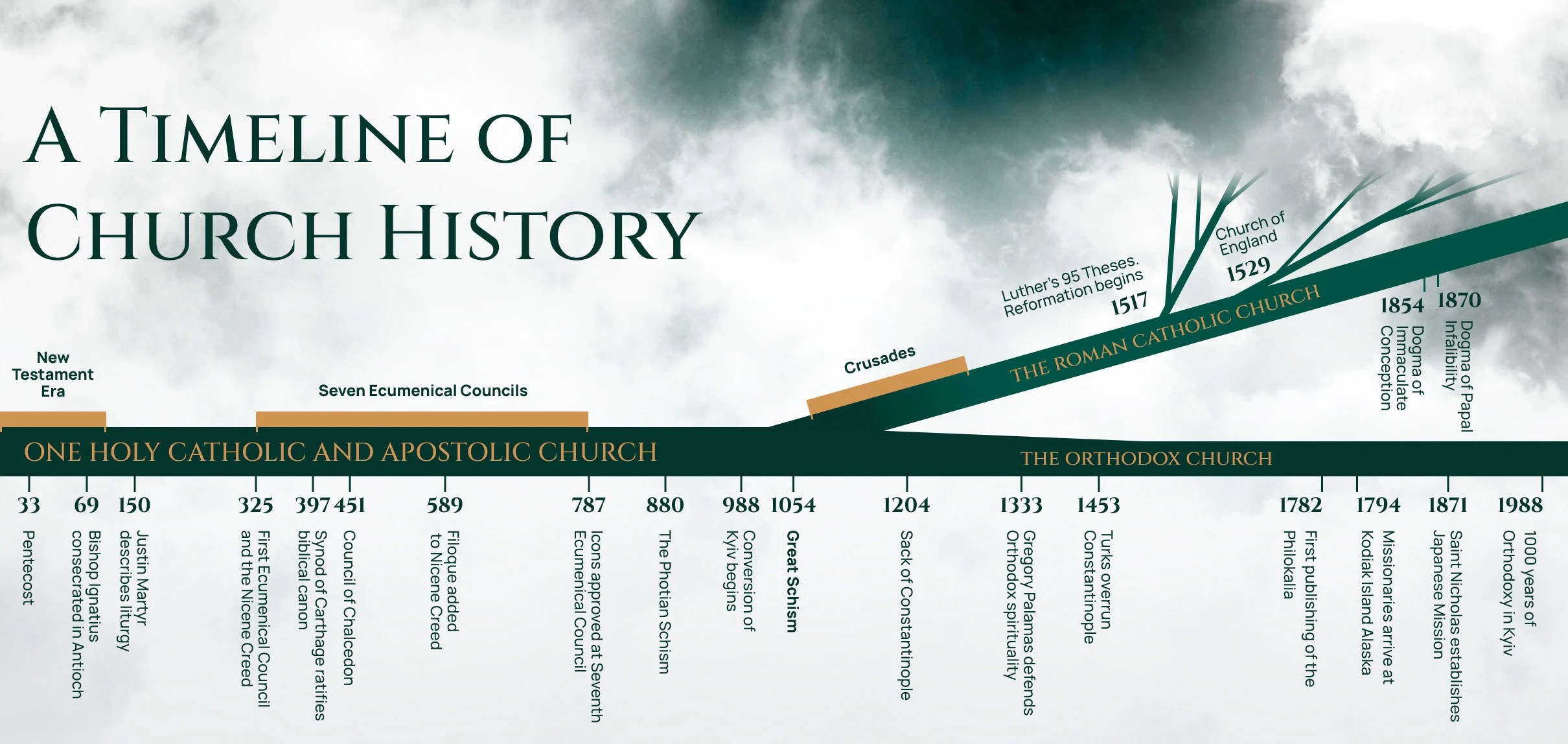
Orthodoxy and Roman Catholicism are not in communion with each other since, in the simplified version, the Great Schism of 1054 (see the timeline above). But a lot of people coming out of Protestant traditions have felt that those were the only two viable Christian alternatives, and I have never found it in me to criticize those who made the wrong-but-plausible choice, like Leah did.

Fallen

Of course, we speak of human beings as “fallen.” However, in Orthodox teaching, this does not refer to our nature itself. Rather, it refers to the fact that we have been made subject to death – we are mortal. It is “death at work in us” that we describe as “sin.” But the origin of sin is not found in our nature. Our nature is inherently good. Understanding this makes a huge difference when we think about human relationships and the character of our common life.

If you take the view (which is common in certain corners of Western Christianity) that human beings have a “sin nature” – that we are, in fact, essentially bad – then how we view one another and the character of our common life takes on a different caste. In an Orthodox understanding, a Bible verse such as, “Spare the rod and spoil the child,” can mean little more than “children need discipline in their lives to help them”. Whereas in a world in which human nature is held to be a “sin nature,” then “sparing the rod,” would be seen as letting evil run amok. It would hold that our nature not only needs to be restrained but requires a vigorous regime of reward and punishment. It has not been that long since the notion of “beating the evil out of a child” was common.

When we speak of our nature as “good,” we are not declaring that human beings are born as saints. Rather, we are saying that our nature (“what we are”) tends towards the good, desires the good. We desire beauty. We desire well-being. We desire truth. Even when we engage in evil actions, they are most often grounded in a misperception of the good. Dictators do not come to power by asking people to be evil – they come to power by distorting the image of the good.

Fr. Stephen Freeman, The Nature of Being Human


Religious ideas have the fate of melodies, which, once set afloat in the world, are taken up by all sorts of instruments, some woefully coarse, feeble, or out of tune, until people are in danger of crying out that the melody itself is detestable.

George Elliot, Janet’s Repentance, via Alan Jacobs

[N]one of the things that I care about most have ever proven susceptible to systematic exposition.

Alan Jacobs, Breaking Bread With the Dead

You can read most of my more impromptu stuff here and here (both of them cathartic venting, especially political) and here (the only social medium I frequent, because people there are quirky, pleasant and real and it has no-algorithms). All should work in your RSS aggregator, like Feedly or Reeder, should you want to make a habit of it.

Great and Holy Race Day

I’m situated geographically in a place so sports- and Indy500-obsessed that in my former Church, men would disappear en masse on “Race Day.” Granted, I lived away from here 20-ish years, but it’s still a point of sinful pride that I’ve never been. Not to the race, not to the trials, not to carburation day.

(I apologize for some funky formatting today. After all these years, I still have trouble dealing with numbered or bulleted lists within block quotes.)

Filioque

As a protestant, I had no idea that the filioque (the words “and from the Son” in the Nicean Creed concerning the procession of the Holy Spirit) was added to the Creed hundreds of years later, nor that it was rejected from the beginning by Christians outside the jurisdiction of the Roman Patriarch, nor even (very distinctly at least) that there were catholic Christians outside the jurisdiction of the Roman Patriarch.

Since becoming Orthodox, I have taken it as a matter of high importance to reject the filioque, but I don’t recall previously seeing all of these reasons for the rejection:

Eastern Europe was converted to Christianity by Byzantine missionaries, the most prominent of whom are Saint Cyril and Saint Methodius. These bonds of religion created a deep sympathy between Bulgar to Byzantine. The Franks attempted to sever these bonds by sending missionaries into Eastern Europe, claiming that the Byzantines had taught them a heterodox version of Christianity and encouraging them to use the filioque.

I know Catholics are tired of Orthodox apologists going on about the Franks. But this really is an important test-case, for the following reasons:

  1. The threat of Arianism was resolved 300 years before the Schism. So, adding the filioque served no pastoral function. On the contrary, it was deeply divisive.  
 2. The underlying theology of the filioque was hotly disputed, especially by the Eastern patriarchs. So, adding the filioque did not express the mind of the universal Church.  
 3. The original Creed had been drafted in Council for a reason: it was supposed to express the *consent* and *concensus* of the orthodox, catholic bishops. So, adding the filioque defeated the whole purpose of the Creed.  
 4. For about six hundred years, Popes had taught the dangers of inserting the filioque into the Creed. So, adding the filioque violated even Rome’s local customs.  
 5. The Ecumenical Councils had ruled that the Creed should not be modified. So, adding the filiioque violated the Holy Canons.  
 6. Rome was advancing the *filioque* for worldly reasons only. So, adding the filioque would have allowed a single bishop to advance his own political and economic interests at the whole Church’s expense.  

The Eastern Patriarchs had every reason to reject the insertion of the filioque, and no reason to accept it—none except, “The pope said so, and we have to do whatever the pope says.”

Michael Warren Davis, ‘Papal Minimalism’ Is Eastern Orthodoxy

Worship

To anyone who has had, be it only once, the true experience of worship, all this is revealed immediately as the ersatz it is. He knows that the secularist’s worship of relevance is simply incompatible with the true relevance of worship. And it is here, in this miserable liturgical failure, whose appalling results we are only beginning to see, that secularism reveals its ultimate religious emptiness and, I will not hesitate to say, its utterly anti-Christian essence.

Alexander Schmemann, For the Life of the World

Protestant, Catholic, Non-Denom

As my readers know, I’ve been an Orthodox Christian ever since I began blogging. The more attentive readers may know that before that I was Reformed (i.e., Calvinist, and specifically Christian Reformed) and before that, I was a generic Wheaton-College type evangelical.

Or maybe I should say “a generic Wheaton-College type evangelical as evangelicalism was configured in the 1950s through the mid-1970s.” Because it has come to my attention more forcefully, and in a way that more painfully implicates and pronounces doom on the kinds of Christian I once was, that things are changing. The evangelicalism I knew is not as powerful as it once was; evangelical denominations are shrinking and dying. So are Calvinist denominations. The Protestantism I knew most closely is increasingly nondenominational, and doesn’t care much about doctrine or sacraments, and increasingly doesn’t even want to be called “evangelical” or even “Protestant.”

This affects me closely because my wife remains Christian Reformed, and I consider it a pretty good penultimate tradition for an Orthodox Christian. And there is a very strong trend toward those denominational Churches dying out in favor of non-denoms.

And it worries me because those nondenominational Churches tend far too much to be personality cults and hotbeds of rampant sexual and other clergy abuse. And God only knows what they’re teaching, insofar as they’re teaching anything other than a mooshy-gooshy relationship with Jesus and a firm commitment to the GOP as a way of gaining power.

Yeah, this means I’ve gained some fresh respect even for the progressive Protestant denominations (which are also dying, even faster than the conservatives). At least there’s some accountability to hierarchies less likely than local parishioners to be mesmerized by Mr. Charisma. And some of them retain a liturgy that will expose worshippers to more scripture and doctrine than Joel Osteen can even imagine.

In any event, I say all that to introduce you to four of the thought-provoking articles (presented in the order in which I encountered them) that brought to my attention how much things are changing in my former haunts. A common thread is that denominational Protestantism is in deep, deep trouble; one goes so far as to suggest that nondenominational Churches are not really Protestant, but a whole new tradition:

  1. Goldilocks Protestantism – First Things
  2. LONG FORM: Does Traditional Protestantism Have a Future?
  3. How ‘Christian’ Overtook the ‘Protestant’ Label – Christianity Today
  4. Low Church in High Places: The Fate and Future of American Protestantism – Public Discourse

Religious ideas have the fate of melodies, which, once set afloat in the world, are taken up by all sorts of instruments, some woefully coarse, feeble, or out of tune, until people are in danger of crying out that the melody itself is detestable.

George Elliot, Janet’s Repentance, via Alan Jacobs

[N]one of the things that I care about most have ever proven susceptible to systematic exposition.

Alan Jacobs, Breaking Bread With the Dead

You can read most of my more impromptu stuff here and here (both of them cathartic venting, especially political) and here (the only social medium I frequent, because people there are quirky, pleasant and real). All should work in your RSS aggregator, like Feedly or Reeder, should you want to make a habit of it.

St. John Climacus, 2025

Denying our ancestry

Just as the Bishop of Oxford refused to consider that he might be descended from an ape, so now are many in the West reluctant to contemplate that their values, and even their very lack of belief, might be traceable back to Christian origins.

Tom Holland, Dominion

The virtue of essays

I write here not as a teacher to students but rather as a reader to other readers, a citizen to other citizens. I write because I think I have learned a few things in my teaching life that are relevant to our common life. You will see what those are if you read on.

My approach here is anything but systematic. Of all the literary genres, I am fondest of the essay, with its meandering course that (we hope) faithfully represents the meanderings of the human mind … certain images in advance and people will recur throughout this book, returning perhaps when you think we’re done with them. I write this way because none of the things that I care about most have ever proven susceptible to systematic exposition.

Alan Jacobs, Breaking Bread with the Dead. That last sentence is a gem.

Notional Evangelical Bibicism

As a public relations stunt, Trump’s Bible photo might seem unserious, but the president certainly understood the importance of Christian scripture to a significant voting bloc. Evangelicals are biblicists, and the extent to which American religiosity has been dominated by evangelical Protestantism correlates to the degree to which American culture has been shaped by the Bible.

Paul J. Gutacker, The Old Faith in a New Nation

I would be remiss were I not to recommend Brad East’s ‌Biblicist churches that don’t read the Bible — Brad East. Historian Gutaker may be missing something contemporary.

The one, true meaning of the text

When I try to explain to people why we need to recover patristic interpretation, the biggest obstacle I face is the desire of my interlocutors to establish the one, true meaning of the text. When I assert that there is no such thing, I provoke raised eyebrows: I must be playing fast and loose with the biblical text, making it echo my preconceptions. My insistence that biblical texts have multiple, even innumerable meanings contradicts our modern objectivism. My defense of patristic allegorizing likewise elicits fears of arbitrariness and subjectivism.

Hans Boersma, No Method but Christ

Whither the magisterial Reformation?

Nearly two decades ago, Bruce McCormack, professor of systematic theology at Princeton ­Seminary, wrote: “The situation in which Christian theology is done in the United States today is shaped most dramatically by the slow death of the Protestant churches.” He went on:

if current rates of decline in membership continue, all that will be left by mid-century will be Roman Catholic, Eastern Orthodox and non-denominational evangelical churches. . . . The churches of the Reformation will have passed from the scene—and with their demise, there will be no obvious institutional bearers of the message of the Reformation. What all of this means in practice is that it will become more and more necessary, for the sake of the future of Christianity, to establish stronger ecumenical relations with the Catholics and the ­Orthodox.

This is a grave prediction, but its sobriety makes it not just prescient but practical. Non-catholic varieties of Christendom are here for good, but Goldilocks Protestantism was always doomed to fail. It presumed too much, relying on a common inheritance—patristic, medieval, and cultural—that was bound to be called into question by future reformers in search of their own style of biblical renewal.

In any case, McCormack is right: Whether, in the coming decades, magisterial Christians look “up” or “down” for friendship and cooperation, they will be living in a world without Protestantism. In truth, they already are.

Brad East, Goldilocks Protestantism

Martyrdom

Many a man will live and die upon a dogma: no man will be a martyr for a conclusion.

John Henry Newman


Religious ideas have the fate of melodies, which, once set afloat in the world, are taken up by all sorts of instruments, some woefully coarse, feeble, or out of tune, until people are in danger of crying out that the melody itself is detestable.

George Elliot, Janet’s Repentance, via Alan Jacobs

You can read most of my more impromptu stuff here and here (both of them cathartic venting, especially political) and here (the only social medium I frequent, because people there are quirky, pleasant and real). All should work in your RSS aggregator, like Feedly or Reeder, should you want to make a habit of it.

Sunday, 3/9/25

Superpower

Contentment in our current world is a superpower. Contentment sets you free.

Contentment isn’t having all your desires fulfilled, but being at peace with having unfulfilled desires.

Contentment is something we need to practice, like patience. And because of the way our society is organized, when you try to practice contentment, nobody will understand it. You’ll be called unambitious, unmotivated, lazy. But the people who say that are the ones that are still enslaved.

(Fr. Stephen De Young), paraphrased and slightly glossed.

Another thought, from the same podcast and again paraphrased and glossed:

Kennth Hagen, Benny Hinn, Paula White Cain and their ilk are not Christians. Their preaching is not Christian. Instead of repentance and faithfulness to Christ, they preach that you can speak things into reality. That’s sorcery, not Christianity. And it usually doesn’t work (the Deceiver, like a casino, knows how to addict people with random reinforcement).

And when people’s pocket have been emptied, and the riches they tried to speak into reality have not materialized (of course, it’s their own fault: their faith was too feeble), they’ll have no interest in real Christianity because they’ve been told that’s what they’re currently practicing.

I’m not poor. Far from it. But even apart from my advancing age, I’d stay content with much less if the price of more was a millstone around my neck like these prosperity preachers have donned.

Religion

“Religion” is not easy to define. Here’s an attempt by Fr. Stephen De Young again:

Religion is a way of being in the world that encompasses all levels of reality and expresses itself in practices.

Lord of Spirits Podcast, Bible, the Prequel.

This is a singular, or at least unusual, hyperlink right to the relevant part of the YouTube version of this podcast.

Marx, Nietzsche, Freud and other Protestants

Paul Tillich has frequently paid tribute to Nietzsche’s influence on his own thought, actually hailing Marx, Nietzsche, and Freud as the greatest modern “Protestants.”

Basic Writings of Nietzsche, (Walter Kaufmann, Translator). Hyperlink added because I’m getting old enough that some readers may not remember him.


Religious ideas have the fate of melodies, which, once set afloat in the world, are taken up by all sorts of instruments, some woefully coarse, feeble, or out of tune, until people are in danger of crying out that the melody itself is detestable.

George Elliot, Janet’s Repentance, via Alan Jacobs

[N]one of the things that I care about most have ever proven susceptible to systematic exposition.

Alan Jacobs, Breaking Bread With the Dead

You can read most of my more impromptu stuff here and here (both of them cathartic venting, especially political) and here (the only social medium I frequent, because people there are quirky, pleasant and real). All should work in your RSS aggregator, like Feedly or Reeder, should you want to make a habit of it.

Sunday of the Last Judgment

No, that’s not a prediction. That’s the formal name of this last pre-Lenten Sunday in Orthodox Christianity. It’s also known as “meatfare,” because tomorrow we begin abstaining from meat until Pascha, April 20 this year.

State of the Union, February 23

A lot of people are trying to find precedents for what’s going on with the USA over the last 34 days. May I suggest that this is a fall of Babylon?

The US as Babylon was first suggested to me by a schismatic (when I was unwittingly schismatic) almost 60 years ago. I’ve never quite shaken it, and I think that there was a seed of truth there that’s compatible with Orthodoxy. One important divergence in my application is that I absolutely wouldn’t say “When the Bible says ‘Babylon,’ it means the USA.” Rather, I think Babylon is a typology, and that the USA fits it to a “T” today. In a few hundred years (“if the Lord tarries,” as they say), it could be China.

On the other hand, we don’t read Revelation liturgically, and I’ve never heard an Orthodox Priest or academic suggest this directly. I can’t rule out that the thought is just a bit of mental baggage from my past. It hasn’t caught on in white American Evangelicalism because — well, read the passage. It’s not holding up a flattering mirror.

In all this, friends, remember that God’s judgments are true and righteous, that He is gracious and loves mankind, and that the end of a world isn’t the end of the world.

Atheism in the Church

Last week, I quoted the ever-provocative Stanley Hauerwas

Atheism slips into the church where God really does not matter, as we go about building bigger and better congregations (church administration), confirming people’s self-esteem (worship), enabling people to adjust to their anxieties brought on by their materialism (pastoral care), and making Christ a worthy subject for poetic reflection (preaching). At every turn the church must ask itself, Does it really make any difference, in our life together, in what we do, that in Jesus Christ God is reconciling the world to himself?

Might this be profitably expanded to include political mobilization? …

The Atheist Liturgical Calendar

… Or our “liturgical calendars”?

Fr. Stephen: Right, and so … what any calendar does, because any calendar you use is going to be cyclical, is going to be a series of weeks that make up a series of months that make up a series of years, and that cycle is going to repeat. There’s going to be a May 23 every year. It loops back around.

Even if you want to talk about— Let’s talk about the most secular calendar I can think of, which is the American consumer calendar, meaning it’s structured around holidays that are built to sell things. So we just had Memorial Day: sell barbecue supplies and flags. We’re going to have—now, Juneteenth has been added to the list; I think that’s also going to be a lot of barbecuing for most people. Fourth of July, sell fireworks, sell flags. Mother’s Day, Father’s Day is in there: buy gifts for Dad, get the tie cake from Carvel. Valentine’s Day. St. Patrick’s Day: sell a lot of beer and green stuff, etc. So this is the most— about as secular as you can get of a calendar; even though some of those dates are still named after saints, it’s pretty secular.

That calendar, if you follow it, will shape the rhythm of your life. And that’s what it’s designed for! … Retail establishments want that to shape the rhythm of your life. That “seasonal” section at your local Walmart, where they have the stuff for whatever the next one of these holidays that aren’t really holy days per se in most cases— They’re counting on that cycle. They want that to shape your life. “Oh, now I go and buy and consume this. Now I go and buy and consume that.” They’ll shape your life; it’ll form you.

This, to me, is one of the worst backlashes of particularly the Puritan movements that come out of the Protestant Reformation. Bear with me here, Protestant friends. Really think about this. They had such an antipathy for [things] like saints’ days… Some of those Puritan movements— Well, most of those Puritan movements wouldn’t celebrate Christmas, the birth of Christ. Some of them won’t even celebrate Easter, Pascha. But definitely we don’t want a lot of, you know, feast days. I think it’s in the Westminster Standards that says you must guard against the proliferation of saints’ days.

Fr. Andrew: Nice! [Laughter]

Fr. Stephen: Protect everyone from this, right? So all of this stuff from the Christian liturgical calendar gets removed. And most American Christianity, American Evangelicalism really comes out of those Puritan movements, just historically. But then what do you end up centering even your church life around? You’ve got Mother’s Day sermons, Father’s Day sermons.

Fr. Andrew: You’re going to have a liturgical calendar one way or another.

Fr. Stephen: Yeah! Fourth of July sermons when you sing patriotic songs in a church!

Fr. Andrew: I know.

Fr. Stephen: All of these things. It’s the same thing! You’ve just chosen the most secular possible version!

Fr. Andrew: What I want to know is—and I’m pretty sure the answer to this question is yes; I just haven’t encountered it yet because I haven’t googled it up yet— Are there Amazon Prime Day sermons?

Fr. Stephen: Oh, I’m sure. I know there are Black Friday sermons.

Fr. Andrew: Oh, absolutely. Yeah, of course!

Fr. Stephen: [Sigh] Right? Just pause and think about it for a minute. What’s better: to base and structure your liturgical life on the life of Christ and the stories about Christ recounted in the Bible, or to base the cycles of your church life on random national holidays that often don’t even have any particular religious significance? I mean, the answer to that seems so obvious to me. I think the Puritans would be horrified by Fourth of July sermons and Mother’s Day and Father’s Day sermons! So think about that. But this is why, again, the calendar is so important.

Fr. Andrew Stephen Damick and (mostly) Fr. Stephen De Young

Science and religion

Just as colonial officials and missionaries, traveling to India, had imposed the concept of ‘religion’ on the societies they found there, so did agnostics colonize the past in similar manner. The ancient Egyptians, and Babylonians, and Romans: all were assumed to have had a ‘religion’. Some peoples—most notably the Greeks—were also assumed to have had ‘science’. It was this that had enabled their civilization to serve as the wellspring of progress. Philosophers had been the prototypes of scientists. The library of Alexandria had been ‘the birthplace of modern science’. Only Christians, with their fanatical hatred of reason and their determination to eradicate pagan learning, had prevented the ancient world from being set on a path towards steam engines and cotton mills.

Tom Holland, Dominion (spelling Americanized)

History Rhymes

Most Church leaders—conscious that to condemn Nazis for blasphemous kitsch might prove risky—opted to bite their tongues. Some, though, actively lent it their imprimatur. In 1933, the year that Hitler was appointed chancellor, Protestant churches across Germany marked the annual celebration of the Reformation by singing Wessel’s battle hymn. In Berlin Cathedral, a pastor shamelessly aped Goebbels. Wessel, he preached, had died just as Jesus had died. Then, just for good measure, he added that Hitler was ‘a man sent by God’.

Tom Holland, Dominion

Naked suffering

My grandparents did not have a car, but they hired one to go in to the hospital, when the end finally came. I went with them in the car, but was not allowed to enter the hospital. Perhaps it was just as well. What would have been the good of my being plunged into a lot of naked suffering and emotional crisis without any prayer, any Sacrament to stabilize and order it, and make some kind of meaning out of it? In that sense, Mother was right. Death, under those circumstances, was nothing but ugliness, and if it could not possibly have any ultimate meaning, why burden a child’s mind with the sight of it?

Thomas Merton, The Seven-Story Mountain


Religious ideas have the fate of melodies, which, once set afloat in the world, are taken up by all sorts of instruments, some woefully coarse, feeble, or out of tune, until people are in danger of crying out that the melody itself is detestable.

George Elliot, Janet’s Repentance, via Alan Jacobs

[N]one of the things that I care about most have ever proven susceptible to systematic exposition.

Alan Jacobs, Breaking Bread With the Dead

You can read most of my more impromptu stuff here and here (both of them cathartic venting, especially political) and here (the only social medium I frequent, because people there are quirky, pleasant and real). All should work in your RSS aggregator, like Feedly or Reeder, should you want to make a habit of it.

Sunday, 1/26/25

Musings from a funeral

I went to a funeral on MLK Day (when there were unrelated festivities going on in Washington DC as well). I hadn’t seen the deceased probably in more than a quarter century, but I always liked him.

Apart from being dead, Tom looked good. Apart from her hair haven’t gone white, his wife looked great. It was good to see them again, though it does eventually get tiresome when you only see your old friends at funerals, especially when one is the guest of honor.

His daughter’s Remembrance dwelt at some lengths on Tom’s piety, and deservedly so in my experience. We got acquainted at our former Reformed church. When our church split planted a sister church with guitars and drums and plexiglass and repetitive praise songs and such, I think he went with the sister church instead of staying with us stick-in-the-muds. Eventually, he moved out of state, to a warmer and trendier place, to start his own business in a field he knew from 30 or so years’ experience. He remained firmly in the Reformed tradition, though he switched in his new home to the Presbyterian side rather than the continental.

And soon enough, the Orthodox Christian faith caught my serious attention and I, too, left — in an opposite direction from Tom.

Which brings me to my topic. Why me? Why did I get lucky? Why don’t more people like me find the Orthodox Christian faith?

I don’t really have an answer, but I have largely gotten over my convert-itis, my urge to harangue people about looking into Orthodoxy. I’m just not prepared to say that the world would be a better place if every pious Protestant was forever wringing his hands and anxiously poring over books to see if maybe he hadn’t picked (or been born into, or married into, or whatever) the true/best Church. There’s something to be said for settling down and practicing your faith, especially since the alternative of searching, searching, searching just might be unhealthier than settling down in the wrong place.

Or so it seems to me. I don’t mean to be cavalier about extra Ecclesiam nulla salus or to fudge the borders of Ecclesiam, but if I can hope for the salvation of all, and can get out of my left brain about distinctions, surely I can hope for the salvation of heterodox Christians.

Settling is what I had done 30-plus years ago. As I can attest, God knows how to unsettle you when you need it. So if you are feeling unsettled in your Church, come and see what’s up in your nearest Orthodox Church. Otherwise, stay put and be the best [fill in the blank] you can be.

And may God have mercy on me if this is the advice of a squish.

Before we forget the stunt …

Of Bishop Mariann Edgar Budde’s National Cathedral sermon (which turned to direct admonition of Donald Trump):

I must be one of the only people other than those actually in the cathedral to have listened to the entire thing. It was dry, high-minded, and Christ-light, and it built on a theme of “unity” in which all people drop their political differences and embrace a generalized, feel-good, Esperanto-like uni-faith, with everyone directing their prayers to Whom It May Concern.

Caitlin Flanagan


Religious ideas have the fate of melodies, which, once set afloat in the world, are taken up by all sorts of instruments, some woefully coarse, feeble, or out of tune, until people are in danger of crying out that the melody itself is detestable.

George Elliot, Janet’s Repentance, via Alan Jacobs

[N]one of the things that I care about most have ever proven susceptible to systematic exposition.

Alan Jacobs, Breaking Bread With the Dead

You can read most of my more impromptu stuff here and here (both of them cathartic venting, especially political) and here (the only social medium I frequent, because people there are quirky, pleasant and real). All should work in your RSS aggregator, like Feedly or Reeder, should you want to make a habit of it.

Sunday, 1/19/25

Here’s the thing about αμαρτία

This excerpt from the Orthodox Trisagion prayers (Thrice-Holy prayers) grabbed my attention 27+ years ago:

O Lord, cleanse us from our sins. O Master, pardon our transgressions. O Holy One, visit and heal our infirmities for Thy Name’s sake.

That left an impression that is still with me.

I learned fairly early in my catechesis that sin in Greek is αμαρτία, commonly rendered “hamartia” in English. It literally means “missing the mark.”

As an Evangelical, and then as a Calvinist (though to a lesser degree), I’d gotten the impression that “sin” was simply rebellion against God. But that wasn’t true to all that I saw in me that missed the mark. There was self-absorption feeding obliviousness to the concerns of others. I didn’t choose that to rebel against God. There was such limitation that I sometimes didn’t know what I should do and chose something that harmed others. I also didn’t choose that to rebel against God (I’d have preferred omniscience).

The three sentences from the Trisagion Prayers seemed a perceptive taxonomy where my Church and pastors saw only uniformity: rebellion. For some kinds of mark-missing we need cleansing, for others pardon, for still others, healing.

My soul said “Yes! They’ve got it!” And so the case for Orthodoxy grew weightier.

I don’t remember mentioning this before. Perhaps it will help someone with the same perception I had.

But now that I’ve got that down on paper (so to speak), connections occur to me. Maybe my Protestant mentors didn’t think about human failures that aren’t acts of rebellion toward God because the common Protestant theory of atonement (basically, God the Father already gave God the Son the punishment we deserve for our rebellion and so He won’t punish us as well) is an uncomfortable fit for non-rebellious mark-missing like self-absorption and lack of omniscience, for which we need something more than pardon.

To call that idea half-baked may be too generous, but now it’s on my mind.

How liberal theology works

I pay a lot of critical attention to American Evangelicalism because in important ways it was my religious world and we’re collectively still swimming in its latest iterations.

Also, I don’t think I ever understood the Protestant mainline. I recently got some help in that regard (recently because I’m gradually catching up with the podcast series from which this transcript comes):

Fr. Stephen: … I don’t think people fundamentally understand how liberal theology works, and this can give us a window into how liberal theology works. Liberal theology is in keeping with Hegel, the Hegel we’re rejecting on this show, just to be clear. Not promoting liberal theology, but we need to understand liberal theology and how it works.

The reason I’m just saying “liberal theology”— I’m not saying “liberal” as opposed to “conservative.” I’m saying “liberal” in the sense of post-Enlightenment, that doesn’t think the Enlightenment was a bad thing. I’m talking about post-Enlightenment theology; I’m talking about— Well, let’s get to brass tacks. …

But liberal theology essentially, like Hegel, takes whatever point in time they stand at as being the apex of history to that point. This means— And I’ve critiqued it this way on the show before, but I’m going to do it again. This means that liberal theology is always innately chauvinist, at least somewhat racist, colonial, because, again, you have to take your culture and civilization as being the apex, which means the other ones who might disagree with you are somehow primitive, backward, unenlightened, etc. So there’s always overtones of that, always overtones of that within liberal theology. But you take your point as being the apex of history to that point, and you ascribe the developments that have led to that apex as being the work of the Holy Spirit.

So if now we, European-derived Western culture, have a new understanding of gender or sexuality or biological sex or any other ethical, moral issue of who God is, whatever—whatever has developed historically, in this Western—dare I say often white—culture, whatever is developed in that culture, this is the work of the Holy Spirit that has brought us to this, and therefore it is endorsed, and we re-shape our theology based on this. So a new understanding of gender that arises within culture and society is, for them—the work of God has brought that about within society.

Fr. Andrew: Yeah… This is where you hear people use language like “the right side of history.”

Fr. Stephen: So it doesn’t matter if the person questioning that is from the same culture but who says, “Hey, I don’t this historical development—” they’re doing more like what we’re advocating for, which is saying, “Well, no, we have to sift through this and say what is from God and what isn’t”; or if it’s someone from another culture, who might have another skin color, might be from another continent. It doesn’t matter who’s questioning it: whoever’s questioning it is innately backwards, is innately rejecting the work of the Holy Spirit in the world.

Fr. Andrew: Yeah, this is also where you hear people say things like: “It’s 2023!” Like that’s an argument! “It’s current year!”

Fr. Stephen: Yeah, but you have to understand, this is their understanding. And this is why trying to take any kind of approach with them, of “well, but this previous understanding…” or “this thing from the past,” no matter what it is, fundamentally doesn’t work, because they have this underlying presupposition that their culture now at this point in time is the apex of all human cultures and civilization and that God has brought it there. This is why, when I— when you hear me critiquing liberal theology, it’s often from what sounds like a liberal perspective, like I’ll say to people who express these ideas— They’ll be attacking, for example, African bishops in their own church for not going along. What’s nice about me using that example is there are at least three different denominations I could be talking about.

When they, as white, bourgeois Americans or Europeans, attack African bishops and call them “backwards” and all of these things for not being on-board with their new liberal consensus, I will call them white supremacists, because that’s what that is.

Fr. Andrew: Colonialism.

Fr. Stephen: Right? That is colonialism. It’s: all the things they claim to hate, they’re actually doing. But that’s why I— If people hear me critique it that way, I know some people might get confused, but that’s why I critique it that way, because that’s the only critique that can function on their own presuppositions. That’s the only critique that’s valid from their— based on their own presuppositions. Any critique from tradition is going to fall flat on its face, because they’ve substituted—instead of our understanding of tradition, they have this alien understanding of history, so trying to talk tradition doesn’t work. That’s the only kind of critique—

And that’s because, ultimately, that line of thinking is an ouroboros. It’s a snake eating its own tail. It can’t— Its first principles are incoherent. That’s why you can critique their beliefs based on their beliefs, because they don’t fit together. But so, we add that at the end this is the deviant view of how the Spirit works and how Tradition works, that we need to be aware of, because I don’t think we can have productive dialogue with people who have imbibed liberal theology and who are coming at things from that perspective when we come at them from a completely alien perspective that shares none of their presuppositions. I don’t think there’s any way for that to be productive, other than, you know, maybe just saying, “You have to abandon everything you think you know. Change everything,” which may work sometimes, and maybe if you show them how self-refuting their own ideas are, maybe that’ll help that happen, but there’s a fundamental lack of communication between those who have fallen prey to that kind of liberal theology and the rest of us. That it would be good for their sakes if we could find a bridge to try to bring them back to the truth.

Fathers Andrew Stephen Damick and Stephen DeYoung on the Lord of Spirits podcast for December 29, 2023.

I share this because I found it helpful in understanding United Methodists and Episcopalians over my lifetime. They’re treating the Zeitgeist as the Heiliger Geist, and they contemn Africans in their communions whose Zeitgeist isn’t keeping up with the latest fashions.

Secularizations

After he had twice visited the United States in the 1930s, Dietrich Bonhoeffer wrote a perceptive essay contrasting Christian development in America with parallel developments in the parts of Europe most directly shaped by the Protestant Reformation. His assessment included an observation that was as shrewd in its comparative wisdom as it is relevant for the themes of this book: “The secularization of the church on the continent of Europe arises from the misinterpretation of the reformers’ distinction of the two realms [of church and society]; American secularization derives precisely from the imperfect distinction of the kingdoms and offices of church and state, from the enthusiastic claim of the church to universal influence in the world.” What Bonhoeffer saw has been described with other terms here: The key moves in the creation of evangelical America were also the key moves that created secular America.

Mark A. Noll, America’s God. This surely is relevant to my inquiry into Carlo Lancelotti’s Touchstone article.

Truth gets a rocky start

Schaff’s work in America got off to a rocky start. In his inaugural address at Mercersberg, The Principle of Protestantism, Schaff argued that American Protestantism needed to reject its antihistorical, sectarian tendencies and recognize its place within the historic church, which had organically developed through time.

Paul J. Gutacker, The Old Faith in a New Nation.

Schaff wasn’t wrong.

Religious versus Secular

Why accept the substantivist definition of religion as about belief in transcendence? Taylor thinks he needs such a definition in order to keep his subject matter properly delimited; if nationalism were a religion, then the whole religious/secular distinction would get thrown into confusion. But there might be good reasons to question this distinction. The distinction has come under increasing scrutiny from scholars who view the religious/secular distinction as both historically constructed and politically motivated.

William T. Cavanaugh, The Uses of Idolatry

Authenticity

The Reformation is the first great expression of the search for certainty in modern times. As Schleiermacher put it, the Reformation and the Enlightenment have this in common, that ‘everything mysterious and marvellous is proscribed. Imagination is not to be filled with [what are now thought of as] airy images.’ In their search for the one truth, both movements attempted to do away with the visual image, the vehicle par excellence of the right hemisphere, particularly in its mythical and metaphoric function, in favour of the word, the stronghold of the left hemisphere, in pursuit of unambiguous certainty. … What is so compelling here is that the motive force behind the Reformation was the urge to regain authenticity, with which one can only be profoundly sympathetic. The path it soon took was that of the destruction of all means whereby the authentic could have been recaptured.

Iain McGilchrist, The Master and His Emissary


Religious ideas have the fate of melodies, which, once set afloat in the world, are taken up by all sorts of instruments, some woefully coarse, feeble, or out of tune, until people are in danger of crying out that the melody itself is detestable.

George Elliot, Janet’s Repentance, via Alan Jacobs

[N]one of the things that I care about most have ever proven susceptible to systematic exposition.

Alan Jacobs, Breaking Bread With the Dead

You can read most of my more impromptu stuff here and here (both of them cathartic venting, especially political) and here (the only social medium I frequent, because people there are quirky, pleasant and real). All should work in your RSS aggregator, like Feedly or Reeder, should you want to make a habit of it.