
Category: Evangelicalism
With doctrine and church attendance.
Confessions
- My hope sometimes trumps my experience.
- I really don’t care for sports any more.
- When I was young and foolish, I was young and foolish.
- I weep at concerts.
- I am, relatively speaking, a real blue nose these days.
- I do not believe that all religions are equally ridiculous to the nonbeliever.
- Wendell Berry has disappointed me.
Religious, but au courant.
Deer Hunting with Jesus
I learn a lot of things from a lot of places, especially from listening to people I formerly blew off.
A book with a title like Deer Hunting with Jesus: Dispatches from America’s Class War was kind of irresistible to someone – well, actually, it was my wife – who for some reason – well, actually, it’s because it was on my wish list – gave it to me for Christmas.
All things considered, I suppose it wasn’t too bad. At least I’ve now gotten a flavor of what’s meant by “Gonzo Journalism.”
Joe Bageant is, I guess, a gonzo journalist. He grew up in Winchester, Virginia – unless that’s one of many facts he made up on the fly – and returned to live there after some decades away:
A raucous, truth-telling look at the white working poor-and why they hate liberalism.
Deer Hunting with Jesus is web columnist Joe Bageant’s report on what he learned when he moved back to his hometown of Winchester, Virginia, which-like countless American small towns-is fast becoming the bedrock of a permanent underclass. By turns brutal, tender, incendiary, and seriously funny, this book is a call to arms for fellow progressives with little real understanding of “the great beery, NASCAR-loving, church-going, gun-owning America that has never set foot in a Starbucks.”
(From the book’s own description)
“Joe Bageant is the Sartre of Appalachia. His white-hot bourbon-fuelled prose shreds through the lies of our times like a weed-whacker in overdrive. Deer Hunting with Jesus is a deliciously vicious and wickedly funny chronicle of a thinking man’s life in God’s own backwoods.”
—Jeffrey St. Clair, author of Grand Theft Pentagon and co-editor of CounterPunch
I think “white-hot bourbon-fuelled prose” is a euphemism for “reckless advocacy, indifferent to factual accuracy.”
“Dead serious and damn funny…Bageant writes with the ghosts of Hunter S. Thompson, Will Rogers, and Frank Zappa kibitzing over his shoulder…Takes Thomas Frank’s What’s the Matter With Kansas, to the next level. “
—Mother Jones“Informative, infuriating, terrifying, scintillating … Imagine a cross between Thomas Frank’s What’s the Matter with Kansas?, Hunter S. Thompson’s booze-and-dope-fueled meditations on Nixon’s political potency, and C. Wright Mills’s understanding of the durability of the power elite.”
—The American Prospect
What’s the Matter With Kansas, from what I hear, was a full-length “how effing stupid are these people!?” But I heard it from conservatives, who Thomas Frank thinks are the beneficiaries of Kansans’ effing stupidity. So maybe I was misinformed.
I’ve accused Bageant of factual inaccuracies, and I owe specifics, I think.
1. First, he says (Chapter 5, page 180 in mine) his parents met “at a Billy Graham tent revival during the Second World War.” I didn’t, and still don’t, think that Graham was doing tent revivals then, but he’s a couple of years older than I thought, and there’s some smallish chance, from his abbreviated biography at Wikipedia for instance, that he did tent revivals as part of his “other preaching engagements” during college. But I’d be willing to bet a modest amount that it was a tent revival by someone other than Billy Graham, or that it was later than World War II.
2. He riffs in the same chapter (page 186) on the “blood” motif in fundamentalist Protestantism, concluding with a quote from an English Professor:
There is a big leap from the liberation of Exodus, when Jews sprinkled blood on their doorposts, to the salvation proposed by Christians, in which blood is drunk by the community of faith. The Christian community not only lives after death by the blood of their Christ; but they feed on it in life. What can this mean, to drink blood?
Well, to a fundamentalist Protestant, “to drink blood” means precisely nothing. It’s pure symbolism. They reckon they’re supposed to have a communion service now and again to recollect Good Friday. The 6th Chapter of the Gospel According to John, where Christ says repeatedly, even to the point of driving away some of His disciples, that we must eat His body and drink His blood if we want life in us, is maybe the only Chapter in the Bible that they resolutely refuse to read literally (even in the loose sense of “literal” that’s pandemic these days). They have elaborate tapdances around that chapter, but basically they reject it because it sounds too damned Catholic.
Bageant was grasping for bloody imagery, grabbed the first faux scholarly blood quote he could find, and in the process confounded a sacrament in historic Christianity with the lurid locutions of Fundamentalism. Even he should know better than that.
3. In Chapter 7 (page 243), Bageant writes about Medicare when he clearly means Medicaid. I know enough about both that I’d bet you any amount he’s wrong.
Still, the arc of Bageant’s story is credible. Despite the Medicare whopper, for instance, he “shreds through the lies of our times [about “nonprofit” hospitals] like a weed-whacker in overdrive,” in his chapter An Authorized Place to Die. I just wouldn’t rely on him for any little details, such as “and” and “the.” Read him like a good ole’ boy competing in a Whopper-Telling Contest.
Reading his chapter on guns (Valley of the Gun) was especially timely as the press and Hollywood goad us to “demand a plan” for gun control (i.e., “we must do something, even if it’s oppressive and counterproductive, about evil guns, not about an evil entertainment industry that feeds the imaginations of the unhinged with revenge and other gratuitously violent movies and video games.”):
In 1960 common sense was equally distributed between liberals and conservatives. In those days, even liberal personages such as Democratic senator and vice president Hubert Humphrey said repeatedly that guns had a place in the home because history has shown that governments, even the best of them, have a habit of oppressing people who cannot defend themselves at their own front doors. Imagine any Democrat saying that aloud today.
(Page 132.)
Now that most states have passed laws allowing honest citizens to carry concealed weapons, gun advocates are being proven more right than they ever hoped to be. Joy of joys, it is women – in fact, poor urban women – and the poor in general who benefit most from concealed carry laws. It doesn’t get any better than that when it comes to serving up cold crow to Democratic gun controllers. Large declines in rapes and attacks on women have occurred wherever the laws have been enacted. A study by John R Lott Jr., author of More Guns, Less Crime: Understanding Crime and Gun Control Laws, found that the urban poor and minorities lived more safely with guns in their pockets or purses: “Not only do urban areas tend to gain in their fight against crime, but reductions in crime rates are greatest precisely in those urban areas that have the highest crime rates, largest and most dense populations, and greatest concentrations of minorities.” …
Most liberal anti-gun advocates do not get off the city bus after working the second shift. Nor do they duck and dodge from streetlight to streetlight at 1 AM while dragging their laundry to the doozy duds, where they sit, usually alone, for an hour or so, fluorescently lit up behind the big plate glass window like so much fresh meat on display, garnished with a promising purse or wallet, before they make the corner-to-corner run for home with their now-fragrant laundered waitress or fast-food uniforms. Barack Obama never did it. Hillary Clinton never did it. Most of white middle-class America doesn’t do it either. The on-the-ground value of the second amendment completely escapes them.
(Pages 146-147.)
And he chronicles many other such blows as well, including “economic conscription.” The poor Scots Irish of places like Winchester make up a disproportionate share of our cannon fodder, by economic necessity. The Democrats are little or no better than the Republicans on feeding them to the coffins in our wars of choice.
Most of the young soldiers were fleeing economically depressed places, or dead-end jobs like the one Lynndie had held at the chicken processing plant, though many deny it or did not even see it in their quick and ready patriotism in useful blindness to the larger national scheme of things. These so-called volunteers are part of the nation’s defense code draft – economic conscription. Money is always the best whip to use on the laboring classes. 1300 a month, a signing bonus, and free room and board sure beats the hell out of yanking guts through a chicken’s ass.
(Page 200.)
Other select quotes:
When our town’s educators decided to hold a conference on the future employment needs of our youth, the keynote speaker was the CEO of a local rendering plant, Valley Protein, a vast stinking facility that cooks down roadkill and renders deep fryer fats into the goop they put in animal feed. He got a standing ovation from the school board and all the Main Street pickle vendors, and not a soul in that Best Western events room thought it was ironic. (Page 29.)
Even if we are one house payment away from homelessness, even if our kids can’t read and our asses are getting so big they have their own ZIP Codes, it’s comforting to know we are at least the best place on earth. There is America, and there is the rest of the world – envious and plotting to bring us down and “steal our freedom.” (Page 83.)
The reality is that our economy now consists of driving 250 million vehicles around the suburbs and mall and eating fried chicken. (Page 110.)
It has been an orgy so glorious and unholy, so mindless that we have now eaten our seed crop in our spiraling consumerism. (Page 112.)
Independent fundamentalist churches are theologically woolly places whose belief systems can accommodate just about any interpretation of the Good Book that a “Preacher Bob” or a “Pastor Donnie” can come up with. (Page 162.)
After a night of political discussion at Royal Lunch, a British relative, a distant continental member of the Bageant clan, called our gang of locals “the most intellectually squalid people I’ve ever met” – and he had chewed qat with Ugandan strongman Idi Amin’s bodyguards. (Page 206-07.)
We live in an age of corporate dominion just as we once lived in an age of domination by royal families, kings, and warlords. (Page 262.)
If middle-class Americans do not feel threatened by the slow encroachment of the police state or the Patriot Act, it is because they live comfortably and often exercise their liberties very lightly, never testing the boundaries. You never know you are in prison unless you try to open the door. (Page 263.)
I guess I’d give it four stars for the story arc, but I can’t give five stars or unequivocal endorsement to a book so riddled with unsettling errors.
* * * * *
Friday, December 14, 2012
Lord’s Day, December 2, 2012
Mark this day on your calendar. I’m about to write something good about a Dispensationalist. Continue reading “Lord’s Day, December 2, 2012”
A Personally Important Anniversary
15 years ago today I was received into the Orthodox Church. Continue reading “A Personally Important Anniversary”
Thor’s Day, November 8, 2012
Change, certainty and salvation
Orthodoxy often gets the back-handed compliment of complaints that it hasn’t changed. For every such compliment, I’m grateful.
But Chris Castaldo pays us the same compliment intentionally:
The notion that Rome doesn’t modify authoritative teaching such as the articles and canons of Trent is, with all due respect, out of step with reality. If you were looking for an example of a church that hasn’t changed for over a millennium, you’ll want to consider Eastern Orthodox Churches, not Rome.
It’s kind of odd after that affirmation to see Castaldo tear into Rome, instead of lovingly caressing Orthodoxy. But I guess Rome’s the 800 pound gorilla against which all western Evangelicals must contend – especially if one was raised Catholic, rather as I tend to obsess a bit about the subspecie of Evangelicalism in which I was instructed beginning in boarding school.
But it’s still puzzling. Castaldo works in a pretty smart setting: Wheaton College and formerly College Church of Wheaton, with both of which I’m pretty familiar. Why doesn’t it occur to him to question the magisterial Reformation not having turned Eastward? Why does he accept (as I assume he does) Evangelicalism’s break with the Magisterial Reformation during and after the First and Second Great Awakenings? (Maybe if I had followed his blog over time, I’d find that he has questioned all this and still come out where he is.)
But he does a good job of arguing that Rome changes. Really. It sounds to me as if Rome is nowhere to go if you want stable, clear doctrine, P.R. to the contrary notwithstanding.
On the one hand, for instance, you’ve got extra Ecclesiam nulla salus, but then it’s a matter of disputed and changing interpretation just who is extra Ecclesiam.
You have a purportedly infallible Magisterium, but nobody to interpret what the Magisterium truly teaches, or even whether Pope so-and-so was speaking ex cathedra when he uttered this or that. And in this election season, I’d be remiss not to note that liberal Catholics cite Catholic social teaching on the preferential option for the poor to justify voting for a feticidal maniac while conservative Catholics insist that voting for feticidal maniacs is intrinsically evil, whereas the best approach to helping the poor is a matter of prudential judgments. (It’s not my fight, but I give the edge to the conservatives there, in case my scrupulously neutral contrast left you wondering.)
That doesn’t sound to me like much of an improvement over an infallible Bible with no infallible interpreter. Infallibility – of Bible or of Magisterium – is a nice dogmatic theory, but not much practical use, it seems. (Calvinists have the same tap-dancing problem. When one of The Elect apostasizes, it just goes to prove he wasn’t really Elect. Some “eternal security,” huh?)
Good form seems to dictate that I now pronounce that you should come to Orthodoxy for stable, clear doctrine. But I won’t. “Stable” we’ve got down pat. “Clear,” not so much. Or so it seems to me.
But I don’t think the faith is about certainty about everything. What’s certainty got to do with union with God? Devils know the right factoids about God, for goodness sake.
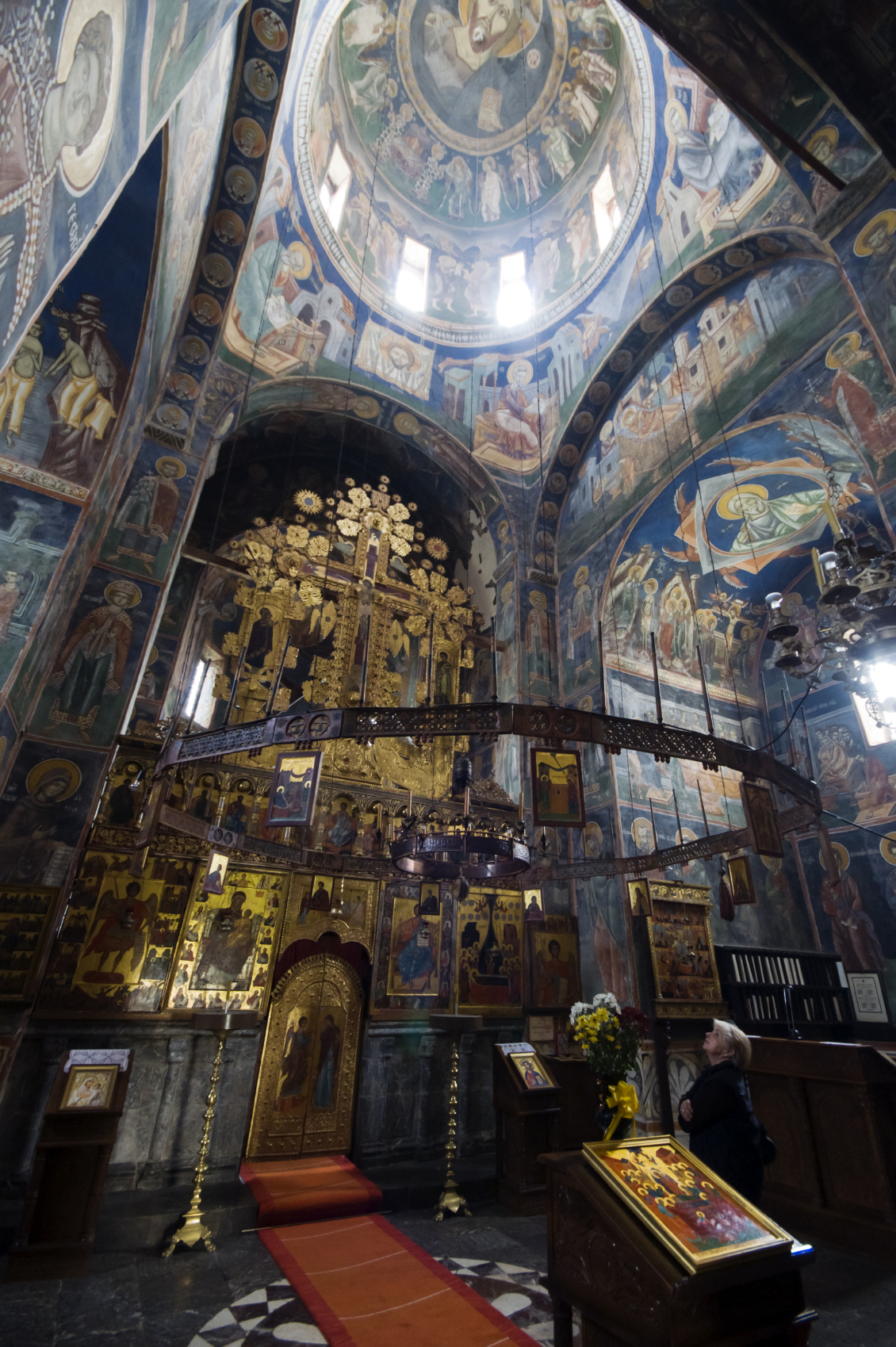
Lack of certainty about some things doesn’t mean I’m confused about what matters. I know what I should do this morning first thing when I get up: thank God for another day to repent as my feet hit the floor, say my morning prayers and read today’s epistle reading. The morning prayers are pretty much universal; the Bible reading’s there because I’ve decided that’s when I’ll do it daily (if no other time). I know what I should do at mealtimes: more prayers. I know what I should do at bedtime. Still more prayers. Seven times a day would be good, actually. “Without ceasing” better still. And repentance, not pride, through it all. (I’m lousy at living this out. I’ll never be saved by my own effort.)
Saturday night? Vespers. Sunday morning? Matins and Liturgy. The texts are set. The music is sober, in whatever musical tradition it’s done. It’s a privilege to be obligated as a Reader (the lowest level of Clergy) to do these services. They form me; they shape my soul.
The Creed? Definitely. It keeps me away from cliffs over which souls have been plunging for 2000 years. But it doesn’t tell me exactly where inside the protective fence I should be. It doesn’t tell me a lot of things about which I might feel idle curiosity. It wasn’t meant to be a Procrustean bed. And that’s okay.
So, what’s the conclusion? I’m not sure. I’ve only been Orthodox 15 years this month, and I had 49 years of bad habits to break. They’re not all broken yet. I’ve noticed for about 14.9 years that the Church isn’t pumping me full of right answers to rattle off to any question or objection, just like all the other ideologues on the block. I sometimes long for greater certainty, but then I’m ashamed of the pride that feels entitled to know instead of trusting.
I may be selling certainty and clarity short. But it seems to me that much as Abraham was told “get thee up into a land I shall show thee,” we walk by faith, not by the sight of a detailed roadmap with reservations staked out each night along the way. It that scandalizes you, and if I’m wrong, then I pray you’ll stumble onto someone who’ll set the record straight.
That someone would be in an Orthodox Church, by the way.
 Tipsy Teetotaler ن