This (sigh!) is as good as it gets

I’ve been waiting for decades for the orthodox to rout the progressives in a denominational split — which amounts to waiting for the progressives to overplay their hand just once.

The usual progressive ploy is to plead for dialog — again and again for as long as it takes to wear down the orthodox — then to give false assurances of pluralism once their heresy or immorality is grudgingly afforded the status of an option, then to crush the orthodox when they gain power. Or as Neuhaus’s Law puts it, “Where orthodoxy is optional, orthodoxy will sooner or later be proscribed.”

It looks like the United Methodist split over homosexuality and same-sex marriage is as close as we’re going to get to an orthodox rout, and even there the progressives are keeping the denomination name (which may prove a blessing in the long run):

This week, a group of church leaders announced a plan for the dissolution of the worldwide church that would allow conservative congregations and conferences to leave the main body and join a new conservative denomination. Under the proposal, the UMC would give the new denomination $25 million and allow departing congregations to keep their property, and departing clergy, their pensions.

(Law & Religion Forum) Keeping property and pensions, and getting a farewell gift to boot, is a smashing victory — relatively speaking.

God bless the Africans, who forced the progressives (a majority in North America) to sue for “peace.” My great-grandchildren may someday need to be evangelized by missionaries from the global south.

* * *

I must also issue a caveat at this point, because the dominant media falsely make disputes like this a matter of good guys versus wicked homophobes.

David French provides an easy way to do so:

The true fracturing point between [progressive and orthodox] churches is over the authority and interpretation of scripture. The debate over LGBT issues is a consequence of the underlying dispute, not its primary cause … [T]here is a strain of Protestant Christianity that views the Bible as valuable but not infallible or inerrant. Evangelical Christians, by contrast, strongly dissent from that view.

Thus, at heart, the disagreement between the [orthodox and progressive] isn’t over issues—even hot-button cultural and political issues—but rather over theology. Indeed, the very first clause of the United Methodist Church’s nine-page separation plan states that church members “have fundamental differences regarding their understanding and interpretation of Scripture, theology and practice.” …

I’m not for a moment going to pretend that there aren’t homophobes and bigots in [orthodox Christianity]. I’ve encountered more than a few people who turn a blind eye to or rationalize and excuse all manner of heterosexual sin while scorning their gay and lesbian friends and neighbors. But for the thoughtful and faithful dissenters on both sides of the theological aisle, sexuality is the side issue. Differences over scriptural authority and biblical theology represent the central dispute.

Orthodox Christian sexual ethics have absolutely nothing to do with animus against gays and lesbians. In fact, there should be zero animus against any person of any sexual orientation or gender identity. Instead, the orthodox Christian sexual ethic—which reserves sex for the marriage between a man and a woman—rests on a sincere conviction that it is not only directly commanded by God through scripture, it’s also best for human flourishing, and it is symbolic of the sacred relationship between Christ and His Church.

And then caveats to the caveat:

French is an Evangelical, which characteristically (and in French’s case) involves a fair amount of parochialism and ecclesiological cluelessness. So I have modified his over-simplified contrast between Evangelicals and Mainstream Protestants to refer to orthodox and progressive more broadly.

Second, for Catholics and capital-O Orthodox, the scriptural teaching on sexuality is important but not all-important, because each Church’s tradition is consistent about the meaning of sexuality. Were I still Protestant, however, I would stand with the lower-o orthodox, because the case that scripture is unclear is dishonest. Here’s an admission against interest to that effect:

I have little patience with efforts to make Scripture say something other than what it says through appeals to linguistic or cultural subtleties. The exegetical situation is straightforward: we know what the text says… . [However] we must state our grounds for standing in tension with the clear commands of Scripture… and appeal instead to another authority when we declare that same sex unions can be holy and good. And what exactly is that authority? We appeal explicitly to the weight of our own experience and the experience thousands of others have witnessed to, which tells us that to claim our own sexual orientation is in fact to accept the way in which God has created us.

(Pro-gay Roman Catholic scholar Luke Timothy Johnson)

That will have to suffice, for everything eventually connect to everything else, and I don’t have an eternity to qualify and ramify.

* * * * *

Sailing on the sea of this present life, I think of the ocean of my many offenses; and not having a pilot for my thoughts, I call to Thee with the cry of Peter, save me, O Christ! Save me, O God! For Thou art the lover of mankind.

(From A Psalter for Prayer)

You can read most of my more impromptu stuff at here. It should work in your RSS aggregator, like Feedly, should you want to make a habit of it.
Motivated reasoning

If I had to name only one thing I have learned in my many years of making arguments, it would be this: You cannot convince people of anything that they sense it’s in their interest not to know. I thought about this often as I was reading Alex Morris’s Rolling Stone story about American evangelicals’ love of Trump.

… It is very much in the interest of Morris’s aunt, and in the interest of millions and millions of other people, not to know that we are, through our economic choices, bringing ruin to the planet that we’re supposed to be the stewards of. And so she doesn’t know. Like so many others, she makes a point of not knowing.

But I think the problem of motivated not-knowing isn’t found only on the conservative evangelical side of things. Here’s one passage from Morris’s essay that seems to be drawing a lot of attention:

“The white nationalism of fundamentalism was sleeping there like a latent gene, and it just came roaring back with a vengeance,” says [Greg] Thornbury. In Trump’s America, “‘religious liberty’ is code for protection of white, Western cultural heritage.”

In that second sentence, the clause “In Trump’s America” is a problem. What does it mean? In one sense, the entire nation is “Trump’s America” right now, whether we like it or not; but maybe Morris means something like “Americans who enthusiastically support Trump,” or “the parts of the country that are strongly supportive of Trump.” Impossible to tell. Thornbury didn’t use the phrase, but presumably he said something that led into his line about “religious liberty” as code for something else.

So the passage is unclear, but I’d like to know what Thornbury means. I’ve written a good deal about the importance of religious freedom on this blog and elsewhere — just see the tag at the bottom of this post — so does that mean that I am using that topic as “code for protection of white, Western cultural heritage”? If so: explain that to me, please.

Maybe there’s something that Greg Thornbury and Alex Morris have an interest in not knowing: that even if millions of white Americans abuse the concept of religious liberty, religious liberty could nevertheless be in some danger.

Alan Jacobs, who has much more than this to say, including ways in which fundamentalist Christian cranks are motivated to ignore environmental damage.

Seriously, read it all.

But Jacobs omits something: anyone who thinks Rolling Stone is prima facie a reliable interlocutor of Christianity, and especially of the religious right, deserves all the false certaintly and motivated ignorance he gains there. Rod Dreher kinda hits that, too.

* * * * *

Sailing on the sea of this present life, I think of the ocean of my many offenses; and not having a pilot for my thoughts, I call to Thee with the cry of Peter, save me, O Christ! Save me, O God! For Thou art the lover of mankind.

(From A Psalter for Prayer)

You can read most of my more impromptu stuff at here. It should work in your RSS aggregator, like Feedly, should you want to make a habit of it.

A new landmark

As Evelyn Waugh noted,

barbarism is never finally defeated; given propitious circumstances, men and women who seem quite orderly will commit every conceivable atrocity. The danger does not come merely from habitual hooligans; we are all potential recruits for anarchy. Unremitting effort is needed to keep men living together at peace; there is only a margin of energy left over for experiment, however beneficent. Once the prisons of the mind have been opened, the orgy is on.

In one sense, the barbarism that Flaubert and Waugh descried is a perennial threat. What is new is its celebration as a form of liberation. We live at a moment when intellectuals have traded the pursuit of truth for the sophistry of power politics, when all manner of obscenity is broadcast and championed by those charged with preserving our cultural and intellectual heritage, when the public square has become a pit of snarling vituperation. In the Nicomachean Ethics, Aristotle observed that nobody but a blockhead believes that our conduct does not form our character. We are as we act, and we have been acting very badly indeed.

It is a melancholy truth that the conservative response to the onslaught of barbarism has been conspicuously impotent. Part of the reason is that conservatives long ago ceded authority in cultural and intellectual matters to leftists, who in turn have capitulated on every issue to the most radical elements.

But culture is not the whole answer. In one of his essays on humanism, T. S. Eliot observed that when we “boil down Horace, the Elgin Marbles, St. Francis and Goethe” the result will be “pretty thin soup.” That truth was also at the heart of Hillsdale’s dedication of Christ Chapel. As Eliot concluded, “Culture, after all, is not enough, even though nothing is enough without culture.” What else is there? Religion, or at least some acknowledgment that the ultimate source of our moral vocation transcends our mundane interventions. Eliot put it neatly: “Either everything in man can be traced as a development from below, or something must come from above. There is no avoiding that dilemma: you must be either a naturalist or a supernaturalist.”

It says a lot that Eliot’s articulation of this core belief of traditional conservatism should be deeply controverted today, even by many conservatives. The depth of that controversy is perhaps an index of our confusion. Dostoevsky once claimed that if God does not exist then everything is permitted. Considerable ingenuity has gone into proving Dostoevsky wrong. To date, though, the record would seem to support him.

A genuinely transgressive act (New Criterion, November 2019), on the dedication of Christ Chapel at Hillsdale College. The chapel is large, classical, and integral to the quad.

A Christian college of no particular Christian tradition strikes me, prima facie, as doomed to the same sorts of spiritual deaths as Harvard, Yale, Princeton, and countless others (some of which haven’t yet succumbed but are in vegetative states). But somehow Hillsdale has been pulling it off for 175 years now, with founding principles that put the Ivies to shame, and with independence from government money and meddling. Everyone who really believes in diversity — you know, like diverse diversity, not uniform “diversity” — should be grateful that such a place exists.

If my grandchildren don’t want technical educations in college, it would be high on my list of “Please, God, let them choose …” institutions.

* * * * *

The Lord is King, be the peoples never so impatient; He that sitteth upon the Cherubim, be the earth never so unquiet.

(Psalm 98:1, Adapted from the Miles Coverdale Translation, from A Psalter for Prayer)

You can read most of my more impromptu stuff at here. It should work in your RSS aggregator, like Feedly, should you want to make a habit of it.

Tragedy and Triumph

Beto O’Rourke says, in the special Thursday Democrat Pander-O-Thon for LGBT votes, that churches, colleges and charities should lose their tax-exempt status if they oppose same-sex marriage.

That’s the succinct version. But I wouldn’t blog if that’s all I had to say.

Liberals will say, “Don’t worry about it. Beto is scraping the bottom of the polls. What he says doesn’t really matter.”…

This conservative said that, too, but

… Huh. Don’t you believe it. If this belief isn’t already held by all the Democratic candidates now, it will be. As Brandon McGinley says, there really is no principled reason to resist it, given what the Democrats already believe about the sanctity of homosexuality and transgenderism. Haven’t we all lived long enough now to recognize that the Law of Merited Impossibility — “It will never happen, and when it does, you bigots will deserve it” — is as irrefutable as the Second Law of Thermodynamics?

Even at this late date, we hear from many liberals that orthodox Christians are “obsessed” with homosexuality. They can’t grasp why, aside from bigotry, that we are so concerned about the issue. It’s largely because the march of LGBT ideology to conquer our culture tramples over the rights of orthodox/traditionalist religious people, and indeed of anybody who objects to whatever claim LGBTs make.

What Beto O’Rourke said last night is a perfect example of why many orthodox Christians who despise Donald Trump will vote for him anyway. The survival of our institutions depends on keeping the Democrats out of the White House (and Congress) for as long as we can ….

Rod Dreher (emphasis added).

Insofar as Dreher is describing why many Christians will hold their noses and vote for Trump, he is surely right.

Insofar as he is saying that the survival of our Christian institutions hinges on Donald Trump’s reelection, he is selling God short.

But this is admittedly a situation with high stakes, where the horrible terribleness of Donald Trump has emboldened the Democrats to veer sharply to their left and to promise their base the heads of orthodox Christians on a platter.

Trust in God comes hard in these circumstances, and the trusting ones need to abandon any illusion that Romans 8:28 means only good things happen to those who love and are called by God.

I’m still strongly inclined never to vote for Trump, come whatever may.

It’s not just “all things considered and on balance.” It’s a question of my ingrained, pre-theoretical ethical orientation. I just couldn’t vote for Richard Nixon, in my first Presidential election, once I’d concluded he was a crook. 47 years later, with a bit more ethical theory under my belt and a lot less starry eyes in my residual optimism, I still cannot begin to articulate a convincing deontological or virtue ethics argument for voting for Trump, and I reject Dreher’s implicit consequentialism.

I’d encourage any Christian readers inclined to vote for Trump to grapple with articulating at ethical case for voting for Trump, aware that consequentialism squares pretty badly with Christianity.

On the other hand, my scriptures (the Christian scriptures before the Reformers bowdlerized them — see this, for instance) do include this bit of consequentialism:

A large force of soldiers pursued them, caught up with them, set up camp opposite them, and prepared to attack them on the Sabbath.

There is still time, they shouted out to the Jews. Come out and obey the king’s command, and we will spare your lives.

We will not come out, they answered. We will not obey the king’s command, and we will not profane the Sabbath.

The soldiers attacked them immediately, but the Jews did nothing to resist; they did not even throw stones or block the entrances to the caves where they were hiding. They said,

We will all die with a clear conscience. Let heaven and earth bear witness that you are slaughtering us unjustly.

So the enemy attacked them on the Sabbath and killed the men, their wives, their children, and their livestock. A thousand people died.

When Mattathias and his friends heard the news about this, they were greatly saddened and said to one another,

If all of us do as these other Jews have done and refuse to fight the Gentiles to defend our lives and our religion, we will soon be wiped off the face of the earth.

On that day they decided that if anyone attacked them on the Sabbath, they would defend themselves, so that they would not all die as other Jews had died in the caves.

(Emphasis added)

Make of that passage what you will. It does seem a pretty consequentialist, and Judas Maccabeus remains a mythical hero.

Maybe the polls in your state will say, in 13 months, that your state’s a toss-up, so that choosing between evils feels compulsory.

What I make of the passage from I Macabees is that I at least must be gentle with fellow-Christians who vote for Trump or (because of his horrible terribleness) his Democrat opponent — and that I should hope and pray that they will recognize such a vote as at best a tragic, not triumphant.

* * * * *

The Lord is King, be the peoples never so impatient; He that sitteth upon the Cherubim, be the earth never so unquiet.

(Psalm 98:1, Adapted from the Miles Coverdale Translation, from A Psalter for Prayer)

You can read most of my more impromptu stuff at here. It should work in your RSS aggregator, like Feedly, should you want to make a habit of it.

Reaping what we’ve sown

The universal brotherhood of man is a real thing, but human beings are limited in their capacity to love and understand one another; we need a hierarchy of loves based on mutual understanding and presence (inseparable from history and culture) that we might best love one another …

We live in a world where various powers have callously disregarded the values of blood or soil. The history of colonialism is mostly one of displacement and stolen land, followed by the imposition of a political imaginary that interpolated blood into foreign political categories, creating the “tribalism” that sickens governments around the world. The recent history of economic development has provided many benefits to people at the cost that they displace themselves from their families or their land for the sake of a “good job.” Various wars have created our current refugee crisis, where people often have no hope of returning to their land or reuniting with their family members whose bones are sinking into that land. Extractive economies — most tragically, the drug economy — allow people in power to enjoy the fruits of the land while those who work that land suffer various kinds of violence.

Because the Gospel must be preached to all nations, because we as Christians have a trans-national identity that ultimately trumps any other identity, and because no man who wants to feed his family should be denied the opportunity to seek the employment necessary to do so, movement around the world should be free.

The fact that any man should be forced to travel halfway across the world to do so, disrupting his relationship with blood and soil, is a travesty of the natural order. The reality that Western nations fear men doing so only demonstrates that we have built our political order on a house of cards. We quake at the possibility that the conditions we have sown in other places through our economic practices and warmongering might come to us through migration. We are hysterical at the possibility of reaping what we have sown.

Matthew Loftus, Pro-Blood, Pro-Soil, Pro-Nation, Pro-Christianity, at Mere Orthodoxy.

I’m glad I’m not the only one who sees cause-and-effect between our economic and foreign policies and the migrants coming to our shores (Europe’s, too).

* * * * *

The Lord is King, be the peoples never so impatient; He that sitteth upon the Cherubim, be the earth never so unquiet.

(Psalm 98:1, Adapted from the Miles Coverdale Translation, from A Psalter for Prayer)

You can read most of my more impromptu stuff at here. It should work in your RSS aggregator, like Feedly, should you want to make a habit of it.

Taking the easy way out

Soren Kierkegaard … [in]n a series of essays compiled as an Attack on Christendom, … makes a characteristically striking claim. He observes that the greatest danger to Christianity is, in fact, Christendom. This is the state-mandated and organized form of belief that parrots the spiritual dimensions of Christian teaching but is thoroughly dependent on the application of legal and social force to demand compliance. In this context, many people came to regard Christianity in thoroughly human terms …

… In many ways, it was far better to see Christendom shrunk down to a few genuine believers than to see it ballooned and enforced into a parody of itself. It was designed, in his famous phrase, to “make the way [to Christianity] easier” when, in fact, the genuinely faithful must always make the way harder. And this is where I think French demonstrates far more understanding than Ahmari. Despite the latter’s ridicule, French’s efforts to change people’s mind by appealing to the individual’s need for spiritual fulfillment is hard. It involves understanding each person as a unique being whose relationship to what is of “highest concern” is mediated by a huge number of complex factors. Ahmari embracing a post-modern conservative like Trump as an answer to Christian decline is actually quite easy. It involves abandoning what makes Christianity challenging, namely the demand to always approach any conflict with love and patience. It instead looks to state authority to resolve the problem of secularism. Abandoning what makes Christianity challenging in order to win the culture war and enjoy “the spoils” means abandoning Christianity.

My purpose in writing this was to defend French against the claim that he is somehow adopting a softer or easier position than those of his rivals.

Matt McManus, Why Christians Should Oppose Sohrab Ahmari (emphasis added)

McManus, by the way, is an apostate who at least hasn’t forgotten selected parts of the faith he now substantially rejects.

* * * * *

I sought to understand, but it was too hard for me, until I went into the sanctuary of God; then understood I their end.

(Psalm 72/73:15-17, Adapted from the Miles Coverdale Translation, from A Psalter for Prayer)

You can read most of my more impromptu stuff at here. It should work in your RSS aggregator, like Feedly, should you want to make a habit of it.

I highly recommend blot.im as a crazy-easy alternative to Twitter (if you’re just looking to get your stuff “out there” and not pick fights).

Trump in Evangelical Texas

Wahington Post’s Elizabeth Breunig went to Texas around Easter to visit Evangelical family and try to figure out the Trump-Evangelical bond.

“I give to everybody,” [Trump] declared in 2015, during the first Republican primary debate. “When they call, I give. And you know what? When I need something from them, two years later, three years later, I call them. They are there for me.” For a frustrated conservative wondering why Republican presidents had never seemed to make good on their promises to evangelicals while their cultural cachet continued to slip, Trump’s blatant indictment of corrupt, money-driven politics must have seemed refreshingly honest — even if part of his admission was that he himself participated in it.

“I really think one of the things that’s changed since I did my fieldwork at the very end of the Bush administration is a rejection of politics in general as a means to advance the common good, even in a conservative vein.” In that case, politics “becomes a bloodsport, where you’re punishing and striking back at people you don’t like” without much hope of changing anything.

(Quoting Lydia Bean, a researcher who devoted her graduate sociological work at Harvard to studying the comparative politics of evangelicals in the United States and Canada.)

“We’re deplorables,” the [Baptist] Collinses intoned in unison, when I asked them what messages they had heard from Democrats. “We cling to our religion and our guns,” Coleman said, mocking the famous Barack Obama remark from 2008. “I don’t think there’s much room in the Democratic Party for evangelicals like me,” [Pastor] Barber added.

Is there a way to reverse hostilities between the two cultures in a way that might provoke a truce? It is hard to see. Is it even possible to return to a style of evangelical politics that favored “family values” candidates and a Billy Graham-like engagement with the world, all with an eye toward revival and persuasion? It is hard to imagine.

Or was a truly evangelical politics — with an eye toward cultural transformation — less effective than the defensive evangelical politics of today, which seems focused on achieving protective accommodations against a broader, more liberal national culture? Was the former always destined to collapse into the latter? And will the evangelical politics of the post-Bush era continue to favor the rise of figures such as Trump, who are willing to dispense with any hint of personal Christian virtue while promising to pause the decline of evangelical fortunes — whatever it takes? And if hostilities can’t be reduced and a detente can’t be reached, are the evangelicals who foretell the apocalypse really wrong?

Elizabeth Breunig, In God’s country, where she asks “Evangelicals view Trump as their protector. Will they stand by him in 2020?” and does an outstanding job of qualifying her answer. Someone at the Post, though, thought her answer was “Yes, they will,” and that tipoff crept into the page title in my browser.

Breunig opens with an implied question and the four frankly condescending theories/answers she knows:

Theories about Trump’s connection with evangelical voters have long been dubiously elegant. The simplest, and perhaps most comfortable for Trump’s bewildered and furious opposition, is that evangelicals are and always were hypocrites, demanding moral rectitude from their enemies that they don’t expect from their friends. Others held that evangelicals must simply be ignorant, taken in by a campaign narrative that attempted to depict Trump as privately devoted to Christ, despite all the evidence to the contrary. Some argued that evangelicals just wanted an invincible champion to fight the culture wars, even if he didn’t share their vision of the good life. And then there was the transactional theory: Their votes were just about the Supreme Court.

I ended up thinking the “invincible champion” theory, condescending or not, was the most plausible of the theories (though I’m not sure any of the four suffices) based on a couple of portions of the article that surprised me:

  • “‘It’s spiritual warfare,’ Dale Ivy added, emphasizing Trump is the only man in the field who seems strong enough to confront it.” My first reaction was “You’ve got to be kidding! Donald Trump as Spiritual Champion!?”
  • But then there was this second synthesis: “By voting for Trump — even over more identifiably Christian candidates — evangelicals seem to have found a way to outsource their fears and instead reserve a strictly spiritual space for themselves inside politics without placing evangelical politicians themselves in power. In that sense, they can be both active political agents and a semi-cloistered religious minority, both of the world and removed from it, advancing their values while retreating to their own societies.”

The idea of sending up an adulterous pagan to do spiritual warfare in your stead really is unhinged. Evil spirits would chew him out an spit him out faster than the eye could follow. But if “spiritual warfare” is hyperbole, as I suspect it is, the theory of “invincible champion” becomes more plausible.

Rod Dreher had to bring this to my attention because I deliberately allowed my Washington Post subscription to expire. If my experience holds for you, you can get a year of digital-only access to the Post, which has the best religion coverage of any major newspaper I know, for $40. I couldn’t resist that offer. Just sayin’.


* * * * *

You can read most of my more impromptu stuff at here. It should work in your RSS aggregator, like Feedly, should you want to make a habit of it.

I highly recommend blot.im as a crazy-easy alternative to Twitter (if you’re just looking to get your stuff “out there” and not pick fights).

Inviting Jesus into her heart

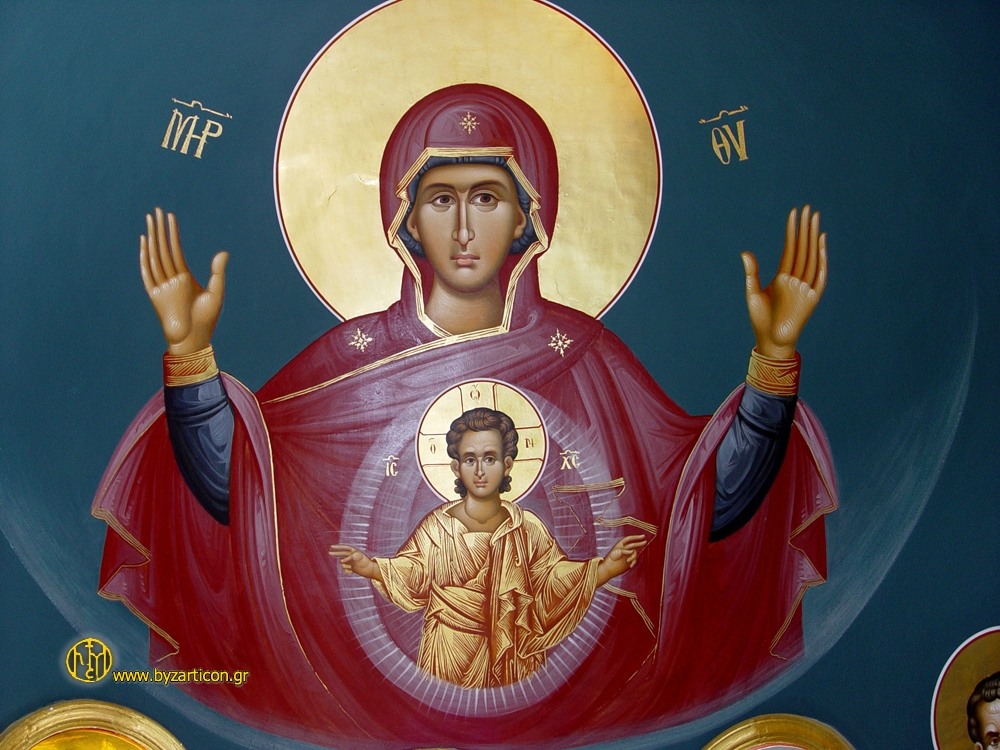
Today, both Latin (Roman Catholic) and Greek (Orthodox) Christians remember the falling asleep of the Mother of God.

THE_PLATYTERA_DETAIL-web

Using some of the terminology from our revivalist friends, Mary became the very first to accept Jesus as her personal Lord and Savior, and invited Him thus into her heart (which is exactly what the Platytera Icon shows).

Fr. Jonathan Tobias.

You cannot get any more “lifework” than a young virgin saying, in the Latin version, fiat mihi secundum verbum tuum, in response to the Archangel’s invitation.

* * * * *

You can read most of my more impromptu stuff at here. It should work in your RSS aggregator, like Feedly, should you want to make a habit of it.

I highly recommend blot.im as a crazy-easy alternative to Twitter (if you’re just looking to get your stuff “out there” and not pick fights).

Instrumentalizing God

For decades, I endured periodic sermons and political rants disguised as prayers. Because of who and where I was, and the few loose political affiliations I had, those sermons and rants almost all ranged from right to further right.

And because I thought God shouldn’t be instrumentalized and that prayer shouldn’t be pretext, I hated them, much as I hated “worship” that was really pep-talk-cum-pop-concert.

I’m pleased to report that who and where I am has changed, that my political affiliations are even fewer, and that it’s much better now. That’s a separate story.

I say all that to note this: A “letter to God” in the New York Times Opinion section. That letter struck me in places as being a left version of those pretextual prayers. But it’s not. Whatever its faults are, they seem outweighed by its merits, especially this week.

(Be it noted that George Yancy is not George Yancey.)

* * * * *

You can read most of my more impromptu stuff at here. It should work in your RSS aggregator, like Feedly, should you want to make a habit of it.

I highly recommend blot.im as a crazy-easy alternative to Twitter (if you’re just looking to get your stuff “out there” and not pick fights).

Sometimes, serendipity!

I blogged just yesterday, on the occasion of his death, about the odd metanarratives of “religion” Supreme Court Justice John Paul Stevens gratuitously spun in some of his religion clause opinions. I acknowledged (boasted?) that nobody else had noticed the falsity of his metanarrative.

And the response to yesterday’s blog seems to be that nobody noticed. Or they noticed and averted their eyes from my nakedness.

Today, in heat indices forecasted to reach 109° F and with a diagnosis of a torn ankle tendon requiring immobility, I decided to (among other things) catch up on some blogs I set aside because the author is always too substantive for a quick read.

And boy, was I ever rewarded! Sometimes, serendipity!

To appreciate why I was so delighted, you’ll need to go back to yesterday’s blog, painful though that may be, and see the parallels between what I wrote about what I called “integral Christianity” and what I found in The Struggle Against The Normal Life:

  • a better description of classical Christianity (I guess I was becoming a classical Christian long before I became one formally)
  • a contrast between it and modern Christianities (of the sort Justice Stevens had in mind),
  • acknowledgement that modern Christianities are ascendant, if facile and false, and
  • a call to the repentance and asceticism necessary to maintain classically Christian belief amid the hegemony of heterodoxy.

Excerpts (generous, but not exhaustive; this one needs to be read in full, then read again and again):

Within the Christianity of our time, the great spiritual conflict, unknown to almost all, is between a naturalistic/secular world of modernity and the sacramental world of classical Christianity. The first presumes that a literal take on the world is the most accurate. It tends to assume a closed system of cause and effect, ultimately explainable through science and manageable through technology. Modern Christians, quite innocently, accept this account of the world with the proviso that there is also a God who, on occasion, intervenes within this closed order. The naturalist unbeliever says, “Prove it.”

The sacramental world of classical Christianity speaks a wholly different language. It presumes that the world as we see it is an expression of a greater reality that is unseen. It presumes that everything is a continuing gift and a means of communion with the good God who created it. The meaning and purpose of things is found in that which is not seen, apart from which we can only reach false conclusions. The essential message of Christ, “The Kingdom of God is at hand,” is a proclamation of the primacy of this unseen world and its coming reign in the restoration of all things (apokatastasis, cf. Acts 3:21).

The assumptions of these two worldviews could hardly be more contradictory. The naturalistic/secular model has the advantage of sharing a worldview with contemporary culture. As such, it forms part of what most people would perceive as “common sense” and “normal.” Indeed, the larger portion of Christian believers within that model have no idea that any other Christian worldview exists.

The classical/sacramental worldview was the only Christian worldview for most of the centuries prior to the Reformation. Even then, that worldview was only displaced through revolution and state sponsorship. Nonetheless, the sacramental understanding continues within the life of the Orthodox Church, as well as many segments of Catholicism. Its abiding presence in the Scriptures guarantees that at least a suspicion of “something else” will haunt some modern Christian minds.

The classical model is, in fact, the teaching found in the Scriptures. It utterly rejects the notion of spiritual knowledge belonging to the same category as the naturalistic/secular world. It clearly understands that the truth of things is perceived only through the heart (nous) and that an inward change is required. It is impossible to encounter the truth and remain unchanged.

The classical model, particularly as found within Orthodoxy, demands repentance and asceticism as a normative part of the spiritual life. These actions do not earn a reward, but are an inherent part of the cleansing of the heart and the possibility of perceiving the truth.

The struggle between classical/sacramental Christianity and modernity (including its various Christianities) is not a battle over information. The heart of the struggle is for sacramental Christianity to simply remain faithful to what it is. That struggle is significant, simply for the fact that it takes place within a dominant culture that is largely its antithesis.

A complicating factor in this struggle is the fact that the dominant culture (naturalistic/secular) has taken up traditional Christian vocabulary and changed its meaning. This creates a situation in which classical Christianity is in constant need of defining and understanding its own language in contradistinction to the prevailing cultural mind. The most simple terms, “faith, belief, Baptism, Communion, icon, forgiveness, sin, repentance,” are among those things that have to be consistently re-defined. Every conversation outside a certain circle requires this effort, and, even within that circle, things are not always easy.

Such an effort might seem exhausting. The only position of relaxation within the culture is the effortless agreement with what the prevailing permutations tell us on any given day. Human instinct tends towards the effortless life – and the secular mentality constantly reassures us that only the effortless life is normal. Indeed, “normal, ordinary, common,” and such terms, are all words invented by modernity as a self-description. Such concepts are utterly absent from the world of Scripture. Oddly, no one lived a “normal” life until relatively recently.

That which is “normal” is nothing of the sort. It is the purblind self-assurance that all is well when nothing is well.

(Fr. Stephen Freeman, emphasis added)

So, among other (much more important) things, I should not be surprised that “the sacramental world of classical Christianity” was unknown to Justice Stevens, just as it is “unknown to almost all.”

This does nothing to relieve my concerns about his false metanarrative making its way into Supreme Court precedents. I can only hope that it’s seen as the obiter dicta that it is.

* * * * *

You can read most of my more impromptu stuff at here. It should work in your RSS aggregator, like Feedly, should you want to make a habit of it.

I highly recommend blot.im as a crazy-easy alternative to Twitter (if you’re just looking to get your stuff “out there” and not pick fights).