Things to think about after exhaling

Things to think about after exhaling

[Wendell] Berry often quotes Wes Jackson’s book Becoming Native to This Place in this regard. “The universities now offer only one serious major: upward mobility,” Jackson writes. “Little attention is paid to educating the young to return home, or to go some other place, and dig in. There is no such thing as a ‘homecoming’ major.

Mark T. Mitchell and Nathan Schlueter, The Human Vision of Wendell Berry


The tomb of Ignatius

Here I am not that Cleon celebrated
in Alexandria (where it is hard to astonish them)
for my magnificent houses, for the gardens,
for my horses and for my chariot,
for the jewels and silk that I wore.
God forbid; here I am not that Cleon;
let his 28 years be erased.
I am Ignatius, a reader, who came to my self
quite late; but I lived so for 10 months
happy in the serenity and security of Christ.

(C.P.) Cavafy


Over the years, I’ve bounced around the political spectrum. I was liberal in Texas, more conservative in college, and now I’m somewhere in the middle. Through it all, I saw politics as a fight between left and right. I don’t see it that way anymore. Donald Trump’s presidency has exposed a bigger threat: an all-out attack on the principle that facts must be respected. We used to take that principle for granted; now we must defend it. Politics has become a fight between those who are willing to respect evidence and those who aren’t.

Progressives and conservatives have always quarreled about what’s true. But to make those debates productive, and to correct our country’s mistakes—failed projects, naïve policies, bad wars—we need a common standard for judging truth. That standard can’t be the Bible or identity politics. It has to be the standard we apply in daily life: evidence. If you say the election was stolen, you have to prove it in court. If you accuse a police officer of murder, your story has to withstand investigation.

… Science has a culture of falsification.

Politics doesn’t. When political promises don’t pan out—wars turn into quagmires, public schools underperform, or tax cuts fail to pay for themselves—politicians invent excuses. This has always been a problem, but it’s getting worse. Trump and his acolytes don’t just spin facts; they completely disregard them. They repeat fantastic lies about election fraud, and when they’re confronted with contrary evidence, they’re not even embarrassed.
Advertisement

If we don’t get control of this—if we don’t reestablish an ethic of respect for facts—nothing else will be solved. We can’t extinguish the virus if tens of millions of Americans insist it’s a hoax and refuse to be vaccinated or wear masks. We can’t restore public faith in election results and put down insurrectionism if half the population refuses to believe anything the media report. Repairing the consensus that facts must be respected won’t settle our debates on spending, education, or criminal justice. But without that consensus, the crisis we’re in will get much worse.

Will Saletan, The Enemy Isn’t Republicans


Nevertheless, behind its variegated forms, each attuned to different challenges, are the timeless truths and principles at the heart of conservative ideology: (1) Humans are flawed creatures; (2) Reason is powerful but limited and prone to error; (3) Utopian thinking is dangerous, especially when combined with ideologies that promote concentrated political power; (4) Humans should respect tradition and custom; and (5) Intuition is an important guide to social policy. Modern Republicans, standing among the ruins of the Trump presidency, should turn to these principles, elaborated below, to rebuild a robust and unified coalition that can appeal to all ages and ethnicities.

Bo Wingard, A Return to Tradition: Creating a Post-Trump Conservatism – Quillette. It’s good to be reminded what conservatism is after four years of the term’s gross misuse.


Robby [George] pulled out his phone, then, and asked what I knew about Heinrich Heine. I knew the Nazis had burned his books, that he was a Jew who had converted to Christianity. That was about it.

In 1834, Robby told me, Heine wrote a prose poem that prophesied the evil that would swallow Europe a century later. He read it to the table:

> “Christianity — and that is its greatest merit — has somewhat mitigated that brutal Germanic love of war, but it could not destroy it. Should that subduing talisman, the cross, be shattered, the frenzied madness of the ancient warriors, that insane Berserk rage of which Nordic bards have spoken and sung so often, will once more burst into flame. This talisman is fragile, and the day will come when it will collapse miserably. Then the ancient stony gods will rise from the forgotten debris and rub the dust of a thousand years from their eyes, and finally Thor with his giant hammer will jump up and smash the Gothic cathedrals.”

Tears rolled down my face as he spoke these lines, as they do now as I re-read them:

> “Do not smile at the visionary who anticipates the same revolution in the realm of the visible as has taken place in the spiritual. Thought precedes action as lightning precedes thunder. German thunder is of true Germanic character; it is not very nimble, but rumbles along ponderously. Yet, it will come and when you hear a crashing such as never before has been heard in the world’s history, then you know that the German thunderbolt has fallen at last. At that uproar the eagles of the air will drop dead, and lions in the remotest deserts of Africa will hide in their royal dens. A play will be performed in Germany which will make the French Revolution look like an innocent idyll.”

The Great Unraveling – Common Sense with Bari Weiss.

Yes, Bari Weiss has started a Substack blog (how soon until we just call them “substacks”? Maybe it’s here already?)

Did you eat popcorn?

(I want to stop thinking about 45. I also want nothing like him ever to happen to my country again, so I do “go on a bit.”)

“You have to show strength,” you said,
“and you have to be strong.”
You promised to go with them
but chose instead to view the destruction on TV.
I wondered if you understood
that the violence that unfolded was real,
and not something made for television.
Did you order Cokes as you watched?
Did you eat popcorn?

Michael D’Antonio, A Goodbye Letter for the Anti-President, reformatted by Tipsy as poetry.


I’m not a big fan of Nina Totenberg (she is incapable of balanced coverage on some issues), but her Biden’s Solicitor General Faces Tough Choices On Trump Supreme Court Positions was a genuinely interesting account of what happens to a successor when a POTUS shatters norms and suborns frivolous arguments from his Justice Department.


For Trump supporters, I would recommend reading the entire post-January 6 debriefing of four Trump biographers by Michael Kruse in Politico, and internalizing that Trump is a con man who conned you big time:

Kruse: … I’m curious: Do you think November 8, 2016, will in the end be the best thing that ever happen to Donald Trump, or the worst?

Tim O’Brien: Both. It’s both the best and the worst. He’s such an egomaniac and so needy for the spotlight that he got the biggest platform in the world in the presidency to fill his need for attention, constant attention, and the media spotlight. And because he’s that damaged and needy he courts these things but then he gets exposed for who he is. And I think he’s permanently sullied his family’s name with at least half the population of the United States, if not more, and it’s historically dark things that they’re going to be associated with—an insurrection, programmatic racism, thuggery, and a real, I think, defaming of the presidency, unlike any other president. And I don’t think he foresaw that … He’s just Mr. Id. And he’s constantly trying to get gratification. He doesn’t care about the consequences. And then they blow up all around him. And so his election as president was both, I think, the best and the worst thing that ever happened to him.

Kruse: Is he capable of some sort of honest personal reckoning …?

[Harry] Hurt: No.

[Gwenda] Blair: No.

[Michael] D’Antonio: No.

[Tim] O’Brien: No way.

Kruse: So there is no …

Hurt: No.

O’Brien: No.

Blair: No.

Hurt: Next question.

‘He Was the Ringmaster in the Demise of His Own Circus’ – POLITICO Subtitle: On the eve of Donald Trump’s exit from power, four biographers who studied him up close reflect on what he wrought on the country. And what he’ll do next.


Phil Vischer, creator of the Christian cartoon series “VeggieTales,” once employed Metaxas as a writer and has known him for years.

“At some point,” he told Religion News Service in an email, “Eric went from idolizing people like Os Guinness to idolizing Ann Coulter and Tucker Carlson — right wing political firebrands who live to ‘own the libs.’ I think there’s an adrenaline rush or dopamine hit from engaging in full-fledged culture wars that otherwise thoughtful souls on both sides of the political spectrum can find intoxicating. For some, life is worth living only when ‘the soul of America’ is at stake. So the soul of America is ALWAYS at stake.”

Belmont University professor David Dark, who has appeared on Metaxas’ radio show in the past, said that Metaxas may be influenced by the financial opportunity of the Trump cause. You can make a living appealing to an evangelical Christian audience, Dark said, but only if you give them what they want — in this case, support for Trump.

“I think that the market he has appealed to has gotten narrower and narrower,” he said.

A Greek Orthodox in his youth, he became an evangelical in his 20s and has since believed in personal revelation and signs from God. In a conversion story he recounted in Christianity Today magazine and in “Fish Out of Water,” an autobiography about faith due out in February, he tells of seeing a golden Jesus fish in a dream.

In the autobiography, Metaxas also lists a whole series of miracles and messages from God — including one from a turtle in Central Park — on topics from 9/11 to his rise from obscurity to fame.

How Eric Metaxas went from Trump despiser to true believer (emphasis added)

So did the “golden Jesus fish” tell apostate Metaxas that Trump was his man?

Welcoming 46 with open — ummmm — adulation

Spin is ubiquitous in modern politics. There is nothing new or shocking about it. Yet it is both noteworthy and troubling just how quickly CNN flipped from treating the previous president like a hostile occupying power to uncritically publicizing the brand-new administration’s efforts to cut itself maximal slack. If the media has any hope at all of improving on its image and reversing the collapsing trust of readers and viewers, it will have to do better than this.

The point is not to try and convince the most hostile Republicans to tune back into mainstream media outlets. Many of them are unreachable by this point, showing less interest in doing or seeking out better reporting than in using accusations of double standards and hypocrisy to help build support for the right and attempt to tear down liberal institutions. Some go even further, to use the failings of professional journalism as a justification for pedaling deliberate distortions on alternative platforms. Those who take this position view all so-called news as a form of propaganda or information warfare and defend the deliberate promulgation of lies as a tit-for-tat response to the actions of their enemies: “If the left does it, then so should we, and with even less restraint.”

But there are plenty of Americans situated between the burn-it-all-down hyper-cynical right and the journalists and Democratic Party politicos who naively or enthusiastically passed around the CNN story last week. Whether the right succeeds in persuading more and more people to join them in tuning out mainstream journalism will depend in large part on whether its accusations of dishonesty and bad faith look accurate to observers. Does the media seem fair-minded and scrupulous in what it labels news? Or does it seem highly invested in enhancing the power of one side in our country’s deep political divide?

Damon Linker, The media has to do better than this


Kamala Harris literally swore on a stack of Bibles to uphold the Constitution. I think that means it will be doubleplusbad when she discards the Constitution for partisan purposes, as every administration seems to do eventually.

The usual postscript

Out of the crooked timber of humanity no straight thing was ever made.

Immanuel Kant, Idea for a Universal History with a Cosmopolitan Purpose

You shall love your crooked neighbour
With your crooked heart.

W.H. Auden, As I Walked Out One Evening

The worst judge of all is the man now most ready with his judgements; the ill-educated Christian turning gradually into the ill-tempered agnostic, entangled in the end of a feud of which he never understood the beginning, blighted with a sort of hereditary boredom with he knows not what, and already weary of hearing what he has never heard.

G.K. Chesterton, The Everlasting Man (PDF)

You can read most of my more impromptu stuff here or join me and others on micro.blog. You won’t find me on Facebook any more, and I don’t post on Twitter (though I do have an account for occasional gawking).
How to deal with two conservative problems

David Hines takes a stab at answering How Do You Solve a Problem Like QAnon? | The American Conservative, and it was one of the better things I’ve read today if only because it doesn’t suggest that Q adherents aren’t wicked racists or antisemites that just need to be made dead. Indeed, without sugar-coating the problem, has has what seems a sensible solution that wouldn’t even be all that difficult to implement:

Not to put too fine a point on it, Righties have a weakness for believing stupid shit.

We’re not the only ones … But nobody on the left is as enthusiastic as deeply or as long about stupid shit as are people on the Right. When Lefties do employ stupid shit, such as gleeful pee tape rumors, the origins are typically elite Lefty circles. Our stupid shit comes from the base, tends toward the wildly implausible, and of late tends to promise imminent glory on earth: the end of a story, in which we win.

This divide exists because Left and Right are different outlooks and different cultures. Accordingly, Lefties have a different failure mode than we do. The failure mode of right-wing is kook. The failure mode of left-wing is puritan …

The central fantasy of QAnon isn’t adrenochrome, or cannibal cults, or mole children, or any of the myriad lunacies of the outlandish dystopia it presents. The central fantasy is the idea that things will be better because somebody is going to do something.

Any attempt to rein in Righty conspiracy theorists and make them actually useful will have to consider their actual interests and aptitudes. And they have them. Many of them are backbone-of-America types: they have jobs, have family lives, and are actively engaged in their communities in various ways. They turn out to events and meetings. They’re genuinely enthusiastic. They’re hard workers. They’re curious about the world and passionate to make a difference in it. They are genuinely interested in learning about things that aren’t immediately obvious. It’s just that they learn them from random YouTube videos because they don’t know how to use PACER to find court records, or how to file FOIA applications to get government documents, or how to look up Form 990s to learn about how nonprofits are organized and funded.

The Righty base desperately wants to do something, but doesn’t know how. And that’s because the elites don’t want it to learn. The root of our real problem on the Right is that elites and the base want different things. So elites don’t train the base in how to actually produce change. QAnon is what you get when a naïve, untrained base tries to fill that vacuum. What they fill the vacuum with is a story where somebody is doing something, and the end of the story is a great big WE WIN.

… It’s often noted that the Right has a surfeit of pundits; what we lack are diggers, the dedicated researchers who do the boring work of poring through documents to find news. But maybe we’ve had them all along — they’re just naive and untrained. What if we trained them, empowered them, and turned them loose?

People turn to conspiracy theories to explain a world they can’t understand. Giving them the tools to explore the real world could keep them more grounded — and turn up some interesting things for the rest of us.


For the senators who will try the impeachment, a thought: It’s time to demystify Donald Trump. He leaves the presidency disgraced. He is a diminishing asset: postpresidential power always wanes, and will especially in this case …

In running in fear from him you are running from a corpse. And you’ll never be safe anyway. Something wild has been let loose. So be brave. The Democrats want you tied to Mr. Trump forever. Stop, now.

Peggy Noonan, Liz Cheney Shows What Leadership Looks Like – Peggy Noonan (January 14)


Out of the crooked timber of humanity no straight thing was ever made.

Immanuel Kant, Idea for a Universal History with a Cosmopolitan Purpose

You shall love your crooked neighbour
With your crooked heart.

W.H. Auden, As I Walked Out One Evening

The worst judge of all is the man now most ready with his judgements; the ill-educated Christian turning gradually into the ill-tempered agnostic, entangled in the end of a feud of which he never understood the beginning, blighted with a sort of hereditary boredom with he knows not what, and already weary of hearing what he has never heard.

G.K. Chesterton, The Everlasting Man (PDF)

You can read most of my more impromptu stuff here or join me and others on micro.blog. You won’t find me on Facebook any more, and I don’t post on Twitter (though I do have an account for occasional gawking).

Church and State, but not Church/State

Where religion and politics meet

David French is not happy with his co-religionists, who he provincially calls “the Church”:

… core biblical values are contingent, but support for Donald Trump is not …

We’re way, way past concerns for the church’s “public witness.” We’re way past concerns over whether the “reputation” of the church will survive this wave of insanity. There is no other way to say this. A significant movement of American Christians—encouraged by the president himself—is now directly threatening the rule of law, the Constitution, and the peace and unity of the American republic.

It’s clear now that when many of those people declared Trump to be “God’s anointed” they did not mean that his presidency was “instituted by God” in the same manner as other governing authorities, as described in Romans 13. (By conventional Christian reasoning, Joe Biden’s upcoming presidency is also instituted by God.)

No, they believe that Trump had a special purpose and a special calling, and that this election defeat is nothing less than a manifestation of a Satanic effort to disrupt God’s plan for this nation. They were not “holding their nose” to support him. They were deeply, spiritually, and personally invested in his political success.

We know that mainstream American Christian leaders can unite to condemn secular and progressive movements and ideas they find biblically problematic. For example, late last month the presidents of Southern Baptist seminaries united to declare that “affirmation of Critical Race Theory, Intersectionality and any version of Critical Theory is incompatible with the Baptist Faith & Message.”

As I’ve written, critical race theory has its uses and its flaws, but I wonder—how many critical race theorists are in conservative Christian pews? But how many more election conspiracy theorists and Christian nationalists are sitting right there, including in my own denomination, fervently believing lies and fervently praying for actions and outcomes that are fundamentally unjust?

Simply put, there should be at least as much concern about injustice and sin from the religious right as from the secular left.

David French, The Dangerous Idolatry of Christian Trumpism

French’s column (along with Damon Linker’s gimlet-eyed identification of Trump as “demonic”) has me musing about whether Donald Trump qualifies for the title “AntiChrist” according to the standards of those who obsess over identifying AntiChrist.

And French’s labeling of Christianish Trumpists as part of “the church” reinforces my skepticism about Evangelical ecclesiology (French is Evangelical or at least Evangelical-adjacent; I think he’d choose the former) — about the possibility of Christ’s Church being so expansive as to take in delusional political freaks whose main interest in Christ seems to be His political utility.

Sigh! It’s none of my business to stake out the boundaries of the Church, but I can understand the reflex “if this is Christianity, I want no part of it.” I wish I could say “this is not, in any sense, Christianity,” but I can’t. I can (and do below) say something else that’s just as decisive for me.


Evangelicalism has figured out how to avoid the numerical decline besetting many religions: become so identified with Republican politics that people whose Lord and Savior is the GOP will self-identify as “Evangelical,” albeit without darkening the doors of church. For instance,

for 2008, 2012, and 2016 low attending evangelicals all start in basically the same spot – 35–40% conservative. But look at the solid pink line representing the data from 2019. Nearly half of self-identified evangelicals who never go to church identified as conservative (a jump of basically ten points).

the most religiously devout evangelical in 2019 is a bit less likely to be conservative than a devout evangelical from 2008.

Ryan P. Burge, So, Why is Evangelicalism Not Declining? Because Non-Attenders Are Taking On the Label (Religion in Public).

Burge, by the way, is becoming huge in social scientific scrutiny of American religion.


I left frank Evangelicalism in my late 20s over the issue of dispensationalism, which I perceived as so pervasive as to almost define Evangelicalism. (I left basically as soon as I discovered that my skepticism about dispensationalist prophecy porn — “Rapture crap” — was shared by others, serious Calvinists, who were not compromising with unbelief.)

At age 49, I was Orthodox, no longer Calvinist, and thus not even “Evangelical-adjacent.”

So I cannot begin to persuade Evangelical Trumpists to repent their folly.

So why do I rail against them as if I could change their minds?

Partly because I persist in the increasingly-implausible instinct that some of them are sane and sincere. But probably a bigger part is performative: I want the world to know that I am not an Evangelical, that Evangelicalsm is well out of the historic Christian mainstream (in its prophecy obsession, yes, but more in its rejection of liturgy and sacrament), and that disgust with Evangelicalism (and Roman Catholic clergy sexual abuse, for that matter) does not necessitate rejection of Christianity or adoption of some sort of me-and-Jesus-who-needs-Church delusion.

I other words, when all else fails, consider Orthodoxy. If there’s no Orthodox Church nearby, that’s curable in many cases.


I include this from Evangelical-leaning Anglican Alan Jacobs because he identifies an ascendant Evangelical vice:

There is no infallible means for discerning when a religious believer has been spoken to, directly and personally, by God. However, there is a reliable way to disconfirm such a claim. When a person demands that other people immediately accept that he has been spoken to by God, and treats with insult and contempt those who do not acknowledge his claim to unique revelation, then we can be sure that no genuine message has been received, and that the voice echoing in that person’s mind is not that of God but that of his own ego.

Alan Jacobs again, testing the spirits.

I suspect this has to do with Saturday’s “Jericho Marches,” which started with some guy who claimed that God told him to do it. I don’t recall whether he claimed that God told him that all Real Christians® must join him.


Evangelicals aren’t the only ones mucking about in political matters.

With America facing a bitterly divisive election, Episcopal Church leaders did what they do in tense times — they held a National Cathedral service rallying the Washington, D.C., establishment.

This online “Holding onto Hope” service featured a Sikh filmmaker, a female rabbi from Chicago, the Islamic Society of North America’s former interfaith relations director, the female presiding bishop of the Evangelical Lutheran Church in America, a Jesuit priest known for promoting LGBTQ tolerance and former Secretary of State Condoleezza Rice.

“Our ideals, values, principles and dreams of beloved community matter,” said Episcopal Presiding Bishop Michael Curry, the church’s first African-American leader. “They matter to our life as a nation and as a world. Our values matter!”

This was the kind of rite – think National Public Radio at prayer – a church can offer when its history includes 11 U.S. presidents and countless legislators and judges from coast to coast.

Continuing its recent trends, “relevance” isn’t working for the ECUSA much better in 2020 than in other recent decades — witness the title Terrifying statistics from 2019 offer another Groundhog Day jolt for Episcopalians — GetReligion

Law and politics, straight up

When conservatives defend their fight to overturn the election as an answer to the way Democrats reacted to Donald Trump’s victory in 2016, they are correct in the sense that most of their arguments and proposed tactics have antecedents on the liberal side …

The difference, though, is that the right’s fantasy has been embraced from the start by a Republican president (Hillary Clinton was a follower rather than a leader in calling Trump “illegitimate”), and it has penetrated much faster and further into the apparatus of Republican politics. In January 2017, only a handful of Democratic backbenchers objected to Congress’s certification of Trump’s election. But you can find the name of the House minority leader, Kevin McCarthy, on a brief supporting the ridiculous Texas lawsuit.

The Texas lawsuit didn’t torch any city blocks, but all those congressional signatures on the amicus brief did make it feel like something more than just another meme. The crucial question it raises is whether people can be fed on fantasies forever — or whether once enough politicians have endorsed dreampolitik, the pressure to make the dream into reality will inexorably build.

Ross Douthat, The Texas Lawsuit and the Age of Dreampolitik


On Saturday, a federal district court judge in Wisconsin issued an opinion explaining why, on the merits, Texas’s substantive arguments were without merit. And, as occurred on the Supreme Court, a judge appointed by President Trump, Brett Ludwig, ruled against him.

Some Trump supporters are inclined to suggest the campaign’s court losses are the result of progressive judicial activism or #Resistance judging. This is nonsense. Dozens of election suits have been filed, and dozens of judges of all political stripes and judicial philosophies have ruled against the claims put forward by the Trump campaign and its allies. In this case, the opinion was written by a judge appointed by President Trump in September. Trump and his allies claim they want their legal claims heard by judges who will apply the law. They have been.

Jonathan Adler, Another Court Loss for Trump Campaign in Wisconsin


Out of the crooked timber of humanity no straight thing was ever made.

Immanuel Kant

You shall love your crooked neighbour
With your crooked heart.

W.H. Auden

The worst judge of all is the man now most ready with his judgements; the ill-educated Christian turning gradually into the ill-tempered agnostic, entangled in the end of a feud of which he never understood the beginning, blighted with a sort of hereditary boredom with he knows not what, and already weary of hearing what he has never heard.

G.K. Chesterton, The Everlasting Man

You can read most of my more impromptu stuff here or join me and others on micro.blog. You won’t find me on Facebook any more, and I don’t post on Twitter (though I do have an account for occasional gawking).

Amusing Ourselves to Death

In 1985, Neil Postman published, to immediate critical acclaim, Amusing Ourselves to Death. For some reason, I did not read it at the time, but it has endured if not grown in value — so say all my friends in cyberspace (about which more later) — so I read it Tuesday and Wednesday of this week.

I would be remiss if I didn’t share some highlights with you, or if I shared all my highlights (though that is technically easier to do), because phrases I found arresting in context might well be boring in isolation. So here goes.

First, Postman is at great pains to distance himself from the Luddites. He acknowledges major communicative changes in the past, with some of what was lost and gained in each, before exploring how television is toxically different.

  • Regarding the Commandment against idols, “The God of the Jews was to exist in the Word and through the Word, an unprecedented conception requiring the highest order of abstract thinking.”
  • “Although one would not know it from consulting various recent proposals on how to mend the educational system, this point — that reading books and watching television differ entirely in what they imply about learning — is the primary educational issue in America today. America is, in fact, the leading case in point of what may be thought of as the third great crisis of Western education. The first occurred in the fifth century BC, when Athens underwent change from an oral culture to an alphabet-writing culture. To understand what this meant, we must read Plato. The second occurred in the 16th century when Europe underwent a radical transformation as a result of the printing press. To understand what this meant, we must read John Locke. The third is happening now, in America, as a result of electronic revolution, particularly the invention of television. To understand what this means, we must read Marshall McLuhan.”
  • “Each medium, like language itself, makes possible a unique mode of discourse by providing a new orientation for thought, for expression, for sensibility. Which, of course, is what McLuhan meant in saying that the medium is the message. His aphorism, however, is in need of amendment because, as it stands, it may lead one to confuse a message with a metaphor. A message denotes a specific, concrete statement about the world. But the forms of our media, including the symbols to which they permit conversation, do not make such statements. They are rather like metaphors, working by unobtrusive but powerful implication to enforce their special definitions of reality.”
  • “It is my intention in this book to show a great media-metaphor shift has taken place in America, with the result that the content of much of our public discourse has become dangerous nonsense.”
  • “[W]e do not measure a culture by its output of undisguised trivialities, but by what it claims as significant. Therein is our problem, for television is at its most trivial and, therefore, most dangerous when its aspirations are high, when it presents itself as a carrier of important cultural conversations.”

There were waystations en route to television land, telegraphy featuring prominently (perhaps as synecdoche), for its obliteration of distance:

  • “Telegraphy … destroyed the prevailing definition of information, and in doing so gave a new meaning to public discourse. Among the few who understood this consequence was Henry David Thoreau, who remarked in Walden that ‘We are in great haste to construct a magnetic telegraph from Maine to Texas; but Maine and Texas, it may be, have nothing important to communicate.… We are eager to tunnel under the Atlantic and bring the old world some weeks nearer to the new; but perchance the first news that will leak through the end of the broad flapping American ear will be that Princess Adelaide has the whooping cough.’ … Only four years after Morse opened the nation’s first telegraph line on May 24, 1844, the Associated Press was founded, and news from nowhere, addressed to no one in particular, began to crisscrossing the nation. Wars, crimes, crashes, fires, floods — much of it the social and political equivalent of Adelaide’s whooping cough — became the content of what people called ‘the news of the day.'”

Now that we’re in television land, Postman also is insistent about not floating conspiracy theories about commies or lizard people deliberately using TV to make us stupid. For instance:

  • “The single most important fact about television is that people watch it. Which is why it is called “television.” And what they watch, and like to watch, are moving pictures — millions of them, of short duration and dynamic variety. It is in the nature of the medium that it must suppress the contact of ideas in order to accommodate the requirements of visual interest; that is to say, to accommodate the values of show business.”
  • “What is happening here is the television is altering the meaning of “being informed” by creating a species of information that might properly be called disinformation. I am using this word almost in the precise sense in which it is used by spies in the CIA or KGB. This information does not mean false information. It means misleading information — misplaced, irrelevant, fragmented or superficial information — information that creates the illusion of knowing something but which in fact leads one away from knowing. In saying this, I did not mean to imply that television news deliberately aims to deprive Americans have a coherent, contextual understanding of their world. I mean to say this when the news is packaged as entertainment, that is the inevitable result.”

It is a commonplace in Evangelical Protestantism that mediums (I know the plural is properly “media,” but that has accumulated distracting connotations) are neutral. Christianity being something I care about very much, Postman’s Chapter Shuffle off to Bethlehem really hit me:

Though it may be unAmerican to say it, not everything is televisible. Or to put it more precisely, what is televised is transformed from what it was into something else, which may or may not preserve its former essence. For the most part, television preachers have not seriously addressed this matter. They have assumed that what had formally been done at a church or a tent, and face-to-face, can be done on television without loss of meaning, without changing the quality of the religious experience. Perhaps their failure to address the translation issue has its origin in the hubris engendered by the dazzling number of people to whom the television gives them access.
“Television,“ Billy Graham has written, “is the most powerful tool of communication ever devised by man. Each of my primetime specials is now carried by nearly 300 stations across the US and Canada, so that in a single telecast I preach to millions more than Christ did in his lifetime.“ To this, Pat Robertson adds: “To say that the church shouldn’t be involved with television is utter folly. The needs are the same, the message is the same, but the delivery can change.… It would be folly for the church not to get involved with the most formative force in America.“
This is gross technological naïveté. If the delivery is not the same, then the message, quite likely, is not the same. And if the context in which the messages experienced is altogether different from what it was in Jesus’ time, we may assume that it’s social and psychological meaning is different as well.

I believe that I am not mistaken in saying that Christianity is a demanding and serious religion. When it is delivered as easy and amusing, it is another kind of religion altogether.

I’ve long not been a fan of televangelists, but I hadn’t thought it through as Postman did. I can’t even say “Aha! He put my intuition into words!”, as I so often feel, because I tacitly bought the idea that mediums are neutral. Maybe the single most important lesson of this book, for me if not for everyone, is that “neutral medium” is rubbish.

And I should have known better all along. Every sick-Sunday or Covidtide streamed Divine Liturgy screamed at me “I am inadequate!” Each was inadequate as “television” and as Christian worship. Every medium shapes all messages it mediates.

To a slightly lesser extent, I care about education. Postman sets forth three commandments of televised education, which I distill:

The three Commandments that form the philosophy of the education which television offers:
– Thou shalt have no prerequisites.
– Thou shalt induce no perplexity.
– Thou shalt avoid exposition like the ten plagues visited upon Egypt.
The name we may properly give to an education without prerequisites, perplexity and exposition is entertainment.

Postman’s concluding chapter not only brings back a lot of stuff for a curtain call, but summarizes colorfully:

An Orwellian world is much easier to recognize, and to oppose, than a Huxleyan. Everything in our background has prepared us to know and resist the prison when the gates begin to close around us. We are not likely, for example, to be indifferent to the voices of the Sakharovs and the Timmermans and the Walesas. We take arms against such a sea of troubles, buttressed by the spirit of Milton, Bacon, Voltaire, Göethe and Jefferson. But what if there are no cries of anguish to be heard? Who is prepared to take arms against a sea of amusement. To whom do we complain, and when, and in what tone of voice, when serious discourse dissolves into giggles? What is the antidote to a culture’s being drained by laughter?

What I suggest here is a solution is what all does Huxley suggested as well. And I can do no better than he. He believed with H.G. Wells that we are in a race between education and disaster, and he wrote continuously about the necessity of our understanding the politics and epistemology of media. For in the end, he was trying to tell us that what afflicted the people in brave New World was not that they were laughing instead of thinking, but that they did not know what they were laughing about and why they had stopped thinking.

Now for a bit of critique.

Television is still with us, but with a fourth broadcast network (Fox, which I recall being announced on NPR in April 1988 — recalled because (a) I was driving a rented Camry around San Francisco and down Highway 1, and (b) I thought it was a stupid idea for which Rupert Murdoch would pay dearly) and countless cable offerings. I don’t think this changes anything. The news is as stupid or stupider than ever, and has us broken into tribes to boot. So much for a peaceful Huxleyan world — and for my ability to spot a good money-making idea when I see it.

But we also can control television, which means relying on it for entertainment — which is all it’s good for — and nothing else. We can only do it at the family level, though, which means we still swim in polluted waters when we step out into the work-world.

Computers, however, Postman underestimated — perhaps because he did not foresee the “technology” of ARPANET expanding to the public and becoming virtually its own “medium.” I am aware of its potential for harm, pornography having become ubiquitous, for instance (and the emergence of “ethically-source porn” and the happy “sex workers” to replace unhappy, exploited “prostitutes”, both to make sensitive wankers feel better about their vice), but I dare say, from personal experience and experiment, that it is concurrently a great power for good. I have Anglophone “friends” around the world as a result, for instance.

Dare I say that the world awaits a treatment of the internet equal in stature to Postman’s treatment of television? Or perhaps it’s here and I just haven’t read it. There are definitely efforts being made to write it.


Out of the crooked timber of humanity no straight thing was ever made.

Immanuel Kant

You shall love your crooked neighbour
With your crooked heart.

W.H. Auden, As I Walked Out One Evening, November 1937

The worst judge of all is the man now most ready with his judgements; the ill-educated Christian turning gradually into the ill-tempered agnostic, entangled in the end of a feud of which he never understood the beginning, blighted with a sort of hereditary boredom with he knows not what, and already weary of hearing what he has never heard.

G.K. Chesterton, The Everlasting Man

You can read most of my more impromptu stuff here or join me and others on micro.blog. You won’t find me on Facebook any more, and I don’t post on Twitter (though I do have an account for occasional gawking).

Brave New World and its enemies

COME AND TAKE MY TURKEY, Ted Cruz exclaimed in one of the most asinine tweets ever shared on a platform that specializes in asininity. Dan Crenshaw said that Thanksgiving COVID restrictions should be met with organized resistance from individuals and businesses that feel unfairly oppressed. Rep. Lee Zeldin (R-N.Y.) echoed this call to flout the law, applauding a sheriff who is choosing not to enforce it. Rep. Chip Roy (R-Texas) wanted to prove that he could put on his big-boy pants by himself this year, saying “I will do whatever I want on Thanksgiving.”

Well here’s the deal, Chip and Lee and Dan and Ted: We all want to do what we want this Thanksgiving. But one thing that most people have learned by the time they are adults is that they don’t get to do whatever they want whenever they want. And this year, we are in the middle of a fucking pandemic that has killed over 260,000 people and is once again starting to overwhelm hospitals around the country, so our wants and desires conflict with the broader interests of our nation. It’s a concept that grown men would understand.

There’s No War on Thanksgiving – The Bulwark


[Aaron] said that he and his wife don’t allow their children to have smartphone access, and are criticized for it by others in their community. It’s as if the adults have decided among themselves that protecting their children from the basilisk is too hard, so they’ve agreed, however subconsciously, to shame any parents who don’t surrender.

Aaron told me that he is grateful to this blog for many things. One thing he said stuck with me: that it reminds him that he is not crazy, that the things he sees really are happening, that he is a sane man in a world gone mad.

Rod Dreher, A Sane Man In A World Gone Mad


What happens when Biden reaches the White House? That’s a doctrinal, as well as political, question. The debate centers, in part, on a Catholic Catechism statement: “Formal cooperation in an abortion constitutes a grave offense.”

“Grave” is a crucial term, since Catholic Canon Law states that those who are “obstinately persevering in manifest grave sin are not to be admitted to holy communion.”

The current Catholic leader in Washington, D.C., is Archbishop Wilton Gregory, who on Nov. 28th will become the first African-American cardinal. He told Catholic News Service that Biden received communion during his years as vice president and, “I’m not going to veer from that.”

Gregory pledged to maintain a dialogue in which “we can discover areas where we can cooperate that reflect the social teachings of the church, knowing full well that there are some areas where we won’t agree.”

Biden and the US bishops: Compromise crafted by ‘Uncle Ted’ McCarrick still in place — GetReligion

Parody

Wilton D. Gregory, the new cardinal-designate of Washington, D.C. said he would not prevent Joseph Biden, the Catholic president-presumptive who promotes abortion, from receiving Communion in the archdiocese.

“Hey, I’m a bureaucrat,” said the cardinal-designate. “It’s not as though I were a shepherd of souls or anything. If the gentleman is in peril of damnation, it’s no skin off my nose.” A twinkle in his eye, he added “We call that being pastoral.”

The cardinal-designate continued, “I don’t highlight one issue or another. It’s no different than if he supported, say, infanticide or the sexual abuse of minors.” He said that disagreements about such things as are part of “being a family, a family of faith.”

“Informed Catholics won’t be confused,” he asserted. “They’re smart. They don’t need me to tell them what the Church teaches.” When the interviewer asked about canon law, which specifies that anyone who facilitates abortion automatically incurs excommunication latae sententiae (just by the fact of doing so), the cardinal-designate replied “See? Like I said. You knew that already.”

The cardinal-designate declared, “The difficulty is that too many people want to call some Catholics unfaithful just because they discredit the faith of the Church. Like the Pope says, who am I to judge?”

“Besides,” he concluded, “non-Catholics and uninformed Catholics will respect the Church more if it doesn’t stand for anything.”

(See: In Washington, With New President, Cardinal-Designate Hopes For Dialogue)

J. Budziszewski, Parody: Cardinal-Designate Hopes for Dialogue with President-Presumptive | http://undergroundthomist.com


I just re-read Brave New World, which I consider a far more prescient dystopia than 1984.

It must have been decades since I last read it — time goes fast at my age — because I remembered so little of it. For instance, I did not remember the story of Linda and John — a big omission — or the Fordian Mass, a Neo-pagan mash-up of eucharistic worship and orgy.

In the revelatory meeting of the Savage and his fordship Mustapha Mond, I found again and again intimations of contemporary arguments I’ve read recently. Our society doesn’t look much like Huxley’s in many ways, but there are a few similarities.

“Have you read it too?” he asked. “I thought nobody knew about that book here, in England.” “Almost nobody. I’m one of the very few. It’s prohibited, you see. But as I make the laws here, I can also break them … “But why is it prohibited?” asked the Savage. In the excitement of meeting a man who had read Shakespeare he had momentarily forgotten everything else. The Controller shrugged his shoulders. “Because it’s old; that’s the chief reason. We haven’t any use for old things here.” “Even when they’re beautiful?” “Particularly when they’re beautiful. Beauty’s attractive, and we don’t want people to be attracted by old things. We want them to like the new ones.” “But the new ones are so stupid and horrible. Those plays, where there’s nothing but helicopters flying about and you feel the people kissing.” He made a grimace. “Goats and monkeys!” Only in Othello’s words could he find an adequate vehicle for his contempt and hatred.

The Savage was silent for a little. “All the same,” he insisted obstinately, “Othello’s good, Othello’s better than those feelies.” “Of course it is,” the Controller agreed. “But that’s the price we have to pay for stability. You’ve got to choose between happiness and what people used to call high art. We’ve sacrificed the high art. We have the feelies and the scent organ instead.” “But they don’t mean anything.” “They mean themselves; they mean a lot of agreeable sensations to the audience.” “But they’re . . . they’re told by an idiot.”


Even more than its dramatic and mystical worship, Orthodoxy is most at odds with this world in its fasts. The fundamental orientation of our modern Western world is: more, faster. There are left-wing versions of this and right-wing versions of this, and you can find them within plenty of churches. My own biases — in both my convictions and my instincts — pull me to the right, which means that I tend to be moralistic and intellectual in my Christianity. There is nothing wrong with having strong morals and cultivating the mind, but Christianity cannot be summed up in either a moral code or a philosophy (though there is a Christian moral code, and there are Christian approaches to philosophy). But that is not the whole of the Christian life and calling …

Similarly for those Christians whose biases draw them to what we identify as the political left, it is good to stand up for the weak (as Christ did), and to bring skepticism to the way we apply traditional moral codes (as Christ did, for example, when he challenged the mob about to stone the adulteress). But if we make idols of the weak and oppressed, forgetting that they too are sinners in need of a life-transforming encounter with the Word Made Flesh, or if we forget that Christ did not negate the Law, but rather fulfilled it, then we will fall short of the harmony to which we are all called.

So much of our religious anxiety is really about having to figure out how we can avoid doing the things we know we must, while still being obedient to God. We become religious minimalists, giving God only as much as we need to do to appease him, while keeping as much as we can for ourselves. This, as opposed to desiring as God himself desires. This, as opposed to living in reality.

Reconciling With The Really Real


Out of the crooked timber of humanity no straight thing was ever made.

Immanuel Kant

You shall love your crooked neighbour
With your crooked heart.

W.H. Auden

The worst judge of all is the man now most ready with his judgements; the ill-educated Christian turning gradually into the ill-tempered agnostic, entangled in the end of a feud of which he never understood the beginning, blighted with a sort of hereditary boredom with he knows not what, and already weary of hearing what he has never heard.

G.K. Chesterton

You can read most of my more impromptu stuff here or join me and others on micro.blog. You won’t find me on Facebook any more, and I don’t post on Twitter (though I do have an account for occasional gawking).

Election, Justices and Sanity

The Election

From “Our choice is Joe Biden*,” an editorial in the New Hampshire Union Leader, Oct. 25:

> Our endorsement for President of these United States goes to Joe Biden.
>
> While Joe Biden is the clear choice for president, it would be a disservice to the country to send him to the White House without a backstop. We suggest splitting the ballot and electing a healthy dose of GOP senators and representatives. The best governance often comes through compromise. The civility of the Biden administration will help foster such compromise, but a blue wave would be nearly as disastrous for this country as four more years of Trump. It would result in a quagmire of big government programs that will take decades to overcome.

Notable & Quotable: A Footnote to a Biden Endorsement – WSJ

Yes, I agree, but I don’t think for a moment that’s what will happen next Tuesday.


For the people closest to me in terms of education (graduate degree), socioeconomic status (upper-middle-class suburban), region (the northeastern megalopolis stretching from Washington to Boston), and race (white), Donald Trump is an appalling human being in just about every respect. He’s corrupt. He’s cruel. He’s a bigot. He’s ignorant. He’s mendacious. He’s a narcissist. And he’s a jerk. Unlike many previous presidents, there is nothing admirable about him at all. He’s a kind anti-role-model, showing how a person shouldn’t behave in the world — the kind of person about whom you might say to your children, “Whatever you do, don’t be like him.”

But for people who write angry responses to my most critical columns about the president — most of them men, many of them from other parts of the country, quite often with military backgrounds — he looks very different. For them, Trump is a man of strength, of courage. He’s a fighter and a patriot. Even if he’s not particularly admirable as a person overall, he has qualities that we should want to have in a leader, and that are under threat in our country. They are qualities that Americans, and especially boys, should be raised to look up to and emulate, including a refusal to back down, a toughness and tenacity, and a willingness to insist that masculine strength be revered and inculcated.

I suspect this difference is a source of many of our political disputes, and the sense that we now reside in very different countries. That’s because the dispute has to do with an important and deeply significant disagreement about what type of human being, oriented to certain kinds of ideals and rooted in a certain kind of emotional life, we want our country to produce.

As a pundit, I usually shy away from issuing armchair psychological diagnoses of public figures, including our president. Unlike some columnists, I’ve never written that Trump is mentally “unwell.” Yet I have nonetheless become convinced by those who speculate that a good part of his worst behavior — the cruelty, the neediness, the craving for approval, the distinctive combination of comic bravado and paralyzing insecurity — could well be a function of him trying to make up or compensate for a childhood almost totally lacking in parental, and especially paternal, love.

Damon Linker, The very different emotional lives of Trump and Biden voters


[The] fears that religious conservatives feel are real and ought not be brushed off lightly. Losing our shaping and beloved institutions is a grievous loss. But I do not think our fears can ultimately be answered politically … Laws and policies that protect religious liberty are important, but we, as a Christian community, cannot seek those laws at any cost. If we do, we will lose our own souls in the process of preserving our freedoms.

If shoring up religious freedom requires us to champion someone whose administration is responsible for making more than 545 children orphans, someone who in Sen. Ben Sasse’s words “flirts with White supremacy,” who bullies and denigrates others and constantly engages in misogyny, arrogance and divisiveness, then we cannot preserve religious liberty while remaining faithful to the ethical call of Jesus. Self-protectiveness on the part of religious people is understandable, but … [t]he church exists to glorify God by loving and serving our neighbor. If our own institutional preservation trumps all other ethical commitments, then we have already lost what is most dear.

Given the Trump administration’s shutdown of the asylum system and so-called “Muslim ban,” it is debatable if his presidency has actually benefitted the cause of religious liberty … The root of religious freedom amid pluralism is love for our neighbors, especially our ideological or political enemies. We cannot spend eight years supporting a president whose basic modus operandi is meanness and cruelty– who vocally disagrees with the call to love one’s enemy–and then expect anyone to take us seriously when we ask them to respect our religious freedom.

“But wait!” I can hear traditional religious people cry, “Even if we are kind, respectful and honoring of our neighbor’s dignity, they will not be respectful of ours. We can be as ‘winsome’ as can be, and we will still be marginalized as bigots.” I think this may be true, but this objection assumes that kindness, respectfulness and the self-giving love of Jesus is useful [only – implied, I think] insofar as it is a successful cultural strategy. Christian discipleship calls us to radical love for our neighbor and to honor the dignity of those around us. We are called to work for the common good. We are called to witness to a different kind of King and a different kind of Kingdom. These ethical mandates are not contingent upon—nor a guarantee of—any particular outcome. They are a means to no other end other than to know and glorify God.

Tish Harrison Warren, Don’t vote Trump for religious liberty (emphasis added)


“The chief value proposition of Donald Trump’s presidency is appointees,” Noah Rothman, an editor at Commentary, told me. Barrett’s confirmation may be “the last act of this presidency,” and if Trump loses next week, “Republicans will look back on [it] fondly.”

Emma Green, Republicans Confirm Amy Coney Barrett to Supreme Court – The Atlantic

“Chief value proposition”: Nice phrase, which being interpreted is “otherwise, he was and is pretty worthless.”


Reading The American Conservative 2020 Presidential Symposium, I’m disappointed how many are voting for Trump, but heartened that three are voting for the American Solidarity Party candidate Brian Carroll.


Amy Coney Barrett

“In a less political time than we find ourselves today, I suspect [Amy Coney Barrett] would have the unanimous support of this body,” said Senator Thom Tillis (R-N.C.)

Knowhere News


[T]here is no precedent for judges or justices recusing because a case implicates the interests of the President who nominated them. Justices Gorsuch and Kavanaugh did not recuse in Trump v. Vance and Trump v. Mazars, and Justices Ginsburg and Breyer did not recuse in Clinton v. Jones. Likewise, the only one of President Nixon’s appointees to recuse in United v. Nixon was William Rehnquist, who recused because of his work in the Office of Legal Counsel, not because he was a Nixon appointee.

Jonathan A. Adler, * Should Justice Barrett Recuse from 2020 Election Litigation?*


A fine irony: after spending ~150 years proving that Roman Catholics are good liberal democratic Americans, we get yet another Catholic Justice just as Catholic scholars Deneen, Vermeule, Pappin argue against liberalism.


General Sanity

According to Michael Casey’s description, lectio divina has four stages—lectio, meditatio, oratio, and contemplatio—that roughly correspond to the different senses of Scripture—literal, Christological, behavioral, and mystical. Though you need not move through these four stages chronologically, one could move through them in the following way. First, in the lectio stage, read and re-read the text, marking key passages where the author’s argument is clearest. Write in your own words the key ideas, concepts, and arguments. In the meditatio stage, think about the context in which the text was written. What was happening in the world or the author’s life when the book was written? What was the author’s motivation, and to whom does the author write? Third, in the oratio stage, pay attention to how these ideas speak to your conscience and make you reflect on your behavior, habits, and dispositions. Fourth, in the contemplatio stage, think about what these texts say about your relationship with God, either directly or indirectly.

Lectio divina helps us slow down.

Margarita A. Mooney, Lectio Divina and Online Learning | First Things


Yet another pet peeve: consequentialist arguments for Christianity (or “religion” if you must). See Tish Harrison Warren above for repudiation of one such bad argument: “that kindness, respectfulness and the self-giving love of Jesus is useful [only] insofar as it is a successful cultural strategy.”


I was leaning toward Supreme Court Term Limits (18-year term, one justice out every two years) until I read this from the son of my late Constitutional Law prof (and himself a ConLaw heavy-hitter). Too many big problems even if you assume a Constitutional Amendment would pass.


Words I hope never to hear in an Orthodox Church: Director of Paintball Ministry. (David French, bless his heart, filled this role at his heterodox church).


I believe we are far advanced down and past the destruction of the republic … [but] maybe Frodo and Sam are, even now, on their way to Mordor to throw the ring of power into Mount Doom.

Andrew Kern, Why We Couldn’t Keep it (I) | Circe Institute

What’s wrong with this picture?

More dramatic than I imagined:

Screen Shot 2020-08-01 at 3.39.29 PM

(link) and

Screen Shot 2020-08-01 at 3.39.55 PM

(link).

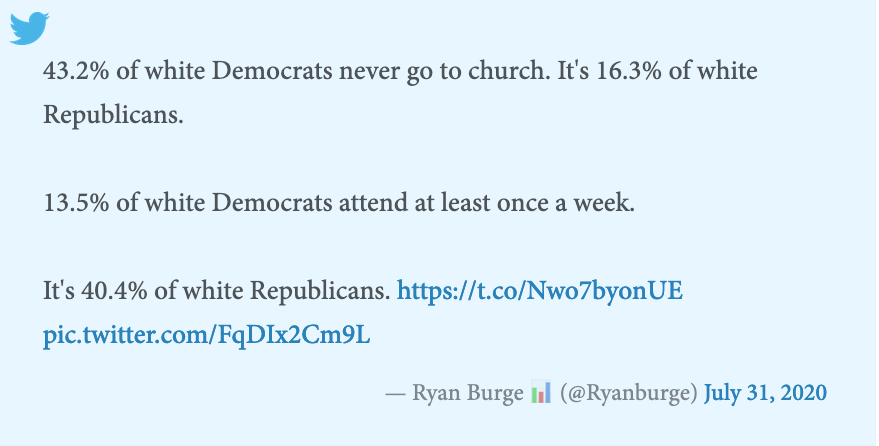
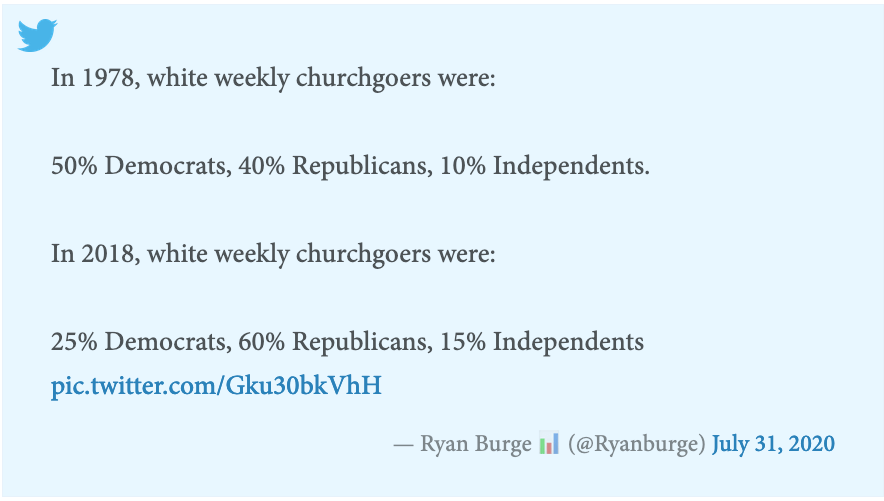
Those are stunning contrasts. So why do I not feel tribal loyalty to the GOP?

A superficial answer would be that for a conservative, I rate shocking low on loyalty in Jonathan Haidt’s Moral Foundations Theory. But I’m almost positive there’s something more important than that.

First, a distinction.

Dissatisfied with my superficial reading habits, I am currently reading Mortimer Adler’s classic How to Read a Book (revised and updated 1972). Chapter 8 is titled “Coming to Terms with an Author”:

[I]n the analytical reading of a book, coming to terms is the first step beyond the outline. Unless the reader comes to terms with the author, the communication of knowledge from one to the other does not take place. For a term is the basic element of communicable knowledge.

A term is not a word–at least, not just a word without further qualifications … [A] word can have many meanings, especially an important word. If the author uses a word in one meaning, and the reader reads it in another, words have passed between them, but they have not come to terms.

Second, a story, which may be apocryphal, but I did not make it up.

A conservative returned to his alma mater for a commencement address and opened thusly:

By a strange coincidence, I am a graduate of a vastly different institution which occupied this very site 40 years ago and even bore the same name …

For some 23 years now, I’ve been an adherent of a religion called “Christianity,” based on the incarnation, life, death, resurrection, ascension and glorious second coming of Jesus Christ, who is both fully God and fully man. It was once, under the necessity of distinguishing it from a particular heresy, partially summarized in a Creed. To distinguish it from other versions, it’s called “Orthodox,” with a capital-O.

Meanwhile, my country is breathing the last few whiffs of an empty bottle labeled, by a strange coincidence, “Christianity,” which apparently is based on the intuition that God wants us to be nice and happy or, in its robust “Evangelical” versions, that Jesus Christ was very special and died a horrible death so that God would get over his anger issues with us and we could get on with being nice and happy.

Its proper name is Moralistic Therapeutic Deism. Although we share a mostly-overlapping vocabulary of words, I cannot come to terms with it, except in relatively brief and exhausting bursts of attempted empathy.

I remember from some 55 years ago an even more rigorous version, to which I then and for several more decades adhered, but it lives on today mostly notionally, in the scribblings of über-fissiparous “discernment bloggers.” I stay as far from them (and it) as I can, because I’m recovering from a mild-to-moderate case of that mindset and I’ve seen the harm it can cause, including when someone brings that mindset into Orthodox Christianity.

There were and are some other versions of “Christianity,” with some of which I have more or less come to terms, but they are not all that easily pigeon-holed politically.

So back to the question:  “why do I not feel tribal loyalty to the GOP?”

First, because it forfeited any claim to my loyalty:

In 2000 and 2004, it was Dubya. He was, we were told, a good Evangelical Christian. He cited Jesus as his favorite philosopher. He talked about America walking humbly in the foreign policy world.

Then 9-11 came, and he turned into a fierce Commander In Chief …

And then came, too, the second inaugural, when he declared as U.S. policy the eradication of tyranny from the world and the planting of democracy. If you don’t understand how delusional that is, read it again: eradicating tyranny from the world. As national policy.

(Conscientious Objector to the Culture Wars | War Correspondence ن)

Second, I have no confidence that was a blip, a lapse. In fact, the ensuing years have confirmed that endless war truly is the position of the party insiders (even though party voters chose a putatively antiwar mad, toxic and incompetent man for President in 2016).

Third, the Churches these Republicans so assiduously attend engage in worship that’s pure glucose and teach religion(s) with which I cannot come to terms sufficiently to form any kind of alliance. That Republicans are so much likelier to attend Church weekly is not all that interesting considering the Churches they attend.

I knew that 10 years ago (if not earlier, but I drove a stake in the ground then — a blog that’s held up surprisingly well) and they drove a stake though whatever remained of “Republican” in my heart on November 8, 2016.

That’s why.

* * *

Perhaps some day I’ll post a more nuanced version of why it’s difficult for a former-Evangelical, former-Calvinist, now-Orthodox, to “come to terms” with typical versions of contemporary American “Christianity.” I acknowledge painting here with a broad brush, but if there’s no glimmer of recognition, then you may to inattentive, gentle reader.

* * * * *

Put not your trust in princes,
in a son of man, in whom there is no salvation.

Psalm 146:3

* * * * *

You can read most of my more impromptu stuff at here. It should work in your RSS aggregator, like Feedly, should you want to make a habit of it.

“What are the duties required in the ninth commandment?”

Around 24 years ago, I had a series of related epiphanies (epiphanies have marked my whole religious life) that made me loosen my Calvinist grip and eventually to pitch Calvinism overboard, It seems to have survived alright without my nurture, and insofar as I’m not 100% Orthodox yet, the residue likely is Calvinist.

And that’s not entirely bad because they got some things quite right. The Westminster Larger Catechism‘s elaboration of the Ten Commandments, for instance, is very good, which brings me to today’s topic:

Q. 143. Which the ninth commandment?
A. The ninth commandment is, Thou shalt not bear false witness against thy neighbor.

Ex. 20:16.

Q. 144. What are the duties required in the ninth commandment?
A. The duties required in the ninth commandment are, the preserving and promoting of truth between man and man, and the good name of our neighbor, as well as our own: appearing and standing for the truth; and from the heart, sincerely, freely, clearly, and fully, speaking the truth, and only the truth, in matters of judgment and justice, and in all other things whatsoever; a charitable esteem of our neighbors; loving, desiring, and rejoicing in their good name; sorrowing for, and covering of their infirmities; freely acknowledging of their gifts and graces, defending their innocency; a ready receiving of good report, and unwillingness to admit of an evil report, concerning them; discouraging tale-bearers, flatterers, and slanderers; love and care of our own good name, and defending it when need requireth; keeping of lawful promises; study and practising of whatsoever things are true, honest, lovely, and of good report.

Zech. 8:16; 3 John 1:12; Prov. 31:8-9; Ps. 15:2; 2 Chr. 19:9; 1 Sam. 19:4-5; Josh. 7:19; 2 Sam. 14:18-20; Lev. 19:15; Prov. 14:5, 25; 2 Cor. 1:17-18; Eph. 4:25; Heb. 6:9; 1 Cor. 13:7; Rom. 1:8; 2 John 1:4; 3 John 1:3-4; 1 Cor. 1:4-5, 7; 2 Tim. 1:4-5; 1 Sam. 22:14; 1 Cor. 13:6-7; Ps. 15:3; Prov. 25:23; Prov. 26:24-25; Ps. 101:5; Prov. 22:1; John 8:49; Ps. 15:4; Phil. 4:8; 2 Cor. 2:4; 2 Cor. 12:21; Prov. 17:9; 1 Pet. 4:8.

Q. 145. What are the sins forbidden in the ninth commandment?
A. The sins forbidden in the ninth commandment are, all prejudicing the truth, and the good name of our neighbors, as well as our own, especially in public judicature; giving false evidence; suborning false witnesses; wittingly appearing and pleading for an evil cause; out-facing and overbearing the truth; passing unjust sentence; calling evil good, and good evil; rewarding the wicked according to the work of the righteous, and the righteous according to the work of the wicked; forgery; concealing the truth; undue silence in a just cause, and holding our peace when iniquity calleth for either a reproof from ourselves, or complaint to others; speaking the truth unseasonably, or maliciously to a wrong end, or perverting it to a wrong meaning, or in doubtful and equivocal expressions, to the prejudice of truth or justice; speaking untruth, lying, slandering, backbiting, detracting, tale-bearing, whispering, scoffing, reviling, rash, harsh, and partial censuring; misconstructing intentions, words, and actions; flattering, vain-glorious boasting, thinking or speaking too highly or too meanly of ourselves or others; denying the gifts and graces of God; aggravating smaller faults; hiding, excusing, or extenuating of sins, when called to a free confession; unnecessary discovering of infirmities; raising false rumours, receiving and countenancing evil reports, and stopping our ears against just defence; evil suspicion; envying or grieving at the deserved credit of any, endeavouring or desiring to impair it, rejoicing in their disgrace and infamy; scornful contempt; fond admiration; breach of lawful promises; neglecting such things as are of good report; and practicing or not avoiding ourselves, or not hindering what we can in others, such things as procure an ill name.

1 Sam. 17:28; 2 Sam. 16:3; 2 Sam. 1:9-10, 15-16; Lev. 19:15; Hab. 1:4; Prov. 19:5; Prov. 6:16, 19; Acts 6:13; Jer. 9:3, 5; Acts 24:2, 5; Ps. 12:3-4; Ps. 52:1-4; Prov. 17:15; 1 Kings 21:9-14; Isa. 5:23; Ps. 119:69; Luke 19:8; Luke 16:5-7; Lev. 5:1; Deut. 13:8; Acts 5:3, 8-9; 2 Tim. 4:16; 1 Kings 1:6; Lev. 19:17; Isa. 59:4; Prov. 29:11; 1 Sam. 22:9-10; Ps. 52:1-5; Ps. 56:5; John 2:19; Matt. 26:60-61; Gen. 3:5; Gen. 26:7, 9; Isa. 59:13; Lev. 19:11; Col. 3:9; Ps. 50:20; Ps. 15:3; Jas. 4:11; Jer. 38:4; Lev. 19:16; Rom. 1:29-30: Gen. 21:9; Gal. 4:29; 1 Cor. 6:10; Matt. 7:1; Acts 28:4; Gen. 38:24; Rom. 2:1; Neh. 6:6-8; Rom. 3:8; Ps. 69:10; 1 Sam. 1:13-15; 2 Sam. 10:3; Ps. 12:2-3; 2 Tim. 3:2; Luke 18:9, 11; Rom. 12:16; 1 Cor. 4:6; Acts 12:22; Ex. 4: 10-14; Job 27:5-6; Job 4:6; Matt. 7:3-5; Prov. 28:13; Prov. 30:20; Gen. 3:12-13; Jer. 2:35; 2 Kings 5:25; Gen. 4:9; Gen. 9:22; Prov. 25:9-10; Ex. 23:1; Prov. 29:12; Acts 7:56-57; Job 31:13-14; 1 Cor. 13:5; 1 Tim. 6:4; Num. 11:29; Matt. 21:15; Ezra 4:12-13; Jer. 48:27; Ps. 35:15-16, 21; Matt. 27:28-29; Jude 1:16; Acts 12:22; Rom. 1:31; 2 Tim. 3:3; 1 Sam. 2:24; 2 Sam. 13:12-13; Prov. 5:8-9; Prov. 6:33.

Does observance of the Ninth Commandment describe our politics and journalism today? Are we better or worse than we were ten or twenty years ago? How do, say, QAnon or the Comet Ping Pong conspiracy theories square with “unwillingness to admit of an evil report” or avoiding “doubtful and equivocal expressions, to the prejudice of truth or justice; speaking untruth, lying, slandering, backbiting, detracting, tale-bearing, whispering, scoffing, reviling, rash, harsh, and partial censuring; misconstructing intentions, words, and actions …”?

One of the great shames of many supporters of Donald Trump is that they act as if anything short of an outright lie about a political opponent is okay for a Christian — and I may be giving too much credit to think they draw even that line.

I acknowledge the availability of “whatabouts” to Trump’s supporters. But it is a great and grave shame when a putative Christian is willing to suspend the moral law in an effort to “win” politically, even if the other side is doing it.

H/T to David French for the reminder of what his denomination’s Catechism says about the ninth commandment.

* * * * *

Out of the crooked timber of humanity no straight thing was ever made.

* * * * *

You can read most of my more impromptu stuff at here. It should work in your RSS aggregator, like Feedly, should you want to make a habit of it.

Un-learning

I recall from my late high school days a presentation by Moody Bible Institute about its school for missionary aviators in Tennessee. It has stuck with me for something like 55 years now that applicants who already had pilots licenses were not ahead of the game: “We have to un-teach them everything they’ve learned.”

Moody was quintessentially Evangelical, so it’s a bit ironic that Evangelicals must now unlearn what they’ve been taught in order to become better, more historically-rooted Christians.

Take conversion, for instance (a topic I began last night, not knowing I’d be continuing).

“Saints are made by good conversions.” In this challenging and provocative book, Gordon T. Smith contends that a chief cause of spiritual immaturity in the evangelical church is an inadequate theology of conversion. Conversion, he says, involves more than a release from the consequences of sin–the goal is spiritual transformation. But there is little transformation without a complete and authentic conversion. The key is beginning well. In this age of false starts and stunted growth, maturing Christians need help reflecting on and interpreting their own religious experience. Christian leaders need to rethink the way that conversions happen. Beginning Well is a catalyst toward this end. Surveying Scripture, spiritual autobiographies and a broad range of theologies of conversion (Protestant and Catholic, Reformed and Wesleyan), the author seeks to foster in the Christian community a dynamic language of conversion that leads to spiritual transformation and mature Christian living. In the process he moves us from a short-sighted “minimalist” view to one that recognizes seven elements necessary for good conversions. This book–a stirring call to rethink the relationship between conversion and transformation–is a must read for pastors, evangelists, spiritual directors, seminary professors and others who are concerned about the nurture and development of Christian converts, and the nature of authentic religious experience.

Book notes for Gordon T. Smith’s Beginning Well: Christian Conversion & Authentic Transformation.

Evangelicals are known for their emphasis on conversion. But what about life after conversion and beyond justification?
Desperately needed is a comprehensive theology of the Christian life from beginning to end, along with the means of formation and transformation. In Called to Be Saints, Gordon Smith draws on a distinguished lifetime of reflecting on these themes to offer us a theologically rich account of our participation in the life of Christ.
Both profound and practical, this book is a trinitarian theology of holiness that encompasses both justification and sanctification, both union with Christ and communion with God. Smith unfolds how and why Christians are called to become wise people, do good work, love others and enjoy rightly ordered affections.
If holiness is the ongoing journey of becoming mature in Christ, then there is no better guide than Smith. Christians in every walk of life will find this a rich resource for learning what it means to “grow up in every way . . . into Christ” (Ephesians 4:15).

Book notes for Gordon T. Smith’s Called to Be Saints: An Invitation to Christian Maturity, which was Evangelical enough to win a book award from Christianity Today.

This volume offers much-needed theological reflection on the phenomenon of conversion and transformation. Gordon Smith provides a robust evaluation that covers the broad range of thinking about conversion across Christian traditions and addresses global contexts. Smith contends that both in the church and in discussions about contemporary mission, the language of conversion inherited from revivalism is inadequate in helping to navigate the questions that shape how we do church, how we approach faith formation, how evangelism is integrated into congregational life, and how we witness to the faith in non-Christian environments. We must rethink the nature of the church in light of how people actually come to faith in Christ. After drawing on ancient and pre-revivalist wisdom on conversion, Smith delineates the contours of conversion and Christian initiation for today’s church. He concludes by discussing the art of spiritual autobiography and what it means to be a congregation.

Book notes for Gordon T. Smith’s Transforming Conversion: Rethinking the Language and Contours of Christian Initiation.

Next, they really need to unlearn the heresy of chiliasm/millenialism in all its forms, not just the novel and particularly virulent dispensational premillennialism.

* * * * *

Secularism, I submit, is above all a negation of worship. I stress:—not of God’s existence, not of some kind of transcendence and therefore of some kind of religion. If secularism in theological terms is a heresy, it is primarily a heresy about man. It is the negation of man as a worshiping being, as homo adorans: the one for whom worship is the essential act which both “posits” his humanity and fulfills it.

Alexander Schmemann, For the Life of the World, Appendix 1

[O]nce you say you are ashamed,
reading the page they hold out to you,
then such light as you have made
in your history will leave you.
They will no longer need to pursue you.
You will pursue them, begging forgiveness,
And they will not forgive you.
There is no power against them.
It is only candor that is aloof from them,
only an inward clarity, unashamed,
that they cannot reach ….

Wendell Berry, Do Not Be Ashamed

You can read most of my more impromptu stuff at here. It should work in your RSS aggregator, like Feedly, should you want to make a habit of it.
Continue reading “Un-learning”

Shattering a Shibboleth

I have increasingly come to respect the Evangelical Regent College (Eeeewwwww! I almost linked to Pat Robertson’s Regent “University”!) as a place of genuine learning (or that at least aspires to it). [Author’s note: there remains something called “Evangelicalism” that is a novel Christian sect rather than The Republican Party at Prayer. I was raised and educated in it.]

One of my favorite Protestants, Hans Boersma, was at Regent for a while until he left for the Anglican Nashota House. I stumbled across its podcast somehow a few months ago. Despite the giggliness of the hosts, many of the podcasts are quite good. But one that I just finished listening to made me exclaim “Glory to Jesus Christ!”

How do we understand a Christian conversion? Is it a static moment or is it a journey? Does our personal conversion experience match the experiences of our favourite Bible characters? In this episode, Gordon T. Smith, who by the way wrote 2 books and did a doctoral dissertation on this topic, challenges our concepts of conversion and tells us where all of our evangelical confusion around conversion started. You cannot miss this episode.

The notion of a “punctiliar” conversion (a new coinage, so far as I know, and not mine) — praying the Sinner’s Prayer, asking Jesus into your heart, etc. — was seemingly a sina qua non of evangelicalism as I grew up. If you couldn’t give the date when you so “got saved” you were highly suspect. The idea of just growing into the Christian faith was scorned.

But on this podcast, Gordon Smith challenges that head-on, tells its sorry history (which like most Evangelical errors is rooted in the 19th and 20th centuries — rarely even the late 18th century) and for my money demolishes it.

Smith’s understanding is not yet Orthodox, but freeing his mind, and those of his Regent College students, from a major Evangelical shibboleth* is huge.

May his tribe increase!

* I am aware that etymologically, a shibboleth is not something to be freed from or shattered, but I think it has evolved in usage to where both are apt.

* * * * *

Secularism, I submit, is above all a negation of worship. I stress:—not of God’s existence, not of some kind of transcendence and therefore of some kind of religion. If secularism in theological terms is a heresy, it is primarily a heresy about man. It is the negation of man as a worshiping being, as homo adorans: the one for whom worship is the essential act which both “posits” his humanity and fulfills it.

Alexander Schmemann, For the Life of the World, Appendix 1

[O]nce you say you are ashamed,
reading the page they hold out to you,
then such light as you have made
in your history will leave you.
They will no longer need to pursue you.
You will pursue them, begging forgiveness,
And they will not forgive you.
There is no power against them.
It is only candor that is aloof from them,
only an inward clarity, unashamed,
that they cannot reach ….

Wendell Berry, Do Not Be Ashamed

You can read most of my more impromptu stuff at here. It should work in your RSS aggregator, like Feedly, should you want to make a habit of it.