Following the horrors of 9/11, Fukuyama and his ideas were derided as triumphalist nonsense. But he was only half wrong. Fukuyama, a Hegelian, argued that Western democracy had run out of “contradictions”: that is, of ideological alternatives. That was true in 1989 and remains true today. Fukuyama’s mistake was to infer that the absence of contradictions meant the end of history. There was another possibility he failed to consider. History could well be driven by negation rather than contradiction…
In the end, Trump was chosen precisely because of, not despite, his apparent shortcomings. He is the visible effect, not the cause, of the public’s surly and mutinous mood.
The State of the Union should be an easy topic for a writer. It’s a televised event; you watch it; you react.
But it’s actually quite challenging to find anything non-obvious to say about it, especially in 2024. Suspense around the address used to derive from what the president might say. Now, given his age, it derives from whether he might expire before the speech ends.
Joe Biden did not expire last night. Read any analysis today and that’s the top-line takeaway.
…
Then came Sen. Katie Britt to deliver the Republican rebuttal to Biden’s speech. Of her performance, the less said, the better. Watching it, I found myself wondering whether she had seized the opportunity to deliberately sabotage her chances of becoming Donald Trump’s running mate, mindful of how close the last guy who held that position came to being murdered.
There isn’t much else to say about Thursday night. Biden is plainly too old to serve competently for another four years, one “fiery and confident” address notwithstanding, and his agenda is too liberal to make any conservative happy.
I’ll be at the polls early on Election Day to vote for him.
I’ve probably said this before, but I plan to vote for neither. Why? The Electoral College.
I fully expect the polls to show that my fair state is going, again, to deliver its Electors to Donald Trump. Therefore, I’m at liberty to write in the American Solidarity Party slate.
That’s how I’ve calculated whether to hold my nose and vote for one of the major party candidates starting in 2008, when I chose John McCain over Barack Obama (whose affect I liked almost as much as I abhorred his brief political policy record) because the polls said my state was a toss-up (Obama won). I may have voted for Romney without holding my nose; I honestly don’t remember. If I did, it wasn’t under the misimpression that he was a stellar conservative.
The corrosion of American character
[Emmanuel] Todd is a critic of American involvement in Ukraine … He believes American imperialism has not only endangered the rest of the world but also corroded American character.
In interviews over the past year, Mr. Todd has argued that Westerners focus too much on one surprise of the war: Ukraine’s ability to defy Russia’s far larger army. But there is a second surprise that has been underappreciated: Russia’s ability to defy the sanctions and seizures through which the United States sought to destroy the Russian economy. Even with its Western European allies in tow, the United States lacked the leverage to keep the world’s big, new economic actors in line. India took advantage of fire-sale prices for Russian energy. China provided Russia with sanctioned goods and electronic components.
…
As Mr. Todd sees it, the West’s decision to outsource its industrial base is more than bad policy; it is also evidence of a project to exploit the rest of the world. But ringing up profits is not the only thing America does in the world — it also spreads a system of liberal values, which are often described as universal human rights. A specialist in the anthropology of families, Mr. Todd warns that a lot of the values Americans are currently spreading are less universal than Americans think.
…
Mr. Todd is not a moralizer. But he insists that traditional cultures have a lot to fear from the West’s various progressive leanings and may resist allying themselves on foreign policy with those who espouse them.
Rod Dreher elaborates on how the US pushes dubious “universal human rights:”
Boy, do we ever see that in Hungary, and throughout Eastern Europe. The US and the EU are fanatical about promoting LGBT. I mean, truly fanatical. When the Hungarian parliament in 2021 passed a law forbidding what it (accurately, in my view) sees as LGBT propaganda for children and minors, European elites went berserk. Mark Rutte, at the time the prime minister of the Netherlands, said that Hungary ought to be kicked out of the European Union over it.
Mind you, it’s routine for European governments to ban information aimed at children, who are (correctly) believed to be incapable of discerning truth and falsehood in them. In 2021, for example, the European Parliament voted to ban online advertising aimed at kids. So you can’t sell kids candy bars online, but Hungary’s refusal to allow people to sell transgenderism and sodomy to children is thought so egregious by European elites that many of them want the country thrown out of Europe.
Readers of this newsletter are well aware of how passionate the US State Department is about shoving LGBT in the faces of the world. Much of the world hates this, and sees it as a vivid sign of US cultural imperialism. Hungary is fairly tolerant on LGBT matters; same-sex couples can have registered partnerships, and almost every time I go out on the street in Budapest, I see at least one same-sex couple holding hands. But as we all know, in the eyes of these elites, to decline to accept the full and ever-changing panoply of LGBT demands is to be a horrible bigot not fit for civilized society.
(Emphasis added)
I’ll put in my 2 cents’ worth. I thought that surely 9/11 would open our eyes to how odious we are to much of the world. It didn’t. I’ve felt since then that we’re past the point of no return (I should add “humanly speaking”) when that became apparent. It hasn’t been an entirely unbroken descent; people have occasionally been red-pilled on some minor issue or another while the major trends continue downward.
I think it important to try to see the present calamity in a true perspective. The war creates no absolutely new situation; it simply aggravates the permanent human situation so that we can no longer ignore it. Human life has always been lived on the edge of a precipice. Human culture has always had to exist under the shadow of something infinitely more important than itself. If men had postponed the search for knowledge and beauty until they were secure, the search would never have begun. We are mistaken when we compare war with “normal life.” Life has never been normal. Even those periods which we think most tranquil, like the nineteenth century, turn out, on closer inspection, to be full of crises, alarms, difficulties, emergencies. Plausible reasons have never been lacking for putting off all merely cultural activities until some imminent danger has been averted or some crying injustice put right. But humanity long ago chose to neglect those plausible reasons. They wanted knowledge and beauty now, and would not wait for the suitable moment that never comes. Periclean Athens leaves us not only the Parthenon but, significantly, the Funeral Oration. The insects have chosen a different line: they have sought first the material welfare and security of the hive, and presumably they have their reward. Men are different. They propound mathematical theorems in beleaguered cities, conduct metaphysical arguments in condemned cells, make jokes on scaffolds, discuss the last new poem while advancing to the walls of Quebec, and comb their hair at Thermopylae. This is not panache; it is our nature.
I’d bet that if we are supernaturally spared the destruction I expect (which may be something like a definitive demotion from “indispensable nation” to “just another large chunk of geography” — “the end of a world,” not “the end of the world”), our supernatural saviors will make their activity deniable, so we can attribute it proximately to people who just faithfully kept on going, like humans rather than LARPing caricatures.
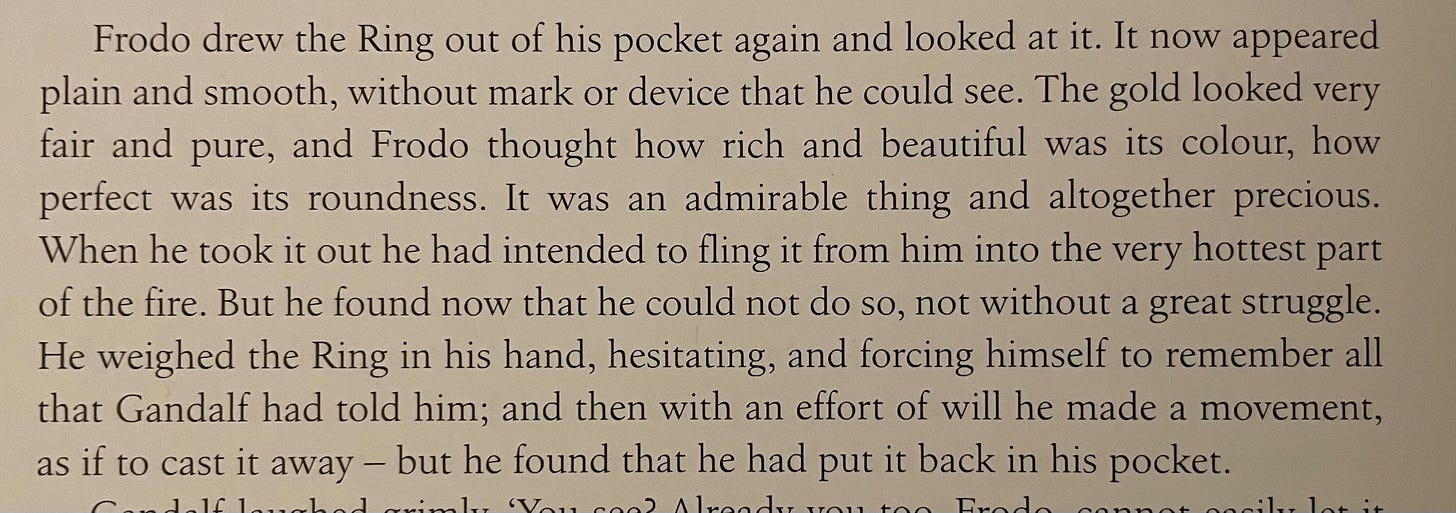
The One Phone of Power
I’ve been reading Tolkien again lately, and I’ve been struck by how easily one can substitute “smartphone” for “the Ring.” Take, for instance, this paragraph early on in which Gandalf invites Frodo to rid himself of the ring.
Above all, do not lose your desire to walk … every day I walk myself into a state of well-being and walk away from every illness; I have walked myself into my best thoughts, and I know of no thought so burdensome that one cannot walk away from it.
Above all, do not lose your desire to walk … every day I walk myself into a state of well-being and walk away from every illness; I have walked myself into my best thoughts, and I know of no thought so burdensome that one cannot walk away from it.
You can read most of my more impromptu stuff here and here (both of them cathartic venting, especially political) and here (the only social medium I frequent, because people there are quirky, pleasant and real). All should work in your RSS aggregator, like Feedly or Reeder, should you want to make a habit of it.
Okay, I can’t resist a little comment. The three are grousing about the Colorado ballot exclusion case, Trump v. Anderson.
George Conway, author of the third listed column, sums up what I think happened:
It may be noble-minded for someone like me, sitting in the cheap seats, to incant my favorite Latin legal maxim, Fiat justitia ruat caelum—“Let justice be done though the heavens may fall.” But I don’t hold a lifetime appointment to decide how justice is to be done. And however much I’d like to think that judges really believe … that they “cannot allow [their] decisions to be affected by any extraneous influences such as concern about the public’s reaction to [their] work,” the fact is that judges are human. Their decisions are affected at times by their perception of what the public reaction may be.
…
I could go on picking apart the weaknesses and inconsistencies in the Court’s opinion, and legions of law professors will do so for ages to come, but the Court’s lack of convincing reasoning is, frankly, beside the point. The Court’s decision wasn’t about law. It was about fear.
I think SCOTUS reached the right conclusion on the wrong rationale. You can make fun of me, but I think the theory is correct that the President is not an “officer” subject to section 3. I think that for having read some of the history around section 3, which I find more persuasive than one Senator’s (disingenuous?) assurance to another that the amendment indeed “hid an elephant (POTUS) in a mousehole” (“other officers”). And I return to that ideé fixe after feeling, as I recall, some passing doubt about it during the oral argument.
Well, at least SCOTUS was “unanimous.” Now I can only hope that never-Trump Republicans, who Trump has disinvited from his party, will oblige him in sufficient numbers to assure his defeat, fair and square, in the November balloting.
What worries me now, though, is not the Christian Nationalists themselves. Frankly, many of them are too reckless, undisciplined, and reactive to be able to accomplish the revolutionary change they seek. What worries me is that there are a great many socially conservative evangelical voters who love the democratic life who are constantly being called “Christian Nationalists” by the likes of Heidi Przybyla for believing things that are utterly unremarkable in Christian history. If our secular media outlets continue to tell them that “Christian Nationalism” is the belief in things virtually all Christians across history have believed, I fear they will listen. And they will find these ethno-nationalist totalitarian aspirants and, not realizing what they are doing, they will make common cause with them.
After all, they’ve already been told that they are ‘Christian Nationalists,’ haven’t they? They’ve been told that protecting the unborn makes them a Christian nationalist, that wishing to promote natural marriage makes them a Christian nationalist, that wanting men to support their children makes them a Christian nationalist. They’ve even been told that believing our rights come from God makes one a Christian nationalist.
Eventually they will start to believe it.
Here is my request: If you are a secular person who wants Christian Nationalism to lose, you should stop helping the Christian Nationalists win.
(One hyperlink added)
It was quite adolescent of me, with my actual adolescence a mitigating factor, but there were several times in my younger life when I was falsely accused of things and reacted by actually doing them.
So I hope you can forgive me for agreeing heartily with Jake Meador on this one.
White Rural Rage
White Rural Rage: The Threat to American Democracy By Tom Schaller and Paul Waldman Random House, 320 pages, $32
Why does a book like this exist? For one thing, it exists to serve the demand for books among people who lack the patience for reading literature. These books are some of the many consumer items that serve as tokens of college education. By visiting the front-most display table at Barnes & Noble and picking up a copy of The Sixth Extinction or Freakonomics, one affirms one’s place among the civilized few who “read.” With White Rural Rage: The Threat to American Democracy, Paul Waldman and Tom Schaller toss another forkful of silage into the troughs of the book-club class.
Of course, a book like this is also intended to provoke a reaction from its targets. The authors are counting on it, as they make clear when they predict that some will conclude that “as two coastal cosmopolitans, we have no right to offer this critique of White rural politics.” The anticipated backlash is an essential part of the marketing strategy.
…
It is the third part of their thesis on which I would like to raise some points of information. Waldman and Schaller assert that, despite their ruling stature, rural whites “paradoxically” fail to demand anything of their political leaders. The authors admit that rural whites have some legitimate sources of anger, particularly the economic hollowing out of their regions by “late-stage capitalism.” However, having despaired of correcting this, rural whites lend their electoral clout to Republicans, who offer a program of cultural vengeance without any redress of rural whites’ material grievances. There is a lot of truth to this. I would just add that pretty much all Americans have seen their communities hollowed out by capitalism, and pretty much all of them have despaired of receiving very much from their representatives. Those who plan to trudge submissively to the polls for President Biden in November are hardly more demanding subjects than those who will cast a vote for Donald Trump.
…
Consider this remark from the authors, in reference to a 2023 conference in Nebraska about preventing agricultural monopolies: “Rural folks are gradually realizing that corporate consolidation, not socialism, is destroying their economies.” Judging by the record of the Grangers, the People’s Party, William Jennings Bryan (who is briefly cited in the book as a typical rural bigot) the Non-Partisan League, the American Society of Equity, Robert LaFollette, the National Farmers’ Organization, Estes Kefauver, the American Agriculture Movement, the National Save the Family Farm Coalition, Tom Harkin, Paul Wellstone, and others, I would suggest that rural people made some hesitant advances toward this insight before 2023. Indeed, a poll conducted by Open Markets Institute in 2018 showed that 54 percent of Trump voters favored the government breaking up monopolies, and only 28 percent were opposed. Moreover, some of the most visible MAGA firebrands are thoroughgoing antimonopolists. Perhaps some of the “gradual realization” Waldman and Schaller delight in when it is expressed in small activist conferences is also reflected in the far more formidable MAGA movement.
Not everyone was totally bowled over by Joe Biden’s Thursday SOTU. Andrew Sullivan had the most colorful, detailed neutral take I’ve seen:
Yes, he did. That’s the core headline. Biden had to convince the American public, and to some extent the world, that he retains the vigor and marbles of his former self. And this he largely accomplished.
He still looks very old though. The first thought I had watching him emerge into the House was that he looks less like Biden than someone wearing a Biden Halloween mask. The features are all there in some kind of uncanny valley, buoyed by fillers, stretched by Botox into a mask whose weirdness hovers somewhere between Joan Rivers and John Kerry, the pure black raisin-eyes peering from within the carved carapace of what was once a face. The Botox is so severe that he has a habit of looking and listening to someone without any measurable change in expression, as if frozen until his mouth can prove he’s not a mannequin. That gives him the open-mouthed squint expression that makes him seem angry at something and yet clueless about why at the same time.
And the vigor was achieved by shouting half the address at about twice the speed required for it to be fully intelligible. The unholy pace made it inevitable he would slur his words as well, so at times, I felt like I was trapped in an Irish pub with a drunk unintelligibly yelling at me for some reason, and I couldn’t get away. And then there was the occasional tone of a fierce, marital squabble: the sudden rising cadence and rhetorical stamp of the foot, as he expressed his volcanic displeasure at something or other. In time, as the adrenaline (or something else) wore off a bit, he became more understandable, but I confess I kept turning the volume down. The Abraham Simpson vibe was strong.
Ouch!
Conservatives and Republicans
[T]he overlap in a Venn diagram of conservatism and capital-R Republicanism has never been smaller.
Nuland shows no sign of rethinking her ideological commitments, however. A few weeks ago, in a speech at the Center for Security and International Studies marking the second anniversary of Vladimir Putin’s invasion, she declared: “Our continued support for Ukraine tells tyrants and autocrats everywhere … that we will defend the rights of free people to determine their own future … and that the world’s democracies will defend the values and principles that keep us safe and strong.”
Such rhetoric shouldn’t be dismissed as pure posturing. Rather, proponents of realism and restraint in foreign policy must reckon with the fact that statements like these reflect the hawks’ deep-seated, immensely consequential convictions about America and its place in the world. Put another way: Nuland & Co. really do mean it when they say such things—and that lack of cynicism is precisely what makes them so terrifying. Their conception of foreign policy as an endless international crusade against ideological enemies, rather than a tool for realizing state interests, fails the American people and risks bringing the world to the precipice of catastrophe.
→ WPATH Files: This week, the leading organization for doctors who perform gender transitions on minors is reeling from a major leak of internal documents, emails, and conference calls. What the leak mostly shows: doctors really had no idea about a lot of the long-term impact of these interventions. Would the kids put on blockers and then cross-sex hormones ever be able to orgasm? Wow, we’re finding out that they can’t, because they’re saying they can’t. Will puberty blockers followed by cross-sex hormones (the yellow brick road of medical transition) stunt a kid’s growth, one clinician asks? Answer seems like yes: “Blockers, by suppressing puberty, keep growth plates open longer, so younger teens have a potential to grow longer, however their growth velocity is typically at prepubertal velocity, without typical growth spurt.” Or watch this video of clinicians trying to figure out how to get their 14-year-old patients to do informed consent to lifetime sterility (often starting at age 9 with puberty blockers). From the video: “It’s a real growing edge in our field to figure out how we can approach that. I’m definitely a little stumped on it.” I am also stumped on how to get gender-dysphoric children to consent to sterility—maybe we can wait till they’re 18? Just an idea. Just a thought. One practitioner talks about meeting former patients now in their 20s who want to start families, and he jokes that when they find him, he responds: “Oh, the dog isn’t doing it for you?”
The biggest news is that these groups knew that the hormone therapies were causing cancer. I’ve said it before, but as a one-time butch teenager with rabid political opinions and the knowledge that I was Correct About Everything, now a happy gay adult with no political opinions and the knowledge that I am Usually Wrong: thank god this movement wasn’t around when I was 14. That said, when I’m done having kids, given the state of things post-breastfeeding, a double mastectomy sounds sort of nice.
I’ve downloaded the files but have only heard excerpts from critics of WPATH. The files are so damning that WPATH has not admitted their authenticity nor, to my knowledge, have they denied it. Since mainstream media don’t like to be shown up as gullible, they’ve embargoed stories on the WPATH files for now.
Andrew Sullivan, a gay writer, has an unusual beef with WPATH. It might be distilled thus: “Doctors who medically transition adolescents are doing so with disregard for autism, mental health comorbidities, and questionably “informed consent. The consequence is that countless kids who have translated their homosexual urges into ‘I’m in the wrong body’ are being sexually mutilated and rendered non-orgasmic.”
But that’s how I would have distilled it last week. Now, with the release of the WPATH files, he’s white-hot:
What does one say of medical professionals who experiment on children in this fashion, and then publicly lie about it? One thing we can say is that they are not medical professionals. And WPATH is not a medical professional outfit, like, say, the American Medical Association. It has many activists and nutballs as members who have no medical or mental health expertise. But in so far as its “guidelines” are used by real medical groups and real doctors, and taken as gospel by woke MSM hacks, it has huge influence and no guardrails. What we are discovering is a grotesquely unethical experiment on vulnerable gender-dysphoric (and often gay) children, performed without meaningful consent, based on manipulative lies (the suicide canard), and defended by a conscious campaign of rank misinformation and ideological bullying.
I used to think there was some good in some of this, and that these experiments were being conducted with entirely good intentions by ethical doctors, who would never violate the Hippocratic Oath to “do no harm.” We all know better now. These quacks treat informed consent as optional, deploy emotional blackmail to alter a child’s endocrine system for life, and care little about the long-term consequences for the victims of their lucrative craft. They have never seen a guardrail protecting children that they didn’t want to remove — and recently abolished any lower limits on the ages at which children can be transed.
At some point the perpetrators of this unethical abuse of vulnerable, troubled kids need to face consequences, and not just in the broken, mutilated bodies of the children they have so callously abused.
Lawyers with the balls to buck the narrative and sue these monsters for malpractice deserve the rich financial rewards they’ll work so very hard to get.
Lost in the Cosmos
Assume that you are quite right. You are depressed because you have every reason to be depressed. No member of the other two million species which inhabit the earth—and who are luckily exempt from depression—would fail to be depressed if it lived the life you lead. You live in a deranged age—more deranged than usual, because despite great scientific and technological advances, man has not the faintest idea of who he is or what he is doing.
You can read most of my more impromptu stuff here and here (both of them cathartic venting, especially political) and here (the only social medium I frequent, because people there are quirky, pleasant and real). All should work in your RSS aggregator, like Feedly or Reeder, should you want to make a habit of it.
Today is an important one in our family’s life. Sunday, too. I wish life weren’t too hectic to figure out how we’re celebrating.
America’s war on traditional cultures
When it comes to culture, America and Western NGOs are global aggressors. For a long time, we’ve been promoting contraception and abortion throughout the world. More recently, we’ve promoted gay rights as well. The U.S. Department of State’s Global Equality Fund, dedicated to advancing LGBT rights, is one among many initiatives, some government sponsored, others carried forward by international organizations. In these and in other ways, progressives in the West are carrying the war on traditional culture to the rest of the world. Reproductive rights, gay rights—they’re the new White Man’s Burden.
I believe this, and it humiliates me as an American.
What could possibly go wrong?
President Biden announced Wednesday the cancellation of $1.2 billion in student loans for about 153,000 borrowers, affecting individuals enrolled in the income-based repayment program called Saving on a Valuable Education (SAVE) who have been in repayment for 10 years and took out $12,000 or less. “If you qualify, you’ll be hearing from me shortly,” Biden said Wednesday, referring to an email selected borrowers would receive alerting them that their loans had been canceled. “The Biden-Harris Administration has now approved nearly $138 billion in student debt cancellation for almost 3.9 million borrowers through more than two dozen executive actions,” a White House fact sheet said.
First Joe trolls them, soon (if not already) bad actors will phish them. Has the President no tech-literate advisors?
Four norms to delay children’s immersion in the virtual world
Jon Haidt (I don’t know when he dropped “Jonathan” in favor of “Jon”) has a new book coming out, and he’s on a crusade to curtain children’s a tweens’ suffering from social media:
A theme of the book is that we are stuck in a series of collective action traps, and the only way to break out of them is with collective action, such as coordinating with the parents of your kids’ friends to all agree to give smartphones later (not before high school) and independence earlier (starting in elementary school). We must stop overprotecting children in the real world and underprotecting them online.
…
“How can you do this to our children?” the senators asked, in a variety of ways. The response from the social media executives was usually some version of “But Senator, we spend X billion dollars each year to create industry-leading tools to find and remove such content.” That phrase, “industry-leading,” was used six times during the hearing; five times by Mark Zuckerberg, and once by Shou Chew from TikTok.
But as I watched the hearing, I kept thinking about how content moderation is to some extent a red herring, a distraction from larger issues. Yes, it must be done and done better, but even if these platforms could someday remove 95% of harmful content, the platforms will still be harmful to kids. The discussion of online harms can’t just be about making an adolescent’s time on Instagram safer, not even 95% safer, because so many of the harms I describe in The Anxious Generation are not caused by bad content. They are caused by a change in the nature of childhood when kids begin to spend many hours each day scrolling, posting, and commenting. Even if Instagram could remove 100% of harmful content and leave only photos of happy girls and young women enjoying their beautiful lives, the effect on adolescent girls would still be devastating from the chronic social comparison, loss of sleep, addiction, perfectionism, and decline of time spent with their real friends in the real world. Even if social media companies currently enjoy protection from lawsuits based on the content that other people have posted (Section 230), they absolutely must be held legally responsible for the hundreds of design choices and marketing strategies they have used to hook tens of millions of children.
… [T]he medium is the message …
This is why two of the four norms I propose for solving our collective action problems are about delaying children’s complete immersion in the virtual world. Here are those four norms:
1) No Smartphone Before High School (give only flip phones in middle school) 2) No Social Media Before 16 3) Phone Free Schools (all phones go into phone lockers or Yondr pouches) 4) More independence, free play, and responsibility in the real world, at an earlier age
Coincidentally, the New York Times has articles here and here that illustrate how stupid parents can be about social media.
Every time I see pre-teen girls tarted up for beauty contests I imagine a mom who needs to be [graphic punishment details omitted]. I didn’t know until now about mom-run tarts-for-pedophiles Instagram accounts.
Dr. Phil, transphobe?
Dr Phil, America’s controversial prime-time TV psychologist, slammed the medical community this week for rushing to put gender-confused children on hormonal therapy or give them reassignment surgery.
Appearing on The Joe Rogan Experience podcast, Dr Phillip McGraw, 73, said he was shocked that America’s leading child doctor group had endorsed the treatments despite countries like the UK and swathes of Europe restricting them due to fears about long-term side effects.
He said: ‘It’s interesting they choose words like gender-affirming care. That’s interesting that they call it that but really what they’re talking about is hormonal therapy or sex reassignment surgery on children.
‘All of the major American medical associations have signed off on this… and I have never seen those organizations sign off on anything with less information as to whether or not it does long-term harm of anything in my life.’
One of our pleasantest visits was to Pere la Chaise, the national burying-ground of France, the honored resting-place of some of her greatest and best children, the last home of scores of illustrious men and women who were born to no titles, but achieved fame by their own energy and their own genius.
Mark Twain, Innocents Abroad
I’m with Twain. I only regret that I got to Pere la Chaise late in the day, and was run out at closure long before I was satisfied.
There is a henhouse of fashion editors who gate-keep and are still living their Sex and the City ‘best life,’ who moved to New York to pursue their dream of being a snob.
It’s not just “fashion editors.” It’s the Economist, too
Viktor Orban, Hungary’s cantankerous prime minister, will strike a note of triumph in his state-of-the-nation address on Saturday. He always does. Last year he boasted of his Fidesz party’s huge win in the election of 2022. This year he has a tougher job. Two of his party’s bigwigs—Hungary’s president, Katalin Novak, and the former justice minister turned MP, Judit Varga—recently quit over their roles in pardoning an orphanage official who covered up sexual abuse.
That scandal stained Mr Orban’s image as an exponent of Christian values and a hero of the international “national conservative” movement Mr Orban likes to brag about standing up to Brussels. In December the EU let him have €10bn ($10.8bn) in aid it had blocked over his rule-of-law violations. But earlier this month, under pressure, he dropped his veto of EU aid to Ukraine. He has since returned to form, holding up sanctions on Chinese firms that have aided Russia’s war effort. No doubt his audience will lap it up.
The Economist World in Brief for 2/17/24
Multiculturalism
The American multiculturalists similarly reject their country’s cultural heritage. Instead of attempting to identify the United States with another civilization, however, they wish to create a country of many civilizations, which is to say a country not belonging to any civilization and lacking a cultural core. History shows that no country so constituted can long endure as a coherent society. A multicivilizational United States will not be the United States; it will be the United Nations.
Samuel P. Huntington, The Clash of Civilizations and the Remaking of World Order
A realistic precis of realingment
The fact is that over the past few decades, and across Western democracies, we’ve been in the middle of a seismic political realignment — with more-educated voters swinging left and less-educated voters swinging right. This realignment is more about culture and identity than it is about economics.
College-educated voters have tended to congregate in big cities and lead very different lives than voters without a college degree. College-educated voters are also much more likely to focus their attention on cultural issues like abortion and L.G.B.T.Q. rights, and they are much more socially liberal than noncollege-educated voters.
Somehow, we managed to get two wonky Township Trustees, a sensitive position that exists for poor relief. One of them squandered money on nonsense, spa trips, and such. She was recently sentenced on criminal charges.
The other became something of a nomad while insisting that her fixed residence was appropriately local. I thought it wasn’t possible to do the job remotely, but she apparently disagreed.
The prosecutor charged her criminally. She was convicted, but the Court of Appeals and now the state Supreme Court reversed (the Supreme Court’s logic differed from the Court of Appeals; that’s probably why they took it.)
A Quo Warranto action, saith the Supreme Court, might well have succeeded, but not a criminal case for theft when every indication was that the peripatetic Trustee sincerely thought she was doing her job and earning her paycheck. Quo Warranto is kind of obscure, but knowing obscure remedies is part of what we go to law school for.
So an embarrassment for the prosecutor and a win for the Trustee who the prosecutor came at too aggressively. There’s typically no love lost between Prosecutors and private practitioners (like me, though I’ve retired), so I find this a suitable outcome.
Automation
Automation did, in fact, lead to mass unemployment. We have simply stopped the gap by adding dummy jobs that are effectively made up.
You can read most of my more impromptu stuff here and here (both of them cathartic venting, especially political) and here (the only social medium I frequent, because people there are quirky, pleasant and real). All should work in your RSS aggregator, like Feedly or Reeder, should you want to make a habit of it.

 Tipsy Teetotaler ن