Meritocracy or virtue?

I’ve noticed something odd about the (still relatively early but) angry commentary over the college admissions scandal, whereby celebrities, “ethical fund” managers, parenting book authors and others crossed legal lines to get their slacker children into elite colleges (or at least more elite than they could get into on true merit). The odd thing is the trope that these parents are arranging for their children to “get ahead” unfairly.

But what is this “getting ahead” in the first place? What virtue is there in it? So far as I can tell, there is none whatsoever.

“Getting ahead” means superficially looking like a meritocratic success. And America is all about superfice.

What is the reality for these slackers? So far as I can tell, it’s going to hell in a delusional cocoon — or whatever sad fate awaits those lacking virtue.

So it seems to me that the most fruitful discussions that can arise out of this chapter in the annals of American superficiality are, as has always been the case, what it means to be human, and more particularly what it means to be a person of virtue — a prize infinitely more valuable than glitz and glamor.

And if you happen to favor deontological or consequentialist ethics, as the commentariat appears to, what these parents did will still fail your ethical tests. It’s unethical all the way down.

But it’s all these parents know in their bones, whatever platitudes pass their lips or gets printed in a child-raising book or fund prospectus.

So why would any sane person want their child to join their ranks?

* * * * *

You can read my more impromptu stuff at Micro.blog (mirrored at microblog.intellectualoid.com) and, as of February 20, 2019, at blot.im. Both should work in your RSS aggregator, like Feedly, should you want to make a habit of it.

The Cyruses we need

The sexuality scholars of the time fancied themselves edgy characters exploding bourgeois norms. They took pleasure in deriding older scholars, the “dead wood” who devoted their careers to such square projects as the Standard Edition of John Dryden. They, by contrast, wrote books with such titles as Sexual Dissidence: Augustine to Wilde, Freud to Foucault; Sodometries: Renaissance Texts, Modern Sexualities; and Vested Interests: Cross-dressing and Cultural Anxiety. The key words of the day were “subversive” and “transgressive.”

Paglia showed them what subverting and transgressing really looked like, mocking the tenured radicals’ bogus cultural politics—bourgeois lives in leafy college towns and hip urban neighborhoods—and inept handling of bohemian, illicit material.…

… It was taken as a sign of profundity, not incoherence, that few people could untangle sentences such as this from Judith Butler’s Gender Trouble: Feminism and the Subversion of Identity (1990):

Once the incest taboo is subjected to Foucault’s critique of the repressive hypothesis in The History of Sexuality, that prohibitive or juridical structure is shown both to instate compulsory heterosexuality within a masculinist sexual economy and to enable a critical challenge to that economy.

Rather than labor to translate such a sentence into English, Paglia mocked it. Why take these writers’ half-baked “readings” and low standards seriously, she asked. They come from dilettantes, not creative minds.

…

In 1991 Paglia spoke at Harvard, where she accused the university of hiring “trendy people in cultural studies centers who believe that the world was created by Foucault in 1969.”…

… Since those professors were too ensconced and comfortable to improve, or even to carry out the basic pedagogical duties, the students must take charge of their own education:

First, make the library your teacher. Rediscover the now neglected works of the great scholars of the last 150 years, who worked blessedly free of the mental pollutants of poststructuralism. Immerse yourself in the reference collection, and master chronology and etymology. Refuse to cooperate with the coercive ersatz humanitarianism that insultingly defines women and African-Americans as victims. Insist on free thought and free speech.

The critique struck home. Under Paglia’s raillery, the theorists of sex and politics looked like small ignorant figures in spite of their knowing demeanor. All they really understood was academic politics, which they played very well. Paglia demonstrated that they had erected a social network that operated on cronyism and prestige, which would collapse as soon as a few genuinely erudite and courageous critics challenged them.

…

In Provocations Paglia declares that the heart of the ’60s movements was “a new religious vision,” whose votaries cared about political reform, but “were also seeking the truth about life outside [existing] religious and social institutions.” The truth came before politics, sex, rebellion, or drugs. The truth Paglia identified long ago is that in all human beings there is an “emotional turmoil that is going on above and below politics, outside the scheme of social life.” Great art touches it, and so does religion. Individuals who respond to art and religion understand that when politics and social life presume to replace them as right expressions of that turmoil, they falsify it instead…and Paglia won’t countenance a lie. That puts her at odds with every institution liberals have managed to seize, from academia to the Democratic Party. But if you mentioned that to her, she would shrug and get on with the truth-telling. She has nature on her side.

Mark Bauerlein, Force of Nature, Claremont Review of Books.

A lot of Evangelicals reportedly believe that Donald Trump is kind of like King Cyrus in Jewish Scriptures/Old Testament (pick your preference), sent to rescue Real Christians® from liberal captivity.

I’m more inclined to think that Camille Paglia and Jordan Peterson, neither of them Real Christians® but with extraordinary crap detectors, are doing the Lord’s work, probably unwittingly, in demolishing parts of the deathworks. (They are two reasons I believe in common grace and natural law.)

It remains to us to walk out of the rubble.

* * * * *

You can read my more impromptu stuff at Micro.blog (mirrored at microblog.intellectualoid.com) and, as of February 20, 2019, at blot.im. Both should work in your RSS aggregator, like Feedly, should you want to make a habit of it.

Good, profitable, dirty fun

On Fat Tuesday, 1988, I was in Boston for a Technology in the Practice of Law conference. (I was a very techy lawyer, relatively speaking: I traveled with my TRS-80 Model 100 for real-time notes and an NEC Multispeed HD 15-pound luggable for post-processing those notes, transferred by serial cable.)

I went out walking in the not-too-chilly coastal March evening, and was impressed by the number of pious college boys retching and relieving themselves in the alleys after doing their darndest to get into the True Spirit of Lent. I’m sure all of them got their ashes the next day and abstained from vice for the next 46 days.

I don’t care to see how far N’Awlins outdoes Boston, and I sure don’t plan ever to contribute to Brazil’s $1.8 billion annual tourist trade by doing Carnival, especially as I might get some sprayover golden shower on me.

A few principled Brazilian politicians — pecksniffs if you’re Bloomberg’s South America correspondent — took some issue with the “cherished, if hedonistic and boozy, cultural institution” (New York Times), whose justification is the riches that pour into Brazil from tourists less repressed than I.

There is something of the deathworks in Carnival, it seems to me, but I’ll let that go.

There definitely is something of the deathworks in the Bloomberg correspondent’s take on the Mayor who expressed some disapproval in advance and pulled some public funds:

Brazil as usual was on fine-feathered display during this year’s Carnival, the rolling street party that captures this nation at its irreverent best …

Rio’s Carnival is Brazil’s signature holiday, the premier attraction for international tourists, and a vitamin jolt for a city still staggered by three years of economic prostration.

Rio pulls in 30 percent of the 6.78 billion reais ($1.8 billion) in tourist revenue that Brazil is expected to generate this year, according to a study by the National Confederation of Goods, Services and Tourism. So skimping on Rio’s carnival is shortchanging Brazil. “Crivella doesn’t understand the difference between his private beliefs and his public role,” anthropologist and noted carnival scholar Roberto DaMatta told me. “As mayor he’s part of Carnival’s cast.”

(Emphasis added)

“Irreverence,” the mocking of holy things, is good business, you see, and the Mayor of Rio is derelict in his duty if he doesn’t bow to the new gods of debauchery once per year on the new high anti-holy day.

Surely I’m overreacting, you may say. Well, judge for yourself, from the New York Times description:

As millions of Brazilians enjoyed the last few hours of Carnival, Jair Bolsonaro, Brazil’s far-right president, denounced what he said was the debauchery of the festivities, and posted a video on Twitter that he presented as graphic proof.

“I don’t feel comfortable showing this, but we have to expose the truth so the people can be aware,” the president wrote alongside a video he posted that showed one man urinating on another in public. “This is what many street parties during Carnival have turned into.”

The video shows a man, wearing a black jockstrap, dancing on what appears to be a bus stop. At one point a second man urinates on the head of the man in the jockstrap. Mr. Bolsonaro urged his 3.4 million Twitter followers to draw their own conclusions and comment on the video.

… the post signals that Mr. Bolsonaro sees value in stoking societal debates over sexual orientation and morality that turbocharged his rise to power.

Note well that the saints in this story are the purported B&D boys taking golden showers, while the sinners are those who suggest that such ought not be taken in public — transvaluation of values and a deathwork in the combined names of mammon and iconic iconoclasm.

* * * * *

You can read my more impromptu stuff at Micro.blog (mirrored at microblog.intellectualoid.com) and, as of February 20, 2019, at blot.im. Both should work in your RSS aggregator, like Feedly, should you want to make a habit of it.

2/37,000,000

A few weeks ago, our old male cat died. I’m not wired to need a pet, but my wife is, so after reading up on cat dander, dander supression and such (we have allergic family members), we adopted a Calico cat, 10 months old, a week ago.

I fear she had lived in cages continuously since weaning, but a week later, she seems to be overcoming her timidity about freedom quite well. Even I, pet-indifferent though I be, can anthropomorphize enough to be glad of that.

The adoption, oddly, got me thinking about death again: Even if I live well beyond my three score and ten (which I’ve already attained, and which longevity I’m striving for at the gym), this young cat is fairly likely to outlive me.

As a religious matter, I’m admonished that mindfulness of death is salutary, and I don’t think I’m being morose about it. One of my favorite homilists spots me by almost a decade, and fairly regularly quips that he “hasn’t got time” for this or that nonsense because his clock is running down (he cranks out new books regularly). I suspect that a similar sense has emboldened me to take on the deathworks in my own small way.

In addition to just reaching our individual “sell-by” dates, unknown to any but God, human beings make themselves deathly sick in various ways, seemingly voluntary but subjectively compulsive.

My personal favorite is gluttony, so once again, I’m using MyFitnessPal to count calories, aspiring to descend from morbid obesity to mere obesity (“try to lose 10%,” says my doctor whose own weight I’ve seen yo-yo over the decades). After that, we’ll see; BMI 30 is a dream of mine.

And then there’s smoking, the all-purpose menace. I got that monkey off my back for good about 35 years or so ago, but I co-suffered with a treasured friend as her chain-smoking husband underwent open-heart surgery and cardio rehab only to be felled by after-discovered metastatic lung cancer, all in the space of 12 months.

If something gives our pleasure centers a buzz, the fear of death seems pretty powerless to stop us repeating it.

Syphilis and gonnorhea used to be the biggies in the sexual realm, yet they continued flourishing until antibiotics knocked them down for at least a while (don’t discount antibiotic resistance).

Still, when oral contraceptives and antibiotics seemed to make random fornication safe, fornication increased, so fear seems anecdotally to play some role, just as it plays a role in getting me away from the table and to the gym.

(Somehow, a whole new array of exotic STDs emerged, as if Someone were telling us “multiple sexual partners is not what you’re designed for.” The Important People drew a different lesson, and admonished us that random fornication wasn’t safe, after all, without good, old-fashioned rubbers. Oh well!)

Those of us who’ve avoided or ceased a particular vice can become unduly censorious about it. C.S. Lewis, drawing an analogy that I only vaguely recall, reminded his readers that the sinfulness of gluttony had never led Christendom to ban the sale of liver pills. Today’s gluttons enjoy the modern version of those liver pills: statins, blood-pressure medications, insulin and milder meds for control of the stuff that raises A1C levels — for each of which I personally am grateful.

So how can I begrudge anyone the emerging miracle of HIV eradication by stem-cell treatments, of which there appear to be two cases so far? Even I, “cisgendered” and hetero though I be, can empathize enough to be glad of that.

But do put them in context:

Scientists are struggling to find a cure for HIV, a virus notorious for hiding in the body and evading attempts to flush it out. Nearly 37 million people have been infected world-wide over the past four decades. While more than 21 million take drugs that keep them alive and reduce the spread, an estimated 1.8 million people were newly infected in 2017.

(Wall Street Journal) Two cures in 37 million cases isn’t  “WOOHOO!!!” just yet.

But it’s a small lifework, though less consequential so far than antiretroviral drugs that merely keep HIV at bay.

* * * * *

You can read my more impromptu stuff at Micro.blog (mirrored at microblog.intellectualoid.com) and, as of February 20, 2019, at blot.im. Both should work in your RSS aggregator, like Feedly, should you want to make a habit of it.

Men thrashing women – a deathwork

“Letting men compete as women simply if they change their name and take hormones is unfair — no matter how those athletes may throw their weight around,” the 62-year-old Navratilova wrote. “[T]he rules on trans athletes reward cheats and punish the innocent.” She added: “It’s insane and it’s cheating. I am happy to address a transgender woman in whatever form she prefers, but I would not be happy to compete against her.

Athlete Ally’s response was swift and certain:

Martina Navratilova’s recent comments on trans athletes are transphobic, based on a false understanding of science and data, and perpetuate dangerous myths that lead to the ongoing targeting of trans people through discriminatory laws, hateful stereotypes and disproportionate violence.

“First of all, trans women are women, period,” the organization’s statement continued. “They did not decide their gender identity any more than someone decides to be gay, or to have blue eyes. There is no evidence at all that the average trans woman is any bigger, stronger, or faster than the average cisgender woman, …

[T]he very existence of women’s sports is predicated, as Martina Navratilova recognized, on the now-highly politically incorrect observation that the two sexes are radically different physically … When biological males and biological females compete with each other on the playing fields, the biological females almost always lose.

…

For decades feminists have castigated heterosexual men for trying to “erase” women—from history, from society, from political life. But the real erasure of women these days is coming from their fellow progressives. They are being denied their distinctive female sports, their distinctive female bodies, and, ultimately, their distinctive female identities.

Charlotte Allen (emphasis added)

* * * * *

You can read my more impromptu stuff at Micro.blog (mirrored at microblog.intellectualoid.com) and, as of February 20, 2019, at blot.im. Both should work in your RSS aggregator, like Feedly, should you want to make a habit of it.

Should a fascist poet be no-platformed?

Courtesy of Alan Jacobs, I found a wonderful essay by Edward Mendelson on a principled dispute between Bennett Cerf and W.H. Auden over Random House banishing Ezra Pound from a revised anthology, in the original of which several Pound poems appeared — that is, in modern parlance, defiantly “no-platforming” Pound.

The essay is multivalent with issues of today, starting with how grateful I am that we have no friends censorious enough to drop us over the name of our late, lamented cat Heidegger, whose namesake (in case you didn’t know) was a consequential philosopher before he was an inconsequential Nazi.

There’s no doubt that today’s progressive callout culture would side with Bennett Cerf’s initial position. My doubt comes in the area of whether they could be persuaded to reconsider, as Cerf did, or whether instead any attempted persuasion would risk getting the would-be persuader banished, too.

But the end of the essay evoked for me my own sentimental forgiveness of Auden’s unrepentant homosexuality (he tried and tried and tried chastity until he stopped trying — or so is my understanding; and yes, that reveals that there’s a callout culture temptation within me, too) based on my sense that his poetry reflected a powerfully Christian imagination despite his sexual irregularities. I think Auden himself would have rejected, and perhaps did reject, such sentiment:

Auden gave much thought to the question of writers “whose works / Are in better taste than their lives,” as he wrote with ironic understatement in his poem “At the Grave of Henry James.” When he wrote to Cerf that he got “very exasperated with the people who argue that Pound should be acquitted or let down gently because he is a poet, which is obviously nonsense,” he was refusing a subtler temptation that he, perhaps like every successful artist, knew from experience. “You hope, yes, / your books will excuse you, / save you from hell,” he wrote in a poem addressed to himself, part of his “Postscript” to a poem about poetry-writing, “The Cave of Making.”

In the same poem, he refused any fantasy that his work justified his faults—the same nonsense that he refused when others used it to justify Ezra Pound. Instead, he sensed, his faults had damaged his work: had he been a better person, he might have written better poems. In print and in private, he seems never to have condemned other writers’ work on the basis of their personal faults. He knew too little about them to judge. But his own self-knowledge led him to imagine a moment when his self and his work would both be subject to judgment:

God may reduce you
on Judgment Day
to tears of shame,
reciting by heart
the poems you would
have written, had
your life been good.

As for my own temptation to judge poetry according to the poet, Auden’s comment to Cerf hints at a cure: “The whole case only confirms my long-held belief that it would be far better if all books were published anonymously.”

* * * * *

You can read other stuff at Micro.blog (mirrored at microblog.intellectualoid.com) and, as of February 20, 2019, at blot.im, at both of which I blog shorter items. Both should work in your RSS aggregator, like Feedly.

Potpourri 2/22/19

1

“We’re in a cage match,” said Rob Renfroe, a conservative pastor in Texas who believes the denomination should break up. “The loser can’t get up off the mat. The winner is beaten up, bloody, battered.”

Frank Schaefer, a Methodist pastor who was defrocked and then reinstated after officiating his son’s same-sex wedding, is in full agreement. “It’s better for our LGBTQ community if we split,” he said.

… [M]any congregations object to allowing such differences on an issue they consider central to their faith, and are preparing for divorce—and for the disputes over church property that will inevitably follow.

…

“All of this comes down to money,” said Mandy McDow, the pastor of Los Angeles First United Methodist Church and a supporter of LGBT rights. “If people wanted to leave, they would have left a long time ago, but they would have had to give up their buildings and their pensions.”

Ms. McDow said she would be in St. Louis to see “the great divorce of my denomination. It’s going to be awful.”

Ian Lovett for the Wall Street Journal on United Methodists.

It boggles my mind, and should serve as a cautionary tale about Moralistic Therapeutic Deism, that both sides think the deep integrity of the Christian faith is at stake — especially when one side is thus tacitly condemning 20 centuries of its spirtual ancestors to the status of inferior pseudo-Christians.

But I agree with Mandy McDow. I’ve seen quite a few clergy who waited until retirement to follow their changed convictions into different Christian traditions, and had personal communication with one who was frank about the financial straits earlier “conversion” would put on his family.

I’m thankful that I did not have direct financial ties to the Christian Reformed Church (of course, one tends to do business with people one knows from Church) when, unbidden, my investigation into the falsity of a new Orthodox Church in town persuaded me of Orthodoxy’s truth.

2

Mr. Smollett deserves to be punished for his hoax to deter others. The media’s punishment will be its continuing loss of public credibility.

Wall Street Journal Editorial Board

Yes, but what of us putatively innocent bystanders, who’d like reliable news? Are we deluded about what we really want? Or have the appetites of our countrymen for sensational confirmation of their biases driven legitimate news out of the market?

I caught a few minutes of the CBS national news last night and quickly caught them eliding legitimate issues to fit complex stories into their narrative and their time-per-story constraints.

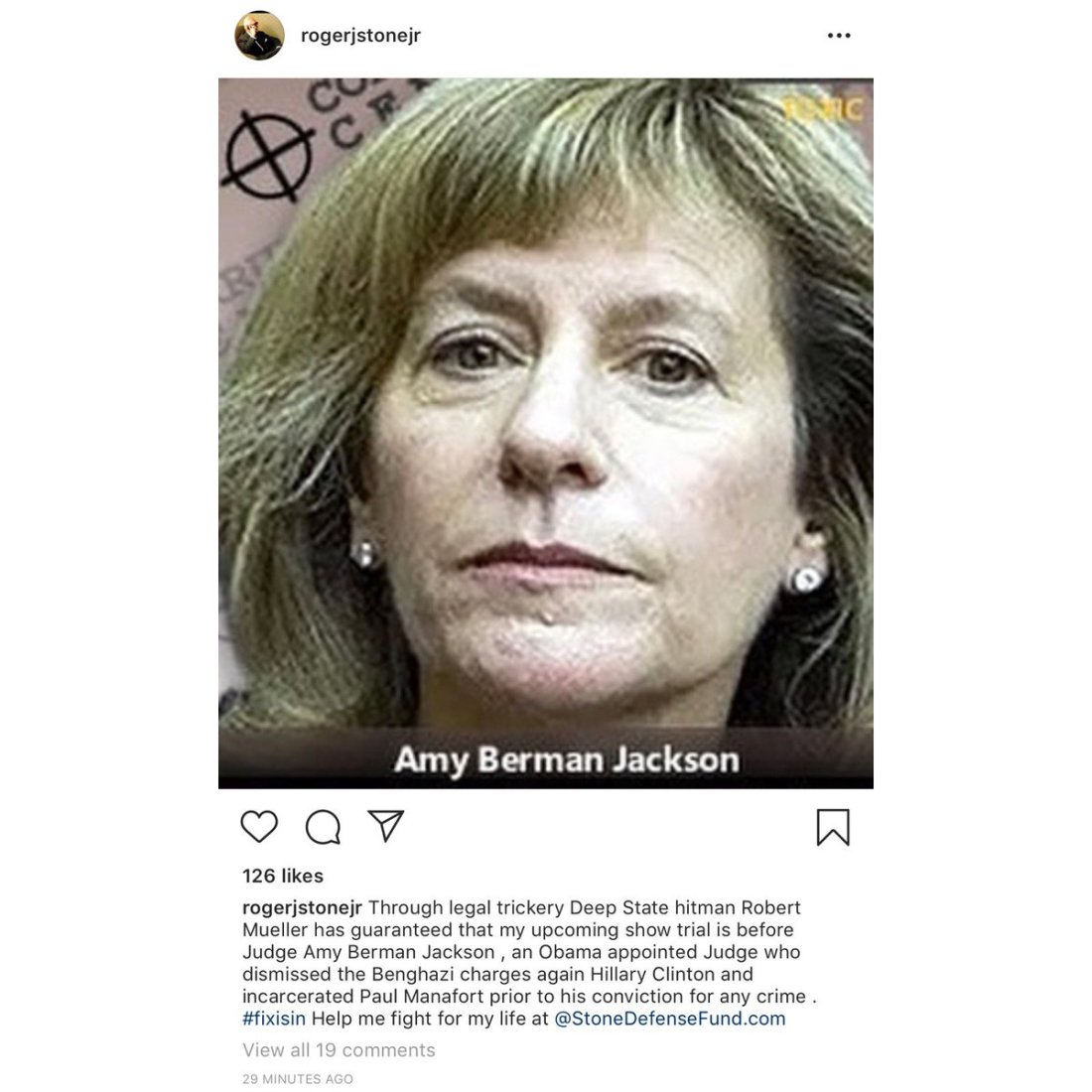
For instance, they tried to make sure that viewers would “see” a rifle’s crosshairs, oddly placed in the corner of a picture motormouth Roger Stone posted of Judge Amy Berman Jackson, when the lines were way too thick and too long, the placement was certifiably weird if a threat was intended, and the accompanying tweet was a plea for defense funds:
DzthWx-VAAAaYtR

Had I not listened to a legal podcast, All The President’s Lawyers, I probably would have fallen for that spin, for spin it was, becoming one of the semi- and mis-informed with a cartoonish notion of what’s going on, and who the good guys and the bad guys are.

And that’s probably what I am.

It’s impossible to read/view/hear and evaluate all world news at length. The sweet spot is knowing what matters, and that’s probably mostly local news, even as local media sink into insolvency that not even sensationalism can fix.

It may become necessary for local news to get its funding from patrons, not just from readers and advertisers, perhaps on the public radio model. We’re on terra incognita.

3

Should corporations, especially big, megarich ones, be given tax benefits for locating in a city or state? No, actually. They should come in simply as grateful and eager new citizens, especially in a place like New York, since there’s nothing like us. But that is not the world in which we live. In this world politicians are desperate to expand the tax base and brag about creating jobs. Companies can and do press every advantage.

…

Here is the truth: New York’s progressives weren’t tough, they were weak. They don’t know how to play this game.

You want to be tough and mean, get what you want, and keep those jobs for your constituents? Here was the play:

You don’t unleash the furies and hold hearings where crowds jeer, hiss and chant “GTFO, Amazon has got to go.” You don’t put stickers on every lamp pole saying “Amazon crime.” You don’t insult and belittle their representatives. You don’t become Tweeting Trotsky.

You quietly vote yes, go to the groundbreaking, and welcome our new partner in prosperity. Then you wait. And as soon as the new headquarters is fully built and staffed, you shake them down like a boss.

Peggy Noonan

4

A tax preparer in Russiaville, Indiana declined to do a repeat customer’s return when she showed up with her new “spouse,” also a “she.”

My first thought was that the culprit drew a dubious line. But then I thought back to the days after the Supreme Court littered same-sex marriage onto the nation’s legal landscape. I believe there were pledges circulating to “never recognize same-sex marriage in any way,” which was a tempting bit of proposed civil disobedience and which might fit doing a joint tax return.

The pair was able to get it’s “married filing jointly” return done elsewhere, of course.

In Indiana, there’s no law against what he tax preparer did.

Because her beliefs warrant respect, too, I’m content with Indiana’s status quo, the only argument against which is that it’s vitally important to Corporate America (and some United Methodists, but I digress) that sex trump all countervailing considerations and that we’ll be on its “naughty list” until our laws say so.

* * * * *

I left Twitter and I’m leaving Facebook, but you can read other stuff at Micro.blog (mirrored at microblog.intellectualoid.com) and, as of February 20, 2019, at blot.im, at both of which I blog shorter items. Both should work in your RSS aggregator, like Feedly.

Clippings and Comments, 2/19/19

1

In the Ralph Northram controversy (medical school yearbook, blackface and Klan costume, just in case you’ve already forgotten), I heard an interesting tidbit on a little-explored backwater of the controversy: who leaked the information about the med school yearbook page?

The answer, apparently, is unnamed, but presumably pro-life, medical school classmates outraged by his defense of what some evocatively call “4th trimester abortion.”

2

[T]he Communist Party and many other outlets feel free to publish strong criticisms of Putin. He is criticized here on a number of other topics, especially what some see as his passive responses to Western aggression. That does not happen in a totalitarian society. If I did not see the news here in Russia, I would judge from Western sources I live in a closed society where no one feels free to criticize the leader. Putin is a strong leader to be sure, but he is no dictator. Dictators silence public criticisms. I would also wrongly conclude Putin enjoys a close relationship with the Communist Party in Russia—or is secretly sympathetic to a return to Communism. A leader wanting to return to Communism does not repeatedly say, as has Putin, that whoever wants Communism restored has no brain. Western publications claiming Putin does not allow dissent in Russia or is a “closet Communist” are not based on actual research of what is written and said here. They ignore or distort both what Putin has written and said and imply contrary views are not allowed …

On a related point, overall I think the news shows here present different sides of most issues more fairly than their U.S. counterparts. I admit surpassing the fairness and objectivity of the American MSM is a very low bar to hurdle. In news talk shows here a number of perspectives are heard. They even have an American journalist, Michael Bohm, who usually takes the pro-American perspective on major international stories on one of the main news programs. Can you imagine a major news talk show in America allowing a knowledgeable Russian to explain freely the Russian “side” of the news?

Hal Freeman, an American expatriate in Russia. You might want to do a reality check on your Russia fears.

3

Data points:

  • As of 2017, acceptance of gay marriage is now stronger among American Muslims than among white evangelical Christians.
  • Two new Muslim congresswomen, Rashida Tlaib and Ilhan Omar, are conspicuously pro-L.G.B.T.Q.

You might want to reality-check your “creeping Sharia” fears, too.

The Economist had a major series on Islam in the West February 16. From what I’ve read so far, it’s consistent with this.

4

More from American expatriate Hal Freeman:

When I was 18 years old I joined the U.S. Marines … John Bolton wasn’t willing to do what I and thousands of young men were willing to do, but he and others in leadership are still sending young men and women to such places. I detest both the hypocrisy and the casual way leaders and politicians are eager to send Americans to risk their lives for what turns out to be political posturing and arms sales. Dying in Afghanistan or Syria will not ensure the security of the American borders or the American way of life. In my youthful naivete, I was willing to risk my life for my country. Knowing what I know now, I’m not willing to risk my children.

5

First, the issue of human sexuality has become the most pressing issue for the church of our generation. This is not to say that it can be divorced from other crucial issues, say, of mission, ecclesial identity, ministerial orders, executive authority, epistemology, and the like. Nor it is to say that everyone would agree that it is the most important issue facing the church. We can all provide our own list of items on this score; for me, it would not be at or even near the top of my concerns. However, the crowbar of civil and church history in the West has sidelined ecclesial debates about ancillary matters. Human sexuality has become the issue of our time and anyone who cares about the future of the church cannot ignore it.

William J. Abraham, In Defense of Mexit, on the impending rending of United Methodism.

6

There’s something touching about a widow of the Aurora, Illinois factory shooting being too emotional to talk to the press about her husband, and about her Facebook postings to which the press thus must resort.

I’m probably on shaky ground here, but I find it faintly creepy when people similarly bereaved are eager to share it with with total strangers through media ghouls. And, of course, their loss gives them no special expertise with which to browbeat the rest of us.

7

This Day in History: Former Vice President Aaron Burr is arrested for treason. Quite good.

8

Don’t assume that events in Venezuela are spontaneous.

* * * * *

Follow me on Micro.blog Follow me on Micro.blog, too, where I blog tweet-like shorter items. Frankly, it’s kind of becoming my main blog. If you prefer, those micro.blog items also appear now at microblog.intellectualoid.com. Both should work in your RSS aggregator, like Feedly.

Clippings & Comments 2/17/19

1

One thing we must not allow ourselves to forget: Our “rising tide” did not “lift all boats.”

That’s a major reason we got Donald “Wake Up Call” Trump as President of the United States. He got that, and at least pretended to care.

2

Joshua Gibbs, a classical educator, has taken to a sort of Socratic Dialogue form of late in his blogging:

[Gibbs:] Children have common sense and knowing that Jackson Pollock’s art is no good is simply a matter of common sense. It’s just a lot of painted scribbles. The same kind of common sense informs little children that two women cannot marry each other and that eating an entire birthday cake will lead to a stomach ache. On the other hand, children have terrible taste, which means they think Thomas Kinkade and Bratz dolls are interesting. You have got to train them out of that kind of delusion by showing them things of real beauty, and a thing of real beauty can be appreciated by bishop and child alike. If I want to tell my children that Bratz dolls are ugly, I cannot, in good faith, tell them that Jackson Pollock is good.

…

McLaren: How can you decide whether an idea should be taken seriously until you’ve heard it out? Until you’ve engaged with it?

Gibbs: Here’s what I want you to do, McLaren. I want you to drop this argument, abandon your position, accept my position, and never mention it again.

McLaren: (laughing) Absolutely not. Why should I? That kind of power move is typical of—

Gibbs: See? You also believe some ideas are so absurd they can be blithely dismissed with a laugh. You rejected my idea without hearing my explanation, then moved into an accusation.

McLaren: That’s because your request was absurd!

Gibbs: No more absurd that treating a lot of splattered paint as legitimate art.

…

[Gibbs:] An idea is taken seriously when time and space are given for the careful explanation of that idea, and when those hearing the idea ask probative questions to make sure they have rightly understood the idea. An idea is taken seriously when those listening to the idea hear with sympathy, interest, and attempt to discern both the discreet inner-logic of the idea, but also the way in which the idea rhymes with the world and underwrites the harmony of created things. A idea is taken seriously when it warrants a patient and reasonable response … An idea which has lasted deserves to be taken seriously, as do ideas which are held by many kinds of people. Ideas which have prompted great acts of charity, ideas which have proven rallying points for the pursuit of truth, beauty, and goodness deserve to be taken seriously. Ideas which are staked in common sense, reason, and intuition deserve to be taken seriously.

Must We Treat Every Bad Idea With Respect And Patience?


Student: I meant that so far as the spirit goes, everyone is different. No two souls are the same.

Gibbs: Classical educators are not terribly interested in the ways that everyone is different. That is a mantra of public school educators. Classical education is interested in virtue, in the human things, in transcendent things, in divine things. All people need to love God, love what is good, and hate what is evil …

Student: Is it not insulting to claim that all people are the same?

Gibbs: I didn’t say that all people are the same. I simply claimed that classical educators are far more interested in what human beings have in common than in what makes each human being distinct. Every one of my students is unique, but the uniqueness of each student has very little influence over how I govern my classroom or deliver my lectures.

Student: Why not?

Gibbs: Because a classical education is about growing in virtue, not self-fulfillment or self-discovery. “Don’t be yourself. Be good.” You’ve heard me say it a hundred times before.

Why Do We Have To Wear Uniforms? (emphasis added because I’m in love with classical education)


If your faith is strong, it doesn’t need a challenge. If your faith is weak, it cannot stand a challenge. I simply don’t see why anyone should seek out a challenge to their faith.

Should I Go To Public School To Challenge My Faith?


I believe Rousseau was often wrong, but he was gloriously wrong. Classical schools borrow one of their great rallying cries from Renaissance schools, and that is, “Ad fontes,” which means, “Back to the sources.” To understand what things are, we must know where they come from. Rousseau is one of the great architects of modern thought; encountering the modern spirit in its nascent form allows us to see the philosophy and theology which underwrites our own world. A classical education assumes students want to know the hidden causes of the world, and to discern those causes, we must dig. So Rousseau was wrong, but he was wrong with style, with clarity, with poetry, and he persuaded millions.

Should We Replace Rousseau And Augustine With John Piper?

I left the Protestant world so long ago that I don’t know who John Piper is, but apparently he’s widely considered a pretty solid guy — no Jimmy Swaggart, Jim Bakker or Benny Hinn.

3

Words are a president’s strongest weapon. Trump is terrible at words.

I saw this yesterday and thought it was a pretty succinct summary. Now I’m wondering of just what it’s a summary.

The author seems to think Trump will turn to will and force, failing persuasion.

I now wonder whether Trump supporters mean something like this when they tell us to watch what he does, not listen to how he describes it (tacitly admitting how inarticulate he is).

4

Freddie has a few pointed thoughts about Amazon pulling out of the New York City deal. He uses some naughty words.

5

Clarissa, an immigrant, publishes occasionally on her Merited Impossibility blog, the title of which is obviously inspired by Rod Dreher’s Law of Merited Impossibility: “It’s a complete absurdity to believe that Christians will suffer a single thing from the expansion of gay rights, and boy, do they deserve what they’re going to get.”

Sunday, she muses about parents who move heaven and earth to conceive children and then abandon them to the electronic Nanny.

6

When it comes to hate crime hoaxes, the Reichstag fire is eternal.

Rod Dreher, noting that no apologies have come forth yet from those who swallowed Jussie Smollet’s hate crime (likely) hoax hook, line and sinker.

For such counter-hegemonic thinking, Dreher’s blog was banned from Facebook at least for a while.

* * * * *

Follow me on Micro.blog Follow me on Micro.blog, too, where I blog tweet-like shorter items. Frankly, it’s kind of becoming my main blog. If you prefer, those micro.blog items also appear now at microblog.intellectualoid.com. Both should work in your RSS aggregator, like Feedly.

Spinning narratives

I’ve recently encountered two disturbing (but stimulating and, ultimately, helpful — I think) items about journalistic “narratives” spun from sometimes-scant facts.

First, both chronologically and because there’s no paywall, Caitlin Johnstone (whose name I’ve been habitually misspelling), a pretty radical progressive daily blogger journalist from down under: Dissidents Must Understand The Difference Between Fact And Narrative:

Do you know the difference between fact and narrative? Are you sure? The ability to be as lucid as possible about the difference between raw data and the story that is spun about it is absolutely essential to understanding and fighting the establishment propaganda machine.

Let’s look at Russiagate for an easy example. The narrative is that Donald Trump is secretly conspiring with the Russian government to subvert American interests to advance the agendas of the Kremlin. But what are the facts? The facts are that a few people who were associated with Trump during his presidential campaign have been convicted and pled guilty to process crimes and some underhanded dealings with nations that aren’t Russia, while Trump has been staging a regime change intervention against Venezuela, bombing Syria, arming Ukraine, implementing a Nuclear Posture Review with a more aggressive stance toward Russia, withdrawing from the INF Treaty, throwing out Russian diplomats, sanctioning Russian oligarchs, expanding NATO and securing it more funding. The narrative and the facts couldn’t be more different.

But that hasn’t mattered, has it? The propagandists have been able to get everyone worked up about the idea that Putin has managed to influence the very highest levels of the US government, despite there being no facts whatsoever to substantiate that idea. It’s pure narrative, yet it’s been used to manufacture a conceptual framework which allows anyone challenging the unipolar world order to be undermined as a Kremlin crony, from Jill Stein to Tulsi Gabbard to Glenn Greenwald to Rand Paul. There is nothing but insinuation and innuendo backing up those narratives, but that’s all they need.

Second, Holman W. Jenkins, Jr. (whose name I usually shorten to Holman Jenkins), from the putatively conservative Wall Street Journal and thus behind a paywall, I fear: Suddenly, Bezos Is Media’s Hero:

Mr. Bezos and his associates deliberately promoted a Hollywood-sized misdirection, with spies and political conspiracy extending all the way to the White House and Saudi Arabia … [through] Mr. Bezos’ own Washington Post. Never mind that the only real lead Mr. Bezos’ agent provided to the paper concerned the possible role of Ms. Sanchez’s pro-Trump brother. If so, means and motive were complete: It was unnecessary to speculate about Donald Trump and the Saudis—a filigree spun on top of the tawdry facts to distract and excite the media.

…

Mr. Bezos’ interest seems self-evident to me: Injecting the Trump-Saudi red herring draws attention away from his own carelessness and that of Ms. Sanchez. After all, being a hero of the anti-Trump resistance, especially when Amazon lately has been vilified from the left, is better than being the chump starring in a garden-variety case of rich-guy infidelity.

… Our press seems increasingly helpless in the face of evidence-free red herrings aimed at its erogenous zones. See the widely circulated email in which Bob Woodward uncritically associates himself with Mr. Bezos’ narrative. The incentive to participate in other people’s idealized self-images is well-known in psychology. Journalists should guard against it. But, in truth, exhibiting compliance with the self-images of their sources is how many journalists do their jobs.

Which is why I strongly favor one part of what’s unfolding here: the media genuinely interesting itself in how such stories based on anonymous sources and leaks come to be published.

When the press gets done with Mr. Bezos’ private messages, let’s find out who leaked decades-old private Trump family tax documents to the New York Times. Let’s inquire into the source or sources who misrepresented to CNN, MSNBC and CBS the date on an email to make it look like the Trump campaign was in cahoots with WikiLeaks.

I could go on. How some stories come to be written strikes me as a lot more newsworthy than the stories themselves ….

If you can get through the paywall, Jenkins is a good read on l’affaire Bezos, including much that I didn’t think I could include and still be “fair use” rather than “ripoff.”

Of course, Mr. Jenkins’ “interest seems self-evident to me.” It builds the image of the Wall Street Journal’s pay-for-what-we-write model (think Apple) at the expense of the Washington Post and New York Times (think Google and Facebook, relatively speaking – or so goes Jenkins’ narrative).

Indeed, I would not be stunned were I to learn that my clicks at the Washington Post feed back into Amazon.com so it can target ads. And I’ve got as much evidence for that as the Post has for Trump and Saudi Arable being entangled with the Enquirer on this.

* * * * *

Follow me on Micro.blog Follow me on Micro.blog, too, where I blog tweet-like shorter items. Frankly, it’s kind of becoming my main blog. If you prefer, those micro.blog items also appear now at microblog.intellectualoid.com. Both should work in your RSS aggregator, like Feedly.