Sunday 10/5/25

Fullness

Orthodoxy holds that the fullness of the Faith was revealed to the Church at Pentecost, once and for all. The Greek Fathers utilized their education in the service of the Church to explain doctrine, not to find new truths, since the fullness of the truth was received at Pentecost.

Dr. Eugenia Scarvelis Constantinou, Thinking Orthodox

Secularism

Secularism was not a neutral concept. The very word came trailing incense clouds of meaning that were irrevocably and venerably Christian.

Tom Holland, Dominion

Ring-lust

When people justify their voting choice by its outcome, I always think of The Lord of the Rings. Tolkien emphasizes repeatedly that we cannot make decisions based on the hoped-for result. We can only control the means. If we validate our choice of voting for someone that may not be a good person in the hopes that he or she will use his power to our advantage, we succumb to the fallacy of Boromir, who assumed he too would use the Ring of Power for good. Power cannot be controlled; it enslaves you. To act freely is to acknowledge your limits, to see the journey as a long road that includes dozens of future elections, and to fight against the temptation for power.

Jessica Hooten Wilson, What ‘The Lord of the Rings’ Can Teach Us About U.S. Politics, Christianity and Power.

In the US, we decided, twice, that if we gave Sauron the ring, he’d use it for good. How’s that workin’ out for ya?

Conversion and cosmology

There is no point in converting people to Christ if they do not convert their vision of the world and of life, since Christ then becomes merely a symbol for all that we love and want already – without Him. This kind of Christianity is more terrifying than agnosticism or hedonism.

Fr. Alexander Schmemann. Again:

A modern secularist quite often accepts the idea of God. What, however, he emphatically negates is precisely the sacramentality of man and world.

Fr. Alexander Schmemann (different source).

Climbing the elite ladder

Here’s one way to think about it. An evangelical who climbs the elite ladder is more or less required, by the nature of the case, to shed vital elements of her evangelical identity. But a Catholic is not. And a Catholic is not for the same reason that, once upon a time, a liberal Protestant was not.

Brad East, Conversions, Protestantism, and a New Mainline. I would add that an Orthodox Christian need not shed identity either.

East’s post is target-rich with suggestions about questions that fascinate me.

Politically homeless

According to the Public Religion Research Institute’s annual census last year, upward of 80 percent of Republicans described themselves as Christian …

Ryan Burge. It might surprise you that I’m unimpressed and un-encouraged by that. I don’t even know what “Christian” means in common parlance any more if 80% of Republicans think of themselves as Christians.

Ain’t. No. Way.

… But the Democratic coalition is a very different spiritual universe. It is made up of a big mix of faiths — Christians of various kinds, Jews, Muslims — as well as somewhere between 30 percent and 40 percent of nones, or people who describe their faith as atheist, agnostic or nothing in particular.

Ryan Burge again. These figures are a surprise, but they may be correlated to the Democrat party positions that keep me politically homeless instead of joining the Dems.

Chicago archbishop Blase Cardinal Cupich, who has stirred some controversy recently, said one true thing that made my heart leap when it was misattributed to the new Pope by a commentator: that Christians (Cupich said “Catholics”) are now politically homeless in the US.

I have recognized my political homelessness for twenty years now.

On reading the Bible

Most North American Christians assume that they have a right, if not an obligation, to read the Bible. I challenge that assumption. No task is more important than for the Church to take the Bible out of the hands of individual Christians in North America. Let us no longer give the Bible to all children when they enter the third grade or whenever their assumed rise to Christian maturity is marked, such as eighth-grade commencements. Let us rather tell them and their parents that they are possessed by habits far too corrupt for them to be encouraged to read the Bible on their own ….

Stanley Hauerwas. Hauerwas wrote the book this quote comes from 32 years ago. It seems to me that those corrupt habits haven’t been reformed.

Get ready

You may have heard these famous lines from Cardinal Francis George, the late archbishop of Chicago …:

I expect to die in bed. My successor will die in prison. And his successor will die a martyr in the public square. His successor will pick up the shards of a ruined society and slowly help rebuild civilization, as the church has done so often in human history.

Kevin D. Williamson, The Totalitarian Tendency and the Confessional, reflecting on a new Oregon law requiring that Catholic priests report certain sexual crimes that might be communicated to them in the confessional.

Starving the beast

In our last episode, I wrote “I don’t think I frequent any websites that use algorithms to target my inferred vulnerabilities.” It may be worth noting that I also have unsubscribed from some blogs and Substacks that I felt were grinding out agitprop aimed at people like me.

Go thou and do likewise.


Religious ideas have the fate of melodies, which, once set afloat in the world, are taken up by all sorts of instruments, some woefully coarse, feeble, or out of tune, until people are in danger of crying out that the melody itself is detestable.

George Elliot, Janet’s Repentance, via Alan Jacobs

[N]one of the things that I care about most have ever proven susceptible to systematic exposition.

Alan Jacobs, Breaking Bread With the Dead

You can read most of my more impromptu stuff here and here (both of them cathartic venting, especially political) and here (the only social medium I frequent, because people there are quirky, pleasant and real and it has no-algorithms). All should work in your RSS aggregator, like Feedly or Reeder, should you want to make a habit of it.
Never say Never

I never imagined that I would recommend listening to an accordion player. But the YouTube channel Sergei Teleshev Accordion is astonishing. I’ve never (that I can recall) seen accordions like that (they’re called button accordions, I guess) or heard them making serious, even thrilling, music, like this father and daughter do. (The daughter is 16, by the way.)

Trigger warning: The remainder of this post is (more or less) political

The Calvinball Presidency

I like arguments about ideas. The only way to have a good argument about ideas is if the person or people you’re arguing with have some degree of sincerity about what they are arguing for—or against. Being a political commentator in the Trump era is like being a sportscaster covering a game of Calvinball. The rules change all the time, so arguing about them is an exhausting waste of time.

Jonah Goldberg, The Boredom of Writing in the Trump Era – The Dispatch

Inspectors General

When hoodlums start disabling security cameras, you can bet they’ve got nothing good in mind.

The Trump administration on Wednesday withdrew funding for the Council of Inspectors General, a federal watchdog group, and the entity’s website was disabled. The group oversaw a network of 72 inspectors general. According to the Washington Post, the Trump administration had decided last week to pull the group’s funding.

The Morning Dispatch

Algorithms

[W]e are a nation divided by algorithms. If your algorithm knows you as conservative and interested in military matters, you got a lot of videos of young soldiers and sailors acting out the past few years, and of service branches tweeting out showy political sentiments. You felt understandable alarm. If your algorithm knows you as liberal and not interested in military affairs, you haven’t seen that content, and will have been surprised by Mr. Hegseth’s reference to “dudes in dresses.” We are all getting different versions of reality every time we look at a screen, and it’s hurting us.

Peggy Noonan, The Embarrassing Pete Hegseth.

As if on cue, some folks known to the algorithm as conservative and interested in military matters let it be known that they thought Hegseth’s show was just fine:

Much depends on the details and execution, but if implemented with both verve and prudence, Hegseth’s commonsense reforms will profit the American profession of arms.

As noted in my standard footer for blog posts, I am a participant on something called micro.blog: I follow people I’ve found interesting and some of them follow me. Yet I sensed it wasn’t like Facebook or Twitter/X. It was pleasant. It was sane.

I think Noonan has put her finger on why it is so: it has no algorithms.

In fact, I don’t think I frequent any websites that use algorithms to target my inferred vulnerabilities.

Grooming codes and Flag Codes

Speaking of The Embarrassing Pete Hegseth, Kevin D. Williamson has a few choice words:

I will believe that Hegseth is serious about this stuff when Hegseth starts acting like he is serious about it. As a few observers have pointed out, Hegseth’s Beverly Hills, 90210-style sideburns often extend to a length that would be prohibited under military grooming standards. But there is another area of dress convention that Hegseth violates in practically every public appearance, one that is in fact relevant to his current position: the Flag Code.

The Flag Code is written into federal law, though there is no penalty for violating it. It forbids wearing the flag as an article of clothing, a rule Hegseth routinely flouts with his dopey flag-lined suits. It specifically forbids using the flag as a handkerchief, which Hegseth does habitually, tucking it into his chest pocket as a decorative pocket square—and surely, surely not because doing so makes it look like he is wearing some kind of military decoration. Hegseth, Donald Trump, and the members of the movement they represent are habitual violators of the Flag Code, which is not merely an aesthetic concern. 

Part of the point of the Flag Code is the notion that the flag is not to be treated as though it were merely an item of personal property. It is not to be used for tawdry, tacky, or self-interested purposes such as advertising. Hegseth has obvious contempt for rules of this kind, and Trump has equally obvious contempt for any kind of rule that would put any kind of limitation on his self-aggrandizement and vanity. You can be sure that if Hegseth or Trump preferred to wear a beard, then beards would be mandatory in the military, possibly even for women.

The allure of delusional self-adoration can be powerful. When a junior high vice principal made me cut my hair (picture your obedient correspondent at 15 with a blond Robert Smith-circa-Kiss Me, Kiss Me, Kiss Me rats’ nest), I was much offended. I believed, in the sincerest possible way, that I was a unique, very special, possibly heroic 15-year-old, one destined for great things, and, above all, one whose autonomy and personal sense of self had to be respected at all times, damn the rules. It all seemed incontrovertible at the time. But I am not in junior high school anymore. Pete Hegseth somehow is. Princeton owes him a refund. 

Mau-mauing the NFL

I’d bet a modest amount that our Censor-in-Chief will figure out some threat to the NFL sufficient to motivate a change of the Superbowl Halftime Show from Bad Bunny to someone markedly more WASPish.

In any event, I’ll miss the game and the show. I’m expecting an emergency call then.


We are all gatekeepers now.

Peggy Noonan

Your enemies are not demonic, and they are not all-powerful and the right hasn’t always lost and the left hasn’t always won. But if you convince yourself of that, you give yourselves all sorts of permission to do a lot of stupid and terrible things under the rubric of “Do you know what time it is?”

Jonah Goldberg.

[A] critical mass of the American people … no longer want[s] to govern themselves, … are sick of this republic and no longer want to keep it if it means sharing power with those they despise.

Nick Catoggio

I don’t do any of the major social media, but I have two sub-domains of the domain you’re currently reading: (a) You can read most of my reflexive stuff, especially political here. (b) I also post some things on my favorite no-algorithm social medium.

Authoritarianism in the 21st century

My father died 27 years ago today. It was too early, but I wouldn’t have wanted to see him at the age he’d be now.

This just might be faintly relevant

There isn’t a single instance of a fentanyl seizure in the Caribbean:

Last month, the U.S. cutter Hamilton returned to Florida with what the agency called “the largest quantity of drugs offloaded in Coast Guard history”: 61,740 pounds of cocaine and 14,400 pounds of marijuana (that’s the weight of about three city buses). The haul, gathered by multiple federal agencies during 19 seizure incidents in the Caribbean as well as the Pacific, had an estimated street value of $473 million. But there wasn’t any fentanyl on the boat.

(Nick Miroff)

Authoritarianism in the 21st century

We are living in an authoritarian state.

It didn’t feel that way this morning, when I took my dog for his usual walk in the park and dew from the grass glittered on my boots in the rising sunlight. It doesn’t feel that way when you’re ordering an iced mocha latte at Starbucks or watching the Patriots lose to the Steelers. The persistent normality of daily life is disorienting, even paralyzing. Yet it’s true.

We have in our heads specific images of authoritarianism that come from the 20th century: uniformed men goose-stepping in jackboots, masses of people chanting party slogans, streets lined with giant portraits of the leader, secret opposition meetings in basements, interrogations under naked light bulbs, executions by firing squad … I’d be surprised if this essay got me hauled off to prison in America. Authoritarianism in the 21st century looks different, because it is different. Political scientists have tried to find a new term for it: illiberal democracy, competitive authoritarianism, right-wing populism …

… To keep their jobs, civil servants have to prove not their competence but their personal loyalty to the leader. Independent government officers—prosecutors, inspectors general, federal commissioners, central bankers—are fired and their positions handed to flunkies. The legislature, in the hands of the ruling party, becomes a rubber stamp for the executive. Courts still hear cases, but judges are appointed for their political views, not their expertise … There are no meaningful checks on the leader’s power.

Today’s authoritarianism doesn’t move people to heroic feats on behalf of the Fatherland. The leader and his cronies, in and out of government, use their positions to hold on to power and enrich themselves. Corruption becomes so routine that it’s expected; the public grows desensitized, and violations of ethical norms that would have caused outrage in any other time go barely noticed. … At important political moments it mobilizes its core supporters with frenzies of hatred, but its overriding goal is to render most citizens passive. If the leader’s speech gets boring, you can even leave early (no one left Nuremberg early). Twenty-first-century authoritarianism keeps the public content with abundant calories and dazzling entertainment. Its dominant emotions aren’t euphoria and rage, but indifference and cynicism. Because most people still expect to have certain rights respected, blatant totalitarian mechanisms of repression are avoided. The most effective tools of control are distraction, confusion, and division.

“If everybody always lies to you, the consequence is not that you believe the lies, but rather that nobody believes anything any longer,” the political philosopher Hannah Arendt said near the end of her life. “And a people that no longer can believe anything cannot make up its mind. It is deprived not only of its capacity to act but also of its capacity to think and to judge. And with such a people you can then do what you please.”

These are the features of the modern authoritarian state. Every one of them exists today in this country …

… It sometimes seems as if the only check on Trump’s power is his own attention span.

George Packer, America’s Zombie Democracy.

Railway to the Moon

Imagine if you were trying to write intelligently about the socioeconomic impact of the railroad in the middle of the 19th century, and half the people investing in trains were convinced that the next step after transcontinental railways would be a railway to the moon, a skeptical minority was sure that the investors in the Union Pacific would all go bankrupt, many analysts were convinced that trains were developing their own form of consciousness, reasonable-seeming observers pegged the likelihood of a train-driven apocalypse at 20 or 30 percent, and peculiar cults of engine worship were developing on the fringes of the industry.

What would you reasonably say about this world? The prime minister of Denmark already gave the only possible answer: Raise your alert levels, and prepare for various scenarios.

Ross Douthat, Drones, Denmark and Dark Magic

PK snippets

  • “I’m not proposing a political program,” he told me. “This isn’t some Christian civilizational vision. It’s much more personal.” You decide how and where to wage battle: at a community garden, on the Appalachian Trail, in a mosque.
  • He was struck by how commonplace legal cannabis had become. “It’s a really, really useful drug for the state to be legalizing,” he said. “Because it’s not like alcohol. It doesn’t get you violent. And maybe life is a bit less crappy. It’s the best antidote to revolution that you could possibly have.”
  • “When you’re sitting in your living room with your Punjabi wife reading a bunch of stuff about how you’re a white nationalist, it makes you want to punch people in the face,” he said. “Luckily, I’m a Christian, so I don’t do that.”

Paul Kingsnorth via Alexander Nazaryan in the New York Times


We are all gatekeepers now.

Peggy Noonan

Your enemies are not demonic, and they are not all-powerful and the right hasn’t always lost and the left hasn’t always won. But if you convince yourself of that, you give yourselves all sorts of permission to do a lot of stupid and terrible things under the rubric of “Do you know what time it is?”

Jonah Goldberg.

[A] critical mass of the American people … no longer want[s] to govern themselves, … are sick of this republic and no longer want to keep it if it means sharing power with those they despise.

Nick Catoggio

I don’t do any of the major social media, but I have two sub-domains of the domain you’re currently reading: (a) You can read most of my reflexive stuff, especially political here. (b) I also post some things on my favorite social medium.

Sunday, 9/28/25

The mind boggles

Recently, I heard a gifted pastor, a man who leads a large nondenominational church, say this:

“You may not want to hear your pastor say this, but some of the things Jesus says are not very helpful. Loving your enemies, for example. We don’t need to love our enemies. We need to love our friends and crush our enemies.”

I winced, but I could hear my younger self trying to shock an audience with a line like that. I figured the pastor would follow up with something like, “But if that is what our Lord says, we need to be figuring out how we are going to obey him.”

No. His following comments dug in deeper. He said in essence that the Lord’s teaching was unrealistic and damaging to the present cause.

It astounded me.

How can one claim to be defending Christianity by disagreeing with what Christ said?

Defending Christianity? (I believe that this must have been my source for this old digital clip though I’m no longer on Facebook to confirm that.)

Doug Wilson

Calvinist provocateur has been getting a lot of press lately and he doesn’t even have a new book out:

Doug Wilson is not a prophet. He is a gifted writer, a trenchant cultural analyst, and a deliberate provocateur. As one observer memorably put it, “Doug is a Christian shock jock, a cable news host, a Daily Wire program (and I like a lot of what Ben Shapiro says).” Wilson’s approach reflects a right-wing attractional model characteristic of partisan punditry and movements, where the foil of political opponents seldom fades from view. The result is a message that tickles ears, entrenches self-righteousness, and bolsters partisan pride rather than cultivating prophetic witness.

If Wilson positioned himself simply as a cultural commentator, the problems would persist, and whatever good he offers could be found elsewhere without the accompanying liabilities, but at least the genre would be clear. The difficulty is that he holds the office of pastor in a church and denomination unwilling to discipline him for his excesses, however outrageous they become, leaving his rhetorical showmanship to be mistaken for faithful ministry. Worse still, he claims biblical warrant for language that Scripture itself calls ungodly.

Prophets Lament, Wilson Lampoons

Jeremy Sexton. If you don’t know who Doug Wilson is, congratulations! I, unfortunately, did know and once thought highly of him. Today, I’m not so sure that his contribution to Christianity is a net plus.

Old Scratch knows the Good Book

Jesus, in Luke 4, was tempted by the devil after 40 days of fasting.

What I had never noticed before is the escalation of the temptations. The first two temptations are pretty crass and Jesus answers them with “it is written.” So on the third temptation, Old Scratch goes all spiritual on Jesus and supports the temptation with his own “it is written” — indeed, with two “it is writtens.”

(And then my mind raced off to contemn snake-handling Pentecostals.)

Politics taints everything

It might have been expected that, since the situation in which the Greek hierarchy found itself after the fall of Constantinople seemed to provide it with an almost providential opportunity for the reassertion of the original and essential nature of the Church, it would have vindicated through its own actions its claims to superiority over what it regarded as the perverse confusion of temporal and spiritual in the Roman Church; but in fact the Greek hierarchy was to become involved in the ‘concerns of state’, the ‘things of Caesar’, to a degree which threatened not merely to confuse the spiritual and temporal, but to eclipse the spiritual altogether. For Mahomet II, in granting privileges to the Greek episcopate in the person of the Oecumenical Patriarch Gennadios, the first such Patriarch after the fall of Constantinople, did so in accordance with the Islamic tradition that a ‘nation’ (millet) is determined by its religious status: he looked upon the Greek Christians as a ‘nation’ of which the Patriarch was the ‘national’, temporal head, and not, as he is according to Orthodox tradition, merely the bishop of one particular local sacramental centre. Hence it was that the Patriarch assumed what the Pope already possessed, something of the power that belongs to Caesar.

Philip Sherrard, The Greek East and the Latin West

Culture wars

Destitute

Most medieval Europeans probably understood better than do nearly all Westerners today that acquisitive affluence is not a prerequisite for human flourishing—even though they also knew, in times of famine, for example, that utter material destitution made flourishing nearly impossible.

Brad S. Gregory, The Unintended Reformation.

Is this the religious right today, or should I look elsewhere?

A week ago there was a marathon funeral or memorial service for Charlie Kirk. I didn’t know about it in advance, and after it was over I only saw (1) Erika Kirk’s speech and (2) maybe a few other snippets. My first impression was of a syncretistic mash-up of Christianity and Americanism.

My delayed impression, though, was of an orderly affair, without (many if any) calls for vengeance. If this is the “religious right” of 2025, I don’t think secularists or religious folks ouside it have much to fear.

Damon Linker largely agrees, though he wrote a critique of the religious right in 2006 titled The Theocons. He concedes he may have been too shrill in 2006, but also sees more reassuring “facts on the ground” in 2025. He still fears the Right, but no longer so much fears the “religious right.” What gives?

On February 29, 2016, just as the pundit class was beginning to realize that Trump just might manage to win the Republican nomination that year, New York Times columnist Ross Douthat tweeted the following: “A thought sent back in time to the theocracy panic of 2005: If you dislike the religious right, wait till you meet the post-religious right.”

That’s a quote from Linker, and one he uses a lot. There are the Stewart Rhodeses and Andrew Tates and too many others to name who are a both non-Christian and a greater threat than TPUSA.

But “If this is the “religious right” of 2025 …” isn’t a throw-away line. I’m not entirely convinced that it is. But it is, as they say (or used to say), a “datapoint.”

I’m not sure I’ve digested this yet

It is time to recognize the Non-Denom Church as its own cultural and institutional force. It is likely to endure into the future as its own branch of Christianity, with much of its Protestantism left behind.

LONG FORM: Does Traditional Protestantism Have a Future?


Religious ideas have the fate of melodies, which, once set afloat in the world, are taken up by all sorts of instruments, some woefully coarse, feeble, or out of tune, until people are in danger of crying out that the melody itself is detestable.

George Elliot, Janet’s Repentance, via Alan Jacobs

[N]one of the things that I care about most have ever proven susceptible to systematic exposition.

Alan Jacobs, Breaking Bread With the Dead

You can read most of my more impromptu stuff here and here (both of them cathartic venting, especially political) and here (the only social medium I frequent, because people there are quirky, pleasant and real). All should work in your RSS aggregator, like Feedly or Reeder, should you want to make a habit of it.

Saturday, 9/27/25

Addled religio-politics

David Brooks isn’t a practitioner of zingers or even aphorisms. He is a penetrating thinker and writer on a lot of our public life in the US:

What happens when people operate without any coherent theory of how religion should relate to politics?

First, people treat electoral politics as if it were a form of spiritual warfare. A battlefield mentality prevails between the forces of Jesus and the forces of Satan. Fear replaces the traditional Christian virtue, hope: We’re under attack, and we have to destroy our enemies! That’s the easiest way to mobilize people.

Second, the process of moral formation is perverted. Instead of discipling people in the Christian virtues of faith, hope and charity, people get discipled in the political passions — enmity, conquest and the urge to dominate.

Third, people develop an addiction to rapture. You’ve probably heard the sort of Christian worship music that preceded and punctuated Sunday’s ceremony. Traditional hymns from centuries gone by covered a range of experiences, but modern worship music tends to hit the same emotional chord over and over again: rapture and praise. Its job is to drive your arms heavenward or to knock you to your knees. It can be a delicious and transforming experience.

The problem is that politics is prosaic. Deliberation and negotiation work best in a mood of moderation and equipoise. If you want to practice politics in the mood best suited for the altar call, you’re going to practice politics in a way that sends prudence out the window.

Fourth, a destructive kind of syncretism prevails. Syncretism is an ancient religious problem. It occurs when believers try to merge different kinds of faith. These days, it’s faith in Jesus and the faith in MAGA all cocktailed together. Syncretism politicizes and degrades faith and totalizes politics.

Fifth, it kicks up a lot of hypocrisy. It’s nice to hear Carlson say he practices a religion of love, harmony and peace, but is that actually the way he lives his life?

Finally, it causes people to underestimate the power of sin. The civil rights movement had a well-crafted theory of the relationship between religion and politics. The movement’s theology taught its members that they were themselves sinful and that they had to put restraints on their political action in order to guard against the sins of hatred, self-righteousness and the love of power. Without any such theory, MAGA imposes no restraints, and sin roams free.

The critics of Christian nationalism sometimes argue that it is a political movement using the language and symbols of religion in order to win elections. But the events of the past week have proved that this is a genuinely religious movement and Charlie Kirk was a genuinely religious man. The problem is that unrestrained faith and unrestrained partisanship are an incredibly combustible mixture. I am one of those who fear that the powerful emotions kicked up by the martyrdom of Kirk will lead many Republicans to conclude that their opponents are irredeemably evil and that anything that causes them suffering is permissible. It’s possible for faithful people to wander a long way from the cross.

David Brooks, We Need to Think Straight About God and Politics (gift link because I’ve quoted so much). I bolded the paragraph about syncretism because that’s my own strong conviction about American MAGA politics. See, for instance, the Jonah Goldberg quote in the footer.

Ya gotta love markets

Wall Street investors are buying up claims to potential tariff refunds, betting that the Supreme Court will strike down President Donald Trump’s signature economic policy and require the government to disgorge tens of billions of dollars that companies have paid this year in import taxes. A handful of hedge funds and specialized investment firms are offering importers around 20 cents for every dollar they paid in Trump’s “reciprocal” tariffs and roughly 5 cents per dollar for levies on Canadian, Mexican or Chinese goods stemming from the president’s ire over fentanyl trafficking, according to Salvatore Stile, founder of Alba Wheels Up International, a New York-based customs broker. The antidrug tariff claims are worth less because they are seen as more likely to survive legal challenges and thus less likely to produce refunds. The deals offer immediate cash for importers that have been absorbing most of the cost of Trump’s tariffs. Investors, meanwhile, hope to profit by collecting the rest of the refund if the Supreme Court invalidates Trump’s tariffs. (Source: washingtonpost.com)

John Ellis. Ingenious, but you’ve got to have gigabucks already even to get into this game.

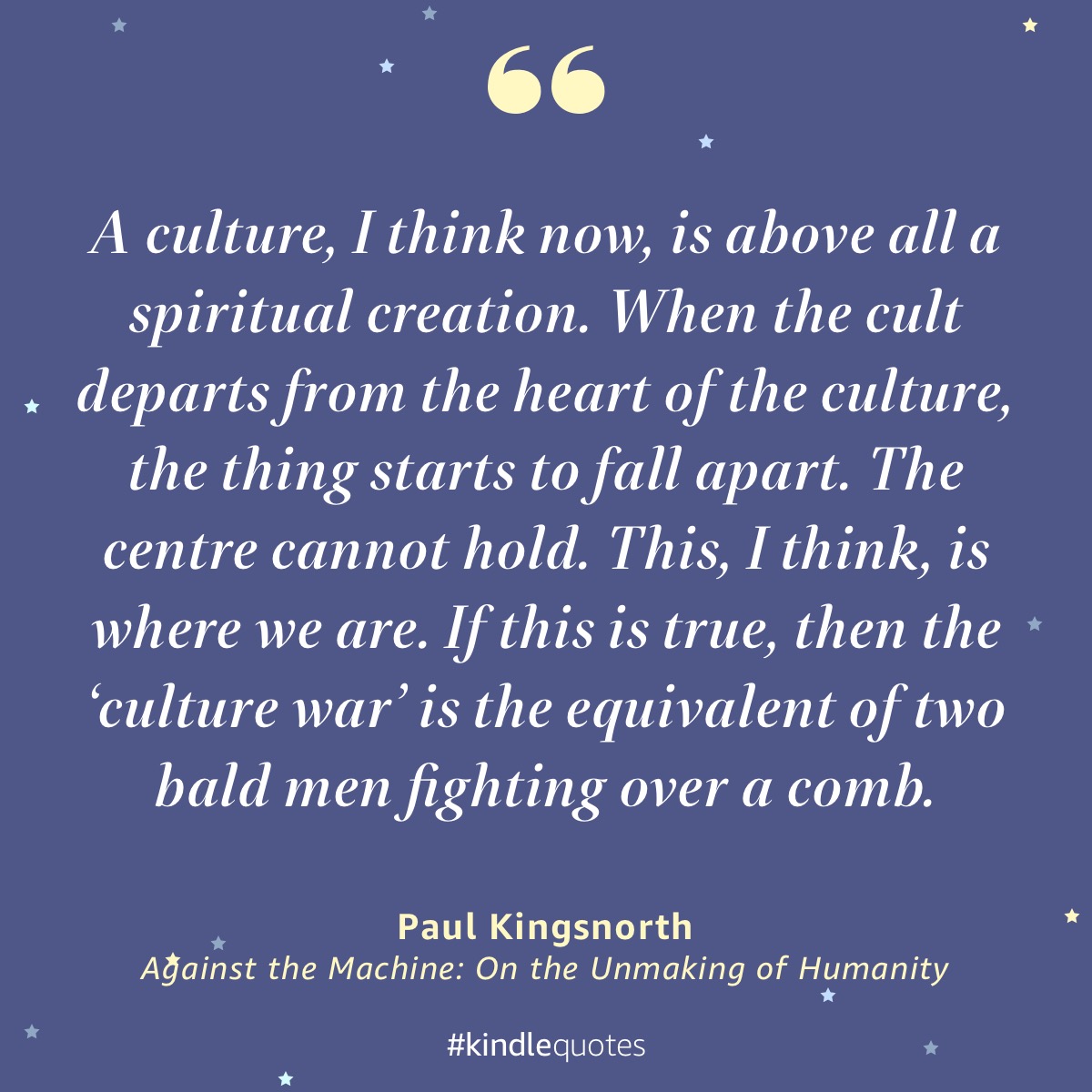
Against the Machine

I’ve read just about everything Paul Kingsnorth has written since I learned of his conversion to Orthodoxy. So I questioned my need to buy his new book, Against the Machine, released Tuesday.

Upon reading a few favorable comments by a trusted friend, I did buy it — for reading on my reading machine (Kindle). Such ironies are not lost on Kingsnorth.

I’m 24% into it and I do recommend it

Farewell to a friend, with an apologia

I lost a valued early subscriber to this blog Wednesday. He had his fill of my “Trump Derangement,” and also thought I was negative toward Charlie Kirk. I know I lost him not because I pay attention to who reads the blog, but because he offered a comment asking that I unsubscribe him. (Neither of us knew how to do that, but I figured it out. I didn’t post his comment because it read more like a personal letter.)

About Charlie Kirk, my subscriber, a skilled wordsmith, nevertheless misread what I wrote, attributing my exceedingly mild criticism of Kirk to Kirk’s support of Trump. Let me say to all you what I said to him:

I regret leaving the impression of a more unfavorable view of Charlie Kirk than I feel. I’ve read a lot about him in the past two weeks because I knew so little about him before September 10. I came to see him as a young man who made fewer mistakes than I did at his age and was maturing before he was cut down. I barely thought about him supporting Trump.

And I’ll add, as justification for criticism that too many conservatives seemed amnesiac about the blemishes on Kirk’s record, eager to declare him a martyr-saint. Treating me as a member of a presumed tribe that must speak thus-and-so is a good way to get my back up.

I’ll add further add: I’m praying for the repose of Charlie’s soul as (and for as long as) I pray for most friends who have died (a few I pray for with no end anticipated). But I am decidedly not asking Charlie to intercede with God for my salvation because I don’t buy the insta-beatification.

If pouring cold water on excessive praise equals condemnation, then I’d plead guilty — but it doesn’t.

As for my Trump Derangement, I’ll quote Jonah Goldberg:

[T]he fact is that the GOP controls the White House and Congress and Trump controls his party in ways no president in living memory has. Moreover, he’s coloring outside the lines. He’s testing the system. He’s redefining conservatism in real time. He does everything he can to be the center of attention constantly. In short, he’s making news. He’s driving events. When people yell at me for writing too much about Trump, what many of them—not all—really mean is “Why do you have to criticize him so much?” Part of this response stems from the idea that conservative commentators are supposed to be partisan Republican commentators. But in ways that have never been truer in my lifetime, Republican and conservative are not synonymous terms.

It’s true, though: I don’t have to criticize him. But I do have to tell the truth as I see it. And I’m sorry to tell you this, but believing what I believe, telling the truth about Trump and criticizing him are pretty close to the same thing.

But nothing I write is likely to dissuade a Trump supporter, just as I have been unmoved by all the “but-look-at-his-policies” rationalizations over the past 8 years. The reader I lost probably isn’t the only one to find it all rather tedious. I should know that by now.

I even understand why people voted for Trump in preference to the Democrat candidates of the last three cycles (I voted for a third party each time in a state that was a polling lock for Trump).

What I don’t understand is those Christians who hold Trump up as a great President instead of “a terrible man, but a better choice than Clinton, Biden or Harris.” Especially when they tell me that I should believe that, too.

That’s my story and I’m sticking to it, while intending to waste fewer obsessive words about it — because I, unlike Jonah Goldberg, don’t charge a subscription that obliges me to endure The Boredom of Writing in the Trump Era.


We are all gatekeepers now.

Peggy Noonan

Your enemies are not demonic, and they are not all-powerful and the right hasn’t always lost and the left hasn’t always won. But if you convince yourself of that, you give yourselves all sorts of permission to do a lot of stupid and terrible things under the rubric of “Do you know what time it is?”

Jonah Goldberg.

[A] critical mass of the American people … no longer want[s] to govern themselves, … are sick of this republic and no longer want to keep it if it means sharing power with those they despise.

Nick Catoggio

I don’t do any of the major social media, but I have two sub-domains of the domain you’re currently reading: (a) You can read most of my reflexive stuff, especially political here. (b) I also post some things on my favorite social medium.

Charlie Kirk

Charlie Kirk and his memorial service

I don’t want to keep banging on about this, because two weeks ago all I consciously knew about Charlie Kirk was that he was affiliated with Jerry Falwell Jr. around the time Falwell made spiritual shipwreck. My impression of him is more favorable now (mama was right: you’re known by the company you keep).

I suspect that Charlie will stop occupying our mind-space relatively soon. Meanwhile, here are some observations I think trenchant.

False note

Some “Evangelicals” are reportedly are starting to style Charlie Kirk as a Christian martyr. Rachel Roth Aldhizer gives examples and cautions that they’re playing with fire.

I have a more fundamental objection: the hagiography should stop not because of dangerous eventualities, but because it’s false.

Not every Christian who is murdered is a Christian martyr, and a Christian martyr is not a murdered Christian who is liked by lot of people, even a lot a people who are good at wordcraft.

Rather, a martyr must be murdered because of his Christian faith. The “tell” in this “Christian martyr” tale is the pronoun “they.” “They killed Charlie because ….“

No, “they” did not, and so far as we know at this point, based on very sketchy information, “he” didn’t either. What little we know points toward the lone shooter perceiving Kirk’s politics as hate-filled.

Plus ça change …

In most secular colleges and universities the largest evangelical organization was Campus Crusade for Christ, founded in 1951 by Bill Bright, a conventionally right-wing Presbyterian, to evangelize students and instruct them in conservative religion and politics.

Frances Fitzgerald, The Evangelicals. Is Turning Point USA the new Campus Crusade?

Erika Kirk

Erika Kirk set a stellar moral example yesterday despite immense emotional and political temptation to be vindictive. All but uniquely for a MAGA Republican, her country is better today for her public influence.

Then the president spoke.

“He did not hate his opponents. He wanted the best for them,” Donald Trump said of Charlie Kirk, seemingly praising the dead. Then he veered off-script: “That’s where I disagreed with Charlie. I hate my opponents, and I don’t want the best for them. I’m sorry. I am sorry, Erika.”

He joked that maybe she could convince him that hating one’s enemies isn’t right, which turned her moving statement of Christian witness into a set-up for a punch line. The crowd laughed. When it was over, Mrs. Kirk embraced him.

I’ve heard of political “big tents,” but I’ve never heard of one big enough to accommodate two moral systems that aren’t just contradictory but irreconcilable. “Christ’s message, followed by its very antithesis,” philosophy professor Edward Feser wrote of the contrast between Kirk’s and Trump’s remarks. “It’s almost as if the audience is being put to a test.”

Almost, yeah.

It’s been many years since I read the gospels, but I do remember Matthew 6:24: “No one can serve two masters. He will either hate one and love the other, or be devoted to one and despise the other.” That’s the test. Many American Christians, possibly including Erika Kirk, seem to reject the premise.

Nick Catoggio

The audience failed the test. They cheered Erika Kirk, but also cheered Trump, who logically they should have booed.

MAGA theology laid bare

Many people who saw or read about the rally were puzzled by what they perceived as a contradiction. How can you cheer love and hate at the same time? How can you worship Jesus and cheer such a base and gross description of other human beings, people who are created in the image of God?

My reaction was different. Finally, I thought, curious Americans who tuned in got to see MAGA theology more completely — and what they witnessed was the best and worst of MAGA Christianity.

The objection to Trump isn’t so much that he’s aggressive — Abraham Lincoln was aggressive against the Confederacy, just as Franklin D. Roosevelt was aggressive against the Axis powers — but that he’s malicious and unjust. And when Trump says that he hates his political enemies, it’s a confession that he’s governing through his basest desires.

David French

The attack on free speech

Our fundamental bargain

Every generation of Americans must come to terms with the fundamental bargain of free speech: we agree that we won’t use the mechanism of the state to punish speech we don’t like and will talk back instead … Every generation has to accept the deal that they’re going to refrain from censorship to protect their own right to speak. Plenty of us still don’t accept that bargain, but if a critical mass of people don’t accept it, then it stops working. Free speech is Tinker Bell; if enough kids don’t clap, she dies. Or as Learned Hand put it more poetically: “liberty lies in the hearts of men and women; when it dies there, no constitution, no law, no court can even do much to help it.”

Popehat

That was then, this is then plus a few months and an opening to act more fashy

Then there’s the Big Guy. In his inauguration speech this year: “I will also sign an executive order to immediately stop all government censorship and bring back free speech to America. Never again will the immense power of the state be weaponized to persecute political opponents.” Trump now: “The [networks] give me only bad publicity, press. I mean, they’re getting a license. I would think maybe their license should be taken away.” And this: “That leaves Jimmy and Seth, two total losers, on Fake News NBC. Their ratings are also horrible. Do it NBC!!!”

Andrew Sullivan.

Plutocrats in the C-Suite

One of the lesser-noted disturbing developments (because of all the higher-profile more “urgent” news) is the takeover of a vast swath of our media by family of billionaire Trump supporter Larry Ellison.

As Thomas Edsall notes in the linked article, this sort of thing is one of the ways Hungary’s Viktor Orbán built an illiberal democracy. They still have elections; they still have free speech; but anti-Orbán speech faces hurdles because Hungarian media are controlled by Orbán supporters.

Donald Trump is a much nastier man than Viktor Orbán. His instincts, unchecked by Congress as they are, are likely to take us to a place that makes Hungary look like paradise.

Chew on this

[T]he most trenchant point about the Kimmel saga was made by civil-rights lawyer Matthew Segal. “In my opinion, when companies or institutions cave to Trump despite the law being on their side, they are not misunderstanding the law,” he wrote. “They are making educated guesses that the U.S. is heading in a direction where, in practice, the law won’t matter.”

Go to court, one might say. Okay—but court is expensive, takes a long time, and risks winning the battle but losing the war. That’s Segal’s point: Even if Disney had prevailed in a legal battle with the FCC, our vindictive president would have looked for other levers of federal power to pull to damage the company. Keeping Jimmy Kimmel on the air and then turning around to find that the FCC has canceled your multibillion-dollar merger out of spite is the definition of a pyrrhic victory.

Nick Catoggio. I can’t say that’s entirely wrong, but this may be a better explanation. As to Jimmy Kimmel in particular, this too is relevant:

If CBS and ABC, two networks that have lately bowed to the president, gave half a hoot, they would easily have prevailed on First Amendment grounds if they put up a fight.

That is, if they prized their network TV businesses sufficiently as businesses, as opportunities to display stewardship, or even as instruments of influence. But they don’t.

Their network news and late-night talk shows are money-losing artifacts of an industry model their parent companies have no intention of investing in or taking risks for.

Holman W. Jenkins, Jr.

Miscellany

A well/ill (choose one) founded fear of persecution

Hannah Kreager, a “trans woman,” fled Tucson for Calgary, Alberta, Canada, and promptly filed for asylum. Kreager had discerned which way the wind was blowing, and it was not propitious:

“If this had been just George Bush or some run-of-the-mill Republican president, I wouldn’t have left,” Kreager said. “I’d have stayed, written to my legislators, and protested because that’s what you do in a democracy. But this feels like an authoritarian regime.”

Rupa Subramanya, The Americans Seeking Refuge from Trump in Canada.

I don’t think Donald Trump feels any personal animus against transgender people, but he knows that quite a few in his base do feel such animus, and he panders to them periodically. Moreover, he is busily demolishing the rule of law in America, and one doesn’t know where he’ll turn next. I can’t say a fear of persecution is less than well-founded, although the Canadian government may, for diplomatic reasons, have trouble admitting that.

Trump lied, children died

The Trump administration has claimed that no one has died because of its cuts to humanitarian aid, and it is now trying to cancel an additional $4.9 billion in aid that Congress already approved. Yet what I find here in desperate villages in southwestern Uganda is that not only are aid cuts killing children every day, but that the death toll is accelerating.

Stockpiles of food and medicine are running out here. Village health workers who used to provide inexpensive preventive care have been laid off. Public health initiatives like deworming and vitamin A distribution have collapsed. Immunizations are being missed. Contraception is harder to get. Ordinary people are growing weaker, hungrier and more fragile. So as months pass, the crisis is not easing but growing increasingly lethal — and because children are particularly vulnerable, they are often the first to starve and the first to die.

It’s difficult to know how many children are dying worldwide as a result of the Trump aid cuts, but credible estimates by experts suggest that the child death toll may be in the hundreds of thousands this year alone — and likely an even higher number next year. In short, President Trump’s cuts appear to be by far the most lethal policy step he has taken.

Let me introduce Trump to the mothers of children that his cost-cutting has killed.

Nicholas Kristoff (Gift Link)

We are all gatekeepers now.

Comparing the top-down “gatekeeper” suppression of the full Zapruder film of JFK’s assassination to the easy access to videos of Charlie Kirk’s assassination:

The gatekeepers are long gone and will never return, but we can’t live as a healthy society without them. We prove this every day.

So you have to be the gatekeeper for your family. You have to be the gatekeeper for yourself. You have to hit delete as the stain tries constantly to creep in, you have to look away and guide others to look away. The school has to be a gatekeeper (removing smartphones from class is a gatekeeping action).

We are all gatekeepers now.

Peggy Noonan.


Your enemies are not demonic, and they are not all-powerful and the right hasn’t always lost and the left hasn’t always won. But if you convince yourself of that, you give yourselves all sorts of permission to do a lot of stupid and terrible things under the rubric of “Do you know what time it is?”

Jonah Goldberg.

[A] critical mass of the American people … no longer want[s] to govern themselves, … are sick of this republic and no longer want to keep it if it means sharing power with those they despise.

Nick Catoggio

I don’t do any of the major social media, but I have two sub-domains of the domain you’re currently reading: (a) You can read most of my reflexive stuff, especially political here. (b) I also post some things on my favorite social medium.

Leavetaking of the Elevation of the Cross

Thinking

What growing up fundamentalist helped me learn early on is how terribly wrong you can be while thinking very hard.

Phil Christman.

How do we become uncomplicated and unsophisticated? Can we simply unlearn all that we have learned?

No, we cannot, but what we can do is to separate ourselves from it in order to look at it with new eyes. For us Westerners to truly enter into the ancient Christian transmission and catch the essence of Christ’s teaching, it is necessary for us to crucify our rationalizing minds and arise above the level of thought and emo for a society founded on Descartes’ proposition “I think, therefore I am,” this of course means a kind of suicide; and it is to precisely such an ego-death that Christ calls us. Contemporary western Christianity trained us how to think and what to think; whereas Christ himself, as did Lao Tzu before Him, taught us how not to need to think.

Hieromonk Damascene, Christ the Eternal Tao.

Theology is offered to the glory of God, not ourselves. Since it is divine, it can never be based on human reasoning, ideas, speculation, or clever argumentation. Orthodox theology can never be disconnected from the spiritual life of the theologian or from the life of the Church. Authentic Orthodox theology is “liturgical, doxological and mystical.”

Dr. Eugenia Scarvelis Constantinou, Thinking Orthodox.

I did not unequivocally “grow up fundamentalist,” but I was at least adjacent. Then Calvinism, which I discovered in my late 20s, increased the “thinking very hard.” But I did not think my way out of all that and into Orthodox Christianity. It was more as if I worshipped and trusted my way across that chasm.

Mike-drop

Whenever a traditional Christian defends some point of traditional Christian morality, you’ll hear one of our lefty friends cry, “I thought Jesus ate with prostitutes and tax collectors!” Once again, the proper response is: Do you identify with Jesus in that parable?

This is where liberal Christianity becomes—ironically; hilariously—elitist. Sorry, folks, but God’s not saying you must condescend to eat with sinners. No: you are the sinner. He condescends to eat with you.

As for us recovering sinners (i.e., Christians) Saint Paul gives us a different rule: “But now I have written to you not to keep company with anyone named a brother, who is sexually immoral, or covetous, or an idolater, or a reviler, or a drunkard, or an extortioner—not even to eat with such a person” (1 Cor. 5:11). Why? Because, not being Jesus, you can’t trust yourself not to fall into their vice.

Michael Warren Davis, You’re Not Jesus


Religious ideas have the fate of melodies, which, once set afloat in the world, are taken up by all sorts of instruments, some woefully coarse, feeble, or out of tune, until people are in danger of crying out that the melody itself is detestable.

George Elliot, Janet’s Repentance, via Alan Jacobs

[N]one of the things that I care about most have ever proven susceptible to systematic exposition.

Alan Jacobs, Breaking Bread With the Dead

You can read most of my more impromptu stuff here and here (both of them cathartic venting, especially political) and here (the only social medium I frequent, because people there are quirky, pleasant and real). All should work in your RSS aggregator, like Feedly or Reeder, should you want to make a habit of it.

Wenesday evening

Poking the Bear

Many sober voices warned that an expansion of NATO to Russia’s border would poke the Bear, leading to an inevitable war. As long ago as 1998, following the U.S. decision to expand NATO eastwards, George Kennan said the following to Thomas Friedman:

I think it is the beginning of a new cold war. I think the Russians will gradually react quite adversely and it will affect their policies. I think it is a tragic mistake. There was no reason for this whatsoever. No one was threatening anybody else. This expansion would make the founding fathers of this country turn over in their graves.

Patrick Deneen. (Link may be inaccurate; I don’t think it was on Substack when I read it.)

Unless we’re prepared to drop our Monroe Doctrine, we ought to be able to understand Russia’s prickliness about Ukraine’s loving glances at the West and the West sidling up to Russia’s “near abroad.”

Spencer Cox

If you had asked me last week to handicap Utah Gov. Spencer Cox’s chances of winning the 2028 Republican presidential primary, I’d have said 1 percent. But after watching him demonstrate impressive moral leadership in calling on Americans to unite after Charlie Kirk’s murder, I’ve changed my mind. It’s zero percent.

The governor is a good man in a party that’s led by hideous people and backed by voters who consider being a hideous person a political virtue

Nick Catoggio

Catoggio continues, pivoting to an important distinction I hadn’t made and that few others seem to have made, either:

Cancel culture, properly understood, is an attempt to bully institutions like businesses into enforcing one faction’s cultural preferences in the absence of moral consensus around those preferences. It doesn’t involve subjects about which we’re all in broad moral agreement, like whether pedophilia should be a crime. It involves subjects about which we disagree, like whether trans women are women. As Thomas Chatterton Williams put it in The Atlantic, “Cancel culture is more fundamentally about solidifying norms that haven’t yet been established.”

That seems like a very sensible way to distinguish “cancellation” of those who celebrate Kirk’s murder from cancellation of those who pointed out that Kirk was no saint (e.g., me, humanizing him) or even demonized him (tastelessly, given the timing).

Is this possible, circular-firing-squad style?

Vacationing in Michigan, I’m struck by all the Marijuana stores. People have spent a lot of money to build or remodel stylish stores in densities that boggle the mind (at least along major roads).

I hate it. So I was heartened by the account of a native Michigander who tells me that competition is so fierce that prices have dropped 91%. That’s one of those facts that’s too good to check. I hope every last one of them is driven out of business by every last one of them.

I’ll spare you catching up on commentary

I’ve been wading through a backlog of reading as my vacation permits. A lot of it, from guttersnipes to established journalists at major publications, comes down to arguing that the other guys are more prone to lethal political violence.

I have concluded (actually, had concluded before Charlie Kirk’s murder) that lethal political violence is bad. I’ve also concluded that the argument about which side is guiltier of it is stupid and likely to be forever inconclusive.

You’re welcome.

Loyalty over competence

Word on the street is that the attorney general is a moron.

Could be. I’m open to the possibility.

Accusing the head of the Justice Department of being an idiot would seem like a lazy smear during any other administration, but Pam Bondi wasn’t selected for her legal acumen. She was picked for the same reason that Kash Patel and Pete Hegseth were, because the president wants the most dangerous arms of the federal government led by people whom he knows will choose him over the law.

When you select for loyalty instead of competence in staffing your government, you’re guaranteeing yourself a higher than usual quotient of morons ….

[Bondi’s moronic comments about “hate speech” and “discrimination” omitted.]

We’re left with two explanations, then. One is that Pam Bondi truly is a moron, irresponsibly BS-ing her way through questions on what can and can’t legally be said in the United States like a 1L who hasn’t done the reading. The other is that Pam Bondi knows what time it is.

In a government distinguished by extreme malevolence and extreme incompetence, it’s hard to tell.

Postliberals don’t worry about what Democrats will do when they return to power because they have the ability right now, or so they believe, to make sure that Democrats never do.

That’s the alternate explanation for Pam Bondi’s “hate speech” comments. She’s not stupid. She just “knows what time it is” and is proceeding accordingly.

Nick Catoggio, riffing off Pam Bondi’s unironic rant and declaration of war against “hate speech.”

Why Tyler Robinson shot Charlie Kirk

I submit that we don’t really know why, and that Nick Cattogio raced just a bit ahead of the evidence here:

Unless the indictment omitted something important, though, the motive was straightforward: Like practically every progressive in this country, he abhorred Kirk’s condemnations of transgenderism. That’s legibly leftist.

Nick Catoggio.

I find that very plausible, but I don’t think we’re to the point where the official allegations or known evidence compel it.

In point of fact, Catoggio and I, as inactive and retired lawyers respectively, probably should be saying “it’s not looking good for him, but Robinson is innocent until proven guilty.”


Your enemies are not demonic, and they are not all-powerful and the right hasn’t always lost and the left hasn’t always won. But if you convince yourself of that, you give yourselves all sorts of permission to do a lot of stupid and terrible things under the rubric of “Do you know what time it is?”

Jonah Goldberg.

[A] critical mass of the American people … no longer want[s] to govern themselves, … are sick of this republic and no longer want to keep it if it means sharing power with those they despise.

Nick Catoggio

I don’t do any of the major social media, but I have two sub-domains of the domain you’re currently reading: (a) You can read most of my reflexive stuff, especially political here. (b) I also post some things on my favorite social medium.

After 5 days’ reflection

Charlie Kirk

I have not read anyone rejoicing at the assassination of Charlie Kirk except second-hand, from folks who are trying to show how terrible “they” are. Of course, I’ve been off Facebook for years and I ignore my X.com and Bluesky accounts because they’re disgusting time-sucks. (I prefer having my time sucked by dwelling too long on the innumerable writers who are still sane, decent, and somewhat thoughtful.)

I’ll rephrase what I hinted before about the murder: anyone my age who knew all about Charlie Kirk (1) is way too political or (2) has a Peter Pan complex.

That said, I have read the news and a lot of the commentary from center-left to center-right sources since the murder, and I offer these brief thoughts:

  1. Drop the hagiography, please. Just drop it. Charlie Kirk was not a saint. He wasn’t just a guy who tried to engage with students in good faith argumentation. He was a bit of a troll or provocateur. He tried to punish speech he didn’t like: his first notable TPUSA act was setting up a right-coded cancel-culture website that’s still up today. I won’t go on, though I could (whereas last Wednesday, I could not have). But see point 3.
  2. Stop rushing ahead of the evidence. I just belatedly listened to a podcast from First Things that knew so very, very much about the assassin and the significance of the shooting being on a campus — before anybody knew who the assassin was (beyond that he was nimble enough to jump from a roof to flee the scene). The decline of First Things proceeds apace. But from what I read, it wasn’t the worst example of that.
  3. Charlie Kirk was young and was changing, arguably for the better: “Charlie Kirk might have been developing into the kind of figure we now lack. Like William F. Buckley in his youth, he began as a rabble-rouser. Yet over time Buckley cultivated himself into the erudite thought leader familiar to Firing Line viewers. Kirk seemed to be walking a similar road.” (Jeffrey Bilbro, The Last Lesson of Charlie Kirk) Sadly, we’ll never know.
  4. Pray for a pandemic of repentance in the USA. Though my personality type is melancholic, I have tended to see major events (9/11, January 6) thus: “Maybe this one will wake America up and drive it to its knees” (instead of “Oh, boy! This is it! It’s war!”). I’m still praying for national repentance, though my soul is getting weary.

Coinage of the year, maybe of the decade: “conflict entrepreneur”

On CNN, [Utah Governor Spencer] Cox labelled the War Room host [Steve Bannon] a “conflict entrepreneur” and encouraged Americans not to listen to voices that profit off of division.

“Look, there are conflict entrepreneurs out there who benefit from radicalizing us. And I’m not one of those. I don’t know that that’s particularly helpful,” he said.

John Bowden.

Speaking of which …

You never want a serious crisis to go to waste. And what I mean by that is an opportunity to do things that you think you could not do before.

Rahm Emanuel.

Trump on Wednesday night pantomimed high-mindedness: “It’s long past time for all Americans and the media to confront the fact that violence and murder are the tragic consequence of demonizing those with whom you disagree.”

President, edit thyself. “Demonic forces” are actual words Trump used at a rally in 2023 to smear his political opponents. That year or the next, he also described them as the “enemy from within,” “Marxist, fascist and communist tyrants who want to smash our Judeo-Christian heritage,” “a sick nest of people,” “thugs, horrible people, fascists, Marxists, sick people,” “vermin” and “radical left lunatics.” Those are highlights from just the past two and a half years. He was whipping up hatred long before then, and he whips up hatred still.

Frank Bruni, The ‘Demonic’ Hypocrisy of Trump’s Plea for Peace.

It was hard to decide what representative quote to pull from the Bruni column, so I’m using one of my gift links so you can read it all. Of particular note is Bruni’s list of recent lethal violence against Democrats, and a welcome note about how hard it is to decipher motives (which is one reason why I didn’t say “lethal violence against Democrats by radical-Right MAGA types”).

Finally:

Your enemies are not demonic, and they are not all-powerful and the right hasn’t always lost and the left hasn’t always won. But if you convince yourself of that, you give yourselves all sorts of permission to do a lot of stupid and terrible things under the rubric of “Do you know what time it is?”

Jonah Goldberg.


[A] critical mass of the American people … no longer want[s] to govern themselves, … are sick of this republic and no longer want to keep it if it means sharing power with those they despise.

Nick Catoggio

I don’t do any of the major social media, but I have two sub-domains of the domain you’re currently reading: (a) You can read most of my reflexive stuff, especially political here. (b) I also post some things on my favorite social medium.

Elevation of the Cross

The modern West is anti-Christian

The modern West is said to be Christian, but this is untrue: the modern outlook is anti-Christian, because it is essentially anti-religious; and it is anti-religious because, still more generally, it is anti-traditional; this is its distinguishing characteristic and this is what makes it what it is.

René Guénon Guénon , The Crisis of the Modern World

The American Hermeneutic

The problem with race and the Bible was far more profound than the interpretation of any one text. It was a problem brought about by the intuitive character of the reigning American hermeneutic. This hermeneutic merged three positions: (1) The Bible was a plain book whose meanings could be reliably ascertained through the exercise of an ordinary person’s intelligence; (2) a main reason for trusting the Bible as true was an intuitive sense, sealed by the Holy Spirit; (3) the same intelligence that through ordinary means and intuitions could trust the Bible as true also gained much additional truth about the world through intuitive processes that were also deliverances of universal common sense. The first position was a traditional Protestant teaching intensified by the American environment; the second was historically Protestant and Reformed; the third was simply a function of the American hermeneutic.

Mark A. Noll, America’s God

I just love this story …

It is well known among Cypriots, not to mention a matter of national pride, that St. Lazarus lived on the island of Cyprus after the Lord’s Resurrection. Saint John’s Gospel tells us that the Jewish leaders had resolved to kill both Jesus and Lazarus. They considered it necessary to kill Lazarus because belief in Jesus as the Messiah increased after he raised Lazarus to life when he had been dead for four days (John 12:9–11). Lazarus was literally living proof of this extraordinary miracle. The New Testament itself does not tell us that Lazarus went to Cyprus later, but this was known in the tradition of the Church of Cyprus. The gospel message came to Cyprus very early, and the Church was established there even before St. Paul became a missionary (Acts 11:19–21).

My husband, Fr. Costas, was born and lived on the island of Cyprus when it was still a British colony. He related to me that the Cypriots would boast about St. Lazarus to the British there. But the British would often scoff at this claim, saying there was no proof that Lazarus had ever come to Cyprus.

A very old church dedicated to St. Lazarus, dating back to the 800s, is located in Larnaca, Cyprus. In 1972 a fire caused serious damage to the church building. The subsequent renovation required digging beneath the church to support the structure during reconstruction. In the process of digging, workers uncovered the relics of St. Lazarus located directly below the altar in a marble sarcophagus engraved with the words “Lazarus, the four-day dead and friend of Christ.”

Dr. Eugenia Scarvelis Constantinou , Thinking Orthodox. You’ll probably see this again the next time Readwise pops it up for me.

… but I love this even more

The Christianity that those of us, at least in the United States … grew up around came from one of two categories largely. And people who want to defend those types of Christianity will call this a caricature. I don’t care anymore. But what I’m about to say, even if you think it’s a caricature of what they’re trying to teach, this is what a lot of the people within these traditions have actually received. Right? So it’s very easy to defend some tradition based on what’s in the books, and what we would mean to say, right? But I’m talking about what the people who I encounter, the people who talk to me about spiritual things. come to me and give confessions, what they’ve received from the Christianity they’ve grew up around, how that has shaped them, how they think because of it. And if people, representatives of those groups want to say that’s not what they meant to teach, cool, but maybe some introspection on why that’s not what people are receiving.

Anyway, what people have received comes in two categories. One is sort of the smilin’ Bob Shuler School of, “God loves you just the way you are and you don’t have to do anything. Just don’t worry about it. Just smile and be happy and listen to the hymns of your choice that you enjoy.” … That worked really well with boomers. That seemed to answer something they needed to hear. Maybe they’re a generation who grew up with very dissatisfied perfectionist parents, and so just hearing you’re fine just the way you are was what they needed, right? But that doesn’t work on subsequent generations, because subsequent generations are more realistic or nihilistic depending on your point of view, and know there’s something deeply wrong with themselves and with the world around them. So just telling them over again, “No, no, you’re fine, everything’s fine, it doesn’t work.” That’s why those kind of churches are all empty now.

The other school of thought is pretty much the exact opposite. It’s God doesn’t really love you. Right. In fact He’s pretty angry with you and He’s getting ready to send you to hell. Right? And the only way to avoid that is, depending on your tradition, right, is, for you to love him nonetheless, really sincerely — and there’s a rabbit hole to go down. How sincere am I ever really? — and do that plus live your life at a certain way and follow certain rules. Which will differ based on tradition, and which you will inevitably fail at.

That second one is most of the people who I interact with on spiritual matters, and it’s almost like they’ve been taught and they’ve internalized that. Their life in this world is this sort of really horrible reality show, almost like Squid Games, and like God is about weeding out contestants and narrowing it down to this faithful few and everybody else goes to hell, goes to eternal punishment except for this faithful few who, again, depending on your tradition, he may just pick. Or, you know, they’re the ones who really did it right. They’re the ones who really loved him sincerely, or they’re the ones who really lived their life the right way.

And any way you slice those things, most people again are realistic enough that when they look at their life, they don’t see a lot of evidence in their life and their actions that they’re one of the people God picked, or they don’t see a lot of evidence of their life that they’re really sincere about following God, or they don’t see a lot of evidence of their life that they’re really toeing the line and living the life they know they should be living, meaning most people are walking around — like religious people — walking around thinking they’re probably going to end up in hell. That God is probably mad at the most of the time, and that He’s looking for them to make some missteps so, boom!, they can get nailed.

Also most atheists are walking around doing the same thing they’re protesting constantly that there is no God because they can’t deal with that guilt and stuff that they’ve internalized. They can’t live like that. No one can live like that their route to trying to live like that and deal with the cognitive dissonance is just to deny that any of it’s true, over and over and over again publicly, loudly to everyone who will listen. Right.

Whereas the religious people are just in this kind of quiet desperation of how do I figure this out. Right.

So let me reiterate again, right, and Penal Substitution plays a big part in this. That’s why I’m bringing it up in this context:

God loves you. Jesus said so. St. John’s Gospel, the Father Himself loves you. He is not angry at you. He does not want to destroy you for your sins. There is no power of justice that commands him to do so. No one commands him to do anything. He loves you. He wants you to find salvation, but salvation is a thing you have to actually do. He wants you to do it. The Bible says so. God wills that all men be saved and come to the knowledge of the truth. But you have to do it. He empowers you to do it. He forgives you when you mess up trying to do it. He heals you when you damage yourself trying to do it and failing. He is entirely on your side. The God who created the universe is entirely on your side and the saints are on your side and the church is on your side. Everyone is on your side. Christ is advocating for you. Everything is set up for us.

When Saint Paul says to us, continue to work out your salvation with fear and trembling. You don’t stop them like Kierkegaard did. Read the next verse because it is God who is working in you to will and to do according to his pleasure. We continue on and we work out our salvation because we know that God is on our side and empowering us to do it and loving us and loving other people through us. We need to pray about that. We need to pray it. We need to repeat it. We need to kind of imitate what the atheists are doing. We need to say it out loud. We need to say it to each other. We need to say it to everyone who will listen right? That God loves you and wants you to find salvation, wants you to be healed, wants you to be set free from sin. He wants all these things for you. It doesn’t mean you have nothing to do. That doesn’t mean you’re fine just the way you are. You know you’re not fine just the way you are, right? But it means that He is there to help you to grow to be transformed into the person who you need to be and want to be. The person he created you to be for eternity. That’s the actual message of Christianity. Don’t accept any substitutes for that, ever at all for any reason.

That’s what I have to say.

Fr. Stephen DeYoung (transcript by Tipsy)


Religious ideas have the fate of melodies, which, once set afloat in the world, are taken up by all sorts of instruments, some woefully coarse, feeble, or out of tune, until people are in danger of crying out that the melody itself is detestable.

George Elliot, Janet’s Repentance, via Alan Jacobs

[N]one of the things that I care about most have ever proven susceptible to systematic exposition.

Alan Jacobs, Breaking Bread With the Dead

You can read most of my more impromptu stuff here and here (both of them cathartic venting, especially political) and here (the only social medium I frequent, because people there are quirky, pleasant and real). All should work in your RSS aggregator, like Feedly or Reeder, should you want to make a habit of it.