I don’t know about your Inbox, but mine tends to fill up especially on Friday. So I’m posting this now rather than in the wee hours tomorrow.
Trump 2.0
I haven’t been able to eliminate sharp criticism of Trump from today’s post because there are too many issues and I’ve read too much that isn’t just “same old same old.” As has become my habit, I’ve posted most of my anti-Trump stuff here.
United States law allows for a quite expedited process to remove people from the country, to deport them. You don’t get a big trial. You don’t get a jury trial. You are moved rapidly because the theory of the case is: First, you don’t have a right to immigrate to the United States, so you have not been deprived of your rights. And secondly, once you’re removed from the United States, you remain a free person. You are sent back to the place you came from or some other place to which you have some connection, and then you’re free to go about your business. You’re not sent to a prison—not sent to a prison for life.
But as I talk about this, the thing that has most gripped my mind with worry and anxiety is not only the effect on the individuals themselves, some of whom may be genuinely innocent, but the effect on those who are sending human beings to a prison without a hearing.
You know, the United States government is now building an apparatus of lawyers, of officials of all kinds, who plan and think every day, How can we apprehend people on American soil and bundle them to a prison without giving them any show of a hearing? They’re building skills and competencies at non-due-process forms of arrest and incarceration that are going to be very hard to limit.
… I remember when I was a Canadian citizen in the United States on a student visa, we were warned if you got into a bar fight, you could theoretically lose your student visa. Now, in those days, that meant that you’d have to go back to Canada and go to school in Canada, which is not the end of the world. In today’s America, that could mean you could lose your student visa and be accused of terrorism, and a bag put over your head and be put into a car and sent to a prison in El Salvador for the rest of your life.
Now, maybe that doesn’t happen in every case. Maybe that doesn’t happen in many cases. But there are people in the employ of the United States government, paid by taxpayers to think about how can we daily broaden the category of people who can be arrested and detained and imprisoned without any showing to any authority at all, without any opportunity to make themselves heard, without any evaluation by an independent fact finder—by any of the things we call due process.
David Frum, introducing a terrific conversation about The Crisis of Due Process with Peter Keisler. (bold added)
Do we really believe in free speech?
Trump 2.0 has been deporting foreign students and others for constitutionally protected speech, using as its current go-to bad-faith excuse that the speech is antisemitic.
The late British-American journalist Christopher Hitchens is a more recent testament to the long tolerance of America toward foreign dissent. Before becoming a U.S. citizen in 2007, Hitchens spent decades as a legal resident—and as one of America’s most acerbic public intellectuals. He accused Ronald Reagan of being “a liar and trickster,” called Israel America’s “chosen surrogate” for “dirty work” and “terrorism,” lambasted Bill Clinton as “almost psychopathically deceitful,” and accused the George W. Bush administration of torture and illegal surveillance. If a student can be deported for writing a campus op-ed critical of Israel, any of Hitchens’ views could have been used to justify deporting him.
This isn’t how our system is supposed to work. When a president does the kinds of things Donald Trump is doing, his popularity should sink so low that Congress will feel empowered to stand up to him. Ideally, they would impeach and remove him from office for attempting to govern like an absolute monarch. Short of that, Congress and the courts would be working in tandem to impose and enforce constraints on the wayward executive until the next election strengthens their hand against him.
But none of this is happening—because our system has broken down. The parties are ideologically sorted, with almost no remaining overlap. And Trump has transformed the GOP into a cult of personality more loyal to him personally than to the Republican Party, the other institutions of American democracy, the law, or the Constitution.
In a situation like this, the only thing preventing the president from transforming himself into a tyrant is his own willingness to do it. The courts can tell him to stop. But will he? If he does, democracy survives, at least for the time being. If he doesn’t, democracy is over, at least until it can be reconstituted at some point in the future.
One should never hope to live through a moment of great political precarity like our own. But one tiny compensation is that such moments bring clarity about certain fundamental matters. How has the United States managed to survive for nearly 250 years without evolving into a dictatorship? The answer really may be this simple: By never electing a man willing to do what it takes to effectuate the change.
It’s not clear that the courts will suffice, but the courts — having already, and deservedly, come to treat the Administration as bad-faith, untrustworthy actors — will provide partial deterrence and may help sway public opinion by the cogency (and sometimes, the tartness) of their reasoning.
[I]f you want a really extraordinary example of that, you would look at the order that the Court issued at 1 a.m. on Saturday morning this last weekend, because even though they had held that everybody has to be given meaningful notice before they could be removed in this way, there was credible evidence that the administration was loading people onto buses without giving them anything like the notice that was required. And the ACLU went to the Supreme Court and said, you know, Please, as you listen to the rest of this case and get briefing, stop this from happening.
And if the administration were a normal administration and had compiled a record so far of being a normal administration, the Court would’ve said, Well, I can be confident they’re not going to do this while we are hearing your petition, so let’s give the government a chance to respond. Let’s see what they say, and then we’ll decide what to do. Because, of course, the government wouldn’t spirit these people away while we are actually in the process of deciding whether it can do so on this emergency application you filed. But they knew that the government had done exactly that with the first 200 or so people they had sent away.
The case was before a district judge, and they rushed to secretly get the people out before he could issue an order. And they didn’t quite succeed on that, which is why you have these issues of contempt floating around now. But at 1 a.m., the Court by a 7–2 vote said, Don’t remove anybody in the class represented by these lawyers until you hear otherwise from us.
And that shows that there is a cost to the administration of acting the way it’s acting towards the courts, because if you squander the reputation that governments of both parties have had for credibility and fair dealing and honest brokering with the Court, then they’re going to treat you different because they know they can’t quite trust you.
The barstool right, which is a genuinely new constituency made up of hedonistic anti-woke libertarians that has replaced the Christian conservatives
The neo-conservative foreign policy hawks, who are the weakest member of the coalition, but can still get what they want on certain issues, as seen with the attacks on the Houthis as well as the saber rattling regarding Greenland
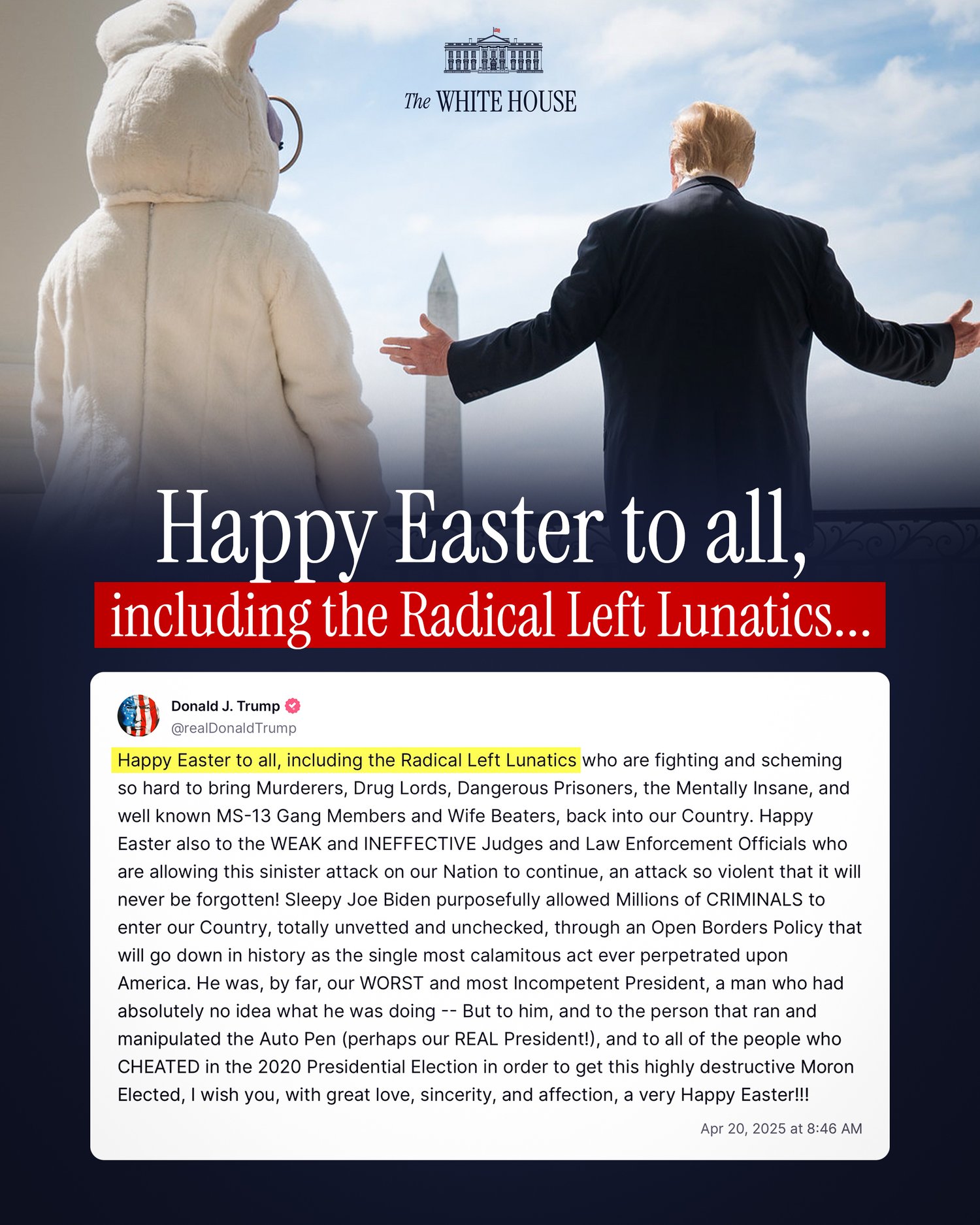
In other words, the Christian influence on actual Republican policy items and their political vision is going to be exceedingly negligible going forward. Sure, Vice President Vance will make an appearance at the March for Life. President Trump will show up to the National Prayer Breakfast. But even when he does acknowledge a Christian event, it often will come loaded with hatred and vile self-aggrandizement, as seen yesterday:
And ultimately when push comes to shove on the policy level, Christian concerns will always be backgrounded or eliminated relative to the priorities of the three above groups, as we have already seen on abortion, marriage, and PEPFAR.
I originally thought to post this on a Sunday, when my focus is narrower, but it didn’t fit there because I don’t value “religion” for its instrumental partisan-political value.
It was a very few years ago when I warned (as had others) “If you don’t like the Religious Right, just wait ‘till you see the irreligious Right.” Well you’ve been seeing them in power for three months now.
Beta-testing tyranny in the Sunshine State
Ron DeSantis walked so that Donald Trump could run. When the time came to formulate a policy response to the woke left, no one mattered more than the governor of Florida.
And through it all, DeSantis declared that Florida was the place where “woke goes to die.”
In his second term, Trump is a scaled-up version of DeSantis. Every element of the DeSantis model has been deployed against Trump’s ideological enemies …
…
At first I was optimistic about the anti-woke right. Their free speech argument resonated with me. I’d spent decades litigating free speech cases, after all, and I’d never really seen anything like a mass movement for free expression.
But my optimism quickly faded. In 2021, the anti-woke right embraced a series of state laws that were designed to ban critical race theory. Rather than meet critical race theorists in the marketplace of ideas, the right chose to try to suppress their expression.
By this time I was familiar with the right’s authoritarian turn — and getting very worried about it. In 2019, parts of the intellectual right were consumed with a fight over liberalism itself, with the new right arguing that liberal values — freedom of speech and free trade, for example — were hollowing out American culture, creating a nation of atomized individuals who were consumed with self-actualization (and consumption itself) at the expense of family and community.
Ironically, the left, now alarmed by the federal government’s intrusive reach [into, say, Harvard], bears direct responsibility for crafting the very legal weapons wielded against the universities it dominates. Almost four decades ago, progressive legislators demanded sweeping amendments to civil rights law, expanding federal oversight over higher education. The sequence of events reveals a cautionary tale of political hubris: progressive confidence that state power would reliably serve their ends overlooked the reality that governmental authority, once unleashed, recognizes no ideological master. Today’s circumstances starkly illustrate how expansive federal control over civil society, originally celebrated by progressives, returns to haunt its architects. The left’s outrage ought to focus not on this particular administration but on its own reckless empowerment of the state.
Yet for all its courage, Harvard’s response stopped short of making the argument that would best protect the values for which it was fighting. It defended the university’s independence without explaining why that independence deserves protection. It invoked values like “pluralism” and “inquiry,” but it did not fully explain why those values are essential to a liberal democratic society. The letter therefore missed an opportunity to articulate what a university is for — not just to students or donors, but to the country. And this matters, because Trump’s attack against this and other universities is not only about the balance of power between universities and the government. It is, at bottom, about the legitimacy of higher education as a public good.
The danger of being a professional exposer of the bogus is that, encountering it so often, one may come in time to cease to believe in the reality it counterfeits.
Your enemies are not demonic, and they are not all-powerful and the right hasn’t always lost and the left hasn’t always won. But if you convince yourself of that, you give yourselves all sorts of permission to do a lot of stupid and terrible things under the rubric of “Do you know what time it is?”
Regarding said “lot of stupid and terrible things,” my failure to call out anything about the current regime does not mean I approve. There’s just too much, and on some of the apparent illegalities I don’t want to abuse my credentials without thinking it through.
I don’t do any of the major social media, but I have two sub-domains of the domain you’re currently reading: (a) You can read most of my reflexive stuff, especially political here. (b) I also post some things on the only social medium I frequent, because people there are quirky, pleasant and real.
While every liberal democracy in the world claims to guarantee free expression in some form, the United States is essentially the only country where the government may not “take sides” on contentious issues by censoring expression based on the speaker’s viewpoint. As the post-October 7 examples show, many European countries have indeed taken a side in the public discourse over the Israeli-Palestinian conflict—in a way that might surprise many American observers: calls for a ceasefire and an end to what they see as an Israel-perpetrated genocide are criminally prohibited hate speech, while support for continued attacks is constitutionally protected. This strange result illustrates the unintended consequences of allowing governments to pick and choose which beliefs are unlawful “hate speech” and which are fair criticism.
The notion—dominant the in most of the world—that hateful speech is not “free speech” dates at least to the global post-World War II reckoning with Nazism …
How governments are responding to Israel-Gaza protests illustrates these radically diverging constitutional commitments to viewpoint neutrality. European national officials defended some of these pro-Palestinian restrictions primarily on public-order grounds more than stifling hate. But even so, the double standard implies that they view much of anti-Israeli speech as inherently anti-Semitic, and therefore, beyond the pale. This leads to a paradox, in which criticizing Muslims or Arabs as a group can constitute unlawful hate speech, but many expressions of support for Islamic-Arab groups are also prohibited, because of the threat that the government thinks those groups pose.
…
These examples offer a cautionary tale: When empowering the government to decide which beliefs are illegitimate, future policymakers may not use that power in ways you like or anticipate. They may even decide that your own viewpoints are the illegitimate ones—as with the song of South African anti-apartheid activists, “Shoot the Boer (i.e., white farmer)”; gender-critical feminists’ insistence that natal sex is critical to sexual orientation; and more recently, Palestinian advocates’ calls for a ceasefire and a “free Palestine.”
Scholars and activists celebrating new and stronger hate-speech laws might therefore consider Justice Hugo Black’s 1952 reaction to a (now largely discredited) decision upholding a conviction for disparaging Black Americans: “If there be minority groups who hail this [development] as their victory,” he wrote, they should contemplate Pyrrhus of Epirus’s observation: “Another such victory and I am undone.”
Kevin Cope, The Global Hate-Speech Conundrum via Eugene Volokh (bold added)
Too rich
We live in comforts that the richest of aristocrats not very long ago could never have dreamed of, and yet we claim that we are too poor to have more than a child or two. The truth is the reverse: we are too rich to have more than a child or two, too committed to work for work’s sake and to the purchase of prestige, mansions, the “best” schools, and toys for grown-ups.
In 1963, JFK signed the Community Mental Health Act. Its order to close the state psychiatric hospitals was followed, and hundreds were shuttered; the community mental health centers that were meant to replace them were never built …
In 1975, the Supreme Court’s O’Connor v. Donaldson decision established a national standard that the mentally ill could only be involuntarily treated if they represented an immediate threat to themselves or others. This completely removed actual medical necessity from the equation, and the standard directly incentivized hospitals to discharge very ill patients, many of whom leave these useless emergency room visits and immediately abuse drugs, self-harm, commit crimes, attack others, or commit suicide …
There are desperately ill, utterly impoverished, terribly vulnerable people living on the street right now. They are exactly the kind of people the left should fight for. But because we have become such a caricature of ourselves, we are incapable of acknowledging that some people really are fucked up, that some people really are dangerous, that some people really aren’t just different but are sick, ugly sick, violent sick, no-silver-lining sick. Not beautiful and poetic madness but drug addicted, horrifically paranoid, caked-in-shit sick. And what people like that need is to be forced into treatment to save their lives. But sunny, false notions that everyone muttering to themselves on the subway hides a sweet little self-actualized busy bee inside of them, and an impossibly myopic fixation on the abstract rights of people whose brains have hijacked their minds, has left us unable to provide the actual help the severely mentally ill need. I have found no way to penetrate the liberal consciousness on this issue. Because it’s conservatives, I guess, who complain about violence and disorder on the streets.
Even if I were still a single-issue (abortion) voter (I’m not; I’ve seen too many insane and/or phoney “pro-life” candidates), the GOP no longer make a compelling case on that issue.
Hamas Hyperbole, Media Credulity
In a May 6 report, the UN stated the death toll was 34,735, including 9,500 women and 14,500 children, or at least 24,000 civilians.
But two days later, the UN quietly revised its figures, stating that 50 percent fewer civilians had died. The total number of deaths is about the same at 34,844, but that number includes 4,959 women and 7,797 children—a total of 12,756 civilians. (And this from the United Nations, whose General Assembly adopted 15 resolutions on Israel in 2023, compared to seven for the rest of the world combined.)
This revision is the clearest sign yet that Hamas’s statistics cannot be trusted. As David Adesnik, senior fellow at the Foundation for the Defense of Democracies, says: “The UN should state clearly that it has lost confidence in sources whose credibility it has affirmed for months.”
…
Spencer says that even the revised UN figures probably overstate the death toll, because the numbers aren’t limited to people who were killed in the war. “The UN numbers include every death in Palestine no matter what the cause was,” Spencer told The Free Press. “Every natural death, missing person, anyone killed by Hamas.”
And yet, so far not a single major media platform, save Fox News, has reported on the new UN numbers.
On a Newsweek article skewering Viktor Orbán for his friendliness toward China:
China doesn’t give a damn what Hungary does with its borders, or with LGBT policy. That’s not to say that China doesn’t have and pursue its own interests. The Chinese are not altruists. It’s just that dealing with them, countries can preserve sovereignty in ways the West makes harder and harder to do.
Talk to African diplomats and lawmakers, and you’ll hear from them deep exasperation with the way Western countries constantly push feminist and LGBT ideology on them, as a condition of foreign aid. I invite you to spend just a little bit of time googling “LGBT”, “feminist” and “foreign policy”. Western institutions are as militantly evangelical about these ideologies as the Church was about religion in the Age of Discovery.
If your country wants and needs development aid, but wants to maintain cultural sovereignty, you’re going to look to China. To be very clear, Chinese support also has strings attached! But they are different strings. My point is simply that mindless cheerleaders for the Western establishment, like the Newsweek essayist, should make the effort to see what things look like to people outside the Greater American Empire.
Whenever I watch a Netflix show these days, it seems as if there are several themes that are yawningly predictable. One of them is the motif of the “strong woman.” (I’m not referring to the South Park “strong woman.” That is a subject for another day.)
I mean the way in which female characters must now almost always be shown to be people of unbelievable strength—including rather unbelievable physical strength. One reason the recent Amazon adaptation of J.R.R. Tolkien’s Lord of the Rings (called The Rings of Power) flopped is that it tried to push this motif at every turn. In one especially implausible scene, a “strong woman” fights off a whole horde of armor-clad men with her bare fists. We were meant to marvel at her strength. Most people reached for the off switch.
I didn’t make it past the first 15 minutes or so of The Rings of Power, but it took me 6 episodes to reach my limit on Apple TV’s Sugar, which ended with a similarly absurd show of superhuman strength.
Zero-sum
Maybe the prospective [wedding service] customers, like many Americans, do not see transcendent meaning in the ceremonial commencement of matrimony, because they associate a wedding as admittance to an institutional legal fiction that allows one access to nothing more than a cluster of political and social privileges not available to other friendships. So, given this understanding, it is not surprising that the customers see the provider’s refusal as a negative judgment on the public legitimacy of their union. Thus, it’s easy to see why the customers would be offended by the provider’s refusal and subsequently seek legal redress. But what the customers fail to see is that their demand that the courts force the providers to rescind their denial and be punished for it is really a demand that the state force the providers not to exercise their freedom of worship, the liberty not to participate in, or not provide assistance to, ceremonies that one believes have sacramental significance.
You can read most of my more impromptu stuff here and here (both of them cathartic venting, especially political) and here (the only social medium I frequent, because people there are quirky, pleasant and real). All should work in your RSS aggregator, like Feedly or Reeder, should you want to make a habit of it.
The ‘woke’ lot are not wrong about standpoint epistemology, they’re just too reductive about it, and they use the wrong metrics. They’re not wrong that it’s impossible to detach yourself entirely from your own background and perspective. And this is a paradigm shift that’s been accelerated by the decentralisation of authority in digital culture: personal authority now counts for more, as does being reflexive about your personal biases. If you want to have an impact now, it’s widely considered good practice and due diligence to acknowledge your own standpoint. I broadly agree with that. I think it’s a basic principle of intellectual hygiene to say: “I can only see things from my perspective and that means that I may have some blind spots.” In that respect, I’m a paid-up postmodernist.
This is the post-liberal shift in a nutshell. It says that we’re all implicated in what we’re dealing with, all of the time, and it’s just not possible to have a neutral public space. It follows from this that you cannot simply privatise moral goods. That follows logically from the acknowledgment that we’re all implicated in the mess of our condition. You can’t just say, “Well, I’m going to worry about myself, for my life is my business.” No, your life is everybody’s business. The question, then, is: which aspects of my life are whose business? And how and why, and who gets to say so? So, the ‘woke’ crowd are not entirely wrong to say that much of the public debate should orbit around questions of power. To say that everything is a question of power is far too reductive. That quickly takes things in a very nihilistic direction.
The big problem with the ‘woke’ movement, in fact, is that it’s not really postmodern. It’s largely a last attempt at modernism. It says, “If we can’t have a neutral shared public square, we’re just going to destroy all remaining shared meaning because that’s the only way we can all be free.” ‘Wokeness’ is, if you like, modernism’s final temper tantrum. But this temper tantrum, unfortunately, is now being institutionalised by HR departments.
If Mary Harrington is right (not so much in my quote, but from other parts of the long interview from which I took it), I’ve largely escaped my Boomer generation’s biases and become Gen-X adjacent: I’m pretty sure liberalism is doomed. That’s a Gen-X type conviction. But I’m still committed to what likely is a lost/doomed cause.
Reformers and vandals
Chesterton wrote that “the more modern type of reformer,” encountering a fence across a road, “goes gaily up to it and says, ‘I don’t see the use of this; let us clear it away.’ To which the more intelligent type of reformer will do well to answer: ‘If you don’t see the use of it, I certainly won’t let you clear it away. Go away and think. Then, when you can come back and tell me that you do see the use of it, I may allow you to destroy it.’” Our customs regarding sex and the family have been battered down without anyone’s caring about why they were there in the first place.
If Cleopatra were asked whether she was white or ‘B’lack, she probably would have met the query with a blank stare. Projecting your confused ideas about race onto historical figures is political — but only in the most embarrassingly vain and trifling sense of the word ….
In the Pensées, Pascal observed that “there are two equally dangerous extremes: to exclude reason, to admit nothing but reason.” With regard to language, we might say that there are two analogous extremes: to exclude the possibility that language can adequately express something truthful about the world, to admit only the truths language can convey. I would assent to the claim that there are truths beyond language. There are inexpressible realities and ineffable experiences. But language is itself a miracle and a gift of extraordinary range, power, and beauty. It is one thing to reach the limits of language by testing its resources and searching its depths, and another thing altogether to mistake our own apathy and incuriosity for the inherent limits of speech.
This week, I watched videos of people literally burning Harry Potter books, like latter-day Nazis, in the cause of transgender liberation. It’s safe to say, I think, that many of these people have lost their minds — just by staying online. And they not only think they’re perfectly sane; they think they’re heroes.
[I]t seems pretty clear that many schools are really ditching the SAT in response to the following sequence of events: Asian American SAT scores rose to the point where elite colleges were accused of discriminating against Asian American applicants to maintain the racial balance they desired, this led to lawsuits, and those lawsuits seem poised to yield a Supreme Court ruling against affirmative action. So universities are pre-emptively abandoning a metric that might be used against them in future litigation, not for the sake of widening opportunity but just in the hopes of sustaining the admissions status quo.
I’ve dubbed this fightback “reactionary feminism.” I use “reactionary” in recognition that “progress” in its contemporary form wages war on human nature. It views “freedom” as best served by reframing embodied men and women as atomized, de-sexed, fungible, and interchangeable “humans” composed of disembodied “identity” plus body parts that can be reordered at will, like meat LEGOs. And I use “feminism” in recognition of the fact that proposing to atomize, de-sex, and remodel “humans” has profound negative impacts on women.
[A] new technology has emerged, and those who stand to make billions off of it are telling you: you will never be lonely again; the meaning you’ve always pined for will be provided for you by superintelligent beings; you will not die, but have eternal life. Or, alternatively, you are soon to witness the end of the world, which will free you from everything you don’t like about your life and yourself. Either way – people are telling you that something very, very important is happening, and right now is important, and you live now, so you’re important, and you want to believe, have to believe, are desperate to believe. And so you do believe, even though it isn’t true.
At the end of his career, Limbaugh was defending—or allowing himself to be understood as defending—political violence, conspiracy theories, and even secessionism.
If you want to defend that by saying, “We’ll that’s what a lot of right-wingers believe today,” I won’t argue with you. I’m just not sure it’s the defense you think it is.
“This is f—ing madness!” [Tim] Miller exclaimed at one point in his piece.
Is it? It seems pretty rational to me.
It’s madness civically. No one who cares sincerely for this country would support returning a coup plotter to power. Every Trump endorsement is tantamount to the endorser declaring that they’re indifferent at best and hostile at worst to the project of American democracy.
But rationally? To behave rationally is to maximize one’s personal self-interest.
It seems to me Daines, Zeldin, and the rest have not only behaved rationally by endorsing Trump but that there’s no rational case—for now—for an influential Republican to endorse Ron DeSantis.
Samsung Electronics told staff not to use generative AI tools because of security concerns. In a staff memo, the company said that confidential code was accidentally leaked after engineers uploaded it to ChatGPT in April. It is the latest setback to the rollout of such technology in the workplace: financial firms such as Goldman Sachs have restricted employees’ use of similar platforms.
[I]t is hard to avoid the sense that today’s “tech” is more often a tax on the real economy, inflicting costs that don’t show up in any ledger because they are paid by you and me in the coin of nuisance.
Case in point. On May Day, I tried to order a bottomless dark roast coffee at a coffee house where I was setting up office for a few hours. It involved scanning a QR code, loading the app, trying to figure out how to “go dutch” despite the app knowing someone else was at the table (because they’d scanned the code, too). (I eventually ordered, a bit sullenly at the counter, where I had to return for every refill.)
Advice in the Deathworks
As I said in the first item, “I’m pretty sure liberalism is doomed.” I’m inclined to think that out civilization is doomed, too, though by that I do not mean that humanity will go extinct.
One of my wise cyberfriends is perhaps even more pessimistic than I am, but pessimism isn’t incompatible with hope:
Meanwhile, I will keep my head down and live the best life I can for me and mine and my community, as the natural forces of our particular system of governance play themselves out.
…
[A]s we straddle the globe, Tom McTague again offers some sobering statistics: 3,000 people sleep homeless in the U.K., while 113,000 sleep homeless in California alone: we have 7 murders per 100,000 nationwide, while Western Europe has 1, the rise in mass shootings are simply too grim to note the number; we lost 58,000 to fentanyl overdoses in 2020, while the entire EU lost 97; and our life expectancy is collapsing across all socioeconomic groups.
And so, our problems are deep and wide, the American Dream has taken a nightmarish turn, and “the situation is hopeless, but not serious.” But, it is Spring and my oakleaf hydrangeas are blooming. I have passed the 42-year mark on our marriage, and it looks like it is going to hold. My dog remains ever faithful. And—I have found a solution to keeping the squirrels out of our bird feeder. (I did not , however, take the advice of the woman who made our acquaintance in Walmart. She suggested that we grease the pole with Vaseline, as she does every morning.) So, in all sincerity, I can say that life is good. What an exciting time to be alive!
Terry Cowan, whose Substack I most heartily recommend, though (indeed, probably because) politics is not his regular beat. He doesn’t post often, but what he posts is really sane.
For all its piety and fervor, today’s United States needs to be recognized for what it really is: not a Christian country, but a nation of heretics.
You can read most of my more impromptu stuff here (cathartic venting) and here (the only social medium I frequent, because people there are quirky, pleasant and real). Both should work in your RSS aggregator, like Feedly or Reeder, should you want to make a habit of it.
I finally dipped my toe into ChatGPT, having been inspired by a story of a mom who used it to plan her child’s birthday party.
I had it draft a policy on delinquent tuition payment for a private school. High marks. Over the coming days, I’ll see what other logjams it can break on my project list.
I asked it “What are some real-world applications of the quadratic equation?” It gave a plausible answer, which I cannot evaluate since I haven’t used the equation since high school and cannot remember it. (If any kids are reading this, that’s probably because I became a lawyer, not an engineer.)
Since I get too easily enamored of technology, it behooves me to read smart critiques and concerns as they come along, if only to guide my personal conduct toward AI.
Nashville shooting
Journalistic lacunae
Why not explore [journalistically] how the attack on children and teachers in a Christian school affects Christians. This massacre may have been what some call a “hate-crime” against a religious group. And it’s odd that the community whose actual children were murdered seems less deserving of coverage than the community wrongly associated with a child-killer. It would be the equivalent of asking the Muslim community how they felt about a mass shooting in a synagogue, but never asking Jews.
It also seems legit to me to cover how violent memes and slogans and rhetoric can prime already-unstable people to commit violence. If it’s fair to call out the NRA’s materials after a mass killing (and I think it is), it’s also fair to note how common violent imagery and rhetoric has become in the TQIA+ world.
“Kill Terfs” is not a fringe slogan; it’s everywhere. A leader of the TQIA+ movement, Chase Strangio, has written that laws restricting child sex-changes are, in fact, laws to “criminalize known survival care for trans youth … That goal is akin to a goal of killing us.“ He has also claimed that his opponents “want to control and eradicate” trans people. Last weekend, a trans activist assaulted a gender-critical speaker with tomato juice in New Zealand, telling a crowd that “I want her to be full of blood, because that’s what she’s advocating for. She’s advocating for our genocide … our extermination.” The mob violently shut the event down. Then there are the many
grimacing skulls that promise “DEATH BEFORE DETRANSITION”, knives, baseball bats wrapped in barbed wire, assault rifles painted in the pastel tones of the trans flag, torrents of rape and death threats, the grim vow that “EVERY DAY IS TRANS DAY OF VENGEANCE.
And it would also be great if the press could fact-check not just the falsehood that trans people are more likely to murder, but also the idea, constantly reiterated by TQIA+ groups, of an “epidemic” of anti-trans, hate-motivated murders. That notion has been repeatedly debunked ….
I was just about ready to join the demand for release of the Nashville Christian School shooter’s reported “manifesto” when this brought me up short:
consider this other possibility: Might the shooter’s manifesto contain accusations of some kind against family, school, church or others? If that’s the case, police and legal officials may be investigating these claims before airing them to the public.
That’s not an entirely idle speculation, as you’ll see if you follow the hyperlink, nor is it implausible: an extremely conservative Presbyterian church in my hometown badly mishandled sexual abuse in the congregation.
So, yes, sooner or later we need to see the “manifesto.” If they’re investigating claims of the manifesto, it would be nice to know.
The Trump Indictment
Selected quotes
I’ve written a bit about the New York case against Trump, now gone to indictment. None of it was particularly original, and neither is this, but then I’m pretty selective about what sources I’ll spend time reading.
That said, some notable commentary by others:
David Frum notes that the charges might not even be about Stormy Daniels. (Deciding what a grand jury’s up to is a bit like reading chicken entrails.)
In his statement responding to the indictment, the former president said, “Never before in our Nation’s history has this been done.” But never before in our nation’s history have we had a president as dishonorable, as unethical, and as malicious as Donald Trump. (Peter Wehner)
There’s something very, well, Trumpy about this: He has a way of making everything sordid. Instead of a dramatic discussion about the meaning of accountability for a president who sought to overthrow the will of the voters to stay in power, we’re arguing about the dirty mechanics of hush-money payments to an adult-film star. (Quinta Jurecic)
I worry that a failed prosecution might strengthen Trump. Yet I’d also worry — even more — about the message of impunity that would be sent if prosecutors averted their eyes because the suspect was a former president. [Paragraph break omitted] The former president’s fixer, Michael Cohen, was sentenced to three years in prison for doing Trump’s bidding, and a fundamental principle of justice is that if an agent is punished, then the principal should be as well. That is not always feasible, and it may be difficult to replicate what a federal prosecution achieved in Cohen’s case. But the aim should be justice, and this indictment honors that aim. (Nicholas Kristoff, I Worry About a Failed Prosecution of Trump, but I Worry More About No Prosecution)
There is a counterargument that this is America’s moment for prosecutorial discretion to allow the country to recover and move on. As a teenager, I was outraged when President Gerald Ford pre-emptively pardoned former President Richard Nixon, yet over time I came to think that it was the right call and allowed the country to heal. Yet one difference is obvious: Nixon in 1974 was already completely discredited, ostracized and broken, while Trump denies any wrongdoing and is running again for the White House. (Nicholas Kristoff, I Worry About a Failed Prosecution of Trump, but I Worry More About No Prosecution)
Extradition
When someone on the Right accuses a progressive of being funded by George Soros, it damages my regard for the accuser more than for the accused. It’s a mark either of stupidity by the accuser or of his contempt for those listening. (The same goes for Lefties’ obsessions with the Koch brothers or Peter Thiel.)
Ron DeSantis is not stupid. You draw the necessary inference.
By the way, as Radley Balko points out, DeSantis famously removed a local prosecutor from office last year for declaring that he wouldn’t enforce the law as written for political reasons. That’s no different from what DeSantis himself is guilty of here [in claiming that “Florida will not assist in an extradition request”].
I want to leave a note here, because I expect to have many occasions to link back to it in the next several months.
Americans and Republicans, remember: You asked for this. Given the choice between a dozen solid conservatives and one Clinton-supporting con artist and game-show host, you chose the con artist. You chose him freely. Nobody made you do it.
I will be reminding you all of that, from time to time.
In a lot of ways, the reversal of party affiliation by the white working class, in increasingly by “POCs” in the working class, is the most astonishing part of the realignment since witless ape rode escalator.
Elite Populism
There is an elite version of populism that masquerades as technocracy.
I’m not sure who first said it, but it’s been observed that Trump’s fundamental political proposition is not really populism, or foreign policy isolationism, or economic protectionism. Trump’s political pitch is, simply, “I will destroy your enemies.” Which is part of what makes him a monster, his zeal for attacking his targets and the targets he picks. But when I see people who favor police and prison abolition exactly up until the police and prisons become useful tools to them, it convinces me even more that “I will destroy your enemies” is all that politics is. When you scrape the surface even a little bit, that’s all that you find, the will to destroy the other side.
I do not agree with Freddie on “all that politics is,” but he’s got an awfully good point about Trump.
Freddie gems
I am waiting for someone to tell me what the radical left approach to law and order adds up to, these days, other than an injunction against ever calling the cops for anything and people screaming on Twitter that it’s fine if you smoke meth in a crowded elevator. No one has taken me up on the offer to explain how any of this works. Because none of it works, and it’s not clear if it was ever intended to work as an actionable set of proposals. It’s all pose, all fashion. Three years after “defund the police” became a ubiquitous slogan in left spaces, nobody knows what it means, nobody feels any pressure to figure that out, but everyone is still sure that if you expect any enforcement of basic order at all, you’re a fascist.
Trump stood for very little in any conventional political terms, barely attempted to define a political agenda on the campaign trail, and was most notable in policy terms for his willingness to defend Medicare and Social Security after Paul Ryan’s former stranglehold on Republican fiscal ideals. Instead, he offered the ritualistic scourging of the people his fans found detestable – first in the primary, mocking John McCain and Jeb Bush and whoever else stood in his way, then the effete liberals who were allowing immigrants and criminals to ruin the country. His potential successor, Ron Desantis, is something of an idea man, but he tilts those ideas towards the urge to destroy constantly. His signature policies are all oriented towards reminding voters that he will target their enemies and use government to oppose them. He has to; it’s a political necessity for a 21st-century Republican with great ambitions.
What all of us have to recognize is that the nihilism and score-settling of the past seven years are not the fault of a single awful man but emergent properties of a toxicity deeply embedded in the guts of this country. We can’t cure that toxicity if we spend all of our time diagnosing it in the other side. Of course I think Republicans are mostly to blame. But that belief tells us nothing about how to build a better, healthier political culture.
Here’s the funny thing: while conservatives balk at even the mildest gun control efforts on account of it being a slippery slope (fine), progressives have absolutely no intention of enforcing even existing gun control laws. What could I mean by this? Just listen to Philadelphia District Attorney Larry Krasner this week on how his office won’t prosecute illegal gun possession:
We do not believe that arresting people and convicting them for illegal gun possession is a viable strategy to reduce shootings,” the DA’s office said.
This is the ur-progressive prosecutor, saying gun control doesn’t stop shootings and that he’s just not going to do it. Because enforcing gun control laws would mean—it’s almost too terrible to say—enforcing laws. And that’s a line that America’s progressive prosecutors simply cannot cross.
Gun control gets a boost every time there’s a mass shooting, especially of schoolchildren. But when you get into the weeds, the details, where the devil notoriously lurks, it’s far from obvious what to do. We can wish that we’d never become so gun-infatuated as a nation, but we did.
Kevin D. Williamson demolishes (as have countless others before him) the case against the AR-15 in The Washington Post Misfires—Again. The only thing particularly dangerous about the AR-15 seems to be its cool factor, its status as an icon of toughness.
So what now? “Do something! (however symbolic, ill-advised or constitutionally provocative)” is not an answer I’ll accept.
Challenge
Purity … is NOT the one thing needful; and it is better that a life should contract many a dirt-mark, than forfeit usefulness in its efforts to remain unspotted.
William James
Pure religion and undefiled before God and the Father is this, To visit the fatherless and widows in their affliction, and to keep himself unspotted from the world.
If I were to support, much less endorse, Donald Trump for president, I would actually have to go back and apologize to former President Bill Clinton.
Southern Baptist Seminary President Al Mohler, 2016. “By 2020, Mohler had nonetheless become a public supporter of Trump, even standing by his vote for Trump after the Jan. 6 insurrection. ‘Based upon the binary choice we faced on November the third, I believe then that that was the right action to take,’ Mohler said on his podcast on January 7, 2021. ‘And going back to November the third, I would do the same thing again.’ To my knowledge, Mohler has yet to issue an apology to Bill Clinton.” (Robert P. Jones, Why a Trump indictment will matter so little to most of his Christian supporters)
Then the angel of the Lord went forth, and smote in the camp of the Assyrians a hundred and fourscore and five thousand: and when they arose early in the morning, behold, they were all dead corpses.
Isaiah 37:36 (King James Version)
‘Traditional art invites a look’, she wrote. ‘[Modernist art] engenders a stare’. The stare is not known for building bridges with others, or the world at large: instead it suggests alienation, either a need to control, or a feeling of terrified helplessness.
Iain McGilchrist, The Master and His Emissary. (I don’t recall who he was quoting.)
Disneyland is presented as imaginary in order to make us believe that the rest [of America] is real.
You can read most of my more impromptu stuff here (cathartic venting) and here (the only social medium I frequent, because people there are quirky, pleasant and real). Both should work in your RSS aggregator, like Feedly or Reeder, should you want to make a habit of it.
Over a third of our college seniors couldn’t show any significant cognitive gain for their college years.
Michael Poliakoff, president of the American Council of Trustees and Alumni via William McGurn.
Saucing geese and ganders
[T]he wrongs wrought by [university DEI policies] are three: First, by folding socio-political goals into the process for tenure and promotion the policy conflates those ends with professional qualifications. This conflation infringes academic freedom. Further, were it to become acceptable for a university to commandeer its faculty toward socio-political ends, made part of the faculty’s professorial obligations, there would be no principled reason why those who fund the institution—the legislatures—should not impose those socio-political ends that they hold dear.
Note well that last sentence, particularly if you commend DEI and contemn Ron DeSantis’s dealings with New College Florida.
What happens on campus doesn’t stay on campus
For a long time we tolerated campus behavior much as we used to tolerate the behavior of toddlers. They’ll grow out of it, we thought, when they enter the real world. But the joke was on us. They graduated into the real world and started to impose their views on it. Weak-kneed managers, eager to protect their privileges and preserve a quiet life, couldn’t face the hostility they’d get from their employees and a media of the same ideological mindset always willing to air the grievances.
We see the implications—occasionally bursting into the open—as when the New York Times forced its opinion editor to resign for publishing an article the radicals didn’t like, or Google dropping a Pentagon contract because employees objected to helping the U.S. defend itself. Most of the time it advances without publicity, as steadily, day by day, the former campus totalitarians make their way in the “real world.”
It’s time employers started to resist, and began to educate their employees—the hard way if necessary—why free speech is so important.
If the Red Ryder BB gun is an artifact of an America in which little boys dreamed of growing up to be cowboys, then the omnipresent AR-pattern rifle testifies to a world in which the great masculine ideals are SEALs and snipers. SOCOM stands for “Special Operations Command,” but you’ll see that acronym deployed at least as often in firearms-related marketing material as you will in actual military reports.
(Incidentally, I was going to link to a “SOCOM” example above, but I am at the moment working from the cafe of a Whole Foods Market, which apparently employs a digital nanny that blocks U.S. gun-manufacturer websites. The link to the Communist Party of China works just fine. It’s a funny old world.)
I am not particularly worried about a new poll everyone keeps talking about that shows collapse of civic virtues.
It’s not just that a knowledgeable pollster counsels caution about this particular due to a change in the pollster’s methodology (internet polling verses phone interview). It’s that I’ve already noted, polling aside, collapse of much about America and I don’t find quantification of it worth my time.
Progress in the 21st century
In the 21st century, Progress means the unbounded forward march of commerce and technology. And any effort at all to set any limits on that forward march, by calling for limits on the free global movement of low-skilled labour, for example, makes you far-Right by definition. As for asserting a sexed limit to self-identification, this also amounts to standing athwart the march of commerce and technology, yelling “Stop!”.
Is Rowling a notorious liar? Are her critics clairvoyant? Are they grievance-pickers?
ICYMI
Hence the old parable about a vacationing New York businessman who gets talking to a Mexican fisherman, who tells him that he works only a few hours per day and spends most of his time drinking wine in the sun and playing music with his friends. Appalled at the fisherman’s approach to time management, the businessman offers him an unsolicited piece of advice: if the fisherman worked harder, he explains, he could invest the profits in a bigger fleet of boats, pay others to do the fishing, make millions, then retire early. “And what would I do then?” the fisherman asks. “Ah, well, then,” the businessman replies, “you could spend your days drinking wine in the sun and playing music with your friends.”
the Ukraine episode showed how Trump and DeSantis, each lionized by their admirers as men of conviction, are opposites in a sense. Trump has extreme instincts but was deterred repeatedly from following them by his advisers while in office. DeSantis, by contrast, works his will routinely in governing Florida but retreated toward a mainstream position on Ukraine when his initial reaction proved too extreme for some of his fans.
Who is the candidate of disruption between the two? The radical who doesn’t know how to govern effectively or the effective governor whose radicalism is shallow?
On Wednesday, as the frenzied mob of Trump enthusiasts desecrated the US Capitol, I had to go into Coeur d’Alene to run a few errands. On the street I saw a group of men and women gathered together, glued to their phones in ecstatic glee. I went into a store, where two men approached me to check if I’d heard the wonderful news about the invasion of the Capitol. They announced that the people are taking power, and this is just the beginning of a new revolution.
“And when the revolution arrives in this town,” they told me, “we’ll be driving all the liberals and BLM people into the hills.”
…[W]hen these men announced that they hoped the storming of the Capitol would culminate in the violent expulsion of their political rivals from town, I replied, “In a free society, people have the right to be jerks if they want to.” I was shouted down by everyone in the store. “Not anymore!” they yelled. “Things are different now.”
You can read most of my more impromptu stuff here (cathartic venting) and here (the only social medium I frequent, because people there are quirky, pleasant and real). Both should work in your RSS aggregator, like Feedly or Reeder, should you want to make a habit of it.
For several hours on December 18, 2020, some of the greatest legal minds of a generation gathered at the White House for a meeting that would change the course of history. Sidney Powell was there, as were onetime national security adviser Michael Flynn and former Overstock CEO Patrick Byrne. Rudy Giuliani showed up, as did Mark Meadows. Shortly after it concluded, then-President Donald Trump sent a tweet.
“Statistically impossible to have lost the 2020 Election,” he wrote. “Big protest in D.C. on January 6th. Be there, will be wild!”
It’s a bit of a false note for the Dispatch to lead with such snark, but I like that false note this time.
Church and State
Colorado Republican Rep. Lauren Boebert caused a stir in late June when she denounced the separation of church and state as “junk” and proclaimed that “the church is supposed to direct the government, the government is not supposed to direct the church.” Bettering her usual performance, she was half-right.
People can’t predict how long they will be happy with recently acquired objects, how long their marriages will last, how their new jobs will turn out, yet it’s subatomic particles that they cite as “limits of prediction.” They’re ignoring a mammoth standing in front of them in favor of matter even a microscope would not allow them to see.
As I watched Ms. Barrett fielding questions from senators [at confirmation hearings], I realized two things.
First, it is amazing how deeply this erasure cuts, how much I have subconsciously internalized that there is something defective about me as a woman because I do not share certain feminist tenets. … Second, I realized how many women I know—most who would not identify with the moniker “conservative”—share Ms. Barrett’s pro-life position and have felt chastened into civic silence and submission. … Too often, I keep my views quiet not out of tact but for the sake of my social life and career. In this, I submit not to the patriarchy but to the oppressive, mainstream feminist vision of myself and my peers and what we are worth to society.
Regardless of whether the committee proves Trump legally culpable for January 6, at least one top Trump adviser held him morally responsible for that day. After police shot and killed Trump supporter Ashli Babbitt as she attempted to breach the Capitol, Trump’s former campaign manager Brad Parscale texted Trump operative Katrina Pierson. “This is about Trump pushing for uncertainty in our country,” Parscale—who worked on both the 2016 and 2020 campaigns—wrote, in messages provided by the Committee. “A sitting president asking for civil war. This week I felt guilty for helping him win [in 2016].”
“You did what you felt right at the time and therefore it was right,” Pierson replied.
“Yeah,” Parscale wrote. “But a woman is dead.”
“You do realize this was going to happen,” Pierson said.
“Yeah,” Parscale said. “If I was Trump and knew my rhetoric killed someone.”
“It wasn’t the rhetoric.”
“Katrina. Yes it was.”
One month later, Parscale tweeted: “Statement to Trump: ‘If they only impeached you twice, you need to run again… I’m in, are you?’”
Normal bad, not existential threat
Since it’s clear (at least for now) that Ron DeSantis is the Republican most likely to unseat Donald Trump, we’re starting to see a predictable line of pieces online. Trump is bad, but DeSantis might be worse. Trump was incompetent authoritarian. DeSantis is ruthlessly efficient. You can read versions of that argument in MSNBC, the Washington Post, MSNBC, New YorkMagazine, and MSNBC.
I started reading many of these pieces earlier this morning, and I finished just as today’s January 6 Committee hearing got underway. The contrast, quite frankly, was jarring. One the one hand, DeSantis’s critics were describing a politician who played by the rules to enact policies they didn’t like. On the other hand, I watched yet another account of a politician who came within one Mike Pence “yes” (to his harebrained electors scheme) to plunging America into the worst constitutional crisis since 1861.
Let me make this analysis as simple as possible. Donald Trump presents an existential threat to the continued existence of the United States as an intact republic. Our nation may not survive a second Trump term. Ron DeSantis has his flaws, but he’s absolutely within the bounds of a mainstream American politician.
I was tempted to stop there, but I read on. French is not happy with DeSantis and spells out clearly why he’s not. Progressive Democrats won’t like his analysis, though.
Introduction to the analysis:
My critique of DeSantis has less to do with Donald Trump and more to do with Kamala Harris or Gavin Newsom. By that I mean that DeSantis is more like a California Democrat than he is like Donald Trump. Specifically, both DeSantis and Harris are culture warriors who are prone to fight the culture the wrong way—by deploying state power at the expense of civil liberties.
Portraits in Credulity
Can you believe that 38 percent of Democrats are LGBT? And that a whopping 44 percent of Republicans earn over $250,000 per year? Those stats are from a 2018 study published by the University of Chicago based on 2015 data, but I may have messed up the delivery a little. Actually, it’s that Republicans in the study reported that 38 percent of Democrats are LGBT and Democrats believe that nearly half of Republicans make a quarter-million dollars a year. In truth, 6 percent of Democrats identify as LGBT and 2 percent of Republicans earn that high a salary. Democrats, themselves, also overestimated the number of LGBT members in their own party. But out-group members were far more likely to misperceive the opposing party’s makeup.
And aside from partisanship, interest in politics was also a great predictor of who was more likely to be wrong, i.e., consuming more political news and social media made a respondent more likely to misjudge the makeup of either party. “Interest in political news will be positively correlated with beliefs about the share of partisans belonging to party-stereotypical groups,” the authors reported.
I’d suspect these biases have gotten worse since 2015. But as I keep seeing surveys about young people refusing to be friends with someone who doesn’t share their political beliefs or people who don’t understand that social media curates their feed to show them political content that is most likely to agree with and shield them from alternative viewpoints, it’s worth a reminder that there’s no substitute—not even this newsletter—for striking up a conversation in the grocery store line, calling up a potential new friend for a beer, or asking someone a question about how he views the world and actually listening to the answer. Good luck!
Sarah Isgur, Andrew Egger, and Audrey Fahlberg, The Sweep (a publication of The Dispatch, my very best media expenditure).
Turning the tables
New York Governor Kathy Hochul recently allocated $35 million to provide special assistance to abortion providers, and there is a proposal to subsidize women’s travel to New York to procure abortions. In New York City, homeless men urinate in doorways and drug addicts shoot up in public at midday. In the face of these realities, Hochul’s commitment of resources to ensure the wide availability of abortion services seems more than a little perverse. The contrasts are even starker in Illinois. As the death toll of gun violence increases on Chicago’s South Side, Governor J. B. Pritzker has called for a special legislative session to address, not the murder rate, but “reproductive rights.”
It’s a dubious form of argument, but the temptation to turn it against those who’ve used it for 49 years is powerful. In other words, who’s obsessed with sex now?
GOP Gift-in-Kind to Stacy Abrams
What I like to do is see it and everything and stuff.
Herschel Walker, Republican nominee for Governor of Georgia, responding to a CNN reporter’s question about whether there should be new gun legislation in the wake of the Uvalde shootings. (H/T John McWhorter)
Consider his candidacy the Republican contribution to Stacy Abrams’ campaign.
Locus classicus
"I don’t want comfort. I want God, I want poetry, I want real danger, I want freedom, I want goodness. I want sin.” “In fact,” said Mustapha Mond, “you’re claiming the right to be unhappy.” “All right then,” said the Savage defiantly, “I’m claiming the right to be unhappy.”
Aldous Huxley, Brave New World.
If people have always said it, it is probably true; it is the distilled wisdom of the ages. If people have not always said it, but everybody is saying it now, it is probably a lie; it is the concentrated madness of the moment.
You can read most of my more impromptu stuff here (cathartic venting) and here (the only social medium I frequent, because people there are quirky, pleasant and real). Both should work in your RSS aggregator, like Feedly or Reeder, should you want to make a habit of it.


 Tipsy Teetotaler ن