Semiquicentennial (and other things)

Semiquicentennial

Burnt-Over America

I thought it would be nice to limit this post to observations on the Semiquicentennial but, alas, it was not to be. Only this item and the next are so timely.

I’ve read quite a lot of religious history, including (maybe even disproportionately) the religious history of this nation of heretics. Among the most important influences of American religion is the revivalism and religious ferment of the so-called burnt-over district in New York state, where revival followed revival and where many of our most marginal Christian-ish groups, like Mormons and Seventh-Day Adventists, were born amidst a seemingly unchallenged conviction that real Christianity had been lost and needed to be “restored.”

But my focus was on the ferment and spawning of group after group of restorationists. I sort of ignored that “burnt-over district” implies exhaustion of fuel with little left but ashes:

Charles Grandison Finney (1792–1875) popularized the term: his posthumous 1876 book Autobiography of Charles G. Finney referred to a “burnt district” to denote an area in central and western New York State during the Second Awakening:

I found that region of country what, in the western phrase, would be called, a “burnt district.” There had been, a few years previously, a wild excitement passing through that region, which they called a revival of religion, but which turned out to be spurious. … It was reported as having been a very extravagant excitement; and resulted in a reaction so extensive and profound, as to leave the impression on many minds that religion was a mere delusion. A great many men seemed to be settled in that conviction. Taking what they had seen as a specimen of a revival of religion, they felt justified in opposing anything looking toward the promoting of a revival.

Wikipedia

And indeed, I understand that the former burnt-over district is uncommonly disinterested in religion still today.

Leave it to David French to see this as metaphor for America as a political burnt-over district. People are so much of the mind “I just can’t even” that Trump is getting away with corruption on a scale unprecedented in our history. Meanwhile, antisemitic crypto-communists are ascendent in the Democrat party.

I can scarcely bear to bear to look any more, but through long habit (and a desire for topics readers might find interesting) it’s hard to look away, too.

I personally can’t imagine voting for the party of MAGA or the Democrats, who just when we need them most seem to be succumbing to extremely radical Democratic Socialists of America (i.e., they despise AOC, for instance, as too mainstream) that founder Michael Harrington wouldn’t recognize.

And I don’t even care that I don’t care. I’ve heard that I’m not alone in feeling that way.

In January the president was asked why members of his family had begun doing business overseas during his second term when they had sworn off doing so during his first. If perceptions of influence-peddling were enough to put them off the practice once before, why would he and they engage in it orgiastically now?

“I found out that nobody cared,” he replied, matter-of-factly.

That’s classic Trump. On the one hand, it’s a pristine vista onto a criminal mind. Moral misgivings about monetizing one’s public office are nowhere in sight, nor is there any interest in setting a good example or anxiety about the civic consequences of letting an appearance of impropriety go uncorrected. To him, the question is simply whether the crime, once committed, is likely to go unpunished. If so, proceed.

On the other hand, he’s right. For all intents and purposes, nobody cares.

Nick Catoggio, who first turned my mind to this morose thought. Then French added the metaphor and cemented it.

I’m burnt over on politics. Maybe you are, too.

Pray for America. I do so daily — not that God would Make America Great Again, but more along the lines that we’d repent, and become good for the long run.

Vive la France!

This is a time for thinking about the things we like and love best about these United States but there is a national shortcoming weighing on me that I feel compelled to mention: Of all the many regrettable political developments of the past dozen years, the most regrettable is the fact that the United States has become such a poor friend and a shabby ally, and not only to the French. Americans sneer at NATO, an alliance organized around a collective-defense provision that has been invoked precisely once in its history: rallying to the defense of the United States after the terrorist attacks of September 11, 2001. Americans lament—not without reason—the expense of what seems to many to have been a pointless war in Afghanistan, and we mourn the loss of American lives there. We are less likely to mention the 457 British soldiers who gave their lives in that conflict, the 159 Canadians, the 90 French, the 62 Germans, the 53 Italians, the 44 Poles, the 44 Danes, and the Australians, Spanish, Georgians, Romanians, Dutch, Turks, Czechs, New Zealanders, and Norwegians. When the United States under Joe Biden decided to suddenly quit Afghanistan, our government did so with hardly any consultation with the allies who had fought and died beside us there. It was a blunder and an insult. The same administration blindsided the French with the AUKUS agreement that, among other things, torpedoed a French-Australian submarine project–another blunder, another insult. The succeeding administration, it goes without saying, has done everything within its considerable power to make things worse with its childish displays of incompetence, ingratitude, and resentment. There is a certain horrifying symmetry at work: Donald Trump, a man without friends, presides over a nation without allies–or one that will be without allies if we continue on our current course.

We didn’t get to 250 by ourselves. There have been times when the United States has carried the world on its back—and times when the United States has been borne up by our friends and allies. We never forget when it’s been us doing the heavy lifting—but we are, at times, shamefully forgetful of what others have done for us.

God bless America, yes. We will need His blessing. 

But, also: God bless the friends and allies who have invested their own blood and treasure in the extraordinary project of liberty that we took up 250 years ago. Vive la France!

Kevin D. Williamson

The Other Stuff

SCOTUS

Right outcome, wrong rationale

It was a grievous disappointment to the sort of person whose interest in Republican politics is coextensive with their interest in “the Great Replacement,” which describes a lot of Trump voters. And it’s no answer to tell them that the decision did nothing more than uphold the law as it’s stood for ages. The point of the revolution is to overturn the law as it’s stood for ages. What do you think the word “postliberal” means, exactly?

Jonah Goldberg is correct that the new right’s difficulty with that language resembles the left’s difficulty with the Second Amendment more so than conservatives’ difficulty with abortion: “It can’t mean what it says because I really don’t want it to!”

Liberalism cares about process, postliberalism cares only about results … Conservatives wouldn’t want a court full of hacks and chuds but postliberals would welcome it.

Nick Catoggio

Because I’m a conservative (i.e., a “right-liberal”) who cares about process, I’m going to eat my words about a result I liked. I wrote: “I’m glad SCOTUS decided the birthright citizenship case as it did because I think the language of the citizenship clause is clear” (italics added). I now, reluctantly, retract that.

I’m reluctant because I think that the Citizenship clause of the 14th amendment is clear enough that we don’t need to look at its “legislative history.”

But there’s a canon besides that “textualist” one: avoid constitutional decisions if there’s a narrower basis. In this case, one or two twentieth-century statutes recognizing birthright citizenship would have trumped Trump’s Executive Order and disposed of the case, leaving the constitutional question for another day should our MAGA Congress repeal those statutes. This narrower statutory basis was what Justice Kavanaugh advocated in his concurrence.

My only excuses for this error are: (1) all the buzz was about the 14th amendment; (2) my perception of the clarity of that amendment’s citizenship clause riveted my attention.

I’m pretty happy with Justice Kavanaugh. I deplore his underage binge-drinking, but he’s not underage any more, and as another underappreciated public figure (not to mention sundry songsters) once said when asked to explain a blemish on his youthful record, “when I was young and foolish, I was young and foolish.”

(David Post at the Volokh Conspiracy blog also commends Kavanaugh’s approach. Some Thoughts on the Court’s Opinion(s) in the Birthright Citizenship Case. I got there before he did, but I’ve been aggregating thing for another multi-topic blogpost.)

The timing couldn’t be worse

Speaking of SCOTUS decisions, I’ve lamented that the “Unitary Executive” theory is being so vigorously exercised by this particularly corrupt and personalist administration, but I sort of assumed the theory simpliciter was correct, probably because it’s pretty easy to understand and apply, partly because it has been supported even by my (non-MAGA) conservative tribe.

Now that it’s 11:59 on the Unitary Executive doomsday clock, I’m reconsidering my position.

[T]here is no question that the federal government needs to delegate authority to officials with the knowledge, skills, and expertise needed to run a complex modern state, and that Congress ought to be able to play a role in protecting that delegated authority.

Francis Fukuyama. See also George Will, Lawrence Lessig & Cass R. Sunstein, and Federalist Papers 51 (James Madison) (not all of which I’ve read as I write)

Donald Trump has demonstrated that he doesn’t really care about running our complex modern state so long as he’s serviced by Cabinet members and agency heads who will tongue-shine his shoes and he can line his pockets with impunity. Even if SCOTUS is right about this, the timing could hardly be worse.

Why the carve-out for the Fed?

For my money, one of the worst decisions of the term came (fittingly) on the same day as Slaughter, and it nicely illustrates the difference between ad hoc, bad-faith reasoning and its opposite. That was Trump v. Cook, the 5-4 decision in which Roberts, along with Kavanaugh and the court’s three liberals, held that Lisa Cook of the Federal Reserve’s Board of Governors could remain in her position while she fights Trump’s attempt to fire her. This, in effect, creates a carve out for the Federal Reserve from the presidential firing power enhanced by Slaughter. Why does the Fed alone receive such special protection? Because, Roberts argued, “the appearance of independence is key to the Federal Reserve’s design.” That’s true. But then how is an independent Fed compatible with the Constitution when the ostensible independence of other agencies is supposedly incompatible with the Constitution?

The argument appears to be that the consequences of undermining the appearance of Fed independence would be bad for American monetary policy and stability. No doubt it would be. But if it’s legitimate to think in terms of the consequences in the case of denying Fed independence, why not when it comes to denying the independence of other federal agencies? The distinction sounds arbitrary to me—unless one grants the Marxist premise that it’s perfectly “normal” for capital to warp the rules of the capitalist system around itself. (I hate granting Marxist premises, but when reality vindicates them, what else am I supposed to do?)

Damon Linker, Two Cheers for the SCOTUS Term.

It’s hard to argue with Linker on this. “Just an eensy-weensy fourth branch to protect money” has a foul odor to it.

Wooden Ships

(Song of my youth that I love)

If you smile at me, I will understand
'Cause that is something everybody everywhere does
In the same language
I can see by your coat, my friend
You're from the other side
There's just one thing I got to know
Can you tell me please, who won?
Say, can I have some of your purple berries?
Yes, I've been eating them for six or seven weeks now
Haven't got sick once
Probably keep us both alive
Wooden ships on the water, very free and easy
Easy, you know the way it's supposed to be
Silver people on the shoreline, let us be
Talkin' 'bout very free and easy
Horror grips us as we watch you die
All we can do is echo your anguished cries
Stare as all human feelings die
We are leaving, you don't need us
Go, take your sister then, by the hand
Lead her away from this foreign land
Far away, where we might laugh again
We are leaving, you don't need us
And it's a fair wind blowin' warm
Out of the south over my shoulder
Guess I'll set a course and go

Crosby, Stills & Nash, or one of its reshufflings, Wooden Ships. Sorry that my stylesheet renders the lyrics monospaced, like a typewriter.

Buy Me a Coffee or Substack? Well, it depends.

I have never quite brought myself to the point of saying I will never move to Substack. The reason? Because I know I could make a lot more money on Substack than I make by using Buy Me a Coffee. Indeed, people remind me of this! My friend Freddie deBoer wrote to me recently to say that a post of mine would have done gangbusters on Substack — which would have meant a lot of people impulse-buying subscriptions. That’s the thing about being in that platform ecosystem: thanks to network effects, you get the impulse buyers. That does not happen on Buy Me a Coffee. You all have had to be really intentional about supporting me, which is a great thing. 

Why is it a great thing? Because by writing on the open web and merely asking for support, I have wholly escaped the pressures that come when people have paid money to see your writing and therefore have certain expectations for what you say and how you say it. Also escaped: that other kind of pressure that comes when people really like one particular post and show their liking with money — which plants the idea in the back of your head that you need to write more posts like that … whether you really want to or not. By contrast, y’all have supported me because you see what the whole package is, and know what you’re getting and are likely to continue to get. That’s really wonderful. So I have every reason to keep writing for the open web and merely requesting/hoping for your contributions.

Well, every reason but one, anyway. Why haven’t I forsworn Substack? Simple: I’m afraid that when I retire next year and take a big financial hit, I’ll be poor, or significantly poorer anyway, unless I hawk my wares on that platform. Which is pathetic. That attitude is unworthy of a mature Christian man.

So — taking a deep breath here — I solemnly affirm before God and my fellow humans that I will never write on Substack. There, I said it. If no one supports my writing I’ll work as a greeter at Walmart — but as for my personal online writing, I pledge my troth to the open web! You heard it here first.

Alan Jacobs. I’m glad I can write as I wish, not as readers might wish, and not for money.

Secularization ——> Anxious Religiosity

Whatever you heard in the early 2000s, reports of the death of transcendence have been greatly exaggerated. Secularization seems instead to provoke anxious religiosity, like a bird with no place to land. The hallowing of the sacred flame at Gettysburg is matched by an equally intense desacralizing instinct, yet even that zealous iconoclasm has a mystic quality of its own.

When I visited the Hudson Valley School painter Thomas Cole’s house in upstate New York, I noticed a tag informing me that an object had been “owned by an enslaver” (or words to that effect). I was struck by the implication that the object was stained somehow. We might not use the word “sin” anymore, but the concept is still there. The extreme scrupulosity, combined – naturally – with an Indigenous land acknowledgment, wasn’t even for Thomas Cole, but for the people who had owned the house before him. My goodness, I thought, how stressful it must be to live in a constant state of confession of an ancestor’s sins. The past is never dead. It’s not even past.

Hannah Long, Hallowed and Haunted

Shorts

  • The Republican Party worshiped the god of political expediency. Once political power became their idol, they lost control. (Nancy French, Ghosted)
  • I got a head start because my ancestors started practicing miscegenation before it was fashionable … In my symbolic family tree there’s a place for Mahatma Gandhi, Anna Akhmatova, Duke Ellington, Mister Rogers, Sappho, Anthony Bourdain, Julian of Norwich, Virginia Woolf, Miguel de Unamuno, Rainer Maria Rilke, Audrey Hepburn, Willa Cather, Cary Grant, Søren Kierkegaard, Frederick Douglass, Hannah Arendt, and many others. (Ted Gioia, reflecting on his identity as an American both in terms of physical inheritance and of chosen influences.)
  • Was Jeannie Gates right about America?
  • “If you invested $10,000 in Trump coin on January 20th, 2025, it would be worth $415 today. You lost everything. He made half a billion,” – Chris Mowrey via Andrew Sullivan.
  • “[Trump has] made more money in one year than his entire life combined. That’s not business, it’s corruption,” – Fred Wellman via Andrew Sullivan.
  • “Intel came in. They had a problem. I said, ‘I can solve your problem, but I want 10% of the company,’” – Donald Trump via Andrew Sullivan.
  • Facebook, Fox and MSNBC have done to our parents what they warned computer gaming would do to us. (Jonah Goldberg)

Elsewhere in Tipsyworld


Your enemies are not demonic, and they are not all-powerful and the right hasn’t always lost and the left hasn’t always won. But if you convince yourself of that, you give yourselves all sorts of permission to do a lot of stupid and terrible things under the rubric of “Do you know what time it is?”

Jonah Goldberg

I don’t do any of the major social media, but I have two sub-domains of the domain you’re currently reading: (a) You can read most of my reflexive stuff, especially political here. (b) I also post some things on my favorite no-algorithm social medium.

UPDATE: Boy, that’s kind of embarrassing. I thought I had finally figured out what this big birthday was called, and I published this using the term “semisesquicentennial.” That was so wrong that I couldn’t bear leaving it – or pretending it never happened.
Solstice Eve

The University As We Know It Is Finished

Nils Gilman, The University As We Know It Is Finished strikes me as a pretty good overview of what AI means to “the University as we know it.” I’ve been a bit disappointed with my subscription to Persuasion, but this makes up for a lot of boring articles.

I’ve long (always?) been ambivalent about the University as we know it. I’ve been under the impression that the “Oxbridge” way of educating surpasses even our most exclusive and competitive universities. I’ve lamented the tentacles of the military-industrial complex extending into our science and engineering colleges. I cynically am tempted to think of universities as nothing more than credential factories (except for the bit that’s drunken whorehouse).

The new reality surely will be different. I hope it will be better. If it is, I don’t see how it will avoid shrinking down to fit the relatively few young citizens who can actually knuckle down and grapple with the great and perennial issues of mankind. I’m kind of worried about the value of my fractional ownerships of student housing apartments.

But I’m kind of excited, despite my inner Eeyore, about what may emerge after what promises to be tumultuous and probably rapid change. Although I’m too conservative temperamentally to tear things down from any instinct that the replacement couldn’t be worse (see Damon Linker on that, in Shorts below), I can watch events beyond my control tear things down with equanimity if I catch a whiff of a better replacement.

A golden-handcuffs commitment to making a living via clicks

From Sara Hendren, writing about selective abortion — or is it about a “golden-handcuffs commitment to making a living via clicks”? You decide.

The occasion of Sara’s story is the pregnancy of an influencer couple, followed by selective abortion for Down syndrome, chronicled in real time as influencers are wont to do.

It has been said that the line between “influencer” and other people making money by writing on the internet is that the influencer is hawking brands.

I had internalized “influencer” as a pejorative for certain shallow content. But that just pushes the distinction question back another step — what kind of shallow content typifies the “influencer”? Maybe it really is brand-hawking.

“Turtles all the way down,” as they say.

Anyway, Sara is a smart lady, one of several super-smart cyberfriends on my cherished social medium, micro.blog. She writes frequently many places, but one of them is Comment, to which I subscribe but which I’ve been neglecting if favor of ephemera. I’m going to try to change that – and if I spend more time there, less in ephemera, that will change the tone of this blog as well.

A philosopher muses on his life thus far

Another regular at Comment is James K.A. Smith, a well-regarded philosopher about whom I’ve been somewhat ambivalent for reasons I needn’t go into. Suffice that it’s pretty stale, I’ve only heard the other side, he’s changed, and he may have outgrown my little beef with him, because he’s trying mightily to change:

Philosophy and the sort of faith that captivated my twentysomething self felt mutually reinforcing. Both were about knowing. Both were about winning—arguments and souls, hearts and minds. And both promised me security. I thought that security was protecting me from all sorts of things: ignorance, error, deception, but also temptation, seduction, hell. It would take me twenty-five years before I realized that the security they offered was its own sort of prison.

I organized my life around something like this vision. Coinciding with a religious conversion, my path to philosophy was paved with polemic and fuelled by brash confidence in the power of logic. When I answered the call to be a philosopher twenty-five years ago, I imagined the world’s problems amounted to a failure of analysis. If only we could think more carefully, the truth would come out. Good arguments would save us. Grasping the world’s puzzles and problems with conceptual clarity would yield enlightenment, even a kind of salvation.

The goal of graduate study in philosophy is to carve out a niche of debate like a territory to be conquered—and to be the last one standing in a field littered with the vanquished arguments and the misbegotten fallacies of your opponents. Pair this formation with the ardour of the religious apologist and you get a carefully honed polemical sword wielded with the confidence of having the Truth on one’s side. I’m a philosopher and I’m here to help. Stand back: I know things. We can think our way out of this mess. Now here I am, in the middle of this profession, in the middle of a career as a philosopher, in the (late) middle of a life, with second thoughts. I’ve had a change of heart about how to change someone’s mind. Or whether that’s even the point. As a philosopher, I’m learning how to wonder again. But before I could imagine another way to be a philosopher, I had to recognize that, first, a lot of change needed to take place in me.

James K.A. Smith, Make Your Home in This Luminous Dark

Some unexpected reality of working with AI

I recognize a lot of what Lila Shroff, America Is Headed Toward the Infinite Workweek is talking about:

In theory, handing tasks off to coding agents should free up time, allowing larger blocks for deep work and rest. But some developers are having the opposite experience. Instead of allowing for greater focus, the latest AI tools are overwhelming workers, frazzling minds and shredding attention spans. Although agents can do plenty more work now than they could a year ago, they still need human oversight. Like toddlers, AI agents ask endless follow-up questions, require detailed instructions—and, if you leave them unsupervised, are liable to make a huge mess. Once you get several running simultaneously, there’s no time for breaks. As Yegge puts it on LinkedIn, his job is to be an “AI babysitter.”

Respondents described a “buzzing” and “fog”-like feeling, sometimes accompanied by headaches, slower decision making, and trouble focusing. One engineering manager told the researchers that managing multiple bots at once was like having “a dozen browser tabs open in my head, all fighting for attention.”

The bot promised that the research would be easy. “Nothing for you to do,” it wrote. “Sit tight.” But the agents were needy from the start. Almost immediately, Claude Code began asking for all kinds of permissions to take actions on my behalf. Because I didn’t understand some of its questions, I started going down different rabbit holes trying to make sense of its requests. I could feel my shoulders tensing. Even once my research swarm finally got going, I kept checking in on the bots to make sure that they were on the right track. The fog was setting in. In the end, the memo that my 17 agents produced wasn’t very good, but neither was the paragraph I’d spent that time writing, because I’d been distracted by my omnipresent agent blob the entire time. (In line with The Atlantic’s policies on AI use, I didn’t use the tools to do any actual writing.)

This all felt like multitasking on steroids. In my quest to maximize my own productivity, I was wasting time and producing lower-quality work.

The difference between my experience and these coders is that I was working on just a single project, in a chat, with no agents deployed to work in parallel (and nag me with questions). Nevertheless, I needed frequent breaks. That’s probably in part because of my age entering this strange new world.

And I’ve gotten the yellow flag, too – a reminder of AI’s limits. Not hallucinations, but “wasted” time.

The project that wore me down with Claude’s followup was some preliminary legal work for a nonprofit corporation that needs to reorganize because of exponentially increased assets. Because I relinquished my law license in 2018, and because corporate law was never my focus, I eventually called a CPA and a Lawyer about advising me (I was hoping my Claude work product might just need review), and basically learned that Claude and I collectively had missed some key distinctions, mostly on the accounting and tax status side (there are many different nonprofit tax statuses, all “tax exempt,” many “tax deductible,” but with differences that we need to nail down to do it the right way). Now maybe Claude asked questions about that, but I don’t think so.

I don’t really view my useless work product as wasted time: I’ve learned a fair amount about what AI is good for — and some of its limits.

Presidents

Overestimating the Boss

Last June, when Vice President JD Vance was defending Operation Midnight Hammer, Trump’s single-day strikes against Iran’s nuclear facilities, Vance said, “I certainly empathize with Americans who are exhausted after 25 years of foreign entanglements in the Middle East.”

“I understand the concern,” he continued, “but the difference is that back then, we had dumb presidents, and now we have a president who actually knows how to accomplish America’s national security objectives.”

Is that so?

The evidence of unreasonable pride is everywhere. Prime Minister Benjamin Netanyahu of Israel had too much confidence in his ability to persuade Trump. For his part, Trump had too much confidence in his ability to bully Iran.

And so it turned out that the “dumb presidents” understood reality far better than Trump. There are no shortcuts. If you’re going to destroy your opponent, you’re going to have to use immense force. If you’re going to compromise with your opponent, it’s best not to lose a war (or blink in the face of adversity) as a prelude.

But Vance’s pride reveals a deeper problem. By scorning their predecessors, Vance and Trump are far too ready to reject their achievements. Trump was eager to withdraw troops from Iraq, Syria and Afghanistan and risk squandering victories against Al Qaeda and ISIS, and by tearing up the Iran deal without a viable replacement (and then launching an ineffective war), he may end up helping create a more radical, more powerful and more dangerous Iran.

In their arrogance, Trump and Netanyahu defied their predecessors in all the worst ways, and now they court a profound defeat when, not long ago, a meaningful victory, however partial, was well within their grasp.

David French

He thought he’d seen the ne plus ultra of demagoguery

After the second presidential debate, in which John Kerry used the word plan 24 times, I said on television that Kerry has a plan for everything except curing psoriasis. I should have known there is no parodying Kerry’s pandering. It turned out days later that the Kerry campaign has a plan—nay, a promise-to cure paralysis. What is the plan? Vote for Kerry.

This is John Edwards on Monday at a rally in Newton, Iowa: “If we do the work that we can do in this country, the work that we will do when John Kerry is president, people like Christopher Reeve are going to walk, get up out of that wheelchair and walk again.”

In my 25 years in Washington, I have never seen a more loathsome display of demagoguery.

Charles Krauthammer, Things that Matter.

Of course, this book was published two years before Trump rode down that escalator, and the columns collected there were earlier than that.

Re-evaluating 44

I never voted for him (his political record was far further left than his smooth speechifying would make you think), but I thought the election of Barack Obama said something good about America, and I appreciated the dignity he maintained in office (especially in retrospect).

But his execrable, brutalist Presidential Center makes me think he’s worse than I thought. The only thing that could make it worse would be gold leaf.

The Tell

9. Defense Secretary Pete Hegseth berated NATO allies as “shameful” for their reluctance to assist in American strikes against Iran, suggesting on Thursday that the Pentagon would reduce the number of troops it keeps in Europe as a result. He repeated President Trump’s previous description of the military alliance as a “paper tiger” and warned that U.S. support to NATO would not be “a one-way street.” Mr. Hegseth’s 12-minute lecture cast a chill over a meeting that had been designed to set a collaborative agenda for a summit of NATO leaders next month. He scolded allies whom he described as having failed to step up their defense spending, as the alliance agreed to do last summer, under pressure from Mr. Trump. But Mr. Hegseth reserved his harshest remarks for countries that had resisted letting American jets or ships use bases in Europe on their way to attack Iran during the war that the United States and Israel initiated Feb. 28. (Source: nytimes.com)

John Ellis News Items for June 19

Be it remembered that when we want to poo-poo Russian concerns about Ukraine getting too thick with Western Europe, and maybe even joining NATO, we insist that NATO is “purely defensive.” But under Trump, we’re treating NATO as our ally, obliged to aid us in the prosecution of a war he started without asking Congress, let alone our NATO partners, before commencing our attack.

Hungary under Orbán

Viktor Orban was not against liberal democracy; the Fidesz-drafted postcommunist constitution was and is a liberal democratic document. What Orban opposed was the post-national, post-Christian version of liberal democracy. Orban was able to do things politically that would not be constitutionally permitted in the US, in terms of promoting Christian values explicitly in law and policy. But he was able to do other things too, like offering super-generous subsidies to encourage Hungarians to have bigger families.

Hungary under Orban was an important experiment. Now Hungary is just one more small, godless European country.

Rod Dreher

Caveat: Dreher’s column starts with a different story than Orban and Hungary — the kind of story I wish he wouldn’t write since I really cannot do anything about Pakistani Muslim rape gangs in Great Britain.

Shorts

  • [Trump] has now crested 80, and as our news-side colleague Katie Rogers wrote this week, that bothers him intensely. He may soon get a midterm comeuppance. Then the clock on his presidency starts ticking more and more loudly. Imagine the self-tributes he’ll need as medicine for all of that. We can file them under octogenarian onanism. (Frank Bruni)
  • “Hain’t we got all the fools in town on our side? And ain’t that a big enough majority in any town?” (Huck Finn via Bret Stephens)
  • Put it this way: Vance’s book is about how he finally decided that Catholicism met his exacting standards. (Alexandra Petri)
  • Even Jimmy Carter didn’t agree to be taken hostage. (National Review Weekly Summary)
  • State Department official John Negroponte drolly observed after Richard Nixon’s 1972 Christmas bombing campaign in North Vietnam that “we bombed them into accepting our concessions.” A similar verdict seems appropriate for President Donald Trump’s war with Iran. (National Review Weekly Summary)
  • Normally one would have to pay a lot of money to a discreet professional to be humiliated this badly. (Graeme Wood on the Iran MOU)
  • It is simply not a reasonable thing to respond to disliking the government of Country A by proposing that we attempt to remove the government of Country A in the hopes that whatever government that follows will be more to our liking. (Damon Linker)
  • “It’s very funny that ten years ago beltway chickenhawks adopted an unachievable phony demand to justify opposing the JCPOA, Trump didn’t realize it was fake and fought a war to get it, discovered it was unachievable, and is now giving the chickenhawks the worst day of their lives,” – Max Fisher. Karma. (Via Andrew Sullivan
  • “FFS… please stop forcing professional athletes to wear rainbow hats and jerseys in June. It’s not helping,” – Dan Savage (via Andrew Sullivan. Bravo!
  • Tehran took the measure of Trump’s courage. What it found was a bone spur. (Bret Stephens)

Elsewhere in Tipsyworld

I’m doing the best I can here. If I could literally rub Trump voters’ noses in it while beating them with a rolled-up newspaper, I’d, ummmmm, consider it.


Your enemies are not demonic, and they are not all-powerful and the right hasn’t always lost and the left hasn’t always won. But if you convince yourself of that, you give yourselves all sorts of permission to do a lot of stupid and terrible things under the rubric of “Do you know what time it is?”

Jonah Goldberg

I don’t do any of the major social media, but I have two sub-domains of the domain you’re currently reading: (a) You can read most of my reflexive stuff, especially political here. (b) I also post some things on my favorite no-algorithm social medium.

Culture

Made Men

I cannot remember the books I’ve read any more than the meals I have eaten; even so, they have made me.

Ralph Waldo Emerson

A perennial favorite for the internet age

I can take a virtual tour of the Forbidden City in Beijing, or of the deepest underwater caverns, nearly as easily as I glance across the room. Every foreign wonder, hidden place, and obscure subculture is immediately available to my idle curiosity; they are lumped together into a uniform distancelessness that revolves around me. But where am I? There doesn’t seem to be any nonarbitrary basis on which I can draw a horizon around myself—a zone of relevance—by which I might take my bearings and get oriented. When the axis of closer-to-me and farther-from-me is collapsed, I can be anywhere, and find that I am rarely in any place in particular.

Matthew Crawford, The World Beyond Your Head

Another oldie

To say that we and the Soviet Union are to be compared is the equivalent of saying that the man who pushes the old lady into the way of an oncoming bus, and the man who pushes the old lady out of the way of an oncoming bus, are both people who push old ladies around.

William F. Buckley via Douglas Murray

New Illustration for the Urban Dictionary

Cringe: It’s like this.

(H/T Nellie Bowles)

Owning the full weight of your worldview

One doesn’t see this sort of observation much any more:

Reason is an absolute … Yet those who ask me to believe this world picture also ask me to believe that Reason is simply the unforeseen and unintended by-product of mindless matter at one stage of its endless and aimless becoming. Here is flat contradiction. They ask me at the same moment to accept a conclusion and to discredit the only testimony on which that conclusion can be based. The difficulty is to me a fatal one; and the fact that when you put it to many scientists, far from having an answer, they seem not even to understand what the difficulty is, assures me that I have not found a mare’s nest but detected a radical disease in their whole mode of thought from the very beginning.

C.S. Lewis, Weight of Glory

Good Dad

Dad only had three stages in his day. He was either (1) drinking coffee, (2) had just finished drinking coffee, or (3) was brewing a fresh pot right now.

Ted Gioia, How Coffee Became a Joke. Unlike Ted, I rather like Starbucks, but the only frou-frou I ever ordered was one, and only ever one, Pumpkin Spice Latté, just to see what the buzz was about. Otherwise, I’m happy with whatever dark roast is on offer or even Pike Place if necessary.

Ruso-Ukraine war and NATO

Be it remembered:

Many sober voices warned that an expansion of NATO to Russia’s border would poke the Bear, leading to an inevitable war. As long ago as 1998, following the U.S. decision to expand NATO eastwards, George Kennan said the following to Thomas Friedman:

“I think it is the beginning of a new cold war. I think the Russians will gradually react quite adversely and it will affect their policies. I think it is a tragic mistake. There was no reason for this whatsoever. No one was threatening anybody else. This expansion would make the founding fathers of this country turn over in their graves.

“We have signed up to protect a whole series of countries, even though we have neither the resources nor the intention to do so in any serious way. [NATO expansion] was simply a lighthearted action by a Senate that has no real interest in foreign affairs. What bothers me is how superficial and ill informed the whole Senate debate was. I was particularly bothered by the references to Russia as a country dying to attack Western Europe.

Patrick J. Deneen, Russia, America, and the Danger of Political Gnosticism

And recently, we’ve had people in the know bragging that we are going to bring Ukraine itself into NATO, though “we have neither the resources nor the intention” of following through by vigorously defending, with troops, a new member that was already under attack when admitted to NATO.

Campus Protests

Coddled2

[S]ociety takes the attitudes and antics of the young far too seriously. In an era when we are reliably informed that adolescence persists well into the twenties, it is strange that we deem the views of anyone under the age of thirty to have any real significance or merit. Yet it seems to be an unspoken assumption that young people, especially young, angry, and opinionated people, are to be indulged as important … 

This exaltation of youth is simultaneously the exaltation of ignorance and incompetence. Early claims of Israeli occupation of Gaza and the continued sloppy use of the language of genocide, fueled by people at the U.N. who could benefit from using a dictionary, are two obvious examples of the former. As for the latter, when, for example, did adult revolutionaries hold hunger strikes lasting a whole twelve hours or seize buildings and then demand that the university authorities give them food and water? I have no affection for Che Guevara, but he did at least spend time in a Bolivian jungle while trying to foment revolution. I presume he never once considered whining to the Bolivian government about the harsh conditions of jungle life and had to find his own food and water. A cynic might say that even our revolutionaries are pathetic these days.

Carl R. Trueman, ‌What the Pro-Palestinian Campus Protests Are Really About

One of the voices on the Matter of Opinion podcast Friday likened Columbia University getting police to clear our an occupied hall to “calling the police on your own kids” because the University is in loco parentis. I think the voice belonged to someone named “Van Winkle.”

I was in college when students effectually abolished in loco parentis. They didn’t want anyone telling them what to do and what not to do. But, giving credit to Ms. Van Winkle, they did generally whistle a different tune when there was the threat of police being brought in.

I’ve long thought take your pick; you don’t deserve protective in loco parentis (“we’ll take care of this ourselves, officer”) if you’re not willing to live by university rules (“here’s the rules you’re expected to live by”).

Radical Revolutionaries on the cheap

And of course the protesters all want (and I’m sure will get) the arrests taken off their records. They want to be radical revolutionaries holding a radical protest. They also want the protest catered ASAP. And when it’s done for summer, they want good grades in all the classes and squeaky-clean records. McKinsey doesn’t staff itself!

Nellie Bowles.

Another thing I seem to remember is that civil disobedience includes taking the consequences for breaking an unjust law. Scott free for breaking a just law does not compute.

Forewarding illiberalism

As readers know, I’m deeply sympathetic to the argument that Israel has over-reached, over-bombed, and over-reacted in its near-unhinged overkill of Palestinian civilians, especially children, in the wake of 10/7’s horrors. It has been truly horrifying. I begrudge no one demonstrating passionately to protest this. But as I watch the rhetoric and tactics of many — but not all — of these students, I’m struck by how this humane concern is less prominent than the rank illiberalism and ideological extremism among many.

Preventing students from attending classes, taking exams, or even walking around their own campus freely is not a protest; it’s a crime. So is the destruction of property, and the use of physical intimidation and violence against dissenting students. The use of masks to conceal identity is reminiscent of the Klan, and antithetical to non-violent civil disobedience. It’s a way for outsiders to easily infiltrate and a way to escape responsibility for thuggishness. It’s menacing, ugly and cowardly.

It did not have to be this way. Imagine if students simply demonstrated peacefully for a cease-fire, placed the victims and hostages at the forefront of the narrative, and allowed themselves to be arrested proudly on camera and face legal consequences for their actions, as the civil rights movement did. Imagine if they were emphatically non-violent and always open to debate.

But they aren’t, because they are not the inheritors of the Christian, universalist civil rights movement but its illiberal, blood-and-soil nemesis, long curated in the Ivy League.

And they will help Trump get an Electoral College landslide, just as the new left handily elected Nixon in 1968 and 1972.

Andrew Sullivan

Politics

Life in the Stupid Party

(I don’t remember the source, but someone called our two major parties the Evil Party and the Stupid Party.)

The so-called hard right in the House is learning an old lesson: Life is hard, but it’s harder if you’re stupid.

Kevin D. Williamson

On Democrats’ promise to help defeat Marjorie Taylor Greene’s effort to oust Speaker Mike Johnson:

Republicans, rather than fume that Democrats have denied them a chance to self-destruct, should consider that perhaps this is the inevitable result of the mid-session motion-to-vacate game that has brought them to the brink of losing their majority without an intervening election. A conference that can’t bear to see any of its members lead the House will soon enough encounter a cure for that.

National Review, The Week email for 5/3/24.

Meanwhile, over at the Evil Party

Once someone determined Trump was so bad it was okay to lie about him, it set the precedent that the only thing that mattered was a subject’s politics.

Matt Taibbi via James Howard Kunstler


So: where did all my mockery of Trump go?

I suffer more from the humiliations inflicted by my country than from those inflicted on her.

Simone Weil, from a letter to Georges Bernanos.

You can read most of my more impromptu stuff here and here (both of them cathartic venting, especially political) and here (the only social medium I frequent, because people there are quirky, pleasant and real). All should work in your RSS aggregator, like Feedly or Reeder, should you want to make a habit of it.

Why history didn’t end

Negation rather than contradictions

Following the horrors of 9/11, Fukuyama and his ideas were derided as triumphalist nonsense. But he was only half wrong. Fukuyama, a Hegelian, argued that Western democracy had run out of “contradictions”: that is, of ideological alternatives. That was true in 1989 and remains true today. Fukuyama’s mistake was to infer that the absence of contradictions meant the end of history. There was another possibility he failed to consider. History could well be driven by negation rather than contradiction…

In the end, Trump was chosen precisely because of, not despite, his apparent shortcomings. He is the visible effect, not the cause, of the public’s surly and mutinous mood.

Martin Gurri, The Revolt of the Public and the Crisis of Authority in the New Millennium

Joe Biden did not expire on camera

The State of the Union should be an easy topic for a writer. It’s a televised event; you watch it; you react. 

But it’s actually quite challenging to find anything non-obvious to say about it, especially in 2024. Suspense around the address used to derive from what the president might say. Now, given his age, it derives from whether he might expire before the speech ends.

Joe Biden did not expire last night. Read any analysis today and that’s the top-line takeaway.

Then came Sen. Katie Britt to deliver the Republican rebuttal to Biden’s speech. Of her performance, the less said, the better. Watching it, I found myself wondering whether she had seized the opportunity to deliberately sabotage her chances of becoming Donald Trump’s running mate, mindful of how close the last guy who held that position came to being murdered.

There isn’t much else to say about Thursday night. Biden is plainly too old to serve competently for another four years, one “fiery and confident” address notwithstanding, and his agenda is too liberal to make any conservative happy.

I’ll be at the polls early on Election Day to vote for him.

Nick Catoggio, The State of Our Union

I’ve probably said this before, but I plan to vote for neither. Why? The Electoral College.

I fully expect the polls to show that my fair state is going, again, to deliver its Electors to Donald Trump. Therefore, I’m at liberty to write in the American Solidarity Party slate.

That’s how I’ve calculated whether to hold my nose and vote for one of the major party candidates starting in 2008, when I chose John McCain over Barack Obama (whose affect I liked almost as much as I abhorred his brief political policy record) because the polls said my state was a toss-up (Obama won). I may have voted for Romney without holding my nose; I honestly don’t remember. If I did, it wasn’t under the misimpression that he was a stellar conservative.

The corrosion of American character

[Emmanuel] Todd is a critic of American involvement in Ukraine … He believes American imperialism has not only endangered the rest of the world but also corroded American character.

In interviews over the past year, Mr. Todd has argued that Westerners focus too much on one surprise of the war: Ukraine’s ability to defy Russia’s far larger army. But there is a second surprise that has been underappreciated: Russia’s ability to defy the sanctions and seizures through which the United States sought to destroy the Russian economy. Even with its Western European allies in tow, the United States lacked the leverage to keep the world’s big, new economic actors in line. India took advantage of fire-sale prices for Russian energy. China provided Russia with sanctioned goods and electronic components.

As Mr. Todd sees it, the West’s decision to outsource its industrial base is more than bad policy; it is also evidence of a project to exploit the rest of the world. But ringing up profits is not the only thing America does in the world — it also spreads a system of liberal values, which are often described as universal human rights. A specialist in the anthropology of families, Mr. Todd warns that a lot of the values Americans are currently spreading are less universal than Americans think.

Mr. Todd is not a moralizer. But he insists that traditional cultures have a lot to fear from the West’s various progressive leanings and may resist allying themselves on foreign policy with those who espouse them.

Christopher Caldwell, The Prophetic Academic Emmanuel Todd Now Foresees the West’s Defeat

Rod Dreher elaborates on how the US pushes dubious “universal human rights:”

Boy, do we ever see that in Hungary, and throughout Eastern Europe. The US and the EU are fanatical about promoting LGBT. I mean, truly fanatical. When the Hungarian parliament in 2021 passed a law forbidding what it (accurately, in my view) sees as LGBT propaganda for children and minors, European elites went berserk. Mark Rutte, at the time the prime minister of the Netherlands, said that Hungary ought to be kicked out of the European Union over it.

Mind you, it’s routine for European governments to ban information aimed at children, who are (correctly) believed to be incapable of discerning truth and falsehood in them. In 2021, for example, the European Parliament voted to ban online advertising aimed at kids. So you can’t sell kids candy bars online, but Hungary’s refusal to allow people to sell transgenderism and sodomy to children is thought so egregious by European elites that many of them want the country thrown out of Europe.

Readers of this newsletter are well aware of how passionate the US State Department is about shoving LGBT in the faces of the world. Much of the world hates this, and sees it as a vivid sign of US cultural imperialism. Hungary is fairly tolerant on LGBT matters; same-sex couples can have registered partnerships, and almost every time I go out on the street in Budapest, I see at least one same-sex couple holding hands. But as we all know, in the eyes of these elites, to decline to accept the full and ever-changing panoply of LGBT demands is to be a horrible bigot not fit for civilized society.

(Emphasis added)

I’ll put in my 2 cents’ worth. I thought that surely 9/11 would open our eyes to how odious we are to much of the world. It didn’t. I’ve felt since then that we’re past the point of no return (I should add “humanly speaking”) when that became apparent. It hasn’t been an entirely unbroken descent; people have occasionally been red-pilled on some minor issue or another while the major trends continue downward.

So what are we to do?

Keep on keeping on, that’s what.

As C.S. Lewis preached in the Fall of 1939, shortly after Great Britain was undeniably at war with the Nazis:

I think it important to try to see the present calamity in a true perspective. The war creates no absolutely new situation; it simply aggravates the permanent human situation so that we can no longer ignore it. Human life has always been lived on the edge of a precipice. Human culture has always had to exist under the shadow of something infinitely more important than itself. If men had postponed the search for knowledge and beauty until they were secure, the search would never have begun. We are mistaken when we compare war with “normal life.” Life has never been normal. Even those periods which we think most tranquil, like the nineteenth century, turn out, on closer inspection, to be full of crises, alarms, difficulties, emergencies. Plausible reasons have never been lacking for putting off all merely cultural activities until some imminent danger has been averted or some crying injustice put right. But humanity long ago chose to neglect those plausible reasons. They wanted knowledge and beauty now, and would not wait for the suitable moment that never comes. Periclean Athens leaves us not only the Parthenon but, significantly, the Funeral Oration. The insects have chosen a different line: they have sought first the material welfare and security of the hive, and presumably they have their reward. Men are different. They propound mathematical theorems in beleaguered cities, conduct metaphysical arguments in condemned cells, make jokes on scaffolds, discuss the last new poem while advancing to the walls of Quebec, and comb their hair at Thermopylae. This is not panache; it is our nature.

I’d bet that if we are supernaturally spared the destruction I expect (which may be something like a definitive demotion from “indispensable nation” to “just another large chunk of geography” — “the end of a world,” not “the end of the world”), our supernatural saviors will make their activity deniable, so we can attribute it proximately to people who just faithfully kept on going, like humans rather than LARPing caricatures.

The One Phone of Power

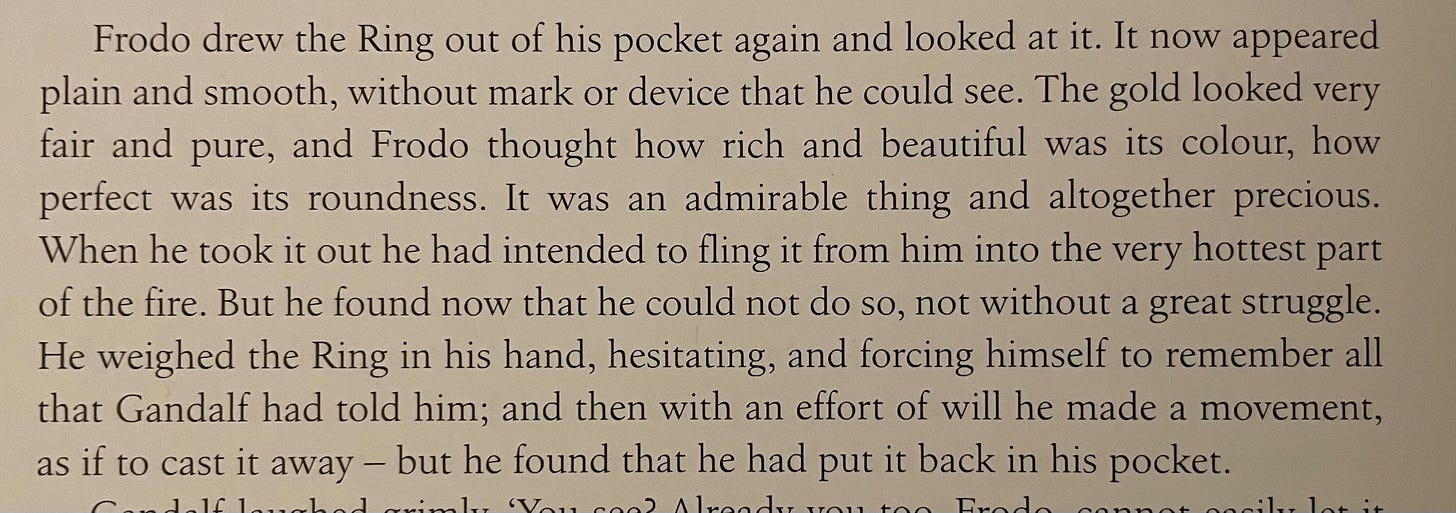
I’ve been reading Tolkien again lately, and I’ve been struck by how easily one can substitute “smartphone” for “the Ring.” Take, for instance, this paragraph early on in which Gandalf invites Frodo to rid himself of the ring.

L.M. Sacasas

Above all, do not lose your desire to walk … every day I walk myself into a state of well-being and walk away from every illness; I have walked myself into my best thoughts, and I know of no thought so burdensome that one cannot walk away from it.

Above all, do not lose your desire to walk … every day I walk myself into a state of well-being and walk away from every illness; I have walked myself into my best thoughts, and I know of no thought so burdensome that one cannot walk away from it.

Kierkegaard, via the selfsame L.M. Sacasas


So: where did all my mockery of Trump go?

I suffer more from the humiliations inflicted by my country than from those inflicted on her.

Simone Weil, from a letter to Georges Bernanos.

You can read most of my more impromptu stuff here and here (both of them cathartic venting, especially political) and here (the only social medium I frequent, because people there are quirky, pleasant and real). All should work in your RSS aggregator, like Feedly or Reeder, should you want to make a habit of it.

Amazon Prime Day 1

Having dated other blogs according to the Christian calendar, it seems only fair to date one according to the Consumerist calendar. I’m debating whether next June I should date things Pride 1, Pride 2, etc.

Okay, the debate’s over: I’ll do that only if I can figure out how to make it clear that I’m being a sarcastic dissenter.

Public affairs

Toward a better understanding of MAGA America

I’ve been trying to understand Trumpworld since Trump started winning GOP primaries in 2016. Really I have. I don’t want to think that almost 50% of this country just raised a middle finger in November 2016 and said “Just watch us blow up your precious nation!”

It has been slow going, but I have made some progress. First was remembering that the alternative was HRC, and that most Americans can’t bear the thought of voting other than for a major party. Second, was appreciating the legitimacy of some of Trumpworld’s grievances, which appreciation began in the run-up to the 2016 election as I left the main highway in eastern Ohio and found Trump signs everywhere in the sorry little town where I re-fueled.

But why Donald Trump felt like the solution to those grievances has eluded me — at least until late last week.

I won’t even try to capture the essence of David French’s The Rage and Joy of MAGA America, published Thursday. It’s David French at his best, as he writes from his home county, just 15% Democrat.

If you want to go deeper into the mindset of what 7 years ago proved to be an electoral majority of your countrymen, I urge you to read it, carefully and sympathetically, bearing in mind the categorical contempt felt toward “flyover country” by our national elites. The link I’ve provided should get you to it even if you’re not a New York Times subscriber.

But Paul A. Djupe in We Should Probably Stop Thinking Religion is a Solution to MAGA specifically faults any implication that MAGA evangelicals would be less MAGA if they attended church more regularly.

Parenthetical

Nick Cattogio feels his own kind of “joy” less by understanding Trump sellouts — the public-figure Never Trumpers who folded for a bit of power — than by something more primal:

The dirty little secret about being an anti-Trump conservative is that it too is often joyous.

In this case the joy derives not from belonging but from not belonging. Many times I’ve heard Jonah Goldberg say on The Remnant how his position on Trump has cost him friendships on the right, and I always sympathize—but cannot empathize. My contempt for those who traded their commitment to classical liberalism to protect their status within a Trumpifying right is so boundless that I’ve never stopped feeling grateful to be rid of them. If ever I should return to their good graces somehow, they’ll discover that they haven’t returned to mine.

It’s an almost spiritual pleasure to find yourself surrounded by people without dignity and to know that you don’t belong. 

The other joy of opposing Trump from the right is the satisfaction one gets from speaking one’s mind when others fear speaking their own. The happiest character in literature must be the boy in The Emperor’s New Clothes who shouted the truth about the sovereign’s attire as the adults around him bit their tongues and kept up a silly pretense so as not to cause themselves trouble.

The emperor wasn’t wearing any clothes. Trump is a criminal reprobate who’s morally and intellectually unfit to wield any sort of power. These are simple truths, acknowledged privately by all but the most devout loyalists. But to say them aloud, in public, when others don’t dare is liberating in a way that’s difficult to describe. If you know, you know. Dispatch readers know.

Chris Christie, very much a latecomer to the practice, knows too.

About saying the truth out loud, see Orange Man Bad in my July 7 post. Want to wager whether Cattogio read that?

Now, though the writing is entertaining, I am conscience-bound to note that the “almost spiritual pleasure” of “find[ing] yourself surrounded by people without dignity and [knowing] that you don’t belong” has a name, Pharisaism, and a “spiritual” pedigree of the diabolical sort. I can only hope Cattagio is exercising artistic license.

Deep-state BlackOps

In The Bourne Supremacy all a journalist had to do is say “Blackbriar” into a cell phone and minutes later, vans full of hyper-efficient assassins scrambled to snatch him up. Jack Bauer could not only direct phone taps and hack security cameras with a few keystrokes on his Blackberry, he could weave through miles of LA traffic in a few minutes. When he calls various government agencies, including after hours, he always gets them on the phone and not some, “Our offices are currently closed. Press 1 for English” message.

That’s all fine for escapist fare. But if you think real life works remotely like that, your assumptions about a lot of politics are going to be really stupid and maybe dangerous.

Jonah Goldberg, who 13 years ago imprudently asked “Why isn’t Julian Assange dead?” — his point being that our BlackOps aren’t as omnipotent as the Left thought.

Now he’s asking a different question, and asking it of a different delusional demographic:

No, the reason I’m going down memory lane is I want to ask a similar question: Why hasn’t the deep state gotten rid of Donald Trump yet? … If the deep state were remotely as powerful, wicked, and skilled as many claim, why let Trump live?

It’s a fair question, with a lot more colorful detail than I’m quoting.

Which brings me to the second problem: A lot of idiots and unwell people don’t realize that a lot of the deep state stuff is a grift. Devin Nunes used to sell deep state collectibles. There are no end of books claiming to expose the deep state and the cabal running our country. Here’s the description of The Deep State Encyclopedia: Exposing the Cabal’s Playbook:

Our country is being attacked from within. The past several years showed us that the shadow government seeks to assert absolute control over the human cattle, but what if we could stop them? What if we could take away the cabal’s power by exposing their entire playbook?

If this was their playbook, it wouldn’t be on Amazon.

And the pseudonymous author, “Grace Reallygraceful,” would be dead, too.

Tribal identity, fluid identity

In Hungarian, the word for their country is “Magyarország” — Land of the Magyars. Russia, in the Hungarian language, is “Oroszország” — Land of the Russians. Unlike the USA, where identity is fluid and contractual, these nations are tribes with flags. In Hungary, for example, they were occupied for 150 years by the Ottoman Empire, which, as you know, was Islamic. These things matter to them — and who are we Americans to say it shouldn’t? … I feel at home here in Hungary, in most respects, as I would in any other country of Europe. But whatever my migration status, I will never allow myself to think of myself as European, because that’s just not how it works. We Americans tend to assume that our openness and fluidity of identity is a natural stance. In fact, we are far outliers on national experience around the world.

Rod Dreher, who has some other worthwhile comments on immigration as well. I am encouraged. Rod has been far too often unreadable for a long time now.

NATO

Oh, my! The Nato mindset leads to war pulls a lot of threads together, and it doesn’t make me like post-cold war NATO any better than I did before. That it is purely defensive and that Russia therefore had nothing to fear from its expansion is a tale told by liars and believed by amnesiacs.

Conservatives today

If conservatism is support of the status quo, then the Democrat Party is today’s conservative party. So argues David Graham.

Homefront

We’ve had a run of cool days, and particularly of cool mornings. I’ve enjoyed sitting in my east-facing sunroom with windows open, sun streaming in, and I have been surprised how quiet my neighborhood is in the morning.

Not today, though. The sound of heavy equipment engines has begun. They are swarming my neighborhood for the next few days (or weeks) with those mechanical monsters that eat up the top few inches of pavement to permit new pavement to be laid without raising the street too high. Then we’ll get some shiny new asphalt. It will, no doubt, look very spiffy.

I have said, and probably have written, before, that I have the good fortune of living in a place that can still afford to repair its infrastructure. But I question why they are repairing in my neighborhood, and I’m not questioning just because I don’t like the noise.

I’m questioning because our streets have no potholes, cracks, irregularities, or other compelling reasons for repair. What they do have is a lot of fading and some tar strips running like spider veins where small cracks have been repaired over the years.

I’ve driven in enough neighborhoods to know that ours are not the city’s worst streets. But we are a wealthy neighborhood, and I suppose that explains much more than I wish it did.

(If I were king of the world, they’d be narrowing the streets by half and repairing the sidewalks. It would still be about as unpleasant to walk as Tokyo, but it would be a step in the right direction.)

Legalia

Consequentialism in jurisprudence

One of the really knotty problems with our public debates is that we often are having two or three debates at the same time, and it is easy to get confused about which question is actually in dispute at any given moment. 

Take, for example, the recent debate about racial preferences in college admissions: The question before the Supreme Court was only a legal one—not that you’d know it from the campaign-style rhetoric of Ketanji Brown Jackson or Sonia Sotomayor!—to wit, whether the law permits what Harvard and the University of North Carolina were doing, or whether that amounted to unlawful racial discrimination. The majority of the Supreme Court rightly found that this racial discrimination was unlawful. A second question—an unrelated question from the point of view of a Supreme Court justice who is actually doing his or her job instead of trying to act as an unelected legislator—is whether racial-preference policies such as those that had been implemented at Harvard are good policies. A third question—never quite explicitly discussed—has to do with “legal consequentialism,” the notion (which has official legal standing in some countries, such as Brazil) that legal questions per se should be made subordinate to utilitarian calculation. As the Brazilian statute puts it, “a decision shall not be made based on abstract legal values without considering the practical consequences of the decision.”

Kevin D. Williamson

Qualified Immunity hits a wall — finally

Seventeen-year-old student is required to participate in police ride-along for a class, and the Hammond, Ind. officer she shadows spends the day groping her, making lewd remarks, and even taking her to a remote location where he offers her to another officer for sex. Officer: This mere “boorish flirtation” was just “making for an exciting ride along.” District court: Qualified immunity. Seventh Circuit: Reversed. “Sexual assault is an intentional act that never serves a legitimate governmental purpose.”

Short Circuit: A Roundup of Recent Federal Court Decisions.

It’s actually a bit surprising, not to mention heartening, that the 7th Circuit reversed this. “Qualified immunity” has become the monster that devoured 42 USC §1983 (the post-Civil War law that gives a remedy for deprivation of rights under color of law).

More:

It is obviously unreasonable for an off-duty, out-of-uniform police officer to lose his temper on the road, follow another motorist home, box him in his driveway, scream profanities, and point a gun at him when the other motorist is nonthreatening. So says the Tenth Circuit, reversing a grant of qualified immunity to a (now-former) Chaves County, N.M. sheriff’s deputy. Claims against the county, which hired him in spite of his history of volatile behavior, are on the table, too.

Purging an evil

A District of Columbia-based disciplinary panel has recommended Rudy Giuliani be disbarred for his “frivolous” efforts on behalf of then-President Donald Trump to overturn the results of the 2020 election.

The committee, an arm of the District of Columbia Bar, found in a report released on Friday that Giuliani had undermined trust in federal elections by directing Trump’s legal challenge to the presidential vote count in Pennsylvania and promoting unfounded theories of fraud in court.

“He claimed massive election fraud but had no evidence of it,” the committee wrote. “By prosecuting that destructive case Mr. Giuliani, a sworn officer of the Court, forfeited his right to practice law.”

Wall Street Journal

Culture

AI wins where people have been deskilled

My present thesis is something like this: The claim or fear that AI will displace human beings becomes plausible to the degree that we have already been complicit in a deep deskilling that has unfolded over the last few generations. Or, to put it another way, it is easier to imagine that we are replaceable when we have already outsourced many of our core human competencies.

L.M. Sacasas, Render Unto the Machine. This is an idea I keep running into. It was a thread through Matthew B. Crawford’s Why We Drive

Wordplay

1

trying to ride a bicycle in zero gravity

Sven R. Larson This seems to be a more refined version of “nailing jello to the wall” or even my father’s favorite, “goosing butterflies.” I assume the metaphor hitch-hikes on the further metaphor of “getting no traction” (in an argument, in this case).

2

As ever more laity, especially young people, seek out the ancient liturgy of the Church, the Eye of Sauron in Rome has turned towards these congregations …

Sebastian Morello, The Tragedy of the Sarum Rite (The European Conservative)

3

[T]he difference between being gay and being black is that if you’re black you don’t have to tell your mother.

Simon Fanshawe

4

[Great Britain’s National Health Service] looms so large in our politics as to wholly justify the sardonic description of Britain as “a health service with a country attached”.

Mary Harrington

5

Mountebank: A hawker of quack medicines who attracts customers with stories, jokes, or tricks; A flamboyant charlatan. (Wordnik)

I’m shocked that his was not already in my vocabulary. Maybe I couldn’t decide on pronunciation, since it was fairly obviously of foreign (Italian, apparently) origin.

6

Insufficient nihilism: David Graham’s characterization of the real reason for Marjorie Taylor Greene’s expulsion from the House Freedom Caucus. (That she had called fellow HFC member Lauren Boebert “a little bitch” was just a plausible excuse.)

7

“Tact” is insulting a man without his knowing it

John “Jackie” Fisher via the Economist

8

… he’s 22, and like many intelligent and loquacious 22-year-olds, quickly got out far over his skis.

Rod Dreher, on a recent conversation

9

Alethic commitment: Committing and belonging because of considered belief that a thing is true. (J Budziszewski)

I no longer believe that the essence, the sina qua non, of authentic Christian life is alethic commitment. I don’t even believe that it’s the proper goal of a Christian life.

Those possibilities seems too left-brain for me, and too culture-bound. Fr. Stephen DeYoung describes it as “checkbox religion.” “Jesus is God?” Check. “Bible miracles were miraculous?” Check. Etc

Experience or immersion might count for as much as considered belief.

By some combination of nature and nurture, I’m an alethic commitment kind of guy, but on entering Orthodoxy, I had a few stumbling blocks — boxes I couldn’t check yet. Because I’d seen enough of the Church to trust it, and to even assume that where I demurred I was wrong, I immersed.

10

All men profess honesty as long as they can. To believe all men honest would be folly. To believe none so is something worse.

John Quincy Adams via the Economist

11

Suddenly life became more like it used to be than it ever was before.

Garrison Keillor on the social effects of Covid.

12

My theory of economics is called Gratitudemy, as found in Psalm 23: “My cup runneth over.”

Garrison Keillor


We are in the grip of a grim, despairing rebellion against reality that imagines itself to be the engine of moral progress.

R.R. Reno

The end of the world as we know it is not the end of the world.

You can read most of my more impromptu stuff here (cathartic venting) and here (the only social medium I frequent, because people there are quirky, pleasant and real). Both should work in your RSS aggregator, like Feedly or Reeder, should you want to make a habit of it. I’m even playing around a bit here, but uncertain whether I’ll persist.

Thursday, 2/16/23

Culture

Don’t say we weren’t told

Many sober voices warned that an expansion of NATO to Russia’s border would poke the Bear, leading to an inevitable war. As long ago as 1998, following the U.S. decision to expand NATO eastwards, George Kennan said the following to Thomas Friedman:

“I think it is the beginning of a new cold war. I think the Russians will gradually react quite adversely and it will affect their policies. I think it is a tragic mistake. There was no reason for this whatsoever. No one was threatening anybody else. This expansion would make the founding fathers of this country turn over in their graves.

Patrick Deneen, Russia, America, and the Danger of Political Gnosticism.

Self-critical thinking

Super-smart people, as Haidt notes in The Righteous Mind, are more skilled than others at finding arguments to justify their own points of view. But when they are asked to find arguments on the opposite side of a question, they do no better than anyone else. Brainpower makes people better press secretaries, but not necessarily better at open-minded, self-critical thinking.

Jonathan Rauch, The Constitution of Knowledge

Alarmist medical news feed

There must be an alarmist news feed, because my local TV station’s noon news always clocks in around 12:20 with some new medical study that shows I should give up yet another pleasure.

I offer in response Study Shows You’re Nobody Until Somebody Loves You.

Distraction is deliberate

“Distraction” will become the formal currency that drives the economy because in a nation where people (especially young men) can no longer count on full-time employment, the state will have every incentive to support and defend every hedonistic, narcissistic, distractive behavior in order to keep attention off themselves and their failed policies.

James Howard Kunstler, Living in the Long Emergency

UBI provocation

What Basic Income ultimately proposes is to detach livelihood from work. Its immediate effect would be to massively reduce the amount of bureaucracy in any country that implemented it. As Leslie’s case shows, an enormous amount of the machinery of government, and that half-government corporate NGO penumbra that surrounds it in most wealthy societies, is just there to make poor people feel bad about themselves. It’s an extraordinarily expensive moral game played to prop up a largely useless global work machine.

David Graeber, Bullshit Jobs

FBI

(An FBI field-office report lumped some “traditionalist” Catholics with “violent extremists” and called for government investigation:)

The document’s “open source” reporting comes from the Southern Poverty Law Center, which has spent years branding mainstream conservative groups as “hate” organizations and has no credibility outside progressive circles. The FBI gumshoes also point to articles in Salon and The Atlantic, which shows they need to expand their reading lists.

No wonder the FBI retreated once the document was made public. It hastened to say the report didn’t meet its “exacting standards” and was being removed from its system. It also promised the FBI “will never conduct investigative activities or open an investigation based solely on First Amendment protected activity.”

FBI Director Christopher Wray’s problem is that millions of Americans no longer believe this ….

Wall Street Journal

An even bigger problem is that millions of Americans justifiably no longer believe anything the federal government says.

WFYI has ruined WBAA

I just need to say this for the benefit of search engines.

WFYI, public radio Indianapolis, purchased WBAA, Indiana’s oldest radio station and the voice of Purdue, in one of a handful of Mitch Daniels moves that have really pissed me off.

At the time of the purchase, WBAA was a better-run station than WFYI, but I had no idea how terribly-run the buyer would make its new acquisition. Monday morning, I listening (because my wife prompted me) to a news segment that ran unintelligibly at half- or quarter-speed. Broadcasts from WBAA are routinely jumping back and repeating 5-10 seconds or material. As I typed this, they played three things (live stream and two pre-recorded announcements, one of them an inaccurate announcement of the time) simultaneously.

Very sad, though it saves me a $X in annual support.

Politics

I want to be a headline-writer when I grow up

I’m cutting back, both by design and lessening interest, on reading about politics. But the headline on an NYT Opinion piece amused me: Nikki Haley Has a Great Future Behind Her.

Top issues of the day

Damon Linker explains why anti-woke isn’t his top voting issue:

Here, meanwhile, are some of the things I consider to be significantly more important than the president and party I vote for coming down against wokeness:

Will the president and party abide by the rule of law, including the peaceful and orderly transfer of power based on the lawful and accurate counting of ballots?

Will the president and party treat mendacity like a virtue, knowingly spreading lies in order to discredit ideological opponents, undermine trust in federal law enforcement, and whip up insurrectionary rage in the hopes of using it to overturn constitutional checks on power?

Will the president and party fight to preserve government programs on which tens of millions of Americans rely? Or will they act, instead, to fulfill the wishes of plutocratic donors who care most of all about cutting their own taxes?

Will the president and party make wise, level-headed decisions in foreign policy? Or will they react on the basis of personal pique and very narrowly defined notions of national interest (and even on the basis of the president’s pursuit of self-enrichment and the party’s desire to score cheap political points)?

If the president and party do make a move against wokeness, will they do so in a way that’s compatible with individual freedom? Or will the goal be achieved by enhancing government power and curtailing various rights, including the freedom of association?

I would add to Linker the reality that the GOP has seized upon “woke” like Christopher Rufo seized upon “critical race theory”, stretching them beyond recognition and crudely weaponizing the stretched misrepresentations.

Chris Christie ain’t afraid of Florida Man

“I’ve known him for 23 years, and so I’m not the least bit afraid of him,” Christie told The Dispatch during an interview last week, while in Washington for meetings with Republican governors. “The presence of Donald Trump [in the primary] still makes a difference to a lot of people. He didn’t do what the normal one-term president does, which is go away in shame because they’ve lost. He has no shame.”

“If I get in, I get in because I want to win,” Christie said. “I’m going to be a truth-teller in this race. I think that the American people are hungry for the truth, and they don’t even know what it is anymore.”

Chris Christie of Donald Trump


Tradition is a bulwark against the power of commerce and the dissolving acid of money, and by removing these, all revolutions in the modern period have ended up accelerating the commercial and technological shift towards the Machine.

Paul Kingsnorth

You can read most of my more impromptu stuff here (cathartic venting) and here (the only social medium I frequent, because people there are quirky, pleasant and real). Both should work in your RSS aggregator, like Feedly or Reeder, should you want to make a habit of it.

Ruso-Ukrainian War

I had collected so much on the current war that I decided to blog it separately.

Resisting Western cultural hegemony

Danilevsky concluded with words that continue to resonate today among Russian conservatives who want to resist the forces of globalism and what they see as Western cultural hegemony:

The danger consists not of the political domination of a single state, but of the cultural domination of one cultural-historical type … The issue is not whether there will be a universal state, either a republic or a monarchy, but whether one civilization, one culture, will dominate, since this would deprive humanity of one of the necessary conditions for success and perfection—the element of diversity.

Paul Robinson, Russian Conservatism, Kindle page 82.

The collective mind of Russia, insofar as there is such a thing, likely matters at present less than the mind of Putin. Were it not so, Putin wouldn’t have smashed civil society at all critical or even inquisitive voices (see below).

But Russian conservatives have at centuries of discomfort with the West. Many of them were educated in the West, and they acknowledge and admire its accomplishments, but they want to keep it arm’s length. They want Russia to be Russian.

I have not yet read about Russian liberals.

Putin and Pushkin

“You have Putin’s Russia and Pushkin’s Russia,” Krielaars observed. To blame a whole culture, past and present, for a current political action implies that everything about that culture contributed to that action. If Germany succumbed to the Nazis, don’t listen to Beethoven; because of Mussolini, cancel Dante and Raphael; if you reject American actions in Vietnam, the Middle East, or anywhere else, no more Thoreau or Emily Dickinson. Could there be a better way to encourage national hatred than to treat a whole culture and its history as a unified whole, carrying, as if genetically, a hideous quality?

When I visited Soviet-dominated Poland in 1970, people understandably resented Russian rule. Ill-disposed to the forced consumption of Russian culture, some responded, as oppressed people often do, with the sort of blind hatred that prepares victims to be oppressors as soon as the tables are turned. As a character in Dostoevsky’s novel The Brothers Karamazov observes, “it can be very pleasant to take offense.” One Pole I met proclaimed proudly: “I even hate Russian trees!” “You have something against birches?” I asked incredulously. But the more absurd his pronouncements were, the more righteous he felt.

Russian expert Michel Krielaars via Gary Saul Morson

Ukrainian Genocide

  • The International Court of Justice ruled 13-2 in favour of Ukraine, concluding that Russia’s allegations that Ukraine was committing genocide against Russian speakers in Donetsk and Luhansk were false. The ruling strips away the legal pretext that Mr Putin used for the invasion. The two dissenting judges were, unsurprisingly, from China and Russia.
  • In a menacing television appearance Mr Putin warned Russians to be aware of “fifth columnists”, urging them to “spit out like a midge that has flown into their mouths” those traitors whose minds had been captured by the West. The West’s ultimate aim, he said, was the destruction of Russia. Russian prima ballerina Olga Smirnova was clearly unpersuaded. Having been publicly critical of the war she quit the Bolshoi Theatre in Moscow to join the Dutch National Ballet. She is the most famous Russian star to quit the country over the war.

The world in brief | The Economist, 3/17/22.

Allegations of Ukrainian genocide in Donetsk and Luhansk (eastern Ukrainian regions oriented strongly toward Russia rather than the West) seemed, apart from the possible hyperbole of “genocide,” plausible to me. I’m relieved that Russia was as bereft of evidence as was Trump in his grousing about the 2020 Election.

As for the claim that “[t]he West’s ultimate aim [is] the destruction of Russia,” there’s too much to it for me to summarily dismiss it.

We have made Russia our bête noire for my entire lifetime, with a brief pause around 1990 when we fancied we might turn it into a Western liberal democracy. But as it turns out, there’s a whole lot of historic and abiding Russian conservative resistance to liberal democracy, and since it’s always helpful for a regime to have an iconic enemy, we acquiesced in Russia remaining the Other.

Add to that widespread western Christian ambivalence about Orthodox Christianity (insofar as the West is aware of it at all) and the history of Russian Orthodox collaboration with successive illiberal regimes and — Why, yes! Now that you mention it we would find it reassuring if Russia as we know it were destroyed, by us, by it’s own overreach, or from internal forces.

Putin knows it, but his very knowing it, we fancy, means it’s false.

How might the Ukraine war scramble world Christianity?

Veteran Religion Beat reporter Richard Ostling does an outstanding, objective job in Beyond the Orthodox questions: How might the Ukraine war scramble world Christianity?. It’s heavily but not exclusively focused on potential scrambling in Christian Orthodoxy. Lots of links, too.

No hate speech except against the hateful people

The Russian government moved to designate Meta as an “extremist organisation”, after reports that the parent company of Facebook and Instagram would allow Ukrainians to call for violence against Russian soldiers on its sites. Meta said there was no change to its policies on hate speech “as far as the Russian people are concerned”. The row does raise questions about Meta’s role in selecting just when it thinks support for violence is suitable across its platforms.

Business | The Economist

Putin’s crackdown on his own people

For whatever reason these stories really brought home to me the enormity of Putin’s deceit and suppression.

Dissidents flee Russia

“The plane from Moscow to Yerevan was packed with people I knew,” he recalled. “Lots of young people — the future of Russia is leaving.”

“Collective blame is an easy way to channel rage,” Maria Stepanova, a prominent Russian poet, told me. But the impulse to punish Russians on the basis of national identity is a misguided one. Ms. Stepanova told me that many emigrants are driven by a feeling of pure moral indignation, a sense that emigration is the only remaining avenue for political protest. “They simply don’t want to breathe the air here,” she said. “They want to cut all ties with their country.… They’re willing to risk ruining their lives out of this feeling of disgust.”

Sophie Pinkham, Putin’s War in Ukraine Is Forcing Russian Dissidents to Flee. That title is underinclusive: intellectuals and potential conscriptees are fleeing, too. It was predicted and now it’s happening.

Remaining dissidents are like vermin

The idea behind the hounding of prominent figures in the arts is to reject Western influence as alien. One of the most public faces of this campaign is Margarita Simonyan, the boss of the state-run RT television station. As she said in one of her recent talk shows, “We must all consolidate, grip our will in our fists, establish exceptional order in education, culture and information, and rid the country of truants, idiots and traitors.” In a speech on March 16th, Vladimir Putin said such people would be “spat out”.

The Economist, ‌Russian propagandists turn on pro-Western “traitors”

Crushing Russian civil society

Wow. Strong opener:

Within the first days of the war, the Russian government smashed to pieces whatever remained of Russian civil society—including independent media, human rights organizations, and anybody who could still speak truth to power and to their fellow citizens. As the Kremlin adopted a new draconian speech law and cracked down on organization after organization—initiating or completing bogus legal procedures against them, shutting down their websites, and sending goons to physically harass them—the people staffing those organizations picked up and left the country. Within only about 72 hours, the entire institutional fabric of Russia’s civil society, painstakingly woven out of the post-Soviet institutional wasteland, was irreparably torn to shreds.

Izabella Tabarovsky, ‌Russia’s New Exiles.

Of all the stories I’ve seen on the new emigration of Russians, this (fairly long, but no paywall) was the most potent. The life of Russia intellectual, potential conscriptee, journalistic and dissident exiles is spartan and very hard; fleeing Russia didn’t “make it all better.”

When The Tablet is good, it’s very, very good.

Personal reversal

I’ve tended to buy the John Mearsheimer argument that we forced Putin’s hand (expanding NATO eastward threatened Russia — the idea is far from being a Mearsheimer exclusive), and this blog’s recent posts have almost certainly reflected that.

I’m no longer convinced of that. Ann Applebaum on Andrew Sullivan’s podcast was surprisingly persuasive, as have been a few others.

The most persuasive argument against the “pushing NATO too far” theory, to my mind, is that we always have nuclear-capable submarines close to Russia (as they have close to us). Although “NATO is purely defensive,” standing alone, wasn’t very persuasive, “NATO, which claims to be purely defensive, is a trivial threat to Russia compared to the U.S. and it’s submarines” packs a punch. Tell me why that’s wrong.

But the most persuasive observation is what Putin is doing within his own borders, and the stupid propaganda behind which he shields himself.

I’m still not sure what Putin is up to, but it should be born in mind that Putin’s intent is not Russia-at-large’s intent — else he wouldn’t crush truthful reporting, arrest protestors, ban civil society mediating structures and so forth.

That this war might bring down Putin is an outcome fervently to be hoped and prayed for, but we dare not directly promote it, and we should not be under any illusions that his fall would lead quickly to a liberal Western democratic Russia. There’s too much history and sentiment to the contrary. Russia and the West may learn to live together, but I don’t look for homogeneity.

Caveat: I have never repudiated my conscientious objection to war, so don’t think for one second that I’m some kind of military expert.


You can read most of my more impromptu stuff here (cathartic venting) and here (the only social medium I frequent, because people there are quirky, pleasant and real). Both should work in your RSS aggregator, like Feedly or Reeder, should you want to make a habit of it.

We have always been at war with Eastasia

I have alluded from time to time to America’s unclean hands in tensions with Russia and/or Vladimir Putin, and specifically to our expansion of NATO right up to Russian borders.

Wednesday, I learned that it’s worse than that. We weren’t acting obliviously. The first Bush administration specifically argued that it was in Russia’s interests that the reunited German be in the NATO orbit, but that NATO would expand no further:

When Gorbachev signaled that unlike his predecessors he had no intention of using force to maintain the Soviet Empire, it almost immediately disintegrated. With that, momentum for German reunification became all but irresistible.

By the end of 1989, the issue facing policymakers on both sides of the rapidly vanishing Iron Curtain was not whether reunification should occur, but where a reunited Germany would fit in a radically transformed political landscape … No one—including German Chancellor Helmut Kohl—thought it a good idea to allow this new Germany to become a free-floater, situated in the center of Europe but untethered from the sort of restraints that the Cold War had imposed.

For Washington, London, and Paris, the solution was obvious: keep the Germans in a warm but firm embrace. Ensuring that a united Germany remained part of NATO would reduce the likelihood of it choosing at some future date to strike an independent course.

The challenge facing the Western allies was to persuade Gorbachev to see the wisdom of this proposition …

To make that prospect palatable, the Bush administration assured the Soviets that they had nothing to fear from a Western alliance that included a united Germany. NATO no longer viewed the USSR as an adversary. Apart from incorporating the territory of the former East Germany, the alliance was going to stay put. Washington was sensitive to and would respect Russia’s own security interests. So at least U.S. officials claimed.

Thanks to newly declassified documents published by the National Security Archive, we now have a clearer appreciation of just how explicit those assurances were. Among the documents is the transcript of an especially revealing conversation between Gorbachev and Secretary of State James Baker in Moscow on February 9, 1990.

… [T]here was no need for Gorbachev to trouble himself about NATO …

“We understand,” Baker continued, “that not only for the Soviet Union but for other European countries as well it is important to have guarantees that if the United States keeps its presence in Germany within the framework of NATO, not an inch of NATO’s present military jurisdiction will spread in an eastern direction [emphasis added].” …

Gorbachev replied, remarking only that “it goes without saying that a broadening of the NATO zone is not acceptable.”

To which Baker responded: “We agree with that.

Later that very year German reunification became an accomplished fact. By the end of the following year, Gorbachev was out of a job and the Soviet Union had become defunct. Before another 12 months had passed, Baker’s boss lost his bid for a second term as Americans elected their first post-Cold War president. By this time, countries of the former Warsaw Pact were already clamoring to join NATO. The administration of Bill Clinton proved more than receptive to such appeals. As a consequence, the assurances given to Gorbachev were rendered inoperative.

NATO’s eastward march commenced, with the alliance eventually incorporating not only former Soviet satellites but even former Soviet republics … apparently assuming that Kremlin leaders had no recourse but to concede.

… Clinton’s successors even toyed with the idea of inviting Georgia and Ukraine to join NATO …

At that point, a Kremlin leader less trusting of the West than Gorbachev had been decided that enough was enough. Vladimir Putin, a very nasty piece of work but also arguably a Russian patriot, made it clear that NATO’s eastward expansion had ended. Putin’s 2008 armed intervention in Georgia, annexation of the Crimea in 2014, and multiple incursions into Ukraine beginning that same year elicited howls of protest from the Washington commentariat. Putin, they charged, was trampling on the “norms” of international conduct that were supposed to govern behavior in the post-Cold War world.

But Putin was not wrong to observe that the United States routinely exempted itself from any such norms when it perceived its own vital interests to be at stake

Today’s NATO consists of 29 nations, nearly double what its membership was when Secretary Baker promised Gorbachev that the alliance would not advance a single inch eastward …

In today’s Washington, where Russophobia runs rampant, it has become fashionable to speak of a New Cold War, provoked by Putin’s aggressive actions. Yet if we are indeed embarking upon a new age of brinksmanship, we can trace its origins to 1990 when Putin was merely a disgruntled KGB colonel and we were playing the Soviets for suckers.

In his meeting with Gorbachev, Baker expressed regret about the victorious allies mismanaging the opportunity for peace created by the end of World War II. A similar judgment applies to the opportunity for peace created by the end of the Cold War. Upon reflection, the United States might have been better served had it honored its 1990 commitment to Gorbachev.

(Andrew J. Bacevich, emphasis added)

But we have always been at war with Eastasia, haven’t we?

* * * * *

Some succinct standing advice on recurring themes.

Where I glean stuff.