Friday, January 10, 2025

Trump 47

I’m leading with Trump because his coronation is imminent and I’ve encountered a few unfamiliar worthy “takes” on him.

The Solzhenitsyn test

In his 1970 Nobel lecture, Aleksandr Solzhenitsyn said, “You can resolve to live your life with integrity. Let your credo be this: Let the lie come into the world, let it even triumph. But not through me.” The problem presently before the United States is that the Trump administration will be staffed in its upper reaches by political appointees who, without exception, have failed this test.

To get their positions, these men and women have to be willing to declare, publicly if necessary, that Donald Trump won the 2020 election and that the insurrectionary riot of January 6, 2021, was not instigated by a president seeking to overturn that election. These are not merely matters that might be disputed, or on which reasonable people can disagree, or of which citizens in the public square can claim ignorance. They are lies, big, consequential lies that strike at the heart of the American system of government, that deny the history through which we have all lived, that reject the unambiguous facts that are in front of our noses. They are lies that require exceptional brazenness, or exceptional cowardice, or a break with reality to assert.

Whatever the defenses they come up with, however, the senior appointees of the Trump administration will have to enter public service having affirmed an ugly lie, or several. No matter what other qualities they have to their credit, that will remain with them. That, in turns, means that we can never really trust them: We must always suppose that, having told an egregious lie to get their positions, they will be willing to tell others to hold on to them. They can have no presumption of truthfulness in their government service.

That in turn will change them fundamentally. In Robert Bolt’s marvelous A Man for All Seasons, Sir Thomas More explains to his daughter why he cannot yield to Henry VIII’s demand that he declare the king’s first marriage invalid, allowing Henry to marry Anne Boleyn, and hopefully get the male heir the kingdom desperately needs. More knows that that declaration is in the public interest. He also knows that his refusal will sooner or later lead him to the execution block.

When a man takes an oath, Meg, he’s holding his own self in his own hands. Like water. And if he opens his fingers thenhe needn’t hope to find himself again.

To land a top job with Donald Trump, you have to open your fingers. It is, as Solzhenitsyn suggested, the end of your integrity.

Eliot A. Cohen, The Solzhenitsyn Test

The imbecilic clown show 1/6/21 was the least of it

We use “January 6” as a shorthand to talk about what Trump did after losing the 2020 election, but it is important to understand—and I think historians will agree about this—that the imbecilic clown show at the Capitol was the least important and least dangerous part of that episode. Trump’s attempt to suborn election fraud—which is what he was up to on that telephone call with the Georgia secretary of state on January 2, 2021—was the more serious part of the attempted coup d’état. Some coup-plotters are generalissimos who just march their troops into the capital and seize power, but many of them—many of the worst of them—take pains to come up with some legal or constitutional pretext for their actions. Often, the pretext is an emergency, as it was with Indira Gandhi, Augusto Pinochet, the coup that brought Francisco Franco to power, etc. You’ll remember that Donald Trump called for the termination of the Constitution as an emergency measure: “A Massive Fraud of this type and magnitude allows for the termination of all rules, regulations, and articles, even those found in the Constitution,” Trump wrote in his trademark kindergartner’s prose. “Our great ‘Founders’ did not want, and would not condone, False & Fraudulent Elections!”

John Adams knew the secret in the heart of democracy: a death wish. “There never was a democracy yet that did not commit suicide,” he wrote. And so the American people, in their belligerent stupidity, have again given the awesome power of the presidency to the man who attempted to overthrow the government the last time he was entrusted with that power. Trump has, of course, promised to pardon those who carried out the violence and chaos of January 6, which is no surprise: The riot was conducted on his behalf, and that is the kind of riot he likes. His contempt for the law is utter and complete, and the only law that he honors is the one inscribed on his heart: “I should get whatever I want.”

Kevin D. Williamson

Cheap date

Trump is the CCP’s cheapest date: Trump is scrambling to save TikTok. He’s filed an amicus brief to the Supreme Court asking them to treat him like he’s already president and to stop this terrible ban of his favorite piece of Chinese spyware. As The Wall Street Journal editorial board puts it: “The brief is extraordinary in several ways, none of them good.”

As background, Trump was against TikTok until. . . TikTok investor Jeff Yass and his wife Janine dropped about $100 million into Republicans in recent years. And then, what do you know, he’s all in for TikTok! Trump asked the Supreme Court not to act all sus on TikTok’s rizz.

Shadow president Elon Musk has deep business entanglements with China, so it’s a given he’s going to be compromised on this. But Trumpo—Mr. CHYNA—made nationalism his whole thing. And all it took was one Republican donor with cash, but not even that much for China, to continue the colonization of teenage American minds through the infectious disease known as TikTok. Democrats at least genuinely believe in the CCP. Like, they prefer it on an intellectual level. Republicans don’t; they’re just for sale, and cheap.

Meanwhile, the White House confirmed this week that a ninth American telecommunications firm has been hacked by China. Per the AP: “Though the FBI has not publicly identified any of the victims, officials believe senior U.S. government officials and prominent political figures are among those whose communications were accessed.” China just reads all our texts and no one even cares. To explain this in a way you TikTok-addled people might understand: America is the unconscious patient in surgery, and our lawmakers are the surgeons and nurses doing a viral dance around our slack-jawed body.

Nellie Bowles. Remember: This is part of Bowles’ weekly sardonic news wrap-up. Take it seriously, not literally.

Simon won his bet with Ehrlich

Be it remembered that Julian (“The Ultimate Resource Simon, in my younger lifetime, made a wager with Paul (“The Population Bomb”) Ehrlich about what would happen to five key commodity prices over the period of the wager. Ehrich predicted that the prices would rise, Simon that they would fall.

As I read The Ultimate Resource, I thought “surely this is some very clever sophistry.” But Simon won the wager. All five commodities fell in real price.

Infinite growth in a finite world still seems impossible (though Simon probably would say the world isn’t finite in any economically significant way because of human ingenuity). There’s also the matter of externalities, about which “human ingenuity” seems kind of cavalier.

But Simon won the wager. That’s not nothing, and it doesn’t fit the left narrative.

Northstar

Dreher proposed the best way forward for the Republican Party when he wrote Crunchy Cons. In case anyone has forgotten the manifesto, here it is again in brief:

* Conservatism should focus more on the character of society than on the material conditions of life found in consumerism.
* Big business deserves as much skepticism as big government.
* Culture is more important than politics and economics.
* A conservatism that does not practice restraint, humility, and good stewardship—especially of the natural world—is not fundamentally conservative.
* Small, local, old, and particular are almost always better than big, global, new, and abstract.
* Beauty is more important than efficiency.
* The relentlessness of media-driven pop culture deadens our senses to authentic truth, beauty, and wisdom.
* The institution most essential to conserve is the traditional family.

Live Not by Lies From Neither the Left Nor Right (Front Porch Republic)

This is the version of Rod Dreher that first caught my so favorable attention. I’m keeping a wary eye on the current version.

UBI

→ UBI really doesn’t work: It pains me to write this. But yet another study was published that shows universal basic income (UBI) doesn’t work.

Researchers gave $500 a month to a group of California households and compared them to a control group who received no money—quite the short straw to draw. The households that received the stipend ended up only $100 richer and actually purchased more cigarettes. So basically, UBI makes people French. They found that UBI had no positive effect on psychological or financial well-being. It didn’t even improve food security. Except that cigarettes make it so you don’t need lunch, so I guess food security is relative.

I was hoping universal basic income would become a reality nationwide. Then I could pursue my true passions: horseback riding, debutante balls, and cyberbullying.

Nellie Bowles, TGIF

Title IX

The entire point of Title IX is to prevent discrimination based on sex. Throwing gender identity into the mix eviscerates the statute and renders it largely meaningless.

Chief Judge Danny C. Reeves of the Eastern District of Kentucky, rejecting the Biden administration’s novel interpretation of Title IX through federal rule-making.

First-world problems

The FBI has issued a formal warning to sports leagues about organized robberies of professional athletes. Since September, nine pro athletes have had their homes broken into, including Kansas City Chiefs stars Patrick Mahomes and Travis Kelce, Dallas Mavericks guard Luka Dončić, and Bengals quarterback Joe Burrow. According to the FBI, organized crime groups from South America have used high-tech surveillance and hacking methods to spy on athletes and disable their security systems. (It also helps to know when a team is playing an away game.)

Madeleine Kearns, The Free Press

Terrifying Parenting advice

What answer did writer Fyodor Dostoevsky give a concerned mother about how to teach her son the difference between good and evil? “His answer both eased my anxiety and terrified me,” Vika Pechersky wrote for Christianity Today. “On the one hand, Dostoevsky gives simple advice to a set of very complex questions. There is no need to master elaborate philosophical systems and social theories to teach my children the meaning of good and evil. According to Dostoevsky, people have a natural yearning for truth, and this yearning comes to our aid in the work of parenting. Herein lies the terrifying part, for the work of parenting starts with my own self—my love of truth, rectitude, goodness of heart, freedom from false shame, and constant reluctance to deceive. I have to embody the love of truth and goodness and live them out in my daily life if I want to teach my children to love what is good.”

Happy New Year From The Dispatch!

In my anecdotal experience, he’s right.

AI Update

I am, relatively speaking, a grouch about AI, so I’m happy to pass along the bad news.

AI is losing money faster than any technology in human history.

I was stunned when OpenAI said it would charge $200 per month for an AI subscription.

That adds up to $2,400 for a full year. Who pays that much for a chatbot?

But the story gets crazier. OpenAI CEO Sam Altman now admits that the company still loses money at that price—the cost of providing AI to premium subscribers is more than $200 per month.

Ted Gioia

Traffic congention

An online forum was getting slower and slower, and users were complaining. An investigation found that the traffic was not coming from users.

Dennis Schubert, who discovered this, shared his irritation in a testy post:

Looks like my server is doing 70% of all its work for these fucking LLM training bots that don’t to anything except for crawling the fucking internet over and over again.

Oh, and of course, they don’t just crawl a page once and then move on. Oh, no, they come back every 6 hours because lol why not. They also don’t give a single flying fuck… [about making] my database server very unhappy, causing load spikes, and effective downtime/slowness for the human users.

I guess this is the new role for human beings in the digital economy. We teach the bots how to replace us.

Those greedy bots will come back again in a few hours—they always do. So get busy and start posting.

Ted Gioia again.

Why would anyone want to read that?

AI F1 A -FRIEND of mine who sings the praises of AI has suggested that I might farm out Touchstone fundraising letters to Al or perhaps even have it write an article or two for the magazine. What could I say? I shook my head in silence. Failing to catch my meaning, he assured me that improvements to Al over the past year have it writing at a professional level.

“So what?” I said. “Why would anyone want to read it?”

“Because,” he said, “it writes well.”

Again I said, “So what?”

I have all but given up trying to explain my opposition to Al to those who seem to think that, if Al can be programmed to mimic the best writing of which men are capable, then why wouldn’t I want to use it? I tell them that I presume Al is now every bit as capable as they say and will be doubly so six months from now. And still I say, “So what?” And still they earnestly try to convince me that Al writes every bit as well as I just conceded it does.

My friend is a Formula 1 racing fan, so I tried a new angle: “I am certain that if they took the men out of the cars (and the pit crews out of the pits), Al drivers could churn out better lap times than their human counterparts every time.”

He found my suggestion ridiculous. “Who would want to watch that?”

-J. Douglas Johnson, Touchstone magazine, January/February 2025

Patience takes a lot out of you

His father said, “Kindness takes more strength than I have now. I didn’t realize how much effort I used to put into it. It’s like everything else that way, I guess.” … “Maybe I’m finding out I’m not such a good man as I thought I was. Now that I don’t have the strength—patience takes a lot out of you. Hope, too.”

Marilynne Robinson, The Gilead Novels (I can’t way which Gilead novel; I have a Kindle version including all three.)


I suffer more from the humiliations inflicted by my country than from those inflicted on her.

Simone Weil, from a letter to Georges Bernanos.

[N]one of the things that I care about most have ever proven susceptible to systematic exposition.

Alan Jacobs, Breaking Bread With the Dead

I don’t do any of the major social media, but I have two sub-domains of the domain you’re currently reading: (a) You can read most of my reflexive stuff, especially political here. (b) I also post some things on the only social medium I frequent, because people there are quirky, pleasant and real.


Georgia on my mind

“Georgians fear their country is becoming like Russia,” proclaims the Economist headline. It’s a bit confusing because most of the Georgians the article discusses actually seem more concerned, if only tacitly, about their country becoming like America. (Did the author hear explicit concerns about Americanization but didn’t report them?)

Witness:

By the Kura river in Georgia’s capital, Tbilisi, a group of old women wearing black clothes and headscarves had stopped on the pavement, clearly lost. They were trying to work out how to get to Rustaveli Avenue, the city’s main thoroughfare, where a large crowd was forming. It included Orthodox priests, people carrying framed icons, families with children waving small Georgian flags and teenagers from a dance school dressed in traditional clothing.

The throng was markedly different from the young, mainly English-speaking protesters who had massed on the tree-lined avenue a few days before. On Tuesday May 14th the government, led by the Georgian Dream party, passed a law that will force organisations that receive more than 20% of their funding from abroad to register as foreign agents. …

This gathering, on the Friday after the law was passed, was more subdued. It was in honour of Family Purity Day, a celebration of “traditional values” that the Georgian Orthodox church has held annually since 2014 (a riposte to the International Day against Homophobia, Biphobia and Transphobia). This year, Family Purity Day was a public holiday for the first time.

The Georgian Dream party claims that Orthodox Christian family values are threatened by a foreign “LGBT agenda”, and that rich foreigners fund NGOs in Georgia to promote this sinister plot. It’s a narrative copied almost word for word from Russia and Hungary, whose scaremongering leaders, Vladimir Putin and Viktor Orban, it has served well. Since pro-democracy and anti-corruption NGOs do indeed depend heavily on western philanthropy, labelling them “foreign agents”, which sounds a lot like “spies”, is a handy way to stifle scrutiny of ruling parties.

Bells rang out as we reached the cathedral. We stood outside, on a huge plaza with views across the city. Some of the people I met seemed sincerely committed to the cause. Other marchers’ motivations were less clear. Before I had a chance to ask them where they were from, several told me that they were locals and hadn’t been paid to be there. Clearly they were sensitive to the rumours that a recent pro-government rally had been populated by rent-a-crowds, bussed in from outside the city.

The Economist free-lancer is worried about where in Georgia the demonstrators for Family Purity Day came from, but strangely dismissive of their concerns. It doesn’t cross her mind that a concern shared by Russia, Hungary and Georgia just might possibly be valid; it’s just a cut-and-paste “narrative.”

Meanwhile, she’s utterly incurious about the bona fides of the “English-speaking protesters who had massed” on those streets days before, demonstrating in favor of unfettered foreign influence. In my admittedly limited experience it would be hard to assemble a “mass” of Anglophones from among the Georgian population. Where did they all come from?

If you read between the lines, even assuming the bona fides of the Anglophone protesters, Georgia is divided between people wanting to westernize and people wanting to maintain traditional values. Since Putin also purports to favor traditional values, it’s low-hanging fruit to draw analogies between traditionalist Georgians and Russia. That, too, is a convenient “narrative.”

It’s not just the Economist writing unself-aware critiques of Georgia, though. From Sunday’s New York Times:

America’s Foreign Agents Registration Act, or F.A.R.A., written in 1938 to combat Nazi propaganda and all but forgotten until Russia began meddling in American elections, basically requires persons or entities engaged in lobbying or advocacy for foreign governments to register with the Department of Justice. It has now become a major tool for exposing efforts by Russia, China and other autocratic states to manipulate the Western public through media, governmental or commercial outlets they control. The European Union is now working on a similar law.

On balance, a law that helps the public understand who is funding foreign influence operations is useful and needed at a time when foreign meddling in elections or other domestic processes is becoming more insidious and widespread. The fact that democratic countries have such legislation does not negate their obligation to speak and act against its perversion by governments and politicians seeking to destroy the very transparency that such laws are intended to provide.

Serge Schmemann, Do Not Allow Putin to Capture Another Pawn in Europe.

Schmemann is far more cosmopolitan than I, but here he sounds provincial. The logic seems to be “Our Foreign Agents Registration Act is directed against foreign subversion, but when they require that “foreign agents” self-identify, it is sinister, directed at NGOs that are all about sweetness and light and all that America currently stands for by gorry by jingo by gee by gosh by gum.” Ipse dixit.

Too many of us assume that the desire of the nations is the USA. But it’s not that simple. It’s really not that simple.

A cyber-friend who follows world affairs more closely than I do (and spends far more time in Georgia, too), weighs in not specifically on Georgia, but on the world more widely:

Yesterday I saw an interview with Tony Blinken. … [H]e said that, in talking with people from around the world, he finds that there is a real “thirst” for American leadership. If you think that is true, or even marginally so, then I predict that the next several decades are going to be disquieting ones for you. … I rather assiduously follow news on the five other inhabited continents, and with the exception of the British, I have found exactly no one “thirsting” for American leadership (and with the British, this is largely due to the fact that we are basically them with a twang.) 

If you were to compare, for instance, American global hegemony to a hotel, you would find most guests checking out of the Hotel Americano. The most attentive and independent have already left, while others are following suit-out at the curb, awaiting their taxis. Stragglers remain in their rooms, but packing or googling to find better accommodations. No one is staying other than a few hard-core residents, ensconced in their lounge chairs in the lobby asking What? What? That is what happens when Management becomes insufferable.

… The Cold War bloc mentality is how we still look at the world, and it saves us from having to confront real history, one in which we are complicit up to our eyeballs; one that includes just about everything that has happened since the Cold War actually ended, by negotiation, in 1989. …

… When we speak of American “values,” we still think it means something. Perhaps it does, but to the rest of the world it is not at all what we think it is. We have become a shambolic nation, stumbling blindly forward in the only way we know, impervious to warning signs and flashing lights.

The future is Multipolarity, which is the old Westphalian balance of power expanded globally; to-wit: BRICS. That should not scare us at all. Why should it?  Failure at unipolarity is actually, on a real level, success. We think we have to be “Great,” Number one, with all the power, making all the rules.  We even have a name for it: the rules-based international order. Who makes the rules? We do. What are the rules? Whatever we say they are at the time. 

We believe that if we are not on top, then we have lost.  That is true only if Power is your guiding principle (and to nearly all politicians, it is that.) If we even had the slightest and most tenuous attachment to the tenets of the Faith we supposedly espouse, then we would realize that that kind of thinking is of the Devil. If we were a schoolkid on the playground, would you want to play with us? 

Wouldn’t it be okay just to be a “good nation,” rather than a great one?  Frankly, the fact that we are not going to be leading the future world doesn’t bother me one whit.

Terry Cowan, The View from Seven Miles Up (emphasis added)

On Monday, not a holiday in Georgia, the veto override on the foreign agents law began. If I wait for the smoke to clear, I may never publish. So I’ll put a bow on it and send it out: Any Georgian who sees wisdom in staying on friendly terms with Russia has ample “Made in America” justification.


I fear the Greeks, especially bearing gifts.

Virgil, The Aeneid

Men will not accept truth at the hands of their enemies, and truth is seldom offered to them by their friends: for this reason I have spoken it.

Alexis de Tocqueville , Democracy in America

I suffer more from the humiliations inflicted by my country than from those inflicted on her.

Simone Weil, from a letter to Georges Bernanos.

I don’t do any of the major social media, but I have two sub-domains of the domain you’re currently reading: (a) You can read most of my cathartic venting, especially political here. (b) I also post some things on the only social medium I frequent, because people there are quirky, pleasant and real.
Tuesday, 3/28/23

Florida

Helen Lewis, Brit, visits Ron DeSantis’ Florida

This one goes out to a certain gun-lover in my life:

When I first arrived in Orlando, in late October, I rented what to me was a comically large Ford SUV and drove to McDonald’s for hash browns and a cup of breakfast tea (zombie-gray, error). Then I went to a gun range, where I began by firing two pistols. The very serious man behind the desk had clocked my teeth (British), accent (Hermione Granger), and sex (female), and expressed skepticism that I would want to fire an AR‑15 assault rifle too. But I did. In the past decade, semiautomatic rifles like the AR-15 have become the weapon of choice for young killers, and I needed to see what America was willing to put into the hands of teenagers in the name of freedom.

With the pistols, my shots pulled down from the recoil or the weight. But the AR‑15 nestled into my shoulder pad, and the shots skipped out of it and into the center of the target. I felt like I was in Call of Duty, with the same confidence that there would be no consequences for my actions; that if anything went wrong, I could just respawn.

Later, a friend texted to ask how firing the rifle had been. I loved it, I said. No one should be allowed to have one_._ This is not a sentiment to be expressed openly in DeSantis’s Florida. When the Tampa Bay Rays tweeted in support of gun control after the Uvalde, Texas, massacre last year, the governor vetoed state funding for a new training facility, saying that it was “inappropriate to subsidize political activism of a private corporation.” You might think: How petty. Or maybe: How effective.

Helen Lewis, How Freedom-Loving Florida Fell for Ron DeSantis

Florida as educational microcosm

[Florida] is a textbook example of academic bloat. The State University System of Florida consists of 12 public universities, with 341,000 enrolled students, of which only four are engaged in what the Carnegie Classification of Institutions of Higher Education refers to as “very high research activity”. The rest of these institutions, such as the enormous Florida Atlantic University, are vast and shabby post-secondary “student warehouses”, similar to UT-Arlington.

It is these universities, not the tiny New College of Florida, that constitute the real threat to public education — and not because they are “woke”, but because their retention and graduation rates are horrific. They are enrolling students, taking their federally-subsidised student loans, and barely graduating around 50% of them.

Oliver Bateman, America is fighting the wrong university wars

Culture

AI Status Report

All signs that I’ve registered counsel me that I’d been wasting my time trying to decide if Artificial Intelligence is boon, bane, or something even further out on the spectrum than those markers. I haven’t chatted with ChatGPT or immersed myself in a single longform essay on how “transformative” (grammatically neutral but functionally adulatory) or “apocalyptic” (mirror-image opposite) the technology is.

They’re all surely speculations by people who don’t really know because nobody knows the future, and I’d be astonished if I found a smoking-gun argument on either side.

I have spent a few minute, though, chuckling at AI screwups.

Routine corporate behavior

Fox News pandering to what its viewers wanted to hear after the last Presidential election is not really out of the mainstream of corporate behavior:

Sycophancy toward those who hold power is a fact in every regime, and especially in a democracy, where, unlike tyranny, there is an accepted principle of legitimacy that breaks the inner will to resist…. Flattery of the people and incapacity to resist public opinion are the democratic vices, particularly among writers, artists, journalists and anyone else who is dependent on an audience.

Allan Bloom, The Closing of the American Mind

Education more generally

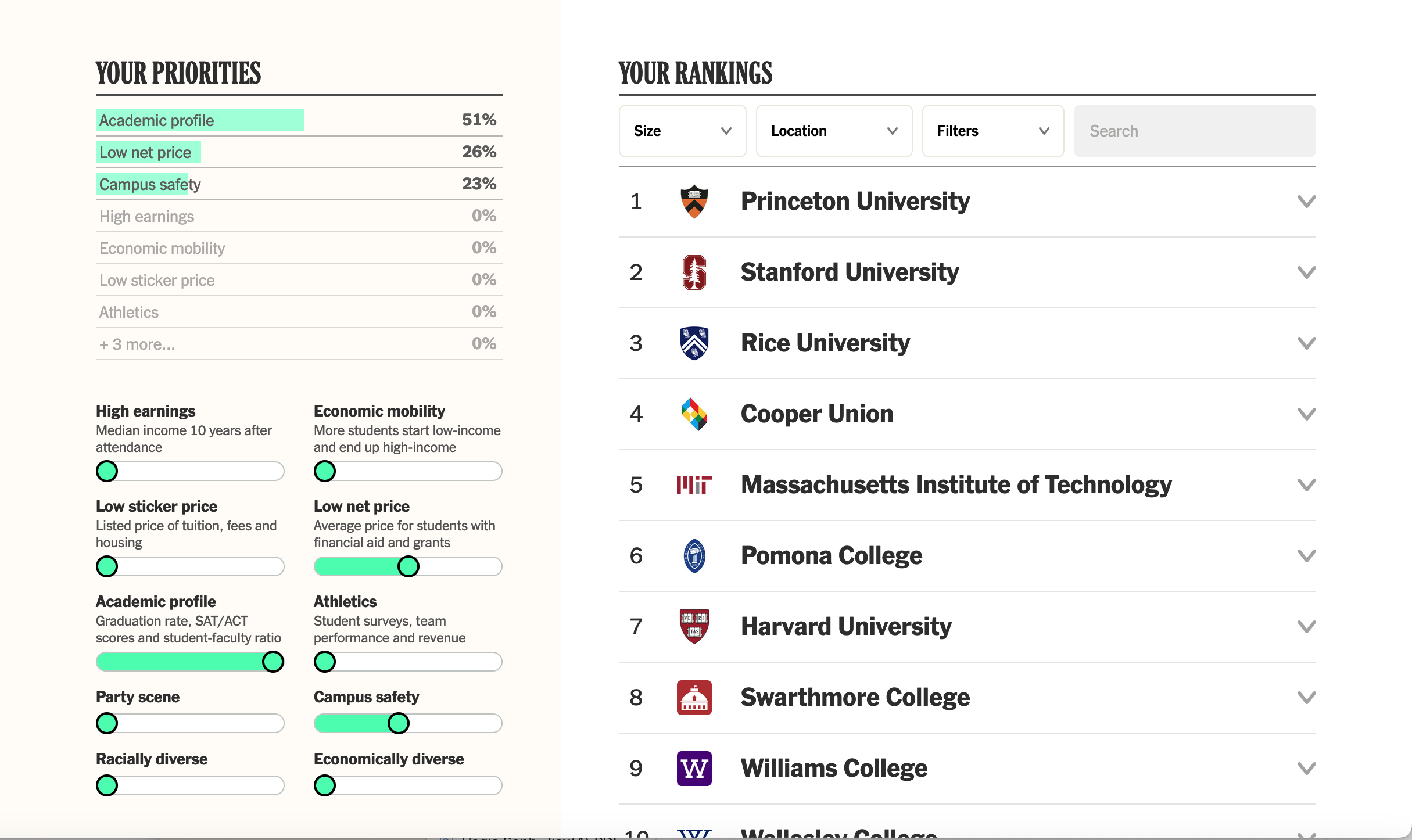
The New York Times’ Frank Bruni opines on The Problem With College Rankings, and How We Fix It. The problem revolves around choosing for prestige.

The “fix” he alludes to is an interactive college selector of the Times’ own devising.

Here are the Times’ selection criteria:

Here’s the closest I thought I could come to what I value in a college or university (though “Academic Profile” seems a belamed version of “will they try to make me an educated person?”):

And here’s where I should go based on those criteria:

It was kind of interesting. If I actually were looking for a college, I’d definitely put this in the mix of tools.

Politics

Eric Metaxas and his kin

Eric Metaxas appeared to be a pretty solid guy until he sold his soul to a politician who remains too much in the news. His over-the-top comments between Election 2020 and the cool-down period after January 6 (see this) destroyed any trust I might have felt.

But I recently listened to a podcast discussion of his presumptuous newish book Letter to the American Church. I discerned very little thought, but a lot of rhetorical cunning: staccato riffs salted with endless straw men. I assume that sort of thing persuades some people. His resort to straw men in support of his inexplicably pre-ordained conclusions is of longstanding (see the Emma Green Atlantic story, the first link above).

Specifically, Mr. Metaxas,

  • I did not vote for Hillary Clinton just because I didn’t vote for Trump (have you heard of the “Electoral College” and “Red States”? A protest vote in a Red State need not be a Blue vote); and
  • I didn’t withhold my vote from Trump because I thought his supporters were yucky, tacky or whatever that straw man was. I refused to vote for him (twice now, and the second time the alternative was not Hillary, Trump’s biggest 2016 advantage) because he is a toxic narcissist and because sooner or later his pathological self-regard was going to make him misapprehend reality. (As we see his current deranged output on Truth Social, it’s obvious that I was right.)

I’ve thought about what would make someone like Metaxas lose his mind over this. There are people closer to me than him who’ve done much the same thing, such as the friend who recently faulted “SJW” jackboots at Purdue for disrupting a “conservative speaker.” That version has a few problems:

  1. Purdue has a strong free speech policy.
  2. So the SJWs did not disrupt, but rather counter-protested and acted up nearby.
  3. The dramtis personnae were not a benign conservative and malign SJWs, but rather a Right provocateur (“we must eradicate transgenderism from America”) eager to give offense and Leftish provocatees eager to take it.

What happened was that my friend had taken his Right narrative and applied it to facts that he assumed fit. He hadn’t bothered to ascertain what actually went on.

This suggests to me a possible causal sequence:

  1. My friend (and Metaxas?) assume that, this being America, if there’s a bad American guy or group, there must be a countervailing good American guy or group. It’s unthinkable that God would forsake America, His special darling, leaving its people with only miserably bad political choices (my strong suspicion of what happened).
  2. Having identified the Democrats as bad, the Republicans must be good (because only they are big enough to countervail; a vote for a third party candidate is “wasted”).
  3. Having identified the Republicans as good, their nominees and elected officials must be good — not just “less bad most of the time” but “good,” or “very good” or (as spoke another evangelical friend in 2016) “the best candidate I’ve had the privilege to vote for in my entire life.”
  4. Thus do we get Christian folk who have syncretized the faith with Manicheanism. Pas d’ennemies áu droit.

I suggest that narrative, which I shall for a while be tempted to use to structure what I observe and what I hear vague rumors about.

Where’s the beef? Maybe Georgia

In April 2020, businesses in Georgia were shuttered by government decree as in most of the rest of the country. Mr. Kemp was hearing from desperate entrepreneurs: “ ‘Look man, we’re losing everything we’ve got. We can’t keep doing this.’ And I really felt like there was a lot of people fixin’ to revolt against the government.”

The Trump administration “had that damn graph or matrix or whatever that you had to fit into to be able to do certain things,” Mr. Kemp recalls. “Your cases had to be going down and whatever. Well, we felt like we met the matrix, and so I decided to move forward and open up.” He alerted Vice President Mike Pence, who headed the White House’s coronavirus task force, before publicly announcing his intentions on April 20.

That afternoon Mr. Trump called Mr. Kemp, “and he was furious.” Mr. Kemp recounts the conversation as follows:

“Look, the national media’s all over me about letting you do this,” Mr. Trump said. “And they’re saying you don’t meet whatever.”

Mr. Kemp replied: “Well, Mr. President, we sent your team everything, and they knew what we were doing. You’ve been saying the whole pandemic you trust the governors because we’re closest to the people. Just tell them you may not like what I’m doing, but you’re trusting me because I’m the governor of Georgia and leave it at that. I’ll take the heat.”

“Well, see what you can do,” the president said. “Hair salons aren’t essential and bowling alleys, tattoo parlors aren’t essential.”

“With all due respect, those are our people,” Mr. Kemp said. “They’re the people that elected us. They’re the people that are wondering who’s fighting for them. We’re fixin’ to lose them over this, because they’re about to lose everything. They are not going to sit in their basement and lose everything they got over a virus.”

Mr. Trump publicly attacked Mr. Kemp: “He went on the news at 5 o’clock and just absolutely trashed me …

At that point, Florida was still shut down. Mr. DeSantis issued his first reopening order on April 29, nine days after Mr. Kemp’s. On April 28, the Florida governor had visited the White House, where, as CNN reported, “he made sure to compliment the President and his handling of the crisis, praise Trump returned in spades.”

Three years later, here’s the thanks Mr. DeSantis gets: This Wednesday Mr. Trump issued a statement excoriating “Ron DeSanctimonious” as “a big Lockdown Governor on the China Virus.” As Mr. Trump now tells the tale, “other Republican Governors did MUCH BETTER than Ron and, because I allowed them this ‘freedom,’ never closed their States. Remember, I left that decision up to the Governors!”

James Taranto, Brian Kemp, Georgia’s Affable Culture Warrior.

Res ipsa loquitur.

Ron DeSantis, George Soros and Peter Thiel

Governor Ron DeSantis should be ashamed.

In contemplating the possible criminal indictment of former President Donald Trump, the Florida governor tweeted: “The Manhattan District Attorney is a Soros-funded prosecutor.”

Let us review.

George Soros, the wealthy Hungarian-American financier and philanthropist, is the bogey man of the American right wing. They trace whatever they don’t like about liberalism or progressive politics back to Soros’ imaginary machinations. Soros is the puppet-master.

George Soros is a Jew.

These are antisemitic conspiracy theories. That is what makes antisemitism so potent, and unique among hatred — it has always existed as a network of conspiracy theories. You just have to say the name “Soros,” and you wind up with an antisemitic dog whistle — in much the same way as “Rothschild” has been, and continues to be.

Jeffrey Salkin, Call it Soros-phobia.

I completely agree that George Soros “is the bogey man of the American right wing.” I do not share that feeling about him.

I have no reason to doubt that Soros is a Jew.

I consider DeSantis’s comment about Alvin Bragg a combination of craven servility to Trumpist voters and hackneyed demagoguery about a bogey man.

But it does not follow that criticism of Soros is antisemitic, unless one absurdly considers any criticism of a Jew, at least if coupled with some dark hint that “he’s up to something,” antisemitic. And both Salkin and the ADL seem to have little more than that. (James Kirchik makes a similar point.)

They may nevertheless be right (I’ve been wrong about my “conservative” countrymen before). Let’s try a thought-experiment: Is Left criticism of Peter Thiel’s influence anti-gay?

Trump’s “Retribution Tour”

The accompanying article wasn’t revelatory, but I love Elaine Godfrey’s title: Trump Begins the ‘Retribution’ Tour


For all its piety and fervor, today’s United States needs to be recognized for what it really is: not a Christian country, but a nation of heretics.

Ross Douthat, Bad Religion

You can read most of my more impromptu stuff here (cathartic venting) and here (the only social medium I frequent, because people there are quirky, pleasant and real). Both should work in your RSS aggregator, like Feedly or Reeder, should you want to make a habit of it.

Friday, 7/15/22

Improving an old adage

I may not agree with you, but I will defend to the death your right to make an ass of yourself.

Oscar Wilde via Nadine Strossen, Who Really Benefits From the First Amendment?

I had never before enountered that delightful upgrade to an old saw.

We. Are. Doomed.

I learned Thursday of a newly-minted epithet for those of us who have no intention of uploading our brains to the cloud to attain immortality, and who oppose the whole project: "fleshists."

Errata

I referred recently to Herschel Walker as an in-kind contribution to Stacy Abrams’ race for Governor of Georgia. The problem is, Walker is running for Senate, not Governor. So he’s actually an in-kind contribution to Raphael Warnock. You can look that up.

Warnock, be it remembered, was elected in an early-2021 runoff partly courtesy of Orange Man petulantly implying that Georgia’s election apparatus was so corrupt that there was no point in voting. Many [brutal characterization of mental and moral capacity omitted] Georgia Republicans obliged Orange Man by staying home, so we now have an evenly-divided Senate instead of Republican control. And, God willing, liberal Raphael Warnock will not be relinquishing his seat to Orange-Man-endorsed Herschel Walker (who absolutely was a superb football player back when I watched the Cowboys religiously).

That’s from memory and opinion banks, and it’s too good to fact-check myself on it. "Orange Man bad" indeed, and bad in so many ways for the GOP that adores him.

Modern and Postmodern

Walter Pater’s aphorism that all art aspired to the condition of music alluded to the fact that music is the least explicit of all the arts (and the one most directly attuned to our embodied nature). In the twentieth century, by contrast, art has aspired to the condition of language, the most explicit and abstracted medium available to us.

Iain McGilchrist, The Modern and Postmodern Worlds in The Master and His Emissary

Abolition of biology

While some degree of ‘gender dysphoria’ is probably as old as the hills, and people who don’t conform to society’s expectations of what men and women ‘should’ be have always existed (many of us could probably comfortably fit into that category), what is happening now is something very different. Western society is engaged in a fundamental shift in its understanding not just of ‘gender roles’ – questioning them has been de rigeur for at least a century, after all – but in the nature of biological reality.

Paul Kingsnorth, The Abolition of Man (and Woman)

Last Resort

The important thing to understand about preventive attacks on other countries is that they can never be a “last resort.”

Daniel Larison, Biden’s ‘Last Resort’ – by Daniel Larison – Eunomia


If people have always said it, it is probably true; it is the distilled wisdom of the ages. If people have not always said it, but everybody is saying it now, it is probably a lie; it is the concentrated madness of the moment.

Anthony Esolen, Out of the Ashes

You can read most of my more impromptu stuff here (cathartic venting) and here (the only social medium I frequent, because people there are quirky, pleasant and real). Both should work in your RSS aggregator, like Feedly or Reeder, should you want to make a habit of it.