… Mormons claim that “total” apostasy overcame the church following apostolic times, and that the Mormon Church (founded in 1830) is the “restored church.” …
A bullet-point in an anti-Mormon tweet after the attack on a Michigan Mormon meeting place. (My source identified the tweeter as “fundamentalist.”) The bullet-points built to the conclusion that Mormons (Latter-Day Saints) are not Christian.
Fine. But the Evangelical and Evangelical-adjacent world in which I spent many decades believes something very much like that Mormon “total apostasy” story. They may think it started in the 4th century and ended in the 16th instead of the 19th, but a lot of them (including former-me) functionally think it ended in the 19th, with the revivals of the “Second Great Awakening,” when the distinctive style of Evangelicalism emerged. (BTW: Try to define “Evangelical.”)
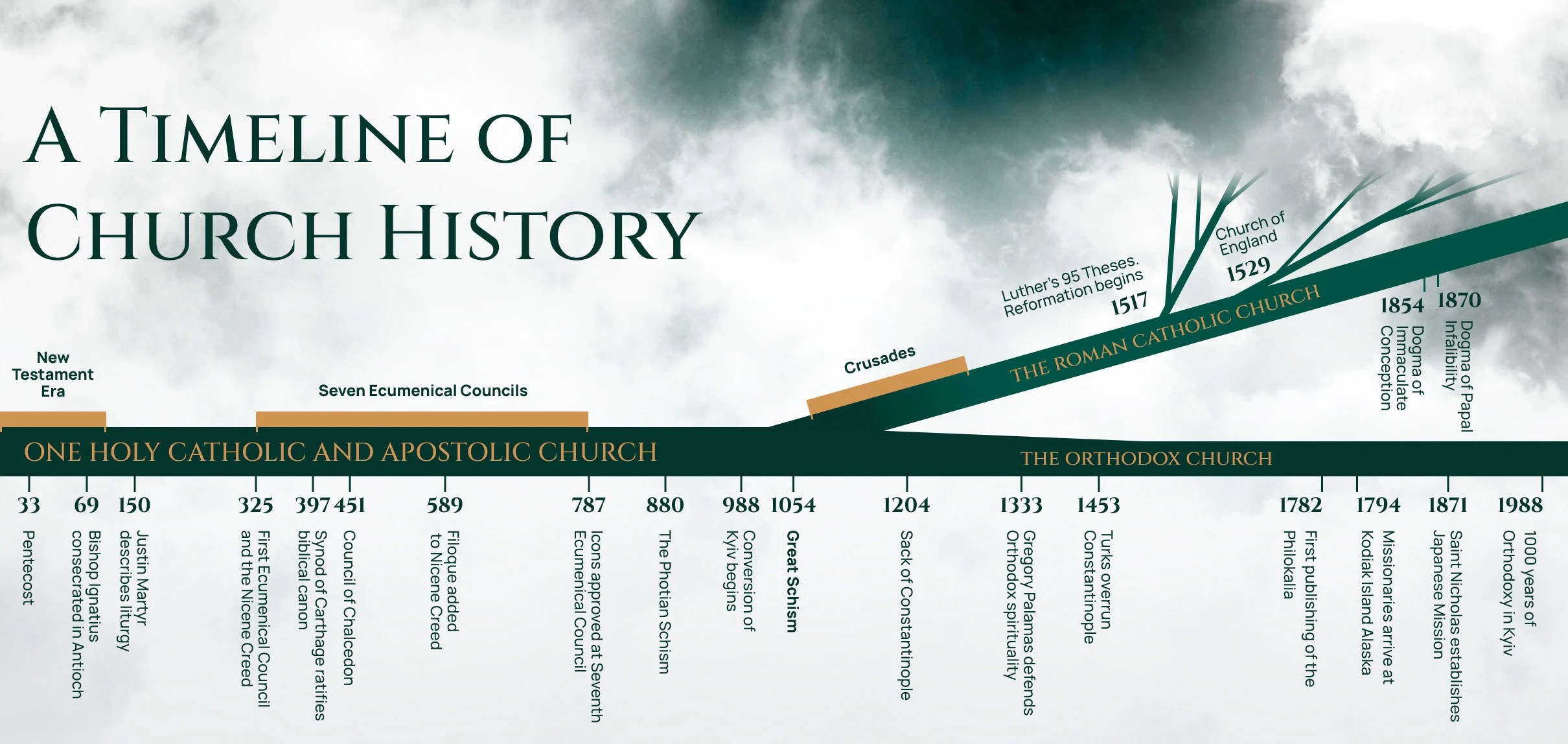
Here, I submit, is a more accurate summary of Church history:
There’s no need of a restored church because Christ’s One Holy Catholic and Apostolic Church never went away.
And I stumbled onto it …
Speaking of which, I had occasion this week to reread an eight year-old blog constituting, my only published spiritual biography (it was reprinted elsewhere one time). There are a few things I’ve written over the years that stick in my mind as worthy efforts, not throw-away lines or curations, and that post is one of them.
Some things bear repeating, and so I shall:
Having settled in for a few decades, what have I found uniquely true about the Orthodox Church?
It’s hard to put into words. That’s why Orthodox evangelism tends to consist of “come and see.”
Harder still for me personally, I need to find words for feelings and tendencies that an intellectualoid has trouble trusting — things that may be true but approach ineffability. I have a Dostoyevsky “Beauty Will Save the World” sticker on my office window, but long habit and self-image keep pulling me back toward “Spock-like logic (think of that tidy, air-tight 5-Point Calvinism) will save the world.”
But here goes. Turn on your feeler.
I’ve found, again, the love of God. Over and over and over and over we hear liturgical exclamations “for You are a gracious God and love mankind.” There’s no contrary stream of wrath that I’ve noted. The steadfast love of the Lord endures forever. I’ve found true worship of God, which was something I longed for and agitated for in my prior Evangelicalism and Calvinism, as best as I then understood worship. For instance, I wanted no “hymns” in worship that were addressed to encouraging one another rather than praising God. Yet somehow bathos kept cropping up, and emotionally manipulative gospel songs kept elbowing out too many hymns. I really had no idea what real worship looked like, but my longing was wholesome. I am very much a member of homo adorans. I have found sobriety and balance. The Christian Reformed Church was on the right track when it aspired to “Catechism Preaching,” an effort to tie sermons to the prescribed portion of the Heidelburg Catechism appointed for that Sunday, rather than letting pastors riff on whatever they read in Saturday’s newspaper or National Review. But Catechism Preaching was a tradition honored more in the breach than in the observance. I have found the Orthodox liturgical cycles (very complex and overlapping) to produce sobriety and balance in homilies, but more, in the entire service (hymnody, Epistle and Gospel readings, etc.) I have found a hard path which, if I faithfully walk it, will make me more Christlike — a nice Protestant way of referring to becoming a “partaker of the divine nature.” I have found a Church that really is a hospital for sinners instead of a club for self-styled saints. Some patients have more embarrassing ailments than others, but we’re all chronic cases; sacramental confession helps to drive that home. Not one of us is a hopeless case: the lives of the Saints help drive that home. Some check out of the hospital against medical advice, but we don’t do involuntary discharges of anyone who knows (s)he’s sick and wants to get well.
Another’s conversion
She elaborates the point with more than a little self-deprecation: “I’d backed myself into a corner. There wasn’t anyone else in the world who talked about ‘the Platonic ideal of the Good as an active agent with a special care for humankind’ without shortening that whole cumbersome phrase to simply God.”
In short, although she resisted the conclusion (or was it a solution?) with all her strength, she finally welcomed its inevitability. “I had just enough love in me to be able to be warmly surprised to find out the rules I loved, loved me back.”
Answer: not her background convictions, but how she applies them to concrete questions, especially questions about public policy and the modern household ….
Orthodoxy and Roman Catholicism are not in communion with each other since, in the simplified version, the Great Schism of 1054 (see the timeline above). But a lot of people coming out of Protestant traditions have felt that those were the only two viable Christian alternatives, and I have never found it in me to criticize those who made the wrong-but-plausible choice, like Leah did.
Fallen
Of course, we speak of human beings as “fallen.” However, in Orthodox teaching, this does not refer to our nature itself. Rather, it refers to the fact that we have been made subject to death – we are mortal. It is “death at work in us” that we describe as “sin.” But the origin of sin is not found in our nature. Our nature is inherently good. Understanding this makes a huge difference when we think about human relationships and the character of our common life.
If you take the view (which is common in certain corners of Western Christianity) that human beings have a “sin nature” – that we are, in fact, essentially bad – then how we view one another and the character of our common life takes on a different caste. In an Orthodox understanding, a Bible verse such as, “Spare the rod and spoil the child,” can mean little more than “children need discipline in their lives to help them”. Whereas in a world in which human nature is held to be a “sin nature,” then “sparing the rod,” would be seen as letting evil run amok. It would hold that our nature not only needs to be restrained but requires a vigorous regime of reward and punishment. It has not been that long since the notion of “beating the evil out of a child” was common.
When we speak of our nature as “good,” we are not declaring that human beings are born as saints. Rather, we are saying that our nature (“what we are”) tends towards the good, desires the good. We desire beauty. We desire well-being. We desire truth. Even when we engage in evil actions, they are most often grounded in a misperception of the good. Dictators do not come to power by asking people to be evil – they come to power by distorting the image of the good.
Religious ideas have the fate of melodies, which, once set afloat in the world, are taken up by all sorts of instruments, some woefully coarse, feeble, or out of tune, until people are in danger of crying out that the melody itself is detestable.
George Elliot, Janet’s Repentance, via Alan Jacobs
[N]one of the things that I care about most have ever proven susceptible to systematic exposition.
You can read most of my more impromptu stuff here and here (both of them cathartic venting, especially political) and here (the only social medium I frequent, because people there are quirky, pleasant and real and it has no-algorithms). All should work in your RSS aggregator, like Feedly or Reeder, should you want to make a habit of it.
Despite sociological evidence to the contrary, it remains to all appearances virtually axiomatic that the acquisition of consumer goods is the presumptive means to human happiness-and the more and better the goods, the better one’s life and the happier one will be.
Brad S. Gregory, The Unintended Reformation
Paradox
The quest for unity that drove people to discard formal theology for the Scriptures drove them further asunder.
“Every theological vagabond and peddler may drive here his bungling trade, without passport or license, and sell his false ware at pleasure.”
Frances FitzGerald, The Evangelicals, quoting Nathan O. Hatch, The Democratization of American Christianity, who in turn is quoting a mainstream Protestant pastor’s lament about the new sects.
Conversion
“There is no point in converting people to Christ if they do not convert their vision of the world and of life, since Christ then becomes merely a symbol for all that we love and want already –without Him. This kind of Christianity is more terrifying than agnosticism or hedonism.”
Rod Dreher, Schmemann and Social Justice (quoting Fr. Alexander Schmemann)
Listening to that other voice
[T]he real problem of the Christian life comes where people do not usually look for it. It comes the very moment you wake up each morning. All your wishes and hopes for the day rush at you like wild animals. And the first job each morning consists simply in shoving them all back; in listening to that other voice, taking that other point of view, letting that other larger, stronger, quieter life come flowing in. And so on, all day. Standing back from all your natural fussings and frettings; coming in out of the wind.
We can only do it for moments at first. But from those moments the new sort of life will be spreading through our system: because now we are letting Him work at the right part of us. It is the difference between paint, which is merely laid on the surface, and a dye or stain which soaks right through. He never talked vague, idealistic gas. When he said, “Be perfect,” He meant it. He meant that we must go in for the full treatment.
In Orthodoxy, you won’t commit mortal sin for missing liturgy. There is no concept of “mortal sin”. That’s just not how the Orthodox “model” works. You are supposed to be at liturgy, not because you fear punishment, but because being present at liturgy is an aid to theosis. It draws you closer and closer to unity with God. On the occasion I miss liturgy, I regret it, and if I don’t have a good reason (traveling, or sick), I confess it when I next go to confession. But I don’t lie there fearing for my everlasting soul.
The demons are still with us, but they have lost. They and their chief, the devil, are still trying to draw us into damnation with them, but they will never again wield the power they once did. All they have left to them is deception. Against their deceptions we have humility in repentance, and the reason that weapon is so powerful is because by humbling ourselves we join ourselves to Jesus Christ, who in His humility threw down that great dragon and banished him forever at the point of the swords of the archangels, angels, and all the saints.
Andrew Stephen Damick and Stephen De Young, The Lord of Spirits (book, not podcast)
Without comment
It’s dangerous to try analyzing a Christian tradition that’s not, and never has been, one’s own — though I’ve probably done so repeatedly. This time, I’ll leave Catholic commentary to a card-carrying Catholic, author of the authorized biography of John Paul II:
To make matters worse from a journalistic standpoint, the only witnesses cited in defense of today’s papal autocracy were such acolytes of the pontificate as Austen Ivereigh, David Gibson, and Massimo Faggioli—the functional equivalent of Tucker Carlson writing a piece entitled, “Donald Trump takes on unprecedented attacks from his opponents” and sourcing it with quotes from Marjorie Taylor Greene, Matt Gaetz, and Lauren Boebert. This isn’t journalism; it’s blatant advocacy. And it should be named as such.
Western Christian theology is founded on the phronema of Augustine. The East did not acquire the mind of one Father, but the mind of the Fathers.
Dr. Eugenia Scarvelis Constantinou, Thinking Orthodox
There’s a tremendous amount distilled there. You can’t read Augustine’s Confessions and easily deny that he was a saint. But he was peerless in the West and was not in serious dialog with the many Greek-speaking Fathers in the East, so he went awry in ways that have ramified mightily in the West and that accordingly lead us in the East to keep him at arm’s length.
Seems about right
The collapse of U.S. Mainline Protestantism also included a collapse in Protestant confidence, intellectual life, and public influence. Modern Evangelicalism lacked the institutions and traditions of centuries-old Mainline groups. They typically could not compete directly with vigorous Catholic intellectual life. And so rising Evangelicalism often relied on Catholic intellectual resources to make needed public arguments.
Looking for a news hook? Duke’s latest report in 2021 (.pdf here) showed evangelicals to be the nation’s least politicized Christian grouping. Only 43% of local evangelical congregations participated in even one of the 12 types of political involvements that were surveyed, compared with the more liberal “mainline” Protestants (at 52%), Catholics (81%) and Black Protestants (82%) or (not part of this study) the well-known activism at Jewish synagogues and Muslim mosques.
The Guy takes the savvy author to task on one detail, the tic of applying words like “Christian” or “church” while referring only to white evangelicals. We’re told that these past few years the radicals “seemed poised to capture the controls inside of the American Church.” True for Catholicism? For Black Protestantism? How about for mainstream evangelical denominations and parachurch groups?
… that Christ may dwell in your hearts through faith; that you, being rooted and grounded in love, may be able to comprehend with all the saints what is the width and length and depth and height — to know the love of Christ which passes knowledge; that you may be filled with all the fullness of God.
You can read most of my more impromptu stuff here (cathartic venting) and here (the only social medium I frequent, because people there are quirky, pleasant and real). Both should work in your RSS aggregator, like Feedly or Reeder, should you want to make a habit of it.
On this eve of the The Nativity According to the Flesh of our Lord God and Savior Jesus Christ (that’s the official name in Orthodox Churches), I deviate somewhat both from my usual tone (because, as you may have noted, there was some fairly big religious news over the past week) and from much particular nativity piety.
What’s wrong with this plan?
The neighborhood will do the luminaries (sic) again this year on Christmas eve. Board member [name/phone omitted] will take point this year distributing the luminaries on Christmas Eve. Distribution will be from my house at [address omitted] beginning at 9:30am. If you would like to volunteer to help with the distribution, be at my house promptly at 9:30 Sunday morning.
Email from my HOA President. I could add emphasis, but I’ll let you ferret out the solecism on the grammar of Christian piety on your own.
Contemporary Pharisaism
The Pharisees of Christ’s time thought that Jews had lost God’s favor through transgressions of His law. To regain God’s favor, they were punctilious about keeping His law — and tried to force other Jews (Jesus, for instance) to do so as well.
I regret that Pharisaism in common parlance has come to connote hypocrisy, censoriousness and self-righteousness, because that sounds prissy and self-satisfied, whereas the real Pharisees were more like theocrats, more like our myths about grim-faced Puritans.
In my preferred sense, I would apply “Pharisaical” to Michael Cassidy, Ron DeSantis and Charlie Kirk:
On Dec. 14, a Christian veteran named Michael Cassidy walked into the Iowa State Capitol and destroyed a display erected by the Satanic Temple of Iowa. The display was an idol of Baphomet, a robed figure with a goat head. Cassidy told Fox News host Jesse Watters that he had destroyed the statue in an act of “Christian civil disobedience.”
…
But the right-wing response to the Baphomet vandalism was notable … Florida’s governor, Ron DeSantis, tweeted, “Satan has no place in our society and should not be recognized as a ‘religion’ by the federal government. I’ll chip in to contribute to this veteran’s legal defense fund. Good prevails over evil — that’s the American spirit.” The Turning Point USA co-founder Charlie Kirk said, “A Christian veteran just beheaded a monument to Satan in Iowa’s State Capitol. If this is Christian Nationalism, we need more of it. Hero.”
David French, who goes on to describe in his words the spirit that makes me (not him) want to call them “Pharisaical”:
To understand the moment, one has to understand the extent to which many religious activists believe that free speech itself is responsible for America’s ongoing secularization and alleged moral decline. They believe the doctrine of viewpoint neutrality — that is, the requirement that the government treat private speakers equally in their access to government facilities — is a proxy for “moral relativism.” …
This claim is a Christianized cousin of the secular idea that defending the free-speech rights of those with whom you vehemently disagree is, in essence, providing aid and comfort to racism, sexism, homophobia or transphobia. In this view, your role as a citizen is first to determine whether any given speech meets with your moral approval, and then — and only then — to rally to its defense.
I would add that at least some religious activists believe not just that we decline morally as a virtual synonym for acting badly, but that America’s plight is a direct judgment (i.e., not just a natural consequence) from a god who’s angry at us because of our collective sins.
Those are the clearest case of modern American Pharisaism.
Fiducia supplicans
Black holes (Rorschach proclamations)
In a by now familiar sequence of events, the Vatican released a document on Monday which caused instant confusion. “Pope says Roman Catholic priests can bless same-sex couples,” the headlines announced. Optimistic Catholic apologists said the media had misunderstood the document, which permitted no such thing. Pessimistic Catholic apologists said the headlines were, alas, correct, and that the pope had erred. Part-time ultramontanists said that the document could only be read in a conservative manner and that it was an outrageous insult to the pope to think otherwise. Full-time ultramontanists said that the document could only be read as a “development of doctrine” and that it was an outrageous insult to the pope to think otherwise. The liberals rejoiced, with a slight undertone of impatience. The world took a brief interest, concluded that the Church was at least making some slow progress, then yawned a little and moved on to the next headline.
I have spent what feels like years parsing these much-debated Vatican documents, checking the exact translation of Italian words, badgering learned canonists and theologians for comments, comparing one sentence with another. And to be honest, I am thinking of retiring from the game. Because in the era of Pope Francis, such “controversial” statements are generally less statements than black holes.
A black hole, according to NASA, is “a great amount of matter packed into a very small area—think of a star ten times more massive than the Sun squeezed into a sphere approximately the diameter of New York City.” That slightly exaggerates the density of Fiducia supplicans’ five-thousand-word text, but the point is the result—which, as NASA explains, “is a gravitational field so strong that nothing, not even light, can escape.”
This seems the perfect frame. I’m less experienced and less connected than Dan Hitchens when it comes to the Roman Church. If he can’t figure it out, I can’t.
But it seems fair to say that Pope Francis has, by Fiducia supplicans, at least given cover to those who have been clamoring for recognition of same-sex couples (and to a lesser extent, divorced and civilly remarried couples).
Fr. James Martin conveniently photographed and posted on social media his “spontaneous” blessing of one couple. (Yes, there is something oxymoronic about a social media photograph of a supposedly spontaneous encounter.)
Untenable tension
Of Monday’s extraordinary action by Pope Francis:
What does it mean to bless a couple without blessing that couple’s relationship? Millions of words will be expended in the coming months to try to explain this, but I can guarantee that none of them will make sense. … It’s hard to see how historic Catholic teaching on marriage and historic Catholic teaching on papal authority can emerge unscathed from this.
There has been speculations that Fiducia supplicans will produce a schism in Catholicism and/or drive orthodox Catholics to Orthodoxy.
The late Jaroslav Pelikan was a Church Historian at Yale. Somewhere in the 20-25 year-ago range, he left Lutheranism to embrace Orthodox Christianity, where his heart had been for some time already.
I emailed the news a Protestant friend who’d studied at Yale. He responded that the development would create a real buzz at Yale.
I followed up with the puzzled question about whether Yale was really so religious that this would be scandalous. “Au contraire,” he replied. “The scandal is that anyone at Yale should take religion seriously enough to change affiliations like that.”
In this situation, Catholics who take religion seriously enough to object to things like Fiducia supplicans probably have been those who in the past attended carefully to the words of Popes and defended the most lavish claims about the authority of the Pope. This is going to be a tough call for them.
… and not just them
[I]t is not a sufficient reason to come to the Orthodox Church if someone is dissatisfied with his own Church community, be it a Catholic Church or a Protestant community. There is something more in the Orthodox Church … and it is simply not enough to be a protester or to this like something happening in your own community in order to become Orthodox.
Metropolitan Hilarion. It will be tempting for some Orthodox priests to treat dissatisfaction with Catholicism over this shift of position as a sufficient basis for receiving them into Orthodoxy. Who doesn’t like “church growth”?
On greener grass
It is important that before any of you choose to abandon your declining church for a different communion, that you not have any false hope. This is true of Orthodoxy as well. It is not the case that all churches are the same, so it doesn’t matter which one you belong to. Nor is it the case that because all churches are dealing with corruption of one kind or another, you might as well stay put. I’m simply saying that one should try to be as realistic as possible, and not allow oneself to be swayed by one’s understandable hope that the grass is greener Over There, With Those People.
It might be greener than where you are, but I assure you there will be problems. As a Catholic priest once put it to me, discussing the decadence within all the churches today, “Churches are made of people, including the clergy. Whatever sins the people of a time and place have, they will bring them into the church.” His point was not that we should reconcile ourselves to sin, much less engage in woke mumbo-jumbo to declare sin to be a blessing. His point, rather, was that we should not allow our idealism to get the better of us, such that we become scandalized by the failures within ecclesial bodies.
I have loved this story before and I love it still:
I am reminded of leaving the RCIA (catechesis) program I had enrolled in at the LSU Catholic Student Center in 1991, under the naive assumption that though I was two years out of college, I would find a more intellectually challenging catechesis there. In fact, it was a liberal priest and a liberal nun leading us all on guided meditations. Zero teaching of what we would be required to believe as Catholics. When I realized at last that this wasn’t going to get any better, and that we were all going to end up being received into the Catholic Church without knowing anything about the Catholic faith, I left.
I found my way to Father Dermot Moloney, an elderly Irishman who pastored the Latin mass parish downtown. He took me on as a catechumen. He said to me on that first day, in his thick brogue, “Lad, by the time I get t’roo with ye, ye might not want to be a Catlick, but you’ll know what a Catlick is.” God bless that priest’s memory. I so respected him for that. The problem today is that a Catholic can be just about anything he or she wants to be, and the administrative class of the Church doesn’t care. If you care, the Pope considers you to be “rigid,” and part of the problem.
Your purpose in life, in all likelihood, is quotidian
I live in Phoenix, the home of Grand Canyon University that has become a fairly major player in the Christian college scene. They have billboards all along the I-17 freeway through town that market their programs as “finding your purpose”. And that in a nutshell, I think, is the “spirit of the age” of our cultural Christian spirituality. The concept that you are potentially a “Bible character level” servant of God is foundational to evangelical Christianity. … [I]t all boils down to this: You exist to be something and do something specific (and great) in the universe and apart from fulfilling that utility you are a failure (or sinner…).
…
I don’t know exactly when “God has a plan for your life” stopped making sense, or more like it stopped making sense to put any energy or investment into trying to make it make sense. I think it was around the time (almost 20 years ago) when I faced the reality I was never going to be ordained to the priesthood, something I “KNEW” was my calling and purpose since first grade. That thought drove my life and I had spent decades in churches, ministries, cultivating relationships, and making preparations of one form or another to prepare for its inevitable, providential fulfillment. It never happened. I’ve ended up being a construction worker for the past 40 years instead. But even so, I found ways to spiritualize my life as a common laborer and make it “significant”.
…
At 71, … [a]s simplistic and tritely “zen” as it sounds, there is some peace accepting the reality that if I hadn’t done what I did, I wouldn’t be where I am (for better or worse) and I just have to deal with my present moment.
…
There was a woman who asked God, “What do you want me to do, what is your will for my life?” His answer? She said, “He told me, do your dishes. What a let down!” But that’s really the answer for all of us. “Do what is in front of you, and then the next right thing.” Yes, even doing the dishes is spiritual warfare sometimes.
The Christian Way, as its first followers referred to it, is in other words a path of internal transformation — what the Orthodox call the “unseen warfare” that goes on in the heart every minute. The battle between the way of God and the way of the world: every religion I know of teaches some version of this.
Being human, though, we like to take these teachings and overlay them onto the world. In Christian history, this has often taken the form of crusading — sometimes literally — to transform the kingdom of Man into the kingdom of God by force …
Currently, this trend is manifesting most obviously in the form of a “cultural Christianity” promoted by anti-woke public figures on the Right. In this reading, the Christian Way is a weapon which can, in the words of Ayaan Hirsi Ali, writinghere as a recent convert, “fortify us against our menacing foes”. Ironically, this spiritual-warfare-as-civilisational-warfare attitude is most obvious at present in the rise of the violent Islamism which so frightens Hirsi Ali, and with good reason. The nervousness with which Europeans have been shopping in their Christmas markets this month is testament to the reality of the violence which some people think God will help them justify. The warning should be clear.
… Religion, despite the many calcified failures of its history, is not at root a weapon in anybody’s culture war. Religion and culture reign in separate domains. A faith wielded as a stick with which to beat the “cultural Marxists” will end up being as empty as the consumer void it seeks to challenge, and potentially as toxic. C. S. Lewis had already spotted the trap more than 60 years ago: “Religions devised for a social purpose, like Roman emperor-worship or modern attempts to ‘sell Christianity as a means of saving civilisation’, do not come to much. The little knots of Friends who turn their backs on the ‘World’ are those who really transform it.”
Both the fundamentalist and the higher critic assume that it is possible to understand the biblical text without training, without moral transformation, without the confession and forgiveness that come about within the church. Unconsciously, both means of interpretation try to make everyone religious (that is, able to understand and appropriate scripture) without everyone’s being a member of the community for which the Bible is Scripture.
Soon enough, Africa will be sending Christian missionaries to darkest America.
Orthodoxy
Anglophone Christians appropriating Orthodoxy
Fr. Stephen DeYoung’s podcast bible studies have brought me one revelation after another. Those on Galatians (from almost three years ago; I came to these podcasts late and have been listening in chronological order) have been particularly helpful for my understanding of how little I understand — and by extension a challenge before all who come to Orthodoxy from a Protestant millieu.
This exchange between Fr. Stephen and a parishioner “went meta” on the challenge:
C1: I have a question that may be a distraction, but… You read this in English, in this English translation.
Fr. Stephen: Yes.
C1: First of all, it makes almost no sense.
Fr. Stephen: Yeah.
C1: Second, if you live in the Western culture that we live in, and you try to make sense of it, you’re going to come to the wrong conclusion.
Fr. Stephen: Yes.
C1: What do we do about that?
C2: Well, we have a Fr. Stephen.
Fr. Stephen: [Laughter] We need… Honestly, we need an Orthodox translation of the New Testament in the English language. And we as English-speaking Orthodox Christians have not fully appropriated the Orthodox tradition and faith yet. We just haven’t. We’re still doing that. We’re still working on that.
C1: Our language is actually a barrier.
Fr. Stephen: Right, because the English language that we’re using, terms like “justification” and things, it’s the vocabulary of Protestant theology. So it’s not just a question of how do we express the Orthodox faith in English; it’s [that] we’re trying to express the Orthodox faith in Protestant terminology, and that’s kind of not going to work. So we have to continue—mostly we’re doing that just by using borrowed Greek words like apophatic theology and cataphatic theology and theosis. We’re just taking the Greek words and using them instead of the Latin ones like justification, to try and help with that, but that’s something we’re just going to have to continue to do.
But, yeah, any New Testament you’re going to pick up, including the New King James Version that you find in the Orthodox Study Bible is translated by a Protestant committee. So, number one, they’re coming at it from a Protestant perspective, but, number two, it’s a committee, so they’re also trying not to take sides, usually, in any internecine Protestant debates. So it’s not [just] that it’s Protestant; it’s that it’s vaguely Protestant, which is what makes it even harder to understand. Because if they just let a Calvinist translate it themselves, it would be skewed, toward Calvinism, obviously, but it would at least make sense. [Laughter] But because they’re trying not to do that, you end up with translating participles with a gerund, just “-ing,” going because we don’t want to interpret beyond that; or just putting “of”—“of faith,” “the hearing of faith.”
…
Fr. Stephen: We’ve got a lot of work to do. And you folks are just as responsible for doing your piece of it as I am for doing my piece of it. So that’s why it’s hard. That’s why it’s hard is that there’s this cyclical [Sic. I think he probably meant more like “recursive”] thing, where Protestantism has read these passages a certain way, and so the English translations all reflect that reading. So you could either go back and read the Greek— but even then, who put together the lexicon you’re using that tells you what the words mean? Yeah, some 19th-century German Protestant liberal. [Laughter] So that’s going to be skewed another way, too.
And again, I’m not saying any of this to bash Protestantism. It’s just we as Orthodox Christians are reading New Testaments that reflect the Protestant tradition of the people who translated it. Just like, if I translate something, it’s going to reflect my Orthodox Christian understanding of it. As humans, none of us is a robot, none of us is completely objective—there’s no way to do a completely objective translation anyway, because words in one language do not equal words in another language, so you can’t mathematically do a translation. You can’t have a computer do a… If you want to see how a computer does a translation, go use Google Translate and see how that works for you! [Laughter] I don’t want a Google translated Bible! That’s going to make a whole lot less sense than this, right? [Laughter]
C1: It also means that we have to struggle within our own minds to deal with thoughts that have been skewed in advance. I mean, you say “justification,” and my mind immediately says, “by faith,” and I know what that means. I’ve heard that in church; wait a minute.
Fr. Stephen: Right, or the word “faith.”
C1: Yeah, the word “faith” itself.
…
C1: So it’s a constant mental struggle.
…
Fr. Stephen: … But to a certain extent, that’s always been true. That’s why we have homilies and sermons. That’s why we don’t just stand up and read a text from the Bible and sit back down. It’s always required teaching and explanation and that kind of thing.
For what it’s worth, today is my 49th anniversary. I hope the 50th starts with something better than a trip to the Emergency Room for a nosebleed that wouldn’t quit (the third in the last 2-3 years after decades with nary a leak). I shall follow up with my Primary Care Doc.
Separated at Birth
Compare:
[P]eople … hate my media criticism. Hate hate hate it. You would not believe the number of people who write to me saying “I almost/might/did cancel my subscription because I don’t want to hear pointless media gossip anymore!” Do the other stuff, they always say, the good stuff, the probing, researched stuff. But this media stuff, it’s too personal. That’s always the claim: that when I write about media, I’m necessarily attacking individuals rather than structures. That it’s personal. Then I go back and read what I wrote and inevitably I see myself critiquing structures and find nothing particularly personal. There’s a real incommensurability here. People are free not to like whatever they want, but I think deciding that criticism designed to reflect on an industry rather than individuals is too personal forecloses on important conversations.
Expressing concern about insufficiently careful diagnostic practices for TGNC youth is not an attack on this group. This is like saying that the sentence “I believe psychiatrists should establish confidence an antidepressant will help a depressed person before prescribing it to them” is an attack on depressed people. It’s just a plainly ludicrous position, and a dangerous one given the extent to which it pathologizes normal, important clinical work.
Do the people who try to turn legitimate concerns into offensive personal attacks actually believe it?
What’s not cancel culture
Perhaps no one’s juvenilia should disqualify her from a job—and the reason isn’t merely that most of us said idiotic things in adolescence—but because that’s as it should be. If we are ever going to test out an extreme idea or hurtful comment, adolescence is the time to do it—a period of identity formation when we require all the feedback we can get. We demand adults behave themselves precisely because we assume this was preceded by beta-testing, a period of adaptive idiocy, when they tore through adolescence’s maze, hungering for affection, altering behavior in response to every dead end, registering each shock of pain. It seems compassionate—perhaps even necessary—to place a black box around statements made in high school and college, particularly where a young person has later disavowed them.
But is there no public statement predating one’s employment so vile as to render someone an obviously bad hire? (The emphasis on public statement seems critical because all social life might end if we did not retain the freedom to explore half-baked or foolish ideas in private with intimates.) …
Abigail Shrier, in a post on what is not “cancel culture.”
Fauci lied, people died
Okay, the causation between Fauci’s lie (that masks don’t help is the one that most offends me) and people dying is pretty convoluted, and I’m not furious with Fauci or obsessed with him. But fourteen months ago, our Masters desperately wanted to move the Overton Window to disallow — nay, to excoriate and anathematize! — any questions about a nexus between the Wuhan emergence of a novel and deadly coronavirus and the Wuhan Institute of Virology (or a sister facility in Wuhan).
Washington Post: “repeating a coronavirus conspiracy theory that was already debunked” (“debunked,” by the way, is becoming a journalistic weasel-word. It means that the hive has decided the narrative.)
New York Times: “Fringe Theory of Coronavirus Origins”
The former President of the United States (“TFPOTUS” or “45”) repeatedly praised China for its “efforts and transparency” in containing the virus, going out of his way to thank Chinese President Xi Jinping “on behalf of the American People.”
That’s definitely changing. F’rinstance …. I could write more, but my knowledge is what you can get by reading a variety of responsible new sources, neither (a) following conspiracy-oriented websites nor (b) living within an entirely monocultural information silo.
And, in full-disclosure mode, the Washington Post’s Josh Rogin and former New York Times science reporter Donald McNeil (chased out of the Times in an unrelated cancel-culture incident) were among those conspicuously giving deeply-reported and establishment-tinged cover for respecting the lab-leak theory of the pandemic. And of course, TFPOTUS went into full blame-shifting mode, with racial overtones, as soon as buddy-buddying with China became a political liability. (The last seemed to persuade nobody sensible.)
But do not forget that the questioners fourteen months ago were right, and our masters were either ignorant or lying for some ulterior motives (which might even have been honorable).
Speaking of which,
Some of the biggest cases of mistaken identity are among intellectuals who have trouble remembering that they are not God.
I cannot help but think of Election 2020 and its aftermath when I read that.
The Late, Not-So-Great “God Bless the USA Bible” project
There are 66 books in the Bible. Some streams of Christian faith include 14 others, known as the “apocrypha.” But no version of orthodox faith has an American apocrypha. Including the founding documents of America and the theology of American nationalism in the Bible is offensive.
I, too, welcome the abandonment, though the proposal itself is a sort of apokálypsis (as if we needed any more) of the sorry state of American Christianity.
But let me correct the authors about something: the 14 books omitted from most Protestant Bibles are only called “apocrypha” by those Protestants. To me and other Orthodox Christians, they’re called “Bible.” And there is at least one additional book, Enoch, recognized as “Bible” by Ethiopian Orthodox.
Art is the one medium in which one cannot lie successfully lie
When we build, say, a business area in which all (or practically all) are engaged in earning their living, or a residential area in which everyone is deep in the demands of domesticity, or a shopping area dedicated to the exchange of cash and commodities – in short, where the pattern of human activity contains only one element, it is impossible for the architecture to achieve a convincing variety – convincing of the known facts of human variation. The designer may vary color, texture and form, until his drawing instruments buckle under the strain, proving once more that art is the one medium in which one cannot lie successfully lie.
Jane Jacobs, The Death and Life of Great American Cities (quoting John Raskin)
What is the purpose of life?
[W]e Americans will hardly need to ponder a mystery that has troubled men for millennia: what is the purpose of life? For us, the answer will be clear, established and for all practical purposes indisputable: the purpose of life is to produce and consume automobiles.
Paul Kingsnorth’s recent (January) conversion to Orthodox Christianity, from a non-Christian prior adult life, has fascinated me partly because I was vaguely aware of the Dark Mountain Project and the “dark ecology” it represented and partly because, frankly, my personal experience of adult converts to Orthodox Christianity is almost entirely of people coming from Roman Catholicism or one of the innumerable Protestant denominations or “independent” churches (scare-quotes because independent churches seem invariably small-b baptists, whether they want to admit it or not).
I nevertheless don’t recall ever reading Kingsnorth’s blog post titled dark ecology until today.
Even if I had read it, it would merit re-reading, long though it be, and I personally read it as the musings of a man developing a sane and sober mind some years before discovering, to his surprise, probably the most sane and sober Christian tradition, which we now share.
Excerpts:
This is the progress trap. Each improvement in our knowledge or in our technology will create new problems which require new improvements. Each of these improvements tends to make society bigger, more complex, less human-scale, more destructive of non-human life and more likely to collapse under its own weight.
‘Romanticising the past’ is a familiar accusation, made mostly by people who think it is more grown-up to romanticise the future.
Progress is a ratchet, every turn forcing us more tightly into the gears of a machine we were forced to create to solve the problems created by progress. It is far too late to think about dismantling this machine in a rational manner – and in any case who wants to? We can’t deny that it brings benefits to us, even as it chokes us and our world by degrees.
The neo-environmentalists have a great advantage over the old greens, with their threatening talk about limits to growth, behaviour change and other such against-the-grain stuff: they are telling this civilisation what it wants to hear. What it wants to hear is that the progress trap which our civilisation is caught in can be escaped from by inflating a green tech bubble on which we can sail merrily into the future, happy as gods and equally in control.
Another foreshadowing in the pre-Christian life of Paul Kingsnorth:
Finally, we put in a small plantation of birch. I love birch groves. Ours is only a few metres square, but I’ve made a fire pit in the middle of it, and maybe in ten years I’ll be able to sit around it and pretend I’m on the Russian steppe. I don’t know why I would want to pretend that, but I do.
This second article also is full of hubristic techno-narcissists, who get little sympathy from PK.
You can read most of my more impromptu stuff at here. It should work in your RSS aggregator, like Feedly, should you want to make a habit of it.

 Tipsy Teetotaler ن