Birth of John the Baptist

So far as I know, we have little or no evidence for when John the Forerunner/Baptist was born, but both Orthodox and Roman Catholics commemorate it on June 24. It’s a big enough deal that my parish had a liturgy for it.

The rest of this post has nothing to do with that.

At Stake in Harvard Grants

Harvard is unique both in the volume of its research output and the extent of these cuts — the government has threatened to end every research dollar to the university. The canceled grants accounted for here add up to about $2.6 billion in awarded federal funds, nearly half of which has already been spent according to government data.

“Even ‘grant’ is a problematic word, because people think they’re just sort of handing this money out for us to do what we want with,” said Marc Weisskopf, who directs a center for environmental health at Harvard that lost its funding from the National Institute of Environmental Health Sciences.

On the contrary, the government is much more explicit in competitive research applications and grant reviews: It wants more neuroscientists. It wants better opioid treatment. It wants to know how lightweight origami-inspired shelters and antennas can be unfurled in war zones.

The money the government sends to Harvard is, in effect, not a subsidy to advance the university’s mission. It’s a payment for the role Harvard plays in advancing the research mission of the United States.

This is the science model the U.S. has developed over 80 years: The government sets the agenda and funds the work; university scientists design the studies and find the answers. The president’s willingness to upend that model has revealed its fragility. There is no alternative in the U.S. to produce the kind of scientific advancements represented by these grants.

Emily Badger, Aatish Bhatia and Ethan Singer, Here Is All the Science at Risk in Trump’s Clash With Harvard

GOP 2012 redux

Many have made the point, but it’s nonetheless true: Presidents can now do pretty anything they want in foreign policy without seeking congressional authorization, provided it involves dropping bombs on other countries.

Five months into the second Trump administration, isn’t it astonishing that we have a Republican president: pushing for passage of a budget bill that cuts Medicaid and Medicare; pursuing an immigration policy focused on workplace enforcement, deportation of non-criminals, and the encouragement of “self-deportation”; and a happy John Bolton cheering the bombing of Iran? After a decade of debates about What Trump Means for the Right, we’ve ended up governed by the GOP circa 2012, as if the Trump administration were just the asshole version of the Romney/Ryan administration we were spared by Obama’s successful bid for re-election that year.

Damon Linker

Received financial wisdom

The longer I live, the more I appreciate that we can’t know everything, and that we live our lives mostly on the basis of trust. What we trust depends largely on our milieu (the polite term for “tribe” for present purposes), despite trying to avoid echo chambers.

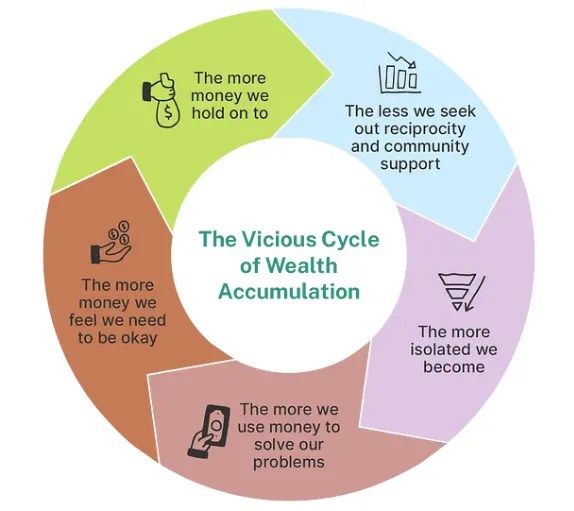
Several of my social media cyberfriends (see footer) are living quite counterculturally, and one of them introduced me to the Dense Discovery newsletter. I probably give it awfully short shrift most weeks, but today caught my attention and led to something pretty thought-provoking, starting with a graph:

Okay, but let’s talk about the prescribed wealth hoarding model in the United States, otherwise known as prudent financial planning (supposedly). The conventional advice from financial planners is that people of my age are supposed to accumulate something like $1 million in order to retire. Or maybe $1.5 million.1 In case you’re not hip to the logic here – I wasn’t until I married a very specific kind of nerd – we’re supposed to amass so much wealth that we can live off the interest and dividends until we die. It’s not enough to save what we’ll need to make it to the end of our life; we need (ostensibly) way more than that. We need to accumulate so much wealth that we can live off the wealth that our wealth earns. We need – we are told – enough that we never have to touch the principal, and we can pass our wealth along to our next of kin, whoever they may be.2

Interdependence is My New Retirement Plan – by Lisa Sibbett

My father, a professional, seemed to live fairly consistently with the values Lisa Sibbett suggests. My widowed mother had enough and to spare, but their church saw a lot of money over the years, too, and his kids occasionally got gifts at the end of a bountiful year.

My father-in-law, a tradesman, lived the “conventional advice from financial planners,” and we are now benefitting from his success at that model.

I’ve lived somewhere in between those two models. Though I (credulously?) aspired to the “conventional advice” model, I just couldn’t resist living life along the way, and not waiting until I was properly fixed for life. Unlike my parents’ generation, I did not live through any Great Depression and didn’t feel that possibility in my bones. I don’t regret it.

One caveat with Sibbett’s approach is that it requires long-enduring personal bonds. You’ll need to sink roots somewhere, and that somewhere will need to be where others are sinking roots as well. It requires long-enduring personal bonds. It’s not for individualist nomads.

The unmentionable elephant in the room

I confess that I struggled with the reasoning of the Supreme Court in Skrmetti although I reluctantly welcomed the outcome.

I was not alone. Josh Blackman and Hadley Arkes (not a lawyer, but an Amherst professor of Jurisprudence) were in the same position as me, but Arkes in particular pointed to the root problem:

The truth that dares not speak its name here is that this wide array of gender-affirming therapies and surgeries is simply predicated on a falsehood. And yet those are the words that the conservative justices apparently see themselves as barred from speaking. Something in conservative jurisprudence holds them back from appealing to the inescapable and objective truth that lies at the heart of these cases. But without it, what were these accomplished jurists able to explain here? What was their ground of justification in overriding the judgments of those parents who were absorbed in the grief and confusion that seized their children? . . . .

The only “instruction” that would be relevant, Justice Thomas, is the unyielding fact that the child is in a state of confusion: he is not occupying some body apart from his own; his sex was not “assigned” at birth but marked inescapably in the organs of reproduction, in the arrangement of his body. His sex is immutable and printed plainly upon him.

Those were the words that Chief Justice Roberts and five colleagues could not move themselves to speak. Or they thought they were constrained from speaking by a jurisprudence that bars them from invoking truths beyond the text of the Constitution—even on the question of what is a human being, the bearer of rights, and when does that “human person” begin? . . .

Without those points in place, the judgment of the Court simply dissolves into a chain of ipse dixits. Why was it not legitimate for the parents of stricken youngsters to order the procedures that might relieve their “gender dysphoria?” Answer: The legislature of Tennessee did not think it a legitimate medical remedy to choose—even though the children and the parents did not share that judgment and were willing to take their risks. One judgment had to prevail, and it was the judgment backed by the power of the State. To put a high finish on it, that “power” represented the authority of a people to govern itself through elected representatives. But when the people speak through their representatives, and override the judgments of parents about their children, they are still obliged to say something more than “we have brute the power to impose this judgment through brute enactment of the law.”

Arkes singles out Justice Thomas, I suspect, because he said “so-called experts have no license to countermand the ‘wisdom, fairness, or logic of legislative choices.’” (Justice Thomas, concurring in U.S. v. Skrmetti, via Eugene Volokh.) Arkes’ re-formulation, I guess, is that the legislature can tell the experts “your elaborations are predicated on the falsehood that a person can be inhabiting a body of the wrong sex.”

That’s not the end of the story, but it’s a starting point for re-writing a story written up to now by activists hiding something only a few clicks less deranged than the whack-a-doodle Chase Strangio ideology:

Strangio disputed that a trans woman could be “born with a male body” or “born male”; in his view, a trans woman was born a woman just like any other woman. There was no such thing as a “male body,” Strangio told his colleagues: “A penis is not a male body part. It’s just an unusual body part for a woman.” Before the advertisement aired, Strangio elaborated on his critique in an article in Slate. “Many advocates defend the use of the ‘born male’ or ‘born with a male body’ narrative as being easier for nontransgender people to understand,” Strangio wrote. “Of course it is easier to understand, since it reinforces deeply entrenched views about what makes a man and what makes a woman. But it is precisely these views that we must change.”

My own position hasn’t changed in 39 months. I think we’re still seeing a cultural contagion of trans claims in adolescents and must be very cautious – which is a bit easier now that even Strangio has given up on the “live son or dead daughter” emotional blackmail.

Patience, Mercy, Tolerance

For defenders of political liberalism there is perhaps no more pressing problem than this: How do you make a compelling case for liberalism in an era of ascendant [illiberalism or] strong gods? The idea of “strong gods” comes from the book Return of the Strong Gods by R. R. Reno, editor of the conservative ecumenical journal First Things.

By “strong gods” Reno means the kind of visceral or agonistic forces that can compel political or social action through deeper existential or even guttural appeals. The strong gods work not by chiefly targeting the intellect, but the appetites.

Michael Reneau, Evan Spear, and Jake Meador, A Virtue-Centric Argument for Political Liberalism (shared link). This article was welcome in light of the ascendance of various illiberalisms.

With a little help from AI, I got this summary table:

VirtueRole Against Postliberalism & Strong GodsRoot/Source
PatienceProvides long-term perspective, allowing growth and changeChristian theology & history
MercyBreaks cycles of retribution, fosters trust and forgivenessScripture, Shakespeare
ToleranceIntellectual humility; suspends harsh judgment; enables coexistenceLiberal philosophy & Scripture (e.g., parable of wheat and tares)

Wordplay

I know every one of these carries political freight, but that’s the burden of many writers these days:

  • Glenn Thrush, Alan Feuer and Adam Goldman remarked on the right-wing ire confronting Patel and Pam Bondi, the attorney general, as they fail to substantiate the accusations that they hurled in their bid for power: “They are running what amounts to a conspiracy theory fulfillment center with unstocked shelves.” (Jeff Lebsack, Buffalo, and Marianne Painter, Tacoma, Wash., among others)
  • In The Financial Times, Edward Luce worried that certain scenes from the Los Angeles protests played into the president’s hands: “Every rock hurled lands like a penny in Trump’s wishing well.” (Todd Lowe, Simpsonville, Ky., and Al Gallo, Huntersville, N.C., among others)
  • In The Washington Post, Philip Bump expressed skepticism about the government’s claim that immigration officers must wear masks for self-protection: “We should not and cannot take ICE’s representations about the need for its officers to obscure their identities at face value.” (Patrick Bell, Carmichael, Calif.)
  • Also in The Post, Dana Milbank took in Trump’s pleasure at some sycophantic Republicans’ suggestion that the D.C. Metro be renamed the “Trump Train”: “It’s a great idea. Qatar will donate the subway cars, which will be powered by coal. Passengers will pay for fares with cryptocurrency after first showing proof of citizenship. And the trains will reverse themselves regularly and without warning — never quite reaching their original destination.” (Mary Ellen Maher-Harkins, Orwigsburg, Pa., and Stan Shatenstein, Montreal)

Via Frank Bruni

Ceci n’est pas un phone

Methaphone. Like Methadone. Get it?

In case you’ve been wondering …

No, you’re not imagining it. The main source of political violence in the USA in this century has been right-wing, not left. Jamelle Bouie, Right-Wing Violence Is Not a Fringe Issue:

It is simply a fact that the far right has been responsible for most of the political violence committed in the United States since the start of the 21st century.

I had been wondering, because there has been some leftwing violence against persons, and much against property.

Poor fit

If it seems that America’s colleges and universities are poorly suited to the average American eighteen-year-old, perhaps that’s because they were never designed to serve him.

Oren Cass, The Once and Future Worker


Your enemies are not demonic, and they are not all-powerful and the right hasn’t always lost and the left hasn’t always won. But if you convince yourself of that, you give yourselves all sorts of permission to do a lot of stupid and terrible things under the rubric of “Do you know what time it is?”

Jonah Goldberg.

Trumpism can be seen as a giant attempt to amputate the highest aspirations of the human spirit and to reduce us to our most primitive, atavistic tendencies.

David Brooks

I don’t do any of the major social media, but I have two sub-domains of the domain you’re currently reading: (a) You can read most of my reflexive stuff, especially political here. (b) I also post some things on my favorite social medium.

Pure politics, 6/5/25

The Courts

Petulant Trump disavows his signature success (1)

Mr. Trump lashed out at the Federalist Society, blaming it for bad advice on whom to appoint to judgeships. He singled out Leonard Leo, a former longtime leader of the Federalist Society who helped recommend his first-term nominees and who exemplifies the conservative legal movement.

“I was new to Washington, and it was suggested that I use the Federalist Society as a recommending source on judges,” the president wrote. “I did so, openly and freely, but then realized that they were under the thumb of a real ‘sleazebag’ named Leonard Leo, a bad person who, in his own way, probably hates America, and obviously has his own separate ambitions.”

Mr. Leo and Mr. Trump had a falling out in 2020, but the personal attack was a sharp escalation. In a statement, Mr. Leo said, “I’m very grateful for President Trump transforming the federal courts, and it was a privilege being involved.”

Still, Mr. Trump’s tirade strained an already uneasy relationship with traditional legal conservatives.

Many share the president’s goals of strengthening border security, curbing the administrative state and ending “diversity, equity and inclusion” programs, said John Yoo, a conservative law professor. But, he added, they dislike some of Mr. Trump’s methods, whether that is prolifically invoking emergency powers or insulting judges who rule against his administration.

And Professor Yoo, who wrote memos advancing sweeping theories of presidential power as a Bush administration lawyer, said Mr. Trump’s attacks on Mr. Leo were “outrageous.”

“Calling for the impeachment of judges, attacking Leonard Leo personally and basically calling him as traitor as far as I can tell — Trump is basically turning his back on one of his biggest achievements of his first term,” he added, referring to the reshaping of the federal judiciary.

Charlie Savage, Trump, Bashing the Federalist Society, Asserts Autonomy on Judge Picks

For what it’s worth, Trump’s pledge to appoint federal judges from a list compiled by Leonard Leo (not the Federalist Society, which doesn’t do endorsements) was pivotal to his 2016 Election victory, especially among abortion foes who understandably did not trust a twice-divorced narcissist playboy with gambling and porn connections. Charlie Savage hasn’t forgotten that, but I shouldn’t quote his whole article.

If the Senate has a couple of Republicans with integrity, hack appointees like Emil Bove will not be confirmed. C’mon, guys! Save him from himself!

Petulant Trump disavows his signature success (2)

There are many stories in literature about people making deals with the devil. Weirdly, in most of them the devil is a square dealer.

That is, he keeps up his end of the bargain. He offers the protagonist wealth or power in exchange for something ethereal, like their immortal soul, and when they agree he delivers. The Prince of Lies turns out not to be a swindler. Most of the drama happens after he makes good on his promise and comes to collect.

The moral of those stories isn’t that you’re a fool to trade with Beelzebub because you’ll be cheated. It’s that you’re a fool to sacrifice your noblest self for something as fleeting as worldly power.

Conservatives made a deal like that in 2016. Donald Trump offered to stock the federal judiciary with their favorite judges, beginning with the vacancy left by Antonin Scalia on the Supreme Court; in return they would set aside their moral, civic, and ideological objections to him and support him in virtually anything he wanted to do, even if it affronted their conservative beliefs. Or basic decency.

The bargain was struck—and he delivered. Three eminent conservative jurists were added to the Supreme Court. Hundreds more were confirmed to federal appellate and district courts. The great white whale of social conservatism, Roe v. Wade, was harpooned in 2022 after a 50-year chase. Many other landmark legal victories for the American right have accumulated since Trump took office in 2017.

Conservatives weren’t cheated. The devil made good.

Fast-forward to last night …

[Leonard] Leo spent many years as the Federalist Society’s sherpa on judicial nominees, advising Republican presidents on whom to appoint and helping to shepherd candidates through the confirmation process. With the exception of Mitch McConnell, no one has done more this century to build a federal bench of originalist judges. But Trump didn’t want originalists—he wanted flunkies—and so Leo’s influence, and the influence of the organization he serves, have gone up in smoke …

Conservatives got the judiciary they wanted in exchange for supporting a man who radiates contempt for the constitutional order. In doing so, they empowered a postliberal movement that despises judges who do their jobs conscientiously instead of dutifully midwifing a Trumpist autocracy. As the Republican Party proceeds further down the path to fascism that those conservatives enabled, eventually the federal judiciary will consist entirely of believers in the “living Constitution,” half authoritarian and half progressive. In the long run, as Reaganites age out and are replaced by younger Trumpists, conservative judges as we’ve known them will go mostly extinct.

That’s what conservatives got for their bargain. The devil has come to collect.

Nick Catoggio

Pardons

The concept of a pardon, of course, is extremely hard for Trump to understand. Traditionally, a pardon is due to someone who has completed (or nearly completed) their sentence, expressed remorse, and turned their life around — and thereby been the recipient of mercy. But remorse is a concept unknown to a pathological narcissist. Mercy is even stranger. After all, who wins and who loses in an act of mercy? It’s one of those acts defined by grace — another literally meaningless concept for Trump. For him, all human conduct is built on a zero-sum, winner-vs-loser foundation. So a pardon is always instrumental — a way to reward allies, win credits, and enlarge his power by announcing to the world that he alone is the ultimate rule of law, and can intervene at any point to ensure his version of justice is the dispositive one. A monarch, in other words.

But Trump is the real outlier (and Biden, in his defense, used Trump’s abuse as a justification for his own self-dealing). In recent times he’s out in front in numbers: more than 1,700 full pardons so far, and we have three-and-a-half years to go. Nixon’s 863, Carter’s 574, Clinton’s 396, W’s 189, and Obama’s 212 put it in perspective. But these previous presidents abused the power occasionally — it’s an absolute power after all — while largely respecting the contours of the rule of law.

Trump has dispensed with any pretense of that. He is an instinctual tyrant — see his immigration overreach and his unilateral tariff mania — and the pardon power was almost made for him. The weakness of any constitution is the virtue — or, more often, the lack of it — in its office-holders. And Trump has the civic virtue of Jeffrey Epstein. The pardon power was always going to be a loaded gun in his tiny, careless hands.

… [H]e is using the pardon power all the time, rather than waiting till the end of his term. It replaces the rule of law with monarchical discretion. That’s why he could not tolerate Jeff Sessions all those years ago. Because Sessions, for all his passionate partisanship, still understood the system he was operating in and still believed that the appearance of impartial justice was integral to liberal democracy’s survival. Sessions was an American.

A majority of the American electorate, mind you, endorsed this lawlessness last November. It’s hard to pity them, as they absorb or ignore all the corruption they voted for and are still content to tolerate. They love crypto-monarchy as long as their king is on the throne. They do not seem to understand that this version of monarchy is still an elected one, and that another king from the other tribe may wear the crown some day. They may miss the benefits of liberal democracy once they have succeeded in killing it.

Andrew Sullivan, Pardon The Death Of Liberal Democracy

TACO

I’m not an active investor. I tend to buy and hold Mutual Funds and ETFs. (That’s just me; you do you.) But it did not escape my notice, even before the term was coined, that what’s now dubbed “TACO trades” could be profitable.

Wall Street is all over the “TACO trade,” another instance of people realizing they shouldn’t take the president at face value. “TACO” is short for “Trump always chickens out.” Markets have tended to go down when Trump announces new tariffs, but investors have recognized that a lot of this is bluffing, so they’re buying the dip and then profiting off the inevitable rally.

A reporter asked Trump about the expression on Wednesday, and he was furious. “I chicken out? I’ve never heard that,” he said. “Don’t ever say what you said. That’s a nasty question. To me, that’s the nastiest question.” The reaction demonstrates that the traders are right, because—to mix zoological metaphors—a hit dog will holler. The White House keeps talking tough about levying new tariffs on friends and geopolitical rivals alike, but Trump has frequently gone on to lower the measures or delay them for weeks or months.

Foreign leaders had figured out that Trump was a pushover by May 2017, and a year later, I laid out in detail his pattern of nearly always folding. He’s a desirable negotiating foil, despite his unpredictable nature, because he doesn’t tend to know his material well, has a short attention span, and can be easily manipulated by flattery. The remarkable thing is that it’s taken this long for Wall Street to catch on.

David A. Graham, The TACO Presidency

Now that the cat’s out of the bag, the profitability will diminish and what’s left will mostly be the pleasure of annoying Velveeta Voldemort.

The most incompetent administration ever

A federal appeals panel ordered officials not to deport a 31-year-old to El Salvador. Minutes later, it happened anyway. The government blamed “administrative errors.”

Alan Feuer, NYT

Will Trump pay any price for this fishy string of “administrative errors”?

Among his voters, I doubt it. But with the courts, the toll is steep and rising. They just cannot believe anything Administration lawyers promise. And they shouldn’t.

DJT, the anti-conservative

[I]t’s hard to think of a more anti-conservative figure than President Donald Trump or a more anti-conservative movement than MAGA. Trump and his supporters evince a disdain for laws, procedures, and the Constitution. They want to empower the federal government in order to turn it into an instrument of brute force that can be used to reward allies and destroy opponents.

Trump and his administration have abolished agencies and imposed sweeping tariffs even when they don’t have the legal authority to do so. They are deporting people without due process. Top aides are floating the idea of suspending the writ of habeas corpus, one of the most important constitutional protections against unlawful detention. Judges, who are the target of threats from the president, fear for their safety. So do the very few Republicans who are willing to assert their independence from Trump.

In one of his first official acts, Trump granted clemency to more than 1,500 people charged in connection with the violent attack on the Capitol on January 6, 2021, including those convicted of seditious conspiracy. The president and his family are engaging in a level of corruption that was previously unfathomable. And he and his administration have shown no qualms about using the federal government to target private companies, law firms, and universities; suing news organizations for baseless reasons; and ordering criminal probes into former administration officials who criticized Trump.

The Trump administration is a thugocracy, and the Republican Party he controls supports him each step of the way. Almost every principle to which Republicans once professed fealty has been jettisoned. The party is now devoted to the abuse of power and to vengeance.

The significance of this shift can hardly be overstated. A party that formerly proclaimed allegiance to the Constitution and the rule of law, warned about the concentration and abuse of power, and championed virtue, restraint, and moral formation has been transmogrified. The Republican Party now stands for everything it once loathed.

Peter Wehner

Thugocracy update

And she has been frank about the dilemma faced by Republicans like her who are dismayed about the president’s policies and pronouncements but worried that speaking out about them could bring death threats or worse.

“We are all afraid,” she told constituents in April, adding: “I’m oftentimes very anxious myself about using my voice, because retaliation is real. And that’s not right.”

Catie Edmondson, Lisa Murkowski Isn’t Using ‘Nice Words’ About Life Under Trump

I do acknowledge threats against Trump’s life, too. Several isolated nuts have been arrested and charged. But it seems to me that a President and his supporters holding Congress hostage for fear of their lives is an order of magnitude worse.

No laughing matter

Next month will be the first anniversary of Tim Walz’s branding of Donald Trump, JD Vance and, by implication, some of their political associates as “weird,” and it’s obvious now that Walz spoke too soon, before Trump won in November and his administration turned weirdness into a credential and an operating principle, before weirdness started afflicting Trump allies who seemed a little less weird in the past, before episodes of Trump-adjacent weirdness proliferated.

… [T]his pageant of peculiarity isn’t a laughing matter. It reflects Trump’s confusion of nonconformity with boldness. It speaks to his love of performance, even if it’s the fruit of a loopy performer. It demonstrates his desire to rattle, no matter how infantile the rattling.

Frank Bruni

Same column, change of topic:

If I’m subjected to one more lamentation, one more rant, about how lost and pitiable and shameful the Democratic Party is, my head is going to explode. Not because the Democratic Party is in good shape — it isn’t. Not because it can make do with only minor adjustments — it can’t. It’s guilty of the arrogance and incompetence of which it’s accused. And the country’s future as a reasonably healthy and prosperous democracy depends on Democrats’ recognition and remedy of that.

But some of the extravagant lashing of the party carries the implicit suggestion that Republicans, by contrast, have their act together. Excuse me? If success at the polls is the only metric for that, then sure, yes, they’re in an enviable spot. But it’s a wretched (and, I have to believe, vulnerable) one. Republican lawmakers who rightly gaped in horror at the events of Jan. 6, 2021, later developed collective amnesia, putting power several light-years above principle. They then indulged or outright applauded Trump’s laughable cabinet picks and his adoration of Musk and his cockamamie tariffs and his abandonment of due process and his swag from Qatar and his sadistic humiliation of President Volodymyr Zelensky of Ukraine and so many other cruelties and outrages that this sentence could go on forever. I struggle to admire Republicans’ political chops. I’m too distracted by their moral rot.

For love of sentences

In Esquire, Dave Holmes marveled at Senator Lindsey Graham’s suggestion, in a social media post before the conclave, that cardinals consider the idea of Trump as the next pope: “I guess he had not yet closed the day’s humiliation ring on his Apple Watch.” Holmes added that while Graham was probably joking, “You can’t be tongue-in-cheek when you are actively licking the boot. There is just not enough tongue for both jobs.” (Susan Fitzgerald, Las Cruces, N.M.)

Frank Bruni (a prior week)

Dissing the Dems

I confess that my laser-focus on Trump can sound like excusing the Democrats’ problems. It really isn’t. I’m just madder at my former party than at the I party whose Presidential nominee I voted for only once, 53 years ago.

An Andrew Sullivan podcast this week with the authors of Original Sin reminded me of just how screwed we are in the other of our major-party choices, the Dems, and how Joe Biden fooled me with his “nice guy” schtick. Though I didn’t vote for him, I would have done so if my fair state hadn’t been a lock for Trump.

Hypocrisy

Hypocrisy is the tribute paid to virtue by vice.

I will give Trump 2.0 credit for not adding hypocrisy to its countless other sins.

On second thought, his attacks on Ivy League universities for suffering antisemites gladly may qualify.

The best jokes

It has been said that the best jokes are dangerous because they are in some way truthful.

On Wednesday, a dangerous joke was told in the Oval Office. The South African president turned to the American president and said: “I’m sorry I don’t have a plane to give you.”

NYT

FWIW

  • Trump lost 96% of federal court cases in May. Even GOP-appointed judges ruled against him 72% of the time,” – Jack Hopkins.
  • “The Washington Post has now confirmed that it was Trump who asked the Qataris to gift him the plane for free (rather than the Qataris offering it), and that Qatar is demanding a written memo from the White House to this effect before the deal is finalized,” – Tom Malinowski.

Andrew Sullivan, Pardon The Death Of Liberal Democracy

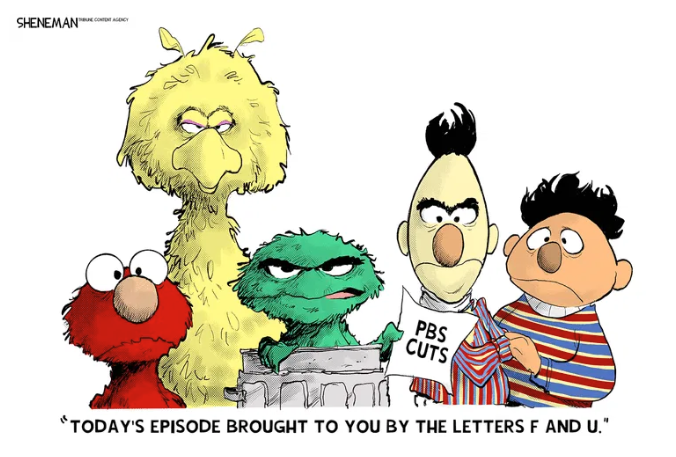
PBS

… and by the numbers 86 and 47.


Your enemies are not demonic, and they are not all-powerful and the right hasn’t always lost and the left hasn’t always won. But if you convince yourself of that, you give yourselves all sorts of permission to do a lot of stupid and terrible things under the rubric of “Do you know what time it is?”

Jonah Goldberg.

Trumpism can be seen as a giant attempt to amputate the highest aspirations of the human spirit and to reduce us to our most primitive, atavistic tendencies.

David Brooks)

I don’t do any of the major social media, but I have two sub-domains of the domain you’re currently reading: (a) You can read most of my reflexive stuff, especially political here. (b) I also post some things on my favorite social medium. I am now exploring Radiopaper.com as well.
Saturday, 5/31/25

AI doomsday?

[Jaron] Lanier agreed that it’s up to humans to protect the truth in the age of AI, but was less optimistic that we will do so: “The issue with AI is not the AI. It’s not the large language model. It’s the concentration of power and wealth around who owns it,” he said. “You have to look at the big system, including the people, the money, the business, the society, the psychology, the mythmaking, the politics.”

A Free Press Debate on Artificial Intelligence in San Francisco

Jaron Lanier had fallen off my radar for a few years. I’ll forever be interested in his take on anything regarding computers and humanity (together, not separately).

Bon mots

Codgers and technology go together like peanut butter and sardines.

Frank Bruni. Then this, merely via Frank Bruni, not from him:

In the quarterly journal Sapir, Bret Stephens made a kind of peace with the heavily partisan slant of so much cable television news: “To demand scrupulous impartiality on their broadcasts is like expecting fancy linens at a Motel 6.” (Naomi Lerner, West Orange, N.J.)

A non-tribal Democrat

Some of my subscribers dislike when I throw elbows to my left. They share my disdain for Donald Trump and his party, and my commitment to understanding them in light of political theory and history, but they are also devoted Democrats who have warm feelings for Joe Biden, were thrilled by the campaign of Kamala Harris and Tim Walz, and still seethe about Hillary Clinton’s loss in 2016.

That isn’t me. I vote for Democrats. I directionally agree with them on most issues. And I consider the Republican alternative thoroughly unacceptable. Yet I am not a devoted Democrat. A big part of the reason is that I’m not a joiner—of anything. I value my own independence too much and temperamentally resist deploying my talents to advance a cause—any cause, even a worthy one, and even one wrapped up, at this moment, with the fate of liberal democratic self-government in the United States.

But this way of thinking presumes that working to help the Democrats should take the form of deferring to and falling in line behind party leadership and elected officials, taking marching orders, rallying around candidates and nominees endorsed by the party bigwigs, and then maintaining message discipline to get them elected. That’s what I resist. But there’s another kind of devotion—one that expresses itself as tough love and a willingness to speak candidly, and even harshly, about faults.

… a Democratic researcher is quoted as saying that when she asks swing voters to liken the two parties to animals, they consistently describe Republicans as lions, tigers, and sharks—“apex predators” that “take what they want when they want”—but Democrats as tortoises, slugs, or sloths, creatures typically considered “slow, plodding, [and] passive.”

Damon Linker, A Party of Sloths

Substance, process

One of this crazy-making aspects of life in Trump 2.0 is that the media coverage of the administration’s antics focuses, mostly on the substance of what they are doing, ignoring the process, and the question of whether they have the authority to do it at all.

Such, I feared, was the infirmity of NPR and PBS Aren’t Entitled to Your Tax Dollars, a Free Press article by a serious Ivy league constitutional law professor. I slogged my way through it, agreeing with the author again and again, but frustrated that he was ignoring the elephant in the room. Finally, in literally the last paragraph, he mentioned the elephant almost as a throwaway line:

NPR also alleges in its complaint that the federal statute creating the Corporation for Public Broadcasting prohibits Trump from making this defunding decision. That’s a very different argument, which I’m not addressing here ….

I would venture a guess that nine out of ten people who read this column will come away with the impression that NPR and PBS are suffering from a liberal sense of entitlement to tax dollars, and miss the point about there being some limits to executive power.

In the end, it may not matter because this Congress is sufficiently servile that if Trump asks Congress to defund CPB, PBS and NPR (a longtime GOP talking point), it almost certainly will oblige him.

But process does matter, tremendously. Where the power to do something resides also matters.

Dissing Adoption

The New York Times … has never found a basic human good it couldn’t ponderously criticize with the shuffling-foot smarm of the ideas festival class. There’s “I Was Adopted From China as a Baby. I’m Still Coming to Terms With That. There’s “World’s Largest ‘Baby Exporter’ Admits to Adoption Fraud.” There’s “Given Away: Korean Adoptees Share Their Stories.” (In easily-digestible video format!) There’s “I Was Adopted. I Know the Trauma It Can Inflict.” (Subtle.) The New Yorker, a $12,000 espresso machine transformed into a magazine by a mischievous wizard, has “How an Adoption Broker Cashed In on Prospective Parents’ Dreams,” “Living in Adoption’s Emotional Aftermath,” and “Where is your Mother?” (The answer is that she has been separated from her child by a cruel and fickle child welfare system despite being perfectly fit, which I’m sure is how it usually goes.) The Atlantic has “No One’s Children: America’s long history of secret adoption.” (Would you be shocked to learn that said history isn’t a good one?) They’ve got “The New Question Haunting Adoption,” the question being whether adoption is really a secretly selfish act, you know, the selfish act of taking a severely-disabled toddler into your home to provide them with support and love after their birth parents smoked meth throughout pregnancy. They also have, incredibly, “What Adoption ‘Salvation’ Narratives Get Wrong,” “Adoption Is Not a Fairy-Tale Ending,” “The Dark, Sad Side of Domestic Adoption”…. I could go on, and that’s just three prestigious publications. There’s a whole world out of this out there.

This is all, for the record, a really excellent example of what we used to mean when we used the word ideology. Once upon a time, one wouldn’t say “My ideology is…” because ideology referred to the hidden, unexplored, unconscious politics that lay beneath the public, open, explicit politics. An ideology was those pre-political assumptions and beliefs which conditioned and limited political thought, which made the conscious political philosophy of any individual what it was. Ideology is the skeleton that hides unseen within the animal of politics but nevertheless determines the structure of that which is seen. Ideology exists in both the macro and the micro; this bizarre upper-caste antipathy towards ideology is a good example. If you asked leadership at these publications if they had any particular interest in leading a charge against the practice of adoption, they’d say no, of course not, what a weird question! If you were to show them just how repetitively this particular set of critiques and questions and hrm hrm hrm noises gets published in their pages, they’d swear to you that it reflects no underlying party line. And yet there it is, the evidence, in black and white. Something about the current constitution of the anxious educated urbanite liberal soul cries out inside of them: the real problem is adoption.

Freddie deBoer, Adoption is Good

If the shoe fits

A well-regarded Evangelical pastor published this weeks before the 2020 Election.

[T]his is a long-overdue article attempting to explain why I remain baffled that so many Christians consider the sins of unrepentant sexual immorality (porneia), unrepentant boastfulness (alazoneia), unrepentant vulgarity (aischrologia), unrepentant factiousness (dichostasiai), and the like, to be only toxic for our nation, while policies that endorse baby-killing, sex-switching, freedom-limiting, and socialistic overreach are viewed as deadly.

I think it is a drastic mistake to think that the deadly influences of a leader come only through his policies and not also through his person.

This is true not only because flagrant boastfulness, vulgarity, immorality, and factiousness are self-incriminating, but also because they are nation-corrupting. They move out from centers of influence to infect whole cultures. The last five years bear vivid witness to this infection at almost every level of society.

Christians communicate a falsehood to unbelievers (who are also baffled!) when we act as if policies and laws that protect life and freedom are more precious than being a certain kind of person. The church is paying dearly, and will continue to pay, for our communicating this falsehood year after year.

The justifications for ranking the destructive effects of persons below the destructive effects of policies ring hollow.

I find it bewildering that Christians can be so sure that greater damage will be done by bad judges, bad laws, and bad policies than is being done by the culture-infecting spread of the gangrene of sinful self-exaltation, and boasting, and strife-stirring (eristikos).

I think it is baffling and presumptuous to assume that pro-abortion policies kill more people than a culture-saturating, pro-self pride.

When a leader models self-absorbed, self-exalting boastfulness, he models the most deadly behavior in the world. He points his nation to destruction. Destruction of more kinds than we can imagine.

It is naive to think that a man can be effectively pro-life and manifest consistently the character traits that lead to death — temporal and eternal.

John Piper, Policies, Persons, and Paths to Ruin: Pondering the Implications of the 2020 Election

Piper did not say who he was voting for. He did not name names. For that reason, I’m blogging this separately from pointed political material.

But I’m not going to deny that my heart soared to see that our current President had not captured and reduced to servility the entirety of one of America’s most prominent Christian traditions.

The right to know isn’t the whole story

To further clarify our situation, consider W. H. Auden’s discussion, which I’ve cited before, of the idea that, as he put it, “the right to know is absolute and unlimited.” “We are quite prepared,” Auden wrote,

“to admit that, while food and sex are good in themselves, an uncontrolled pursuit of either is not, but it is difficult for us to believe that intellectual curiosity is a desire like any other, and to recognize that correct knowledge and truth are not identical. To apply a categorical imperative to knowing, so that, instead of asking, ‘What can I know?’ we ask, ‘What, at this moment, am I meant to know?’ — to entertain the possibility that the only knowledge which can be true for us is the knowledge that we can live up to — that seems to all of us crazy and almost immoral.”

L.M. Sacasas, Structurally Induced Acedia (The Convivial Society)

Harvard and the Trump administration

Harvard and the Trump administration have each finally met an adversary too big to push around. America’s richest university never really considered how much it depends on government policy, including lavish federal research funding, federal student aid, and a permissive immigration regime for the foreign students—who make up a third of the university’s student body and often subsidize the rest by paying more. Progressives also never thought through how the many tools they devised for using government leverage against private institutions—including threatening tax exemptions, as the Supreme Court allowed on dubious grounds in Bob Jones University v. United States (1983)—could be used against universities that engage in race discrimination for the “right” reasons, cultivate a political monoculture among the faculty, and permit campus mobs to terrorize minority groups who are out of progressive favor (Jews). Now, Trump is trying to strip Harvard of everything—tax exemption, federal funding, and visas for foreign students already enrolled. While the comeuppance for Harvard is admittedly delicious, the president is abusing powers he ought not to have, and Harvard has deep enough pockets to fight him in court.

National Review Weekly email.

Some cases don’t have valid arguments on both sides. That I find nothing “delicious” about Harvard’s “comeuppance” is an example of why I ignore National Review’s regular email invitations to resubscribe.

Can a car have a “catfish smile”?

“Behind that catfish smile, the company’s twin-turbo 4.0-liter DOHC V8 now discharges a drama-drenched 656 hp and 590 lb-ft—153 hp and 85 lb-ft more than the previous Vantage Roadster—thanks to larger turbochargers, revised camshaft profiles, optimized compression ratio and upgraded fueling and cooling.”

Kudos to Dan Neil for the spot-on “catfish smile.”

The car, by the way, is a 2025 Aston Martin Vantage Roadster, which will set you back $300,000 as equipped (this week’s ephemeral tariffs not included).

Credentials, good times, and genuine learning

Most young people today feel, with considerable justification, that they live in an economically precarious time. They therefore want the credential that will open doors that lead to a good job, either directly or (by getting them into good graduate programs) indirectly …

But those same young people also want to have a good time in college, a period of social experience and experimentation that they (rightly) think will be harder to come by when they enter that working world …

… Yes, students understand — they understand quite well, and vocally regret — that when they use chatbots they are not learning much, if anything. But the acquisition of knowledge is a third competing good, and if they pursue that one seriously they may well have to sacrifice one of the other two, or even both. Right now they can have two out of three, and as Meat Loaf taught us all long ago, two out of three ain’t bad.

Alan Jacobs, responding to Ted Gioia on the topic of ending AI cheating.

Potpourri

  • After Trump held a crypto dinner last Thursday night, crypto moguls who paid to be there felt scammed that the president didn’t even stick around at the event they’d hoped to do their own scams at. I saw someone describe him as the apex scammer. Our Scammander in Chief.
  • In other Russia news, a new statue of Joseph Stalin in a Moscow metro station was unveiled this month. President Putin has called Stalin an “effective manager,” and has said that enemies of Russia use the “excessive demonization” of Stalin to attack “the Soviet Union and Russia.” Stalin is back, big time. Interesting that “effective manager” is being used here to describe a man who facilitated the death of millions—and not efficiently. But I’m not a businessman.
  • The continued reckoning: A postmortem on Kamala Harris’s campaign cited a “perception gap” as one of the reasons she lost, saying voters believed she held positions that she didn’t. “Over 80% of swing voters who chose Trump believed Harris held positions she didn’t campaign on in 2024, including supporting taxpayer funding for transgender surgeries for undocumented immigrants (83%), mandatory electric vehicles by 2035 (82%), decriminalizing border crossings (77%), and defunding the police (72%).” But Harris had, in fact, supported all of these positions. Like, she is on record supporting each of those positions (here, here, here, and here). So it’s not really a perception problem so much as a reception problem, like these ideas are not popular even though I support them. There’s a sense among Dems that people should simply ignore the things that are unpopular and that referencing them is fake news. Like, how dare you talk about the surge of migrants coming through our new open borders thanks to swift changes from the Biden admin. Yes, it’s technically true, but it’s disinformation-coded.
  • Leave Bruce alone: A bar in New Jersey canceled a performance by a Bruce Springsteen tribute band after the real Springsteen called Trump “corrupt, incompetent, and treasonous” while on tour in England. Citing the bar’s MAGA clientele, the bar owner said that a Springsteen cover band would be “too risky at the moment.” And: “Whenever the national anthem plays, my bar stands and is in total silence, that’s our clientele. Toms River is red and won’t stand for his bull—.” [But MAGA doesn’t have a violent streak. No way. That’s fake news.]
  • Things that are not antisemitism: The Democratic Socialists of America “Liberation Caucus” has announced its support for Elias Rodriguez, the suspect arrested for slaughtering two Israeli Embassy staffers outside D.C.’s Capital Jewish Museum last week. Here’s the statement signed by the DSA Liberation folks and a bunch of others: “As imperialism has made the entire world its battlefield, it is justified to fight it, by any means necessary, without regard for geography.” And: “[T]here must be consequences for genocidal [Z]ionist imperialism, and those consequences are righteous.”

Nellie Bowles

Fake my …

The latest fitness craze is surely going to be Fake My Run. It fits perfectly with the national ethos whereby university students are already doing Fake My Education.


Your enemies are not demonic, and they are not all-powerful and the right hasn’t always lost and the left hasn’t always won. But if you convince yourself of that, you give yourselves all sorts of permission to do a lot of stupid and terrible things under the rubric of “Do you know what time it is?”

Jonah Goldberg.

Trumpism can be seen as a giant attempt to amputate the highest aspirations of the human spirit and to reduce us to our most primitive, atavistic tendencies.

David Brooks)

I don’t do any of the major social media, but I have two sub-domains of the domain you’re currently reading: (a) You can read most of my reflexive stuff, especially political here. (b) I also post some things on my favorite social medium. I am now exploring Radiopaper.com as well.

Political 5/30/25

What it takes to tick off David Brooks

Last Monday afternoon, I was communing with my phone when I came across a Memorial Day essay that the Notre Dame political scientist Patrick Deneen wrote back in 2009. In that essay, Deneen argued that soldiers aren’t motivated to risk their lives in combat by their ideals. He wrote, “They die not for abstractions — ideas, ideals, natural right, the American way of life, rights, or even their fellow citizens — so much as they are willing to brave all for the men and women of their unit.”

This may seem like a strange thing to get angry about. After all, fighting for your buddies is a noble thing to do. But Deneen is the Lawrence Welk of postliberalism, the popularizer of the closest thing the Trump administration has to a guiding philosophy. He’s a central figure in the national conservatism movement, the place where a lot of Trump acolytes cut their teeth.

In fact, in his acceptance speech at the Republican National Convention, JD Vance used his precious time to make a point similar to Deneen’s. Vance said, “People will not fight for abstractions, but they will fight for their home.”

Elite snobbery has a tendency to set me off, and here are two guys with advanced degrees telling us that regular soldiers never fight partly out of some sense of moral purpose, some commitment to a larger cause — the men who froze at Valley Forge, the men who stormed the beaches at Normandy and Guadalcanal.

But that’s not what really made me angry. It was that these little statements point to the moral rot at the core of Trumpism, which every day disgraces our country, which we are proud of and love. Trumpism can be seen as a giant attempt to amputate the highest aspirations of the human spirit and to reduce us to our most primitive, atavistic tendencies.

Mild-mannered David Brooks, popping a vein (shared link, bold added).

The rest of the column was quite good, but the idea that a primitive, atavistic President would deploy his “throne-sniffing sycophants” (H/T Kevin D. Williamson, below) to reduce the nation to primitive atavism struck me as (a) too sophisticated conceptually, but perfect temperamentally, for Trump (a “stupid, lazy and angry” man — Kevin D. Williamson again); (b) exactly what his smart and unprincipled intimates would realize is necessary for their success; and (c) the kind of radical moral rot that Brooks sniffs out and exposes to us all.

And for his ability to distill evils to their essence, I am grateful.

Stupid, lazy and angry

We’ve been here before, of course. Donald Trump and his team have been three weeks away from announcing a groundbreaking new health care plan for … what, just about a decade now? Donald Trump’s confidence in addressing a complex subject has a linear relationship to his ignorance regarding that subject, and so we have got gems like this presidential declaration of ineptitude: “Nobody knew that health care could be so complicated.” It isn’t the case that nobody knew—lots of people knew. Some of those people had good ideas, some had terrible ideas, but they knew it was complicated. The guy who didn’t know? The one who spent most of his life as a Manhattan gadfly, a game-show host with side hustles in pro wrestling and porn. That guy didn’t know.

There are no conspiracies. There are no secrets. Everything is more or less what it seems. … [T]he obvious explanation for Trump’s eccentricity (or most anything else) is almost always the correct explanation. Which is why I have been writing for all these years that the key to understanding the Trump administration is that its central figure, Donald Trump, is stupid, lazy, and angry …

There are people around Trump, such as Marco Rubio and J.D. Vance, who are not stupid or lazy (though both are distinctly angry men) but are functionally indistinguishable from the stupid and the lazy because they are throne-sniffing sycophants who dread a return to the private sector more than almost anything else in this life.

It’s all right there to see: Trump, the supposed master negotiator, is as a matter of practical fact able to effectively negotiate exclusively in situations in which no substantial negotiation is required: with people he can fire, for example, or with utterly dependent parties. He calls this “negotiating from a position of strength” instead of “bossing around your cowering flunkies.”

Kevin D. Williamson

It didn’t take long for the courts to figure this out

The Abrego Garcia ruling and the Alien Enemies Act litigation have left legal scholars warning of a constitutional crisis. But a more tangible effect, attorneys told me, has been the erosion of the “presumption of regularity”—the benefit of the doubt given to the government in court proceedings. It’s based on the idea that federal officers and attorneys are operating in good faith, and not trying to achieve political goals through acts of subterfuge.

As judges see the administration saying one thing in public and another in court, they have started to treat the government’s claims with more skepticism and, sometimes, with outright suspicion of criminal contempt. A recent Bloomberg analysis found that the Trump administration has been losing the majority of its immigration-related motions and claims, regardless of whether the judges overseeing their cases were appointed by Democrats or Republicans.

Nick Miroff, In Trump Immigration Cases, It’s One Thing in Public, Another in Court

I’m not by any means certain that it will all be alright, i.e., that the courts can protect us from Trump’s lawlessness. But denying his administration the presumption of regularity is an important and needed step.

Note well that when a government lawyer tried to address the court honestly, the Attorney General fired and defamed him:

When a senior ICE official said in sworn testimony in March that Abrego Garcia had been deported to El Salvador because of an “administrative error,” the Justice Department attorney who initially represented the Trump administration, Erez Reuveni, relayed that characterization to the court. When asked why the administration hadn’t taken steps to correct the error and bring Abrego Garcia back, Reuveni said his client—the Trump administration—hadn’t provided him with answers.

The top Trump aide Stephen Miller soon began insisting publicly that Abrego Garcia’s deportation was not, in fact, an error—the opposite of what the government admitted in court. Vice President J. D. Vance claimed that Abrego Garcia is a “convicted MS-13 gang member with no legal right to be here,” even though he has no criminal convictions in the United States or El Salvador. Attorney General Pam Bondi cast the error as missing “an extra step in paperwork” and said that Abrego Garcia should not be returned.

Reuveni was fired. Bondi said he had failed to “zealously advocate” for the government. “Any attorney who fails to abide by this direction will face consequences,” she told reporters.

Nick Miroff

It’s a good time to be a retired attorney or, failing that, to practice outside a Department of Justice that requires you to lie (the normal term for Bondi’s “zealously advocate”) in court.

Marks of dystopia

Speaking of lying to court and losing in court:

I offer you the most dystopian thing I’ve read about the state of the federal government this year—so far:

Amid rising tensions between the Trump administration and the judiciary, some federal judges are beginning to discuss the idea of managing their own armed security force.

The Supreme Court has its own dedicated police force, but other federal judges are protected by the U.S. Marshals Service, which reports to Attorney General Pam Bondi. Security committee members worried that Trump could order the marshals to stand down in retaliation for a decision that didn’t go his way.

A country where judges need their own bodyguards because they no longer trust the president to guarantee their safety if they rule against him (and understandably so) is a country waaaaay too far down the slope of banana republicanism to chastise anyone else about failing to live up to Western “virtue ethics.”

[Trump named Ed Martin acting U.S. attorney in Washington] earlier this year despite the fact that he hadn’t worked a day in his life as a prosecutor. The president later nominated him to fill the position permanently, but that required Senate confirmation. And although Senate Republicans have set the bar for confirming Trump cronies on the floor, somehow Martin still failed to clear it. You need to be awfully sketchy—like, Matt Gaetz levels of sketchy—for John Thune’s conference to bork you.

From time to time I think back to what Sen. Susan Collins said when she was asked during Trump’s first impeachment trial whether she’d vote to convict him for demanding a quid pro quo of Ukraine. No, she answered, there’s no need. “I believe that the president has learned from this case,” she told CBS News. “The president has been impeached. That’s a pretty big lesson.”

He did learn a lesson. What he learned was that Senate Republicans would never hold him accountable for blatantly abusing his power.

Nick Catoggio

Whole-of-Government Gaslighting

[W]hy is the Justice Department not only settling the lawsuit that [Ashli] Babbitt’s relatives filed but also mulling an apology in the millions? Because Trump’s alternate reality demands it. Because that is how you turn truth entirely on its head.

You don’t simply challenge what really happened at the Capitol, which is that lawless hooligans in thrall to Trump’s delusions attempted a kind of coup. You chip-chip-chip away at it in so many ways over so much time and with such unflagging frequency that many people who thought they understood what they were seeing aren’t wholly sure anymore — or give up trying to make sense of it.

Trump recast a day of shame as a “day of love.” The rioters became “patriots” and Babbitt a martyr. As soon as Trump returned to the Oval Office, he pardoned nearly all of the roughly 1,600 people criminally charged in connection with the rioting. He even floated the idea of a compensation fund for them. Everybody gets a prize!

To live in fiction, commit to it. That’s the moral not merely of Trump and Jan. 6 but of Trump, period. Yesteryear’s hand-wringing about whether to label his individual falsehoods “lies” and those periodic tallies of his misstatements now seem quaint; they don’t do justice to the scope and audacity of what he’s up to. Nor does the occasional current chatter about “propaganda.” Trump is engaged in a multifront, multipronged attack on any and every version of events that impedes his goals and impugns his glory. It makes the spin control of presidents past look like child’s play.

Frank Bruni (shared link) This is so good I probably would have shared one of my ten monthly links even if it weren’t the end of the month.

86ing the important stuff

Kash Patel Says He’s Prioritizing Social Media Mocking Trump Over ‘Child Sex Predators, Fentanyl Traffickers, Terrorists’ – Above the Law

He didn’t say that in so many words, but his meaning was clear:

FBI Director Kash Patel took a break from his busy schedule of hanging out in Las Vegas instead of actually running the FBI, to go on Fox News last night to rant a bit about James Comey. After Comey posted his beachside “8647” insta, Patel quickly took to social media — where all professional law enforcement vents about its investigation priorities — to pretend that “86,” a century old term for bouncing unruly customers or canceling food orders, actually amounted to an assassination threat directed at Donald Trump.

This was, to use the technical term, f ****** stupid. Though against all odds, it was not nearly as stupid as Patel’s next move. Per the Daily Beast:

“Do you know how many copycats we’ve had to investigate as a result of that beachside venture from a former director?” he asked Baier. “Do you know how many agents I’ve had to take offline from chasing down child sex predators, fentanyl traffickers, terrorists?”

Hopefully some career law enforcement professional within the FBI intervened to make sure the answer to both questions is close to zero.

First of all, since threats to the president are the jurisdiction of the Secret Service — something Patel publicly acknowledged at the time — why the hell is he pulling agents off ANYTHING to run down a soccer mom who took a picture of her bottomless mimosa brunch bill having tipped to make sure the total was 8647?

So our President’s ego is more important protecting us from child sex predators, fentanyl traffickers, and terrorists. Keep that in mind. It’s barely 19 months to Retribution Day 2026.

That’s assuming the Democrats can serve up something palatable. But they’re convened in luxury hotels to do some

soul-searching after November’s defeat. “Democratic donors and strategists,” Goldmacher writes, “have been gathering at luxury hotels to discuss how to win back working-class voters, commissioning new projects that can read like anthropological studies of people from faraway places.”

One of those proposals is a $20 million effort “to reverse the erosion of Democratic support among young men, especially online.” The goal is to “study the syntax, language and content that gains attention and virality in these spaces.”

David French.

This is a reprise of this era’s Democrat delusion: “We just aren’t communicating our message right.” Au contraire, mon frere: your message is your problem.

86 both major parties.

Woke Right

Richard Hanania is a longtime critic of DEI, but has a few bones to pick with Trump 2.0 fake demolition of it:

Unfortunately, it is now clear that, rather than sticking to the principles of colour blindness, merit and individual liberty that I believe in, the Trump administration seeks to implement its own version of thought control and federal-government overreach.

This can be seen most clearly in the letter of demands the administration sent to Harvard on April 11th and its announcement that it was cutting off research funds to the university. The letter stated that Harvard must cease all DEI and affirmative-action policies in hiring, promotions and admissions.

So far, so good …

… [T]here is a direct contradiction between the goal of viewpoint diversity and the principle of merit, which the administration is claiming to defend. We all have an interest in our top institutions selecting students and faculty based on intelligence, competence and their fit within a programme. Having ideological litmus tests for professors and scientists would do more damage to the principle of merit than race and sex preferences ever have, given how few individuals with advanced degrees identify as conservatives …

… Harvard may never be an institution where MAGA has a large constituency. Accepting that is necessary for being at peace with the idea of America as a pluralistic society.

An influential voice from the right laments Trump’s attack on universities

When the rhetoric comes home to roost

“I voted for Donald Trump, and so did practically everyone here,” said Vanessa Cowart, a friend of Ms. Hui from church. “But no one voted to deport moms. We were all under the impression we were just getting rid of the gangs, the people who came here in droves.”

She paused. “This is Carol.”

A Missouri Town Was Solidly Behind Trump. Then Carol Was Detained. – The New York Times (shared link)

Prelude to a pissing contest

Elon Musk said he would step down as a “special government employee” with the Trump administration. The billionaire has led a radical effort to overhaul the American state through the Department of Government Efficiency. He has been critical of Mr Trump’s budget bill, which would add trillions to debt. He recently said he wanted to spend more time on his businesses—which have themselves suffered a backlash.

The Economist

Neither Trump nor Musk can keep his mouth shut. The Bromance is over. The divorce oughta be good — “good television” as Trump likes to say.


Your enemies are not demonic, and they are not all-powerful and the right hasn’t always lost and the left hasn’t always won. But if you convince yourself of that, you give yourselves all sorts of permission to do a lot of stupid and terrible things under the rubric of “Do you know what time it is?”

Jonah Goldberg.

Regarding said “lot of stupid and terrible things,” my failure to call out anything about the current regime does not mean I approve. There’s just too much, and on some of the apparent illegalities I don’t want to abuse my rusty credentials without thinking it through.

I don’t do any of the major social media, but I have two sub-domains of the domain you’re currently reading: (a) You can read most of my reflexive stuff, especially political here. (b) I also post some things on my favorite social medium. I am now exploring Radiopaper.com as well.

Political (5/27/25)

Shooting us in the foot

Defunding Science

I don’t think I elevate science unduly, and I even try to burst the bubbles of those who do. I think we’ve neglected the humanities in worshiping the almight STEM.

But Steven Pincker has a long and passionate defense of Harvard in the New York Times opinion section. Remembering that Trump’s attack is largely based on alleged antisemitism at Harvard, this in particular struck me as key:

Just as clear is what won’t work: the Trump administration’s punitive defunding of science at Harvard. Contrary to a widespread misunderstanding, a federal grant is not alms to the university, nor may the executive branch dangle it to force grantees to do whatever it wants. It is a fee for a service — namely, a research project that the government decides (after fierce competitive review) would benefit the country. The grant pays for the people and equipment needed to carry out that research, which would not be done otherwise.

Mr. Trump’s strangling of this support will harm Jews more than any president in my lifetime. Many practicing and aspiring scientists are Jewish, and his funding embargo has them watching in horror as they are laid off, their labs are shut down or their dreams of a career in science go up in smoke. This is immensely more harmful than walking past a “Globalize the Intifada” sign. Worse still is the effect on the far larger number of gentiles in science, who are being told that their labs and careers are being snuffed out to advance Jewish interests. Likewise for the current patients whose experimental treatments will be halted, and the future patients who may be deprived of cures. None of this is good for the Jews.

The concern for Jews is patently disingenuous, given Mr. Trump’s sympathy for Holocaust deniers and Hitler fans. The obvious motivation is to cripple civil society institutions that serve as loci of influence outside the executive branch. As JD Vance put it in the title of a 2021 speech: “The Universities Are the Enemy.”

Steven Pinker, Harvard Derangement Syndrome (shared link)

Leave them all alone

A German concept used to validate the society-saturating politics infecting Europe 90 years ago was Gleichschaltung. It denoted totalistic government: the “coordinating” or “harmonizing” of all important social institutions. A foreign word, but no longer a foreign practice.

As a candidate in 2023, Donald Trump vowed to “choke off the money” to schools assaulting “Western civilization itself.” As he defines this, and as he defines “assaulting” it. What could go wrong?

America’s research universities are sources of U.S. economic dynamism and vital to technology-dependent national security. It is folly (and unlawful) to punish entire institutions for the foolishness of a few departments. When English departments are “decolonized” — dead White men purged from the curriculum — the only victims are students deprived of Shakespeare. Ideological indoctrination is rarer in engineering departments, where knowing the right facts rather than having the right feelings matters, otherwise bridges crumble and skyscrapers tumble. Leave all departments alone, some because their silliness does not matter much, others because their excellence matters greatly. (Source: washingtonpost.com)

George Will via John Ellis

Keeping score

SCOTUS and the “Shadow Docket”

We have plenty of things to worry about in constitutional law today. But those worried about how the court will confront the unprecedented and sometimes unlawful actions of the Trump administration should save their outrage for other cases.

In the two cases here, the court held that the president was likely to prevail in his unitary executive claim, that the administration was unduly harmed by allowing the officials to keep their offices while the case was pending, and that this reasoning would not imperil the independence of the Federal Reserve. It did all of this in an emergency order, rather than waiting for the issues to arrive on the court’s regular docket.

The president’s ruinous tariffs, purported cancellation of birthright citizenship, renditions to foreign prisons and retaliations against his political opponents all raise far graver constitutional problems than the court’s ultimately unsurprising order in these cases. We should focus our concern there.

Will Baude in the New York Times.

I had Will’s father, Pat Baude, for several Constitutional Law classes, and he, too, was brilliant. I only wish he had lived long enough to bust his buttons at his son’s brilliance and esteem in the legal community.

The Big Picture: A Hostage Crisis

This newsletter concerns itself with the great patriotic project to turn America into a banana republic, but something gets lost by doing that episodically. Each day we study some crooked new tree that Donald Trump’s administration has planted; rarely do we step back and consider how large the forest has already become.

Here’s Andy Craig at The UnPopulist, stepping back:

Since Jan. 20, the United States has been in a state of rapid constitutional collapse. Congress’ power of the purse, its most fundamental prerogative, has been usurped; statutory laws have been suspended by claimed “emergency” powers; the requirement for Senate confirmation has been made irrelevant; a transparently political purge of both the civil service and the armed forces has been launched; the president has threatened aggressive military force against longtime allies; a decree was issued to strip constitutional citizenship rights; our treaty obligations have been blown up with a self-sabotaging trade war; mass pardons have been used to gleefully sanction political violence; courts have been defied to send innocent people to a Central American torture camp; the world’s richest man has deployed a gaggle of racist hackers to shut down government agencies on a whim; and, just as we were going to press, news broke that Harvard University has been barred from enrolling foreign students because of its refusal to hew to the president’s ideological demands.

What Craig is describing is essentially a hostage crisis.

An authoritarian state is a national hostage crisis … Most hostage crises aren’t orchestrated by coolly ingenious master-planners. They’re what happens when someone who’s ruthless, audacious, volatile, and cunning but not very bright makes a mess of his caper, like a bank robber whose hold-up takes longer than expected. He turns to leave and finds cop cars pulling up outside, causing him to panic and to start taking hostages instead.

There’s no “plan.” He just doesn’t know what else to do now that a wildly reckless, dangerous course of action like robbing a bank has suddenly gone sideways.

That was also the theme of yesterday’s newsletter, not coincidentally. The One Big Beautiful Bill that passed the House on Thursday is incomprehensible as a plan to strengthen America fiscally. It makes sense only as a desperate act in the midst of a dangerous caper gone bad: Having decided long ago that making Trump happy is more important than protecting the country, House Republicans acted accordingly when forced to choose.

Nick Catoggio

Amnesiac Nation

The background fact of this second Trump impeachment trial was how broadly popular it was. In January, a Monmouth survey found that 56 percent of Americans wanted Trump convicted. Quinnipiac reported that 59 percent regard him as responsible for inciting violence against the U.S. government. According to ABC/The Washington Post, 66 percent believe that Trump acted irresponsibly during the post-election period. According to polls, fewer than a quarter believed that Trump did “nothing wrong” on January 6.

Those are not the numbers on which to base a Grover Cleveland–style comeback tour—especially not when the majority of Americans also believe that Donald Trump did a bad job handling the COVID-19 pandemic and that President Joe Biden is doing a good job.

David Frum.

There came a time when “President Joe Biden” became a legal fiction, and that boosted Trump’s stock.

Abundance Agenda

Jonathan Chait writes about the civil war in the Democrat party over a proposed “abundance agenda” for the party.

Here are the pieces of that agenda, according to Chait:

[T]he canonical abundance agenda consists of three primary domains.

The first, and most familiar, is the need to expand the supply of housing by removing zoning rules and other legal barriers that prevent supply from meeting demand …

The second focus of abundance is to cut back the web of laws and regulations that turns any attempt to build public infrastructure into an expensive, agonizing nightmare …

The third domain, and the one that has received the least attention from commentators, is freeing up the government, especially the federal government, to be able to function. Policy wonks call this issue “state capacity.” The government itself is hamstrung by a thicket of rules that makes taking action difficult and makes tying up the government in lawsuits easy. The abundance agenda wants to deregulate the government itself, in order to enable it to do things.

The problem is that there’s a bloc of progressive special interests within the party (“the groups,” per the abundance agenda proponents), and the groups are large and unified (or at least in alliance):

The progressive movement seeks to maintain solidarity among its component groups, expecting each to endorse the positions taken by the others.

Much of the most vociferous opposition to the abundance agenda has zeroed in on its betrayal of this principle. The Roosevelt Institute’s Todd Tucker attacked Ezra Klein on X for his “survivor island approach to coalitions—first unions and Dems team up to vote enviros off the island, and then Dems turn on labor.” David Sirota, a left-wing journalist, complained, “Abundance Libs are insisting the big problem isn’t corporate power & oligarchs, it’s zoning laws & The Groups? Come on.” Austin Ahlman, a researcher at the Open Markets Institute, an anti-monopoly advocacy organization, mused, “You have to wonder whether the Abundance faction stuff would have landed better if the proponents had not laid the groundwork for it by first broadsiding every other organized constituency in the democratic tent.”

This angry response is not merely a knee-jerk reaction to criticism, but the logical outgrowth of a well-developed belief system. Since the Obama era, many of the component groups in the progressive coalition have drifted further left on their core demands. (Single-issue lobbies are naturally incentivized to grow more extreme over time—what organization is going to decide its pet cause is too unpopular or costly to merit a strident defense?)

At the same time, they have grown more purposeful about their belief that each group must stand behind all the positions outlined by the others. That is why civil-rights groups will demand student-debt relief, abortion-rights groups endorse abolishing the police, or trans-rights groups insist that Palestine should be liberated. Leah Hunt-Hendrix, an heir to the Hunt oil fortune who became a full-time progressive organizer, and who has raised and donated millions to causes such as the Sunrise Movement, the Debt Collective, and Black Lives Matter, articulated the principle of cross-endorsements in her book, Solidarity. She argues for “the necessity of working in coalition with progressive social movements,” and of resisting the opposition’s efforts “to weaponize a movement’s fault lines.”

Such progressives are not wrong to see the abundance agenda as a broader attack on their movement.

The Coming Democratic Civil War – The Atlantic

I have long believed that “the groups” impede Democrat success by alienating Democrats in the cultural mainstream. And as I’ve long said, whatever else Trump’s triumph means, it means major political realignment. The Democrat party’s travails over the abundance agenda, and controlling the toxic “groups,” could further advance that realignment, but I’m not sure it will benefit the Democrats all that much.

But then what do I know? I’m almost completely alienated from a country that can elect Velveeta Voldemort.


Your enemies are not demonic, and they are not all-powerful and the right hasn’t always lost and the left hasn’t always won. But if you convince yourself of that, you give yourselves all sorts of permission to do a lot of stupid and terrible things under the rubric of “Do you know what time it is?”

Jonah Goldberg.

Regarding said “lot of stupid and terrible things,” my failure to call out anything about the current regime does not mean I approve. There’s just too much, and on some of the apparent illegalities I don’t want to abuse my rusty credentials without thinking it through.

I don’t do any of the major social media, but I have two sub-domains of the domain you’re currently reading: (a) You can read most of my reflexive stuff, especially political here. (b) I also post some things on my favorite social medium. I am now exploring Radiopaper.com as well.

Trump rants 3/19/25

The stripping away of illusions

President Trump does not seem to notice or care that if you betray people, or jerk them around, they will revile you. Over the last few weeks, the Europeans have gone from shock to bewilderment to revulsion. This period was for them what 9/11 was for us — the stripping away of illusions, the exposure of an existential threat. The Europeans have realized that America, the nation they thought was their friend, is actually a rogue superpower.

In Canada and Mexico you now win popularity by treating America as your foe. Over the next few years, I predict, Trump will cut a deal with China, doing to Taiwan some version of what he has already done to Ukraine — betray the little guy to suck up to the big guy. Nations across Asia will come to the same conclusion the Europeans have already reached: America is a Judas.

This is not just a Trump problem; America’s whole reputation is shot. I don’t care if Abraham Lincoln himself walked into the White House in 2029, no foreign leader can responsibly trust a nation that is perpetually four years away from electing another authoritarian nihilist.

David Brooks

Anti-Constitutional

An anti-constitutional act is one that rejects the basic premises of constitutionalism. It rejects the premise that sovereignty lies with the people, that ours is a government of limited and enumerated powers and that the officers of that government are bound by law.

The new president has, in just the first two months of his second term, performed a number of illegal and unconstitutional acts. But the defining attribute of his administration thus far is its anti-constitutional orientation. Both of its most aggressive and far-reaching efforts — the impoundment of billions of dollars in congressionally authorized spending and the attempt to realize the president’s promise of mass deportation — rest on fundamentally anti-constitutional assertions of executive authority.

There is much to say about the administration’s decision to seemingly ignore a court order to halt or reroute deportation flights for these people and return them to United States. For now, let’s focus on the Justice Department’s initial defense of the president’s order, in which government lawyers argued the following: “Beyond the statute, the President’s inherent Article II authority is plainly violated by the district court’s order. As a function of his inherent Article II authority to protect the nation, the President may determine that [Tren de Aragua, a criminal gang] represents a significant risk to the United States … and that its members should be summarily removed from this country as part of that threat.”

In other words, according to the Justice Department, the president of the United States has an “inherent” power to summarily deport any accused member of Tren de Aragua (and presumably, any foreign national accused of membership in any gang) without so much as a hearing. What’s more, under this logic, the president can then direct his administration to send that person, without due process, to prison in a foreign country.

This is a claim of sovereign authority. This is a claim that the president has the power to declare a state of exception around a group of people and expel them from the nation — no questions asked. It is anti-constitutional — a negation of the right to be free, in Locke’s words, of “the inconstant, uncertain, unknown, arbitrary will of another man.”

There is nothing in this vision of presidential power that limits it to foreign nationals. Who is to say, under the logic of the Department of Justice, that the president could not do the same to a citizen?

Jamelle Bouie, Trump Has Gone From Unconstitutional to Anti-Constitutional (shared article).

If Congressional Republicans took their oaths of office seriously, they’d be impeaching Trump and removing him from office. He has already destroyed many of our most important international relationships (see David Brooks, above), and by “destroyed,” I mean that we face a long period of repair even if he were removed this afternoon.

Dems and Damon in the same headspace?

[M]y assumptions and style of analysis bring me back again and again to a feeling of fatalism rooted in the conviction that the time to stop Trump was in November 2016, in the immediate aftermath of the January 6 insurrection (via conviction in his second impeachment trial), or in November 2024. I don’t want to succumb to the feeling that it’s already too late to stop him. It’s just that I’m still trying to figure out how to break out of that cul-de-sac.

Damon Linker

How to create a legal banana republic

To collapse the structure of American justice and replace it with a proper banana republic, each pillar holding it up needs to be weakened.

The president spent most of his first two months in office focused on a single pillar: law enforcement. He purged officials at the Justice Department and FBI and replaced them with clownish toadies like Pam Bondi, Kash Patel, and Dan Bongino. That was a sensible way for an authoritarian to prioritize: Of the institutional players I’ve mentioned, corrupt cops and prosecutors can do the most damage. As long as the DOJ is willing to behave like a secret police force, Donald Trump doesn’t need to send Liz Cheney or Mark Milley to prison to make their lives miserable. Investigations are punishment enough.

His Castro-esque speech on Friday to Justice Department officials reflected his priorities. The president labeled political enemies like former special counsel Jack Smith “scum,” claimed that CNN and MSNBC are behaving “illegally” somehow, babbled about the supposedly rigged 2020 election, and insisted that the January 6 defendants he pardoned were “grossly mistreated.” The speech ended with the song “YMCA,” as you might hear at one of his political rallies.

Watching it felt like watching a dog mark his territory.

Nick Catoggio

Trying not to try

I may not have said this before: Trump’s shock and awe assault on norms, perceived enemies, constitutional limitations and the independence of “independent agencies” are so comprehensive, and so blur together in news coverage, that I couldn’t keep up, and couldn’t cogently predict which actions will ultimately be found unlawful, even if I tried.

And I’m trying not to try.

Oh, I still listen to legal podcasts, and they typically cover some of the cases brewing. If you get an opinion from me on a case, I’ll probably be regurgitating some of them, lightly post-processed.

I don’t feel responsible for Trump. He’s something I’m suffering along with everyone else — and my situation means I’m not personally suffering all that much except anxiety for my living descendants.

I don’t think Trump is the eventuality of true conservatism, though he may be the eventuality of the Moral Majority and other Religious Right activism starting in the 70s. I was never on board with them; I’m even less on board with them since becoming an Orthodox Christian; and I’m pleased to contemplate a knife fight between the New, Improved Religious Right (The New Apostolic Reformation! All you loved about the Moral Majority, but now with added Charismatic flakery!) and the Catholic Integralist “Common Good Constitutionalism.”

(Thoughts prompted by my deciding not to read a Wall Street Journal article on a Federal District court ruling against the demolition of USAID.)

Inflicting trauma

Russell Vought, a graduate of Wheaton College, now describes himself as a “Christian nationalist.” He also says:

“We want the bureaucrats to be traumatically affected,” he said. “When they wake up in the morning, we want them to not want to go to work because they are increasingly viewed as the villains. We want their funding to be shut down so that the EPA can’t do all of the rules against our energy industry because they have no bandwidth financially to do so.

“We want to put them in trauma.”

He may be a nationalist, but he puts his Christianity open to serious question by such hateful intentions. (Mark 8:36.) He’s rather unpopular at Wheaton, too, which is much to its credit.

Free speech lies

The president brags about ‘ending censorship’ while describing negative coverage about him as ‘illegal.’

Jonah Goldberg’s subheadline to his recent The Trump Administration’s Free Speech Hypocrisy. The whole (relatively short) thing is worth reading.

Weaponizing government

War is Peace. Freedom is Slavery. Ignorance is Strength. And Donald Trump is “Ending the Weaponization of Government”

David Post, Paul, Weiss Next on the Chopping Block


I suffer more from the humiliations inflicted by my country than from those inflicted on her.

Simone Weil, from a letter to Georges Bernanos.

[N]one of the things that I care about most have ever proven susceptible to systematic exposition.

Alan Jacobs, Breaking Bread With the Dead

I don’t do any of the major social media, but I have two sub-domains of the domain you’re currently reading: (a) You can read most of my reflexive stuff, especially political here. (b) I also post some things on the only social medium I frequent, because people there are quirky, pleasant and real.

Can this be happening here?

Denial at its most alluring

My Experience of Trump 2.0 so far

Some Zen Buddhists hold that the entirety of human suffering can be boiled down to this effort to resist paying full attention to the way things are going, because we wish they were going differently (“This shouldn’t be happening!”), or because we wish we felt more in control of the process.

Oliver Burkeman, Four Thousand Weeks

See also On Minding What Happens (Or Not)

Phase-shift

I realized suddenly on Wednesday morning that I could not bear listening to Trump — not even short sound clips from his address to Congress as part of a critical story.

Every other word Trump utters is a lie, and the words come in Tsunami waves. Some people apparently don’t care about the lies because letting those waves roll over them feels good.

They don’t make me feel good, and I don’t have the bandwidth or patience to filter out the lies. Hate-listening is spiritually sick even outside of Lent, so better not to listen at all.

It can’t be happening here

The extent to which the United States is embroiled in a major political crisis would be obvious and apparent if these events were unfolding in another country. Unfortunately, the sheer depth of American exceptionalism is such that this country’s political, media and economic elites have a difficult time believing that anything can fundamentally change for the worse. But that, in fact, is what’s happening right now.

Jamelle Bouie, There Is No Going Back

Antichrist

It’s typical political rhetoric to say you “stand with Israel” or that you “stand with Jewish Americans against antisemitism.” Trump offers a different claim: If you fail to support him, you hate your own religion. Trump wants to judge religion in light of his political interest, but detests a religious judgment on him or his politics. Politicians have long appealed to religious voters, but Trump wants religious voters to appeal to and accommodate him.

Have you noticed that the term “values voters” is essentially absent from national political discourse since Trump solidified his hold on the GOP? It’s not because the media is more progressive or antagonistic toward social conservatives now than they were pre-Trump. It’s because Trump’s case was not based on shared values. George W. Bush said at a presidential debate that his favorite philosopher was Jesus Christ. Donald Trump told a crowd of Christian conservatives that he does not need God’s forgiveness. He rejected Jesus’ teaching to love your enemies at the National Prayer Breakfast. He does and says these things all while insisting on his audience’s religious obligation to support him. In so doing, Trump fundamentally disrupted the typical understanding of what large, influential swaths of religious voters were looking for in a politician, and how a politician must approach them. It’s hard to sustain the moniker “values voters” when the candidate receiving the support of those voters regularly disregards, or even flagrantly undermines, those values.

… It took an extra four years, but with Trump’s second administration underway, the leader of GOP—the party that has been viewed as more “friendly to religion”—is casting aspersions on the very idea of religious organizations receiving federal money, and openly attacking the credibility and sincerity of the Catholic Church regarding work it has done for centuries.

Not even the pope provokes magnanimity or respect from Trump and his White House. When asked about Pope Francis’ letter to American bishops regarding God’s care for migrants and the dignity of the human person, Trump’s border czar, Tom Homan, responded: “I got harsh words for the pope: the pope ought to fix the Catholic Church … and focus on his work, and leave border enforcement to us.”

Trump’s new paradigm doesn’t have to be what replaces the old one. The paradigm Trump offers requires a set of circumstances, real and perceived, that make it plausible. To seek a protector, you must feel you need—and therefore prioritize—protection. To cut a deal, you must feel sufficient anxiety about the future without one. To seek refuge with someone who will make light of what you believe, you must feel that discomfort to be more desirable than the alternatives on offer.

What Trump promises is a future for Christianity, while claiming that the future he is promising is the only one on offer. Eric Trump claimed his father “literally saved Christianity.” During the last presidential campaign, Donald Trump told a gathering of Christians that “in four years, you don’t have to vote again. We’ll have it fixed so good, you’re not going to have to vote.”

Michael Reneau and Michael Wear, The New Era of Religion and Politics

To borrow from Josh Barro (about the Democrat base, below), “These people don’t have good intentions; they have a worldview that is wrong, and they need to be stopped.” I’m feeling very affirmed in rejecting both major parties in the last three election cycles. And I’m blessed not to be in a cult that cheerfully votes en masse for an Antichrist.

TDS is dead (because it’s now totally rational)

Trump 2.0 is what you get when you take Trump 1.0 and subtract nearly every element of accountability. Since his first term in office, the president has gained a considerable degree of legal impunity from the Supreme Court, almost limitless political impunity from his supporters and the cowards in Congress who represent them, absolute administrative impunity from the slavish cronies with whom he’s staffed his government, and electoral impunity from the fact that, one way or another, he’ll never face voters again.

If there ever were such a thing as irrational “Trump Derangement Syndrome,” it died in the Oval Office on Friday.

Nick Catoggio

Sometimes Buttegieg is spot-on

At the University of Chicago’s Institute of Politics last week, former Transportation Secretary Pete Buttigieg was nearly apoplectic about the diversity spectacles at the recent Democratic National Committee meeting

Yet Buttigieg pulled his punches, emphasizing the good “intentions” of the people who have led Democrats down this road of being off-putting and unpopular.

These people don’t have good intentions; they have a worldview that is wrong, and they need to be stopped.

Josh Barro, Democrats Need to Clean House


I suffer more from the humiliations inflicted by my country than from those inflicted on her.

Simone Weil, from a letter to Georges Bernanos.

[N]one of the things that I care about most have ever proven susceptible to systematic exposition.

Alan Jacobs, Breaking Bread With the Dead

I don’t do any of the major social media, but I have two sub-domains of the domain you’re currently reading: (a) You can read most of my reflexive stuff, especially political here. (b) I also post some things on the only social medium I frequent, because people there are quirky, pleasant and real.

More taking stock

I don’t claim to understand what’s going on with Trump 2.0, but these are among the things that seem to contain glimmers of insight.

Vance’s “true self”

Normal people puzzling over which version of Vance is his “true self” should consider the possibility that, for politicians of extreme ambition, there is no “true self” as the concept is commonly understood. They are what they need to be to get ahead, period, irrespective of moral or civic considerations. They’re less “converts” than reptiles, a distinct species.

Jonah Goldberg

This was written last July and has aged very well.

Flag worship

President Trump responded with horror: “There are other things you can protest, but not our Great American Flag—NO KNEELING!” For Trump, kneeling before the flag was enough potentially to disqualify one from membership in the nation: “You have to stand proudly for the national anthem or you shouldn’t be playing, you shouldn’t be there. Maybe you shouldn’t be in the country.”

William T. Cavanaugh, Nationalism as Religion, in The Uses of Idolatry

USAID

The role of the president is merely to enforce the laws made by Congress in institutions created and funded by the legislature. If Congress has funded a government agency for certain reasons, for example, only the Congress can defund it. So a huge amount of Elon Musk’s manic destruction of the administrative state is thereby illegal on its face. Which means it almost certainly cannot last.

This is not to say that Musk hasn’t exposed predictable waste. Why are we surprised that our enlightened elites would use USAID for their pet ideological projects: $3.9 million to promote critical gender and queer theory in — checks notes — the western Balkans; $2.1 million to help the BBC “value the diversity of Libyan society” (is the British government funding insufficient?); $8.3 million for “USAID Education: Equity and Inclusion,” and $7.9 million to teach Sri Lankan journalists how to avoid “binary-gendered language.” Exposing this is fantastic — and could lead to real reform; but instantly shutting down whole agencies, freezing funding for others, laying off thousands and thousands, without any congressional approval, is the path to nowhere.

Andrew Sullivan

Rod Flunks the Marshmallow Test

[I]t feels so, so good that we don’t have to pretend anymore that all the crazy-ass nonsense imposed on us all over the past decade is good or normal. That makes me happier than if the Tigers had shut out the Crimson Tide. I know I’m dumb about this, but it feels like the first day of spring after a long and miserable winter, and that feels great.

I was having pints with a fellow American expatriate conservative at a pub near Paddington on Saturday, and we were both on a big high about how Trump and his team are wrecking wokeness and all its pomps and works. Yet my friend said that he has this nagging feeling that this might not end well. “It feels like the way I felt leading up to the Iraq War,” he said, and I got what he meant. Conservatives like him and me, we felt this surge of heroic destiny for America. It was clear who we were as a country, and what we had to do. It felt great! And it ended in disaster.

Rod Dreher

Zero-sum

I don’t believe there’s anything more morally corrupting than an utterly single-minded focus on defeating your political enemies, even when those political enemies really deserve to be defeated. To think only in terms of Winning and Losing is dehumanizing, both to your enemies and to yourself. It’s virtually animalistic, and it makes you forget a lot of things you need to remember.

Alan Jacobs

Don’t hold your breath

A lot of conservatives, myself included, appreciate some of Trump’s Executive Orders on Culture War issues, but we need to get a grip.

If you are waiting for the media to stop calling surgical mutilation of young people “gender-affirming care,” don’t hold your breath.

The reasons why these lunacies persist have to do less with politics than with profound shifts in how we think about right and wrong, life and death, truth and falsehood — about God and man, men and women, adults and children – and about the nature of our bonds with each other.

These shifts have been going on for a long, long time, and the dirty secret is this: Milder versions of the lunacies of which progressives are so fond are widely accepted among conservatives too. They want to embrace lunatic premises, without coming to lunatic conclusions. They want the poison apple, without the worm.

J Budziszewski

This was written last July and has aged very well.

Government’s chief adversary

Donald Trump’s election has created real opportunities for advancing needed change. But the new administration seems intent on squandering those opportunities because it does not see itself as responsible for the federal government. Eager to demonstrate how corrupt our institutions have become rather than to facilitate their improvement, it is opting for lawless and performative iconoclasm over the more mundane but potentially transformative work of governance.

Yuval Levin

Kennedy Center

The VSG (Very Stable Genius) has indicated that he is planning on (and may perhaps have already begun?) firing the members of the Kennedy Center Board of Trustees (including chairman David Rubinstein), replacing them with his own appointees, and naming himself as Chairman of the Board.

… This is a guy who, as far as we know, has never, with all his millions and billions of dollars tucked away in some hedge fund somewhere, given $25.00 to any cultural or artistic institution of any kind. Not a nickel, as far as I can tell (and I’ve looked).

He’s not, of course, much given to philanthropy in support of anything; it’s as though he’s taken the “Reverse Giving Pledge” in which he promises to keep most of his money rather than giving it away to try to make the world a better place.

It is, I candidly admit, one of the things I dislike most about him.

David Post, The Kennedy Center? Really?

Government’s chief adversary

Donald Trump’s election has created real opportunities for advancing needed change. But the new administration seems intent on squandering those opportunities because it does not see itself as responsible for the federal government. Eager to demonstrate how corrupt our institutions have become rather than to facilitate their improvement, it is opting for lawless and performative iconoclasm over the more mundane but potentially transformative work of governance.

Yuval Levin


I suffer more from the humiliations inflicted by my country than from those inflicted on her.

Simone Weil, from a letter to Georges Bernanos.

[N]one of the things that I care about most have ever proven susceptible to systematic exposition.

Alan Jacobs, Breaking Bread With the Dead

I don’t do any of the major social media, but I have two sub-domains of the domain you’re currently reading: (a) You can read most of my reflexive stuff, especially political here. (b) I also post some things on the only social medium I frequent, because people there are quirky, pleasant and real.

Forest and Tree

Forest and trees revisited

[I’ve already quoted a very pungent Nick Catoggio distillation, but I keep returning to it.]

Insofar as I thought Trump marked mostly a populist realignment of partisan political boundaries, I think I was wrong — or at least that Trump 2.0 is a bigger deal than Trump 1.0. I think he’s now leading us into a post-liberal/illiberal world (that may be inevitable).

Nick Catoggio nails my feelings:

2015 me would have gazed around at the first nine days of Trump’s term, taking each policy in isolation, and concluded that the individual trees look pretty good. 2025 me stares around at the forest Trump is planting and shudders.

Many are freaking out about this.

The post-liberal/illiberal world is ominous for a lot of reasons:

  1. Liberal democracy has been very good materially to me, and mine, and most of the U.S. (But some have been left behind relatively because they didn’t register as Important People.)
  2. There’s a decent case to be made that liberal democracy represents our best chance to live together peacefully despite deep differences. Trump’s zero-sum mentality requires winners, losers and chaos, not co-existence.
  3. Postliberalism/Illiberalism in America feels alien, and how tolerably it’s implemented will depend on those implementing it. Trump, a toxic narcissist with authoritarian impulses and a taste for lethal retribution, is a terrible person to implement it. I’d be more comfortable with an Orbán than with Trump, but I cannot identify any American Orbán.
  4. Donald Trump has millions or tens of millions of supporters for who lethal retribution is a feature, not a bug, and they’ll turn on anyone he turns on. He’s an antichrist heading a new toxic religious cult, and since the failed assassination attempt, he may actually believe that he’s anointed (in contrast to his former cynicism toward his Christian enthusiasts).

Bottom line: it’s probably the end of a world, but not the end of the world. And I can’t do much about it except, possibly, take personal and familial protective measures. Some of those are in place; others we’ve ruled out as a matter of principle.

Good People

[I]t is impossible to overstate the conformist power among elites of being seen as a Good Person. This is why no Republican leader ever pushed back against this stuff prior to Trump. They were terrified of being seen as a Bad Person by the media and other elites. Trump is the Honey Badger of politics: he doesn’t care. (That’s a link to the megaviral Randall video from some years back; he drops some profanity in it, so be aware.)

Rod Dreher

Niall Ferguson on the bipartisan assault on the rule of law

Let me add two more big drops of rain on the Promenade parade. Since Adam Smith, economists have mostly seen free trade and the rule of law as beneficial for growth. Not only have we now entered a period of extreme uncertainty about the future path of U.S. trade policy (does Trump really mean to jack up tariffs on Canada, Mexico, and China on February 1, or are the threats just a negotiating tactic?), but we also appear to have jettisoned the rule of law in the euphoria of the monarchical moment.

It is not just Trump’s executive order suspending a law to ban TikTok that was passed by Congress, signed by his predecessor, and upheld by the Supreme Court. Trump has also issued a blanket pardon to all those convicted of crimes—including assaults on police officers—committed on January 6, 2021. And he has issued an executive order overturning the birthright citizenship most people had long assumed was enshrined in the Fourteenth Amendment.

But the truly disturbing thing to my eyes is that the assault on the rule of law has been bipartisan. And it is at least arguable that the Democrats began the process. It all started with their hounding of Trump in the courts, at least some of which was politically motivated, and continued in the final days of Biden’s presidency with his preemptive pardons of family members and political figures (they’re all here, including the one for his son Hunter), and a wild attempt to declare a constitutional amendment ratified (the Equal Rights Amendment) that hadn’t been.

“I believe in the rule of law, and I am optimistic that the strength of our legal institutions will ultimately prevail over politics,” Biden said in a statement justifying his actions. “But . . . ” You can stop reading right there. Because if you believe in the rule of law, “but,” then you don’t believe in the rule of law at all. It’s the same as those people who say they believe in free speech, but . . .

To be clear, I begin to fear we may be living through the death of the republic—the transition to empire that historical experience has led us to expect—but it’s not all Trump. It’s a truly bipartisan effort.

I am just fine with a vibe shift that gets us away from ESG, DEI, and the strangling regulation and ideologically motivated incompetence that lies behind the Los Angeles inferno, not to mention Chicago’s less spectacular descent into insolvency and criminality. If Davos Man needed Trump’s reelection to point out that if Europe went woke, it would go broke, then fine.

But trashing the rule of law is another matter.

And note how perfectly the phenomena coincide: the erosion of the laws and the imperial aspirations—Greenland; the Panama Canal; Canada (just kidding); the “Gulf of America;” and Mount McKinley ….

Niall Ferguson, Always Bet Against the Davos Man

Fascism?

Take the word fascism, properly applied to Franco’s Spain or Mussolini’s Italy, and to some extent beyond. The fasces were the bundles of rods carried by Roman lictors: symbols of punishment and magisterial authority, but in modern times also of a tightly unified society controlled from above, and organized in corporate form. The desire of totalitarians everywhere is to achieve harmonization, with all of society marching in military cadence under the guidance of an omnipresent government.

But the Trump administration is more interested in blowing up the state than in extending its power. Its ideologues, such as they are, are reacting to what they think of as government overreach. They will abuse executive power to do it, but they want to eliminate bureaucracy, not grow it.

Trump himself is not Mussolini, or Hitler, or Orbán—two of them soldiers with creditable war records, the third an activist against a dying Communist regime. Trump was a draft dodger by choice and a grifter by trade, and more important, he does not read. Unlike others in his orbit, he does not have ideas so much as impulses, whims, and resentments. He is, to be sure, cruel and malicious, but unlike the others, has no real governing vision.

Eliot A. Cohen, America Needs a Mirror, Not a Window

Too much

My simple thought: that in our politics now we consistently go too far and ask too much. It has become a major dynamic in the past 20 years or so. It manifests in a kind of ideological maximalism. You must get everything you want and grant your foe nothing. In terms of the issue above, you don’t ask society to give you something you deserve—good and just treatment of all transgender folk. Instead you insist that others see reality exactly as you do—that if a man experiences himself as a woman, then you must agree that he is a woman, and this new insight must be incorporated into all human activity, such as sports.

Reaction to the Trump executive order from those who disagree with it has been curiously absent. The reason is that they know they went too far.

The biggest and most politically consequential example of going too far, in the past generation, has been the Democratic Party and illegal immigration. Everyone knows this so I’ll say it quickly. If you deliberately allow many millions to cross the southern border illegally, thus deliberately provoking those who came here legally or were born here, Americans will become a people comfortable with—supportive of—their forced removal, certainly of those who are criminals.

Jump to what has been going on the past few weeks in Washington, with the unelected Elon Musk reorganizing, if that’s the word, the federal agencies. Here I pick on him, in part to show fairness. He is surely a genius, a visionary, a titan, but there is something childish and primitive about him. He has wild confidence in his ability to engineer desired outcomes, but unstable elements have a way of exploding in the beaker, and like everyone else from Silicon Valley he lacks a sense of the tragic. They think human life can be rationally shaped and perfected, that every problem just needs the right wrench, and in any case they all think they’re God.

My fear, here we switch metaphors, is that Mr. Musk and his young staffers and acolytes are mad doctors who’ll put 30 chemo ports in the sick body. They’ll not only kill the cancer, they’ll kill the patient.

But they are up against, or trying to reform, a government whose agencies themselves were often maximalist and went too far.

Of all the agencies being batted about the one we will remember first when we recall this period in history is the U.S. Agency for International Development, so much of whose line-item spending was devoted to cultural imperialism. You have seen the lists. USAID produced a DEI musical in Ireland, funded LGBT activism in Guatemala. It spent $426,000 to help Indonesian coffee companies become more climate- and gender-friendly, $447,000 to promote the expansion of atheism in Nepal, and on and on.

When you look at what they were pushing on the world you think: They’re not fighting anti-American feeling, they are causing anti-American feeling.

Who is defending these USAID programs? Nobody. Obviously not Republicans, but not Democrats either. Everyone knows the agency went too far.

Peggy Noonan

Journalism’s horrible bind

[O]n Wednesday afternoon, when I visited the essential Live Updates feed at The New York Times to check in on the latest barrage of Trump administration hyperactivity, I found literally the entire feed devoted to Trump’s bullshit “plan” for the U.S. takeover of Gaza. Breaking news stories. Reactions from around the world. Chin-scratching analysis from experts. All taking the suggestion, which Trump’s own senior staff hadn’t been expecting prior to its announcement during his press conference with Israeli Prime Minister Benjamin Netanyahu, with utmost seriousness. As if it was a real proposal that could conceivably become a reality.

I admit, this made me want to throw my laptop at the wall. Can’t you see he just fucking with us? But that’s unfair to the hardworking journalists at the Times. The American president’s words matter. They have to cover it as if it’s real. Which, of course, takes attention away from the things happening that are real. That illustrates quite vividly the horrible bind in which journalists, reporters, and news organizations find themselves at this maximally harrowing moment.

Damon Linker, Three Observations from the Midst of the Maelstrom

Starting your seventh-string QB

Thank god for James Carville: While the entire Dem establishment seems committed to losing at every opportunity they have, one James Carville is screaming into the void. “We ran a presidential election. If we were playing the Super Bowl, we started our seventh-string quarterback. . . . You can’t address a problem unless you’re honest about a problem.”

When the glowing orb of Carville pops up on the TV, you know you’re about to be yelled at. You know there’ll be spit on that table. Carville said people would be shocked to know that there are Dem candidates that “can actually complete a sentence, that actually know how to frame a message, that actually have a sense of accomplishment, of doing something.” Where are they hiding? Maybe in Governor Phil Murphy’s attic. Maybe somewhere in South Bend. But it’s time, guys: We need a complete-your-sentence–level politician, and we need one ba (sic)

Nellie Bowles

Born Against

Source, which is very worth reading.

Offshore politics

Obviously, there’s a lot going on, but I have limited my political comments in this post. Here are still more from my least-filtered blog:


I suffer more from the humiliations inflicted by my country than from those inflicted on her.

Simone Weil, from a letter to Georges Bernanos.

[N]one of the things that I care about most have ever proven susceptible to systematic exposition.

Alan Jacobs, Breaking Bread With the Dead

I don’t do any of the major social media, but I have two sub-domains of the domain you’re currently reading: (a) You can read most of my reflexive stuff, especially political here. (b) I also post some things on the only social medium I frequent, because people there are quirky, pleasant and real.

Whew! What a week!

Politics

A key question for the quadrennium

What is the honorable way to oppose while hoping for the best, to oppose while being as quick to recognize progress as to see failure, to oppose while appreciating any outcomes that are healthy for and helpful to the United States of America? And without forgetting why you oppose? We’ll find out. This is our goal. History is long and our moment within it short. Play it straight and say what you see.

He is going to utterly dominate our brainspace. He is a neurological imperialist, he storms in and stays. In his public self, Joe Biden asked nothing and gave nothing. Mr. Trump demands and dominates: Attention must be paid. It was said years ago that Fox News viewers were so loyal that they never changed the channel and the Fox logo burned itself into the screens. Donald Trump won’t be happy until he’s burned himself into the nation’s corneas.

… let me tell you what happens when you pardon virtually everyone who did Jan. 6: You get more Jan. 6ths. When people who commit crimes see that their punishment will be minimal they are encouraged. It was a wicked act. Conservatives are tough on crime because of the pain and disorder it causes. In that case it pained an entire nation. Jan. 6 too shamed us in the eyes of the world. This pardon was not a patriotic act.

Peggy Noonan on Trump 2.0.

Our building-on-precedent President

The effect — and I believe purpose — of these pardons is to encourage vigilantes and militias loyal to the president, but unaccountable to the government. Illiberal democracies and outright dictatorships often rely on such militia groups, whose organization and seriousness can range widely, from the vigilantes who enforce Iran’s hijab dress code to the United Self-Defense Forces of Colombia that have killed government opponents.

Here in America, lynch mobs and the Ku Klux Klan bolstered a racial caste system with violence that state governments, for the most part, were unwilling to commit themselves. But for decades, we had little reason to fear that vigilantes or militias would enforce the will of the state.

Former Federal Prosecutor Brendan Ballou

The Biden administration enlisted the “whole of society” to suppress supposed misinformation on social media. In practice, that meant screaming, cussing and threatening social media owners to do what the government itself is not allowed to do.

Mafia Don, by pardoning or commuting the sentences of violent felons who support him, says “hold my beer.”

I fear we’re in for vigilante justice.

Moral equivalency? Not if you think threats of violence and death are worse than threats of regulatory harassment. But it’s not unprecedented.

The day I became politically homeless

Monday, inauguration day, was the 20th Anniversary of my declaring an end of my loyalty to the GOP.

George W. Bush, for whom I’d voted in 2000 because of his promise of a humbler foreign policy, announced a 180-degree reversal:

So it is the policy of the United States to seek and support the growth of democratic movements and institutions in every nation and culture, with the ultimate goal of ending tyranny in our world.

(Italics added) He immediately added “This is not primarily the task of arms,” but I knew that the policy was delusional and that arms would be required in the folly.

I was right.

I wish I could say I quit because I foresaw something like Donald Trump as the eventuality of, say, the GOP’s “southern strategy,” but that would be a big ole lie.

MAGA Granny repents

One of the January 6 rioters doesn’t want a pardon:

Ms. Hemphill, 71, who was called “MAGA Granny” in some news headlines, has said that she no longer supports Mr. Trump or believes his lie that the 2020 election was stolen. She said that a therapist had helped change her view of the attack by telling her she was “not a victim of Jan. 6; I was a volunteer.”

“I lost my critical thinking,” she said on Wednesday, reflecting on her involvement in the riot and the “Stop the Steal” movement. “Now I know it was a cult, and I was in a cult.”

Would that this were not a man-bites-dog story! Would that most of the rioters had come to their senses!

Over-interpreting

Episcopal Bishop Mariann E. Budde pointedly challenged President Trump from the pulpit this week:

So, she took a breath, and spoke.

President Trump, seated seven feet below and some 40 feet to her right, made eye contact. One representation of American Christianity began speaking to another, and the most powerful man in the world was arrested by the words of a silver-haired female bishop in the pulpit. Until he turned away.

“Let me make one final plea, Mr. President: Millions have put their trust in you. And as you told the nation yesterday, you have felt the providential hand of a loving God. In the name of our God, I ask you to have mercy upon the people in our country who are scared now. There are gay, lesbian and transgender children in Democratic, Republican and independent families, some who fear for their lives. And the people, the people who pick our crops and clean our office buildings, who labor in poultry farms and meatpacking plants, who wash the dishes after we eat in restaurants and work the night shifts in hospitals, they — they may not be citizens or have the proper documentation, but the vast majority of immigrants are not criminals. I ask you to have mercy, Mr. President, on those in our communities whose children fear that their parents will be taken away, and that you help those who are fleeing war zones and persecution in their own lands to find compassion and welcome here, Mr. President.” …

For everyone watching, the vastness of Washington National Cathedral compressed, in one stunning moment, into a sudden intimacy. And with it, all the existential fights not simply of politics, but of morality itself. In a flash, the war over spiritual authority in America burst into a rare public showdown.

The Canterbury Pulpit confronted the bully pulpit on the greatest possible stage.

For nearly a decade, American Christianity has been torn apart in every possible way. Christians have fought over whether women should be allowed to preach. Over the place of gay people. The definition of marriage. The separation of church and state. Black Lives Matter. And at the heart of much of it has been Mr. Trump’s rise as the de facto head of the modern American church, and the rise of right-wing Christian power declaring itself the one true voice of God.

Elizabeth Dias, New York Times (Emphasis added)

I deny that Donald Trump is any representative of American Christianity; I don’t even think his Christianish supporters any longer claim that he is a Christian of any sort. I deny that he is “the de facto head of the modern American church.” This is highly tendentious reporting, notwithstanding the author’s credentials.

I remain scandalized that Trump gets so much enthusiastic Christianish support, but I have come to understand, at least a little bit, why voters, Christianish or not, preferred him to the senile, corrupt, manipulative, gaslighting and extremist alternative.

Honey Badger

A fairly short paragraph that packs a big claim. Speaking of a panel at Davos:

[O]ne of the panelists said she has been talking to CEOs there, and they all promise that they are not going to roll back DEI, despite the criticism. I believe she’s telling the truth. Whether those CEOs were just telling her that to calm her down, or whether they really believe it — only time will tell. I would bet that most of them really believe it, because DEI is held to with religious fervor by that elite class. As I’ve written here before, it is impossible to overstate the conformist power among elites of being seen as a Good Person. This is why no Republican leader ever pushed back against this stuff prior to Trump. They were terrified of being seen as a Bad Person by the media and other elites. Trump is the Honey Badger of politics: he doesn’t care. (That’s a link to the megaviral Randall video from some years back; he drops some profanity in it, so be aware.)

Rod Dreher

Greatness

Literary greatness

Of life in the Soviet Union for writers:

the lesson I have learned from the writers of my father’s generation is that those who resisted the life of doublethink then are the one who keep influencing us now.

Natan Sharansky, The Doublethinkers

Musical greatness

Garth Hudson, the last surviving member of The Band, has died at age 87. Alan Jacobs mourns, and in doing so points out what was so special about The Band:

Robbie Robertson once said that — when they were all living in and around the house in West Saugerties, New York they called Big Pink — Dylan would play them songs he was working on and they couldn’t tell whether he had just written them or found them under a rock. The Band’s best music is like that: it feels old, time-worn and seasoned, and yet is also a brand new thing.

Yeah, that’s how it felt.

Healthy Society, Sickly Society

The quality that sets the true elites apart—that bestows authority on their actions and expressions—isn’t power, or wealth, or education, or even persuasiveness. It’s integrity in life and work. A healthy society is one in which such exemplary types draw the public toward them purely by the force of their example. Without compulsion, ordinary persons aspire to resemble the extraordinary, not superficially but fundamentally, because they wish to partake of superior models of being or doing. The good society, Ortega concluded, was an “engine of perfection.”

In a sickly society, the force of exemplarity is reversed. Elites seek to flatter and imitate the public. They make a display of popular tastes and attitudes, even as they retreat behind barricades of bodyguards and metal-detecting machines. This, of course, is what I meant by distance: a moral alienation felt even more keenly than the structural divide.

Martin Gurri, The Revolt of the Public and the Crisis of Authority in the New Millennium


I suffer more from the humiliations inflicted by my country than from those inflicted on her.

Simone Weil, from a letter to Georges Bernanos.

[N]one of the things that I care about most have ever proven susceptible to systematic exposition.

Alan Jacobs, Breaking Bread With the Dead

I don’t do any of the major social media, but I have two sub-domains of the domain you’re currently reading: (a) You can read most of my reflexive stuff, especially political here. (b) I also post some things on the only social medium I frequent, because people there are quirky, pleasant and real.