No peace I find

1

[O]ur brains did not evolve to understand the world but to survive it. Reality is software that doesn’t run well on our mental hardware, unless the display resolution is minimized. We therefore seek out stories, not because they are true, but because they reduce the incomprehensible into that which is comprehensible, giving us a counterfeit of truth whose elegant simplicity makes it seem truer than actual, authentic truth.

Gurwinder Bhogal.


2

I spent days laconically poking at this blog, trying to get to the bottom of Brett Kavanaugh and Christine Blasey Ford. But I can’t come up with a story (see item 1) that persists for more than 24 hours.

I wouldn’t call my experience “oscillating wildly,” but “oscillating around equipoise” would be fair.

Under the circumstances, it would be presumptuous and vain beyond the usual measure to confide my present conviction, as it seems likely to be swayed yet again. Because my current conviction is related to a recurring “even if” conviction I’ve had about this matter, I may have finally found a resting place, but I’m not at all sure. I’ve stripped out some quotations that now seem beside the point.

Yes, I do think that the Kavanaugh matter in some ways is “signal,” not “noise.” It involves two (or more) looming varieties of damage to one of our nation’s most important governing institutions, and that seems to matter legitimately to citizens even if I could once and for all dismiss it sub specie aeternitatis.


3

“Tell me again why we shouldn’t confront Republicans where they eat, where they sleep, and where they work until they stop being complicit in the destruction of our democracy,” tweeted Ian Millhiser, justice editor at ThinkProgress.

“Because it is both wrong & supremely dangerous,” replied Georgetown Law professor Randy Barnett. “When one side denies the legitimacy of good faith disagreement over policy — as well as over constitutional principle — the other side will eventually reciprocate. Neither a constitutional republic nor a democracy can survive that.”

Hugh Hewitt

4

Donald Trump doesn’t understand George H.W. Bush’s “thousand points of light,” and that may be his most telling vulgarity. Barack Obama didn’t get it, either.

There was never a time that I didn’t get it.

As has been pretty well documented, though, those points of light have been vanishing since Tocqueville commented on them and even during my own (soon) 70 years. And that may be part of our death sentence as a free people.

* * * * *

Follow me on Micro.blog Follow me on Micro.blog, too, where I blog tweet-like shorter items and … well, it’s evolving. Or, if you prefer, those micro.blog items also appear now at microblog.intellectualoid.com.

Tangential Miscellany

1

Riveted by the proceedings, I felt at times I should have looked away rather than play voyeur to the humiliation of two fine people — stripped of dignity and emotionally exposed before the world.

Kathleen Parker.

This was a predictable response of decent people. Unlike political pundits, I had no obligation to watch, so I didn’t. That limits how much I can comment with integrity.

* * *

I didn’t watch Thursday’s hearing because I didn’t expect to come any closer to warranted belief by watching (and I expected to be slimed — see above). I think I called that right. Except that most Kavanaugh backers found Ford a powerful witness, Thursday seemed to function as Rorschach Test.

* * *

I’m pretty disgusted with both the Wall Street Journal and the New York Times coverage. The Times is more blatantly partisan, dishing up wave upon wave of shockingly tendentious commentary and “news,” but I also have trouble crediting most of the Journal’s arguments for Kavanaugh.

* * *

Lindsey Graham’s display of rage seems a bit amnesiac. Despicable power grabs in confirmation context started with the proto-Borking, but the penultimate power grab was the GOP’s grab and tabling of Merrick Garland’s confirmation hearing. The GOP brought a pen knife, the Democrats brought an AK-47, but it’s the same street fight.

2

Regarding Presidential politics more generally:

I just don’t understand it. Why aren’t parents more concerned about what their children are hearing about the President’s behavior? … I am left to conclude from these opinions that our greatest problem is not in the Oval Office. It is with the people of this land! We have lost our ability to discern the difference between right and wrong.

As it turns out, character DOES matter. You can’t run a family, let alone a country, without it. How foolish to believe that a person who lacks honesty and moral integrity is qualified to lead a nation and the world! Nevertheless, our people continue to say that the President is doing a good job even if they don’t respect him personally. Those two positions are fundamentally incompatible. In the Book of James the question is posed, “Can both fresh water and salt water flow from the same spring” (James 3:11 NIV). The answer is no.

… Nothing short of a spiritual renewal will save us.

Dr. James Dobson.

Those words are as true now as they were when Dr. Dobson first wrote them — about Bill Clinton, of course. Surely you didn’t think that an Evangelical® would say such a thing about Donald Trump, God’s anointed!

3

When you strip away the blind, fawning hero worship of his supporters and the shrieking, garment-rending hysteria of his opponents, instead examining the actual behavior of this administration, the sitting president looks an awful lot like a fairly conventional Republican scumbag with about as many differences from Obama as Obama had from Bush.

And, to be clear, that is a bad thing. Both Trump supporters and Trump haters get upset whenever I say that this president is not significantly different from his predecessors in any meaningful way outside of rhetoric and narrative, Trump supporters because they believe he is a populist hero and Democrats because I’m disputing the narrative that he’s Literally Hitler. But I don’t say this because I like upsetting everyone, I say it because it’s extremely important to be absolutely clear about what is happening here if we ever want to turn things around for the fate of our species. Trump’s election did not represent the arrival of a new Hitler-like monster, the monster was already here. The call is coming from inside the house..

I’m getting used to Caitlin Johnstone, and trying to figure out the (seeming) conspiracy theory she believes — as I think she’s also doing. Sometimes, Donald Trump appears as one of the plutocrats who’s controlling this all; other times, he’s beholden to those plutocrats.

But she does rack up a lot of points as she careens about the pinball table.

4

If journalism is the first draft of history, history editors have pretty good job security well into the future — assuming we have a future and that people there will want to read history instead of just consulting their feelings.

5

Today is the 20th anniversary of my Father’s repose in the Lord. He was one of the most level-headed people I know, or at least he created that impression by not blathering.

That obviously is a recessive trait, or perhaps one acquired on mine sweepers in the South Pacific and not hereditable.

* * * * *

Follow me on Micro.blog Follow me on Micro.blog, too, where I blog tweet-like shorter items and … well, it’s evolving. Or, if you prefer, those micro.blog items also appear now at microblog.intellectualoid.com.

Potpourri (mostly political) 9/25/18

1

I apologize if I’ve quoted this before, but I’m a retired lawyer, I’ve watched SCOTUS for decades, and I can’t stop mulling this over.

Here goes:

I can imagine two operative standards for a nominee in Kavanaugh’s shoes. One is what we might call the minimally convincing standard—which we can loosely define as a showing just powerful enough to align the few uncommitted Republicans with the already-declared Republicans and thus assure confirmation.

The other let’s call the no-asterisks standard—that is, a showing sufficiently powerful that a reasonable person will not spend the years of Kavanaugh’s service mentally doubting his integrity or fitness for the role he is playing. It is a showing sufficient for a reasonable pro-choice woman to believe it legitimate—if not desirable—for Kavanaugh to sit on a case reconsidering Roe v. Wade, or for a sexual-assault victim, whatever she may think of his views, to believe it legitimate for him to hear her appeal.

Putting it all together, Kavanaugh’s task strikes me as an unenviable one. He needs to prove a negative about events long ago with sufficient persuasiveness that a reasonable person will regard his service as untainted by the allegations against him, and he needs to do so using only arguments that don’t themselves taint him.

Benjamin Wittes in the Atlantic.

I have called this article “clarifying,” and I particularly had these passages in mind. But now I’m wondering.

We’re all aware of the high levels of polarization in the country. Democrat Senator Mazie Hirono says she disbelieves Kavanaugh’s denial of Dr. Ford’s accusation because she doesn’t like his ideology. On the other side, we have Donald Trump predicting he could shoot someone in Times Square and get away with it.

Consider Hirono and those blasé Times Square bystander archetypes. Where is the archetypal “reasonable person” (or “reasonable pro-choice woman”) who hasn’t already made up his or her mind on the Kavanaugh nomination, or whose opinion of his qualifications (not some political calculus) has materially changed because of the accusations against him?

If you were already inclined to trust Kavanaugh, the evidence against him is weak enough to justify rallying to his side. (“How dare these liberals engage in dirty tricks against this smart, decent family man who’s devoted his life to the law!”) But if you were already inclined to distrust him, the evidence against him is strong enough to justify feeling vindicated. (“You mean the guy who seems eager to gut women’s reproductive rights shows a pattern of misogyny and violence againéé women? No kidding!”)

Damon Linker.

Who thinks that they’ll watch Dr. Ford or Kavanaugh without a glimmer of confirmation bias?

Can any justice be confirmed in this toxic atmosphere without an asterisk by his or her name? (“Hey! I’m reasonable! I think he’s guilty as hell! He’s just the type!”)

Can any conservative man be confirmed without accusations of sexual improprieties? If it comes from an old acquaintance rather than a total stranger, won’t it always come packing an asterisk?

There’s an aphorism about not letting the perfect be the enemy of the good. It’s on my mind these days.

2

FBI Director Christopher A. Wray recently told an audience that there must be a way that cryptographers hadn’t thought of yet to securely guarantee that law enforcement could unlock encrypted devices. He proclaimed “We put a man on the moon” in trying to make the point that if mathematicians and scientists could do that, surely they could find a way to build a secure encryption backdoor. But after decades of research and debate, the experts overwhelmingly agree: trying to build a secure backdoor would be like asking NASA’s to safely land a human on the sun. It’s not possible.

Robyn Greene

3

If Trump fires Rosenstein, he gets rid of the guy who has been Robert Mueller’s main protector at Justice. Yet firing him on charges of insubordination means believing that the Fake News got the story about Rosenstein’s 25th Amendment musings right. This may be the ultimate Trumpian dilemma.

Bret Stephens, in conversation with Gail Collins.

4

The clear implication of the [ad’s] sumptuous red lipstick and the impossibly tall high-heel is that a woman’s womb, ovaries, and breasts are recreational equipment which it would be unthinkable to waste on nurturing a new human being. Maybe when these organs are older and starting not to work so well, they can be used for making and nourishing babies—after a few rounds of chemical fertility treatment, of course. But right now, it’s party time. It’s me time. It’s little black dress time.

Because sex is fun, right? And it’s even more fun when there’s an edge of risk in it, which is why we end up with “emergency contraception” ads in the Underground and an epidemic of STDs. But what’s the purpose of all these cocktails and clubbing? Why do people devote so much of their lives to finding someone with whom to rub bodies if they’re not interested in what body-rubbing was designed to create?

Or take for example this WebMD article about “emergency contraception,” which suggests a woman might want to use it if she had sex and “something went wrong.” Could you run that by me again? In what other instance do we describe body systems accomplishing their intended functions by saying “something went wrong”? ….

G. Shane Morris, If You Don’t Want Kids, Don’t Have Sex (or Get Married).

Caveat: Do not ever think that my quoting something from Shane Morris implies that I agree with him more than about half the time. Some day, I may even unload on him about something in the other half.

5

… I despise Ted Cruz. That is “D-e-s-p-i-s-e,” in case I haven’t spelled out my loathing clearly enough … Because he’s like a serpent covered in Vaseline. Because he treats the American people like two-bit suckers in 10-gallon hats. Because he sucks up to the guy who insulted his wife — by retweet, no less. Because of his phony piety and even phonier principles. Because I see him as the spiritual love child of the 1980s televangelist Jimmy Swaggart and Jack Nicholson’s character in “The Shining.” Because his ethics are purely situational. Because he makes Donald Trump look like a human being by comparison. Because “New York values.” Because his fellow politicians detest him, and that’s just among Republicans. Because he never got over being the smartest kid in eighth grade. Because he’s conniving enough to try to put one over you, but not perceptive enough to realize that you see right through him. Because he’s the type of man who would sell his family into slavery if that’s what it took to get elected. And that he would use said slavery as a sob story to get himself re-elected.

Otherwise, you might say I’m his No. 1 fan.

Bret Stephens, in conversation with Gail Collins.

* * * * *

Follow me on Micro.blog Follow me on Micro.blog, too, where I blog tweet-like shorter items and … well, it’s evolving. Or, if you prefer, those micro.blog items also appear now at microblog.intellectualoid.com.

Bearing reality

I anticipated reading in Monday’s newspapers some analysis of how Dr. Christine Blasey Ford’s potential corroborating witnesses (those she said were at the party where Brett Kavanaugh allegedly assaulted her) have all failed to corroborate anything about the party, including its existence, and that some even volunteered defenses of Kavanaugh.

That’s all true, and I wondered how the crypto-Resistant press would handle it.

But it was not to be. (Trigger warning for sexual assault):

Judge Kavanaugh’s prospects were further clouded on Sunday when The New Yorker reported on a new allegation of sexual impropriety: A woman who went to Yale with Judge Kavanaugh said that, during a drunken dormitory party their freshman year, he exposed himself to her, thrust his penis into her face and caused her to touch it without her consent.

In a statement, Judge Kavanaugh denied the allegation from the woman, Deborah Ramirez, and called it “a smear, plain and simple.” The New Yorker did not confirm with other eyewitnesses that Judge Kavanaugh was at the party.

The Times had interviewed several dozen people over the past week in an attempt to corroborate her story, and could find no one with firsthand knowledge. Ms. Ramirez herself contacted former Yale classmates asking if they recalled the incident and told some of them that she could not be certain Mr. Kavanaugh was the one who exposed himself.

New York Times. The New Yorker, though, makes the new allegation sound a bit more plausible.

I’ve had two simmering reactions to the whole picture, new allegation aside, lasting for a few days now, that I at first thought unsuitable for public consumption. They went in my personal journal today for that reason.

Standing alone, I suppose they are unfit for public consumption, in addition to or as a function of being cryptic, but I’m not going to let them stand alone:

  1. My oatmeal’s cold! I want the FBI to investigate!
  2. Hey, boys and girls! Aren’t drunken parties fun!?

* * *

It’s my understanding that FBI investigations of nominees are focused on whether the nominee is a national security threat. It certainly is not the role of the FBI to investigate the truth or falsity of allegations of decades-old violations of state law just because partisans want to know more for purposes of a political fight. (Such skeletons presumably might come out in response to the question “Any skeletons in his closet?” as the FBI interviews old acquaintances.)

When politicians demand an FBI investigation in circumstances like those now present, they’re just buying time. That’s why the calls are all coming from Democrats currently. They are performing so strongly in election polls that they just might re-take both House and Senate in January and force Trump to nominate, say, Merrick Garland (that is, someone sufficiently moderate that he won’t plausibly be cast as the vehicle for a nefarious agenda, and who will allow both POTUS and the Senate avoid the onus of leaving a seat vacant for years).

The echoed calls of others, not in politics, for FBI investigations are, it seems to me, at least one of at least two things (that’s not a typo; it’s an acknowledgement that beyond that, imagination currently fails me):

  1. Partisan efforts to buy time, just like the Senate Democrats.
  2. Tacit admissions that all the unfounded he-said-she-said accusations flying around are disorienting, and we want some putative neutral expert to tell us what to believe.

The first point requires no elaboration beyond that such calls come from Democrats or progressives even if they’re not personally involved in politics because they’re savvy enough to know the strategy.

As for the second point, I’ve known for decades that we turn inappropriately to “experts” to resolve our vexing problems. I first noticed it when physicians were asked about “quality of life” in the context of medical treatment, nutrition and hydration for gravely ill or injured people — typically, survivors of drug overdoses, traumatic head injuries or dementia.

But quality of life is not a medical question, something about which physicians by experience and training have special knowledge. It’s existential (for the person being evaluated), philosophical for the rest of us. Vexing, yes, but not in the doctor’s bailiwick. (I believe that a few curmudgeonly or pro-life lawyers successfully excluded such testimony on the basis that physicians have no expert qualifications on the subject.)

Another approach to those same tragic situations was to let a proxy decisionmaker, typically a close family member, make the non-treatment decision in the name of patient autonomy. (Yes, the desired decision was non-treatment; if the proxy chose treatment, the search for another proxy who wasn’t an “extremist” or “vitalist” would continue.)

But “autonomy by proxy” is a blatant oxymoron.

The main virtue of letting doctors opine on “quality of life” or letting proxy decisionmakers exercise a patient’s autonomy to refuse further treatment, food or water, was that it spared the rest of us the wrestling with such issues and permitted us to evade what was really going on.

A final example of the phenomenon is conducting capital punishment covertly, so the rest of us can pretend it’s somehow quick and humane. Lethal injection even made it clinical (and we know how expert doctors are about everything).

Similarly, the main virtue of letting the FBI investigate decades-old questions, beyond delay for delay’s sake, is the hope that it will come up with a plausible declaration that the accusation is clearly true or clearly false.

That a professional law enforcement agency is not designed to do, but if they did, we’d be back close to square one asking “so now what?” If true, is it disqualifying?

* * *

My second reaction (“Aren’t drunken parties fun!?”) is aimed at a social problem from which we’ve averted our gaze in a different way.

Instead of delegating amelioration or elimination of adolescent drinking to putative experts, we’ve just decided to ignore it. “Boys will be boys.” “When I was young and foolish, I was young and foolish.” “Harmless fun so long as they don’t drive.”

Or as long as it doesn’t get sexy somehow without full and informed consent. (Or whatever next decade’s #MeToo Moment will be focused on.)

Dare I suggest that a history of binge drinking is itself a problem, or at least a big ole warning flag of problems?

For a change, I’m suggesting something without the need to say “Yes, I did so myself, but have repented.” I never have binge-drunk. When they asked me in my character and fitness examination (for admission to practice law) about past law-breaking, I confessed two occasions where I had one alcoholic beverage where I was not of legal age. The examiner, a cop-turned-lawyer, laughed out loud. At least I’m pretty sure. My memory is fuzzy. That may be my sole qualification for high office.

We know that kids drink, if for no other reason, to lower their inhibitions. In some cases, to lower them specifically to facilitate hooking up, an unchivalrous and predatory act by men and an unnatural act by women.

Are we really shocked by what those inhibitions were holding back? Truly, humankind cannnot bear very much reality.

* * *

Here endeth my meditation, because I have no more expertise than your doctor to tell you what to think about all this. I’m mostly just cynical about our odds of resolving the factual questions.

For what it’s worth, I’m starting to think that Drunk Brett was or is different than Sober Brett, and that the difference may be revelatory. Your mileage may vary, as may your assessment of how that should affect confirmation.

My closest approach to a personal resolution for this whole saga came from reading this, published before the second accusation, which suggests a course of action for Sober Brett.

* * * * *

Follow me on Micro.blog Follow me on Micro.blog, too, where I blog tweet-like shorter items and … well, it’s evolving. Or, if you prefer, those micro.blog items also appear now at microblog.intellectualoid.com.

Brett Kavanaugh again (9/23/18)

All of these have something to do with the Kavanaugh nomination and Dr. Ford’s accusation. I’m saving the best for last — analysis from Ben Wittes at the Atlantic.


1

McConnell’s incentive to confirm Garland was simple: A reality TV star had hijacked his party’s presidential nominating process and appeared ready to drive the GOP bus over a cliff. If that had happened, Hillary Clinton would have won the White House. She could, if she wished, have taken Garland off the table and replaced him with a younger and far more liberal nominee who might have been around for 30 years or more.

But McConnell didn’t blink … In November, to Washington’s amazement, Clinton lost the election and McConnell won his bet.

McConnell’s gamble on stonewalling Garland may have been the key to Trump’s narrow victory. It made the stakes crystal clear for self-professed Christian conservatives who might otherwise have been loath to vote for a boorish former casino owner ….

David Von Drehle.

I’m glad I clicked that link, not just for that bit of recent history insight, but for his thoughts on what the bets on the table are now.

2

Every one of us has a moral bank account. Our good deeds are deposits, and our bad deeds are withdrawals. We therefore assess a person the same way we assess our bank account. If our good actions outweigh our bad actions, we are morally in the black; if our bad actions greatly outweigh our good actions, we are morally in the red.

By all accounts — literally all — Brett Kavanaugh’s moral bank account is way in the black. He has led a life of decency, integrity, commitment to family, and commitment to community that few Americans can match. On these grounds alone, the charges against him as a teenager should be ignored.

Dennis Prager.

I quote that to disapprove it. It’s even more repulsive than I suspected when Nancy French took issue:

Without judging the veracity of Ford’s memories or accusations, most reasonable people would agree that a male attacking a female is serious. Not Prager. His article can be summed up in five words: If it happened, so what?

He justifies his position by using the concept of a “moral bank account.” He writes: “Our good deeds are deposits, and our bad deeds are withdrawals. … If our good actions outweigh our bad actions, we are morally in the black; if our bad actions greatly outweigh our good actions, we are morally in the red.”

Among the many problems with this assertion, including that he presents his readers with no legal or scriptural source for it, is that it gives carte blanche to the powerful. Victims who’ve been abused by clergy, the wealthy or the philanthropic are frequently assured that their predators are overall “good people.” But how much money does a person need to donate to a women’s shelter to make up for striking a woman in the face? How much for a rape? Who determines the value of innocence? Who determines the price to be paid?

I will grant Prager a measure of consistency, though. He’s dismissive of sexual assaults even against his mother and his wife.

French adds this, too:

One reason I’m not a Democrat is because they’ve been telling women for years that Kennedy’s and Clinton’s support for women, generally, outweighs their interactions with them individually. One reason I’m no longer a Republican is that, more and more, they tell me character doesn’t matter and that people are disposable when power, policies and Supreme Court seats are on the line.

I used to enjoy Dennis Prager. I don’t know which of us has changed more, but I rarely read him any more, and the column in question here was reptilian.

3

What’s done is done, but I want to share John Murdock’s account of how we got here:

The Judiciary Committee hearings began with coordinated Democratic theatrics. Then, Senator Diane Feinstein played a card she had been sitting on since July. Ostensibly, this delay was fueled by the senator’s deep concern about maintaining her informant’s anonymity. And what better way to honor a victim’s request than to issue a statement about the allegation and release the media hounds!

Conservatives have been rightly repulsed by Feinstein’s tactics, but they have worked. The accuser was flushed out of hiding and onto the public stage ….

Overall, Murdock makes a pretty decent (inadvertent?) case for Dr. Ford.

We are in a pretty lousy position, with no good and honorable way out, it seems to me. (Confirm him just because you can? Drop him just because he’s an electoral liability?)

4

I wrote the immediately preceding question before reading this, which concludes the most clarifying commentary I’ve seen, from someone not hostile to Kavanaugh. It can be viewed as a reframing of the question “what is the standard of proof for the accusation?”:

As a general matter, Kavanaugh cannot blame or attack or seek to discredit a woman who purports to have suffered a sexual-assault at his hands. He cannot play Harvey Weinstein games if he wants to emerge from this episode as a credible figure. A Supreme Court justice is not a movie executive. Simply winning isn’t good enough.

Putting it all together, Kavanaugh’s task strikes me as an unenviable one. He needs to prove a negative about events long ago with sufficient persuasiveness that a reasonable person will regard his service as untainted by the allegations against him, and he needs to do so using only arguments that don’t themselves taint him.

If Kavanaugh believes he can do this, he should certainly try. In fairness to both Ford and to him, I will reserve judgment on the merits of the matter until I hear a full account of both sides of it. I urge others to do the same. I can imagine, in theory, defenses that would meet the high bar I think Kavanaugh needs to clear.

But if Kavanaugh cannot present such a defense—even if he truly believes himself innocent, even if he is innocent—the better part of valor is to get out now.

Getting out does not mean admitting that Ford’s account of his behavior is accurate, something Kavanaugh should certainly not do if her account is not accurate. It means only acknowledging that there is no way to defend against it in a fashion that is both persuasive and honorable in the context of seeking elevation to a job that requires a certain moral viability. It means acknowledging that whatever the truth may be, Kavanaugh cannot carry his burden of proof given the constraints upon him.

It means accepting that it is better to continue serving as a D.C. Circuit judge than to play the sort of undignified games that Republicans are playing on his behalf.

Ben Wittes, H/T Ross Douthat. Do read the whole commentary if you find this intriguing. Am I missing anything? (I am not missing the possibility that Dr. Ford’s accusation will be unproven or weakly proven; as long as it’s plausible, it taints.)

* * * * *

Follow me on Micro.blog Follow me on Micro.blog, too, where I blog tweet-like shorter items and … well, it’s evolving. Or, if you prefer, those micro.blog items also appear now at microblog.intellectualoid.com.

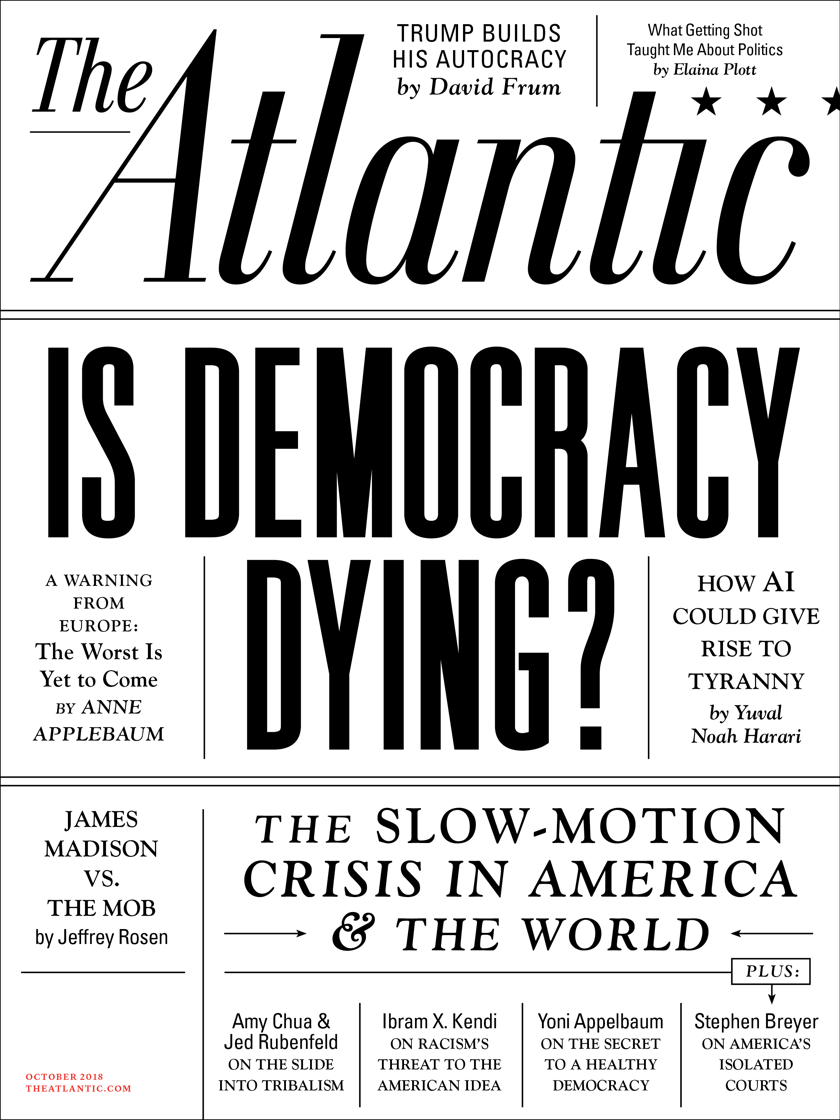
Is (Liberal) Democracy Dying?

The Atlantic for October is a theme issue:

840

I can’t provide URLs because it’s still subscriber-only, but you get get to your favorite bookstore and pick up a copy. All of the following are from that issue, as was Anne Applebaum, A Warning From Europe: The Worst Is Yet to Come, about which I blogged earlier.

1

It is much harder to struggle against irrelevance than against exploitation.

Yuval Noah Harari, Why Technology Favors Tyranny.

And a stunning microcosm:

On December 6, 2017, another crucial milestone was reached when Google’s AlphaZero program defeated the Stockfish 8 program. Stockfish 8 had won a world computer chess championship in 2016. It had access to centuries of accumulated human experience in chess, as well as decades of computer experience. By contrast, AlphaZero had not been taught any chess strategies by its human creators — not even standard openings. Rather, it used the latest machine-learning principles to teach itself chess by playing against itself. Nevertheless, out of 100 games that the novice AlphaZero played against Stockfish 8, AlphaZero won 28 and tied 72 — it didn’t lose once. Since AlphaZero had learned nothing from any human, many of its winning moves and strategies seemed unconventional to the human eye. They could be described as creative, if not downright genius.

Can you guess how long AlphaZero spent learning chess from scratch, preparing for the match against Stockfish 8, and developing its genius instincts? Four hours.

(Emphasis added)

2

Many progressives, particularly young ones, have turned against what were once sacrosanct American principles. Freedom of speech is an instrument of the dehumanization of women and minorities. Religious liberty is an engine of discrimination. Property rights are a shield for structural injustice and white supremacy. In a recent poll, two-thirds of college-age Democrats said that “a diverse and inclusive society” is more important than “protecting free speech rights.” Only 30 percent of Americans born in the 1980s believe that living in a democracy is “essential,” compared with 72 percent of Americans born in the 1930s.

… One of our students told us: “I don’t know any lefty people my age who aren’t seriously questioning whether the First Amendment is still on balance a good thing.”

Amy Chua and Jed Rubenfeld, The Threat of Tribalism.

But wait! There’s more! It’s not tribalist without at least two tribes!

In a 2017 survey by the Pew Research Center, less than half of Republicans said that the freedom of the press “to criticize politicians” was “very important” to maintaining a strong democracy in the United States. In other 2017 surveys, more than half of Trump supporters said the president “should be able to overturn decisions by judges that he disagrees with,” and more than half of Republicans said they would support postponing the 2020 presidential election if Trump proposed delaying it “until the country can make sure that only eligible American citizens can vote.”

I can’t pick which side is worse. Can you?

3

Jeffrey Rosen incited in me kindly feelings toward California:

Voters in several states are experimenting with alternative primary systems that might elect more moderate representatives. California and Washington State have adopted a “top two” system, in which candidates from both parties compete in a nonpartisan primary, and the two candidates who get the most votes run against each other in the general election — even if they’re from the same party. States, which Louis Brandeis called “laboratories of democracy,” are proving to be the most effective way to encourage deliberation at a time when Congress acts only along party lines.

Madison and the Mob.

4

This author was shot, randomly, with a 22:

Knee-jerk calls for gun control didn’t resonate with me. Yet a reverence toward guns no longer felt right either.

I found my ambivalence unsettling. Everyone else seemed so sure about how to feel about guns—people on campus, on the internet, back home. Unlike most of them, I had made intimate acquaintance with gun violence. I should have had some special insight. If what had happened to me wasn’t fodder for clarity, I feared nothing ever would be.

As we drove, he asked me to remind him what I was writing about. I said some- thing lazy, offhanded: “What it was like getting shot in a place that loves guns.”

“It’s not love,” he said. We pulled into the parking lot of his store, which sits high on a hill. You can see almost all of Tuscaloosa from there. “It’s about necessity.” He mentioned rattlesnakes and coyotes. For people in rural areas — that’s more than 40 percent of Alabamians — guns are still a day-to-day defense against such animals. Yes, there is ample love for guns in Alabama. But to forget that they’re tools is to miss an important point.

Elaina Plott, The Bullet in My Arm.

Perhaps, but they’re not the kind of tools Our People use now, are they dear?

5

A 2018 U.S. Magazine asking whether democracy is dying might be suspected of a hit on 45, but it really was not. He did get more than passing mention in David Frum’s contribution, though:

[A] Donald Trump with impulse control would not be Donald Trump …

When Trump refers to “my” generals or “my” intelligence agencies, he is teaching his supporters to rethink how the presidency should function. We are a long way from Ronald Reagan’s remark that he and his wife were but “the latest tenants in the People’s House.”

In 2016, Trump supporters openly brandished firearms near polling places. Since then, they’ve learned to rationalize clandestine election assistance from a hostile foreign government. The president pardoned former Sheriff Joe Arpaio, convicted of contempt of court for violating civil rights in Maricopa County, Arizona, and Dinesh D’Souza, convicted of violating election-finance laws—sending an unmistakable message of support for attacks on the legal order. Where President Trump has led, millions of people who regard themselves as loyal Americans, believers in the Constitution, have ominously followed.

Building an Autocracy.

6

To stop the rot afflicting American government, Americans are going to have to get back in the habit of democracy.

[In the 19th Century] From churches to mutual insurers to fraternities to volunteer fire companies, America’s civic institutions were run not by aristocratic elites who inherited their offices, nor by centrally appointed administrators, but by democratically elected representatives.

Civic participation was thus the norm, not the exception.

Democracy had become the shared civic religion of a people who otherwise had little in common.

But the United States is no longer a nation of joiners. As the political scientist Robert Putnam famously demonstrated in Bowling Alone, participation in civic groups and organizations of all kinds declined precipitously in the last decades of the 20th century.

Trump turned the long-standing veneration of civic procedure on its head. He proclaimed that America is “rigged”; that “the insiders wrote the rules of the game to keep themselves in power and in the money.” The norms and practices of democratic governance, he insisted, had allowed elites to entrench themselves.

Trump secured the Republican nomination by speaking directly to those voters who had the least experience with democratic institutions. In April 2016, when the Republican field had narrowed from 17 candidates to three, a PRRI/The Atlantic survey found Trump enjoying a narrow lead over second-place Ted Cruz among Republican-leaning voters, 37 to 31 percent. But among those who seldom or never participated in community activities such as sports teams, book clubs, parent-teacher associations, or neighborhood associations, Trump led 50 to 24 percent. In fact, such civically disengaged voters accounted for a majority of his support.

Yoni Applebaum, Americans Aren’t Practicing Democracy Any More.

7

And finally:

The cardinal fact always is the loss of contact with objective information. Public as well as private reason depends upon it. Not what somebody says, not what somebody wishes were true, but what is so beyond all our opining, constitutes the touchstone of our sanity. And a society which lives at second-hand will commit incredible follies and countenance inconceivable brutalities if that contact is intermittent and untrustworthy. Demagoguery is a parasite that flourishes where discrimination fails, and only those who are at grips with things themselves are impervious to it. For … the demagogue, whether of the Right or the Left, is, consciously or unconsciously an undetected liar.

Walter Lippman, November 1919 (before my father was born), quoted in a side-bar.

I’m venturing a guess that nobody born since 1970 will understand his use of “discrimination” unless they have a liberal arts college education.

* * * * *

Follow me on Micro.blog Follow me on Micro.blog, too, where I blog tweet-like shorter items and … well, it’s evolving. Or, if you prefer, those micro.blog items also appear now at microblog.intellectualoid.com.

Mostly religious, 9/21/18

1

Small-o orthodox Christians are up against immense power. Think of the opening lines of David Foster Wallace’s famous Kenyon College commencement address:

There are these two young fish swimming along, and they happen to meet an older fish swimming the other way, who nods at them and says, “Morning, boys, how’s the water?” And the two young fish swim on for a bit, and then eventually one of them looks over at the other and goes, “What the hell is water?”

This is liberalism. If we wish to change the water, so to speak, we have to first learn what water is, why it’s wrong, and how to be in the water, but not of it …

It’s not an either-or, but a both-and. But as Alan Jacobs says, if we’re going to have Daniels and Esthers, we have to have fathers, mothers, and communities that produce Daniels and Esthers. Notice, though, that Dante (the pilgrim) comes to Marco from a world where the formative institutions have become corrupt. Marco tells Dante that if he wants to undertake the work of reforming the corrupt institutions, he has to start with his own heart, and work outward.

It’s true for us too.

Rod Dreher.

Remember: Dreher is not using “liberalism” as an epithet for the beliefs of the Democrat party. He’s using it as a term that fits roughly 99% of us — or at least I thought it did until the 2016 election. Its opposite is not “conservative” but “illiberal.”

I don’t think I’d ever read that David Foster Wallace commencement address before. It’s well worth reading.

2

Some fellow named Richard Gaillardetz explains in The Tablet (pay wall — my summary is from an email teaser) what’s going on with Pope Francis:

Francis is determined to realise the bold, reforming vision of the second Vatican Council, and some of those closest to him are determined to stop him.

Gosh. That was easy — facile, even. It’s nice when neutral observers can help clear the mind of troublesome doubts.

3

I should say that the danger to our own social order is not that a relatively small number of people engage in same-sex acts, but that a great number of people are approaching the view that the bodily powers have no purpose but physical pleasure, and that not even marriage has any necessary connection with either the procreation of children or the union of their parents. One might say that heterosexuals are coming to accept an essentially homosexual view of sex.

J. Budziszewski, responding to a question about whether we should treat homosexual acts as an evil whose eradication nevertheless would bring even greater evil (as Augustine treated prostitution).

4

Having left Evangelicalism some 21 years ago, I’ve lost track of who’s who (with a few exeptions: Tim Keller, good; Jen Hatmaker, bad). I had heard the name “Beth Moore” but couldn’t place her.

Now Emma Green has done a profile, occasioned by Moore’s lost attendance, revenues, etc. because she thought there was something rotten about Evangelicals barely skipping a beat for Trump even when the obstacle was “grab them by the pussy.”

She still gets push-back, even from people who attend her rallies, talks or whatever they are:

“I don’t think this is the avenue for political discussions,” said Shelly, 56. “I think it should stay focused on God.”

Moore believes she is focused on God. The target of her scorn is an evangelical culture that downplays the voices and experiences of women. Her objective is not to evict Trump from the White House, but to clear the cultural rot in the house of God.

Moore has not become a liberal, or even a feminist. She’s trying to help protect the movement she has always loved but that hasn’t always loved her back—at least, not in the fullness of who she is.

(Emphasis added)

I still don’t know whether Moore is a solid teacher or a flake; that’s not within Emma Green’s scope, really.

But I do find it reasonable to view Evangelical acceptance of Trump’s misogynist (okay: maybe it’s just misanthropy or narcissism) remarks as clean clinical specimin of the mind that gave us, most recently, Bill Hybels and Paige Patterson. That mind could use some reform, no?

5

Phillipino Catholics are as zany as American Evangelicals:

Who is the world’s worst popular president? “Probably the foul-mouthed, gun-toting septuagenarian president of the Philippines, Rodrigo Duterte. His most recent approval rating was 88 per cent, rising to 91 per cent among the poorest Filipinos. How does he do it? By indiscriminately rubbing out supposed bad guys – and if some of them do actually turn out to be criminals, so much the better. Insulting all and sundry seems to help too. He recently had a pop at God himself, who is a ‘stupid … son of a bitch’ in the president’s considered opinion. And all that in a country that remains deeply Catholic.”

Micah Mattix, Prufrock

6

It may seem at times that I’m a Democrat because of all the scorn I heap on the Republicans. But that would be like thinking I’m an atheist because of my frequent criticisms of Evangelicalism and my fascination with lurid news out of Roman Catholicism.

I am not a Democrat. I have never been a Democrat. As long as they remain the Friends of Feticide I will never be a Democrat. My favorite old characterization of that party was that of, I believe, the late Joe Sobran: the party of “vote your vice.” Were sexual vices the only vices, that would have been true at the time he wrote it. Nowadays, I give the GOP no credit for any manner of probity, sexual or otherwise.

To he## with them both. My most formal affiliation is with the American Solidarity Party, though I expect no miracles from that quarter.

I’m so full of disgust about the state of our politics that I’m going to ignore it now. Really. I’ve done it dozens of times before. It’s easy. You’ll see.

Or not.

Religiously, I’m Orthodox.

Long observantly Christian, I stumbled into Orthodoxy 21 years or so ago. I finally told the story a few years ago, first on my own blog and then, verbatim, here. I think I could easily enough be Western Rite Orthodox (just as there is “Byzantine Rite” Roman Catholicism), but I happen to be “Eastern” Orthodox because such was (and is) the rite used in the parish through which I entered the Church. I hope to visit a Western Rite parish some day, as much of the language is familiar from 55 years of singing sacred choral music.

Frankly, my residual care about politics is mostly for “completion of our lives in peace and repentance” as one of our litanies has it — and tides have turned so suddenly that it’s clear that the United States is not exempt from the 30,000 foot view of history in Psalm 2, elaborated in the Acts of the Apostles:

The kings of the earth take their stand and the rulers gather together against the Lord and against His Anointed One.

(Acts 4:26) They hate Him and they’ll hate us. Get over it. Better: get ready for it.


7

This is, or is very close to, Autumnal Equinox, but I’d be a non-trivial amount that the sky will not be as light at 7:09 today as it was at 7:09 yesterday evening, when I happened to notice it.

Update: Equator, dummy, equator. #facepalm.


8

Just about anyone can spark a Trump meltdown; forcing lasting reform on Nike would be a real feat.

Matt Steward, Notes on Nike.

* * * * *

Follow me on Micro.blog Follow me on Micro.blog, too, where I blog tweet-like shorter items and … well, it’s evolving. Or, if you prefer, those micro.blog items also appear now at microblog.intellectualoid.com.

Brett Kavanaugh

All opinions herein expressed are subject to revision — probably the opinions of my sources as well as my own — but I’m not going to wait any longer.

That things like what is described in Ford’s letter “happened all the time” is, I’m sure, true. That it’s “all too consistent with stories” that people heard and their lived experience is also, I’m sure, true. But the questions is whether Brett Kavanaugh did something like this. Evidence that stuff like what he’s accused of happened to many people, or that prep-school guys like him always get away with things like this, is not evidence against Brett Kavanaugh. It is more like a cultural script in search of players to be cast in their respective roles later.

Evidence may yet be presented that incriminates Kavanaugh, and it may shift this conversation away from people generalizing from their own experiences. But until then, it is a dangerous thing to proceed toward a judgment, even a political judgment, based on prejudices such as “this thing happens all the time” and “it’s consistent with stories we know.” The sensation of finding archetypal victimizers and victims is what made false stories about Duke’s lacrosse players and the University of Virginia’s fraternity brothers go viral across the culture.

And this “he’s the type” style of accusation will not be used only on privileged men like Kavanaugh. It can, it has, and it will be used on anyone. Of course they’ll deny it. They always do.

Michael Brendan Dougherty. There’s also a counter-narrative that women use sex to get what they want and then leverage it to get even more as victims.  I know this to be true because I heard it from a woman, who believed it vigorously.


I’ve always been dissatisfied with the declaration, “Women don’t lie about rape.” Sure, some small number of women do affirmatively lie, but as a general matter, the word “lie” is an odd fit for a real world where perceptions differ and memories are malleable. And, by the way, this isn’t “right-wing denialism,” it’s just scientific fact.

… [I]f there isn’t any corroboration or external evidence outside of Christine Ford’s three-decades-old recollections, that’s simply not sufficient basis for derailing the nomination of an outstanding jurist — no matter how fiercely they’re believed.

David French.


I am in favor of withholding judgment on Kavanaugh and his accuser, and I was in favor of that even before it became moot (because he now would lose a forced vote on Thursday).

We’re going to hear the accuser and the accused, and that’s as it must be.

But as I think several steps forward, I can’t imagine any plausible good resolution. Brett Kavanaugh probably can’t disprove the accusations conclusively, but neither can the Democrats disprove the plausible suspicions about the “late hit”:

Unfortunately, with the midterms almost upon us, there is now no path to an outcome that both sides see as legitimate. Democrats can insist that the revelation of Ford’s story was not exquisitely timed to exactly the moment when it became impossible to confirm a different nominee before the elections. But they are in essentially the same position as Kavanaugh: Even if they are telling the truth, they have no way to provide convincing proof.

Megan McArdle (emphasis added).

I suspect that years from now we’ll still be divided into “I fiercely believed her” versus “I fiercely believed him” camps on this as on Anita Hill versus Clarence Thomas.

The hardest thing may be avoiding toxic presumptions or forcing the story into archetypes (see Michael Brendan Dougherty, above).

Rod Dreher, finishing a book tour in Italy, wrote a long blog while at the airport for his return flight. It’s not his best work, but he alluded to getting attacked on Twitter

for suggesting that the way people behave in high school, especially under the influence of drugs or alcohol, should not be a determinative factor in taking public office decades later. Someone said, “I hope you don’t have a daughter.”

I do have a daughter, [but] I also have sons, and I shudder to think what a teenage drunken encounter gone bad might do to their lives over three decades later, if somebody dredged it up. Or what a mere uncorroborated allegation of an unwanted sexual encounter might do to them ….

Just so. I know men are all monsters — a bias I find it all too easy to share — but too easy really is too easy.

Pre-publication update: An old Evangelical friend, (who at least used to be) a good man, is foaming at the mouth on Facebook with “let him who is without sin …” and a Facebook friend replies with lurid innuendo about the accuser.

* * * * *

Follow me on Micro.blog Follow me on Micro.blog, too, where I blog tweet-like shorter items and … well, it’s evolving. Or, if you prefer, those micro.blog items also appear now at microblog.intellectualoid.com.

Monday 9/17/18

1

David French is much more sensible than Damon Linker on the current status of the Brett Kavanaugh nomination. Linker’s approach gives veto power to accusers whose lurid accusations are likelier false than true (by which I’m not pre-judging the current accusations — I’m talking about his rationale).

Neither would approve a Thursday vote, though.

2

I believe it was Ross Douthat who coined “if you don’t like the Religious Right, just wait ’till you see the irreligious right.” That’s panning out — though the “irreligion” is just one facet of communal breakdown:

[T]he different groups make about the same amount of money, which cuts against strict economic-anxiety explanations for Trumpism. But the churchgoers and nonchurchgoers differ more in social capital: The irreligious are less likely to have college degrees, less likely to be married and more likely to be divorced; they’re also less civically engaged, less satisfied with their neighborhoods and communities, and less trusting and optimistic in general.

This seems to support the argument, advanced by Tim Carney of the Washington Examiner among others, that support for populism correlates with a kind of communal breakdown, in which secularization is one variable among many leaving people feeling isolated and angry, and drawing them to the ersatz solidarity of white identity politics.

… only about a third of Trump’s 2016 voters are in church on a typical Sunday, and almost half attend seldom or not at all.

Ross Douthat

3

[T]he Deep State now feels confident enough to say … openly: the Deep State wants international conflict. The op-ed includes a bald-faced declaration to that effect:

Take foreign policy: in public and private, President Trump shows a preference for autocrats and dictators, such as President Vladimir Putin of Russia and North Korea’s leader, Kim Jong-Un . . .

Astute observers have noted, though, that the rest of the administration is operating on another track, one where countries like Russia are called out for meddling and punished accordingly. . .

The op-ed goes on to talk approvingly about how the Deep State has punished Russia against the President’s wishes, to the point of boasting about it:

He (President Trump) complained for weeks about senior staff members letting him get boxed into further confrontation with Russia, and he expressed frustration that the United States continued to impose sanctions on the country . . .

But his national security team knew better – such actions had to be taken, to hold Moscow accountable.

Here is the significance of the op-ed, not in what it reveals about President Trump but what it says about the Deep State itself, namely that it thrives on unnecessary and strategically counterproductive international conflicts. Those conflicts justify the trillion dollar “national security” budget off which the Deep State feeds, they provide the arenas in which the “national security team” builds its careers and power and they distract the public from our sorry military performance against the real threat, the threat of Fourth Generation war and the entities that wage it. They are, in short, bread for the Establishment and circuses for the citizens.

William S. Lind, The Deep State Speaks (emphasis added).

4

First, now that being censored on social media is a surefire way to win conservative clicks, it’s fair to assume that claims of censorship will proliferate, and not all of them will be true. Second, that doesn’t mean they’re all false, either. When it comes to the right, Silicon Valley almost certainly suffers from what the Valley used to call “epistemic closure” before the Valley embraced it. In that climate, “Sorry, mistake” isn’t likely to mollify anyone.

So the right has good reason for its suspicion, and no way to get good evidence that might rebut it. To see if Alex Jones had indeed been turned into Voldemort, I had to put my Facebook account — and a bit of my reputation — at risk. And even then, the fact that my account stayed up might simply show that the censors saw it as a trap that they were smart enough to avoid.

Bottom line: conservative concern about platform bias will continue to grow, and only radical transparency about platform standards and due process is likely to address that concern.

Stewart Baker (emphasis added), who tested reports that linking to Infowars from Facebook could get you suspended from the latter.

My personal “line I won’t cross” is somewhere between Breitbart and Infowars. I’ll occasionally visit the former, never knowingly visit the latter as if I might learn anything except how odious it is.

Where’s Facebook’s? Okay to link to Richard Spencer? Daily Stormer?

5

The McCarrick outcry is fading, it would appear, because his victims are adult men. Apparently sexual abuse of young men by an older man who is their ecclesiastical superior isn’t that big a deal.

Adult men make less instantly sympathetic victims than children, and the alleged incidents involving McCarrick are less headline-grabbingly horrifying than the episodes revealed by Pennsylvania’s recent grand jury report. But the church has more than a duty to ensure that minors aren’t victimized and should be sensitive to the fact that, where religious authority is exploited, the effects of sexual abuse can be especially devastating, as in Reading’s case.

Terry Mattingly, commenting on some fine reporting by Elizabeth Breunig under the Washington Post’s “Acts of Faith” rubric.

Yeah. Right. Winnowing out men who don’t want the priesthood so much that they’ll tolerate hanky-panky is a swell way of making sure you get lots of gay or sexually ambivalent priests who value the prestige of priesthood more than the truth of dogma and moral teaching.

6

Seriously, folks, if you are planning to withhold your regular tithe to your diocese for the time being, why not redirect it to the Norcia monks, who are the real deal? They are a light for the whole world. Please think about making a donation — or sign up for regular donations. You know how much I care about them, and esteem them. If you want to give confidently to help build a Catholic future you can believe in, the Monks of Norcia need your help.

Rod Dreher.

* * * * *

Follow me on Micro.blog Follow me on Micro.blog, too, where I blog tweet-like shorter items and … well, it’s evolving. Or, if you prefer, those micro.blog items also appear now at microblog.intellectualoid.com.

Brief collection 9/13/18

1

Pope Francis has called a global meeting of Catholic bishops to discuss how to prevent sex abuse …

The Vatican statement said the topic of the gathering, scheduled for Feb. 21-24, would be the “prevention of abuse of minors and vulnerable adults.” It wasn’t clear whether the agenda would also include the disciplining of abusive clergy and of bishops who cover up or neglect abuse by priests under their authority.

Wall Street Journal

I think the Roman Church has had a fairly good idea how to reduce pedophilic child abuse since the report 14 years ago in the wake on the 2002 scandal.

But I don’t see much sign that it has made progress on homosexual predation on adolescents, seminarians and priests, or any progress at all at dropping the hammer on high-ranking enablers.


2

What will the Supreme Court look like when neither side has to walk on eggs to win the favor of the one in the middle? It will be a more conservative court, for sure, and maybe a more honest one. Justices may feel more free to say what they really think, and the public will ultimately judge the result by expressing itself in electoral politics. History does not stop in 2018.

Linda Greenhouse

Greenhouse is often outrageously biased even in her news reporting, not just in opinion pieces, but this one’s worth reading — with a grain of salt.


3

Public health experts dismiss [Critical Reviews in Toxicology, and Regulatory Toxicology and Pharmacology] as unreliable vanity journals. “These two journals exist to manufacture and disseminate scientific doubt,” says David Michaels, a professor at the George Washington University School of Public Health and the author of “Doubt Is Their Product,” a book about product defense science. “They provide the appearance of peer review and credibility to ‘product defense’ science — mercenary studies not designed to contribute to the scientific enterprise but to forestall public health and environmental protections and to defeat litigation. Corporations opposing public health or environmental regulations enter the rigged studies and questionable analyses published in these mercenary journals into regulatory proceedings or lawsuits to manufacture scientific uncertainty.”

Then, Michaels says, companies can say, “Look, the studies have conflicting conclusions, so there is too much scientific uncertainty to issue regulations to protect the public or to compensate victims.” ….

Paul D. Thacker, Scientists know plastics are dangerous. Why won’t the government say so?

I had no idea. The industry didn’t want me to have any idea. The “forensic” scientists (as in “‘forensic dating’ is the world’s oldest profession”) did their dirty duty.

 * * * * *

Follow me on Micro.blog Follow me on Micro.blog, too, where I blog tweet-like shorter items and … well, it’s evolving. Or, if you prefer, those micro.blog items also appear now at microblog.intellectualoid.com.