Fanatics and others

Fanaticism

The Minnesota Assassin

The Minnesota political assassin (who I won’t name) had some red flags in initial biographical information. From my perspective (Eastern Orthodox, formerly Evangelical and Calvinist, always active in my faith and never “charismatic”), the biggest one was his invocation of new apostles and prophets as what America needs spiritually — an indication of New Apostolic Reformation beliefs or something adjacent.

(Surprisingly few NAR advocates will own up to it; either it’s so loosely structured that adherence is ambiguous – which I suspect is the case – or they’re told to lie, or something.)

Now Stephanie McCrummen at the Atlantic has dug a little deeper and confirmed my suspicions.

Now comes the hard part: Assuming his guilt (which I’m allowed to do because I’m not a criminal court), dare we blame his assassinations, and the apparent intention to assassinate as many as 70 others, on his NAR ideas, or do we hold open the possibility of insanity or some other explanation?

Blaming NAR is tempting for me because I so detest it. But I have seen no information that NAR actually encourages physical violence, and not just vehement rhetoric. (Their “violent prayer” talk seems, preliminarily, to be a red herring.) The theory of stochastic terrorism has always struck me as plausible, but it’s hard to imagine any forcefully-expressed opinion that has zero chance of pushing some random person over some edge.

So I’m glad Stephanie McCrummen withheld judgment about causation. It’s still the extremely early days in the criminal proceedings, and more, if not all, will be revealed eventually.

Christianity is not an instrument of political power

David French comes closer than McCrummen to linking the assassination effect to the N.A.R. cause, and also had this observation:

Last election cycle I helped create a new Christian curriculum for political engagement …

As I talked about the curriculum in gatherings across the country, I was struck by the extent to which I was asked the same question time and again. “Sure,” people would say, “we need to be kind, but what if that doesn’t work?”

The implication was clear — victory was the imperative, and while kindness was desirable, it was the contingent value, to be discarded when it failed to deliver the desired political results.

David French

A “Christian” who thinks political victory is more important than living as Christ taught (let’s say, in the Beatitudes for instance) is a sorely confused Christian.

I’ve probably said it before, but I’ll say it again. One of the countless blessings I’ve received in Orthodox Christianity is the company of martyrs, many of whom died because they knew that gaining the world wasn’t worth losing one’s soul. If you’re in a “Christian” tradition where leaders or laity act as if that’s a good trade (none of them are wicked enough to actually teach it), get out before it’s too late.

Who are the fanatics?

We know now that the FBI’s infamous Richmond Memo, targeting traditional Catholics as potential terrorists and comparing them with Islamists, was not merely the product of a few rogues in a single field office, as the agency had claimed.  Multiple offices were involved in drafting it, and it was distributed to over a thousand employees.

This post is not going to be a rant against the Biden administration.  What interests me is what was going on in the analysts’ heads.  I credit them with sincerity.  But why did they think traditional Catholicism is comparable to the ideology of radical Islam?

The most generous interpretation which can be placed on the memo is that the analysts thought of fanaticism simply as strong belief, and assumed that any strong belief is potentially violent.

But a sensible definition of fanaticism would emphasize the content of belief, not its strength.  You aren’t a fanatic for believing very strongly that you should “Love your enemies and pray for those who persecute you, that you may be children of your Father in heaven.”  The more strongly you believe that, the less likely you are to be a terrorist.

On the other hand, you really are a fanatic for believing that you should “kill them wherever you find them,” meaning Jews and infidels.  The more strongly you believe that, the more likely you are to be a terrorist.

The content of belief did come into the analysts’ definition in one way.  They plainly believed strongly in their own ideology, yet it seems never to have occurred to them to view themselves as fanatics.  It seems, then, that in their view, the term “fanatic” must have meant not just “anyone who believes strongly,” but rather something like “Anyone who believes strongly enough in God, rather than in progressive dogma, for his belief to influence the rest of his life” – and the full force of the federal government must be used to surveil and suppress all such people.

So by their definition, yes, traditional Catholics are fanatics.  But by a more sensible definition, which ideology is a better candidate for being called by that label?

J Budziszewski

Evangelical Religion

I return to the subject of Evangelicalism so often, I think, because there is some stubborn something within me that believes, against so much journalistic “evidence” (thousands of profiles of self-identified Evangelicals doing bizarre things), that a significant number of Evangelicals are acting and believing in perfect good faith, and that I simply need to find the magic words to help them see what I can’t un-see.

There is some tenderness mixed with my frustration at 28 years of almost complete failure in that regard. And there is some perversity in my rejection of the wisdom of Orthodoxy, which really does not encourage trying to argue people into the Orthodox faith. “Acquire the Holy Spirit and thousands around you will be saved,” said Saint Seraphim of Sarov, but something there is about an American ex-Evangelical that still loves a short-cut.

Over the years, I have cast a lot of shade on the concept of “religion.” I’m starting to think I should have self-critically cast similar shade under the concept of “Evangelicalism.”

Here’s what I think I’ve been doing that’s sorely mistaken:

  1. The “good faith” Evangelicals I’m trying to persuade are basically wealthy white church-going Evangelicals in, or in orbit around, Wheaton, Illinois (and maybe Grand Rapids, Michigan). The former are the kind of people I hung out with for roughly 6 years of my life (five years in school plus one year in my young adulthood), the latter for 15 years. They are the kind of people I see at my Wheaton Academy homecomings every five years. I like them; no, I love them. We don’t talk politics when we get together. I fancy they’re not Trump fans, but I really don’t know and I fear I’d be disappointed if I found out.
  2. The evangelicals I’m yelling about are random self-identified Evangelicals or flakes identified as Evangelical by journalists in mainstream media, who may or may not attend church and who may have adopted the Evangelical label simply because they’re Trump supporters. I have little experience of them. The “good faith” Evangelicals may be as baffled by them as I am.

My impression, which I’ve had but suppressed for rather a long time, is that “Evangelicalism” isn’t coherent, though we seem not to be able to live without it. So when I shout at Evangelicals, it’s like shaking my fist and cursing at the clouds.

It has always been notoriously difficult to define what an Evangelical is. Probably the most widely-accepted attempt is the Bebbington Quadrilateral. But my favorite is from Ken Myers of Mars Hill Audio Journal. I’m not going to take the time to dig it up verbatim, but the gist was that Evangelicals recognize one another not by right doctrine, orthodoxy, but by “right feeling,” orthopathos. They sing the same songs, and pray similar extemporaneous prayers, supported Billy Graham Crusades, and so forth.

I don’t know whether that is even true today of the motley crew that journalists identify as Evangelical.

“Briefly stated, the Gell-Mann Amnesia effect is as follows: You open the newspaper to an article on some subject you know well … Often, the article is so wrong it actually presents the story backward—reversing cause and effect. I call these the ‘wet streets cause rain’ stories. Paper’s full of them.

In any case, you read with exasperation or amusement the multiple errors in a story—and then turn the page to national or international affairs, and read as if the rest of the newspaper was somehow more accurate about Palestine than the baloney you just read. You turn the page, and forget what you know.”

Michael Crichton (via ChatGPT because I couldn’t remember “Gell-Mann Amnesia effect”).

The press tends to garble Eastern Orthodoxy, so why should I believe them about Evangelicalism?

Many of them probably labeled the Minnesota assassin “evangelical.” Was he? Is the evidence that he wasn’t a No True Scotsman fallacy?

I know Orthodoxy; I just really don’t know Evangelicalism or its outer boundaries any more, if ever I did.

So you have my permission to go back to everything I’ve written about Evangelicals and Evangelicalism and say “he doesn’t know what he’s talking about,” because much of the time I’ve been Gell-Mann-ing it.

I’ll try to do better, but old habits die hard.

Sanity (a/k/a The Gospel for people battered by bad religion)

Having dwelt long on some pretty sorry stuff, a very long but infinitely more positive note:

I know that what I’m about to talk about is something I’ve talked about probably even fairly recently on the show, but I find myself in real life — meaning as a priest dealing with a group of parishioners, and trying to help them and guide them and just family members and everybody in general — I find myself having to say this over and over and over again, which tells me that probably if I say it over this microphone to people, there’s probably at least some folks out there who need to hear it again, even if I have talked about it recently.

The Christianity that those of us, at least in the United States — and I can only speak about that experience because I haven’t had any others — the Christianity we grew up around came from one of two categories largely. And people who want to defend those types of Christianity will call this a caricature. I don’t care anymore. But what I’m about to say, even if you think it’s a caricature of what they’re trying to teach, this is what a lot of the people within these traditions have actually received. Right? So it’s very easy to defend some tradition based on what’s in the books, and what we would mean to say, right? But I’m talking about what the people who I encounter, the people who talk to me about spiritual things. come to me and give confessions, what they’ve received from the Christianity they’ve grew up around, how that has shaped them, how they think because of it. And if people, representatives of those groups want to say that’s not what they meant to teach, cool, but maybe some introspection on why that’s not what people are receiving.

Anyway, what people have received comes in two categories. One is sort of the smilin’ Bob Shuler School of, “God loves you just the way you are and you don’t have to do anything. Just don’t worry about it. Just smile and be happy and listen to the hymns of your choice that you enjoy.” … That worked really well with boomers. That seemed to answer something they needed to hear. Maybe they’re a generation who grew up with very dissatisfied perfectionist parents, and so just hearing you’re fine just the way you are was what they needed, right? But that doesn’t work on subsequent generations, because subsequent generations are more realistic or nihilistic depending on your point of view, and know there’s something deeply wrong with themselves and with the world around them. So just telling them over again, “No, no, you’re fine, everything’s fine, it doesn’t work.” That’s why those kind of churches are all empty now.

The other school of thought is pretty much the exact opposite. It’s God doesn’t really love you. Right. In fact He’s pretty angry with you and He’s getting ready to send you to hell. Right? And the only way to avoid that is, depending on your tradition, right, is, for you to love him nonetheless, really sincerely — and there’s a rabbit hole to go down. How sincere am I ever really? — and do that plus live your life at a certain way and follow certain rules. Which will differ based on tradition, and which you will inevitably fail at.

That second one is most of the people who I interact with on spiritual matters, and it’s almost like they’ve been taught and they’ve internalized that. Their life in this world is this sort of really horrible reality show, almost like Squid Games, and like God is about weeding out contestants and narrowing it down to this faithful few and everybody else goes to hell, goes to eternal punishment except for this faithful few who, again, depending on your tradition, he may just pick. Or, you know, they’re the ones who really did it right. They’re the ones who really loved him sincerely, or they’re the ones who really lived their life the right way.

And any way you slice those things, most people again are realistic enough that when they look at their life, they don’t see a lot of evidence in their life and their actions that they’re one of the people God picked, or they don’t see a lot of evidence of their life that they’re really sincere about following God, or they don’t see a lot of evidence of their life that they’re really toeing the line and living the life they know they should be living, meaning most people are walking around — like religious people — walking around thinking they’re probably going to end up in hell. That God is probably mad at the most of the time, and that He’s looking for them to make some missteps so, boom!, they can get nailed.

Also most atheists are walking around doing the same thing they’re protesting constantly that there is no God because they can’t deal with that guilt and stuff that they’ve internalized. They can’t live like that. No one can live like that their route to trying to live like that and deal with the cognitive dissonance is just to deny that any of it’s true, over and over and over again publicly, loudly to everyone who will listen. Right.

Whereas the religious people are just in this kind of quiet desperation of how do I figure this out. Right.

So let me reiterate again, right, and Penal Substitution plays a big part in this. That’s why I’m bringing it up in this context:

God loves you. Jesus said so. St. John’s Gospel, the Father Himself loves you. He is not angry at you. He does not want to destroy you for your sins. There is no power of justice that commands him to do so. No one commands him to do anything. He loves you. He wants you to find salvation, but salvation is a thing you have to actually do. He wants you to do it. The Bible says so. God wills that all men be saved and come to the knowledge of the truth. But you have to do it. He empowers you to do it. He forgives you when you mess up trying to do it. He heals you when you damage yourself trying to do it and failing. He is entirely on your side. The God who created the universe is entirely on your side and the saints are on your side and the church is on your side. Everyone is on your side. Christ is advocating for you. Everything is set up for us.

When Saint Paul says to us, continue to work out your salvation with fear and trembling. You don’t stop them like Kierkegaard did. Read the next verse because it is God who is working in you to will and to do according to his pleasure. We continue on and we work out our salvation because we know that God is on our side and empowering us to do it and loving us and loving other people through us. We need to pray about that. We need to pray it. We need to repeat it. We need to kind of imitate what the atheists are doing. We need to say it out loud. We need to say it to each other. We need to say it to everyone who will listen right? That God loves you and wants you to find salvation, wants you to be healed, wants you to be set free from sin. He wants all these things for you. It doesn’t mean you have nothing to do. That doesn’t mean you’re fine just the way you are. You know you’re not fine just the way you are, right? But it means that He is there to help you to grow to be transformed into the person who you need to be and want to be. The person he created you to be for eternity. That’s the actual message of Christianity. Don’t accept any substitutes for that, ever at all for any reason.

Fr. Stephen De Young.

I probably will publish this from time to time for the rest of my blogging life.


Religious ideas have the fate of melodies, which, once set afloat in the world, are taken up by all sorts of instruments, some woefully coarse, feeble, or out of tune, until people are in danger of crying out that the melody itself is detestable.

George Elliot, Janet’s Repentance, via Alan Jacobs

[N]one of the things that I care about most have ever proven susceptible to systematic exposition.

Alan Jacobs, Breaking Bread With the Dead

You can read most of my more impromptu stuff here and here (both of them cathartic venting, especially political) and here (the only social medium I frequent, because people there are quirky, pleasant and real). All should work in your RSS aggregator, like Feedly or Reeder, should you want to make a habit of it.

Sunday, 11/24/24

Formatting things a bit differently today, without “headlines.”

  • After he had twice visited the United States in the 1930s, Dietrich Bonhoeffer wrote a perceptive essay contrasting Christian development in America with parallel developments in the parts of Europe most directly shaped by the Protestant Reformation. His assessment included an observation that was as shrewd in its comparative wisdom as it is relevant for the themes of this book: “The secularization of the church on the continent of Europe arises from the misinterpretation of the reformers’ distinction of the two realms [of church and society]; American secularization derives precisely from the imperfect distinction of the kingdoms and offices of church and state, from the enthusiastic claim of the church to universal influence in the world.” What Bonhoeffer saw has been described with other terms here: The key moves in the creation of evangelical America were also the key moves that created secular America.
  • It is a matter of great historical significance that American Protestants almost never cited biblical chapter and verse to defend their interpretive practices. Precisely as it worked on Scripture, the Reformed, literal hermeneutic revealed most clearly how it arose from the special circumstances of American life. Yet even if this hermeneutic itself was not necessarily rooted in a literal reading of Scripture, it was nonetheless the American norm for the generations between the writing of the Constitution and the end of the Civil War.

Mark Noll, America’s God. (You may need to chew on that a bit. Or read the book.)


Religions devised for a social purpose, like Roman emperor-worship or modern attempts to ‘sell Christianity as a means of saving civilisation’, do not come to much. The little knots of Friends who turn their backs on the ‘World’ are those who really transform it.

C.S. Lewis via Paul Kingsnorth, who situates Lewis’ insight in our age.


Brad East once pondered:

Why do people convert to Christianity? Why do intellectuals and other public figures convert so often to Catholicism (or Eastern Orthodoxy) and so rarely to Protestantism?

Conversions, Protestantism, and a new mainline. I suspect he’s still pondering, though I don’t think he’s addressed the topic as explicitly as in the quoted article.

I keep coming back to the article deliberately, feeling as if I haven’t exhausted it. Maybe you’d find it helpful, too.


The west, so it seems to them, tends to think of the Crucifixion in isolation, separating it too sharply from the Resurrection. As a result the vision of Christ as a suffering God is in practice replaced by the picture of Christ’s suffering humanity: the western worshipper, when he meditates upon the Cross, is encouraged all too often to feel an emotional sympathy with the Man of Sorrows, rather than to adore the victorious and triumphant king.

Timothy Ware, The Orthodox Church


No, St. Paul wasn’t a perv:

When teaching non-Jewish Christians, one of the most radical disjunctions with their former way of life was sexual morality. Sexual continence had simply not been a concern for most of them before, so it became Paul’s focus. Paul’s frequent emphasis on this area was not based on prurient interest but on the continuing education and reorientation of former pagans.

Fr. Stephen De Young, Saint Paul the Pharisee. Actually (I’m sure Fr. Stephen noted it elsewhere), fornication with temple prostitutes was the former practice of some of these non-Jewish Christians. That’s why Paul had to focus there.


“Man is what he eats.” With this statement the German materialistic philosopher Feuerbach thought he had put an end to all “idealistic” speculations about human nature. In fact, however, he was expressing, without knowing it, the most religious idea of man. For long before Feuerbach the same definition of man was given by the Bible.

Fr. Alexander Schmemann, For the Life of the World


“The clock,” [Lewis] Mumford has concluded, “is a piece of power machinery whose ‘product’ is seconds and minutes.” … [A]s Mumford points out, with the invention of the clock, Eternity ceased to serve as the measure and focus of human events.

Neil Postman, Amusing Ourselves to Death


It’s profoundly significant that of all the Christian groups, only the Orthodox include the babies at the Holy Chalice, completely recognizing and demon-strating their full incorporation into the Church, the Body of Christ. This alone, it seems to me, shows forth the truthfulness of our Church’s claim to be the One, Holy, Catholic, and Apostolic Church, alone preserving the fullness of the Christian Faith.

Frederica Mathewes-Green & Rod Dreher, Healing Humanity


  • Only a few peoples—the odd German tribe and, inevitably, the Jews—had stood aloof from the exposure of unwanted children. Pretty much everyone else had always taken it for granted. Until, that was, the emergence of a Christian people.
  • Islamic the Islamic State may have been; but it also stood in a line of descent from Anabaptist Münster. It was, perhaps, the most gruesome irony in the whole history of Protestantism.
  • When scholars in Europe sought to justify the Spanish conquest of the New World, they reached not for the Church Fathers, but for Aristotle. ‘As the Philosopher says, it is clear that some men are slaves by nature and others free by nature.’
  • The concept of secularism—for all that it was promoted by the editor who invented the word as an antidote to religion—testified not to Christianity’s decline, but to its seemingly infinite capacity for evolution.

Tom Holland, Dominion

Several narrower books linger more persistently in my mind, but Dominion has in a sense penetrated deeper than mere “mind.”


  • Even after His Resurrection, Christ instructed disciples on the road to Emmaus when “beginning with Moses and all the prophets, he interpreted to them in all the scriptures the things concerning himself” (Luke 24:27). The Christological key to unlock the Jewish Scriptures was given to the Church by Christ Himself…
  • Two centuries later, fundamental differences in phronema would again be an obstacle to union between the West and the East at the Council of Florence in 1439. Catholics presented rational arguments for their positions, and the Orthodox responded by citing apostolic Tradition. It was “the constant conviction of the Latins that they always won the disputation, and of the Greeks that no Latin argument ever touched the heart of the problem.”

Dr. Eugenia Scarvelis Constantinou, Thinking Orthodox


Sometimes this whole 2000-year-old faith seems like a living koan. Chew on this until you are enlightened. Keep walking.

Paul Kingsnorth

You can read most of my more impromptu stuff here and here (both of them cathartic venting, especially political) and here (the only social medium I frequent, because people there are quirky, pleasant and real). All should work in your RSS aggregator, like Feedly or Reeder, should you want to make a habit of it.

Sunday 11-3-24

Some ironies of American slavery

This was only one of many ironies in the debates over slavery, which saw Catholics ignoring or reinterpreting papal decrees, Episcopalians celebrating early American Puritans, Presbyterians defending medieval society while criticizing the Reformation, Baptists treating patristic exegesis as authoritative, and anticlerical abolitionists praising the pope. Not all of this irony was lost on contemporaries. As has been discussed, African American historians, in particular, took pleasure in pointing out the hypocrisy of proslavery authors who cited North African church fathers in their arguments for white supremacy.

Paul J. Gutacker, The Old Faith in a New Nation

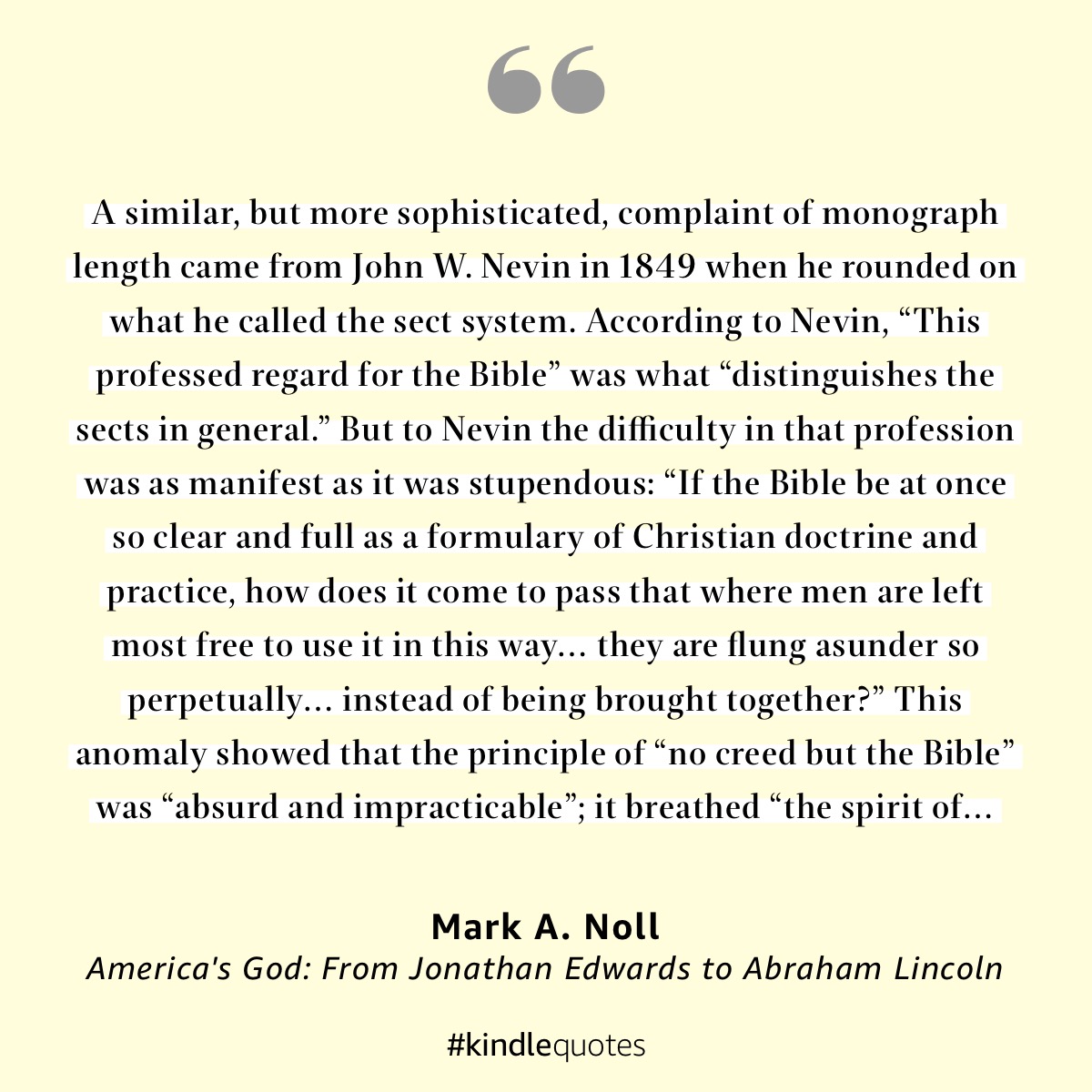
No creed but the Bible?

Orthodoxy in America

Whatever else Orthodoxy in America is, it’s not bourgeois. It’s too weird for that. At the same time, bourgeois people like me come to it. The point is to be converted by it, to learn by the fasts, the prayers, and the way of Orthodox life to train our hearts to want what Christ says we should want.

Rod Dreher, Schmemann and Social Justice

Me too

I fear that I’m like the little girl in Flannery O’Connor’s short story, who was sure she could never be a saint, but thought she might could be a martyr if they killed her quick.

Rod Dreher, Sunday With St. Paraskeva


Religious ideas have the fate of melodies, which, once set afloat in the world, are taken up by all sorts of instruments, some woefully coarse, feeble, or out of tune, until people are in danger of crying out that the melody itself is detestable.

George Elliot, Janet’s Repentance, via Alan Jacobs

You can read most of my more impromptu stuff here and here (both of them cathartic venting, especially political) and here (the only social medium I frequent, because people there are quirky, pleasant and real). All should work in your RSS aggregator, like Feedly or Reeder, should you want to make a habit of it.

St. Thomas Sunday 2024

Creed

The theologian William Placher defends the importance of creeds by citing Lionel Trilling: “It is probably true that when the dogmatic principle in religion is slighted, religion goes along for awhile on generalized emotion and ethical intention—morality touched by emotion—[but] then it loses the force of Its impulse and even the essence of Its Being.” Placher elaborates: Even if I have a warm personal relationship with Jesus, I also need an account of what’s so special about Jesus to understand why my relationship with him is so important. If I think about dedicating my life to following him, I need an idea about why he’s worth following. Without such accounts and ideas, Christian feeling and Christian behavior start to fade to generalized warm fuzziness and social conventions.

Kendra Creasy Dean, Almost Christian

Protestants

Then

The truth is that, while St David’s is a beautiful place, full of history, it feels somehow … dead. Maybe I’m being unfair. I only visited for a day. But I’ve seen enough living religious sites to know what they look – and feel – like. In Ireland, and even more so in places like Romania or Greece, a site like this would not only be hung with offerings, but would often be full of pilgrims lighting candles or kneeling in prayer. Here? Just tourists like me with hiking boots and cameras.

This is not an observation unique to St David’s: it’s the norm throughout Britain. I’ve only realised the depth of the problem since I moved out of the country and began to understand what others still had – and what we once had here.

Britain, almost uniquely amongst the many countries I have visited in my life – at least those in the ‘old world’ – feels spiritually dead, and this in turn feels like the root cause of the many problems that plague the land today. I don’t say this with any relish: this is my homeland, and I wish it were different. But since I have become a Christian, in particular, I have come to see just what has been lost there. Much of this is the legacy of the inaptly-named ‘Reformation’, which in Britain led to a frenzy of iconoclasm and sacrilegious violence. The ransacking of the monasteries, along with the centuries of spiritual tradition they held, the destruction of shrines like that of St David, the beheading of statues, the whitewashing of churches, the banning of festivals, the filling-in of holy wells: the wonder of medieval British Christianity will never be regained. And this was all done by Christians. It’s hard not to resent it sometimes.

Paul Kingsnorth, The God-Shaped Hole.

To be deep in history is to cease being Protestant.

Cardinal Newman

Now

Much of the Republican Party, including white evangelicals and fundamentalists, would line up in support of Trump even if he did order the assassination of a political opponent. If you don’t think so, you’re simply not familiar enough with the MAGA mind. You’re not listening closely enough to what Trump is saying to his supporters, and what they’re saying to one another.

It’s easy to anticipate just how their argument would unfold: first, deny that any amount of evidence could be amassed to prove that Trump tried to assassinate anyone; second, dismiss the allegations because they are being made by “haters” who suffer from Trump Derangement Syndrome; third, point the finger at the “Biden crime family,” whose corruptions far exceed what we see from Trump and his kin; and fourth, insist that even if the former president did order the assassination of a political opponent, it’s essential that Trump retain the presidency, because his absence would lead to dystopia. Unfortunately, for the sake of America, some people must perish. Or so Trump supporters would say.

Peter Wehner

Sacred covenants

True, the Methodist church adopted a statement about marriage. It affirms “marriage as a sacred, lifelong covenant that brings two people of faith (adult man and adult woman of consenting age or two adult persons of consenting age) into a union of one another and into deeper relationship with God and the religious community.” But what does “sacred” mean when divorced from the traditional theological and ethical beliefs that underpin Christianity? The description is nothing more than an aesthetic gloss to conceal what’s transpiring: the reduction of marriage to an emotional bond rather than the mysterious union of a man and woman that would normatively lead to the most sacred and godlike of events, the creation of new life.

Carl Trueman in the Wall Street Journal Opinion pages

A very big deal

Normalizing homosexuality is a very, very big deal, no matter which side you are on. Some progressives have a habit of accusing conservatives of making too big a deal of it. But this is hypocritical. If it weren’t a big deal, then progressives wouldn’t wreck whole denominations over it. To be fair, if I believed about homosexuality and the human person what progressives believe, I would probably be doing exactly what they’re doing, as a matter of justice. I would hope, though, that I would have the humility to recognize that what I was asking of my fellow churchmen was to accept and affirm a massive theological and historical change within Christianity, one that overturns the clear and unambiguous testimony of Scripture and Tradition. But they don’t. Those people typically act like it’s no big deal, except to the bigots who resist Progress.

… [A]ll ecclesial bodies have to have within them an agreed-upon method of authoritatively determining moral and theological truth. Simply as a sociological claim, if a church body cannot agree on an authoritative means of resolving these questions, what holds it together, except some combination of sentiment and historical inertia?

… It is an interesting psychological question as to why the leadership class within churches believes that the future of their church requires liberalizing … even though the evidence that liberalization doesn’t stop decline, but if anything increases it, is overwhelming. I believe it was Schumpeter who said that every institution, over time, will be led by people who mistake what’s good for them personally with what’s good for the institution.

[F]or the orthodox (theological conservatives), religion is in part a means through which we discover the structure of reality and conform ourselves to it. For the modernists (theological liberals), religion is a means by which we make ourselves at home in this world. It’s not that the orthodox don’t want to make a home in this world, or that the modernists don’t want to live in reality. Rather, it’s that the orthodox believe that all of reality is undergirded, and founded, in a sacred order of which we are a part. We can’t make it up as we go along; we must instead be open to divine revelation, and organize our lives from what has been revealed from God, because it tells us what is really Real. The modernists, by contrast, more or less disbelieve that the material world has a telos (end purpose), and that things have a logos (rational purpose) intrinsic to themselves.

Rod Dreher, When Is It Time To Schism?, quoting Mircea Eliade, The Sacred And The Profane.

This was an unusually good piece by Rod, who has become hard to read much of the time. I recommend all of it.

Protest is who the West is

Thomas Aquinas is often held responsible by Eastern Orthodox theologians for some of the key theological errors which led the Roman branch of the Church astray. Those errors in turn, they say, led to the internal Western schism known as the ‘Reformation’, whose ‘protestant’ rebels were themselves reacting against the impact of those errors. Catholic Christians naturally disagree. What we can say with certainty is that since Luther et al began their protest, the protest has never stopped. Protest, now, is what the West does. There has been so much protesting against the Church, in fact, that Christianity itself has died as the foundation of our moral order, and we are only now dimly becoming aware of what a catastrophe this is.

Paul Kingsnorth

Ecclesial Christianity

One man’s move to ecclesial Christianity

One thing I like about both Orthodoxy and Catholicism is that you have to do these things, whether you like it or not, whether you’re in the mood or not, sometimes whether you believe or not. You just have to plow ahead. I want that. If it’s left up to me, I am one lazy son-of-a-bitch. I will not do anything unless someone comes along and says, “You need to do this. This is really important. This will shape your life. Come on, Galli. Get off your butt.”

Yonat Shimron, Mark Galli, former Christianity Today editor and Trump critic, to be confirmed a Catholic (Religion News Service, September 10, 2020)

Stones to bread

I have heard various naive Orthodox opine that we need jurisdictional unity in the United States so that we can have a stronger voice and a more visible presence. It would seem that they have yet to renounce the world and are still thinking about the stones/bread problem. Unity is good because the Church is One (as is affirmed in the Creed). But it is not good because it is “useful.” Indeed, I suspect that God has allowed our disunity for His own purposes – including saving us from ourselves.

Our modern world, it would seem, has won the debate concerning turning stones into bread. We imagine that Christianity’s superiority lies in the fact that it would somehow make better bread ….

Fr. Stephen Freeman

Where’s the problem?

Archbishop Chaput’s brief critique of the theology of Cardinal Fernández in “Cardinal Fernández Misleads” (April 2024) seems to capture what many of us outside the Roman Catholic Church see as the real character of the Francis papacy: It is a form of liberal Protestantism in papal vestments …

Yet as an orthodox Protestant, I take no pleasure in the theological disaster that has been unfolding in Rome over the last decade. Rome has status, money, and power that could, if her leadership so desires, be used to hold the line on key social and political issues. And all Christians potentially benefit from that. But to act with conviction, one must believe with conviction. And there lies the problem, as the archbishop has so helpfully indicated.

Carl R. Trueman

A favorite prayer

LORD our God, Who art rich in mercy and Who hast no equal with respect to Thy compassion, Who alone art sinless by nature and becamest man, though without sin, for our sakes, Hearken at this hour unto this, my painful entreaty, for I am poor and bereft of good works, and my heart is troubled within me. For Thou knowest, O King most high, Lord of heaven and earth, that I have wasted all my youth in sins and, following after the lusts of my flesh, have become wholly an object of scorn to the demons. Continually have I followed wholly after the Devil, wallowing in the mire of the passions; for darkened in mind from my childhood, and even unto the present time, I have never desired to do Thy holy will; but, held wholly captive by the passions which assail me, I am become the butt of the mockery and scorn of the demons, being in no way mindful of the threat of Thine unendurable wrath against sinners and the fiery Gehenna which awaiteth. As one who hath thus fallen into despair and is in no way capable of conversion, I am become empty and naked of Thy friendship. For what manner of sin have I not committed? What demonic work have I not done? In what shameful and prodigal activity have I not indulged with relish and zeal? I have polluted my mind with lustful thoughts; I have sullied my body with intercourse; I have defiled my spirit by entertaining; every member of my wretched flesh have I loved to serve and enslave to sin. And who now will not lament me, wretch that I am? Who will not bewail me who am condemned? For I alone, I, O Master, have stirred up Thy wrath; I alone have kindled Thine anger against me; I alone have done that which is evil in Thy sight, having surpassed and outdone all the sinners of ages past, having sinned without rival and unforgivably. Yet, because Thou art most merciful and compassionate, 0 Lover of mankind, and awaitest the conversion of man, Lo! I throw myself before Thy dread and unendurable judgment seat, and, as it were, clutching Thy most pure feet, cry out from the depths of my soul: Cleanse me, O Lord! Forgive me, O Thou Who art readily reconciled! Have mercy upon my weakness; condescend unto my perplexity; hearken unto my supplication; and receive not my tears in silence. Accept me who repenteth, and turn me back who am gone astray; embrace me who am returning, and forgive me who prayeth. For Thou hast not appointed repentance for the righteous, nor hast Thou appointed forgiveness for them that have not sinned; but it is for me, a sinner, that Thou hast appointed repentance for those things wherein I have caused Thee displeasure, and I stand before Thee, naked and stripped bare, O Lord, Who knowest the hearts of men, confessing my sins; for I am unable to lift up mine eyes to gaze upon the height of heaven, being weighed down by the heavy burden of my sins. Enlighten, therefore, the eyes of my heart, and grant me remorse unto repentance, and contrition unto amendment of life, that, with good hope and true confidence, I may proceed to the world beyond, continually praising and blessing Thy most holy name: of the Father, and of the Son, and of the Holy Spirit; now, and ever, and unto the ages of ages. Amen.

Prayers After Reading the Tenth Kathisma, A Psalter for Prayer: An Adaptation of the Classic Miles Coverdale Translation


… that Christ may dwell in your hearts through faith; that you, being rooted and grounded in love, may be able to comprehend with all the saints what is the width and length and depth and height — to know the love of Christ which passes knowledge; that you may be filled with all the fullness of God.

Ephesians 3:17-19 (NKJV)

You can read most of my more impromptu stuff here and here (both of them cathartic venting, especially political) and here (the only social medium I frequent, because people there are quirky, pleasant and real). All should work in your RSS aggregator, like Feedly or Reeder, should you want to make a habit of it.

Veneration of the Cross

My parish in going to have visitors today from a United Methodist confirmation class. It happens to be the day where we start the Liturgy with everyone present, one-by-one or two-by-two, coming forward, kneeling and prostrating before Christ’s cross, which will probably take 20 minutes or more considering how attendance has been lately.

If nothing else, they ought to come away understanding that we don’t distill or do things by halves.

Churchgoing and the busting thereof

That relationship with organized religion provided many things at once: not only a connection to the divine, but also a historical narrative of identity, a set of rituals to organize the week and year, and a community of families. PRRI found that the most important feature of religion for the dwindling number of Americans who still attend services a few times a year included “experiencing religion in a community” and “instilling values in their children.”

When I read the PRRI survey, this emphasis on community is what caught my eye.

Did the decline of religion cut some people off from a crucial gateway to civic engagement, or is religion just one part of a broader retreat from associations and memberships in America?

Many people, having lost the scaffolding of organized religion, seem to have found no alternative method to build a sense of community.

Derek Thompson, The True Cost of the Churchgoing Bust – The Atlantic

…we are not advocating community merely for the sake of community. The Christian claim is not that we as individuals should be based in a community because life is better lived together rather than alone. The Christian claim is that life is better lived in the church because the church, according to our story, just happens to be true. The church is the only community formed around the truth, which is Jesus Christ, who is the way, the truth, and the life. Only on the basis of his story, which reveals to us who we are and what has happened in the world, is true community possible.

Stanley Hauerwas, Resident Aliens

Time to retire “Christian Nationalism”

Brad East insists that six things associated with “Christian Nationalism” are really characteristic of Christians more widely. For instance,

4. Believing divine providence guides America. In a weak sense, all Christians believe this, and when nonreligious outlets overreact to providential language it’s just that: an overreaction. But many Christians endorse a much stronger version. They speak of America as a light to the world, a city set on a hill with a special role in God’s plan for the world.

I wish fellow Christians would give up this belief. It claims too much; it ignores the church; it forgets Israel (Rom. 11:1–2, 28–29); it overinvests in a nation that will, like all others, one day pass away (Is. 40:15, Matt. 24:35). And yet there is nothing more American than American exceptionalism. From our founding onward, this belief has always been with us, often with religious overtones. Christians who disagree with me on this issue aren’t radicals. They’re ordinary Americans, especially by the standards of older generations and immigrants. You might as well accuse them of liking barbecue or apple pie.

Evangelical Sacramentalists

Mere Orthodoxy, a blog populated by young Calvinists and growing in respectability, sounds a sour note: The Overcorrection of the Evangelical Sacramentalists. That disappoints me because I like the lads there awfully well.

I can’t say the author is wrong within Evangelical context; maybe it’s impossible to get the exact kind of “balance” Gillis Harp craves. I’ve never been able to get the world to conform to my inchoate desires, either. (Maybe he should start another church to get it right, right?)

But the fundamental problem is that Harp and his compatriots won’t consider the possibility that there’s a balanced Christianity in continuous existence since the Apostles. They can’t see it because it’s eclipsed by the Latin Church from which their spiritual ancestors emerged, ultimately achieving not reformation but schism.

The Orthodox Church goes through a whole lotta “word” embedded in the fixed parts of the Liturgy before every communion. It has homilies. And it has Vespers, Matins, Compline, canonical Hours, and countless Canons and Akathists, suffused with the word (and The Word) for worship without sacrament. Apart from it, outside the Ark, you’re on your own.

And adding sacraments to evangelicalism won’t be any panacea.

Beauty

Whereas I once believed that the decadence of the West could only be turned around through politics and intellectual dialectics, I am now convinced that authentic renewal can only emerge out of the imaginative visions of the artist and the mystic.

Gregory Wolfe, Beauty Will Save the World

Ethics

Aristotle said that only those who have been well brought up can usefully study ethics: to the corrupted man, the man who stands outside the Tao, the very starting point of this science is invisible. He may be hostile, but he cannot be critical: he does not know what is being discussed.

C.S. Lewis, The Abolition of Man

Speaking iconically

The Seventh Council was able to declare that “icons do with color what Scripture does with words” precisely because both speak in an “iconic” manner—or we could say that icons speak in a “Scriptural manner.” They are revelatory of one another—however, literalism is descriptive of neither. The iconic character of Scripture begins to be apparent when one pays attention to how the New Testament “reads” the Old.

Fr. Stephen Freeman, Everywhere Present

Choosing or being chosen

Matt, a pastor, admitted: “The older I get, the more I feel that I didn’t choose faith, ministry, or youth ministry. They chose me. I don’t do this because I feel like it. I do it because everything else I’ve done has felt like a lie. (Especially retail. I really suck at retail.)”

Kendra Creasy Dean, Almost Christian

Blessed is he whose job or profession feels like the truth.


… that Christ may dwell in your hearts through faith; that you, being rooted and grounded in love, may be able to comprehend with all the saints what is the width and length and depth and height — to know the love of Christ which passes knowledge; that you may be filled with all the fullness of God.

Ephesians 3:17-19 (NKJV)

You can read most of my more impromptu stuff here and here (both of them cathartic venting, especially political) and here (the only social medium I frequent, because people there are quirky, pleasant and real). All should work in your RSS aggregator, like Feedly or Reeder, should you want to make a habit of it.