Sunday, 12/7/25

Just a few items today.

A world without Protestantism

Imagine a world without Protestantism.

I don’t mean a world without Christians who are neither Catholic nor Orthodox. I mean a world in which there are only two groups of Christians. The first group encompasses believers who belong to ancient fellowships led by bishops and ordained priests, who confess the Creed and their sins and celebrate the Eucharist in a traditional liturgy of word and sacrament. These believers hand on tradition, petition the saints, venerate icons, and baptize their babies. Call them “catholic.”

Call the other group “evangelicals.” They have no creed but the Bible. They have no bishops or priests; instead, they have ministers and elders, who are rarely ordained. They baptize not infants but adults, who can make a public declaration of faith. They reject the interposition of anyone or anything between the individual and Jesus, who is known immediately in the soul and clearly through the Scriptures.

Imagine a world in which every Christian is either catholic or evangelical, with nothing in between. It is a world without Protestantism—for the religion of the magisterial Reformers in the sixteenth century did not desire, commend, or practice either of these options. Theirs was a via media. They baptized babies, recited the Creed, ordained pastors to the service of word and sacrament, practiced baptism and communion as sacraments (not as symbols), and insisted on the validity of the early councils.

The world I invite you to imagine, then, is one in which this middle way—neither Roman nor Anabaptist, both traditional and reformed—has vanished. Is such a world possible? It is. In fact, we are living in it right now. Ours is a world without Protestantism.

German Saucedo, Goldilocks Protestantism.

A very arresting five-paragraph introduction to an article earlier this year in First Things. Saucedo goes on to analyze how very few Christians remain “in between” the catholics and the evangelicals. My wife is part of that remnant, as was I before entering Orthodoxy (one of the “catholic” churches).

I think Saucedo may have a point that I need to digest: at some point (during my lifetime, I think, though maybe 200 or so years ago in the Second Great Awakening), the Venn Diagrams of “Protestant” and “Evangelical” lost most of their overlap.

I believe there’s no paywall for First Things articles older than the current issue.

Standpoint epistemology

I, for instance, feel differently about these subjects than an unbeliever. I hear, “Christ was crucified” and immediately I admire His loving-kindness to men. The other hears and esteems it as weakness. I hear, “He became a servant” and I wonder at his care for us. The other hears and counts it as dishonor. I hear, “He died” and I am astonished at His might, that He was not held in death, but even broke the bands of death. The other hears and surmises it to be helplessness. He, on hearing of the resurrection, says the thing is a legend. I, aware of the facts which demonstrate it, fall down and worship the dispensation of God. . . . For not by the sight do I judge the things that appear, but by the eyes of the mind. I hear of the “Body of Christ.” In one sense I understand the expression, in another sense the unbeliever.

Saint John Chrysostom


Religious ideas have the fate of melodies, which, once set afloat in the world, are taken up by all sorts of instruments, some woefully coarse, feeble, or out of tune, until people are in danger of crying out that the melody itself is detestable.

George Elliot, Janet’s Repentance, via Alan Jacobs

[N]one of the things that I care about most have ever proven susceptible to systematic exposition.

Alan Jacobs, Breaking Bread With the Dead

You can read most of my more impromptu stuff here and here (both of them cathartic venting, especially political) and here (the only social medium I frequent, because people there are quirky, pleasant and real and it has no-algorithms). All should work in your RSS aggregator, like Feedly or Reeder, should you want to make a habit of it.

Sunday, 11/9/25

No excuses

I find that when I think I am asking God to forgive me I am often in reality (unless I watch myself very carefully) asking Him to do something quite different. I am asking Him not to forgive me but to excuse me. But there is all the difference in the world between forgiving and excusing.

C.S. Lewis, The Weight of Glory.

I spent almost five decades in churches that didn’t do sacramental confession, and I confess that I have not “taken to it” as I have taken to other aspects of Orthodoxy.

But in reading early in my Orthodox walk about how to confess well sacramentally, I was struck by this: there should be no excuses in confession; you’re there to confess how you sinned, missed the mark, not to indict the person who provoked you or or distracted you.

It’s a mark of how right Lewis is in the above quote that this is sometimes very hard to do. We are provoked. We are distracted.

And yet we are responsible (and in my mind equally weighty: we are ourselves damaged by it), needing forgiveness, penance, and healing.

(In my experience of Orthodoxy, penance is generally an exercise of the spiritual muscles. Like maybe reading James 3 every day if one of your sins is a foul mouth—not that I’d know anything about that, mind you.)

Victimless sins?

In our modern culture, it is claimed that all things should be allowable as long as they don’t hurt anyone else. This is not the Orthodox approach, since it is impossible that our spiritual condition should not affect those around us. As the poet John Donne wrote, “No man is an island.” By virtue of the contact we have with others, the consequences of our words and actions, or even the energy that emanates from our soul, we bring either grace or harm to others, directly or indirectly. St. Seraphim of Sarov famously expresses this when he advises, “Acquire the Spirit of peace, and thousands around you will be saved.”

Michael Shanbour, Know the Faith.

Moreover, one should care about hurting oneself. See generally, Lewis, C.S., The Great Divorce.

Bad Religion

America has … become less traditionally Christian across the last half century … But certain kinds of religious faith are as influential as ever … [T]o the extent that there’s an ongoing crisis in American culture, the excesses of the faithful probably matter more than the sins of unbelievers.

For all its piety and fervor, today’s United States needs to be recognized for what it really is: not a Christian country, but a nation of heretics.

Ross Douthat, Bad Religion.

Prayer

No one may mock another’s form of prayer. Extempore prayers and set prayers both reach the Throne if there is any spark of desire in the one praying that they do so. God is not a literary critic or a speech teacher. He does not grade our prayers. But it is for us to realize that there is great help available for us in our prayers. Spontaneity is impossible sooner or later; there only remains for us to choose which set of phrases we will make our own. The prayers of the church lead us into regions that, left to our own resources, we might never have imagined. Also, in this connection, it is worthwhile remembering that prayer is as much a matter of our learning to pray what we ought to pray, as it is expressing what we feel at given moments. The prayer of the church gives us great help here.

Tom Howard, Evangelical is not Enough.

Mixed marriage

At a recent Turning Point USA event at the University of Mississippi, JD Vance remarked that he hoped his wife, Usha, would convert to Catholicism. The backlash was swift and savage. People criticized the vice president for being a bad husband and not respecting his wife’s choices and Hindu faith. Most of it was just noise. The backlash does, however, express an unfortunate reality. It is the terminus of American small-l liberalism: The ultimate truth is individual autonomy, and by publicly expressing a desire for his wife to convert, the vice president committed the cardinal sin in the religion of liberalism.

First, a simple directive: “Husbands, love your wives, even as Christ also loved the church, and delivered himself up for it” (Eph. 5:25). Given that to love is to will the good of the other, that God is the greatest good, and that religion is an aspect of the virtue of justice whereby we render unto God what is owed him, it follows that husbands are to will that their wives believe and practice the true religion. JD Vance ought to will that his wife convert. To do otherwise would be unloving.

I told my wife on more than one occasion that I hoped she would convert, and I even expressed that desire publicly. Willing the good of the other is a concept mostly lost on liberalized Americans. “You do you” is the motto of our day. But it is an uncharitable motto.

Jeremy M. Christiansen, On Converting Your Spouse


Religious ideas have the fate of melodies, which, once set afloat in the world, are taken up by all sorts of instruments, some woefully coarse, feeble, or out of tune, until people are in danger of crying out that the melody itself is detestable.

George Elliot, Janet’s Repentance, via Alan Jacobs

[N]one of the things that I care about most have ever proven susceptible to systematic exposition.

Alan Jacobs, Breaking Bread With the Dead

You can read most of my more impromptu stuff here and here (both of them cathartic venting, especially political) and here (the only social medium I frequent, because people there are quirky, pleasant and real and it has no-algorithms). All should work in your RSS aggregator, like Feedly or Reeder, should you want to make a habit of it.

Sunday, November 2

The final blow

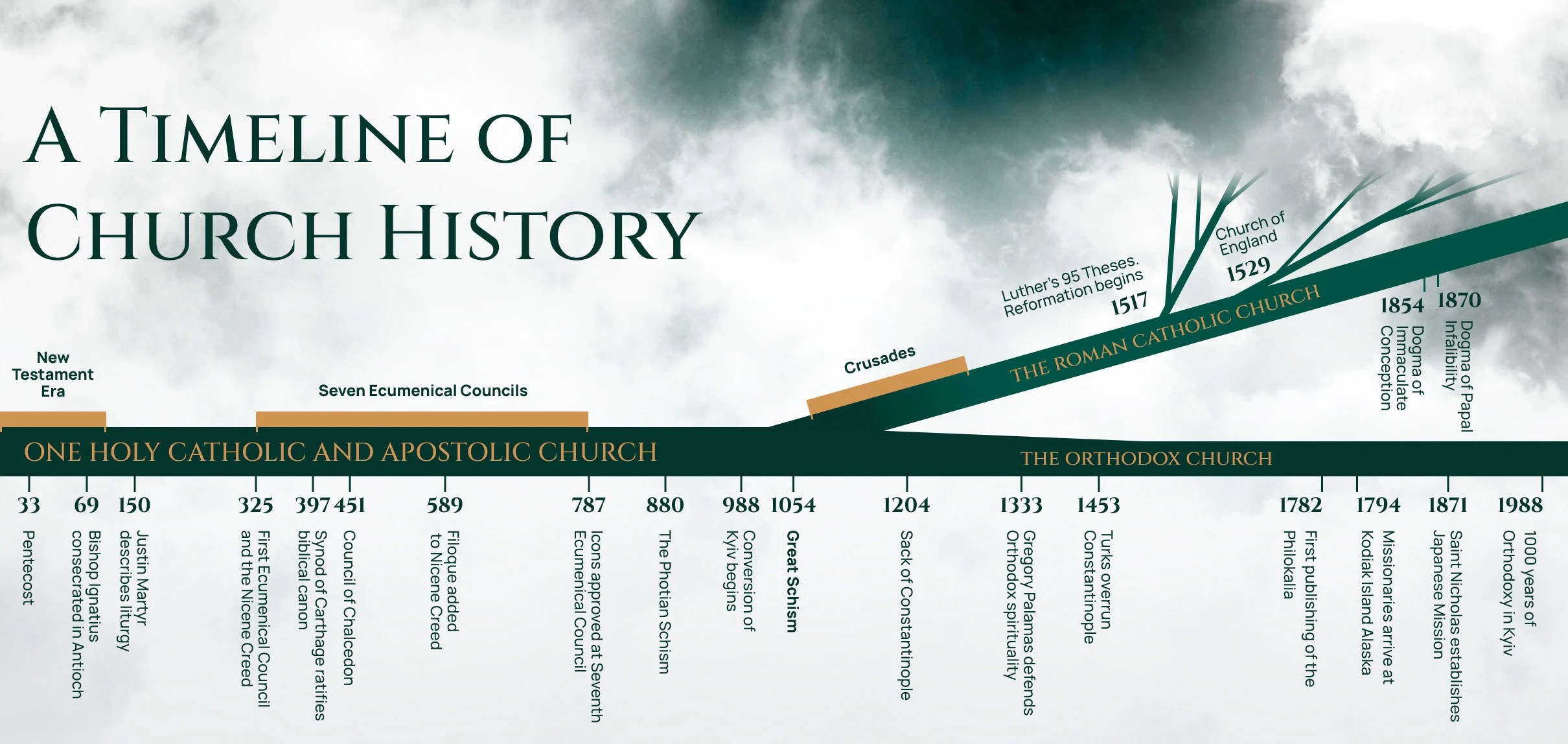
A campaign led by the kings of France and England to recapture it had failed. A second expedition, launched in 1202 in obedience to Innocent’s own summons, had been diverted to Constantinople. In 1204 it had stormed and sacked the city. A stronghold that for long centuries had withstood the envy of pagan warlords had fallen at last—to a Christian army. Its captors justified their storming of the city by charging that its inhabitants were rebels against the papacy: for the churches of Rome and Constantinople, ever since the age of Gregory VII, had been divided by an ever-widening schism. Innocent, however, appalled by the despoliation of Christendom’s bulwark, lamented the fall of Constantinople as a work of hell.

Tom Holland, Dominion.

The Great Schism between the papacy and Eastern Christian patriarchs is conventionally dated 1054, and not without reason. But those who dig deeper (or, like me, who read those who have dug deeper) tend to think that the 1054 schism was curable until this sacking of Constantinople by Crusaders.

A quintessential American heresy

[L]iving by no rule but the Bible turned out to be a defense against virtually the same list of enemies as living up to the standards of republicanism: “Many are republicans as to government, and are yet half republicans, being in matters of religion still bent to a Catechism, creed, covenant, or a superstitious priest. Venture to be as independent in things of religion as in those which respect the government in which you live.” Few Protestants expressed themselves as flamboyantly as [Elias] Smith in the early republic, but most followed where he led.

Mark A. Noll, America’s God.

I was reminded this week of a distinction that’s relevant here. I believe I learned it from the late Richard John Neuhaus, who I followed closely starting sometime in the 1980s. I won’t give a name (other than “quintessential American heresy”) to the view expressed so flamboyantly by Elias Smith, a view which I once effectively held, but I’m now in the camp of “ecclesial Christians”: those for whom faith in Christ and faith in His Church is one act of faith, not two.

I decidedly do not venture to be independent in things of religion, but very consciously submitted to the tradition of the Church particularly about Mary, the Mother of God-in-the-flesh, who was a stumbling-block to me as she has been to other Protestants (who in our generation call her “blessed” only sullenly, bound by scripture to do so).

The worst of the worst

Church management is a tricky and complicated business. I am glad that it is not my job. But I do know this much: The church is there for Gyp the Blood and Humpty Jackson, for Charlie Whitman and John Wilkes Booth and me. If there is no room for the worst of the worst in your church, then you do not have a church: You have a crappy book club.

Kevin D. Williamson (hyperlinks added).

Work and play

But there is the question. What, precisely, is “the business of life”? We can get onto an endless carousel if we try to decide which is the serious stuff of life, work or play. It is possible to take either view: either we toil away our eight hours so that we can get down to the real stuff—pleasure and love and recreation—or we enjoy periodic intervals of escape from the real stuff, the work.

Thomas Howard, Chance or the Dance? I would not have retired had I thought the real stuff was work; that’s just livelihood, not life.

What evangelism can obscure

With the clergy focused on the task of evangelism, their doctrines received so little scrutiny that laypeople took them for granted: the Bible was an infallible guide in every situation, and the church taught what was written in it. Coming into contact with people who read the Bible differently, southerners, unconscious of their own scrim of interpretation, concluded that those others were not Christians.

Frances Fitzgerald, The Evangelicals.

Fallen hero

Jérôme Lejeune was a hero of the National Right to Life Committee for his stance against aborting unborn children with Down syndrome.

He also was a thief—a stealer of glory that belonged to others.

It was apparently how the game was played back then. (Gift Link) That may not have changed much.

There’s probably a better moral to this little story than I can write: convention is no assurance of morality.

Upright life, sound doctrine

Over and over again he insisted that in electing an abbot upright life and soundness of doctrine were to be the prime considerations, not rank or family influence. ’I tell you in all sincerity,’ he said, ‘that as a choice of evils I would far rather have this whole place where I have built the monastery revert forever, should God so decide, to the wilderness it once was, rather than have my brother in the flesh, who has not entered upon the way of truth, succeed me as abbot. Take the greatest care, brothers, never to appoint a man as father over you because of his birth; and always appoint from among yourselves, never from outside the monastery.

Bede et al, Bede


Religious ideas have the fate of melodies, which, once set afloat in the world, are taken up by all sorts of instruments, some woefully coarse, feeble, or out of tune, until people are in danger of crying out that the melody itself is detestable.

George Elliot, Janet’s Repentance, via Alan Jacobs

[N]one of the things that I care about most have ever proven susceptible to systematic exposition.

Alan Jacobs, Breaking Bread With the Dead

You can read most of my more impromptu stuff here and here (both of them cathartic venting, especially political) and here (the only social medium I frequent, because people there are quirky, pleasant and real and it has no-algorithms). All should work in your RSS aggregator, like Feedly or Reeder, should you want to make a habit of it.

Sunday, 10/12/25

Total apostasy?

… Mormons claim that “total” apostasy overcame the church following apostolic times, and that the Mormon Church (founded in 1830) is the “restored church.” …

A bullet-point in an anti-Mormon tweet after the attack on a Michigan Mormon meeting place. (My source identified the tweeter as “fundamentalist.”) The bullet-points built to the conclusion that Mormons (Latter-Day Saints) are not Christian.

Fine. But the Evangelical and Evangelical-adjacent world in which I spent many decades believes something very much like that Mormon “total apostasy” story. They may think it started in the 4th century and ended in the 16th instead of the 19th, but a lot of them (including former-me) functionally think it ended in the 19th, with the revivals of the “Second Great Awakening,” when the distinctive style of Evangelicalism emerged. (BTW: Try to define “Evangelical.”)

Here, I submit, is a more accurate summary of Church history:

There’s no need of a restored church because Christ’s One Holy Catholic and Apostolic Church never went away.

And I stumbled onto it …

Speaking of which, I had occasion this week to reread an eight year-old blog constituting, my only published spiritual biography (it was reprinted elsewhere one time). There are a few things I’ve written over the years that stick in my mind as worthy efforts, not throw-away lines or curations, and that post is one of them.

Some things bear repeating, and so I shall:

Having settled in for a few decades, what have I found uniquely true about the Orthodox Church?

It’s hard to put into words. That’s why Orthodox evangelism tends to consist of “come and see.”

Harder still for me personally, I need to find words for feelings and tendencies that an intellectualoid has trouble trusting — things that may be true but approach ineffability. I have a Dostoyevsky “Beauty Will Save the World” sticker on my office window, but long habit and self-image keep pulling me back toward “Spock-like logic (think of that tidy, air-tight 5-Point Calvinism) will save the world.”

But here goes. Turn on your feeler.

I’ve found, again, the love of God. Over and over and over and over we hear liturgical exclamations “for You are a gracious God and love mankind.” There’s no contrary stream of wrath that I’ve noted. The steadfast love of the Lord endures forever.
I’ve found true worship of God, which was something I longed for and agitated for in my prior Evangelicalism and Calvinism, as best as I then understood worship. For instance, I wanted no “hymns” in worship that were addressed to encouraging one another rather than praising God. Yet somehow bathos kept cropping up, and emotionally manipulative gospel songs kept elbowing out too many hymns. I really had no idea what real worship looked like, but my longing was wholesome. I am very much a member of homo adorans.
I have found sobriety and balance. The Christian Reformed Church was on the right track when it aspired to “Catechism Preaching,” an effort to tie sermons to the prescribed portion of the Heidelburg Catechism appointed for that Sunday, rather than letting pastors riff on whatever they read in Saturday’s newspaper or National Review. But Catechism Preaching was a tradition honored more in the breach than in the observance. I have found the Orthodox liturgical cycles (very complex and overlapping) to produce sobriety and balance in homilies, but more, in the entire service (hymnody, Epistle and Gospel readings, etc.)
I have found a hard path which, if I faithfully walk it, will make me more Christlike — a nice Protestant way of referring to becoming a “partaker of the divine nature.”
I have found a Church that really is a hospital for sinners instead of a club for self-styled saints. Some patients have more embarrassing ailments than others, but we’re all chronic cases; sacramental confession helps to drive that home. Not one of us is a hopeless case: the lives of the Saints help drive that home. Some check out of the hospital against medical advice, but we don’t do involuntary discharges of anyone who knows (s)he’s sick and wants to get well.

Another’s conversion

She elaborates the point with more than a little self-deprecation: “I’d backed myself into a corner. There wasn’t anyone else in the world who talked about ‘the Platonic ideal of the Good as an active agent with a special care for humankind’ without shortening that whole cumbersome phrase to simply God.”

In short, although she resisted the conclusion (or was it a solution?) with all her strength, she finally welcomed its inevitability. “I had just enough love in me to be able to be warmly surprised to find out the rules I loved, loved me back.”

… If one can know what she thinks by reading the Catechism, what’s left to surprise?

Answer: not her background convictions, but how she applies them to concrete questions, especially questions about public policy and the modern household ….

Brad East, quoting Leah Libresco Sargeant’s conversion from atheism to Roman Catholicism. The occasion, of course, is that she has written a new book, The Dignity of Dependence: A Feminist Manifesto.

Orthodoxy and Roman Catholicism are not in communion with each other since, in the simplified version, the Great Schism of 1054 (see the timeline above). But a lot of people coming out of Protestant traditions have felt that those were the only two viable Christian alternatives, and I have never found it in me to criticize those who made the wrong-but-plausible choice, like Leah did.

Fallen

Of course, we speak of human beings as “fallen.” However, in Orthodox teaching, this does not refer to our nature itself. Rather, it refers to the fact that we have been made subject to death – we are mortal. It is “death at work in us” that we describe as “sin.” But the origin of sin is not found in our nature. Our nature is inherently good. Understanding this makes a huge difference when we think about human relationships and the character of our common life.

If you take the view (which is common in certain corners of Western Christianity) that human beings have a “sin nature” – that we are, in fact, essentially bad – then how we view one another and the character of our common life takes on a different caste. In an Orthodox understanding, a Bible verse such as, “Spare the rod and spoil the child,” can mean little more than “children need discipline in their lives to help them”. Whereas in a world in which human nature is held to be a “sin nature,” then “sparing the rod,” would be seen as letting evil run amok. It would hold that our nature not only needs to be restrained but requires a vigorous regime of reward and punishment. It has not been that long since the notion of “beating the evil out of a child” was common.

When we speak of our nature as “good,” we are not declaring that human beings are born as saints. Rather, we are saying that our nature (“what we are”) tends towards the good, desires the good. We desire beauty. We desire well-being. We desire truth. Even when we engage in evil actions, they are most often grounded in a misperception of the good. Dictators do not come to power by asking people to be evil – they come to power by distorting the image of the good.

Fr. Stephen Freeman, The Nature of Being Human


Religious ideas have the fate of melodies, which, once set afloat in the world, are taken up by all sorts of instruments, some woefully coarse, feeble, or out of tune, until people are in danger of crying out that the melody itself is detestable.

George Elliot, Janet’s Repentance, via Alan Jacobs

[N]one of the things that I care about most have ever proven susceptible to systematic exposition.

Alan Jacobs, Breaking Bread With the Dead

You can read most of my more impromptu stuff here and here (both of them cathartic venting, especially political) and here (the only social medium I frequent, because people there are quirky, pleasant and real and it has no-algorithms). All should work in your RSS aggregator, like Feedly or Reeder, should you want to make a habit of it.

Leavetaking of the Elevation of the Cross

Thinking

What growing up fundamentalist helped me learn early on is how terribly wrong you can be while thinking very hard.

Phil Christman.

How do we become uncomplicated and unsophisticated? Can we simply unlearn all that we have learned?

No, we cannot, but what we can do is to separate ourselves from it in order to look at it with new eyes. For us Westerners to truly enter into the ancient Christian transmission and catch the essence of Christ’s teaching, it is necessary for us to crucify our rationalizing minds and arise above the level of thought and emo for a society founded on Descartes’ proposition “I think, therefore I am,” this of course means a kind of suicide; and it is to precisely such an ego-death that Christ calls us. Contemporary western Christianity trained us how to think and what to think; whereas Christ himself, as did Lao Tzu before Him, taught us how not to need to think.

Hieromonk Damascene, Christ the Eternal Tao.

Theology is offered to the glory of God, not ourselves. Since it is divine, it can never be based on human reasoning, ideas, speculation, or clever argumentation. Orthodox theology can never be disconnected from the spiritual life of the theologian or from the life of the Church. Authentic Orthodox theology is “liturgical, doxological and mystical.”

Dr. Eugenia Scarvelis Constantinou, Thinking Orthodox.

I did not unequivocally “grow up fundamentalist,” but I was at least adjacent. Then Calvinism, which I discovered in my late 20s, increased the “thinking very hard.” But I did not think my way out of all that and into Orthodox Christianity. It was more as if I worshipped and trusted my way across that chasm.

Mike-drop

Whenever a traditional Christian defends some point of traditional Christian morality, you’ll hear one of our lefty friends cry, “I thought Jesus ate with prostitutes and tax collectors!” Once again, the proper response is: Do you identify with Jesus in that parable?

This is where liberal Christianity becomes—ironically; hilariously—elitist. Sorry, folks, but God’s not saying you must condescend to eat with sinners. No: you are the sinner. He condescends to eat with you.

As for us recovering sinners (i.e., Christians) Saint Paul gives us a different rule: “But now I have written to you not to keep company with anyone named a brother, who is sexually immoral, or covetous, or an idolater, or a reviler, or a drunkard, or an extortioner—not even to eat with such a person” (1 Cor. 5:11). Why? Because, not being Jesus, you can’t trust yourself not to fall into their vice.

Michael Warren Davis, You’re Not Jesus


Religious ideas have the fate of melodies, which, once set afloat in the world, are taken up by all sorts of instruments, some woefully coarse, feeble, or out of tune, until people are in danger of crying out that the melody itself is detestable.

George Elliot, Janet’s Repentance, via Alan Jacobs

[N]one of the things that I care about most have ever proven susceptible to systematic exposition.

Alan Jacobs, Breaking Bread With the Dead

You can read most of my more impromptu stuff here and here (both of them cathartic venting, especially political) and here (the only social medium I frequent, because people there are quirky, pleasant and real). All should work in your RSS aggregator, like Feedly or Reeder, should you want to make a habit of it.

Elevation of the Cross

The modern West is anti-Christian

The modern West is said to be Christian, but this is untrue: the modern outlook is anti-Christian, because it is essentially anti-religious; and it is anti-religious because, still more generally, it is anti-traditional; this is its distinguishing characteristic and this is what makes it what it is.

René Guénon Guénon , The Crisis of the Modern World

The American Hermeneutic

The problem with race and the Bible was far more profound than the interpretation of any one text. It was a problem brought about by the intuitive character of the reigning American hermeneutic. This hermeneutic merged three positions: (1) The Bible was a plain book whose meanings could be reliably ascertained through the exercise of an ordinary person’s intelligence; (2) a main reason for trusting the Bible as true was an intuitive sense, sealed by the Holy Spirit; (3) the same intelligence that through ordinary means and intuitions could trust the Bible as true also gained much additional truth about the world through intuitive processes that were also deliverances of universal common sense. The first position was a traditional Protestant teaching intensified by the American environment; the second was historically Protestant and Reformed; the third was simply a function of the American hermeneutic.

Mark A. Noll, America’s God

I just love this story …

It is well known among Cypriots, not to mention a matter of national pride, that St. Lazarus lived on the island of Cyprus after the Lord’s Resurrection. Saint John’s Gospel tells us that the Jewish leaders had resolved to kill both Jesus and Lazarus. They considered it necessary to kill Lazarus because belief in Jesus as the Messiah increased after he raised Lazarus to life when he had been dead for four days (John 12:9–11). Lazarus was literally living proof of this extraordinary miracle. The New Testament itself does not tell us that Lazarus went to Cyprus later, but this was known in the tradition of the Church of Cyprus. The gospel message came to Cyprus very early, and the Church was established there even before St. Paul became a missionary (Acts 11:19–21).

My husband, Fr. Costas, was born and lived on the island of Cyprus when it was still a British colony. He related to me that the Cypriots would boast about St. Lazarus to the British there. But the British would often scoff at this claim, saying there was no proof that Lazarus had ever come to Cyprus.

A very old church dedicated to St. Lazarus, dating back to the 800s, is located in Larnaca, Cyprus. In 1972 a fire caused serious damage to the church building. The subsequent renovation required digging beneath the church to support the structure during reconstruction. In the process of digging, workers uncovered the relics of St. Lazarus located directly below the altar in a marble sarcophagus engraved with the words “Lazarus, the four-day dead and friend of Christ.”

Dr. Eugenia Scarvelis Constantinou , Thinking Orthodox. You’ll probably see this again the next time Readwise pops it up for me.

… but I love this even more

The Christianity that those of us, at least in the United States … grew up around came from one of two categories largely. And people who want to defend those types of Christianity will call this a caricature. I don’t care anymore. But what I’m about to say, even if you think it’s a caricature of what they’re trying to teach, this is what a lot of the people within these traditions have actually received. Right? So it’s very easy to defend some tradition based on what’s in the books, and what we would mean to say, right? But I’m talking about what the people who I encounter, the people who talk to me about spiritual things. come to me and give confessions, what they’ve received from the Christianity they’ve grew up around, how that has shaped them, how they think because of it. And if people, representatives of those groups want to say that’s not what they meant to teach, cool, but maybe some introspection on why that’s not what people are receiving.

Anyway, what people have received comes in two categories. One is sort of the smilin’ Bob Shuler School of, “God loves you just the way you are and you don’t have to do anything. Just don’t worry about it. Just smile and be happy and listen to the hymns of your choice that you enjoy.” … That worked really well with boomers. That seemed to answer something they needed to hear. Maybe they’re a generation who grew up with very dissatisfied perfectionist parents, and so just hearing you’re fine just the way you are was what they needed, right? But that doesn’t work on subsequent generations, because subsequent generations are more realistic or nihilistic depending on your point of view, and know there’s something deeply wrong with themselves and with the world around them. So just telling them over again, “No, no, you’re fine, everything’s fine, it doesn’t work.” That’s why those kind of churches are all empty now.

The other school of thought is pretty much the exact opposite. It’s God doesn’t really love you. Right. In fact He’s pretty angry with you and He’s getting ready to send you to hell. Right? And the only way to avoid that is, depending on your tradition, right, is, for you to love him nonetheless, really sincerely — and there’s a rabbit hole to go down. How sincere am I ever really? — and do that plus live your life at a certain way and follow certain rules. Which will differ based on tradition, and which you will inevitably fail at.

That second one is most of the people who I interact with on spiritual matters, and it’s almost like they’ve been taught and they’ve internalized that. Their life in this world is this sort of really horrible reality show, almost like Squid Games, and like God is about weeding out contestants and narrowing it down to this faithful few and everybody else goes to hell, goes to eternal punishment except for this faithful few who, again, depending on your tradition, he may just pick. Or, you know, they’re the ones who really did it right. They’re the ones who really loved him sincerely, or they’re the ones who really lived their life the right way.

And any way you slice those things, most people again are realistic enough that when they look at their life, they don’t see a lot of evidence in their life and their actions that they’re one of the people God picked, or they don’t see a lot of evidence of their life that they’re really sincere about following God, or they don’t see a lot of evidence of their life that they’re really toeing the line and living the life they know they should be living, meaning most people are walking around — like religious people — walking around thinking they’re probably going to end up in hell. That God is probably mad at the most of the time, and that He’s looking for them to make some missteps so, boom!, they can get nailed.

Also most atheists are walking around doing the same thing they’re protesting constantly that there is no God because they can’t deal with that guilt and stuff that they’ve internalized. They can’t live like that. No one can live like that their route to trying to live like that and deal with the cognitive dissonance is just to deny that any of it’s true, over and over and over again publicly, loudly to everyone who will listen. Right.

Whereas the religious people are just in this kind of quiet desperation of how do I figure this out. Right.

So let me reiterate again, right, and Penal Substitution plays a big part in this. That’s why I’m bringing it up in this context:

God loves you. Jesus said so. St. John’s Gospel, the Father Himself loves you. He is not angry at you. He does not want to destroy you for your sins. There is no power of justice that commands him to do so. No one commands him to do anything. He loves you. He wants you to find salvation, but salvation is a thing you have to actually do. He wants you to do it. The Bible says so. God wills that all men be saved and come to the knowledge of the truth. But you have to do it. He empowers you to do it. He forgives you when you mess up trying to do it. He heals you when you damage yourself trying to do it and failing. He is entirely on your side. The God who created the universe is entirely on your side and the saints are on your side and the church is on your side. Everyone is on your side. Christ is advocating for you. Everything is set up for us.

When Saint Paul says to us, continue to work out your salvation with fear and trembling. You don’t stop them like Kierkegaard did. Read the next verse because it is God who is working in you to will and to do according to his pleasure. We continue on and we work out our salvation because we know that God is on our side and empowering us to do it and loving us and loving other people through us. We need to pray about that. We need to pray it. We need to repeat it. We need to kind of imitate what the atheists are doing. We need to say it out loud. We need to say it to each other. We need to say it to everyone who will listen right? That God loves you and wants you to find salvation, wants you to be healed, wants you to be set free from sin. He wants all these things for you. It doesn’t mean you have nothing to do. That doesn’t mean you’re fine just the way you are. You know you’re not fine just the way you are, right? But it means that He is there to help you to grow to be transformed into the person who you need to be and want to be. The person he created you to be for eternity. That’s the actual message of Christianity. Don’t accept any substitutes for that, ever at all for any reason.

That’s what I have to say.

Fr. Stephen DeYoung (transcript by Tipsy)


Religious ideas have the fate of melodies, which, once set afloat in the world, are taken up by all sorts of instruments, some woefully coarse, feeble, or out of tune, until people are in danger of crying out that the melody itself is detestable.

George Elliot, Janet’s Repentance, via Alan Jacobs

[N]one of the things that I care about most have ever proven susceptible to systematic exposition.

Alan Jacobs, Breaking Bread With the Dead

You can read most of my more impromptu stuff here and here (both of them cathartic venting, especially political) and here (the only social medium I frequent, because people there are quirky, pleasant and real). All should work in your RSS aggregator, like Feedly or Reeder, should you want to make a habit of it.

Sunday, 8/31/25

I enjoyed my Evangelical boarding school experience. I looked forward to the end of Summer Vacation and moving back into the dorm.

For that and a few other reasons, this has long been my favorite time of the year.

It began 62 years ago tomorrow, when my dad and I packed up the car and headed north. The day ended up being quite an adventure, involving fuel pump failures on both family vehicles. I’m not sure the story is worth retelling – except for the possibility that my dad was wondering “Is God trying to tell us this was a mistake?”

I don’t think it was, despite all the Evangelical problems I now can’t un-see. “Evangelical” is where my family was, and we couldn’t imagine wanting to be otherwise.

PSA

No, not prostate-specific antigen, nor public service announcement.

We’re talkin’ Penal Substitutionary Atonement. It is not the sine qua non that so many think it is.

Grace

I can think of few phrases in modern Christian speech that have been more abused through misuse and overuse than “we are saved by grace.” As a young Protestant, this was explained to me thus: “We are saved by God’s unmerited favor.” This has the unfortunate implication that, whatever salvation may be, it’s something that’s happening in the mind of God – His unmerited favor. It strikes me as somewhat empty.

Its emptiness belongs to that nefarious doctrine (as I would describe it) of the Penal Substitutionary Atonement (PSA), in which God’s justice demands our condemnation, while God’s mercy demands the blood of Jesus. All of which, it would seem, leaves us as bystanders in a cosmic court where the eternal disposition of our wretched souls is worked out.

In Orthodox understanding (which is the understanding of the early Church), grace is ever so much more. Indeed, grace is the Divine Energies, the very life of God. I have given this article the title, “Saved by the Stuff of Grace,” to draw attention to the ontological character of grace. Grace is not an aspect of a Divine psychology. Grace is the very life of God. We are saved by becoming partakers in the life of God: He becomes what we are that we might become what He is – i.e., that we might dwell in Him and He in us.

Fr. Stephen Freeman, Saved by the Stuff of Grace

Vladimir Lossky

The inadequacy of this theology was brilliantly deconstructed by Vladimir Lossky, whose analysis reveals why this opinion results in other problems that manifest themselves in Western Christian theology: Christian horizons are limited by the drama played between God, who is infinitely offended by sin, and man, who is unable to satisfy the impossible demands of vindictive justice. The drama finds its resolution in the death of Christ, the Son of God who has become man in order to substitute Himself for us and pay our debt to divine justice. What becomes of the dispensation of the Holy Spirit here? His part is reduced to that of an auxiliary, an assistant in redemption, causing us to receive Christ’s expiated merit. . . . The price of our redemption having been paid in the death of Christ, the resurrection and the ascension are only a glorious happy end of his work, a kind of apotheosis without direct relationship to our human destiny. This redemptionist theology, placing all the emphasis on the passion, seems to take no interest in the triumph of Christ over death. The very work of the Christ-Redeemer, to which this theology is confined, seems to be truncated, impoverished, reduced to a change of the divine attitude toward fallen men, unrelated to the nature of humanity.

Dr. Eugenia Scarvelis Constantinou, Thinking Orthodox

Taming the Church

There was a subtle repressiveness behind this seemingly innocuous pluralism. Niebuhr failed to describe the various historical or contemporary options for the church. He merely justified what was already there—a church that had ceased to ask the right questions as it went about congratulating itself for transforming the world, not noticing, that in fact the world had tamed the church.

Stanley Hauerwas, Resident Aliens

Work

No one should imagine that the work he does is an end in itself; it has the role of beautifying his nature, with the virtues of patience, of self-control, of love for his neighbor, of faith in God, and in turn of opening his eyes to the wise principles placed by God in all things.

Dumitru Staniloae, Orthodox Spirituality

A hundred fine names for the Sulks

Ye see it easily enough in a spoiled child that would sooner miss its play and its supper than say it was sorry and be friends. Ye call it the Sulks. But in adult life it has a hundred fine names—Achilles’ wrath and Coriolanus’ grandeur, Revenge and Injured Merit and Self-Respect and Tragic Greatness and Proper Pride.’

C.S. Lewis, The Great Divorce

The Creed

I have said elsewhere that I deliberately will never adopt any theological “ism” that isn’t clearly derived from the Creed. Far from being a cynically contrived statement or a politically motivated one, the Creed was formulated to be as dogmatically expansive as possible, without opening the doors to needless speculation on the one hand or to doctrinal reduction for the sake of accommodation on the other.

Addison Hodges Hart, “God concepts,” the “impersonal transcendent,” and “superstitious” babushkas

Bad Religion

Ross Douthat wrote a book a few years back titled “bad religion.” a book like that wouldn’t be much use unless there was some definition of his terminology:

bad religion: the slow-motion collapse of traditional Christianity and the rise of a variety of destructive pseudo-Christianities in its place.

[A] religious mistake has been to fret over the threat posed by explicitly anti-Christian forces, while ignoring or minimizing the influence that the apostles of pseudo-Christianity exercise over the American soul.

Question: how can you tell whether your church is pushing one of the varieties of destructive pseudo-Christianity? The answer is not “do they use the Bible as their source of authority?” The arch-heretics have always used the Bible, sometimes quite cunningly.

If you’re not Orthodox, I want this question to be a burr under your saddle, as it became under my saddle 34 or so years after I first headed off to Boarding School.


Religious ideas have the fate of melodies, which, once set afloat in the world, are taken up by all sorts of instruments, some woefully coarse, feeble, or out of tune, until people are in danger of crying out that the melody itself is detestable.

George Elliot, Janet’s Repentance, via Alan Jacobs

[N]one of the things that I care about most have ever proven susceptible to systematic exposition.

Alan Jacobs, Breaking Bread With the Dead

You can read most of my more impromptu stuff here and here (both of them cathartic venting, especially political) and here (the only social medium I frequent, because people there are quirky, pleasant and real). All should work in your RSS aggregator, like Feedly or Reeder, should you want to make a habit of it.

Sunday Sundries, 8/3/25

Shift of power

The shift from church power to state power is not the victory of peaceable reason over irrational religious violence. The more we tell ourselves it is, the more we are capable of ignoring the violence we do in the name of reason and freedom.

William T. Cavanaugh, The Myth of Religious Violence

I’ve always loved this quote, but it somehow seems even more salient these days.

Our cultural glue

Given the destructive fruitlessness of religio-political conflicts in the Reformation era, Catholics and Protestants alike built on trends that antedated the Reformation and decided to go shopping instead of continuing to fight about religion, thus permitting their self-colonization by capitalism in the industrious revolution. In combination with the exercise of power by hegemonic, liberal states, a symbiosis of capitalism and consumerism is today more than anything else the cultural glue that holds together the heterogeneity of Western hyperpluralism.

Brad S. Gregory, The Unintended Reformation

The shift (see first item) was not instantaneous.

The Gimlet Eye

So many well-meaning Christians believe that the best way for the Church to influence American culture is by imitating as much as possible whatever way of life happens to be fashionable and popular, in the hopes that people will like us and listen to us.

Ken Myers, All God’s Children and Blue Suede Shoes

What is “enough”?

The question with which to start my investigation is obviously this: Is there enough to go round? Immediately we encounter a serious difficulty: What is “enough”? Who can tell us? Certainly not the economist who pursues “economic growth” as the highest of all values, and therefore has no concept of “enough.” There are poor societies which have too little; but where is the rich society that says: “Halt! We have enough”? There is none.

E.F. Schumacher, Small Is Beautiful.

A reminder

I posted this scarcely sixteen months ago, but when I stumbled onto the source again, a was struck with how it addresses a real problem:

[I]t’s good to remind ourselves periodically of the first rule of Scriptural exegesis: You are not Jesus. Whenever you read a story about Jesus’s life, you should not identify with Jesus. You should identify with the sinner whom He is healing/converting/forgiving/upbraiding/flagellating/etc.

Whenever a traditional Christian defends some point of traditional Christian morality, you’ll hear one of our lefty friends cry, “I thought Jesus ate with prostitutes and tax collectors!” Once again, the proper response is: Do you identify with Jesus in that parable?

This is where liberal Christianity becomes—ironically; hilariously—elitist. Sorry, folks, but God’s not saying you must condescend to eat with sinners. No: you are the sinner. He condescends to eat with you.

As for us recovering sinners (i.e., Christians) Saint Paul gives us a different rule: “But now I have written to you not to keep company with anyone named a brother, who is sexually immoral, or covetous, or an idolater, or a reviler, or a drunkard, or an extortioner—not even to eat with such a person” (1 Cor. 5:11). Why? Because, not being Jesus, you can’t trust yourself not to fall into their vice.

Michael Warren Davis, then a Catholic, You’re Not Jesus

Wingman

He recognized that he couldn’t “convert me” to Orthodoxy; only Christ can do that. The Lord had to enter my heart and lead me into a deeper relationship with Him through His Body, the Orthodox Church. The Orthodox evangelist, then, isn’t a preacher or apologist. He’s more like a wingman.

Michael Warren Davis, now Orthodox, the Yankee Athonite

Ready to get strong?

Okay, I’m stealing this analogy from a Catholic podcast/YouTube channel, but I love it and it fits Orthodoxy, too:

Protestantism is like having some dumbells at home. Orthodoxy is like having a fully-equipped gym with a personal trainer.

A long and winding road

From a different episode of that Catholic podcast, Ridvan Ayedemir, a/k/a Apostate Prophet, talks of his spiritual journey:

  • out of Sunni Islam,
  • through agnosticism,
  • through atheism (of the “there’s-just-not-enough-evidence-for-god” variety, not the “theists are stupid” variety),
  • through adopting some Jewish practice and thinking of conversion,
  • through the Rosary and its mysteries (which he still prays), and
  • into the Orthodox Catechumenate.

It’s long, but fascinating. I figured with an adopted persona like “Apostate Prophet,” he would be very polemical and combative. He’s not, though the podcast features his very most polemical points as the teaser.

What I found most interesting is that he didn’t start really feeling attracted to Jesus Christ until he tried filling his “meaning” void with the Rosary! He liked it, started reading about the mysteries of the Rosary (which I’ve never read), and came to love Jesus through the Rosary meditations on His Crucifixion.

Most of us are so used to insisting on understanding and certainty before we take a religious step that taking a step, assessing its effects, and then coming to understanding (not always certainty) seems like a real man-bites-dog story.

I had already heard rumors that Ridvan/Apostate, who I’d never heard of until within the past two months or so, had become Orthodox. I was praying for him since he’s at least a minor celebrity and I don’t want him making shipwreck because of Christian limelight. Having now heard him for some 2.75 hours, my prayers will be more appreciative and fervent.


Religious ideas have the fate of melodies, which, once set afloat in the world, are taken up by all sorts of instruments, some woefully coarse, feeble, or out of tune, until people are in danger of crying out that the melody itself is detestable.

George Elliot, Janet’s Repentance, via Alan Jacobs

[N]one of the things that I care about most have ever proven susceptible to systematic exposition.

Alan Jacobs, Breaking Bread With the Dead

You can read most of my more impromptu stuff here and here (both of them cathartic venting, especially political) and here (the only social medium I frequent, because people there are quirky, pleasant and real). All should work in your RSS aggregator, like Feedly or Reeder, should you want to make a habit of it.

Sunday, 7/27/25

My parish takes an important vote in a special meeting today. I think I know how I’ll vote, but it’s premature to write about it – and it may forever be premature, for that matter, depending on whether I see a larger application than just us.

Manly Orthodoxy

Speaking of sanity:

So there have been a few reports of late, including this most recent one currently making the rounds, about a number of young people converting to Orthodoxy, particularly young men, converting because they find in the Orthodox Church, according to these reports, an environment that preaches ‘masculinity’ and real ‘manhood’. And I want to say that if you’re here because you think that that’s what we are here to do, then you are a fool. This is stupidity. ‘Masculinity’, so far as I am aware, is not an Orthodox term. It is not a term that has any traditional place in Christianity. It is a term embraced by the secular world because this world has rejected normal concepts of humanity, in which of course there is male and there is female, there is child, there is adult. These are simply human beings. But because the world has lost sight of the basics of what it means to be human, it is forced to respond to the lack of clarity it has pushed on itself by fostering these concepts of ‘femininity’, ‘masculinity’, and so on.

Our only goal is that every single human being might become a living image of Christ Himself. That men might become Christ-like men; that women might become Christ-like women; that children might be true children of God; that the aged might find the real respect due to those who long live and struggle for Christ; that this world might come to understand what it means to be redeemed.

… [I]f any of us is here so that we can be reinforced in our cultural understandings, so that we can somehow have strengthened our own politics or our own social norms, if that’s what you want, go do that at home. Go do that by yourself, and come back to us when you’re ready to repent.

Seeking After Worldly Visions of “Masculinity” is Not an Orthodox Pursuit

Manifesto: The Mad Farmer Liberation Front

by Wendell Berry

Love the quick profit, the annual raise,
vacation with pay. Want more
of everything ready-made. Be afraid
to know your neighbors and to die.
And you will have a window in your head.
Not even your future will be a mystery
any more. Your mind will be punched in a card
and shut away in a little drawer.
When they want you to buy something
they will call you. When they want you
to die for profit they will let you know.
So, friends, every day do something
that won’t compute. Love the Lord.
Love the world. Work for nothing.
Take all that you have and be poor.
Love someone who does not deserve it.
Denounce the government and embrace
the flag. Hope to live in that free
republic for which it stands.
Give your approval to all you cannot
understand. Praise ignorance, for what man
has not encountered he has not destroyed.
Ask the questions that have no answers.
Invest in the millennium. Plant sequoias.
Say that your main crop is the forest
that you did not plant,
that you will not live to harvest.
Say that the leaves are harvested
when they have rotted into the mold.
Call that profit. Prophesy such returns.
Put your faith in the two inches of humus
that will build under the trees
every thousand years.
Listen to carrion — put your ear
close, and hear the faint chattering
of the songs that are to come.
Expect the end of the world. Laugh.
Laughter is immeasurable. Be joyful
though you have considered all the facts.
So long as women do not go cheap
for power, please women more than men.
Ask yourself: Will this satisfy
a woman satisfied to bear a child?
Will this disturb the sleep
of a woman near to giving birth?
Go with your love to the fields.
Lie easy in the shade. Rest your head
in her lap. Swear allegiance
to what is nighest your thoughts.
As soon as the generals and the politicos
can predict the motions of your mind,
lose it. Leave it as a sign
to mark the false trail, the way
you didn’t go. Be like the fox
who makes more tracks than necessary,
some in the wrong direction.
Practice resurrection.

“Manifesto: The Mad Farmer Liberation Front” from The Country of Marriage, Harcourt Brace Jovanovich, Inc. 1973. Also published by Counterpoint Press in The Selected Poems of Wendell Berry, 1999; The Mad Farmer Poems_, 2008;_ New Collected Poems, 2012.

An insta-favorite

This seems to be a Sunday for posting favorites. Here’s a quite new favorite I’ve called “The Gospel for People Battered by Bad Religion”:

God loves you. Jesus said so. St. John’s Gospel, the Father Himself loves you. He is not angry at you. He does not want to destroy you for your sins. There is no power of justice that commands him to do so. No one commands him to do anything. He loves you. He wants you to find salvation, but salvation is a thing you have to actually do. He wants you to do it. The Bible says so. God wills that all men be saved and come to the knowledge of the truth. But you have to do it. He empowers you to do it. He forgives you when you mess up trying to do it. He heals you when you damage yourself trying to do it and failing. He is entirely on your side. The God who created the universe is entirely on your side and the saints are on your side and the church is on your side. Everyone is on your side. Christ is advocating for you. Everything is set up for us.

When Saint Paul says to us, continue to work out your salvation with fear and trembling. You don’t stop them like Kierkegaard did. Read the next verse because it is God who is working in you to will and to do according to his pleasure. We continue on and we work out our salvation because we know that God is on our side and empowering us to do it and loving us and loving other people through us. We need to pray about that. We need to pray it. We need to repeat it. We need to kind of imitate what the atheists are doing. We need to say it out loud. We need to say it to each other. We need to say it to everyone who will listen right? That God loves you and wants you to find salvation, wants you to be healed, wants you to be set free from sin. He wants all these things for you. It doesn’t mean you have nothing to do. That doesn’t mean you’re fine just the way you are. You know you’re not fine just the way you are, right? But it means that He is there to help you to grow to be transformed into the person who you need to be and want to be. The person he created you to be for eternity. That’s the actual message of Christianity. Don’t accept any substitutes for that, ever at all for any reason.

Fr. Stephen DeYoung

Life verse

At my evangelical high school, there was a bit of social pressure to choose a “life verse.” I resisted, but if forced, it likely would have been these:

For this reason I bow my knees to the Father of our Lord Jesus Christ, from whom the whole family in heaven and earth is named, that He would grant you, according to the riches of His glory, to be strengthened with might through His Spirit in the inner man, that Christ may dwell in your hearts through faith; that you, being rooted and grounded in love, may be able to comprehend with all saints what is the width and length and depth and height—to know the love of Christ which passes knowledge; that you may be filled with all the fullness of God.

Ephesians 3:14-19.

Their sensibility, their longing for something deeper than hell-avoidance, may explain why, after another 30 years or so, I embraced Orthodox Christianity so readily.

Orthodoxy also clarified Hebrews 6:1-3 for me.

Political wisdom through a shepherd who hasn’t been bought

A B-team religio-political pundit has dined out of late on calling various evangelical pastors and leaders sell-outs. That pundit’s own motivations aside, here, I think, is the voice of a shepherd who truly hasn’t been bought:

I think it is a drastic mistake to think that the deadly influences of a leader come only through his policies and not also through his person.

This is true not only because flagrant boastfulness, vulgarity, immorality, and factiousness are self-incriminating, but also because they are nation-corrupting. They move out from centers of influence to infect whole cultures. [The years 2015-2020] bear vivid witness to this infection at almost every level of society.

I find it bewildering that Christians can be so sure that greater damage will be done by bad judges, bad laws, and bad policies than is being done by the culture-infecting spread of the gangrene of sinful self-exaltation, and boasting, and strife-stirring (eristikos) … And I think it is baffling and presumptuous to assume that pro-abortion policies kill more people than a culture-saturating, pro-self pride.

When a leader models self-absorbed, self-exalting boastfulness, he models the most deadly behavior in the world. He points his nation to destruction. Destruction of more kinds than we can imagine.

It is naive to think that a man can be effectively pro-life and manifest consistently the character traits that lead to death — temporal and eternal.

John Piper, Policies, Persons, and Paths to Ruin, October 22, 2020.

When I think all Evangelicals are nuts, I should read some John Piper (having lost my taste for Russell Moore for reasons other than his alleged selling out).

Chew, walk

Sometimes this whole 2000-year-old faith seems like a living koan. Chew on this until you are enlightened. Keep walking.

Paul Kingsnorth, The Moses Option


Religious ideas have the fate of melodies, which, once set afloat in the world, are taken up by all sorts of instruments, some woefully coarse, feeble, or out of tune, until people are in danger of crying out that the melody itself is detestable.

George Elliot, Janet’s Repentance, via Alan Jacobs

[N]one of the things that I care about most have ever proven susceptible to systematic exposition.

Alan Jacobs, Breaking Bread With the Dead

You can read most of my more impromptu stuff here and here (both of them cathartic venting, especially political) and here (the only social medium I frequent, because people there are quirky, pleasant and real). All should work in your RSS aggregator, like Feedly or Reeder, should you want to make a habit of it.

Sunday, 7/20/25

Divorce, penance, annulment

Roman Catholic apologists have long cited their Church’s ban on divorce and remarriage as commending it and condemning other Churches’ approaches. I have occasionally wondered if they were right.

Such doubts diminished when I began acquiring an Orthodox Christian way of thinking. I heard the somewhat penitential tone of the service for a second marriage. I gained empathy for some of those whose marriages ended, even through their own fault, because we are broken and we do break things. And God doesn’t give up on us when we do.

I also knew that Roman Catholic annulment practice could easily be cast as a (hypocritical) workaround for wealthy Catholics who cared to pursue it (like one of my very attractive law school classmates). I came to prefer the Orthodox practice; briefly:

  • some sort of penance being connected to the Church’s recognition of divorce and,
  • as mentioned earlier, the very service for a second marriage reflecting soberly that a second marriage is a concession to human weakness — “better to marry than to burn with lust”

Then a day or two ago I heard an Orthodox podcast’s treatment of the difference, and decided to dig in a bit deeper.

The Orthodox Church doesn’t give divorces; it penances divorces. Its approach is pastoral. Before remarriage, one must repent of his or her fault in the destruction of the first marriage. This helps those hurt by divorce to be healed and re-integrated into the community and set on the right path again. Since marriage is ordered to the salvation of the spouses, a second marriage is sometimes necessary (“better to marry than to burn with lust”). For a specific, albeit typical, “procedure” for Orthodox second marriages, see here.

The Roman Catholic Church officially does not permit divorce, but has a legal process for declaring, retroactively, that there was never a valid marriage in the first place. Suspecting that the Orthodox podcaster’s characterization of that process and its effects went a bit overboard, I sought out reliable Catholic sources, like here, here, and here.

You can read and judge for yourself (they’re not long), but I find that process described a legal and apologetical dodge with no repentance and spiritual healing for anyone. There’s nothing pastoral about it. In the three sources I consulted, there was only one whiff of examination of conscience about the broken marriage, and even that was in the form of “some people find that simply writing out their testimony helps them to understand what went wrong and why,” not “you really should pause, reflect and repent for your role.”

If the point is to get people into the Kingdom of Heaven, I see a clear winner as between the Orthodox approach and the Roman Catholic. And I’m ready to give as good as I get the next time a Catholic apologist tries the play the divorce card.

Biblical rules

I never hear the [college] administration admit they’re wrong about anything, even though you and I both know they’ve made some bad decisions. Rules get changed every year, but the deans never acknowledge the previous rules were arbitrary—they’re couched in all this talk of biblical principles.

Philip Yancey, Where the Light Fell (Kindle location 3371)

Yancey is very much my contemporary, and I think he was writing professionally before we were 25. Where the Light Fell is autobiographical, and I’m astonished that he retained any sort of Christian faith considering the spiritually abusive environment he grew up in.

The pretense that Christian college policies were from “biblical principles” is one that I knew well and saw through quickly. But it’s a pretext that Biblicists almost have to adopt if they’re going to (a) make rules without (b) appearing arbitrary.

It’s very much with us still. Ross Douthat this week interviews a proponent, one Allie Beth Stuckey, host of an evangelical podcast called “Relatable,” which I guess is a big deal.

For the most part, Ms. Stuckey acquits herself well (Ross is not an interviewer who goes on the attack, like a cross-examiner), but there’s one thing that bothered me. She podcasts on theology, lifestyle, politics, the leftward drift of evangelical leaders and probably other topics. She claims clear guidance from “biblical principles” on all these, and on such things as Donald Trump’s policies on immigration and deportation (which biblical principles predictably support).

And next year, when she changes her mind, it will be from “biblical principles,” too.

It’s false clarity. But the pretext of biblical principles on everything is de rigueur in the Evangelical world.

Most of the time, the earth is flat

Multiple cosmologies should be able to coexist and play different functions, some more philosophical and human and others more technical and mathematical. But in our lives most of the time, the Earth is flat. Most of the time, the Heaven is up and the Earth is down, most of the time means in those instances when I am interacting with my family, my society and my enemies. And most of all, if we wish to understand religion and its symbolism, if we wish to understand the Bible or icons or church architecture we must anchor ourselves to the world of human experience, for that is where we can love our neighbor. We must force ourselves to believe that the sun rises every morning, or that the moon waxes and wanes and honestly it should not be so difficult, because despite Galileo and Newton and Einstein I’m pretty sure I will find some Truth in tomorrow’s rosy fingered dawn.

Jonathan Pageau

Ties that still bind, at least a little

Amid the hyperpluralism of divergent truth claims, metaphysical beliefs, moral values, and life priorities, ubiquitous practices of consumerism are more than anything else the cultural glue that holds Western societies together.

Brad Gregory, The Unintended Reformation

Quotable

I am a slow unlearner. But I love my unteachers.

Ursula K. Le Guin, Dancing at the Edge of the World, via Phil Yancey


Religious ideas have the fate of melodies, which, once set afloat in the world, are taken up by all sorts of instruments, some woefully coarse, feeble, or out of tune, until people are in danger of crying out that the melody itself is detestable.

George Elliot, Janet’s Repentance, via Alan Jacobs

[N]one of the things that I care about most have ever proven susceptible to systematic exposition.

Alan Jacobs, Breaking Bread With the Dead

You can read most of my more impromptu stuff here and here (both of them cathartic venting, especially political) and here (the only social medium I frequent, because people there are quirky, pleasant and real). All should work in your RSS aggregator, like Feedly or Reeder, should you want to make a habit of it.