Wisdom from (or via) R.R. Reno

The December First Things has arrived, and R.R. Reno is worth the cost again after a few months left me wondering if I would renew.


Back in the day, we had race hucksters like Jesse Jackson, monetizing their internships as activists or community organizers.

Nowadays, we have rage hucksters, from Steve Bannon on the fairly far right to Sarah Jeong and one Alexis Grenell on the fairly far left:

In the aftermath of Brett Kavanaugh’s confirmation to the Supreme Court, the New York Times published an opinion essay that was strangely crude and sophisticated at the same time: “White Women, Come Get Your People.” On the surface it runs on raw invective. The author, Alexis ­Grenell, denounces the female Republican senators who voted to confirm Kavanaugh as gender traitors …

Alexis Grenell is a white woman who received her BA from the University of Chicago and her master’s degree from ­Columbia University’s School of International and ­Public Affairs. She worked on progressive campaigns and recently established a public relations firm, Pythia Public. This is the standard path for political activists, campaign operatives, and media personalities, on both the left and the right. They throw themselves into politics, and then, after gaining experience, they “monetize” their influence and contacts by working for a public relations or lobbying firm. Grenell shows herself a real go-getter, having founded a firm of her own.

As Andrew Breitbart demonstrated, the rage trade is where real money can be made these days …

Rage on the right tends to be satisfied with attacks on liberals as inconsistent, stupid, or hypocritical. It often seems sated when ostentatious violations of political correctness arouse liberal responses. The tone of right-leaning flamethrowers turns more toward mockery than indignation. Progressive rage is more earnest, more serious. Attacking others as racists and “gender traitors” amounts to an assassination attempt—not in a literal sense of trying to kill them, but of killing their social standing and ruining their careers. Accusations of this sort are meant to disqualify someone from public life. A racist is not to be argued with. He needs to be cleansed from our body politic.

A thirty-something progressive activist like Alexis Grenell is climbing the ladder in the political-media-corporate complex. As she does so, she can be confident that her rhetorical extremism will not cost her anything among the elite-educated people who call the shots, which is why the New York Times could publish her furious invective without worrying that a line was being crossed …

Alexis Grenell has incentives that will draw her into the progressive political-corporate establishment, neutering anything genuinely radical about her projects. Her rage will be marketed and consumed. She’ll play a scripted role as a “progressive voice” who gives legitimacy to the rich and powerful who “listen.”

R.R. Reno


From the beginning I adopted a skeptical attitude toward the elite outrage over our crude and demotic president. The Great and the Good deride him as beneath the office and unworthy of the role for which they imagine one of their rank better suited. The warm embrace [the American Enterprise Institute] has given to the newly born Giselle Donnelly, transgender exhibitionist with a taste for BDSM sex, shows how ridiculous that line has always been. Our leadership class accommodates itself to mental illness and allows itself to be conscripted into private fantasies. They’re the ones unfit to rule.

R.R. Reno.

He has a point.


Robert Mariani makes an astute observation about political correctness as a marker of social class. “We learn at college that ‘people of color’ is the proper designation for non-whites and that ‘LGBTQA+’ is the proper acronym for the broader gay community. This is the twenty-first-­century version of knowing which fork to use when navigating a multi-course meal.” He continues, “Pride Month, which comes every June, is a new sort of Eastertide, complete with passion-plays about LGBT history. Trillion-­dollar corporations trip over each other to indicate adherence to the queer, borderless creed. Their otherwise shameful power is sanitized.”

R.R. Reno.

* * * * *

Follow me on Micro.blog Follow me on Micro.blog, too, where I blog tweet-like shorter items and … well, it’s evolving. Or, if you prefer, those micro.blog items also appear now at microblog.intellectualoid.com.

Potpourri, 11/20/18

Wherever there is trauma, there has been betrayal, an abuse of authority, a moral injury.

… People who have suffered a trauma — whether it’s a sexual assault at work or repeated beatings at home — find that their identity formation has been interrupted and fragmented. Time doesn’t flow from one day to the next but circles backward to the bad event.

As a culture we’re pretty bad at dealing with moral injury. Sometimes I look at the rising suicide and depression rates, the rising fragility and distrust, and I think it all flows from the fact that we’ve made our culture a spiritual void. When you privatize morality and denude the public square of spiritual content, you’ve robbed people of the community resources they need to process moral pain together.

David Brooks


Like any other news and information site, Church Militant and LifeSite News are rightly subject to fair criticism when they overstep morally and journalistically responsible bounds. But I’ll tell you this: the reason these outlets have such a readership is that they are doing what the mainstream media has for many years refused to do: report on a key aspect of the abuse scandal that offends liberal prior commitments.

Rod Dreher, commenting on an NBC online hit piece:

Corky Siemaszko approaches the Catholic gay conflict issue as a cause, not a news subject. Do his editors at NBC News even care? Are they even capable of seeing that there is a problem of news judgment here?


An instructive pattern emerges:

When Gospel Coalition people opine on LGBT issues and celibate Evangelicals respond, the latter almost always strike me as more deeply Christian than the former. Here and here, for instance. Ditto when the celibate Evangelicals start it.


“Sovereign Citizens” may be the tin-hattiest of the tin-hatters.


Companies are forever wanting to do “team-building,” but everything about the woke workplace compels those with any common sense to consider everyone around them a potential threat.

Rod Dreher.

Corporatizing the revolution has been rapid and consequential. Dreher is starting a “Woke Workplace” series with reader input.


 Ingenious: Divide States to Democratize the Senate:

Article IV providesthat “new States may be admitted by the Congress into this Union”—including from the territory of an existing state, if
its legislature consents. Five states were created in this manner: Vermont from New York (1791), Kentucky from Virginia (1792), Tennessee from North Carolina (1796), Maine from Massachusetts (1820) and West Virginia from Virginia (1863).

Drawing on that tradition, a Democracy Restoration Act could grant blanket consent to populous but underrepresented states to go forth and multiply to restore the Senate’s democratic legitimacy.

It responds to a plausible concern about a founding decision that threatens to become unsustainable.

But is the response a plan, or a taunt?

* * * * *

Follow me on Micro.blog Follow me on Micro.blog, too, where I blog tweet-like shorter items and … well, it’s evolving. Or, if you prefer, those micro.blog items also appear now at microblog.intellectualoid.com.

We’re after power and we mean it

WordPress, the platform I use for this blog (see footer for my other blog) has stooped to censoring material that should not be censored in any society that values free speech.

I regret this very much.

The story that got GenderTrender suspended was, predictably, about the insatiable desire of some people with gender dysphoria (or just creeps pretending to be gender dysphoric to raise hell) to rope the rest of us in LARPing along with them — specifically, if I understand it correctly, the desire of a man-calling-himself-a-woman to get his scrotum commercially waxed over the objection of female aestheticians to servicing him. (In related news ….)

Such crypto-fascists (perhaps the man with the hairy scrotum himself) apparently persuaded WordPress that the policy against “the malicious publication of private details related to gender identity” should henceforth, without advance notice, include “publishing former names” — a practice known among certain hysterics as “deadnaming.” Moreover, “malice” is presumed and the penalty, WordPress apparently decided, should be summary capital punishment: irrevocable suspension of one’s account.

That’s my characterization. Orwellian details here if you are interested.

“Did you really think we want those laws observed?” said Dr. Ferris. “We want them to be broken. You’d better get it straight that it’s not a bunch of boy scouts you’re up against… We’re after power and we mean it… There’s no way to rule innocent men. The only power any government has is the power to crack down on criminals. Well, when there aren’t enough criminals one makes them. One declares so many things to be a crime that it becomes impossible for men to live without breaking laws. Who wants a nation of law-abiding citizens? What’s there in that for anyone? But just pass the kind of laws that can neither be observed nor enforced or objectively interpreted – and you create a nation of law-breakers – and then you cash in on guilt. Now that’s the system, Mr. Reardon, that’s the game, and once you understand it, you’ll be much easier to deal with.”
Ayn Rand, Atlas Shrugged

I now shall ritually violate WordPress terms of service be deadnaming “Caitlyn”:

Bruce Jenner, Bruce Jenner, Bruce Jenner, Bruce Jenner, Bruce Jenner.

There. That felt about as good as anything I could imagine doing in response to an effort to purge inconvenient truths and unfashionable arguments from public discourse.

I take comfort at some signs that such insanity may have run its course, and that it is terrified of the rising rebellion (can you say “Jordan Peterson“? Or even “Jonathan Pageau“?).

* * * * *

Follow me on Micro.blog Follow me on Micro.blog, too, where I blog tweet-like shorter items and … well, it’s evolving. Or, if you prefer, those micro.blog items also appear now at microblog.intellectualoid.com.

Trading Lenin for Bezos

Of Amazon’s decision to expand in New York and suburban D.C.:

I used to be suspicious of the phrase “costal elites,” but it seems more apt every day. And as those elites congregate with one another, and concentrate their wealth in ever-smaller enclaves, and increasingly see the 95% of the American landmass between the coasts as material (human and natural) to be exploited for their economic purposes, they also complain ever more vociferously that the American political system — with its “undemocratic” institutions like the Senate — prevent them from exercising even more complete domination over places they will never see and people they will never know.

Alan Jacobs

Remembers this when you hear our Lords and Masters blathering about them “winning the popular vote” or saying we deplorables have too much political power.

Don’t ever let them take away the Senate as currently constituted to reflect a federalist polity.


[I]n our last election, “Drain the swamp!” was the mantra of the Trump supporters. But did anyone really expect that the man we elected, a swamp creature if ever there were one, would be able to do this? And what, exactly, does one do with a drained swamp anyway? Probably sell it to developers who would build overpriced, poorly made, beige and boring condos, nicely accessorized with a strip mall complete with a Dunkin Donuts and a Vape shop. In other words, just a different kind of swamp. The Democrats prefer the fevered swamp of coercive governmental power, whereas the Republicans prefer the fetid swamp of corporate greed. So all we have really done is trade Lenin for Bezos.

Larry Chapp via Rod Dreher.

* * * * *

Follow me on Micro.blog Follow me on Micro.blog, too, where I blog tweet-like shorter items and … well, it’s evolving. Or, if you prefer, those micro.blog items also appear now at microblog.intellectualoid.com.

Picohontas, Paul Allen and more

1

I’ve been watching “alternate” and “independent” news sites, left and right, for a week or two. From a “right-wing” site (that seems to have gotten what I consider an unduly bad rap) comes the term Picohontas, with a reminder that “pico” is a prefix denoting 10-12, or one-trillionth.

Let him who has lungs to giggle, giggle.

And be assured that I’m taking these “alternate” and “independent” news sites with a whole shaker of salt. So far, they seem disappointingly tendentious. For instance, in this story (about a 70-year-old weed enthusiast who just got what amounts to a life sentence) the line that “unfortunately, he couldn’t find a lawyer that wasn’t intimidated by Bass’s trumped up charges and that was willing to fight for him” is almost certainly sewage, and a spoonful of sewage in a barrel of wine creates a barrel of sewage.

Maybe he was too poor — court-appointed public defenders often are overworked and under-funded relative to prosecutors, and might reasonably be thought too passive.

Or maybe he was too cheap to hire a lawyer and thought someone should represent him for free.

One thing I know: criminal defense attorneys are not “intimidated by … trumped up charges.” Their mouths water at such things. But they do need to make a living.

And if that site compares one more long sentence to notorious perv Anthony Weiner’s relatively short sentence, I’m deleting them from my RSS feed tracker.

2

The Atlantic notes, in an item that seems not quite up to Atlantic standards, that Paul Allen “signed the Giving Pledge in 2010, becoming one of 40 people to agree to give at least half their fortune to philanthropy,” did in fact give away hundreds of millions of dollars per year, but died 8 years later, worth 50% more than when he made the pledge. This, to the Atlantic, is “a sign of just how broken the American system of wealth is.”

In my opinion, all the author proved is that it’s deucedly hard to give away hundreds of millions of dollars without doing much collateral harm, or even more harm than good.  Let interventionist government take note.

(Meanwhile, I have little doubt that prosperity gospel preachers are going to turn Paul Allen’s last eight years into a parable, the better to fleece their flocks.)

3

Both “political correctness” and “civility” have become inflammatory notions in the post-2016 world. But what are they? Essentially, they’re both modes of speech and public conduct that aim to address the largest possible number of listeners without offense. In a liberal democracy, where citizens deliberate in public about political choices, it’s critical to have a widely inclusive, intelligible manner of speaking. The great liberal theorist John Rawls called this maximally inclusive way of communicating about politics “public reason,” and he considered it essential to maintaining a functional liberal democracy.

Elizabeth Bruenig (emphasis added).

Bruenig broached this topic differently differently a few weeks ago. I find this version better, but I’m still bothered if people really consider it “lying” to use (what Rawls calls) “public reason.”

My brain must work, my convictions form, very idiosyncratically.

4

One final thought.

I didn’t get on my bicycle much this summer, partly due to injuries sustained other than by biking. But I love riding “rails-to-trails” and other paved trails, where one can bike with minimal worries about traffic (i.e., only when you cross a road or perhaps a farm lane crosses the trail). Biking on the road is relatively worrisome, and it’s where I’ve had all my biking mishaps.

But I have stopped supporting the rails-to-trails advocacy groups because I’ve become aware that they’re carrying water mostly for wealthy, white, leisured people like me, and presumably someone else is paying the price. I am giving to support maintenance and extension of my favorite trails up in Michigan, but I’d feel really debased were I to respond to letters about some abandoned rail corridor somewhere in Indiana that isn’t paved yet, with some sentiment to put it to some other use.

5

Assorted thoughts on Picohontas — a topic in which I’m mildly embarrassed at indulging. In my defense, I skipped a lot of them. Those DNA hijinks seemed to be real pundit bait.

Since I collected ’em already, I might as well share:

According to my 23 And Me profile, I am as black as Elizabeth Warren is Native American, and as Native American as Elizabeth Warren is Native American. To put it another way, the 0.6 percent of my genes that derive from West Africa entered into my genetic line five or more generations ago; the 0.1 percent of Native American ancestry in my genetic line entered six or more generations ago.

I am 99.3 percent European, according to the same test. And of that number, all but 0.4 percent is northwestern European.

I’m fine with having non-European blood in my lineage, but guess what? I’m not Sitting Bull. I’m not Kunta Kinte. Genetics says nothing about the content of my character or yours. Elizabeth Warren is a moron to have brought this up again, and deserves the mockery she’s getting. So does the Left in general, given its obsession with racial identity.

Rod Dreher

I also have a family legend that there is Native American ancestry way back. That doesn’t mean that I publicly list my ancestry as Native American so that my employer can promote me as a diversity hire. I also don’t plagiarize French recipes and submit them to Pow Wow Chow with the claim that I am Cherokee.

Read David French’s article from last year if you want to see the full depth of her fraud: https://www.nationalreview.com/2017/11/elizabeth-warren-native-american-heritage-harvard-fraud/

Ryan Booth

As they say, history doesn’t repeat itself, but it does indeed rhyme. And so “Elizabeth Warren” rhymes with “Hillary Clinton” ….

James Pinkerton.

Finally, the best:

Warren should not have taken the test; having taken it, she should not have publicized it; having publicized it, she should quietly fire anyone who urged this gambit and move on. And liberals generally should regard this whole thing as a cautionary tale. There is an obvious appetite on the activist left for a candidate or candidates willing to take on Trump on his own brawler’s terms. But if you come at him that way, you best not miss — as Michael Avenatti, the would-be Trump of the Resistance, has been missing repeatedly of late, with a Kavanaugh intervention that helped get the judge confirmed and a libel lawsuit that just got his own client ordered to pay Trump’s legal fees.

Ross Douthat

*  *  *  *  *

Follow me on Micro.blog Follow me on Micro.blog, too, where I blog tweet-like shorter items and … well, it’s evolving. Or, if you prefer, those micro.blog items also appear now at microblog.intellectualoid.com.

Ready to move on?

1

We seem to be at the end of a process that is legitimately important but has been hyped, manipulated and sullied to even greater prominence. I have no doubt that Brett Kavanaugh will forever carry the metaphorical “asterisk next to his name” in the minds of many until the day he leaves the court.

But I’m sure ready to move on now.

2

Adam Gopnik displays some world-class non-sequitur and false confidence:

[Brett Kavanaugh] became disqualified for the Supreme Court the moment that he accepted the offer from Donald Trump. At this stage in his Presidency, Trump, already described in reports from his own aides as unfit for the office, implicated by his former lawyer as an unindicted co-conspirator in a felony, and now alleged, according to the Times, to have benefitted from tax schemes that in some instances amounted to “outright fraud”—not to mention being a liar and a con artist—should not be allowed to appoint Justices for lifetime appointments.

Whatever the effect of this truth on vote-counting congressional Realpolitik, it is the moral ground upon which all subsequent argument has to begin. Trump’s purpose in appointing Kavanaugh to the Court was clearly to provide himself with a protective vote for whenever one issue or another arising from his misbehavior makes its way there ….

I don’t particularly disagree with anything Gopnik said about Trump, but his conclusions do not remotely follow, and to my mind they are the deranged fury of a liberal who thinks conservative justices are as outcome-oriented as progressive justices.

Be it noted, however, that not all spittle-flecked un-thought come from the left.

Most of us are relatively naïve, ready to believe what our news outlets put forth. We have open minds and were ready and willing to listen to Ford’s testimony and consider for ourselves if it was believable. It was not. Her testimony was obviously scripted, practiced, massaged, and fabricated out of whole cloth.

Patricial McCarthy at The American Thinker (which consistently fails to live up to its name).

I think a case could be made that McCarthy’s article actually gets worse from there.

3

I’ve faulted Rod Dreher’s recent preoccupations, mildly because I like him, but here he could be said to read my mind on the omens for Kavanaugh’s confirmation:

Of course I am relieved by this outcome — not so much that Brett Kavanaugh is going to the Supreme Court, but that a nominee was not brought down by unsubstantiated, last-minute accusations, and media bullying, and that logic, evidence, and due process won the day. Even so, I don’t feel triumphalistic …

I don’t think our country is going to be better off because of any of this, though. We will only be less worse off than we would have been had the Left won this clash by using these malicious tactics.

(“Here” in my lead-in excludes the matters I elided. That’s why I elided them.)

4

The U.S. Chamber is running political ads against Joe Donnelly’s re-election.

Oh! No! How could I have been so wrong!? They’re running educational ads asking us to call him and tell him to stop siding with Bernie Sanders and Elizabeth Warren by voting against middle-class tax cuts for Indiana’s “hard-working employers and families” and to support the the Permanent Tax Cuts for Americans Act (break out the band for a chorus of God Bless America).

I’m so ashamed of my mistake.

(Yes. That’s how the game is played. A lot of advocacy groups have decided that tendentious “education” is less hassle and more lucrative than maintaining a PAC, a Political Action Committee, for the purpose of explicit endorsements and financial support of candidates.)

5

Trump supporters who imagine that they’ve found a straight-talking champion who will drain the swamp while using his business acumen to make America great again have been suckered, bigly.

Paul Krugman, who I rarely quote (or even read, but who accurately summarizes the major New Yok Times exposé here, executive summary of sorts here, and podcast discussion here).

The Times does not, so far as I’ve seen or heard, dispute Trump’s boast of $10 billion net worth, but I frankly doubt that. To paraphrase Mary McCarthy’s characterization of Lillian Hellman, “Every word he utters is a lie, including ‘and’ and ‘the’.”

Were Trump not the boss of the boss of the IRS, he and his siblings might soon be paying tens or hundreds of millions of dollars in taxes and penalties on wealth swelled by tax fraud.

Grant me to accept with serenity the things I can’t change, Lord.


6

[I]f you apologize to a manipulator for something they will never, ever let you forget it and will bring it up any time you step out of line. For normal, empathetic people, apologies are a way to improve relations with each other and avoid hurting one another in the future; they’re a way of saying “I understand that I did a thing that hurt you, and I’ll try really hard not to do it again in the future.” Narcissists, sociopaths, psychopaths and other chronic manipulators don’t see them that way, since they don’t care if they hurt other people and only care about getting what they want. For a manipulator, an apology is a weapon to use against the person making it, which is why you never see them making apologies of their own.

Caitlin Johnstone.


7

I cannot recall the last time I so thoroughly agreed with Peter Leithart (it’s probably more than 22 years ago):

God has given the United States over to divisive blindness and stupidity.

This is the way the world ends
Not with a bang but a soap opera.

As my friend Mike Bull said, the Spirit has departed, and we’re back to Babel, where no one can speak to his neighbor. God has delivered us to divisive blindness and stupidity, to the force René Girard identified as “Satan.”

It’s not as if he didn’t warn us. Paul writes that ungrateful idolaters become “futile in their speculations, and their foolish heart was darkened.” Isaiah saw it happening in Judah: Idolaters “do not know, nor do they understand, for He has smeared over their eyes so that they cannot see and their hearts so that they cannot comprehend” (Isa 44).

This doesn’t mean we’re helpless. Or, better, our helplessness can drive us to seek justice in a higher court. We can shatter the idols that bind and blind us, and turn to God in prayer ….

Deride it as “thoughts’n’prayers in its Sunday best” if you like, but I think you’re deluded if you fancy that only one of the major parties is at fault and we need only vote them out.

* * * * *

Follow me on Micro.blog Follow me on Micro.blog, too, where I blog tweet-like shorter items and … well, it’s evolving. Or, if you prefer, those micro.blog items also appear now at microblog.intellectualoid.com.

The redder pill

Every so often, someone comes along and says something sufficiently arresting that it makes all the usual commentary on the events of the day seems as superficial as I occasionally suspect on my own, unbidden.

No, it’s not Rod Dreher. He says he took the Red Pill, but I think he’s still in The Matrix. (I really need to watch that movie some day instead of just alluding to it randomly.)

Ladies and gentlemen, I give you Caitlin Johnstone:

A think tank is an organization wherein highly-paid academics pour their collective brainpower into coming up with convincing arguments that it would be good and smart to do something evil and stupid.

(Medea Benjamin Shows America What Real Resistance Looks Like)

In reality, the US political system is like the unplugged video game remote that kids give their baby brother so he stops whining that he wants a turn to play. No matter who they vote for they get an Orwellian warmongering government which exists solely to advance the agendas of a plutocratic class which has no loyalties to any nation; the only difference is sometimes that government is pretending to care about women and minorities and sometimes it’s pretending to care about white men. In reality, all the jewelers work for the same plutocrat, and that video game remote won’t impact the outcome of the game no matter how many buttons you push.

(Trump’s “Opposition” Supports All His Evil Agendas While Attacking Fake Nonsense)

I’ve encountered the latter theme in Fredrik deBoer, but Caitlin brings her views to life with things like free verse, not just vivid prose. I consider them complements, and Caitlin is more prolific as Fredrik battles some thorny personal issues.

I thank Eric Mader of Clay Testament for “introducing” us.

* * * * *

Follow me on Micro.blog Follow me on Micro.blog, too, where I blog tweet-like shorter items and … well, it’s evolving. Or, if you prefer, those micro.blog items also appear now at microblog.intellectualoid.com.

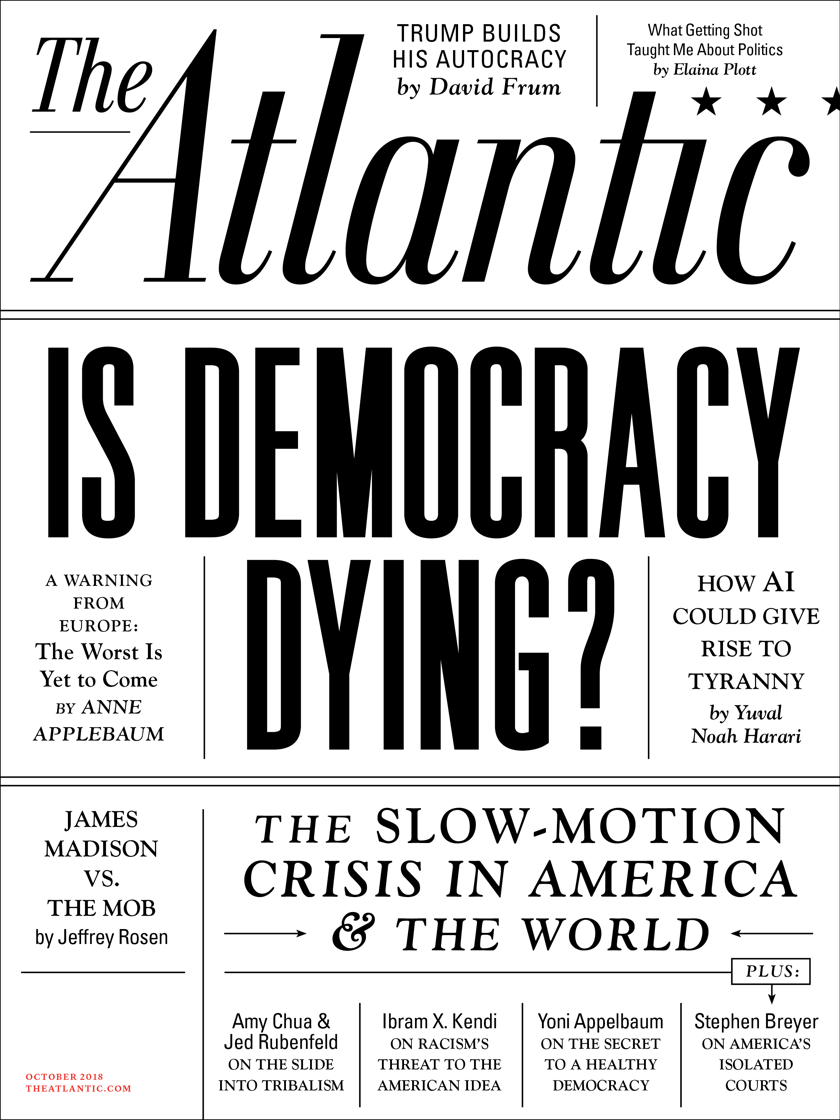
Is (Liberal) Democracy Dying?

The Atlantic for October is a theme issue:
840

I can’t provide URLs because it’s still subscriber-only, but you get get to your favorite bookstore and pick up a copy. All of the following are from that issue, as was Anne Applebaum, A Warning From Europe: The Worst Is Yet to Come, about which I blogged earlier.

1

It is much harder to struggle against irrelevance than against exploitation.

Yuval Noah Harari, Why Technology Favors Tyranny.

And a stunning microcosm:

On December 6, 2017, another crucial milestone was reached when Google’s AlphaZero program defeated the Stockfish 8 program. Stockfish 8 had won a world computer chess championship in 2016. It had access to centuries of accumulated human experience in chess, as well as decades of computer experience. By contrast, AlphaZero had not been taught any chess strategies by its human creators — not even standard openings. Rather, it used the latest machine-learning principles to teach itself chess by playing against itself. Nevertheless, out of 100 games that the novice AlphaZero played against Stockfish 8, AlphaZero won 28 and tied 72 — it didn’t lose once. Since AlphaZero had learned nothing from any human, many of its winning moves and strategies seemed unconventional to the human eye. They could be described as creative, if not downright genius.

Can you guess how long AlphaZero spent learning chess from scratch, preparing for the match against Stockfish 8, and developing its genius instincts? Four hours.

(Emphasis added)

2

Many progressives, particularly young ones, have turned against what were once sacrosanct American principles. Freedom of speech is an instrument of the dehumanization of women and minorities. Religious liberty is an engine of discrimination. Property rights are a shield for structural injustice and white supremacy. In a recent poll, two-thirds of college-age Democrats said that “a diverse and inclusive society” is more important than “protecting free speech rights.” Only 30 percent of Americans born in the 1980s believe that living in a democracy is “essential,” compared with 72 percent of Americans born in the 1930s.

… One of our students told us: “I don’t know any lefty people my age who aren’t seriously questioning whether the First Amendment is still on balance a good thing.”

Amy Chua and Jed Rubenfeld, The Threat of Tribalism.

But wait! There’s more! It’s not tribalist without at least two tribes!

In a 2017 survey by the Pew Research Center, less than half of Republicans said that the freedom of the press “to criticize politicians” was “very important” to maintaining a strong democracy in the United States. In other 2017 surveys, more than half of Trump supporters said the president “should be able to overturn decisions by judges that he disagrees with,” and more than half of Republicans said they would support postponing the 2020 presidential election if Trump proposed delaying it “until the country can make sure that only eligible American citizens can vote.”

I can’t pick which side is worse. Can you?

3

Jeffrey Rosen incited in me kindly feelings toward California:

Voters in several states are experimenting with alternative primary systems that might elect more moderate representatives. California and Washington State have adopted a “top two” system, in which candidates from both parties compete in a nonpartisan primary, and the two candidates who get the most votes run against each other in the general election — even if they’re from the same party. States, which Louis Brandeis called “laboratories of democracy,” are proving to be the most effective way to encourage deliberation at a time when Congress acts only along party lines.

Madison and the Mob.

4

This author was shot, randomly, with a 22:

Knee-jerk calls for gun control didn’t resonate with me. Yet a reverence toward guns no longer felt right either.

I found my ambivalence unsettling. Everyone else seemed so sure about how to feel about guns—people on campus, on the internet, back home. Unlike most of them, I had made intimate acquaintance with gun violence. I should have had some special insight. If what had happened to me wasn’t fodder for clarity, I feared nothing ever would be.

As we drove, he asked me to remind him what I was writing about. I said some- thing lazy, offhanded: “What it was like getting shot in a place that loves guns.”

“It’s not love,” he said. We pulled into the parking lot of his store, which sits high on a hill. You can see almost all of Tuscaloosa from there. “It’s about necessity.” He mentioned rattlesnakes and coyotes. For people in rural areas — that’s more than 40 percent of Alabamians — guns are still a day-to-day defense against such animals. Yes, there is ample love for guns in Alabama. But to forget that they’re tools is to miss an important point.

Elaina Plott, The Bullet in My Arm.

Perhaps, but they’re not the kind of tools Our People use now, are they dear?

5

A 2018 U.S. Magazine asking whether democracy is dying might be suspected of a hit on 45, but it really was not. He did get more than passing mention in David Frum’s contribution, though:

[A] Donald Trump with impulse control would not be Donald Trump …

When Trump refers to “my” generals or “my” intelligence agencies, he is teaching his supporters to rethink how the presidency should function. We are a long way from Ronald Reagan’s remark that he and his wife were but “the latest tenants in the People’s House.”

In 2016, Trump supporters openly brandished firearms near polling places. Since then, they’ve learned to rationalize clandestine election assistance from a hostile foreign government. The president pardoned former Sheriff Joe Arpaio, convicted of contempt of court for violating civil rights in Maricopa County, Arizona, and Dinesh D’Souza, convicted of violating election-finance laws—sending an unmistakable message of support for attacks on the legal order. Where President Trump has led, millions of people who regard themselves as loyal Americans, believers in the Constitution, have ominously followed.

Building an Autocracy.

6

To stop the rot afflicting American government, Americans are going to have to get back in the habit of democracy.

[In the 19th Century] From churches to mutual insurers to fraternities to volunteer fire companies, America’s civic institutions were run not by aristocratic elites who inherited their offices, nor by centrally appointed administrators, but by democratically elected representatives.

Civic participation was thus the norm, not the exception.

Democracy had become the shared civic religion of a people who otherwise had little in common.

But the United States is no longer a nation of joiners. As the political scientist Robert Putnam famously demonstrated in Bowling Alone, participation in civic groups and organizations of all kinds declined precipitously in the last decades of the 20th century.

Trump turned the long-standing veneration of civic procedure on its head. He proclaimed that America is “rigged”; that “the insiders wrote the rules of the game to keep themselves in power and in the money.” The norms and practices of democratic governance, he insisted, had allowed elites to entrench themselves.

Trump secured the Republican nomination by speaking directly to those voters who had the least experience with democratic institutions. In April 2016, when the Republican field had narrowed from 17 candidates to three, a PRRI/The Atlantic survey found Trump enjoying a narrow lead over second-place Ted Cruz among Republican-leaning voters, 37 to 31 percent. But among those who seldom or never participated in community activities such as sports teams, book clubs, parent-teacher associations, or neighborhood associations, Trump led 50 to 24 percent. In fact, such civically disengaged voters accounted for a majority of his support.

Yoni Applebaum, Americans Aren’t Practicing Democracy Any More.

7

And finally:

The cardinal fact always is the loss of contact with objective information. Public as well as private reason depends upon it. Not what somebody says, not what somebody wishes were true, but what is so beyond all our opining, constitutes the touchstone of our sanity. And a society which lives at second-hand will commit incredible follies and countenance inconceivable brutalities if that contact is intermittent and untrustworthy. Demagoguery is a parasite that flourishes where discrimination fails, and only those who are at grips with things themselves are impervious to it. For … the demagogue, whether of the Right or the Left, is, consciously or unconsciously an undetected liar.

Walter Lippman, November 1919 (before my father was born), quoted in a side-bar.

I’m venturing a guess that nobody born since 1970 will understand his use of “discrimination” unless they have a liberal arts college education.

* * * * *

Follow me on Micro.blog Follow me on Micro.blog, too, where I blog tweet-like shorter items and … well, it’s evolving. Or, if you prefer, those micro.blog items also appear now at microblog.intellectualoid.com.

Brief collection 9/13/18

1

Pope Francis has called a global meeting of Catholic bishops to discuss how to prevent sex abuse …

The Vatican statement said the topic of the gathering, scheduled for Feb. 21-24, would be the “prevention of abuse of minors and vulnerable adults.” It wasn’t clear whether the agenda would also include the disciplining of abusive clergy and of bishops who cover up or neglect abuse by priests under their authority.

Wall Street Journal

I think the Roman Church has had a fairly good idea how to reduce pedophilic child abuse since the report 14 years ago in the wake on the 2002 scandal.

But I don’t see much sign that it has made progress on homosexual predation on adolescents, seminarians and priests, or any progress at all at dropping the hammer on high-ranking enablers.


2

What will the Supreme Court look like when neither side has to walk on eggs to win the favor of the one in the middle? It will be a more conservative court, for sure, and maybe a more honest one. Justices may feel more free to say what they really think, and the public will ultimately judge the result by expressing itself in electoral politics. History does not stop in 2018.

Linda Greenhouse

Greenhouse is often outrageously biased even in her news reporting, not just in opinion pieces, but this one’s worth reading — with a grain of salt.


3

Public health experts dismiss [Critical Reviews in Toxicology, and Regulatory Toxicology and Pharmacology] as unreliable vanity journals. “These two journals exist to manufacture and disseminate scientific doubt,” says David Michaels, a professor at the George Washington University School of Public Health and the author of “Doubt Is Their Product,” a book about product defense science. “They provide the appearance of peer review and credibility to ‘product defense’ science — mercenary studies not designed to contribute to the scientific enterprise but to forestall public health and environmental protections and to defeat litigation. Corporations opposing public health or environmental regulations enter the rigged studies and questionable analyses published in these mercenary journals into regulatory proceedings or lawsuits to manufacture scientific uncertainty.”

Then, Michaels says, companies can say, “Look, the studies have conflicting conclusions, so there is too much scientific uncertainty to issue regulations to protect the public or to compensate victims.” ….

Paul D. Thacker, Scientists know plastics are dangerous. Why won’t the government say so?

I had no idea. The industry didn’t want me to have any idea. The “forensic” scientists (as in “‘forensic dating’ is the world’s oldest profession”) did their dirty duty.

 * * * * *

Follow me on Micro.blog Follow me on Micro.blog, too, where I blog tweet-like shorter items and … well, it’s evolving. Or, if you prefer, those micro.blog items also appear now at microblog.intellectualoid.com.

Thoughts on Complete Education

Your work and career are a part of your life,” he said when I met with him and the Santa Fe president, Mark Roosevelt. “Education should prepare you for all of your life. It should make you a more thoughtful, reflective, self-possessed and authentic citizen, lover, partner, parent and member of the global economy.” I love that assessment — the precision, balance and sweep of it.

Frank Bruni, writing about St. John’s College (emphasis added). During his visit to the Santa Fe campus and his eavesdropping on some classes:

Three dynamics stood out.

The first was how articulate the students were. Something wonderful happens when you read this ambitiously and wallow in this many words. You become agile with them.

The second was the students’ focus. A group discussing Homer’s “Iliad” spent more than 10 minutes on the phrase — the idea — of someone having his “fill of weeping.” If digital devices and social media yank people from one trumpet blast to the next, St. John’s trains them to hold a note — to caress it, pull at it, see what it can withstand and what it’s worth.

The third dynamic was their humility. They weren’t wedded to their initial opinions. They weren’t allowed to be. And they moved not toward the best answer but toward better questions. In the “Iliad” and in life, is there any catharsis in revenge? Any resolution in death? Does grief end or just pause? Do wars?

Jack Isenberg, a senior, told me that St. John’s had taught him how much is unknowable. “We have to be comfortable in ambiguity,” he said.

What a gift. What an education.

(Emphasis added)

It’s now official: if I get huffy and drop the New York Times again, Frank Bruni is part of what I’d miss, along with his more conservative brethren Ross Douthat and David Brooks. (Heck, I already miss Brooks because he’s on “book leave” or some durn thing.)


I added emphasis to the preceding item for a reason:

The end of education for the religious-minded person might be seen, depending on his or her particular religion, as, say, the salvation of one’s soul, the glorification of God, the attainment of holiness or enlightenment, that is, something distinctly transcendent or spiritual. For the secular-minded person, it might be career preparation, the material betterment of humanity, self-fulfillment, that is, something distinctly temporal and material … [B]oth extremes and those in between consider education as primarily a means to these all-important ends. For this reason, they tend to characterize the transmission of knowledge and skills as the right and only model for education, with right answers, whether spiritually or materially regarded, and the most useful skills, aimed at the good of the soul or the good of the world, the only proper curriculum.

In this view, questions and questioning are important, but only when they give rise to and are aimed at definite answers. And liberal-arts disciplines, such as logic and literature, are generally a good thing to learn, but only when directed to securing desirable spiritual or worldly goods. In this way, the priority of answers, especially the right answers, and useful skills, in a school’s curriculum and pedagogy tends to render other types of questioning and other, not-so-useful skills obsolete. Open-ended questioning, speculative contemplation, and philosophical enquiry, and those skills that are deemed “useless,” such as a capacity for wonder, an appreciation of the true, the good, and the beautiful, and a grasp of the world as a whole, are either a waste of time and money, or just mere means to obtaining “right” answers and useful skills.

Thaddeus Kozinski, Questions Are Better Than Answers: On the Socratic Method.

* * * * *

Follow me on Micro.blog Follow me on Micro.blog, too, where I blog tweet-like shorter items and … well, it’s evolving. Or, if you prefer, those micro.blog items also appear now at microblog.intellectualoid.com.