Alternative Media

If you’ve come to distrust mainstream news as much as I have, some advice:

  • There are many things going on in the world the truth about which you’ll never know for certain.
  • My two favorite alternate media have become the Real News Network and Consortium News, though I’d be happy for other suggestions. Real News focuses on investigative reporting and Consortium News on commmentary.
  • Neither of my alternate media will keep you up-to-date and fully informed.
  • Neither will ever do blockbuster investigative reports or exposés like the Wall Street Jounal, New York Times and Washington Post. No, I take that back. Unless people step up with greater reader support, neither will ever do that, which is almost the same thing.
  • Both will appear to have a leftward bias, if only because mainstream media are self-constrained from center-left to center-right, the range that is optimally profitable for their corporate owners.

That’s all I can think of.

You’re welcome.

* * * * *

Sailing on the sea of this present life, I think of the ocean of my many offenses; and not having a pilot for my thoughts, I call to Thee with the cry of Peter, save me, O Christ! Save me, O God! For Thou art the lover of mankind.

(From A Psalter for Prayer)

You can read most of my more impromptu stuff at here. It should work in your RSS aggregator, like Feedly, should you want to make a habit of it.

Book Report 2019

My total book reading for 2019 was 39 books. Highlights include three “classics”:

The Abolition of Man and Abuse of Language, Abuse of Power are always highlights, and I re-read both regularly.

I just completed book 39, and it was another highlight: Charles L. Marohn, Jr., Strong Towns: A Bottom-Up Revolution to Rebuild American Prosperity. It might even merit re-reading, though its “timeless” wisdom is of a different timelessness than Lewis or Pieper.

Some excerpts from Marohn:

Let me summarize: in exchange for 26 years of tax relief, the community was able to get an out-of-town franchise restaurant to abandon their old building and move three blocks up the street where they tore down a block of buildings and replaced them with a development that is 44% less valuable than the development pattern of what was removed. By any financial measure, this is a bad investment, yet cities everywhere routinely do this exact kind of transaction.

(Page 134)

Middle-class housing subsidies and transportation spending are the bread and circuses of modern America. Americans express a preference for single-family homes on large lots along cul-de-sacs because that’s the lifestyle we subsidize. We’ve been willing to bankrupt our cities and draw down the wealth prior generations built, in order to provide that subsidy. It can’t go on forever.

(Page 145)

Planners like to describe neighborhoods with both homes and neighborhood-friendly businesses as “mixed use.” Our ancestors would simply have called them “neighborhoods.”

(Page 163)

[After noting that local governments not infrequently mistake insolvency for a mere cash flow problem.] A local government must be obsessively intentional, organized and disciplined to discern it true financial status.

I gave a presentation to a group of bond analyst from one of the large ratings agencies. I showed them how public balance sheet didn’t reflect the extent of municipal liability, that cities had under-reported amounts of maintenance obligations totaling many times the reported pension shortfalls. The analysts were stunned, professed this was new to them, and asked a lot of good questions. Then they informed for me that it wouldn’t change anything about how they rated bonds because cities don’t default on their debt – they have not defaulted en masse since the Great Depression – and that track record superseded all other considerations.

(Page 190-91)

At the national level, I tend to be libertarian. Let’s do a few things and do them very competently.

At the state level, I tend to be a Minnesota version of conservative Republican. Let’s devolve power, use market and feedback where it drives good outcomes, and let’s do limited state interventions when we have a broad consensus that things would be better by doing it. Let’s measure outcomes and hold ourselves to a high standard.

At the regional level, I tend to favor a more progressive approach. Let’s cooperate in ways that improve everyone’s lives. Let’s work together to make the world more just.

At the city level, I’m fairly progressive. What do we need to do to make this place work for everyone? Let’s raise our taxes, and put sensible regulations in place, to make that a reality.

At the neighborhood level, I’m pretty much a socialist. If there’s something I have that you need, it’s yours. All that I ask is that you do the same in return for me and my family.

At the family level, I’m completely communal. Without hesitation, I’ll give everything I have so my family has lives that are secure, happy, and prosperous. I expect nothing in return.

(Page 210)

We’re all Detroit, just a couple of decades behind. Then we’re back to living humanly — that is, making small bets, winning or losing small, learning from both wins and losses, and in general building antifragility, like we (other than Detroit) had until the postwar suburban sprawl was thrust upon us.

Next year I hope actually to hit 52 books, my unattained goal for this year. I think the news in 2020 will be so distressing, dominated as it will be by Presidential politics, that ignoring it more, in favor of books that might make me wise, will be relatively easy.

To that end I’ve recently discovered a podcast and an alternate view of the digital New York Times that expedite getting the necessary news, the latter by letting me focus on the real news of the day without digging through NYT’s “most viewed” and otherwise boosted stories day after day after day.

* * * * *

Sailing on the sea of this present life, I think of the ocean of my many offenses; and not having a pilot for my thoughts, I call to Thee with the cry of Peter, save me, O Christ! Save me, O God! For Thou art the lover of mankind.

(From A Psalter for Prayer)

You can read most of my more impromptu stuff at here. It should work in your RSS aggregator, like Feedly, should you want to make a habit of it

Same God?

Hang on here. I purposefully meander a bit today, which is a fitting way of sharing a little epiphany I had while reading un-Christmassy stuff (Thomas S. Kuhn and Ian Hacking, The Structure of Scientific Revolutions: 50th Anniversary Edition) on Christmas Eve.

Do we, however, really need to describe what separates Galileo from Aristotle, or Lavoisier from Priestley, as a transformation of vision? Did these men really see different things when looking at the same sorts of objects? Is there any legitimate sense in which we can say that they pursued their research in different worlds? Those questions can no longer be postponed, for there is obviously another and far more usual way to describe all of the historical examples outlined above. Many readers will surely want to say that what changes with a paradigm is only the scientist’s interpretation of observations that themselves are fixed once and for all by the nature of the environment and of the perceptual apparatus. On this view, Priestley and Lavoisier both saw oxygen, but they interpreted their observations differently; Aristotle and Galileo both saw pendulums, but they differed in their interpretations of what they both had seen.

(Page 120, Kindle edition)

These sorts of questions could be extended to other areas, which was why Stanley Fish so insistently schooled Nico Perrino, on one So to Speak podcast:

[Stanley]: Do you believe in the distinction between faith on the one hand and reason or empirical investigation on the other?

Nico: Yes.

Stanley: Yes, I thought you would.

Nico: Of course, I do. So, I’ve fallen into your trap.

Stanley: Because I don’t. I taught a course yesterday on Inherit the Wind. It’s a movie about the Scopes Trial in the early part of the 20th century.

Nico: Yeah, Scopes Trial.

Stanley: That’s a movie produced and directed by Stanley Kramer who is a stalwart First Amendment liberal. The entire dramatic rhetoric of the movie depends on the distinction between faith on the one hand and reason, especially reason associated with scientific experiments, on the other hand. That distinction doesn’t hold up for a second. That distinction doesn’t hold up. What’s you’re dealing with in science as opposed to let’s say orthodox Christianity or something else are two different faiths.

Two different kinds of faiths undergirded by radically opposed assumptions and presuppositions. But it’s presupposition and assumptions which are generating the evidence and facts on both sides. Again, you have – I can tell and say this with all the generosity – you are deeply mired in the basic assumptions and presuppositions of classical liberalism. Anything else that is brought to you, anything that is brought to you by some kind of retrograde sinner like me sounds outlandish and obviously perverse.

Nico: No, not necessarily. Because otherwise, I wouldn’t be having this conversation with you.

Stanley: Good point.

Nico: But, you know, we’re at the corner of what? 5th and 12th Avenue. Are you telling me it’s not a fact that we’re at the corner of 5th and 12th Avenue?

Stanley: Oh, come on. Come on. Look, have you ever read The Structure of Scientific Revolution?

Nico: I have not.

Stanley: Okay. Do you know what it is?

Nico: No.

Stanley: Okay. It’s a book that is probably the most influential book in the social sciences and humanities for the past 75 years. That’s not an understatement. That is not an overstatement. Kuhn, his project, is the history of science as his title suggests. What he does is challenge the picture that I’ve already referred to where he says that science is not an activity in which one generation because of using its powers of observation and experiment adds to the details of the description of nature that was begun by previous generations.

What he’s saying is that scientific knowledge is not cumulative in the way that the usual picture of science suggests. Instead, scientific knowledge, that is the establishment of scientific fact, depends on what he calls paradigms. What’s a paradigm? A paradigm is the set of in place assumptions and authorized methodologies that govern and are in fact the content of scientific investigation at any moment. Paradigms rather than any direct confrontation between the observer and the world. Paradigms are what produces evidence and interpretations.

Finally, interpretations that are persuasive and successful for a while until that paradigm, for reasons that he details, is dislodged by another. When that happens, when the paradigm within which scientific observers work Kuhn says changes. One might say without exaggeration that without the world in which the scientific practitioner works has itself changed.

Nico: See, I don’t buy it though because there are things that scientist do maybe through this paradigm that produce a tangible result that only come as a result of. Changing the paradigm won’t change the result.

Stanley: Tangible result is itself along with other talismanic phrases like that – tangible result will be recognized as one depending on what pragmatic point of view you are situated. What Kuhn would say, he’s not the only one and I’m not the only one, is that any conclusion that you might reach and be confident in is not supported by some correspondents between your methodological, descriptive protocol and the world. Rather it’s produced by the paradigm within which you are ensconced and of which you are in some sense an extension.

I really urge to read this book because he considers – he’s not debunking science. He’s not debunking scientific achievement. He’s just giving a different picture of it which challenges what he thinks of as the over simplified picture, again, of a world out there waiting to be correctly described. We, as rational observers, having the task to describe it.

Having now read a bit more than half of Kuhn, I understand what Stanley was saying, and I’m less inclined to agree with with Nico.

Anyway, one extension of the “paradigm” (or “gestalt,” as Kuhn so often has it) is the continually vexed question of “whether Christians and Muslims worship the same God,” which I have visited several times in the past (here, here, and even here in passing).

My paradigm, which led me to say “of course they do“ is monotheism strictly and literally speaking: There is only one God, howsoever He may be misunderstood. Those who say they do not worship the same God strike me as tacitly embracing henotheism, usually with some vehement tribal pride thrown in about the superiority of our God.

But in fairness, the paradigm of the “different God” folks is perhaps doctrine, and “common parlance” rather than strict and literal monotheism. A sufficiently different understanding of God (as the Islamic understanding differs from the orthodox Christian) is, figuratively, “another God,” much as scientists after a gestalt shift are figuratively in “a different world,” according to Kuhn (and Fish?).

Further, my paradigm is apparently flexible. I sometimes ruminate on how the “loving God” I met in bedtime Bible stories as a child, and in childhood Sunday School, got displaced by an “angry God,” prickly, even furious, at how our screwups besmirch His dignity, as if He were a feudal lord. They do indeed feel like different Gods. (I found the loving God again, once and for all, in Orthodox Christianity, but that story is too tangential today.)

Likewise, a “progressive Christian” profession that Matthew 25 is the “heart of the Gospel” arises from a different hermeneutic than mine and, I suspect, is a convenient way of making Christ’s incarnate deity an optional doctrine and doing away with “the scandal of the Cross.” In their paradigm/gestalt, Matthew 25 being the heart of the Gospel is almost axiomatic, and the stupendous paradox we celebrated yesterday is at best tangential, likelier credulous or even incomprehensible. They and I are divided by our nominally common (“Christian”) faith. (It also makes Christian sexual morality, which rivals the Cross for scandal-giving these days, optional.)

And then there are the Jews. I and they, too, worship different Gods if you want to be very figurative about it, though their non-Trinitarian God is pre-Christian rather than anti-Christian. I wonder, though, how many of the “Muslims-worship-a-different-God” folks even think about the Jews when blasting the Muslims?

So what? So can we, on this second day of Christmas (indeed, on all days) be less hasty with expressions that needlessly divide us with intimations that The Other believes as he believes because he’s pure evil rather than out of a very different, good faith, perspective?

That doesn’t mean we all unequivocally worship the same God, for God’s sake, but might our divisions can produce yearning instead of angry denunciations?

* * * * *

Sailing on the sea of this present life, I think of the ocean of my many offenses; and not having a pilot for my thoughts, I call to Thee with the cry of Peter, save me, O Christ! Save me, O God! For Thou art the lover of mankind.

(From A Psalter for Prayer)

You can read most of my more impromptu stuff at here. It should work in your RSS aggregator, like Feedly, should you want to make a habit of it.
Motivated reasoning

If I had to name only one thing I have learned in my many years of making arguments, it would be this: You cannot convince people of anything that they sense it’s in their interest not to know. I thought about this often as I was reading Alex Morris’s Rolling Stone story about American evangelicals’ love of Trump.

… It is very much in the interest of Morris’s aunt, and in the interest of millions and millions of other people, not to know that we are, through our economic choices, bringing ruin to the planet that we’re supposed to be the stewards of. And so she doesn’t know. Like so many others, she makes a point of not knowing.

But I think the problem of motivated not-knowing isn’t found only on the conservative evangelical side of things. Here’s one passage from Morris’s essay that seems to be drawing a lot of attention:

“The white nationalism of fundamentalism was sleeping there like a latent gene, and it just came roaring back with a vengeance,” says [Greg] Thornbury. In Trump’s America, “‘religious liberty’ is code for protection of white, Western cultural heritage.”

In that second sentence, the clause “In Trump’s America” is a problem. What does it mean? In one sense, the entire nation is “Trump’s America” right now, whether we like it or not; but maybe Morris means something like “Americans who enthusiastically support Trump,” or “the parts of the country that are strongly supportive of Trump.” Impossible to tell. Thornbury didn’t use the phrase, but presumably he said something that led into his line about “religious liberty” as code for something else.

So the passage is unclear, but I’d like to know what Thornbury means. I’ve written a good deal about the importance of religious freedom on this blog and elsewhere — just see the tag at the bottom of this post — so does that mean that I am using that topic as “code for protection of white, Western cultural heritage”? If so: explain that to me, please.

Maybe there’s something that Greg Thornbury and Alex Morris have an interest in not knowing: that even if millions of white Americans abuse the concept of religious liberty, religious liberty could nevertheless be in some danger.

Alan Jacobs, who has much more than this to say, including ways in which fundamentalist Christian cranks are motivated to ignore environmental damage.

Seriously, read it all.

But Jacobs omits something: anyone who thinks Rolling Stone is prima facie a reliable interlocutor of Christianity, and especially of the religious right, deserves all the false certaintly and motivated ignorance he gains there. Rod Dreher kinda hits that, too.

* * * * *

Sailing on the sea of this present life, I think of the ocean of my many offenses; and not having a pilot for my thoughts, I call to Thee with the cry of Peter, save me, O Christ! Save me, O God! For Thou art the lover of mankind.

(From A Psalter for Prayer)

You can read most of my more impromptu stuff at here. It should work in your RSS aggregator, like Feedly, should you want to make a habit of it.

God bless the socialists

Something extraordinary has happened.

On August 19, the New York Times published its “1619 Project” — a conscious re-writing of the arc of American history so radical that they had to completely ignore the top experts on American history to come up with something so tendentious.

They’re printing hundreds of thousands of reprints for school use, and some school districts are going to use it.

Consservatives responded with “stupid liberals, promoting identity politics again” and left it at that. No conservative publication seemed to think of actually talking to the top experts on American history that the Times ignored.

So far, dog bites man.

But now the Times is coming under attack from its left, as the World Socialist Web Site objects that by falsifying history to create a purely racial narrative, the Times is consciously trying to help the Democrat party and is suppressing the importance of class, so as to make almost impossible the formation of a multi-racial coalition of proletariat victims of capitalism.

That’s the ax they have to grind, but they ground it by interviewing the top experts on American history that everyone else had overlooked (as well as writing some pointed critiques of their own):

I’m indebted to Rod Dreher for calling this extraordinary set of articles to my attention, but we’re all more deeply in debt to the cantakerous socialists for doing the work nobody else thought, or cared, to do.

* * * * *

Sailing on the sea of this present life, I think of the ocean of my many offenses; and not having a pilot for my thoughts, I call to Thee with the cry of Peter, save me, O Christ! Save me, O God! For Thou art the lover of mankind.

(From A Psalter for Prayer)

You can read most of my more impromptu stuff at here. It should work in your RSS aggregator, like Feedly, should you want to make a habit of it.

Punching down

More than 20 states have incorporated sexual orientation into their anti-discrimination statutes. As Charlotte Allen documents in “Punching Down,” this has empowered well-educated and well-paid gays to punish less educated, less wealthy neighbors who dare to refuse to bake a cake or make a bouquet for their weddings. At present, Colorado baker Jack Phillips has been targeted by yet another lawsuit, this time brought by a transgender Denver lawyer. The situation is exactly the opposite of the Montgomery bus boycott.

In certain circumstances it may be unjust to deny employment to a gay person. But this kind of discrimination, if it happens in our society (as surely it does), is not “invidious.” By any measure, discrimination against gays is uncommon. I am willing to bet a substantial sum that a fat person is far more likely to suffer employment discrimination than someone who engages in sodomy in the privacy of his home.

GLAAD set a goal: It wanted 10 percent of primetime TV characters to be LGBT. The organization recently reported that this goal was achieved. The new goal is 20 percent. Four percent of the population identifies as gay. In what universe does a group capable of compelling fivefold overrepresentation in the media require anti-discrimination protection?

R.R. Reno

* * * * *

Sailing on the sea of this present life, I think of the ocean of my many offenses; and not having a pilot for my thoughts, I call to Thee with the cry of Peter, save me, O Christ! Save me, O God! For thou art the lover of mankind.

(From A Psalter for Prayer)

You can read most of my more impromptu stuff at here. It should work in your RSS aggregator, like Feedly, should you want to make a habit of it.

What it takes to keep a man alive

Rod Dreher is much exercised over Chick-fil-A’s announcement that the Cathy Family Foundation is going to focus on education and homelessness, presumably dropping support for Fellowship of Christian Athletes and Salvation Army, who the progressive bigots considered bigots simply because they have moral positions against homosexual acts.

Yes, that (combined with one statement by one family member that same-sex marriage invites God’s judgment) is how slender the case is for Chick-fil-A as monster: Some Chick-fil-A profits go to a family foundation that supported garden-variety Christianish groups that adhered to historic Christian sexual standards, though opposition to sexual deviance wasn’t their focus.

Even at that, I think Rod’s overdoing it, letting one more win by the other tribe work him too far toward frenzy, but that’s not my point, which rather is to praise an analogy offered up by one of his readers:

I cannot help but to compare Chick Fil A to Thomas More–and the comparison isn’t very favorable. Both quietly supported efforts to keep a marriage (or type of marriage) from being recognized that they thought was invalid. Both saw their cause lose. Both quietly accepted defeat and went about their business and did not try and stir up trouble. Yet neither was left alone, but compelled to publicly affirm the marriage. More was locked up. There are some great portrayals of Thomas More (A Man For All Seasons) and even Jeremy Northam’s performance in The Tudors. Northam’s version of More’s response to the Henry’s demand that he sign it is excellent. He protests that by remaining silent, he is in effect consenting to the public. “I do no harm, I say no harm, I think no harm and if that not be enough to keep a man alive, I long not to live.” Of course Henry was not satisfied with silent consent, he insisted upon on public and explicit affirmation.

There are differences of course. Chick Fil A is an organization, not a man. (In fact they are a multibillion dollar empire.) But More was locked up in prison and he refused to give an inch even in the face of death. A bunch of underemployed losers with nothing better to do than nurse imaginary grievances wrote nasty things on social media and Chick Fil A folded like a cheap suit.

Note two things: they have not yet publicly affirmed gay marriage, yet they have surrendered their conscience already by trying to appease the bullies. What this means is that there is blood in the water and the LGBT activists are not going to quit until Chick Fil A explicitly affirms the LGBT stance. CFA should have rather responded in More’s words: We do no harm, we say no harm, we think no harm and if that not be enough to keep a company in business, we long not to be.

I’m a sucker for A Man for All Seasons (the first time I saw the ever-creepy Julian Assange look-alike John Hurt, appropriately cast) so that hits my sweet spot.


* * * * *

The Lord is King, be the peoples never so impatient; He that sitteth upon the Cherubim, be the earth never so unquiet.

(Psalm 98:1, Adapted from the Miles Coverdale Translation, from A Psalter for Prayer)

You can read most of my more impromptu stuff at here. It should work in your RSS aggregator, like Feedly, should you want to make a habit of it.

Wednesday, November 13

We’ve come a long way from the days when the Tea Party handed out pocket Constitutions. Now, in the interests of defending President Trump, smart people are exploiting civic ignorance to maintain the red wall against impeachment. No, that’s too mild. They’re not just exploiting civic ignorance, they’re affirmatively deceiving the American people about the content and meaning of the Constitution. They’re trying to make people believe things that plainly aren’t true. They’re making the American people less constitutionally literate.

What do I mean? Take this comment, from Rand Paul:

The Sixth Amendment is pretty clear. It’s part of the Constitution, part of the Bill of Rights, and it says that you get to confront your accusers. And so, I think it’s very clear that the only constitutional mandate here is, is that if someone’s going to accuse you of something that might remove the president from office, for goodness’ sake, shouldn’t they come forward and present their accusations in person?

This has become a talking point among the Trumpist right. For another—rather shocking—example, read this from Northwestern University law professor and Federalist Society co-founder Steven Calabresi:

Impeachment is a legal proceeding, and just as criminal defendants have constitutional rights in criminal trials so too does Trump have constitutional rights, which House Democrats are denying him. For example, the Sixth Amendment gives criminal defendants the right to “a speedy and public trial.” House Democrats are trying Trump in secret and are denying him the right to a public proceeding….

The Sixth Amendment also guarantees criminal defendants the right to be “informed” of the charges against them. House Democrats are not informing Trump of the charges against him and are leaking salacious information to the press.  This, too, violates Trumps rights under the federal Bill of Rights.

Moreover, the Sixth Amendment guarantees Trump the right “to confront the witnesses against him,” which right House Democrats are denying to Trump. The president has a right under current Supreme Court case law to have a public face-to-face confrontation with the witnesses against and to testify in his own defense. House Democrats are denying the president that very basic constitutional right….”

Now, compare that comment with the actual text of the Sixth Amendment:

In all criminal prosecutions, the accused shall enjoy the right to a speedy and public trial, by an impartial jury of the State and district wherein the crime shall have been committed, which district shall have been previously ascertained by law, and to be informed of the nature and cause of the accusation; to be confronted with the witnesses against him; to have compulsory process for obtaining witnesses in his favor, and to have the Assistance of Counsel for his defence.

Note the key words—“in all criminal prosecutions.” As the CATO Institute’s David Post notes, Calabresi’s argument is “utter nonsense, completely devoid of any apparent constitutional logic.” The scope and reach of the Sixth Amendment has been extensively litigated, and it most assuredly does not apply to the House’s impeachment inquiry.

One can certainly make a good faith argument that maintaining the whistleblower’s anonymity is unfair, but to argue that it violates the Sixth Amendment is simply and plainly wrong.

But this Sixth Amendment nonsense is only the tip of the iceberg of constitutional confusion. Take these paragraphs from a recent piece by Victor Davis Hanson:

The “inquiry,” supposedly prompted by President Trump’s Ukrainian call, is only the most recent coup seeking to overturn the 2016 election.

Usually, the serial futile attempts—with the exception of the Mueller debacle—were characterized by about a month of media hysteria. We remember the voting-machines-fraud hoax, the Logan Act, the Emoluments Clause, the 25th Amendment, the McCabe-Rosenstein faux coup and various Michael Avenatti-Stormy Daniels-Michael Cohen psychodramas. Ukraine, then, isn’t unique, but simply another mini-coup.

He later argues that “We are witnessing constitutional government dissipating before our eyes.” Words have meaning, and impeachment isn’t a “coup.” A coup is an unlawful (often violent) seizure of power. Impeachment is a constitutional process that can’t succeed without the affirmative votes of, first, a majority of the House, and then, a supermajority of the Senate—and every person voting is a person who won an election, also according to constitutional process. Impeachment isn’t the dissipation of constitutional government, it’s the exercise of constitutional authority.

And no, if Trump is impeached and convicted (highly unlikely), it doesn’t “overturn” the 2016 election. Hillary Clinton won’t be president. Every one of the laws, judicial confirmations, and regulations enacted during the entirety of Trump’s term would remain in place.

If one took literally the complaints of serious senators, law professors, and historians (and why wouldn’t you? They’ve spent a lifetime demonstrating their constitutional knowledge), you’d believe that House Democrats were currently engaged in an illegal, unconstitutional proceeding. If you’re a partisan, you already likely despise Democrats. And now they’re engaged in a “coup”? Outrageous!

Yes, I know that there’s a longstanding tradition of hyperbole in American political rhetoric, but there’s a difference between exaggerations and plainly false constitutional assertions. Moreover, while people expect hyperbole from Sean Hannity or any other screaming Trump defender on talk radio, the same ideas from the pen of a respected historian sends a message that “this really is a coup.” It’s not. It’s not even close.

If you follow social media in the age of Trump, you’ve likely noticed a pattern. When there’s a report of an alleged Trump scandal, there’s often a brief pause on MAGA Twitter and in MAGA Facebook. One set of defenders waits patiently for the media overreaction, ready to pounce on the first blue checkmark who goes too far or misstates the alleged facts. Another set waits for a credentialed or credible person to toss a word salad for Trump—granting them a “well akshually” fig leaf that they can trot out as a talking point online.

“Akshually, the founder of the Federalist Society says Trump has a constitutional right to confront the whistleblower.”

“Akshually, a Hoover Institution senior fellow and esteemed historian recognizes impeachment as a coup.”

This sets up the debate as a battle of experts, and we all know that when there’s a battle of experts, the expert you like tends to win—regardless of whether he’s despoiling his expertise.


David French.

Every Republican who makes “plainly false constitutional assertions” to defend Donald Trump is a traitor to his oath to uphold the Constitution.

Such was the status of Weimar America at the end of Wednesday. It got worse Friday, with the President Tweeting out witness-intimidating lies (“exercising my freedom of speech”) about a career diplomat who was on the witness stand at that very moment.

* * * * *

The Lord is King, be the peoples never so impatient; He that sitteth upon the Cherubim, be the earth never so unquiet.

(Psalm 98:1, Adapted from the Miles Coverdale Translation, from A Psalter for Prayer)

You can read most of my more impromptu stuff at here. It should work in your RSS aggregator, like Feedly, should you want to make a habit of it.

Musings from the Progressive Era

It’s stimulating, and a bit unsettling, to read Wilfred McClay’s Land of Hope: An Invitation to the Great American Story (my long-overdue antidote to Howard Zinn) during impeachment hearings (which I won’t watch or audit closely, but cannot avoid entirely).

The professionalism of our Diplomats in contrast to the grubby demagogues trying to interrogate them gives me a vastly heightened appreciation of the early 20th Century progressives, whose main cause (besides breaking up or regulating trusts) was to remove administration from politics, entrusting it to neutral professionals.

I have half a mind to advocate abolition of primary elections and 17th Amendment, too — two other Progressive initiatives that I think have not stood the test of time all that well, judging from election grubby demagogues like Devin Nunes and Jim Jordan in the House, Lindsey Graham in the Senate.

* * * * *

The Lord is King, be the peoples never so impatient; He that sitteth upon the Cherubim, be the earth never so unquiet.

(Psalm 98:1, Adapted from the Miles Coverdale Translation, from A Psalter for Prayer)

You can read most of my more impromptu stuff at here. It should work in your RSS aggregator, like Feedly, should you want to make a habit of it.

New York adventures and thoughts

I’m visiting New York City for a few days, mostly to see Heroes of the Fourth Turning, but with other things thrown in for good measure.

I’m glad I allowed four full “ground days” (i.e., non-travel days) because I kept stumbling onto subway trains that took me further south when I needed to go north to get to the Met. Then I got off at 96th and Lexington because the Met is at 1000 5th Avenue, so I’d need to walk West to 5th Avenue, north 4 blocks to the Met.

5 blocks north, at 101st, no sign of the Met. Out come the phone and GPS.

Well, do tell! 1000 5th Avenue is roughly at 82nd Street, not 100th.

I think I’ll adopt a preferential option for busses, as I know north from south on the surface, but I don’t know what I need to do to realize that things like street addresses are not always logical here.

* * *

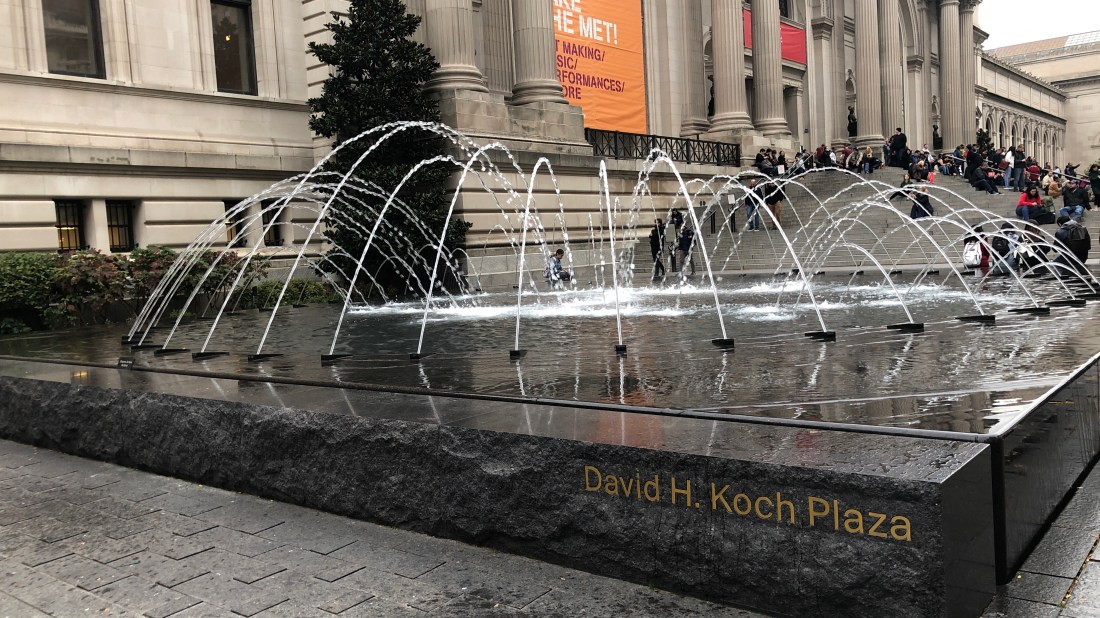
The Met may be facing an encounter with Cancel Culture. It not only has a Sackler (Purdue Pharma opioids) Gallery of Egyptian art but (oh the horror!) a David H. Koch plaza.
fullsizeoutput_b1c

* * *

There is literally nonstop background noise in my hotel just west of 9th Avenue on 42nd Street. I’m 12 floors up but can’t escape it.

I used to think I’d like living here if money were no object. But I’m quickly relenting. It would have to be enough money to let me live above the noise, and that would be kind of artificial, no?

God loves us all. God loves the city(ies). There’s even a St. Raphael of Brooklyn, canonized after I became Orthodox.

And God knows that small(er) towns have their distinctive constellations of temptations. But I think that for the duration, something a bit less urban than Manhattan is my sweet spot.

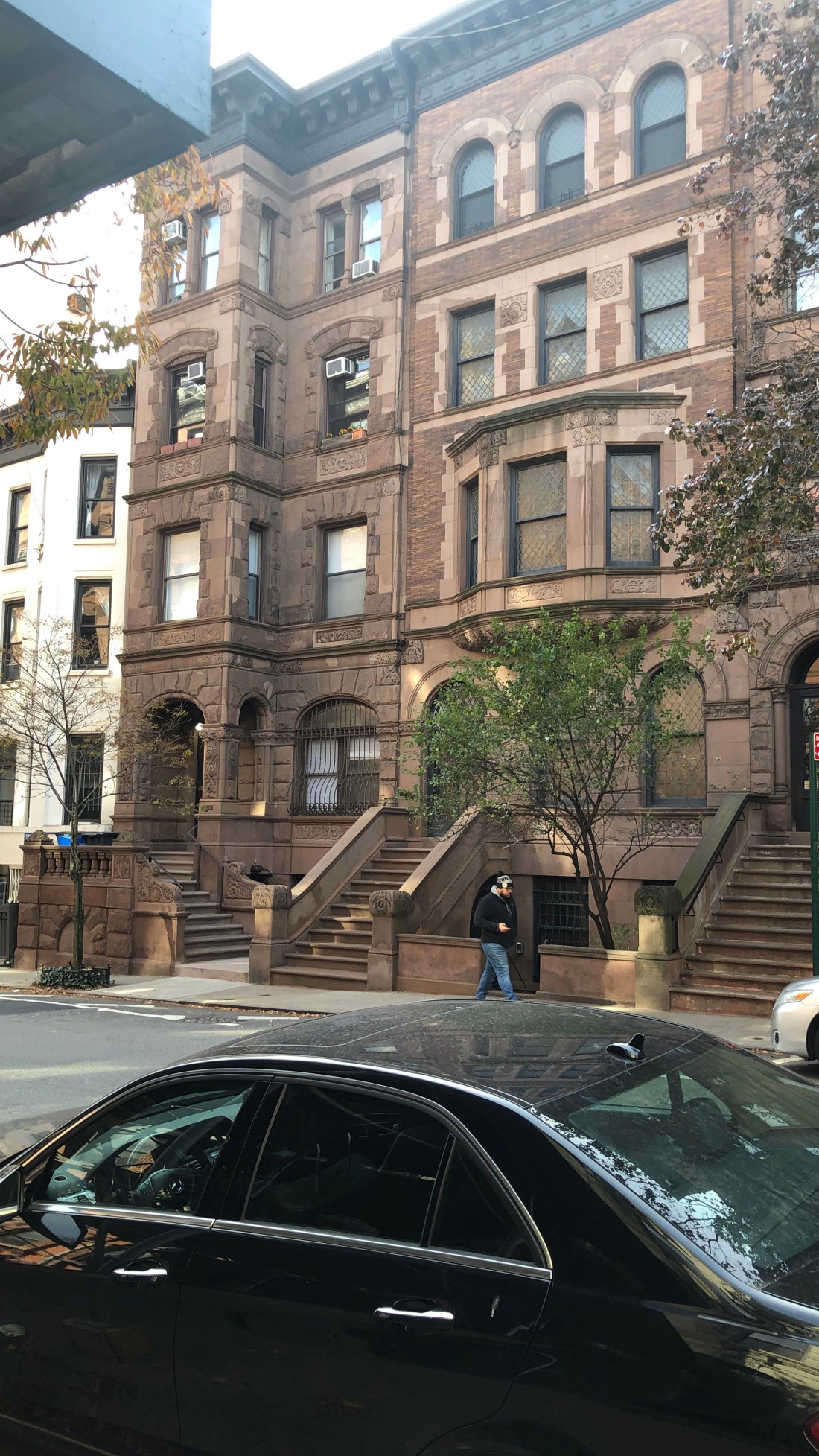
UPDATE: “Above the noise” might mean “above 59th Street and away from the major avenues.” I walked from 10th Avenue over to Central Park (86th Street, I think) on Saturday morning, and it was acceptably quiet. Nice brownstones, too.

fullsizeoutput_b78.jpeg

* * * * *

The Lord is King, be the peoples never so impatient; He that sitteth upon the Cherubim, be the earth never so unquiet.

(Psalm 98:1, Adapted from the Miles Coverdale Translation, from A Psalter for Prayer)

You can read most of my more impromptu stuff at here. It should work in your RSS aggregator, like Feedly, should you want to make a habit of it.